
Audio
Transcript
Sarah Jane Thomas 00:00
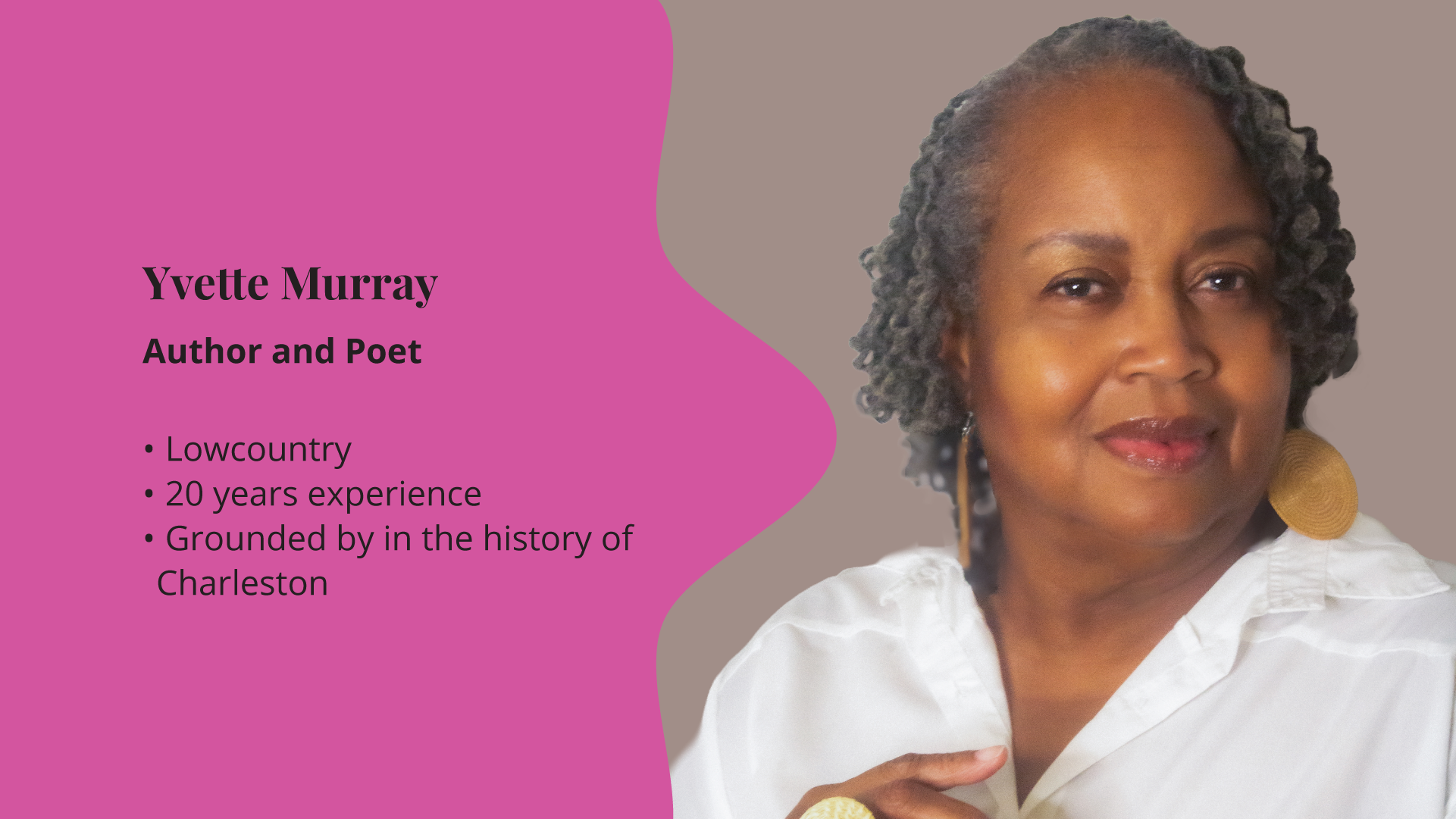
Hi, my name is Sarah Jane Thomas, and today we are talking with Yvette R. Murray, a professional creative working from and within South Carolina. As we get started, can you tell us your current career and where you’re from?
Yvette Murray 00:13
I’m from Charleston, South Carolina, and currently I have a full-time job, as most of us creatives do, but right now I’m a children’s book author and poet.
Sarah Jane Thomas 00:26
Before we go into the details of your profession, we have a brief section of the interview called “One Career, 60 Seconds,” where you describe your job in 60 seconds or less, similar to an elevator pitch. Okay, ready?
Yvette Murray 00:41
Yes.
Sarah Jane Thomas 00:42
Okay. Start whenever you feel comfortable.
Yvette Murray 00:44
Okay. I’m responsible for everything: curating, finding the material, creating it, and at that point, that’s where an editor comes in. But I’m I’m responsible for turning what I see and what I hear into art.
Sarah Jane Thomas 01:05
Well, that was perfect. So, what would you consider your official job title?
Yvette Murray 01:14
An author.
Sarah Jane Thomas 01:15
Author. Okay. So, as an author, is there anything in South Carolina or where you grew up, that you bring into your work
Yvette Murray 01:25
everything. My first book of poetry was literally about the neighborhood that I grew up in, and neighborhoods I grew up in downtown Charleston, and neighborhoods in downtown Charleston, and my children’s book is called “Celebrate We Galagici. So it’s all about everything that children can see. The book is my publisher is an educational publisher, so the book teaches little ones about their five senses through things that they know and recognize and and have seen and experienced. So it’s it’s all about the Low Country.
Sarah Jane Thomas 02:12
Do you think that this brings a diff different aspect to your work compared to people that maybe don’t live in South Carolina,
Yvette Murray 02:21
yes, because what they what they bring is research. What I bring is experience. There’s a section in the book. It’s on smells, and I am literally describing my mother’s garden from when I grew up, literally the plants, everything. So it brings a level of authenticity that can’t be duplicated. It can’t be recreated. They may write a nice book. They may write an authentic book, a book that’s full of facts that are true, but they don’t bring the the love and the timing of having been here, having walked these streets, experiencing the dismay when you see neighborhoods destroyed. They don’t. They don’t have that, and you can’t. You can’t teach that.
Sarah Jane Thomas 03:25
That’s very beautiful.
Yvette Murray 03:26
Thank you.
Sarah Jane Thomas 03:27
Do you think there was a defining moment in your life that had such a big impact on your creative journey?
Yvette Murray 03:35
Actually, a conversation that I overheard at a poetry reading, we were-they were discussing downtown, and the person said, “Don’t you think it’s better than just a bunch of burnout old buildings? And that really struck me because he thought that’s all these neighborhoods were. That’s all that was here. Not even understanding the businesses. The I called my neighborhood an enchanted urban forest, and I said that because the neighborhood had everything. You know how a forest is an ecosystem, and all the little animals, the little bugs, everybody works together to make it work. And that’s how the neighborhood was, and that’s how all the neighborhoods were. There are tons of businesses that used to be there, and they created an environment where everything you needed was there. There was a lawyer. There was-I am old enough to know there was a fish man that would come by. There was a lady down the street that did. The lady next door made quilts. Everything. There was actually a school right across the street from me, and I just wanted to capture that. I wanted to capture what was in those neighborhoods and speak up for those neighborhoods, just because you know that person said that.
Sarah Jane Thomas 05:22
That’s cruel, honestly. It is. It
Yvette Murray 05:25
is because no neighborhood is that. No neighborhood that becomes a blight, torn down. No neighborhood was always that. People live there. They raise their children there, and that was just really short-sighted, and I couldn’t let that pass.
Sarah Jane Thomas 05:48
Well, that’s a very good head mindset that you have to do that. Do you think that there was a? I know you’ve talked about your book about the five senses. Do you think there was a particular project that you produced that really showcased your creativity.
Yvette Murray 06:05
Yes, the book started as just the first chapter. It was a board book, and it won a contest. And part of winning the contest, you got to meet with publishers that would consider maybe publishing your book. So when I met with the publisher, you know they were excited. They want to move forward, but because my publisher is an educational publisher, they wanted to. At first, they were going to do five different books with the five senses, and then they combined it into one book with a different trim. Born books are little like this, and they wanted to combine it, and so we did. But the creativity, I guess, the authenticity showed through. They could see that I really knew what I was talking about, and I cared about it. See, that brings back to your other question. That brings a level of care and concern and diligence, attention to detail that somebody else wouldn’t be able to duplicate. Someone not from here. They didn’t really care.
Sarah Jane Thomas 07:20
It’s unique to you.
Yvette Murray 07:22
Yeah, we had some really interesting conversations. Me trying to explain what the fiddler crabs sound like, what pluff mud smells like. We have a pretty unique area of the country here.
Sarah Jane Thomas 07:39
Yeah, I’m not native, but I’ve been I grew up in the South all my life, so I love hearing all of the little niche uniqueness that South Carolina has, specifically South Carolina. It’s beautiful.
Yvette Murray 07:55
Absolutely, I’m glad that you’re
Sarah Jane Thomas 07:57
bringing that into your work.
Yvette Murray 07:59
Thanks.
Sarah Jane Thomas 08:00
Before entering your field, did you have any fears about becoming a creative professional?
Yvette Murray 08:06
Oh yes, yes. We all suffer from imposter syndrome. Even after I’ve seen authors that have numerous, numerous books, numerous prizes, still get nervous. Still be afraid. You you don’t know how to make it. You don’t know what to do. A lot of creatives teach. In addition, because you know they get the summer off, so it kind of works. They have time, but you just you don’t know how to do it. And the interesting thing that I’ve learned is that everybody does it differently. You have creatives that they may be a poet, but they also paint. They also make jewelry. They also sell soap. They, you know what I mean. So there’s so many different ways to do it. They make films. I have a couple of really wonderful poet friends of mine that have made films, short films. So it’s you can explore all of your creativity, all of the things you figure, oh well, maybe I could try this. Yeah, you sure can. You can try it all, do it all, and still stay true to what your main love is.
Sarah Jane Thomas 09:33
What inspired you to move beyond these fears? If you have,
Yvette Murray 09:39
you almost have to. People talk about the muse inspiration. I’m not a person that believes that I can only write when I feel inspired. I believe that you can get yourself into that state of being able to hear the muse. So to speak, at any given time, you just need some quiet and little little time to get yourself into it. But it’s almost like the stories have to be written. I like to say the ancestors want their stories told, so you will just. I know for me, sometimes I’ll hear a line. 4o’clock in the morning is a good, good creative time for me, and I’ll hear a line if I’m kind of awake. That in between wake and sleep state, I think it’s the theta state that you’re in just super creativity, and it’s just coming. That’s why you see so many creatives. They always have a notepad, or they’ve got tons of notes in their phone. It’s like the stories want to be told, and we’re just the vessels of the story. Whatever creative endeavor, if it’s art, if it’s poetry, like I write children’s books, short stories, whatever it is, it it wants to be written, and we just have to be open. We have to be open to what’s coming to us. I know that sounds really woo woo, but
Sarah Jane Thomas 11:20
you just gotta listen.
Yvette Murray 11:22
Absolutely, absolutely gotta listen.
Sarah Jane Thomas 11:26
Well, do you have any advice for young adults or students who also want to pursue poetry?
Yvette Murray 11:33
Oh, I got lots. The first one is do it. Whatever you want to do, do it. But always be a student. Always be willing to learn and to listen. You know, everybody’s got this idea of an artist, a flaky artist. But we have to. We are flaky. That is who we are because you know we are who we are. But Always learn, never stop learning. And I had a teacher in college that gave me the best advice. He said, “Yvette, a writer writes, and you write, write, write, and you cut, cut, cut, which is true. And just just keep at it, keep learning, explore different genres, different art forms, but just stay at it and develop a thick skin. Yeah, it’s it’s a numbers game as far as submitting. It’s a numbers game, and I still remember the moment when my book of poetry, which came first, was accepted for publication, and in my head it was like, well, there it is. It just happened, and it’s like that. You do and you do and you do and you do, and then one day you get accepted. One day you get into the fellowship, one day somebody wants to buy your artwork. You just got to keep at it.
Sarah Jane Thomas 13:06
Do you think there’s a particular skill one should learn before stepping into something like that?
Yvette Murray 13:12
I would say learn the business. Whatever, whichever part you’re, whichever art form you’re pursuing, learn the business, learn how much people do charge, learn how get your speak with an accountant so you understand what receipts you need to keep, how you need to do things. Because when it all boils down, it is a business, art, creativity. It is a business, and look for grants. Don’t be afraid to look for grants.
Sarah Jane Thomas 13:46
Yeah, there’s lots
Yvette Murray 13:48
out there.
Sarah Jane Thomas 13:49
Wonderful advice. I just want to thank you so much for sitting down and talking with me and offering your insights. Would you be open with talking to somebody from our team again?
Yvette Murray 14:01
Sure.
Sarah Jane Thomas 14:02
Perfect. Well, thank you. I hope you have a good rest of your day. This one, I hope you do. Okay. We’ll send over a transcript for your approval, and somebody will be in contact with you soon.
Yvette Murray 14:15
All right. Sounds good.
Sarah Jane Thomas 14:17
Thank you so much.
Yvette Murray 14:18
Enjoy your time off. Thank
Sarah Jane Thomas 14:20
you. You too.
Yvette Murray 14:21
Thanks.
Leave a Reply