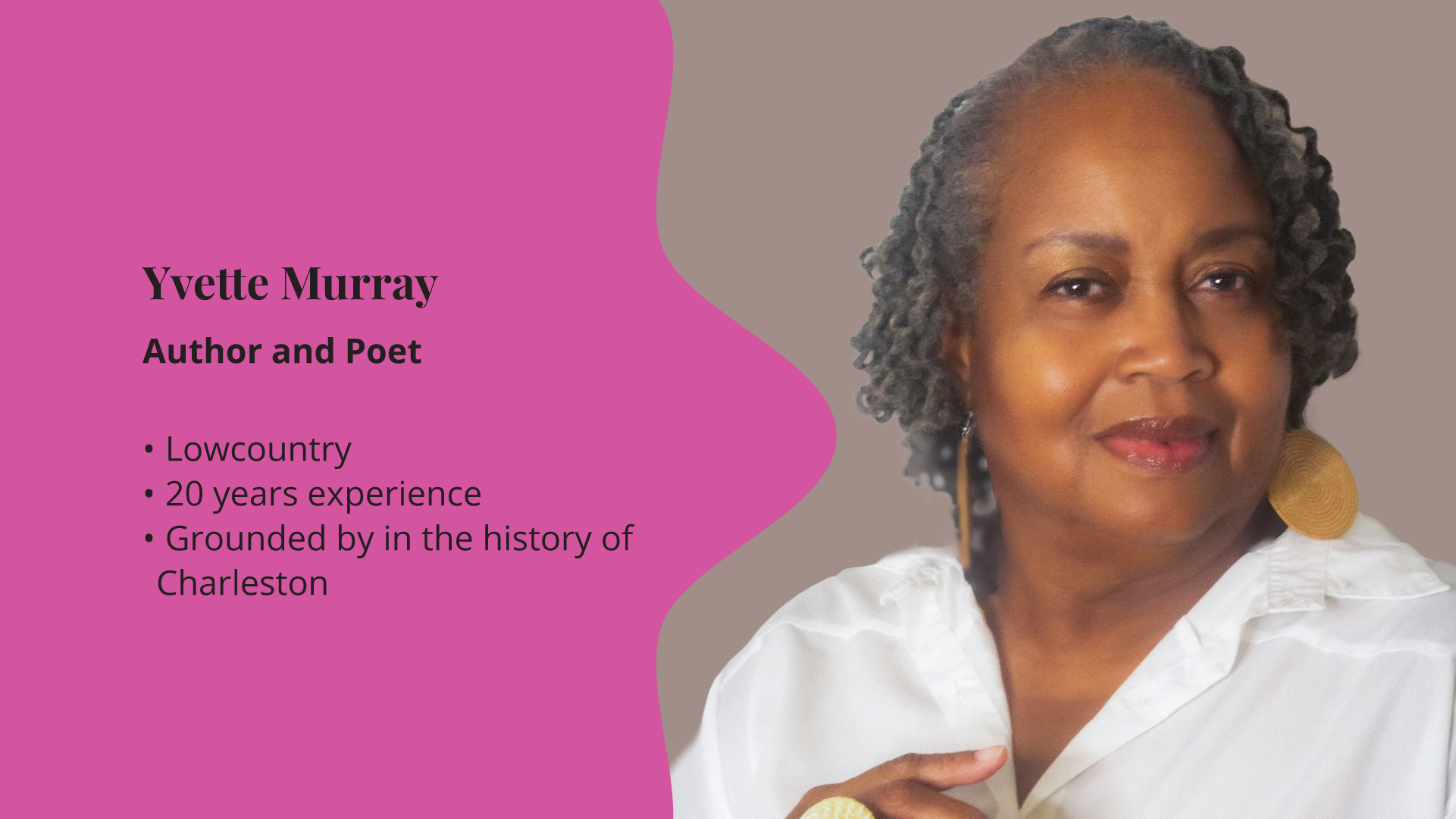
Hi, my name is Sarah Jane Thomas, and today we are talking with Yvette R. Murray, a professional creative working from and within South Carolina. As we get started, can you tell us your current career and where you’re from?
Yvette Murray 00:13
I’m from Charleston, South Carolina, and currently I have a full-time job, as most of us creatives do, but right now I’m a children’s book author and poet.
Sarah Jane Thomas 00:26
Before we go into the details of your profession, we have a brief section of the interview called “One Career, 60 Seconds,” where you describe your job in 60 seconds or less, similar to an elevator pitch. Okay, ready?
Yvette Murray 00:41
Yes.
Sarah Jane Thomas 00:42
Okay. Start whenever you feel comfortable.
Yvette Murray 00:44
Okay. I’m responsible for everything: curating, finding the material, creating it, and at that point, that’s where an editor comes in. But I’m I’m responsible for turning what I see and what I hear into art.
Sarah Jane Thomas 01:05
Well, that was perfect. So, what would you consider your official job title?
Yvette Murray 01:14
An author.
Sarah Jane Thomas 01:15
Author. Okay. So, as an author, is there anything in South Carolina or where you grew up, that you bring into your work
Yvette Murray 01:25
everything. My first book of poetry was literally about the neighborhood that I grew up in, and neighborhoods I grew up in downtown Charleston, and neighborhoods in downtown Charleston, and my children’s book is called “Celebrate We Galagici. So it’s all about everything that children can see. The book is my publisher is an educational publisher, so the book teaches little ones about their five senses through things that they know and recognize and and have seen and experienced. So it’s it’s all about the Low Country.
Sarah Jane Thomas 02:12
Do you think that this brings a diff different aspect to your work compared to people that maybe don’t live in South Carolina,
Yvette Murray 02:21
yes, because what they what they bring is research. What I bring is experience. There’s a section in the book. It’s on smells, and I am literally describing my mother’s garden from when I grew up, literally the plants, everything. So it brings a level of authenticity that can’t be duplicated. It can’t be recreated. They may write a nice book. They may write an authentic book, a book that’s full of facts that are true, but they don’t bring the the love and the timing of having been here, having walked these streets, experiencing the dismay when you see neighborhoods destroyed. They don’t. They don’t have that, and you can’t. You can’t teach that.
Sarah Jane Thomas 03:25
That’s very beautiful.
Yvette Murray 03:26
Thank you.
Sarah Jane Thomas 03:27
Do you think there was a defining moment in your life that had such a big impact on your creative journey?
Yvette Murray 03:35
Actually, a conversation that I overheard at a poetry reading, we were-they were discussing downtown, and the person said, “Don’t you think it’s better than just a bunch of burnout old buildings? And that really struck me because he thought that’s all these neighborhoods were. That’s all that was here. Not even understanding the businesses. The I called my neighborhood an enchanted urban forest, and I said that because the neighborhood had everything. You know how a forest is an ecosystem, and all the little animals, the little bugs, everybody works together to make it work. And that’s how the neighborhood was, and that’s how all the neighborhoods were. There are tons of businesses that used to be there, and they created an environment where everything you needed was there. There was a lawyer. There was-I am old enough to know there was a fish man that would come by. There was a lady down the street that did. The lady next door made quilts. Everything. There was actually a school right across the street from me, and I just wanted to capture that. I wanted to capture what was in those neighborhoods and speak up for those neighborhoods, just because you know that person said that.
Sarah Jane Thomas 05:22
That’s cruel, honestly. It is. It
Yvette Murray 05:25
is because no neighborhood is that. No neighborhood that becomes a blight, torn down. No neighborhood was always that. People live there. They raise their children there, and that was just really short-sighted, and I couldn’t let that pass.
Sarah Jane Thomas 05:48
Well, that’s a very good head mindset that you have to do that. Do you think that there was a? I know you’ve talked about your book about the five senses. Do you think there was a particular project that you produced that really showcased your creativity.
Yvette Murray 06:05
Yes, the book started as just the first chapter. It was a board book, and it won a contest. And part of winning the contest, you got to meet with publishers that would consider maybe publishing your book. So when I met with the publisher, you know they were excited. They want to move forward, but because my publisher is an educational publisher, they wanted to. At first, they were going to do five different books with the five senses, and then they combined it into one book with a different trim. Born books are little like this, and they wanted to combine it, and so we did. But the creativity, I guess, the authenticity showed through. They could see that I really knew what I was talking about, and I cared about it. See, that brings back to your other question. That brings a level of care and concern and diligence, attention to detail that somebody else wouldn’t be able to duplicate. Someone not from here. They didn’t really care.
Sarah Jane Thomas 07:20
It’s unique to you.
Yvette Murray 07:22
Yeah, we had some really interesting conversations. Me trying to explain what the fiddler crabs sound like, what pluff mud smells like. We have a pretty unique area of the country here.
Sarah Jane Thomas 07:39
Yeah, I’m not native, but I’ve been I grew up in the South all my life, so I love hearing all of the little niche uniqueness that South Carolina has, specifically South Carolina. It’s beautiful.
Yvette Murray 07:55
Absolutely, I’m glad that you’re
Sarah Jane Thomas 07:57
bringing that into your work.
Yvette Murray 07:59
Thanks.
Sarah Jane Thomas 08:00
Before entering your field, did you have any fears about becoming a creative professional?
Yvette Murray 08:06
Oh yes, yes. We all suffer from imposter syndrome. Even after I’ve seen authors that have numerous, numerous books, numerous prizes, still get nervous. Still be afraid. You you don’t know how to make it. You don’t know what to do. A lot of creatives teach. In addition, because you know they get the summer off, so it kind of works. They have time, but you just you don’t know how to do it. And the interesting thing that I’ve learned is that everybody does it differently. You have creatives that they may be a poet, but they also paint. They also make jewelry. They also sell soap. They, you know what I mean. So there’s so many different ways to do it. They make films. I have a couple of really wonderful poet friends of mine that have made films, short films. So it’s you can explore all of your creativity, all of the things you figure, oh well, maybe I could try this. Yeah, you sure can. You can try it all, do it all, and still stay true to what your main love is.
Sarah Jane Thomas 09:33
What inspired you to move beyond these fears? If you have,
Yvette Murray 09:39
you almost have to. People talk about the muse inspiration. I’m not a person that believes that I can only write when I feel inspired. I believe that you can get yourself into that state of being able to hear the muse. So to speak, at any given time, you just need some quiet and little little time to get yourself into it. But it’s almost like the stories have to be written. I like to say the ancestors want their stories told, so you will just. I know for me, sometimes I’ll hear a line. 4o’clock in the morning is a good, good creative time for me, and I’ll hear a line if I’m kind of awake. That in between wake and sleep state, I think it’s the theta state that you’re in just super creativity, and it’s just coming. That’s why you see so many creatives. They always have a notepad, or they’ve got tons of notes in their phone. It’s like the stories want to be told, and we’re just the vessels of the story. Whatever creative endeavor, if it’s art, if it’s poetry, like I write children’s books, short stories, whatever it is, it it wants to be written, and we just have to be open. We have to be open to what’s coming to us. I know that sounds really woo woo, but
Sarah Jane Thomas 11:20
you just gotta listen.
Yvette Murray 11:22
Absolutely, absolutely gotta listen.
Sarah Jane Thomas 11:26
Well, do you have any advice for young adults or students who also want to pursue poetry?
Yvette Murray 11:33
Oh, I got lots. The first one is do it. Whatever you want to do, do it. But always be a student. Always be willing to learn and to listen. You know, everybody’s got this idea of an artist, a flaky artist. But we have to. We are flaky. That is who we are because you know we are who we are. But Always learn, never stop learning. And I had a teacher in college that gave me the best advice. He said, “Yvette, a writer writes, and you write, write, write, and you cut, cut, cut, which is true. And just just keep at it, keep learning, explore different genres, different art forms, but just stay at it and develop a thick skin. Yeah, it’s it’s a numbers game as far as submitting. It’s a numbers game, and I still remember the moment when my book of poetry, which came first, was accepted for publication, and in my head it was like, well, there it is. It just happened, and it’s like that. You do and you do and you do and you do, and then one day you get accepted. One day you get into the fellowship, one day somebody wants to buy your artwork. You just got to keep at it.
Sarah Jane Thomas 13:06
Do you think there’s a particular skill one should learn before stepping into something like that?
Yvette Murray 13:12
I would say learn the business. Whatever, whichever part you’re, whichever art form you’re pursuing, learn the business, learn how much people do charge, learn how get your speak with an accountant so you understand what receipts you need to keep, how you need to do things. Because when it all boils down, it is a business, art, creativity. It is a business, and look for grants. Don’t be afraid to look for grants.
Sarah Jane Thomas 13:46
Yeah, there’s lots
Yvette Murray 13:48
out there.
Sarah Jane Thomas 13:49
Wonderful advice. I just want to thank you so much for sitting down and talking with me and offering your insights. Would you be open with talking to somebody from our team again?
Yvette Murray 14:01
Sure.
Sarah Jane Thomas 14:02
Perfect. Well, thank you. I hope you have a good rest of your day. This one, I hope you do. Okay. We’ll send over a transcript for your approval, and somebody will be in contact with you soon.
Well, thank you again for your patience. If you just wouldn’t mind just saying your name, what you do, and then we’re going to jump into telling us what you do in sixty seconds or less.
00:14 Clay Hadden
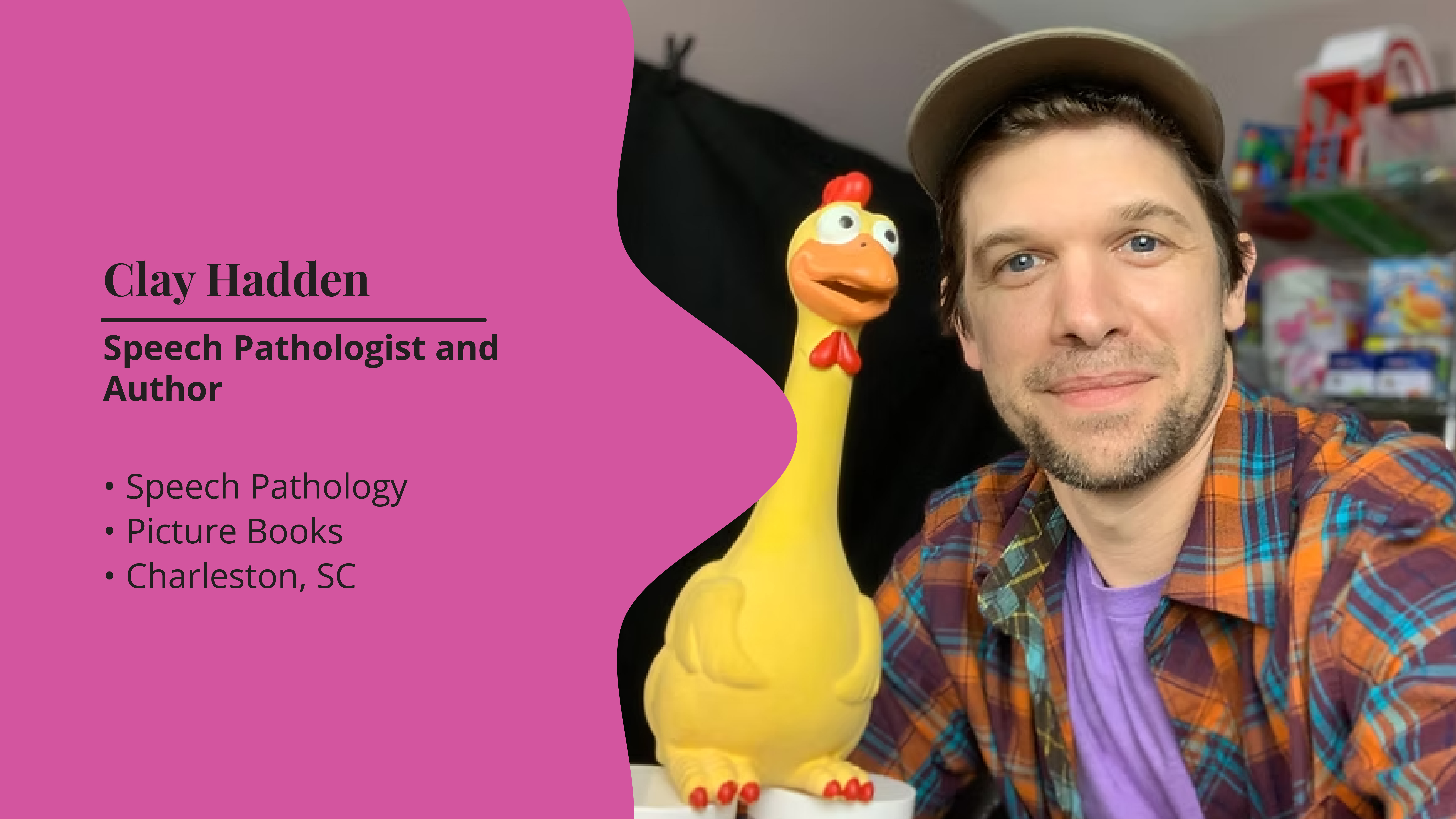
My name is Clay Hadden. I am a speech pathologist and children’s book writer. I also have an online ecosystem called Mister Clay, “M I S T E R Clay.”
00:29 Alli Crandell
Excellent. One of the things that we’re really interested in is everybody oftentimes, we have all these creative careers, but we don’t really know what exactly it means. If you wouldn’t mind, we’re going to play a little kind of fun game of “One Career, Sixty Seconds,” where you explain what it is that you do in sixty seconds or less. Are you ready?
00:52 Clay Hadden
Okay. Oh, I’m ready.
00:54 Alli Crandell
Okay. All right. Go.
00:57 Clay Hadden
So, I went to grad school to be a speech language pathologist. I work primarily with pediatrics, mostly with kids who are on the autism spectrum. During the pandemic, when everything kind of got shut down, I started trying to do some other things. I started writing children’s music and doing children’s YouTube, and then that turned into a book deal, and now I also write children’s picture books.
01:25 Alli Crandell
Amazing. So, what would you say is your typical day as a speech pathologist working with children?
01:32 Clay Hadden
I would say that the most typical day is that most of my days are not typical. I’m the clinical director of a company, but even beyond that, when I was just a clinician, if I’m being very honest, every day is kind of different. People get sick, and people cancel. There’s a constant reshuffling of schedules, lots of changes that feel almost like weekly changes regarding insurances and different payers and stuff like that.
The most typical day would be from about nine. I work in a private clinic. You can work in a school; you can work in hospitals. So, for a private clinic, my day starts about eight-thirty, nine o’clock depending on when my patients start, and goes till about five o’clock depending on the patient’s payer source. Sometimes those sessions are thirty minutes, sometimes they’re an hour, and we help them communicate. Sometimes that looks like just articulation; making sure you’re saying your G’s and your K’s and your R’s right, and sometimes that looks like augmentative communication, communication, which is any other form of communication that’s not verbal. So, everything from sign language to my expertise of using a communication device. Most of the time it’s like an iPad-like tablet with some kind of symbols on it, teaching children how to use that, so it’s a big mix of everything. Most of the kids that I work with are little, and so there’s a lot of floor time and child-led therapy too.
03:06 Alli Crandell
That’s excellent. And are most of your sessions one-on-one, or do you often do group sessions?
03:11 Clay Hadden
So, most of mine are one-on-one. The reason for that usually is based in insurance, so in schools, if you worked in a school system, you would not see kids one-on-one. So, I prefer one-on-one. It allows me to give the person in front of me my undivided attention and build a connection with them.
I think the artistic piece of this job is almost like improv. If you’re familiar with improv, you have to meet the kid where they are. You have to do a lot of “yes and-ing” and build on what they’re saying in order to make them feel comfortable doing the things that you need to do to educate them, especially with these little ones. Getting a two-year-old down on the ground and just working on flashcards is going to last about a minute and a half.
04:05 Alli Crandell
So how would you kind of describe how you mentioned that your practice kind of led, and social media presence, led to a book deal? What was that process like?
04:14 Clay Hadden
I had a buddy and we were writing children’s music during the pandemic as kind of a way to not go crazy. All at the time, my three children that I own, the ones that belong to me, were little. So, there was lots of singing in our house, lots of children’s books, picture books, even outside of work at the house. So, we started writing music. We had one song that I was like, “This isn’t really working as a song.”
So, I started doing some research into publishing, and I found a small publisher called Nine Wise Publishing that specializes in picture books for kids from birth to about three or four, with a focus on getting the writers to be SLPs, other educators, stuff like that. It was a really nice relationship. I wrote the words, they found the artist, they produced the book, and then it came out, and it was great, and everybody received it really well.
I forget who it is. Gosh, I heard somebody say that once you create something and put it out, it’s no longer yours, right? So, it was very well received, which I feel is a blessing, and won the Independent Book Publishing Awards Gold for best picture book in its age group last year. It was just a really neat process. In working with a smaller publisher, I got to be in on the design of the book, the images. It wasn’t all me, we had an amazing artist, but I was able to give feedback, which was really nice too.
05:57 Alli Crandell
That’s awesome. Have you ever thought about, even while you were going to school and grad school, like ever becoming an author, or was it this just something really unexpected?
06:06 Clay Hadden
Yeah, so when I was a teenager, my life goal was to be a writer for Rolling Stone magazine, like that’s all I wanted to do. Math was not my strong suit, writing and psychology and stuff like that; those were not only my interest, but that’s what I was just naturally better at. So, I wrote a couple of short stories that got published in some now defunct online journals and stuff like that. Then, we had kids, and life got busy, and so it was always there.
My wife and I joke. Hers is: if she doesn’t get to go outside and do something in nature, there’s like this river that gets louder and louder in the back of her head. For me, it’s that creative piece, right? If I don’t get to do something creative, all my anxiety and stress kind of builds up until I can do that. It’s been a really good outlet for me too, and it is kids’ stuff, right? I mean, it’s not kids’ stuff. Early literature for children is so important, but it’s more fun and a little bit less serious than writing a Pulitzer Prize-winning novel or something.
07:26 Alli Crandell
Yeah, absolutely. I would just kind of wonder, now that you have kind of this very established and recognized outlet, it’s like, are you now opening yourself to think through like the music that you were creating over the pandemic, or are you thinking about what’s next?
04:47 Clay Hadden
I think about it all the time, the busyness of life. I think it kind of puts a damper on that sometime. I would love to get back, for example, to my YouTube page. I signed a contract for the sequel to this book, so Nine Wise is going to do that. Then I had another publishing company that I’m hopefully in some early negotiations with for another book.
I don’t want to do it fulltime because I don’t think it’s sustainable as a primary income source, but I would love to incorporate writing in early intervention and early reading and all that kind of stuff together for some kind of online platform for families to go to and have access to. I think that’s where my next steps might, might be going.
08:40 Alli Crandell
Wow, I mean, and it’s such a really interesting journey that you’ve been on. So many of the young folks that we talked to might be interested in this, and something else, right? Whether its arts therapy or something else. Do you have any words of advice for somebody who is either thinking about going into, as you say clinical practice, in terms of speech pathology, or interested in maybe applying some of their disciplinary background into a publishing work?
09:16 Clay Hadden
I would say do it if so. I’ll address the writing piece first. If there’s something creative in you, do it. Don’t let people hate on it. I mean, even if it does come out cringe, which, trust me, a lot of the stuff that I have done has turned out cringe, you can ask my children, it might still be made for one or two people who need it right.
As far as speech goes, it’s a great job. I highly recommend it. I do think that it’s a job, personal face-to-face jobs. I don’t think AI is going to disrupt them as much as it is going to do some of these other things that we’re seeing. Occupational therapy, physical therapy, speech therapy. I would say, look into them. You still get to work with pediatric populations; you still get that teachery kind of vibe, without some of the hassle of being the teacher. My wife’s a teacher, so I think I’m okay in saying that. I like both of the things that I do. My only concern is that there’s not enough of us doing it and reaching out to those families that need it to do it.
10:29 Alli Crandell
Yeah, and I mean it. I think it takes you, to have like demonstrated such bravery in both, you know, it’s like putting up your..
10:38 Clay Hadden
I don’t know about that. First of all, thank you. That’s very kind, and I guess there is a part of somebody who, once you put your art out there, is kind of a brave-ish work. But I’m truly just doing it because I enjoy it, and I think other people might enjoy it.
11:00 Alli Crandell
Wow, yeah. You do so many so many things, and I really just love the way that you’ve just described, of just, you know, just doing it. Very Nike. But I’m wondering, if you wouldn’t mind, is there any questions that I haven’t asked you that you wish I had asked you?
11:21 Clay Hadden
Oh, any questions that you haven’t asked me, that I wish you would ask me. I don’t know. I mean, if you’re a parent and you’re reading this or listening to this, read to your kids. Don’t let them watch short form videos on your phone; screen time is okay with boundaries. I tell people all the time, one day your whole house is going to have a stomach bug, and you’re going to let your kid have the iPad, and that’s okay. But we have to be disciplined with things, and good old-fashioned entertainment, like books and being outside, is so good for your kid’s brain. I don’t know why I felt the need to put that message out there, but that’s the only thing I didn’t say that I would like to say.
12:12 Alli Crandell
Absolutely. Well, I mean, I think that it kind of feeds back into what you were saying, both with AI and the importance of writing and creating books that are targeted to help families. I think that that’s really beautiful.
12:24 Clay Hadden
Yeah, thank you!
12:26 Alli Crandell Awesome. Well, thank you so much for taking the time. Yeah, apologies, but thank you so much.
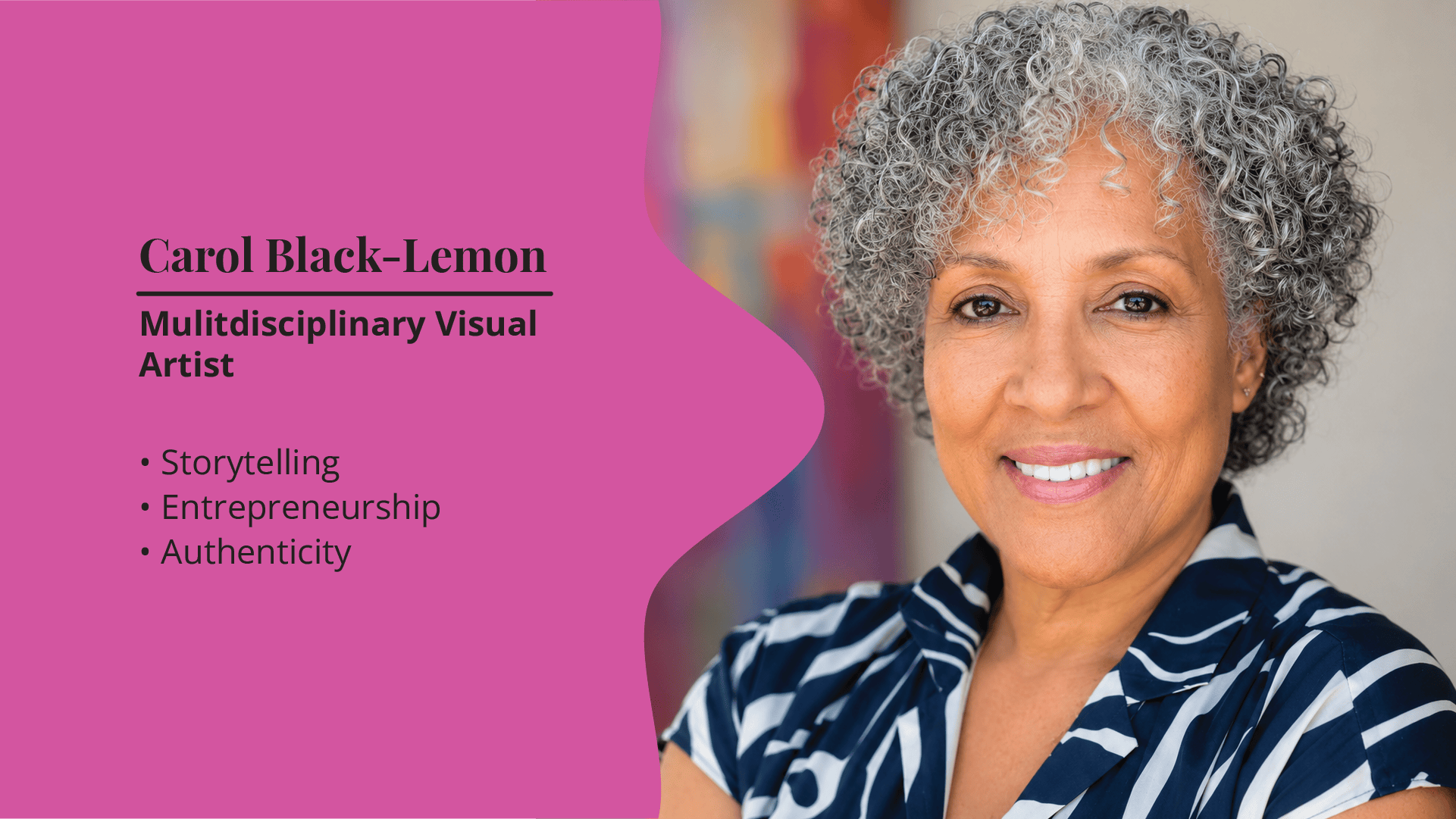
Hello, my name is Sarah Jane Thomas, and today we are talking with Carol Black-Lemon, a professional creative working from and within South Carolina. So, as we get started, can you tell us your current career and where you’re from?
Carol Black-Lemon 00:12
Sure. I’m originally from New Jersey, born in Newark, raised in Brooklyn, and my husband and I retired recently and moved to Florence, South Carolina.
Sarah Jane Thomas 00:24
Wonderful. Before we go into details of your profession, we have a brief section of the interview called “One Career, Sixty Seconds” where you describe your job in sixty seconds or less, similar to an elevator pitch. And we can start whenever you’re ready.
Carol Black-Lemon 00:38
Okay. So I consider myself a solopreneur, and that I do pretty much everything on my own. I’ve always been that type of person where I multitask. But four years ago, almost four years ago, I retired, and from my job as a marketing administrator for a law firm. I was there for twenty years, and I built a lot of experiences working on web design and marketing.
So now I do that for myself, and my business is Black-Lemon Art, aka Carol Black-Lemon Art, and I am a multidisciplinary artist, where my mainstay is creating artwork and storytelling through my art, and that’s my passion. Always been, always will be, and now I represent a new generation of artists who are at a certain age point, and for me, I’m still becoming, and it’s me letting younger folks know that even when you get a certain age, it doesn’t end. It’s where your passion lies. Just keep going with it, and that’s what life is all about.
Sarah Jane Thomas 02:08
I love the term solopreneur. I think that’s so fun and exciting. That was perfect. So, what would you consider your official job title?
Carol Black-Lemon 02:20
Creator. I’m a creator. I just feel very, very blessed to be creating whatever, whatever comes to mind. But painter, for sure, storyteller through my art. I love doing web design. They make it pretty easy today, so I don’t have to get into coding. But I can fiddle around with that as well. And what was the question?
Sarah Jane Thomas 02:55
I was just wondering what you would consider your professional job title, but creator just sums it all up. So, as a creative creator, is there anything in South Carolina that you feel you bring into your work, as opposed to people who may not live in South Carolina?
Carol Black-Lemon 03:17
Something that I bring into my work…I would say communicating with other like-minded or other folks that that want to tap into their creativity. I’m all about that. It’s like folks that I know work on nine-to-five jobs and under fluorescent lighting and the watchful eye; they don’t have freedom. They may be in a creative job, which is wonderful, but for a lot of people, they have their jobs that don’t really give them an opportunity to be creative. You have to follow the pattern and the hierarchy and so forth. But tapping into your creativity allows you to find your voice, allows you to be your authentic self. So, I like to help people to do that, and I founded a group called Creative Connection here in Florence, and it was a call out to anyone who wants to tap into that and talk about their creative process.
Sarah Jane Thomas 04:33
That’s beautiful. Do you think that there was a defining moment in your life that really had an impact on your creative journey?
Carol Black-Lemon 04:43
A defining moment in my life on my creative journey….it’s a good question. Defining moment….I think I had many defining moments, and which was just letting me know that I can control my creative voice, so I had to find time for that. When I had a nine-to-five and raising a family, it wasn’t just about me. It was about what I have to give to my job, what I have to give to my family. But at some point, I’m like, well, what about me? Who am I? And I tapped into that little girl that was just curious about everything, and so that little girl still lives in me, and I keep reminding myself who she was. And now, I was proud of her, and she would be proud of me that I’m still doing that.
Sarah Jane Thomas 05:45
You mentioned your own initiative, your own little startup. Do you think that there was a particular project that you worked on that allowed you to express that creativity in a way that hadn’t really been something that you’ve done before?
Carol Black-Lemon 06:03
I think that might be. There was a point where I was designing my own website, and I went with the DIY. I’m like, okay, I’m that type of person. I’m gonna figure it out, and I really enjoyed it. I had fun with it, and my website was great. And then I thought, “I can do this for other people,” so I looked at some other folks’ websites, some friends, or just people that I knew, and I’m like, “Would you like me to improve your website?” And I did like three of them for free. I’m like, “let me do this so that I can put it on my portfolio,” and that led to a client. So, I said after six months, I’m like, “okay, I’ll help you to navigate it.” Ultimately, and this is going back maybe twenty years now, but that led to fifteen website clients, and for me, that’s why I say I’m a solopreneur. I didn’t have anyone helping me, and by the way, I was doing a nine-to-five job.
Sarah Jane Thomas 07:16
So, you mentioned this nine-to-five job. So, before you stepped away from that and became a creative strictly in your professional life, did you have any fears about that?
Carol Black-Lemon 07:34
Yeah, absolutely. I had to learn about just the business setup and taxes, all the accountability what goes with being a legitimate business and calling yourself a business. So, I had to learn all that, and I was always afraid if I was doing that correctly. My fears of starting up is just learning how to prioritize and not getting ahead of myself, and because then I became responsible for other people, and then I learned that people were counting on me. I’ll never forget a call on Easter Sunday because there was something that they wanted on their website, and I was like, “Wait a minute, it’s Easter. I didn’t sign up for that.” But that was when I understood that the criteria that I had to set forth and letting folks know this is a business, and you have to go by these terms and so that was a real learning experience for me to set those guidelines.
Sarah Jane Thomas 09:00
Was there anything in particular that helped you move beyond these fears?
Carol Black-Lemon 09:07
Anything in particular that helped me move beyond these fears….what got me moving beyond the fears was this understanding the complexity of ownership and accountability, and that if I were to call myself the boss lady, that I needed to step up and take better notes and just be better at what I was doing, what I was being called to do. So it was that I need to step up. That was like pivoting to the next level of being a professional.
Sarah Jane Thomas 09:59
Do you have any advice for young adults or students who have an interest in becoming a creative professional and maybe starting up their own business, as you have?
Carol Black-Lemon 10:08
Yeah, I would say tap into what’s already out there. You don’t have to reinvent the wheel. The information is at our fingertips now. I mean between Google and ChatGPT and Claude, it’s all there. Like, what do I do? They can even build your own website. You know, push the button. There’s your website already. But I’m a hands-on kind of person, and I always want to make sure that if I do use AI to help me, which why not, it’s there. Make sure that it’s at least 80% you and maybe 20% AI, if that makes sense. Yeah, it’s a great tool and it really helps to get things done. But don’t let AI do more of your work than you, and then talking to seasoned professionals and talking to your peers, especially those that are transparent, that are willing to share.
There are some folks that they’re not maybe willing to tell you what they use. I’m like, well, those aren’t your people. If I find something that’s working for me, I’m going to tell my friends, “look, don’t waste your time there. This is a better tool.” But talking to seasoned professionals who are doing it, who will give you the real lowdown in terms of what you need? Make good use of your resources.
Sarah Jane Thomas 11:50
So, you mentioned utilizing AI and utilizing the internet and just like all the information that’s out there now. Do you think that there are any particular skills, either within that or apart from that, that one should practice before trying the same things?
Carol Black-Lemon 12:12
Right, before trying the same things for sure, and that is having just being more hands-on with your own work in your own occupation, meaning taking notes. Every thought that comes into your mind, some of them are good, and some you need to trash. So, prioritizing your vision for yourself, like what do you need to do right now? And that’s doing your homework. So, and if you’re a student, that’s like the greatest place to be tapping into all the resources available to you. Because at a certain point, those resources and those mentors may go away.For me, it’s organization for sure.
Just you know, and there’s a lot of folks [who have it]. I don’t like the term ADHD. A lot of people are like, “I have ADHD.” It’s like if you got a lot going on in your head, there’s a lot of attention deficit because you’re managing so many different things that you are that you have to be accountable for. You’re a student, but you may have a part-time job, and you may have other responsibilities. So, time management is really key. And for someone like me, who’s a multitasker, which I’ve had to tone down. I’m at a certain age right now, and I can’t remember everything, but my mind is still going and going. I wake up with thoughts and ideas, and I don’t want to lose track of it. So having a wonderful calendar, I have this great, beautiful calendar that I use that may even have two years versus an annual calendar and files that I can reference. Organization is definitely key.
Sarah Jane Thomas 14:16
Well, I want to thank you so much for just sharing your story and your experience and your advice and I really–listening to you talk is it just fills me with happiness for some reason. You have such a way of expressing yourself in a way that’s very genuine, and I really loved it.
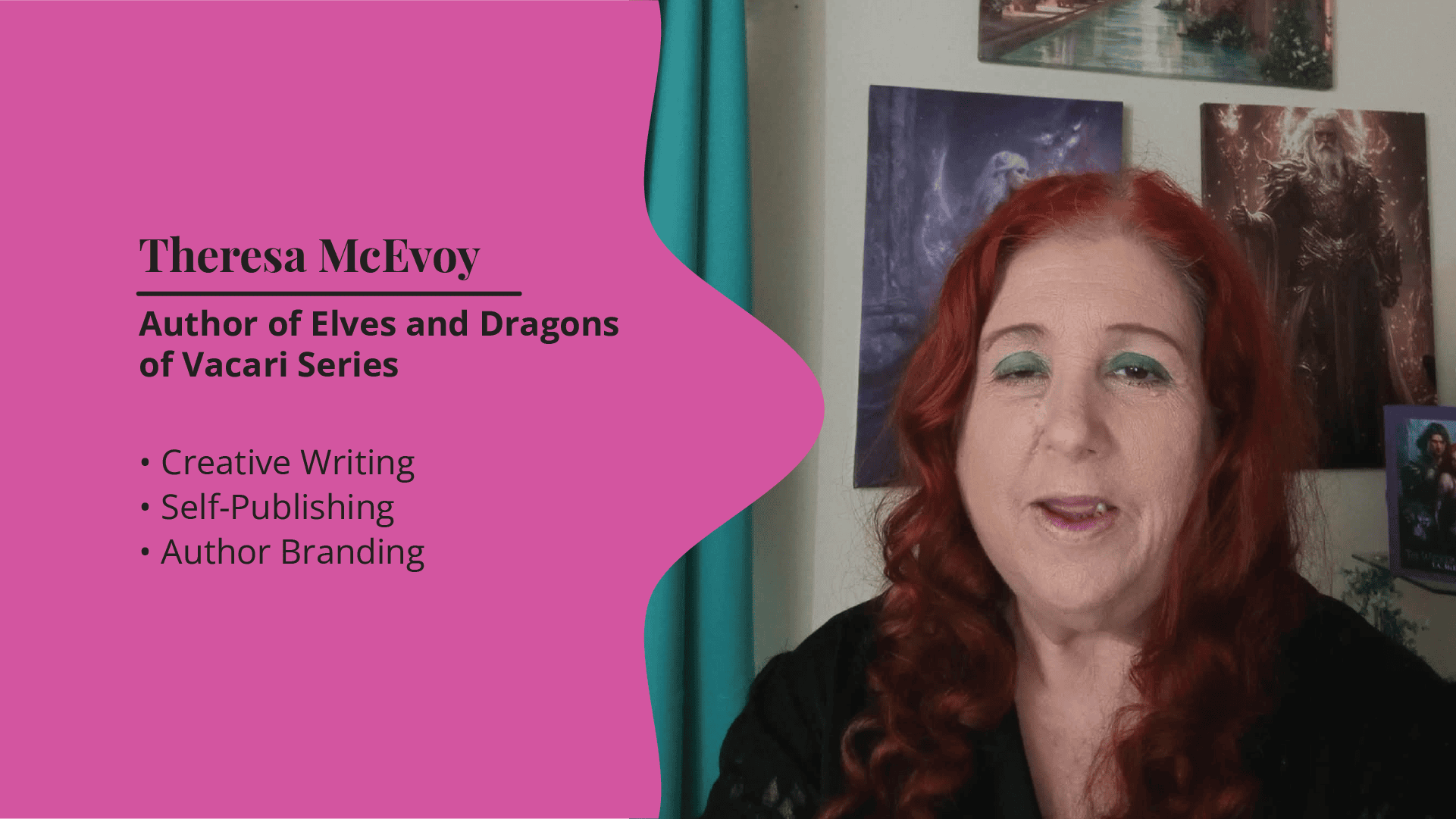
Hello, everybody. My name is Victoria, and today we are talking with Teresa McAvoy, a professional creative working from and within South Carolina. As we get started, can you tell us a little bit about your current career and where you’re currently located?
00:14 T.A. McEvoy
I’m in Anderson, South Carolina.
I have been writing epic fantasy books for about six, seven years now. I started out as a paralegal and worked, and the legal background helps a lot with your author career.
00:33 Victoria Bartolotto
Awesome.
So, before we get into the details, we have a brief section of our interview called “One Career Sixty Seconds,” where you describe your job in sixty seconds or less, similar to an elevator pitch. Are you prepared?
00:46 T.A. McEvoy
Yes, I’m ready.
00:48 Victoria Bartolotto
You can go ahead.
00:49 T.A. McEvoy
Okay. I am T.A. McEvoy, an epic fantasy author and world-builder , best known for the Dragons of Vicari series. My work combines character-driven storytelling, ancient dragon lore, and interconnected fantasy realms centered on themes of hope, unity, and resilience.
Beyond writing novels, I also create audiobook productions, cinematic fantasy content for YouTube, and expanded lore that allows the readers to engage with the world of Vicari.
My goal is to create an immersive world where dragons are not simply creatures, but living emotional beings woven into the soul of the story itself. I don’t like them being just beasts.
01:42 Victoria Bartolotto
That’s great. Thank you so much.
01:44 T.A. McEvoy
Thank you.
01:45 Victoria Bartolotto
So as an author, is there anything about South Carolina or Anderson in particular that brings something to your work? I know it’s a fantasy series, but do you ever take some inspiration from South Carolina and implement that?
02:00 T.A. McEvoy
Sometimes, I do the forest because I have four forests in my books. Of course, they’re not called [the Forest], but they got their own special things like purple fire. But yeah, the forests. I can take the forests or the outdoors. That would be pretty.
02:25 Victoria Bartolotto
When you decided to start publishing, was there anything that helped you make that decision or was there some sort of defining moment that had an impact on your creative journey?
02:38 T.A. McEvoy
I’ve always liked writing. When I was in high school, I wrote mysteries and my best friend would read them. She would read all those books, but my dad didn’t think I could make it, so I went into law.
But I’ve always loved to write. My mom accuses me of having a vivid imagination. I am a self-publisher because I am very picky on the person who does my covers. Everybody wants these covers like this and that, but I have – no. And if I can’t connect with the cover designer, forget it. But I was very lucky. I’ve had this cover designer I’ve been working with since I started, and she is awesome.
03:25 Victoria Bartolotto
Can you talk a little bit about the self-publishing industry and why I understand being very picky. I’m a writer myself, so I know how it is to be wanting specific things. Can you talk a little bit more about the decision of self-publishing and how that experience has been for you so far?
03:42 T.A. McEvoy
For self-publishing, it was easier for me to do it because I knew what I wanted and I knew what I didn’t want. The only thing you can get very aggravated with is KDP [Kindle Direct Publishing] and Amazon because they keep changing their mind.
My recommendation is unless you really want to, do not do the KDP Select because they restrict it for ninety days, which means you can’t publish your books anywhere else.
I didn’t do that. I went wide. Now, Kobo has it where it’s sort of like KDP, but you can publish it, and people can have a membership there. They can read your book or even listen to your audio book for free, and you still get paid, but they let you do it wherever you want. So, I think Kobo’s a better idea.
04:35 Victoria Bartolotto
I know you mentioned having a book cover designer. Can you talk a little bit about the process of editing your novel and going to somebody and freelancing people to help you work on your books?
04:50 T.A. McEvoy
Most of the editing I do myself, but I have like seven stages of editing, so it takes a while. They’re broken down into dialogue, world building, and grammar. That’s what was OK for me.
I don’t know about some people. I have a background in legal, so of course I’m very critical. Whenever you’re doing motions and stuff, they have to be critical. So, you’re going to need to be so critical.
But you can do it. Now sometimes some people do need an editor because they don’t catch the spelling or the grammar. It’s one thing, but you can do it pretty well on your own. I would, though, except not for a book cover. I would never do it. Never. I don’t know how. My book cover designer is awesome. She’s really sweet. I will give her an idea, and she’ll give me four or five ideas. Then I’ll say, “well, can you take this one and put it over here?” And she’ll say, “let me see,” because she’ll do it.
06:00 Victoria Bartolotto
That’s great. Because I know in comparison to self-publishing, traditional publishing, you don’t get as much of a say in your cover or your editor or, you know, the specific nitty gritty details of something that self-publishing would give you. I understand that you have a lot more freedom in it.
06:23 T.A. McEvoy
It can be, a little. You also have to learn how to do your marketing and stuff. But that’s where I say AI works good for marketing. Do not use it in your books, but you can use it for your marketing. I’m real picky about writing like that. No, that’s where your imagination has to come in, too.
06:47 Victoria Bartolotto
So, having a legal background, you said you did paralegal work. What was the, I guess, motivation behind wanting to switch from legal work to creative work? And if you had any fears about doing that and kind of transitioning, and if there was some sort of fear, what inspired you to continue beyond it?
07:10 T.A. McEvoy
Well, partly I stopped working, and we moved from Texas to South Carolina. My mom is bedridden, so I’m a caregiver. A lot of that has to do with making sure she’s comfortable. I can be there whenever she needed me. I’ve always loved writing and she always got mad at me for not writing. But I was afraid when I first started writing that nobody would like my books. My first series was just about the elves. The dragons came into it but, I went into the Dragons of Vicari, and I’ve always loved dragons. Not like how most people want to make the dragons into beasts or, shall we say, glorified mouths that carry on from point A to point B. My dragons have personalities.
08:02 Victoria Bartolotto
That’s great! Do you have any advice for students or young adults who want to pursue becoming an author? Is there any interest, do you think, that they should have or any kind of programs you think they should look into?
08:18 T.A. McEvoy
Well, I would definitely tell them to look into critical writing because critical writing will help. Also, you better love to write and find a genre you love to write in. I know some authors go from one genre to another, but I stay with everything. Find something that you really love to do.
And then be very careful after you publish your first book, because all these people are going to say, I can do this. I can do this for you. Ninety percent of them are just scammers. So be very careful.
08:53 Victoria Bartolotto
Thank you so much for talking with me. I really appreciated it.
08:56 T.A. McEvoy
It was nice meeting you.
08:58 Victoria Bartolotto
Yes, it was nice meeting you as well. Have a great day.
“Read, read, read. Novels hold a wealth of knowledge, experiences, and creativity.”
Quick Facts
Education: Undergraduate School
Years of Experience: 37 Years
About
A producer, writer, and director at Silver Hand Productions, Paul Mento has been tinkering with the camera since elementary school. As his passion turned into a career, he primarily works with documentaries, short films, and commercial media. Mento’s documentary, “Howard Pyle, and the Illustrated Story,” was recently accepted by the George Lucas Museum of Narrative Arts in Los Angeles.
Originally from Wilmington, Delaware, he initially became interested in shooting Super 8 films, borrowing his father’s equipment. “I was part of Explorers in high school, which had a program that centered around advertising and media,” he says, “I was immediately hooked.”
What captivates Mento about filmmaking are its interdisciplinary roles, all working towards one project. In addition, he is inspired by the involvement of multiple skills across the team, from researching to camera operation. He encourages aspiring filmmakers to read and engage critically with literature, for it can serve as a springboard for ideas.
It’s okay. To start, could you do the favor of introducing yourself? Spell out your name, tell us where you’re located currently. And yeah, we’ll start there.
00:10 Glenn Meganck
My real name is, that I rarely use is Glenn Meganck. And right now, I’m in Chapel Hill, North Carolina.
00:20 Victoria Bartolotto
Okay. Can you tell us a little bit about your job? I know you do multiple things, songwriter, ghostwriter, author. Can you just tell us just a little bit about what you do and what you specialize in?
00:35 Glenn Meganck
Well, that’s it. Every day I do some writing and some music. Both are equally important to me. So, I tend to write every morning, seven days a week, and then switch to music at some point in the afternoon, and work on more songwriting and recording and that sort of thing. I’m always working on at least two or three novels at a time, it seems, these days as well, under a lot of different genres. So, there’s no one kind of thing that I do in terms of that.
01:07 Victoria Bartolotto
I know one of your books, “Booking a Killer Vacation”, is set in Myrtle Beach, South Carolina. Is that correct?
01:16 Glenn Meganck
Yeah, that’s a J.R. Ripley book, and that’s more like a light mystery, which I do a lot of those. I did a bunch of them in a very short period of time, and now I just do a few here and there, but…
It was something I had never done before, and then I just sort of fell into it for a couple of years where people were asking for them, a publisher. And so, I ended up doing about, nine a year for a few years. Kind of cranking them out until I got kind of tired of it, because it really wasn’t what I did. I really didn’t even know the genre at all. It was like, “oh, I better read some of those and see what they do.”
02:01 Victoria Bartolotto
Can I ask specifically about that book? What about South Carolina or Myrtle Beach itself drew you to that specific location? What did you think was unique about it that you were like, “yeah, this needs to be set in South Carolina?”
02:15 Glenn Meganck
Well, for that genre, of these sorts of cozy light mysteries, that are amateur sleuths, right? So the setting is important. You want someplace unique and that makes sort of like its own little world that can be fun and has enough interesting things going on. Not necessarily a small town, but most of them are in a small town. I mean, there are a few that are probably in New York City that people do, but in general, they tend to be a either real, a fictionalized version of a real town or again, just something you make up or use like Myrtle Beach. I like Myrtle Beach and I’ve been there a lot. And it was a good setting. And I just finished a couple more of them. And it has a nice vibe.
I love music. I mean, I’m a musician. So, the next one, when I finally got back to doing more of them, the next one, which comes out in, I don’t know, a couple of months, maybe, that one involves music as well. And of course, in the Myrtle area, there’s lots of live music and bands that come through and theater. So I was able, in the ’60s kind of music and stuff, so I was able to incorporate that. Then in the third one, which I wrote already as well, but I don’t know when that one comes out, but that one involves more surfing. So, it has people surfing yeah, so. But yeah, it’s just a fun place. And because it’s a place a lot of people know and have been to, at least in this country, and lots of tourism. It has a lot of interesting characters too, the kind of people that come there and the partying and then the motorcycle events and things like that too. And yet it’s a small, sort of a small town feel in and of itself, you know?
04:10 Victoria Bartolotto
Definitely. Overall, throughout your creative career, was there a defining moment that you can think of that led you to wanting to become an author or wanting to do kind of multiple pen names? Was there anything that really stood out to you when you were like, “yeah, I want to be a writer? Yeah, I want to pursue this kind of career?”
04:34 Glenn Meganck
The writing and music, I’ve always been since the youngest that I can remember. I loved to read. I didn’t grow up in a household where reading mattered or music. I mean, my grandparents loved music and played, but my parents weren’t into music, didn’t play at all. They listened to country music, but they didn’t play any instruments and nobody read books in my family except me. And, I always wrote whether it was writing poetry or whatever, when I was a little kid. And I always wanted to learn the piano and then the guitar and whatever so I just kind of started on my own with all that. And it’s just sort of like a compulsion. I’m not happy or satisfied if I don’t do it.
The pen names is because when I started out getting published, I remember I was still living at home. I was young. One day I was home alone and, at my parents’ house, and a girl came knocking at the door and wanted to meet me because she’d seen an article about me in the paper. It just freaked me out, you know, and it was a book that came out under my real name. And I hadn’t thought about it at the time. This was when I was living in Florida. It just freaked me out that people knew who I was. And so, I liked the idea from then of using pen names, because I like being anonymous.
So, I’ve done a lot of books and a lot of music where, and for the longest time it was new book, new name. New record, new name. Just so nobody would ever know who I was because I like my privacy. So, I’m still not keen on a lot of that. I know, especially these days of social media and everything, it’s kind of hard to remain anonymous. And of course, publishers or music people and whatever in the business, they don’t want you to be anonymous because that doesn’t sell, it’s not good for business. It’s not good for your career. In a perfect world, I would be completely anonymous.
06:54 Victoria Bartolotto
Yeah, I can relate to that a little bit. I’m a writer myself. I’m in school to become a writer and I’ve been thinking about pen names and things like that because, like you, I really don’t like people in my privacy, especially with, like you said, social media. Everyone wants to know who you are. Everyone wants to know everything about you. And it’s like, that’s not how it should be. Celebrities are people too.
07:20 Glenn Meganck
Exactly. I’m not in it for that. I don’t care about celebrity stuff. I don’t care about other celebrities. I don’t care. I mean, for a long time I lived in LA full of celebrities and the gym I would go to was full of all these really well-known people in every aspect of the arts, especially, actors and musicians and writers. I mean, because it was in this little studio in this area of town where they all went, and that’s where I happened to live and go too. But it didn’t mean anything to me, and I just wanted to be left alone.
And when I would go to the gym, I never talked to anybody. I always felt like, I always feel invisible, that nobody sees me anyway. I can just come and go, and nobody notices me. And then one day in the gym, a woman came up to me and said, “my friend is afraid of you.” I thought, “huh?” I never talked to anybody. And she said, “yeah, you come here every day. You never look at anybody. You never talk to anybody. You’re just kind of freaking her out.” So, I said “I didn’t even know you saw me, I just feel like I’m a ghost.”
And the other thing, for you as a writer, what evolves though, uh, with the writing. What kind of writing do you do? Do you have any preferences?
08:43 Victoria Bartolotto
I’m very into historical action, very much like treasure hunting. I love any kind of contemporary story that involves history, that involves big impacts on the world. Right now, I’m currently writing a treasure hunting series that takes place in Key West. So I’m super excited about that project. I’ve been thinking about it for so long. So, I really want to go in the direction of kind of this contemporary adventure that isn’t so much commercialized. I feel a lot of things are, especially commercialized fiction nowadays. I feel it’s so quick and rapid and not deep, if that makes sense.
09:27 Glenn Meganck
Oh, sure. I mean, the market right now, because the people who run the business, they’re business people. They’re not the kind of people who, when you read about the days when Hemingway and stuff was writing, where the editors really loved books and cared about books. Now they’re just marketing people and that’s all they care about; how many followers you have. Whatever kind of book succeeds, they just want more of those. So, it’s tough. But so like with yours, I mean, so you have historical elements in it too, or just more of a modern day?
10:04 Victoria Bartolotto
It has some historical elements. I did a lot of research on this one fleet of Spanish ships that went down in the Keys, and there was someone who went and found all the treasure in that, fleet. One of my questions was, for the novel to take place, because it is obviously fictionalized. I don’t want to just pull directly from history and do whatnot. But one of the questions I had was, “what if there was a third ship?” Because there were two that went down. And so, I’m like, “what if there was a third ship with a secret treasure on it that no one knew about?” And it draws from some people who actually lived in Key West. It draws from this one guy who actually owned it at one point before America bought it. Not Mel Fisher, I know who that is and that’s who like found everything. I actually went to go see his museum there and I did like the whole walkthrough which was an amazing experience.
11:05 Glenn Meganck
I’ve met him in the past a long time ago yeah.
11:07 Victoria Bartolotto
Oh really? Oh wow! That’s cool!
11:10 Glenn Meganck
Because he lived in Florida so I met him there, yeah.
11:15 Victoria Bartolotto
Yeah, kind of just really want to incorporate the history of Key West and how it kind of became the kind of big tourist spot that it is now. Maybe draw a little bit of attention to how it’s not just a tourist spot. There’s actually a lot of history here that no one really knows about. So that’s kind of my goal with that novel, with that series.
11:37 Glenn Meganck
So that’s it, you’re planning it as like a series?
11:40 Victoria Bartolotto
Yeah, I want it to be a three-book thing.
11:43 Glenn Meganck
Yeah, that’s a good way to look at it. Anyway, again, my advice is because I remember sometimes, again, when I was starting, you’d write a book and you’d think “that’s it, that’s just all I want.” But then the publisher would want more. And like, wait, there can’t be more. I mean, that was the end, but they wanted it to be a series because it did well enough and they liked it.
I had thought, well, I boxed myself. Where am I going to go? How am I going to do that? But you find a way. Now, whenever I do a book that even as a standalone, I always tell myself, leave some room that it could be a series. And then to get back to your point again with the pen names, though, the way it develops too, because of the business side of it over time as it’s become harder and harder and tighter and tighter and more labels become more important.
So certain pen names and most of the names I use are just ones that I can’t say anyway, even though they’re pen names or names that publishers asked for. I do the ghostwriting too with other authors. But so, if you have a certain name, for a style of book that you do, then if I write a book that’s like the, what was the one you said, the Myrtle Beach one? I forget the titles because I write so many books in a year. But the Myrtle Beach series, when you write a book like that, and then you say you write a book that’s more like Carl Hiaasen kind of novels, which are kind of Florida thrillers, but there’s a lot more sex and violence and all that kind of stuff. Well, you can’t very well do that under the same name because it’s a different audience, they’d be offended by the language or whatever. So it’s better the publishers would rather that was under a different name.
So your name sort of becomes your label. They know you’re buying a certain name that they’re going to get a certain kind of book, right? If you buy a James Patterson book, you know what kind of the vibe and feel and language are going to be, right? Or if you buy a, I can’t think of anybody modern. I mean, but they’re a lighter novel or someone who writes literary things.
The business just expects you to stay within that. And the bookstores, they don’t want a cozy mystery by someone who writes hard thrillers. Well, no, that’s not going to fit or that doesn’t sell. They’re looking at that name. They would rather have it under a new name. than the other name, even though people know that name. They would rather you start with a fresh name. So, the little things of the business that come up that, you know, for better or worse, that’s the business.
14:40 Victoria Bartolotto
With changing up the names, because every time you take a new name, you kind of get a fresh blank page, fresh slate. Is there any kind of fear that comes up that maybe the project isn’t going to work out or maybe dipping into this genre isn’t going to be received well? Is there any kind of fear or something around that that you experience?
15:02 Glenn Meganck
Not for me, because I don’t care. I mean, I do what I like to do, and it’s all I’ve ever done, you know? So even within a certain genre, if I don’t like it, I’m not going to do it, and I don’t need to do it. So, I don’t do it for the money. I don’t do it for fame, clearly. I just do what I feel like writing, and it has to excite me. It has to make me want to sit down the next morning and do some more of that and have it in my head like you, you’re a writer you know, so it’s in your head.
You couldn’t pay me enough to write something I didn’t want to write. And whether it succeeds or not in a genre, again, I’ll get asked to do things and I can’t go into them because they’re for other well-known authors. But, in genres that I don’t necessarily write in, they’ll say they’re stuck and, “oh, can you help me?” And I don’t really want to, but people ask and it just becomes, “oh, fine, I’ll help you.”
Then it’ll often be where I have to research the genre a little bit. And then even then I’ll kind of twist it to the way I see it, like one that I just recently doing with, again, a bestselling author, but I thought, when he first asked me to do it was because he felt like he couldn’t write the next one. I said, “yeah, no, I’m just not the right person and I don’t want to write it, it’s just not my thing.” And I said, “you went too dark and that kind of violence. I just don’t gravitate.” And he said, “well, don’t make it like that. Make it sound like me but make it like you too. And you can make it what you want.”
Ah fine. I just try to always truck myself out of jobs. So, things succeed. I’d rather write what I like and have 10 people like it than write something I don’t like and have a million people like it. You know what I mean? Because I would. And I would be out of it and I’d feel like I’d cringe. So, I worry about failure if I’m happy, though I’m never happy. So that’s different.
17:11 Victoria Bartolotto
As we kind of wrap up, do you have any kind of advice or skills that you would give to college students like me or people in high school that maybe want to pursue becoming an author? Do you have any kind of advice to give to those kinds of people?
17:25 Glenn Meganck
Well, just kind of what I was saying. I mean, write because you love it. Don’t write because you think you’re going to make money. Don’t follow the trends. Just write what you love because you’ll find your audience. It’s easier now in some ways because you can always self-publish, indie publish, whatever, and get started and get your name out there. So instead of trying to be like everybody else, which is how I feel about life in general. There’s an old song called “Dare to be Different”. And that’s how I think. Don’t be afraid to be different. Don’t be afraid to say what you feel.
And another thing people get into when they write their first book is they hold back because they feel, well, “I can’t put too much in it because what will I write about in the next book?” Don’t worry about it. Just throw everything. It’ll come. And for me, and again, this is just my advice. Plenty of people will tell you different, but for writing and music are two things that I absolutely love. And just, I mean, I can’t live without them. I do them every day just because I can’t not do them and I’m not satisfied if I don’t. But they’re also the two things I would never go to school for personally, because I don’t want anybody else telling me how to do it.
Isaac Asimov, when people would ask him, how do you write a novel, he would say, write a million words. I mean, all these people, they would say, don’t go. I mean, all you’re going to learn is how someone else did it. If you want to be unique, do it your way. Just don’t worry about the rules or whatever anybody else tells you. Just go figure it out your way. And that’s, that’s what I’ve always done. And whether people like it or not, I mean, I don’t care. So it all worked out okay for me anyway.
So, I mean, I had a friend who, her father, an old girlfriend, whose father, he had been in World War II as an American soldier. And when he got out, he wanted to be, he was an artist, a painter, and a writer. And they decided to stay in France after the war. And the mother taught at an American school. And he would paint in the summer and write in the winter. Never sold anything. Couldn’t sell a painting, couldn’t sell a book, couldn’t sell anything, right? Until he was about, let’s see, I would say he was 55 or 60 years old. And then out of the blue sells a book for half a million dollars. And took off from there. They made some movies, some other books, but I mean, he just kept doing what he did. And he again, did it under a pen name because he didn’t want anybody to know who else. And he wanted to paint under one name, do his books under another name, and have nobody know any of the names. And when he died, he had a huge warehouse with full of thousands of paintings because he didn’t even want anybody to see him or make them for sale at that point. He just thought, oh, I don’t need money now, so I’m not even going to try to sell them, right? He just hoarded them all.
20:23 Victoria Bartolotto
Thank you so much for taking the time to talk with me today.
“Write because you love it. Don’t write because you think you’re going to make money. Don’t follow the trends. Just write what you love because you’ll find your audience.”
Quick Facts
Years of Experience: Over 25 Years
About
While he is known by a variety of aliases, Glenn Meganck is an author, ghostwriter, and musician. With an interest in piano and poetry as a child, the love for creating is what fueled Glenn’s passion for pursing the arts as a full-time career. He dabbles in a bit of everything, from writing light mystery novels to rock songs, and maintains an important balance of creation between them all.
As his books span across multiple genres, Glenn is an advocate for the use of pen names in order to differentiate his work personas from one another, as well as direct the audience to what kind of book they are reading. “Your name sort of becomes your label,” he remarks, “They [readers] know you’re buying a certain name that they’re going to get a certain kind of book, right? If you buy a James Patterson book, you know what kind of the vibe and feel and language are going to be, right?”
Even though he has been immersed within the traditionally published world for a long time, Glenn also highly regards self-publishing, as it can be more accessible for authors to get their work out and into the world than traditional publishing.
He stresses the importance of writing for passion rather than for money. “You’ll find your audience,” he says. “Instead of trying to be like everybody else…don’t be afraid to be different. Don’t be afraid to say what you feel.”
“Don’t overthink the process. Start where you are, keep creating, and trust that your growth will come from showing up, not from waiting until everything feels perfect.”
Quick Facts
Education: South Carolina State University, Graduate
Years of Experience: 2 Years
About
For Samyra Hunter, writing was a way of making sense of things as a child. It was how she transmitted the weight of everyday experiences somewhere it could breathe. Ever since then, she kept at it, stayed consistent, and over time became a practice that was more than a habit.
What sets her storytelling apart is where she starts. Rather than outlining a plot structure, Samyra begins with emotion. She seeks what her audience is currently feeling, which makes the experience personal and roots the process in honesty. She says, “I create meaningful, thought-provoking experiences through storytelling that connect deeply with people.” While she is only two years into her professional writing life, Samyra carries the confidence of someone who has been a long-time storyteller. She describes herself as continuously growing, not just as a writer, but as a creative, and is intentional about expanding her work into new spaces to reach a wider audience.
Her message to anyone hesitating to start is simple: don’t overthink it. Start where you are. The growth multiplies by showing up, not from waiting for the perfect moment or the perfect version of yourself.
OK, so to start, can you just introduce yourself, spell out your name and tell us where you’re from?
00:06 Kristen Ness
Yes. My name is Kristen Ness, and that’s spelled. And I grew up mostly in Columbia, SC.
00:17 Victoria Bartolotto
So, what do you do for work and where are you currently working from?
00:22 Kristen Ness
I am currently living in Charleston, SC, right near the coast.,And I am an author, so I write novels and my first debut novel was published in 2023. It’s called At Loggerheads. I mostly work from home, although because I’m a writer and my lifestyle, I can kind of write anywhere, even if there’s white noise in the background. So sometimes I’ll pop around to bookstores or coffee shops. There’s so many great spots in Charleston, or even out by the beach.
00:52 Victoria Bartolotto
Do you have a favorite spot to go or…?
00:55 Kristen Ness
A couple of my favorite coffee shops. I like Kudu Coffee right downtown on Vanderhorst St. and Starbucks. Pretty much any Starbucks. I’ll go to those as well and book stores. There’s a new bookstore called The Archive that just opened up. I like to sit in there. They have a little coffee spot, like a little coffee bar and wine for later in the evening inside their bookstore. I’ve only been there once, but I’m planning to spend more time there and then so many great bookstores around town that I’ll occasionally pop into, but those are a few favorite.
01:30 Victoria Bartolotto
That’s awesome. So being from South Carolina, I did a little bit of research on your book. I’m a big reader myself, and I’m also a writer. So like when I was looking your stuff up, I’m like this looks so interesting. I love murder mystery novels. And so one of my questions is, what does South Carolina bring to your work? What about it is unique and influences you compared to anywhere else, any other kind of place?
01:56 Kristen Ness
Oh, that’s a good question. OK, so why set my novel in South Carolina? Well, first of all, I grew up here, so I grew up coming down to the coast right here near Charleston, to Isle of Palms.
What’s unique, I think about our coastline is the way the barrier islands are set apart from the mainland, so those islands become sort of small towns of their own. And I know that happens in other places, but there’s something about our beaches in particular, the way the marshes are in between the mainland and the barrier island.
I think there’s something unique about the people in South Carolina. We tend to be friendlier and kind of create little microcosms of bigger cities in our smaller towns, so you have just a big mix of people and everybody kind of knows what’s going on in everybody’s business. I like that about small South Carolina towns.
That beach in particular became a big inspiration from my book. I did fictionalize the barrier island in my story only because I wanted to be able to control everything that was happening in the setting, but it is loosely based on Isle of Palms.
Another big reason why this state in particular worked for my story is the loggerhead sea turtle. So I’m on the Island Turtle Team on Isle of Palms and Sullivans Island and I’ve been doing that for about a decade; a little more than a decade since I moved down here and loggerhead sea turtles are the most common species of sea turtles that nest on our beaches. And I needed a setting where that was going to be the case. And the loggerhead sea turtle is also the South Carolina state reptile.
So, so many things, you know, made it work as the best setting for my story. Everything from the small town feel to the way the barrier island ecosystem works to the way that development is happening on those barrier islands that plays into my story a little bit and I’ve seen a lot of the changes take place on some of the barrier islands here on our coast.
So, that gave me a great background in what the setting would be like over time and why my main character, Brooke, would be so connected to it both through the sea turtles and because she grew up there.
04:14 Victoria Bartolotto
Wow, that that seems it just fit perfectly and that’s — that’s great. Oh my goodness. So could you define a moment in your creative journey that really had an impact on why you became an author, why you wrote At Loggerheads? Was there anything that kind of struck you as: “this is the time I need to write this novel”?
04:37 Kristen Ness
Yes, that’s a great question. I’ve first of all, I’ve always, I think I am a writer at heart. From the start, I’ve always, even when I was little loved to write, I would keep journals from the time I was probably in first grade. So I went on to try to turn all of my papers in other classes into creative papers. Any chance I got, I would go to my teachers or professors and just say ‘instead of writing this boring, like research paper, can I just turn it into a creative version, like fictionalize it and make that my final paper?’ and some of my professors would humor me, but there was always that lean toward fiction that lean toward making it into a creative writing piece, and I majored in English.
I would say what eventually kind of kicked me into gear to write my first novel was about the time when I was practicing law, so I went to law school out of college and I’m a lawyer and I was with a big firm in Charlotte and I was practicing immigration law, which is what I still do a little bit on my own. I have my own firm now, but I was with this big firm and I was thinking in my office. I had all of these favorite quotations from different writers and I would still, I would still be doing a little bit of research, like ‘what would I want to write about?’ and even while I was in my office doing law work – shhh, don’t put that in the story – but I was supposed to be doing my work, but anyway it was clear that I was wanting to do more creative writing. I needed a creative outlet.
About that time I’ve been practicing law in big firms for about 7 years and I had decide as much as I enjoyed that practice, I didn’t want to do it that way. I didn’t want to be a partner at a big law firm, so I needed to get off that partner track and so. You know, I did something that most associates at big law firms never do, and I just resigned. I just decided; “you know what? I want to start a family. We’re in Charlotte and this now is the time. If I keep going and stay on this track, I’m going to end up being a partner at a big law firm and I’m never going to have time to write my novel, and I really want to give it a shot.” So I left the big law firm world.
I thought probably at some point I’ll start my own little firm, but I wasn’t doing it yet and about a month after I left, I got pregnant with my daughter, so we started our family! So I was pregnant, and I figured now’s the time. I haven’t started my new firm yet. I have a lot of free time. I need to find that idea for a novel. I wanted it to involve something on the coast. I knew I wanted it to be connected back to the sea. I always loved marine biology as a young child and growing up too, so I thought that’d be a great way to marry my love for writing with my love for marine biology.
And the reason that was such a perfect time is because not only did I have more time to get started on the idea, but I happened to be down at the beach with my mom, pretty soon after. So that summer, after I had left my law firm job and I saw a sea turtle track for the first time in real life. And so, it planted the seed of an idea. I was kicking around like ‘which creature would I wanna write about? Which genre am I gonna be in?’ I really like reading mysteries and thrillers and suspense. So probably that.
We saw this track on the beach and it was at Isle of Palms and I just the seed of an idea came to me like ‘what might be going on if there was a track, a turtle track on the beach?’ And when you read my book, you learn about it. Normally there’s a track going on from the water to the dunes. She makes a nest and then she leaves a track going back to the water. And I thought, well, ‘what would be going on?’ Maybe if you just saw one track from the water up to the dunes. But then there was no nest, no turtle, and no track going back into the water.
That idea just popped into my head. What would be going on the island if that sort of thing was happening and that’s where I got the seed of the idea. And at the same time, because I had a little bit more time, I was taking an evening creative writing course at Queens University in Charlotte and just getting the tools to put together a novel, since I don’t have any actual degree in creative writing, I just wanted some guidance on that.
And so, all of those things came together, and I started putting together my outline for what became At Loggerheads and sat down and started writing it from page one on my computer. Now, that was the moment I started it. Remember I was pregnant with my daughter and she’s now 17 years old.
So, it took, off and on. You know, I started a law firm. We moved to Charleston. I had my son. So, we had a second child, and I was just using any creative time I could find to work on my story. It just became this passion project while I was doing a little more immigration work and raising our kids and enjoying being here at the beach and joining the turtle team and gaining some more insight so I could put that in my book.
I’d say off and on. It took me about 10 years to write the first draft. If you condense down all the time I spent on it, it was probably more like a year of full-time writing. But I was just getting a couple hours here and there each day, or maybe even not even every day. And so, it took me just that long to do the full first draft.
And I was editing as I went and then I edited it a lot before. Then I went and found an agent. That took a little time to work with that agent and then got the published and going. So, overtime it took me a long time to get from Page One to publication, but now that I’ve kind of been through all of that and I’ve done it once, I’m working on my next book and it’s going much faster. So I think I’ll have it finished within-I’ve probably been working on it for about a year and I’ll have a manuscript, I think finished by probably the end of summer, early fall and hopefully get that out from my agent to a publisher pretty soon.
10:54 Victoria Bartolotto
Oh, that’s amazing. I understand the whole like trying to find time because I’m a writer myself. I’ve written a couple of books but just trying to make my way and even as a college student, I’m always trying to find a couple hours, wake up earlier just so I can get a couple words in just like spacing that time.
11:12 Kristen Ness
But so, you’re busy with classes and you have life, and things are going on and the writing. As much as you love doing it, it’s something that you have to really keep doing on your own until at some point maybe you have a publisher who has you under contract and then you have a deadline. But until you have that, it’s really up to you and your schedule can look. However it works best for you.
There’s no right way or wrong way to write. You just have to write. So anytime you can find if even if it’s just 15 minutes for a while. You know when I was working at that big firm, I was just doing sitting down at night and writing for 15 minutes and I called it my free write. And just whatever came out on the page that was creative at that time.
I would just write for 15 minutes, and a lot those little bits of writing ended up being in my book. I pulled from some of those little free writes I’ve done and used them for part of the story. So, you never know where it might be going, as long as you’re just– just don’t give up. Just keep working at it. Little by little, it might take you 10 years, but that’s, it’s OK.
12:18 Victoria Bartolotto
Speaking of how long a span you had to drop this novel, were there any kinds of fears or things that gave you a little bit of anxiety when you decided to pursue becoming an author? Was there any fear around querying, submitting to publishers? How did that kind of go for you?
12:38 Kristen Ness
That’s a good question. OK. So, I’d say some of my fears were, first of all, as you’re in the middle, I’m in the middle of this, you know, trying to write a novel. And I’ve never attempted writing a novel length piece of writing before. So, I had a lot of, I guess, trepidation or like uncertainty around like, “am I doing this right? Like is this making sense?” I had a little bit of an outline, but some people write with outlines and some people just fly by the seat of their pants and I was a little bit of both I guess I had plot points, but then from one plot point to the next, I wasn’t exactly sure how I was going to get there. So definitely a little bit of uncertainty about am I going to actually be able to pull this off? Is this going to come together and make any sense to anybody or are people going to read the first chapter and be like “I know who did it.”?
It’s like I’ve got to figure out how to make the mystery enough of a mystery, so they keep reading. Not having done that before, but of course, having read a lot, I’m a voracious reader. So I had read a lot of books, so I kind of knew what it should do. How it should look. So that kind of kept me going. Like I’m just gonna go for it. I just need to write it.
And then when it came to the agent search. Yeah, I was. There was a lot of –I had a lot of nerves around that because that to me, I really wanted to go the traditional publishing route. I figured if I couldn’t find a publisher who wanted to publish my book, I would just write another one. I just didn’t want to, I didn’t want to be in the business of publishing books. I didn’t want to have to go figure out how to do all of that. I just wanted to do the writing.
14:18 Victoria Bartolotto
Yeah, I get that.
14:19 Kristen Ness
I was planning to get the agent and then try to find a publisher and then try to find a publisher. I spent a lot of time editing it myself and trying to get it as in is the best shape it could be in for going to an agent. I really got lucky with the agent search. I was very nervous about it to start, but I think luck and timing were on my side, so I had heard from going, I also went to a lot of author events as I was getting into writing I would.
I’d love to go hear authors talk about their books and their process and how their publishing experience was. So I remembered one of the authors I’d seen had said when you’re looking for an agent, a great way to find one aside from just going into the general list of literary agents is to go to the bookstore and find books that are similar to yours in similar genres or books that you really liked, that you felt resonated with you because of the writing style, maybe, or because of how they put the book together. The structure of it, and then the authors always almost always without fail thank their agents in the back of the book, in the acknowledgements. So, find those books that are similar to yours, or that you really loved. And go look and see in the acknowledgements who the agent is and then query those agents.
And so, I, about that time it was probably 2019, middle of 2019, in the summer, a book that you might have heard of called where the Crawdad sing has become.
15:56 Victoria Bartolotto
Yes, I have.
15:57 Kristen Ness
Huge book, right? So Reese Witherspoon had picked it for her book club, and it had just taken off and I’d heard about it. I had seen it in the bookstores, and I was always like, I mean, an interesting title. What is this book about? And so a friend of mine told me you have to read it. You know, she knew how much I love nature and sea creatures and that I was writing this murder mystery set on a coastal beach and in the South Carolina setting.
So I went and read it, and it had so many things I loved. I loved her descriptions of nature. I loved her writing style. And also, the story itself had a murder mystery wrapped into a coming of age. Now mine’s not as much of ‘a coming of age’, but I had a murder mystery, and it was set on a in a coastal location. So, hers was North Carolina mine, South Carolina. A lot of nature and science woven into the story and I thought, “OK well, go big or go home.” I’m going to query him. You know? Why not?
So I looked him up in the back of her book, and then I looked him up online and found his agency. And every agent has a different way that they want to receive submissions from authors. So the way he wanted his submission was just a query letter. The one page query letter that you send by e-mail. So the query letter’s one page, it tells a little bit about why you think an agent will like your book, what your book is about, and then any credentials that you have in publishing. So obviously I had a lot of nervous energy around this thinking like, “OK, well, I’m just going to send it.” And I mean, I don’t know what I’m doing. This is I’m brand new to this. And either it’ll just go into his slush pile and I’ll never hear from him or maybe I’ll hear from him. I don’t know. I have this whole other list of agents.
And so just not really even knowing what I’m doing. I just sent him my query letter and went on about my day and went back to check my work e-mail and he had emailed me back 15 minutes later and I thought that my e-mail had been like, that’s how that’s how fast it was, and now that I know as so, yeah, I messed it up. So I opened his e-mail and it just said “You had me at turtles. Please send me your manuscript.” That’s all it said. That was his e-mail to me.
I screamed and jumped up and down sent him my manuscript and you know, called my mom, called my husband. I was like, “Oh my God. Like, I actually heard back from this agent.” And he read it in about a week and he got back to me and said, “you know, I’m interested in seeing where this is going. Let’s keep in touch and work on it a little bit. If you don’t hear back from any other agents.” I was like, “are you crazy? Like you’re my dream agent. I’m not going, not even looking for any other agents. I’m just working on making sure we can work together.”
So we kind of corresponded back and forth and he was reading my manuscript and giving me suggestions for edits and kind of seeing if he could get it to a point where he felt like it was saleable and by the time we got to that point, COVID 19 hit, and it was 2020 March and none of the publishers were accepting submissions and a lot of their authors, they were having to take off of tour. So we just held it for a while and didn’t submit it to publishers until maybe 20 late 2021, when COVID had settled down and the publishing houses were opening back up. And again, had some good luck there.
We submitted to maybe 7 or 8 different publishers at all ranges to some of the big houses, mid-size houses, small publishers and landed with the small press where the editor had been a volunteer on a sea turtle team up in Pawleys Island. The turtle team, so she knew, she really liked the whole sea turtle piece of it and how that wrapped into the story. And she bought my book and put me under contract. And then I worked with them and we put it out. I think it was. Oh, yeah.
So we my publication day, publication days are always on Tuesdays. In case you didn’t notice that new books are coming, are always released on Tuesday, and so the Tuesday in May that we chose in 2023 happened to be world seat World Turtle Day. So, it was May 23rd, 2023. It was World Turtle Day. It was a Tuesday, and that was my launch day.
So I definitely had some from there to get back to the original question, there was a lot of nervous energy and uncertainty in the whole process of writing along the way and that’s why I say just keep going. Don’t give up, even if this is your first time writing a novel, even if you’re not sure where it’s going, get that first full draft finished. Edit it. Make it as good as you can and then with the agent process, I was very nervous about that and really just kind of blind luck I ended up with an agent; who one of the reasons why he wrote back to me so quickly is because it just happened that the second thing he really loves in addition to being a literary agent. First is he loves conservation and nature and science, and he actually represents a lot of authors who write nonfiction, science related books, as well as fiction that has science in it.
So it just turned out that the book that I was writing happened to be right in his wheelhouse. And that that agent searched was much shorter than pretty much anybody I’ve heard of. So that was a lot like I said, just a lot of luck and good timing. Had Crawdads not been out and so big at that time, I don’t think I ever would have found him. So it was just all it all, I guess was kind of meant to be from my book.
21:46 Victoria Bartolotto
That’s so amazing. That’s cause I-I’ve done a little bit of querying for one of the books I wrote and it needed to be worked on a little bit more, let’s just say. It’s always been such an anxiety inducing thing for me because I’m like, ‘oh gosh, what if they don’t respond? What if, like, this happens? What if that happens?’ It’s, you know, a lot.
22:07 Kristen Ness
And that is way more than normal. That is definitely more of the normal response. In fact, I’ve heard since I’ve been going around doing stuff with my book, I’ve been on panels with other authors and the general average number of queries that people sent out to agents. I mean, we’re in the hundreds, like sometimes people would query 50 agents, 100 agent before they found that one that worked for them and then ended up going on to have a really big book. I think that Shelby Van Pelt, who gave me my cover blurb. She’s the one who wrote Remarkably Bright Creatures about the octopus. I don’t know if you’ve read her book yet, but…
22:48 Victoria Bartolotto
I’ve heard of it, yeah.
22:48 Kristen Ness
It became a big hit, too, when it was it was picked by Jenna for Jenna’s book club, and it’s an awesome book, but she had a long agent search, so she had gone through, I mean I think probably at least 50, maybe even 100 agent queries before she found the agent who wanted to represent her book, and they ended up landing with an imprint of, oh, I don’t want to mess up the house. I think it’s Harper Collins. But it was Echo Publishing, and they didn’t think, they didn’t know it was going to be such a big book, but again, just a lot of just sticking with it. Sometimes you’re going to get crickets. You’re not going to hear anything back from an agent, and that’s a really common thing that happens sometimes. You’ll just get a couple requests for a partial manuscript or requests for a full manuscript. Even then, they might read it and say it’s not quite a good fit for me.
And I experienced a lot of that when we were going through the publishing process, trying to find a publisher. Even though I had an agent, we were submitting my book to publishing houses, and sometimes they would take a really long time to get back to us. Sometimes we would get responses that were just like this doesn’t fit with our list or you know, we like the idea, the concept of it, but it’s just not for us. So you have to just keep going. You have to have a thick skin. And believe in your work.
I also have heard a lot of authors who have that, that book or several books in a drawer, that those were kind of their practice novels. And those were the ones they’ve written, but they just for whatever reason didn’t find a home with an agent or with the publishing house. And maybe at some point they’ll bring them back out and work on them and they’ll get published. But that’s also a really common thing that I hear and had my book not found a home. I think I would have done the same thing, just chalked it up to this was my this was my training and I’m gonna keep going on and working on my next one.
24:46 Victoria Bartolotto
Yeah, that’s great. Oh, my goodness. As we wrap up, I know we’ve kind of talked a little bit about not giving up and a little bit of advice, but if you do, do you have any advice or skills that you think would be important to have for current college students or pre-professional young adults who want to pursue possibly being author, is anything that you think they definitely should hit before they start their process? Do you have any advice for something like that?
25:12 Kristen Ness
That’s a good question. So if. Yes, and again, novelists can come from any kind of background. You don’t have to have a degree in English or creative writing to be a great writer. If you do have the chance to take some coursework, I think it would be really helpful to take a creative writing course because you will learn some of the tools of the trade of how to structure a novel. I see a lot of novelists who often came from a journalism background, so maybe if you have those types of courses available to you, it helps you.
As you’re researching a novel and putting a story together to learn those who, what, when, where, why, how to investigate your story, how to develop your characters. You know, a lot of characters come from real life. So, learning to pull stories out of what you see and observe around you, those would be the types of classes I would look to take.
In general, if you’re developing your skills as a writer, some of the things that I did that I found to be very helpful were, of course, reading, read, read the authors that you truly enjoy. You enjoy their writing style, or you enjoy their plots. Pay attention, go to those books as a writer instead of a reader, and try to read the book as if you’re taking it apart and paying attention to how did they put in so much background information about this character without slowing down the plot? So go to your favorite books and read them as a writer. That was really helpful to me as I was developing my skills. Go hear authors speak, go to author events and ask questions and find out from them what their process is like. Very much like you’re doing with me. You get little tips and insights that might work for you later.
Sit down and if even if you don’t have a story that you’re working on, or a or a novel or a plot in mind that you want to write, go to the page as often as you can and just write something. Like I was doing a lot of free writing that turned out to be a great way to exercise those writing muscles, and I just would spend, like I said, about 15 minutes a day. Usually at night when I had a little bit of downtime between dinner and whatever I was doing later. Just sat down and wrote for fifteen minutes. It could be what I did that day. It could be something I observed that I thought was interesting. It could just be a completely made-up paragraph about something. I found that to be very helpful too.
And then I’d say after college, if you’re really wanting to go, if coming out of school that what you want to do is become a novelist. Another thing I’ve heard a lot of people do that helps launch you into the industry a little bit is to get a master’s in fine arts. So an MFA degree, or if you if you’re still working on your bachelors, you can get a bachelor’s in fine arts or a bachelor’s degree in creative writing. A lot of times having that tool, the masters in particular. If you go into a master’s program, I didn’t do this myself, but I know that a lot of authors I’ve been on panels with and heard talk have come through a master’s program.
It provides you with a great networking opportunity where you get to meet not only professors who might also be published authors, but sometimes they’ll have agents come or publishing houses come to the master’s program and you might get a chance to connect with one of those and also a lot of times in the masters programs you’re working on, you’re working on a book while you’re in the program and you’re getting immediate feedback from both your peers and from your professors.
So that’s also something to consider if you know going in, coming out of college or even while you’re in college, that you definitely want to see, you want to try to become a novelist and just keep writing. Go to your favorite books and see which kinds of course work, and possibly degree programs might be available to you and go just go for it.
29:08 Victoria Bartolotto
Thank you so much for taking the time to talk with me today. I really appreciated it.
29:11 Kristen Ness
Welcome, it was such a pleasure. Thanks for reaching out to me. I really, I was so pleasantly surprised to get your message and always happy to help pass along what little advice I have one book in, you know, it’s fun to be able to be to have a little bit of experience under my belt. So, I can tell people about it.
29:32 Victoria Bartolotto
Would you before we end the call, would you be open to talking with our team again if we have questions or if we want to contact you for more interviews or things like that, would you be open to that?
29:44 Kristen Ness
Absolutely. Happy to do that. Feel free to reach out to me. You have my e-mail address and my phone number. Yes. Follow up with any questions or anything you’d like for me to do to be involved with. I love talking to people about writing and about my book. It’s just such a thrill. It seems really surreal to me still, so I love it, I’ve been talking to a lot of book clubs that reach out and have me come to their book club meetings. It’s just been so much fun. So I would love to be involved however I can be and talk to students and answer your questions whatever you need.
30:16 Victoria Bartolotto
OK. Thank you so much. I hope you have a great day.
“Sit down and even if you don’t have a story that you’re working on, or a or a novel or a plot in mind that you want to write. Go to the page as often as you can and just write something.”
Quick Facts
Education:
Undergraduate studies at Duke University in English, Durham, NC
Evening Creative Writing Course for 1 Quarter at Queens University, Charlotte, NC
Received Law Degree from the University of South Carolina School of Law
About
Lover of turtles and words, Kristen Ness is an author who writes novels while bringing awareness to endangered sea inhabitants. She was inspired to write a book after encountering a set of turtle tracks on a heading away from the ocean but never returning while on vacation. The mystery of that turtle’s whereabouts sparked the story of her debut novel, At Loggerheads, a murder mystery set on a fictionalized barrier island off the coast of South Carolina.
Currently residing in Charleston, Kristen can be found at a coffee shop or on the shore writing her novels. Her stories reflect a passion for wildlife protection as she is an advocate for marine wildlife. Kristen’s advocacy is found not just through her writing, but also in her time volunteering for the Island Turtle Team through Isle of Palms and Sullivans Island.
When asked about balancing writing, work, and family life, Kristen acknowledges that “it’s something that you have to really keep doing on your own until at some point you have a publisher who has you under contract…but until you have that, it’s really up to you and how your schedule can work.”
Her advice to aspiring writers is simple and consistent. The time it takes to write might be long or tedious, but the reward for finishing the draft is unlike any other. “There’s no right way or wrong way to write,” she says. “You just have to write. Anytime you can find it, even if it’s just fifteen minutes.”