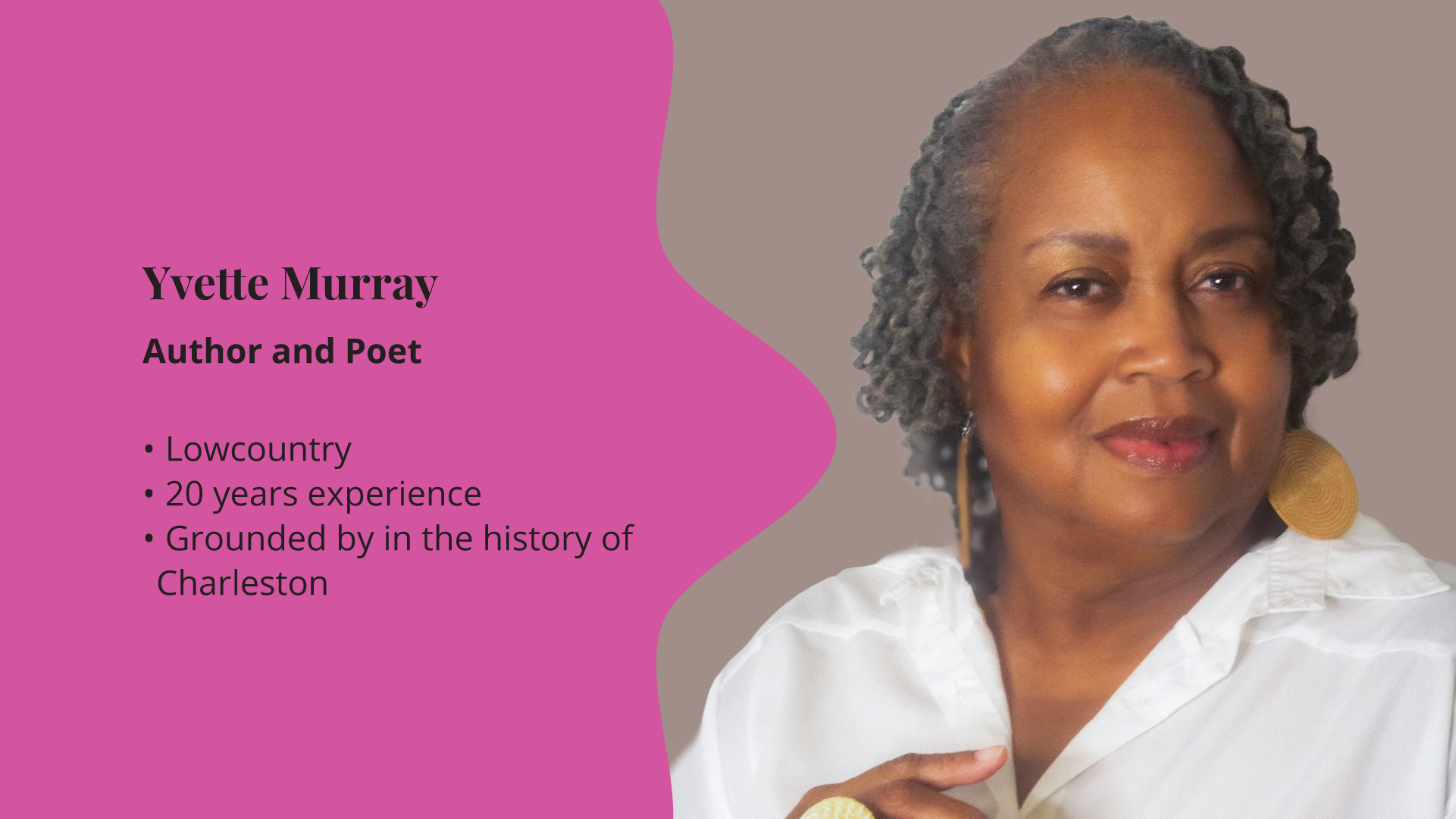
Hi, my name is Sarah Jane Thomas, and today we are talking with Yvette R. Murray, a professional creative working from and within South Carolina. As we get started, can you tell us your current career and where you’re from?
Yvette Murray 00:13
I’m from Charleston, South Carolina, and currently I have a full-time job, as most of us creatives do, but right now I’m a children’s book author and poet.
Sarah Jane Thomas 00:26
Before we go into the details of your profession, we have a brief section of the interview called “One Career, 60 Seconds,” where you describe your job in 60 seconds or less, similar to an elevator pitch. Okay, ready?
Yvette Murray 00:41
Yes.
Sarah Jane Thomas 00:42
Okay. Start whenever you feel comfortable.
Yvette Murray 00:44
Okay. I’m responsible for everything: curating, finding the material, creating it, and at that point, that’s where an editor comes in. But I’m I’m responsible for turning what I see and what I hear into art.
Sarah Jane Thomas 01:05
Well, that was perfect. So, what would you consider your official job title?
Yvette Murray 01:14
An author.
Sarah Jane Thomas 01:15
Author. Okay. So, as an author, is there anything in South Carolina or where you grew up, that you bring into your work
Yvette Murray 01:25
everything. My first book of poetry was literally about the neighborhood that I grew up in, and neighborhoods I grew up in downtown Charleston, and neighborhoods in downtown Charleston, and my children’s book is called “Celebrate We Galagici. So it’s all about everything that children can see. The book is my publisher is an educational publisher, so the book teaches little ones about their five senses through things that they know and recognize and and have seen and experienced. So it’s it’s all about the Low Country.
Sarah Jane Thomas 02:12
Do you think that this brings a diff different aspect to your work compared to people that maybe don’t live in South Carolina,
Yvette Murray 02:21
yes, because what they what they bring is research. What I bring is experience. There’s a section in the book. It’s on smells, and I am literally describing my mother’s garden from when I grew up, literally the plants, everything. So it brings a level of authenticity that can’t be duplicated. It can’t be recreated. They may write a nice book. They may write an authentic book, a book that’s full of facts that are true, but they don’t bring the the love and the timing of having been here, having walked these streets, experiencing the dismay when you see neighborhoods destroyed. They don’t. They don’t have that, and you can’t. You can’t teach that.
Sarah Jane Thomas 03:25
That’s very beautiful.
Yvette Murray 03:26
Thank you.
Sarah Jane Thomas 03:27
Do you think there was a defining moment in your life that had such a big impact on your creative journey?
Yvette Murray 03:35
Actually, a conversation that I overheard at a poetry reading, we were-they were discussing downtown, and the person said, “Don’t you think it’s better than just a bunch of burnout old buildings? And that really struck me because he thought that’s all these neighborhoods were. That’s all that was here. Not even understanding the businesses. The I called my neighborhood an enchanted urban forest, and I said that because the neighborhood had everything. You know how a forest is an ecosystem, and all the little animals, the little bugs, everybody works together to make it work. And that’s how the neighborhood was, and that’s how all the neighborhoods were. There are tons of businesses that used to be there, and they created an environment where everything you needed was there. There was a lawyer. There was-I am old enough to know there was a fish man that would come by. There was a lady down the street that did. The lady next door made quilts. Everything. There was actually a school right across the street from me, and I just wanted to capture that. I wanted to capture what was in those neighborhoods and speak up for those neighborhoods, just because you know that person said that.
Sarah Jane Thomas 05:22
That’s cruel, honestly. It is. It
Yvette Murray 05:25
is because no neighborhood is that. No neighborhood that becomes a blight, torn down. No neighborhood was always that. People live there. They raise their children there, and that was just really short-sighted, and I couldn’t let that pass.
Sarah Jane Thomas 05:48
Well, that’s a very good head mindset that you have to do that. Do you think that there was a? I know you’ve talked about your book about the five senses. Do you think there was a particular project that you produced that really showcased your creativity.
Yvette Murray 06:05
Yes, the book started as just the first chapter. It was a board book, and it won a contest. And part of winning the contest, you got to meet with publishers that would consider maybe publishing your book. So when I met with the publisher, you know they were excited. They want to move forward, but because my publisher is an educational publisher, they wanted to. At first, they were going to do five different books with the five senses, and then they combined it into one book with a different trim. Born books are little like this, and they wanted to combine it, and so we did. But the creativity, I guess, the authenticity showed through. They could see that I really knew what I was talking about, and I cared about it. See, that brings back to your other question. That brings a level of care and concern and diligence, attention to detail that somebody else wouldn’t be able to duplicate. Someone not from here. They didn’t really care.
Sarah Jane Thomas 07:20
It’s unique to you.
Yvette Murray 07:22
Yeah, we had some really interesting conversations. Me trying to explain what the fiddler crabs sound like, what pluff mud smells like. We have a pretty unique area of the country here.
Sarah Jane Thomas 07:39
Yeah, I’m not native, but I’ve been I grew up in the South all my life, so I love hearing all of the little niche uniqueness that South Carolina has, specifically South Carolina. It’s beautiful.
Yvette Murray 07:55
Absolutely, I’m glad that you’re
Sarah Jane Thomas 07:57
bringing that into your work.
Yvette Murray 07:59
Thanks.
Sarah Jane Thomas 08:00
Before entering your field, did you have any fears about becoming a creative professional?
Yvette Murray 08:06
Oh yes, yes. We all suffer from imposter syndrome. Even after I’ve seen authors that have numerous, numerous books, numerous prizes, still get nervous. Still be afraid. You you don’t know how to make it. You don’t know what to do. A lot of creatives teach. In addition, because you know they get the summer off, so it kind of works. They have time, but you just you don’t know how to do it. And the interesting thing that I’ve learned is that everybody does it differently. You have creatives that they may be a poet, but they also paint. They also make jewelry. They also sell soap. They, you know what I mean. So there’s so many different ways to do it. They make films. I have a couple of really wonderful poet friends of mine that have made films, short films. So it’s you can explore all of your creativity, all of the things you figure, oh well, maybe I could try this. Yeah, you sure can. You can try it all, do it all, and still stay true to what your main love is.
Sarah Jane Thomas 09:33
What inspired you to move beyond these fears? If you have,
Yvette Murray 09:39
you almost have to. People talk about the muse inspiration. I’m not a person that believes that I can only write when I feel inspired. I believe that you can get yourself into that state of being able to hear the muse. So to speak, at any given time, you just need some quiet and little little time to get yourself into it. But it’s almost like the stories have to be written. I like to say the ancestors want their stories told, so you will just. I know for me, sometimes I’ll hear a line. 4o’clock in the morning is a good, good creative time for me, and I’ll hear a line if I’m kind of awake. That in between wake and sleep state, I think it’s the theta state that you’re in just super creativity, and it’s just coming. That’s why you see so many creatives. They always have a notepad, or they’ve got tons of notes in their phone. It’s like the stories want to be told, and we’re just the vessels of the story. Whatever creative endeavor, if it’s art, if it’s poetry, like I write children’s books, short stories, whatever it is, it it wants to be written, and we just have to be open. We have to be open to what’s coming to us. I know that sounds really woo woo, but
Sarah Jane Thomas 11:20
you just gotta listen.
Yvette Murray 11:22
Absolutely, absolutely gotta listen.
Sarah Jane Thomas 11:26
Well, do you have any advice for young adults or students who also want to pursue poetry?
Yvette Murray 11:33
Oh, I got lots. The first one is do it. Whatever you want to do, do it. But always be a student. Always be willing to learn and to listen. You know, everybody’s got this idea of an artist, a flaky artist. But we have to. We are flaky. That is who we are because you know we are who we are. But Always learn, never stop learning. And I had a teacher in college that gave me the best advice. He said, “Yvette, a writer writes, and you write, write, write, and you cut, cut, cut, which is true. And just just keep at it, keep learning, explore different genres, different art forms, but just stay at it and develop a thick skin. Yeah, it’s it’s a numbers game as far as submitting. It’s a numbers game, and I still remember the moment when my book of poetry, which came first, was accepted for publication, and in my head it was like, well, there it is. It just happened, and it’s like that. You do and you do and you do and you do, and then one day you get accepted. One day you get into the fellowship, one day somebody wants to buy your artwork. You just got to keep at it.
Sarah Jane Thomas 13:06
Do you think there’s a particular skill one should learn before stepping into something like that?
Yvette Murray 13:12
I would say learn the business. Whatever, whichever part you’re, whichever art form you’re pursuing, learn the business, learn how much people do charge, learn how get your speak with an accountant so you understand what receipts you need to keep, how you need to do things. Because when it all boils down, it is a business, art, creativity. It is a business, and look for grants. Don’t be afraid to look for grants.
Sarah Jane Thomas 13:46
Yeah, there’s lots
Yvette Murray 13:48
out there.
Sarah Jane Thomas 13:49
Wonderful advice. I just want to thank you so much for sitting down and talking with me and offering your insights. Would you be open with talking to somebody from our team again?
Yvette Murray 14:01
Sure.
Sarah Jane Thomas 14:02
Perfect. Well, thank you. I hope you have a good rest of your day. This one, I hope you do. Okay. We’ll send over a transcript for your approval, and somebody will be in contact with you soon.
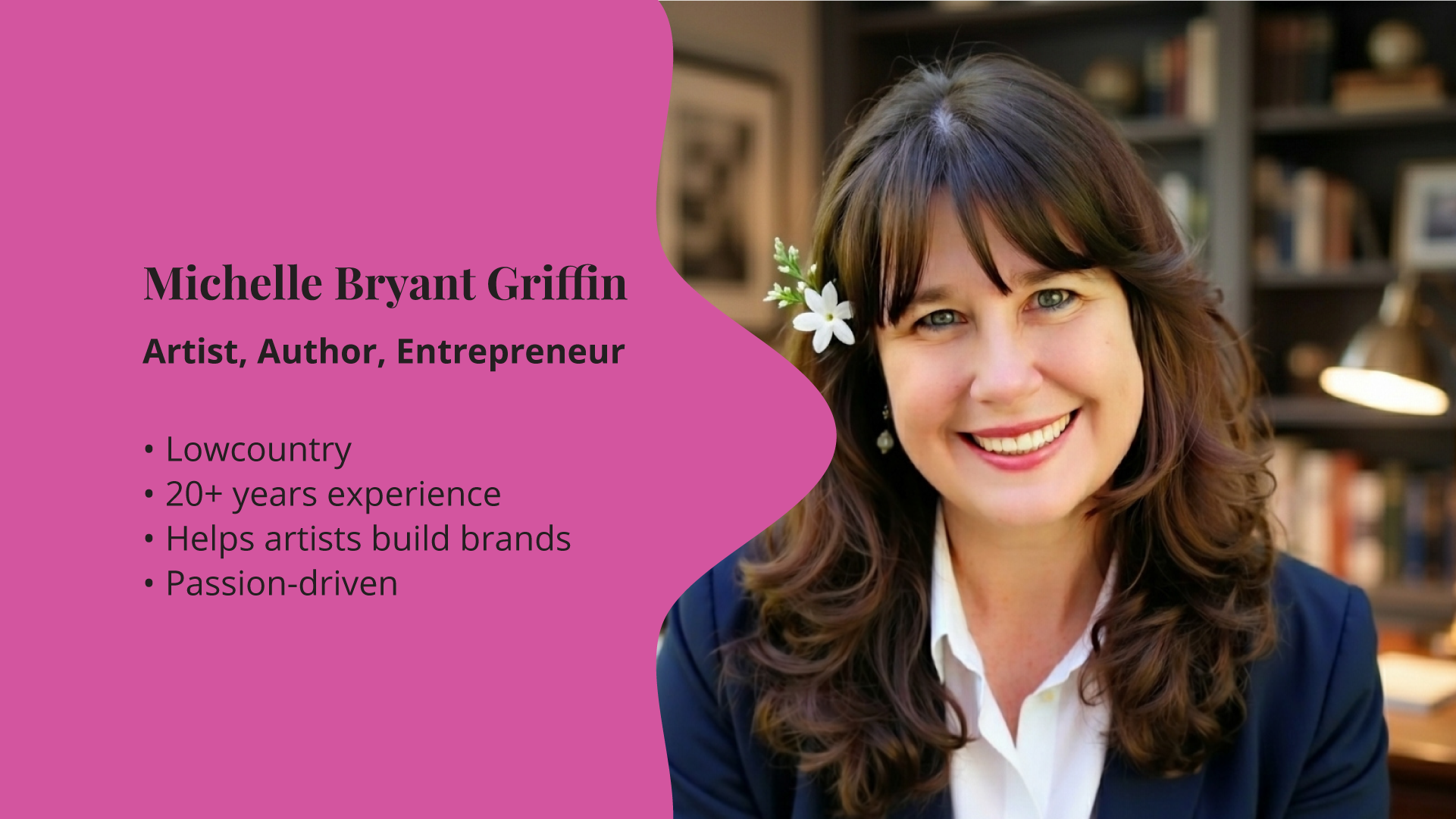
Hello, everybody. My name is Victoria. And today we are talking with Michelle Bryant Griffin, a professional creative working from and within South Carolina. As we get started, can you tell us your current career and where you’re from?
00:14 Michelle Bryant Griffin
Yes, I am a business branding specialist, business developing specialist, and I am in the Charleston, South Carolina area. I service all over the United States, but I’m based in the Charleston area.
00:33 Victoria Bartolotto
Awesome. Before we go into the details of your profession, we have a brief section of our interview called One Career 60 Seconds, where you describe your job in 60 seconds or less, similar to an elevator pitch? Are you ready?
00:45 Michelle Bryant Griffin
I’m ready.
00:46 Victoria Bartolotto
Alright, you can go ahead.
00:48 Michelle Bryant Griffin
So, I don’t just build brands. I teach people how to see their vision, well, not people, dreamers, doers, entrepreneurs, how to see their vision, own it, and bring it to life. I do that through art strategy, speaking, real world guidance, and out of the box ideas. I create momentum that builds confidence and transforms passion into something powerful and profitable.
01:14 Victoria Bartolotto
Awesome. Thank you so much. That was really good. So, in your business, is there anything that South Carolina – you said you were mostly based in Charleston, but you do work worldwide – is there anything about Charleston or South Carolina in particular that brings uniqueness to your work compared to if you could do your job anywhere else?
01:37 Michelle Bryant Griffin
Not necessarily, I could do it anywhere else. I am an ex-military wife, since retired, but it’s something that even if I was still a military wife, I could do anywhere, wherever I lived. I think that gives me the flexibility to work with people, no matter where they are in globally, or in their journey, whether they’re just getting started or they’ve been somewhere. I don’t want to say business, and their brand for ten, fifteen, twenty years, and now maybe they’re stuck, so I get that transition mobility kind of thing.
02:26 Victoria Bartolotto
Is there anything about Charleston in particular that you’ve liked rather than any other place that you’ve lived before?
02:34 Michelle Bryant Griffin
Well, I have either lived in or been to all fifty states, and I love the beach, so I have to be near the beach. I do like that Charleston is a coastal town, and I love that I can be in Memphis in a day, I can be in Virginia in a day, I can be in Florida in a day. I can go anywhere and take a day trip and be in a whole other town or state, and that’s very cool. So, I like that.
03:06 Victoria Bartolotto
So, in helping people discover their creativity, or explore their creativity, or brand it in a way that represents them, was there a defining moment in your life that had an impact on your own personal creative journey?
03:22 Michelle Bryant Griffin
Yes, I grew up in a house full of creative intellects, and so I’ve always been in a creative household. It kind of set me back in that I didn’t think that I was ever as good, or there’s always people out there that are better. So, I just kind of was a wallflower. I just do this for fun, and it wasn’t really until later in life that I realized I did have a gift, I did have a talent, and started just stepping into those gifts and talents, and branching out, and offering that to the world.
04:06 Victoria Bartolotto
Was there a particular project or client that you helped develop which showcased your creativity in a way that it never had before?
04:17 Michelle Bryant Griffin
Yes. First of all, I love what I do. I love when somebody comes to me with an idea and we birth it, we bring it to life, because especially when it’s they’re just getting started. So, they basically have ideas on a piece of paper. We come up with color, brand colors, and logo designs and everything, and it just starts to bloom, and I love that. I get so excited, like it’s my baby too.
But I had one client, and she had a chicken salad recipe that was her mother’s, and she was certain it was the best chicken salad you ever ate. And before she even started, she did a blind taste test. She went to the grocery store. She went to farmers’ markets, and she had people test all these different chicken salads, so that she could really claim this was the best chicken salad you ever tasted. And we came up with a logo for her. It’s now been trademarked, and she’s in grocery stores. A logo that I created is now in grocery stores, and it was very, very cool. She has since passed away, but it was a very defining moment for me in my career to watch that dream of carrying on her mother’s legacy into carrying on her legacy and making that dream come true for her, and then it being a trademark, and seeing it. I did this, we did this. It was amazing.
05:55 Victoria Bartolotto
Yeah, especially that it’s something that you can touch too when it’s out on a product, and you’re like, “I helped create that.”
06:01 Michelle Bryant Griffin
It’s like when you bring a baby, your very first child home from the hospital, and you’re like, “ We made this.” That’s exactly what it was like. It was very cool.
06:11 Victoria Bartolotto
It’s a surreal feeling.
06:13 Michelle Bryant Griffin
It really is. And even though it wasn’t my product, it wasn’t my business. I get so involved in what I do that it’s a part of me and so I was just as thrilled as she was.
06:28 Victoria Bartolotto
Yeah. Before entering graphic design or development, did you have any fears about becoming a creative professional, about having your income depend on creativity, and if there was that some kind of fear, what inspired you to continue beyond it?
06:47 Michelle Bryant Griffin
Well, actually, yes. When I was in high school, I got three scholarships in high school. One was for journalism, because I’d already been published in writing, and I had won two art awards, and so I had all this talent.
I didn’t know what to do when I’m eighteen years old, and it’s like, “what am I going to be for the rest of my life?” It was so overwhelming, and I went to art school for a while, and I lost my scholarship, and because it was very, very difficult, and I ended up pretty much doing nothing. Like I said earlier, art was just something I just kind of did for me. It was just a fun kind of fun. I’m not really that great.
Then I started dabbling a little bit, doing logos and business cards and flyers in the eighties, when it was called desktop publishing, and I didn’t really make a living at it. I was just like, “Yeah, I can do that for you.” I worked for some print shops and some newspapers, and it wasn’t really until I moved to Charleston.
I got divorced in my fifties, and was kind of like, “Okay, what am I going to do?” I don’t really have anything more than some college. I have a high school education and some college, but I have all this talent, and I became a CNA. I was working, doing elderly care, in-home care, and when I moved to Charleston, they wouldn’t trade my license over. I would have to go back through the whole nursing training again, and my ex-husband was like, “You’re an award-winning photographer. You’re in a beautiful place, do something with it.” So, I entered a couple photography contests and won, and so I started doing something with that.
I had to find a niche, so I started doing boudoir photography for women over forty who kind of felt like they didn’t have it, and that led to a magazine called Focus on Fabulous. Before I started that, I looked and there was nothing like it. I spent hours at Barnes and Noble, and in the supermarket, and there was nothing. I mean, I had piles and piles of magazines, and these were real women, everyday women, and their stories of struggles and survival and successes, and I was tooting their horns, because as women we don’t do that enough, and that’s what this magazine was. For ten years, we found these stories, and we showcased these women, and I look back over these issues of thirty something issues, and some of these women are no longer on this planet and their stories are now told and shared with the world, and that I think is one of my greatest accomplishments.
During the pandemic, of course we couldn’t go anywhere or do anything, so I was going through my websites. I was sitting at home with nothing to do, and I found some links that were broken, and a couple of things that didn’t work right, and I was like, “Gosh, I wonder if anybody else is so busy running their business that their online presence is falling apart?” And so, I just sent a message out to social media, “Is anybody else having this issue, I can fix it for you.” That’s when Fabulous Business Solutions started, and I started just reaching out and helping people with their online presence. It just grew from there to, “Hey, I’m stuck in this, or I’m having this event, and I need this.” It’s just one thing kind of morphs into something else, and that creativity is just kind of grown into this purpose that I think I was destined for all along, and didn’t even realize.
10:33 Victoria Bartolotto
It is kind of like that snowball [effect] where it keeps rolling and rolling until you got this huge amalgamation of networks and projects, and that must be such a fun feeling.
10:43 Michelle Bryant Griffin
When you’re young and you’re looking, and you’re like, “I’m so overwhelmed, I don’t know.” You get older and you’re just like, “Uh, whatever. I’m just going to go with the wind. I don’t care, what the heck, what have I got to lose?”
Yesterday, I went with some friends to Beaufort. We went to the kazoo factory, where kazoos are made. One of the kazoos on it, if you’ve ever blown a kazoo, they’re very loud, and it says ‘live out loud’ on it. I thought, “That’s me. I’m going to live out loud.” I think that’s something that comes when you get a little older, with little more years under your belt. You’re just like, “Yeah, what the heck, I’m just going to throw caution to the wind and go for it.” So, I don’t know if that answered your question. I knew that was a lot in there.
11:32 Victoria Bartolotto
No, no, that was great, because I know it’s hard to get yourself into it, and to just start it because, there’s the whole thing of, “Oh, what if it doesn’t work, what if I don’t make it?” But it always kind of works itself out, and I feel like that is what happened to you as well, is that it kind of just–you found where you needed to be.
11:55 Michelle Bryant Griffin
Well, and that overwhelming feeling, at least for me, and I’ve noticed for other people too, sometimes that overwhelming feeling makes you end up doing nothing, which is what happened to me when I was eighteen.
So, I’ve actually created a dreamer’s course, I call it the dreamer’s course, because whether you’re an entrepreneur or a business owner or an author or a writer, or a crafter, you’re a dreamer, you’ve got a plan, you’ve got something you’re trying to accomplish, and it can be overwhelming.
Do I need this? Am I an LLC? Am I an S Corp? Do I need contracts? So, I created this course, and it’s not super long. You can do it in an afternoon, and it’s on my website. I can do it with you. We can do it with a couple of people. I do it in classes with several people. I teach it, or I do one-on-one. That’s what it does is it answers some of those questions, it’s full of resources, and just kind of helps you walk through the process of where you need to go and what you need to do. I wish that I had had something like that when I was younger, just to kind of check some boxes, and okay, did that, got that. I’m kind of a list-maker and a note-taker.
13:13 Victoria Bartolotto
Yeah.
13:14 Michelle Bryant Griffin
I love it. I think I was like, “Gosh, I think there’s a lot of people that could really use this.” Because they do. You get so wrapped up in your passion, then your purpose, that you forget the principles, the basics, and you’re like, “Oh, I forgot about that, you know?
13:34 Victoria Bartolotto
Speaking of the younger generation, and young adults wanting to get into creative fields, but feeling overwhelmed. Do you have any advice for possible young students or young college kids who have an interest in pursuing a creative path, but not really sure where to go with it? Are there any particular skills or mindset that they should have before entering the industry?
13:57 Michelle Bryant Griffin
I do, and actually, I’ve written a book. I’ve written eleven books, but I have this one book that I wrote, but it’s called Rise High, Stand Tall. I just did a book signing, so I don’t have one in front of me, but anyway, it’s on Amazon. It’s on my website. It’s a book basically, for that. It’s just ten little tips for anybody in business, and it’s all the things that I learned the hard way. The two biggest things that I can say, and, like I said, there’s ten basic things in there, but the two biggest ones for me were: don’t be afraid to fail.
Michael Jordan failed a gazillion baskets before he made a lot, but if he’d have not gone into the NBA every time he failed, and he wouldn’t be the star that he is today. There’s a lot of people, Walt Disney and Henry Ford, and dozens of people who failed numerous times before they made it. Learn from your mistakes and your failures. And I failed numerous times. It’s easy to say, “Oh, I suck at this, maybe this isn’t right for me.” Maybe it isn’t, but don’t give up immediately. Kind of just address it, and so don’t be afraid to fail.
And collaboration. Collaboration over competition is huge. Find somebody who does what you do; you can collaborate and not be a competitor. You and I can both do the same thing and still help each other, because we see things differently. We’re different ages. I mean, when I had my magazine, on my board, I had people that were old as my mother and younger than my daughter, because I wanted all of those viewpoints in the core of my magazine. We can learn from each other, and that collaboration is huge. We’re stronger together, and so there’s a lot of tidbits like that in there.
The biggest one for me was delegating. I’m the oldest of eight, and so I was born a leader, and I know I talked to so many people, especially if you’re just starting out, like “This is my baby. Nobody’s going to love it like me. Nobody’s going to take care of it like me. Nobody’s going to be as passionate as I am.” That’s the way I was with most of my businesses. It’s like by the time I tell you what I want you to do, I could just do it myself. But truly, once I delegated, oh my gosh! I had so much less stress, and I had more time to do what I needed to do, where my talents and my gifts were. I could build my magazine. I could do InDesign. I hated it. It was awful. I pushed one wrong key, and then it took me two hours to undo whatever was I did, because it was just that.
But I hired somebody, and I would just throw the words and pictures on a page and say “I want it to look like this.” She had little magic fingers, and she would make it beautiful, and that was wonderful. I had a vision. She stirred in the pot and made it beautiful. Once I delegated it, my vision came to life, and I didn’t have to stress about it, and it didn’t take me one hundred years to do it.
So, don’t be afraid to delegate. That’s huge. And then you can do what you need to do, without getting burned out. Yeah, those are three big things I would really, really encourage.
17:53 Victoria Bartolotto
Well, thank you so much for taking the time to talk with us today. I sincerely appreciate it. I hope you have a great day.
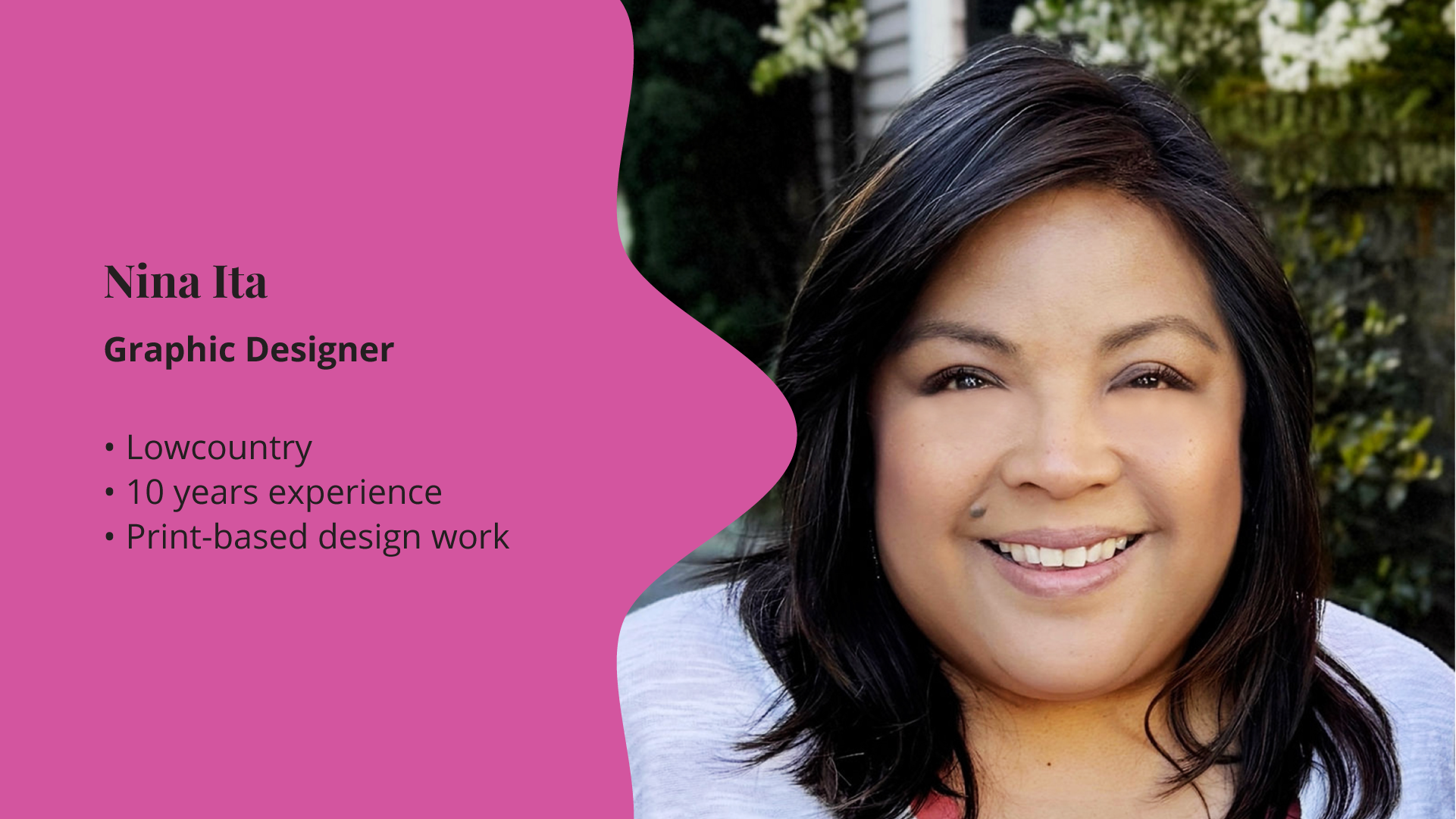
My name is Alli Crandell, and we are talking with Nina J Ita, and she is a graphic design professional in South Carolina. And as we get started, could you just tell us your current career and where you’re from and where you’re currently living?
Nina J Ita 00:14
Sure, I’m a graphic designer at A&E Printing. That is my full-time job in Charleston, downtown Charleston. I grew up in Goose Creek, which is a suburb of Charleston. Everybody says they’re from Charleston, but it’s always like part of a – they’re not really from the city, and yeah, I grew up here. I still live in Goose Creek and went to college here, so just never left. But I love it; it’s a fun place.
Alli Crandell 00:47
That’s excellent. And so I know that you know graphic designer holds a lot of different, you know, like spaces. So what bucket? I know if you have had a chance to look through our Uncharted website, what bucket would you say that you’re in?
Nina J Ita 01:00
Um. Oh, probably. yeah. Just I’m really production designer a lot of the times just through the nature of my job, but quite often there’s some pretty fun creative jobs that come through where I get to start from the beginning. I’m really good at picking up where people have left off, or like somebody has started a brand guide, and then I just have to continue do a lot of researching. So like researching is real. Just seeing, you know, what have they done? Can I match the fonts? Can I match the colors for continuity? Their style, their design style. So it’s kind of different every day. I work for a medium-sized print shop in Charleston, so and I am the sole designer there. So I do a lot of file checking for people, their files that come in, and but I do a lot of design, mostly prepress too, and you get to see what people don’t know the technicalities, and it’s very important to know how to design for printing. But but yeah, I do a lot of everything. It just the date can differ. I can be doing a bunch of boring things, or I can be doing something hopefully that’s really cool that I get to do from start to finish. So that’s basically my job. Yeah.
Alli Crandell 02:33
yeah. And so I’m going to ask you to just kind of like revisit that a little bit, if you don’t mind, just because we talk with a bunch of middle schoolers and high schoolers, all who have no idea what you know a creative career set really looks like, and so when we say graphic designer, there isn’t like a strong like sense. So we have
Nina J Ita 02:53
this
Alli Crandell 02:53
kind of initiative that we’re calling One Career 60 Seconds, where I know where you describe your job to somebody who might not know anything about design or it’s like or what your work is, similar kind of to an elevator pitch. So would you like to give it a try?
Nina J Ita 03:14
Sure. Oh my gosh, I’m going to sound terrible at this. Okay, I’ll go. So basically, my job is I am given an objective of a message to send to somebody. Like there’s a sale. These are, or if it’s like a menu, this is what we are offering. So we have to match the personality of the business, the look that they have already presented, or sometimes we are creating a look that’s a brand for the company. So that includes colors, fonts, type styles. Are we left aligned, right aligned? Are we traditional? Are we a little bit, you know, more abstract, funky, you know, more feminine, more masculine in the middle, and designing a piece that can be usually for me printing printed. So there’s technical issues and a piece that the customer is happy with that conveys the message, and most importantly, that people can look at and understand because that is the whole point of graphic design. Graphic design should not hinder communication; it should make it flow. I always say, if you’re stopping and like, what in the world am I looking? I don’t even know where to start. It’s not in design. If you don’t notice it, it’s a good design is one of my things that I always tell people. That’s pretty much it.
Alli Crandell 04:48
Thank you. I want that on a T-shirt.
Nina J Ita 04:50
Yeah. Okay. I like to. Yeah. Yeah. I always tell people. I’m like, oh my gosh. Like you know, when people are stumbling like at a restaurant again. A menu, and they’re like, I don’t know where to start. It’s because there’s probably no hierarchy. It’s not organized well, and you know they’re just doing all kinds of things. Like they’ve got bullet points over here and a list over here, and you just don’t know where you’re going. There’s got to be a certain flow to things. So those are things that are important that you notice once you become a more seasoned designer, and you’re like, “Oh yeah. One of my favorite things at my job is to take apart what somebody’s done or try to do in programs that we won’t talk about, and put it back together in a better way. And that’s I always say like I’m just here to fix a problem, and usually the problem is either we don’t have something to design, so we need somebody to do it. Who knows what they’re doing? I tried and I failed. It’s not looking good. It’s not like what I want to look like, or it’s not printable. Can you make it printable? Doesn’t have bleeds, naked bleed, and all that kind of stuff. It’s missing the right bleed, so all this kind of fun stuff is basically a problem fixer, is what I. And so people
Alli Crandell 06:12
come to you kind of like in a panic, it sounds like. And
Nina J Ita 06:16
yes, yeah, and that’s in. So some of our business is just like straight printing, so people will provide files. They have their own designers, but there’s a lot of there’s a disparity between some designers who can make things look great versus they don’t know the technicalities of like you have to make the artboard the size, the final size. You have to add the bleeds. Like you can’t just plop it in the middle of a big artboard and then call it a day because printers, small printers or big printers, won’t take files like that. You have to have them a certain way. My boss always says design with the end in mind, and that’s one of the things. Not only your mission, but like your print specs, like I always ask in the beginning, like okay, what do they need so that I know, so I’m not doing anything, not having to you know work it back to fix a file later on. Yeah, but some people, I mean, I find it fortunate that this was my first job and well, real job and design was at a print shop. You learn all the technicalities, but then you also see what other people don’t know, and then you learn from their mistakes of what not to do, and then you also learn how to fix it.
Alli Crandell 07:36
And I mean, I find it really intriguing that like you’re from Goose Creek, and then you decided to stay in Charleston. So, like, yeah, what impact do you think that this, like, the peninsula and the Charleston region have had on your work?
Nina J Ita 07:50
It’s just, I was actually wanting to go to Clemson. I was expected to Clemson, but my mom was a little protective, and she wanted me to stay closer to home. So and Clemson has a great graphics program too. So I don’t even know if I would approach it because I was looking at computer science, honestly. And I did do that in at College of Charleston, but I could not. I was not hacking it, so I switched to business and found marketing. But yeah, it’s the you know the hospitality industry was huge. That was one of my first jobs. There’s a lot of great artists that came out of Charleston, and there’s just so much beauty around that. You know, I see water every day I drive to work, which is cool. It’s just a blip, and probably should be paying attention. But it’s over there, and it’s just nice, and I like being downtown. There’s like a different vibe. It’s changed a lot in the like I’m older, so it’s been 25 years since I started going to college. But yeah, it’s just as inspirational. There’s always something going on in Charleston. So, do
Alli Crandell 08:59
you ever encounter something like a project that you’ve worked on, like it’s since you’re.
Nina J Ita 09:03
I do all the time. Yes, I do all the time. I can drive up the street on King Street, and then I’m like, oh yeah, I did that. I did that sign. We did, you know, we worked on the lettering for that hotel or the window signage. So yeah, it’s kind of all over, honestly. Even like boring things like the you know real estate signs, you know like developers. I mean, it’s nothing big, but it’s like, hey, if it gets your your building sold or leased out, then then it’s effective. So yeah, that’s I’ve seen I’ve seen stuff, and you get to see
Alli Crandell 09:42
as you were saying like the design is communication. It feels just like you know you get to see the impact of what you do
Nina J Ita 09:48
exactly, and yes, for sure because I I try to you know educate people, you know like if I’m sending a proof for like a sight sign. And I don’t just send. I mean, I’ll send them the artwork, but I also put it in a mockup so that they say, “Okay, that’s what it’s going to look like from you know from the street. You know, or like people that are wanting to put QR codes on a sign that, and like there’s no space, and I’m like, they’re driving by, like they nobody is going to capture it at that speed. So maybe we don’t, and maybe we just make your name really big because people will have your name if they’re interested top of mind, and then they’re just going to Google it and then find you. So things like that are helpful for people and for me too because sometimes you just don’t understand the space until you mock it up and go, okay, yeah, that’ll work. So,
Alli Crandell 10:43
and so I was kind of curious, like with something that you said earlier. You know, it’s like we’re trying to like find. You know, it’s like if there was a moment of impact in your life, and you mentioned that like working within a print shop, like that your first kind of design job was in a print shop. You’re working in a print shop now. What was what was that? What impact did? And you kind of mentioned a little bit about the impact. Is that the biggest impact in your design career, or is there another moment?
Nina J Ita 11:05
That over the years, I as I, you know, freelance also it kind of has influenced that just education because you, I went to you know I went to school to learn how to use the back to school, rather, I tried in tech to learn how to use the program efficiently because I was like not doing it right. I was using Photoshop for no good reason, and just because that was all I had, and I was like, “What in the world is InDesign? Like, how this is insane! Like, I could not figure it out until somebody sat me down and learned it, but really, your real learning is in the real world in Google. And I mean, I you learn a lot of things in school. It’s important, I think, to go to school and learn. But really, when you’re out there and just kind of making a mistake or learning from, especially honestly, learning from other people’s mistakes has given me more of an education. Yeah, but like, thank goodness for Google. It’s just yeah, there’s so much that you can learn, and like, oh, I didn’t even know. In following, there’s started a tab on Instagram like Illustrator Tips, and it’s kind of just merged into Design Tips. And I’m like, oh, I didn’t know because it’s hard to keep up with all the new things that they’re adding, new features that they’re adding. So I’m like, oh, I’ll try to remember that that’s there. But I try and go through it every now and then, and then I’ve had to refer a couple times to some like new techniques, so the information’s out there. Is you just have to you know look for it and save it and hopefully remember it, but it’s out there. Yeah, I think
Alli Crandell 12:52
that that’s yeah. I mean, it’s it sounds like amazing, and it’s like in so many resources that are out there. And so, can I ask a little bit in terms of like, what made you make the decision to go back to Trident Tech to get familiar with the software programs?
Nina J Ita 13:06
Yeah, sure. Well, I was just getting frustrated without knowing because it’s really frustrating. I mean, there was like, was it lynda.com? I think that was, but I think you had to pay in the books. It was just kind of I don’t know. It was just frustrating for me to learn that way, and I just really wasn’t happy at my other job. It was it was fun. It was you know great benefits, but I wanted to do something. I always wanted to be a designer. I think, especially in when I was taking marketing courses and doing advertising, and I was like, “Oh man, that’d be cool! Like, you know, to come up with an idea. But I wasn’t like, I’m not an arty kid. I wasn’t drawing. I need to draw a little, but I was like mostly just. I remember drawing Fred Flintstone from scratch. I’m like, “Oh, pretty good. But it’s not. I wasn’t doodling everywhere. Nothing like that. But I did like things to look nice. I like things to look pretty. So, especially when I was we were doing the Asian Student Union, we were making those posters. You know, just oh my gosh, it was terrible. Like we would just photocopy them, you know, and just slap them all around. But I mean, it was something. But even then, I didn’t even realize I was, you know, doing the hierarchy of like big title, you know, like a subhead, and just I was like, I kind of had it ingrained somehow. I must have just picked it up from, you know, seeing signs elsewhere, but it was something I wanted to do. And I was like, I had taken like classes a little at a time, and the stumbling blocks in the beginning were like those beginning classes of like drawing and like color theory, because it was so it was. Pretty much foreign to me. It was as if I was taking like biology, in a way, and it was just we have to just get through it. And I’m glad I did. And then yeah, once we got into the nitty gritty of it, I was like, oh, this is cool. Like you know, this is oh that’s how you make shapes and Illustrator and you know the Bezier curve and all that. You know that stuff. I was like, “Oh my gosh, this is so challenging! And then mesh, gradient mesh. Yeah, I was like, “Oh my gosh, that was tough. And my eyes, you know, were dead after that. But I did it, and then I just had to go full steam to finish, and I had to quit my job because the upper level courses were during the day, and I was like, no way I could. They were pretty strict about time off, so I was like, okay. So I just saved money and did it, and I was like, I hope I can find a job, and and also like networking helped because I just happened to go there and be like, hey, I need a job, and I think I was there to print my portfolio showpieces at Annie, where I work now, and then yeah, and then they called me a couple months later and like, hey, somebody’s leaving, you know. So that was great, and I got hired, and then I’ve been there ever since. So it’s been a long time. So it worked out, thank goodness. I’m sure it would have worked out another way, but I’m glad this was the route that happened.
Alli Crandell 16:24
And I mean, I think that you just spoke so well to like, you know, it’s like that kind of like fear, right? To like jump in, and I mean, that must have been a huge decision for you to be like,
Nina J Ita 16:34
oh yeah, it was. Yeah, my dad was like, “Are you crazy? Like, you have a job? Like, and I don’t even know if he fully understands like what I do now, but I’m like, I’m okay. I’m you know I’m doing the job I have benefits. You know I’m I’m good. I’ve kept clean shop for you know over 13 years, but yeah. And it’s also I’m Filipino, so you know I’m my brother’s software engineer. You know my cousin’s a dentist. You know everybody’s like has you know like fancy careers, and I mean I love what I do. It really is fun. It’s kind of what I dreamed of when I was a kid. I didn’t know what I was going to do, but I just imagined myself kind of in a in front of a computer or sometimes you know, just taking stuff off, and every time like I put a folder up here, I have a proof folder, you know, so it’s out of my sight, but it’s done. I’m like, man, like I dreamed of this when I was a kid. It’s funny. I didn’t even know what I was dreaming of, but I was like, this is kind of what I wanted to do, so yeah,
Alli Crandell 17:42
powerful. Yeah, and I mean, and so you touch on this a little bit, but what does your family think of your career now?
Nina J Ita 17:48
Yeah, my brother thinks it’s cool. My, I mean, I’m sure I don’t know my dad. I mean, I’m just like, I guess I’m glad she has a job and she’s employed, but yeah, I mean, they think it’s cool. I mean, I’m, you know, I do things for them too, so I create stuff for them. So they, everybody’s like, “Hey, yeah, can you do this? But yeah, sure, it’s fun. So yeah, they like it. Yeah, I was just
Alli Crandell 18:12
thinking about because so many I we when we’ve talked with, you know, it’s like those emerging creatives that they may have that like a similar career where they’re like, I’m not entirely sure what I want to do, but I know that this is like my like exactly as you just said. This is my dream, and so I was just wondering if you had any like words of wisdom for how they translate that to their stakeholders, right? Like their people that are around them and supporting.
Nina J Ita 18:35
Sure. Yeah. I mean, just if if you’re happy, like see what what is their ultimate goal? I mean, I know your parents want you to be a doctor, a lawyer, and because it sounds good, but I mean, if you’re happy, you know you’re surviving, you’re paying your bills, you’ve got hopefully you know decent job benefits, and you’re just trying to make yourself better. Just be happy with that, and don’t compare yourself to other people because there’s always, you know, especially if you’re in a good place or be proud of what you’ve accomplished because there’s people who can’t or don’t or don’t want to push themselves. So you know, just do the best you can and be proud of where you are and always look to move forward.
Alli Crandell 19:22
And for folks that might be interested in joining the design profession, you know, it’s like maybe following your career. What what advice would you give them as they’re thinking about networking or places to think about? You know, it’s like in terms of looking for, like, just to get their foot in the door.
Nina J Ita 19:38
Gotcha. I would definitely, you know, if you’re in school, like talk to your professors and see, you know, who they know. I would, you know, I would recommend a print shop because you get so much hands-on information. You know, we’re not like a press that mixes the inks. And all that kind of stuff. We’re mostly digital. We’ve gotten into sign thing, sign shop, or sign. We do part of it signs, so we’ve learned like the large format latex printers and all that stuff. So that was a cool additional thing to learn. But yeah, even just see if you can intern somewhere and kind of get exposure. Don’t you know? Ask them like, can I just shadow the print production person and just learn about it? Because you’ll really see and start to understand. And I’m focusing on the technical aspect because it’s so important because it gives us a lot of headaches. You know, I mean, it’s either going to cost your client money, or you know, or take your time if they can’t do it properly. But it’s just so important. Like we can always, usually always fix it, but it’s just time and money that it’s going to cost. But you know, I would see what other organizations like you guys seem to have like a good thing going here. I wish we didn’t have anything like that at Tech. There used to be an advertising federation in Charleston. There’s a marketing association, American Marketing Association in Charleston, but it’s more toward like actual marketing, not design. I just went to a great conference, Creative South Conference, in Columbus, Georgia, last month, and they’ve been doing it for 15 years. And they have-it’s actually not very pricey if you want to recommend it to your students. The student rate is like really great, and it’s fun. It’s-it was-it was my first time going. I’ve been watching for a couple of years. The conferences are a great way to network and meet people, and especially if you’re young and ready and wanting to move, the people come from all over. So yeah, just get involved. You know, ask people because you never know. If I hadn’t told my boss like I was about to graduate and I’m be needing a job, do you know anybody? He wouldn’t have known that I was looking for a job. Two months later, I mean, he tried, and if I had a job, I would said no. But I was like, no, no, I don’t have a job. So thank goodness. Two months after I graduated, I got a job.
Alli Crandell 22:22
Excellent! You’ve given such amazing insights and advice just from everything from technicality.
Nina J Ita 22:28
Oh, good! I hope to help, buddy. Yes. Oh my gosh, the technical. Oh my god, I could go on forever, but yeah, it’s very important to know. Yeah, ask always ask when you’re sending a file to a printer. Do you have print specs? And I’m sure they do, or they will tell you this is what we need. And yeah, very important. Make everybody happy. Yeah, make it go smoothly. Yeah.
Alli Crandell 22:55
Well, thank you. Is there anything that I didn’t ask you that you wish I had asked you?
Nina J Ita 23:00
I don’t think so. Oh my gosh, I’ve spoken a long time already. I think I’m good.
Alli Crandell 23:05
Yeah. Oh, excellent. Well, thank you so much for talking, you know, like with us today, and like in sharing these amazing words of wisdom for like our. Oh, good. I
Nina J Ita 23:13
hope. Yeah. Yeah. Perfect. I hope I help. I hope you know you get some great designers out of your program, and yeah, it’s great. I love what you guys are doing.
Alli Crandell 23:25
Thank you so much, and thank you so much for all of your work in South Carolina and in Charleston, and so.
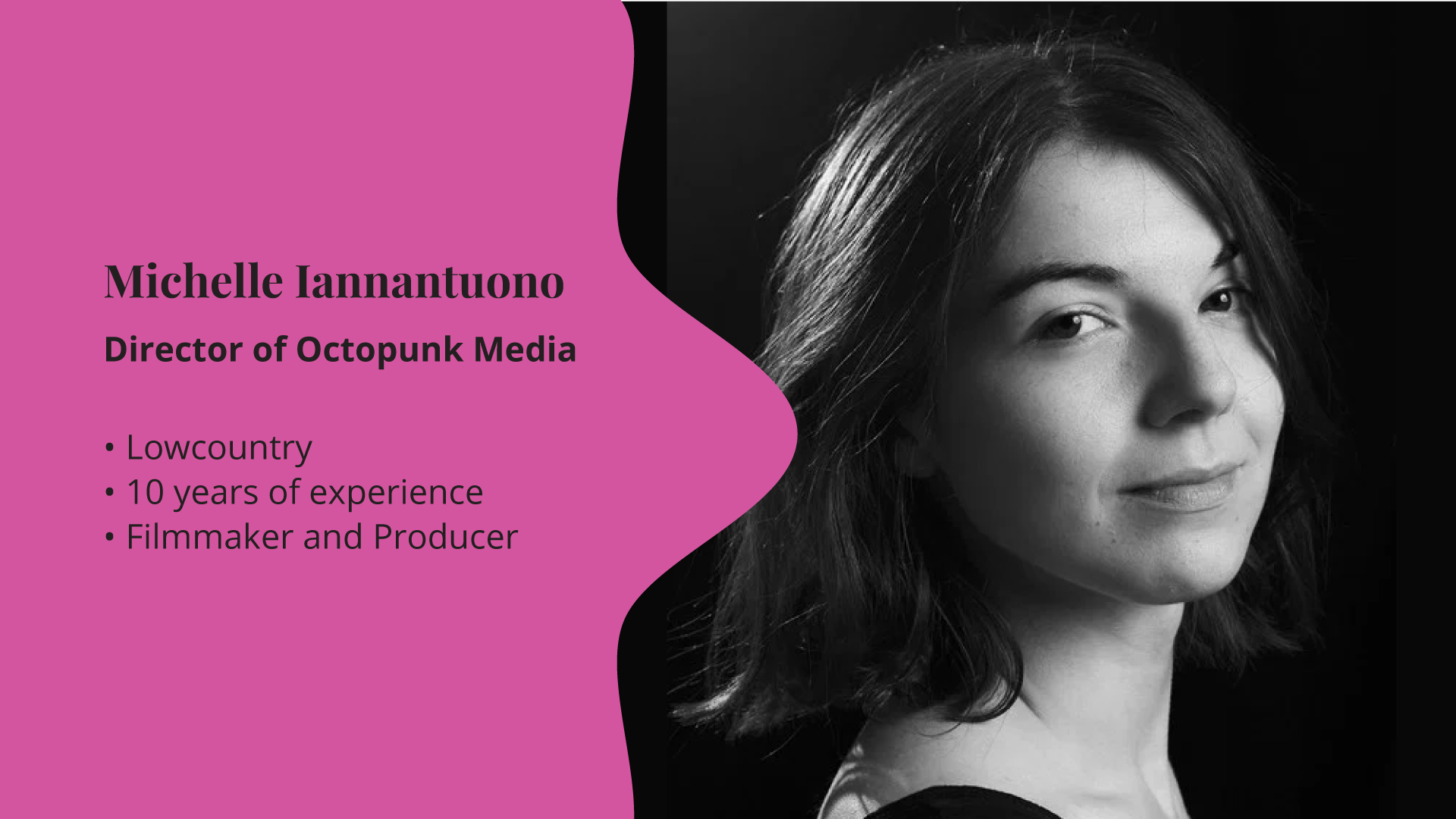
Alright, hello! My name is Ryleigh and today we are talking with Michelle Iannantuono as a professional creative working from and within South Carolina.
As we get started, can you tell us your current career and where you’re from?
00:15 Michelle Iannantuono
I am from Charleston, South Carolina, in the north area suburbs. I am a filmmaker and have been for 10 years. I am making a little bit of a transition into the games industry, I think.
00:29 Ryleigh Kelley
Very cool, very cool.
00:30 Michelle Iannantuono
I’m kind of between this career nexus point right now.
But yeah, the majority of what I’ve done and still continue to do is film and video.
00:40 Ryleigh Kelley
Very cool. So, before we go into the details of your profession, I know you’re talking about a little bit of a career transition right now.
We have this brief section of the interview, and it’s called “One Career, Sixty Seconds,” where you describe your job in 60 seconds or less. I know you kind of briefly discussed about it in the previous question, but this is similar to an elevator pitch.
Okay? Alright. Are you ready?
01:07 Michelle Iannantuono
Oh, I’m actually being timed. Okay, great.
01:10 Ryleigh Kelley
I have a stopwatch ready.
01:12 Michelle Iannantuono
Alright. Yeah, let’s go.
01:14 Ryleigh Kelley
Okay. You’re on the clock. Let’s start.
01:17 Michelle Iannantuono
I am the creative lead and owner of Octopunk Media, which is a film and video production company located in Charleston. I am a sole proprietor, so I do a little bit of everything above the line and often below the line. So that includes direction, writing, producing.
I run a streaming service called Octopunks.tv, which is for our fan community to enjoy exclusives that we produce, as well as our entire backlist library of VODs, films and shows. I’m most known for the feature films Live Screamers, Live Scream, and Detroit Evolution, as well as over 7 or 8 short films over the past few years.
I also take client work on a per-project basis for editing, post-production, that sort of thing.
Or I’m a bit of a Swiss army knife, so whatever you need to put me in, I’ll do.
02:08 Ryleigh Kelley
Okay. That was really great.
You had six seconds left.
02:12 Michelle Iannantuono
I also do Unreal Engine. That’s the other thing.
02:15 Ryleigh Kelley
Yes, yes, yes. I know that. That’s another kind of thing that another part of your background that you do. Obviously we’ll talk more a little bit about that. But yeah, thanks for playing.
So as the director of Octopunk Media and especially with your background in working with Unreal Engine, is there anything South Carolina, or your region in South Carolina, or city in particular that brings to your work?
Does it have a unique influence on you compared to people in the same profession in different states?
02:51 Michelle Iannantuono
Oh, that’s a really interesting one.
So, in terms of film, I think we have a really good community here, especially because of Trident Tech. I have a lot of admiration for Trident. I’ve worked with a lot of graduates from Trident.
My mother actually graduated from there in graphic design 20 years ago, 30 years ago. Then I also have gone through their animation program when the COVID stuff and when the tuition was free.
And, yeah, I wouldn’t have been able to make my SC Indie Grant film, Lotso, without them as well because they fronted a lot of the bill of that film and let us use their motion capture volume and stuff for free.
We also ran an animation practicum for an entire semester where a bunch of students worked on the film. So yeah, I think that that’s probably one of the major places that Charleston has, and South Carolina has that other places may not.
I would say Rough House, the Danny McBride, David Gordon Green stuff is also pretty significant. They kind of have staked their claim on a lot of the film industry in South Carolina. For better or for worse, I think that they do a lot of good for giving opportunities to new grads from Trident and stuff to get on a real set and make union money and that sort of stuff. But I also think that they hire a lot of above the line from out of state.
So, I would like to see more opportunities for directors and writers and department heads to be here in the region as well, particularly from these bigger productions like Outer Banks and Righteous Gemstones and other stuff that’s kind of come to the area. I do think that is a struggle though, even in Atlanta, even in Georgia, they like outsourcing or bringing in from out of town, those department heads and stuff.
We have talent in South Carolina, and I think that we should be given a shot as well. But, yeah, in terms of other influence on the region, I mean, I’ve lived in Charleston for 25 years. I was originally from Wilmington, also a film town. So, it’s kind of just always sort of been a thing for me.
I think that my latest film, Lotso, which was the SC Indie Grant film, takes place in Charleston. It is a cyberpunk Charleston. It is like 2059. King Street’s flooded. It’s all built in Unreal because it’s a fantasy world, but I still sort of am recreating my hometown in there, which is really cool to be able to combine real life references with this sort of sci-fi vision of the future of this town.
As well as the FC&D grants, I should mention as well, that’s another unique opportunity that South Carolina has. You can get up to $45,000 for a short film, and they do that every year. A lot of places don’t have, a lot of states don’t have anything like that.
So that’s a really cool opportunity for short filmmakers to be able to have a significant budget for a short and have access to festivals that they wouldn’t normally have access to and resources and department heads and stuff as well.
06:02 Ryleigh Kelley
Speaking of real life, was there a defining moment in your life which had an impact on your creative journey? I know you talked about how your hometown or Wilmington, or Charleston means a lot to you and is featured in your work.
Was there a particular project or something you produced which showcased your creativity in a way you never had before?
06:26 Michelle Iannantuono
Oh, so I’ve had a lot of big moments. In terms of, I’ve always wanted to be a storyteller since I was four years old and I’ve always wanted to be a filmmaker since I was 8. So that was always part of me.
But I actually went to school for chemistry. I went to the College of Charleston and got a chemistry degree.
I graduated high school in ‘09, so right in the Recession. I was like, “well, I’m going to get a pragmatic career and then this film stuff will be kind of like the plan B, I guess.” It turns out I did some cool stuff as a scientist.
I was an intern at NASA, I was an intern at MUSC, and I was a chemist for four years, but I was kind of lousy at it. It was very clearly for somebody who’s actually passionate about this and was good at it could do it better.
I remember I was stuck on this project in summer 2015 at that job, and I was really, really miserable in that job. I remember I just turned to my spouse, and I was like, “I can’t do this anymore.” I was like, “I have to do something.”
This job is destroying me.
I just had a vision board, and I started just writing down a plan. I was like; I’m going to make a videography company. I’m going to be self-employed. I’m going to climb my way out of this job.
Within a year, I had started an LLC and started taking clients. Then a year after that, I quit my job and was full time in just corporate freelance video editing. Never did super well at that either.
I did okay, but I was not making a lot of money. I remember there was sort of another defining moment in Summer 2018 after I’d been doing the freelancing for a year or two, and it was not super lucrative. I was doing okay. But I had just completed my first feature, Live Scream. At that point I was making movies because it was fun.
I didn’t really have any sort of intention to do it as a career. I remember I was part of a female networking group called Elevate, which was all online. There was a life coach, business coach lady who was giving free consultations as part of our group.
She gave me a personality quiz or something and told me what category I fit into, what are my strengths, what are my weaknesses, whatever. She’s like, “your strengths are power and excellence, and your weakness is discretion.” I’m like, “oh yeah, I have no poker face at all.”
That doesn’t surprise me, but power and excellence. I was like, “so what is that?”
She’s like, “you’re committed to quality, and you have, you can command, and you can lead, and you have the ability to be able to get attention.”
I was like, “what do I do with this?”
She was like, “so you just put out this feature film. What have you learned?”
One thing that’s surprising to me, as I go to festivals and stuff, is how much it connects with the audience to where they actually want to see it again or they want to buy it. They want to watch it. I’m, for the first time realizing that, as an independent person, I have the ability to get fans.
I have the ability to actually get an audience interested in my work beyond other filmmakers supporting me and being a peer-to-peer thing, but actually getting an audience interested into my stories. She’s like, “okay, so act like that is possible.”
I started doing these live streams called Octopunk Live on Facebook Live, where basically it was State of the Union for Octopunk. 10 people showed up, mostly my friends, but it started to build a brand.
It started to build the identity of my films and my company as beyond just me, but actually a brand.
I made a fan film called Detroit Awakening, which is in the Detroit Become Human Universe because I was obsessed with that game at the time. Within 8 months of that, I published that movie, and it kind of blew up on YouTube and connected with the fandom. I was having 70, 80, 90 people watching my Twitch streams to talk about my movie.
Long story short, over the next year or two, I leaned more into that fan film thing and built an audience. That audience ended up crowdfunding over $100,000 of other original projects and provided the basis for what Octopunks.tv is today. I had a Patreon with them for six years, and then Octopunks kind of replaced the Patreon.
I’ve basically been able to finance my film career all in crowdfunding and audience building from the last six years.
So, I would say deciding to actually do it and take the life less ordinary. Then also realizing that fans can come.
Like you, even as an independent, even without a publicist, even without a studio connections in finance. If you can find a niche, you can find an audience; you actually can find other people like you who are interested in the stories that you have to tell. You have to believe that.
You have to get over that kind of imposter syndrome of like, “who’s gonna pay attention to me? Aren’t they gonna watch Disney movies instead?”
11:37 Ryleigh Kelley
Yeah, yeah.
11:38 Michelle Iannantuono
Are they gonna pre-judge me? Some will. There’s a lot of audience out there for people who, like for me particularly, like the queer community really latched on to our work. Even specific niches within the queer community have latched on to our work. They’re like, “well, we don’t see like this sort of representation in movies, in Hollywood movies.” So, this means a lot to them.
12:04 Ryleigh Kelley
That’s really beautiful.
So, imposter syndrome, before you entered the field, when you were having these conversations with your spouse about like, “I don’t want to be a scientist anymore. I don’t want to live this kind of life, something needs to change.”
Did you have any fears about becoming a creative professional? What inspired you to continue beyond them?
12:32 Michelle Iannantuono
I think the inspiration was really my spouse being a safety professional, talked a lot about the burning platform.
You’ll be on a burning platform and then there’s shark-infested waters, but the platform ain’t gonna last, so you better take your risk with the sharks. That’s kind of where I was with that chemistry job is like, “well, I can’t stay here.”
I don’t have to go home, but I can’t stay here. So, I have to find something else. Actually, within three months of me quitting, I do believe I had a performance review where my boss was just like, “hey, so, we don’t know if you’re gonna be here in six months, you know?”
I think I would have been fired from that job, had I not quit. What inspired me was necessity. I had to do something else.
Did I ever have doubts? I mean, yeah, it was scary. Luckily, he made enough money to where we could pay our bills. We would not be destitute so long as he had his job.
So, we could live on one income. So, we were never going to lose our house or anything. I was still kind of like, “all right, well; I have a decent amount of savings. I have a 401k. I’ve lived pretty frugally these past four years as a chemist, and I made decent enough money to where I was able to build up a bit of a safety net.” I wasn’t super worried again about that, but I definitely didn’t want to fail, and I didn’t do as well as I had hoped.
I was hoping to have big contracts and stuff within a few years, and it was really hard for me to find work. It was really hard for me to find clients. I actually have to think back on it now. I was…24? I was a kid. I didn’t know anything.
Now that I’ve, looking back on it 10 years later, I’m like, “oh, one of my prime issues is that I kept saying that I was a company and that I was a business.” I don’t like the word freelancer, but I still behaved like one. I still conducted my searches like one.
Now, going into the game stuff and thinking about starting new businesses and structures and what do I do, I have a much different mindset about it. It’s like, “oh, I actually know how to think like a business.”
I know how to think like a studio. I also have the network and the connections and the partnerships to be able to make a structure like that from the jump instead of doing everything myself and pricing my stuff per hour instead of per value.
I also just understand now that people got money. They do, it exists. Companies will write a $50,000 check and not think about it. You just have to know where to look and also understand that writing down that number is not insane.
And it’s still to this day something I have a hard time wrapping my brain around because to me $50,000 will never not be a lot of money. That will always be a lot of money.
It is actually pretty standard if you’re working with a certain level of client and working with a certain level of partnership or sponsorship.
15:49 Ryleigh Kelley
Do you have any advice for young adults or students who have an interest in pursuing a similar career to yours or pursuing a career in the creative world? Are there any particular skills one should practice or have before entering the industry?
I know you talked about when you’re writing that $50,000 check as a director of a company, they don’t blink twice. If you could maybe speak a little bit more about that, especially particular skills that young adults or students may want to think about before or develop before entering the field?
16:22 Michelle Iannantuono
The biggest thing that I see in young people that I always sort of shake my head at is scope. Know what you know and realize that the dream project is gonna take time to get to.
Don’t try to drink from a fire hose and learn it all at once. It’s impossible.
I actually have an apprentice right now in Unreal, and I’ve sort of had to navigate this a little bit with him, and he’s just like, “well, I want a job in six months.” I’m like, “we’ll try, buddy. I’m gonna try my best.”
He’s a very hard worker. He’s a very great learner and he’s becoming very good at something, but in order to achieve his goal, we’ve tried to niche down just into animation.
I’m like, “I’m gonna make you really good at animation and you can maybe get a job in that. There’s still gonna be a ton of other stuff that we’re gonna learn over time that I know that I can share eventually, but we’re putting on the shelf for right now because I’ve been doing this for the better part of a decade, depending upon what we’re talking about, whether it’s Unreal or editing and stuff and I’m still learning all the time.” There’s still certain things where I know a little bit about that, but I’m not an expert at it.
I’m kind of a jack of all trades. I think that that’s something I definitely didn’t do well when I was younger. I also see it in other people all the time. I see kids graduating from film school at 21 and they’re like, “I’m gonna go make a feature film.”
I’m like, “buddy. Whoa, whoa, whoa. You will regret that because it’s not gonna be what you want it to be.”
You’re gonna be like, “man, I failed my passion project or I’m gonna be apologizing for this movie two years later when I’m publishing my second feature film,” and all the press are gonna be like, “well, we really hated his first one.”
No, you move in silence. You only get one shot to be able to move in silence and build yourself up. Fail in private. Don’t fail in public; you can’t come back from it in a lot of cases. I see this a lot as well with crowdfunding.
I see a lot of people who say, “I’m gonna crowdfund $25,000 for my first project and I don’t know anybody.” Then they make 500 bucks, and then the Kickstarter fails. No, you have to have an audience before you can try and do that.
I kind of worked myself up to that a little bit because I crowdfunded Detroit Evolution, which is my second feature. I self-financed Live Scream. That was $1,500.
I just paid for it. Detroit Evolution was about $17,000. That was more money than I had. I was like, “I’m not gonna do a Kickstarter for this because this is still a little fledgling.”
I’m gonna do a Patreon, I’m gonna do Ko-Fi, I’m gonna do Twitch, I’m gonna do a merch store and just any money that I get from that over the next nine months, I’m gonna put towards the movie. That’s basically how I financed the film.
Then after that was a success, I was like, “okay, we have the audience now. Let me see if I can make another one and we’ll do an Indiegogo.” We set the goal at 10,000. We achieved that in 3 minutes. Then ultimately raised $50,000 in that campaign because our stretch goals were doing an event in Europe and doing an event in New York.
Over a month we were able to raise $50,000. And so, I was like, “okay, now I understand crowdfunding.”
You have to have the audience, you have to have the people who are eager for what you’re selling because otherwise it’s really, really hard. I’m really glad that I didn’t try to do a crowdfunding campaign when I was nobody because that sticks with you forever. It’s always going to be on your page that like, “oh, they got the failed crowdfunding campaign. Nobody wanted this project.”
Unfortunately, a lot of it’s about appearances. It’s funny how people who just know me through social media or just know Octopunk through social media perceive it. They perceive it as so much more successful than, maybe it is financially. They’re like, “oh, can you hire me?” I’m like, “I don’t have money for that. I barely pay my own bills. What are we talking about?”
I would say that young people fail in private, move in silence and work yourself up. I know it sucks to basically be like, “oh man, I have all these big ambitions.” I’ve spent maybe my entire life. I mean, I spent my entire childhood in high school and college, wanting to make movies, wanting to write. By the time I finally was an adult and had the free time and the wherewithal to do it, I’m gonna go out there and do it.
Those first projects were not good. They weren’t. They weren’t very good. Luckily, I didn’t spend a lot of money on them. Luckily, I didn’t spend a lot of time on them. I learned a lot. Luckily, a lot of people didn’t see them.
Then by the time I actually did have something that people liked, which was Live Scream. I still made a lot of mistakes on Live Scream, but it was good enough. I was able to be proud of the work that I was putting out and be able to look back on it years later and be like, “oh, people still watch that movie. People still like that movie. Cool. It’s something that I don’t have to apologize for.”
21:37 Ryleigh Kelley
Yeah, yeah, absolutely. I really resonate with your advice about failing in private. Move in silence. Take your time because especially with the kind of work that you do. That does take a lot of time and learning.
I’m curious to know more about your work with Unreal Engine, which is a 3D computer design software developed by Epic Games. I’m curious to hear more about your experience with that and how you came across it. What was your experience with that?
I know that you mentioned you have an apprentice learning skills in that. Could you speak a little bit more on your work with that and just the experiences you’ve had with Unreal Engine?
22:24 Michelle Iannantuono
Yeah.
I’ve been into the games sphere since 2014. I didn’t grow up with video games. They just were not a thing in my house. I had a couple PC games, but that was it.
Then I won a PlayStation 3 at work in a raffle at Christmas in college. So I had that and my then-boyfriend, now spouse, was really into games. He grew up with games, and he’s like, “can you use your PlayStation 3 as more than just a Blu-ray player, please?”
So, I was like, “okay, well, what should we play?”
And of course, Portal 2 was my gateway game, as it is for 25% of my generation. And then I played Heavy Rain. That I would say was such a life-changing game for me in so many, so many avenues. It introduced me to Quantic Dream, the studio that made it, which later made Detroit Become Human, which later I made fan films on, which later changed my life.
It introduced me to the fact that motion capture could be used in games, and you could make this sort of photorealistic-like story that wasn’t high fantasy, that wasn’t Beowulf or the Polar Express or anything that had been used in Hollywood. Like a gritty David Fincher crime thriller you could do with mocap, and you could tell a story through it.
Also, it was my gateway into video games at large, which again has completely changed my life. Actually, I interviewed at Quantic Dream last year, which was really, really cool. I applied to be a writer for one of their games, and ultimately, I didn’t want to move to Paris full-time. I was like, “I would love to work for you guys, but yeah, if we can’t do this remotely, this isn’t gonna work.”
That was such a watershed moment for me because I was talking to the interviewer, and I was like, “literally, you guys are responsible for my entire life right now.”
This is big for me. So Heavy Rain was kind of my gateway. From that point on, I started learning more about motion capture, and I started playing more games like Life is Strange, Tales from the Borderlands, a lot of those Telltale games, interactive games.
I was also watching a lot of Let’s Play culture, watched a lot of Markiplier, Jacksepticeye, that sort of thing. I was absorbing so much about games history and games culture, game news, how games are made.
I saw that a lot of people were using Unreal Engine to make little games. It’s free, so these people with no experience were just downloading the engine and just building things in it, putting it online for free, and these streamers would play it. Some of the games were good, some of them were not very good, but it was a tool that I learned about through absorbing, over the course of five years, the game industry.
As I got into film, I was thinking about maybe doing some animation stuff. I downloaded Unreal and just played around with it for eight hours. I was like, “oh, this is surprisingly user friendly. This is very intuitive to me and easy to learn.” There’s a lot of documentation about it, so, I kind of had that on the back burner of my mind.
Then when I had the idea for Live Scream, which essentially is a found-footage movie. It’s a real time found-footage movie. It’s like a screen capture of a Twitch stream as an uninterrupted webcam for 70 minutes of this one actor reacts to gameplay footage that is happening on screen and there’s a chat as well with narrative characters who come and go. Basically, if he dies in the game, his followers start to die in the chat. So, it’s like a high-stakes horror film that I had to build nine fake games for in order to achieve the concept of the film.
When I had the idea for the movie, again, having watched Let’s Play Culture for so long and understanding that world in and out. I was like, “I got to make fake games for this.”
Unreal it is. I was able to pick it up really quickly and by using assets that I was, because I wasn’t a modeler, I couldn’t like square the circle of like, how do I get the stuff to put in the game? All that is available for purchase or download or for free. There’s a lot of assets out there.
If you need a door, if you need a monster, if you need animations, you can find that stuff online and then just cobble it kind of together in Unreal and do some visual scripting and make it work. That was my first intro to Unreal, and this was in 2018. This was at a point where like nobody was using Unreal for film short of James Cameron and like the Mandalorian, maybe.
Over time, I revisited Unreal in 2022, when I was making the sequel to Live Scream, and that was when Unreal Engine 5 came out. Lots of new features, incredible new features. Unreal and Epic Games are starting to get more into the film industry at this point in time. They’re doing a lot of virtual production. They were also doing a lot of like in-engine animation and that sort of stuff.
They were starting to realize that like, “oh, there’s more people who could use our tools than just game makers.” I actually went to the AFM, the American Film Market, in 2023, when I had finished Live Screamers and was pitching it.
I remember seeing Unreal Engine logo everywhere and I just had to laugh. I was just like, “yeah, I knew it. Yeah, right? Yeah.
I was like, “hey, I just made a movie with this.”
They’re like, “oh, virtual production.”
I’m like, “no, not quite.” I was like, “I’m doing a hybrid live-action game capture cinematic thing. I don’t really know how to describe it.” I really dove into Unreal in Live Screamers. Just working on it for months and months and learned the cinematic creation tools really, really deeply. Then the SC Indie Grant(s) thing happened because I have, by sheer happenstance, met an OptiTrack rep and OptiTrack is a motion capture company.
They’re like, “oh yeah, we have a system at Trident Tech.”
I’m like, “that’s in my backyard. I can walk there.” I knew that Trident Tech and the Indie Grants were tied together. They like to put Trident Tech students in the Indie Grants projects.
I wondered if they would go for a pitch where I use their volume because the OptiTrack guy was like, “yeah, they don’t really do much with it. I think that they would like somebody to come in and use it.”
I wrote a short film that was completely animated, completely actually CGI-animated in Unreal, and would use motion capture. Through my Detroit movies, I also got to know Neil Nubon, who is Astarion in Baldur’s Gate 3. He’s one of the best motion capture artists in the world.
I was like, “hey, would you like to come direct my mocap?”
He agreed.
Through him coming on to the pitch and us having this interesting concept, I think the Indie Grants went for it. We were able to shoot on their volume at Trident Tech and then use their animation program as well to get some students on the project. I’ve spent the last two years in post. We’re really close to finishing.
That’s sort of my journey with Unreal Engine.
Ultimately, my thesis on Unreal Engine is that it’s the most democratizing thing for indie filmmakers since the DSLR. It is a free program. It is easy to learn. You can make anything in it.
I’m not going to say it’s easy. I’m not going to say it’s going to be quick, but I would never be able to make cyberpunk Charleston in real life. It would always look cheap no matter what, if we had a low budget for that, even with VFX workflow. For me to be able to build that completely from scratch in Engine and also have photorealistic versions of our actors who are able to come to life, who are very, very high fidelity of what they look like in real life, all due to free tools that came with Unreal Engine. Yeah, it’s really cool.
I remember Neil; I was showing him how we were capturing facial mocap on an iPhone, literally just right here beside me. I had my actor sitting in front of an iPhone, and they were doing their facial capture.
He was like, “it captures the neck movement? That’s insane. Like we can’t do that on these big stages.”
I was like, “yeah, man, it’s the future.”
31:05 Ryleigh Kelley
It’s the future.
31:09 Michelle Iannantuono
Yeah, and completely marker-less on the face, which he was telling me is actually pretty normal now. It’s pretty old fashioned to do the markers on the face, although some people still do it. To be able to even introduce some of these tools to a seasoned veteran in this technology and in this world, who’d been doing it for 10, 15 years himself was really cool.
I think that just goes to show how powerful this resource is. It also has so many, if you want to go get a job in it, you could do arch phys, you can do automotive, you can do, the military actually has a lot of applications for Unreal as well. I know that from my mother working for the Coast Guard. So yeah, it’s not just for games and film and television. It also has like wide-ranging applications that anybody can pick up and learn.
32:06 Ryleigh Kelley
Yeah, that is just really so fascinating and thank you for speaking more about that. I know that’s one of the key tools that you use in your work. Thank you so much for taking the time to speak with me today.
Hello, my name is Ryleigh, and today we are talking with Melanie McClellan-Hartnett, a professional creative working from and within South Carolina. So, as we get started, can you tell us your current career and where you’re from?
Melanie McClellan-Hartnett 00:14
Sure, so I grew up in McClellanville, South Carolina, which is the same as my last name. There is a lot of my family there. It’s a very small town, and I did go to school elsewhere, and I’ve lived elsewhere, but that’s my roots, and that’s where I’ve been from most of my career, which has been wonderful.
I will always support, when you have a community behind you, no matter how small they are, that’s just a wonderful, wonderful resource. There’s just less, just not as many opportunities in a small place as there are in a city.
So, my husband and I are empty nesters now. I have some very wonderful mentors, who said, ‘We love you, you’re doing great work. You’ve got to get out of your zip code. Listen, you can come back. We want you to come back, but you need to be where you can connect with people easily, and that just happens more readily in a city.” You can walk into an art gallery, and you’ll bump into somebody you know. It’s just different.
I am in Charleston, South Carolina, right now, and everything is just blown open. It’s incredible. It’s been the best year, and I just want to encourage people to go out on that limb and see what can happen, and especially I think that we feel like we’re extra connected sometimes because of social media, which we can be.
My daughter is in Europe, and I get to see her face. I love that, but we miss out on some of the people connections, and you really miss out on what can happen organically when people just come together and it’s not planned or scheduled. Especially because art, whether it’s literary or visual or whatever, means whatever, it’s a larger vision.
When you can come together and connect with other people in that larger vision, you’re going to see stuff you never would have thought of before, and so coming to Charleston has been wonderful for me. I just started painting. My husband was in my studio yesterday, and he’s like, “You have three exhibits here.” Which is a lot, because I have one currently hanging, so really, before the paintings were like four exhibits, but it’s because I realized I was so lucky to be in such a pretty place. I always thought of 1920s Paris with the artists. God, I was jealous, and now I’m not jealous, because we have that.
You live in a beautiful place. You want to paint it? Do it. You want to draw it? Do it. You want to write about it? Do it, and don’t be afraid to just connect with people who are doing what they love. You don’t have to be a professional. I didn’t start out as a professional by any means. I thought I was going to be a writer.
“Melanie, you’re going to be doing oil paintings.” Okay, another life, maybe. I like oil paintings, but I was scared to try, and I think getting over that fear, meeting a lot of people, and so right now I have an exhibit, it’s at the Healing Gallery, which is on Queen Street, and everybody laughs at me, so like, “Of course, this is your solo exhibit,” my debut one.
You have to go down a little path between hedges, very hidden, private, covered in vines, just the house I moved from, but it’s the best vibe, and so it has twenty-two oil paintings in it that they’re all full of words and symbols, intentions, mantras, anything I’ve kind of wrangled out, but then I’ll paint it out, or sometimes I will inscribe it with a lit incense stick, so because I feel like if you’re doing that and then you’re using the other end to inscribe, it’s like a prayer.
It just puts me in the right place, and people are always like, “Well, how do you know when you’re done when you look at these very abstract paintings?” I think that’s a fair question. I say, “Because I’m struggling with things in the paintings, and so I don’t sign it until I find the light.” I think you can do that with anything.
So, with this show, I’m really excited. It posits that if you put positive intentions in something, and then you tell people, because I don’t want to be sneaky, if you tell people and they are open to it, and they want to look for that immediately, your brain triggers positive neurochemistry. It’s psychological priming. It doesn’t even matter if you believe in the metaphysics of what is written, your brain will automatically reward you. So, this show is about what could happen if we just start putting positive things in everything, because I’m tired of microplastics, and all that. If we have to live with all the negativity, we need to learn to do more. It has been amazing, seeing so many different kinds of people come in and just be open.
It’s a great experience, and I have found that I was a little nervous moving here because I was very comfortable where I was. I just turned fifty, and you don’t always make friends very quickly, and I don’t know how this is going to go. I have started getting to know artists around here, and they’re wonderful, and we’re doing things together; we’re doing cool things together.
I don’t know if this is a little repetitive, if it’s not, but I will say that one of the biggest things that helped me coming to Charleston was somebody connected me with Beeple Studios, and they are so great about supporting artists and connecting artists. I’ve met a bunch of artists through that, and it’s like when you have somebody who’s willing to put that kind of support in, it’s fantastic.
Ryleigh Kelley 06:41
Yeah, absolutely. Community is so important, and I’m happy to hear that you’re finding that in Charleston, because you’re in your comfort zone for a while. It’s like you feel that peace and security, and then when that change comes, it can be scary, but it sounds like that it’s doing just wonders right now.
Melanie McClellan-Hartnett 07:05
It’s wonderful. I am working on the poster, or a competition for the poster for the 2027 Cooper River Bridge Run. I pretty much try to die then after a run, which is not my fate at all, but I have started entering more community competitions like that, because somebody wins, so why not try?
Also, I find it makes me really value things about my community, because you have to think about it, if you’re going to do something, have your vision, then you have to really engage with it, and it helps you value what’s there. I’ve started doing more little things like that, because those are all opportunities when you see things like that, I think a lot of artists think, “That’s not ‘angsty’ enough.”
Ryleigh Kelley 08:08
Yeah, the tortured artist aesthetic.
Melanie McClellan-Hartnett 08:10
Or serious, or whatever, and I get that, obviously, I want to do serious stuff. When you are forced to think about things through your medium, but they’re different things, that’s great. People [Studios], when he has live painting events, I’ve been lucky enough to paint at two of them. The first one was about crypto punks. I didn’t even know what they were. I had to learn about them.
That was fascinating. And then the second one was the future of art, which I was like, well, that’ll be the future of humanity. And for a moment, I was like, “that sounds kind of bleak.” And then I was like, “no, wait a minute, let’s think.” They say we’ll be living on Mars. And so, I spent three months studying Mars. It’s so cool.
Do I think that we should solve stuff here first? Heck yeah, but it’s great to give your mind new frontiers. New challenges. It doesn’t matter if it’s not your subject matter. I guess that’s kind of my point. It’s like take that risk, try it, it doesn’t have to define you.
Ryleigh Kelley 09:27
Yeah, and also, too, it gets into this aspect of play and art, and I love how you’re leaning into that. You said, there could be positivity, there could be play and I love that you explore that.
Melanie McClellan-Hartnett 09:48
Well, I feel like people need to tell artists that, because we need permission to be humans, and also we need ease. But I don’t know, one of my artist friends, actually, she’s the one that she’s from Japan, and she gave me this little guy, and one day we’re having a show in Japan, so I always wear this to all my art stuff, because it’s like a promise that we’re gonna be that.
But she is like one of those ‘extremely talented when you sit next to her’ people, and she told me that my gift to her was teaching her to make art without rules, which there are obvious rules like you can’t put acrylic over oil, like there’s things, yes, you have to pay attention to–
Ryleigh Kelley 10:34
Yeah, the practical, I guess, yeah.
Melanie McClellan-Hartnett 10:37
Right. Like, the physics rules, the chemical rules, but the people rules? No, that’s like one of the coolest things about being an artist is my job is to question why those are rules, and think about it,
Picasso is a mixed bag for me. Sometimes I don’t want to know about people’s personal lives, people are people, but he said to, “Learn the rules like a pro, so you can break them like an artist.” That is my favorite art quote. That is exactly what you need to do, because you want your work to stand up, but you also don’t want, I mean, if it’s your vision, nobody else can tell you how to do it.
I mean, I get our mentors who can say, “Hey, you could do this better.” One thing I did when I moved to Charleston, I joined the Redux Art Gallery, does figure drawing on Sunday nights. It’s expensive, and it’s just a great vibe, and all my lines immediately improved. I never draw naked people, but the human body is very, very beautiful, and if you can draw it, you can draw anything, and being around more artists who are just that’s all there, everyone’s just following their vision.
Then you’ll find, “Hey, I’m using this too, or I’ve been thinking about whatever.” I love it, especially, if it’s someone from another country, and you’ll meet, you’ll be playing with some of the very same things, and not from social media. Usually I don’t do a lot of scrolling while I’m thinking about stuff, because I’m afraid of it being too much. I’ll do it after I have an idea, because then I want to see what kind of variations there are, but I, but I think it’s really cool when you’re like, “oh my god, we’re all leaning into something so much bigger.” That’s so cool.
Ryleigh Kelley 12:43
Yeah, yeah, and especially, too, I love how you talk about that temptation to scroll on social media when you get an idea, because it fulfills our curiosity a little bit, but it’s that fine line of, okay, when it gets too much, and then you lose the idea. Finding and striking that balance in everything.
I kind of want to talk a little bit more about, what you just said about how even you’re meeting artists from different countries, and how you’re all collectively working to something kind of bigger, and I’m curious, you kind of already talked about this, but is there anything South Carolina, or maybe even your hometown, or Charleston, in particular, brings to your work, and does it have a unique influence on you compared to people in the same profession in different states, or even different countries?
Melanie McClellan-Hartnett 13:42
I might be too small to answer that. I think that water is a huge part. I’m living in downtown Charleston. We feel flooding all the time. Also, where I grew up, McClellanville, South Carolina, was where Hurricane Hugo hit, which was devastating water. So, I’ve seen what water can do, and we know sea levels are rising. That is something – it’s not like everybody is painting water, but everybody’s talking about it.
Everybody’s talking about what kind of changes are we going to need to make, like architecturally, which, honestly, I don’t think that’s doom and gloom. I think that’s cool, because the world has been changing forever. That’s what it does. People have been adapting, that’s what we do, and that I honestly think is cool… like, I don’t know if you’ve ever read, they’re very old school, The Notebooks of Leonardo Da Vinci.
Ryleigh Kelley 14:53
I feel like I’ve heard of it, but I haven’t read it.
Melanie McClellan-Hartnett 14:55
Okay, just skim it, that’s all I’ve honestly done, because they’re dense. But they’re so cool, because science is such a part of art and social stuff. You’re studying all kinds of different stuff. I think it’s exciting, I feel like there are going to be answers made. I think an artist is not afraid to completely fantasize. We fantasize about making it big all the time, but also, well, what do you mean you can’t have a house made out of a sphere?
I can, I’m gonna make it work, and that’s a little bit of a jump. I’ve gotten really interested in the fact that MIT has all kinds of open-source courses that you can study. I know a lot of artists and people who are kind of interested, because that was not them in school, but now just want to know more about this.
I think the dynamics of where you live, for sure, and South Carolina – it’s really not just coastal South Carolina, because I saw a map the other day, and it was kind of scary, but it was also cool. It was like from space, showing how the currents were changing the coastline again. But okay, we’ll adapt, so however that looks, maybe it’s relocating, maybe it’s completely different housing.
When you’re an artist or a writer or a musician, all of that is an opportunity to discuss that and to think about different ways you could do it, and to not really have a budget, like when you’re trying to produce it. Yes, but in your head with your idea, it’s free, so it’s a lot less limits.
Ryleigh Kelley 16:55
Great sentiments about that too, especially with Charleston, how there’s this issue of rising sea levels. You kind of take as an opportunity to be like, “we need to adapt, like we’re going to adapt.” I love too, about architecture, and how that may change being an artist and the opportunity to be included in that discussion.
Melanie McClellan-Hartnett 17:24
If you include artists in that discussion, then they’ll think of something radical, and then the person who knows physics better will say, “But…” I do love all the steam education stuff they’re doing? It’s fantastic. It’s so holistic, and I know that they put that label on some things; they’re like, “Where are you getting that?” But honestly, any connection you can make, you don’t know where that’ll go. So, try it.
Ryleigh Kelley 17:57
Yeah, speaking of that, kind of little bit of words of advice. Do you have any advice for young adults or students that have an interest, in pursuing a similar career, in your world, in the creative world? And are there any just particular skills, not just like artistry, but like people skills, one should practice or have before stepping fully into this industry?
Melanie McClellan-Hartnett 18:26
Artists are such a wide range of folks, you know? One thing that helped me become more professional, and because I was just working out of my laundry room-turned-studio, and then I ended up being the director at the McClellan Arts Council for a while, which was really cool, because that really connected me to the network that is in South Carolina. That’s where I saw Arts Commission, that’s where I saw the different universities coming together, and we did stuff with the Smithsonian.
That’s where you see people who just don’t know that you have all these resources, and so with that I think getting a working knowledge of the resources that are around you is invaluable. Also, I’ve done a lot of volunteer work with seniors and kids. I think the better your social skills are all across the board, like Queen Victoria said something about beware of artists, because they mix with all types of societies, so therefore they’re the most dangerous and good.
I think that that’s true, and I think that the more so, like social studies, a little bit of business sense. What I have done is find somebody who’s better at business than I am who I call my ‘business oracle.’ I think that’s fair, but you still want to have some idea of what the rules are, because I love her – she’s wonderful, but you can’t trust everybody. You need to know. You read stories about people with managers and things going wrong all the time, so get a mentor.
I love my mentors, and I think you should switch them up sometimes, because if you get a little too good, too connected, then it becomes more support, which is great, but you still need someone who will tell you if, “Nah, you’re going off kind of weird path, there.” So, get good mentors, and connect with your museums and your universities’ programs. They always need hands. They always need hands. If you’re good at that, doors will open. You’ll meet people.
We just had Piccolo and Spolito here in Charleston, and Marion Square is like one of my favorite places to get with all—I had a bunch of friends there. I do not have the stamina to stay in a tent for seventeen days in the heat, but I will come visit them when they do. I was really struck with; I don’t even know how they would do it, but this is such an opportunity for mentorship.
If you look at young artists who are just starting, or even not sure they want to do it, but they’re thinking about it, not for the whole time, just for a little bit of that time, it’d be so good for them because they need so much. This is going to sound kind of crazy, but most artists are doing food and bev[erage] anyway to pay their bills. I actually think that working food and bev[erage] was great, because you meet all kinds of people. You just don’t know where that’s going to go.
I did an arts program once where I specifically went and hired people from restaurants, because I knew a lot of creatives have that side. I wanted people who couldn’t do that full time, didn’t have room or resources to have it set up, but just still to do their work for a little bit, get into their groove. It was so cool, honestly, you could study anything in the whole wide world, but languages, social time, different age groups, and just plug into all the resources. There’s so many resources, I mean, goodness, and also–
Ryleigh Kelley 22:36
Emphasis on resources.
Melanie McClellan-Hartnett 22:38
No, like really, but they can help each other so much, and you can get two for one. If people are working together, there’s so much money. Well, what if we can do more with it? You know, not trying to shortchange people, maybe that same person could get two benefits.
I was thinking down here every restaurant should adopt an artist, because they’re so hot out there. Like, name a drink after them, put one of their pieces, so many possibilities.
Ryleigh Kelley 23:13
Really, there really is. There really is. Yeah. We are running a little bit out of time, but thank you so much for just taking the time to speak with me, and I really appreciate all of your sentiments, and just for you talking and articulating about your experiences. I think this was a lovely, lovely conversation.
Melanie McClellan-Hartnett 23:37
You’ve been really awesome. Thank you so much. I don’t really like doing interviews, and you have just been so human.
Hello, everybody! My name is Victoria, and I’m talking with Cookie Washington, a creative professional working from and within South Carolina. As we get started, can you tell us your current career and just where you’re from?
00:14 Cookie Washington
Hi, I am Cookie Washington, and I currently live in Goose Creek, South Carolina. I’ve lived in South Carolina for forty years, but I’m not originally from here. I came here and fell in love with the place, and I’ve stayed.
00:30 Victoria Bartolotto
Great, so before we get into the nitty-gritty details of your profession, can you give us a little elevator pitch about what quilting and ragging is?
00:41 Cookie Washington
You know how some people feel instantly comforted by a handmade quilt or a basket? You know that moment when your hands brush against soft fabric that has possibly lived another life? Well, I believe in a world drowning in fast fashion and waste; we’re desperate for things that last. Things that feel like home. That carry history, and that do not harm Mother Earth.
Futility is my line of handcrafted rugs, baskets, home goods, and totes rooted in the Gullah tradition of rag quilting, an indigenous no-sew method created from necessity. We transformed discarded textiles into soulful, functional art for everyday living. Each piece is made by me in the South Carolina Low Country using century-old techniques passed down by Black women who knew how to make beauty from nothingness.
I’ve been featured in some national press, and I’ve taught at the Smithsonian. Futility is redefining luxury as a sustainable, emotional, and ancestral craft.
01:52 Victoria Bartolotto
Thank you so much, that was great!
01:55 Cookie Washington
Thank you.
01:58 Victoria Bartolotto
So, as a quilter, is there anything that South Carolina, or the Lowcountry in particular, that brings some uniqueness to your work? What kind of influence does South Carolina have on it?
02:11 Cookie Washington
Being surrounded by water on three sides; I’m in the Charleston area, so we’re in a peninsula. The colors of the marshes, and the sky, and the beautiful birds that fly around in my neighborhood very much inspire me. I also try really hard to upcycle and reuse things that have gone before.
One of the ways that I got into this part of my career was, I lost my mother in October of 2023, and then I lost my brother 90 days later in January of 2024. I was obviously overwhelmed and in huge grief. I was both of their executors, and I didn’t know what to do with their clothing. I didn’t want to just throw it out. I’m a way different size than my mom was, so I couldn’t wear her clothes, and my daughters didn’t want clothes from their 89-year-old grandmother.
So, I was sitting, going through some things with my mom’s, and I found a really old picture of me and my grandmother, her mother, sitting on the porch, and we were weaving rag rugs together. I had kind of forgotten about that, and I thought, “oh, I know how to turn this into baskets.” So, I took my mother’s and my brother’s clothes, and I created a basket. For each of the cousins. My mother was the last surviving one of her generations. She had 16 siblings.
03:50 Victoria Bartolotto
Oh, wow.
03:51 Cookie Washington
She was very last one that passed. So, when the cousins came down for our memorial, I made baskets for the ones that I knew were really close and important to her.
I wove some things of my brother’s into that too. When he passed away, I wanted to present his son with a living memory, so I made him a beautiful basket as well. My brother had been in the military, and so I wove in some of his old uniforms, and he loved the beach, so there was beach clothing. I even ripped up one of his kites that he had used and put that all into a weaving to honor him. To make it as a piece of living memory that will hopefully last for a couple more generations.
04:39 Victoria Bartolotto
Yeah, wow, that is extremely touching and definitely personal. Is there a particular piece of clothing or cloth that you liked working with? I crochet, so I know a little bit about handmaking stuff, and I know a lot of the different fabrics feel different when you’re working with them. Was there a particular one that you enjoy?
05:02 Cookie Washington
I use rag crochet, so I rip up old sheets or old clothing, into 1-to-1.5-inch strips, and I crochet with a size 7 needle.
05:13 Victoria Bartolotto
Mmm.
05:14 Cookie Washington
Because it’s really important to me because I found this statistic out, and it drove me crazy. There’s about one hundred fifteen pounds of textile waste that goes into the landfill for every single American every year. Think about it, there are three hundred fifty million of us.
So, one of the things that I do that I think is really important in my work is whenever I make something, I weigh it. And write it down so that I’m trying to get to zero. I have zero waste by the end of the year. I’ve made rugs that are 4 pounds, and 10 pounds, and baskets that are a pound and a half or something. I write that all down, and by the end of each year, I try to make sure that I have at least used my 115 pounds of textiles so that I’m taking them out of the landfill.
This is important to me because landfills are generally in the neighborhoods of people who look like me. It’s poisoning the land. It’s poisoning the groundwater, and I’m very concerned about that. Only about 15% to 18% of what you would buy from a thrift store or Goodwill is ever used. The rest of it is packed up and shipped to another continent to ruin their land. I’m trying in my very small way to help that.
06:39 Victoria Bartolotto
Before entering quilting professionally, did you have any fears about doing it professionally and making a living off of it, or was there anything that held you back?
06:51 Cookie Washington
Another great question, Victoria, thank you. Before I started quilting, I was making upscale wedding gowns.
I have a degree in nursing from Johns Hopkins, and I realized that I couldn’t do that. I was a neonatal nurse, and the first baby that died under my care, it was just devastating. So, I went home, and I’d just gotten married, and had my own babies, and I thought, “I have to do something.” It was easier for me to stay at home and take care of my children. And, I have sewn since I was four.
Being able to make beautiful upscale wedding dresses here in the Lowcountry, and as well as raise my children, I have three children, was very important to me. I did, at one point, get a little stressed about bridezillas, and I thought “I will do something different.”
I saw the most amazing exhibit; it was the Communion of the Spirits exhibit by Roland Freeman at the Gibbs Museum in Charleston. I had been gifted the book for Christmas the year before. To see those quilts in person, it was like…wow! I’m also a crazy activist. I realized that I was waging peace against people who were trying to wage war, and I thought. I have so much that I could say in cloth. It’s my voice in the cloth.
So, I could change the way that I was trying to get my point across in a more gentle, easy-to-digest way. So that’s how I started doing art quilting. I don’t do traditional [quilting]. This is not like your grandmother’s quilt.
08:45 Victoria Bartolotto
Oh, yeah.
08:46 Cookie Washington
I’m never gonna make a bed quilt that’s 9 patches or something. I work a lot with Black mermaids and African goddesses and queens in my work, and so that’s really important to me, because you don’t know where you’re going if you don’t know where you’ve been. I want very much, especially now that I’m the grandmother of three granddaughters, I want them to know that the history of Black women in America or in the world did not start on a slave station somewhere in South Carolina or Mississippi.
We have been regarded as goddesses for four thousand years. We need to remember that and claim that. Whether it’s a myth or whether it’s the truth, just knowing that there is some scholarship around those stories. I think makes you walk a little taller, makes you feel a little more important, and so I love that.
09:43 Victoria Bartolotto
Definitely, yeah. That is so important. Do you have any advice for possibly young adults or students who would want to get into just either quilting, ragging, or just making with their hands in general? Are there any particular skills? Obviously, there are some skills that one would need. What would be kinds of those skills?
10:07 Cookie Washington
Other than having the technical skill of being able to sew, or crochet, or knit, or weave, the thing that I think you most need is patience. Decisiveness, and you’ve got to learn how to market. That is so important, and you need to know your worth. I’ve seen there’s some incredible people who are crocheting clothes, which is something I don’t do.
But they’ll make an entire wedding gown, or the most beautiful coat, and they’re like, “oh, well, $300.” It’s like, “no, no, no, there’s $200 worth of yarn in that.”
10:50 Victoria Bartolotto
Yes.
10:52 Cookie Washington
I usually keep a little notebook when I’m sitting in my studio. I’ll say, “Okay, I started working on this particular project at 9 AM, and I go through lunch, and I sign off. Okay, I did 3 hours.” At the end of the project, you’ll know how many hours you spent. I pay myself about $25 an hour or more, depending on the technique that I’m using. You add that up, plus the price of your ingredients.
I’m currently working on a really cool orange and pink, large tote bag out of tee-shirt yarn. And, I’m at hour five, and I think I’ll be able to finish it in about nine or ten hours. I need to know that for myself, so that I can price it correctly.
I would say to many, many people who are trying to get started in this, in any kind of arts career, find a mentor who will be very honest with you. Sometimes you think that you’re doing something fantastic, and it’s not quite there. Or you’re just duplicating something else. You want to be original; you don’t want to be a copyist.
The other thing I would suggest to people, especially in any kind of textile arts: go to the most expensive, like Neiman Marcus, or iMagnon or something, and look at what they’re selling their handmade, crocheted, or knitted goods for. Take that as a way to think about pricing your stuff. Everything that they’re getting is probably coming from overseas, and they’re probably not paying those people anywhere near what they’re charging. So I think that it’s important for us to, especially in America, at this time, where it’s so difficult to find work-work. As we’re becoming more hands-on. I think we’re switching back to analog work. Rather than an infection of AI or whatever.
I think we just need to know our worth, and we need to work hard to be successful. Some people think, “Oh, I’m going to start a business, and I’m gonna be able to have lunch with my friends three days a week, and I’m going to get to go sailing.” No, you’re gonna sit in your studio sometimes till two o’clock in the morning, but if you want it badly enough, it really will happen.
13:34 Victoria Bartolotto
I can totally empathize with the whole textile situation. I have friends who will ask me for sweaters, or for blankets, and they’re like, “Oh, well, can you get it to me by the end of the week?” I’m a full-time student, and I’m working two jobs. I would look at them like, “That’s gonna take me at least fifteen hours to do.”
13:56 Cookie Washington
Even if you weren’t, you’re not a genie. You’re a craftsperson.
14:03 Victoria Bartolotto
So, I can totally imagine.
14:04 Cookie Washington
When they ask you for something for free, I think that’s the hardest part. It’s learning to say no.
You want a blanket for the baby, and you’re always glad when someone is bringing a new life into the world, but if you spend ten hours on that, and they say, “Oh, I’ll pay for your yarn.” The yarn is the smallest part of it. It’s your labor, it’s your love. You need to be compensated for that.
I think telling people, “Oh okay, well, my crocheted baby blankets start at $450. My hand-crocheted or hand-quilted baby blankets start at this other price, and this is why.”
Then shut up, because people go “$400 for a baby blanket? I thought…” Let them talk themselves into it or out of it. No is a complete sentence. “No. I will not make you a baby blanket for $50. Unless it’s out of air.” Be very firm and confident in yourself.
15:20 Victoria Bartolotto
Yeah. Well, thank you so much for taking the time to speak with me today. I am so grateful and honored to hear from you, especially from somebody who works with textiles as well.
15:30 Cookie Washington
You have a wonderful afternoon, hon!
15:33 Victoria Bartolotto
You as well. It was a pleasure speaking with you.
15:35 Cookie Washington
It’s a pleasure speaking with you too, hon. Bye-bye.
“Read, read, read. Novels hold a wealth of knowledge, experiences, and creativity.”
Quick Facts
Education: Undergraduate School
Years of Experience: 37 Years
About
A producer, writer, and director at Silver Hand Productions, Paul Mento has been tinkering with the camera since elementary school. As his passion turned into a career, he primarily works with documentaries, short films, and commercial media. Mento’s documentary, “Howard Pyle, and the Illustrated Story,” was recently accepted by the George Lucas Museum of Narrative Arts in Los Angeles.
Originally from Wilmington, Delaware, he initially became interested in shooting Super 8 films, borrowing his father’s equipment. “I was part of Explorers in high school, which had a program that centered around advertising and media,” he says, “I was immediately hooked.”
What captivates Mento about filmmaking are its interdisciplinary roles, all working towards one project. In addition, he is inspired by the involvement of multiple skills across the team, from researching to camera operation. He encourages aspiring filmmakers to read and engage critically with literature, for it can serve as a springboard for ideas.
“If you can’t go to sleep until you have done this thing, you will never rest easy. Be curious, challenge the world and yourself.”
Quick Facts
Education: Some elementary school in Aiken, SC; Self-taught
Years of Experience: 40 Years
About
Jeannie Rounsefell started creating art out of necessity. She was broke, young, a single mother, and had an urge inside of her to create something from her surroundings. Such objects were unlikely materials; unloved items and forgotten things other people had long given up on.
Forty years later, she calls herself a trash pirate (a compliment to her work). Jeannie’s creations are built on humor, irreverence, and a deep love for the absurd. She has a vast working knowledge of tools and processes, almost all of it earned through trial and error. This knowledge establishes a vast pocket of problem-solving skills, to which she implements both into her practice every day.
As for her career, her whole philosophy is that she simply creates. Jeannie follows what interests her, works with what she discovers, and allows the material to speak for itself. It is a practice grounded in freedom and curiosity. She supports herself with her making, which is what she intended and continues to do. For anyone wondering whether to start, her answer is short and clear: “Do it. If it keeps you up at night, you already know you have to.”
Hello, my name is Ryleigh Kelley, and today we are talking with Joshua Shumak, a professional creative working from and within South Carolina. As we get started, can you tell us your current career and where you’re from?
00:23 Joshua Shumak
I serve as the tribal liaison for the State Commission for Community Advancement and Engagement, as well as the Assistant Chief for the Wasamasaw Tribe of Barnertown Indians.
I am from Monk’s Corner, South Carolina, moved to North Charleston, South Carolina, and ever since I took on my state role, I’ve been in Columbia working statewide.
00:46 Ryleigh Kelley
Before we get into the details of your profession and what you do, we have this brief little section of the interview called “One Career, Sixty Seconds”, where you describe your job in sixty seconds or less, similar to an elevator pitch.
01:03 Joshua Shumak
Understood.
01:04 Ryleigh Kelley
So, let me get my timer started. Alright, are you ready?
01:16 Joshua Shumak
Yeah, yeah, we’ll see. Maybe I’ll have less than sixty seconds, maybe more. We’ll see.
01:21 Ryleigh Kelley
Alright, great. Okay, let’s begin. You’re on the clock.
01:25 Joshua Shumak
I’m Joshua Shumak, and I’m a Native American leader and cultural preservationist from South Carolina. I serve the Assistant Chief with the Wasmassaw Tribe of Warner Town Indians.
And for a little bit over the past decade, my work is centered around Native American affairs, where I focus on advancing tribal communities through policy, partnerships, and programming across the state.
My work mainly centers on historic and cultural preservation, food sovereignty, expanding opportunities for Native American artists and small businesses across the state. I’ve led some initiatives ranging from statewide cultural programming, film festivals, agricultural and community development projects that directly support tribal citizens.
And really, at the core of everything I do, I do it with a commitment to preserving our state’s Native American history and culture, and ensuring that Native American communities are represented, not just for our presence in the past, but as peoples who actively shape the future of the state.
02:21 Ryleigh Kelley
Oh, perfect! You had three seconds left. That was really good. Thanks for playing!
In your profession, is there anything South Carolina, or in your region, or in the city in particular, brings to your work? Does it have a unique influence on you compared to people in the same profession in different states?
02:45 Joshua Shumak
When we’re talking about Native American affairs, I think it’s really different state to state. I’ve worked in South Carolina for this past decade, but I’ve also talked with some of my correspondence and equivalents in Georgia, North Carolina, Minnesota, and even when I spoke at the UN, I got a lot of different worldviews and perspectives.
Each state has its own history, and that history and how it’s worked with its Native people shape where their Native people are today. There are some states where there’s a lot more opportunity, and there are some states where there’s a lot less opportunity. My job has been trying to find out where those opportunities have been in other states, and seeing if I can bring them into our states. Working with our Native American business owners, our Native American artists, seeing if I can put them into some more mainstream art shows.
I’ve worked with the Columbia Museum of the Arts. We’ve been doing our Native American Art Marketplace during Soda City for the past four years now. I know that the Native American Studies Center at USC Lancaster has also been a big supporter and are even doing their quarterly art shows now, along with their monthly programming. And there’s just so many different partnerships that are getting built out across the state. And so, even though we started in 2005, with statewide Native American programming and positioning, I think that we are slowly coming along.
04:08 Ryleigh Kelley
You mentioned that you spoke at the UN, is that correct?
04:11 Joshua Shumak
That’s correct.
04:12 Ryleigh Kelley
Could you talk a little bit more about that experience?
04:15 Joshua Shumak
That was the first time I had been to Geneva, Switzerland. It was a very interesting experience. The food is very different. I love the public transportation. You can just go anywhere by their little train system.
It was my first time speaking at that body. I think I was the first representative or tribal delegate from South Carolina to approach that specifically for the expert mechanism on the rights of Indigenous people.
The UN Voluntary Fund brought me up to represent South Carolina in that conversation; basically talking about what are the things that we’ve gone through, what are the things we are looking at, those to connect with some of our peers, both in the United States and the Indigenous population across the globe.
05:01 Ryleigh Kelley
Very cool, very cool.
You were talking about the UN and these really interesting experiences, but was there a defining moment in your life which had an impact on your creative journey?
And was there any particular project or something you produced which showcased your creativity in a way that it never had before?
05:25 Joshua Shumak
Well, coming from a Native community, I feel like I’ve been ingrained in the arts and culture since a very young age. I know that since 2005, I’ve been going to our local my tribe-specific culture classes, which are usually monthly culture classes where we do pottery, basket weaving, and beadwork.
I’ve been very blessed to have taken some apprenticeships through our cultural preservationist, Tammy Leach, who is a Jean Laney Harris Folk Heritage Award winner, who herself learned some of her artistic skills from Will Goins, who was another Gene Laney Harris Folk Heritage Award winner.
And having been able to work since 2005 to present day, and now actively working in our community, I think one of the things that is the best that I have seen come out is some of the programming is what we’ve been able to do with our own youth.
For example, we just started our own master apprenticeship program based on the one I was able to take through the South Carolina Art Commission with Tammy, and now I believe we have about fifteen different apprentices being trained by five different masters, all from different tribes, to bring in some of that culture.
Something about Native American communities is that, especially on the East Coast, our culture was very targeted and erased due to the Code of Indian offenses, which was a code that existed that basically, illegalized a lot of our ceremonies, a lot of our arts, a lot of our practices.
It’s only now recently, within the past twenty to thirty years, we’ve been actively allowed and actively pursuing these practices publicly that had been stripped from us. And so that, all these tribal artists and culture bearers coming together, being able to bring them together, work together with them to re-inject that in our tribe and recultivate that in our youth is something that I think I’ve seen that is very important to my community.
07:15 Ryleigh Kelley
With this kind of tension that you’ve outlined, especially growing up in Native American community, being ingrained in the arts from such a young age, but also there is that external, cultural erasure slash pressure. Before entering your field, did you have any fears about becoming a creative professional? And if you did, what inspired you to continue beyond them?
I know you’ve kind of discussed that throughout the interview, but, what really inspired you to just work beyond those barriers and try to push against those?
07:54 Joshua Shumak
I think that your question raises a few good points. I think almost it’s the wrong question, only because from my perspective, coming from a twentieth century child, twenty-first century, I think we are going through life not understanding our history. For me, I really didn’t start understanding the importance of the history of my community or these cultural practices, even though I grew up ingrained in it, until I was about fifteen to my early years in college.
When I started to get exposed more to other people, other communities, I started to really appreciate and realize the importance of my own community. And I think for me. The kind of the erasure of community that you see going along throughout the nation, just as urbanization comes with the rise of the internet. Some of the things that are fraying community bonds all across the nation, not just the Native communities.
It really helped inspire me. That it was so important to make sure that we were able to keep culture alive, keep practices alive, document it, and try to especially capture and inspire tribal youth. I think that having that cultural identity also can bring a lot of pride and be an anchor in a world that can blow you away.
09:15 Ryleigh Kelley
You’re talking about talking to tribal youth and bringing awareness to what you do. With that being said, do you have any advice for young adults or students who have an interest in pursuing a similar career in the creative world? Are there any particular skills one should practice or have before entering this industry?
09:40 Joshua Shumak
I think that we all take ourselves very seriously as people. I have that issue sometimes. I think once you learn it’s okay to make mistakes, it’s okay to be silly, and it’s okay to learn, because I think a lot of things that stops people from getting involved in creativity, or even things that they don’t fully understand, is that discomfort that, “Will I be laughed at, will I pick it up?”
You will make mistakes, and it’s okay to make mistakes. I think that’s why it’s so good to have mentors within whatever field you’re trying to go into, and to be able to laugh at yourself.
It’s kind of the same thing when you go into public speaking. You have to know how to have fun with it. Otherwise, you’re just going to tremble and just sit there in that discomfort. I think it’s all about a mindset that you have to be okay with. Okay with learning something new, knowing that there are going to be bumps along the way.
10:33 Ryleigh Kelley
I resonate with that, because it can be easy to take yourself seriously, but I like that piece of advice to have fun with it, and whatnot. So that was the last of my questions. Is there anything particular that you would like to speak on, before we wrap up?
10:44 Joshua Shumak
I am bad at speaking about myself, but I’m really good at answering questions. So ask away anything that may have piqued your interest that you might want to know a little bit more about.
11:07 Ryleigh Kelley
I would love to hear about how you mentioned that you didn’t get really into learning more about your community until you were a teenager. Could you maybe talk about that experience a little bit more?
11:21 Joshua Shumak
Well, for me, up until I started to actually get truly engaged with my community.
It almost seemed like a little bit of a chore when you’re a kid, and you’re like, “Oh, why is history important? Why is this important? I want to go play video games; I want to go and do this fun thing over here.” I think it’s that aspect of not knowing what you’re sitting on.
It’s kind of like whenever someone in your family dies, or your grandparent dies, and you’re like, “I should have been closer to this person,” and then you hear all the stories about them after the fact.
And I feel like it’s kind of like that mindset where you suddenly have that shift, and you see what’s important, especially in your community and your context. And I think that shift happened to me, like I said, end of high school, early college for myself.
After that, I was very much involved in my community, working with tribal government, working with the cultural preservation team, bringing in cultural programming and other programming for my tribe, and some collaborations with other tribes around the state.
12:24 Ryleigh Kelley
Very cool. One common thread I’ve seen, or I’ve noticed, as you’re talking about is the kind of intention that you have behind your creative practice is mindset. And I feel like, especially right now, there’s all these different pressures and external forces. Especially as young adults, it can be easy to get swept up in that. When a young creative is kind of, like, trying to navigate all those spaces and craft their mindset.
I know you briefly talked about this a little bit, what are some pointers or just gentle reminders that young adults and young creatives should remember when they’re crafting that mindset, amidst all these different potential distractions and whatnot.
13:24 Joshua Shumak
I think you have to find joy in what you’re doing. I worked in beadwork with seed beads and master beadwork. I’ve also now started working more seriously in pottery. I find both of them very fun. I think sometimes, for me, some of the hardest things were actually doing hands-on art.
13:46 Ryleigh Kelley
Yes.
13:47 Joshua Shumak
Psyching myself up to get started, because I know it’s a long process, and once I get started, I’m good. Then it’s psyching myself up from there.
I think it’s a lot about community, too. Like, do you know somebody that you’re willing to go up to and say, “Hey, are you willing to teach me this? Is that available to you? Does your city have an art guild if your community isn’t as involved in it?”
I think a big part about Native American art that I feel is that it’s very stereotyped still. In that regard, where it comes from. It’s very hard for emerging Native artists who are practicing folk art specifically to be able to put their art in places contemporarily. Because you see these museums sometimes that — let’s bring up Catawba pottery, for example. That is a very strong folk art. It has a very unique, distinct style to it.
And you see sometimes, a museum or an art museum may say, “We have this piece from 1924, why do I need to invest in this kid’s piece from 2026?” And so you see that that does not happen as much.
And I think just the fact that folk art is less celebrated across the United States right now means that a lot of these grants that museums have don’t really apply to that category, so sometimes it’s hard to get that breakout for Native artists who specifically are using folk art.
I was even talking with South Arts and different programming that could be involved in potentially making funds specifically for African American community, the Native American community’s art acquisition in museums, which I think would be very, very needed. But I think sometimes they can be discouraging, so I think sometimes trying to find these opportunities is very hard for young Native creatives.
15:45 Ryleigh Kelley
Like you said, that’s kind of hard to find these opportunities for Native creatives. Do digital platforms like social media, the rise of all these technological advancements, do you feel that it might complement young Native artists, or does it complicate their efforts, especially as they’re trying to find more opportunities?
16:15 Joshua Shumak
I feel like it is adjacent. I wouldn’t say it complements, but I would say it’s adjacent. I feel like it is a way to get them out there to people who do value folk art and the art that is being created, but I do think there is still sometimes that issue when it comes to Native Americans breaking into the contemporary greater art field. It’s very exclusive for Native art for a long time. Because the art sells, don’t get me wrong, but sometimes it’s hard for a young Native creative to be celebrated outside of the niche Native American or folk art-specific community.
17:00 Ryleigh Kelley
You said you talk about poetry, let’s discuss! Feel free to add it, whatever it is about that. Yeah, I can’t believe we missed that.
17:11 Joshua Shumak
Well, one of the things that I think I was very blessed to have been able to go through is the Berkeley County arts program. I started out getting into the lottery to be able to go to Howe Hall Ames Elementary School for the Arts. Then I went to Marrington Middle their art program, and then I was able to go into the Goose Creek High School art program, where I really started to go into the creative writing field, specifically poetry, and I’ve been able to publish quite a few poems since my high school years.
And a lot of it goes around some of that theme of identity, culture, and even into that, what Native communities today are facing, which includes a lot of land loss, cultural loss, trying to reclaim culture and some of the struggles and victories that we face every day.
18:04 Ryleigh Kelley
Is there any particular style or creative style of poetry that you like?
18:11 Joshua Shumak
I usually do free verse spoken word, only because my creative writing teacher really hated rhyming poetry. He wanted us to do very different things, sometimes avant-garde poetry, which is all about doing unique poetry writing styles. Sometimes you basically speak around a poem instead of saying the poem. Sometimes it’s the words that are missing in the poem. Things along that line.
18:40 Ryleigh Kelley
I love to hear that. Very cool to hear about your background in that as well. You have a creative writing component and a hands-on craft component. I’m curious on how all of those flow together in your creative process. Is there one that you feel really speaks to you more? Do they all have some sort of personal component?
I do digital work as well as creative work, and those are all in different conversations with each other. I’m curious for you, how do those kinds of mediums of art and your creative practice talk to each other?
19:31 Joshua Shumak
Of course, poetry, I think, is the only one that actually talks.
I think that that one is one that you can go into a lot more different directions with what you are actually saying. I feel like that almost goes hand-in-hand with beadwork. I know that that usually in itself, is like painting a picture, but without words. What am I trying to express?
Some of the beadwork I’ve done has been more nature-based. It has more symbolism, especially when you’re talking about making regalia, or sometimes the tribal symbols, putting that together, what that means to the community or myself. And I feel like it’s almost the opposite with pottery. I feel like pottery is almost more of a resilient, defying art form.
One of the things I try to incorporate in my pottery is in my slip, which is what we use to bind the different coils of clay together for hand building, I try to include some soil from either the Charleston Peninsula or Edisto Beach State Park, which is our first contact location. And that way, in each of my pieces that I’m creating, there’s a little bit of our history in it.
We are basically using the Earth, putting back into the Earth, creating things from nothing. I almost feel like art in itself is just such a big gift. From the creator to be able to create things ourselves.
21:01 Ryleigh Kelley
I really love to hear how, especially with pottery and the bead making. I love to hear about resilience. I think it’s interesting through something like that it speaks to that, whereas poetry maybe could be more literal, and like, “I’m literally telling you what it is.”
21:30 Joshua Shumak
I would even say that through poetry and beadwork, those two pieces of art, saying something and painting a picture. I would say pottery is the opposite. Pottery, it tells you what it wants to be and it tells you what it doesn’t want to be.
21:47 Ryleigh Kelley
Yeah. Alright, well, I love how we went on that little tangent. Thank you for sharing about your poetry background as well. I really appreciate that.
Thank you so much for taking the time to speak with us today. I really appreciate it.
22:03 Joshua Shumak
Will do. Thank you very much. Hope you have a good rest of your day.