Career Area: Visual Arts

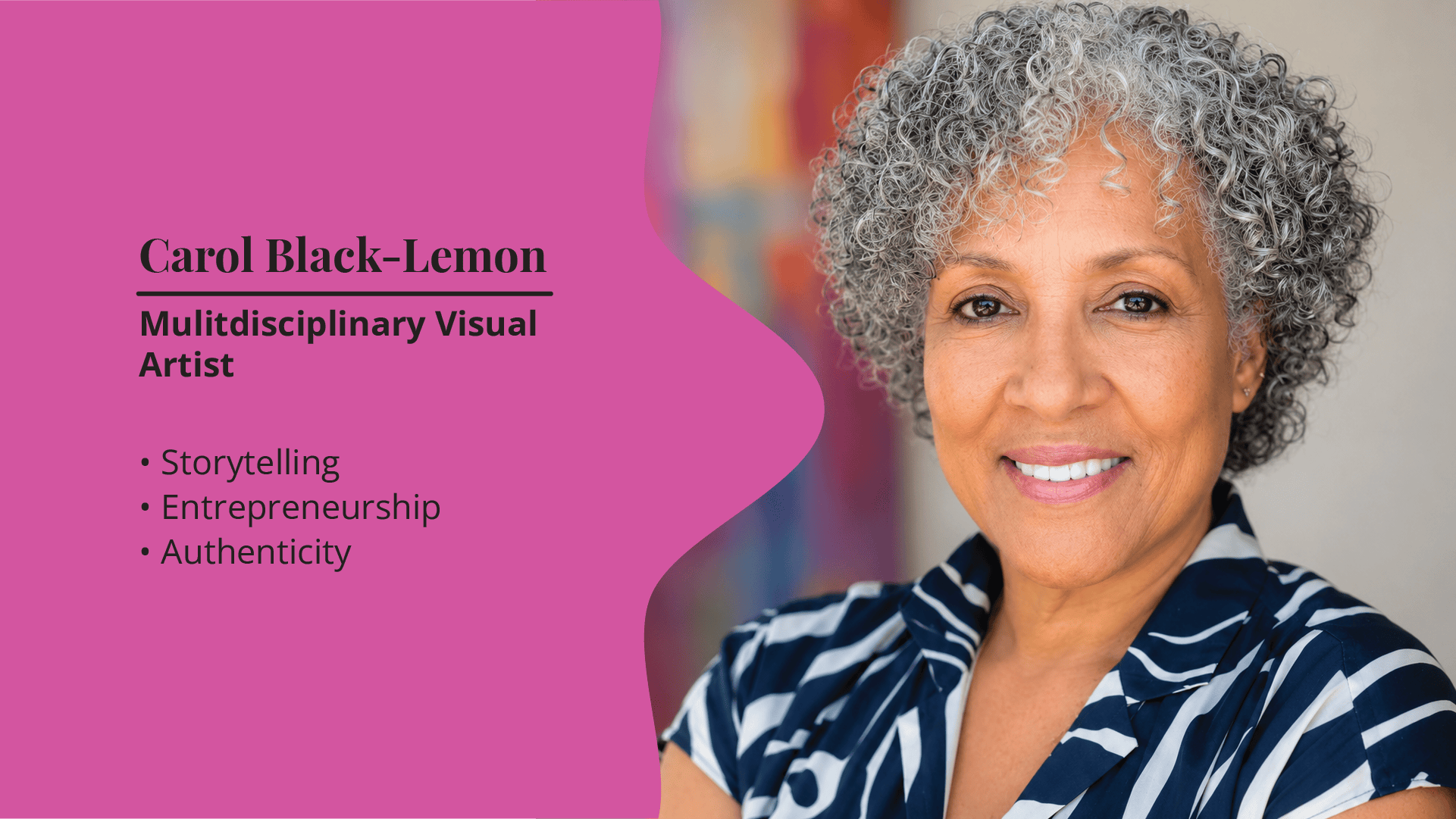
  • Carol Black-Lemon

    Carol Black-Lemon

    Interview

    Transcript

    Carol Black-Lemon 

    Sarah Jane Thomas  00:00 

    Hello, my name is Sarah Jane Thomas, and today we are talking with Carol Black-Lemon, a professional creative working from and within South Carolina. So, as we get started, can you tell us your current career and where you’re from? 

    Carol Black-Lemon  00:12 

    Sure. I’m originally from New Jersey, born in Newark, raised in Brooklyn, and my husband and I retired recently and moved to Florence, South Carolina. 

    Sarah Jane Thomas  00:24 

    Wonderful. Before we go into details of your profession, we have a brief section of the interview called “One Career, Sixty Seconds” where you describe your job in sixty seconds or less, similar to an elevator pitch. And we can start whenever you’re ready. 

    Carol Black-Lemon  00:38 

    Okay. So I consider myself a solopreneur, and that I do pretty much everything on my own. I’ve always been that type of person where I multitask. But four years ago, almost four years ago, I retired, and from my job as a marketing administrator for a law firm. I was there for twenty years, and I built a lot of experiences working on web design and marketing.  

    So now I do that for myself, and my business is Black-Lemon Art, aka Carol Black-Lemon Art, and I am a multidisciplinary artist, where my mainstay is creating artwork and storytelling through my art, and that’s my passion. Always been, always will be, and now I represent a new generation of artists who are at a certain age point, and for me, I’m still becoming, and it’s me letting younger folks know that even when you get a certain age, it doesn’t end. It’s where your passion lies. Just keep going with it, and that’s what life is all about. 

    Sarah Jane Thomas  02:08 

    I love the term solopreneur. I think that’s so fun and exciting. That was perfect. So, what would you consider your official job title? 

    Carol Black-Lemon  02:20 

    Creator. I’m a creator. I just feel very, very blessed to be creating whatever, whatever comes to mind. But painter, for sure, storyteller through my art. I love doing web design. They make it pretty easy today, so I don’t have to get into coding. But I can fiddle around with that as well. And what was the question?  

    Sarah Jane Thomas  02:55 

    I was just wondering what you would consider your professional job title, but creator just sums it all up. So, as a creative creator, is there anything in South Carolina that you feel you bring into your work, as opposed to people who may not live in South Carolina? 

    Carol Black-Lemon  03:17 

    Something that I bring into my work…I would say communicating with other like-minded or other folks that that want to tap into their creativity. I’m all about that. It’s like folks that I know work on nine-to-five jobs and under fluorescent lighting and the watchful eye; they don’t have freedom. They may be in a creative job, which is wonderful, but for a lot of people, they have their jobs that don’t really give them an opportunity to be creative. You have to follow the pattern and the hierarchy and so forth. But tapping into your creativity allows you to find your voice, allows you to be your authentic self. So, I like to help people to do that, and I founded a group called Creative Connection here in Florence, and it was a call out to anyone who wants to tap into that and talk about their creative process. 

    Sarah Jane Thomas  04:33 

    That’s beautiful. Do you think that there was a defining moment in your life that really had an impact on your creative journey? 

    Carol Black-Lemon  04:43 

    A defining moment in my life on my creative journey….it’s a good question. Defining moment….I think I had many defining moments, and which was just letting me know that I can control my creative voice, so I had to find time for that. When I had a nine-to-five and raising a family, it wasn’t just about me. It was about what I have to give to my job, what I have to give to my family. But at some point, I’m like, well, what about me? Who am I? And I tapped into that little girl that was just curious about everything, and so that little girl still lives in me, and I keep reminding myself who she was. And now, I was proud of her, and she would be proud of me that I’m still doing that. 

    Sarah Jane Thomas  05:45 

    You mentioned your own initiative, your own little startup. Do you think that there was a particular project that you worked on that allowed you to express that creativity in a way that hadn’t really been something that you’ve done before? 

    Carol Black-Lemon  06:03 

    I think that might be. There was a point where I was designing my own website, and I went with the DIY. I’m like, okay, I’m that type of person. I’m gonna figure it out, and I really enjoyed it. I had fun with it, and my website was great. And then I thought, “I can do this for other people,” so I looked at some other folks’ websites, some friends, or just people that I knew, and I’m like, “Would you like me to improve your website?” And I did like three of them for free. I’m like, “let me do this so that I can put it on my portfolio,” and that led to a client. So, I said after six months, I’m like, “okay, I’ll help you to navigate it.” Ultimately, and this is going back maybe twenty years now, but that led to fifteen website clients, and for me, that’s why I say I’m a solopreneur. I didn’t have anyone helping me, and by the way, I was doing a nine-to-five job. 

    Sarah Jane Thomas  07:16 

    So, you mentioned this nine-to-five job. So, before you stepped away from that and became a creative strictly in your professional life, did you have any fears about that? 

    Carol Black-Lemon  07:34 

    Yeah, absolutely. I had to learn about just the business setup and taxes, all the accountability what goes with being a legitimate business and calling yourself a business. So, I had to learn all that, and I was always afraid if I was doing that correctly. My fears of starting up is just learning how to prioritize and not getting ahead of myself, and because then I became responsible for other people, and then I learned that people were counting on me. I’ll never forget a call on Easter Sunday because there was something that they wanted on their website, and I was like, “Wait a minute, it’s Easter. I didn’t sign up for that.” But that was when I understood that the criteria that I had to set forth and letting folks know this is a business, and you have to go by these terms and so that was a real learning experience for me to set those guidelines. 

    Sarah Jane Thomas  09:00 

    Was there anything in particular that helped you move beyond these fears? 

    Carol Black-Lemon  09:07 

    Anything in particular that helped me move beyond these fears….what got me moving beyond the fears was this understanding the complexity of ownership and accountability, and that if I were to call myself the boss lady, that I needed to step up and take better notes and just be better at what I was doing, what I was being called to do. So it was that I need to step up. That was like pivoting to the next level of being a professional. 

    Sarah Jane Thomas  09:59 

    Do you have any advice for young adults or students who have an interest in becoming a creative professional and maybe starting up their own business, as you have? 

    Carol Black-Lemon  10:08 

    Yeah, I would say tap into what’s already out there. You don’t have to reinvent the wheel. The information is at our fingertips now. I mean between Google and ChatGPT and Claude, it’s all there. Like, what do I do? They can even build your own website. You know, push the button. There’s your website already. But I’m a hands-on kind of person, and I always want to make sure that if I do use AI to help me, which why not, it’s there. Make sure that it’s at least 80% you and maybe 20% AI, if that makes sense. Yeah, it’s a great tool and it really helps to get things done. But don’t let AI do more of your work than you, and then talking to seasoned professionals and talking to your peers, especially those that are transparent, that are willing to share.  

    There are some folks that they’re not maybe willing to tell you what they use. I’m like, well, those aren’t your people. If I find something that’s working for me, I’m going to tell my friends, “look, don’t waste your time there. This is a better tool.” But talking to seasoned professionals who are doing it, who will give you the real lowdown in terms of what you need? Make good use of your resources. 

    Sarah Jane Thomas  11:50 

    So, you mentioned utilizing AI and utilizing the internet and just like all the information that’s out there now. Do you think that there are any particular skills, either within that or apart from that, that one should practice before trying the same things? 

    Carol Black-Lemon  12:12 

    Right, before trying the same things for sure, and that is having just being more hands-on with your own work in your own occupation, meaning taking notes. Every thought that comes into your mind, some of them are good, and some you need to trash. So, prioritizing your vision for yourself, like what do you need to do right now? And that’s doing your homework. So, and if you’re a student, that’s like the greatest place to be tapping into all the resources available to you. Because at a certain point, those resources and those mentors may go away.For me, it’s organization for sure.  

    Just you know, and there’s a lot of folks [who have it]. I don’t like the term ADHD. A lot of people are like, “I have ADHD.” It’s like if you got a lot going on in your head, there’s a lot of attention deficit because you’re managing so many different things that you are that you have to be accountable for. You’re a student, but you may have a part-time job, and you may have other responsibilities. So, time management is really key. And for someone like me, who’s a multitasker, which I’ve had to tone down. I’m at a certain age right now, and I can’t remember everything, but my mind is still going and going. I wake up with thoughts and ideas, and I don’t want to lose track of it. So having a wonderful calendar, I have this great, beautiful calendar that I use that may even have two years versus an annual calendar and files that I can reference. Organization is definitely key. 

    Sarah Jane Thomas  14:16 

    Well, I want to thank you so much for just sharing your story and your experience and your advice and I really–listening to you talk is it just fills me with happiness for some reason. You have such a way of expressing yourself in a way that’s very genuine, and I really loved it. 

    Carol Black-Lemon  14:36 

    Thank you. I appreciate that. 

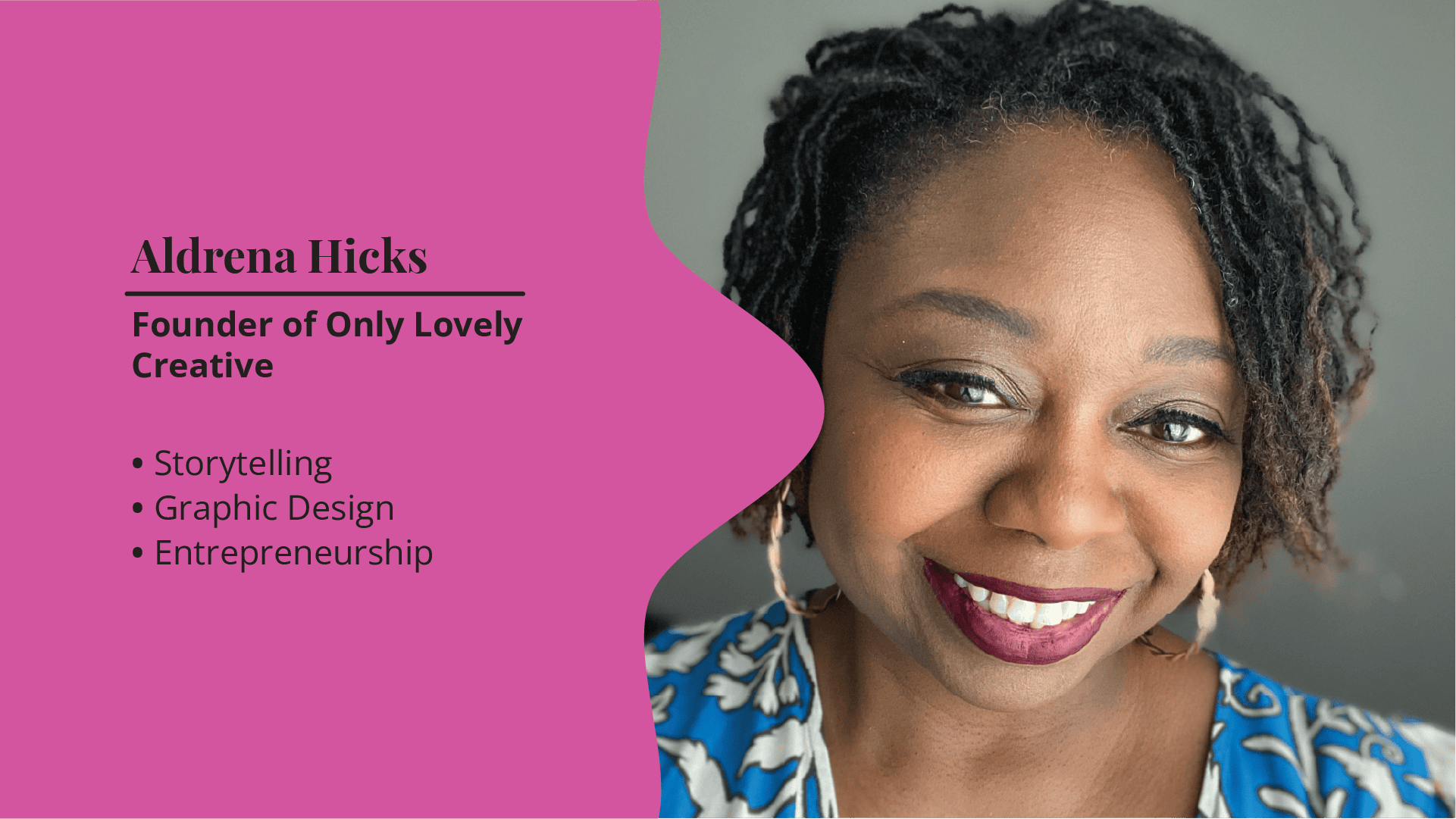
  • Aldrena Hicks

    Aldrena Hicks

    Interview

    Transcript 

    00:00 Victoria Bartolotto

    Hello everyone. My name is Victoria, and today we are talking with Aldrena Hicks. She’s a professional creative working from and within South Carolina.

    As we get started, can you tell us your current career and where you’re from?

    00:13 Aldrena Hicks

    Yes. So, my name is Aldrena Hicks, as she said. I am a maker, artist, creative director, and founder of Only Lovely Creative. So, I’ve spent the last 20 years working across higher education, nonprofits and cultural organizations, leading design work that blends strategy, storytelling, brand, and design thinking.

    My work ranges from large-scale public projects like the Briggs v. Elliott case. That’s a case that led to the big paved the way for the Brown v. Board of Education. Then to editorial work, like the stitch cover I did for Louisville Magazine, honoring Breanna Taylor.

    At the core of it, I’m always making, and it’s through Only Lovely. I do design weddings and experiences that feel personal and lasting. It’s things that people actually want to keep.

    So one of the things that is near and dear to my heart is also making sure I care deeply. I care deeply about who gets to be in these rooms. So, making sure the next generation of creatives, especially those that look like me, see a path forward and know that this space is a viable career.

    01:32 Victoria Bartolotto

    Wow, that’s awesome. That’s amazing work.

    Before we go into the nitty gritty details, we have a brief section of our interview called “One Career, Sixty Seconds,” where you kind of describe your job in an elevator pitch style.

    01:47 Aldrena Hicks

    Oh, that’s what I just did.

    01:49 Victoria Bartolotto

    Oh! Oh! It’s okay. If that was your script, that’s totally fine. We can continue, but that was great. I didn’t know if you had anything else.

    02:00 Aldrena Hicks

    No.

    02:01 Victoria Bartolotto

    No, okay. That’s perfect. Thank you so much. So as a graphic designer, as a maker, is there anything about South Carolina or your region in particular that brings some uniqueness to your work?

    Does it have any kind of influence on you?

    02:18 Aldrena Hicks

    Yeah, that’s a great question. So of course, I grew up in South Carolina, Somerville, Charleston area. Everybody knows Charleston, right?

    I come from a long line of makers. So, my grandfather was a brick mason. He’s actually paved some of the walkways with brick work in some of the plantations when they’ve needed somebody to redesign some or fix it up. Then also some of the walkways in the downtown Charleston area, I remember going. My dad would take us to visit him while he was laying bricks on those special pave ways and stuff. So that was nice. My grandmother was a seamstress, very well-known and well respected. Then of course, a family of musicians. All of that I bring into the things that I do.

    I’ve always been around creatives growing up. So just having that flair. What I try to do is then incorporate that identity into little nuggets here and there in the work that I do. But that’s why I’m hyper focused on when I’m doing stories, especially when I’m working with brides or organizations. I want to hear the story because that’s important, incorporating that into whatever we’re going to create for them.

    03:43 Victoria Bartolotto

    Definitely. I feel it really depends on who the person is in order to continue the project.

    03:48 Aldrena Hicks

    Yeah.

    03:50 Victoria Bartolotto

    Was there a defining moment in your life that had an impact on your creative journey, whether in education or just personal life? Was there anything that kind of marked that?

    04:00 Aldrena Hicks

    Oh, there’s so many. Which one do I choose?

    04:06 Victoria Bartolotto

    Any one! Any one!

    04:08 Aldrena Hicks

    I will probably say my experience with my graduate work. I am a graduate of Vermont College of Fine Arts, and I majored in graphic design. That was my concentration, of course, the MFA in graphic design. When I started there, I applied sight unseen.

    I was already in some other graduate programs. I bounced around a little bit, but nothing felt personal. Nothing felt like this is what I want to do. There was nothing wrong with those other programs, but I didn’t want to lean into the corporate world like that. I’ve already felt I was losing a sense of self because, as you know, when you’re designing and you’re doing work, it is about who you’re designing for. So, you kind of lose that, and I didn’t want that to happen.

    When I got to VCFA, I immediately fell in love because the school focuses on the work, the creative, who you are, and then that comes through. That typically doesn’t happen in this case, in cases of grad school work.

    So, the probably the pivotal moment is when, I was in a two-year track. Probably after my year and a half review, they’re like, “Aldrena, listen, girl, we love you, but we don’t see you. We don’t see, you’re giving us all the polish and that’s cute, but we’re here to discover the messy and you know, who are you?”

    After that little talk, I had my little cry and all that stuff. I realized, “Okay. This is the time where I need to shine and show and dig deep into who I am, my roots, my culture, and be proud of that.”

    From that came my thesis work, which has paved the way for other things that I’ve done since then. I will say that was probably the most transformative experience. I’m very proud to be a part of that legacy.

    06:08 Victoria Bartolotto

    That’s amazing. So, speaking of your thesis project, was that something particular that you produced that maybe showcased your creativity in a way that it never had before? What about it was different compared to previous work?

    06:28 Aldrena Hicks

    Yeah. So, I took the approach. I did weave in some research because that’s part of the requirements. I took the approach of creating a storytelling experience, because I told you storytelling is part of my thing. What I did was I explored how the media portrays black women and how we’ve influenced the media and culture. I wove certain pieces of history and then turned it back on to how it affected me personally, how it did as a creative.

    I studied and talked about hair, respectability, politics, and then skin, colorism and all that stuff. I then found ways to remember how those things affected me growing up and how I now advocate for, especially young black women and my daughter, to be proud of who they are.

    So yeah, the approach was different because I did a personal narrative, but I wove in some history and some research in that. It has won a few awards. I’ve written a children, a self-published children’s book out of that. So yeah.

    07:56 Victoria Bartolotto

    That’s really awesome. Especially just seeing that I’m a writer too. A lot of the times that I’m working on projects, it’s like seeing something grow from a tiny little seed into this huge thing. You have to step back and be like, “Wow. I did that. You know?”

    08:14 Aldrena Hicks

    Yeah.

    08:16 Victoria Bartolotto

    So before entering your field, maybe in your education process, did you have any fears about becoming a creative professional? If there were some fears, what inspired you to keep going beyond them?

    08:30 Aldrena Hicks

    I knew I wanted to do creative work. Like I said, grew up with musicians, makers and all that stuff. I never knew graphic design was an actual thing. I’ve been doing that, just didn’t know that’s what it was.

    So, I was at my undergrad, working at Columbia College, SC, not Chicago. When I discovered graphic design, I was like, “People make money doing this?” They’re like, “yeah.”

    So, I don’t think I was ever afraid of being a creative in this space. It was more of finding the right place to let that talent grow. Of course, through trial and error and all the careers and stuff, I quickly found out that advertising work is not my scene. I met some wonderful people and did a lot of things. But again, going back to the why behind things, the history behind things. So, then I veered into the nonprofit world. Now what’s scary now is that I’m doing this full time. So, it’s more like, “who’s going to get these invitations? Who wants to have brand work done?”

    09:53 Victoria Bartolotto

    Oh, wow. Do you have any advice for young adults or students who may have an interest in pursuing becoming a graphic designer? Are there any particular skills that you think someone should practice or at least have before entering the industry?

    10:08 Aldrena Hicks

    Yeah. One of the things I want to say is that, and I know people have different networks and all of that, all of that is great.

    I read a book along, I think I might have mentioned in my pre-interview, one of the books I recommend is reading is Talent is Not Enough, because a lot of people think talent will get you all the places, but it really is the soft skills, building these connections and learning how to relate with folks. It will show up in your work. So, make as many connections as you can.

    I know it’s hard because a lot of times you feel like people aren’t going to respond to you. But there are a lot of us out here who really love and want to reach back and help. I mentor. I’m still in touch with many of the students that I taught during my time as a professor.

    Do not discount your people skills. I know it’s hard when folks like love the internet, love being on Chat and all that stuff. That’s great. Still learning how to write with and without AI. Learning how to write, learning how to speak, learning how to read the room, that will get you further than just having a talent because you can be the most talented person in the

    world. If you don’t know how to relate to folks, you don’t know how to talk with them, get with them on a personal level or at least be professional about things; you won’t last long.

    11:45 Victoria Bartolotto

    Thank you so much for taking the time to speak with me today. This has been an amazing interview. Have a great day.

    11:51 Aldrena Hicks

    Thank you so much. You too.

    11:53 Victoria Bartolotto

    Bye.

    11:53 Aldrena Hicks

    Bye.

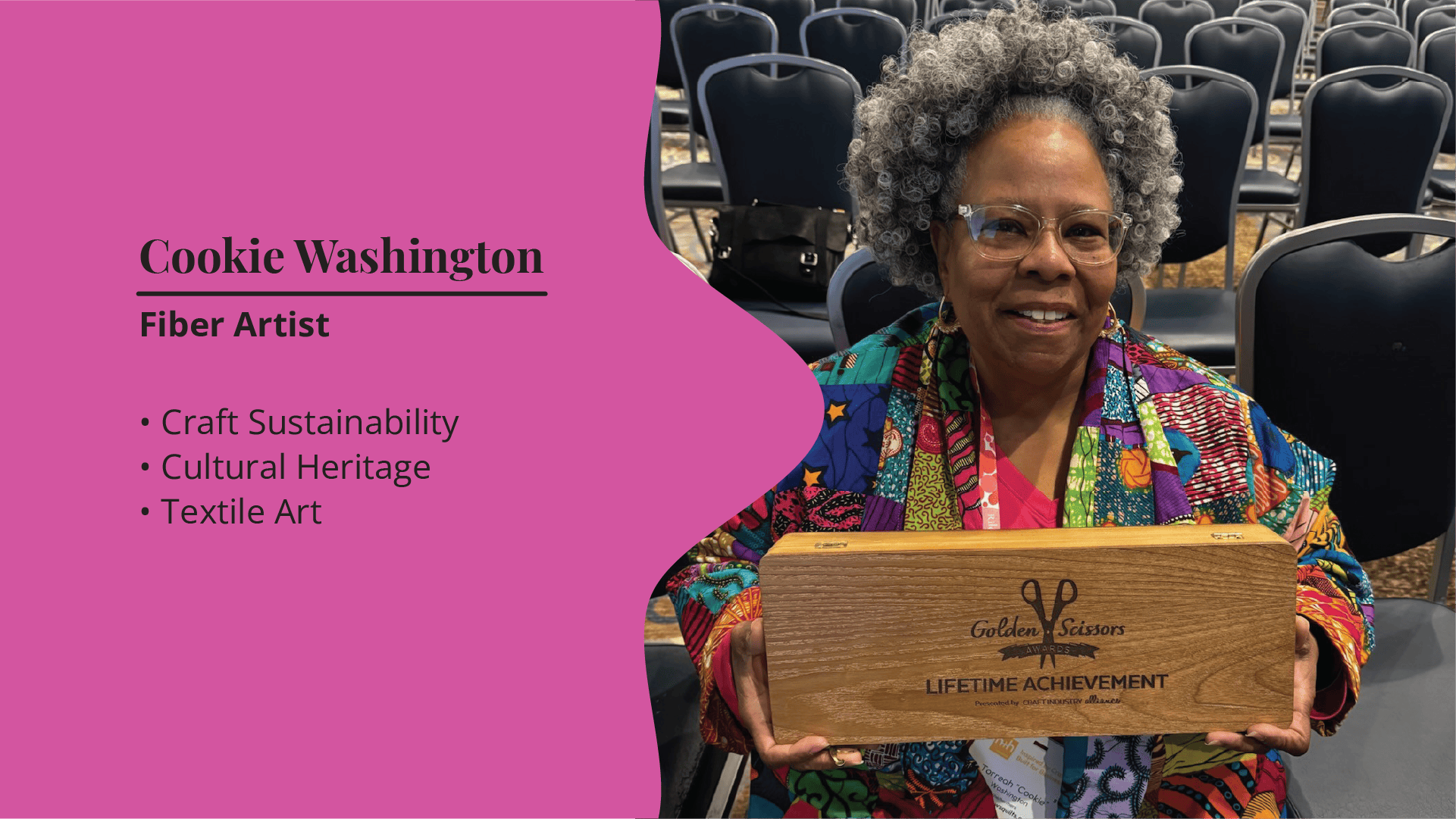
  • Cookie Washington

    Cookie Washington

    Interview

    Transcript

     00:00 Victoria Bartolotto 

    Hello, everybody! My name is Victoria, and I’m talking with Cookie Washington, a creative professional working from and within South Carolina. As we get started, can you tell us your current career and just where you’re from? 

    00:14 Cookie Washington 

    Hi, I am Cookie Washington, and I currently live in Goose Creek, South Carolina. I’ve lived in South Carolina for forty years, but I’m not originally from here. I came here and fell in love with the place, and I’ve stayed. 

    00:30 Victoria Bartolotto 

    Great, so before we get into the nitty-gritty details of your profession, can you give us a little elevator pitch about what quilting and ragging is? 

    00:41 Cookie Washington 

    You know how some people feel instantly comforted by a handmade quilt or a basket? You know that moment when your hands brush against soft fabric that has possibly lived another life? Well, I believe in a world drowning in fast fashion and waste; we’re desperate for things that last. Things that feel like home. That carry history, and that do not harm Mother Earth. 

    Futility is my line of handcrafted rugs, baskets, home goods, and totes rooted in the Gullah tradition of rag quilting, an indigenous no-sew method created from necessity. We transformed discarded textiles into soulful, functional art for everyday living. Each piece is made by me in the South Carolina Low Country using century-old techniques passed down by Black women who knew how to make beauty from nothingness. 

    I’ve been featured in some national press, and I’ve taught at the Smithsonian. Futility is redefining luxury as a sustainable, emotional, and ancestral craft. 

    01:52 Victoria Bartolotto 

    Thank you so much, that was great! 

    01:55 Cookie Washington 

    Thank you. 

    01:58 Victoria Bartolotto 

    So, as a quilter, is there anything that South Carolina, or the Lowcountry in particular, that brings some uniqueness to your work? What kind of influence does South Carolina have on it? 

    02:11 Cookie Washington 

    Being surrounded by water on three sides; I’m in the Charleston area, so we’re in a peninsula. The colors of the marshes, and the sky, and the beautiful birds that fly around in my neighborhood very much inspire me. I also try really hard to upcycle and reuse things that have gone before.  

    One of the ways that I got into this part of my career was, I lost my mother in October of 2023, and then I lost my brother 90 days later in January of 2024. I was obviously overwhelmed and in huge grief. I was both of their executors, and I didn’t know what to do with their clothing. I didn’t want to just throw it out. I’m a way different size than my mom was, so I couldn’t wear her clothes, and my daughters didn’t want clothes from their 89-year-old grandmother. 

    So, I was sitting, going through some things with my mom’s, and I found a really old picture of me and my grandmother, her mother, sitting on the porch, and we were weaving rag rugs together. I had kind of forgotten about that, and I thought, “oh, I know how to turn this into baskets.” So, I took my mother’s and my brother’s clothes, and I created a basket. For each of the cousins. My mother was the last surviving one of her generations. She had 16 siblings. 

    03:50 Victoria Bartolotto 

    Oh, wow. 

    03:51 Cookie Washington 

    She was very last one that passed. So, when the cousins came down for our memorial, I made baskets for the ones that I knew were really close and important to her. 

    I wove some things of my brother’s into that too. When he passed away, I wanted to present his son with a living memory, so I made him a beautiful basket as well. My brother had been in the military, and so I wove in some of his old uniforms, and he loved the beach, so there was beach clothing. I even ripped up one of his kites that he had used and put that all into a weaving to honor him. To make it as a piece of living memory that will hopefully last for a couple more generations. 

    04:39 Victoria Bartolotto 

    Yeah, wow, that is extremely touching and definitely personal. Is there a particular piece of clothing or cloth that you liked working with? I crochet, so I know a little bit about  handmaking stuff, and I know a lot of the different fabrics feel different when you’re working with them. Was there a particular one that you enjoy? 

    05:02 Cookie Washington 

    I use rag crochet, so I rip up old sheets or old clothing, into 1-to-1.5-inch strips, and I crochet with a size 7 needle. 

    05:13 Victoria Bartolotto 

    Mmm. 

    05:14 Cookie Washington 

    Because it’s really important to me because I found this statistic out, and it drove me crazy. There’s about one hundred fifteen pounds of textile waste that goes into the landfill for every single American every year. Think about it, there are three hundred fifty million of us. 

    So, one of the things that I do that I think is really important in my work is whenever I make something, I weigh it. And write it down so that I’m trying to get to zero. I have zero waste by the end of the year. I’ve made rugs that are 4 pounds, and 10 pounds, and baskets that are a pound and a half or something. I write that all down, and by the end of each year, I try to make sure that I have at least used my 115 pounds of textiles so that I’m taking them out of the landfill.  

    This is important to me because landfills are generally in the neighborhoods of people who look like me. It’s poisoning the land. It’s poisoning the groundwater, and I’m very concerned about that. Only about 15% to 18% of what you would buy from a thrift store or Goodwill is ever used. The rest of it is packed up and shipped to another continent to ruin their land. I’m trying in my very small way to help that. 

    06:39 Victoria Bartolotto 

    Before entering quilting professionally, did you have any fears about doing it professionally and making a living off of it, or was there anything that held you back? 

    06:51 Cookie Washington 

    Another great question, Victoria, thank you. Before I started quilting, I was making upscale wedding gowns. 

    I have a degree in nursing from Johns Hopkins, and I realized that I couldn’t do that. I was a neonatal nurse, and the first baby that died under my care, it was just devastating. So, I went home, and I’d just gotten married, and had my own babies, and I thought, “I have to do something.” It was easier for me to stay at home and take care of my children. And, I have sewn since I was four. 

    Being able to make beautiful upscale wedding dresses here in the Lowcountry, and as well as raise my children, I have three children, was very important to me. I did, at one point, get a little stressed about bridezillas, and I thought “I will do something different.” 

    I saw the most amazing exhibit; it was the Communion of the Spirits exhibit by Roland Freeman at the Gibbs Museum in Charleston. I had been gifted the book for Christmas the year before. To see those quilts in person, it was like…wow! I’m also a crazy activist. I realized that I was waging peace against people who were trying to wage war, and I thought. I have so much that I could say in cloth. It’s my voice in the cloth. 

    So, I could change the way that I was trying to get my point across in a more gentle, easy-to-digest way. So that’s how I started doing art quilting. I don’t do traditional [quilting]. This is not like your grandmother’s quilt. 

    08:45 Victoria Bartolotto 

    Oh, yeah. 

    08:46 Cookie Washington 

    I’m never gonna make a bed quilt that’s 9 patches or something. I work a lot with Black mermaids and African goddesses and queens in my work, and so that’s really important to me, because you don’t know where you’re going if you don’t know where you’ve been. I want very much, especially now that I’m the grandmother of three granddaughters, I want them to know that the history of Black women in America or in the world did not start on a slave station somewhere in South Carolina or Mississippi.  

    We have been regarded as goddesses for four thousand years. We need to remember that and claim that. Whether it’s a myth or whether it’s the truth, just knowing that there is some scholarship around those stories. I think makes you walk a little taller, makes you feel a little more important, and so I love that. 

    09:43 Victoria Bartolotto 

    Definitely, yeah. That is so important. Do you have any advice for possibly young adults or students who would want to get into just either quilting, ragging, or just making with their hands in general? Are there any particular skills? Obviously, there are some skills that one would need. What would be kinds of those skills? 

    10:07 Cookie Washington 

    Other than having the technical skill of being able to sew, or crochet, or knit, or weave, the thing that I think you most need is patience. Decisiveness, and you’ve got to learn how to market. That is so important, and you need to know your worth. I’ve seen there’s some incredible people who are crocheting clothes, which is something I don’t do. 

     But they’ll make an entire wedding gown, or the most beautiful coat, and they’re like, “oh, well, $300.” It’s like, “no, no, no, there’s $200 worth of yarn in that.” 

    10:50 Victoria Bartolotto 

    Yes. 

    10:52 Cookie Washington 

    I usually keep a little notebook when I’m sitting in my studio. I’ll say, “Okay, I started working on this particular project at 9 AM, and I go through lunch, and I sign off. Okay, I did 3 hours.” At the end of the project, you’ll know how many hours you spent. I pay myself about $25 an hour or more, depending on the technique that I’m using. You add that up, plus the price of your ingredients.  

    I’m currently working on a really cool orange and pink, large tote bag out of tee-shirt yarn. And, I’m at hour five, and I think I’ll be able to finish it in about nine or ten hours. I need to know that for myself, so that I can price it correctly. 

    I would say to many, many people who are trying to get started in this, in any kind of arts career, find a mentor who will be very honest with you. Sometimes you think that you’re doing something fantastic, and it’s not quite there. Or you’re just duplicating something else. You want to be original; you don’t want to be a copyist. 

    The other thing I would suggest to people, especially in any kind of textile arts: go to the most expensive, like Neiman Marcus, or iMagnon or something, and look at what they’re selling their handmade, crocheted, or knitted goods for. Take that as a way to think about pricing your stuff. Everything that they’re getting is probably coming from overseas, and they’re probably not paying those people anywhere near what they’re charging. So I think that it’s important for us to, especially in America, at this time, where it’s so difficult to find work-work. As we’re becoming more hands-on. I think we’re switching back to analog work. Rather than an infection of AI or whatever.  

    I think we just need to know our worth, and we need to work hard to be successful. Some people think, “Oh, I’m going to start a business, and I’m gonna be able to have lunch with my friends three days a week, and I’m going to get to go sailing.” No, you’re gonna sit in your studio sometimes till two o’clock in the morning, but if you want it badly enough, it really will happen. 

    13:34 Victoria Bartolotto 

    I can totally empathize with the whole textile situation. I have friends who will ask me for sweaters, or for blankets, and they’re like, “Oh, well, can you get it to me by the end of the week?” I’m a full-time student, and I’m working two jobs. I would look at them like, “That’s gonna take me at least fifteen hours to do.” 

    13:56 Cookie Washington 

    Even if you weren’t, you’re not a genie. You’re a craftsperson. 

    14:03 Victoria Bartolotto 

    So, I can totally imagine. 

    14:04 Cookie Washington 

    When they ask you for something for free, I think that’s the hardest part. It’s learning to say no. 

    You want a blanket for the baby, and you’re always glad when someone is bringing a new life into the world, but if you spend ten hours on that, and they say, “Oh, I’ll pay for your yarn.” The yarn is the smallest part of it. It’s your labor, it’s your love. You need to be compensated for that.  

    I think telling people, “Oh okay, well, my crocheted baby blankets start at $450. My hand-crocheted or hand-quilted baby blankets start at this other price, and this is why.” 

    Then shut up, because people go “$400 for a baby blanket? I thought…” Let them talk themselves into it or out of it. No is a complete sentence. “No. I will not make you a baby blanket for $50. Unless it’s out of air.” Be very firm and confident in yourself. 

    15:20 Victoria Bartolotto 

    Yeah. Well, thank you so much for taking the time to speak with me today. I am so grateful and honored to hear from you, especially from somebody who works with textiles as well.  

    15:30 Cookie Washington 

    You have a wonderful afternoon, hon! 

    15:33 Victoria Bartolotto 

    You as well. It was a pleasure speaking with you. 

    15:35 Cookie Washington 

    It’s a pleasure speaking with you too, hon. Bye-bye. 

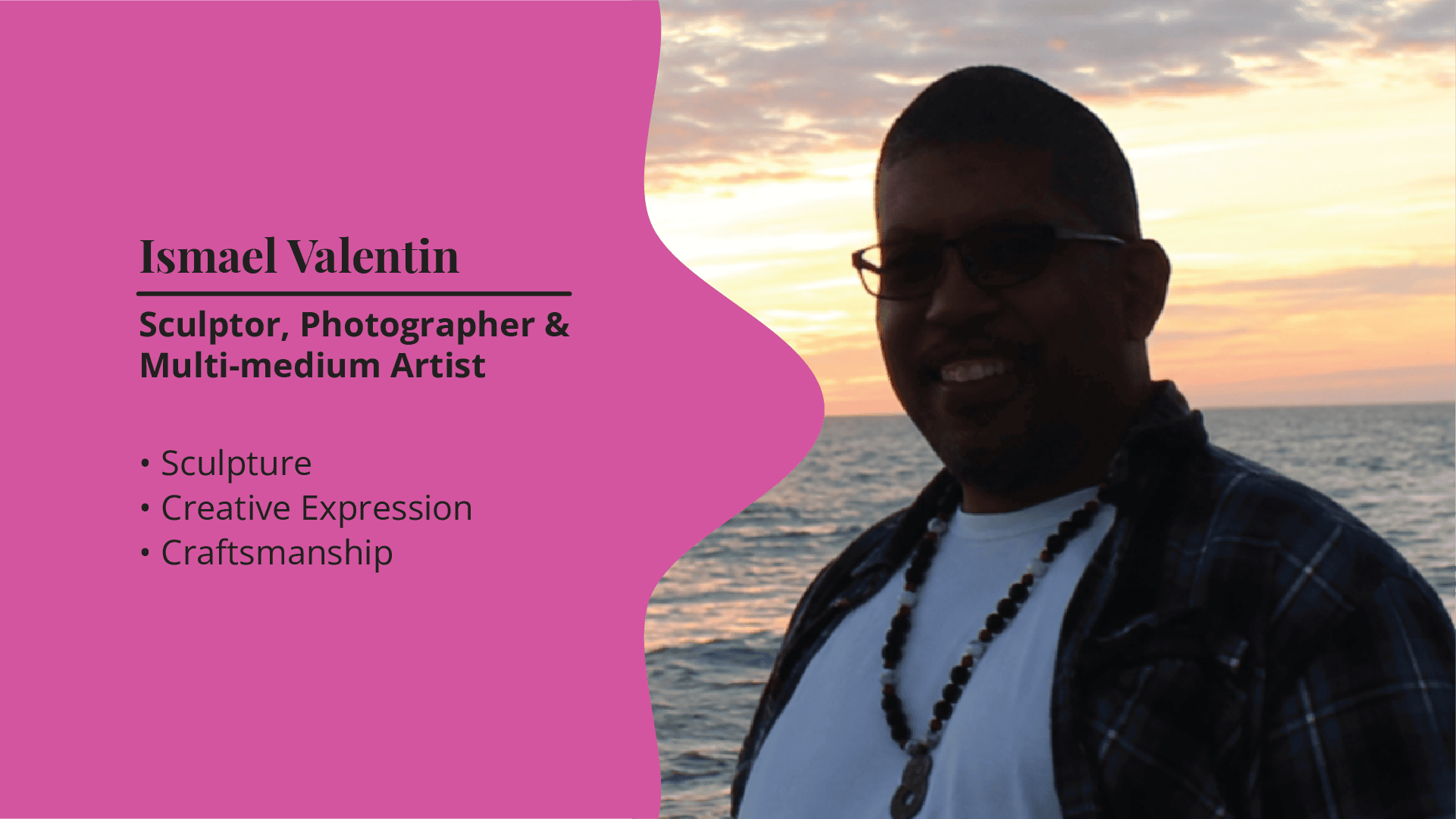
  • Ismael Valentin

    Ismael Valentin

    Interview

    Transcript

    00:00 Victoria Bartolotto 

    Hello everybody! My name is Victoria, and we are talking with Ismael Valentin, a professional creative working within and from South Carolina. As we get started, can you tell us a little bit about your current career and where you’re from?  

    00:16 Ismael Valentin 

    Sure. So, my heritage is from Puerto Rico. Tyrannal Roots. That’s native to Puerto Rico. Born and raised in Farmingham, Massachusetts. And, went to school in, Chicopee and Springfield, Massachusetts. 

    What would you like me to get into? How I got into my art?  

    00:52 Victoria Bartolotto 

    Before we do that, can you talk a little bit about where in South Carolina that you’re from?  

    01:00 Ismael Valentin 

    Sure, we’re at the Wild Wings plantation and golf course in South Carolina.  

    01:09 Victoria Bartolotto 

    Okay. Before we go into the nitty-gritty details of your profession, we have the “One Career Sixty Seconds” portion of our interview, where you give an elevator style pitch. If you’re ready to go, I can set a timer, and we can start.  

    Okay. Alright. Ready? Set. Go.  

    01:36 Ismael Valentin 

    Basically, I went to a store, and they asked me to, sign up for a raffle. I must have been eight years old.  They turned around, and I said “sure.” So, I signed up for the raffle. They called me a week later, saying I won. They gave me an easel with all art products and whatnot.  

    I just had it lying in the corner of my room, not knowing what to do with it. My cousin comes over a week later, and he’s like, “Oh, you know how to draw? You’ve been drawing? Oh, I’m a better drawer than you.” I said, “Word? Let’s go.” Ever since then, I’ve been trying to find the best outlet to express myself.  

    02:29 Victoria Bartolotto 

    What kind of mediums do you work with?  

    02:34 Ismael Valentin 

    Acrylic paintings. I do glass blowing, and I do bronze work. It’s called the Lost Work of Wax.  I sculpt in wax, and then I cast the bronze. I also work in stone. I sculpt stone.  

    I do a little bit of welding. I’m no professional at welding, but I can at least weld my form and then build up on it.  

    03:11 Victoria Bartolotto 

    Wow, that’s a lot of different things! Jack of all trades.  

    03:14 Ismael Valentin 

    Yeah. Yeah, I have touched on a lot, a lot of things, trying to find the best way to express myself and my vision as an artist.  

    03:27 Victoria Bartolotto  

    Yeah, for sure. With being located in South Carolina, is there anything in particular that the state or your particular neighborhood or region brings to your creative work? Does anything about South Carolina have an influence on you?  

    03:42 Ismael Valentin 

    Yeah, so there’s something called the American College. They have a course there where they do a lot of stonework. I find that to be very attractive, and what got me out here to begin with. 

    04:04 Victoria Bartolotto 

    Was there a defining moment in your creative career that had an impact on your journey? I know from the form that you filled out, you mentioned that you had an artist residency in Italy. Was there anything particularly, maybe in Italy or in the United States, that kind of have an impact on you?  

    04:24 Ismael Valentin  

    Oh yeah. So, Italy is the reason why I got into stonework. I went out there and did a residency. I did a marble ram’s head. I just found that to be the best way that I could express myself in art. That’s eventually what caused me to move out here. It was because the college out here that does all the stonework. So, I can continue working on that.  Unfortunately, where I live, my neighbors wouldn’t necessarily like me working on stone. 

    05:12 Victoria Bartolotto 

    I can imagine it is very loud.  

    05:14 Ismael Valentin 

    Yeah, it is. It can get there. So, it actually gives me a perfect workplace. To be able to have space to do my stuff.  

    05:25 Victoria Bartolotto 

    Is there a particular kind of stone or material that you prefer working with over others?  

    05:32 Ismael Valentin  

    Not that I have found. I like dabbling in all of it. One thing that I have found a caveat to that is marble. Marble is kind of like granite. It’s kind of a little bit harder to work with. It’s a lot harder to work with, actually. The soft stones are more my go-to. Just because I can get the form faster and it’s easier to work with. It’s not as hard.  

    06:16 Victoria Bartolotto 

    Yeah. Was there a particular project, maybe the Ram’s head that you mentioned before, is there a particular project that you have done that really showcased your creative abilities in a way that it never had before? Was there anything that really spoke to you and is a proud moment of your career?  

    06:38 Ismael Valentin 

    Yeah, so I did a bronze ballerina foot. I feel like that was really my standout moment where I was like, “Oh wow, I could actually seriously get into this.” I could also, how you say, have this as an actual career. I just got so many compliments from it. I got so many praises for it, and it was literally my first piece that I did for sculpting. Since then, I haven’t stopped my toes. I haven’t dropped my toes, I should say. 

    07:25 Victoria Bartolotto 

    Yeah. Before entering stonework and working with stone, did you have any fears about having that being your profession? Was there anything that might have held you back from pursuing it?  

    10:40 Ismael Valentin 

    Definitely. There’s that stigma where the artist is a starving artist. So, everyone was always pushing on me, saying, “Oh artists, you don’t really make any money off of it.” 

    I feel like once you find certain people that love your work, they kind of stick with you. They follow you. I actually found that to be a stigma that really shouldn’t be stuck to us artists.  

    11:19 Victoria Bartolotto 

    I recently graduated from Coastal. I got my degree in English because I want to be an author, and I’ve heard that so many times. when people say, “Oh, well, writers don’t make any money. Artists don’t make any money. Why don’t you pick something else?” But it’s what you love, and it’s your passion. It’s hard to just tell some people that, “no, I want to follow my passion.”  

     Do you have any advice for young adults or students who maybe want to get into stonework, about things that they should know, or any skills that they should practice before getting into it? 

    12:03 Ismael Valentin 

    If anything, you definitely want to know how to do anatomy. Depending on if you want to do human figures. If you wanted to go abstract, then I guess you don’t really need to. Just dive right in. Keep an open mind and keep an open eye. Sorry, keep an open mind. Yeah.  

     So, by going to Italy, I learned how the old-timers used to do it. By hand and chisel, and I definitely would not suggest anyone doing it that way. That is grueling at best. This is very tiring.  

    13:10 Victoria Bartolotto 

    Yeah, I can imagine.  

    13:13 Ismael Valentin 

    If you can definitely get an air hammer. Get some air tools, that definitely would make it easier on you.  The chisel, you are eventually going to have to work with the hammer and chisel, especially when you start getting into those fine details. Try to be open to all of it.  

  • Steve Davis

    “Say yes, then figure out how. Experiment. Fail. Experiment more. You will find your path and discover new ways of creating that you never considered before.” 

    Quick Facts

    Education: Undergraduate School

    Years of Experience: 10 Years

    About

    Steve’s first experience with glass was an unexpected labor of love. After being asked by his daughter to craft her wedding favors, he agreed and embarked on his adventure with sandblast etch glass sculptures. After experimenting with different styles and attending more weddings, Steve’s work began to garner recognition.    Eventually, people started to commission him for custom pieces.  

    His business has expanded beyond art, as he currently produces custom architectural glass such as shower enclosures, entry doors, and partitions. Steve’s studio is one of few that can handle large and heavy glass, as less than twenty studios nationwide produce such a variety of pieces.  Sandblast techniques allow him to craft three-dimensional pieces that cannot be achieved by laser or chemical etching.  

    When asked about encouraging aspiring creatives, Steve’s words implore hands-on commitment: “Experiment. Fail. Experiment more. You will find your path and discover new ways of creating that you never considered before.” 

  • Caroline East Harnish

    “Keep on creating; the world needs your art!” 

    Quick Facts

    Education: High School

    Years of Experience: 50 Years

    About

    Caroline East Harnish is a visual artist inspired by the ‘flow state’ seeking to manifest and embody the human spirit through her paintings and drawings. She lived and painted in Europe for over twenty years.  

    What started as a hobby of drawing with her mother as a child, her passion blossomed into a career that spans nearly five decades. “I enter into a state of ‘flow,’ and thereafter, work out how to manifest these ideas,” she says.  

    Harnish observes that there is a resurrection of meaning and beauty in the arts, with creatives revisiting the conversation between beauty and aesthetics. She encourages young artists to stay in touch with their practice, and most importantly, to keep creating because “the world needs your art!” 

  • Cat Wondergem

    “Don’t only make the time to find your voice in your particular medium.” 

    Quick Facts

    Education: High School/2-year Technical College  

    Years of Experience: 20 Years

    About

    A linocut visual artist, Cat Wondergem dives into the rough edges and sparkles of humanity, one stroke of watercolor at a time. Initially introduced to linocuts during her middle school years, she did not return to the medium until her late thirties, highlighting “the simplicity and mobility of the tools needed to create this vibrant art form.”  

    Her process involves four multifaceted parts: drawing, carving, ink, and printmaking, before she can finally dip her paintbrush into a watercolor palette. Using a linoleum block, Cat aims to capture life’s vibrant flow of adventure and authenticity.  

    She encourages aspiring artists to become deeply familiar with their skillsets. “Take the time to learn what your tools and various techniques can do,” she says. “Learn how they can level up your work.” 

  • Protected: Michelle L Kingsberry

    This content is password-protected. To view it, please enter the password below.

  • Jeannie Rounsefell

     “If you can’t go to sleep until you have done this thing, you will never rest easy. Be curious, challenge the world and yourself.”

    Quick Facts

    Education: Some elementary school in Aiken, SC; Self-taught

    Years of Experience: 40 Years

    About

    Jeannie Rounsefell started creating art out of necessity.  She was broke, young, a single mother, and had an urge inside of her to create something from her surroundings. Such objects were unlikely materials; unloved items and forgotten things other people had long given up on. 

    Forty years later, she calls herself a trash pirate (a compliment to her work). Jeannie’s creations are built on humor, irreverence, and a deep love for the absurd. She has a vast working knowledge of tools and processes, almost all of it earned through trial and error.  This knowledge establishes a vast pocket of problem-solving skills, to which she implements both into her practice every day.  

    As for her career, her whole philosophy is that she simply creates. Jeannie follows what interests her, works with what she discovers, and allows the material to speak for itself. It is a practice grounded in freedom and curiosity.  She supports herself with her making, which is what she intended and continues to do. For anyone wondering whether to start, her answer is short and clear: “Do it. If it keeps you up at night, you already know you have to.” 
     

  • Susan Lenz

    Susan Lenz

    “Get a timecard and track the number of hours actively spent making. Being creative is a skill that is improved through lots and lots of practice.” 

    Quick Facts

    Education: Undergraduate

    Years of Experience: 23 Years

    About

    Susan Lenz built her creative life in a familiar way to the arts: a little late, on her own terms, and with complete conviction. She was forty-two years old when she finally let herself say aloud what she wanted to be: a fiber artist. 

    She rented a studio in a cooperative artist enclave. With no formal degree program and no one to guide her through a process, Susan taught herself everything she needed to work professionally. She figured it out by doing, logging the hours, and treating the crafting process as her full-time job. 

    What she makes is entirely her own. Every piece is an original, born from a threaded needle, an object, and a specific way of seeing the world. For over two decades, she has built a full working practice of gallery representation, commissions, teaching workshops, and a daily studio habit that has never ceased throughout her artistic journey. 

    Her advice to anyone starting is to be practical and direct as “being creative is a skill that is improved through lots and lots of practice.” Track the hours. Treat the making like work, because it is work. Creativity is not something to either have or not. It is a skill, and like any other, it only gets better with more time and care invested into it.