Career Area: Arts Education

  • Rick Sargent

    “I actually got turned down twice when I applied to medical illustration school. I took time off, reassessed, and just drew and drew. When I finally got in, I was excited, and I have been doing this ever since.” 

    Rick Sargent is a professor of art at The Citadel, where he teaches drawing, painting, animation, and illustration. He is also a seasoned freelance medical illustrator specializing in medical-legal illustration. A native of Columbus, Georgia, now based in Mount Pleasant, South Carolina, Sargent holds a bachelor’s degree in interdisciplinary studies from the University of Georgia and a Master of Science in Medical Illustration from the Medical College of Georgia (now Augusta University). 

    Interview

    Transcript 

    Rick Sargent 00:00 
    I am Rick Sargent. I’m originally from Georgia, Middle Georgia, a smallish, mid-sized town called Columbus, Georgia. And right now, I currently reside in Mount Pleasant, South Carolina. 

    Sara Sobota 00:12 
    What do you do for work? And where are you working from right now? 

    Rick Sargent 00:16 
    I am primarily a college professor at The Citadel, and I teach art. I teach drawing, painting, animation, and illustration. What makes me suitable for that is my other career. My other gig which is being a medical illustrator. When I’m teaching, obviously it’s in person, not online. As a medical illustrator, I work from home. 

    Sara Sobota 00:43 
    Okay, next question. How long have you been working there, and what is your official job title? You have two of each of those? 

    Rick Sargent 00:50 
    I do, yeah. I’ve been at The Citadel for 10 years. I have been a medical illustrator for 22 years. 

    Sara Sobota 00:59 
    Okay, wow. How did you end up in the field? We kind of went over that already, but if you could just give us a recap? 

    Rick Sargent 01:06 
    Yeah, absolutely. So, I ended up becoming a medical illustrator from the inspiration and advice I had from my high school art teacher, who knew a medical illustrator and thought I would be a good fit.

    I changed my major at the University of Georgia, earned an undergraduate degree in Interdisciplinary Studies, and then went on to get a Master of Science degree in Medical Illustration. From there, I started practicing medical illustration in New Jersey, came down to South Carolina, and had a colleague who was teaching at another school who turned me on to the idea of teaching. He eventually left the program, and I took over his role and fell in love with teaching. I have been a teacher ever since. 

    Sara Sobota 02:08 
    Wow, that’s great. So, your graduate degree was an M.S. in Medical Illustration? 

    Rick Sargent 02:15 
    Correct. 

    Sara Sobota 02:16 
    Wow, that’s fantastic. You don’t often hear or see that. 

    Rick Sargent 02:21 
    Yeah. Different programs offer different degrees. Some, like Johns Hopkins, offer a Master of Arts program. At the Medical College of Georgia now Augusta University they wanted to provide a stronger scientific foundation, so they offered a Master of Science degree while teaching the arts. 

    Sara Sobota 02:49 
    Forgive me, I don’t know what’s the Medical College of Georgia’s name now? 

    Rick Sargent 02:56 
    It is now Augusta University. 

    Sara Sobota 03:00 
    Oh, I didn’t know that. 

    Rick Sargent 03:01 
    It changed maybe five years ago. It used to be Georgia Regents University, but they were absorbed into Augusta University. 

    Sara Sobota 03:10 
    Got it. What background helped you land your roles? 

    Rick Sargent 03:16 
    Yeah, for sure. For being a professor, it was a real-world experience plus having a master’s degree, which is the terminal degree for medical illustration, since there is no Ph.D. in the field. 

    Sara Sobota 03:34 
    Are there any medical illustration programs in South Carolina? 

    Rick Sargent 03:40 
    There are not. 

    Sara Sobota 03:40 
    So you need to go to another state? 

    Rick Sargent 03:46 
    Yes. There are about six schools across the country offering a master’s degree program. Some, like Rochester Institute of Technology, offer a bachelor’s degree in medical illustration. 

    Sara Sobota 04:01 
    Can you walk us through a typical workday? What’s your process and what’s expected? 

    Rick Sargent 04:08 
    Sure. I’ll focus on the medical illustration side. I specialize in what’s called medical-legal illustration. I work for attorneys who need to explain in layman’s terms and visually what happened in an accident or a procedure.

    A typical day involves reviewing operative reports and radiology films, then making a proposal on the best way to present their case. That gets reviewed by a medical expert. We usually schedule Zoom meetings to clarify the case, and once I have the supporting materials, I begin creating the illustrations. 

    Sara Sobota 05:04 
    Wow, you are blending law, medicine, and art. 

    Rick Sargent 05:08 
    I’m telling you, it’s all over. 

    Sara Sobota 05:10 
    That’s amazing. 

    Rick Sargent 05:12 
    Yeah. 

    Sara Sobota 05:14 
    That is awesome. Can you describe a defining moment in your creative journey, something that had a significant impact on you, or something you produced that really showcased your creativity? 

    Rick Sargent 05:27 
    I will say, medical illustration-wise. Yeah, there was a defining moment; I was the senior medical illustrator at Houston Sports Medicine Orthopedic Hospital in Columbus, Georgia. And there was a conference coming up, where a surgeon wanted to display a new surgery technique. And he was; this was back in 2002. Um, 2003, time. And he was cutting edge. And even in technology as far as visual communication. And so, he was really pushing the department to move to 3D. While we were just scratching the surface of that, a lot of stuff that we did was in Photoshop. Every now and then, we would dip into After Effects and things like that to make things move for animation.  

    And so, in a very quick turnaround, he bought the software for 3D, told me to learn it, and created an animation of his procedure. So, we had a roughly three-week turnaround time, from start to finish, of storyboarding of creating the models and rendering to get ready for his presentation at his conference. And we actually won an award for it. It was, it was insane. It was long nights spent. I slept there over the weekend trying to create something. But it’s well worth it. And I think he is still using some of the components of it.  

    Sara Sobota 06:37 
    That’s amazing. So, when you say “we,” who was on the team? Was it just you and him or?  

    Rick Sargent 07:19 
    It was me and him as; we had another medical illustrator on staff, who was helping to kind of give art direction to it. Since she was more, publications. But she was definitely lending a hand to the process. We had all hands-on deck, so to speak, right?  

    Sara Sobota 07:39 
    That’s amazing. Was it for you to find this career path? Or to figure out how to apply your background to this task? We talked about that. 

    Rick Sargent 07:49 
    Definitely a challenge, for sure. And I definitely wrestled with, could I make a career, I’m just gonna go with medical illustration, like, it was definitely challenged to say that I was going to be a medical illustrator. I actually got turned down, twice, to apply to the school. And so, with my portfolio I just kept, I was more kind of not really, I was a little bit wishy-washy, at least on the second round, because I was debating on this career or this career. And I was like, well, I’ll just submit my application. 

    And then I took a year off. And that kind of sat down, reassessed where I was going, and what I needed to do, and I think, really put the nose to the grindstone and just drew and drew and drew and drew, you know, everything that they wanted for the portfolio, took their advice from the previous portfolio, and it’s like, Alright, I’m going to, I’m gonna hit this hard, you know. And then, when I finally got in, I was pretty excited.  

    Sara Sobota 08:50 
    Yeah, that’s amazing. Great. Can you recommend any specific skills that an aspiring applicant should have to increase their chances of landing a role in your field? 

    Rick Sargent 09:04 
    I know that, obviously, rendering and the timeless skills are line, shape, accuracy, value, accuracy, being able to communicate visually, and being confident and effective about the way that you communicate with line and value. That is something that, hands down, digital or non-digital, you have to know.  

    So, but I know that, you know, AI is coming up and you know, or people say, is that going to replace, you know, illustration and things like that, and then relying on generative AI, things inside of software such as Adobe Photoshop, which we use a ton. That software only gets you so far, and that reliability on that can only get you to a certain level.  

    So, I would say you need to; don’t rely on those things. You can use them as tools, but you’re making case specific and what’s going to make you relevant is that you can be case specific, and not generic and not rely on things like AI, or generative art that’s going to make you seem more clip art and non-relevant.  

    So, I would say, keep being creative, I would say, keep up your draftsmanship skills and your ability to learn how contrast of how atmospheric perspective communicates and makes a hierarchy. That will be the most important skill that I would recommend. 

    Sara Sobota 10:30 
    Okay, great. Okay. Are there any local organizations, programs, or events that you recommend for aspiring creatives in South Carolina? 

    Rick Sargent 10:41 
    In South Carolina, I would say, you know, Piccolo Spoleto, getting involved in getting your artwork out there as much as possible. Being involved in art and art competitions, I found it really useful. I won the Cooper River Bridge run poster design contest, you know, way back when, and just getting involved in competitions, like those sort of things, even though the Cooper River Bridge one, wasn’t medical illustration at all, you know, but it’s designed, and it got my name out there. It gave me a little bit of, you know, clout. As I approach and talk about design, they are like, well, what did you do? And I say, well, here is this or people recognize my name from certain things.  

    And I have always been a proponent of just finding any competition that interests you make stuff and find ways to get into it. You get connected to more artists that way, that, oh, I saw your work and filled in the blanks, right? And so, design organizations, graphic design organizations, I would be a part of or try to connect with. There is the Association of Medical Illustrators, as far as my own career that I am a part of, I would connect with them, you know, follow them online, look at their stuff on Instagram. See what is happening? What are hot topics? And learning those topics? The research know, is it on your own? 

    Sara Sobota 12:10 
    One more aside, have you ever been to Artfield’s? 

    Rick Sargent 12:16 
    I have never been to art fields. I know, stop. I know, I know. It’s my own fault. It’s my own fault. Some of that, I’ve submitted fine artwork to art fields that were not accepted. It is one of my goals to have a piece that is accepted that way; a lot of my stuff is more illustration-based rather than pushing the envelope of art.  

    I’ve had friends; one of my best friends here, who is a painter, you know, got in several years ago, and just spoke highly of that and loved it. And I want to take my kids there; they are now traveling at an age where we can do that sort of thing. And so, yes, it is my own fault. But I want to be part of that. 

    Sara Sobota 12:59 
    I only ask because I’m so proud of that gem for our state. 

    Rick Sargent 13:04 
    It’s amazing. Really incredible. 

    Sara Sobota 13:07 
    It’s really nice to have you here. Do you have any advice for current college students or pre-professional creatives? 

    Rick Sargent 13:18 
    Yes, I do. I would say there are two main schools of thought for creatives currently. Number one is that you find your thing and do it really, really well. It seems more of a single focus. And so, I would, I would say, it’s easy to get distracted from social, in social media, and discouraged and say, well, I’m not that person, and then just quit what you’re doing. I would say, first and foremost, find, figure out what you like, and figure out what you want to do. And what gives you energy, what feeds your creativity, and do that thing and keep going at it. It is discipline. And so focus on that. And just keep going, keep going, keep going.  

    Rick Sargent 14:09 

    Draw, sketch. If you are a fanatic about birds. How can you communicate, birds, and do it over and over and over and over and over and over again? The thing is, to not resist the temptation to have diversity. So, are you an acrylic painter? Are you an oil painter? Are you a sculptor? Do you have a creative inkling to move into other realms? Don’t limit yourself.  

    So, I know it seems like a little bit of a disconnect or contract or I’m contradicting myself a little bit. But at the same time, man, there’s some really cool stuff that you can be involved in, and you’re never going to know that if you follow this little track of creativity it’s going to come back to that other bit that you were just passionate about or like oh, wow, now I see these connections.  

    I’ve had so many things that have strangely connected me and developed my artwork. You name it. sand sculpting, you know, like what? Sure, you know, like sculpting has helped me become a better draw or like a better illustrator, like learning in depth and plains of the face as maybe a better portrait painter by becoming better by sculpting like things that you would never think that could be connected somehow gets connected.  

    So, if there’s something doesn’t ignore things that give you fire as far as a creative like, Man, that is so interesting. pursue it, learn about it, and figure some things out because it may come back to bless your drawing, so to speak, or enhance your drawing, so to speak, or enhance your other part of your creativity. 

    Sara Sobota 15:45 
    Yeah, fantastic. Well, that’s all the questions that I have for my interview; you have given me so much; I really appreciate it and your input, I know it will really be helpful to the students. And there is also a few other things that we might have gone on with creative careers in the future. So, is it okay if I reach out to you again if anything comes up? 

    Rick Sargent 16:06 
    Yes, absolutely. Yes. Okay, well, I love talking about this stuff. I love meeting other medical illustrators or other illustrators or aspiring medical illustrators. For you know, Zoom calls, I’ve had text, Zoom calls, coffee, you know, with people who are interested in this. So, either that or any sort of creative, please let me know. 

    Sara Sobota 16:28 
    Okay, that sounds great. 

    Rick Sargent 16:29 
    Yeah. 

    Sara Sobota 16:30 
    Thank you for your time! 

    Rick Sargent 16:31 
    You’re welcome, Sara. Nice to meet you. 

    Sara Sobota 16:33 
    Have a great weekend! 

    Rick Sargent 16:34 
    You too! 
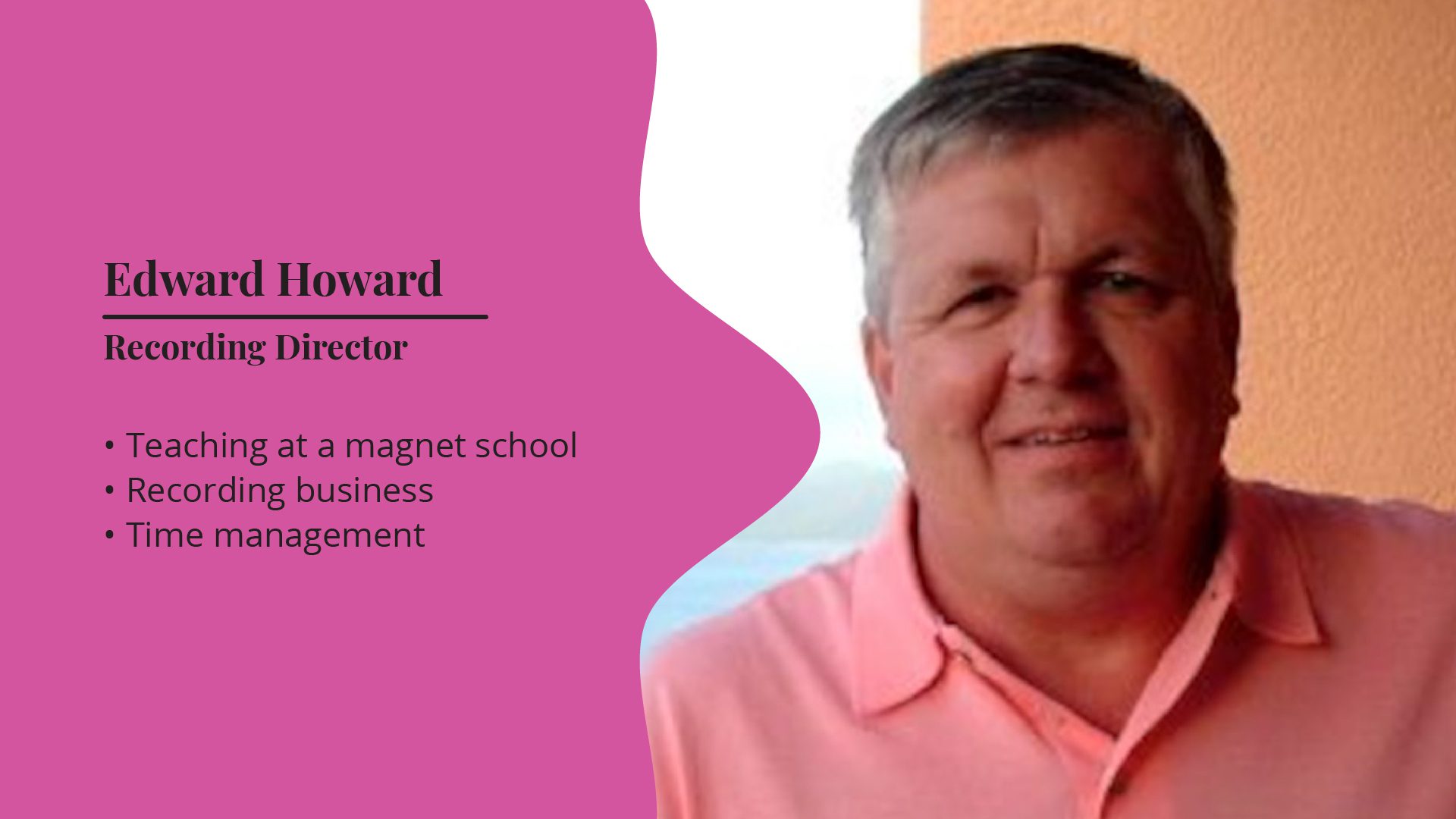
  • Edward Howard

    Edward Howard

    “Do your best, and never settle for seconds.”

    Eddie Howard, from Greenville, South Carolina, is the Director of the Recording Arts Program at the Fine Arts Center. Establishing the program in 2007, Eddie Howard teaches both younger and older students how to record music.  

    Interview

    Transcript

    Edward Howard 00:00 

    I am from Greenville, South Carolina. I teach the Recording Arts program at the Fine Art Center in Greenville.  

    Haley Hansen 00:07 

    How long have you been working there?  

    Edward Howard 00:08 

    Well, I started the Recording Arts program in 2007 as an afternoon class, teaching high school students- the art of recording. It’s like a recording studio. And that’s what we have. And so, I’ve been teaching afternoon classes since then. But we just added a morning class, so, that is it is doing I’m doing that full time now.  

    Haley Hansen 00:28 

    What is your official job title at the Fine Arts Center?  

    Edward Howard 00:31 

    It is the Director of Recording Arts.  

    Haley Hansen 00:33 

    Can you walk me through a typical workday there?  

    Edward Howard 00:36 

    Okay. Yeah, we have a morning class of younger students who are more on an entry level, just learning how to record the very, very basics. So, I walk through and demonstrate different things they have, they do some book work, but it’s mostly hands-on.  

    Edward Howard 00:53 

    And then my afternoon class has little older students. They are typically 11th and 12th graders, sometimes 10th graders.  And most of those students are already recording when they come into that class. They have figured out ways to do it at home, and so they have some experience going in. So, they just kind of come in and take it to the next level.  

    Haley Hansen 01:16 

    How did you end up in this field? 

    Edward Howard 01:18 

    My uncles, my mother’s three- four brothers built the first recording studio in Greenville, South Carolina, in 1958. And so, my dad used to love to go hang out in the studio when I was five or six years old. So, we, for years, really all my life, would go hang out at the studio, sometimes at nights and on weekends when they were doing sessions. So, I kind of got the studio bug from that.  

    And then later, for the last couple of years in high school, I was a guitar player. And that was involved in a couple of bands between 1971 and ’74. We finished high school in ’72 and hit the road, and the band got very, very busy. And we were staying gone so much, I just did not like traveling that much.  

    And so, I decided to come back to Greenville, and wanted to get into the studio business. And so, that is what I did, I came back to Greenville in ’74, started hanging out at the studio, and went to work there in ’77, spring of ’77.  

    So, I worked in the studio ever since I’ve been in the recording business; I have owned three different studios, been part owners/partners, in three different studios. And I’ve built several studios for people as well. So, that’s what I’ve done.  

    Haley Hansen 02:34 

    How did you wind up at the Fine Arts Center? 

    Edward Howard 02:36 

    Well, a friend of mine, Steve Watson, who is retiring this year, has been directing a jazz program at the Fine Art Center for 27 years. He and I met in 1985 when he first moved back here from L.A., and he and I worked. We did a number of jazz records together, and a number of albums together in the studio. Became friends and just have ever since.  

    And so when they built the new Fine Arts Center in 2006, I believe it’s when they were it was under construction, he called, and he said, “I think I can get the budget to put a recording rig in my jazz class, I just won’t be able to record my kids.” And so, we met, and I consulted with some folks there about what kind of equipment to put in, and you know, everything had gone Pro tools and computers and stuff by then. So, he did that. And they installed all the equipment.  

    And every couple of weeks or so he would call and say, “Can you come by on Thursday afternoon or something and record the kids?” And so, I’d go over and do that every couple of weeks or so. And I will say recording one day in 2007, I believe it was, and Dr. Flour, the director at the time walked in, and he said, “Oh my gosh, we’ve got $80,000 worth of equipment in this room, and we’re not doing a recording program.” And so, I said, “I’ll help you start it. And I give you the afternoons, that’s all I can give you: two-hour afternoons.”  

    And so, we did that and started our first semester, which began in 2008. I think it was fall of 2008, and that has a two-hour afternoon class. And then we just added this past year, added the morning class. So doing a morning and afternoon class.  And I have about 20 students now.  

    Haley Hansen 04:16 

    Are you still teaching out of the first studio you helped design there? 

    Edward Howard 04:19 

    Where? 

    Haley Hansen 04:20 

    At the Fine Arts Center, like the one that you were hired as a consultant for? 

    Edward Howard 04:24 

    Yes, that’s our main control room. And since then, since we started the program, we’ve added two spaces. There are two rounds that are about 12 by 12 spaces. One of them has three workstations in it, the other one has four workstations.  

    Haley Hansen 04:39 

    Do you have a defining moment in your creative journey that made you realize this was what you wanted to do with your life like a particular project that you worked on?  

    Edward Howard 04:48 

    No, really, I had always loved the recording process. And even when I was traveling on the road before I always had in the back of my mind that “You know one day I need to get into the studio that’s what I need to do.” And I really just kind of knew that. I had grown up around it and had seen enough of it to know that that’s what I want to do. And so, I did that and started in ’77. And I have been doing it ever since.  

    Haley Hansen 05:14 

    What was the biggest adjustment or challenge that you faced when you started your current role at the Fine Arts Center? 

    Edward Howard 05:20 

    Well, when Dr. Fluhrer, Roy, is what we always called him. When Roy asked me to start the program, I said, “Roy, I’m not the teacher. That is not something I feel like I do.”  

    My biggest challenge was learning how to teach, learning how to develop curriculum. I have done some workshops. Me and a friend of mine used to do some workshops in the studios, but it was mostly for adults, producers, and arrangers and musicians who wanted to learn how to record. They wanted to learn the technical side of the recording.  

    So, I’ve never been in a position to teach kids, you know, students. So that was probably the biggest challenge. Learning that, but the faculty, the other teachers, these guys are just incredible people. And they were so helpful to help me to learn how to do stuff like that, how to develop a curriculum, how to teach, you know, how to teach a class. Yeah, it’s a whole different thing than recording with a bunch of professional musicians. 

    Haley Hansen 06:24 

    Do you recommend any specific skills that someone aspiring toward you, toward your field or position like yours should try to develop? 

    Edward Howard 06:32 

    Just learn, learn how to do it yourself. You know, most of my best students come in, and they’ve found free software programs at home. And they found out ways to do it. And a lot of them are just doing stuff on their phones nowadays. And they come in with these demos, impressive demos that they’ve done with them, on their phone, with free software. And that’s, that just seems to be the best way to get started with it.  

    And a lot of times when I am interviewing students, one of the first questions I ask is, “Are you already recording?” And if they say, “No, I’ve not done anything yet.” So, I’ll tell them, “Then find a way. Go out and find your way. There’s free software all over the internet, you could do it on your phone, you can do it on iPads, if you have the luxury of having a good computer available, you know, even better. But find a way to do it.” And that’s really the best way for them to learn the basics, to start learning the basics. 

    Haley Hansen 07:31 

    What’s something that you want your students specifically to learn about pursuing a career in a creative field? 

    Edward Howard 07:39 

    The biggest thing you know, some of the biggest things I have tried to do with them is to teach them how to be self-disciplined. Teach them how to manage projects, manage their time and do their best, you know, never settle for seconds, go in for the best sounds. And because if they go out in this business as a recording engineer, or producer, or composer, that’s what the challenge is going to be in the real world. 

    Haley Hansen 08:02 

    What would you say is the hardest part of advising students for college and for career-readiness? 

    Edward Howard 08:08 

    In this kind of work, in the recording work, the college of choice has more to do with where do you want to be when you come out on the other side? Because they’re their universities around the country. Almost all universities have great recording programs now. Unlike when I came along, there were no educational, no colleges, were offering any kind of training in recording field, and audio or video. And so now just about every university has serious recording programs.  

    But each university tends to steer students in a particular direction. So, if you go to Nashville and Belmont, you are probably going to end up in Nashville, you know. So, different universities and different programs tend to guide students in different areas into different parts of the country. So, you have to kind of look at their programs, and look at their internship programs, and see where do they push students at the other end? You know, and where do you want to be? You want to be in New York, you want to be in Dallas, LA, you know, or in a small town somewhere, like Greenville?  

    Haley Hansen 09:13 

    What part of that process of preparing students for college and career readiness would you say that you’re very successful at? 

    Edward Howard 09:20 

    Just teaching at a commercial-level, recording. Teaching them how to how to record music, you know, live music and digital music. And how to produce music. How to work with people, you know. I really encourage my kids to collaborate on projects because they will learn 10 times more collaborating with someone else than they will if they just sit down at their computer and work in a bubble. The progress they make will be very slow for most students, generally, but they will progress much faster if they work with other students creating music projects. And that prepares them for university level. 

    Most of the college programs, that are doing recording programs, I constantly get feedback from people from the universities, that will tell me that my, my students that go into those programs, they’ll tell the students, you’re going to be bored for the first semester or maybe for two semesters, because it takes that long for, for my students to catch up with where you are. So, they’re getting a real boost ahead in the recording program, you know, if they decide to enter a four-year program of recording. 

    Haley Hansen 10:31 

    I know that some of the colleges in South Carolina have an arrangement with the Fine Arts Center, that the classes there count as college-level courses. I took creative writing there, and I got credit for a creative writing class at Coastal [Carolina University. Does your program have anything set up with colleges like that?  

    Edward Howard 10:51 

    Yeah, we try to get colleges to do as much of that possible. We have actually had a contract with Clemson for a number of our programs, with Clemson University. Were with Recording Arts, they can test out of a semester, or they might test out of two semesters.

    So, if they decided to go into the Recording Arts program, depending on what level that they’ve learned in my program, they might be able to skip a semester at Clemson, for instance. And we’re working on more universities that do that there. A lot of universities will talk about that. And they’ll say, oh, yeah, that’s a great idea. But it is a very time-consuming thing to put together an agreement like that. It’s a very complex agreement.  

    Haley Hansen 11:33 

    Are there any organizations or programs, or events that you recommend for folks in South Carolina who are interested in your field?  

    Edward Howard 11:41 

    For universities?  

    Haley Hansen 11:43 

    Universities, or summer camps, like getting involved in the community, or anything like that? 

    Edward Howard 11:49 

    Well, I encourage them to get involved in the community, all they can. They can go to other studios and hang out, or they go hang out at some live concerts and just kind of get the feel of live music as well. But there’s not a lot of programs, summer camps, for that kind of thing.  

    We are actually doing a thing this summer, called Summer Intensive, where a number of our programs at the Fine Arts Center are doing one week, three hours a day for a week. Four days, it’s just four days, not a week. And so, it’s kind of like an icebreaker for a student that would be coming into my program. And I’ve got several students that have enrolled in my program next Fall that are coming to the Summer Intensive thing, just to kind of get a leg up on it, you know, get ahead of the game. So that’s a particular thing.  

    But you got universities, like in this area, immediate area, you’ve got UNC Charlotte, you’ve got Francis Marion, I think Coastal Carolina has a program, Clemson has an incredible program, the USC [University of South Carolina] has a program. And so, most of the universities nowadays are doing really good Recording Arts programs.  

    Haley Hansen 12:57 

    Before we end the interview, do you have any advice for current students or young adults who are pursuing a creative career? 

    Edward Howard 13:05 

    You know, Dr. Fluhrer, the guy who started the Fine Arts Center and ran the Fine Arts Center for years, always had this whole thing…. All the time I’ve worked around him, he had this little saying, and he would say he would just say, “Do the work.” You know, just a simple thing. And that’s coming to school every day, doing the work, you know, not lollygag, not hanging out, just talking.  

    But you know, I think for the Recording Arts Program, I tell parents and students, this is not if you’re not a very self-disciplined program, this is not for you. Because we don’t have a class where I gather everybody up every day. And today’s students, this is what we’re going to never happen. Everybody works at their own pace at their own level. And that’s the way the real world works. In the recording business.  

    You know, nobody in the recording world wants to be paying a studio musician or a recording engineer or producer and has to say, “Come on, guys, let’s go for it. Let’s get this done. You know, they don’t want to be pushing people. You know, they want people to work there because they love what they do, and they do it well. And that’s what I try to get my students to learn, learn how to do the work and do it well. 

    Haley Hansen 14:20 

    Is there anything else you think it’s important to say before we end the interview?  

    Edward Howard 14:24 

    No, just self-discipline and do what you love. My dad used to tell me, “Whatever you decide to do, make sure it’s what you love to do.” There’s no reason why anybody should hate their job or their career. And so, when you choose students when they choose, we just try to encourage them to choose the right career for the right reason. And choose something that you love to do.

    You know, not something that your parents want you to do, or somebody else is pushing you to do it. Or not because you think, “Oh, I’ll look at that career because you can make a lot of money.” You know, you can’t do it for the money. You know, the recording business is a very lucrative business for people who are very self-disciplined and determined. It makes a great career. And if you do that for the right reason, the money is always there. 

    Haley Hansen 15:17 

    Well, thank you for taking the time to speak with me. 

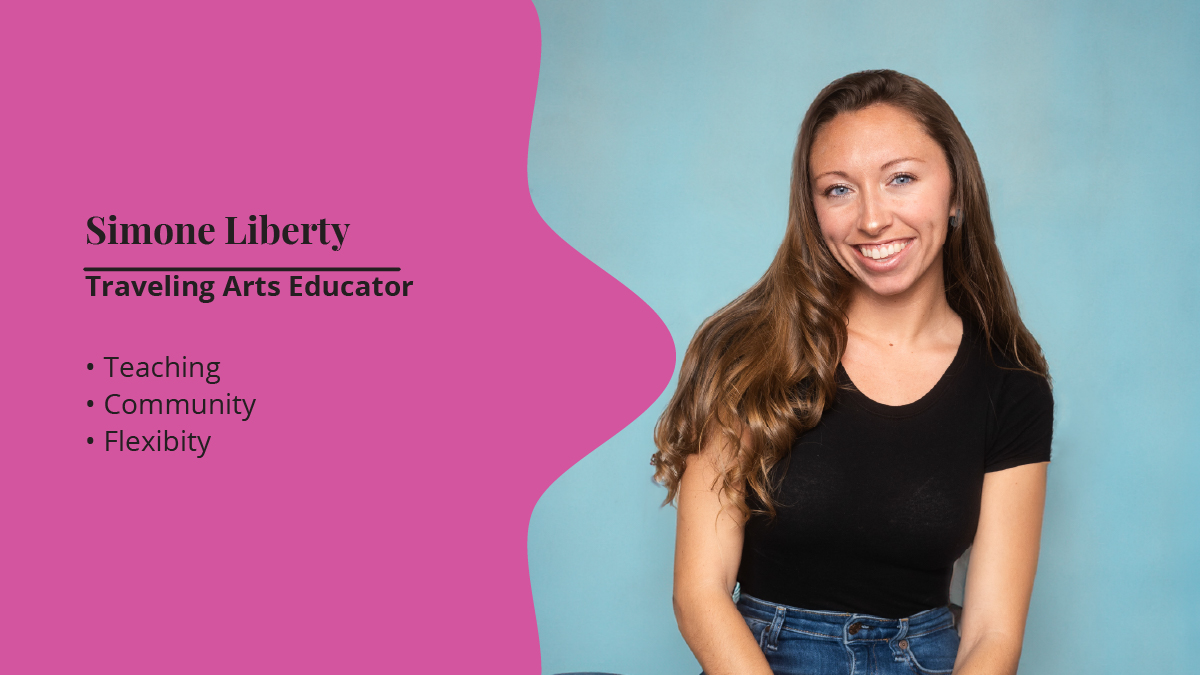
  • Simone Liberty

    Simone Liberty

    “I really love to extend art and creativity for everyone. Art for all. Art for everybody.”

    Simone Liberty is a full-time Teaching Artist based in Charleston. As a Teaching Artist, or traveling arts educator, Liberty teaches Arts Integration in schools throughout Charleston, Dorchester, and Berkeley counties. Arts Integration uses visual and performing art forms including dance, art, and theatre, connecting them to core curriculum subjects such as math, science, and ELA. 

    Interview

    Transcript

    Simone Liberty 0:00  

    I’m Simone Liberty. I’m from Connecticut originally- but I’ve been down here in Charleston since fall 2015. 

    Emma Plutnicki 0:06  

    So, can you please tell us what you do for work and what your official job title is? 

    Simone Liberty 0:10  

    Yeah, sure. I am a Teaching Artist, and this would be my official job title. I’m a traveling arts educator. I go to lots of different schools at this point. Although a teaching artist doesn’t have to be just confined to schools; they are community art educators, so they could go and do workshops for adults or other communities as well. Right now, my work has me going into schools all over Charleston, Dorchester, and Berkeley counties. 

    Emma Plutnicki 0:41  

    Very cool. How long have you been doing that? 

    Simone Liberty 0:43  

    I’ve been a full-time Teaching Artist for about two years now. 

    Emma Plutnicki 0:48  

    So, how did you end up doing this? How did you know that it was a profession that you could actually pursue? How did you know that you wanted to do this? 

    Simone Liberty 0:53  

    Yeah, so. It was kind of funky. So, I have to go back to tell you about my undergraduate degree at the College of Charleston. I was an Arts Management Major, and I graduated in 2019 with my bachelor’s degree. And while I knew that I wanted to roll right into a master’s program. I also had a desire to start connecting with some of the organizations around Charleston in the arts. 

    So, the best thing about my arts Management experience undergrad was that we had some great adjunct faculty members, and one of my professors was Catherine Brack, who at the time was the Director of Development at the Gaillard Center. So, I went in, and I was just kind of trying to pick her brain about what she does for work. And while I was there, she invited me to go and see their youth theater program in the summertime.  It was a summer camp. And she said, “You know, it’s going to be super cute.” They do every summer. So, would you, you know, just come and check it out? And totally adorable. I fell in love with just watching the kids on stage. And it reminded me of some work that I had done in the summers during my undergraduate experience. 

    So, I met Sterling DeVries, who is the Director of Education at the Gaillard Center, and still is, and just told her how interested I was in arts education. We talked for a while about that. And I ended up actually writing a letter in email form- to both Catherine and Sterling. I’m basically creating myself a position at Gaillard. I ended up getting that position, but the catch was that what I really wanted to do was work part-time in the Education Department and part-time in the Fundraising and Development Department. And instead, what they could offer me because of budgetary needs, was a full-time or it was still a part-time position in development while I was in graduate school. And I ended up raising funds for specifically the education program at the Gaillard while I was there for about two and a half years and absolutely loved the work that I was doing because I got to raise the funds that were supporting the arts education. But I wasn’t doing it myself. I really wanted to be with the kids specifically. So, I started to talk to Sterling more about that. And she eventually ended up asking me to be one of their teaching artists for the summer camp that I went to and saw originally. So, that was kind of my bridge into teaching artistry. 

    It started out as just teaching summer camps. And increasingly as I got my name out there and started to network myself a little bit harder and got connected with some other community partners, I’m now able to say that I’m full-time as a teaching artist. 

    Emma Plutnicki 3:46  

    Amazing. That’s a great story. So, nowadays, how would you say the split is between working in schools and working behind a desk? What does your typical day look like? 

    Simone Liberty 3:58  

    Yeah, so it really depends. I used to love my routine. Unfortunately, this job has no routine. So, if I’m in school, it’s either in school after school, or maybe summer camp. 

    Let’s take today, I am going to be in a school, but my school time doesn’t starts until 12:45 And from 12:45 until the end of their school day, basically, I’ll be teaching different classes, and then I will do an after-school program. So, that meant that I had a couple of hours this morning to be on my laptop. And that’s what I have been doing and will continue to do after we get off this zoom call. This I would say, looks like a pretty typical day. If there were such thing as a typical day, where you know, it’s a balance between computer work and then being face to face with students for me, but like I said, a teaching artist can also be face to face with adults in the community or anything like that. 

    Emma Plutnicki 4:53  

    Yeah, so do you think it’s been I mean, you said that you kind of paved your way to find this position, but has it been challenging to work within this field? What kind of challenges do you see on a day-to-day basis? And how do you kind of overcome those? 

    Simone Liberty 5:07  

    Yeah, so it has been difficult to call this a full-time career path. As I mentioned before, you really must be intentional with networking and getting yourself out in the community, so that people know who you are and what you do. And what I have found is that I’ll speak specifically to the Charleston area. Lots of people have questions or are generally confused about what a teaching artist does for their work, and I think that has to do with the broad nature of the role. You know what age range do you like to work with? Or what’s the style of your workshops? Sometimes, when I’m working with different community members when I am going into schools, specifically, I’m doing arts integration. And so that’s making sure that it’s not just a dance or theater, workshop, I’m teaching dance and theater things, but it’s also teaching a core curriculum subject like Math, or Science or ELA. 

    So, all those moving pieces make a teaching artist change how they describe themselves. And it’s just this really vast thing that hasn’t really been nailed down, nor do you want it because we’re creative individuals. So, all, it’s tricky to keep having the conversation of who are you and what do you do? And you know, what are your credentials? Because there’s not real credentials in Geometry, there’s no certificate, and there’s no degree in teaching artistry. But you know, that’s, that’s kind of the tricky part of it. And with that comes, where do you find your peers? You know, it can be a little bit isolated if you don’t have community partners that you’re really in contact with. It’s just that it requires lots of self-initiation. 

    Emma Plutnicki 6:51  

    Yeah, and so far, as networking goes, how have you been able to network with people? Are there any events that you’ve gone to? Or is there anything within South Carolina programs or communities that you’ve found to kind of build those connections? 

    Simone Liberty 7:05  

    Yes. So, first and foremost, I will need to tell you about Engaging Creative Minds, which is one of my community partners, and one of the organizations that I work for. They’re kind of like a booking agent for Teaching Artists, and they have a whole roster of artists. All these artists go into schools as well and do very similar things to what I’m doing, but just maybe in a different discipline or the same. So, I focus on dance and Musical Theater. And so lots of those teaching artists I’ve been able to connect with through engaging creative minds, even if it’s just on an email basis, some of them I’ve been able to meet in person, even, you know, get coffee with and pick their brain about how they run their workshops. But that’s been a great help. 

    I should also call out professional connections that aren’t teaching artists have been very helpful in just understanding the field more broadly. And I would like to stay well connected with the South Carolina Arts Commission and the South Carolina Arts Alliance, two separate things. The Arts Alliance is a non-profit that is a statewide Arts Advocacy Organization. So, that, those two organizations or the agency and that organization have been great to relate to so that I understand more about the South Carolina Arts field at large. 

    And then I found a lot of my personal connections to be a part of my graduate program. So not only did I do the master’s in public administration, but the College of Charleston also offers a certificate in Arts and Cultural management. So, a lot of the individuals from my cohort and I are still quite close. So, I would say that those are a couple of events and organizations that I stay connected with. 

    Emma Plutnicki 8:48  

    Perfect, and so throughout your journey so far, has there been any particular project or, I don’t know, a program that you’ve worked on that has had a significant impact on you, or that you hold, like, close to your heart, anything that stands out as being like a highlight of your career so far? 

    Simone Liberty 9:05  

    Yes. And it’s kind of a new one. But I’ve been happy about this past couple of months now. So, I for the past couple of years, have struggled with the question of what my why is. And I think that’s a really important question, especially for young professionals to ask themselves when they’re going through, trying to find what they love to do for work. What you know, makes their workday feel like it’s fun, rather than work. And what I’ve been working on is, I really love to extend art and creativity to everyone, art for all, art for everybody. And one thing that had been kind of gnawing at me for a while is that I love tap dancing. I’m not a ballerina, but I do love tap dancing, and I can’t teach that in most of the schools that I go into because there’s a prohibitive cost to tap dancing. Those tap shoes they start at $65 dollars. So, that’s just not possible for a lot of the students that I teach. 

    So, what I created last fall, I’m calling them Tip Taps. It is a low-cost tap accessory, I’ll call it. It’s not a replacement for tap shoes. But it’s simply just a piece of metal that you can strap to any shoe. And I can now go in and teach tap dance workshops. Now it’s just one tap, it’s not the heels, but I can teach tap dance workshops to kids who might not have ever had a tap shoe on their feet before. So, this has been a highlight. And it’s really brought me back to that, what’s your why? Because, like I said, my why is art for all and making sure that there are accessible ways to bring art into our community, even if it’s not in a traditional way. 

    Emma Plutnicki 10:48  

    As far as the skills that you possess, what do you think has helped you in this role? Clearly, you have ingenuity and creativity with projects like that. But are there any other skills that you’ve had that you think really advance your role? 

    Simone Liberty 11:02  

    That’s a good question. Yes, I want to say flexibility and not in the dance way. But being flexible in your schedule, in your idea of what your day is going to look like in your goals, even. You know, sometimes you end up either under or overshooting a goal that you have at, say, the beginning of the year or the beginning of a school year or semester, whatever it might be. Whether that’s a financial goal, a mindset goal, or a life, a work-life balance goal, whatever it is, there’s an element of entrepreneurship in craft. And it takes some flexibility. 

    There was another thing that I was thinking of well, ah, curiosity would be another one. That’s been a skill that I’ve had to flex quite a lot, you know, ask lots of questions and kind of dive into who might be potential partners for you to go in and offer your teaching artistry to. I would say, Yeah, curiosity and flexibility. Those would be the two skills. 

    Emma Plutnicki 12:03  

    Yeah, great. And so, just as we wrap up, do you have any advice for young professionals and college students who are trying to make a path in the creative world and looking for a job similar to yours? 

    Simone Liberty 12:15  

    Stay connected to what brought you to the arts in the first place. This has been something that I’ve been trying to get back to the last year, I would say, you know, we probably all landed in arts management or arts administration or wanting to be in the creative field because we are creatives, and we are artists, or at least we say like, oh, I used to be. 

    It’s not gone, and it doesn’t need to be. So, my advice to young professionals is to find that adult dance class, down here in Charleston, we’ve got Redux that offers adult art workshops. Find those opportunities to stick with your craft and make sure that that stays in your practice. So, I think the reason that I’m saying this is because it really does help you to fill in that work-life balance, and at the same time might let you draw some connections towards your why, why you’re doing this. 

    Emma Plutnicki 13:09  

    Great. That’s such good advice. Okay. So, thank you so much for joining us. Is there anything else you’d like to add about your profession, your career, or anything else? 

    Simone Liberty 13:18  

    Oh, my gosh, we need more teaching artists please. You know there is no lack of demand. I think that the field of teaching artistry is growing at just an exponential rate in South Carolina at large. I do know that there’s planning to be a teaching artists forum in the fall by the South Carolina Arts Commission. And I think they always have community partners on things like that. So yes, you know, look out for things like that if the idea of teaching artistry is interesting to you. I also would say to get connected with Tag, which is the Teaching Artists Guild. There’s other national and even international resources for teaching artists to kind of connect with so that you can explore the field more and of course, if you have anyone up your way that would like to connect with me about teaching artistry with more questions, feel free to send them my way.  

  • Thurayya UmBayemake

    Thurayya UmBayemake

    “Your path in life won’t look like anyone else’s.” 

    Thurayya UmBayemake is the Spark Lead Actor-Teacher in support of the Arts Grow SC program at SC Governor’s School for the Arts and Humanities. She delivers literacy-based drama programming to public schools to encourage “creative thinking, divergent thinking, and overall motivation to read.” UmBayemake earned a degree in drama studies at South Carolina State University (SC State). 

    Interview

    Transcript

    Thurayya UmBayemake  00:00 

    My name is Thurayya UmBayemake. I moved to South Carolina a couple of years ago from Ohio. But I claim Ohio, Kentucky, and South Carolina because I went to college here, and I felt like I grew up here.  

    Emma Plutnicki  00:13 

    Perfect. So, what do you do for work? And where are you currently working? 

    Thurayya UmBayemake  00:18 

    My official title is Actor-Teacher Coach for the South Carolina Governor’s School for the Arts and Humanities. So, what that entails, is that I’m the Lead Actor-Teacher for a program called Spark, which is through their department of outreach and community engagement. The Spark program is a literacy-based drama program. So, we go to elementary schools, and not only do we show students how to take stories from picture books and how to add drama enactments in there, to show characters, to show settings, to show plot, to reinforce the literacy-based learning, but also creative thinking, divergent thinking, and just overall motivation to read. That’s our main goal. But we also have a goal of showing teachers that even though you don’t have an arts background, you could do this too. So, it’s a twofold job. 

    Emma Plutnicki  01:18 

    Amazing. So, you’re working out of South Carolina? 

    Thurayya UmBayemake  01:21 

    Yes. 

    Emma Plutnicki  01:22 

    Okay. Perfect. And how long have you been working there? 

    Thurayya UmBayemake  01:25 

    So, I’ve been here for a little over two years. And that’s when the residency program started. But the program before I came along was a summer based only pilot. And when the SR [Sub-recipient], ARP [American Rescue Plan] grant money came in, that’s the federal grant money that was given for the pandemic, it turned this program into a year-long residency program. So, that’s when I was hired in. And I had a team underneath me of other actor teachers, and we’re spread out throughout the state. So, we work somewhat remotely and we traveled to different schools across the state. To spread the wealth, to spread the joy of the job. 

    Emma Plutnicki  02:11 

    Yeah, amazing. So, two years, how did you end up in this field? How did you hear about it? How did you know that this is something that you could do?  

    Thurayya UmBayemake  02:19 

    So, my background, I’ve always been into theater. Well, I shouldn’t say I’ve always been. I’m a storyteller. So, I’ll try not to be so long winded, I promise you, I will try hard. 

    So, it all started when in high school, I was actually an athlete, I did cross country and track and field. I got injured my senior year. And at the same time, I got injured, the African community theater opened up in my hometown. And I tell this story, because it’s very important. That’s how I got into theater. I was involved in a theater that embraced me for who I was and told stories that I could truly relate to. And so, that gave me the theater bug because, actually, I wasn’t even initially an actor; I was an assistant director, slash stage manager, then came acting, and I knew from then I wanted to stay in theater. So, I went to college and ended up at South Carolina State University because they had a drama education program. And that’s how I ended up from Ohio to down here. I have no ties to South Carolina other than that, but that program really developed me. One as a family unit, you know, I felt comfortable and vulnerable enough, which is very important. When it comes to drama and theater, you have to be vulnerable onstage, in the script, everywhere, for the story to be told authentically.  

    So, that was one thing. But then also, when I realized how long the drama education program was going to take to complete, I switched to drama studies, which was good for me because it helped me learn other aspects, more in depth in theater, I learned Tech, I learned administration, all these different aspects, versus just little surface levels and education. So, that is my educational background. 

    Once I graduated, I did some traveling. I called myself a little bit of a nomad, so I went back to Ohio for a bit. I did a children’s theater up there, and I opened up my own theater, basically for social justice. It was called the Sue Company. And I opened it with two of my friends, and we focused on telling the African American stories, you know, up here. I don’t know why I said up here, I put American in there. African American stories. 

    From there, I went to New York and, actually when I moved to New York, I took a break from the theater, even though I was living in New York. I know that’s backwards, but I just was living life and, and me being a natural storyteller, you have to experience life to tell stories. So, that’s what I did in New York. I just was experiencing life. I did go to do readings, and volunteered as an actor, but that’s the extent of my theater experience in New York. Once I came back to Ohio, I realized I wanted to get back into theater. But I also knew I wanted to come back down south to South Carolina, because this, to me, is where my home theater is now. Where my friends from school kind of stayed in the area. So, I was looking for jobs. And then one of my colleagues or old classmates sent me this job. He was like, “Hey, I think you’d be interested.” So that’s how I learned about this job. And I was like, “I am interested.”  

    So, I was nervous. I actually applied for both the actor, teacher job and the actor, teacher coach job, because I didn’t know if I fully qualified or not. And it’s funny, because I think you’ve probably seen that article where there was a study on men and women. How women feel they have to heal. That’s me. I was like, “I don’t know.” So, obviously, I interviewed well, and I got the position. And it’s just been smooth, not smooth sailing, but it’s been smooth sailing since. It’s definitely been challenging, but it’s a good challenge. And I’m really happy that, one, that they picked me, and they trust me with this position, and that I could do justice for it.  

    Emma Plutnicki  06:20 

    Yeah, amazing. So, what kind of challenges have you experienced? And how have you overcome those challenges? 

    Thurayya UmBayemake  06:26 

    Well, one is I’ve somewhat managed before. My managing experience has always been short-term, right? Like my last job, I worked for the Board of Elections in Cuyahoga County, and I was a recruiter official. So, what that means is that I basically was responsible for filling in the poll workers. So I hired them. And then sometimes I had to fire them, you know, or relocate them, and things like that. But it was a very short-term commitment. This job is a very long-term commitment. You know, because once someone’s on the team, we want them to stay on the team. So, I had to grow as a manager to overcome difficulties, whether it’s individual or personal, or just overall team dynamics. 

    Emma Plutnicki  07:10 

    Yeah, that makes sense. So now, on a daily basis, what kind of things are you working on? And what are your responsibilities on a day-to-day basis? Are you working on long projects? Or are there kind of short assignments that come up? Or what does it look like? 

    Thurayya UmBayemake  07:26 

    It’s a mixture of both. And I feel like since I’ve been brought on, it has always been a mixture of both. Mostly because it was such a brand-new idea of a program, where we had an idea where it was going to go, but we didn’t necessarily have the pathway. So, we had to be always flexible, which sometimes is harder than it sounds, you know. So, my daily projects, like the shorter terms, are what I know, right? Like summer programming, I know what comes up every year. So, I have to plan for it, right? During the school year residency, I have to plan for that. That’s the short term, you know, constantly, but the long term part is choosing the districts, how we’re going to get to those districts, who’s going to be involved, that’s more of the long term, and also getting the word out about our program because, there’s a lot of challenges that comes with our program, because it’s new, you got to explain it. But you have to explain it in a way that you don’t lose interest. For instance, not being too long winded. But you don’t also want to be too short, because they’ll come up with their own idea of what the program is. I feel like the whole program has had a significant impact on me.  

    Emma Plutnicki  08:31 

    Yeah, it makes sense. So, throughout your time doing this, has there been one project or something that you worked on that stood out the most like resonating with you or something that had a significant impact on you? 

    Thurayya UmBayemake  08:45 

    You know what, one thing I’ve always wanted to do is be a presenter, right? Like when I go to conferences or things, there’s always a presenter up there explaining. And I always thought that job looked cool. I didn’t know that this job would turn into part of that. So, this past year, particularly, I got to go to different conferences and present the program. So, I was really happy with that accomplishment.  

    Emma Plutnicki  09:12 

    Yeah, that’s so fun. You said that you didn’t really have too many ties to South Carolina. So, when you came, were there any, um, like organizations or events that you went to, or interacted with to kind of build a network, or just overall help you in your field? 

    Thurayya UmBayemake  09:30 

    Yes. So, this is when I bring in my mama. Growing up, we moved around a lot. My mama has always instilled in me that you get to know the community. Like, on the first and second day moving, we always went and got a library card. We met at the police station to meet the officer, like you have to know who you’re living with, you know, your neighbors and everything. So, when I came down here, not only did I reach out to my former classmates from SCSU [South Carolina State] who are still in the area. I did the same exact things. I went to get a library card, I went to local community festivals or events, you know. And I reached out to different communities to let’s say, hey, you know, introduce myself to things of that nature, you know. And that’s how I built my network here. I also went to many different theater events around. I live in Colombia. I don’t know if I mentioned that, but my remote position is in the Midlands. So, I went to the theater network here to just introduce myself because I’m also doing something in drama and wanted to know the familiar bases. 

    Emma Plutnicki  10:38 

    Amazing. When you were trying to get this job, were there any skills that you found helped you land, the position, or any skills that you think someone trying to get into your field should have in order to find success? 

    Thurayya UmBayemake  10:53 

    Definitely. So, I think two major skills are what got me the job. One was my natural storytelling ability. The second was my background and job experience. I have worked so many different types of jobs. And I know some people feel that once they get out of college, they should only work in their field, right? You’re missing out, right? Like you are missing out on meeting different people, learning about different situations, how to overcome it, you know, taking that L, you know, learn from your mistakes. So, I think having all those different types of jobs, one led me to be a recruiter official, because I could deal with people well, and that recruiter official helped me get this job because they’re like, Oh, you have management experience, see how it all just comes into place?  

    Emma Plutnicki  11:42 

    Yeah, perfect. And just as we’re wrapping up, do you have any advice for someone who would want to get into a position like yours, and how they can manage that? And just any overall advice for them? 

    Thurayya UmBayemake  11:56 

    Yes. One, don’t narrow your network, right? Like, make friends with any and everybody, just to learn about their life experiences and what they went through. It will help you learn that your path is not going to look like anybody else’s. Like, you could talk to 100 people, I promise you, your path is going to be different from all 100 people. Right? And with that being said, you can’t take everyone’s advice. Everyone’s advice is used with a grain of salt because, again, your path is going to be different no matter what. 

    Emma Plutnicki  12:28 

    Yeah, for sure. That’s good advice. And is there anything else you’d like to add about your experiences or your profession? 

    Thurayya UmBayemake  12:38 

    Yeah, I would like to add one more thing.  

    I feel like this job was a dream come true. And I say that because when you major in one of those fields that doesn’t, quote-unquote, guarantee you a job. You have to learn patience, right? And when I came out of college, I think my first job was housekeeping. Like, who wants to admit that nobody, right? I eventually got into children’s theater and other stuff, but none of those paid the bills, right? Like it was just something I enjoyed doing. But this job is the first one that meets both. That satisfied my living situation. And I really love and enjoy doing it. And it took a while. But I feel like it was perfect timing. So, it’s about faith. It’s about persistence. I just had to, like I said, refocus and learn different jobs and different skills and enjoy the journey of life. But I really do love this job. My team is great. Working at the SC gov school is great. And I couldn’t ask for anything better. 

    Emma Plutnicki  12:40 

    Yeah. Amazing. I’m so happy you found your dream job. So good to hear. 

  • Marius Valdes

    Marius Valdes

    “Everyone’s got their own journey, and you have to find your way. I would never discourage anyone from a journey in the applied arts or the creative arts if they have the drive and the will to do it. Because that’s the biggest part of it: just being disciplined.”

    Marius Valdes is an artist, illustrator, and professor of Studio Art teaching graphic design and illustration at the University of South Carolina. Valdes received his BFA in graphic design from the University of Georgia (UGA) and his MFA in visual communication from Virginia Commonwealth University (VCU). Valdes is originally from Charleston and lives in Columbia.

    Interview

    Transcript

    Marius Valdes  00:00 

    My name is Marius Valdes. I’m from Charleston, South Carolina. I currently live in Columbia, South Carolina. I’m a professor at the University of South Carolina. I teach graphic design and illustration. I’m also a practicing artist and illustrator. 

    Emma Plutnicki  00:15 

    Amazing. So, can you just tell us what your official job title is? And how long have you been working as a professor there? 

    Marius Valdes  00:22 

    Yep, it’s Professor of Studio Art. And I’ve been here since 2007, so something like 17 years. 

    Emma Plutnicki  00:31 

    Yeah. 

    Marius Valdes  00:33 

    So long! 

    Emma Plutnicki  00:34 

    Yeah, that is a long time. So how did you end up as a professor, and I believe before you were a practicing professional in the field, so how did you kind of make that transition from practicing in the field to then to academia? 

    Marius Valdes  00:48 

    So, I graduated from the University of Georgia in 1998. And I worked as a designer for about four or five years. And I had got to a point where I was really exploring illustration, I was kind of enjoying that almost more than the design work I was doing. But one of the things I felt like was limiting me as a designer was, I didn’t feel like I was very good at talking about my work. So, I thought going to graduate school would be kind of a good way to go and kind of expand my education, and kind of take what I’ve been doing for four or five years and kind of refocus and kind of just make myself more marketable. And while I was there, I had no intention of being a professor or teacher, and to me today that still seems kind of crazy. They let me do that. But when I was there, part of my scholarship was to teach a class. And I just loved it. And it was really fun. And what I found was kind of like, even though some of the students I taught were, were, maybe in some ways, more talented than I was, as a designer, I just knew more than them, because I had been doing it as a professional. And so, I just kind of really enjoyed it. 

    When I originally started college, I was going to be a psychology major, because I thought maybe I would be a counselor, or a shrink or something. I like talking to people. But then I realized there was science involved. So, I feel like teaching has kind of given me the ability to do that sort of stuff, in addition to teaching, you know.  

    Emma Plutnicki  02:25 

    Yeah, it makes sense. So, what kind of background led you to become a professor? What do you think, specifically lead you to do studio design, how has your background within studio design helped you to teach it now? 

    Marius Valdes  02:39 

    Yeah, so I think what helped me was, and I always tell students who are thinking about going to grad school to work for a couple of years, because when you get out of college, and you start working, and this is also why internships are really important, it gives you a chance to kind of figure out what you like, and also what you don’t like. So, for example, I was working in Charleston, and I was doing really well, I was working for companies that were doing a lot of real estate, like brochure design and advertising for real estate companies. And it just got so boring. I mean, it paid okay, and it was a nice job. But it wasn’t very interesting. And I started painting on the side for fun. I was literally finger painting on cardboard. And that started winning me awards. And I was, just like “what?” You know? 

    So it was kind of taking those things that were fun with the practical stuff I had kind of learned as a designer, and putting those together and then going to graduate school for two years, and working with a whole new group of professors who treated me more like a colleague and less like a student, and just learning to talk about work and look at my own work and kind of evaluate it, and look at other people’s work and be able to learn how to talk about it. All those things make me able to teach now, you know. Some semesters are easier than others, you know, some groups of students are easier to work with than others. But usually, it just means it takes me a little longer to kind of get through to people. But once I do, you know, I can share with them what I’ve been through. And I think that helps. 

    Emma Plutnicki  04:11 

    Yeah, that’s great. So nowadays, can you walk us through a typical workday, like what you have to do, what classes you teach, and just what’s expected from you on a daily basis? 

    Marius Valdes  04:33 

    Yeah, so I teach what they call two-two load, which means I teach two classes in the fall and two classes in the spring. I teach Mondays and Wednesdays, which is why I normally check my calendar first thing Monday morning. But the thing about teaching is my classes are two hours long. And I don’t always go the full time because a lot of times, the students, I give them something to do and they need get started and they’ve got to meet with me, and then once I’ve I met with them they need to go work. And that can be, they can stay in the classroom, they can go to a design lab, they can go to the library, they can go wherever they need to do their work. But for me on Mondays and Wednesdays, I’m teaching from eleven to four. Before the classes start, I’m usually checking email, getting caught up talking to students. 

    On Tuesdays and Thursdays, I do office hours, and that might be coming into my office and actually meeting with people. It might be doing a Zoom call; it might just be looking at work that’s been posted online and making comments on it. And then I’m also doing emails with, you know, colleagues and trying to figure out how to keep the design program going. It might be service at the university where I have to go to, like, for example, I was a faculty senator for a bunch of years. And that was a thing where once a month, for two or three hours, you go to a really long meeting and talk about all the things going on at the university. 

    So, Fridays are usually research days where it’s supposed to be a day where you have kind of an uninterrupted time to just work on your work. Although I will say this year, it’s been a lot of meetings on Fridays, because there’s so much going on all the time. At the university level, I’m at what they call research one university. So that means the emphasis is 40% teaching, 40% research, and then 20% service, which is doing things like being a faculty senator, for example. Other schools, like I taught at USC Upstate for two years. That’s what they call a teaching school where you’re teaching more classes and there’s less expectation of you doing research. Research for me is doing design work, illustration work, making art, and putting on other shows and stuff like that. And going to conferences to present my work. 

    Emma Plutnicki  06:55 

    Cool. Yeah, so, you just mentioned putting together projects and things like that. Do you have one project that stands out in your career as being, like, exceptionally motivating toward you or something that just had a significant impact on your life? 

    Marius Valdes  07:11 

    Oh yeah. You know, for the past couple of years, I’ve been working with the medical university, Carolina’s Children’s Hospital in Charleston. And I got a couple of grants through the school to work with them and created several murals for them. I’ve created some kids’ activities and books for therapists to use. I would say that’s been the most rewarding thing I’ve ever done, because it’s weird, I mean, I’m not kidding you, about an hour ago, a guy I work with here was like, “Hey, man, I’m at MUSC right now in the children’s hospital with my kid and my kid is like obsessed with your frog, you know, the mural, and it’s been really nice, like, it’s really made a difference on this visit,” and I get emails like that occasionally from people. And its always kind of sad, because like, the only way to really see those things is if you have a sick kid, but I really enjoy that. 

    And then I have other projects, I’ve done things that are more self-initiated, where I’ve kind of created little casts of characters. Some of them are called The Secret Species, and they’re these little clay figures, and I kind of would make art about them and leave them places and stuff. And I got a lot of mileage out of those, like that was kind of part of my thesis for my grad school. And I just kept kind of working on it. I got some really good attention for that work that was meaningful to me, for people to say, “Wow, this is a really creative idea,” you know. I kept hoping a toy company would come and offer me a couple million dollars for it. But that never happened. So… 

    Emma Plutnicki  08:45 

    No, that’s so cool. And just like, overall, has it been challenging in your career, both as a professor and as a practicing creative? 

    Marius Valdes  08:57 

    Yeah, I mean, you know, I’ll be honest with you, I think being a professional creative is not for the weak of heart. But what I will tell you is that when I was probably a little bit, like, your age, or even a year or two younger, I remember driving with my dad, and telling him, “I think I’m going to be an art major.” You know? I was just waiting for him to like, say, “What are you doing?” you know, and he just said to me, he’s like, “Well, if you do something like that that you love, you’ll never really work.” And I kind of feel like that. I mean, now, I do feel like I work. But, I mean, I work on things I care about. And I think that to me, it is sort of one of the main things that is like, you know, on my worst day, I might be struggling with a painting or an illustration for a client, but what I’m sitting here doing is drawing, you know. And I’m married to my wife who is a paralegal. She has a very normal nine-to-five job. And, you know, her job is answering to five attorneys, you know, screaming, like, “I need this now, I need this now.” And I can’t really complain too much, right? 

    The other thing is, I think that like, if you go into design or advertising, you are a little bit subject to your clients, and where you’re working and who your clients are, versus academia, which is much more steady, it’s a little bit more of a routine, you know, you kind of get into a groove. And I feel like whenever it gets too stressful, oh, spring break! Oh, Christmas time, here’s a month off! Here’s summertime, you can go paint for a month. And you kind of get all the stress of all the things you have to do, kind of out of your system, and then you reset. So, I feel like I’ve done a little bit of everything in the creative world. And I think like, sometimes the grass is greener, you know, sometimes you’re doing, you know, I’m doing academia, and I’m here teaching a bunch of kids, or students, and I think like, “man, I’d really like to just be in like an office setting right now, working on a project all day, sitting in front of it not worrying about this person or this person or this person.” But then you go into having a critique, and your students bring in a bunch of amazing work. And you’re like, “oh, man, I am a good teacher!” I mean, I joke around them all the time, and when they do something good. I always say, “Oh, I do know what I’m doing.” You know? There are little rewards everywhere. 

    And I think there’s all levels of like, I look at some people who have careers, you know, in the arts, and they are just doing amazing things. And they’re making gobs of money. And they have tons of exposure and fame and fortune. And I looked at people who were totally content just to be in their studio painting all day and illustrating and never seeing anybody and that makes them happy too. So, it’s like anything in life, you kind of have to everyone’s got kind of their own little journey. And you kind of have to find your own way. But I would never discourage anyone from a career in the applied arts or creative arts, if they have the drive and the will to do it. Because I really think that’s the biggest part of it is just being disciplined, you know? 

    Emma Plutnicki  12:15 

    And along with being disciplined, are there any physical skills that you think are beneficial for people trying to break into the world of design? Any specific skills that maybe you possess, that help you in your day to day life, or just if you saw, if you were hiring for a design job, and you saw, “Oh, this applicant has this skill,” what kind of things like that are beneficial to have? 

    Marius Valdes  12:39 

    Yeah, I think anytime you can get better and faster at learning software, that just becomes a tool in your tool belt that will help you get your ideas out faster. The one thing I preach to my students about a lot, and I always tell them this story that I graduated on Friday, and I started the following Monday freelancing at Cartoon Network, which at the time, back then that would have been my dream job, to work there and work with animation stuff. And what happened was, I was at Turner network, which is in Atlanta, and they were using a brand-new version of Adobe Illustrator that was different than what we had in my undergrad at Georgia. And I just could not teach myself how to figure out the new software, because I was used to having a professor always come over my shoulder and say, “All right, push that button, push this button.” And back then there was no SkillShare. There was no LinkedIn learning, it was called Adobe Classroom in a book, and it was a book like this thick, and you had to flip through and follow the steps, and it was really unintuitive. So I always kind of preach, I think one skill students can really do is teach themselves how to learn, and learn how to learn, and be open, you know, because technology is changing so quickly, that if you can’t keep up with it, it’s going to really hinder your growth, I think. 

    And the other thing is to be a design sponge or art sponge. And I mean that in the sense of, don’t just look at Pinterest and don’t just look at Google. It’s like, go to the library, look at design books, find stuff that’s been curated and edited, and it’s got the really good stuff in it, because the stuff you see on the internet, while some of it’s really cool, a lot of it is just a copy of a copy of a copy, you know. It’s good to go back and go to the original stuff. I think also just being a decent person, a nice person, nice to people. That goes a really long way. You know. And not everybody is going to be nice to you, but I think I’m in this job because I’m a good, decent person. I think that as I make connections and networks and you start meeting people, I think people are like, “Oh, that’s someone I would want to work with,” you know? 

    Emma Plutnicki  15:03 

    Yeah. That makes sense. So, for networking, are there any events or programs or organizations within South Carolina to meet people like that? Like design specific events or anything that you know of that someone who’s looking to get into that field could go to and kind of meet people that have similar minds? 

    Marius Valdes  15:22 

    Yeah, for design, AIGA [The Professional Association for Design] has always been kind of the big national organization, and they have chapters throughout. Some chapters are better than others. We used to have one in Columbia that was amazing, and it’s basically dead now. But you could go to Charlotte, or depending on where you live, you could go to Atlanta, or maybe another place that has a little bit more thriving AIGA chapter. 

    The other thing we’re seeing is like, here at the university we’ve got a group of students who just kind of took it upon, amongst themselves, to start a new chapter of a design club. And they’ve been doing amazing things, bringing guest speakers and doing workshops for students that are younger than them. And it’s just kind of been really cool to see them kind of take on a mentorship role. And some of the speakers they’ve got in, I’m just like, “how did you get that person for free?” I mean, you know, I think if there’s not something for you to use, then you can always start your own thing, and get like-minded people together. For advertising, there’s the Advertising Federation, there’s usually chapters of that. So, for example, there’s the Midlands Federation here, and they have things every year called The Addy Awards. So those are competitions you can put your student work in and try and get feedback on. But those are kind of probably the main ones I would think about, you know? 

    Emma Plutnicki  16:47 

    Amazing. And then just as we wrap up, do you have any advice for either a college student who’s trying to, after graduating, get into design or academia, or just somebody who wants to get into a creative field? Any advice? 

    Marius Valdes  17:02 

    Yeah, I mean, so one of the things I’ll tell you is, you know, and again, something I tell my students all the time is, you’re going to graduate with a portfolio that you made. And if you have a good teacher, it should be a good portfolio; it should be a pretty solid portfolio. But the day you graduate, you could take that portfolio, you can throw in the garbage, and make one that you really like, you know? Or you can have several, you could have a portfolio that’s aimed at a very conservative company, you could have one that sort of, like, aimed at like your dream company, you could have one that is more about your illustration than your design, or one that’s all about your lettering. And the main thing is like you want to go after the kind of work you’re interested in doing, because if you put a bunch of calligraphy or hand, you know, handwritten stuff in your portfolio, and you hate doing it, that’s usually what you end up getting hired to do. And you’ll be like, “oh, man, why’d I do this?” So, I think part of it is kind of, again, figuring out what you’re interested in, but also what you’re not interested in. So, you can be more targeted yourself. 

    I also feel like when you’re in college, and you’re graduating, if you’re young, if you can try and come out of college without any credit card debt or student loans, and you have nothing, like, no baggage, go to a big city and work if you can, because it’s a bigger market. You’ll have more opportunity, it’s faster paced, it’ll make you better, because you’ll be competing against a lot of other people and you’ll be working a lot harder. If you are from a town like Charleston, or Columbia, when you come back, you’ll be heads and shoulders better than everybody else, because you’re used to working in those bigger markets.  

    And I also tell students, if you’re sending out emails and cold calling people by email, sometimes it helps to have a really nice piece that you can mail, because people love getting cool things in the mail. If you’re looking at a very specific city, you can always email art directors and tell them you’re coming to visit that city for a week, and you would love to meet with them while you’re in town. And sometimes just stopping by place and letting people see you in person and see that you’re a normal, nice person. Or maybe you’re an abnormal person, they like that too, you know? I mean, sometimes just going and introducing yourself, the person sits behind that front desk, they have a lot of power, because they can reach back to the creative director and say, “Hey, you know, this guy Marius came by here today. And he was so polite and nice. He would be a good fit here.” You know? Sometimes that can be the thing that makes a difference, versus just sending a PDF to someone saying, “Hey, here’s my stuff. I just graduated, let me know,” you know. 

    And lastly, once you graduate, you have your student portfolio. You should be working immediately to try and replace student work with real work. So, if you find an organization, or nonprofits that you’re really interested in, maybe it’s like maybe you’re someone who’s really into cats and dogs, well maybe go to your local SPCA and offer to do a poster for them. If they print it, you’ll trade design services for them doing that, then you can replace one of your student projects with a real project. And I think the more you start building that up, the better it is. 

    And then the last thing I’ll say, this is the advice I would tell myself, if I could go back in time: be patient, finding a job is, sometimes it’s the market, sometimes its timing, is just like, you know, you just never know what the elements of finding that right job are at the moment. It could be someone is going on maternity leave, and they need someone to fill in for six months. They just happened to get your resume that day; you know that literally happened to me. So, it’s about being patient and not looking at your classmates or your friends and seeing “Oh, man, so-and-so is going to work for Google and so-and-so’s going to work for this agency, and I just can’t find a job.” It’s going to take a little time for some people. And you just have to be persistent, and again, disciplined. Maybe you get a job waiting tables at night, so you have your days open so you can go to an interview or do freelance work. Or maybe you just got your dream job right out of college that happens to you know? 

    Emma Plutnicki  21:16 

    That’s great advice, thank you. And just overall, is there anything else you’d like to add? 

    Marius Valdes  21:21 

    I mean, I think college and work are the same thing. You get what you put into it. So, I think you just got to get started. Like, that’s really something someone told me. The Cartoon Network thing didn’t work out, so I moved to Charlotte. And the girl I was dating at the time got this amazing job making really good money and doing awesome client work. And I got offered this really boring job, making almost half of what she was making. I remember one of my teachers just saying, “Dude, just get started.” And it’s so true. Once you get into the field, that first job is kind of a fifth year of college. You learn more, and you start to get better at things. And once you’re in a job, it’s easy to find another job, you know? And you will be amazed, and students will be amazed at what life is like when you don’t have homework. You have so much more time, like spare time, that you won’t know what to do with yourself. My first year out of college, I was like the healthiest I ever was in my life, because I would get home from work and be so bored. I would just go for a two-hour walk with my dog and then come home and read, and paint, and I had so much spare time outside of the nine to five thing, and it was great, you know, it was really, really nice. So, I guess that’d be my last little bit of advice. 

    Emma Plutnicki  22:49 

    Yeah. Perfect. Well, thank you so much for joining us today.