“It’s a very fortunate blessing to find something in life that you like enough that you do it before you’re paid for it.”
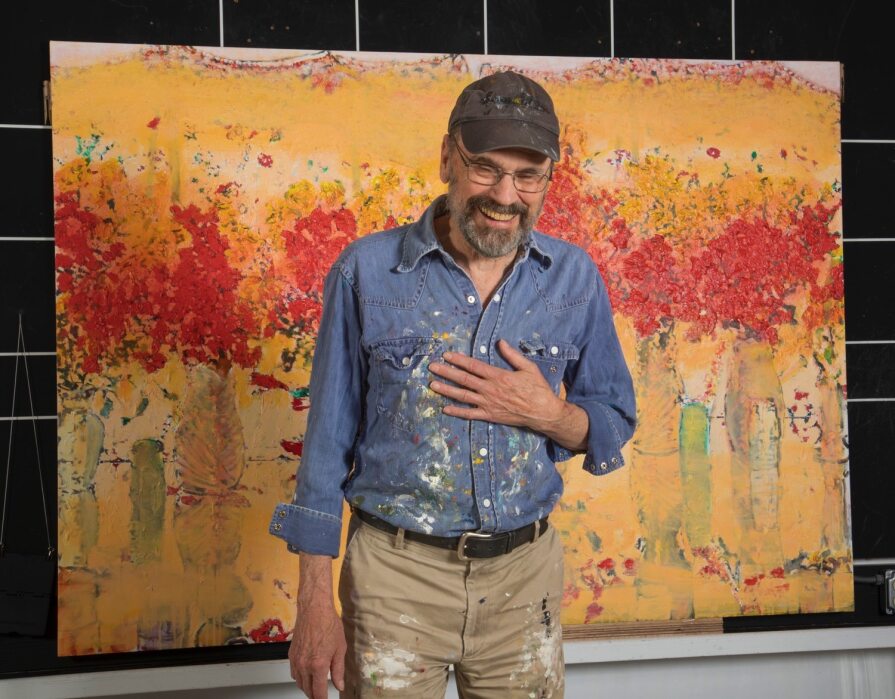
Philip Mullen is a Painter and professor emeritus Philip Mullen reflects on decades of artmaking and mentoring and why South Carolina and a bathtub shaped his creative life.
About
Philip Mullen is a well-known painter and a Distinguished Professor Emeritus at the University of South Carolina. For over fifty years, he’s poured his energy into large-scale acrylic painting, mentoring others, and staying true to his artistic vision. His awesome studio in Columbia even got a shoutout in The Artist Magazine. He’s had major shows in New York and participated in the prestigious Whitney Biennial. Throughout his journey in the art world, Mullen has shown both resilience and style.
Mullen opens up about the unique challenges and quirks of keeping an artistic practice going for life. He talks about stuff like making custom racks for his big canvases, learning to fix elevators in Andy Warhol’s old studio, and how he juggles teaching with showcasing his art. “To be an artist, you’ve got to have it in one seat. You’ve got to have a big ego … But myself, like most artists I know, have very fragile egos.”
During his 31 years at USC, Mullen created a hands-on course called The Artist Experience. This class lets students dive into practical learning by visiting studios, firing pottery, and getting up close with Degas sculptures.
Even though he faced some early doubts, especially from his own family, Mullen built a career based on passion rather than prestige. “In a way, to me, the success has to do with putting together a life in which I could spend a lot of time making paintings,” he explains. In this heartfelt conversation, he reflects on the joy of being creative, the need to keep that creativity going over time, and why Columbia, South Carolina, is such a big part of his artistic journey.
“You need to get out there, doing things, while you’re a student.”
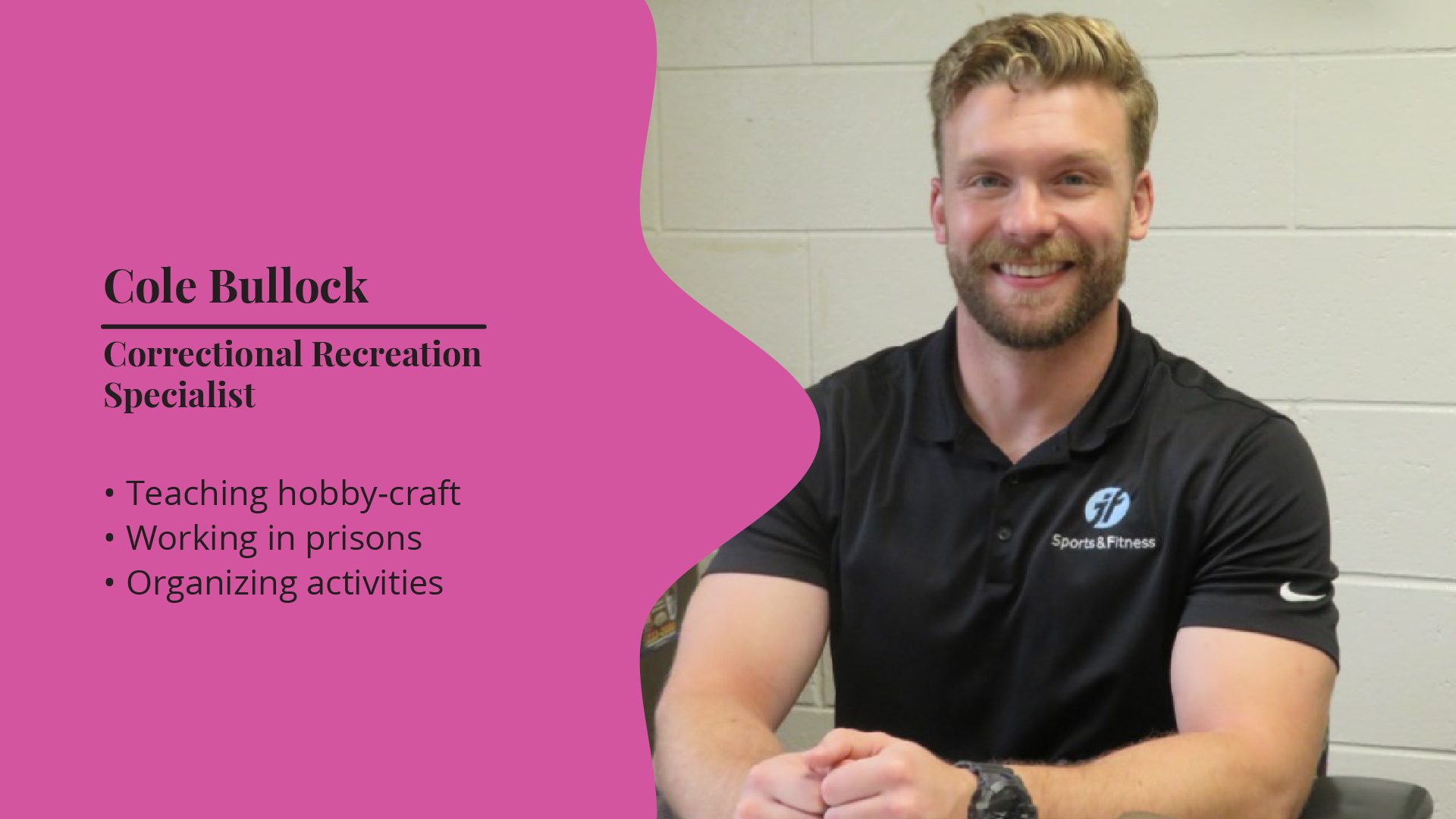
Cole Bullock is a Recreation Specialist at Perry Correctional Institution in Greenville, SC. He designs and runs creative and athletic programs for inmates.
Interview
Transcript
Cole Bullock
I’m Cole Bullock. I am a recreational specialist at Perry Correctional Institution in Greenville, South Carolina.
Haley Hansen
How long have you been working there?
Cole Bullock
This is my fourth year in June.
Haley Hansen
Can you walk me through your typical workday?
Cole Bullock
Yes. So a typical workday for me would be to open up a multipurpose facility that Perry has that has a couple classrooms, but more importantly, a gymnasium. And so first things first, I walk in, I prep everything, look for any sort of contraband items that might have been left over, get all the lights on, make sure all of my rec workers who I hire on certain inmates that I’m allowed that I allowed to kind of conduct different cleanings and programs and stuff, I get their stuff ready, I prepare their the workouts of the day, which would be a pre designed class of my own creation, and they’ll post them on certain boards.
Cole Bullock
And usually when the guys start coming in, we’ll start the bell being kind of a calendar for the week, when I’m looking for, you know, as far as the programming aspects of things, and we kind of just let the show roll.
Cole Bullock
Right now currently, we’re in our Pickleball League. So, inmates have had a chance from their dorms to sign up and create a team of doubles or singles. And so, we are just now building out the tournaments for them.
Cole Bullock
And as well as our Hobby-Craft program, as well, which is a program that allows for men to purchase certain items such as arts and crafts, different wood. Ah, surprisingly, different types of like saw blades, which you wouldn’t think they’d be able to have, but to do woodworking as well as leather working as well. So, different kind of tears that they’re able to build up to. And I will illustrate that with their programming and their needs and making sure that they’re, you know, in compliance with everything for what the state likes to see them. Have.
Haley Hansen
You said that your background was in sports ministry, right?
Cole Bullock
Yeah, so I double majored and Bible Theology and then Sports and Fitness Leadership. And so coming in, I guess, that degree specifically, if you transfer it to more of a secular university, that’s kind of like a sports ethics degree. As far as how the credits match up.
Haley Hansen
Ok. Would you say that has helped you a lot at this position?
Cole Bullock
Yeah, I mean, the the biggest thing for I think a degree is that once you have it on paper, you essentially have to learn how to put it into practice.
Cole Bullock
So I think, although my degree has certainly given me the framework to, you know, understand the need for why to do what I do, but the big process, I think of learning is just doing the reps on site. So there’s, there’s not really much preparation as far as what it’s like to train yourself for prison except for go to prison. Right. So but for the most part, yeah, I think the degree my degree itself has kind of inspired me on the idea that, hey, this is a very valuable career to jump into, because there is a need in order for recreation, you know, the hot topic, word is always rehabilitation, rehabilitate these guys, and you know, so we can bring them back out society and make them productive members.
Haley Hansen
What do you say was the biggest adjustment or challenge that you faced, when you started at Perry?
Cole Bullock
The biggest thing, the biggest challenge for us is just getting everyone on board with the idea that recreation is something that you would want in an institution. Depending on who you’re speaking with, it just, it’s a challenge to get everyone to kind of connect the idea that rehabilitation and physical fitness are actually a good coupling. You could have some staff members who could perceive the idea that guys are getting physically fit as a threatening thing, meaning they’re, you know, enhancing their physical capabilities and given them maybe that advantage when it comes to anything like physical altercations.
Cole Bullock
So, that was my first I think major hurdle was just establish, “Hey, if you program correctly in this institution, good programs create good security. Creating competent individuals that exert their energy in a healthy way, where they are establishing themselves in some some discipline and also giving them something that they enjoy. Which is a privilege that they really don’t want to get taken away from them. So, they kind of adjust their their mindset to be able to keep what they like.”
Haley Hansen
You mentioned, you are in charge of getting materials for the hobby crafting class. I imagine there’s some overlap in the conversations you mentioned with that, too. Like talking about how getting physically fit can be perceived as a threat you mentioned, like the saw blades and stuff?
Cole Bullock
Yeah, yeah. So oftentimes, we’ll get new staff members and they’ll do their orientation, and they’ll they’ll kind of walk into our hobby craft room. And you know, you’ll see their eyes get this big because they’re like, “They’re they’re allowed to do this? I don’t I don’t understand.”
Cole Bullock
And as long as like I said, as long as it’s programmed correctly, the Hobby-Craft, I’ve seen guys create things where I’m like, “There is no way you could have possibly made this, you know, behind bars, this is incredible. This looks machinery.” And you know, if you speak with them long enough, it’s like, “Listen, you know, I had nothing to do but learn this craft, and so day in and day out I had plenty of time to fail and improve upon my ability, and eventually you get pretty good at it.”
Cole Bullock
And so, some of these guys make amazing things. Some artists here draw like you with a picture off, you know, with a realism. I mean, it’s quite shocking the talent that happens when you you know, give a man enough time and I would say initiative to do something rather than nothing.
Haley Hansen
Do you think the hobby crafting creativity side of it is about as important as the physical fitness? Or do you think one is more helpful?
Cole Bullock
Yeah, these are, these are two sides of the same coin, the objective for us is probably the worst thing that you could do to someone who’s incarcerated is put them behind door, lock it away. And then in 40 years, unlock it, and then let them out and see if they’re any better for society, right? Since you you’ve only compounded the problem.
Cole Bullock
So the idea is we just want to keep them busy, wanting them to maybe perceive themselves in a different manner. So if you’ve ever coming in, and maybe life has handed you a deck of cards that’s not so favorable. And then when you’re back in prison, you realize “Hey, I am a little bit more talented than I thought. I got these crafts that I’ve learned, I can actually use this to make money on the street.” or “This is something that actually I prefer doing instead of, you know, hustling.” These are the moments that we’re trying to create with the inmates and especially with with working out is, you know, especially for those who are suffering with addiction, if they’re able to kind of place their energy and their mind and their efforts towards something that can create that dopamine effect within the mind. And it’s also healthy for them, you know, we would prefer them, you know, transferring their desire for the drug and replacing that with physical fitness.
Haley Hansen
Did you—would you say that you had something is an element when you were working there where you realized, like, it was a job that fit you?
Cole Bullock
It’s one of my favorite questions. Because just like many people, I’m coming into this institution with the idea, yeah, I’m gonna meet some broken guys, right? I’m kind of used to that being from a ministry background, and I’m completely okay with that. But, I had no idea what to expect. I mean, you know, I’m walking into a prison with Hollywood movies, given me the context for what I’m about to, you know, encounter, you know, so I don’t know them, and they’re gonna get stabbed, am I gonna get cussed out, am I gonna get, you know, there’s no telling. And I get my hined here. And I see an ecosystem that yeah, it’s complex. And it’s complicated and can be dangerous at some times. But more importantly, I see is just a desire for men to, to do something. To redeem themselves. To give themselves, essentially, another chance at life. And if you don’t think there’s nervousness behind the bars for freedom there is, because they understand and listen, if I’m gonna waste 20 to 40 years sitting here, you know, walk in a circle, I’m gonna walk out into a world that I don’t understand and going to be set up for failure. And so, a lot of us get nervous about that. And they want to be active, they want to, you know, try to see where, where their talents lie, where, you know, what, what society is, how it’s changing on the outside, and how can they be doing things in here to adapt to that reality, I simply want to provide that ability for them to change and adapt and to be successful. So, when they get back to their families are not burdensome to the community or for themselves. So, I grew great compassion, when I learned that the plight of someone that’s incarcerated, which is a far cry from when I came into, because like many people, I looked at those who were incarcerated and went, “Well, they did the crime. So, whatever happens behind bars happens, I don’t really care”. I can’t help but to care now, just because of the fact that I’ve seen it, I’ve seen the humanity in them. And I just want to support that. Someone’s looking to do better and get a redemption story in their life. I want to give them every tool that they can possibly have to make that dream come true.
Haley Hansen
Working with inmates, it’s a, it’s not a very visible profession. So, if someone is interested in doing that, are there any programs or organizations you’d recommend them check out?
Cole Bullock
Yeah. There’s a lot of groups there’s groups all the time that go into prisons. I think the main thing is if you if you want to know whether or not prisons a good fit for you, as far as a career, if you wanted to work programs in prisons, you just got to get your feet wet. A lot of ministries will come in here and just do support groups, sometimes colleges depending on you know, whatever program is happening will actually will come in here. I know we have a sociology class that we have students from the University I’m not sure which one comes in here and does class with the guys.
Cole Bullock
So ultimately, really, what I would suggest for people is if you’re if you’re looking and you want to be interested. Volunteer, in some capacity, contact that institutions chaplain and ask, “Hey, are there any groups that come in that would essentially support inmates or give me a chance to just interact with the guys” , and I’m sure he’ll connection to the correct third party when you’re in that environment. Just placing guys who have been on lockup back in the regular population that doesn’t tend to go well, you know, you kind of have to slowly reintroduce them back into society, a social capacity, because if you’re alone by yourself for years and years and years, you lose some skills, right? And you kind of get to slowly work yourself back into being able to handle other people and different, you know, situations.
Haley Hansen
Alright. Do you have any advice for current students who might be interested in this sort of thing you’re doing?
Cole Bullock
Yeah, well, I’d say just for any any field is that if you’re going to go through four years of university, and think that when you leave with a piece of paper, that that’s going to be kind of your ticket to get this dream job, you’re in for, unfortunately, a shock.
Cole Bullock
I had one of my mentors had established this idea that you’re going to go on your graduation day, you’re going to look to your left, then you go look to your right, and you’re going to notice hundreds of students all with this, essentially the same piece of paper, what’s going to distinguish you amongst the masses of people that graduated that year. And the idea is, is that you need to get out there doing things while you’re a student to increase your marketability. So, shaking hands. I think I’ve opened more doors, in my path in my career by a handshake than anything that a degree has ever offered me. So, they really want to be able to be networking and finding the right people to speak with, especially during school. That’s, you know, someone that’s able to give you some hours, you know, that’s similar to your field. I think that’s just irreplaceable, within your time at school.
Haley Hansen
And before we end today, is there anything else you think it’s important to say, for this, project?
Cole Bullock
Yeah, I think that speaking from my heart, corrections is a industry that needs support. It needs more of the public’s support to help us accomplish, I think, a goal that everyone should agree on. And that’s this idea that if we’re going to release these guys, we got to make sure that we’re being responsible with what we’re doing with them while we have them with the State. So, that’s a, that’s a group effort.
Cole Bullock
That’s, that’s a community effort. And that has to be a willingness for people that although you may have a certain opinion about those who are incarcerated, completely find, but that certain person might live in a neighborhood near you. So, it’s an investment to care about the guys that are behind bars. It’s an investment to have an interest in their improvement and their well being.
“The more you push yourself out of your comfort zone and out of the box you’re used to, the more confident you get.”
Tori Hord is an Associate Professor of Graphic Design at Methodist University in Fayetteville, N.C. She grew up in Loris, S.C., and earned her bachelors in graphic design at Coastal Carolina University. She continued her graphic design with a Master of Graphic Design M.G.D. at North Carolina State University.
Interview
Transcript
Tori Hord
My name is Tori Hord. I am from Loris, South Carolina, so very close to Coastal [Carolina University], like 30-ish minutes. And I currently teach graphic design at Methodist University in Fayetteville, North Carolina.
Emma Plutnicki
So how long have you been working there?
Tori Hord
Seven years.
Emma Plutnicki
Wow. Amazing. And your official job title, would that just be graphic design teacher?
Tori Hord
Associate Professor of Graphic Design.
Emma Plutnicki
Amazing. So how did you get into that? How did you find that job? And how did you just end up in that field overall?
Tori Hord
That’s an interesting, so I started when I started Coastal. I went to undergrad there, I started as a biology major. About a semester or two semesters in, I decided to switch my major to graphic design without telling any of my family and made them all have a small heart attack when they found out.
Emma Plutnicki
Oh my gosh.
Tori Hord
But it’s always something that I’ve loved. So it was a really good change for me. And from there, I just, I was just very passionate about it. And when I graduated, I got a job in the field. And I worked there for a couple years and then decided that I wanted to pursue my masters in graphic design. So I went and got a masters in graphic design from NC State. And then when I graduated from NC State, there were, y’know, lots of applying to jobs, and I landed here in Fayetteville at Methodist University.
Emma Plutnicki
Amazing. So what made you switch from biology to graphic arts? Was it more hating biology? Or was it more a passion for graphic arts?
Tori Hord
It was more passion for sure. Always loved it growing up, but just never considered or thought of it as a turning something I loved into the career. And once I figured out that I could do that, I was like, “Absolutely. Let’s do this.”
Emma Plutnicki
Yeah. More fun, probably. So can you walk us through a typical work day? Like, what’s expected of you, what your work process looks like, what kind of things you work on?
Tori Hord
Yes, absolutely. So for me, I think being, teaching design and being a professor, you kind of get the best of both worlds. So my initial attraction to teaching it, you know, other than just loving the subject and wanting to share more was that it has a great schedule. You have time for, you know, it’s a great work life balance for the most part. And that also gives you lots of time to continue to work in the field, which I was adamant about not stopping, I didn’t want to stop my design career to teach, I wanted something that would allow me to do both. And that’s what the shop does, which I love it, you get a great schedule, you get a, you know, it’s a steady, it’s not like you’re freelancing all the time, it’s a steady income. Day to day, it depends on what classes I have offered, but I teach anywhere from two to three, like studio length classes a day. So I’m in the art building, in the studio, working with students. And then when I’m not teaching I’m in my office, you know, doing housekeeping things and preparing and also working on my own work.
Tori Hord
Amazing. So the classes that you teach, are those different levels of graphic designer, or do they have specialties within them?
Tori Hord
Yes, I teach at all levels. So I teach the freshmen their first semester, on up to the seniors in their last semester. And everything in between. So I see a little bit of all of them all the time.
Emma Plutnicki
Yeah, that’s great. So can you describe a defining moment in your, like, creative journey so far? So maybe it’s a specific project that really showcased your creativity or had a significant impact on you?
Tori Hord
The one, this is ironic, but the one that really comes to mind as being most memorable for me was actually at Coastal at the Athenaeum Press.
Emma Plutnicki
Oh, really?
Tori Hord
Yes, we worked on the Gullah Geechee project. And there was, we traveled out to these different places and took photographs and did interviews and then the project itself won an Addy Award at the end. So it was kind of like a, a quintessential moment for me. I was like, “this is actually going to work. This is neat. We’re getting recognition for work that me and my friends have, you know, kind of poured our hearts into.” So that was a big moment for me.
Emma Plutnicki
Yeah, I’ve seen that work. It was great. So I’m sure that was a really fun time to work on. So do you think this career path is challenging? What challenges have you faced and how have you been able to kind of overcome those challenges? Because being in a creative career as a whole is pretty challenging, but how have you kind of worked through this?
Tori Hord
It is, I would say it was challenging. And it’s um, it’s like with anything you do, the more you do it, the more you push yourself out of your comfort zone and out of the box that you’re used to, the more confident you get in it. I do remember my first year teaching anything, I was terrified, right? I’m standing up in front of this group of people. And you’re suddenly faced with like, “I know nothing,” right? “I am not qualified to do this, I should not be here. Why did these people give me a job.” But the more you do it, you realize, “okay, I’m equipped, I have the knowledge, I’ve done the education, I have a passion for it.” So for me, it really was just making sure I was getting out of my comfort zone, and putting in the effort… and it was fantastic. But the more I was in those classrooms with the students and got to know them, and saw their excitement for it, everything just came together.
Emma Plutnicki
Yeah, that’s amazing. So within your specific field, can you think of any skills that you possess that helped you land that role, or any skills that you think an applicant should have to increase their chances of getting that role? I know, like you’re in teaching, so is there any like connection with teaching that you had to help you or was your skill in graphic design, like the driving force to lead you to teaching, or just in general, like any skills that helped you?
Tori Hord
Obviously, to be able to teach art or graphic design or anything, you have to have a certain level of knowledge, but especially for art design, you also have to have a certain level of skill, right, you have to be able to get to that point. So a portfolio is still a big part of this job, even though it’s not a, the focus is not necessarily all design, you know, work all the time, you still have to have a great portfolio, you still have to make sure that you’re paying attention to the detail, because it matters when getting these roles. And I think the other part of it is, is communication, being able to talk about what you want from that job, but also be able to talk about your work in ways that ties it in to people that might not necessarily be in your field. Which is a great skill for designers have anyway, because there’s lots of contact with people outside of the art world. So being able to communicate those ideas and your thoughts and passions to those people is really important, too.
Emma Plutnicki
Yeah. It’s a very important skill. And so, you studied in South Carolina, and now working in North Carolina. Are there any like organizations or programs or events that you recommend for people who are trying to get into that field? Is there any like conferences you went to that helped you network to figure out, like, gain more connections within the creative world or anything like that in the area?
Tori Hord
Yeah, I’m a big supporter of AIGA [the Professional Association for Design] I’ve been a member of AIGA since I was an undergrad, and continued that. But more so than that, I found a lot of helpful was these kind of like open houses for different schools. So when I was pursuing my master’s or thinking about going to get my graduate degree, I looked into these different kind of open houses, kind of meet and greets. And I met a lot of really great people and lots of great networking opportunities just from doing that. And that had no ties to it. You didn’t have to, no commitments, you’re just kind of going and exploring and learning about what your options are.
Emma Plutnicki
That makes sense. So AIGA, you said?
Tori Hord
Yes.
Emma Plutnicki
What does that stand for, do you know?
Tori Hord
American Institute of Graphic Arts.
Emma Plutnicki
Okay, awesome. I’m sure a lot of people know that. I didn’t know. That’s amazing.
Tori Hord
The chapter here is in Raleigh, the closest one. But a lot of universities have like local student chapters. I know Coastal used to have one, whenever I was there. And we have one here. It’s just a great opportunity for professionals and students to kind of connect.
Emma Plutnicki
Yeah, that’s amazing. So great. Thanks for saying all this. This is such an interesting field. I’m sure you have fun with it every day. But just as we wrap up, do you have any advice for current college students or just people who are looking to get into these fields in creative professions?
Tori Hord
Follow what you’re passionate in. That was a big thing for me. So I went along with, like I said, the biology doing what I thought I was supposed to do, and what, you know, everyone was like, “Oh, you’d be great, at you know, XYZ, you’d be a great doctor, you’d be great at this.” And in the back of my mind, there was always something like, “Maybe but I don’t know that I want it.” And just listening to that little voice, and you know, going after what you do want, regardless of what other people might think which, I mean is, you know, life anyway right?
Emma Plutnicki
Yeah. No, that’s great advice. I definitely need to listen to that too.
“Everyone’s got their own journey, and you have to find your way. I would never discourage anyone from a journey in the applied arts or the creative arts if they have the drive and the will to do it. Because that’s the biggest part of it: just being disciplined.”
Marius Valdes is an artist, illustrator, and professor of Studio Art teaching graphic design and illustration at the University of South Carolina. Valdes received his BFA in graphic design from the University of Georgia (UGA) and his MFA in visual communication from Virginia Commonwealth University (VCU). Valdes is originally from Charleston and lives in Columbia.
About
“Being a professional creative is not for the weak of heart,” said Valdes. “You need to be patient and persistent.” He recalled the first time, as a college student, that he told his father he wanted to major in art. “I remember driving with my dad and telling him, ‘I think I’m going to be an art major.’ I was waiting for him to say, ‘What are you thinking?!’ but he just said to me, ‘Well, if you do something that you love, you’ll never really work.’ And I feel like that. I do work, but I work on things I care about. And that, to me, is one of the most important things.”
Valdes didn’t set out to be a university professor. After graduating from the University of Georgia (UGA), he worked as a graphic designer for several years and allowed his creativity to determine his next step.
“I was exploring illustration and enjoying it more than graphic design. I wasn’t very good about talking about my work, and I thought grad school would help with that, as well as allowing me to refocus my work and make myself more marketable,” said Valdes. Valdes earned a scholarship for his MFA at Virginia Commonwealth University (VCU), and part of that scholarship included teaching a class.
“I just loved it,” said Valdes. “I found that even though some of the students were in some ways more talented than I was, I knew more than them because I’d been doing it as a professional, and I really enjoyed it.”
In addition to teaching, Valdes works as an artist creating work for area organizations. “The past couple years I’ve been working with the Medical University of South Carolina children’s hospitals,” said Valdes. “I created some murals for them, created some kids’ activities books for therapists to use, and that’s been the most rewarding thing I’ve ever done. One day, a man I work with came up and said, ‘My kid is obsessed with your frog mural. It’s made a real difference.’ So it’s sad because seeing that mural means you have a sick kid, but it’s also rewarding to know it had an impact.”
“Your path in life won’t look like anyone else’s.”
Thurayya UmBayemake is the Spark Lead Actor-Teacher in support of the Arts Grow SC program at SC Governor’s School for the Arts and Humanities. She delivers literacy-based drama programming to public schools to encourage “creative thinking, divergent thinking, and overall motivation to read.” UmBayemake earned a degree in drama studies at South Carolina State University (SC State).
About
Thurayya UmBayemake was an athlete in high school, doing cross country and track and field, until she hurt her back her junior year. Still injured her senior year, she decided to get involved with a newly opened African community theater in town. “I was involved in a theater that embraced me for who I was and told stories that I could truly relate to,” UmBayemake said. While she couldn’t relate to every single story, she always felt culturally connected to the theater. She became an assistant director, stage manager, and eventually, an actress. UmBayemake moved to South Carolina to study drama education at South Carolina State University, where she graduated Summa Cum Laude.
After graduating, she traveled the country and opened her own theater with friends: the Ma’Sue Theater in Akron, Ohio, which focused on African American stories and social justice. UmBayemake then moved to New York City, where she took a break from theater work, saying, “You have to experience life to tell stories. That’s what I was doing in New York.”
UmBayemake is the Curriculum Coordinator Actor-Teacher Coach for a program called Spark, which is a literacy-based drama program based in the South Carolina Governor’s School for the Arts and Humanities. “We go into elementary schools…we show students how to take stories from picture books and add drama and acting in there to show characters, to show settings, to show plot, to reinforce the literacy-based learning, but also creative thinking, divergent thinking, and just overall motivation to read,” she says. UmBayemake also works to show teachers how to take the same artistic approach to teaching, even without an artistic background.
UmBayemake credits her current position to her storytelling abilities and her wide variety of previous experiences. “I know some people feel once they get out of college, they should only work in their field,” she says. “But you’re missing out!” She advises those seeking a job in the arts to be patient with the process and not get discouraged if it takes time to land a dream job. She also emphasizes the importance of building a strong community. “Make friends with any and everybody, just to learn about their life experiences and what they went through. It will help you learn that your path won’t look like anyone else’s.”
“I actually got turned down twice when I applied to medical illustration school. I took time off, reassessed, and just drew and drew. When I finally got in, I was excited, and I have been doing this ever since.”
Rick Sargent is a professor of art at The Citadel, where he teaches drawing, painting, animation, and illustration. He is also a seasoned freelance medical illustrator specializing in medical-legal illustration. A native of Columbus, Georgia, now based in Mount Pleasant, South Carolina, Sargent holds a bachelor’s degree in interdisciplinary studies from the University of Georgia and a Master of Science in Medical Illustration from the Medical College of Georgia (now Augusta University).
About
Rick Sargent’s career is a seamless fusion of art, science, and education. With over two decades of experience in medical illustration and a decade of college-level teaching, Sargent brings a dual perspective to the classroom. His journey began with a high school art teacher’s advice to pursue medical illustration, a field that would allow him to combine his love for drawing with a deep interest in science.
After earning his master’s degree in medical Illustration, Sargent began working in the field, eventually specializing in medical-legal illustration, where he collaborates with attorneys to visually communicate complex medical scenarios through 2D, digital, and 3D illustrations. “They have to explain and communicate in layman’s terms what happened in an accident or medical procedure,” he said. “That’s where I come in.”
Sargent transitioned into teaching when a colleague suggested he consider the classroom. “I fell in love with teaching,” he recalls. Now a professor at The Citadel, he continues to practice freelance illustration while guiding students through the fundamentals of art and creative expression.
His advice to aspiring creatives is both disciplined and expansive: “Find your thing and do it really, well but don’t be afraid to explore. The creative paths you follow may connect in unexpected and meaningful ways.”
Sargent’s impact at The Citadel is evident in art has become the college’s largest minor, in part because students discover new ways of thinking visually through his classes. “There are many incredible artists at The Citadel who didn’t know they were artists,” he said. “For me, coming from a medical illustration background that’s something they can get their minds around.”
Eddie Howard, from Greenville, South Carolina, is the Director of the Recording Arts Program at the Fine Arts Center. Establishing the program in 2007, Eddie Howard teaches both younger and older students how to record music.
About
Eddie Howard was born and raised in Greenville, South Carolina, where his love of music and recording was passed down through the family. In 1958, Howard’s four uncles on his mother’s side built the first recording studio in Greenville, where Howard spent most of his childhood. “My dad used to love to hang out at the studio when I was five or six years old. For years, really, all my life, we would go hangout at the studio—sometimes at night or on weekends when they were doing their sessions. So, I kind of got the studio bug from that,” said Howard.
From 1971 to 1974, Howard played guitar in a band for the last few years of high school. “We finished high school in ’72 and hit the road, and the band got very, very busy, and we were staying gone so much,” said Howard. “I didn’t like traveling that much, so I decided to come to Greenville, wanting to get into the studio business.”
Howard returned to his family studio business and began working there in the spring of 1977, where his career path in the recording business grew. After a few years, Howard owned three different recording studios and was a consultant in building several others. Howard’s involvement with the Fine Arts Center began when the jazz program director, Steve Watson, asked him for advice on creating a recording studio for the arts magnet school. Howard agreed to assist and continued to help Watson run recording sessions even after completing the studio. Subsequently, Howard played a pivotal role in helping the Fine Arts Center launch its first recording program as an afternoon class in the fall of 2007.
Since the development of the program and as the Director of Recording Arts, Howard’s typical workday involves teaching a morning class consisting primarily of younger students as an entry-level course of recording basics and an afternoon class of older students build on their experience in the studio to tackle more complex projects.
From Howard’s experience in the recording arts and helping to develop the recording arts program, he offers advice he gives to his current students and upcoming creatives interested in a recording arts path. “Some of the biggest things I try to do with them is teach them how to be self-disciplined, manage projects, manage their time, and just do their best,” said Howard.
“The importance of learning the craft, learning the principles and elements of art and design and really understanding how to apply them, cannot be overstated. Design theory ends up being the currency of whether or not you can develop a particular visual way of expressing yourself, whether it’s sculpture, ceramics, architecture or another field.”
Jim Craft, who lives in Greenville, was a studio artist for ten years and then transitioned to academia. He was a professor of art at North Greenville University for 16 years and then moved to West Palm Beach, Fla., teaching at Palm Beach Atlantic University for 10 years. He earned his B.A. and M.A. from Bob Jones University and his MFA at Clemson University.
About
As a studio artist, Craft worked in nearly all traditional media, including drawing, painting, ceramics, sculpture, and printmaking. He marketed ceramics, sculpture, and art to galleries and designed and produced ceramics for the High Point, N.C., furniture market. Craft secured commissions for paintings, murals, and architectural installations, including one at Our Lady of the Rosary in Greenville, S.C.
“It was really fun having a studio and being an artist, getting up every day and making stuff, showing my work at exhibitions,” said Craft. “But, it’s just not a realistic long-term goal. Even my friends who were wildly successful as artists had to supplement their income with other things, and it’s good to have those kinds of things in your pocket. So, I wouldn’t discourage anyone from getting a degree in graphic design or advertising or any of the design areas.”
Craft had also earned a degree in education, and making the move to academia was the best fit for him and his family. Teaching allowed him to mentor and guide aspiring artists, and the range of their career journeys was vast.
“I had students who have ended up in retail and selling in galleries or auction houses, traveling internationally even. Keep your alternatives lined up and be realistic about a career in the arts. You don’t have end up in a studio to stay in the arts. I had a student who ended up being an international buyer of fine rugs from all over Europe and North Africa and the Middle East. She was a painter, and she understood artistic principles and elements. You can focus on that and keep that, but keep a number of alternatives in your pocket just to be more widely marketable. It’s all the same – whether you’re looking at a Persian rug or a really nice ceramic vessel.”
Cole Bullock is a Recreation Specialist at Perry Correctional Institution in Greenville, SC, where he runs creative and athletic programs for inmates. With a background in Bible theology and sports and fitness, he sees his work as a form of ethical service fostering discipline and confidence through healthy expression.
About
Cole Bullock didn’t grow up imagining he’d work in a prison, but today he finds deep purpose designing and running recreation and hobby-craft programs for inmates at Perry Correctional Institution in Greenville, SC. A double major in Bible theology and sports and fitness, Bullock says his degree helped him understand why the work matters but not what it would feel like.
He works with long-term, often violent offenders, and believes that structured recreation especially creativity and physical fitness leads to better security, better behavior, and even better mental health. “I’m creating confident individuals that exert their energy in a healthy way.” New employees are often stunned by the quality of the art they see inmates produce art that’s photorealistic and precise. “It looks machine-made.”
“You have to be very, very comfortable with making mistakes.”
Laura Ybarra-Kane, a native of Columbia, South Carolina, services as the Manager of Education and Interpretation Planning at the South Carolina State Museum. She holds an Anthropology of Education in Museum Studies degree from the University of South Carolina.
About
Laura Ybarra-Kane discovered her passion and career path at a young age. When visiting family in San Antonio at age four, Kane remembered walking into the planetarium and hearing Star Trek’s Captain Picard speak to her. She was in awe. She remembered, “I went into this planetarium and was like this is it! This is what I want to do, this is amazing.”
From then on, Kane kept her passion throughout her school journey to follow the path that would lead her to a career in museums. When transitioning to college, Kane went with the mindset of wanting to be able to work in museums, but she didn’t have a clear understanding of the field. “I went into college with many different majors, but I ended up landing on the Anthropology of Education and Museum Studies,” said Kane.
After receiving her degree from the University of South Carolina, Kane began volunteering at her current job, the South Carolina State Museum in Columbia. As a volunteer, Kane gave tours and worked with the curating team for six months before being hired part-time. For five years, Kane traveled with a portable planetarium, teaching students the wonders of astrology, before transitioning to the EdVenture Children’s Museum, also in Columbia. After five years with EdVenture, learning and working within schools, Kane returned to the South Carolina State Museum as Manager of Education and Interpretation Planning.
As Manager, Kane has many different duties and responsibilities, and so her typical workday includes wearing many different hats. As an interpreter, she observes how individuals interact with each exhibit within the museum and how they interpret the space they are in. As management of education, Kane assists with all things that involve teaching. “We do all things education and inspiring wonder,” said Kane. Additionally, Kane oversees all accessibility efforts at the museum and serves as the liaison for South Carolina on education resources.
Among all her work and experience, the project she is most proud of at EdVenture was opening the first Makerspace in South Carolina. “That one stands out with me as the first time I got to do a lot of experience and a lot of mistakes,” said Kane. She also offers advice to upcoming creatives interested in a career within the museum field: “Just try it, see what you like because you never know what you might find.”