
Interview
Transcript
00:00 Alli Crandell
Well, thank you again for your patience. If you just wouldn’t mind just saying your name, what you do, and then we’re going to jump into telling us what you do in sixty seconds or less.
00:14 Clay Hadden
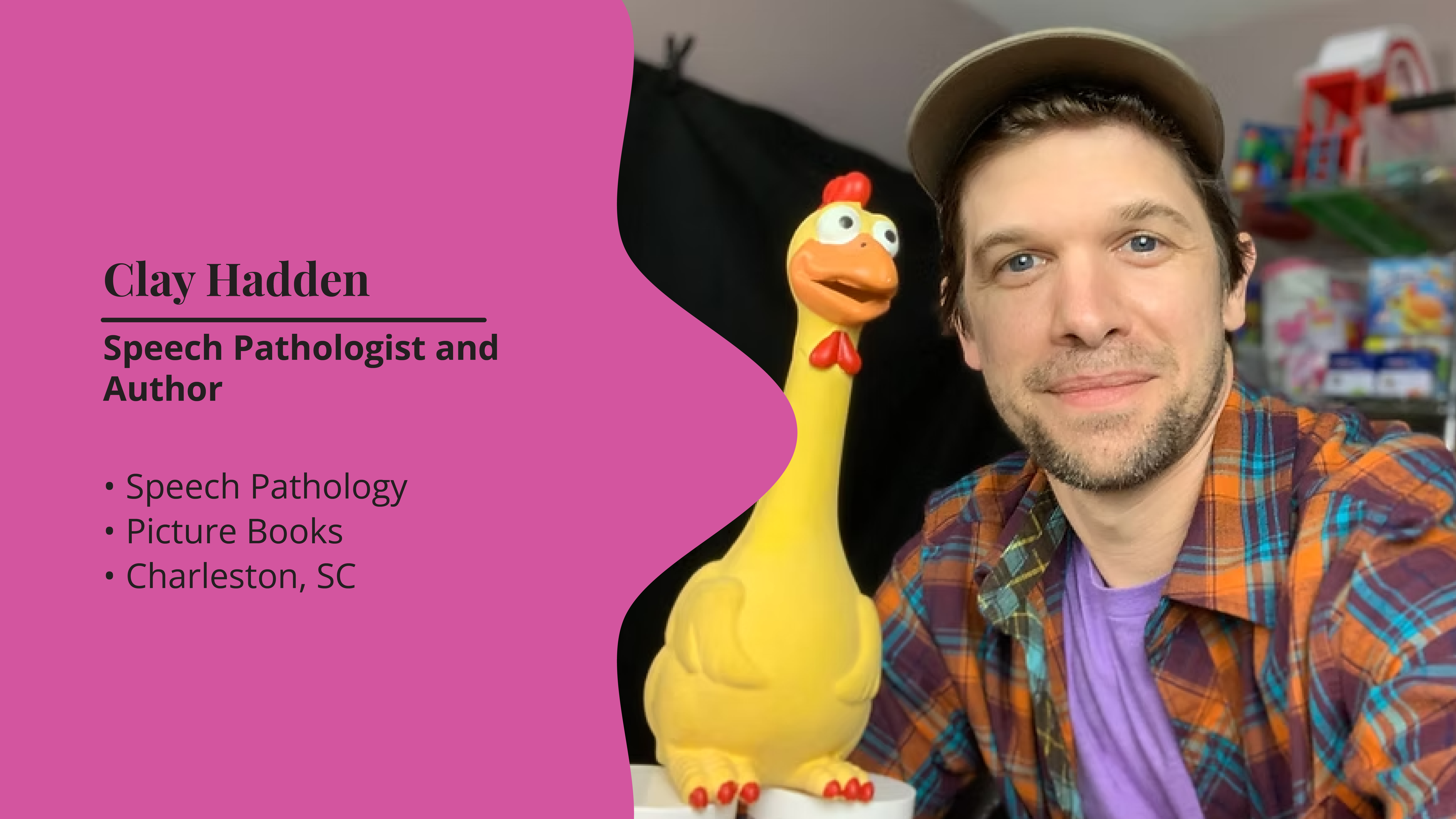
My name is Clay Hadden. I am a speech pathologist and children’s book writer. I also have an online ecosystem called Mister Clay, “M I S T E R Clay.”
00:29 Alli Crandell
Excellent. One of the things that we’re really interested in is everybody oftentimes, we have all these creative careers, but we don’t really know what exactly it means. If you wouldn’t mind, we’re going to play a little kind of fun game of “One Career, Sixty Seconds,” where you explain what it is that you do in sixty seconds or less. Are you ready?
00:52 Clay Hadden
Okay. Oh, I’m ready.
00:54 Alli Crandell
Okay. All right. Go.
00:57 Clay Hadden
So, I went to grad school to be a speech language pathologist. I work primarily with pediatrics, mostly with kids who are on the autism spectrum. During the pandemic, when everything kind of got shut down, I started trying to do some other things. I started writing children’s music and doing children’s YouTube, and then that turned into a book deal, and now I also write children’s picture books.
01:25 Alli Crandell
Amazing. So, what would you say is your typical day as a speech pathologist working with children?
01:32 Clay Hadden
I would say that the most typical day is that most of my days are not typical. I’m the clinical director of a company, but even beyond that, when I was just a clinician, if I’m being very honest, every day is kind of different. People get sick, and people cancel. There’s a constant reshuffling of schedules, lots of changes that feel almost like weekly changes regarding insurances and different payers and stuff like that.
The most typical day would be from about nine. I work in a private clinic. You can work in a school; you can work in hospitals. So, for a private clinic, my day starts about eight-thirty, nine o’clock depending on when my patients start, and goes till about five o’clock depending on the patient’s payer source. Sometimes those sessions are thirty minutes, sometimes they’re an hour, and we help them communicate. Sometimes that looks like just articulation; making sure you’re saying your G’s and your K’s and your R’s right, and sometimes that looks like augmentative communication, communication, which is any other form of communication that’s not verbal. So, everything from sign language to my expertise of using a communication device. Most of the time it’s like an iPad-like tablet with some kind of symbols on it, teaching children how to use that, so it’s a big mix of everything. Most of the kids that I work with are little, and so there’s a lot of floor time and child-led therapy too.
03:06 Alli Crandell
That’s excellent. And are most of your sessions one-on-one, or do you often do group sessions?
03:11 Clay Hadden
So, most of mine are one-on-one. The reason for that usually is based in insurance, so in schools, if you worked in a school system, you would not see kids one-on-one. So, I prefer one-on-one. It allows me to give the person in front of me my undivided attention and build a connection with them.
I think the artistic piece of this job is almost like improv. If you’re familiar with improv, you have to meet the kid where they are. You have to do a lot of “yes and-ing” and build on what they’re saying in order to make them feel comfortable doing the things that you need to do to educate them, especially with these little ones. Getting a two-year-old down on the ground and just working on flashcards is going to last about a minute and a half.
04:05 Alli Crandell
So how would you kind of describe how you mentioned that your practice kind of led, and social media presence, led to a book deal? What was that process like?
04:14 Clay Hadden
I had a buddy and we were writing children’s music during the pandemic as kind of a way to not go crazy. All at the time, my three children that I own, the ones that belong to me, were little. So, there was lots of singing in our house, lots of children’s books, picture books, even outside of work at the house. So, we started writing music. We had one song that I was like, “This isn’t really working as a song.”
So, I started doing some research into publishing, and I found a small publisher called Nine Wise Publishing that specializes in picture books for kids from birth to about three or four, with a focus on getting the writers to be SLPs, other educators, stuff like that. It was a really nice relationship. I wrote the words, they found the artist, they produced the book, and then it came out, and it was great, and everybody received it really well.
I forget who it is. Gosh, I heard somebody say that once you create something and put it out, it’s no longer yours, right? So, it was very well received, which I feel is a blessing, and won the Independent Book Publishing Awards Gold for best picture book in its age group last year. It was just a really neat process. In working with a smaller publisher, I got to be in on the design of the book, the images. It wasn’t all me, we had an amazing artist, but I was able to give feedback, which was really nice too.
05:57 Alli Crandell
That’s awesome. Have you ever thought about, even while you were going to school and grad school, like ever becoming an author, or was it this just something really unexpected?
06:06 Clay Hadden
Yeah, so when I was a teenager, my life goal was to be a writer for Rolling Stone magazine, like that’s all I wanted to do. Math was not my strong suit, writing and psychology and stuff like that; those were not only my interest, but that’s what I was just naturally better at. So, I wrote a couple of short stories that got published in some now defunct online journals and stuff like that. Then, we had kids, and life got busy, and so it was always there.
My wife and I joke. Hers is: if she doesn’t get to go outside and do something in nature, there’s like this river that gets louder and louder in the back of her head. For me, it’s that creative piece, right? If I don’t get to do something creative, all my anxiety and stress kind of builds up until I can do that. It’s been a really good outlet for me too, and it is kids’ stuff, right? I mean, it’s not kids’ stuff. Early literature for children is so important, but it’s more fun and a little bit less serious than writing a Pulitzer Prize-winning novel or something.
07:26 Alli Crandell
Yeah, absolutely. I would just kind of wonder, now that you have kind of this very established and recognized outlet, it’s like, are you now opening yourself to think through like the music that you were creating over the pandemic, or are you thinking about what’s next?
04:47 Clay Hadden
I think about it all the time, the busyness of life. I think it kind of puts a damper on that sometime. I would love to get back, for example, to my YouTube page. I signed a contract for the sequel to this book, so Nine Wise is going to do that. Then I had another publishing company that I’m hopefully in some early negotiations with for another book.
I don’t want to do it fulltime because I don’t think it’s sustainable as a primary income source, but I would love to incorporate writing in early intervention and early reading and all that kind of stuff together for some kind of online platform for families to go to and have access to. I think that’s where my next steps might, might be going.
08:40 Alli Crandell
Wow, I mean, and it’s such a really interesting journey that you’ve been on. So many of the young folks that we talked to might be interested in this, and something else, right? Whether its arts therapy or something else. Do you have any words of advice for somebody who is either thinking about going into, as you say clinical practice, in terms of speech pathology, or interested in maybe applying some of their disciplinary background into a publishing work?
09:16 Clay Hadden
I would say do it if so. I’ll address the writing piece first. If there’s something creative in you, do it. Don’t let people hate on it. I mean, even if it does come out cringe, which, trust me, a lot of the stuff that I have done has turned out cringe, you can ask my children, it might still be made for one or two people who need it right.
As far as speech goes, it’s a great job. I highly recommend it. I do think that it’s a job, personal face-to-face jobs. I don’t think AI is going to disrupt them as much as it is going to do some of these other things that we’re seeing. Occupational therapy, physical therapy, speech therapy. I would say, look into them. You still get to work with pediatric populations; you still get that teachery kind of vibe, without some of the hassle of being the teacher. My wife’s a teacher, so I think I’m okay in saying that. I like both of the things that I do. My only concern is that there’s not enough of us doing it and reaching out to those families that need it to do it.
10:29 Alli Crandell
Yeah, and I mean it. I think it takes you, to have like demonstrated such bravery in both, you know, it’s like putting up your..
10:38 Clay Hadden
I don’t know about that. First of all, thank you. That’s very kind, and I guess there is a part of somebody who, once you put your art out there, is kind of a brave-ish work. But I’m truly just doing it because I enjoy it, and I think other people might enjoy it.
11:00 Alli Crandell
Wow, yeah. You do so many so many things, and I really just love the way that you’ve just described, of just, you know, just doing it. Very Nike. But I’m wondering, if you wouldn’t mind, is there any questions that I haven’t asked you that you wish I had asked you?
11:21 Clay Hadden
Oh, any questions that you haven’t asked me, that I wish you would ask me. I don’t know. I mean, if you’re a parent and you’re reading this or listening to this, read to your kids. Don’t let them watch short form videos on your phone; screen time is okay with boundaries. I tell people all the time, one day your whole house is going to have a stomach bug, and you’re going to let your kid have the iPad, and that’s okay. But we have to be disciplined with things, and good old-fashioned entertainment, like books and being outside, is so good for your kid’s brain. I don’t know why I felt the need to put that message out there, but that’s the only thing I didn’t say that I would like to say.
12:12 Alli Crandell
Absolutely. Well, I mean, I think that it kind of feeds back into what you were saying, both with AI and the importance of writing and creating books that are targeted to help families. I think that that’s really beautiful.
12:24 Clay Hadden
Yeah, thank you!
12:26 Alli Crandell Awesome. Well, thank you so much for taking the time. Yeah, apologies, but thank you so much.
Leave a Reply