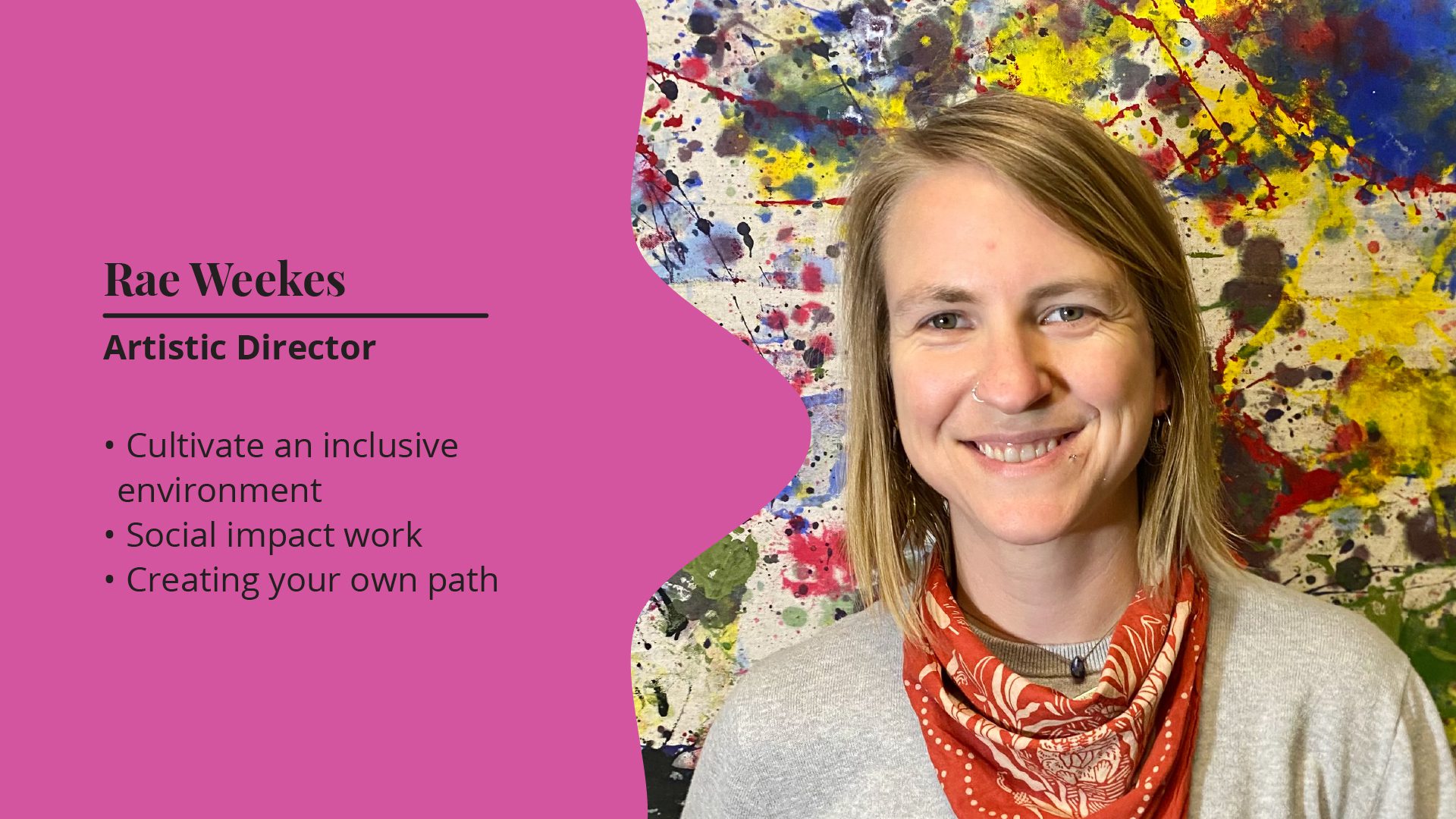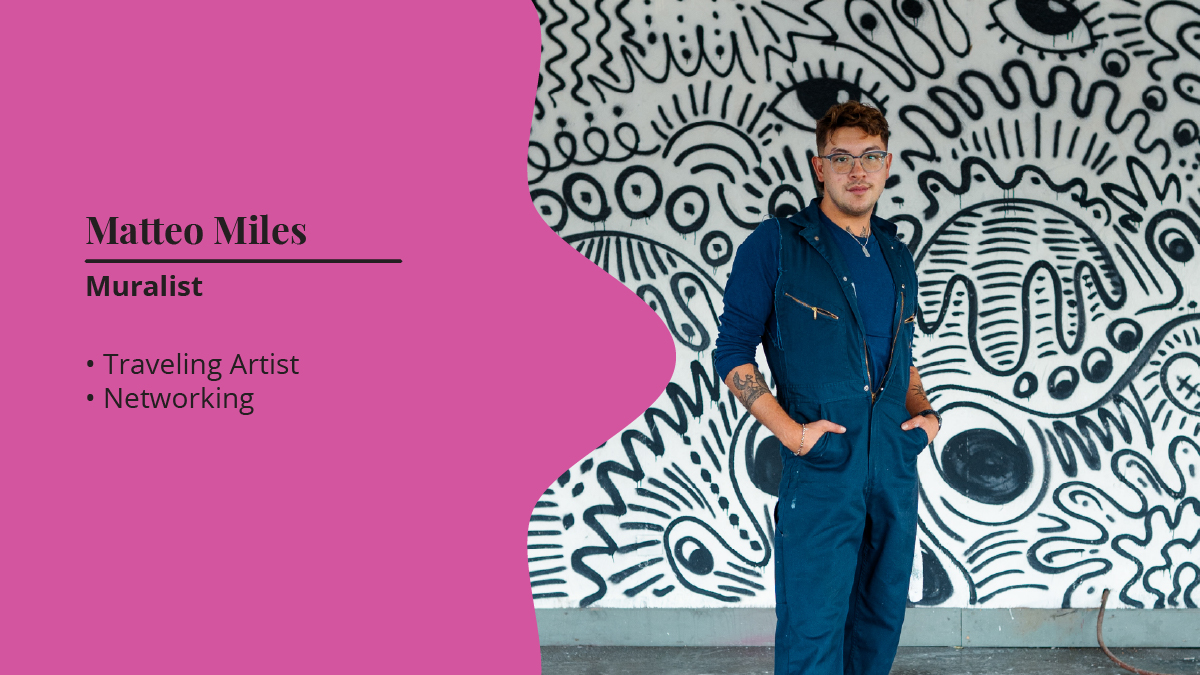
In this episode, we’re talking about the journey and realities of being a full-time artist with Matteo Miles, a muralist and painter, based in Greenville, South Carolina. Matteo took advantage of the programs and opportunities within the emerging art scene of Greenville to cultivate his talents, but his path hasn’t always been clear.
Career Area: Visual Arts
-

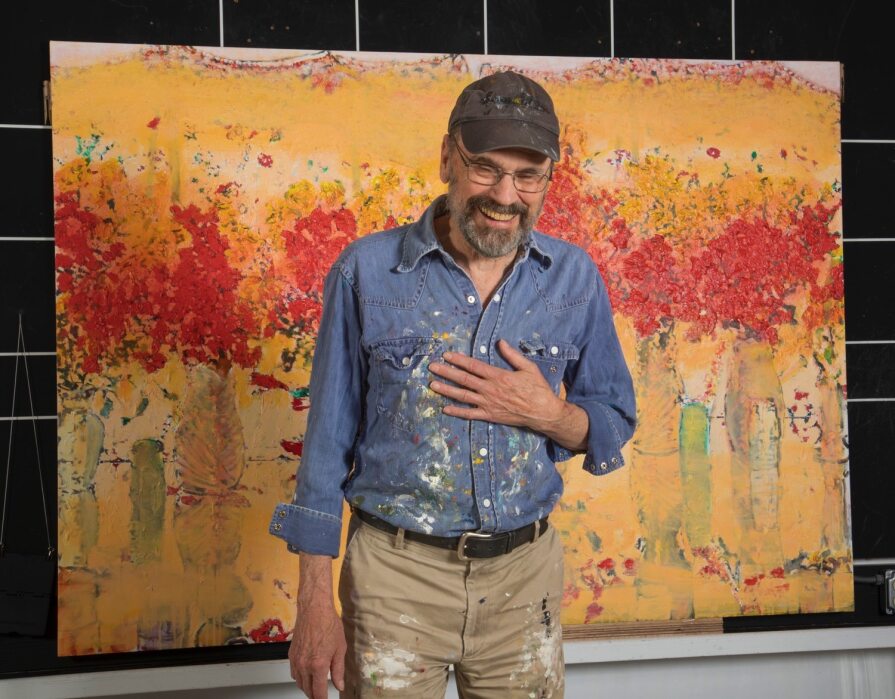
Philip Mullen
“It’s a very fortunate blessing to find something in life that you like enough that you do it before you’re paid for it.”
Philip Mullen is a painter and professor emeritus. Philip Mullen reflects on decades of artmaking and mentoring and why South Carolina and a bathtub shaped his creative life.
Interview
Transcript
Nora Smith 00:00
Alright, to start. What do you do for work, and where are you currently working from?
Philip Mullen 00:07
Well, I’m a painter of large acrylic paintings, and I have a studio in Columbia. My studio is designed for large paintings. It’s 1300 square feet made as a studio for that. Actually, when I first built the studio in 1989 and when, right after I built it, a national magazine was running this…It was called, The Artist Magazine, and I think it may have had the biggest circulation of any art magazine at the time, because it was, it was aimed at a really clever group, and that was amateur artists who think they’re pros, a very large audience. But it’s, you know, it’s a great audience. It’s a wonderful thing for people to go into. But they used mine as an example of how to set up big paintings.
And the two, the two items that kind of got them interested was, I needed a big sink. Big sinks are really expensive, but mobile home Bathtubs are really pretty cheap, and you can mount them up high, like a sink. Of course, the guys who installed it kept saying, what are you going to have a ladder to get into this thing? No, no, guys, it’s a sink. It’s a sink.
And then during the time I did, it was, I was represented for 35 years by David Finley galleries in New York. And those shows, you know, I had, like I said, 14 solo shows with them over the 35 years. And those shows often would have 40 to 45 pieces, half of which have six-foot dimensions, or half of which just had a four-foot dimension, and maybe a few larger ones included. And because the way I do my edges, I can’t set them down, but I’d have a lot of paintings collected up at any one given time. And I designed a very simple rack that I could hang 46-foot paintings on without the edges touching anything.
More of an answer than you probably needed. I warn you, I was once interviewed on the radio, and after 10 minutes, the interviewer said, Mr. Mullin, I was kind of hoping to ask a second question.
Nora Smith 02:45
Okay, well, this one kind of wraps in with the first one. How long have you been working there, and what is your official job title?
Philip Mullen 02:53
Well, my only official job title now is artist. And I guess I have a sort of official job title as distinguished professor emeritus from USC. I had a very good arrangement with USC. I taught there from 69 to 2000 and, but I took nine, I did not teach in summers, and I took nine years of leave during that time. So, I taught 22 because those New York shows took an enormous amount of time to put together. You really put it this way, my art gallery friends were very suspicious of my teaching, because they said, if you teach, you can’t paint enough. And my teaching friends were very suspicious of my art gallery’s success because they said, “You can’t sell without selling out.” And each of those things probably has some basis in possibility, but there’s certainly things you have to watch out for.
Nora Smith 04:06
Yeah, well, you just do, you do it all.
Philip Mullen 04:10
Well, I was a bit of an obsessive worker for decades and decades. It didn’t make me socially very interested, but I got a lot of artwork done. And the teaching, you know, the teaching like that, was wonderful, because I didn’t end up doing it quite, it wasn’t like I was doing it all the time. You know that one period where I literally was taking half, where I had 12 years and only taught during fall semesters, yeah, and so it made my teaching much more exciting for me, and it was like a chance to talk to bright young people about the only thing I knew anything about. And it, you know, while I’m sure there were other teachers that were more talented, as teachers, than I was.
The one thing I could bring to it was especially like the graduate students might see me working on a particular painting and then end up seeing that painting reproduced in Arts Magazine, for example. And so, it brought the sense, I think, to students, that it could be something bigger. That was especially true before I built the studio in 89 because I had a studio at the university furnished and, you know, graduate students and undergraduates were in and out of that while I was down there.
Nora Smith 05:40
That’s so cool.
Philip Mullen 05:42
Well, I tell you, it’s, you know, its a very fortunate blessing to find something in life that you like enough that you do it before you’re paid for it. You do it if you’re paid for you do it if you’re not paid for it, you know people, they said, “Oh, man, you’re so disciplined, you’re always in the studio.” I wasn’t disciplined. I was self-indulgent. I was doing what I, you know, that’s what I wanted to be doing.
Nora Smith 06:11
Yeah. Super cool! Okay, so this is more of a question specific to your area, okay, in the creative field in South Carolina. What is one thing you love about working in the creative field in South Carolina?
Philip Mullen 06:29
Well, one thing that was that I found really great at first, when I was young and needed to get grants for something, was that while there may not be as many grants here as there are in a bigger city, when you stop to think about how many artists are per grants available, it’s pretty rich here. When I got with my gallery in New York, I’d had the good fortune of being included in a show called the Whitney Biennial. It’s a show at the Whitney Museum in New York, and in 1975, and I knew I wanted to have a gallery in New York, so I wanted to take advantage of that.
I took a year off of teaching, moved to New York, and did that, I did have sabbatical money that time. Most of my leaves were unpaid, but I went on sabbatical money. I spent all of my own money, but got what was at the time, a quite large grant from the Arts Commission to go there. Rented three fifths of Andy Warhol’s old factory, lived and worked in that. Of course, lived illegally.
Nora Smith 07:42
The commitment, a lot of commitment there.
Philip Mullen 07:45
Yeah, I learned a couple of very important skills there because of living illegally, you know, because if you’re in a place that is selling commercial in New York, they only have to give you heat six days a week. Oh yes. And so first we crank the heat up, you know, very high on Saturday night and hope to survive till Monday. Later I learned two of the skills I developed was how to hotwire a locked elevator and how to start up a furnace in a big building. And none of the other tenants complained, and the building manager didn’t like the building owner. So, I’m sure he figured it out when he came in every Monday and the furnace was on.
Nora Smith 08:29
That’s so funny.
Philip Mullen 08:32
The art world, the painting world, has changed a good bit since then. Now I loved, absolutely loved the notion of earning money, selling paintings in New York and spending money in South Carolina. You can see where that might function. Of course, one of the things I did learn is, if you’re going to do that, you’re not just making paintings and somebody else is doing stuff for you. You are pretty constantly working on business things as well.
Nora Smith 09:06
For sure, for sure. Yeah. How would you describe your local professional community around you?
Philip Mullen 9:16
It’s a lot like most places. There’s a few people who are, who are, you know, real top-notch pros to deal with. There’s a lot of people who it’s a hobby for, and it’s a wonderful hobby to take up, you know, I mean, I was reading one time about in different professions, what age you peak at. Or you don’t want to be a female gymnast, you know, you peak very early in life, but being an artist was actually the thing that you the people peaked at the latest in life. Yeah, you know, it’s sort of something that you can do for a long time.
So, I would describe most of the community as a sort of normal hobbyist community. But one of the funny things, you know, in certain areas, there’s sort of funny things that occur in terms of how people develop, like, if you want to learn yoga real well, pretty quickly, you end up going into yoga teacher training. I mean, even if you don’t want to teach, you go through yoga teacher training, and all of a sudden, then you’re a trained yoga teacher.
Nora Smith 10:33
Yeah.
Philip Mullen 10:34
So, you’re out teaching yoga. If people go and take a painting, go into it. I mean, very quickly, way too quickly. Generally, they feel like they need to get out and start selling their stuff. And I’m a little suspect that was certainly not me. Now, when I did it, I got, I was obviously really serious about it, because, you know, I’ll tell you that year in New York, while it was professionally very important, it was very lonely, I’m going around to galleries, trying to get into galleries. They’re being approached every day by artists. Many of them are not very polite to you. You know, it pretty gruesome thing. You know, to be an artist, you’ve got to have it in one seat. You’ve got to have a big ego. I mean, the idea that, the idea that you can make something and somebody else should actually take time looking at it, is pretty amazing.
That they should actually pay you for it is incredible. But myself, like most artists I know, have very fragile egos. You know, it’s so getting out there and trying to do that part about promoting it is something.
Now, I did, you know, I lived in New York. I did not want to raise a family in New York, like South Carolina, that way. You know, in 69 when I was looking for a university teaching position, I very specifically looked at the south, it’s one of those, you know, I didn’t know where I was raised. I went to nine schools before I was out of high school. You know, when I went to college, I thought I’d settle down, and most of us in states in the north, but for three years, it was in Texas, and that was the only place that the weather made any sense to me. So, I focused on South Carolina, and the position I got here worked out so so well for me. Fortunately, I never really had any reason to not want to just stay.
Nora Smith 12:55
That’s great. That’s great. How would you define success personally?
Philip Mullen 13:06
Well, I think one of the wonderful things about being a serious artist in an art is that we define other artists’ success in terms of the work they make. We don’t define it in terms of how well they do business. Mm, hmm. We all know people who have who are just out of the out of this world, sensational painters, lot of depth to their work, and all who never get any recognition. We also know people who are just hacks who make tons of money because they’re great business people.
Nora Smith 13:45
Yeah.
Philip Mullen 13:47
In a way to me, success has to do with putting together a life in which I could do, spend a lot of time, making paintings. Now, there were parts to that that were, you end up doing some other things in order to make that happen. You know, in my case, one of the things I did was I did an academic PhD, which was, boy, not my forte. I was, I mean, that was three years of struggling, but it gave me a wonderful way to get into a really good academic position, which gave me a basis of support and encouraged me to do a lot of painting early on. In those early years, I used to send a lot of shows around the state, including one to Coastal Carolina, probably back in the early 70s.
Nora Smith 14:50
How lovely!
Philip Mullen 14:51
It might have been later than that, because actually, one of my students ended up as a theater professor at Coastal.
Nora Smith 14:58
Really! Are they still here?
Philip Mullen 15:00
I would Imagine not, and they must be retired by now. I cannot remember her name.
Nora Smith 15:09
That’s alright.
Philip Mullen 15:10
She did have it. Have you ever seen the movie sleeping with the enemy?
Nora Smith 15:13
No, but I’ve heard of it.
Philip Mullen 15:16
Yeah. Well, it’s almost just a two-person thing, but she’s a big part in that.
Nora Smith 15:21
Oh, okay, that’s super cool.
Philip Mullen 15:23
If you ever watch it, she’s a nurse and she was a professor at Coastal.
Nora Smith 15:27
Oh, that’s super cool. Okay, great to know. I find out so much doing these interviews with people, yeah, so kind of going back to the beginning of starting your career. What was your biggest fear when you decided that you wanted to do something in the arts?
Philip Mullen 15:41
My biggest fear, well, I certainly had no encouragement. I’m not going to say the words online that my dad said to me when he realized I was actually going into being an artist. It’s not something you want to publish. So that was, that was a big challenge.
Nora Smith 15:58
Yeah, I’m sure, I’m sure.
Philip Mullen 16:00
Fortunately, I ran across people who gave me enough encouragement. One thing that helped me a lot was that I graduated in the lower half of my high school class. I did not want to go to college. I didn’t know what else to do. I got to, you know, I went to the University of Minnesota. I had been such a poor student, I realized I’d never get through college, so I figured, and I was not an art major, so I figured I’d go hang out with my buddy Mike, who was an art major. And I got over there, and I realized that the beginning art classes were not much fun, and the art majors had to take them, but I didn’t. So, I sort of had to talk this professor into letting me start in that upper level, middle level, I should say mid-level painting course. He did not want to do it, and I was kind of persistent. And he finally said, okay, okay, I’ll let you in and under his breath, he said, “In the other guy’s section.
And it turned out the other guy was Ed Corbett, who back when abstract expressionism was getting going, and the Museum of Modern Art did a show of 16 of the young abstract expressionists. Ed Corbett was in it. So, my first teacher was an absolute top run guy, and I thought, and I had had really very little success in life. So, failure was like, was getting pretty, if not comfortable with it, at least used to it. I just think this is wonderful. These guys get to spend tons of time just making paintings. What could be better? You know? Yeah, I still feel that way. That didn’t go away. And that’s amazing. That’s amazing to have it last that long. You know, I mean, and I was, what was 18 years old, then I’m 82 years old. Now, it’s great to have something stick with you that long.
Nora Smith 17:55
Yeah, that’s amazing.
Philip Mullen 17:57
It is, it’s, I don’t feel like taking credit for that so much is just being very thankful that I stumbled upon the stuff that made me want to do that, you know.
Nora Smith 18:10
Right. So, what would you say is the best and worst advice you’ve ever received about going into the field or being in the field, just some things you’ve heard?
Philip Mullen 18:22
I can’t think of anything, anything that I really think was best or worst advice. I think a person needs to be realistic about what they’re willing to put into it and what they want out of it.
Nora Smith 18:35
Yeah.
Philip Mullen 18:36
I had some wonderful art students over the years, some that I’ve you know remained long term friends with. I don’t know you might, you might even see above my head one of my ex-students works if…
Nora Smith 18:46
Oh, no, I can’t.
Philip Mullen 18:49
I pride myself in the fact that my student’s work does not look like mine. It, you know, there’s something important to all that.
These two guys are guys that are like me. They’re driven to make this stuff. They can’t help themselves. They’re quite different in terms of how they handle their business around it. Now, that’s one way you can go into it. Now, there’s a lot of other art students who really got a lot out of it, but I’d see him afterwards, and it’s, I always hated this one as subjective. “Well, I hate to tell you, I’m really not painting anymore. I’ve gone into I’m doing something else.” Well, the point wasn’t that everybody becomes a painter. It’s, you know, you took a sociology class, you took a history class, you took a math class. You can become a mathematician. You know.
It’s a lot of that’s about rounding it all out for yourself. Actually, in a way, when I get done with it, a class that I invented that I taught, not for the art department, but for the Honors College, is probably the class that I am most proud of having come up with when I was teaching at the university. It was called the artist experience, and only 15 people could be in it, but you’ll see why as I tell you. It was, it’s basically an art history class, I don’t know, an art appreciation class. However, you never saw a slide in it. If we learned about ceramics, we went to a ceramic studio. Graduate students there taught each person how to how to make, how to throw a pot. Two weeks later, we go back and do a Raku firing. Say, learn it from the inside out.
We visited artists studios and went to art shows. Now, what the purpose of this course was, is not to develop artists, but the purpose was to develop people’s appreciation for the Arts. I think art departments should be doing way, way, way more of that. It’s not so great for the egos of the professors who want to teach graduate students and the people who are really going into it, you know, sure, and I value, you know, these guys work, obviously, who were former students, and I value the kind of careers they put together, but I think as a general service.
And then what we would do is we would end the course with a three-day trip to New York. And that was when I had, when I had a lot of good New York connections. My former Los Angeles dealer had moved to New York, and she would lead the trip some. She would lead a day of the trip. Sometimes my own gallery would always do a wonderful thing. Oh, we go to, went up to Peter Finley gallery and his son, Josh, who worked there. And he was young, and the students kind of related to him, you know. And he, I remember, one year he’s passing a sculpture around. It’s about two and a half feet high, heavy pieces going around, gets a halfway around the circle, and he announces that it’s a Dega, with a kid holding it. I mean, he’s probably still clenched in this position, you know? And Josh says,”No, no, no, no. We’re not a museum. We’re trying to sell this piece.” People touch it. I mean that opportunity to, like, hold something like that.
I remember going to the Museum of Modern Art, and one of the girls in the class who probably hadn’t gotten too far out of South Carolina Previously, she calls me over to Van Gogh’s Starry Night was up, which calls me, and she says, Dr. Mullen, is this the real Starry Night? Yes, this is a real Starry Night, you know. And my gallery would always take them in the back room and pull out all the paintings for them and stuff. So it was, that’s why I called it the artist experience? We didn’t do it by teaching about art. We did it by experiencing. I didn’t have to worry. I didn’t have to worry about grading. I mean, this is honors college class. They’re all “A” students all the time anyhow. And so, what I did, I did the grades were simply based on attendance and a certain amount of projects they did, they would have to do. I mean, I’d have them do. I don’t know, are you a visual artist at all?
Nora Smith 23:53
No.
Philip Mullen 23:55
Okay, well, I had them do an exercise called negative shape drawing.
Nora Smith 23:58
I think I know what you’re talking about.
Philip Mullen 24:00
Okay, it’s sort of a, it’s a beginning, it’s a beginning drawing thing. But they would not, and we, you know, we’d spend not the time that an art major would spend on it but would spend a period on that. But they would never grade it on the quality of the work because that’s not the point. The point was to get to the head of it. And, I mean, that is where I would really like to see training in, not just in visual arts, but in the arts in general. Because being an artist does what we imagine, you just make this art and people buy it. That’s like, it’s like being an athlete who plays for; it’s a pretty small percentage of folks that that works out for. And the commitment is just, it’s more than most people really want to make to it and more than we. It makes sense for most people to make,
Nora Smith 25:03
Yeah.
Philip Mullen 25:03
And interestingly enough, of any classes I ever took taught, I still, I mean, here I am, 25 years away from having retired to university, and within the last year, I’ve still gotten some correspondence from some of the people who took that course. I mean, it was, you know, it was something that, it’s something that offers a kind of art, art can enrich, enrich everybody’s life.
Nora Smith 25:34
I agree. I would take that class. I would take that class.
Philip Mullen 25:38
Oh, whenever they opened it up. It started with seniors, you know, I mean it, it was filled the first day it was opened up.
Nora Smith 25:47
That sounds awesome, yeah.
Philip Mullen 25:51
And it was a very simple idea of art appreciation. But whoever got interested in art by looking at slides, I don’t know, you know, whoever got interested in music by memorizing composers?
Nora Smith 26:06
That’s such a great idea for a class. And I can imagine how amazing that was, teaching that, and the students experiencing that, such a great take on it, because now it seems so distant when you’re looking at slides of how to do things, instead of experiencing it like it completely distances it from you. And it’s, it feels impossible, almost in a way. Yes, yeah, that’s so cool. I love that.
Philip Mullen 26:34
What is the area that you’re studying in?
Nora Smith 26:37
I’m in English, in English. So, everything you’re saying, I’m like, it’s going to be my writing, because I would like to be a writer, and so I totally understand the artist. The whole it’s, yeah.
Philip Mullen 26:52
Every Wednesday, including today, almost every Wednesday, I have lunch with a writing friend of mine. And one of the things that I like about talking with him is it’s so nice to talk across disciplines, because you tend to talk about the bigger picture, as opposed if you talk to people in your own discipline, it can kind of get into, you know, how do you compose this sentence? How do you make this color transition and things like that? And we find that there are so many things about how we work that crossover.
Nora Smith 27:44
Yes, exactly. That’s so cool. Yeah, everything you were saying, I’m like, yeah, makes complete sense, even to me. So, yeah. So, I’ll keep you updated. Thank you so much for taking the time to speak with me. If you have any questions, just send me an email, send me a text, but I will keep you updated.
Philip Mullen 28:06
Good. Well, it’s nice to talk to you, Nora.
-
Rae Weekes
“Pave your own path, make your own way, it can look anyway you want it to.”
Rae Weekes is the Artistic Director at the Hearts Inclusive Arts Community in North Charleston, South Carolina.
Interview
Transcript
Emma Plutnicki 00:00
Okay, so to start, what do you do for work and where are you currently working from?
Rae Weekes 00:06
I work for a nonprofit called Heart Inclusive Arts Community, and we are a visual and performing arts studio for adults with disabilities who want to grow as artists. And, I am currently working or, yeah, I’m currently working from my office that is in our studio building in North Charleston.
Emma Plutnicki 00:26
Amazing. And how long have you been working there?
Rae Weekes 00:29
I’ve been here since it started 10 years ago in 2014.
Emma Plutnicki 00:34
Wow. And what’s your official job title?
Rae Weekes 00:36
I am currently the artistic director.
Emma Plutnicki 00:39
Okay amazing. So, what is one thing that you love about working in South Carolina specifically?
Rae Weekes 00:48
I really don’t have any experience elsewhere. So, this is really, I’ve lived most of my life in South Carolina. I grew up in Greenville and then moved to Charleston for college, and then just have stayed here ever since, and Heart has kept me here. So, I mean, it’s, it just kind of is, I think we have a lot of opportunities here. I think what’s also special about our organization, specifically being here is that I think our state tends to lean in a direction that is not very supportive of who we work with and what we do and who we are. So, it feels good to be doing something that takes up space and lets our artists be seen in a different light.
Emma Plutnicki 01:39
Amazing. And how would you describe the local professional community in South Carolina? Are you able to collaborate with other groups? Or how’s the professional community?
Rae Weekes 01:50
Absolutely. I’d say within the creative community here, it’s pretty tight knit. We’re always trying to connect and figure out ways that we can collaborate together. I think at times, well, at times it can be, it can feel a little competitive, I guess, just because we’re all kind of trying to fight for our way to exist, but, but it all in all like we acknowledge that and realize that that’s not beneficial to anybody. And so yeah, we all try to work together as much as we can, and that opens up new opportunities that you wouldn’t really imagine or think of before, and also just kind of pulls from all different disciplines.
Emma Plutnicki 02:31
Yeah perfect. So you know, in a creative career, it can be kind of difficult to figure out what success looks like. So how do you define personal or professional success in your career. Do you have any metrics, or how do you kind of calculate that?
Rae Weekes 02:51
That’s a big question for me. I guess I would say social impact, community impact and those kinds of things, awareness. How many people can we affect? Are we changing things for the better? So I try to stay on that track, and that’s, I guess, kind of my focus for success.
Emma Plutnicki 03:14
Yeah, amazing. And did you have any fears when you were looking into a career in kind of off the beaten path, any careers that came up?
Rae Weekes 03:27
No I guess I’d say no for me personally, no, I think my parents did. I’m probably, like a lot of other folks in this field, was kind of the black sheep of the family. So was paving my own path. Was doing things that my parents didn’t really, I mean, I’m super grateful they were super, super supportive, but they were definitely nervous. And my dad gave me like a book when I was a senior in high school that said what to do with an arts major, and I probably thumbed through it once or twice. It’s like, well, I don’t know. I’m probably not going to follow any one specific path. And I didn’t. Here I am.
Emma Plutnicki 04:11
Yeah there you go. And along the way, throughout your career, and when you were looking into this career, was there any advice that you were given along the way, good or bad, either from family or mentors or anything that stuck with you?
Rae Weekes 04:27
I can’t, I guess I can’t really say any one thing that sticks out, I think, kind of at large it was to pave your own path, make your own way, and that can, that can look any way you want it to. And yeah, I think that was just comforting to be able to hear that, especially from somebody who’s older, and it wasn’t any one person that said that. It was kind of like, once I got into this field and into the arts, it was kind of like a, surrounding advice from mentors within the community, teachers…
Emma Plutnicki 05:07
Yeah that makes sense. So now, on a typical day-to-day basis, what does your work look like? What’s expected of you on a daily basis? What kind of tasks do you get into? What does your day look like?
Rae Weekes 05:20
It can differ from day to day, which is something that I really enjoy about what we do. So, I guess a typical day we would come in, everybody, all of our artists would, well, let me backtrack a little bit. So, our artists are only in our studio two days a week. The other two days we do all of the behind the scenes. We’re a very small staff. Do all of the emailing, scheduling, things like that. So that’s more of like the boring, like computer stuff, I guess, and then. But when our artists are in the studio, that’s when we all are very energetic, and personalities are just bouncing off the walls. So, I’ll talk about that kind of day. We all come in, and all of our artists just kind of trickle in for the first, like 30 minutes, hour of the day. We’re together for eight hours, and we start our day with a daily draw, which is led by a volunteer. And that kind of gets our creative juices flowing. And just kind of, it’s not expected to be a masterpiece by any means, just a creative activity to get the day started, and then we’ll jump into our main activities for the day. And that can typically start with a couple hours of Visual Arts, where everybody is working on their own, their own projects, their own ideas, brainstorming, everybody’s at different stages. And then staff is there to just help facilitate any needs or wants or thoughts or questions and help just kind of build and strengthen whatever they’re working on. And then we’ll break for lunch. And then after lunch, we dedicate the afternoon to, well, maybe, like 30 minutes of, like movement, or just kind of meditation, yoga, and then after that, a couple hours of Performing Arts, and that could be whatever we’re working on at the time. Maybe we have a small performance that’s coming up and we’re going to do a couple songs, or we have our big summer production, and we’re doing full rehearsals, but that time would be dedicated to that, and then at the end of the day, we just kind of chill while everybody’s leaving, but we do pepper in a lot of outings within our community. We go see shows and events. We go have fun and go to the beach or go to the pool. We take a family vacation every year. And so, yeah, it really just kind of varies week by week.
Emma Plutnicki 07:48
Yeah, amazing. Sounds like busy days. And so, you mentioned that there are some shows for the Performing Arts, kind of side of your days, but for the art, like portions of the days, are there ways for the art to be exhibited? Or do you have exhibits? Or do the artists take the works home with them? Are there any ways of showing their work to the community?
Rae Weekes 08:11
Absolutely, we do a number of markets throughout the year, so we’ll have, like, a vendor table, and those markets can vary as well. We’re part of an arts festival some other like holiday markets. We also have been or the past couple of years, have had an exhibition and a professional gallery, one at one in Somerville at the Public Works Art Center, which was incredible, and then one in the Park Circle gallery, we try to have an art exhibition that coincides with our show or its own exhibition at a gallery. I’m not explaining this very well. Yeah, we try to take whatever opportunity we can find, but that also puts us in the same playing field as any other artist. We don’t want to be secluded, we don’t want to be set aside, pushed to the side. We want to hang on the same walls that another artist would, and that’s important to me, personally and for our artists as well. And then we do have an online store. It’s a little messy right now, but that’s another space that we try to showcase their work and on our website, and try to make that accessible to folks who can’t physically come to our shows.
Emma Plutnicki 09:44
Oh, great, great. And so throughout your career, has there been a particular project that has really resonated with you, or one, one single moment that you really reflect on as being kind of a defining moment in your creative journey?
Rae Weekes 10:07
Oh, every single day you see something that, yeah I try to see every moment, or try to use every moment as a learning opportunity through and through. So, I mean, there’s been a lot of big moments. I mean, that feeling you get after a production. All of our productions are original, and so there’s a lot, a lot of work and effort put into it. I mean, across the board, within our gallery exhibitions as well, there’s just so much work put into it. And so I feel, I mean, I’ve never been disappointed after a show or after an exhibition, opening. Never been disappointed. We’ve been disappointed in rehearsals like, What the hell are we doing? You know, but, but everybody just shows up and shows out for everything, every performance and exhibition that we do, and I think those are just big moments that you know, you feel accomplished, you feel pride, you’re there with your people. And you can, I mean, you see it on everybody’s face, it’s oh. So, I guess collectively, those moments of just being able to take a breath and be like, Look what we just did. Look what we accomplished, and all together, we did it together. So those are, those are the moments, I guess.
Emma Plutnicki 11:31
Yeah, that’s very sweet and I’m sure when you know performances happen, that’s taking up a lot of time in your life. So how do you manage the life-work, balance? And you know, just have space for personal creativity, while also managing that in a professional setting?
Rae Weekes 11:49
I wouldn’t say I’m a poster child for work life, for a healthy work life.
Emma Plutnicki 11:54
Why not?
Rae Weekes 11:57
Because, I mean, I’m getting, I’ve gotten better over the years, but I think a big thing that defines my life is my work and because we’re so close knit, we consider ourselves a family. So it’s, I mean, I hang out with some of our artists outside of our studio hours. We go to shows together. We go to dances together. So, it’s not necessarily all work. I also feel it’s kind of difficult to get things done when our artists are in the studio. So, anything like, we’ve done the computer, I could be like, Yeah, well, I’ll just do that later tonight, or, like, I’ll look up that later tonight. I can do it on the couch. And I also, I mean, I’m a single person with a dog living alone, and so I have, I mean, I’m able to do all those things, and it doesn’t really affect my life too much, but also it’s all kind of I know, but that’s okay. And then in terms of personal creativity, it really is just whenever it strikes me, it’s not a regular thing that happens. Because we’re so creative all the time in our studio, I feel like I do get that creative—that scratches that creative itch very quickly. By just being here. I tend to get more personal work done, I guess, around the holidays and stuff, because I make most of my gifts. So, when there’s a need for a gift or something like that, I can get a little bit more creative and get more work done. But really, if I other than that, if I’m out, or if I’m inspired by something, or if I want to try new material, like I’ll do it pretty quickly, and then it’ll just kind of sit on my coffee table for a while, and then I’ll pick it up again, and then I’ll put it away. So, it just varies. But I think everything’s kind of intertwined for me.
Emma Plutnicki 13:45
Yeah, no makes sense. So just as we wrap up, is there anything else you’d like to add, or anything else you may have wished that I asked that I didn’t?
Rae Weekes 13:54
Not that really comes to mind. Remind me, how are you guys using these interviews again? So, I know you’re pulling the information for folks who want to, like, maybe gain some insights and things like that. But is it going to be like, written or like, our video is going to be posted?
Emma Plutnicki 14:15
Yeah, so it’ll be a little bit of both. Mainly, we are having a professional directory on the Uncharted initiative of the Creative Career Studio, and then I’ll send you the link to the South Carolina Arts Commission Creative Career Studio website. It’s very cool, very intuitive, and offers a lot of great information, but we’ll be collaborating with that, kind of cross-referencing the interviews that we’re doing here with them, so there’ll be a little bit of back and forth on their website. And then we’re also starting a podcast and having video guides to just give more information for young professionals. So, getting the word out there,
Rae Weekes 14:54
Yeah, it’s so awesome.
Emma Plutnicki 14:59
Yeah, no, it’s a great resource. And everybody we’ve been talking to has been amazing. So, I really hope that a lot of young kids are able to utilize this and really work toward a future career doing whatever they want to do.
Rae Weekes 15:08
That’s amazing, exciting.
Emma Plutnicki 15:10
And is there anybody else that, either a coworker or somebody else that you know, in a creative field that you think we should interview?
Rae Weekes 15:21
I mean, I have a number, like, just like artists and teaching artists.
Emma Plutnicki 15:27
Amazing, yeah, I can send you a follow up email. We’ll we ask for, like, a headshot of you. And then also just sign-up permission form, and then I’ll also send a nomination link. If you think of anybody, you can put them there!
Rae Weekes 15:44
Well, thank you so much for doing this. I know I, when I found out about the—sorry reminder—the Creative Career Studio, I immediately send it to my mom, because I was like, I think this would have just been so helpful for you guys, just to feel like, okay, look at all this, the variety of opportunity that people can have, and because they just could, you know, they’re creative, in a sense, but like they probably wouldn’t consider themselves like creatives, and so they just were so unaware. And my mom was also a guidance counselor after I was in school and everything. And I just think that would be such an important tool for all of those people to have who are guiding young people, and especially, yeah, just families, parents who are scared that, like, you can’t make a life out of something like that. And it’s so, so not true. Collecting all this data and information and having real people, real voices is, it’s really important stuff you’re doing. So again, yeah, just super great. It’s awesome.
-
Mahoganee Amiger
“Just love yourself and talk to yourself nicely.”
Mahoganee Amiger works in Beaufort S.C., is an interdisplinary artist in the field of music and has been a songwriter for over 30 years. Mahoganee incorporates poetry and photography into her music to produce a form of visual art.
Interview
Transcript
00:02 | Lexi
So first, we’re going to start, just give a little introduction of yourself. What do you do for work, and where are you currently working from?
00:13 | Mahoganee Amiger
So I am, well, I’m an artist. I am an interdisciplinary artist in the field of music. Music, Music is my primary discipline, and I have been a songwriter for over 30 years, and I incorporate poetry and photography to my music and makes me a visual art.
00:43 | Lexi
That’s, that’s amazing. So is that like your full time job?
00:49 | Mahoganee Amiger
Yeah, it is.
00:50 | Lexi
That’s, that’s amazing. So how long you said? 30 years?
00:54 | Mahoganee Amiger
Yes, I’ve been in music 30 years. How long I’ve been full time in music? I would say, let’s see. I had my last corporate job in 2010 I believe, yeah, somewhere, somewhere in there.
01:21 | Lexi
That’s awesome. Yeah. Okay, so what is- Wait, where are you based in?
01:28 | Mahoganee Amiger
I’m in, I’m in the lowcountry. I’m in Beaufort, South Carolina, in Beaufort.
01:32 | Lexi
So what’s one thing that you love about working as a creative in Beaufort?
01:40 | Mahoganee Amiger
One thing that is so I live on Saint Helena Island, and specifically I am a Gullah Geechee woman, right? This is Gullah Geechee land in Saint Helena Island is so important and pivotal in our community, and it’s a very special place, very spiritual. And so being a creative it is, in my opinion, it is a very magical portal, yes, that right, that I can tap into, and because I allow myself to be open to that I I am never, not creative. Yeah, I am never, there’s not a dry spell.
02:31 | Lexi
That’s awesome. That’s amazing. So with your, what is your you said that, of course, your heritage is tied to South Carolina. How would you describe the local creative community there?
03:00 | Mahoganee Amiger
There is a very powerful and strong creative community here on Saint Helena Island. And also, because I my my branches, you know, reach out into, you know, other areas I am able to… I live here, right? I work here, I create here, but I’m also able to reach out, literally to people all over the world and create. And a lot of people are interested in South Carolina, in the lowcountry, and the delegatee culture. And so I’m able to, I’ve done tours, you know, people have wanted to come here and visit. And my husband and I have actually, you know, put an itinerary together and really introduce people to the low country of South Carolina, to the Gullah culture. And it’s a magical place. And people are, you know, very, very interested in it. Now, it’s a hot culture.
04:05 | Lexi
Yes, that’s such a, that’s such a beautiful thing to be able to do for others, because I feel like South Carolina does have so much to offer. You just kind of have to reveal it to people, and so you do so much creatively, how would you define both your professional and personal successes in your creative endeavors?
04:36 | Mahoganee Amiger
So the interesting thing, I believe they’re one, right? They’re just woven together, because being a culture keeper or cultural worker and all of my artistry is tied to my culture and who I am in. It’s about South Carolina. It’s about. The culture. It’s about my African heritage, so it’s personal. Is professional? Yes, right? Because when I, when I walk in, I am whether it is a professional setting or personal setting. I walk in as an artist. Yes, I’m able to just, you know, share from that perspective. So they’re, they’re definitely woven together.
05:25 | Lexi
Yeah, that is very true. So what was your biggest fear when you decided to pursue your career professionally?
05:41 | Mahoganee Amiger
You know, I have been singing literally all my life, since elementary school, and I have always done it afraid, you know, like my friends would like, I’ll give you an example. So elementary school, I believe this was fourth or fifth grade, my teacher walks out of the class and they’re like, Okay, can you sing us a song? Can you sing this song? So I go up and I sit in my teacher’s desk, and I don’t know where we got these glasses from, but I had on I put on some glasses like Ray Charles or Stevie Wonder. So to block out everybody, because I’m I’m nervous, but I’m still excited to do it, yeah, and so I think, through, through high school, I was very afraid, but I always did it, even if I had to turn my back to the crowd. So there was the fear of, I think, just being in front of people, you know, and sharing something, but the love for it really just it outshine the fear. And I think I’ve just always been able to walk like that, and until I just got to a point where now I’m nervous, I’m not fearful, the nerves are always going to be there. But I get past the nerves usually in the first, you know, couple of lines of the song, and then, and then I’m in it.
07:09 | Lexi
Yeah, I feel like that’s amazing. There’s, I feel like there’s so much that people can take from that. I feel like that’s a really good piece of advice, just to get out there and just do it. So, right, yes, do it afraid. That’s that’s a really, really good piece of advice, because I feel like fear holds a lot of people back sometimes. So can you describe, for me, like a defining moment in your journey, like was your particular project that you did that made a significant impact on you, or something that you’ve done that you believe really like showcased your creativity and talent.
07:53 | Mahoganee Amiger
I think what sticks out the defining moment, really for me, embracing myself as an artist and really embracing myself right like and what I mean by that is being able to look in the mirror and love who I see was when I moved back to South Carolina, and this was also in 2010 and I’m from Summerton, South Carolina, which is about an hour and maybe 15 minutes away from Beaufort, South Carolina. And I never knew about the Gullah Geechee culture. Growing up like it was. It was not taught in school. But once I moved back here and I started to learn about the culture, and it was as if I gained a superpower, yeah, right. The more I learn about my heritage and my culture, the more I learn about myself, the more I learn about my parents, you know, my siblings, just my ancestry, yeah, the more powerful I am. But moving back home was the starting point for that, and it just, everything else just opened up. And it’s been, it’s been an amazing journey finding myself.
09:20 | Lexi
Yes, that is amazing. And I know, I know there have been so many movements, especially like along the coast, to bring awareness to the Gullah Geechee community. And I think that is like, I think that’s just wonderful. Like, it can bring, it brings so many people together. And I think that’s just just an amazing thing. So what was the best and worst advice you’ve ever received?
09:48 | Mahoganee Amiger
You know, that’s an interesting question, because I don’t hold, I don’t retain bad advice. Yeah, so I’m not really like i. Really have to think about that one. And you know what? I think something that I remember was trying to play small and having people tell you that you’re not good enough, or you’re that the person to be in the spotlight. And what I mean by that is, I’ve been in music groups where I because of the way that I look, because of my physical attributes, I will not the one they wanted to be, the lead vocalist, and so for somebody that might crush them, you know, and it might stop them on their journey from pursuing their dreams, specifically in music, right, and in the arts and in something in the public. But for me, I just decided that, okay, that means I need to be solo on this journey, and I’m going to have to be my own advocate, right? I’ve gotta be my cheerleader. And but that’s one thing that sticks out. They were trying to put me in the background, and I was like, nah, nah. That’s this is not going to work for me.
11:22 | Lexi
Yes, yeah. I feel like that is just something that it’s an amazing piece of advice. You just gotta Well, not that specifically, but just learning that there’s always going to PP be people that are trying to hold you down, but you just gotta move past it. Can’t, can’t surround yourself with those people.
11:48 | Mahoganee Amiger
Yeah, so the other half of your question was some of the best in life. Yes. And I don’t remember who told me this, but I know I’ve heard it somewhere, and it was to when you get up in the morning and you the first thing you do is you go and you talk to yourself in the mirror, right? And you give yourself these affirmations. And it’s something that I have. I do throughout the day. I don’t write. I don’t just do it in the morning. Whenever I need to give myself a pep talk, I just go and I find a mirror and I talk to myself and because I am with me all day long, right, all the time, and So just always feeding yourself positive words. Positive affirmation is some of the best advice that I got, and I hate that. Can’t remember who told me, and I’ve heard it over and over again, and I see it often, so it’s just, it’s something that I would always tell people, yeah, just love yourself and talk to yourself nicely.
13:02 | Lexi
Yeah. That is, honestly, like, I do believe that’s one of the most important things you can do, because you are stuck with you for forever. You gotta love yourself. So can you, like, walk me through a typical workday, like, what does your process look like, and what’s what do you expect of yourself, just on a daily basis?
13:28 | Mahoganee Amiger
Right now, as an artist I am in a fellowship, and that’s also some some good advice that I would share with people, anytime you can find an opportunity to be in a cohort or fellowship or something that is really going to help you grow as a human being, as an artist, as a community leader, I would look for those opportunities because they have been very instrumental in my growth, just as a human and and as an artist and one so how my days look now. I am in a cohort, and we have meetings every month. We also have to work on a project, so and so that is also along with, if I’m having to rehearse for a show just got through writing and recording project for Zora Neale Hurston, so it’s not just one thing. I don’t have a nine to five, so my schedule is kind of different every day, yeah, and it’s but what I’ve learned is that time management is something I need to really, really work on. And as an when you are an entrepreneur or an artist and we’re. For yourself. That’s the that’s the thing that we have to work on the most, because we don’t have the the nine to five schedule where, you know, we we have to create some sort of schedule for ourselves.
15:13 | Lexi
Yes. So you said that you kind of find that you’re professional and, like personal times are, like, woven together. Like, your creativity, do you try to create a work life balance? Or are you able to maintain, like, keep those two life separate? Or do you like having them join together?
15:41 | Mahoganee Amiger
It’s all joined together because my husband is also my partner, my business, my partner in music, my partner, my my partner in life, and because we are both musicians and both creatives, it is. It’s an interesting thing balance, because there is no, you know, like I said, there’s another nine to five schedule. And my husband is a music producer and a sound engineer, so he could be working on a particular composition at 3am right? I’m sleeping. If I hear the music, I’m going to wake up. And this has happened, and lyrics have come to me immediately, right? So I get up, yes, I’ve either recorded them on my phone or I, you know, write the lyrics down. So it’s in the creative world, you have to get it when it comes.
16:50 | Lexi
Yes, right? So, yeah, go ahead. I’m sorry. No, you’re good. You can continue.
16:58 | Mahoganee Amiger
So the the, that’s why I say the balance is we make it work. Yes, the best answer I can give you is that it works for us because we make it work. And when, when the creative waves come, you have to answer to that call, and then, you know, life moves around that.
17:23 | Lexi
Yeah, so what are some habits that you have that you think would be beneficial for others, wanting to get into music, wanting to get into storytelling, just get into a creative field?
17:42 | Mahoganee Amiger
I would say, always capture the idea when it comes whether that is audio right, or whether that is writing it down. Make sure you are always in a learning mindset and just wanting to grow and always get better in your craft. And that’s why I recommended the cohorts and fellowships, any type of professional development that you can do that first helps you as a human being, and then second, it helps you to better yourself and your craft. Those are things that I, I think, have been the most important to me, especially in the growing phase, and just always be willing to learn and grow.
18:42 | Lexi
Yes, I think, I think those that’s an amazing mindset to begin like at all times in your life. So do you have any questions that you wish that we asked you?
18:57 | Mahoganee Amiger
Ah, I couldn’t think of any, that’s a really good question. And we didn’t even get through all the questions, right? I cannot think of any question that you shouldn’t have asked me, and I’m trying to think of something that I really want to leave with. People go ahead and ask me the last question, and I’ll marinate on that one for a minute.
Think of something that I wish I had thought of. Here’s, here’s one thing, not a question, but something that I will share. And because there’s so much noise on the internet, right, and a lot of times, people are emulating what they see, I would really tell people to dig deep and be your authentic self, because that is where the magic is, and that is what really will make you excel, because now you’re able to stand out when you dig Deep and you really find who you are and what you love, the passion and the purpose I feel will really elevate you in that authenticity, but just being yourself, and that may mean being by yourself for a little bit. You know, being away from people, being away from the noise, and not looking at anything online, because sometimes it’ll feed into your creativity. It’ll feed into who you are, and some, some self reflection time alone, just dig deep for who you are, and that’s where the light is, that’s, that’s where you’re going to shine. That is what I want to share with just everybody, just and it’s, it’s, it’s a simple phrase, be you, but it’s really a big phrase, be you. You know, yeah, that’s, that’s what I would leave people with.
22:45 | Lexi
That is, I think, really, really beautiful advice. I think that’s really amazing. So many people could learn from that. But thank you so much for your time. I’ve really enjoyed this interview. I think that you’re going to give so many people a lot to think about, a lot of good advice. And yeah.
23:15 | Mahoganee Amiger
Thank you, Lexi. Of course, I appreciate you taking the time to you know, to do this, and I love that you’re actually doing it, and you made me think of something else, because not just Gullah Geechee people, but really all people. Every every place has a dialect, right? Right. Every place has, you know, people speak differently. Words are said differently. Words mean different things in different cultures. And I want people to hold on to that, you know, because we try, not we, but the world will try to take you out of you.
You know the world wants you to sound a certain way. The world wants you to look a certain way. But it all really comes back to again, who you are, what you how you grew up. You know that playing might be in your voice. It may be Jamaican, right? It may be Patwa, it may be Southern, it may be whatever it is, but that’s the thing that makes you you. And I wish that someone had told me that instead of No, I need you to speak proper, you know, I need you to do this, and I need you to look this way. And all they were doing was stripping away, you know, pieces of me. And so when I got back home, I began to, you know, those scripts, I began to put them back on Me. You. And really just become myself and but when you when you said about, you know, learning people’s stories and sharing their voice, it’s like the voice can actually, actually be literal, right? And it can be your speaking tongue, and the world will try and strip that away from you. And I, and I wish that we can hold on to whatever our ancestors did, you know what, whatever our parents did, and allow that to always be a piece of you. Take the other stuff, but just keep, keep that for yourself, and it just adds to the magic.
-
Mahoganee Amiger
“Just love yourself and talk to yourself nicely.”
Mahoganee Amiger works in Beaufort S.C. as an Interdisplinary artist in the field of music and has been a songwriter for over 30 years. Mahoganee incorporates poetry and photography into her music to produce a form of visual art.
About
Amiger is a Gullah Geechee woman who lives on Saint Helena Island. She explains that Saint Helena Island is a place where she is able to tap into her creative side, “And so being a creative it is, in my opinion, it is a very magical portal, yes, that right, that I can tap into, and because I allow myself to be open to that I am never not creative”. Amiger also reflects on her journey as a musician and explains how her love for art has always overcome her fears, “so, there was the fear of, I think, just being in front of people, you know, and sharing something…now I’m nervous, I’m not fearful, the nerves are always going to be there.”
Amiger explains the importance of taking opportunities in the creative career field, like a fellowship. She says that “anytime you can find an opportunity to be in a cohort or fellowship or something that is really going to help you grow as a human being, as an artist, as a community leader…look for those opportunities because they have been very instrumental in my growth.” With this, Amiger considers today’s day in age with the noise of the internet and advocated for nurturing oneself away from the media.
-
Philip Mullen
“It’s a very fortunate blessing to find something in life that you like enough that you do it before you’re paid for it.”
Philip Mullen is a Painter and professor emeritus Philip Mullen reflects on decades of artmaking and mentoring and why South Carolina and a bathtub shaped his creative life.
About
Philip Mullen is a well-known painter and a Distinguished Professor Emeritus at the University of South Carolina. For over fifty years, he’s poured his energy into large-scale acrylic painting, mentoring others, and staying true to his artistic vision. His awesome studio in Columbia even got a shoutout in The Artist Magazine. He’s had major shows in New York and participated in the prestigious Whitney Biennial. Throughout his journey in the art world, Mullen has shown both resilience and style.
Mullen opens up about the unique challenges and quirks of keeping an artistic practice going for life. He talks about stuff like making custom racks for his big canvases, learning to fix elevators in Andy Warhol’s old studio, and how he juggles teaching with showcasing his art. “To be an artist, you’ve got to have it in one seat. You’ve got to have a big ego … But myself, like most artists I know, have very fragile egos.”
During his 31 years at USC, Mullen created a hands-on course called The Artist Experience. This class lets students dive into practical learning by visiting studios, firing pottery, and getting up close with Degas sculptures.
Even though he faced some early doubts, especially from his own family, Mullen built a career based on passion rather than prestige. “In a way, to me, the success has to do with putting together a life in which I could spend a lot of time making paintings,” he explains. In this heartfelt conversation, he reflects on the joy of being creative, the need to keep that creativity going over time, and why Columbia, South Carolina, is such a big part of his artistic journey.
-
Jim Craft
“The importance of learning the craft, learning the principles and elements of art and design and really understanding how to apply them, cannot be overstated. Design theory ends up being the currency of whether or not you can develop a particular visual way of expressing yourself, whether it’s sculpture, ceramics, architecture or another field.”
Jim Craft, who lives in Greenville, was a studio artist for ten years and then transitioned to academia. He was a professor of art at North Greenville University for 16 years and then moved to West Palm Beach, Fla., teaching at Palm Beach Atlantic University for 10 years. He earned his B.A. and M.A. from Bob Jones University and his MFA at Clemson University.
Interview
Transcript
Jim Craft
I’m Jim Craft, and I was a studio artist for 10 years self-supporting. And then I had three kids and a wife. And you know, I think the statistic is less than half a percent of people who actually get degrees in visual art actually ended up being artists; I think it might even be less than that by now. It’s a pretty narrow field, actually. But, you end up doing a lot of other things, you know, you can go into Applied Arts, graphic design, and stage design, and you know.
Haley Hansen
What did your path look like? What did you go into?
Jim Craft
Well, I had my degrees in painting and ceramics, and… but I also had education, degrees in education. So, which was fortunate, I guess, because then I, I got a job as a professor. Well, as an instructor, and then worked my way. And then, when I retired just a few years ago, five years ago, I was a full professor and was granted Professor Emeritus, which just means I can come back and teach if ever I want to. So that’s, that’s what I’ve, what I’ve done. I’ve actually spent most of my life in academia. When you teach, it demands all your time, way too much of your time, and your energy and resources. And…
Haley Hansen
Where were you a professor at?
Jim Craft
Well, I started out, well, first, I started out in public schools and taught two years of Elementary, two years of middle school, and two years of high school, and then I got a job at a little Baptist College in Upstate South Carolina. I just turned…
Haley Hansen
Which kind of Baptist College, I’m guessing Bob Jones.
Jim Craft
Now, actually, I got my undergraduate degree from Bob Jones and a Master’s, an M.A., from Bob Jones. And then I finished my graduate work at Clemson, but I got my first job as a professor at North Greenville University and taught there for 16 years. And then, I took a position down in West Palm Beach, Florida, for 10 years a little longer, actually, at Palm Beach Atlantic University, and sort of headed up the visual art program down there, department down there. And it was kind of a blast, you know, being down in Florida in mind that at all, but it was really fun having a studio and being an artist, you know, getting up every day and making stuff and doing exhibitions, shows, and things like that.
Haley Hansen
Was there ever one specific moment that made you realize you wanted to be a professional studio artist?
Jim Craft
Well, that was always, you know, the goal to be an artist, but it’s just not a realistic goal. I mean, even my friends who were wildly successful had to actually supplement their income with other things. And it’s good to have those kinds of things in your pocket. So, I wouldn’t ever discourage anybody from, you know, getting a degree in, you know, graphic design or advertising or any of the design areas, just because, well, you know, Andy Warhol was a graphic designer and musicians and composers actually did other things. But, it was always the goal to be just an artist. And that was kind of a blast. But it didn’t really take care of everything. Kids were getting bigger. And you know, everybody knows three kids and my wife. So, it was really four against, well, not against, but it was four votes against one vote. And so, I had to go get a job teaching. It’s not terrible. I didn’t mind teaching. It actually turned out, I was okay at it. All of my evaluations were good. It was always in the top percentile and got a number of awards and so on for teaching, because I didn’t mind teaching. I liked people. I like students, and interacting with them, and telling them the truth. And they didn’t always like me, but that’s okay. I guess my evaluations were…. had a big gap in the middle. There were those who really liked me and said I was the best professor they ever had. And there was a big gap in the middle. And then there were those that said, I was awful, and don’t ever take any courses from this man, because he’ll, he’ll make you work.
Haley Hansen
I had a couple of professors like that. Yeah.
Jim Craft
Yeah. Yeah, that’s actually a pretty good, you know, way too, like, let your evaluations fall. You don’t want a bunch in the middle, that just isn’t so great. That way, you kind of, like, you get students that maybe are a little more serious. Are you an art student?
Haley Hansen
I’m an English major.
Jim Craft
Well, and of course, I would always tell people, students, that you know, minor in education or English, because English is good. Because writing is always a valuable skill, it’s always a valuable skill no matter what you do, if you can write, and put together good, you know, sentences and presentations, and if you can read if you can know how to do research, if you actually understand what real research looks like, that will help you it really well, I taught a lot of art history. And a lot of our pre; I had to teach a lot of sections or at a pre all the time, but you know, I don’t miss grading all the, all the research papers, oh, my goodness. When they’d come in, I would have, I’d be gone for a week and a half. I just have to go through them all. And I can never give a student a bad grade, or even a good grade without telling them why, you know, I wanted them to know why they’re getting what they’re getting. Yeah, English is a good, a good minor. And I suppose there’s a number of other areas where you could minor and and that would be well advised. I think it’s probably healthy for students to know that being, being a learning the craft learning the, you know, the principles and elements of art and design. And really understanding how to apply them and not be understated design theory was always something that I think that it can’t really be undervalued. Because, that really ends up being the currency of, of whether or not you can develop a particular visual way of expressing yourself, whether it’s in, you know, sculpture, ceramics or architecture, whatever. They all, they all apply. All those principles and elements. They apply to every one of the arts. Whether, even if, you go into dance or theater, or any of that, it really doesn’t matter. They’re all very similar.
Jim Craft
In fact, I taught a number of courses on the integration of the principles and elements in… and it was teamed up with a dance and theater major, music professor and myself. And it’s all the same language. So all those, I think that’s really valuable because then I’ve had students that have ended up because they heard me, they ended up in, you know, retail and, and um, you know, selling in galleries or auction houses. Traveling internationally, even if you don’t necessarily have to end up in the studio to stay in the arts; I even had a student who ended up being a buyer internationally of fine rugs, and all over the Europe and North Africa, and the Middle East. And she was a painting person she was I mean, she learned the principles and now, so they all fit, it’s all still the same, whether you’re looking at a Persian rug, or if you’re looking at a really nice ceramic vessel, it’s all the same. And I never could quite figure that out. You know, people will say, Oh, this Van Gogh is, real art. But, this Song Dynasty bowl is just a craft? Well, if it’s if it’s well made, well designed, and has beautiful line and balance and unity, and you know, all that, to me, it’s just as breathtaking. And, of course, that’s… that would that always would make for a good discussion. It’s good to be able to tell why each is good. And, I’ve had students end up in stage design, and you know, theater design, and even going into product design. And it’s very much all kind of related.
Haley Hansen
Very, broadly applicable skill set.
Jim Craft
Sure. It really…
Haley Hansen
Sort of like English.
Jim Craft
Yeah, like English. And the the kind of core I would say in English is hopefully that you can read well, and understand what good research and a real you know what a good sentence is, and good paper is, and good presentations, all those kinds of things are incredibly widely applicable.
Haley Hansen
Are there any specific programs or organizations around the state that you would recommend for someone interested in pursuing a career in the arts?
Jim Craft
Well, there’s certainly, you know, you can become members of, you know, artists and crafts societies or artists.
Haley Hansen
I think I’ve seen a couple of galleries run by like artists and guilds and stuff like that.
Jim Craft
Yeah. And then members of both, like um, Co-ops and just commercial galleries, and there’s upsides to both, you know, they, it’s nice to be able to keep, you know, 75-80% of your sales prices. It’s also nice not to have to worry about advertising and promotion, not having to coordinate an exhibition, it’s all done for you. But then they, you know, they keep 50 or 60 or 70 present in a gallery, but that’s what they do. Of course, galleries are gone now. I mean, galleries are not completely gone, but just about it’s, it’s just a completely changed situation because you have online galleries and, you know digital media and promotion, all that kind of thing. And that’s a completely different kind of thing, now.
Haley Hansen
At least in Greenville, there’s still plenty of physical ones to wander into.
Jim Craft
Oh, yeah, it’s true. It’s it, you know, I just, I just, I’ve done I’ve done those. And I’ve done I’ve made production type runs and things like that, for commercial entities, design houses that make accessories and things like that, that would be called Object art, you know. And I’ve produced for them, and then I’ve also done sub wholesaling for houses that, you know, they like I have sold to the furniture market, in High Point North Planet, and selling to especially tabletop accessories, and lamp companies and things like that. It’s all very fashion-oriented, and you go, you know, you submit a bunch of pieces to put in a furniture market twice a year. And then you might get $20,000 of orders selling your stuff suppose sale, but with minimum quantity. And that was that I felt like, Whoa, I might be able to make it doing this. But everything is always changing; it was always very fashion-oriented. And then, as soon as you would start selling something successfully, they would, you know, find another supplier, usually out of Asia, and then all of a sudden they discontinue that item. And that’s that’s kind of brutal. But that’s, that was that. I didn’t mind being a teacher, though. It was okay. It’s not a; it’s not a… I mean, it’s an honorable profession.
Haley Hansen
You have a very big impact in a lot of people’s lives that way.
Jim Craft
Well, some would say, you know, some, some, some, some would say that. The best thing about teaching is it gets easier. I mean, I don’t know if anybody’s told you that. But it’s it’s when you teach it gets easier. Because you learn your stuff. You always have to keep up and stay abreast of important improvements and changes in contributions. But it does get easier. I mean, toward the end there, I wasn’t using my notes hardly at all; I would just go into lecture and just go for a couple of hours at a time and not… and it just gets easier, which is which was nice.
Haley Hansen
As we’re wrapping up. Do you have any final advice for students who are pursuing a creative career?
Jim Craft
I would say keep your alternatives lined up and be realistic about a career in the arts. Don’t fall in love with the idea that you must be just a studio person only. But you know, you can focus on that and keep that. It’s not like you lose that, but, you know, keep keep a number. A number of alternatives in your pocket just to be more widely marketable.
-
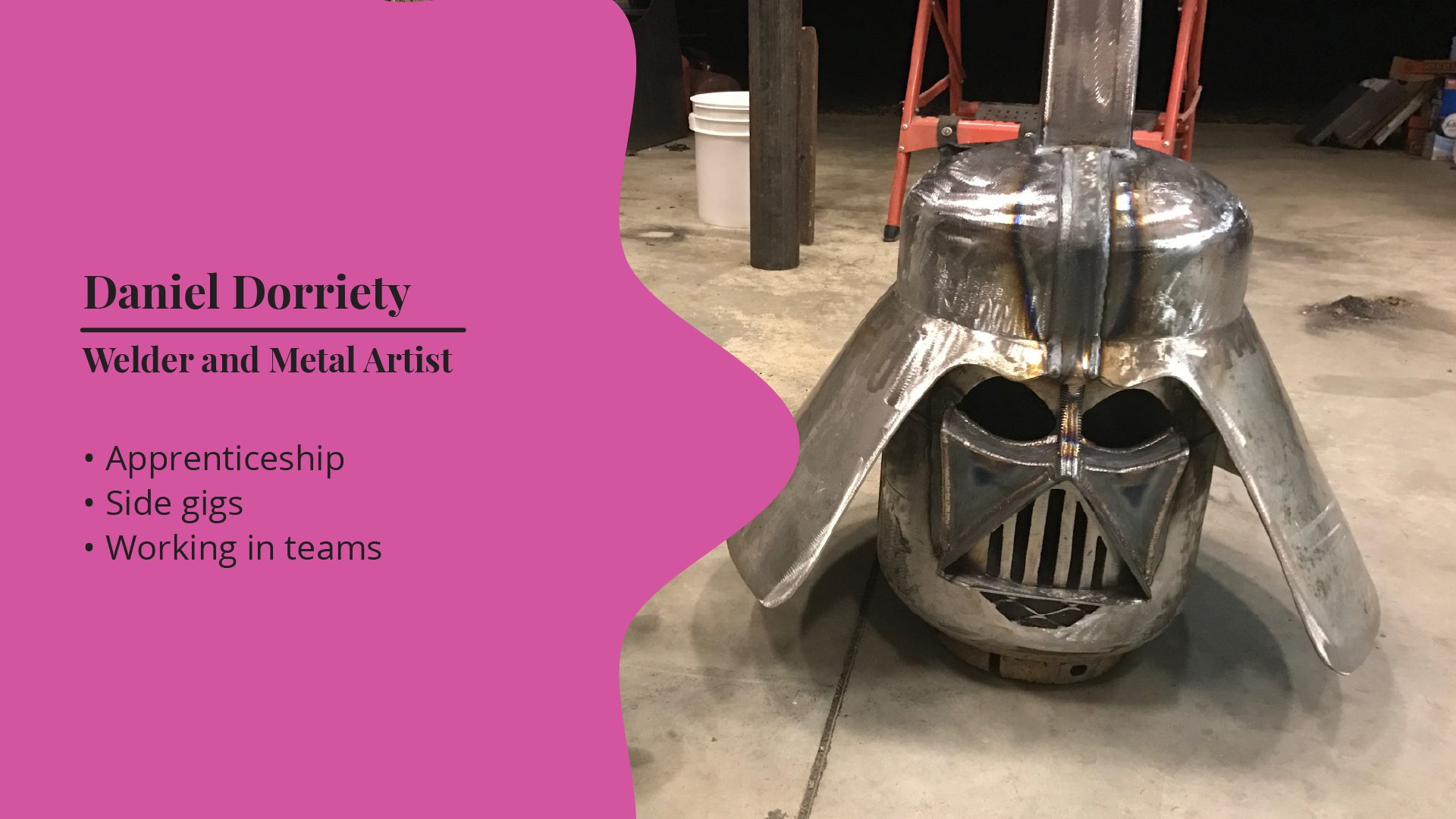
Daniel Dorriety
“I’ve always had a passion for welding… I’ve always been the kind of person who likes to work with his hands. The more you do, the more you try, the better you get.”
Daniel Dorriety is a welder by trade and works at General Electric building gas turbines. He is part of a special process team for repair engineering, focusing on joining development, handling the welding on every part of the gas turbines that get fixed.
Interview
Transcript
Daniel Dorriety
My name is Daniel Dorriety. I am a fabricator slash welder by trade. I worked for General Electric. I’ve been there for 24 years. Prior to that, I worked in some other Welding Fab [Fabrication] shops. But G.E. has been the most of my career.
Haley Hansen
You said you’d been working there for 24 years?
Daniel Dorriety
Yes, ma’am.
Haley Hansen
Can you walk me through like a typical workday?
Daniel Dorriety
Sure. So, we build gas turbines. At Greenville, I work for the repair engineering side. I am part of the special process team for repair engineering. So I focused on the joining development, which means all the parts on the gas turbine that get fixed; I handled the development of the welding, the braising, and the laser cladding repair of these parts. I have, typically, a dozen projects at a time that I work intermittently between each other. Today was more admin, catching up on documentation, more than anything. I kind of plan that out, because I’m on vacation in the next two weeks. Typically, my role specifically now is for laser repair. So, I run a C.N.C.[Computer Numerical Control] laser clatter; I do 3D Adaptive repair of gas turbine components that are by definition, unweldable. Hence why we’re using a laser. This is a fairly new change for me; that’s something I picked up about two… two years ago. The 22 years prior was all welding and brazing, and then, welding on gas turbine parts my entire stance; we did new mate manufacturing the first few years I was there, and then I switched to repair. So, I’ve been repairing and refurbishing gas turbine parts for nearly 20 years now.
Haley Hansen
For someone who doesn’t know anything about the industry, can you elaborate on the difference between welding and laser repair?
Daniel Dorriety
Sure. So, welding is it’s a manual process, and you’re using just a welding machine, and has a lot of human interface. So it’s, it’s a lot of variability between operators, not all welders are the same, right? So, it’s hard to establish control critical guidelines, you know, if you have to have a very stable process, it’s hard to control that when you have the human factor involved. And gas turbines are made of components that are very difficult to weld. By nature, they are super strong, and they hold up the very high temperatures in the engine. And that equates to alloys that don’t like to be welded. So they’re in a nutshell, very brittle and a crack. So, the difference between manual welding and laser is that laser is a more controlled process. It’s a C.N.C.[Computer Numerical Control] process that has a program driving it, right? So, you can control your heat input, your travel speed, the amount of filler that’s added, you can control all those precisely, and the density of a laser is so much more precise that your heat affected zone is smaller, which just means that you’re not going to introduce stress and cracking into the base metal nearly as much as you would with a manual welding process. Plus, it’s faster. And it’s an automated process, right? So, you can control it. You can’t weld everything with a laser, but we try to focus on the parts that are the most critical. Everything else, is pretty much a manual repair from that point.
Haley Hansen
How did you end up in the field that you’re working in, right now?
Daniel Dorriety
I always had a passion for welding. I went to Career Center in high school, took some welding classes, and loved it. I’ve always been the kind of person who likes to work with his hands. So, I knew that’s what I wanted to do. I like to build things. The fabrication side is not just welding, but it’s building structures. It’s, you know, whether you’re building a trailer or building a house. I’m building my second house now, and I’m doing all the work myself, right? I just liked that work with your hands and have something to see when you’re all done. Welding was something that I was good at it. I was always kind of into art. When I was young, I did a lot of drawing. And I think that helps me with welding.
Daniel Dorriety
You know, it’s a lot of hand-eye coordination, just fell in love with it. I stuck with it. And this is where I’ve ended up.
Haley Hansen
Being able to like to visualize the finished product I imagined helps a lot.
Daniel Dorriety
Especially on the artistic side. Yes. You know, typically, in my field, they give you a drawing, and you have to make it, right? So, there’s not a lot of visualization in that. But outside of G.E., I know I do gifts for people. I do fire pits. I built fire pits and that’s where the vision comes in, right? You have to have an idea in your head and then create it.
Haley Hansen
Did you, go straight into professional welding right out of the career center and like high school?
Daniel Dorriety
Pretty much. Yeah, I started in a [work] Co-oping in my senior year of high school. That would be my second year at the Career Center. So, instead of going to class my senior year, I went straight to work, Co-op, and then, when I graduated, I was hired full-time into the company I was working for welding, and then I continued on at Tech[Horry Georgetown Technical College] and got my associate’s degree. Then, eventually, I switched over to General Electric and have been there ever since.
Haley Hansen
What was your associate’s degree in?
Daniel Dorriety
Industrial Technology, with a major in Welding.
Haley Hansen
Do you have, like, a defining moment in your career or your creative journey where you realized, like, that was what you wanted to do for the rest of your life?
Daniel Dorriety
I guess the only thing I can really remember, is that my uncle had a fabrication shop. He built trailers. I found that fascinating when I was young; pretty young. I was probably in middle school, and I would go over to his shop and see what he was building and see all his tools. I just thought that was fascinating. And I wanted that for myself. And I think that’s how I kind of went down this road. 30 years later, I now have my own shop, and I’m starting to do stuff freelance on the side with a goal of eventually being self-employed, but G.E. is a pretty good job. So, I’m gonna stay there for a while.
Haley Hansen
I’m sure they’re glad to hear it. [Dorriety laughs] What would you say was the biggest adjustment or challenge you faced when you started your current role?
Daniel Dorriety
Maybe working with people? You know, all the different kinds of personalities.
Haley Hansen
That would do it.
Daniel Dorriety
You know, being a welder, especially the first place I worked at, you kind of got a rough crowd. I worked with a lot of field hands, guys that are used to working on the road and a lot of different personalities. And then, switching over to GE, a much more professional environment. So, that was definitely better. And then migrating into working for repair engineering, where I’m working with all very professional people, you know, that are engineers, and PhDs, and again, very different personalities, right? So, it’s learning how to fit in the world from one extreme to the other.
Daniel Dorriety
So, one of my primary jobs is, developing a repair but also transferring that repair to the shop so that they can do the repair. And then I have to train the operators, right? So, I’m the interface between the operator on the floor doing the work, the engineering staff that controls the process, and then our engineering staff that owns the process, right? So, it’s working with a vast difference in personalities is probably the biggest challenge. And we’re global too. So, we work with people in Singapore; we work with pink people in Saudi Arabia, shops all over the place, language barriers, and cultural differences. So, I’d say people. People are the biggest challenge.
Haley Hansen
Kind of related to that, can you recommend any specific skills that someone aspiring to your profession should develop?
Daniel Dorriety
Practice. It goes just along with everything, you know, if playing a guitar, for instance, I can’t play but I imagined that the more you do, the more you try, the better you get. And the same things for welding; I mean, you’re not going to grow and have better opportunities. If you don’t try be the best you can at it, right? You’ve got to put in the time, and you got to put the effort in; it takes a lot of practice to get good at welding; it’s not something you can just learn in three weeks; it literally takes months to years to get proficient, much less expertise. If somebody chooses to be a welder, I’d say that patience and practice. And a lot of it.
Haley Hansen
Are there any organizations or programs, or maybe, like, annual events that you would recommend for folks who are interested in your field, in South Carolina?
Daniel Dorriety
Well, the tech centers are bringing back trade schools. I went to Greenville Tech, their program was pretty decent. There is a private organization called ArtLabs that has a more intense and faster program that’s more specific to getting people employed and getting into work faster, versus going to Tech[Horry Georgetown Technical College], that kind of, kind of drags things out because they want to add extra classes to your workload and things that don’t get you into a job shop faster, right? So, I would probably lean towards art labs, they come with a very good reputation for their program. You know, other than that, working with people, making connections with experienced people, I’ve had a lot of people come up to my place that wants me to do things for them, and that are fascinated, and they want to watch and they want to learn and then they come back and I help them. Not necessarily a school, but this kind of gets them started just enough, where, they can do things at their house, and they can practice.
Haley Hansen
Do you have any advice for current students or young adults who are pursuing a creative career in welding?
Daniel Dorriety
Just don’t be afraid to try. Don’t let the fear of the unknown hold you back, I think I would have probably been freelance much earlier. If while, one, I had a family, so I had to have a steady income and benefits. So, that kind of helped me where I was. Still, the fear of the unknown kind of holds me back because I do have a stable good job. And I hate to walk away from that and struggle, right? So, I’ve been trying to build my own thing on the side.
Daniel Dorriety
In addition to keeping my stable pay slash benefits, who knew the day I enjoy making things? I do a lot of retirement gifts for people at G.E. I’ve probably made 30, 40, 50 of them over the years. Some of them have turned out really good, very artistic. Some of them are okay, but in the day, it’s fun. But I’m afraid if I get in a position to where it’s a consignment job, or I have to do it to make a living, that the fun will disappear.
Haley Hansen
Oh, I know that feeling.
Daniel Dorriety
Yeah. So, I don’t want to get in that position to where I don’t enjoy it, right? So, I don’t know. It’s the fear of the unknown that still gets me. I don’t know how to compress that yet. Small doses I guess.
Haley Hansen
Before we end, is there anything else you think is important that you say here?
Daniel Dorriety
Just, I always told my daughter that if you can find something that you enjoy… that you can make money at it. Then you never really have to work for a living. I never quite figured that out for myself, but I hope she does. So, just try to follow your passion and make some money at the same time.
-
Matteo Miles
“Take your work seriously, and your client will as well.”
Matteo Miles, from Greenville, South Carolina is a self-employed and full-time traveling artist and painter. Specializing in painting murals, he travels around the region creating artwork.
Interview
Transcript
Matteo Miles
My name is Matteo Miles. I’m 28, I live in Greenville, South Carolina, and I’m a full time artist, painter, specifically in murals. So it helps you do murals and kind of travel to other areas of the region and the country as well.
Haley Hansen
Are you self-employed?
Matteo Miles
Yes, I am.
Haley Hansen
Can you say, like, what your typical workday is?
Matteo Miles
So typically, what I’ll do is kind of start off by either answering emails or DMs of, like, inquiries, and just get those out of the way. And probably just, most of the time, it’s answering questions, especially for people who haven’t had any mural work done specifically, is what the business is that I’m doing right now. So I’ll respond to those, and either get people scheduled or, you know, kind of giving the information. And then after that, I’ll go in and work on some proposals that may be required for people that have moved forward in getting a mural done, whether that be getting together a vision board full of ideas, taking measurements, or doing the designs and drawings, and kind of going back and forth. And I call that pretty much the whole like planning process of it. And then if I have anything going on that day, any projects to start, then I’ll probably go on-site to wherever I’m working on, whether that be a restaurant or a hotel, and then kind of mapping out and prepping the space, if it isn’t day one for a project. But I typically like to at least try to work on at least two or three murals a month, and sometimes they will overlap. But that can get kind of chaotic, depending on the project, and what it could require. But on a typical day, during the week, if, if I’m not actively on-site at a project, it’ll just be kind of the administration stuff with planning and drawing. Takes up a lot of that time.
Matteo Miles
How did you get started painting murals?
Matteo Miles
So I got started painting murals, pretty much a transition from doing canvas work. So I’m assuming this is just like another part of the question, another question kind of talking about how I got into it. But I always started doing murals was I worked at a hotel over here in Greenville, South Carolina, and I was bartending and they had this big chalk wall in their lobby space that someone else had initially done when the hotel opened. And that person, you know, wasn’t able to come back. So I was like, oh, well, I, you know, was already doing chalk signage for Starbucks and stuff like that. So I was like, why not give it a go. So since then, I was able to change it out and rotate the themes, and along with the seasons with the artwork. So with that in mind, it became public art. So I was able to present that, you know, pretty much for free, and then you know, I would get paid to just change it out. But through that, I was able to get other people reading my name, and then kind of looking me up and asking me to come to their space, or, you know, if they said they had chalk murals and whatnot, or a permanent mural, and that’s kind of how it got started with kind of, you know, networking and getting other opportunity for larger walls and not just on canvas.
Haley Hansen
Did you have any education in visual arts, or were you self taught?
Speaker 1
I was self taught for the majority of the time. Of course, throughout grade school or high school, I would take the art classes required, or like AP, any kind of advanced, you know, exercise that I could get with it, because I just, I loved it. I was always drawing since the second grade and, just, any reason to not do other homework. And just to, and just focus on like, whatever required any kind of art, whether that be like science class and stuff like that. And then through high school, there was a institution called the Fine Arts Center. That was for high schoolers, kind of like a magnet trade school to get people started into college as well, but this one just focused on arts and liberal and music and stuff like that. And so after that, I did a couple years at Greenville Technical School over here, and that focused on, that had an incredible art program.
Speaker 1
But I did that for a couple of years, and that really helped me get a better gauge on the community, and like my mentors, including professors, and, you know, people who are really trying to take it more seriously and engage, you know, their own work into real life and into career aspect. So, that definitely helped me take it more seriously. Of course, it got a little bit heavy with trying to regulate, you know, I was living on my own already and then I had two jobs and stuff like that. So it was a lot to carry. But it really was manageable. You know, it was just you learn a lot about discipline and, you know, what art school or whatever you’re focusing on in creative work requires. But it really did help having like my mentors and the professors there kind of guiding me. I did have to take a break for about a year just to focus on work, but I was still selling my own personal freelance canvas stuff, and I eventually returned back to finish up my studies. And then after that, went to mortuary school for a few years, worked in a funeral home, and decided that my passion took even further a backseat. And I wasn’t really making art anymore. And then after that is when I found that hotel opportunity to do public art. And I’m like, “Well, let me just jump on this and see where that goes.” And over a span of maybe about three years, where I’m at now, I was able to kind of kickstart you know, going full time and, but learning every day about everything, and then everyone else in that community. Yeah.
Haley Hansen
You said that you’ve pretty much been, like, artistic your whole life. But was there one defining moment where you realized that you could and you wanted to make a career out of that?
Matteo Miles
There was in, I’d say it started in about middle school, when I would do art, or participate in art shows, I just had more of a business mindset, like track on it. So that was all I was determined to do was to really make it into a business and say, “I want to make a living off of this, I can’t do it by you know, just appreciating my own work.” Of course, I appreciate my own work, but just to be realistic. And I tried to share that concept with other people, then, you know, our professors as well, just so people didn’t think that the super high privileged could be the only ones being able to make art today as an adult in our generation. So I think that’s something that we all work on in education at the moment just to make everyone aware about that.
Haley Hansen
What would you say the biggest adjustment or challenge you faced was when you started being self-employed, working as a mural painter?
Speaker 1
One of the biggest challenges that took me a while to learn was how much things cost, but also the like, kind of underestimating what actually was required to get a project done. And at the end of it, having that learning experience of being like, “Oh, well, this required so much more than I at first intended to,” with supplies or equipment. And at the end of it, you kind of just didn’t really gain much out of it other than having the job finished. But that was just learning scenario, that’s probably one of the things I share with other people who are trying to go into actual murals, is just make sure you have your, your estimate correct, and your numbers good for your client. Because it’s, you can’t go back and try to change the numbers just because you thought you needed a more expensive paint or needed a scissor lift that you didn’t initially put into your proposal or a number, you’re just gonna have to like eat it.
Matteo Miles
Also be just taking your work seriously so that your client does as well. And that equals your own value. Because you can do the work, you can do what I call portfolio building, which I think is really important, which is doing your mural work. But if you’re first getting started and you’re gaining that experience, you know, you kind of give some slack to your prices, just so, you know, you make it easier, you’re able to portfolio build, and I think that’s important. And later on, as soon as you’re getting more experience, you get more value, then you can kind of up those prices. But don’t feel discouraged that you’re not just doing your work for a penny, you know, on the dollar just, you know, kind of realize that these are stepping stones in every career and every type of creative work too. And they only get better.
Haley Hansen
Are there any specific skills that you would recommend to someone who’s trying to start a career in your field?
Matteo Miles
I think special skills, probably first, drawing and painting, getting good exercise. With large scale, for some reason for me, it feels easier to draw large scale, that idea seems really intimidating for people who are used to drawing within boundaries of you know, a smaller form, so just exercising with that. Also your body is super important, because you’re using your whole body. So exercise your body, stretch, make sure you’re able to have endurance, whether it’s inside or outside on ladders, scaffolding, scissor lifts, weather difficulties, whether it’s outside or inside, accessibility, not being afraid of heights, and not being afraid of strangers, not being afraid to perform in public, because that’s a big deal of it too. I had, it took me a while to kind of build up that, that shell of anxiety, like to reduce anxiety from being in public trying to draw or paint and not being able to focus because there’s people around you, people want to talk to you, people are interested in what you’re doing.
Matteo Miles
And sometimes that little like, “Oh, thank you” or “Yeah, I am drawing this” is fun, but, it’s exciting, but it’s so hard to like keep clicking back in that gear of like focusing on your drawing, because you’re not like in your studio, being able to do your own thing whenever you want. That’s, that’s one thing I’d say to definitely learn is that public, just awareness. Exercise your body, and your eye, your hand eye coordination, to think big, because when you’re up close, you spend 10 hours working on something super up close, and then you like stand back, it’ll look completely different. So sometimes you have to shift things up close on purpose, though, stand back, it looks different. So those are probably the three things that I would recommend for someone who’s wanting to go into mural paintings, and that’s just kind of the physical of it. And then business is a whole other ballgame. Yeah.
Haley Hansen
Are there any organizations or programs or events that you would recommend for people who are interested in, like locally or statewide?
Matteo Miles
There are mural festivals happening all over the country, they’re very easy to look up, there’s plenty of resources to find them. I’d say there’s about maybe well over 10 that happen every year all over the country. In my region, in South Carolina, we have our local art festivals, like Artisphere, or I think there’s one in Asheville, and then Charleston I believe, and Columbia, like Soda City. But those, they will incorporate sometimes some larger work or live performances by a mural artist or other people. So that’s for like the festival part and also going there to look at what other artists or muralists are doing. And you really learn a whole lot about that. I feel like I didn’t start doing that until maybe like last year. I was learning about Asheville’s big art, mural scene. And then also I went to Miami for the first time this year to look at Art Basel. I think Miami is a super huge mecca for murals within the United States, it’s probably one of the largest. And then there’s always, always local city of resources for RFQs, request for proposal that cities and people will post those goes for funding for grants and scholarships and opportunity for people interested in doing the mural work.
Matteo Miles
Because the most common question that I get asked from artists who want to do murals is, “how do I get started? Who do I ask?” And I’ll say, “if you haven’t done one yet, if your neighbor or family member or friend hasn’t asked you to come into their home and paint their bedroom wall or something, if it’s not a rental, then that was to me, it’d be a good place to start.” And what I got started with was a great opportunity was in a hotel space. But if you don’t have the opportunity, I’d say start with residential, that includes the bedroom, kitchen, ceilings that are pretty cool, and also baby nurseries, as well, those are a great start to do. You can do them for $1,000 to $3,000 per project. That way for people to agree with, and then you could start going into like restaurants or, you know, hotels or sides of buildings, and you know what the professional people are doing.
Matteo Miles
So I would say that that’s a good start. Because eventually, honestly, how it goes is once you do one or two of, you know, give it your best shot, mostly, most of the time that person’s going to share it, or people are going to see it and they’d be like, “Wow, I would really like something like that.” And it’s all word of mouth honestly, as well. It’s a very short one just because it’s very taxing on your body. So that’s another challenge that I faced was like, I’m 28. So I think I could probably do murals for another, hopefully 10 years is the goal. And then hopefully more after that if I’m still good at that checkpoint. But yeah, that’s another thing too is what makes it a little bit more challenging. Do you have any more questions?
Haley Hansen
Do you have any final advice for current students who are interested in pursuing a career in the creative world?
Matteo Miles
I’d say, stay in school as long as you can. Because there, most of the time there will be a section in, if you’re doing specifically Visual Arts on outdoor art, sculpture or murals. And I remember vividly, when we got to that part of the course or the curriculum, I was like, “I don’t need to learn.” I was like, “I’m never going to be doing that.” I go “that sounds too complicated.” I go “I don’t want to do that.” But, and then I didn’t really listen, and, but that’s what I would say to people or to students. It’s to just pay attention to maybe that portion, just since we’re getting a little bit more education and actual muralists out there now that are younger and kind of starting that generation. So I would say to if you’re, if they’re interested in it, it does pay off. Just pay attention in school to that part. And then yeah, and just try your best to connect to other muralists online to because I’ve met, I’ve met a lot that really do, they do like to work with each other. And I’ve met a few that rather would not work with other artists. I think, I don’t know why that works, I just think artists are just like that. But there are a lot of resources and helpful tips that people could share with each other. Yeah.
Haley Hansen
Awesome.
Matteo Miles
Good stuff. Awesome. Well, thank you Haley.
-
Rick Sargent
“I actually got turned down twice when I applied to medical illustration school. I took time off, reassessed, and just drew and drew. When I finally got in, I was excited, and I have been doing this ever since.”
Rick Sargent is a professor of art at The Citadel, where he teaches drawing, painting, animation, and illustration. He is also a seasoned freelance medical illustrator specializing in medical-legal illustration. A native of Columbus, Georgia, now based in Mount Pleasant, South Carolina, Sargent holds a bachelor’s degree in interdisciplinary studies from the University of Georgia and a Master of Science in Medical Illustration from the Medical College of Georgia (now Augusta University).
About
Rick Sargent’s career is a seamless fusion of art, science, and education. With over two decades of experience in medical illustration and a decade of college-level teaching, Sargent brings a dual perspective to the classroom. His journey began with a high school art teacher’s advice to pursue medical illustration, a field that would allow him to combine his love for drawing with a deep interest in science.
After earning his master’s degree in medical Illustration, Sargent began working in the field, eventually specializing in medical-legal illustration, where he collaborates with attorneys to visually communicate complex medical scenarios through 2D, digital, and 3D illustrations. “They have to explain and communicate in layman’s terms what happened in an accident or medical procedure,” he said. “That’s where I come in.”
Sargent transitioned into teaching when a colleague suggested he consider the classroom. “I fell in love with teaching,” he recalls. Now a professor at The Citadel, he continues to practice freelance illustration while guiding students through the fundamentals of art and creative expression.
His advice to aspiring creatives is both disciplined and expansive: “Find your thing and do it really, well but don’t be afraid to explore. The creative paths you follow may connect in unexpected and meaningful ways.”
Sargent’s impact at The Citadel is evident in art has become the college’s largest minor, in part because students discover new ways of thinking visually through his classes. “There are many incredible artists at The Citadel who didn’t know they were artists,” he said. “For me, coming from a medical illustration background that’s something they can get their minds around.”