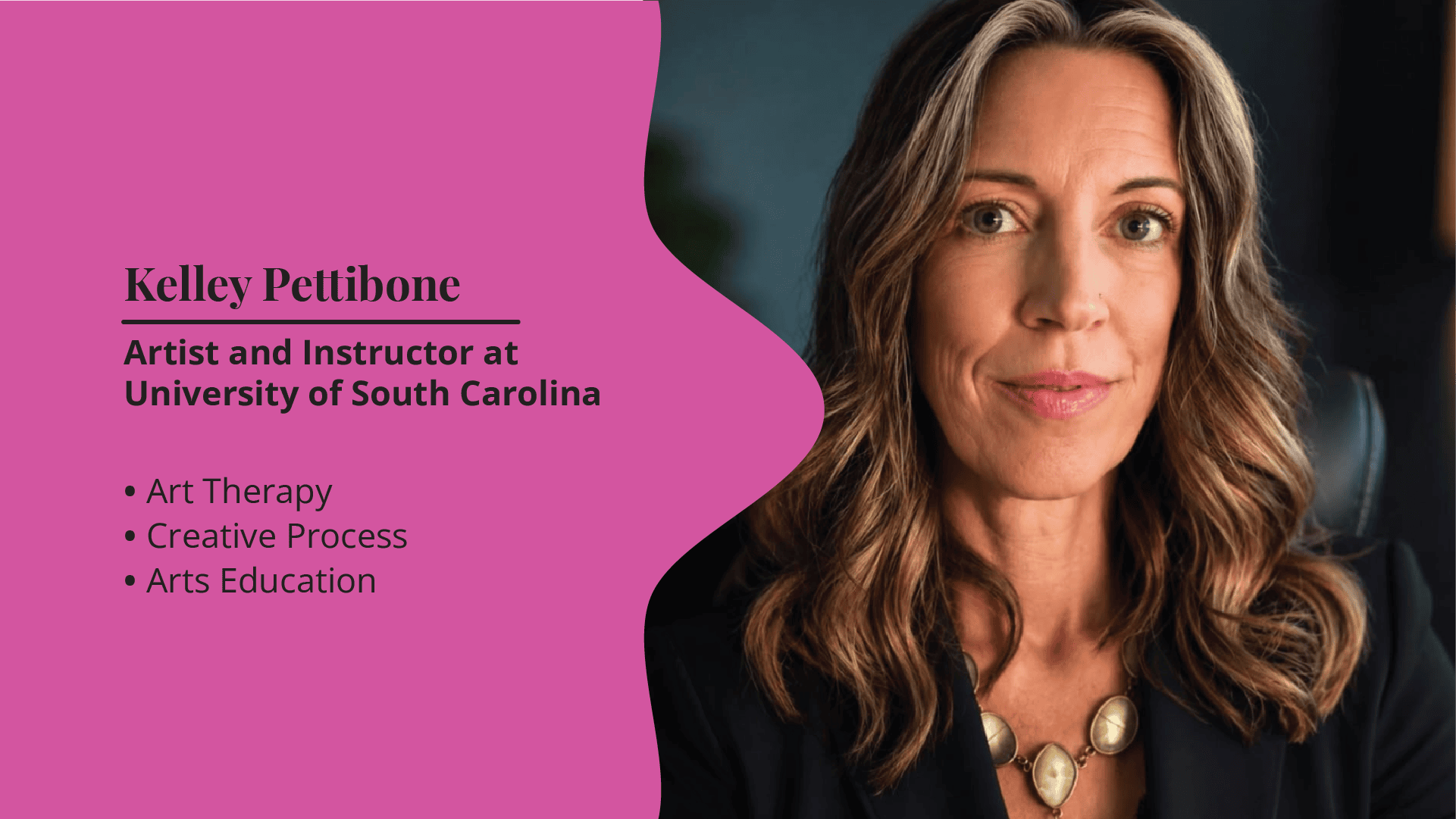
Career Area: Teaching Artist

  • Kelley Pettibone

    Kelley Pettibone

    Interview

    Transcript 

    00:00 Victoria Bartolotto

    Hello, everybody.

    My name is Victoria, and today we are talking with Kelly Pettibone, a professional creative working from and within South Carolina.

    As we get started, can you tell us about your current career and where you are currently located?

    00:14 Kelley Pettibone

    Yeah, I live in Columbia, South Carolina, and I am an educator. I teach for the School of Visual Art and Design at the University of South Carolina in Columbia.

    As an artist, as a working artist, I mainly am a printmaker, but also mixed media artist and sculptor. I’m a mom and a dog mom. I’m a wife and my husband is a retired Army veteran and a disabled veteran.

    So, I wear many hats. I do a lot of different things.

    00:50 Victoria Bartolotto

    Okay. Before we get into the nitty gritty details of being a professional educator, but also a studio artist, we have a brief section of our interview called “One Career, Sixty Seconds,” where you give an elevator style pitch about what your work is and how it kind of functions. Are you ready?

    01:08 Kelley Pettibone

    I’m ready.

    01:08 Victoria Bartolotto

    Okay, you can go ahead.

    01:11 Kelley Pettibone

    All right. Primarily printmaking and mixed media collage art, I focus mainly on grief. That’s the nature of my art. My art was born in grief as a therapy for myself. I look to my studio as a way to heal myself and work through my grief. That has blossomed now into more of a joyful space.

    I also work sculpturally. I entertain the idea of home and what home means to me in the essence of losing my entire family in a decade of time. That is kind of where all my body of work began and where it has continued to grow, through living with that grief rather than living in grief. I love to do art as therapy, but it’s become so much more.

    02:05 Victoria Bartolotto

    Wow. I know art speaks to a lot of people and with that being your main focus, is there anything about South Carolina in particular that brings, in addition to your family and the grief that you experienced, does the state or your particular region or the city of Columbia bring anything to your art as well?

    02:25 Kelley Pettibone

    It does. My father passed away of leukemia, and he was treated at the MUSC Center in Charleston. My parents lived for a while down across the street from the Folly Beach Pier in Folly Beach. That’s where he was getting treatment. I used repurposed wood when they rebuilt the Folly Beach Pier. I was able to get a lot of that wood.

    I use that in my sculptural work because of the place and it’s from Folly Beach. It’s significant to South Carolina in the region.

    03:07 Victoria Bartolotto

    So that project with the reclaimed wood is just one of many. Is there another project in particular that had an impact on your creative journey as well?

    03:17 Kelley Pettibone

    Absolutely. In working with my mother, she passed away in 2018 on Mother’s Day, so May has been a big month for me. I had all of her clothing after she passed away. No one tells you what to do with people’s stuff. You have to make these rough decisions.

    As a printmaker, I needed paper. And so, I took her cotton clothing and pulped it and turned it into paper. That was a significant experience in learning to let go of things, but repurposing it into something that’s going to be useful for me in my art practice.

    I have now started a whole new series of handmade paper using four generations of denim. It’s my grandmother’s, my mother’s, mine, and my daughter’s blue jeans. So all denim. So, I have quite the denim pulp happening at the moment.

    Things like that, learning how to let things go, but then repurposing it into something else within your art and giving it a new space and then sending it out in the world to exhibit or wherever it ends up. It’s kind of cool and fascinating.

    04:31 Victoria Bartolotto

    Before entering becoming a studio artist full-time and obviously with teaching and things like that, did you have any fears about pursuing studio art as a full-time job? Was there anything that kept you back from maybe pursuing that as a source of income? If there was, what might have inspired you to continue beyond it?

    04:58 Kelley Pettibone

    Right now, I’m entertaining the idea of, and I haven’t yet, and only because I’ve been holding back. I wasn’t ready to pull the plug yet on it, but I want to join like art events as a vendor to sell art outside of a gallery environment, but in like an art fair and community events.

    I want to do that in terms of like the capitalism side of selling my art, but I work to fund my art. That’s kind of why, being an educator and getting that check from being an educator helps fund my studio passion and my art helps me buy more materials so that I can do that.

    Well, now I’m at a point where I have a lot of art and I need to get rid of it. I’m running out of space. So now I’m at the point where how do I sell this and how do I do both? How do I make money being an educator as well as making money being a studio artist? It’s great I can make it, but now I need to figure out selling it.

    06:12 Victoria Bartolotto

    Can you talk a little bit about the gallery experience and how a student who might be wanting to pursue becoming a studio artist or have their art exhibited in a gallery? Can you talk a little bit about that and how that works?

    06:26 Kelley Pettibone

    Yeah, it’s a full-time job in and of itself. I’m trying to find open calls, who’s looking for work, for what type of work, making sure that your work fits in that space. My work, because it’s grief in nature, doesn’t fit in a lot of places. So, you kind of have to pick and choose.

    Also, if it’s sculptural art, it might be an environment where there are a lot of traffic. Maybe sculpture isn’t okay to say show in a bookstore where there’s going to be children and families and things like that.

    So, you kind of have to know the gallery or do your homework and research the places. But it’s a lot of time spent on the computer. It’s a lot of administrative type work in the looking, but also in the applying. I had someone tell me one time, “if you haven’t collected a box of nos, then you haven’t made it yet as an artist.” Throwing all the pasta at the wall and seeing what sticks, basically.

    You have to be okay with being told no. I’ve applied and reapplied at places, I’ve been told no and then reapplied, and then I’ve been told yes with the same body of work. So maybe it’s just not the right time, but maybe later. And I’ve been told no, not this year, but next year, and that’s okay. You can put it on a back burner for next year.

    Planning ahead and keeping a good calendar of what you have going on and what you have applied where, so you don’t overbook or double book your work. Last thing you want to do is have this body of work in one gallery and then you’ve promised another space the same images or the same pieces.

    So being a good juggler and a good manager but also being good administratively and researching.

    08:27 Victoria Bartolotto

    With the different types of mediums that you work with, do you approach each one through the lens of grief, or are there different lenses that you approach the different mediums through?

    08:40 Kelley Pettibone

    I kind of always seem to fall into that vein because it is so therapeutic for me. But when I work with printmaking, mainly I’m a woodcut printmaker and so I carve wood and carving is meditative, but it’s also very mindful.

    I have to be present while I’m carving because one carve and now it’s gone and I can’t get it back. So, you have to be fully present and fully mindful of what you’re doing in that.

    But whenever I am, say, mixed media collage or painting, it’s more playful and it’s more joyful and I can dance around and listen to music while I’m working, and I don’t have to necessarily be as mindful with that. And it is more of a playful in nature process for me and also very impromptu.

    When I am working in printmaking, it’s very planned and it’s very organized. I have to have an idea of where it’s going, or it’ll fall apart quickly. With collage, it’s very throw it all up in the air and see where it lands. And then if I don’t like it, just cover it up with paint, you know? So, it’s not a lot of planning at all, if any. I might start with a color story and that’s about the extent of the planning on that.

    But with sculpture, also, it’s more mindful. I have to kind of have an idea of what I’m going for and then sculpt it out. But it also can be more playful than the printmaking for me. So, I kind of go back and forth between the two or three or four. I might have three or four things going on.

    And when I’m tired of being present and I’m tired of being mindful, then I might say, “okay, it’s time to play.” Then I’ll go do something else that feels more playful for a while.

    10:34 Victoria Bartolotto

    It seems like there’s a good balance that you have.

    10:36 Kelley Pettibone

    Yeah, I try. I try to, and I don’t know if maybe it’s the ADD or the ADHD in me that I can’t sit still for very long. So, I have to kind of hop around in both process and in my pieces. I get bored with something for very long. And so, I can only sit here for a few hours and then I gotta, oh, I gotta go do something else.

    11:01 Victoria Bartolotto

    Yeah.

    11:02 Kelley Pettibone

    Seasonally, I’m like that in my own house too. Like I change around spaces and I change around things. I just get tired of it after a while and I have to do something different and freshen it up.

    11:14 Victoria Bartolotto

    Do you have any advice for young students, particularly like high school or freshmen in college who might want to pursue studio art and multimedia art as a profession? Do you have any advice? Are there any particular skills that they should have or a mindset they should go into it with?

    11:32 Kelley Pettibone

    The only real advice that I have after having taught studio art for a while is that I have a lot of students. The very first thing they’ll say at the beginning of the semester is, “I don’t know how to do this very well” or “I’m not a good drawer” or, you know, “I can’t draw” or “I can’t do this”. Nobody does when you begin.

    I didn’t even know of printmaking or like my idea of printmaking was making posters or t-shirts. I had no idea, and everyone starts somewhere. And don’t be afraid to learn and play and allow yourself to play because through play is when you learn what works well and what doesn’t work well.

    But also, I think my greatest advice, because I started as a biology anatomy major. That’s a heck of an adjustment. But I spent a lot of time and a lot of money in classes that didn’t translate over to studio art.

    But don’t spin your wheels and waste your time doing something because it’s what you feel like you ought to do. Or like, “I had an uncle that was a biologist. I should study biology.” No, you should not. You should admire your uncle for being that and what he was and his hard work. But if that is not innately you, that is not what you should do.

    And I feel like everyone should follow their passion. And if the world were full of people that were passionate about what they do every day, imagine the space we’d live in. I mean, it’d be different.

    13:21 Victoria Bartolotto

    It would be so different.

    13:23 Kelley Pettibone

    Everyone waiting to take your order would be so happy you’re here. “My pleasure,” everywhere. If it was like that, it would be wonderful. And I feel like that if making art is your passion, you’ll find a way. Everything else will fall into space. The money will come. All the questions will get answered. You will find a way to make it work if that is what your passion is.

    If it’s not what your passion is, then that’s gonna be a struggle bus. But if it is what you’re passionate about, then you will find a way. Where there’s a will, there’s a way. But definitely don’t do something because — I have a lot of students that are in my class, classes, studio art classes, and I’ll say, “what’s your major?” “Math.” “Why? Do you like your major?”

    And they’ll say, “well, I really wish that I was a studio art major, but–” and I’m like, “why aren’t you a studio art major?”

    And then they’ll say, “well, because I can’t make money at that, because my dad said I can’t make money at that.”

    Well, you can, make money at that. As a matter of fact, I have artist friends that sell art for the price of cars, houses. You can make money at that, but you have to decide how much you’re willing to sacrifice to make that happen in the beginning to make that money in the end. Passion is where it lies and do from the get-go what you are passionate about doing rather than having a 25-year college plan like I did before you finish up.

    15:20 Victoria Bartolotto

    Yeah, no, I can totally sympathize with that because I graduated with an English degree. And a lot of people come up to me and they’re like, “oh, what do you want to do with an English degree? Do you want to be a teacher?” And while teaching is an amazing profession, it is not for me. And I’m like, “oh, no, I want to be an author. I really want to write books.” And they’ll be like, “Authors don’t make any money. You won’t make any money.” It’s just like, well, I have a vision. I have a plan. I want to make it work. And so, I can totally sympathize with that kind of mindset, for sure.

    15:55 Kelley Pettibone

    I remember specifically coming home after I had discovered, I was in clinicals, and I was going through all of my notes. I had tons of notebooks full of all anatomy stuff. And I was going through all my notebooks, and I realized that all my notes were drawings. I draw all my notes rather than write notes. I have pictorial notes.

    And all my notes were mainly drawings of like body parts and like the human body and its inner workings. And I thought, “I’m an artist”. That’s what I am. I don’t want to be stuck in a lab for the rest of my life.

    There’s no creativity in that, and like you feel about teachers. That’s a life for somebody, but that is not the life for me. That is not what I want to do. We need those people, but that is not my jimmy jam. I went home and I told my parents, I remember I was not living at home at the time, but I told them one night over dinner, I said, “I’ve decided that I’m gonna change my major.”

    And both of them were like, “what?” And I said, “I’m going to art school.” And I remember my dad, who was a chemical engineer, he said, “How are you going to support yourself being an artist? Like you’re going to be one of those people that sit on the side of the road and tries to sell art out of your trunk. Like, how are you going to do that?” And I was like, “I don’t know if I haven’t figured it out yet, but I will.”

    And my mom, she was always so supportive and she was like, “Well, I know you’ll do it, and you’ll do great because you’ve been drawing since you were like 2. So, I think you’re going to be fantastic. Like maybe you can make Hallmark cards.” That’s what she said.

    17:43 Victoria Bartolotto

    That’s what my mom said, too! She was like, “You can write for Hallmark.” And I was like, “I don’t know, maybe?”

    17:49 Kelley Pettibone

    You write it; I’ll make it comical. There we go! It’s a collaboration.

    I just remember them thinking, “How are you gonna do this?” But my mom being very supportive, but also she couldn’t support you forever. I know now, once I figured out that I do love teaching, I love teaching, I love creating artists. That’s like my thing.

    Like, I believe everybody is an artist. You’re an artist. You’re an artist of words.

    18:25 Victoria Bartolotto

    Yeah.

    18:25 Kelley Pettibone

    We’re all artists in our own way. You don’t necessarily have to be a painter or a sculptor. We all have a gift and that’s an art. Being able to write is an art. You’re in the literary arts. I couldn’t write a book. Maybe I don’t know. But I have written poems and poetry. So, it’s all an art and we’re all creatives in some way.

    I feel like being a teacher is kind of the vein where I fell into and creating and encouraging students to follow their passion is like right where I belong.

    And that funding my art, you know, my independent art as a fine artist, as a studio artist, that’s necessary. But also having a creative space for me is necessary. My grandmother used to say, “Idle hands are a devil’s workshop.” And that’s true. Like I cannot not create. That’s essential for me. It’s essential to get all of these feelings and all of these thoughts out.

    If it becomes a whole body of work that gets shown in an exhibition, if it touches somebody, even if just one person, job well done, you know?

    19:51 Victoria Bartolotto

    Yeah. Well, thank you so much for taking the time to talk with me today. I sincerely appreciate it.

    19:59 Kelley Pettibone

    Enjoy your summer and congratulations to you.

    20:01 Victoria Bartolotto

    Thank you so much. I appreciate it. I hope you have a lovely day.

    20:04 Kelley Pettibone

    All right, you too.
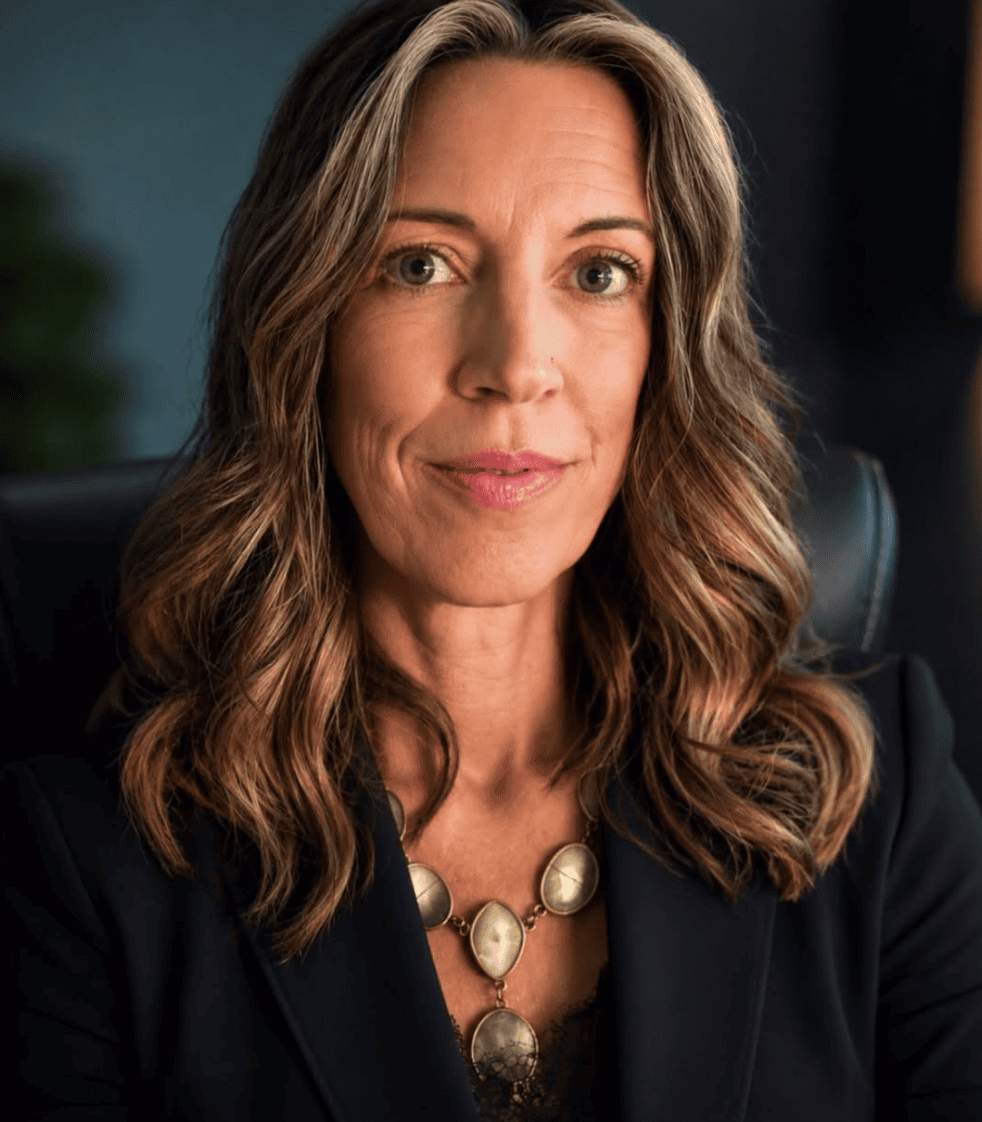
  • Kelley Pettibone 

    Kelley Pettibone 

    “Do not be afraid of receiving rejections.” 

    Quick Facts

    Education: University of South Carolina

    Years of Experience: 15 Years

    About

    After realizing all her notes were filled with drawings and not written words for her biology major, Kelley Pettibone switched to Studio Art and never looked back. Currently, she is an Artist and Instructor at the University of South Carolina. She primarily works as a woodcut relief printmaker, but also dabbles in painting, mixed media collage, sculpture, and paper making.  

    During her BFA, she suffered a hard familial loss and struggled to find creativity. Over time, she channeled her feelings through her artistic practice to visually document her journey through grief. Kelley is an advocate for the healing nature of creating art and refers to her studio as a “sanctuary.” She insists that “a box full of ‘no’s’ indicates that you are putting yourself out there and trying,” and emphasizes the importance of continuously submitting your work. 

    Kelley enjoys fusing inherited family ephemera and repurposed materials. In her next project she will be reimagining denim, a fabric spanning the age of four generations, to make paper. Kelley strives to express her emotions through her work and allow her creativity to live a life beyond herself. She loves teaching and advises any potential graduate student to experience an Assistantship, feeling as though every class is “a series of playdates each day.” 

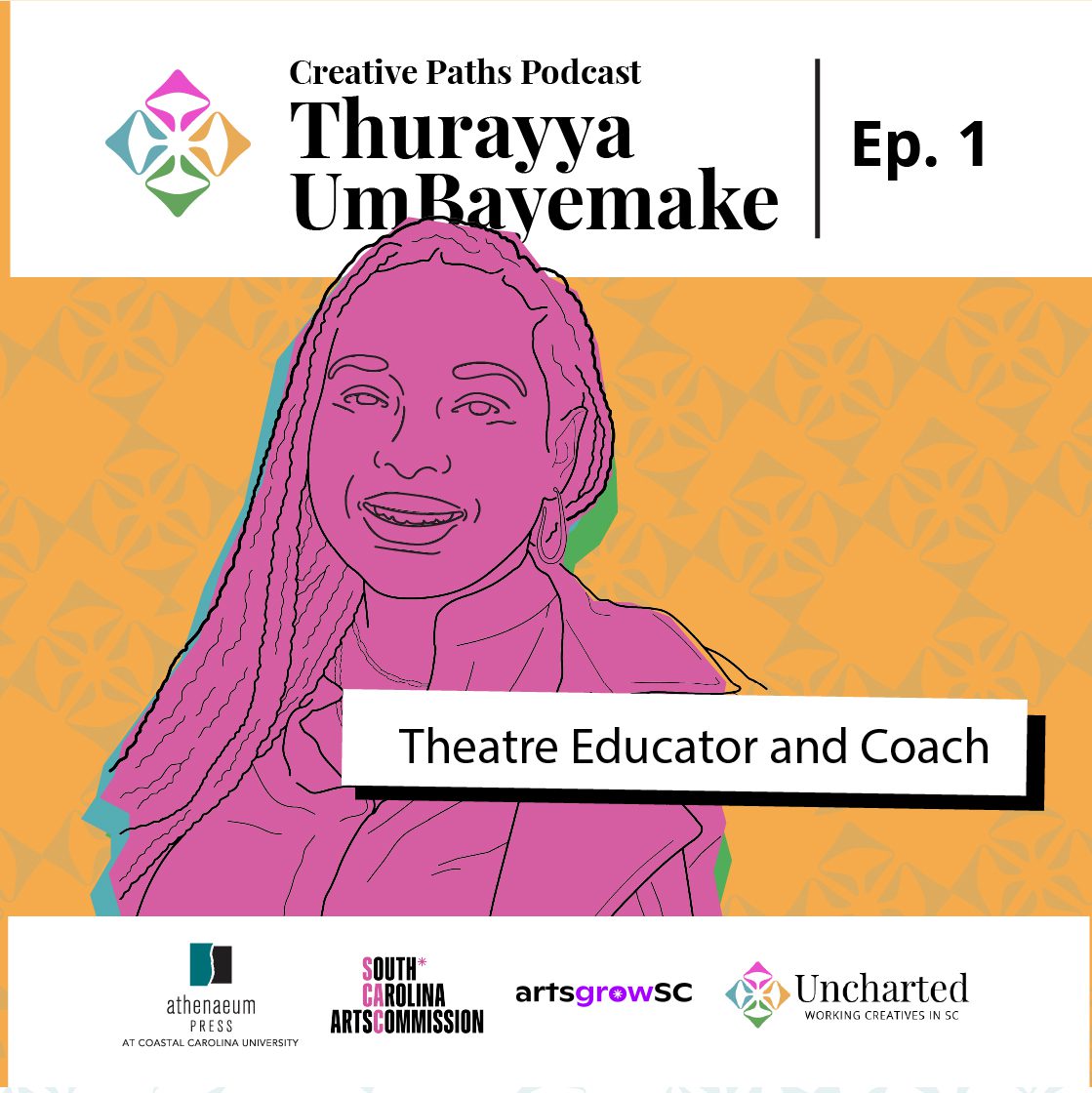
  • Thurayya UmBayemake

    Thurayya UmBayemake

    In this episode, we’re navigating finding your place in theatre education with Thurayya UmBayemake, a Coaching Teacher with the Spark! Program at the SC Governor’s School of the Arts and Humanities. Thurayya is based in Columbia, but she works around the state guiding a team of teaching artists working with elementary school children to learn reading and storytelling. While Thurayya has lived all over the United States, a series of opportunities brought her to South Carolina.

    Transcript

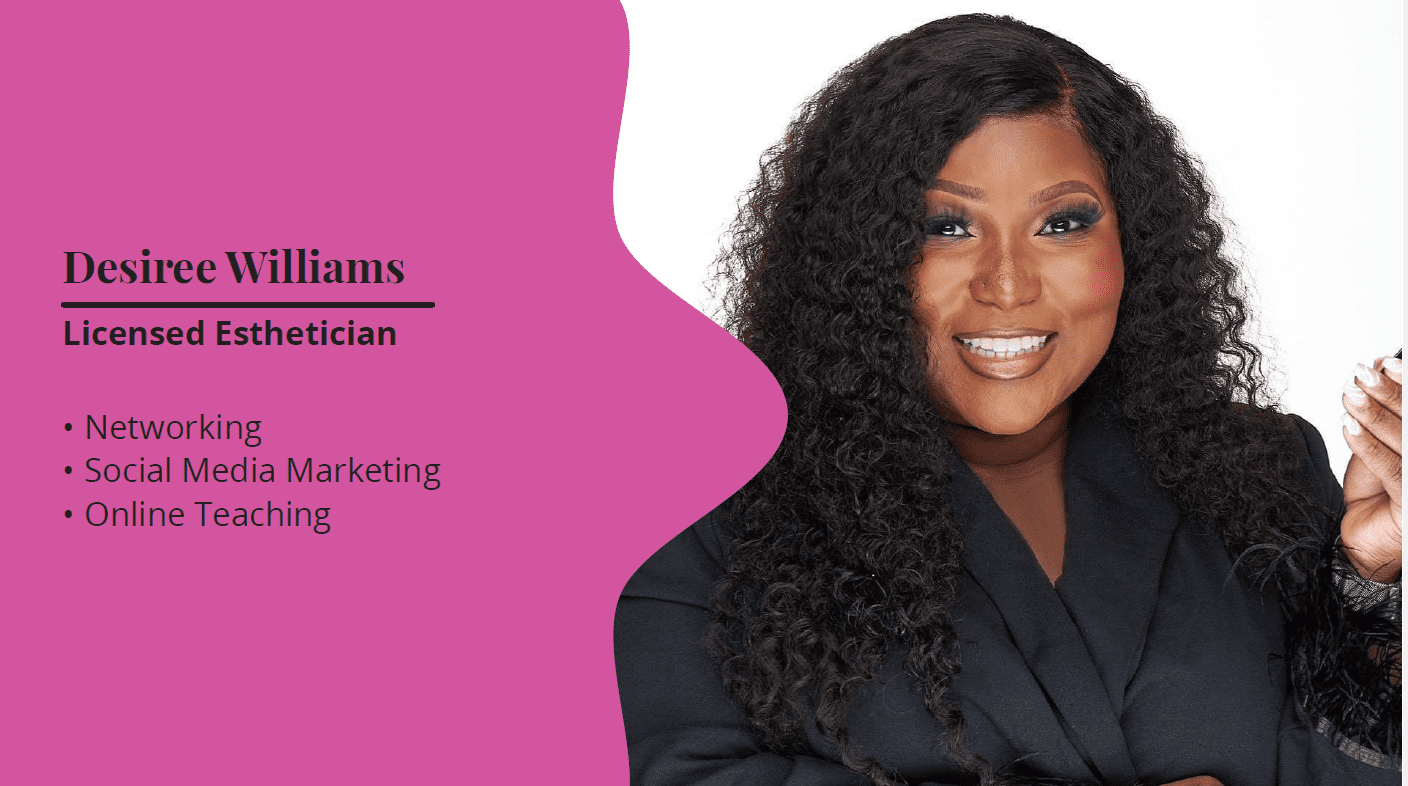
  • Desiree Williams

    Desiree Williams

    “I define success by being able to wake up and actually see my work impacting the lives of others.” 

    Desiree Williams is a licensed esthetician and educator. Desiree is turning creative passion into community impact, one lash, lesson, and life at a time. 

    Interview

    Transcript

    Emma Plutnicki  00:03 

    Okay, so to start, what do you do for work and where are you currently working from? 

    Desiree Williams  00:08 

    Well, my name is Desiree Williams. I am a licensed esthetician and a licensed esthetics instructor. I do have a suite that I work from, and I perform master extension applications as well as teaching it. 

    Emma Plutnicki  00:22 

    Amazing. And how long have you been doing that? 

    Desiree Williams  00:25 

    It’s been going on for six years. 

    Emma Plutnicki  00:30 

    Okay, a good amount of time. So, what is a typical day? Look like for you? 

    Desiree Williams  00:36 

    A typical day for me kind of starts like today. Wake up, do all my good, do all the things I need to do, and then run and go see clients. So, I like to get my clients out of the way at the beginning of the day, so in the evening I can do all of my marketing, all of my mentee calls. I teach a lot on Tiktok. So, I do free lash artist classes on Tiktok every day at 9pm so that’s basically what my day looks like. I start immediately getting into it after I do my gratitude and drink my tea and do everything that I need to do. 

    Emma Plutnicki  01:14 

    Yeah, amazing. And so how did you gain the skills to be successful in your career? I would 

    Desiree Williams  01:20 

    Say networking as well as reading. One thing that I learned is that if you want information out there it is always in a book, it’s somewhere in a book. I don’t even like Google anymore. I love to find a good book that talks about whatever topic I want to learn. So, I also watch a lot of like Alex hermosi, Grant Cardone, those guys to help me scale and do things like that. So, I feel like just networking and being a student forever has assisted me in getting where I am today. 

    Emma Plutnicki  01:50 

    Yeah, for sure. And did you have any fears when you were going into this career? 

    Desiree Williams  01:54 

    Oh, yes, plenty. I’m the first business owner in my family. So, it was a learning curve. I don’t even know where to start with my fears. I always was like, oh, well, how am I going to do this to get the inventory or the main thing was capital. So, a lot of times when you don’t have previous experience in business, it’s hard to get capital, especially if you’re not educated on things like the SBA and stuff like that. So, getting started finding a space to work was, you know, kind of hard as well. I started from my home and grew my business and was able to leave my home. So, there were a lot of fears, but thankfully, with faith, I overcame all of that. 

    Emma Plutnicki  02:35 

    Yeah, and did you have anybody along the way giving you any advice, any mentors or family members? Do you remember any of the best or worst pieces of advice that you were given? 

    Desiree Williams  02:44 

    I’m not gonna lie, like a couple weeks ago, my husband gave me the best pep talk ever, because I was like, I’m just gonna go get me a job. I’m not gonna have to worry about anything. I don’t have to follow up behind people. Just go get a job. So, I would definitely say my husband, he very, very much inspires me, even though, you know, it’s like, oh, it’s your husband. He should do that. No, some days he’s not going with my shenanigans, and other days he is. So, he was a big integral part of growing the business and doing things or learning how to do things the right way. So, some of the best advice I’ve gotten from him was, just do it. Stop overthinking it, just do it. And some of the worst advice I’ve ever gotten was not from him, but just from in general, like listening to social media. Like on social media, people tell you do ABC, you do it, and you don’t get the results that they promised. So, I learned not to use social media as a guy. But as far as the inspiration goes. 

    Emma Plutnicki  03:42 

    Yeah, that’s a good point. And have you been able to maintain a healthy work life balance with your work? Is it hard to kind of separate your personal life from your professional life 

    Desiree Williams  03:54 

    In the past? Yes, I was at the point where my business was my personality. So, like every time someone sings seeing me, they’ll be like, oh, its flash girl dance, you know? So, over the years, I was actually diagnosed with lupus at the height of my career. So that goes to show that when you first start in your business, create systems that are going to help your business continue to do what it needs to do, even if you’re not behind the chair or you can’t work. So now, after that diagnosis, I have a healthy work life balance. But before I didn’t, I woke up immediately checking emails, immediately doing this, but putting implement in business hours has been a great help to me, and now I feel like once I follow my business hours, the balance is it’s not even balanced. It’s harmony for me, yeah, 

    Emma Plutnicki  04:40 

    Perfect. And with a career like this, I’m sure it can be hard to kind of define what success looks like. So, what does success look like for you? Is it a positive review? Is it financial based? How do you define success in your professional career? 

    Desiree Williams  04:58 

    Oh, that’s a good one. I. I define success by being able to wake up and actually see my work impacting the lives of others. A lot of times, like in the career that I’m doing as an esthetician, a lot of people go to school, and they get done with school, and they never take their boards, or they learn lash extensions, and they never actually start the business or take clients. So, with me being able to teach over 1500 students, I’ve learned that my success is in helping people change their lives in a real, true way, where you know they’re not worried about what’s happening next, they actually have a plan, a strategy, to get things done. So, I define my success by how many lives I can positively impact, which is, which has been a lot. It’s kind of overwhelming once you think about it, but just being myself and letting them know, like, hey, if I can do it, you can do it too. My success comes from that. Yeah, 

    Emma Plutnicki  05:53 

    I love that. And has there been one specific moment that you can remember throughout your career that kind of stands out as having a significant impact on you, whether that’s your greatest success or just something that was kind of the pinnacle of your creativity. 

    Desiree Williams  06:08 

    I would say, honestly, my loop is diagnosis. Then the reason I say that is because I had to quickly pivot into not being behind the chair as much to oh my goodness, my hands are numb today. I can’t work today. What? What else can I do to help impact others? That moment where it’s like, I don’t I realize that I don’t physically have to be touching people to impact them. That was very pivotal for me, because social media is huge. You can. You could be in China right now. We’ll be talking like you get what I’m saying. So, um, just understanding that, boom, this is, I don’t know, it’s a lot, it’s a lot, it’s it’s a lot. And I would say, just, excuse me, I’m so sorry. No, you’re so good. Questions over here, like, I can think of multiple moments that’s great talking. I was thinking of another moment like, I was just like, whoa. You don’t realize how much you’re pouring into something till you step back and look at the bigger picture. So just the bigger picture, that’s really it? 

    Emma Plutnicki  07:17 

    Yeah, no, for sure, and working in South Carolina has that had any specific impact on you the state as a whole? Have you worked in other places, and does South Carolina specifically have any impact on your work? 

    Desiree Williams  07:30 

    Oh, very much. So I’m completing a course with Columbia’s business office. It’s called The Next Level micro entrepreneur, and I’ve never seen something like that in any other state, like just researching like, oh, I want to leave South Carolina. Where am I going to move to? What type of business support would I have? One thing that I will say about South Carolina in whole, is that our bit the business realm of it, those who are in those higher seats, they do want to see smaller micro businesses succeed. And today is, well, tomorrow will be week nine of the course. And I always tell anybody, if you want to run a business, definitely take this course, because it tells you, step by step on how to run your business and what to do, how to find loans with the SBA.  This all the resources you think we didn’t have here in South Carolina that we do have, the class is only like $50 so I was just like, whoa, this information. It needs to be more. So South Carolina has definitely impacted my business like that, because it shows me that I have the resources here to do better than do the things that I want to do to impact the community. I don’t really I only work in Columbia, but I do have a lot of people that travel from Charleston. I had a young lady travel from North South Carolina, and I have no idea. I was like, I have no idea where that’s at. But just being born and raised here, it was, it’s great to have run a business here and see how things are changing. And it’s a really great straight state, especially if you want to run a business. So, yeah, I love my city. 

    Emma Plutnicki  09:02 

    Yeah, no, amazing. And how is the local working professional community? Is there a lot of support? Is, are there any, like, weekly meetings you go to? Or what kind of support do you receive within South Carolina, 

    Desiree Williams  09:16 

    It’s so many to name. They have different things, like, I’ll go on like Facebook and see what they have for meetups, like networking mixers and things like that. I don’t do anything weekly as far as networking. The last 10 weeks, I have been doing that class with the Columbia Business Office, and then just the esthetics community here is very loving, very huge. You know, everyone wants to see each other win, so I love that aspect of running my business here as well. 

    Emma Plutnicki  09:48 

    Yeah, amazing. And just as we wrap up, is there anything else that you’d like to add about your job, your career, any advice or anything like that? I’ll 

    Desiree Williams  09:59 

    Give some advice. If you are creative, because I’m definitely a creative I love with last extension, application, and just being an esthetician, doing application and things like that, you have to have that type of creativity so each person can have like, their signature look. So if you are creative, I just recommend to stick to it. Don’t try to see, do what other people are doing, do what works for you and your business will flourish. 

    Emma Plutnicki  10:25 

    Yeah, I love that. Well. Thank you so much. Thank you for taking the time to speak with us. I know everything that you said will definitely help anybody looking to pursue a similar career. So really appreciate it. 

    Desiree Williams  10:35 

    Yes, ma’am.  

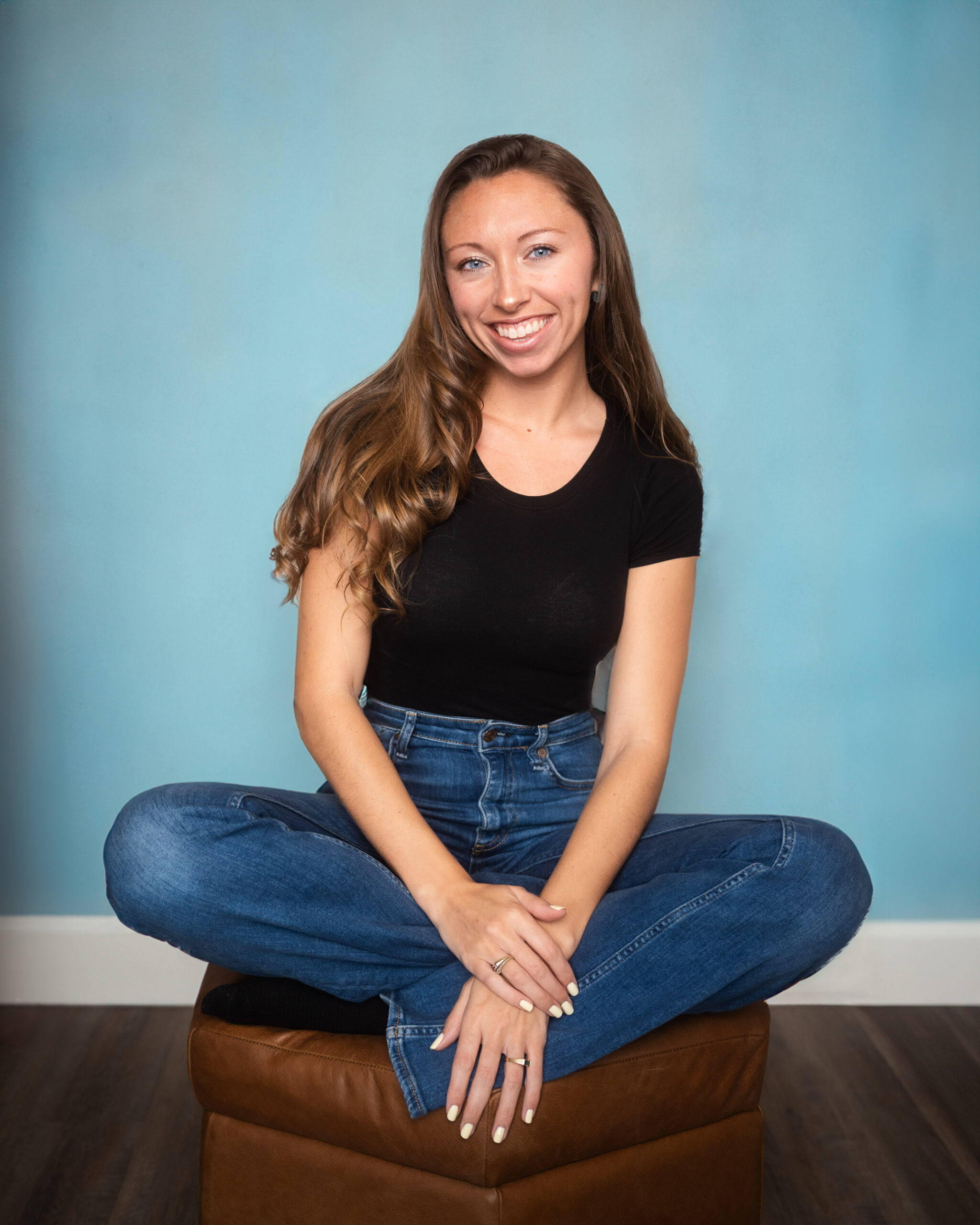
  • Simone Liberty

    Simone Liberty

    “I really love to extend art and creativity for everyone. Art for all. Art for everybody.”

    Simone Liberty is a full-time Teaching Artist based in Charleston. As a Teaching Artist, or traveling arts educator, Liberty teaches Arts Integration in schools throughout Charleston, Dorchester, and Berkeley counties. Arts Integration uses visual and performing art forms including dance, art, and theatre, connecting them to core curriculum subjects such as math, science, and ELA. 

    About

    Simone Liberty has been in Charleston since 2015, when she left her hometown in Connecticut to attend the College of Charleston to pursue an Arts Management degree. She remained at the College of Charleston to earn a Master of Public Administration with a certificate in Arts and Cultural Management.  

    While in graduate school, Liberty observed a summer theater program for children at the Gailliard Center; she was so inspired to get involved that she wrote a letter to the program director, essentially creating a part-time position for herself in fundraising and education. Her proposal was successful, and over the next year, she worked as a fundraiser to support Gailliard’s educational programs. While she enjoyed that position, she realized she wanted to work more directly with children, and becoming a Teaching Artist has fulfilled that desire.  

    Liberty speaks openly about the difficulties of working as a Teaching Artist, such as the networking required to make it a full-time endeavor and the isolation of being an independent educator. “You have to be intentional with networking and getting yourself out in the community so people know who you are and what you do. It requires lots of self-initiation.”  

    At the same time, Liberty is excited about the increasing demand for Teaching Artists and opportunities for entrepreneurship. Liberty loves tap dancing, for example, but the cost of tap shoes makes teaching the dance form in schools cost-prohibitive. Instead of allowing that challenge to get in her way, she took inspiration from her “Art for all” mantra and created a tap accessory that can be added to the front of a child’s own shoe to give them the tap-dancing experience. 

    Liberty advises aspiring creative students to “Remember your why” in order to “stay connected to what brought you to the arts in the first place.” She notes that many Arts Management professionals are artists and creatives themselves who run the risk of losing touch with their skill and craft if their professional roles require them to drift from their original purpose. She encourages young professionals to “find those opportunities to stick with your craft and make sure that stays in your practice. It helps you to fill in that work-life balance and at the same time might let you draw some connections toward your ‘why,’ why you’re doing this.” 

    For more information about Teaching Artist careers, connect with the Teaching Artists Guild: https://teachingartists.com/ 

    For Teaching Artist careers in the Charleston area specifically, visit Engaging Creative Minds: https://engagingcreativeminds.org/  

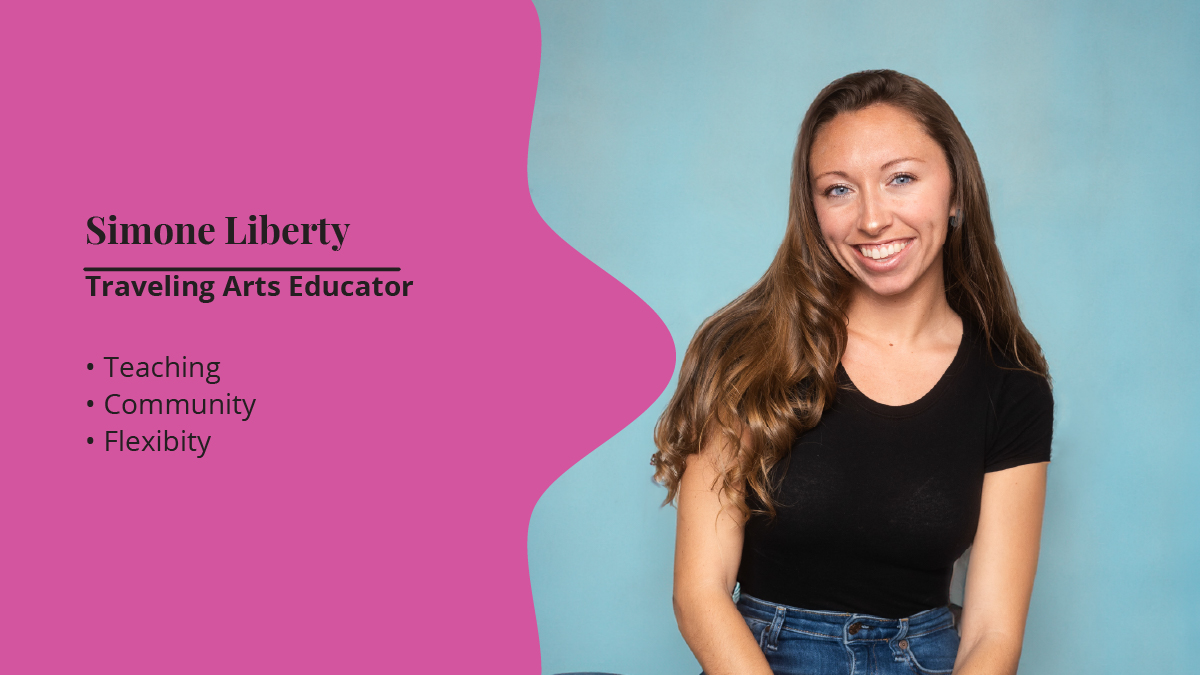
  • Simone Liberty

    Simone Liberty

    “I really love to extend art and creativity for everyone. Art for all. Art for everybody.”

    Simone Liberty is a full-time Teaching Artist based in Charleston. As a Teaching Artist, or traveling arts educator, Liberty teaches Arts Integration in schools throughout Charleston, Dorchester, and Berkeley counties. Arts Integration uses visual and performing art forms including dance, art, and theatre, connecting them to core curriculum subjects such as math, science, and ELA. 

    Interview

    Transcript

    Simone Liberty 0:00  

    I’m Simone Liberty. I’m from Connecticut originally- but I’ve been down here in Charleston since fall 2015. 

    Emma Plutnicki 0:06  

    So, can you please tell us what you do for work and what your official job title is? 

    Simone Liberty 0:10  

    Yeah, sure. I am a Teaching Artist, and this would be my official job title. I’m a traveling arts educator. I go to lots of different schools at this point. Although a teaching artist doesn’t have to be just confined to schools; they are community art educators, so they could go and do workshops for adults or other communities as well. Right now, my work has me going into schools all over Charleston, Dorchester, and Berkeley counties. 

    Emma Plutnicki 0:41  

    Very cool. How long have you been doing that? 

    Simone Liberty 0:43  

    I’ve been a full-time Teaching Artist for about two years now. 

    Emma Plutnicki 0:48  

    So, how did you end up doing this? How did you know that it was a profession that you could actually pursue? How did you know that you wanted to do this? 

    Simone Liberty 0:53  

    Yeah, so. It was kind of funky. So, I have to go back to tell you about my undergraduate degree at the College of Charleston. I was an Arts Management Major, and I graduated in 2019 with my bachelor’s degree. And while I knew that I wanted to roll right into a master’s program. I also had a desire to start connecting with some of the organizations around Charleston in the arts. 

    So, the best thing about my arts Management experience undergrad was that we had some great adjunct faculty members, and one of my professors was Catherine Brack, who at the time was the Director of Development at the Gaillard Center. So, I went in, and I was just kind of trying to pick her brain about what she does for work. And while I was there, she invited me to go and see their youth theater program in the summertime.  It was a summer camp. And she said, “You know, it’s going to be super cute.” They do every summer. So, would you, you know, just come and check it out? And totally adorable. I fell in love with just watching the kids on stage. And it reminded me of some work that I had done in the summers during my undergraduate experience. 

    So, I met Sterling DeVries, who is the Director of Education at the Gaillard Center, and still is, and just told her how interested I was in arts education. We talked for a while about that. And I ended up actually writing a letter in email form- to both Catherine and Sterling. I’m basically creating myself a position at Gaillard. I ended up getting that position, but the catch was that what I really wanted to do was work part-time in the Education Department and part-time in the Fundraising and Development Department. And instead, what they could offer me because of budgetary needs, was a full-time or it was still a part-time position in development while I was in graduate school. And I ended up raising funds for specifically the education program at the Gaillard while I was there for about two and a half years and absolutely loved the work that I was doing because I got to raise the funds that were supporting the arts education. But I wasn’t doing it myself. I really wanted to be with the kids specifically. So, I started to talk to Sterling more about that. And she eventually ended up asking me to be one of their teaching artists for the summer camp that I went to and saw originally. So, that was kind of my bridge into teaching artistry. 

    It started out as just teaching summer camps. And increasingly as I got my name out there and started to network myself a little bit harder and got connected with some other community partners, I’m now able to say that I’m full-time as a teaching artist. 

    Emma Plutnicki 3:46  

    Amazing. That’s a great story. So, nowadays, how would you say the split is between working in schools and working behind a desk? What does your typical day look like? 

    Simone Liberty 3:58  

    Yeah, so it really depends. I used to love my routine. Unfortunately, this job has no routine. So, if I’m in school, it’s either in school after school, or maybe summer camp. 

    Let’s take today, I am going to be in a school, but my school time doesn’t starts until 12:45 And from 12:45 until the end of their school day, basically, I’ll be teaching different classes, and then I will do an after-school program. So, that meant that I had a couple of hours this morning to be on my laptop. And that’s what I have been doing and will continue to do after we get off this zoom call. This I would say, looks like a pretty typical day. If there were such thing as a typical day, where you know, it’s a balance between computer work and then being face to face with students for me, but like I said, a teaching artist can also be face to face with adults in the community or anything like that. 

    Emma Plutnicki 4:53  

    Yeah, so do you think it’s been I mean, you said that you kind of paved your way to find this position, but has it been challenging to work within this field? What kind of challenges do you see on a day-to-day basis? And how do you kind of overcome those? 

    Simone Liberty 5:07  

    Yeah, so it has been difficult to call this a full-time career path. As I mentioned before, you really must be intentional with networking and getting yourself out in the community, so that people know who you are and what you do. And what I have found is that I’ll speak specifically to the Charleston area. Lots of people have questions or are generally confused about what a teaching artist does for their work, and I think that has to do with the broad nature of the role. You know what age range do you like to work with? Or what’s the style of your workshops? Sometimes, when I’m working with different community members when I am going into schools, specifically, I’m doing arts integration. And so that’s making sure that it’s not just a dance or theater, workshop, I’m teaching dance and theater things, but it’s also teaching a core curriculum subject like Math, or Science or ELA. 

    So, all those moving pieces make a teaching artist change how they describe themselves. And it’s just this really vast thing that hasn’t really been nailed down, nor do you want it because we’re creative individuals. So, all, it’s tricky to keep having the conversation of who are you and what do you do? And you know, what are your credentials? Because there’s not real credentials in Geometry, there’s no certificate, and there’s no degree in teaching artistry. But you know, that’s, that’s kind of the tricky part of it. And with that comes, where do you find your peers? You know, it can be a little bit isolated if you don’t have community partners that you’re really in contact with. It’s just that it requires lots of self-initiation. 

    Emma Plutnicki 6:51  

    Yeah, and so far, as networking goes, how have you been able to network with people? Are there any events that you’ve gone to? Or is there anything within South Carolina programs or communities that you’ve found to kind of build those connections? 

    Simone Liberty 7:05  

    Yes. So, first and foremost, I will need to tell you about Engaging Creative Minds, which is one of my community partners, and one of the organizations that I work for. They’re kind of like a booking agent for Teaching Artists, and they have a whole roster of artists. All these artists go into schools as well and do very similar things to what I’m doing, but just maybe in a different discipline or the same. So, I focus on dance and Musical Theater. And so lots of those teaching artists I’ve been able to connect with through engaging creative minds, even if it’s just on an email basis, some of them I’ve been able to meet in person, even, you know, get coffee with and pick their brain about how they run their workshops. But that’s been a great help. 

    I should also call out professional connections that aren’t teaching artists have been very helpful in just understanding the field more broadly. And I would like to stay well connected with the South Carolina Arts Commission and the South Carolina Arts Alliance, two separate things. The Arts Alliance is a non-profit that is a statewide Arts Advocacy Organization. So, that, those two organizations or the agency and that organization have been great to relate to so that I understand more about the South Carolina Arts field at large. 

    And then I found a lot of my personal connections to be a part of my graduate program. So not only did I do the master’s in public administration, but the College of Charleston also offers a certificate in Arts and Cultural management. So, a lot of the individuals from my cohort and I are still quite close. So, I would say that those are a couple of events and organizations that I stay connected with. 

    Emma Plutnicki 8:48  

    Perfect, and so throughout your journey so far, has there been any particular project or, I don’t know, a program that you’ve worked on that has had a significant impact on you, or that you hold, like, close to your heart, anything that stands out as being like a highlight of your career so far? 

    Simone Liberty 9:05  

    Yes. And it’s kind of a new one. But I’ve been happy about this past couple of months now. So, I for the past couple of years, have struggled with the question of what my why is. And I think that’s a really important question, especially for young professionals to ask themselves when they’re going through, trying to find what they love to do for work. What you know, makes their workday feel like it’s fun, rather than work. And what I’ve been working on is, I really love to extend art and creativity to everyone, art for all, art for everybody. And one thing that had been kind of gnawing at me for a while is that I love tap dancing. I’m not a ballerina, but I do love tap dancing, and I can’t teach that in most of the schools that I go into because there’s a prohibitive cost to tap dancing. Those tap shoes they start at $65 dollars. So, that’s just not possible for a lot of the students that I teach. 

    So, what I created last fall, I’m calling them Tip Taps. It is a low-cost tap accessory, I’ll call it. It’s not a replacement for tap shoes. But it’s simply just a piece of metal that you can strap to any shoe. And I can now go in and teach tap dance workshops. Now it’s just one tap, it’s not the heels, but I can teach tap dance workshops to kids who might not have ever had a tap shoe on their feet before. So, this has been a highlight. And it’s really brought me back to that, what’s your why? Because, like I said, my why is art for all and making sure that there are accessible ways to bring art into our community, even if it’s not in a traditional way. 

    Emma Plutnicki 10:48  

    As far as the skills that you possess, what do you think has helped you in this role? Clearly, you have ingenuity and creativity with projects like that. But are there any other skills that you’ve had that you think really advance your role? 

    Simone Liberty 11:02  

    That’s a good question. Yes, I want to say flexibility and not in the dance way. But being flexible in your schedule, in your idea of what your day is going to look like in your goals, even. You know, sometimes you end up either under or overshooting a goal that you have at, say, the beginning of the year or the beginning of a school year or semester, whatever it might be. Whether that’s a financial goal, a mindset goal, or a life, a work-life balance goal, whatever it is, there’s an element of entrepreneurship in craft. And it takes some flexibility. 

    There was another thing that I was thinking of well, ah, curiosity would be another one. That’s been a skill that I’ve had to flex quite a lot, you know, ask lots of questions and kind of dive into who might be potential partners for you to go in and offer your teaching artistry to. I would say, Yeah, curiosity and flexibility. Those would be the two skills. 

    Emma Plutnicki 12:03  

    Yeah, great. And so, just as we wrap up, do you have any advice for young professionals and college students who are trying to make a path in the creative world and looking for a job similar to yours? 

    Simone Liberty 12:15  

    Stay connected to what brought you to the arts in the first place. This has been something that I’ve been trying to get back to the last year, I would say, you know, we probably all landed in arts management or arts administration or wanting to be in the creative field because we are creatives, and we are artists, or at least we say like, oh, I used to be. 

    It’s not gone, and it doesn’t need to be. So, my advice to young professionals is to find that adult dance class, down here in Charleston, we’ve got Redux that offers adult art workshops. Find those opportunities to stick with your craft and make sure that that stays in your practice. So, I think the reason that I’m saying this is because it really does help you to fill in that work-life balance, and at the same time might let you draw some connections towards your why, why you’re doing this. 

    Emma Plutnicki 13:09  

    Great. That’s such good advice. Okay. So, thank you so much for joining us. Is there anything else you’d like to add about your profession, your career, or anything else? 

    Simone Liberty 13:18  

    Oh, my gosh, we need more teaching artists please. You know there is no lack of demand. I think that the field of teaching artistry is growing at just an exponential rate in South Carolina at large. I do know that there’s planning to be a teaching artists forum in the fall by the South Carolina Arts Commission. And I think they always have community partners on things like that. So yes, you know, look out for things like that if the idea of teaching artistry is interesting to you. I also would say to get connected with Tag, which is the Teaching Artists Guild. There’s other national and even international resources for teaching artists to kind of connect with so that you can explore the field more and of course, if you have anyone up your way that would like to connect with me about teaching artistry with more questions, feel free to send them my way.