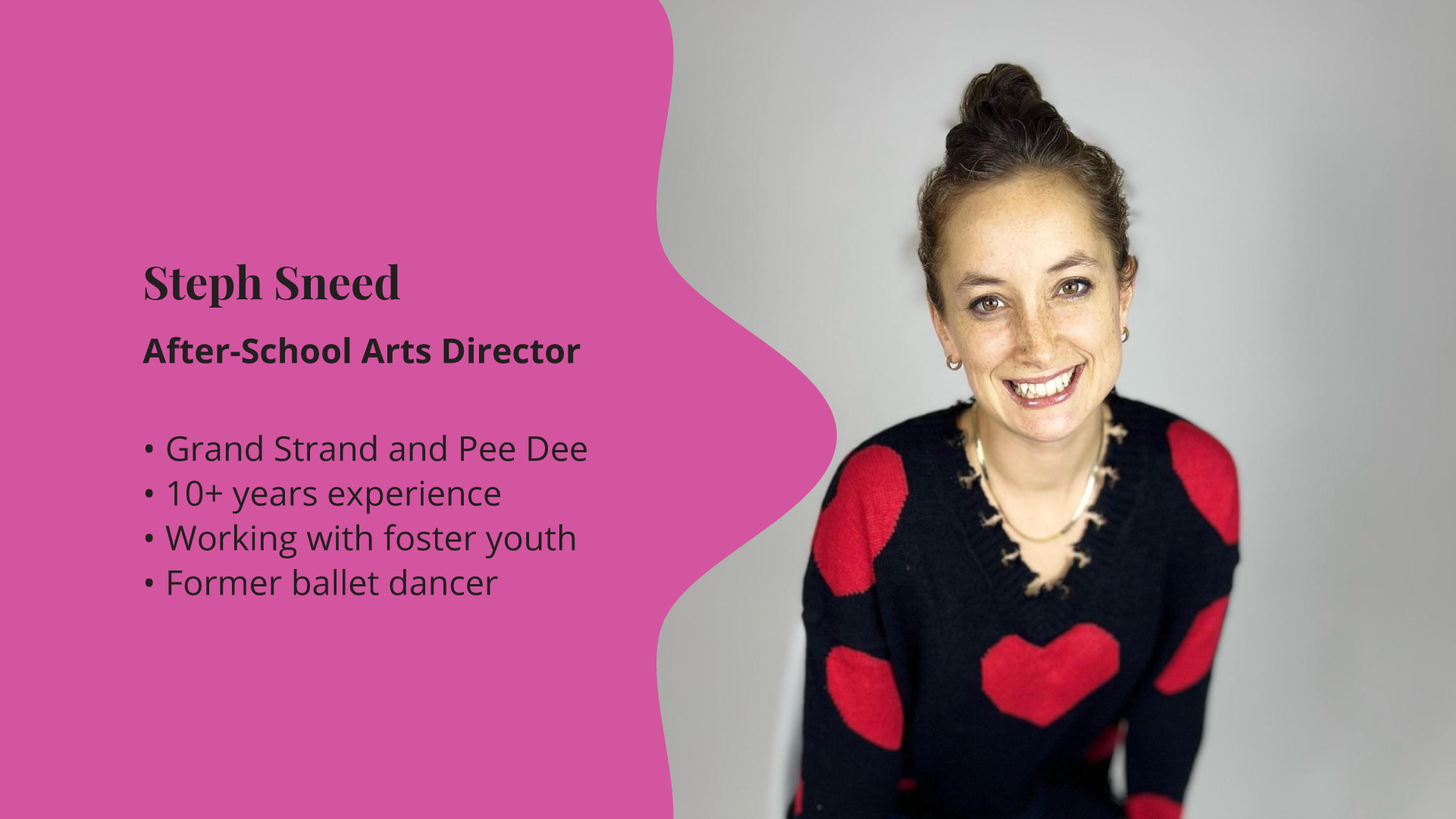
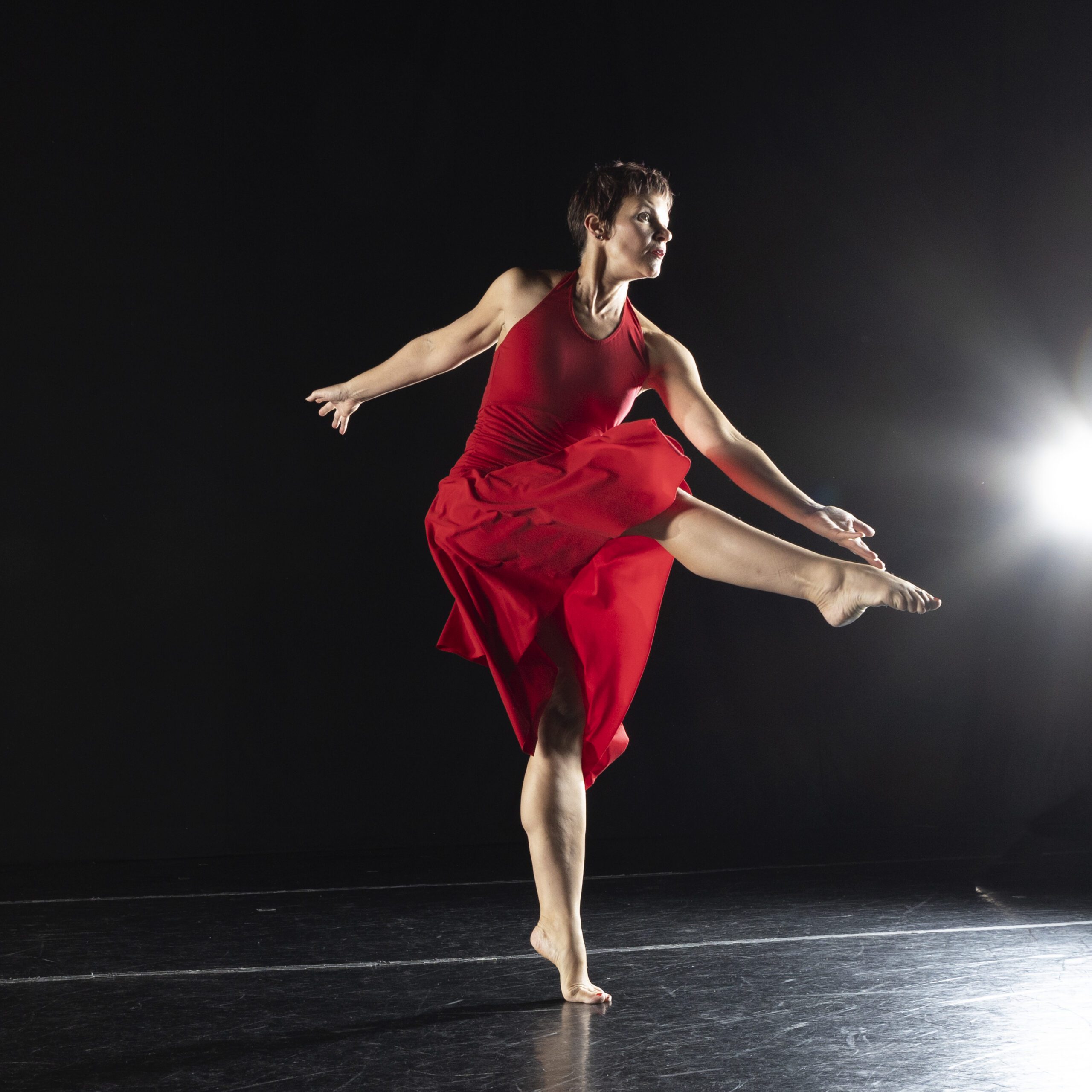
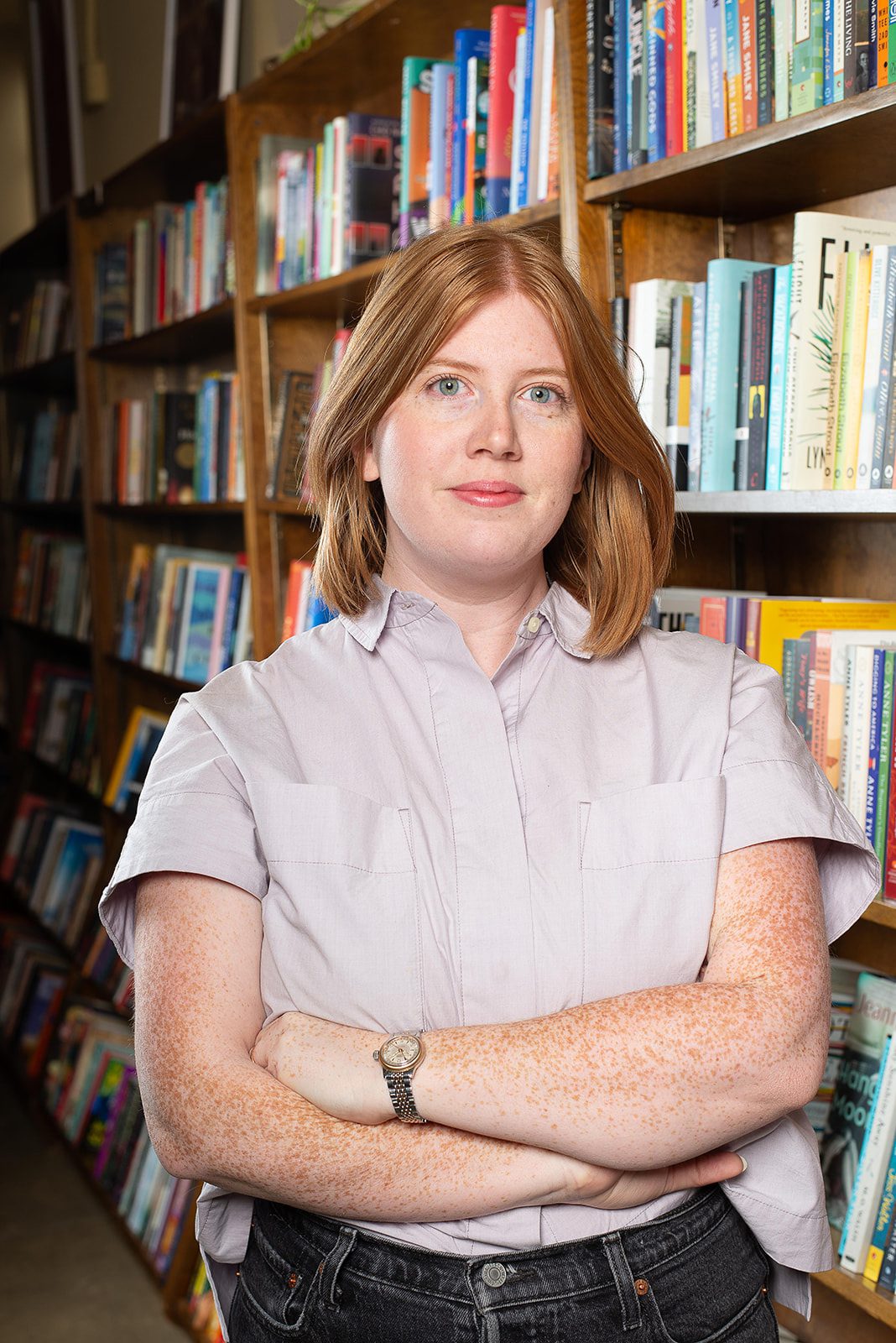
Hello, my name is Sarah Jane Thomas, and today we are talking with Steph Sneed, a professional creative working from and within South Carolina. As we get started, can you tell us your current career and where you’re from?
Steph Sneed 00:12
Sure. Originally, I am from West Virginia, but I have moved around a lot in my life, and I ended up in South Carolina, about eight years ago, and my job is called Imagine Academy. It’s an after-school program for kids age six to 12, and I also do like a lot of workshops, and I work with different organizations within our community.
Sarah Jane Thomas 00:40
Perfect. Before we go into detail of your profession, we have a brief section of the interview called One Career 60 Seconds, where you describe your job in 60 seconds or less, similar to an elevator pitch. We’re ready whenever you are.
Steph Sneed 00:55
Okay, so my job is basically creating programming for kids, but I also I’m like a one-woman show here. I don’t have any employees or anything. I keep my program very small. I operate out of my house, so I have six students a day. And let’s see what else. I also have a big heart for just kids and youth who don’t get the opportunity to create on a regular basis, and so I actually get to partner with a foster. It’s like a an organization who work with teens in foster care. So I work a lot with that organization, creating classes and opportunities for them to express themselves. And I also work a lot with an occupational therapist nonprofit in our area, who allows me to work with kids on the spectrum and have other disabilities.
Sarah Jane Thomas 01:48
That was perfect. What would you consider your job title?
Steph Sneed 01:53
I am the director, but I’m also like the teacher. But I would say I’m like the creative director. A lot of the program, a lot of the projects that we do, I like push the kids to create like individual, like themes, and so I’m often like directing them individually based off their ideas.
Sarah Jane Thomas 02:20
So, as a director, is there anything in South Carolina in particular that you bring to your work?
Steph Sneed 02:28
Like that maybe sets me apart. So, I think the thing that sets my work apart is that I work kind of so with such a small group. I have done workshops with like the school with different school districts, and I’ve noticed in like based off of feedback from the other teachers, the projects that I have in mind are unique because in school settings they would not have the capacity to attempt them, and so because it requires so much like personalized help and support. So I think that’s kind of that and the that I do two part classes. I do like a guided part where we work on like something technical, and then yeah, we do the project where they’re like really being pushed to express themselves personally, based off their interest in, and it’s it’s amazing because it really asks a lot of them to figure out like what do they like, what are they interested in, what inspires them, and that’s a pretty big question for a child.
Sarah Jane Thomas 03:40
Do you think it gives you a sense of familiarity being in the area?
Steph Sneed 03:45
I don’t know. I don’t know what you mean.
Sarah Jane Thomas 03:47
Like with the kids, do you think? Like, do you work with the same kids consistently? Do you work with the same school consistently? Does it kind of give you the ability to get familiar with everything?
Steph Sneed 04:00
Yeah. Well, I live in a small town, so I definitely see kids in the community on repeat. I’m really fortunate with the organization, the like teens in foster care organization, that I get to work with their group home. And though that does have turnover, it’s been really amazing. I actually the school district pays me to work with them. They have like a special grant, and so I get to go once a week and work with the group home, and it really, really helps me connect with them by getting to work with them regularly. And they really need people to take the time to get to know them, and I’ve seen a lot of growth in engagement with them because of that consistency.
Sarah Jane Thomas 04:50
That’s beautiful. Do you think that there was a defining moment in your life that had an impact on your creative journey?
Steph Sneed 04:58
Ooh, good question. Well, for this career, yes. So I actually was a professional ballet dancer before this, and so I’ve I say that I’ve worked in the arts like my whole like professional career, but I I have had kind of like a switch from like the dance to visual arts, and the way that happened was really organically. I was, I kind of had retired from dance, but I was actually babysitting a family in our area, and the kids moved away, and I realized that I really didn’t want to, and when I was babysitting them, all we did was art together, and I I realized when they moved away, or as I was preparing to like say goodbye to them, that I didn’t want to stop working with kids in this way. They just filled this like hole in my heart, and like also they were wonderful collaborators. So that was the moment. Like that was a big moment in my career where I was like, “Okay, I guess I’m gonna try this out. And crazy enough, it worked.
Sarah Jane Thomas 06:16
So, kind of along the same lines, before entering your field, did you have any fears about that?
Steph Sneed 06:23
Yeah, of course. I mean, I didn’t know if my idea would work. I and also because I hadn’t really trained all my training. It was in the arts. It was in the arts, and I went to like a boarding school for ballet, and like I’ve like and I went to the San Francisco Conservatory of Dance and like I have lived and worked in the arts, but I hadn’t really technically been in the trained in like the visual art field. But I, all my dance education had taught me how to basically pay attention to what my ideas are and learn how to like execute those ideas, and so that really translated into like this whole thing, and give me the confidence to try it, even though I hadn’t gone to like art school necessarily like visual art school, but as I’ve done all this work, I’ve also learned and gained a lot more confidence in my visual art skills, of course, and I’m always hungry to learn more. So yeah, I think those were some fears, but I wasn’t I wasn’t that afraid because I knew, like, from the experience that I had with the kids, that it was fun. Like, whatever we tried together, we were all learning, and it was fun. And so, I was like, if anyone is willing to take a chance on me, I think this is going to be fun for everybody who tries it, and I’ll just be committed to keep learning and getting better, and paying attention to how kids learn. And so, does that answer the question?
Sarah Jane Thomas 08:09
Yeah, perfectly. Okay. I was going to ask what inspired you to move beyond those fears, but you kind of encompassed the whole thing for me. Okay.
Steph Sneed 08:16
Sorry.
Sarah Jane Thomas 08:17
No. Please don’t apologize. This is wonderful. Do you have any advice for young adults or students interested in pursuing a similar career path?
Steph Sneed 08:28
I guess so. You have well, you have to be smart, especially like financially. You have to play the game of like how. You really do have to pay attention to. You can’t just go on like your love of art. Like you have to become a business person as well, and so I’ve learned that the best way that I can get like gigs and stuff is to package it nicely, like come up with how it’s going, come up with the plan for how it’s going to benefit the person you’re working with, and like explain that in a concise and clear way, and then just be committed to what you’re doing. Like do a good job with what you’re offering. Like pay attention and be a good communicator. Like those are all like really key elements. But also just like when you get started, you just have to be a little bit brave and show up and ask people if they’re interested in sharing an experience like this with you. Like one of the gigs that I got for a while was at a assisted living place, and what I did was I just showed up with I made this like pumpkin cottage. Like I bought like a little pumpkin from Target, and I like made all these like. Pieces for it that I glued onto it that made it look like a little cottage. I made it out of polymer clay and painted it, and I brought the pumpkin in, and I was like, “Hey, would you guys like it if I like did a class with you and I could teach you guys how to make this pumpkin, like a pumpkin cottage? And they were like, “That is amazing. Yes, and actually, that whole class ended up falling through that time. But later, they reached out to me, and they invited me to come later. And I worked with them for almost a year. And just similarly, like with the organization with the foster teens is called the Trent Hill Center, and I had I think I asked them if they wanted to do the pumpkin cottages as well, and they say yes. So so yeah, I think just being willing to like put yourself out there a little bit. Be kind. Don’t burn bridges, especially if you’re in the community of South Carolina. It’s kind of you know it’s a very small town vibe. Like I think across the state, and so I guess that yeah. I think that’s how I answer that question.
Sarah Jane Thomas 11:22
Well, aside from knowing how to build pumpkin cottages, are there any other particular skills one should practice before entering your career path or industry?
Steph Sneed 11:33
Well, yeah. I mean, I think if you’re wanting to be like an art teacher or like a community Art teacher, you do also need to, like I said, it kind of goes back to like the business, the business mindset. You have to like price things out, and you have to figure out how to make it affordable for your customers. Also, you have to know who your customers are, and I think something that drives me crazy is when people just consider art a business because it’s like you have to love it, like you have to believe in it, and then that helps you make your business decisions, like have an identity, and like your passion for it becomes your identity, and then you can make your decisions from, from like why you care about what you care about. Like for instance, like my son is autistic, and that’s why I like love to work with the occupational therapist nonprofit because I’m kind of uniquely I’m not like a professional therapist, but the experience that I have with my son makes me a little bit more uniquely qualified to at least facilitate classes where kids with who need like additional support, like that’s like that’s a great area for me to explore. And so, like paying attention to what you care about, what makes you mad, like what upsets you, and creating solutions like is really important because if you go through it identity less and you’re just copying things that you’re seeing like other art groups doing, it’s not going to be as interesting, and they’re going to like they don’t really have a reason to pick you over anybody else to select you to be the person who’s going to hold or host or facilitate. So, those are some of my thoughts on that. Yeah.
Sarah Jane Thomas 13:45
Well, I want to thank you so much for taking the time to speak with me today. Would you be open to talking to our team again?
Steph Sneed 13:52
Sure. Yeah.
Sarah Jane Thomas 13:54
Perfect. We will send you the transcript from this interview. Do you have any of those questions you were wondering about at the beginning of this.
Steph Sneed 14:02
So I guess I guess I’m curious, like who I looked at the website a little bit, but like who does this reach?
Sarah Jane Thomas 14:11
A big part is students like me. I go to Coastal Carolina, and so obviously me working on the project, I’m aware of it. My boss Alli will go into different classes and speak to different students about it. We also have a big Gullah Geechee presence on campus, and so any opportunity, like we have days for it, and so any opportunity to do some kind of outreach, we kind of talk about this. It’s a big thing for students still trying to figure out like where we are in the world and like what we can do with our passions, and so like especially you talking about formally being a ballerina and now coming into this world, like I think it’s a big pathfinder, I guess, for students like me. So that’s kind of what it’s intended for, but it’s also intended for people in the community to understand their other community members. So that’s kind of what this specific project is.
Steph Sneed 15:12
Oh, that’s really cool. That’s cool.
Sarah Jane Thomas 15:14
Yeah, I send it like my grandmother looks at it and like sees all the different peoples, and I think too it helps. Like it can be used as a tool for business as well, because we have a lot of artistic creators. We have a lot of film directors. We have theater producers. We have game makers. So it’s kind of just like it could be used as a little directory as well.
Steph Sneed 15:39
Oh, okay. Yeah, I like that.
Sarah Jane Thomas 15:41
It kind of does a lot of things, reaches a lot of people.
Steph Sneed 15:45
That’s great. I love that.
Sarah Jane Thomas 15:47
Yeah. So we’ll get the interview transcript sent off to you if you want anything edited or cut. Feel free to tell us. And if you have any questions, you can always reach out to that email.
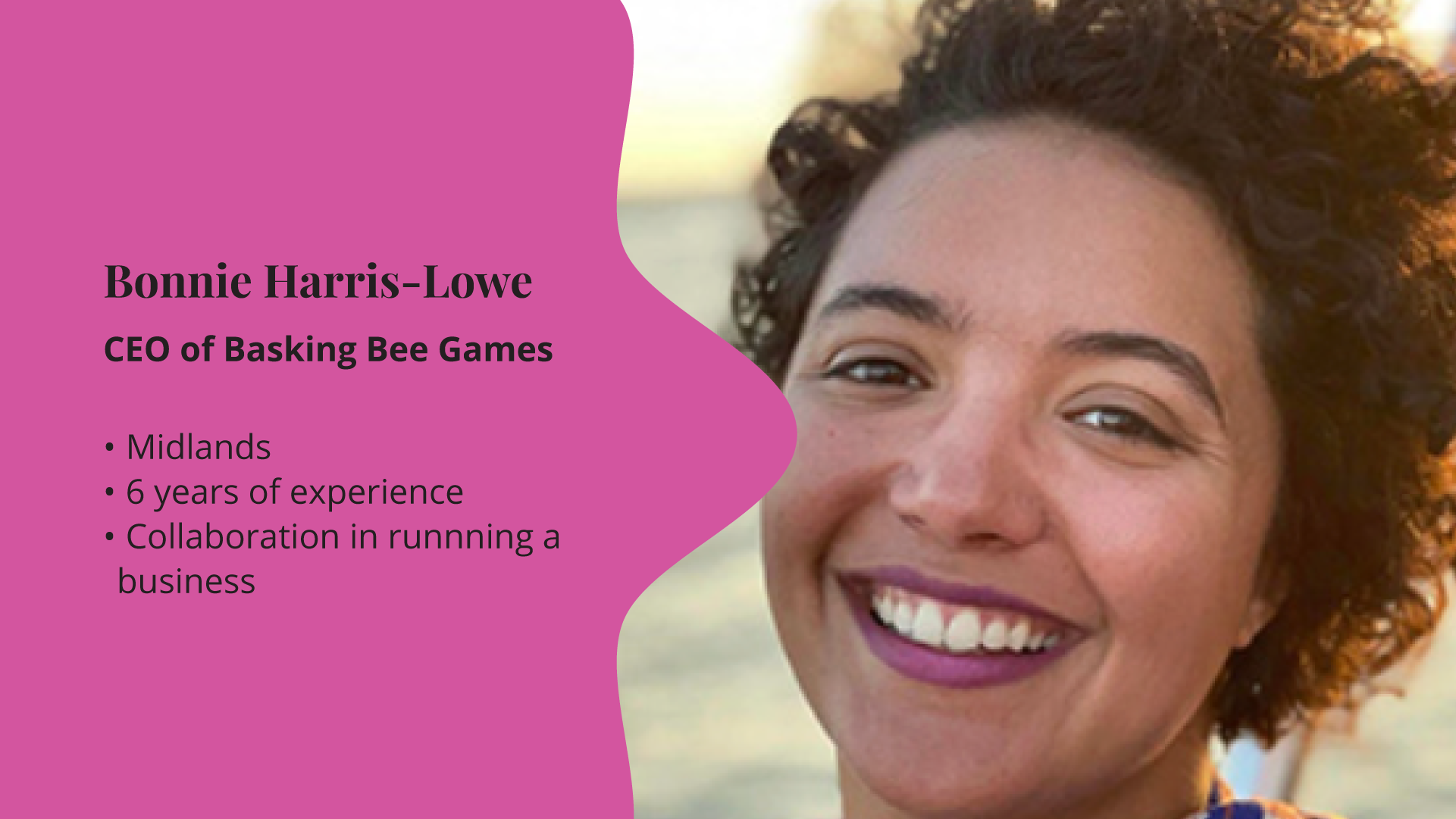
My name is Sarah Jane Thomas, and today we are talking with Bonnie Harris-Lowe, a professional creative working from and within South Carolina. As we get started, can you tell us your current career and where you’re from?
Bonnie Harris-Lowe 00:13
So currently, I am an instructor at the University of South Carolina, and I also have my own business, which is a combination work for hire and game development studio. I live in Columbia, South Carolina, currently.
Sarah Jane Thomas 00:28
Perfect. Before we get into details, we have a brief section of the interview called “One Career 60 Seconds”, where you describe your job in 60 seconds or less, similar to a little elevator pitch.
Sarah Jane Thomas 00:44
Go ahead and give it a shot. Sorry.
Bonnie Harris-Lowe 00:47
Okay, no, you’re good. Basking Bee Games is a combination work for hire and volunteer game development studio. Since our founding in 2023, we have been hired by multiple clients, including Legend Stories Studios, and have released a game demo, which was showcased at DreamHack Dallas and the Southeast Game Exchange. We are currently working on a multiplayer party game called Wardrobe Dysfunction internally, while continuing to work on active external contracts.
Sarah Jane Thomas 01:16
That sounds absolutely perfect. Thank you so much for playing our little game.
Bonnie Harris-Lowe 01:20
Yeah, no problem.
Sarah Jane Thomas 01:21
So, what would you describe your official job title as?
Bonnie Harris-Lowe 01:26
Within Basking Bee, I’m the founder and sole full-time member. So, CEO, creative director, either of those would apply. But as far as oh, sorry, no, okay, I didn’t want to just like clarify. As far as the studio, I’m the creative director, as far as operations and everything, but when it comes to our internal projects, I do like to spread the responsibility around.
So, I wouldn’t say I’m the creative director for like every project that we’re doing. The development side is a much more flat structured collaborative effort.
Sarah Jane Thomas 02:09
Okay, so as a CEO and creative director, is there anything in South Carolina or where you’ve grown up and lived that brings something new to your work that you think others in your field don’t necessarily have?
Bonnie Harris-Lowe 02:26
Interesting question. So, I don’t think I said before–I live in Columbia now, but I grew up in Greenville, South Carolina. So, I’ve been here most of my life. I went to graduate school in California and lived there for three years, where I studied. I got my master’s in game design and interactive media there, and what was interesting about that experience was they were kind of in… California, obviously, is a huge hub for entertainment in all sectors, including game development in the U.S. Whereas South Carolina, North Carolina has a few game studios, but South Carolina doesn’t really have that much of a scene in that in that industry.
So, I think as far as growing up here, I feel like a common theme with growing up in South Carolina is it gets you it gets you kind of underestimated, kind of labeled in some less than favorable ways by people who aren’t from here. I’ve seen through like mentorship opportunities that I’ve done at high schools and summer camps and things living here that there is a lot of creativity and a lot of thirst to work in these creative spaces, including games.
I just kind of want to not only put forth my own creative energy but also focus on doing it in South Carolina because I know that there are that there’s a lot of potential here, and I want to help kind of bring that to the forefront over the course of my career.
Sarah Jane Thomas 04:06
Oh, that’s really beautiful, actually.
Bonnie Harris-Lowe 04:08
Oh, thanks.
Sarah Jane Thomas 04:10
Do you think that there was like a defining moment in your life that had a big impact on your creative journey, or a particular project?
Bonnie Harris-Lowe 04:21
I can think of two big moments. So, the first one was when I was around eight years old. I was playing The Legend of Zelda: The Wind Waker, and you know, prior to that, I’d been gaming for about three years at the time I started, when I was around five. There’s a character in Wind Waker who is a little girl with brown skin, and spoiler alert: later in the game, it’s revealed that she is the princess in disguise. And when that is revealed, she goes through a transformation sequence, and her skin turned white, which really messed me up. Because as I had noticed already, that there weren’t a lot of women, especially or brown women or brown people at all, in video games, unless they were villains.
So, seeing a little brown girl who looked like me was really impactful, and then watching that get washed away literally just really broke my heart and made me think, “You know, if I ever start making games, I’m gonna do something about this.”
Then, as I was growing up, I learned more about what working in the games industry traditionally is like with bad labor practices and toxicity from within companies and within the community at large, especially being a woman of color, which kind of gave me pause. But when I went to undergrad at the University of South Carolina, which is again where I’m teaching now, I took every single class on games that I could find while still trying to figure out which part of a creative industry I would, which creative sector I wanted to work in.
In one of the games classes I took, we watched a documentary called Indie Game: the Movie, which hasn’t aged the best. But at the time, watching it and seeing the stories of these developers, you know, struggling but ultimately meeting their goals, it kind of made me cry and just gave me the sense that like that’s what I’m supposed to be doing, regardless of all of the horror stories. I knew I had to at least give it a try.
Sarah Jane Thomas 06:32
Are you? I’m assuming you’re happy that you did….
Bonnie Harris-Lowe 06:35
For the most part.
Sarah Jane Thomas 06:38
Is there something particular that you felt showcased your creativity in a way that you’ve never been able to before?
Bonnie Harris-Lowe 06:46
The biggest example is the demo that Basking Bee released in 2023 called Project Parallel, which started out as my graduate thesis project, but I was not able to finish it because my last semester of graduate school was Spring 2020.
Sarah Jane Thomas 07:08
Oh.
Bonnie Harris-Lowe 07:09
Yes, and that kind of threw a big wrench into my team’s productivity, and you know, totally understandable. And it took me a few years to get back to it, and by the time I did, I’d already founded the Basking Bee label, so I decided to release it under that name. And in 2024, that’s the game that was showcased at two different games exhibitions.
I remember I have a TikTok floating around somewhere of walking into DreamHack and setting up the booth and everything. And when I saw the name of the game on my empty booth, once again, I started crying. I’m a very teary, emotional person, but yeah, that was just a really amazing feeling.
Sarah Jane Thomas 07:55
Yeah, this is something that you’ve kind of already touched on a little bit, but I think a more direct question would help. Before entering your field, did you have any fears about being a professional?
Bonnie Harris-Lowe 08:08
Yes, numerous. So yeah, like I said, the games industry is not known for being a welcoming place for women and people of color or LGBTQ people, for that matter. Just I’m not really. I don’t really fall into that category, so I tend to focus on the other two when talking about myself, but I digress. A few, I think, a year at the year after I, the year I graduated high school or my first year of college, is when the Gamergate incident happened, which was a massive harassment campaign against a targeted select few female game devs, who you know they received death threats, rape threats.
They were doxxed. They had to flee their homes and things like that. One of them wasn’t even a game developer. She was a content creator who just talked about feminism and representation of women in games. Somebody actually made a game where the premise was just you get to beat that woman up. Yeah, it’s pretty dark stuff, and so that really like scared me. Like if I ever get too loud about what I’m doing, get too get too feminist, get too woke, as I think I would call it these days. Like, is that kind of thing going to happen to me?
And then on top of that, if I were to work at a larger studio, I learned about ‘crunch,’ which is when going back to the bad labor practices, the most infamous in the games industry is the idea of crunch, where people basically have to live at their jobs and work like 80-hour weeks, no overtime for months at a time, which just does not sound sustainable for anybody. I don’t know how people out there do it. I’m sure that I could not.
So, between those two things, just to illustrate in greater detail what my trepidation was, I was definitely frightened. But I’ve kind of gone down a path. Obviously, I’m not working at a big Triple A studio. I can set my own hours and kind of am in control of my own schedule, my own voice. And because we’re such a small studio, there’s also not much of a reason to target any of us at the moment, which is nice. I don’t know if that will last forever because I would like to have a bigger name out there.
But yeah, I’ve managed to squeak through all of the problems that I have described, and you know I know better now what I’m willing to accept and what I’m not if I ever were to pivot to working for a game studio again, and there’s one other thing I wanted to say on that subject, but I can’t remember, so I’ll stop there.
Sarah Jane Thomas 11:13
Okay. Aside from, you know, you setting up your own company and being able to do all of this yourself, are there any other things that kind of helped you continue and push forward into this field?
Bonnie Harris-Lowe 11:28
I would definitely have to shout out my two collaborators for that, Jessica and Pernima. Pernima is still a student and an absolute rock star programmer, and Jessica is a longtime friend. We met at what was my first industry job in games? I think it might have been her first job in games as well. She is a prolific 2D artist. She was also a bridesmaid in my wedding. So, we’ve known each other for oh my gosh, it’s been like six years now. But yes, they are working with me on our new game, Wardrobe Dysfunction, and it’s just really nice having somebody to touch base with every week. We stream on Fridays at 5:30pm on Twitch. The channel is called Basking Bee Games, if you want to check it out.
But yes, just having that time to collaborate with people who, while we’re all making something that we are excited about, because you know, working by yourself can get pretty lonely. It can be hard to motivate yourself, especially for like the internal projects. But the contract stuff, it’s easier because that’s somebody who’s hiring me and paying me to perform a service for them, whereas the internal development can get easily pushed off because it’s just like something I’m doing in my free time.
Doing contract work and now teaching–it’s exhausting. So, definitely having people who are willing to come along on this ride with me, and who have been so instrumental in you know the process of brainstorming, creating this idea, and now building this game has been lovely. So big shoutouts to them!
Sarah Jane Thomas 13:23
Oh, good! I’m glad you had people to come alongside of you. Do you have any advice for young adults or students who have an interest in pursuing a similar career path?
Bonnie Harris-Lowe 13:35
Yes. So, I think the games industry is in a weird spot right now. So, another problem in the games industry is layoffs are rampant. Oh, I remember the thing I was going to say earlier. There are starting to be movements towards unionization in games, especially in QA (quality assurance), which is one considered a lower rung or lower tier job in games, even though it’s extremely important. So, I’m optimistic about unionization efforts for the future of games.
So, if you want to work at a big studio, know that I would say keep watch on those kinds of efforts. See which companies are supporting those versus which ones are trying to suppress them. But the future of the games, I think, right now is pivoting towards indie studios, independent development, because in 2023, the layoffs we experienced were in historic numbers.
I think there’s a whole Wikipedia page just on layoffs in 2023, even though it’s always been a common thing. And since then, there’s been a big upswing in people who are working at indie studios, starting indie studios like what I did, or even forming volunteer teams, which is essentially what Basking Bee is as far as the internal development part, like with the contracting. Obviously, we get income from that, but the internal development, we are all volunteering our time for that.
I had the good fortune of meeting Alla Derrick at a game jam in 2023. I want to say, or yeah, 2023 or four, and she shortly after that started a company called Cave Bear Games, which is now a nonprofit volunteer game studio. Their whole mission is to connect small studios to each other, to aspiring talent, and just help people find other people to make games with. That’s how I found Pernima, who is the backbone of this organization’s programming, so I think being willing to volunteer your time and look for those opportunities to collaborate with people who can fill in the gaps in your skill set and who can motivate you to continue working and whom you like working with is a big first step.
Even if you do want to transition into working at a more traditional studio, the best thing that you can have in your portfolio, if you want to be a game designer and apply to game design companies, is a game that you’ve already finished and released. So, I think looking for those volunteer opportunities and those collaborators that you can be close with and maintain relationships with, and you know ideally keep working with, is a critical first step.
Sarah Jane Thomas 16:37
I guess along the same lines of finding people and continuing with people and finding those opportunities to volunteer your time, are there any particular skills you would suggest refining before stepping into the career path?
Bonnie Harris-Lowe 16:52
I mean, it’s never a bad idea to learn to code. That’s one of the most in-demand and secure career paths in game dev. I personally am not a programmer. I have tried to learn several times. I know enough to do basic things, but it stresses me out so much. I have not been able to breakthrough that barrier to doing the more advanced things. But knowing at least how to build simple things with code will help you contribute. It will help you contribute to volunteer projects.
It might not get you a job unless you are really dedicated to learning the more advanced stuff. But if you do want to go down that path, again, it’s very secure. The two big game engines that I would recommend are Unity and Unreal Engine; they’re both free to download. Unity is much more common at small indie studios. A lot of big studios have their own custom engines, but if they don’t, a lot of them will use Unreal because it’s a bit higher fidelity. It’s got a lot more bells and whistles than Unity.
Other than that, learning the basics of game design, game theory can help if you already have some creative background. It can help you learn how to pivot those skills into games because let’s say you’re coming from television or you’re coming from music or something, the skills that you have in those fields are transferable, but they do need to be tweaked when you are incorporating interactivity into the medium.
So, learning how interactivity can change and augment the skills that you already have is also a great step. So, the last thing I’d say on that is, if you want to work at a larger studio, it’s good to specialize in something. Whether that’s programming, whether it’s animation or character rigging, that’s a big one. If you want to do 3d characters, a lot of people can animate and model, rigging is a bit more of a specialized skill set, but if you want to work at a bigger company, specializing in one thing and showcasing that a lot is a good idea. Whereas if you want to work at an indie studio, it’s generally a good idea to develop and showcase multiple different skills across your projects because at indie studios, it’s much more common that you will have to do multiple jobs because the teams are smaller. So yes, I’d say tailor your skills to the kind of studio that you want to work at. Does that help?
Sarah Jane Thomas 19:43
Yes. Okay. I just want to thank you so much for talking with me and taking the time out of your day. Out of your day, would you be willing to talk to one of my team members again?
Bonnie Harris-Lowe 19:55
Sure.
Sarah Jane Thomas 19:56
Well, I will take that off. I have a personal question. I would like to ask you. Okay, have you ever read the book, Tomorrow and Tomorrow and Tomorrow?
Bonnie Harris-Lowe 20:05
I have not. Let me look it up really quick.
Sarah Jane Thomas 20:07
It is. I think it takes place over the span of like 25 years, and it’s about these three people who go on to develop these games. I haven’t read it in a few years, so I can’t remember like all the specifics. But just hearing you talk about the Unreal Engines and stuff like that just reminded me of it, and I feel like it might be up your alley a little bit. Yes, but it is a really good book.
Bonnie Harris-Lowe 20:36
I’m skimming the Wikipedia right now. It does look very interesting and super applicable to what I was talking about. That’s why check this out.
Sarah Jane Thomas 20:43
That’s why I wanted to ask because hearing you talk about all of this, I’m like, I have read a book about this stuff.
Bonnie Harris-Lowe 20:49
Yeah, there you go.
Sarah Jane Thomas 20:51
Well, it was wonderful to meet you. Thank you so much for talking with us. We will get a transcript of your interview, and I believe the video clips to it, and your profile all sent to you, so you can check over that. Thank you.
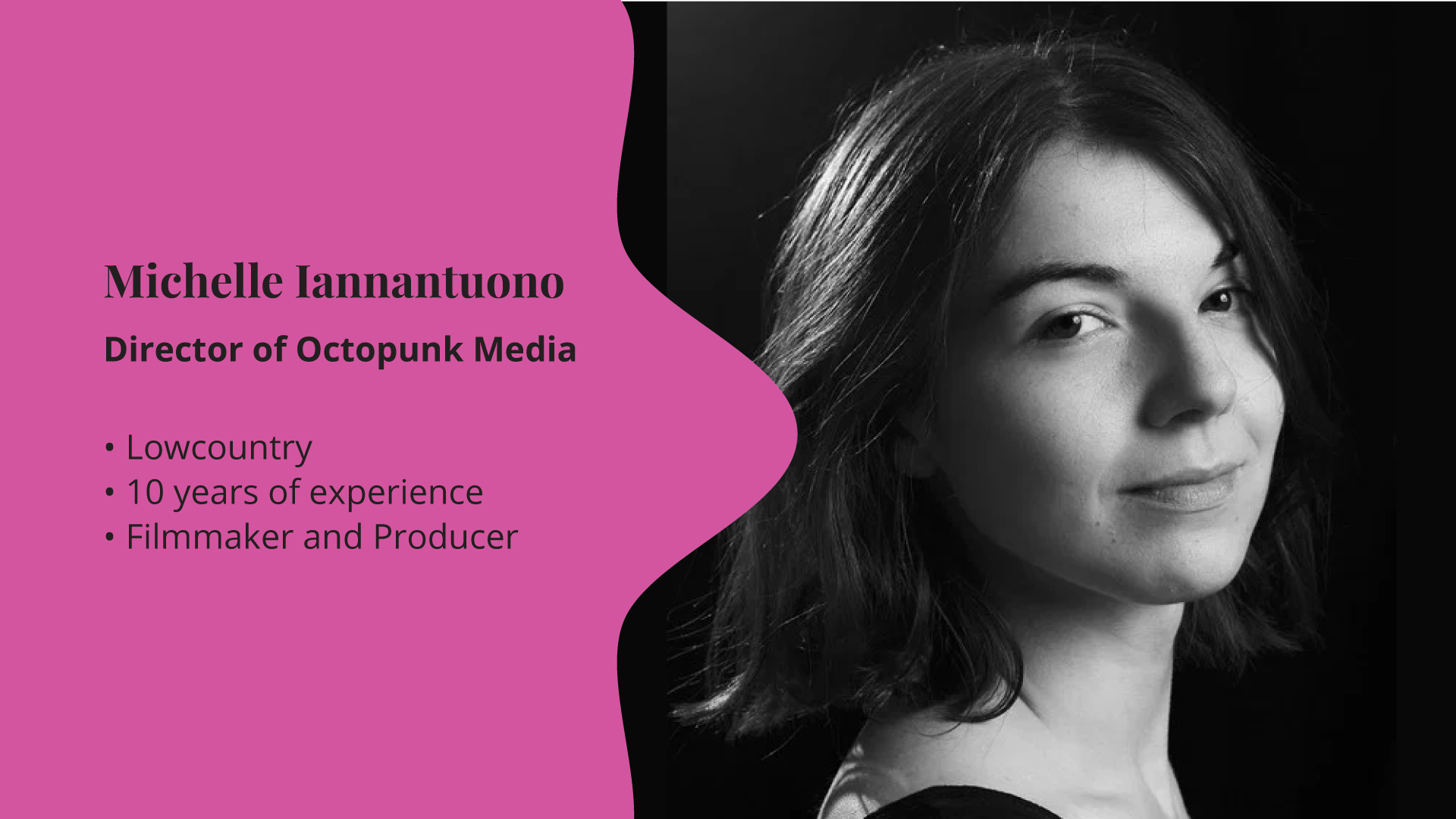
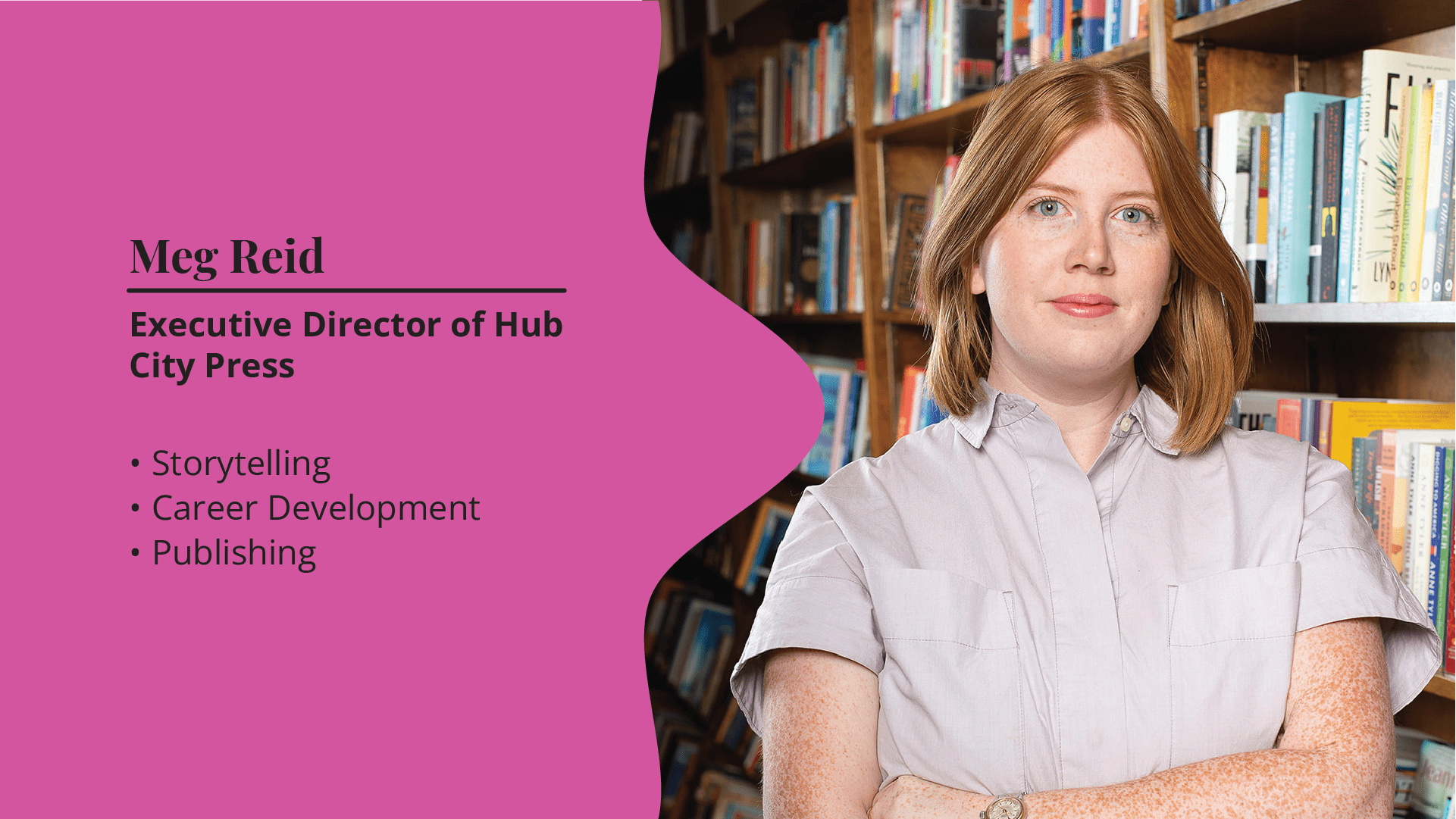
Alright, hello! My name is Ryleigh and today we are talking with Michelle Iannantuono as a professional creative working from and within South Carolina.
As we get started, can you tell us your current career and where you’re from?
00:15 Michelle Iannantuono
I am from Charleston, South Carolina, in the north area suburbs. I am a filmmaker and have been for 10 years. I am making a little bit of a transition into the games industry, I think.
00:29 Ryleigh Kelley
Very cool, very cool.
00:30 Michelle Iannantuono
I’m kind of between this career nexus point right now.
But yeah, the majority of what I’ve done and still continue to do is film and video.
00:40 Ryleigh Kelley
Very cool. So, before we go into the details of your profession, I know you’re talking about a little bit of a career transition right now.
We have this brief section of the interview, and it’s called “One Career, Sixty Seconds,” where you describe your job in 60 seconds or less. I know you kind of briefly discussed about it in the previous question, but this is similar to an elevator pitch.
Okay? Alright. Are you ready?
01:07 Michelle Iannantuono
Oh, I’m actually being timed. Okay, great.
01:10 Ryleigh Kelley
I have a stopwatch ready.
01:12 Michelle Iannantuono
Alright. Yeah, let’s go.
01:14 Ryleigh Kelley
Okay. You’re on the clock. Let’s start.
01:17 Michelle Iannantuono
I am the creative lead and owner of Octopunk Media, which is a film and video production company located in Charleston. I am a sole proprietor, so I do a little bit of everything above the line and often below the line. So that includes direction, writing, producing.
I run a streaming service called Octopunks.tv, which is for our fan community to enjoy exclusives that we produce, as well as our entire backlist library of VODs, films and shows. I’m most known for the feature films Live Screamers, Live Scream, and Detroit Evolution, as well as over 7 or 8 short films over the past few years.
I also take client work on a per-project basis for editing, post-production, that sort of thing.
Or I’m a bit of a Swiss army knife, so whatever you need to put me in, I’ll do.
02:08 Ryleigh Kelley
Okay. That was really great.
You had six seconds left.
02:12 Michelle Iannantuono
I also do Unreal Engine. That’s the other thing.
02:15 Ryleigh Kelley
Yes, yes, yes. I know that. That’s another kind of thing that another part of your background that you do. Obviously we’ll talk more a little bit about that. But yeah, thanks for playing.
So as the director of Octopunk Media and especially with your background in working with Unreal Engine, is there anything South Carolina, or your region in South Carolina, or city in particular that brings to your work?
Does it have a unique influence on you compared to people in the same profession in different states?
02:51 Michelle Iannantuono
Oh, that’s a really interesting one.
So, in terms of film, I think we have a really good community here, especially because of Trident Tech. I have a lot of admiration for Trident. I’ve worked with a lot of graduates from Trident.
My mother actually graduated from there in graphic design 20 years ago, 30 years ago. Then I also have gone through their animation program when the COVID stuff and when the tuition was free.
And, yeah, I wouldn’t have been able to make my SC Indie Grant film, Lotso, without them as well because they fronted a lot of the bill of that film and let us use their motion capture volume and stuff for free.
We also ran an animation practicum for an entire semester where a bunch of students worked on the film. So yeah, I think that that’s probably one of the major places that Charleston has, and South Carolina has that other places may not.
I would say Rough House, the Danny McBride, David Gordon Green stuff is also pretty significant. They kind of have staked their claim on a lot of the film industry in South Carolina. For better or for worse, I think that they do a lot of good for giving opportunities to new grads from Trident and stuff to get on a real set and make union money and that sort of stuff. But I also think that they hire a lot of above the line from out of state.
So, I would like to see more opportunities for directors and writers and department heads to be here in the region as well, particularly from these bigger productions like Outer Banks and Righteous Gemstones and other stuff that’s kind of come to the area. I do think that is a struggle though, even in Atlanta, even in Georgia, they like outsourcing or bringing in from out of town, those department heads and stuff.
We have talent in South Carolina, and I think that we should be given a shot as well. But, yeah, in terms of other influence on the region, I mean, I’ve lived in Charleston for 25 years. I was originally from Wilmington, also a film town. So, it’s kind of just always sort of been a thing for me.
I think that my latest film, Lotso, which was the SC Indie Grant film, takes place in Charleston. It is a cyberpunk Charleston. It is like 2059. King Street’s flooded. It’s all built in Unreal because it’s a fantasy world, but I still sort of am recreating my hometown in there, which is really cool to be able to combine real life references with this sort of sci-fi vision of the future of this town.
As well as the FC&D grants, I should mention as well, that’s another unique opportunity that South Carolina has. You can get up to $45,000 for a short film, and they do that every year. A lot of places don’t have, a lot of states don’t have anything like that.
So that’s a really cool opportunity for short filmmakers to be able to have a significant budget for a short and have access to festivals that they wouldn’t normally have access to and resources and department heads and stuff as well.
06:02 Ryleigh Kelley
Speaking of real life, was there a defining moment in your life which had an impact on your creative journey? I know you talked about how your hometown or Wilmington, or Charleston means a lot to you and is featured in your work.
Was there a particular project or something you produced which showcased your creativity in a way you never had before?
06:26 Michelle Iannantuono
Oh, so I’ve had a lot of big moments. In terms of, I’ve always wanted to be a storyteller since I was four years old and I’ve always wanted to be a filmmaker since I was 8. So that was always part of me.
But I actually went to school for chemistry. I went to the College of Charleston and got a chemistry degree.
I graduated high school in ‘09, so right in the Recession. I was like, “well, I’m going to get a pragmatic career and then this film stuff will be kind of like the plan B, I guess.” It turns out I did some cool stuff as a scientist.
I was an intern at NASA, I was an intern at MUSC, and I was a chemist for four years, but I was kind of lousy at it. It was very clearly for somebody who’s actually passionate about this and was good at it could do it better.
I remember I was stuck on this project in summer 2015 at that job, and I was really, really miserable in that job. I remember I just turned to my spouse, and I was like, “I can’t do this anymore.” I was like, “I have to do something.”
This job is destroying me.
I just had a vision board, and I started just writing down a plan. I was like; I’m going to make a videography company. I’m going to be self-employed. I’m going to climb my way out of this job.
Within a year, I had started an LLC and started taking clients. Then a year after that, I quit my job and was full time in just corporate freelance video editing. Never did super well at that either.
I did okay, but I was not making a lot of money. I remember there was sort of another defining moment in Summer 2018 after I’d been doing the freelancing for a year or two, and it was not super lucrative. I was doing okay. But I had just completed my first feature, Live Scream. At that point I was making movies because it was fun.
I didn’t really have any sort of intention to do it as a career. I remember I was part of a female networking group called Elevate, which was all online. There was a life coach, business coach lady who was giving free consultations as part of our group.
She gave me a personality quiz or something and told me what category I fit into, what are my strengths, what are my weaknesses, whatever. She’s like, “your strengths are power and excellence, and your weakness is discretion.” I’m like, “oh yeah, I have no poker face at all.”
That doesn’t surprise me, but power and excellence. I was like, “so what is that?”
She’s like, “you’re committed to quality, and you have, you can command, and you can lead, and you have the ability to be able to get attention.”
I was like, “what do I do with this?”
She was like, “so you just put out this feature film. What have you learned?”
One thing that’s surprising to me, as I go to festivals and stuff, is how much it connects with the audience to where they actually want to see it again or they want to buy it. They want to watch it. I’m, for the first time realizing that, as an independent person, I have the ability to get fans.
I have the ability to actually get an audience interested in my work beyond other filmmakers supporting me and being a peer-to-peer thing, but actually getting an audience interested into my stories. She’s like, “okay, so act like that is possible.”
I started doing these live streams called Octopunk Live on Facebook Live, where basically it was State of the Union for Octopunk. 10 people showed up, mostly my friends, but it started to build a brand.
It started to build the identity of my films and my company as beyond just me, but actually a brand.
I made a fan film called Detroit Awakening, which is in the Detroit Become Human Universe because I was obsessed with that game at the time. Within 8 months of that, I published that movie, and it kind of blew up on YouTube and connected with the fandom. I was having 70, 80, 90 people watching my Twitch streams to talk about my movie.
Long story short, over the next year or two, I leaned more into that fan film thing and built an audience. That audience ended up crowdfunding over $100,000 of other original projects and provided the basis for what Octopunks.tv is today. I had a Patreon with them for six years, and then Octopunks kind of replaced the Patreon.
I’ve basically been able to finance my film career all in crowdfunding and audience building from the last six years.
So, I would say deciding to actually do it and take the life less ordinary. Then also realizing that fans can come.
Like you, even as an independent, even without a publicist, even without a studio connections in finance. If you can find a niche, you can find an audience; you actually can find other people like you who are interested in the stories that you have to tell. You have to believe that.
You have to get over that kind of imposter syndrome of like, “who’s gonna pay attention to me? Aren’t they gonna watch Disney movies instead?”
11:37 Ryleigh Kelley
Yeah, yeah.
11:38 Michelle Iannantuono
Are they gonna pre-judge me? Some will. There’s a lot of audience out there for people who, like for me particularly, like the queer community really latched on to our work. Even specific niches within the queer community have latched on to our work. They’re like, “well, we don’t see like this sort of representation in movies, in Hollywood movies.” So, this means a lot to them.
12:04 Ryleigh Kelley
That’s really beautiful.
So, imposter syndrome, before you entered the field, when you were having these conversations with your spouse about like, “I don’t want to be a scientist anymore. I don’t want to live this kind of life, something needs to change.”
Did you have any fears about becoming a creative professional? What inspired you to continue beyond them?
12:32 Michelle Iannantuono
I think the inspiration was really my spouse being a safety professional, talked a lot about the burning platform.
You’ll be on a burning platform and then there’s shark-infested waters, but the platform ain’t gonna last, so you better take your risk with the sharks. That’s kind of where I was with that chemistry job is like, “well, I can’t stay here.”
I don’t have to go home, but I can’t stay here. So, I have to find something else. Actually, within three months of me quitting, I do believe I had a performance review where my boss was just like, “hey, so, we don’t know if you’re gonna be here in six months, you know?”
I think I would have been fired from that job, had I not quit. What inspired me was necessity. I had to do something else.
Did I ever have doubts? I mean, yeah, it was scary. Luckily, he made enough money to where we could pay our bills. We would not be destitute so long as he had his job.
So, we could live on one income. So, we were never going to lose our house or anything. I was still kind of like, “all right, well; I have a decent amount of savings. I have a 401k. I’ve lived pretty frugally these past four years as a chemist, and I made decent enough money to where I was able to build up a bit of a safety net.” I wasn’t super worried again about that, but I definitely didn’t want to fail, and I didn’t do as well as I had hoped.
I was hoping to have big contracts and stuff within a few years, and it was really hard for me to find work. It was really hard for me to find clients. I actually have to think back on it now. I was…24? I was a kid. I didn’t know anything.
Now that I’ve, looking back on it 10 years later, I’m like, “oh, one of my prime issues is that I kept saying that I was a company and that I was a business.” I don’t like the word freelancer, but I still behaved like one. I still conducted my searches like one.
Now, going into the game stuff and thinking about starting new businesses and structures and what do I do, I have a much different mindset about it. It’s like, “oh, I actually know how to think like a business.”
I know how to think like a studio. I also have the network and the connections and the partnerships to be able to make a structure like that from the jump instead of doing everything myself and pricing my stuff per hour instead of per value.
I also just understand now that people got money. They do, it exists. Companies will write a $50,000 check and not think about it. You just have to know where to look and also understand that writing down that number is not insane.
And it’s still to this day something I have a hard time wrapping my brain around because to me $50,000 will never not be a lot of money. That will always be a lot of money.
It is actually pretty standard if you’re working with a certain level of client and working with a certain level of partnership or sponsorship.
15:49 Ryleigh Kelley
Do you have any advice for young adults or students who have an interest in pursuing a similar career to yours or pursuing a career in the creative world? Are there any particular skills one should practice or have before entering the industry?
I know you talked about when you’re writing that $50,000 check as a director of a company, they don’t blink twice. If you could maybe speak a little bit more about that, especially particular skills that young adults or students may want to think about before or develop before entering the field?
16:22 Michelle Iannantuono
The biggest thing that I see in young people that I always sort of shake my head at is scope. Know what you know and realize that the dream project is gonna take time to get to.
Don’t try to drink from a fire hose and learn it all at once. It’s impossible.
I actually have an apprentice right now in Unreal, and I’ve sort of had to navigate this a little bit with him, and he’s just like, “well, I want a job in six months.” I’m like, “we’ll try, buddy. I’m gonna try my best.”
He’s a very hard worker. He’s a very great learner and he’s becoming very good at something, but in order to achieve his goal, we’ve tried to niche down just into animation.
I’m like, “I’m gonna make you really good at animation and you can maybe get a job in that. There’s still gonna be a ton of other stuff that we’re gonna learn over time that I know that I can share eventually, but we’re putting on the shelf for right now because I’ve been doing this for the better part of a decade, depending upon what we’re talking about, whether it’s Unreal or editing and stuff and I’m still learning all the time.” There’s still certain things where I know a little bit about that, but I’m not an expert at it.
I’m kind of a jack of all trades. I think that that’s something I definitely didn’t do well when I was younger. I also see it in other people all the time. I see kids graduating from film school at 21 and they’re like, “I’m gonna go make a feature film.”
I’m like, “buddy. Whoa, whoa, whoa. You will regret that because it’s not gonna be what you want it to be.”
You’re gonna be like, “man, I failed my passion project or I’m gonna be apologizing for this movie two years later when I’m publishing my second feature film,” and all the press are gonna be like, “well, we really hated his first one.”
No, you move in silence. You only get one shot to be able to move in silence and build yourself up. Fail in private. Don’t fail in public; you can’t come back from it in a lot of cases. I see this a lot as well with crowdfunding.
I see a lot of people who say, “I’m gonna crowdfund $25,000 for my first project and I don’t know anybody.” Then they make 500 bucks, and then the Kickstarter fails. No, you have to have an audience before you can try and do that.
I kind of worked myself up to that a little bit because I crowdfunded Detroit Evolution, which is my second feature. I self-financed Live Scream. That was $1,500.
I just paid for it. Detroit Evolution was about $17,000. That was more money than I had. I was like, “I’m not gonna do a Kickstarter for this because this is still a little fledgling.”
I’m gonna do a Patreon, I’m gonna do Ko-Fi, I’m gonna do Twitch, I’m gonna do a merch store and just any money that I get from that over the next nine months, I’m gonna put towards the movie. That’s basically how I financed the film.
Then after that was a success, I was like, “okay, we have the audience now. Let me see if I can make another one and we’ll do an Indiegogo.” We set the goal at 10,000. We achieved that in 3 minutes. Then ultimately raised $50,000 in that campaign because our stretch goals were doing an event in Europe and doing an event in New York.
Over a month we were able to raise $50,000. And so, I was like, “okay, now I understand crowdfunding.”
You have to have the audience, you have to have the people who are eager for what you’re selling because otherwise it’s really, really hard. I’m really glad that I didn’t try to do a crowdfunding campaign when I was nobody because that sticks with you forever. It’s always going to be on your page that like, “oh, they got the failed crowdfunding campaign. Nobody wanted this project.”
Unfortunately, a lot of it’s about appearances. It’s funny how people who just know me through social media or just know Octopunk through social media perceive it. They perceive it as so much more successful than, maybe it is financially. They’re like, “oh, can you hire me?” I’m like, “I don’t have money for that. I barely pay my own bills. What are we talking about?”
I would say that young people fail in private, move in silence and work yourself up. I know it sucks to basically be like, “oh man, I have all these big ambitions.” I’ve spent maybe my entire life. I mean, I spent my entire childhood in high school and college, wanting to make movies, wanting to write. By the time I finally was an adult and had the free time and the wherewithal to do it, I’m gonna go out there and do it.
Those first projects were not good. They weren’t. They weren’t very good. Luckily, I didn’t spend a lot of money on them. Luckily, I didn’t spend a lot of time on them. I learned a lot. Luckily, a lot of people didn’t see them.
Then by the time I actually did have something that people liked, which was Live Scream. I still made a lot of mistakes on Live Scream, but it was good enough. I was able to be proud of the work that I was putting out and be able to look back on it years later and be like, “oh, people still watch that movie. People still like that movie. Cool. It’s something that I don’t have to apologize for.”
21:37 Ryleigh Kelley
Yeah, yeah, absolutely. I really resonate with your advice about failing in private. Move in silence. Take your time because especially with the kind of work that you do. That does take a lot of time and learning.
I’m curious to know more about your work with Unreal Engine, which is a 3D computer design software developed by Epic Games. I’m curious to hear more about your experience with that and how you came across it. What was your experience with that?
I know that you mentioned you have an apprentice learning skills in that. Could you speak a little bit more on your work with that and just the experiences you’ve had with Unreal Engine?
22:24 Michelle Iannantuono
Yeah.
I’ve been into the games sphere since 2014. I didn’t grow up with video games. They just were not a thing in my house. I had a couple PC games, but that was it.
Then I won a PlayStation 3 at work in a raffle at Christmas in college. So I had that and my then-boyfriend, now spouse, was really into games. He grew up with games, and he’s like, “can you use your PlayStation 3 as more than just a Blu-ray player, please?”
So, I was like, “okay, well, what should we play?”
And of course, Portal 2 was my gateway game, as it is for 25% of my generation. And then I played Heavy Rain. That I would say was such a life-changing game for me in so many, so many avenues. It introduced me to Quantic Dream, the studio that made it, which later made Detroit Become Human, which later I made fan films on, which later changed my life.
It introduced me to the fact that motion capture could be used in games, and you could make this sort of photorealistic-like story that wasn’t high fantasy, that wasn’t Beowulf or the Polar Express or anything that had been used in Hollywood. Like a gritty David Fincher crime thriller you could do with mocap, and you could tell a story through it.
Also, it was my gateway into video games at large, which again has completely changed my life. Actually, I interviewed at Quantic Dream last year, which was really, really cool. I applied to be a writer for one of their games, and ultimately, I didn’t want to move to Paris full-time. I was like, “I would love to work for you guys, but yeah, if we can’t do this remotely, this isn’t gonna work.”
That was such a watershed moment for me because I was talking to the interviewer, and I was like, “literally, you guys are responsible for my entire life right now.”
This is big for me. So Heavy Rain was kind of my gateway. From that point on, I started learning more about motion capture, and I started playing more games like Life is Strange, Tales from the Borderlands, a lot of those Telltale games, interactive games.
I was also watching a lot of Let’s Play culture, watched a lot of Markiplier, Jacksepticeye, that sort of thing. I was absorbing so much about games history and games culture, game news, how games are made.
I saw that a lot of people were using Unreal Engine to make little games. It’s free, so these people with no experience were just downloading the engine and just building things in it, putting it online for free, and these streamers would play it. Some of the games were good, some of them were not very good, but it was a tool that I learned about through absorbing, over the course of five years, the game industry.
As I got into film, I was thinking about maybe doing some animation stuff. I downloaded Unreal and just played around with it for eight hours. I was like, “oh, this is surprisingly user friendly. This is very intuitive to me and easy to learn.” There’s a lot of documentation about it, so, I kind of had that on the back burner of my mind.
Then when I had the idea for Live Scream, which essentially is a found-footage movie. It’s a real time found-footage movie. It’s like a screen capture of a Twitch stream as an uninterrupted webcam for 70 minutes of this one actor reacts to gameplay footage that is happening on screen and there’s a chat as well with narrative characters who come and go. Basically, if he dies in the game, his followers start to die in the chat. So, it’s like a high-stakes horror film that I had to build nine fake games for in order to achieve the concept of the film.
When I had the idea for the movie, again, having watched Let’s Play Culture for so long and understanding that world in and out. I was like, “I got to make fake games for this.”
Unreal it is. I was able to pick it up really quickly and by using assets that I was, because I wasn’t a modeler, I couldn’t like square the circle of like, how do I get the stuff to put in the game? All that is available for purchase or download or for free. There’s a lot of assets out there.
If you need a door, if you need a monster, if you need animations, you can find that stuff online and then just cobble it kind of together in Unreal and do some visual scripting and make it work. That was my first intro to Unreal, and this was in 2018. This was at a point where like nobody was using Unreal for film short of James Cameron and like the Mandalorian, maybe.
Over time, I revisited Unreal in 2022, when I was making the sequel to Live Scream, and that was when Unreal Engine 5 came out. Lots of new features, incredible new features. Unreal and Epic Games are starting to get more into the film industry at this point in time. They’re doing a lot of virtual production. They were also doing a lot of like in-engine animation and that sort of stuff.
They were starting to realize that like, “oh, there’s more people who could use our tools than just game makers.” I actually went to the AFM, the American Film Market, in 2023, when I had finished Live Screamers and was pitching it.
I remember seeing Unreal Engine logo everywhere and I just had to laugh. I was just like, “yeah, I knew it. Yeah, right? Yeah.
I was like, “hey, I just made a movie with this.”
They’re like, “oh, virtual production.”
I’m like, “no, not quite.” I was like, “I’m doing a hybrid live-action game capture cinematic thing. I don’t really know how to describe it.” I really dove into Unreal in Live Screamers. Just working on it for months and months and learned the cinematic creation tools really, really deeply. Then the SC Indie Grant(s) thing happened because I have, by sheer happenstance, met an OptiTrack rep and OptiTrack is a motion capture company.
They’re like, “oh yeah, we have a system at Trident Tech.”
I’m like, “that’s in my backyard. I can walk there.” I knew that Trident Tech and the Indie Grants were tied together. They like to put Trident Tech students in the Indie Grants projects.
I wondered if they would go for a pitch where I use their volume because the OptiTrack guy was like, “yeah, they don’t really do much with it. I think that they would like somebody to come in and use it.”
I wrote a short film that was completely animated, completely actually CGI-animated in Unreal, and would use motion capture. Through my Detroit movies, I also got to know Neil Nubon, who is Astarion in Baldur’s Gate 3. He’s one of the best motion capture artists in the world.
I was like, “hey, would you like to come direct my mocap?”
He agreed.
Through him coming on to the pitch and us having this interesting concept, I think the Indie Grants went for it. We were able to shoot on their volume at Trident Tech and then use their animation program as well to get some students on the project. I’ve spent the last two years in post. We’re really close to finishing.
That’s sort of my journey with Unreal Engine.
Ultimately, my thesis on Unreal Engine is that it’s the most democratizing thing for indie filmmakers since the DSLR. It is a free program. It is easy to learn. You can make anything in it.
I’m not going to say it’s easy. I’m not going to say it’s going to be quick, but I would never be able to make cyberpunk Charleston in real life. It would always look cheap no matter what, if we had a low budget for that, even with VFX workflow. For me to be able to build that completely from scratch in Engine and also have photorealistic versions of our actors who are able to come to life, who are very, very high fidelity of what they look like in real life, all due to free tools that came with Unreal Engine. Yeah, it’s really cool.
I remember Neil; I was showing him how we were capturing facial mocap on an iPhone, literally just right here beside me. I had my actor sitting in front of an iPhone, and they were doing their facial capture.
He was like, “it captures the neck movement? That’s insane. Like we can’t do that on these big stages.”
I was like, “yeah, man, it’s the future.”
31:05 Ryleigh Kelley
It’s the future.
31:09 Michelle Iannantuono
Yeah, and completely marker-less on the face, which he was telling me is actually pretty normal now. It’s pretty old fashioned to do the markers on the face, although some people still do it. To be able to even introduce some of these tools to a seasoned veteran in this technology and in this world, who’d been doing it for 10, 15 years himself was really cool.
I think that just goes to show how powerful this resource is. It also has so many, if you want to go get a job in it, you could do arch phys, you can do automotive, you can do, the military actually has a lot of applications for Unreal as well. I know that from my mother working for the Coast Guard. So yeah, it’s not just for games and film and television. It also has like wide-ranging applications that anybody can pick up and learn.
32:06 Ryleigh Kelley
Yeah, that is just really so fascinating and thank you for speaking more about that. I know that’s one of the key tools that you use in your work. Thank you so much for taking the time to speak with me today.
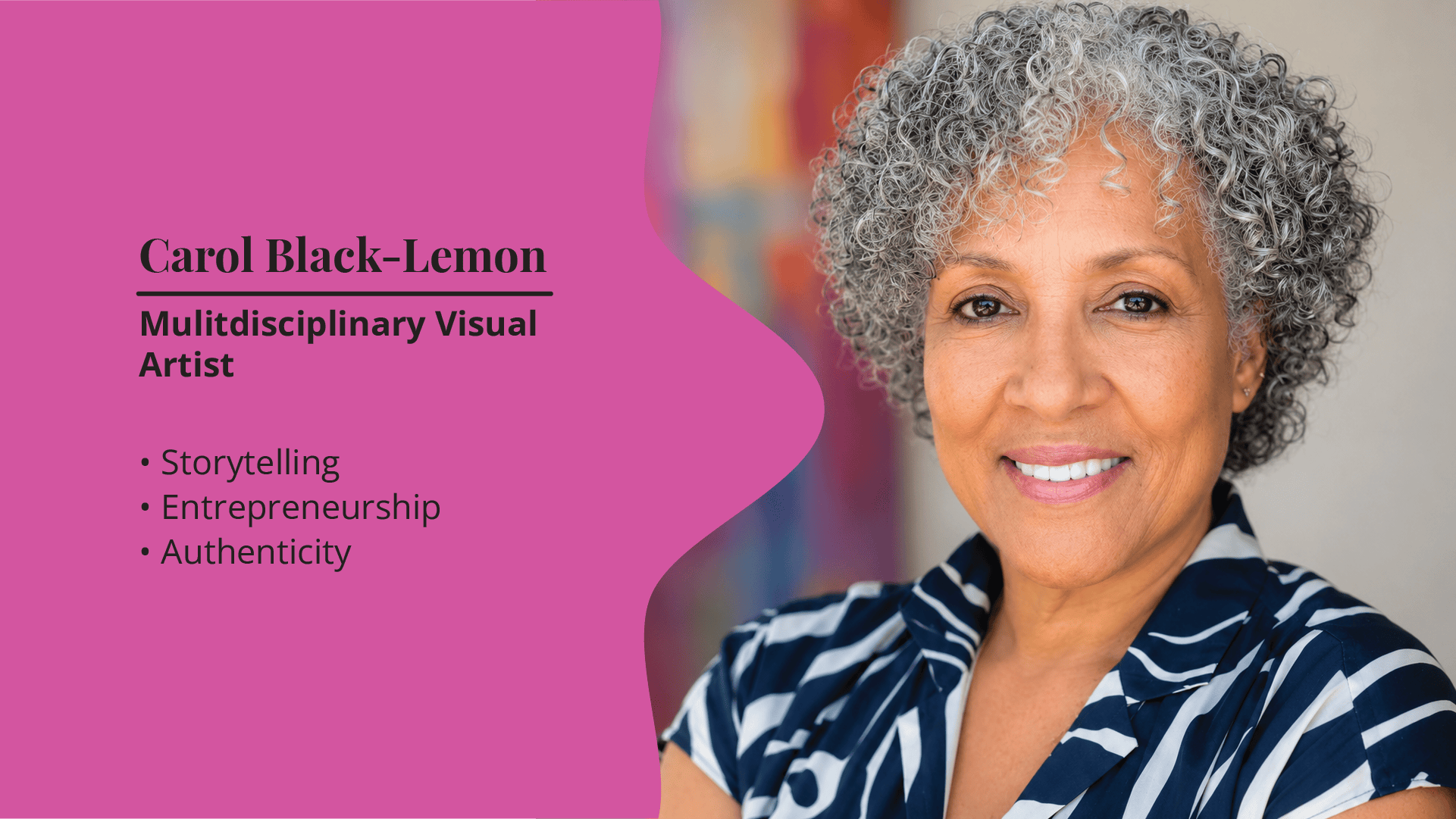
Hello, my name is Sarah Jane Thomas, and today we are talking with Carol Black-Lemon, a professional creative working from and within South Carolina. So, as we get started, can you tell us your current career and where you’re from?
Carol Black-Lemon 00:12
Sure. I’m originally from New Jersey, born in Newark, raised in Brooklyn, and my husband and I retired recently and moved to Florence, South Carolina.
Sarah Jane Thomas 00:24
Wonderful. Before we go into details of your profession, we have a brief section of the interview called “One Career, Sixty Seconds” where you describe your job in sixty seconds or less, similar to an elevator pitch. And we can start whenever you’re ready.
Carol Black-Lemon 00:38
Okay. So I consider myself a solopreneur, and that I do pretty much everything on my own. I’ve always been that type of person where I multitask. But four years ago, almost four years ago, I retired, and from my job as a marketing administrator for a law firm. I was there for twenty years, and I built a lot of experiences working on web design and marketing.
So now I do that for myself, and my business is Black-Lemon Art, aka Carol Black-Lemon Art, and I am a multidisciplinary artist, where my mainstay is creating artwork and storytelling through my art, and that’s my passion. Always been, always will be, and now I represent a new generation of artists who are at a certain age point, and for me, I’m still becoming, and it’s me letting younger folks know that even when you get a certain age, it doesn’t end. It’s where your passion lies. Just keep going with it, and that’s what life is all about.
Sarah Jane Thomas 02:08
I love the term solopreneur. I think that’s so fun and exciting. That was perfect. So, what would you consider your official job title?
Carol Black-Lemon 02:20
Creator. I’m a creator. I just feel very, very blessed to be creating whatever, whatever comes to mind. But painter, for sure, storyteller through my art. I love doing web design. They make it pretty easy today, so I don’t have to get into coding. But I can fiddle around with that as well. And what was the question?
Sarah Jane Thomas 02:55
I was just wondering what you would consider your professional job title, but creator just sums it all up. So, as a creative creator, is there anything in South Carolina that you feel you bring into your work, as opposed to people who may not live in South Carolina?
Carol Black-Lemon 03:17
Something that I bring into my work…I would say communicating with other like-minded or other folks that that want to tap into their creativity. I’m all about that. It’s like folks that I know work on nine-to-five jobs and under fluorescent lighting and the watchful eye; they don’t have freedom. They may be in a creative job, which is wonderful, but for a lot of people, they have their jobs that don’t really give them an opportunity to be creative. You have to follow the pattern and the hierarchy and so forth. But tapping into your creativity allows you to find your voice, allows you to be your authentic self. So, I like to help people to do that, and I founded a group called Creative Connection here in Florence, and it was a call out to anyone who wants to tap into that and talk about their creative process.
Sarah Jane Thomas 04:33
That’s beautiful. Do you think that there was a defining moment in your life that really had an impact on your creative journey?
Carol Black-Lemon 04:43
A defining moment in my life on my creative journey….it’s a good question. Defining moment….I think I had many defining moments, and which was just letting me know that I can control my creative voice, so I had to find time for that. When I had a nine-to-five and raising a family, it wasn’t just about me. It was about what I have to give to my job, what I have to give to my family. But at some point, I’m like, well, what about me? Who am I? And I tapped into that little girl that was just curious about everything, and so that little girl still lives in me, and I keep reminding myself who she was. And now, I was proud of her, and she would be proud of me that I’m still doing that.
Sarah Jane Thomas 05:45
You mentioned your own initiative, your own little startup. Do you think that there was a particular project that you worked on that allowed you to express that creativity in a way that hadn’t really been something that you’ve done before?
Carol Black-Lemon 06:03
I think that might be. There was a point where I was designing my own website, and I went with the DIY. I’m like, okay, I’m that type of person. I’m gonna figure it out, and I really enjoyed it. I had fun with it, and my website was great. And then I thought, “I can do this for other people,” so I looked at some other folks’ websites, some friends, or just people that I knew, and I’m like, “Would you like me to improve your website?” And I did like three of them for free. I’m like, “let me do this so that I can put it on my portfolio,” and that led to a client. So, I said after six months, I’m like, “okay, I’ll help you to navigate it.” Ultimately, and this is going back maybe twenty years now, but that led to fifteen website clients, and for me, that’s why I say I’m a solopreneur. I didn’t have anyone helping me, and by the way, I was doing a nine-to-five job.
Sarah Jane Thomas 07:16
So, you mentioned this nine-to-five job. So, before you stepped away from that and became a creative strictly in your professional life, did you have any fears about that?
Carol Black-Lemon 07:34
Yeah, absolutely. I had to learn about just the business setup and taxes, all the accountability what goes with being a legitimate business and calling yourself a business. So, I had to learn all that, and I was always afraid if I was doing that correctly. My fears of starting up is just learning how to prioritize and not getting ahead of myself, and because then I became responsible for other people, and then I learned that people were counting on me. I’ll never forget a call on Easter Sunday because there was something that they wanted on their website, and I was like, “Wait a minute, it’s Easter. I didn’t sign up for that.” But that was when I understood that the criteria that I had to set forth and letting folks know this is a business, and you have to go by these terms and so that was a real learning experience for me to set those guidelines.
Sarah Jane Thomas 09:00
Was there anything in particular that helped you move beyond these fears?
Carol Black-Lemon 09:07
Anything in particular that helped me move beyond these fears….what got me moving beyond the fears was this understanding the complexity of ownership and accountability, and that if I were to call myself the boss lady, that I needed to step up and take better notes and just be better at what I was doing, what I was being called to do. So it was that I need to step up. That was like pivoting to the next level of being a professional.
Sarah Jane Thomas 09:59
Do you have any advice for young adults or students who have an interest in becoming a creative professional and maybe starting up their own business, as you have?
Carol Black-Lemon 10:08
Yeah, I would say tap into what’s already out there. You don’t have to reinvent the wheel. The information is at our fingertips now. I mean between Google and ChatGPT and Claude, it’s all there. Like, what do I do? They can even build your own website. You know, push the button. There’s your website already. But I’m a hands-on kind of person, and I always want to make sure that if I do use AI to help me, which why not, it’s there. Make sure that it’s at least 80% you and maybe 20% AI, if that makes sense. Yeah, it’s a great tool and it really helps to get things done. But don’t let AI do more of your work than you, and then talking to seasoned professionals and talking to your peers, especially those that are transparent, that are willing to share.
There are some folks that they’re not maybe willing to tell you what they use. I’m like, well, those aren’t your people. If I find something that’s working for me, I’m going to tell my friends, “look, don’t waste your time there. This is a better tool.” But talking to seasoned professionals who are doing it, who will give you the real lowdown in terms of what you need? Make good use of your resources.
Sarah Jane Thomas 11:50
So, you mentioned utilizing AI and utilizing the internet and just like all the information that’s out there now. Do you think that there are any particular skills, either within that or apart from that, that one should practice before trying the same things?
Carol Black-Lemon 12:12
Right, before trying the same things for sure, and that is having just being more hands-on with your own work in your own occupation, meaning taking notes. Every thought that comes into your mind, some of them are good, and some you need to trash. So, prioritizing your vision for yourself, like what do you need to do right now? And that’s doing your homework. So, and if you’re a student, that’s like the greatest place to be tapping into all the resources available to you. Because at a certain point, those resources and those mentors may go away.For me, it’s organization for sure.
Just you know, and there’s a lot of folks [who have it]. I don’t like the term ADHD. A lot of people are like, “I have ADHD.” It’s like if you got a lot going on in your head, there’s a lot of attention deficit because you’re managing so many different things that you are that you have to be accountable for. You’re a student, but you may have a part-time job, and you may have other responsibilities. So, time management is really key. And for someone like me, who’s a multitasker, which I’ve had to tone down. I’m at a certain age right now, and I can’t remember everything, but my mind is still going and going. I wake up with thoughts and ideas, and I don’t want to lose track of it. So having a wonderful calendar, I have this great, beautiful calendar that I use that may even have two years versus an annual calendar and files that I can reference. Organization is definitely key.
Sarah Jane Thomas 14:16
Well, I want to thank you so much for just sharing your story and your experience and your advice and I really–listening to you talk is it just fills me with happiness for some reason. You have such a way of expressing yourself in a way that’s very genuine, and I really loved it.
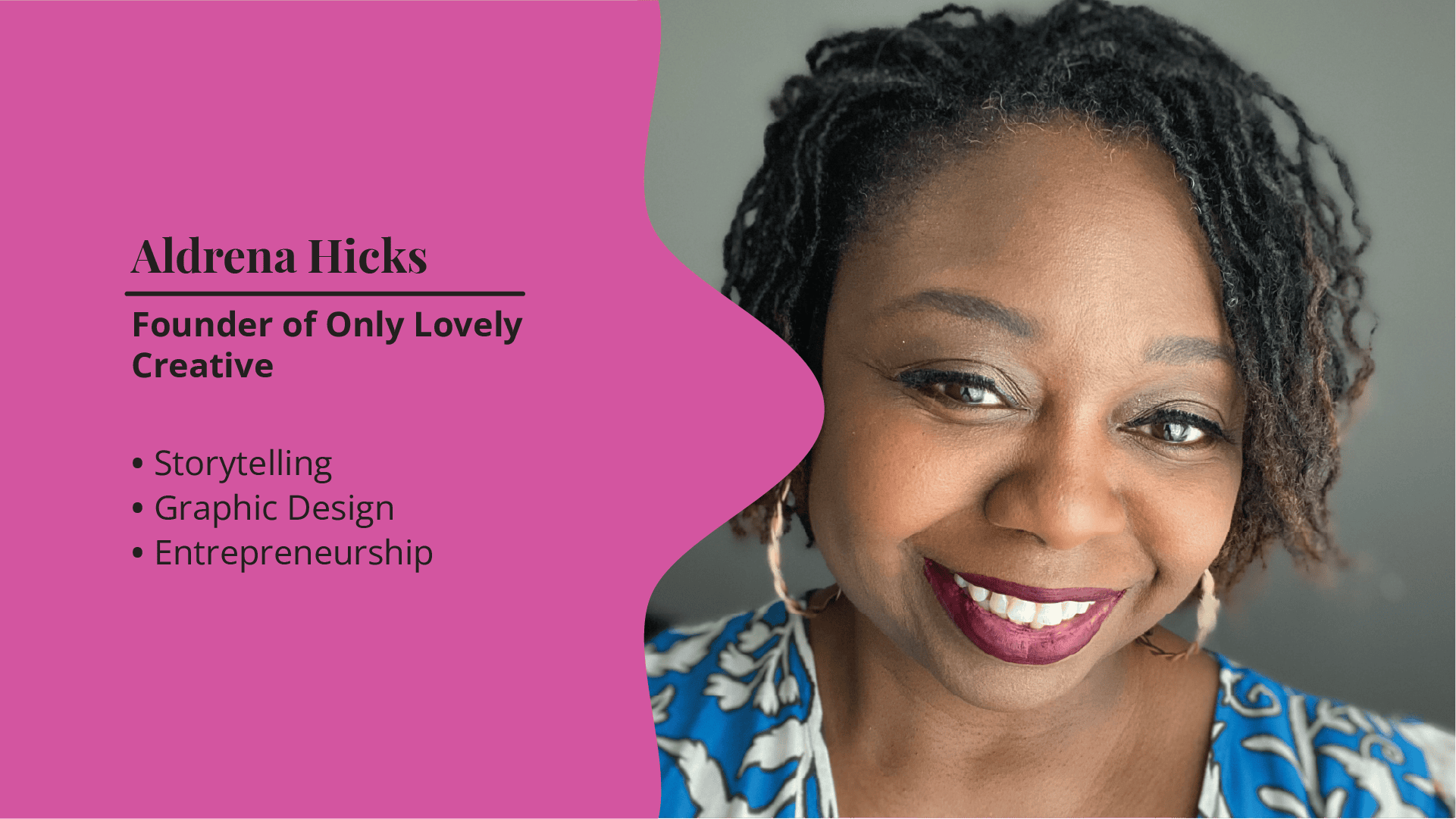
Hello everyone. My name is Victoria, and today we are talking with Aldrena Hicks. She’s a professional creative working from and within South Carolina.
As we get started, can you tell us your current career and where you’re from?
00:13 Aldrena Hicks
Yes. So, my name is Aldrena Hicks, as she said. I am a maker, artist, creative director, and founder of Only Lovely Creative. So, I’ve spent the last 20 years working across higher education, nonprofits and cultural organizations, leading design work that blends strategy, storytelling, brand, and design thinking.
My work ranges from large-scale public projects like the Briggs v. Elliott case. That’s a case that led to the big paved the way for the Brown v. Board of Education. Then to editorial work, like the stitch cover I did for Louisville Magazine, honoring Breanna Taylor.
At the core of it, I’m always making, and it’s through Only Lovely. I do design weddings and experiences that feel personal and lasting. It’s things that people actually want to keep.
So one of the things that is near and dear to my heart is also making sure I care deeply. I care deeply about who gets to be in these rooms. So, making sure the next generation of creatives, especially those that look like me, see a path forward and know that this space is a viable career.
01:32 Victoria Bartolotto
Wow, that’s awesome. That’s amazing work.
Before we go into the nitty gritty details, we have a brief section of our interview called “One Career, Sixty Seconds,” where you kind of describe your job in an elevator pitch style.
01:47 Aldrena Hicks
Oh, that’s what I just did.
01:49 Victoria Bartolotto
Oh! Oh! It’s okay. If that was your script, that’s totally fine. We can continue, but that was great. I didn’t know if you had anything else.
02:00 Aldrena Hicks
No.
02:01 Victoria Bartolotto
No, okay. That’s perfect. Thank you so much. So as a graphic designer, as a maker, is there anything about South Carolina or your region in particular that brings some uniqueness to your work?
Does it have any kind of influence on you?
02:18 Aldrena Hicks
Yeah, that’s a great question. So of course, I grew up in South Carolina, Somerville, Charleston area. Everybody knows Charleston, right?
I come from a long line of makers. So, my grandfather was a brick mason. He’s actually paved some of the walkways with brick work in some of the plantations when they’ve needed somebody to redesign some or fix it up. Then also some of the walkways in the downtown Charleston area, I remember going. My dad would take us to visit him while he was laying bricks on those special pave ways and stuff. So that was nice. My grandmother was a seamstress, very well-known and well respected. Then of course, a family of musicians. All of that I bring into the things that I do.
I’ve always been around creatives growing up. So just having that flair. What I try to do is then incorporate that identity into little nuggets here and there in the work that I do. But that’s why I’m hyper focused on when I’m doing stories, especially when I’m working with brides or organizations. I want to hear the story because that’s important, incorporating that into whatever we’re going to create for them.
03:43 Victoria Bartolotto
Definitely. I feel it really depends on who the person is in order to continue the project.
03:48 Aldrena Hicks
Yeah.
03:50 Victoria Bartolotto
Was there a defining moment in your life that had an impact on your creative journey, whether in education or just personal life? Was there anything that kind of marked that?
04:00 Aldrena Hicks
Oh, there’s so many. Which one do I choose?
04:06 Victoria Bartolotto
Any one! Any one!
04:08 Aldrena Hicks
I will probably say my experience with my graduate work. I am a graduate of Vermont College of Fine Arts, and I majored in graphic design. That was my concentration, of course, the MFA in graphic design. When I started there, I applied sight unseen.
I was already in some other graduate programs. I bounced around a little bit, but nothing felt personal. Nothing felt like this is what I want to do. There was nothing wrong with those other programs, but I didn’t want to lean into the corporate world like that. I’ve already felt I was losing a sense of self because, as you know, when you’re designing and you’re doing work, it is about who you’re designing for. So, you kind of lose that, and I didn’t want that to happen.
When I got to VCFA, I immediately fell in love because the school focuses on the work, the creative, who you are, and then that comes through. That typically doesn’t happen in this case, in cases of grad school work.
So, the probably the pivotal moment is when, I was in a two-year track. Probably after my year and a half review, they’re like, “Aldrena, listen, girl, we love you, but we don’t see you. We don’t see, you’re giving us all the polish and that’s cute, but we’re here to discover the messy and you know, who are you?”
After that little talk, I had my little cry and all that stuff. I realized, “Okay. This is the time where I need to shine and show and dig deep into who I am, my roots, my culture, and be proud of that.”
From that came my thesis work, which has paved the way for other things that I’ve done since then. I will say that was probably the most transformative experience. I’m very proud to be a part of that legacy.
06:08 Victoria Bartolotto
That’s amazing. So, speaking of your thesis project, was that something particular that you produced that maybe showcased your creativity in a way that it never had before? What about it was different compared to previous work?
06:28 Aldrena Hicks
Yeah. So, I took the approach. I did weave in some research because that’s part of the requirements. I took the approach of creating a storytelling experience, because I told you storytelling is part of my thing. What I did was I explored how the media portrays black women and how we’ve influenced the media and culture. I wove certain pieces of history and then turned it back on to how it affected me personally, how it did as a creative.
I studied and talked about hair, respectability, politics, and then skin, colorism and all that stuff. I then found ways to remember how those things affected me growing up and how I now advocate for, especially young black women and my daughter, to be proud of who they are.
So yeah, the approach was different because I did a personal narrative, but I wove in some history and some research in that. It has won a few awards. I’ve written a children, a self-published children’s book out of that. So yeah.
07:56 Victoria Bartolotto
That’s really awesome. Especially just seeing that I’m a writer too. A lot of the times that I’m working on projects, it’s like seeing something grow from a tiny little seed into this huge thing. You have to step back and be like, “Wow. I did that. You know?”
08:14 Aldrena Hicks
Yeah.
08:16 Victoria Bartolotto
So before entering your field, maybe in your education process, did you have any fears about becoming a creative professional? If there were some fears, what inspired you to keep going beyond them?
08:30 Aldrena Hicks
I knew I wanted to do creative work. Like I said, grew up with musicians, makers and all that stuff. I never knew graphic design was an actual thing. I’ve been doing that, just didn’t know that’s what it was.
So, I was at my undergrad, working at Columbia College, SC, not Chicago. When I discovered graphic design, I was like, “People make money doing this?” They’re like, “yeah.”
So, I don’t think I was ever afraid of being a creative in this space. It was more of finding the right place to let that talent grow. Of course, through trial and error and all the careers and stuff, I quickly found out that advertising work is not my scene. I met some wonderful people and did a lot of things. But again, going back to the why behind things, the history behind things. So, then I veered into the nonprofit world. Now what’s scary now is that I’m doing this full time. So, it’s more like, “who’s going to get these invitations? Who wants to have brand work done?”
09:53 Victoria Bartolotto
Oh, wow. Do you have any advice for young adults or students who may have an interest in pursuing becoming a graphic designer? Are there any particular skills that you think someone should practice or at least have before entering the industry?
10:08 Aldrena Hicks
Yeah. One of the things I want to say is that, and I know people have different networks and all of that, all of that is great.
I read a book along, I think I might have mentioned in my pre-interview, one of the books I recommend is reading is Talent is Not Enough, because a lot of people think talent will get you all the places, but it really is the soft skills, building these connections and learning how to relate with folks. It will show up in your work. So, make as many connections as you can.
I know it’s hard because a lot of times you feel like people aren’t going to respond to you. But there are a lot of us out here who really love and want to reach back and help. I mentor. I’m still in touch with many of the students that I taught during my time as a professor.
Do not discount your people skills. I know it’s hard when folks like love the internet, love being on Chat and all that stuff. That’s great. Still learning how to write with and without AI. Learning how to write, learning how to speak, learning how to read the room, that will get you further than just having a talent because you can be the most talented person in the
world. If you don’t know how to relate to folks, you don’t know how to talk with them, get with them on a personal level or at least be professional about things; you won’t last long.
11:45 Victoria Bartolotto
Thank you so much for taking the time to speak with me today. This has been an amazing interview. Have a great day.
“Have determination and resilience. Commitment to the craft is very important. Seek feedback from others in the field and always keep learning.”
Quick Facts
Education: Graduate School
Years of Experience: 30 Years
About
The art of dance has always been part of Angela Gallo’s life. For thirty years, she has worked as a choreographer and movement artist, creating work in contemporary dance, film, and multimedia. She believes the body is an instrument for art, and that it should be properly maintained, protected, and aware of its limits as part of the practice.
Angela runs two organizations out of Columbia, South Carolina. She serves as the Artistic Director of Sapphire Moon Dance Company and Executive Director of The Movement Lab at NOMA, a creative arts and wellness space. Both reflect the same belief that movement is not just performance; it is a way of existing in the world. Both Angela’s artistic spheres emphasize the importance of caring for the body and mind equally for an optimal and enjoyable experience.
Her work blends dance with film and text, mixing multiple mediums into one performance. The restlessness and curiosity burning inside her has kept the practice alive for over three decades in the world of dance. After such an expansive time, Angela carries the challenge and the reward of it with equal honesty and reverence.
She knows from experience that artists who last are the ones who show up first and stay curious. Her advice to those willing to put the work in is simple. “Have determination and resilience,” she says. “Commitment to the craft is very important. Seek feedback from others in the field and always keep learning.”
Education: Graduate, Furman University, University of South Carolina, Converse University
Years of Experience: 20 years
About
Marlanda Dekine is a Listening Poet, lending herself to write, publish, and read aloud poems. As a child, Marlanda wrote poems to process difficult emotions, and while she attended Furman University, participated in her first poetry slam. She highlights poets like Saul Williams and Patricia Smith, crediting their readings as models for her own performances.
As a Listening Poet, Marlanda has opportunities to collaborate with artists across all mediums. She emphasizes the importance of creating as often as possible and practicing without external validation. Marlanda advocates for professional workshops with other writers in order to “stretch your ideas of what is possible,” and insists on only keeping the feedback “that makes your work better.”
To start, can you introduce yourself? Tell us where you’re from. Spell out your name. Just kind of, like a general overview, I guess.
00:09 Meg Reid
Sure! I’m Meg Reid and I am in Spartanburg, South Carolina and I am the executive director of the Hub City Writers Project and as well as the publisher of Hub City Press. I was born in Canada and raised in Maine. I went to school in North Carolina at University of Wilmington, in North Carolina, Wilmington, and then I moved to Spartanburg for a job at Hub City Press, and I’ve been here for the last 10 or 11 years.
00:38 Victoria Bartolotto
Oh wow. Per the Hub City press, overall, I was doing a little bit of research. It sounds like you guys have an amazing initiative. It’s an independent – indepe –, excuse me. It’s an independent publishing firm, isn’t it? Or is it more like traditional?
00:53 Meg Reid
It is — It’s a, we’re traditional publisher, but we’re a nonprofit literary prep. So, we’re a 501-C3 organization, and that means that we have a mission, and everything we do in the publishing relates to our mission.
01:08 Victoria Bartolotto
Could you describe the mission a little bit?
01:13 Meg Reid
Yeah! Our mission is publishing new and extraordinary writers from the American South, and we are the only publisher in the world, really, that only publishes southern writers, and we define that it, you know it, it’s a little bit loose, but usually from the D.C./Virginia area to Texas. We publish fiction, nonfiction and poetry, and books of regional interest, and this year is our 30th anniversary.
And though we published books about the American South, so we are like a regional press. We do so to a national audience and international audience. And our books are routinely in the New York Times and Wall Street Journal and places like that. And so, we’ve been in Spartanburg since 1995, and we’re still very embedded in this community. And then we do national work from Spartanburg.
02:06 Victoria Bartolotto
Oh, wow. Congratulations on 30 years!
02:09 Meg Reid
Thank you! It is, it’s quite the quite the achievement. So, we’re very excited. We’ve kind of been celebrating all year long. So…
02:18 Victoria Bartolotto
Awesome. Speaking of the South and South Carolina in particular, is there anything you think about either Spartanburg, or South Carolina as a state, that brings something unique to the table in publishing that other houses anywhere else don’t really have? Do you think there is anything special about South Carolina or Spartanburg?
02:38 Meg Reid
Yeah! I think that Hub City could only exist in Spartanburg. We are very much built from the people who started it and who have supported it. We have had hundreds of people in Spartanburg who have given money every year to support what we’re doing. So, we’ve been community-vested and community-grounded since we started, so you can’t separate our community from what we’re doing.
But also just I think that we’re big proponents at Hub City of something that we call, like “decentralizing publishing.” Most of publishing occurs in New York, in big cities, and specifically in New York. And it occurs, you know, with one of five big conglomerate companies. And so those big 5 companies have so many imprints underneath them. But they all funnel to five companies.
We think that our model is kind of like local foodways or other kinds of celebrations of local culture. It’s saying that we’re doing something that is different from the consolidated model. And we are doing something that’s really grounded in our place and where we’re from. And so, we really think that’s scalable and that if somebody wants to start, like they’re like, “oh, I want to start publishing books.” If it feels really daunting because it’s a really big system, it’s really good to think about: What does my community need? What does my town need? What can I celebrate here with the people around me? And starting from there and growing from that local community aspect. And so that’s what we’ve done and that’s a really integral to our identity as a press.
I think that we can do a lot of the stuff we do because we’re not in New York. We’re in South Carolina, and I think people don’t have as high expectations overall from a small city in South Carolina. So, it’s very fun, surprising people and reminding people that books and literary culture can exist anywhere, not just in one city.
04:42 Victoria Bartolotto
Yeah, I think that’s really important to think about, especially with like New York. And also, I think also in California like I know so many writers just come out of there and I’m actually an English student studying writing, studying how to write books and do poetry and things like that. So hearing that, oh, I have to be in New York, or I have to be in L.A. to publish. It is kind of daunting like you said.
05:06 Meg Reid
Yeah, well, we just want people to remember that they can. And the great thing about independent publishing is that there are independent publishers everywhere. There’s independent publishers in, you know, Minnesota and Texas and Kansas City, big ones, really good ones. So, it there is something about independent publishing that works, can kind of work anywhere. So, I think that once people find that out, it opens up the whole world for them. It’s not like publishing is just six buildings in New York City. It’s a lot broader than that. And it includes a lot more people.
05:42 Victoria Bartolotto
Throughout your own personal journey, becoming the executive director, was there anything that you think was a defining moment that made you want to go into publishing, made you want to get into this industry and kind of like, make your mark on it? Was there any kind of ‘something’ that propelled you into it?
06:00 Meg Reid
Yeah, I think I always had an interest in publishing, and I didn’t know how to go about it. The same problem. You know, I grew up in, as I said, Maine and I was kind of far from any publishing activities and so. But I did go; I went to UNCW for my MFA and they have a publishing laboratory program which is like a student-run press. I decided to take classes in the pub-lab because I had that interest. I’m a book designer as well and I learned how to do book design at UNCW and that was something I had never done. I have no artistic inclination. They had this book building class where you learn about how cover design works and how the insides of books work, and that it’s required to work for the publisher. You have to have a background and like how books are put together and that was really fascinating to me, and I found out I was really good at it, even though I cannot draw. I have no artistic ability. But putting type and photos together made sense for my brain, and that was really exciting and it was a skill that I didn’t know I had until I was in grad school. At Hub City, we’ve always tried to really make our books with a lot of care and we don’t do that many books. We do 8 to 10 books a year and we’ve kept that really small, so that we can keep producing them at the quality that we want to produce them. And I think that idea got set at that point and that’s how I decided to do things because I really wanted them always to make an impression of being objects of art and objects that the people who made them cared about them. It’s not just like we’re cranking out a million books; very opposite of Kindle and Ebook, you know, like high volume stuff, which is just a totally different model. But I think that that got set very early that we would, that I would do things in a different way that was more sustainable and more based on care and cultivation.
08:04 Victoria Bartolotto
I think that’s really important, and I really appreciate the work that you described because I know so many big publishers they’ll put out like a book and people will get copies in the mail and they’ll be damaged or they’ll be, you know, like printing was wrong. And I’ve heard so many stories, and I’ve experienced a few myself, so I really appreciate that you guys do that. When you were going through your education, when you were starting out, was there any kind of fear that you had when you first decided to pursue getting into the industry?
08:38 Meg Reid
I definitely didn’t know. So, I graduated from UNCW and I was working at a coffee shop and I didn’t know how I was going to stay in publishing and not go to New York. I wasn’t necessarily committed to staying in the South, but then this job at Hub City came up, and so that’s why it’s become really important for us to like as part of our mission, to remind people that they don’t need to feel like they need to leave, their home or their region or wherever to in order to do publishing that doesn’t exist only in one place. But I definitely was, because I knew that I just could not afford to move to New York and do the unpaid internship, at that point, it’s all unpaid. And so that was a little scary because it was kind of what I thought I wanted to do and now I know that there are a bunch of publishers nationwide, like I said, and I should have been kind of like looking more broadly.
Kate McMullen, who also went to UNCW, she works here, she’s the managing editor. She and I both whenever we talk to students or talked to any sort of education settings, we’re always trying to remind people like, you know, there could be a publisher in the city you grew up in and you might not know about it because they’re not Penguin Random House but they’re doing something, you know? So, I think that’s really become important to me, is reminding people to do that digging and see and not feel despondent that they have to go to New York or California.
10:10 Victoria Bartolotto
Yeah, popping off of that. Do you think that for students who want to get into publishing, who want to get into this kind of career, do you think there are any specific skills that they should have? Any kind of niche interests or something you think that they should explore before getting into publishing or that would help propel them into it?
10:30 Meg Reid
Well, I think you know the general interest in books, and reading obviously is really important. I don’t think you can do it without that. And so I think career writing and English students tend to kind of have that.
But I think publishing has a really the reverse way; I think publishing skills are also very applicable to other things. That’s why I always tell people if you’re going to do a program at well while you’re in school, publishing programs are really useful because even if you don’t end up going into publishing, it teaches you how to like, take large amounts of information and like, summarize them really quickly. Like, say, what is this book about in one sentence. Or say why somebody should read a book like be more persuasive and argumentative, in terms of being able to persuade people while you’re speaking. So those are skills that I definitely think are developed in publishing. And so, I think if you’re not interested in those skills, then I think that publishing wouldn’t be a great fit for you.
But I think really just an interest in books, and an interest in, everybody that I know that has really loved publishing, this is including the people that work here and that have worked here, have an interested in how things are made and how putting things together. Because books take eighteen months to put together and a bunch of people work on it from manuscript to final product.
If you’re looking for really like quick, instant gratification, it’s not that kind of job necessarily. It’s a very, very slow burn job. But if you like that feeling of assembling something with the team, I think those are, that’s really the skill that you need along with interest and love of books, in order to do well and succeed in publishing.
12:16 Victoria Bartolotto
Awesome. Thank you so much for taking the time to speak me today. As we wrap up, would you be open to talking with our team again? I can let you know when the interview is published on our website. There may be an opportunity for another conversation for a podcast that we have here with the Atheneum Press. Just kind of general stuff like that. Any updates.
12:36 Meg Reid
Absolutely. Yeah. I’d be happy too. And I’m really interested in what you guys are doing over there. I like how multidisciplinary it is and everything different from the Wilmington program, but like, you know, similar ethos. And so, what have you been doing in the program?
12:56 Victoria Bartolotto
So mostly I’ve been working well, I’ve actually mostly been doing this: organizing interviews with the Uncharted initiative, which is just like being able to showcase people across l different creative careers to students who didn’t know that those careers were an option. So that’s one of the things I’ve been working on this summer.
And then another thing is our Communal Pen initiative, which is our writing workshops across South Carolina to get local voices and local stories and tell them to people who wouldn’t have known. So those are the two main projects I’m working on right now.
We do also have a third initiative. It is a food-ways project with the Gullah Geechee community. I’m not so much involved on that, but it’s a really cool thing. We’re putting together a bunch of different boxes and there have been interviews done with Gullah Geechee makers for either they’re farmers or the people who work with yarn, or just overall artisan craftsmanship. It’s a really cool project, and I’ve been watching it kind of grow over the summer. And everyone who’s worked on it has done a phenomenal job. And, yeah.
14:04 Meg Reid
Well, that’s awesome. Well, yeah, happy, happy to be involved. And yeah, if you guys need anything else for me, just shoot me an e-mail. I’m happy to help.
“There is something about independent publishing that works anywhere. I think that once people find that out, it opens up the whole world for them. It’s not like publishing is just six buildings in New York City. It’s a lot broader than that. It includes a lot more people.”
Quick Facts
Education: UNC Wilmington
Years of experience: 11 Years
About
The art of bookmaking has been a passion for Meg Reid’s for as long as she can remember. She found her love for the publication process in The Publishing Laboratory at the University of North Carolina Wilmington while working toward her M.F.A. From that experience, Meg moved on to Hub City Press, where she has served as the Executive Director for the last decade.
Originally from Maine, Meg realized that being involved in the publishing world did not have to be defined by one or two major cities alone. After being in Spartanburg with Hub City, she has become an advocate for independent and non-profit publishing. “It’s become really important for us as part of our mission,” she says, “to remind people that they don’t need to feel like they need to leave their home or their region or wherever to in order to do publishing. That doesn’t exist only in one place.
Meg is a huge proponent of “decentralizing publishing” in order to make it accessible for everyone. She prides the driving mission of Hub City Press, which is to highlight and represent writers of the American South, all the way from the top of Virginia, to the coasts of Texas, and everything in between.
She stresses the importance of patience in the publishing industry, detailing the eighteen-month long process it takes for a book to be born into the world. Meg remarks that, “if you like that feeling of assembling something with the team, that’s really the skill that you need, along with interest and love of books, in order to do well and succeed in publishing.”