Career Area: Film and Video
-

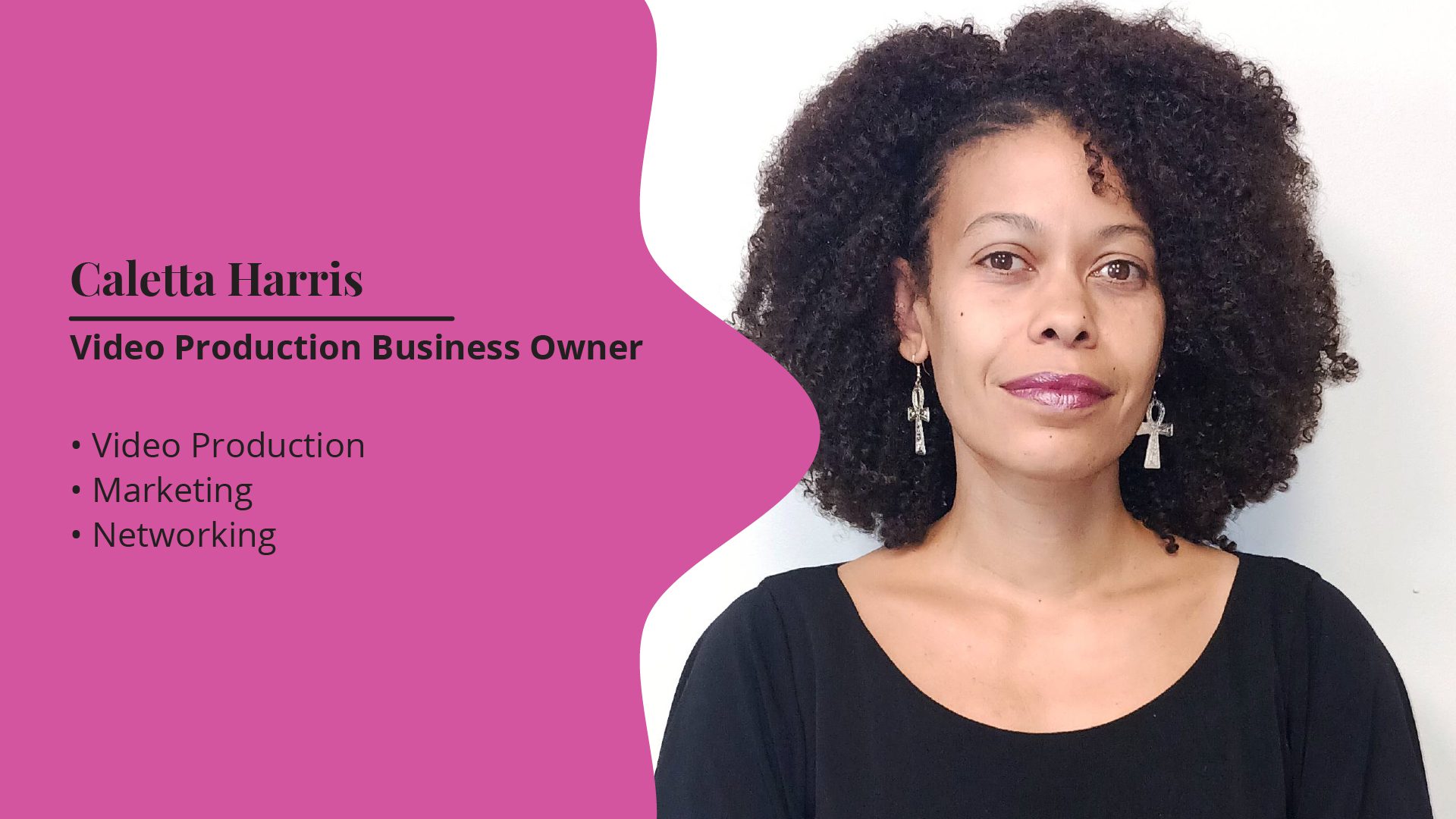
Caletta Harris
“Know your worth and follow your path, and entrust yourself”
Caletta Harris is the founder and owner of Reel2Real Productions, a video production company that has been transforming stories into powerful visual narratives for nearly 20 years. She is based in South Carolina and works nationally, blending creative passion with purpose-driven storytelling by using media to empower, educate, and amplify voices across South Carolina.
The powerhouse behind Reel2Real Productions is a woman with a camera and a mission. For nearly two decades, she has built a full-service video production company that thrives on diversity of stories, clients, and causes. Based in South Carolina, her work stretches far beyond its borders, but the state’s rich history and collaborative spirit have deeply shaped her creative journey.
Interview
Transcript
Lexi Raines 00:01
So, what do you do for work, and where are you currently working from? Well, I
Caletta Harris 00:05
Currently I have my own business called Reel to Reel change to Reel2Real Productions, and we have been there for 19 years, almost 20 years. Next year will be 20 years, and I’m kind of out of everywhere. I’m remote, but I do work all over. So right now, I’ll say South Carolina, awesome.
Lexi Raines 00:26
And so, what is your official job title, being the creator of realtor. I am the owner. And what is one thing that you love about working as a creative in South Carolina?
Caletta Harris 00:37
Well, I love the rich history in South Carolina, and to have that creative freedom being a creative there’s a lot of stories to be told. A lot of rich history here, and just the people connecting with some great, like minded individuals, is always a plus.
Lexi Raines 00:55
I completely agree. So first, just tell us a little bit about Reel2Real.
Caletta Harris 00:59
So, Reel2Real is my baby. My production company is a full service video production company. So we basically do everything from commercial marketing all the way to documentaries. I am the videographer, the editor, all of the above, the marketer, all of that. So we basically do a lot of branding for companies. So we are going on our 20th year, next year.
Lexi Raines 01:25
Awesome. That’s so cool. So what does South Carolina bring to reel to reel, and what is its unique influences on you compared to anywhere else I can
Caletta Harris 01:33
Say, South Carolina has brought me a lot of diverse clients, like my projects totally different. And when I was starting the business, people always would say, you need to get, like, a portfolio that’s vast. You can’t just do one thing, and then expect people to say, Oh, well, you can do it, but they have to see it. I’m like, This has definitely given me an opportunity to have different type of clients, different type of genres. And I just love it. I love just creating people’s vision that
Lexi Raines 02:03
Awesome. I feel like South Carolina is definitely a very diverse community. And saying that, like, how would you describe your local professional community? Local
Caletta Harris 02:11
Professional community? They are wonderful. They’re very interesting. They’re very talented. And, you know, they bring opportunities with them. So it’s not like, this is just mine. They see where people can fit in. And then once I start talking, you know this, the wheels start spinning, and it’s like, oh, well, maybe we can fit you here. And then my wheels start turning. Say, oh, maybe I can connect you with so is a good connecting hub? I like, yes,
Lexi Raines 02:38
That’s actually something I’ve heard a lot throughout, like almost all of my interviews, is that South Carolina really is such a good community where people want to like be able to lean on each other, which I think it achieves pretty well. How do you define professional or personal success in your creative endeavors? Well,
Caletta Harris 02:57
I would define personal professional success is retention rate. I can say my longest client has been 15 years, and then the next one has been 11. So I can say that I have a great rent retention rate with a lot of my clients. And then from there it’s still, you know, multiple years, and then even the new client is like, we don’t want to just stop here. We want to keep that show’s success. To me, that I must be doing something right, and then just personally, it’s kind of the same thing. Sometimes I’d intertwines, but just building relationships personally, because it’s not always professionalism with my clients. So we build that relationship. Yes,
Lexi Raines 03:38
That’s awesome. And sometimes that’s the base you need to work on. So that’s really great. What was your biggest fear when you first decided to pursue the arts professionally? Can
Caletta Harris 03:47
I be self-sustainable? I think that’s a lot of people fear. Can you do this long term? So I was smart with it, because I held on to a job until I said I can do this long term. It kind of worked out. And then when I got my first office space, I just took off from there, because people want to see that to make it real for them, right? So that I just didn’t have to go back doing anything else for anybody else.
Lexi Raines 04:15
And that is awesome. I know a lot of the creatives that I’ve interviewed so far like they are kind of working on their projects, and then they have, like, a day job, and so that seems like difficult to juggle. So it’s awesome that, like, you aren’t having to do that. Okay, so can you describe, for me, like, a defining moment in your creative journey? Like, did you have a particular project that made a significant impact on you
Caletta Harris 04:40
Absolutely! back in 2013 I started a journey while in my office downtown, I read it in the newspaper that city council wanted to do something about their homeless issue, and I was called by what the options were. So I was like, I want to do something about. It. I already have a production company. Let me just start filming and talking to people and seeing what’s going on around me. And it became a full feature documentary. It’s called No Address. It’s a documentary series featuring Columbia, South Carolina and Atlanta, Georgia.
So it talks about, you know, the criminalization of homelessness, what’s going on as well as practical solutions, because we can’t keep talking about the problems without the solutions. And that has had the biggest impact on my life. I the first one came out. Columbia came out in 2020 and Atlanta came out in 2022 so we hit the whole film festival market, and now it’s on Tubi, Amazon. I’m about, I’m thinking, I’m on about 10 streaming platforms now, so it has made a huge impact. I’ve spoken to a lot of colleges, even middle school and high schoolers, and they’re excited about doing something in their own community. So this has been one of my biggest passion projects, and I continue to expand with it, because I want to be a part of the solution now, yes,
Lexi Raines 06:01
That is, like, actually so amazing and so meaningful that is, and being on so many streaming sites like, that’s so cool, that’s actually awesome. So what is the best and worst advice you’ve ever received on your career path? That
Caletta Harris 06:19
Was a struggle, because I can’t really think of the worst advice, because I really block out a lot of that negative energy, right? The best advice, I would say, is when you know someone told me just going through this is to trust yourself, follow your own path, because had a lot of challenges at the beginning, me being a woman owned business, so that was a challenge in itself, and people taking you seriously. So that I that was the best advice was to say, you know you know your worth and follow your path, and you know you know and trust yourself. So but the I could say something generalized, like the worst advice would be something like, it doesn’t matter, everybody’s doing it, so go ahead and do it. And I’m not that type. If you say go right, I’m gonna go left. Open your mind and think creatively, yes, so that I don’t say that. Yeah,
Lexi Raines 07:16
I think that is, like, really good advice to, like, stay true to what you want to do, not what everybody else is doing. So that’s awesome. Can you walk me through like a typical work day for you, what does your process look like and what’s expected of you on a daily basis?
Caletta Harris 07:32
So normally, I wake up, I stretch, I meditate, then I go drink some coffee or tea, and then I either edit or film, depending on the day. So every day is different. I usually work until like seven, unless it’s a long shoot or something, but I kind of cut it off at seven, and then I have me time. I relax and do whatever, and then I try to go to bed by 10 o’clock, because rest is so important to me, because I use my brain so much, and sometimes I’m juggling two or three projects simultaneously. So it’s like shifting gears here and there all the time, somebody else talking about something totally different. So it’s like your mind is always going so I’m like, shut it down at 10 o’clock and then, and then I just start the day, just to rejuvenate and start the day. So that’s kind of my routine. And then I don’t I try not to talk business after seven.
Lexi Raines 08:28
I think that is super smart, like, and a good practice to have, because I think so many times people don’t know where the line, like, the line kind of blurs between, like, work life and personal life. So I think that’s really, really good advice. Actually,
Caletta Harris 08:44
Being entrepreneurs, we people don’t know how to cut it off. It emailed at 2am from people in that one time, and then I said, You know what? This isn’t healthy, because you’re going to burn out at some point. So it’s like, every day is a new day, and I’m ready to conquer it. You know, along
Lexi Raines 09:01
Kind of with that, I know you’ve explained some of them trying to get to bed early. What are some habits that you think would be beneficial for others wanting to do what you do? I
Caletta Harris 09:10
Would say, you know, just find your peace. Whatever it is at times, just take breaks and find your peace. I’m a nature person, so I go out in nature and, you know, just soak it in vitamin D, go out to the farm, you know, things like that, just to digress, and then you can kind of recharge yourself and get back into because you don’t realize, once you do that, how much information can come in and Creativity can come in when always thinking about everything else. So take that time, even if it’s five minutes, whatever it takes, just go out, walk, do something, stretch or just be silent, you know. And a lot of times that really can make a huge difference, subtle, but it can make a big difference.
Lexi Raines 09:57
Yes, I completely agree, just for. My personal experience, I feel like just those few moments that you take to like, ground yourself, super, super important.
-

Brooks Leibee
“You can score a Hollywood movie out of a bedroom now.”
Brooks Leibee is a media composer for TV, film, and interactive media, currently working out of Myrtle Beach, South Carolina. He describes his role as “virtually building assets that go into another digital process” and is excited by the growing creative community in the region. Originally a filmmaker, he discovered his love for composition during college and now collaborates with local musicians and studios. Leibee defines success as “being happy doing what you’re doing” and believes strongly in the value of creative work in the digital age.
Interview
Transcript
Emma Plutnicki 00:02
Okay, so to start, what do you do for work and where are you currently working from?
Brooks Leibee 00:07
I’m a Media Composer for TV, film and interactive media, like games. This is my first year venturing into that. I’m currently working out of Myrtle Beach, South Carolina.
Emma Plutnicki 00:21
Amazing, so what is one thing that you love about working as a creative in South Carolina, specifically?
Brooks Leibee 00:27
Just from the perspective of via composition, there’s not a lot of us here. It’s a very niche job in industry. It’s one of the- it’s like a big three sort of situation where you find them in, like LA, Nashville, New York, or even overseas. So it’s a rare occasion when I, you know, get to meet other people in my field. So it’s, it’s fun talking to, like, local filmmakers and things like that, because they’re like, “oh, wow, I’ve never met someone who does this sort of thing”. So it’s, it’s, it’s fun to be like, the hidden gem or whatever.
Emma Plutnicki 01:10
Yeah, amazing. So how does having kind of a smaller knit community in South Carolina influence your work as as compared to working in New York or LA if you were to work there?
Brooks Leibee 01:22
It’s far less competitive. Obviously, you make friends. Here it is a small knit community, so there’s that little bit of competition there, but I find it more community based. I mean, there’s only a few studios in the area that can fit ensembles or things like that- that you’d find in soundtracks for things like movies, shows and video games and not a lot of for example, like orchestras that are aware of like forming those relationships with media composers and building a work out of that, cities like Nashville, LA, they they have that just naturally because of the culture there. And also working with people like I said, it’s a lot of fun, because when you’re one of a handful of someone that does a certain thing, the excitement is a fun part of it. I mean, it always feels like, you know, working on something with your friends, because it’s, it’s an exciting thing to have original music for your project. It’s, it’s tailor made. It’s, it’s a bit more emotional, far more than what, like library music or something you pull off of YouTube, for example, can do.
Emma Plutnicki 02:47
Yeah, and how would you describe the local professional working community in Myrtle Beach and in South Carolina overall?
Brooks Leibee 02:58
In South Carolina, most of the people that I work with is it’s a lot more commercial in Myrtle Beach. A lot of people seem to, I know right now they’re working on getting more film projects and narrative projects here, but so far, it’s, it’s heavily commercial in the literal sense. It’s, it’s a lot of commercials, promo, that sort of thing. And the people that are making narrative things in Myrtle Beach, they’re super independent. A lot of the time they’re making everything on their own. So you find a lot of well rounded people in film. Before I started getting into music, when I was at Coastal I was making short films, and a lot of the time I was doing it on doing everything myself, filming, writing, and then getting into music. And that’s how I discovered, wow, this is my favorite part of the process. Let me focus on on this thing and run with it. But most of the people that I work with for narrative appear to be from Midlands, the upstate of South Carolina. A lot of narrative work out of the those cities, and same with like festivals and things like that. So I think, like the film culture more inland out of Myrtle Beach you get the more used to they seem to be and familiar with it, yeah, but I’m excited for the future of film in Myrtle Beach.
Emma Plutnicki 04:29
Yeah that’s exciting. And I mean, within a creative career, it can sometimes be hard to define success. So in your opinion, how do you define either professional success or personal success in your career?
Brooks Leibee 04:48
Yeah, I guess it’s like, professional success, it’s like, it’s a comfortability. And I guess that comes in fine with personal success. If you’re happy doing what you’re doing, people always say, if your- if your job- if you have fun with your job, it won’t feel like a job, and when there’s bills to pay and things like that can be tough. It’s not a rare thing for someone to have a day job, and that’s fine. You just you have to live. So if you’re struggling with your creative you know, job, your career in that field, work for it. Never, don’t give up on it. But if you have to get a part time, or even full time job, I know plenty of people that have full time jobs on top of their full time jobs. So it’s, it’s, it’s- it’s overall, it’s okay. And it’s not a failure. It’s not a failure. It’s not a you know, time waster. You have to live. And whenever you have that creative job, it that’s like, what keeps you going. So I think, yes, the personal success is just being happy doing what you’re doing, and professional success, you know, you’re living comfortably if you’re if you’re struggling, that tends to make the creative job harder, because sometimes the creative jobs are more expensive than living so.
Emma Plutnicki 06:11
Yeah, and so when you decided to go into this career, did you have any fears, or did you have, like- What was your biggest fear going into this career?
Brooks Leibee 06:25
Starting out, yeah, the fear of just industry, like in Myrtle Beach, it’s it’s growing, for sure, the last few years, especially, it’s just been rapid shifting, especially in community, with just meeting people, but starting out, yeah, there, you know, just no one here in this industry, even in just like the more, even more niche parts of it, like recording engineers, orchestrators, things, you know, things that go into it, that more behind the scenes, that a lot of people don’t get to see or or know about but we’re thinking about it all the time, and be the prospect of moving to another city. So LA was always on the mind, uh, Nashville, New York, things where, or even overseas, where these industries are flourishing, and that’s where the people are, and there’s an abundance of of culture and facility resources, especially so I’m sure in the future it’ll be it’ll become more localized, and there are more resources than there were just a few years ago. So yeah, starting out, it was just the fear of location, industry, resources, things like that. But career wise, those go hand in hand. But yeah, there weren’t, there aren’t many fears in terms of like choice or like repercussions of career choice, if that makes sense.
Emma Plutnicki 08:03
Yeah and so when you have those fears, were there any people around you giving you advice? What was the best and worst advice that you have received throughout your career?
Brooks Leibee 08:18
Worst advice is going to be is going to take a minute.
Emma Plutnicki 08:20
Yeah?
Brooks Leibee 08:20
Best advice that I hear all the time, and it’s true. I mean, it’s it’s proven true, just in my experience. But with some jobs, you can do it wherever. With this job, especially like in the digital age and post COVID, we’re like working from home became part of our daily lives with this, I’m, you know, I’m virtually building assets that go into another digital process. You know, in editing, people just drop the music in, it lines up, and that’s it. You know, there’s some mixing that other people have to do, but my job can literally be done anywhere, and especially now post COVID, a lot of the things, like the things I was talking about with recording engineers and recording spaces that can fit large ensembles, there are brand new services overseas or even in the states that can record large Hollywood scale orchestras that are used in Hollywood films and TV shows and video games remotely, and these are in major European countries and cities with AAA musicians, some of the best in the world. And that’s a post COVID thing that wasn’t possible pre-2020, so that just yeah, that adds to it. So you can, really, you can write. Like, I’m working out of my bedroom right now. Yeah, you can write anywhere, prepare, do all of your mechanical technical work. And then, I mean, yeah, you can, you can, you can score a Hollywood movie out of out of a bedroom now. And I think that’s crazy. That’s probably the best advice that I’ve heard everywhere. And it’s proven true that you can work from anywhere in this field. And, yeah, worst advice is hard.
Emma Plutnicki 10:29
That’s good, good that you haven’t had anybody tell you-
Brooks Leibee 10:34
I- if I hear or see things, something where, that’s where something you know, rubs me the wrong way. I tend to deflect it, because there’s just no point, you know, in focusing on- on- on our you know, of course, there’s the doubters and people that that are always going to say creative fields aren’t successful. You know, it’s a rare thing. It’s one, one in a million, which I’m sure, I’m sure there’s some statistic truth to that. But if you know, if you work hard, work hard, and you love what you’re doing, and you’re good at what you what you’re doing, that comes with working hard, and over time, yeah, you fly. So it’s, yeah.
Emma Plutnicki 11:17
Yeah, no, I love that. And so throughout your career, have you had any specific project that has made a big impact on on you, or something that you’ve produced that has really showcased your creativity?
Brooks Leibee 11:35
Last year yeah, I worked- I got to work with another Coastal alum on a short film. Name is Jay Bennett, and they made this Gothic Horror short that, yeah, she produced a short film while she was at Howard, and it was the most creative and I think culturally and emotionally rich project that I’ve gotten to write music for, and when things like that have that amount of support creatively, that makes music writing so much easier. So I really enjoyed scoring that one, and also that was a very fun project to produce because worked with a studio in Calabash, North Carolina called Sunset Beach recording. Ironically, it’s not in Sunset Beach, but yeah, and local musicians, five cellists and the bass player. So there’s this cello choir that we called it, but like a low string ensemble, and recorded there for for a few hours, and just got to jam with some cellists and that was a lot of fun. Some were from Wilmington, some were from Myrtle Beach. And, yeah, just the, like, just the Carolina musicianship showed itself there, and that was a lot of fun. So I definitely think that’s where, like, oh, local resources are here. And it was a lot of fun, especially, and I feel more prepared for future projects when that sort of opportunity comes again. That was the second time I got to record with musicians. So you know, if you learn as you go, and that was definitely the more successful session.
Emma Plutnicki 13:36
Yeah amazing. It must be so cool to see the music come to life like that. Very cool-
Brooks Leibee 13:43
Yeah, it’s unreal every time.
Emma Plutnicki 13:44
Yeah, so nowadays, what- What does a typical work day look like? What’s expected of you on a daily basis? What does your work process look like?
Brooks Leibee 13:54
It’s very different. Every day. I don’t have, like, a set process, but I like to set deadlines, so usually days like today is when I’m having calls, having meetings and setting my calendar for deadlines through the week or in the following weekend. So and I live in my calendar and my it’s just the Apple calendar. I live out of that thing. So a lot of the scheduling happen happens through there. So from say, I have a call today for a project coming up in the next couple of weeks, if it’s a film, generally, after the first call, I like to set up what’s called a spotting session, where either the filmmaker or I can screen share. We watch the project. Usually it’s edited. It’s mostly done by the time I’m but I’m brought on board and we set ins and outs for things called cues, where music starts in. Ends, and that’s for every scene. So we just watch the movie and talk about what music could go there, what it’s supposed to do, what it could sound like. And from there, I start sketching, and that’s usually like a week to two weeks most time I’m working on short films. So there they come together pretty quickly, and from then, it’s just a an approval process. So I’m sending drafts, either they- they have notes, or they sign off. And if I’m given the opportunity to record musicians, that’s probably another two weeks of taking the virtual music from my software and transferring it onto paper as legible music for musicians, and then contracting a space the musicians, setting a date, making sure everyone is ready to go on that- sending the musicians the music, and then recording, and after that’s just mixing, mastering the music and then sending it off to the editor. And it’s very similar for for interactive music, a lot more music than your than a short film whenever it’s a game, but that’s generally it’s generally a similar process, only when you’re writing, you’re focusing on interactivity, loops, stingers and the different possible endings for where a player chooses to go in a game. That’s, that’s a whole other, whole other thing. But yeah, generally that’s, that’s the process, and it’s different with each project. But usually it’s a about a month, month and a half for a project.
Emma Plutnicki 16:57
Okay, yeah, so it sounds like pretty busy schedule. So how were you able to kind of manage the work life balance with keeping personal creativity, but then also getting your professional work done?
Brooks Leibee 17:09
Yeah, also days like today, I feel like Sundays generally are like the “life day”. I hang out with my roommates a lot more because most of the scheduling and calls happen in the morning to afternoon. So after that, yeah, anything’s possible. So but, and then also just throughout, throughout weeks. Some, you know, some days are off, or even in off seasons, sometimes there isn’t a project. So it’s a lot of, excuse me, so it’s a lot of like, housekeeping or, yeah, it’s sparse, but like, Yeah, but it’s there. The work, the work life balance is there. And actually had a kind of conversation with a friend online not long ago about the work life balance and how it’s just life. You know, it’s all it’s all life. So if because I can get caught up in the whole work life balance thing like, Oh, am I spending my putting enough time into A or B? But if you, if you are mindful about it, and you don’t spiral over one thing or another, and just making sure that you’re spending time taking care of yourself, touching grass, you know, getting out of getting out of your space, and I’m working out of my bedroom. So, you know, it’s always a work life, a mix. You know, my beds are behind me. My there’s a closet of clothes right there. You know, it’s, but on the opposite side, I have all, all of my instruments and tools and my desk right here. So it and living with a house of roommates, you know, we’re young, we’re saving money. It’s, it’s the intersection of work, like work life balance and Brooks’s life right there. That makes it really interesting, but it but it’s working, and as long as it works for you, won’t work for everyone, but as long as it works for you, and you’ll find that then.
Emma Plutnicki 19:34
Yeah, that’s a great way of looking at it. And just as we wrap up our Is there anything else that you would like to add, or any questions you wish that I might have asked that I didn’t?
Brooks Leibee 19:49
No, I think you asked really good questions. Anything else to add? I- Yeah, the- this, it’s funny with things like social media and like online presence. Since, since you are where, at least from my perspective, I am working out of my bedroom. I amsometimes going overseas for programs or, you know, traveling the country to meet to meet friends. It’s it, but all of these are connected online. So I think having a strong, a strong social media presence is important, but especially today, where social media is in a very strange spot. Yeah, you have to be careful, I suppose, maintain your professionalism. I think more so because in these creative fields where, and especially living in somewhere like Myrtle Beach, where there isn’t an industry for this specific job. It’s all online. You’re going to be talking to people from around the world, around the country, and you never know who’s going to come across you. I was went to a concert in New York last year, very end of last year, and the composer, I’m a huge fan of or, his music, excuse me, and we had a moment to chat after his concert, and he recognized me just from online. He’s like, “Oh yeah, I see you everywhere”. I was like, “Oh, is that a good thing? “Didn’t clarify, so I don’t know, but, but yet, but we had a great talk, and talked about music and things like that. But that made it very clear that you know your presence online is very important now, and if you’re in a creative field, it’s, it’s a weird moment in time where you kind of have to be very active and putting things out there, which is something that I’m personally struggling with, is just writing music that I can just, you know, throw online. Because sometimes with projects, you have this like respectability thing, where you don’t want to throw all your music out there, because the filmmaker is, you know, still processing, and it’s a creative process, and you don’t want to show all of it. It’s a thing also NDAs with larger projects, but, yeah, social media presence is big, and the work life balance thing is also there with- with, like your personal accounts and professional accounts. That’s the one that comes to mind right now. Yeah, not sure of anything else.
Emma Plutnicki 23:06
No, that’s great. Thanks for sharing all that. And so last thing, if there is any other creative that you think we could benefit from talking to, would love to hear of anybody. I could send you a link to that to nominate people. So I’ll give you time to think on it, if you can think of anybody. But other than that, thanks for talking with me today.
-

Akai Shelise Jones
“Success is building meaningful relationships with our youth… making sure that the youth get positive exposure and not just be limited to what their sentence is.”
Akai Shelise Jones is the Visual Digital Media Director for the South Carolina Department of Juvenile Justice, where she blends creativity with purpose to tell powerful stories of change.
Interview
Transcript
Emma Plutnicki 00:02
So to start, what do you do for work and where are you currently working from?
Akai Shelise Jones 00:06
All right. So, hi guys. My name is Akai Jones. I currently work for the Department of Juvenile Justice, and what I do here is, the state title is Public Information Manager. So, I urge anyone, if they were going to look, it’s in the communications umbrella, but my in-house title is Visual Digital Media Director. So, it runs the gamut from anything like, if we have an incident here, I may have to communicate that internally. If it’s really bad, we may have to communicate that externally, and that would happen by way of media notification, some type of writing. Sometimes it’s drafting a letter or a memo to state the facts, so the funner sides of it, or the more love and light sides of it, I get to carry a camera and I go out and sometimes I just try to capture things that are around retention efforts for current employees. Sometimes it’s trying to gain the interest of potential employees. So, I may post some employee morale things. I run the social media page so you can check out the South Carolina Department of Juvenile Justice Facebook page. Sometimes it’s website updates. So, it really is a lot under the communications umbrella.
Emma Plutnicki 01:38
Yeah, and how long have you been working there for?
Akai Shelise Jones 01:41
So, this August will make three years.
Emma Plutnicki 01:44
Okay.
Akai Shelise Jones 01:45
Yeah, it’s coming up fast. But prior to that, I was a foster care social worker, so this has always been my population of people. We have youth here depending on the age, but most of the youth are anywhere between, and this is facility wide, between 13 and 18.
Emma Plutnicki 02:06
Okay, makes sense. And so what does the typical day to day look like for you? What are your responsibilities and what do you get into on a daily basis?
Akai Shelise Jones 02:13
So it depends. So, I try to be very organized, because I’m the only one that does this job for the entire state of South Carolina. So depending on, I usually try to keep like a content calendar. And like, for instance, this month is Social Worker Month Appreciation Month. So instead of just doing a flyer, I was like, let’s do something a little different this year, as long as everyone is on board. So, we had, like the leadership, our deputy directors, submit a few names, and I literally went out and grabbed a few interviews for a few social workers. So now that would mean capturing it, editing, putting some graphic design around some of the more poignant parts of the interview. So that’s just like one small piece. Some like day, the day after tomorrow, we have a community graduation. So that’s anybody that’s in a community role. So, you could be Intensive Supervision, you know, a Probation Officer. You could be an administrative person in the community, because we have over 43—it’s either 43 or 46, excuse me, counties, and those people do varied work. So, I may go out, I’ll take the graduation so that everybody has that personal moment. I’ll just do still photographs, but then I’ll come back to Facebook and post, we had another graduation. We had X amount of people. So, the duties do change. The other hot topic right now is we’re migrating from an old, kind of antiquated website to a new one. So I had to, like, kind of go through my external drive and find some cool pictures and upload that. Then there was a lot of text. I had to go back, and I had to vet information with leadership and say, “Is this still valid? Do we still need this? Is this any good?” So, it—that’s been laborious in that way, because it’s just like, I gotta make sure that everything is current and, you know, still even relevant. Yeah, so it really depends day to day.
Emma Plutnicki 04:30
Yeah, and with so many tasks on a daily basis, how do you personally define success in your role? Is it accomplishing all your tasks? Is it financial based? Is it, you know, ideological? How do you define success in your career?
Akai Shelise Jones 04:45
For me, I think it’s getting the right stories out, and what I mean by the right stories. A lot of employees here have been here for 17, 20 years. And for me, I think there’s some intrinsic value to getting those stories out where people don’t, you know, they don’t even know what the role is. I mean, some roles are so unique, like, I have a colleague of mine. He’s a Hearings Officer. Well, he’s the only one that does that role over the entire state. So, getting his story out and like, how the worlds collide with how we help our youth. To me, that’s the most important is just making sure that these kids are exposed as well. Like, because I have the clinical background with social work, it allows me to open up that conversation when I just have the camera out. So, they’re like, “Ms. Akai, you know you’re gonna, can you take my picture?” or “Do you do, you know, you do videos, you do music videos?” You know? And it allows me to put the camera in their hand, and then I have a conversation, and I might say, what are you in here for? And somebody may say, “Well, I did armed robbery.” I mean, some of these charges are heavy. And I’m like, “How much do you think the camera is?” And you know, they usually don’t guess. And I’m like, “Just the body of the camera, without a lens, is $3,600” and they’re like, “What?” And then I start to tell them. I said, “Well, if you were to book me as a client for two hours, what could you charge me to come out and shoot your event?” So, I think for me, defining success is have—making building meaningful relationships with our youth, giving them the opportunity to understand what I do and how it can translate to their life, and getting their stories out. So like, I guess the long answer is, you know, making sure that the youth get positive exposure and not just be limited to what their sentence is.
Emma Plutnicki 06:48
Yeah, no, it makes sense. And did you have any fears when you were coming into this career?
Akai Shelise Jones 06:53
I won’t really say fears, but like, there was some apprehension, because I’m what we call, we have some jargon, but we call it “behind the fence.” So like, for you, I wanted to take your call, but if there’s an incident and I’m on the other side of the fence where I’m just locked out, you know, so I think, like, more family and like friends were like, “Don’t do it,” you know, they have these stories and in their mind it made up that this is jail, this is corrections. But for me, it was a dream come true, because, like, I’ve always loved media, but, and I’ve always liked working with children, and really on the prevention side and the intervention side, but here, just because they’ve made a mistake doesn’t mean that it’s over. So, this was a dream job to be able to have both parts for me. So, I really didn’t listen to anyone, but I would say apprehension, like, would I be safe? You know, would I be able to tell the stories in the way that I want, have the autonomy to work? But I don’t know. I’m from the Bronx too, so I don’t, I don’t know about being scared.
Emma Plutnicki 08:04
Yeah, no, it makes sense. You mentioned your family members talking about it. Have you received any advice from family or friends or mentors or other colleagues along the way in your career, either positive or negative? And what kind of things do people say, what’s like, the worst and the best thing that people have given you advice about?
Akai Shelise Jones 08:27
The best advice is keep creating like, no matter what. I probably would say the worst advice is people saying, “Oh, they don’t want to see that,” you know, or “Oh, don’t, don’t do the pictures. Just do a newsletter, a stoic newsletter with no pictures or no don’t attach video to it.” I think that’s probably the worst advice, because in this ever changing world where we’re literally being, our attention spans are like really being governed by social media and things like that, like we have an opportunity to leverage that in the communications field and, like, do things in a new and fresh way. And so, I think that’s probably been the worst advise. Like, don’t do it, just somebody trying to put a limit on the seat. You know, when I look at it, like it’s a glass ceiling, I’m like, I can keep going. So, I don’t know. I’m just, I motivate myself, I try new things, and I think I really have leadership. You know, I have a nice relationship with the director here, Eden Hendrick, and the Chief of Staff, Christine Wallace, and they give me the autonomy to work, and that is probably the biggest blessing, so I can try new things. If it doesn’t work. They you know, I don’t know if there’s anything they’ve ever been displeased with, but they may tell me, I have an area of opportunity, and I work on them go from there.
Emma Plutnicki 09:48
No, that’s great to have, great to have. And throughout your career, has there been one moment that stood out as an especially significant moment in your career? Whether that’s a project you worked on, maybe an individual who impacted you, anything like that?
Akai Shelise Jones 10:05
I think one of the things that I have, I have two, but I’ll give you one. When I see youth, if they’ve been incarcerated and they’re out, they’re released into the community, and they’re able to actually come back and say, “Ms. Akai, I’m working. I’m here, I’m, you know, I’m helping my family.” So I started a segment called, where are they now? And I think the most memorable time was I had a young man and he said, “Ms. Akai, I want to play for South Carolina State.” And I was like, “What?” And he, big guy, and when you go, go scroll our Facebook page and look, look for in the video section. But so the team, we have a Career Readiness Team here that worked with him to help him with admissions and getting into the school and that kind of thing. Well, for me, what was so gratifying was, he was like, “Well, let’s just ride up there and you can see, you know, be a part of the process.” So it was like, I was like an extended family member, and it was myself, a few of the counselors here that worked with him, and I literally just followed him around with the camera through SC State, and then the school superintendent here, Floyd Lyles, was like, we’re gonna try to find the football team, since that’s what he wants to do. So we, like, went to that building, and ironically, the football team happened to be in a meeting, and they—we just kind of knocked on the door and they let us in. So he, to see the kid light up and say, this is at arm’s reach. It is attainable. And like to capture all of those moments. And it was just a short video. I mean, I think in it was toward the end of 2024 but like in a short amount of time, I had over 20,000 views, and that that felt good, because he got exposure, and it just showed that these kids are more than their, the first mistake that they made. So that was pretty memorable.
Emma Plutnicki 12:10
That’s a great story, and I’m sure it’s so rewarding to be able to see those stories come to light. Amazing. Yeah. And just like as we’re wrapping up, is there anything else you’d like to share about your career? Any advice for young professionals, young professionals who might want to get into this career?
Akai Shelise Jones 12:29
I would, I would tell them the first thing is, go beyond the actual search, because I think looking for a job like sometimes the descriptions are not really what we think it is, and like for me, seeing public information, having no exposure to what that meant, may have deterred me from applying. So I would say, do a cross search, ask questions, and look at some of the sub points within a posting, and then ask questions about those sub bullets because a lot of times something that you want to do is really embedded in that job description. I think the second thing would be, is still try the job shadowing. It feels like it may be an archaic thought, but some people are willing, whether it be internships, career shadowing and going for a day. I would tell those young folks, go online and be bold, because they’re so brazen and bold now. Use that boldness to like command and build what career you want, because you can do it. And not saying like you can do it, but like you, literally, it’s within arm’s reach to have someone write a position description and really make a job for you that you may not necessarily see on Indeed, on Monster or whatever, and that the third thing would be, use the creativity that they have in their personal life. You know, if you’re, if you’re a social media person, if you’re a Tiktok person, use that to get some structure around what you do, because it will help you professionally. So, I’ll give an example. If you, if you are, if you podcast, I’m just saying, and you think it’s just fun and you’re doing it with your friends, well, really set up the structure of a show. Really, storyboard, really, you know, do a treatment, really do a shot list for it. So, I would urge them to do what they do in their—use what they do in their personal time, and make it as structured and professional as they can, because it will translate to a career that’s awesome like this.
Emma Plutnicki 14:41
Yeah, well, thank you so much for your advice.
Akai Shelise Jones 14:44
You’re welcome.
Emma Plutnicki 14:45
I really appreciate it.
-

David Estrada
“You want your creatives to be the enigmas. You want them to be undefinable… I try to be chaotic as possible.”
David Estrada is the Director of Content Production at Cargo, a marketing firm based in Greenville, South Carolina. With degrees in both film and advertising from the University of Texas, Estrada blends creative direction with strategic thinking. He founded his own production company in Austin before transitioning into agency work, where he now leads cross-disciplinary teams. Passionate about film, media, and collaboration, Estrada emphasizes the importance of creative chaos and community in South Carolina’s upstate marketing scene.
Interview
Transcript
Lexi Raines 00:00
David. Okay, so first, just give a little introduction of yourself, like, what’s your name? Who do you work for? And where are you currently working from?
David Estrada 00:11
Yeah. So my name is David Estrada. I am the director of content production at Cargo in Greenville, South Carolina, and it’s a marketing firm that’s been around since 2006
Lexi Raines 00:25
Okay, so have you been working there since 2006 or how long have you been- How long have you worked there?
David Estrada 00:33
I’ve been working at Cargo since April of 2016 so about 10 years after it started, I came on board. It was a company of about 15,12 to 15 people and since has, you know, I’ve been there about nine years, and it’s grown at one point. At its largest it was like 75 people, and now we’re back to under 50. I was pre-COVID. Now we’re back to just under 50.
Lexi Raines 01:06
Yeah, that’s still like a lot of growth, though and COVID impacted so many different things so for sure. So what’s one thing that you love working you- that you love about working as a creative in South Carolina?
David Estrada 01:21
Yeah, one thing that I love about working as a creative in South Carolina, wow. You know, there’s so many things that come to mind. I studied film, radio, television, film, studied advertising. Got two different degrees at the University of Texas, you know, way back when, and never really thought that things would pan out to where I was doing both of those things at one location. You know, at one job, it’s one of those things where you- you hear stories about how people study a certain thing and they get into a totally different field. And so I just feel very lucky, very, you know, blessed, I guess, to be able to be working in in the creative field like I hoped and intended to but as far as like, yeah, the creative field in South Carolina specifically, I like that there is a base, a very good baseline, of creative professionals and strategic professionals in upstate South Carolina, and I can’t really speak from any real experience in the coastal or midlands area, haven’t worked in those regions, but in the upstate, it’s- it’s nice to be surrounded by folks with so much experience to be able to learn from and I don’t know that you necessarily get that in every region, every market, yeah.
Lexi Raines 03:10
So would you say that’s like, it’s unique influence on you compared to being anywhere else?
David Estrada 03:18
Yeah, you know, this area, I guess, has the- the benefit of, at one point in history, there was a very large amount of advertising being done on a national scale from one particular agency called Henderson advertising, and there was just a lot of money coming through the area for that, and that agency, I think, collapsed back, I don’t want to misspeak on what year that happened, but it shut its doors, and from that, a lot of other like smaller agencies and professionals that learned from being at that shop kind of fragmented off and started their own shops. So now there’s just a very robust community of advertisers you know, marketing and advertising agencies.
Lexi Raines 04:22
Yeah, that’s awesome. So, could you go into like, a little bit more detail about the profession, the community there?
David Estrada 04:31
Definitely, yeah, you know, it’s, it’s a, it’s a small, I mean, you know, it’s a small place. So it feels like everybody has kind of worked everywhere, at all the different shops. Everybody kind of knows each other, or has at least heard of each other the like I said, there’s a mix of video production strategy, design, copywriting, developers, photographers, and, you know, it’s, it’s nice in in a smaller region or market like this, to have the opportunity to work in smaller organizations where you get to learn about all those different fields. So I think especially as a young professional, I- I came in as a project manager, and that allowed me to interact across every single creative discipline to kind of learn, like, okay, what are the challenges that copywriters face, as far as, like, you know, the direction they get from their- their creative directors versus, you know, what they hear from the clients, versus like, how they’re briefed in on projects. You know, what are the challenges that designers face that are different than, like, what an animator would- would face, and then how all those kind of cogs work together in efficiencies from like, how they transfer files back and forth, how they work from the Cloud, versus what types of things need to be local, like, you know, local hard drives and or local servers. And, you know, how do they collaborate? Not just like, like, technically, but also how they collaborate in the brain space, you know, and in hybrid environments. Or, you know, in the same room and kind of like what the hierarchy is, you know, being a being a project manager, allowed me to just integrate myself across all those things. You know, I came from a background of, like I said, having studied film, you know, in college, I came from that more writing background and editing background directing and I actually owned a production company for four years in Austin after college, in Austin, Texas, after college. And so I also got the benefit of kind of learning the hard way about the aspects of like being an entrepreneur, being a business owner, you know, paying vendor invoices, accounts receivable, accounts payable. You know, paying, filing your taxes, managing a team, both internal and external, payroll, payroll taxes, and- and so there’s, there was kind of all these things that that fuse together from my background, so that when the opportunity arrived for me to kind of take more even as a project manager, take more creative control and provide more creative direction that the agency that I was at recognized that, and then, you know, allowed me to kind of make the shift over to being a full time creative
Lexi Raines 08:13
Yeah, that’s awesome. So having that background in film and then being a project manager, that’s like combining so many different aspects, like you were explaining, how have you come to, like, define your professional or personal successes and your creative endeavors?
David Estrada 08:32
How to define, gosh, you know, I think that’s what everybody’s always trying to do is to define creatives and that’s it’s just that’s not what you want to do. You want- you want your creatives to be the enigmas. You want them to be undefinable, like if, if your creatives are operating inside of your systems, then they’re not able to be creative. You know, I think that’s why you hire that’s why you hire a quote, unquote creative is because you want them to be thinking of different not just to provide you with a set of materials that you think you want but to provide you with processes, ways of thinking, ways of getting work done that are outside of your- your the blinders that you might have on as- as a business owner or as a strategist. So as far as how I would define my creative success. I think it’s, it’s that I, I try to be chaotic as possible. Yeah.
Lexi Raines 09:54
Yeah. I think, I think those are really good points to keep in mind. Success to everybody and creativity to anybody is just so different, depending on like whoever you ask. So it really, really is person to person. So you said that you started a film production company out once you got out of college. What was your biggest fear like when you decided to pursue that.
David Estrada 10:22
Oh, money for sure, you know, like, I think everybody is seeking a sense of security, you know, a sense of that, that feeling of being safe and a life of filmmaking is the furthest thing from that is It’s the scariest thing I think you can set out to do, not only because of how vulnerable your work is can be, but also because of that financial security aspect. So, you know, I mean, I was definitely afraid of putting my work out there and- and people not understanding it, or people, you know, ragging on it or- or critiquing it, and but then there’s always people that interpret it in new ways that I didn’t even think about. But I think that was always why- That was also why I studied advertising in addition to film, was because I wanted to understand the science behind, like, how businesses use the craft that that I love, and I would, I would definitely, like, recommend to everybody, like, even if you’re really interested in in film or- or any of the arts really, you know, take the time to go to finance classes, go to accounting classes, go to management and marketing classes, because even in today’s, I mean, especially in today’s age, like you are always marketing yourself. You know, your smile is your handshake, your, sorry, your- what is the saying? It’s something like your smile is your business card, your handshake is your website kind of, you know, but like we were always, regardless of how good we are at something, just being really good is not necessarily enough to get paid. You have to be able to sell your abilities. Does that kind of answer the question?
Lexi Raines 12:40
Yes, it does, and that’s honestly, that’s something I’ve heard across the board in some of the interviews I’ve done. I think that’s something that a lot of emerging creatives do need to understand, is that there’s so much more to it. Rather than just being creative, you have to know, like you said, how to market yourself, networking all the business aspects of it. So, I feel like that’s that’s really something good to think about.
David Estrada 13:08
Yeah, I would say the other well, can you go back to what the top? Know, what the question was at the top?
Lexi Raines 13:13
The question I asked? Yeah, your biggest fear when you first decided to pursue the arts?
David Estrada 13:19
Okay? Yeah, okay, yeah. I was just, I was thinking I wanted to add something else to that, but I think we summed it up.
Lexi Raines 13:29
Yeah, okay, awesome and so you’ve come a long way since graduating, obviously. Do you have, like, a defining moment in your creative journey, like was, did you have a particular project that you think made a significant impact on you?
David Estrada 13:48
There is one defining moment that does come to mind. It’s not actually a creative project, which I mean, I could, I could give a creative project as well as it was defining. But I think probably something like one of the things that made the biggest difference in my career was actually, I took two years off of college after freshman year. f\Freshman year, I went in wholeheartedly, like, I’m going to study film and and I was my, my only major. And then I took two years off, I came back, and I think that that that fear, like you talked about, that fear of security, had started to creep in. And so I thought, “you know what? It’s- films just not a- a viable career choice”. It’s an, you know, as an art like I’m always gonna be struggling. And so I went to my career advisor at- at UT and told him, “hey, you know, I want to, I want to change my, my major over to advertising”. And he said, “okay, cool. You know, schedule you to class- Classes, we’ll get you set and, you know, apply to the advertising school. We’ll see if you get in”. I should find out in a couple of weeks. This is like at the start of the semester, and I’m walking out, and I hit the button to go down the elevator, and this woman comes running, walking quickly towards me, and she’s like, “Hey, I’m so sorry,- I I am the Career Advisor with the office next door to yours, and I’m just, I couldn’t I couldn’t help the doors were open. I couldn’t help I was eavesdropping”. I was like, “oh, okay, nope, whatever. I don’t care”. And she’s like, “well, I just, I felt like, you know, you sounded like, you really love making films, making movies, and, you know, you can, like, double major or whatever, right?” And I was like, “no, like, I didn’t even realize that was a concept”. She’s like, “well, you know, with maybe, like, an extra semester looking at the” because, I guess while we had been meeting, she was like, “looking at the comparisons and like, how they how the courses would- would interactions like, I think with like, one extra semester, you could get a degree in both”. And I was like, “No way. Okay”. So then I walked right back into her office and sat down, and she got me totally rearranged and set up. I ended up getting an email from the moody College of Communication at UT that I wasn’t accepted into the advertising program, and then like, the next day, or it might even been, like, two hours later, they’re like, “oh, sorry, we made a clerical error. You’re in”. I was like, “Oh my gosh, this is like, such a roller coaster”, yeah. So that was definitely a defining moment, because now I get to have a full time job out of this. I’ve worked professionally, full time in publishing, on the publishing side, making videos and original content. And I’ve worked, you know, obviously I had my business doing commercial work and short film, and then I’ve had an agency job for nine years, and every time, it’s always been with an angle of marketing, plus video or video production or photography production. So definitely extremely grateful for that.
Lexi Raines 17:19
Yeah, yeah. Yeah, that sounds, that sounds awesome. Like I- I feel like you don’t really ever wish someone was eavesdropping on you, but in that moment, I feel like that made a big difference for sure. And I feel like- I feel like everybody really, especially in college, needs somebody that’s going to guide them towards their passions, but also something that is, I don’t want to say, more realistic, but will help stabilize you. So I feel like that’s really awesome.
David Estrada 17:52
It’s good to have something to be to be grounded to. And, you know, I don’t want this in any way, shape or form, to deter somebody from fully pursuing the arts, because, you know, this is just my path, and it’s probably my path, because maybe I never fully took the leap, you know, like there, I think that there. I mean, I have colleagues from- from college who have struggled, but then I also have colleagues who did take that leap. And now are, you know, VPs at, I don’t know, like one of my buddies is VP at Black Bear pictures, you know, which has produced award winning films, and we graduated the same year, you know. So it’s, I think it’s that move of like being in the place where the work is going on, like a New York or in LA, can be very difficult financially and but if you love it enough and you’re willing to put up with the difficulty and be patient. I mean, I think that that is still the move. I don’t know how much longer you know that will be the move. Maybe things are fractaling out, you know, to different regions a little bit more. But, yeah.
Lexi Raines 19:17
Yeah, I feel like, definitely- I feel like New York and LA used to be, like a big hub for all of that, but I feel, especially with the internet and social media and everything, I feel like it’s definitely way more possible to be creative outside of those areas now, like easier than it was then. So this kind of goes along the lines of what you were talking about. But what’s the best and worst advice that you’ve ever received?
David Estrada 19:50
Okay, start with sort of the worst advice, which was. Is,” don’t be so idealistic”, which, I mean, I’ll explain because, you know, I think that there’s, there’s definitely some, I mean, there’s some drawbacks to being an idealist, but that, if you don’t have something that keeps you going, you don’t have some kind of hope, you don’t have some kind of, like, vision for what the best possible outcome could be, then what are you doing? You know what I mean, like, in order to be a visionary, like, well, in order to be a person who can affect positive change in your own life or in the life of your coworkers or your family, like, my opinion, you have got to be an idealist with a healthy dose of pragmatism. You have to know what it’s going to take. You can’t be, you know, pure idealist. You have to understand what the barriers are going to be. But there’s always going to be that final gap between what seems possible and what is impossible, that like, there’s only like, there’s only so much like delusion that you can have about a goal, right? Because if you have too many delusions, then people are going to write you off. I think you get one delusion per goal, and that delusion is usually the idea that you can do it, that you can be the one to do it, unless you’re like, you know Ryan Reynolds, or you know Trump, or whoever, like people who don’t have to the delusion doesn’t have to be them, because people already know that they can do it, right. So then they can have delusions about other, like, other things in the project, and that gap can be made up. But yeah, I would say the worst advice would be like, don’t be so idealistic. Gotta have some- gotta be an idealist to become a visionary. The best advice I’ve ever received was listen. Listen a lot more than you speak. Because, in my opinion, telling stories is not about talking in order to find the best story and ultimately tell the best story, you have to listen to the world around you, the people around you. That’s where you’re going to find the inspiration. And if you’re too busy worrying about, like, what am I going to say, what am I going to write, you’re always going to be in your own head. You know, draw from the experiences of other people. And I do think it’s an issue that maybe, maybe it’s rooted in academia. In early K through 12, academia, of like, okay, we got a speech class, we got an oration class. We don’t have, like, we don’t teach listening skills, and there’s the public speaking aspect, but I think listen more than you than you speak. In order to tell a great story, you got to listen first.
Lexi Raines 23:37
Yeah, I think that. I think that’s a great thing to live by. That’s really something that we focus on here at the Athenaeum Press- is just lifting up people’s voices from all over South Carolina, because at the end of the day, their stories matter, and they deserve to be heard, and who knows they can, if they can help anybody. It was something that was worth putting out there. Yeah, so kind of shifting gears. Do you have, like, a typical work day? Like, what does your process look like, and what’s expected of you on a daily basis?
David Estrada 24:08
For sure. Yeah. So I think that those things change a lot, because as much when you’ve been somewhere for a very long time, like 10 years, the business around you changes, and what that business needs from you can- can change pretty drastically. So like I said, I started off as a project manager, and then I became a producer, and then became a, I guess, like, for lack of a better term, like an executive producer, or like a, like a, like a production lead. So I had as a manager. I had a full team of shooters, filmmakers, editors, animators, and so, you know, my role shifted more towards being a sort of like a creative director over video and helping to make sure that all of those folks had the resources that they need and had the information that they needed in order to do their jobs, but so now my day to day is much more in the trenches of executing the work rather than the managerial side. So my day to day is oftentimes show up to a set and take a bunch of photos, commercial photography, and then spend some time in post-production, retouching those, color grading those. Or, you know, my- my day might be, because now I have a producer who does, like most of the communication stuff for me, and, you know, she might come to me and say,” Hey, we have a new bid. Can you help me kind of scope out what the lift will be, what the level of effort will be?” And so I could, I could provide some input on the budget side, or, you know, it might be, hey, we, we’ve got this new video project that we need you to direct. And so I might then be on set, you know, doing the actual commercial direction of the spot. You know, help with crewing up projects. So, you know, maybe, maybe I need to reach out and contact some directors of photography, you know, video shooters that I would want to bring on board a project. You know, other producers that could help gaffers or hair and makeup artists and just using my network to kind of crew up shoots, or honestly, a large part of my day, each day could be spent editing video, doing sound mix and color grade and searching for music tracks.
Lexi Raines 27:30
So that sounds like definitely a lot to kind of schedule and work around. How have you created a work life balance, where you think you’re able to maintain both your professional and your personal creativity.
David Estrada 27:48
I think in advertising business, there is because what you’re selling is the brain power of your people. You know, there, there’s not a physical production line with a product that is the output, where you can physically measure the quality versus the competitions output in a quantifiable way. I think, you know, media and data try to do that. But as a- as a creative shop like us that doesn’t have an internal we have media partners that we work with, but not an internal media arm. You know, it’s very difficult to come up with, like, an idea of how we measure up against the competition in a non-qualitative way. So, because of that, it is an extremely competitive industry, and everyone is always vying for that next AOR contract. And oftentimes you’re in competition against a bunch of other local shops, or sometimes national shops. And there tends to be a because of that sort of cutthroat mentality, there tends to be a do whatever it takes mentality when it comes to work life balance. So, you know, I think when you love it, it, it doesn’t affect you in a negative way, as far as, like, your- your mental health, or whatever. But, and I do love it, and so, you know, there’s, there’s definitely, like, I would say less of a work life balance in advertising than maybe other, even creative other creative industries. But yeah, as far as like me personally, what I do, I try to set boundaries more for myself than anyone I- or with myself, of like, hey, you know, like, no matter what it is you’re working on, trying to go home at seven at the latest, and, you know, pick back up where you left off. But if you have a deadline, you know, it can be tough to to sign off. And so then it becomes a question of just managing your time effectively saying no when you know, even if you want to help out on a project, knowing when your bandwidth is too strapped at smaller you know, especially specifically at cargo, you know, when it, when it was a smaller company, there weren’t really, like resource managers. So it wasn’t like, wasn’t like there was anybody managing my bandwidth. So, you know, I just, whatever came through the door, came to my plate and had to get done. Yeah, you know, Now, thankfully, we’ve, we’ve matured, and we have resource managers that are able to look at what’s on the plate of a specific creative and say, You know what, I’m not even going to bring this project to their attention. I’ve got to, I’ve got to go to an outside resource because I know that their- their plate’s already full. So yeah, I think as a as a company matures. Hopefully you’re not having to, as a creative really, like worry too much about your work life balance. Hopefully there’s, there’s a resource manager that’s that’s helping with that.
Lexi Raines 31:31
Yeah. Okay, so my final question, well, second to final question, do you have any questions that you wish you were asked during this interview.
David Estrada 31:43
Oh, that’s a great question. Let’s see. Yeah. I mean, just what’s the coolest project I’ve ever worked on? You know?
Lexi Raines 31:50
So tell me what’s the coolest project you’ve worked on?
David Estrada 31:55
Well, I guess in most in most recent years, the my favorite one is a music video that I shot with Fred Armisen from Portlandia. So, you know, working with- with celebrities is always fun and challenging. But in this specific case, you know, it was an opportunity to work with somebody who really respect and find to be, you know, extremely funny, and also to implement some new technology that I hadn’t worked with before, in the case of virtual production, so working on a volume soundstage and building environments in Unreal Engine in order to deploy those onto, you know, onto the LED screen, and just seeing how we can do in camera visual effects with, you know, the way that those volume stages can detect camera movements and and props and scale or move The background in, in parallax in a way that that computes and makes sense with the real world.
Lexi Raines 33:06
Yeah, that sounds awesome. That sounds so cool. I feel- I that was sounds like such a like an amazing experience.
David Estrada:
Yeah, it was great.
Lexi Raines
So my last question for you today is, do you have a creative based in South Carolina that you’d like to nominate to be interviewed?
Speaker 1 33:22
Oh, yeah, Rocky French.
Lexi Raines 33:26
Rocky French. Okay, awesome. And what? What the What do they do?
David Estrada 33:32
He’s a creative director.
Lexi Raines 33:35
Oh Awesome. Okay, so thank you so much for your time. Today. Sounds good, awesome. Have a good rest of your week.
David Estrada
You too. Thank you. Bye.
-

Sam Sokolow
“Make something. Follow your gut. And remember, everything, success or failure, is a learning experience.”
Sam Sokolow is a two-time Emmy-nominated film and television producer who recently relocated to Greenville, South Carolina after 23 years in Los Angeles and a childhood in New York City. Now focused on building a slate of independent films from the South, Sokolow is also helping develop the Clemson Film School and working on global workforce training for emerging film markets. His mission is to empower storytellers and creatives through mentorship, opportunity, and industry experience.
Interview
Transcript
Lexi Raines 00:00
Sam, okay, so first, I just want you to give like a little introduction of yourself. What do you do for work, and where are you currently working from?
Sam Sokolow 00:09
Sure. My name is Sam Sokolow. I am a producer of Film and Television. I’m a two time Emmy nominated producer who, after 23 years in Los Angeles and growing up in New York City, has now moved to Greenville, South Carolina, where I am building a slate of independent films. I am working to help build the Clemson film school, and I’m still running my production company from here, as well as working on a global workforce development program that I helped build to help train crew to work in emerging markets, which are skills I certainly want to bring to South Carolina.
Lexi Raines 00:46
Yeah that- and that’s awesome. So you said you’ve lived in LA. So what does working in- what does working in Greenville like, or in South Carolina in general, what’s one thing that you have loved about working here?
Sam Sokolow 01:01
There are many things I love about working in Greenville. One, most of the time I feel like I’m in the middle of a Hallmark movie. Absolutely beautiful, and it is, and I and I say quaint in the best way, coming out of big cities like New York and Los Angeles. This is a perfect place for me right now. My wife is from the upstate of South Carolina. She’s from Gaffney, South Carolina, and we moved here for the best reasons in the world, which was love. To be near her family, and when you do those things, I think miracles happen around you, and so all of the things that I’m working on right now to help bring production to South Carolina and develop production in South Carolina are really motivated by love and by being in the right place that I’m supposed to be in life right now, but bringing my unique skill set from a from a career, you know, in Hollywood, in New York, making movies and TV shows.
Lexi Raines 01:54
Yeah that’s- that’s awesome. So would you say that that’s one aspect that South Carolina like brings to your work, or what would you say its unique influences on you compared to like anywhere else?
Sam Sokolow 02:07
Well, at the end of the day, we’re storytellers. How we execute those stories is modified project to project. I’ve told stories for very, very little money, and I’ve told stories for astronomical sums of money in studio deals with companies like Disney, but at the end of the day, it’s about great storytelling and one thing that I have found in my, you know, 25 plus years of coming to the upstate of South Carolina is that this place is, you know, teaming with great storytellers and whether those storytellers tell their stories in journalistic fashions, whether they write books, poems, essays, short stories, make YouTube videos, as my wife does on her YouTube channel, the Southern Women channel. It’s about authentic storytelling that can also connect with universal themes, so that people locally can appreciate them, and people you know globally can appreciate them. Because we live in a remarkable time right now where there’s only one territory left and it’s the whole world at once. Yeah. So the opportunity to be a part of an emerging market like South Carolina, and hope to help facilitate the remarkable storytellers here tell their stories on screen, is extremely exciting and gets me up every morning with a tremendous amount of ambition and enthusiasm and there are a lot of talented people in the state of South Carolina, I think it’s a hidden gem. So, you know, again, if I can help facilitate some of those storytellers and- and some of those stories then, then it’ll be a true blessing.
Lexi Raines 03:54
Yeah that’s- that’s an amazing to hear, and that’s such- you’re bringing such wonderful opportunities to South Carolina. So, I’ve actually heard that there’s like, a really, like, big and close knitted filmmaking hub in Greenville that I didn’t know about before. How would you describe that local community?
Sam Sokolow 04:15
It’s a, it’s a, I would describe the Greenville production community, to paraphrase Shakespeare, you know, “she may be small, but she is mighty”. There are very talented people here, cinematographers, grips, you know, directors, assistant directors, certainly writers and I think that tapping into that talent is something that I’m in a constant state of trying to do because, you know, being a producer and- and having had the fortune of producing some pretty big things in my career, it’s a very unique skill set, and I think that producers, while not everyone understands what they do. Are, are organizing? Can we? Can we? Can be a part of organizing the- the talent that’s already there. So, you know, I’m not here to put my own thoughts or process into play or attempt to do that. I’m here to try to learn and discover and harness the energy that’s here, and again, see if my experience as a producer can- can help some great stories be made here, and hopefully made by local artists, filmmakers, writers, directors, and exported to the world. So, the South Carolina stories and attitude and wonder can be felt by everyone the way I feel it, you know, by getting to live here now.
Lexi Raines 05:43
Yeah, that is- that’s awesome. That’s so amazing. So how would you define your professional or personal successes and like your creative endeavors, since you have shifted to kind of helping people along in their paths?
Sam Sokolow 06:02
You know, when you have a career in the arts, I think that you’re always looking ahead to the next project, as we say, swimming to the next buoy in the ocean. And, you know, I’ve been very fortunate to work on amazing projects my whole career, and at different levels. So, when I was in New York, it was more independent films and commercials. When I moved to Los Angeles, I got involved in larger television series, and eventually global, you know, shows that really had a massive impact. And now that I’m in South Carolina again, I’m not bringing my own preconceived ideas of what it should be. I’m trying to harness the energy here and see if I can be a supportive force. Again, there are a lot of different ways to think of a producer, and I certainly have many definitions and many facets that I go through when doing a project, from development through production, through delivery, then distribution and marketing. I mean, you’re sort of there for the whole life cycle of a project. But ultimately, I distill the job of being a producer down to putting creative people in a position to do their best work. Yeah, and I can come here and put creative people in a position to do their best work, then I’m doing my job that I’ve been fortunate to learn over many, many years of trial and effort, and, you know, failure and success. And, you know, learn by doing this. This, this job, I think, for everyone that works in filmed entertainment, to a large degree, is you learn by doing. You can get trained, certainly, and you can get the education, but once you step on set, that’s where you take your training and you’re in your education, put it to work and begin to learn by doing and by- by the real world experiences that you have and- and so I’m just hoping to bring that experience and good energy and support to the to the creatives here that I am fortunate to meet and hopefully work with.
Lexi Raines 08:09
Yeah, it’s- it’s amazing that you can give that to people, because I know there are so many people that in like smaller states that don’t have that type of guidance to look to. When you first started your journey in film, what was, what was your biggest fear to first starting out with that?
Sam Sokolow 08:31
I’ve wanted to do this as long as I can remember. I was what’s called the latch key kid growing up in New York. My parents both worked. My brother and sister were older than me, so I came home most days from school, and sort of was on my own, and movies were my imaginary friend. Movies were my escape. Movies were my babysitter, and so I’ve loved movies and dust as well television and storytelling on screen my entire life. So, I try to keep things very positive, but honest to goodness. My biggest fear was not getting to do it. My biggest fear was failing in my attempts to actually work in the industry and be a part of projects. That was what drove me to never quitting, to being, you know, really stick to it, to having something that I think everyone needs in this industry, which is perseverance. And I have a deep well of perseverance, because not doing this was the worst thing I can imagine. You know, you know, could I have been a lawyer, a doctor, or the politician or whatever, perhaps. But I think that, you know, going back to the original, original, original, sort of caveman days, you know, there are people who go out or cave people who go out and kill dinosaurs, and they’re those who guard the cave. And then there are people in the back drawing on the wall and creating a sense of entertainment. Storytelling, continuity and storytelling, to me, is the bedrock of society and the bedrock of continual society. And so not being a storyteller was the scariest thing. And so again, I’m very blessed to have had a supportive family, to have had a supportive people around me, but, but really, my only fear was not doing it.
Lexi Raines 10:24
Yes, and obviously, you’ve become so successful being nominated for the Emmys, that’s like mind blowing. That’s absolutely awesome. Was- was this like a defining moment in your creative journey, or do you have one, like, was there a particular project you worked on that had a significant impact on you.
Sam Sokolow 10:45
I think there are many projects that have impacts on you as you go through time. Yes, and with each achievement, you have earned the right and what I would say, the internal credibility to reach for the next rung on the ladder. You know, I’ve done projects; when I- I made an independent feature when I was in my 20s in New York, that was like the- the very definition of the labor of love, the fall on the sword, the kind of, you know, throw all caution to the wind. And when we got that film made, I thought that was the most definitional moment of my career. Yeah, when the film didn’t get the distribution deal that we had hoped, and we sort of somehow ended up with it, literally like sitting in boxes in an apartment, I thought that was the other kind of definitional moment of my career. Then we created a paradigm and became the first filmmakers to ever self-distribute a movie using the internet? Yeah, that’s got a tremendous amount of national and in some cases, international attention. And I thought that was a defining moment, you know, so that that the goal is to keep working, and the goal is to keep trying, and the goal is to keep stretching yourself, to try to, you know, do bigger projects or more significant projects as you see them. And that definition is different for everyone. But certainly, when I got nominated for the first Emmy, it was, without question, a feeling to kind of use the allegory of the hero’s journey of slaying a dragon. I went out to Hollywood, I- I broke into an industry I’d never been in before. I only knew at the time my brother and my best friend, even- even Julia, my wife, who was my fiance at the time, was still in New York. It was a very kind of caution, again, caution to the wind. I hope it works out experience and to have built a career there and built the relationships and built the company that I built and achieved those things, I would say that getting nominated for the Emmy was certainly a significant moment that allows me to kind of step back and be like, wow, look, look what, look what happened. It was pretty remarkable. But even that is a collaborative experience, you know, I didn’t get nominated for an Emmy. I mean, technically, I did, but we got nominated for an Emmy, the creative team on that show, and that year, you know, Jeffrey rush got nominated for Best Actor, and there were, you know, there were 10 nominations from the technical side. So it was, it was being able to work with people of that caliber that I think, for me, was more exciting and more meaningful than the accolade. But the accolade certainly is, is pretty astounding. And, you know, frankly, pretty cool.
Lexi Raines 13:41
Yeah for sure. So you seem like you obviously, you have so much experience in this. I’m sure people have tried to put in their two cents into your career. What is the best and worst advice you’ve received?
Sam Sokolow 13:59
The best advice that I received was that you don’t aim for money in the creative arts. You aim for relative moments and to be a part of moments that that capture people’s imaginations or get a certain amount of attention and become a certain level of success that, again, allow you to go up to the next rung in the ladder. Because, you know, as a- as a producer, I want to work with the best talent in the world. You know, that’s the goal, world class talent. And so if I was aiming just for money, I may not have achieved or taken some of the risks that I took that allowed me to achieve things that allowed me to go up that ladder. So, working for moments, being a part of something relative, always thinking, how can we do something that cuts through? How can we do something that really connects with an audience that taught me to focus? On the work and the creative idea and process and quality of something, and give the things you’re a part of an opportunity to become relevant, and then the opportunities and things like money follow. So that was the best advice I would say to anybody that wants to be a filmmaker or be in this industry, make things,? you know. Don’t just wait to get chosen. Don’t just wait to get picked, take agency of your career, of your experience, and make a short film, write a script, do something that gets noticed, because we’re in the visual arts, and if you have visibility and getting to do the art, kind of follows. So that was the best advice I was given. The worst advice that I was given, honestly, it, I don’t think I can nail one particular thing down. It’s sort of in, you know, I would say that there were moments where my gut told me to do something, and I allowed a representative, an agent, a manager, a lawyer, to tell me that’s probably not going to work. Yeah, and when I, when I took the advice of others that something wouldn’t work and didn’t execute something that my gut was telling me to do more than not, I would see some version of it become a success. You know, not in every case. This is not a business, a patent, 1000 for sure, but I would see that and say I should have just followed my gut. So it was less about, I think, sweeping advice that was like bad advice, yeah, which is, I think it was in the moment, listening to whoever was in my ear at any given moment that talked me out of following my heart and my gut, and so I learned over time, to follow my heart and my gut, and as one of my other producing mentors said to me, do the things that you believe in, and I promise that you know, 10 years from now, there’ll be plenty of people lined up to tell you if you were right or wrong.
Lexi Raines 16:57
Yeah, I think those are good words to live by, because you truly never know until you’ve gone out and you’ve tried it, so-
Sam Sokolow 17:06
Exactly, I don’t look at anything like a failure. Everything is a learning experience. Everything is a learning experience. So, you know, I try not to think about things in the terms of successes and failures. I try to think in the terms of, what did I learn, what did we experience? And, you know, again, you have a lot more failure, quote, unquote, than you do success in the industry. I’ve put 20 TV shows on the air. I’ve been a part of making half a dozen films. You know, these are all incredible experiences and achievements, of course but to get there, I’ve probably tried 300 things, so there’s 275 things that never quite made it, yeah, but, but I’ve learned from every single thing that that we tried.
Lexi Raines 17:59
Yeah, I think that’s extremely valuable. So, can you walk me through a typical work day for you, like, what does your process look like, and what do you, what’s kind of expected from you on a daily basis?
Sam Sokolow 18:15
It’s a great question. On a daily basis, I- I wear several hats. And- excuse me-
Lexi Raines
You’re good.
Sam Sokolow
On a daily basis, I wear several hats. And the number one thing that I’ve learned is to be present, so that whatever I’m doing, I’m completely present for and right now I am only here talking to you. This is, this is what I’m doing. When we’re done, I will move on to something else and be present for that. So any given day, I even just- taking today as an example: I woke up early. I had a 90 minute meeting with a writer in the UK, in England, with a producing partner in Iceland on a global television series that we’re developing. We hope it becomes a global series, but it has the potential to be. I did some of that while driving to Clemson. I then taught film production courses at Clemson, which I’m extremely passionate about, to help build the Clemson film program. Help- help South Carolina again, go up and weight class itself, which isn’t going to happen because I wanted to it’s going to happen because great young talent is emerging here. And put in that effort and energy, and I love teaching. Then on my way back to Greenville, I had a few other business calls. And then once I got to Greenville, I put all my energy into this, you know, global workforce training program that I do with a company called Stage 32 and in that, I’ve been going back and forth, literally, with film commissions and some studios in Austria, in Uganda. Bucha. I had an exchange with the film commissioner in Croatia. So, you know, I think it’s seeing the- the world as open right now, but again, trying very hard to focus locally on developing things. But in any given day, I will develop. I will work on the projects that I’m producing. I will work on educating people here in the state of South Carolina, I will work on building the Clemson film school, and I’ll work on this, you know, incredible global training project to help people all over the world get the skills they need to work in the industry as- as it’s emerging all over the place. Yeah, it sounds like, but they’re, they’re busy days, but they’re exciting days. And what I will say on a very personal note is that working from Greenville is an absolute joy, and in New York and Los Angeles, there’s more external pressure and external noise, and I find that I’m more effective here in focusing on each thing that I’m trying to do. Zoom has changed the world. So nobody cares where I am as much as what I can bring to any given opportunity, or- or- or aproject or initiative. So, you know, it’s wonderful to be in Greenville and kind of have this calm around me, but, but be doing, you know, probably the most exciting work I’ve, I’ve ever done, including, you know, two seasons of genius that have, that have happened since I’ve been here.
Lexi Raines 21:33
Yeah, and that’s that’s so good to hear. So it sounds like you obviously have so much going on at all times. How do you create, like, a healthy work life balance where you’re able to maintain kind of like your professional life and also just your personal life?
Sam Sokolow 21:53
You know, maintaining a healthy work life balance is not the easiest thing in the world, and sometimes you certainly put more emphasis on work at times, and then you have to make a point of, you know, either having set date nights with, you know, my wife, or making sure that we get in the car and go spend a day with her family, or I hop on a plane and go up and spend a weekend in New York with my mom and my brother and taking vacations when we can. And when those things happen, get out of the house and do things, hiking a little bit, getting into nature here has been really wonderful. I try to have a little bit of balance in every day, you know. And- and by having a little bit of balance in every day, then, then- then you end up in balance in life. But I, you know, I meditate, I- I have my own, you know, spiritual, you know, experience that I am deeply into and- but I love the work and so from the outside looking in. You know, others might think that I maybe work too much, but to me, this is such a reward to get to do this work. I-I’m not a hobbyist. I don’t, I don’t really- I’m not going to bake sourdough bread or make a ship in a bottle. I’d rather spend that time helping somebody make a short film or reading a script or- or again, helping Clemson with new opportunity, helping the Film Commission in South Carolina try to achieve whatever goals they have, helping, you know, people around the world get the skills they need to work in this industry. So it’s not always easy. You do have to really be disciplined to take time off and to and to make sure that you do smell the roses and- and cultivate a really healthy personal life. And I’m lucky. I’ve got some really wonderful friends. I’ve got a great family and- and I have a wife who I love so dearly that I’m in South Carolina now.
Lexi Raines 23:56
Yeah. So what are some, like, habits that you have developed throughout your career that you think would be beneficial for others wanting to join your field?
Sam Sokolow 24:10
It depends on what they want to do, but immersing yourself in what you want to do while sounding so obvious, I think that there’s a there’s a sense that the arts and filmed entertainment is some type of magic and- and is some artistic experience, which it is, but on some level, that is like, can feel a little unattainable. But when I graduated from film school myself, I did not get a bachelor of the arts. I got a Bachelor of Science, and that always reminds me that this is a science, this is a craft, and you have to apply yourself to the craft. So if you want to be a producer, you know, go online, Google “What does a producer do?” Google things about the things that- that- that make a producer. I know how to manage a budget. I know how to do cost reporting. I know how to manage a crew of people on the creative side and the business side. If you want to be a cinematographer. Study cinematography, shoot things, get a camera, take the camera apart, put the camera back together. You know, don’t, don’t, kind of sit around dreaming about things. Be active. Yes, meet, meet your dreams halfway. Don’t, don’t expect somebody to just knock on the door and hand them to you. Study work. If you want to be a screenwriter, awesome. Read screenplays. You can download screenplays right now off the internet for almost any movie, -there’s- there- you can go on sites and download all the Oscar nominated movies right now, the scripts, read the scripts, then watch the movie, see what choices were made by the by the director and by the creative team and the production designer and the costume designer and the hair designer to all be a part of telling that story. So, I really think it’s about immersing yourself in the things that you want to do and just trying to learn as much as you can about them. And those are things that every individual can control. If you want to be an actor, study acting, get into acting class, put in the time, get- get better at your craft, get, you know, build your reservoir of- of- of tools so that you can be a strong actor. And then, by being an acting class, you may meet other actors that invite you to be in a film, be in a short, be in a play. You know, I think, I think you have to get into the community that you want to be in, and you have to kind of commit yourself to learning and- and- and experiencing the things that you want to do and learn from them. So, yeah, I’m just a real believer in self-studying and self-motivation, and- and, and, and we live in a moment now with the internet where everything’s at your fingertips, so you can learn about anything, and you can learn about and then apply those things yourself. So, you know, I think that the best advice I can give people is think about the things that you want to do, and you don’t have to do one thing. I have a friend in Los Angeles who, you know, we refer to as the Swiss Army knife. He’s a professional grade editor. He’s a professional grade line producer, which is someone who makes budgets and handles the money. He’s an accomplished producer. He’s in the Writers Guild of America. He’s a writer, and he’s given himself the opportunity to always work by mastering multiple crafts. And so I think ultimately, we’re crafts people, and when you’re a crafts person, you know, study the craft, do the craft, and everything else will happen.
Lexi Raines 27:46
I completely agree. I feel like so many people, they think that the most successful people are only these creative geniuses that have had this, this burst of creativity. But there’s so much more to that, to it than that. There’s, like, every aspect of it outside of that, marketing yourself, networking, learning how to budget, like you were saying, basically. So I think people, I think people will find a lot of good advice from that.
Sam Sokolow 28:17
Well, yeah. I mean, look, ultimately, and I don’t want to sound like brash or anything, but the difference between amateurs and professionals in the arts is really the difference between people who start stuff and people who finish stuff. And if you can become a finisher, get your film done, get your script done, you know, put it out there in the world, even if you just put it on YouTube and share it with people to see and get see, get feedback, finish things. You know, being a professional producer for all the years I was in Hollywood, especially working in television, you know, these weren’t independent projects that I could get back to later. I mean, this was like, deliver on time and on budget and- and, and you have to deliver a finished thing. And so all of the things I’ve been talking about always come back down to me as- as learning how to finish finishing the great divider of people that that want to do things and people that are doing it. And so, it’s, it’s not to me again, it’s not very complicated. It’s just finish the script you’re writing. Don’t get to page 40 and write another one. Don’t get to page 40 and start rewriting it from page one again. Get to the end, finish of something, and then go back and look at the edit and keep working on it. But finishing is the ultimate goal, I think, for anybody that wants to work professionally in this world. And if you finish something, the great news is you can then start the next thing and apply everything you learn from the thing that you finished. But if you don’t finish things, you can easily get bogged down and lose a lot of time and momentum and then feel like I can never get anything done. And you know, there’s no perfection. There’s no perfection. I mean, Francis Ford Coppola just recut God Father Three again. You watch the movie, Empire Strikes Back and there are continuity issues. There’s no such thing as perfection, but finishing and exposing your work to an audience is, is, is the is, to me, the coolest thing in the world. And you know, not everybody’s going to like everything you do. Some people might really not like something that you do. That’s okay, but finishing is really the key. So I- I hope that people in South Carolina continue to create, continue to start, and really continue to finish, and get the work out there.
Lexi Raines 30:36
Yeah. So do you have any questions that you wish you were asked today?
Sam Sokolow 30:47
Hmm, it’s a good question. I don’t believe I do. I mean, if you feel that I’ve answered the questions that that this, this opportunity to talk to you, you know was about then, then I feel pretty good about it. You know? Again, there I’m I can talk about this all day long. I love teaching and I love the I love talking about the process, but at the end of the day, it’s the doing. And so instead of answering more questions, you know, hopefully we’ll do a lot of things that people will hear about and see and enjoy and- and you know, continue to look at South Carolina as this great place that great stories come from.
Lexi Raines 31:32
Thank you so much. I think that people are definitely going to get so much from this interview. I think you had so much amazing advice, so much so many good stories that people can take and just digest on their own. So my last question for you is, do you have a creative in South Carolina that you’d like to nominate to be interviewed?
Sam Sokolow 31:58
Ah, can I get back to you on that?
Lexi Raines
Yes, you can, yes
Sam Sokolow
Because I don’t. I mean, I will, but I don’t, I don’t for something like this. I don’t like to nominate people that I have not asked if they want to do it.
Lexi Raines
Yeah, you’re completely good. Yeah.
Sam Sokolow
I want to make sure that who I nominate says yes and- and isn’t too busy or into some other things, or maybe this isn’t their jam. So give me, you know, pop me a note, maybe again on Monday or Tuesday. I’ll talk to a few folks and there, I mean again, I’ve met some extraordinary creative energies down here. I have two at the very top of my head, one in the film industry and one of the music industry but let me, let me put a feeler out to them and see if they’re if they’re game.
Lexi Raines 32:44
Okay. Thank you so much again. This interview has been so amazing, like, even just on a personal level, like, your advice means a lot. So yeah, I hope you have an amazing rest of your day.
Sam Sokolow 32:59
You too, appreciate you making the time work. And, you know, reach out if there’s anything else I can do. And awesome. Alright, well, I’ll let you know about nominating somebody. And if you wouldn’t mind, whenever my interview does drop, if you can just pop me a note and a link, I’ll share it with a bunch of people.
Lexi Raines 33:14
Yeah I definitely, will definitely do that. Love it.
Sam Sokolow 33:17
Alright Lexi, awesome yourself. And great Friday night and we’ll be talking. We’re in touch. Thank you.
Lexi Raines 33:22
Thank you too.
Sam Sokolow
All right. Take care. Bye.
-

Eugene Rocco Utley
“I would rather fail at pursuing a passion that I love rather than playing it safe, and never truly pursuing it.”
Eugene Rocco Utley is a freelance creative professional based in Myrtle Beach. By day, he manages marketing and advertising for Coastal Carolina National Bank (CCNB), blending strategic communication with local insight. Outside his 9-to-5, Utley pursues freelance work in film production, with experience in both commercial and narrative projects.
Interview
Transcript
Lexi Raines 00:00
First, just give a little introduction of yourself. What do you do and where are you currently working from?
Eugene Rocco Utley 00:06
Yeah, so my name is Eugene Rocco. I was born and raised in Myrtle Beach, South Carolina. I went to Clemson University for undergrad, but I also did a couple years at Coastal Carolina University. Right now, I’m still stationed in Myrtle Beach, working locally, as I currently work for CCNB, Coastal Carolina National Bank for my nine to five job. So, I do all their marketing and advertising there and then on the side, in freelance, I work with film production and commercial work and narrative work.
Lexi Raines 00:39
Okay, that’s awesome. So how long have you been doing freelance videography and filmmaking?
Eugene Rocco Utley 00:50
So, I’ve worked with freelance videography and filmmaking ever since just getting right out of college. I was just doing, I did my first couple of film projects while at college, and then was able to, just as soon as I graduate, was just doing as many jobs as I can while working a serving job. Then, I started just doing my own little producing, seeing just whatever projects I could create for little to no budget, and just kind of growing my network from there as much as I could, while also working with jobs more nine to five pertaining to the film world.
Lexi Raines 01:22
Yeah, that’s awesome. So, you said that you have lived in South Carolina your entire life. What’s one thing that you love about working as a creative in South Carolina?
Eugene Rocco Utley 01:36
One thing that I really love about the South Carolina creative community is the fact that we have such, I think, a very versatile market around here for any kind of creatives. You’re able to find a lot of very passionate people who are really able to have a range of talents or credits to their name. It’s something where it’s still a very growing area, especially relative to any other gigantic states like New York or California, but here, it’s something where everyone kind of is still having a voice to prove and there’s still so much that whenever you get to create your network with people, they’re willing to really go the extra mile and work with you. And you just can find so many different kinds of communities just through that kind of shared passion?
Lexi Raines 02:22
Yeah, I’ve actually interviewed a few other filmmakers, and they said the around the same thing, they just said that the community is just so willing to collaborate, and y’all are all just excited, excited to be here. Yeah? So what does South Carolina bring to your work? Does it have like, any unique influences on you compared to being anywhere else.
Eugene Rocco Utley 02:52
Yeah, well, I think that there’s a lot of diversity of work here that you are able to find. So like, you’re able to find like different markets that offer different ranges of work. I’m not sure if that answers your question, but like, for example, I’ve worked in Greenville areas while I was close to Clemson. I still travel up that way, and there’s a very potent market for creatives there, especially with filmmaking and a very growing area, especially since it’s so close to areas like Atlanta, Asheville, Charlotte etc, you’re able to find a lot of business work there as well. Around the coastal regions, you’re able to find a lot more local work and very strong, tightly knit communities of work. Here in Columbia, you’re able to be very commercial business focused. Well, if you even go to like the low country or like Aiken area closer towards, like the Georgia borderline, you’re able to find a lot of really small, like, I said, kind of like around here, like very tightly knit groups, but it’s very home oriented. So there’s just a lot of different ways that you’re able to find different markets that you can thrive in as a creative that are just completely just pertain to different parts of the region of the state. So you do definitely have a lot of versatility of options and just which directions you want to go within the state itself, which is very nice.
Lexi Raines 04:08
Yeah, that’s awesome. I didn’t know that there are so many different types of filmmaking that relies so much like on your area. So, you said you’re located in Myrtle Beach now, yes, correct. So how would you describe the local creative community here?
Eugene Rocco Utley 04:29
Yeah, in particular to here, I would say there’s, there’s a lot of people. It’s very closely knit, I think, where there was someone that I just happened to work with on a film project where I was paying and doing grip work for them, just like on the side, and then less than a year later, I reached out to them, and they’re working on a DP for a project that I was creating, and I still work with that person pretty regularly. So, it’s something where it’s not a gigantic area for filmmaking, for particular but once you find people, it helps, because you’re kept in mind, whenever they do have a project turn up, and we’ve worked with multiple projects together, and there are plenty of other people I could say the same for of just how many times you’ll find yourself kind of crossing paths with them again around here.
Lexi Raines 05:17
Yeah, that’s awesome that y’all can all stay in contact like that. So how would you define professional or personal successes in, like, your creative endeavors?
Eugene Rocco Utley 05:31
So,I think when you’re saying creative successes, are you referring mainly to, like, just in personal work, or how it relates to personal successes if that makes sense?
Lexi Raines 05:45
Yeah, like just in your life, in films, you’ve worked on stuff like that.
Eugene Rocco Utley 05:53
Okay, yeah, so, yeah, I can give two answers to that, where there’s, there’s a lot of in my work professionally in terms of defining just the work I do as a business. I think any kind of successes I find is whenever someone wants to just work together twice, whether it’s a client that I’ve served and they’ve just been happy with what I’ve been able to deliver, if it’s been a creative that I’ve been able to work with, just any time where you know you, you go out above and beyond the first time, so much that it creates it where they want to work with you again, and there’s someone that you’re happy to be in collaboration with, whether client to professional or professional to professional. It’s always just really great to have that kind of goal of just having made a good enough impression the first time that you’re, you’re kept top of mind, and you’re worth something to them.
Lexi Raines 06:44
Yeah, I feel like so much as, like, working as a creative has, it has so much to do with networking and what you’re able to do with that.
Eugene Rocco Utley 06:53
Yeah, absolutely, there’s so much that I think is important to the just any sort of creative process where you have to be worried about, not worry, but like you have to be constantly in mind of the network around you and just the people that you’re working with, and always making sure that you’re keeping them in mind with the field and then artistically. I think one thing I would also say is, even though you have to keep other people in mind, whatever you’re doing through your artistry and your passion, and it has to be something that you have to be gratified with at the end of the day. And I think that’s an important part where there’s a constant balance between making sure you’re having a strong network of people, but also still making sure that it’s all for you at the end of the day, especially just because, you know, creative work is very hard. It’s hard to find a lot of external validation through it a lot of times. So there’s a lot that you have to find internally of the pride of your works, I think.
Lexi Raines 07:47
Yeah. So, you said that you have been doing this kind of stuff since college. What was your biggest fear when you first decided to pursue filmmaking?
Eugene Rocco Utley 08:02
Yeah, I think just there’s a taken risk of instability whenever you, whenever you take it on, because whenever you do any kind of freelance work, there’s a liberty and a curse to it, of you’re always going to be reaping what you sell, how much you’re taking in is all accounting of how much you’re able to find work, how much you’re able to get that work in. And it’s something where it’s like you can always find the work no matter how much you put into it. But there’s a lot that you’re not going to be finding people just immediately coming to you out of college, or seeing that you have, oh, you have a website set up, or you have this set up. There’s a lot of grass rooting your business or your freelance work or anything like that. And I’ve been fortunate enough to where I’ve been working with a nine to five for about two years now I’ve been able to work with a creative adjacent field of working in marketing that’s given me the ability to work with passion projects or external freelance work on edge, so that fear of instability is definitely not there right now. So, I’m very grateful for that aspect is a privilege, for sure, but um, having just that known as a, a taken risk was a big thing in terms of pursuing this field for sure.
Lexi Raines 09:20
Can you describe a defining moment that you had in your creative journey so far?
Eugene Rocco Utley 09:26
Yeah, absolutely. Um, I think one of a huge defining moment for me was, um, there was a project that I made about, I wouldn’t, I want to say two years back, it was a little short film called A B, and that was a huge pivoting point of my artistic career, of just being able to it was my, I think, second professional project that I did a film festival circuit with, and it was the one that I felt the most internal and external change with externally. It was the one that I think I had my premiere with back in like. October of 2023 so just over a year ago, and it was something where I didn’t really feel like I was known, really within the community. And that was a project that went from my first showing a place outside of Myrtle Beach in South Carolina or in the Carolinas, but my first big showing elsewhere to it ended up winning the festival there and got into a bunch. It kind of just had this, like big chain reaction of getting into other festivals and ended up having a pretty big tour around the Carolinas, which I was extremely grateful for. And it was something that just kind of gave a lot of momentum into kind of the network that I was wanting to establish and being able to make a lot of great connections with people. But it was also something where it kind of correlated with an internal journey of success, and it was something where the whole project is about kind of the mental health of artists and learning to kind of find yourself through art, rather than defining yourself as a person or as an artist, learning that you’re both and having to take care of yourself as a person, because that’s the artist that you want to be anyway. So just kind of making a project that was about that struggle of mental health for artists of that put either too much pressure on them or don’t see that they should treat themselves as a person, because I think sometimes that’s a toxic mindset that exists within creative worlds making a project that kind of focus on that balance that you have to find in life as an artist, between your art and life was a big aspect for me, and I think it was around that time where I decided, like, I would rather be, I would rather fail at pursuing a passion that I love, rather than playing it safe and never truly pursuing it. And just around that time was whenever it had its premiere and had just the great success that did follow it so it that, I think is a big just aspect of where I am right now, that I’m very grateful for that project and just the path that’s paved so far.
Lexi Raines 12:09
Yeah, congratulations. That seems like, also like such a full circle moment. And I feel like that’s definitely very true. And like, you’re saying, a lot of creatives struggle with that and like, burn out, but I think that’s an amazing piece of advice. So also on that note, what is the best and worst advice that you’ve ever received?
Eugene Rocco Utley 12:37
Best and Worst? Best, I would say it’s a super nice minute one for just writing, but I think it carries a kind of applicable weight to anywhere when writing, use note cards, not entire sheet of paper. It’s something that I love because it gives you so much flexibility with your writing. And there’s so many times where I know a lot of creatives within even their respective field, have some sort of creative block. Like everyone knows writer’s block for a writer is just the worst. So it was something where doing that kind of gave a lot more freedom to just kind of write out notes, kind of plan and feel like what I was writing didn’t have much pressure to it, as if I was writing it on entirely blank sheet of paper, and I use it constantly for outlining and planning, and it’s something that I think is something to apply to any aspect of a creative field where don’t put so much pressure on yourself to get it right the first time, make sure you’re creating liberties in the creative process, that anything can be written down and thrown away at any time, anything can stick or not stick, anything can be ignored then returned to later. I think that there’s just so much abilities of being able to understand the fluidity of the creative process, and I think that that kind of piece of note card advice was a huge aspect of helping me understand to not put as much pressure on myself as an artist. Worst piece of advice, this is, this is a tougher one, I’ll admit, because I try to not let these stick to me, I guess. But I would say, not necessarily, like a single piece of advice but just a mindset that I’ve like seen throughout is a lot of people kind of think that art needs to be something that like you make your entire life like it has to be your obsession to make it, and it’s something where you have to be passionate about it, because it is very tough, and there’s absolutely aspects that you have to have sacrifices in your life with it, and sacrificing time or efforts, anything like that. But I think that there are so many people who almost focus way too much on just the artistic process and being like, too much of like the obsessed artists kind of feel. And I think that there’s so much where, not only for your sake, but also the sake of your art, that so many people are so focused on like, Okay, but how can we create this? This that you almost forget that with any sort of artistic field, you need to be saying something. And in order to say something and have views on your life, you have to be going out and experiencing life. And there are so many people that I know who kind of get paged in, held into just making, just generic projects over and over that have either been seen constantly or are just little like skittish projects because they’re not wanting to do something important with their projects, or they don’t go out to life and experience life, so they have something to reflect in themselves. And I just think making your entire life about art is something that is far too dangerous for people, and not only for the respect of yourself, but also the respect of your art.
Lexi Raines 15:48
Yeah, I feel like that is a very profound piece of advice as well, because I just feel like there’s so many elements to being a professional creative, besides just having that creativity, there’s, like, all the logistical sides, the business side, so much from it. So, do you have like, a typical work day? Like, could you walk us through? What is a typical work day?
Eugene Rocco Utley 16:19
Yeah, absolutely, it definitely varies between what my nine to five marketing work looks like versus my creative writing or onset work. In terms of what my nine to five marketing advertising work, it could be something where I could be going in, taking photographs for new employees, handling just any sort of merchandise, orders, business card orders, working on graphics, doing any sort of social media management, either updating social media calendars or designing posts, etc. 90% of my life there is between Adobe and Excel, and it’s a great job, but it definitely has a lot more to be, I guess, it has a much more of a predictable work day for sure, as for whenever it’s like writing or filmmaking, my writing process usually is existing on the weekends, where I’ll usually wake up, go to a coffee shop in the morning, try to write for about four or five hours, Six if I can get a good day in, then I’ll just kind of go on a walk, step away for a bit, either grab lunch somewhere, or just kind of clear my head. And then once I get back in the evening, just try to do some outlining for what I’m going to write the next day. And then if there’s anything producing wise, I need to be taken care of, or focusing on just responding to emails, doing any sort of planning there. So just kind of getting the creative juices flowing in the morning, and then using evenings for the kind of management aspects of either producing any freelance work, etc, and then just always kind of leaving a little bit to be excited to be writing about the next day. If that makes sense.
Lexi Raines 17:57
Yes, that makes a lot of sense. So, you definitely have to kind of juggle your nine to five and then your writing and filmmaking. What are some habits that you’ve developed that you would think would be beneficial to others wanting to do what you do?
Eugene Rocco Utley 18:20
Definitely, I think just prioritizing time management, I think there are so many times where, I mean, it’s something that I’ve had to really nail down ever since, uh, graduating and getting into the workforce, of just kind of having to learn that balance. Because I know that jumping between nine to five and freelance work and creative projects, it is very time consuming, still leaving time for myself. And I think a good way that I did that is I love being able to journal, and I love being able to just kind of, at the end of the day, just write down what my day looked like. What did I do? How much time did I put into this, and not even necessarily setting crazy goals for yourself, but just being able to look at, you know, what your day look like on paper, is always a big thing. Like, are you happy with the amount of time that you focus on these projects, as opposed to this? Are you focusing? Are you relaxing too much, or on your phone too much? Or are you not giving enough time for yourself and it’s just all work, and you’re not giving any time to step away, and just being able to have that ability to look back on your day in writing, I think was just something that helped a ton with time management, because if you make it too much of like trying to set it as like a goal for yourself ahead of time, it feels like a task, and it feels like you’re holding yourself back from doing other things, but just allowing yourself to intuitively look at what your day looks like. And like, are you satisfied with what that day was? Helps kind of cut out a lot of the fluff of the day. Of like, if a weekend I just spent too much time bed rotting, or if it was like, I spent way too much time focusing on just this one project and not the projects I need to be doing. And just like that kind of stuff, I think is always a very important thing to do when you’re learning to balance time management and you’re just balancing time between work, life, art, etc,
Lexi Raines 20:09
I would agree. I feel like I’ve recently started journaling myself, and I feel like just having that however long you’re doing it 30 minutes of just self reflection of the day, your week, your weekend. I think it’s super healthy. I think it’s super, super beneficial.
Eugene Rocco Utley 20:30
Absolutely. Yeah.
Lexi Raines 20:33
So, do you have any questions that you wish you were asked today?
Eugene Rocco Utley 20:41
Cool. I mean, they’re all great questions. I I always love just hearing kind of about people’s like, if there’s ever a failure that someone has learned from because I think everyone has it, whether you’re creative or not, something where something just didn’t go right, and it’s just like, how do I kind of get back from this? How did I solve this? I think it’s just always a great way, especially for other people, to kind of, like, figure out what they would have done in this scenario, or, know, kind of like the pitfalls that people can sometimes run into, and how can I avoid this ahead of time? And then I just think it’s also a great way to know that. You know, failures are something to learn from. They’re not just failures.
Lexi Raines 21:25
So, what’s a failure? A failure that you’ve learned from?
Eugene Rocco Utley 21:30
Throwing it back at me? Shoot, let me think. I mean, I’ve definitely had just too much of, like, generic things, like, just, like, too much focusing on, like, one project, or too much where I’ve, like, put too much effort into a project that I’m not going to get the biggest skill from, if that makes sense, or, yeah, those are all very generic things I’m trying to think of, like a good specific time of, like, oh, I messed this up. I think one of the biggest things was just a lot of my time, especially in college, was a lot of kind of waiting for the things to come to me. Like, there was a lot of times where my college studies were really great in all the fields, but I always was just kind of waiting for a time where it’s like, okay, it’s going to get to this class, and I’m going to finally learn how to make film or make films, or, like, learn how to properly run with a marketing company, or do this or that, or and there was just, like, a lot of setbacks that I think happened, whether it was just like, oh, I wasn’t going to get as much from that class as I thought I would, or there was COVID that kind of kept a lot of the hands on practices of the filmmaking world that I wanted to have. And by my senior year was the time where I was like, okay, if I’m going to be learning it, it’s going to be because I’m going out and doing it myself. And I just found some like-minded creatives and just like, hey, let’s just make some projects together and just see what happens. And we started making projects, and we’re very like-minded in that, and it really was a great just way to kind of shake off the rust of what should have been more sharpened before. So, I would say just not having that sort of self-initiative was a big problem at the beginning of my career that I finally learned to shake off and kind of, you know, no better time to finally start than now.
Lexi Raines 23:37
I would completely agree with that. I’ve faced that myself, like sometimes you just have to, you have to go out and get what you want. So absolutely, it’s really important. And so finally, my last question for you today is, do you have a creative based in South Carolina that you’d like to nominate to be interviewed?
Eugene Rocco Utley 23:57
Ooh, based in South Carolina. Okay, do we want one more towards the coast or just in South Carolina?
Lexi Raines 24:04
Anywhere, really, it can be anywhere in South Carolina.
Eugene Rocco Utley 24:11
Okay, I’m trying to think. I have a couple of people I can just rattle off. And if any stick, there was a precious person who I think actually went to CCU, yeah, Brooks Leibee, or I hope I’m saying his last name, right? But he is a composer. He’s actually the person that, whenever I was talking about like someone I paid for and then he ended up doing cam work for me. It’s something where his main focus is actually composing. He, like I said, he is super versatile, and he’s a great testament to someone who’s just knowledgeable all around and how that embodies a lot of South Carolina creatives. So, he could absolutely attest to that of just being someone who is very knowledgeable around the board and just what it’s like to be a South Carolina artist. And a couple other people I can just think to rattle off. There’s a writer director in Greenville, South Carolina, Robert Isaac, super great guy, super nice. And he’s just like, done some of like the funniest projects I’ve seen in a while on but has also done some really, like strong productions of just like, the smallest things that, like any other artist would think, wouldn’t like, would think, is like a three out of four project. He makes that like a 10 out of 10 project. So those would be the two that I would definitely call out he’s so, yeah, awesome.
Lexi Raines 25:37
And then how do you spell Brook’s last name?
Eugene Rocco Utley 25:41
L, e, i, b, e, e,
Lexi Raines 25:46
Okay, awesome. Okay, um, thank you so much for your time. I’ve really enjoyed this interview. I think you, you’ve got given a lot of good advice. I think your experiences will definitely really help.
Eugene Rocco Utley 25:59
Lexi, thanks so much.
Lexi Raines 26:05
Yeah, of course, have a good day. Thank you.
Eugene Rocco Utley 26:11
You as well. Thank you. Bye.