
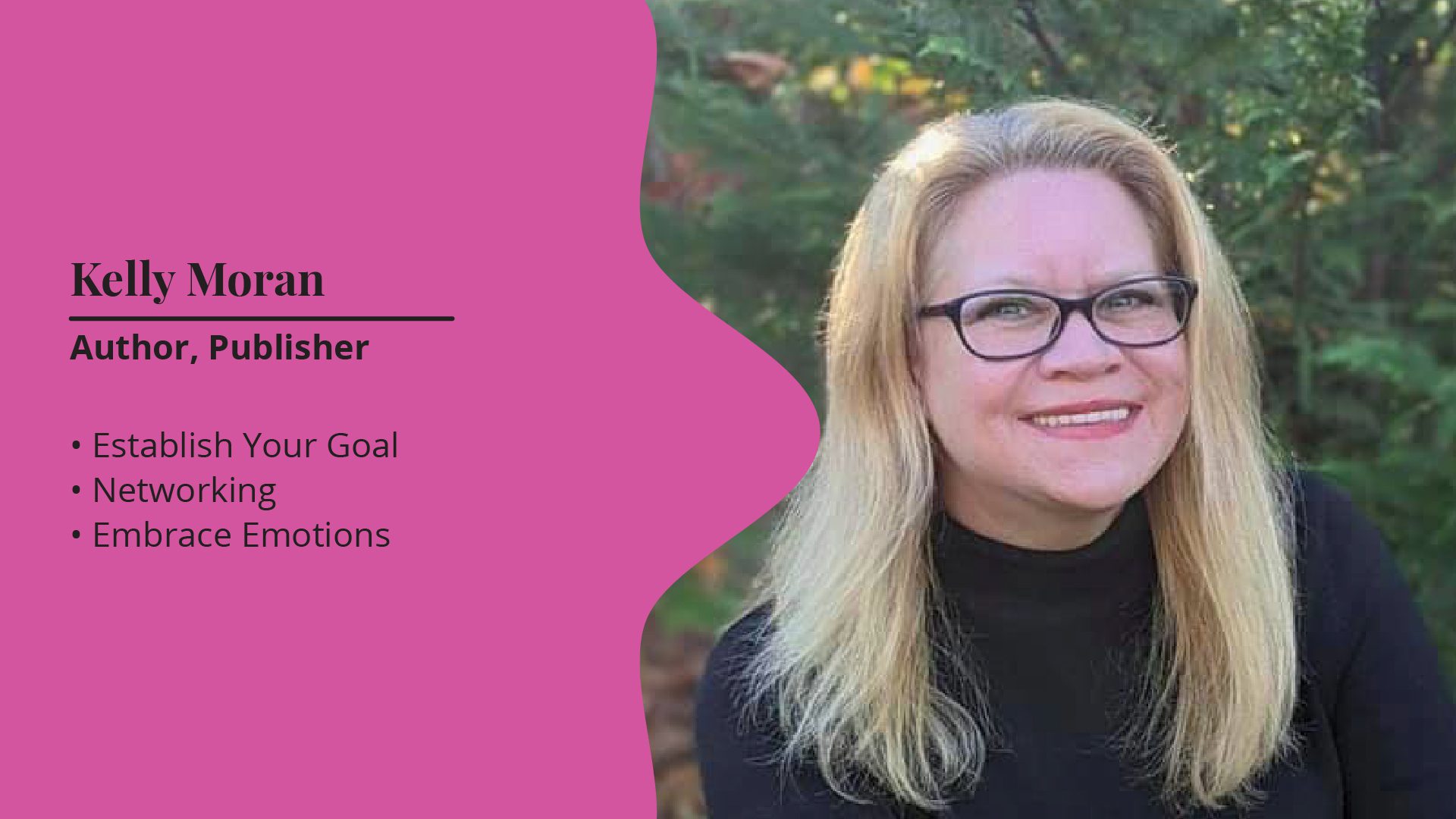
“Success is all dependent on every single individual’s definition… You have to define what that goal is for you, because it’s going to be different for everybody.”
Kelly Moran is a multi-genre author and founder of Rowan Prose Publishing, based in York County, South Carolina. Since her first book was published in 2005, Moran has authored over 30 titles across paranormal romance, contemporary romance, and light horror.
Interview
Transcript
Emma Plutnicki 00:02
So to start, what do you do for work, and where are you currently working from?
Kelly Moran 00:09
I live in South Carolina. I’m in York, up in the north-central area, not far from Charlotte. As an author, my first published book was in 2005, and I’ve been publishing it ever since. I mostly write paranormal and contemporary romance, but I do have a horror persona as well, who writes light horror books. And in 2023 I started my own small press publishing company called Rowan Prose Publishing, also based out of York. And right now, we’ve got a little over 50 authors.
Emma Plutnicki 00:57
And so how long have you been doing each? Author you said since 2005 and publishing since 2023?
Kelly Moran 01:05
I want to say 2005 was my first published book. That sounds about right. But really, in essence, I’ve been writing since kindergarten. I always wanted to be an author, but I didn’t always know that’s what it was. You know, I get these ideas in my head, like I want to be the president, or I want to be a US gymnast or whatever, and I realized it was more the story I was interested in, than, you know, the actual job title. So I always had a creative mind. Other people sit and watch movies or do things, and 10 ideas for a new book pops up in my head. I can’t tell you how many titles I have, like 45 maybe, and I’ve been traditionally published with Berkeley/Penguin, larger publishers like Entangled and Kensington, and then I’m also I’m what they call a hybrid author. I also independently published some of my own work. I have foreign translation rights in seven different countries, and I learned a lot about marketing and design amongst other things. That kind of persuaded me to start Rowan Prose Publishing, because I would get a lot of authors who would ask for advice. So, we’re getting a whole different side of publishing and writing and things like that which never would have been seen before. So, you got the Big Five who are publishing what they want to publish, what sounds good, what’s trending. But a lot of them are not taking on what readers are necessarily looking for. They’re not taking a chance on the smaller authors, debut authors, who are just starting out. They don’t want to put a lot of time and effort into helping an author build a career or working really hard on developing a book to the best of its ability. But unless you’re a big name, a lot of publishers, even with agents, aren’t accepting new and debut authors. I got into conversations with an author, and I’ve been friends with her for a very long time, and we were discussing how can we do this? It was a big undertaking, a huge undertaking, but we’re showcasing a lot of authors that you would not see on shelves elsewhere. You know, you would never have heard about these great, amazing, wonderful stories that bigger publishers don’t just want to take a chance on. And because we were by authors, for authors, we wanted to make sure we were not only showcasing new talent, but using new and innovative marketing techniques that some other publishers don’t. We give our authors a lot more freedom than some other publishers would. So, it was a big undertaking, but I’m really glad we did it. We have some really, really amazing talent.
Emma Plutnicki 06:03
And is the is the talent that you work with from South Carolina? Or is there any influence of South Carolina within your work, whether that be the clientele or any influence that the state has on your writing?
Kelly Moran 06:19
In my own personal writing, yes, I have. In my, fact, I’m writing a southern romcom series right now that’s been contracted with Germany for foreign translation. For Rowan Prose, yes and no. We’ve had some really great output from independent bookstores and libraries. I don’t think we have a South Carolina author right now. Publishing is mostly a virtual entity. What I would love to see is more of the colleges and whatnot, like what you guys are doing, showcasing how to properly do this. I mean, there are so many young adults who were me once, who are like, I want to do this. And it can be very dejecting and demoralizing. And it’s, it’s, I wouldn’t want that for anybody. One of our authors, in fact, is based out of Louisiana, and is only 20. She’s in college right now.
Emma Plutnicki 08:02
Amazing. And within a creative career, I mean, it can be very difficult to figure out what your niche is and also how to find success. So how would you define professional success? Is it the number of books you sell, or is it kind of just something within you of like bringing your words to the page. What does success look like for you, both personally and professionally?
Kelly Moran 08:27
I think, to be honest with you, success is all dependent on what every single individual’s definition is. Several of my authors are like, I would just love to see my book in a library, and they will be happy for the rest of their life. Some want New York Times and USA Today bestsellers. Some want to be Stephen King or Nora Roberts and be a household name. For each individual person, you have to define what that goal is for you, because it’s going to be different for everybody.
Emma Plutnicki 14:15
Yeah, no, it makes sense. Did you have any fears when you were starting as an author, or any fears when you started your publishing company?
Kelly Moran 14:23
Oh my gosh, yes, and I still do to this day. I’ve been in this business for 20 years. A lot of it now is fear for my authors. Like, I remember getting that first bad review. Having somebody navigate that with you when you’re first starting out makes all the difference. It’s kind of like hand holding. Not every reader picks up the same book. They always say to grow a backbone, but, in my opinion, if you grow a backbone, you lose a lot of that emotional edge you can put into your writing. You know what? Cry about the bad review. Drink a glass of wine and start again. That’s all you can do. I mean, one of the funniest things I like to tell my authors is, if you look up on Google the reviews for Stonehenge, it’s got an average 2.5 to a 3-star review. So, look at it that way. There’s going to be people out there who are going to hate, and all you can do is keep going, because for everyone that does, there’s 10 that don’t. It’s easy to say grow a backbone, sometimes you get tougher skin out of it. But that’s what always scared me. I think about that every day, and I think about all my new debut authors and how they’re going through that right now. I tell them the same thing: you’re going to get bad reviews, but you’re going to get great ones, and you’re going to build great readers, too. I think a lot of what they fear the most: rejection and failure, but failure is just like success.
Emma Plutnicki 17:43
Yeah, that must be pretty cool to look back on. But has there been a significant project that you’ve worked on throughout your career that really stands out as kind of the pinnacle of your creativity, or just one project that has had a significant impact on your life?
Kelly Moran 18:02
I don’t know if there’s one project in particular, because especially for an author, it’s the little things like, oh my goodness, USA Today reviewed me, or I just won this award, or I’m a finalist in this one, or you collaborate with other authors sometimes to write a compilation and anthology. As a matter of fact, one of my other big pieces of advice is to join a writer’s group, because they have publishing professionals, editing professionals, cover design professionals, indie authors, and traditional authors. And you’ll learn a lot by going to conferences. And some of them are virtual. Some of them are in person. I remember, I think, probably my most pivotal moment that I can think of is I had written and published two or three books with some small press before this happened, and I had written this book, and it was very emotional, it kind of bordered on romance and women’s fiction, but it was a romance, and one of my author friends who I met at a conference had said, why don’t you try submitting it to my agent? I’m like, I don’t know. Okay, let me try. I had hit up hundreds of agents before in some of these previous books, and I didn’t have the reader following. I didn’t have that experience. Most of them didn’t pick me up. So, I did. I submitted it to her agent. She loved it, and that was my first mass market contract. That was my first I’m in every bookstore. That to me, I think, was the most, to date, eye opening and pivotal experience I had, because not only did I get a mass market contract and these books were everywhere, but it was also a two-book deal. That was my moment. So that would probably be the one that stands out the most.
Emma Plutnicki 21:57
Yeah, that’s pretty special. So now, a typical day, what does that look like for you? Do you spend a certain amount of time in your day writing? Are you more on the publishing side? What does a typical day look like?
Kelly Moran 22:10
It depends on what contracts I have for my writing. At the time, Rowan Prose ate most of my time, and I’m happy to do it. I mean, I love what I do. I’m literally living my dream. I wake up when I feel like it, though it’s usually six o’clock in the morning. I check on my authors, and I check on our social media. I post, but it’s a big balance. Here I have all of these responsibilities, and I don’t want to let my authors down. So, there’s that, and then I have my own books to make sure I maintain for my readers, and I’m still following that dream, and I do still have many foreign translation contracts that I fulfill every year. So what I like to do is start out with, you know, something slow in the morning, I always do our social media accounts, make sure we’re posting, doing things, checking email, and then from there, I like to get into whatever edits we have for our authors. Make sure everybody is doing okay. We’re ahead of schedule, and I’ll usually do two to three hours of writing in the late afternoon. We have three interns who are amazing, who help me out when we get backed up, and two other editors beside me. One of them is an author, the other one’s a blogger earning a bachelor’s degree in journalism. We try to make sure we have a balance between work and whatnot.
Emma Plutnicki 24:25
We maintain that, because I’m sure working from home doesn’t make it easy to separate the work from just your normal day-to-day life, and I’m sure creativity strikes at different times of day and night. So how are you able to kind of have time for your work, and then also have time for yourself?
Kelly Moran 24:43
It’s really difficult. You have to be very detail oriented. I have a number of my writers who have day jobs, and then they write at night, which is what I used to do. And for me, I’ve always been obsessively organized, would probably be a good way to put it. So, I have schedules. My schedules have schedules, and those have post-it notes that have their own post-it notes. I make myself follow a schedule, because if I can’t do that, then things go crazy. You just have to set boundaries and stick to them, and set a schedule and stick to it, especially if you’re working a full-time job away from your writing career or your publishing aspirations. A lot of people feel really bad because they go to three days without writing or typing something on a page, but you can’t fix a blank page. I mean, writers probably have one of the best and toughest jobs.
Emma Plutnicki 27:06
Yeah, it’s hard.
Kelly Moran 27:10
I mean, unless you’re an actor or a journalist, what other job is there where, when your day is done, every single person in the world can leave a review about you. I mean, it’s cutthroat. Let’s say you’re a mechanic, right? Imagine going to the shop every day and you’re changing brakes and oil and transmission work, and then every person whose car you fixed then went on to the largest platform on the planet and says, “One star.” I didn’t like his overalls. That’s how it is.
Emma Plutnicki 28:05
I can imagine you must have tough skin to, you know, brave in those reviews?
Kelly Moran 28:12
A dream is a dream, and that’s just one of the things that a lot of people need to take into consideration. A lot of authors don’t even read their reviews for that reason. They don’t even look at one of them. I will, on occasion, pop onto Goodreads or Amazon, but I try not to anymore.
Emma Plutnicki 28:35
Oh man, oh my gosh, yeah. I don’t know if I could, uh, restrain myself from reading them. But, um, perfect. Well, just as we wrap up, is there anything else you’d like to add about your career advice or anything like that?
Kelly Moran 28:51
Follow your dream? It’s the cheesiest, most cliche thing out there on the planet. Learn your craft, join some writer groups, meet a couple of writer friends, and they don’t have to be in your area. I mean, in this day and age, zoom, or, you know, Facebook chat or whatever. Meet some other authors. Learn how it’s done. We do get a lot of authors who don’t even bother reading our submission page before they send it to us, and I’m sorry, but if you can’t take the time to at least think about what we need from you to submit, then that tells me you’re not going to be open to the other things that need to be done later on. When you’re submitting to agents and publishers, follow their guidelines, because every single one is going to have something different. Think about what your goals are. If this is something you want to do, definitely think about the degree you are earning and how you can get into that world, earning a paycheck while you’re working on your book, while you’re working on submitting and any of things like that. That would be my best advice. I had, I want to say it was something like 80 agent rejections before I got mine. And yeah, and I’ve had a number of small presses all the way up to big five rejections, and most of those came from the series that got me the Spiegel bestseller in Germany, and lots and lots of royalties afterwards. And when you’re stuck, move on to something else. We’re authors, we’ve always got something going on in our heads. Don’t feel dejected, because this is one of the toughest markets to break into.
Emma Plutnicki 31:37
That’s great advice. Thank you so much. I really appreciate the time and words of wisdom. I’m sure this will definitely help some people who want to become authors in the future. So, I really appreciate it. Thank you. Bye.