Tag: Time Management

  • Mahoganee Amiger

    Mahoganee Amiger

    “Just love yourself and talk to yourself nicely.”

    Mahoganee Amiger works in Beaufort S.C., is an interdisplinary artist in the field of music and has been a songwriter for over 30 years. Mahoganee incorporates poetry and photography into her music to produce a form of visual art. 

    Interview

    Transcript

    00:02 | Lexi 

    So first, we’re going to start, just give a little introduction of yourself. What do you do for work, and where are you currently working from? 

    00:13 | Mahoganee Amiger 

    So I am, well, I’m an artist. I am an interdisciplinary artist in the field of music. Music, Music is my primary discipline, and I have been a songwriter for over 30 years, and I incorporate poetry and photography to my music and makes me a visual art. 

    00:43 | Lexi 

    That’s, that’s amazing. So is that like your full time job? 

    00:49 | Mahoganee Amiger 

    Yeah, it is. 

    00:50 | Lexi 

    That’s, that’s amazing. So how long you said? 30 years? 

    00:54 | Mahoganee Amiger 

    Yes, I’ve been in music 30 years. How long I’ve been full time in music? I would say, let’s see. I had my last corporate job in 2010 I believe, yeah, somewhere, somewhere in there. 

    01:21 | Lexi 

    That’s awesome. Yeah. Okay, so what is- Wait, where are you based in? 

    01:28 | Mahoganee Amiger 

    I’m in, I’m in the lowcountry. I’m in Beaufort, South Carolina, in Beaufort. 

    01:32 | Lexi  

    So what’s one thing that you love about working as a creative in Beaufort? 

    01:40 | Mahoganee Amiger 

    One thing that is so I live on Saint Helena Island, and specifically I am a Gullah Geechee woman, right? This is Gullah Geechee land in Saint Helena Island is so important and pivotal in our community, and it’s a very special place, very spiritual. And so being a creative it is, in my opinion, it is a very magical portal, yes, that right, that I can tap into, and because I allow myself to be open to that I I am never, not creative. Yeah, I am never, there’s not a dry spell. 

    02:31 | Lexi 

    That’s awesome. That’s amazing. So with your, what is your you said that, of course, your heritage is tied to South Carolina. How would you describe the local creative community there? 

    03:00 | Mahoganee Amiger 

    There is a very powerful and strong creative community here on Saint Helena Island. And also, because I my my branches, you know, reach out into, you know, other areas I am able to… I live here, right? I work here, I create here, but I’m also able to reach out, literally to people all over the world and create. And a lot of people are interested in South Carolina, in the lowcountry, and the delegatee culture. And so I’m able to, I’ve done tours, you know, people have wanted to come here and visit. And my husband and I have actually, you know, put an itinerary together and really introduce people to the low country of South Carolina, to the Gullah culture.  And it’s a magical place. And people are, you know, very, very interested in it. Now, it’s a hot culture. 

    04:05 | Lexi 

    Yes, that’s such a, that’s such a beautiful thing to be able to do for others, because I feel like South Carolina does have so much to offer. You just kind of have to reveal it to people, and so you do so much creatively, how would you define both your professional and personal successes in your creative endeavors? 

    04:36 | Mahoganee Amiger 

    So the interesting thing, I believe they’re one, right? They’re just woven together, because being a culture keeper or cultural worker and all of my artistry is tied to my culture and who I am in. It’s about South Carolina. It’s about. The culture. It’s about my African heritage, so it’s personal. Is professional? Yes, right? Because when I, when I walk in, I am whether it is a professional setting or personal setting. I walk in as an artist. Yes, I’m able to just, you know, share from that perspective. So they’re, they’re definitely woven together. 

    05:25 | Lexi 

    Yeah, that is very true. So what was your biggest fear when you decided to pursue your career professionally? 

    05:41 | Mahoganee Amiger 

    You know, I have been singing literally all my life, since elementary school, and I have always done it afraid, you know, like my friends would like, I’ll give you an example. So elementary school, I believe this was fourth or fifth grade, my teacher walks out of the class and they’re like, Okay, can you sing us a song? Can you sing this song? So I go up and I sit in my teacher’s desk, and I don’t know where we got these glasses from, but I had on I put on some glasses like Ray Charles or Stevie Wonder. So to block out everybody, because I’m I’m nervous, but I’m still excited to do it, yeah, and so I think, through, through high school, I was very afraid, but I always did it, even if I had to turn my back to the crowd. So there was the fear of, I think, just being in front of people, you know, and sharing something, but the love for it really just it outshine the fear. And I think I’ve just always been able to walk like that, and until I just got to a point where now I’m nervous, I’m not fearful, the nerves are always going to be there. But I get past the nerves usually in the first, you know, couple of lines of the song, and then, and then I’m in it.  

    07:09 | Lexi 

    Yeah, I feel like that’s amazing. There’s, I feel like there’s so much that people can take from that. I feel like that’s a really good piece of advice, just to get out there and just do it. So, right, yes, do it afraid. That’s that’s a really, really good piece of advice, because I feel like fear holds a lot of people back sometimes. So can you describe, for me, like a defining moment in your journey, like was your particular project that you did that made a significant impact on you, or something that you’ve done that you believe really like showcased your creativity and talent. 

    07:53 | Mahoganee Amiger 

    I think what sticks out the defining moment, really for me, embracing myself as an artist and really embracing myself right like and what I mean by that is being able to look in the mirror and love who I see was when I moved back to South Carolina, and this was also in 2010 and I’m from Summerton, South Carolina, which is about an hour and maybe 15 minutes away from Beaufort, South Carolina. And I never knew about the Gullah Geechee culture. Growing up like it was. It was not taught in school. But once I moved back here and I started to learn about the culture, and it was as if I gained a superpower, yeah, right. The more I learn about my heritage and my culture, the more I learn about myself, the more I learn about my parents, you know, my siblings, just my ancestry, yeah, the more powerful I am. But moving back home was the starting point for that, and it just, everything else just opened up. And it’s been, it’s been an amazing journey finding myself. 

    09:20 | Lexi 

    Yes, that is amazing. And I know, I know there have been so many movements, especially like along the coast, to bring awareness to the Gullah Geechee community. And I think that is like, I think that’s just wonderful. Like, it can bring, it brings so many people together. And I think that’s just just an amazing thing. So what was the best and worst advice you’ve ever received? 

    09:48 | Mahoganee Amiger 

    You know, that’s an interesting question, because I don’t hold, I don’t retain bad advice. Yeah, so I’m not really like i. Really have to think about that one. And you know what? I think something that I remember was trying to play small and having people tell you that you’re not good enough, or you’re that the person to be in the spotlight. And what I mean by that is, I’ve been in music groups where I because of the way that I look, because of my physical attributes, I will not the one they wanted to be, the lead vocalist, and so for somebody that might crush them, you know, and it might stop them on their journey from pursuing their dreams, specifically in music, right, and in the arts and in something in the public. But for me, I just decided that, okay, that means I need to be solo on this journey, and I’m going to have to be my own advocate, right? I’ve gotta be my cheerleader. And but that’s one thing that sticks out. They were trying to put me in the background, and I was like, nah, nah. That’s this is not going to work for me. 

    11:22 | Lexi 

    Yes, yeah.  I feel like that is just something that it’s an amazing piece of advice. You just gotta Well, not that specifically, but just learning that there’s always going to PP be people that are trying to hold you down, but you just gotta move past it. Can’t, can’t surround yourself with those people. 

    11:48 | Mahoganee Amiger 

    Yeah, so the other half of your question was some of the best in life. Yes. And I don’t remember who told me this, but I know I’ve heard it somewhere, and it was to when you get up in the morning and you the first thing you do is you go and you talk to yourself in the mirror, right? And you give yourself these affirmations. And it’s something that I have. I do throughout the day. I don’t write. I don’t just do it in the morning. Whenever I need to give myself a pep talk, I just go and I find a mirror and I talk to myself and because I am with me all day long, right, all the time, and So just always feeding yourself positive words. Positive affirmation is some of the best advice that I got, and I hate that. Can’t remember who told me, and I’ve heard it over and over again, and I see it often, so it’s just, it’s something that I would always tell people, yeah, just love yourself and talk to yourself nicely. 

    13:02 | Lexi 

    Yeah. That is, honestly, like, I do believe that’s one of the most important things you can do, because you are stuck with you for forever. You gotta love yourself. So can you, like, walk me through a typical workday, like, what does your process look like, and what’s what do you expect of yourself, just on a daily basis? 

    13:28 | Mahoganee Amiger 

    Right now, as an artist I am in a fellowship, and that’s also some some good advice that I would share with people, anytime you can find an opportunity to be in a cohort or fellowship or something that is really going to help you grow as a human being, as an artist, as a community leader, I would look for those opportunities because they have been very instrumental in my growth, just as a human and and as an artist and one so how my days look now. I am in a cohort, and we have meetings every month. We also have to work on a project, so and so that is also along with, if I’m having to rehearse for a show just got through writing and recording project for Zora Neale Hurston, so it’s not just one thing. I don’t have a nine to five, so my schedule is kind of different every day, yeah, and it’s but what I’ve learned is that time management is something I need to really, really work on. And as an when you are an entrepreneur or an artist and we’re. For yourself. That’s the that’s the thing that we have to work on the most, because we don’t have the the nine to five schedule where, you know, we we have to create some sort of schedule for ourselves. 

    15:13 | Lexi 

    Yes. So you said that you kind of find that you’re professional and, like personal times are, like, woven together. Like, your creativity, do you try to create a work life balance? Or are you able to maintain, like, keep those two life separate? Or do you like having them join together? 

    15:41 | Mahoganee Amiger 

    It’s all joined together because my husband is also my partner, my business, my partner in music, my partner, my my partner in life, and because we are both musicians and both creatives, it is. It’s an interesting thing balance, because there is no, you know, like I said, there’s another nine to five schedule. And my husband is a music producer and a sound engineer, so he could be working on a particular composition at 3am right? I’m sleeping. If I hear the music, I’m going to wake up. And this has happened, and lyrics have come to me immediately, right? So I get up, yes, I’ve either recorded them on my phone or I, you know, write the lyrics down. So it’s in the creative world, you have to get it when it comes. 

    16:50 | Lexi 

    Yes, right? So, yeah, go ahead. I’m sorry. No, you’re good. You can continue. 

    16:58 | Mahoganee Amiger 

    So the the, that’s why I say the balance is we make it work. Yes, the best answer I can give you is that it works for us because we make it work. And when, when the creative waves come, you have to answer to that call, and then, you know, life moves around that. 

    17:23 | Lexi 

    Yeah, so what are some habits that you have that you think would be beneficial for others, wanting to get into music, wanting to get into storytelling, just get into a creative field? 

    17:42 | Mahoganee Amiger 

    I would say, always capture the idea when it comes whether that is audio right, or whether that is writing it down. Make sure you are always in a learning mindset and just wanting to grow and always get better in your craft. And that’s why I recommended the cohorts and fellowships, any type of professional development that you can do that first helps you as a human being, and then second, it helps you to better yourself and your craft. Those are things that I, I think, have been the most important to me, especially in the growing phase, and just always be willing to learn and grow. 

    18:42 | Lexi 

    Yes, I think, I think those that’s an amazing mindset to begin like at all times in your life. So do you have any questions that you wish that we asked you? 

    18:57 | Mahoganee Amiger 

    Ah, I couldn’t think of any, that’s a really good question. And we didn’t even get through all the questions, right? I cannot think of any question that you shouldn’t have asked me, and I’m trying to think of something that I really want to leave with. People go ahead and ask me the last question, and I’ll marinate on that one for a minute. 

    Think of something that I wish I had thought of. Here’s, here’s one thing, not a question, but something that I will share. And because there’s so much noise on the internet, right, and a lot of times, people are emulating what they see, I would really tell people to dig deep and be your authentic self, because that is where the magic is, and that is what really will make you excel, because now you’re able to stand out when you dig Deep and you really find who you are and what you love, the passion and the purpose I feel will really elevate you in that authenticity, but just being yourself, and that may mean being by yourself for a little bit. You know, being away from people, being away from the noise, and not looking at anything online, because sometimes it’ll feed into your creativity. It’ll feed into who you are, and some, some self reflection time alone, just dig deep for who you are, and that’s where the light is, that’s, that’s where you’re going to shine. That is what I want to share with just everybody, just and it’s, it’s, it’s a simple phrase, be you, but it’s really a big phrase, be you. You know, yeah, that’s, that’s what I would leave people with. 

    22:45 | Lexi 

    That is, I think, really, really beautiful advice. I think that’s really amazing. So many people could learn from that. But thank you so much for your time. I’ve really enjoyed this interview. I think that you’re going to give so many people a lot to think about, a lot of good advice. And yeah. 

    23:15 | Mahoganee Amiger 

    Thank you, Lexi. Of course, I appreciate you taking the time to you know, to do this, and I love that you’re actually doing it, and you made me think of something else, because not just Gullah Geechee people, but really all people. Every every place has a dialect, right? Right. Every place has, you know, people speak differently. Words are said differently. Words mean different things in different cultures. And I want people to hold on to that, you know, because we try, not we, but the world will try to take you out of you.  

    You know the world wants you to sound a certain way. The world wants you to look a certain way. But it all really comes back to again, who you are, what you how you grew up. You know that playing might be in your voice. It may be Jamaican, right? It may be Patwa, it may be Southern, it may be whatever it is, but that’s the thing that makes you you. And I wish that someone had told me that instead of No, I need you to speak proper, you know, I need you to do this, and I need you to look this way. And all they were doing was stripping away, you know, pieces of me. And so when I got back home, I began to, you know, those scripts, I began to put them back on Me. You. And really just become myself and but when you when you said about, you know, learning people’s stories and sharing their voice, it’s like the voice can actually, actually be literal, right? And it can be your speaking tongue, and the world will try and strip that away from you. And I, and I wish that we can hold on to whatever our ancestors did, you know what, whatever our parents did, and allow that to always be a piece of you. Take the other stuff, but just keep, keep that for yourself, and it just adds to the magic. 
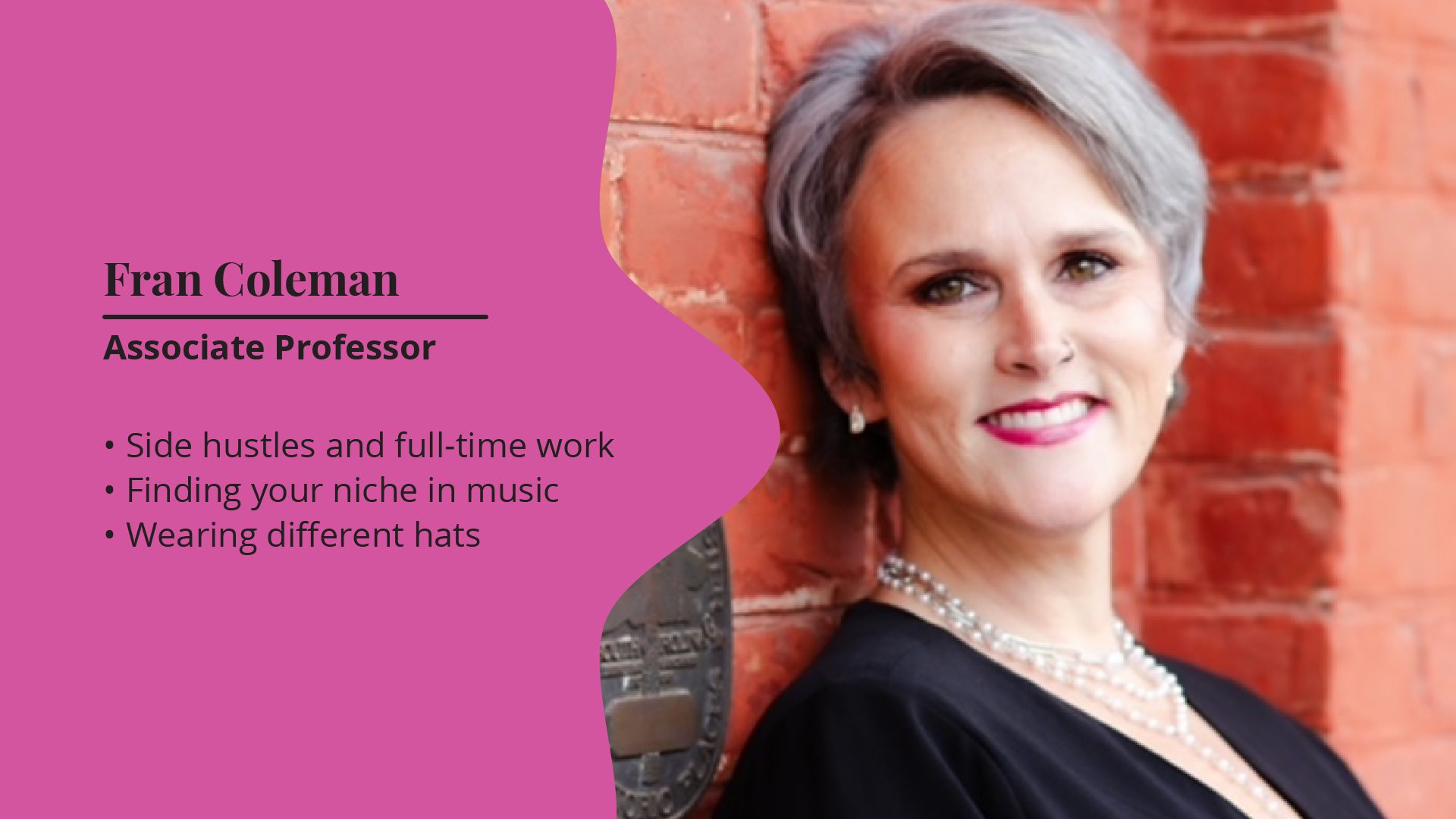
  • Fran Coleman

    Fran Coleman

    “Anything is possible. Anything is possible. You just have to be creative”

    Fran Coleman is an associate professor of voice and choral activity at Francis Marion University. Fran’s teaching spans from voice lessons, directing choirs and any other coral activity. Fran is located in Florence S.C. and currently teaches but is also a performer as well as producer with a regional party band called Emerald Empire band.  

    Interview

    Transcript

    0:03 | Emma Plutnicki 

    Okay, perfect. So, to start off, what do you do for work and where are you currently working from? 

    0:09 | Fran Coleman 

    I do a lot of work. Currently, I work at Francis Marion University. I am an associate professor of voice and choral activities there. So, I teach voice lessons. I direct all of their choirs. I arrange any kind of Choral Activities that might be on or off campus. I arrange any kind of vocal recitals, anything like that. I arrange. We also have a couple of other vocal groups. We have a jazz ensemble and a music industry ensemble. I don’t direct those, but I do work with most of the singers that are in those groups, just by default music.  

    1:03 | Emma Plutnicki 

    How long have you been working there? 

    1:05 | Fran Coleman 

    This is my seventh year. Yeah, this is the end of my seventh year. So I’m also a performer and a producer with a regional party band. So I obviously sing and perform with them, but I also put together events with them. I work with our, with our vendors, with our, with our, obviously, with all of our clients. I work with them. I’m kind of like the third party between them and the vendor and the band also. So I kind of wear multiple hats when it comes to them, because when I am dealing with them before the event, I’m the producer, as far as helping them to plan the event, plan out what the band is going to do, how the band how the band is going to fit into their event schedule. When I get on site, I am kind of the band manager, as far as advocating for the band, making sure the band gets their breaks, making sure that they can, especially like last summer, when it was super duper hot, making sure they, you know, get water, make sure they get their dinner break and all that kind of stuff.  

    2:16 | Fran Coleman 

    And then when I’m on stage, I am the performer.  I wear lots and lots of hats when I’m with the band as well. And then I’m also a classical singer. That’s kind of a freelance thing. I sing with a lot of different churches in the area for weddings, funerals, Sunday services. I sing with the symphony in the area. I also sing with the Long Bay symphony at Myrtle Beach. I do a lot of regional work just with other events in the Carolinas and Georgia. When it comes to the arts, I always like to say that you have to wear a lot of different hats. You have to be willing to have a kind of piecemeal life together. You have to be willing to, you have to be willing to have lots of different side hustle. And if you’re willing to do that, you’re going to be fine. But it’s like understanding that you have to know where your passion is, if to know why you’re doing it, you know. 

    3:24 | Emma Plutnicki 

    Yeah, amazing, yeah. It sounds like you have a lot of things pulling you in different directions. But what is one thing that you like specifically about working as a creative in South Carolina? 

    3:40 | Fran Coleman 

    You know, moving down here, I moved from Richmond, Virginia, which is a fairly different size city, you know, then particularly Florence, which is where I’m at, but even Conway, or Charleston, for that matter, I mean, Richmond’s a pretty, pretty decent sized city, which I wasn’t, I really wasn’t ready to realize until I moved, but it was really nice to move to an area that appreciated the arts as much as they do. This area really appreciates the arts and and they’re willing to pay for it.  

    3:40 | Fran Coleman  

    You know what I mean? Like, I feel like in Richmond, I was constantly advocating for artists to be paid for what they do, constantly, constantly advocating. When I was in Richmond, the hustle was even more real when I mean I was, I wasn’t a full-time professor up there. I was an adjunct professor, which is what’s called a part time professor. Where I was, I was part time at several different universities around the state. Some were a couple hours away. Some were less than, you know, an hour away.  

    4:58 | Fran Coleman 

    But either way, I was trying. Traveling a lot. I was working with several different nonprofit organizations to advocate for the arts. And I was working with Virginia opera, which was a couple hours away. I mean, it was just, it was a lot a lot of driving, and a lot a lot of hustle, and that was and the basis of all of that hustle was advocating for the arts, advocating for the artists to be paid, you know, and to be such a cosmopolitan area, it’s amazing how little they wanted to pay for the arts. So, to move down here and to come to an area where the arts were so appreciated, the very second question after you know, what can you offer? Is, what is your fee? And I was just dumbfounded, because I was like, wow, okay, let me think about it, because I didn’t know. So, so that I really do love is how appreciated the arts are around here. 

    6:00 | Emma Plutnicki 

    Yeah, amazing. And have you been able to find a professional community within South Carolina that you kind of meet with, or how would you describe your local professional community? 

    6:14 | Fran Coleman 

    Well, you know, through the band, through the band that I work with is called Emerald Empire band. And Emerald Empire band, excuse me, I have a frog in my throat. Emerald Empire band is part of a larger organization called the International Musicians League. And so that International Musicians League is literally International, and it spans across the world. And so I was with them in Virginia as well. Up there, they were called the Bachelor Boy Band. And so when I moved down here, I was able to transition over to Emerald. And so they really helped me to find a large entity of professional musicians that I wanted to be a part of and through them, I was able to branch out and kind of find a little bit more of that, like classical entity that I was looking for. But also in working with the Florence Symphony Orchestra and the Long Bay symphony orchestra, and then also through working with some of the other musicians in Emerald, I was able to meet some of the some of the other crossover musicians like myself that do classical as well as contemporary music, that work in the Charleston area and as well as in the Columbia area. I also sing with a nonprofit in Columbia called Palmetto Opera. 

    7:40| Fran Coleman 

    And so I was able to meet some of the other classical players in the Columbia area. So through all of those entities, I feel like I’ve been able to really like I’ve been able to really dig into the contemporary pool of players. I’ve been able to scratch the surface when it comes to the classical players. I know there are so many more that I would love to get in touch with and start collaborating with. There’s a fantastic woman in the Florence area who is doing some work with the Met, the Florence Masterworks Choir. She’s doing some work rebuilding their website and helping to build their database, and she has created an organization called the Ladies Who Lunch, and that is a group of ladies, all who work within the arts community in Florence, whether it be through visual arts or performing arts.  

    8:40 | Fran Coleman 

    And we all try and get together at least once a month, just to kind of talk through things that are happening, things that are, you know, things that need to happen, things we like to see happen. And so that’s a great, great way to try and keep things moving. And so that’s been happening, and so that’s really good. Things like that are what need to continue to happen, right? Just having conversations, and just knowing who to have conversations with, right? Yeah, particularly within the female community, you know, because even in 2025 we’re still so subdued, yeah, so yeah, yeah, 

    9:27 | Emma Plutnicki 

    No, it sounds like a great community, and hopefully it continues to grow. And with all the hats that you wear, you know, how do you define professional or personal success in such creative fields? 

    9:44 | Fran Coleman 

    Oh, I used to put dollar signs on it. I don’t anymore. I really define success in how full my heart is. You know, if I’m waking myself up and putting myself to bed? Every day with music, then that’s how I define my success.  

    10:03 | Emma Plutnicki 

    That’s great. It really is great. So have you had a kind of major project in your life, or, I don’t know, like a defining moment in your creative journey that’s made a significant impact on you, or something that you have produced or sang, or project that you’ve worked on that has really showcased your creativity? 

    10:36 | Fran Coleman 

    So many things. I try and keep the creative fires burning as much as I can. This particular semester, I’ve got, like, next week, we have an event happening at a little restaurant in Florence called Victor’s. And so, through the Palmetto opera, I was introduced to a kind of dinner, a dinner theater type event called up, called, what they call it, Villa Tronco. And Villa Tronco is just a restaurant in Columbia, and excuse me, it’s like a it’s like a dinner theater where two opera singers get up and they just sing a few songs, and then they take a little break, and then they sing another few songs, they take a little break, and then they get up and they sing a few more, and then they take a little break all and all of it is paired with meals and then within those pairings are like little mini sets. And those little mini sets include some backstory behind the areas. And there’s always a duet within each of those mini sets, and there’s an explanation behind it.  

    12:00 | Fran Coleman 

     Anybody is invited to these dinner theaters like you don’t have to be a world-renowned opera buff to understand. I kind of borrowed their idea, and I took it to Victor’s, which is a restaurant in Florence, and I said, I’ve got this great business model, and I would love to bring it to Victor’s. Victor’s is like one of the classier restaurants in Florence, and they have a great back room, like, a kind of conference room area where they could kind of create a nice little dinner concept and sell reservations. And so that was a great success. We did that a couple times, so it was really successful. And we’ve got another one coming up in February, and so far, it’s been really successful. We had one scheduled for October, and it was the day before Halloween, and it didn’t sell like we wanted, so we had to end up postponing that one.  

    12:55 | Fran Coleman 

     That was, unfortunately, not as great, but the one we had coming up in February was really successful, so that was great. I did an event on campus last year with where it was called singing the legacy of black female composers, and I paired that with some of my current students along with some of my alumni students, and we did a whole concert where we sang nothing but music of black female composers, and we talked about the works of these women and all of the great all of the great information, all of the great things they did. We talked about all sorts of amazing things they brought to us as composers, as women, and that was really cool. Back home, I worked with a couple of nonprofits where we built a Mozart Festival every year in different parts of the city.  

    13:55 | Fran Coleman 

    That was amazing. I mean, every year it was, and it was almost all completely female run. You know, that was amazing. Every year, I am the only female that helps to put together this event called FSO Rocks at the end Florence, where it’s the Florence Symphony Orchestra, and we do all classic rock music. So that’s really amazing. Anytime I can help build something new and exciting that is even the slightest bit different. I always like to say that, you know, I kind of like Winnie the Pooh. I’m not your average bear. Yeah, you know, yeah. Anytime I anytime I can, anytime help out, like, with something that’s slightly different, I try and get involved. So great. 

    14:47 | Emma Plutnicki 

    And when you decided to go into a creative profession, did you have any fears about that? Like, what was your biggest fear? 

    14:55 | Fran Coleman 

    I mean, I’m always fearful of the unknown, but ultimately I. Um, I let anybody who says they don’t think I can handle it fuel me, like anytime I’ve ever had a professor to say, I don’t know if this is for you or you might want to try something different. I let them. I let that fuel me to say, oh, really, really, watch me, you know, and I let that kind of feel me. And so that’s what’s gotten me to where I am. Any negative feedback has been what’s got me to where I am? Yeah, it’s not, it’s not pulled me down. 

    15:37 | Emma Plutnicki 

    What’s the worst advice that you’ve ever gotten, or the best advice? 

    15:45 | Fran Coleman 

    Well, when I first got to undergraduate school, I was so in when I was a senior in high school, my dear and bestest friend from, like, literal infancy, um, she, she and her dad and my dad were like, best friends. They like went to military school together. They were stationed in Germany together. They like, we were born two months apart. Like, we were raised together, you know. And she died in a car accident when we were, like, 17, just boom, two months before graduation, gone. Dead. And it was just, I mean, it just, it shook your world, you know. And so, I didn’t go straight to high school. I mean, I didn’t go straight to college straight after graduation. I just moved out after high school, and just kind of like, got a couple jobs and started singing in bands, and started going to open mic nights and just kind of sewing my musical oats and deciding what I might want to do with my life. I just didn’t know. I just knew that if God could take Kim at 17, he could take me too, you know, and so, so I just knew that I needed to explore what, what the world had to offer me. And so that’s what I did. And so, one band led to another, led to another, led to another, until eventually I started getting into some, some significantly successful bands, and we started doing some touring up and down the coast, and things were doing really well, until eventually that van broke up. I was about 24 at that point, 23 maybe, landed back in Richmond, and I said, okay, now what do I do? And so, I decided I would go back to college.  

    17:38 | Fran Coleman 

    And I started, you know, taking some like, gen ed classes at community college. And then by the time I was 24 I decided, okay, I’m going to go back to Virginia Commonwealth University, which is kind of like the USC of Richmond, you know, big urban campus. They’ve got a great music program, and I was going to learn how to really sing, right? And they are a very, very traditional school in 2001 which was at the time when I decided to go back to school. They had removed their jazz voice program, which in 1994 when I originally auditioned for the school, they had they didn’t tell me, they dropped it, right?  

    18:24 | Fran Coleman 

    So, like, when I re-auditioned with the exact same two songs that I auditioned in 1994 for, they didn’t tell me, they dropped it. So when I got in again, I was like, Okay, well, I’m going to be a jazz voice major. And I was, I was alerted very, very, very staunchly in the middle of theory class, that I was not a theory, that I was not a jazz voice major, but I was classical voice major. And so, so that was a little daunting and so that was eye opening to know that I was going to spend the next four years singing classical music when I’d never sung a note of classical music before. And so I spent the next at least two years fighting that tooth and nail and so many, many of my teachers in undergraduate school were not pleasant to me.  

    19:19 | Fran Coleman 

    They basically compartmentalized me and said, oh well, she sings rock music, so she must be an alto or a mezzo. No, I’m really not. I’m very much a high soprano. But they didn’t give me the benefit of trying to listen to me or understand me at all because they didn’t want to. So that was very frustrating those first two years, so and so, and that’s really the negativity that fueled me, but at the same time, I needed to find an outlet, because I knew I couldn’t just in classical music. So that’s when I started. Kind of moonlighting, so to speak, with the jazz department at school. And instead of just singing with the madrigalists, which was like the very traditionalist a cappella group, I sang with the small jazz ensemble, and then I was invited to sing with the large jazz ensemble, which was like their big band, you know.  

    20:19 | Fran Coleman 

    And I really fell in love with jazz music. And then I started, you know, studying like Jazz, Jazz vocal pedagogy, and I was able to do an independent study with them, and, and I was able to study with one of the best jazz drummers that this country’s ever seen, you know, and, and I was able to make some fabulous connections that I still have to this day, and that have stuck with me for 20 years, you know, and it’s just, it’s, it’s been phenomenal. And they, they really are, who got me through undergraduate school. Now, mind you, I fell in love with classical music in the meantime, and I ended up getting a doctorate in opera. And I love classical music. 

    20:58 | Fran Coleman 

    And like I said, I you know, both of the nonprofits that I worked with in Richmond were both classical. One of them was the Classical Revolution, and the other one was a small nonprofit opera company that I helped build from the ground up. And so, I love classical music, and I will sing classical music till the day I die, but I’m never going to not sing other things either, you know what I mean, I can’t, I can’t just sing one thing. That’s not who I am. I’m somebody that has to have my hand in lots of different cookie jars, because that’s just the world we live in, and that’s the person I am, you know? So, um, so that’s, and that’s also the teacher I am as well.  

    21:39 | Fran Coleman 

    That’s, that’s who, in my opinion, we need to be as singers, is, is somebody that is diverse in what we sing, in what we represent as performers. Because there’s just, there’s too much talent and there’s too much to say, you know. So, if you want an active job as a performer, you need to be able to say a lot of different things and in a lot of different ways. 

    22:11 | Emma Plutnicki 

    Yeah, wow. That’s been an incredible journey for you. Thank you for sharing all that. So nowadays, what does your typical workday look like? What’s expected of you daily, 

    22:25 | Fran Coleman 

    On Mondays and Wednesdays…Mondays, I have voice lessons in the morning and then we have studio in the afternoon, meaning, like either recital, like with the whole voice department, or the, excuse me, the whole music department, or just my voice studio in the afternoon, and then I have my women’s choir in the afternoon after that. And then on Tuesdays, I have voice lessons in the morning, and then I have my University Choir in the afternoon. On Wednesdays, I just have voice lessons. On Thursdays, I have voice lessons in the morning, University Choir in the afternoon, and then my men’s choir after that. And then on Fridays, I generally try and keep that free for you know, personal like if I have makeup lessons, or if I have doctor’s appointments, or if I have personal appointments, or, you know, interviews, things, whatever need to happen. And then on the weekends, you know, on Friday, Saturday, Sunday is generally set aside for gigs and things like that too. 

    23:37 | Emma Plutnicki 

    Okay, amazing. So how do you create that kind of work life balance when you have a busy schedule, where you’re able to kind of have professional creativity, but then also have some time for personal creativity? 

    23:50 | Fran Coleman 

     Last semester, really, last year 2024, was probably the busiest year I’ve had in probably a decade, and it was, it was so busy for me. I mean, it was great. Everything was great. Like all of them, all the work I had was all good work, but it was so much. It was so demanding. And last fall in particular, I was supposed to be teaching four classes. I ended up teaching seven classes because my part time professor resigned, so I had nobody else to teach but me. And instead of telling anybody that I can’t help them, I just say, no, I’ll do it. I’ll just take another class. I’ll take another student. And so, I ended up overloading myself by like, three classes, right? 

    24:45 | Fran Coleman 

     And then the fall is always busy with the band, so I ended up in triple overload academically, and then I ended up with over 70 singing engagements on me. Calendar, and between that, between all of the teaching and all of the singing, I ended up by December and then, so with not being able to find a healthy work life balance, I ended up getting sick constantly. I mean, I was sick constantly last semester, from the end of September until the middle of December. I think I got sick at least five times. It was like, every time I got better, I’d get sick again. It was like, it was just this constant roller coaster of like, you know, it was like a sinus infection, and then it was a cold, and then it was an upper respiratory infection.  

    25:45 | Fran Coleman 

    Then everything just sits right here, when you’re a singer, you know, it’s just and it was just horrible. And so, I would get better long enough to, you know, regain my voice for the next gig, and then, and then I would get sick again, and then I would sing through illness, and then I would get better enough to sing for the next gig. And then I would, you know, lose my voice. And that, you know what I mean, and that the window of time that I would have to get my voice back was getting wider and wider and wider until eventually I was getting really worried, and so I went to my otolaryngologist, which, if any vocalist is having a challenge with their voice, I would say, don’t just go to your standard ENT down the street, because God bless them. If you have a cleft palate, if you have a deviated septum, if you have chronic sinus infections, if you have you know concern of laryngeal cancer. 

    26:44 | Fran Coleman 

     You know any standard ENT issue go right, but anything else that is pertaining to the singing voice, please go to an otolaryngologist that is who is trained to know things about the singing voice, and I went to go see mine. And I had, I had a vocal injury, you know, and so I had to go on strict vocal rest for two and a half weeks. And for the very first time in my entire adult singing life, I couldn’t sing for Christmas. I’ve never been able to sing for Christmas, and it was heartbreaking, you know.  

    27:23 | Fran Coleman 

    And so that was really, really sad. And that was, that was, that was the result of not knowing or not being able to find a good work life balance, you know, yeah. And so that’s sad. And so that’s that, that’s, that’s how I had to find that. That’s how I had to know, unfortunately, a better, that’s how I had to find a better work life balance this semester. You know? 

    27:55 | Emma Plutnicki 

    So just as we wrap up, are there any, is there anything else you want to add, or any questions you wish I may have asked that I didn’t? 

    28:21 | Fran Coleman 

    I can’t think of anything right off the top of my head. Um, you know, like I said before, it’s like, you know, the life of an artist is not one for the faint of heart. You know, I certainly don’t deter anybody from it. If you have a passion for anything, if you have a passion for singing, if you have a passion for painting, if you have a passion for set design or costume design or makeup or arts administration, or, you know, sound work or production or anything, you know, I mean, anything in the arts is going to be challenging. Anything, anything that does not live in a box, is going to be challenging, right? But if it is what makes you happy, then do it right? Because think about how many times you go out into the world, whether it be to the grocery store or to pick up you know, your food order, or your, you know, your dry cleaning, or whatever it’s like.  

    29:25 | Fran Coleman 

    And you deal with miserable people who want to be miserable. Nobody wants to be miserable. Be happy and spread happiness. And the only way to do that is to find what brings you joy. You know, so the best way to find, the best way to do that is to is to do what brings you joy, and if that is not ultimately lucrative upfront, then you have to find ways to bring the funding. You know what I mean. Anything is possible. Anything is possible. You just have to be creative. 

    29:49 | Emma Plutnicki 

    Yeah, that’s great advice and a great perspective. Amazing. So last thing. Do you have anybody that is in your life that’s a creative working in South Carolina that you would like to nominate or think would be beneficial for us to talk to?  

    30:23 | Emma Plutnicki 

    I could also just have you think on it and send you, yeah, if anybody comes to mind, we have a nomination link where you can input somebody. 

    30:34| Fran Coleman 

     Yeah, yeah. Let me think on it, and then I can maybe send you, like, a list of a few people. 

    30:37 | Emma Plutnicki 

    Yeah, that’d be great, amazing.  

    30:41 | Fran Coleman 

    I’m always the type of person that likes to think of a bunch of things since I walk out the door. 

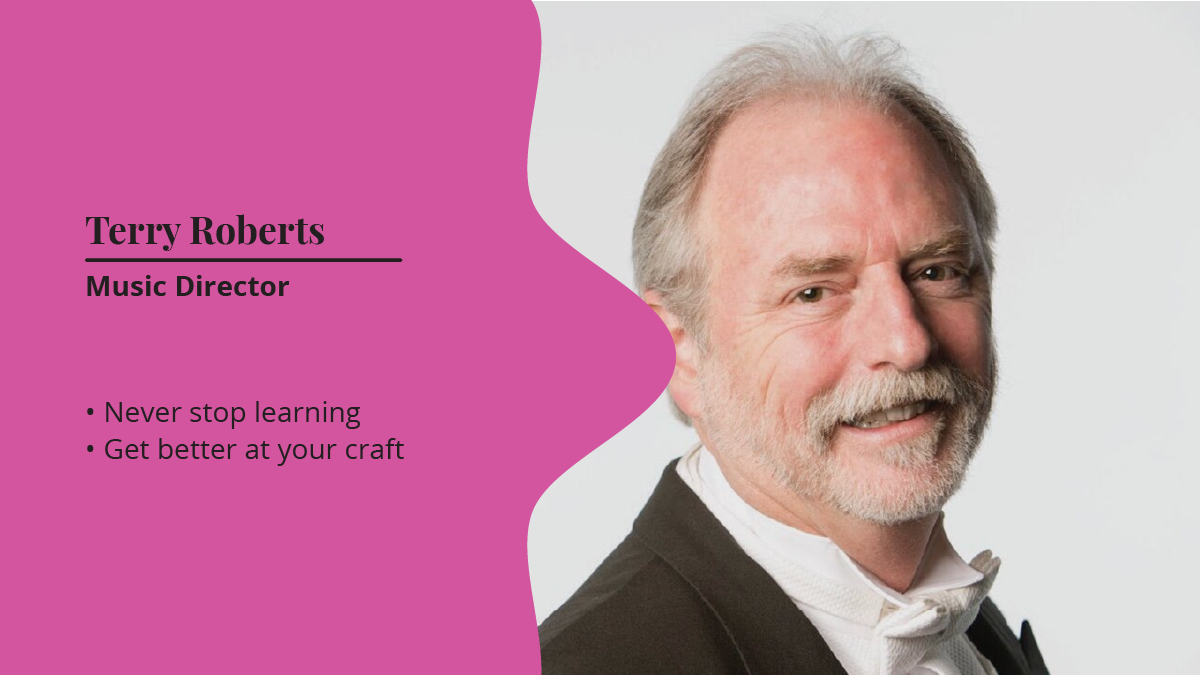
  • Terry Roberts

    Terry Roberts

    “There’s always something new to learn, if you really believe in yourself then something will happen.”

    Terry Roberts is a conductor, professor, and lifelong musician in Florence, South Carolina. He leads with passion and perseverance across every stage.

    Transcript

    Emma Plutnicki |00:01 

    Okay, so first, what do you do for work and where are you currently working from?  

    Terry Roberts| 00:06 

    I’m the coordinator of music at Francis Marion University, and I’m a professor for various different classes and ensembles, and I’m also the music director of the Florence Symphony Orchestra. So, this is all in Florence, of course. I’ve been here, I’ve been a conductor since 2003 and with the University for about 16 years. I believe.  

    Emma Plutnicki| 00:31 

    Amazing. So, what is one thing that you love about working in South Carolina, specifically?  

    Terry Roberts| 00:37 

    Well, normally, you can play golf year-round, but not now. Well, I was raised in the South mostly. I’m from Oklahoma originally, but, yeah, most of my life I’ve lived in the South. It’s a lot nicer, calmer. I had friends, one friend of mine, who’s a soloist, said “The only reason to go to New York is to get the check and leave.” So yeah, I was in Europe for a long time. When I moved back, people asked why I didn’t move to New York. I said, “Well, I can get to New York real easy. I don’t need to live there.” So yeah, and I get up there to do some gigs. But, yeah, one week’s about all I can stand in there.  

    Emma Plutnicki |01:25 

    Fair. So, what does South Carolina bring to your work? Does it have any unique influence on your work compared to working anywhere else, working in New York?  

    Terry Roberts| 01:37 

    Well, like I said, I’ve had, I’ve had the good fortune to live in several different places. So, I’m more like trying to bring what I’ve learned culturally in different countries, different places in the United States, to impart that information, if you will, to my students and also to the public, and culturally speaking simply. South Carolina obviously has a lot of history. One of my professors was a famous composer from Latta, just up the street here, Carlisle Floyd, and I studied with him when I was in Florida State University, and I played some of his works and things like that.  

    Emma Plutnicki| 02:28 

    And how would you describe kind of the working community in South Carolina? How is your local professional community?  

    Terry Roberts| 02:38 

    Oh, well, Florence especially is sort of booming. To be quite honest, when I moved here, I wasn’t going to stay, but things change you know. That’s fate, as they say, and this particular community has really just blossomed. I mean, we have two major hospitals, several major companies have moved here, and culturally, it’s just a gold mine. There’s a lot of culture going on here, and there’s a lot of talent within the community. So, it’s great. I mean, it’s very refreshing, and everyone loves to partake in the arts here, which is great. And I try to be diverse as possible, which is a hard thing to do anyway, but to include as many people as I can in the arts. So, I mean, when I had hair, long hair, I played in rock bands and all that stuff. So, you know, I’ve sort of done everything, if you will, so just a classical player.  

    Emma Plutnicki| 03:46 

    Amazing yeah, so within your working in a creative field, how do you define personal success and professional success?  

    Terry Roberts| 03:57 

    Oh, wow. Well, for me, personal success is being able to learn more every day. You never stop learning in music. There’s always something new to learn and to hopefully to grow a bit every day. Professionally, I’ve been blessed to have done a lot of different things. I’ve played in all the major, I played French horn, solo horn in Europe for 16 years, and I played in all the major opera houses, concert halls in Europe and the United States. And that was, I was very fortunate. I was able to learn two more languages, you know. So, all those things are because of music. I got to see a lot of the world. So, it, I’ve been very fortunate. And it wasn’t easy at first, I have to admit, you know, but I think everyone who’s successful has to persevere.  

    Emma Plutnicki |05:08 

    Yeah, amazing. So, you said it was difficult. Were there any fears that you had when you first decided to step into a profession in the arts?  

    Terry Roberts| 05:18 

    Well, my father has a PhD in music education. He was a chairman of music for years at universities, and so I was sort of raised in that environment. And I thought about actually becoming a pilot, that really intrigued me. But then I would have to stop playing, and I really wanted to play. And I mean, I’ve been playing some instruments since I was six years old, so, you know, and playing music is almost mathematical too, so that sort of tied in. I thought about piloting or architecture and things that, and my father encouraged me to do that because he didn’t want me to be a poor musician. But, but anyway, it worked out. So, it was hard at first. I mean, when I got to Germany, I was going to study for one year, and I had like, $250 in my pocket and a horn and two suitcases, and I didn’t know what was going to happen. And it just sort of blossomed from there. So, I was very fortunate. Right place at the right time, so to speak.   

    Emma Plutnicki| 06:24 

    Yeah, it’s great how it works out that way. Were there any people in your life giving you advice? Do you remember like the best advice or the worst advice that you ever received?  

    Terry Roberts| 06:39 

    Well, I mean, gosh, there’s so many different people. My teacher, he was very famous horn player, Erich Penzel in Germany. He gave me a bunch of tips about how to handle conductors and now I’m a conductor, so it’s funny. And I would talk to a lot of different conductors, I worked under some very big names, and I would ask them how they went into the field. And all of them, all of them, talk about perseverance, and talk about, when you’re starting out, how hard it is, and it is. You just have to be at the right place at the right time. You know, there’s, there’s plenty of people out there that can do my job, but I just happen to get lucky, you know? I tell my students, “There’s always someone waiting to take your place.” You have to think that way. You have to, you have to practice. You have to always continue to get better. You can’t just sit and do nothing. And that, I believe that still to this day. I mean, the orchestra could say one day, “oh, come on and get someone else,” you know, with different ideas, you know.  

    Emma Plutnicki| 07:46 

    Makes sense. And within your career, has there been one particular project that has made a significant impact on your life or a project that you think really showcased your creativity and kind of was the pinnacle of your career?  

    Terry Roberts| 08:15 

    I don’t think I’ve reached that yet. To be quite honest. I hope I haven’t. I’m very proud of some of the works I’ve commissioned to be premiered with this orchestra, and I’m doing another work next fall, in October, that a former student of mine is writing. So, I’m always very proud when former students are successful. It makes me, you know, it’s like having your own children be successful. You know, which I do have children, they’re somewhat successful to me.  

    Terry Roberts| 08:58 

    I mean, it’s always good, when you see someone succeed and you’ve been nurturing them and sort of mentoring or whatever, you know. So, yeah, I mean, I like helping out young people, and I think that’s probably one of my best things around.  

    Emma Plutnicki| 09:18 

    I love that. So nowadays, what does a typical workday look like for you? What’s your work process and what’s kind of expected of you on a daily basis?  

    Terry Roberts| 09:32 

    Well, one thing about the arts, it’s never the same every day. I mean, obviously at the university you have your schedule. But, like, I’ve just done three days of rehearsals with three different ensembles, Monday, Tuesday and Wednesday. And today, I gotta regroup. I’ve gotta get ready for a different ensemble. Yeah, so and then I’ll teach a bit. I always have one day, and this is my day actually. I always have one day during the week where I try to regroup, and that’s Thursday this semester. But normally I come into the office, I start answering emails, which there’s plenty of, and stuff like that, and then I’ll start studying whatever music I need to be studying for the next concert I’m doing, or next project I’m doing. And at the same time, I’m doing budgets for the orchestra, budgets for the music program, things like that and people are asking me for money and all that neat stuff, a lot of paperwork. I mean, everyone goes, “Oh, so it must be so great be a musician.” I say, “Well, you know, when you spend 75% of your time doing the other stuff, so you can be a musician, yeah, it’s really great when you make music.”   

    Emma Plutnicki| 10:53 

    So how are you able to keep that work life balance where you’re able to work on your professional responsibilities, but then also have time for personal creativity?  

    Terry Roberts| 11:07 

    It’s, actually not that hard. It’s all about time management. And, you know, teaching my students about that, that’s the one thing that you know, ever since I was, gosh, since I don’t know “it,” or whatever. The first thing I do every day is do some music. You know, whether it’s practice, listen, study or something, that’s the first thing you want to do every day. That sort of like, gets you going, then you can take care of all this, other things like that. So, I don’t think it’s hard to balance it out. I like to play golf, I like to watch sports, crazy about the football stuff right now and, you know, I try to have other interests. And everyone you know, sort of, you know -I hate saying this. Everyone thinks that I’m just focused on music. I said, “You know, I have a normal life,” you know, and that’s what you have to have, is a normal life.  

    Terry Roberts | 12:10 

    So, you have to shut it down sometimes. And I get, you know, nervous or excited, whatever. But you have to learn how to turn it off, too. And that’s, that’s difficult, and some days I’ll get pretty perturbed, you know? But you always have to look for a solution. You can’t stay perturbed. You have to figure out what you can do. After every rehearsal, I like to sit down for a second and just think about what I can do to make something better. You know, after when I teach something, did I teach it correctly? Or can I make it better? Make it more understood, if you will. So, it’s, it’s a, you know, different lifestyle. It’s not going into the office, clocking in, do your work, there, go have lunch. It’s not that. You’re sort of married to music, but you have to, just like with your spouse, you have to spend a little time away from it.  

    Emma Plutnicki| 13:20 

    That’s a great perspective to have.   

    Terry Roberts| 13:23 

    I once told someone, I’ve known my horn longer than I’ve known my wife.   

    Emma Plutnicki| 13:27 

    Yeah, there you go. True. Perfect. So just as we wrap up, are there any other questions you wish I would have asked, or anything else you’d like to add about you, know, your career and your life.  

    Terry Roberts| 13:43 

    I think the most important thing for anyone in the arts doesn’t matter, music, art, theater, whatever, that you cannot become discouraged. And that’s easy to say, very easy to say, because I have been discouraged many times. I’ve done auditions all over the world, and, you know, been disappointed, gotten almost there, and you feel really disappointed afterwards, but you have to persevere. You can’t just stop, you know. If you really love what you’re doing, it doesn’t matter. And I used to say, “the money will come later.” Yeah, you have to pay bills. Yeah, you have to know how to do a budget and all that stuff. But, if you persevere, if you really believe in yourself, then something will happen. It might not be exactly the way you thought. I mean, I didn’t think I was going to be a professor. After growing up that way I swore, I’d never do that. Here I am, you know. So you just never know the path, you have to be flexible and persevere.   

    Emma Plutnicki| 15:22 

    Well perfect. Do you have any other creatives in your life that you think would be good for us to interview? Can you think of anybody?  

    Terry Roberts| 15:40 

    My wife, she was a prima ballerina in Pacific Northwest Ballet in France and we met in Monte Carlo. We were both working there, and she does the ballet here. She’s artistic director of the South Carolina Dance Theater.  

    Emma Plutnicki| 15:58 

    Okay, amazing. If we could get her contact information, or I can send you the link to nominate an individual.  

    Terry Roberts| 16:05 

    I’ll just email you her email address and whatever.  

    Emma Plutnicki| 16:08 

    Okay, amazing. That’d be great.   

    Terry Roberts| 16:11 

    She’s seen more of the world than me. She has literally been around the world. But she’s from Wilmington, North Carolina, of all things. And she went to North County School of the Arts and studied. Well, she’d been dancing since, professionally, she started at 17. Dancers have a short lifespan, you know. Then she went into teaching, so I never saw her dance. I met her when she was finished dancing, so.  

    Emma Plutnicki| 16:41 

    She’s got to still be dancing a little bit these days, right?   

    Terry Roberts| 16:44 

    Well, she demonstrates. And sometimes she says, “I shouldn’t have demonstrated that.”  

    Emma Plutnicki| 16:50 

    Yeah.  

    Terry Roberts| 16:53 

    So, she choreographs and runs the ballet here.  

    Emma Plutnicki| 16:57 

    Okay, amazing. That would be great if you could send that over.  

  • Shaquasia Coleman and Labria Strong

    Shaquasia Coleman and Labria Strong

    “Get used to being uncomfortable. You have to feel uncomfortable to get to new levels, because it’s something you haven’t done before. It’s ok to feel uncomfortable. That means you’re doing something right.”

    Labria Strong

    Sisters Shaquasia Coleman and Labria Strong are co-owners of Juice Crush juice bar in Conway. They are both from Myrtle Beach and attended the University of South Carolina (USC). Shaquasia earned a degree in public relations, and later, two Masters of Business Administration degrees, and Labria earned a degree in public health. Labria is also a real estate agent on the Grand Strand.

    Interview

    Transcript  

    Shaquasia Coleman 0:00 

    My name is Shaquasia Coleman, and I am from Myrtle Beach. 

    Labria Strong 0:04 

    My name is Labria Strong, and I am from Myrtle Beach. 

    Sara Sobota 0:07 

    Okay, what do you do for work? And where are you currently working? 

    Shaquasia Coleman 0:12 
    We are entrepreneurs, and we are currently working from our storefront location in Conway. Our business is named Juice Crushed 

    Sara Sobota 0:12 

    Okay. How long have you had it? 

    Shaquasia Coleman 0:14 

    Well, we started the business in May 2020. And we have been inside our storefront since September 2021. Almost 3 years in the storefront. Four years in business in total. 

    Sara Sobota 0:33 

    Okay, and your official job title is Co-owners? 

    Labria Strong 0:36 

    Yes. 

    Sara Sobota 0:37 

    Okay. Great. How did you end up in this field? And how did you hear about it? 

    Labria Strong 0:42 

    So, we started creating juices, cold-pressed juices, and smoothies for our mother, who was diagnosed with colon cancer stage four. She did not have an appetite after Chemo treatments. We wanted to make sure she was able to get her nutrients somehow. 

     
    So, I have a public health background from the University of South Carolina. So, I looked into juicing and making smoothies, adding a little bit more protein, because she would drink but not eat.  

    And so, after she unfortunately transitioned in 2018. Shaquasia and I decided that we needed to continue to juice and make smoothies just because of all of the health benefits that we read up on. And during COVID, all of our family and friends decided that they wanted to juice and have our smoothies, and we kind of went from there. 

    Sara Sobota 1:38 

    So, where are you blending? And you have told me the story before, and I have written about it before. You had public health and Shaquasia; you had business, was that the blend? Tell me about your college degrees. Did you both go to, you both went to USC. 

    Shaquasia Coleman 1:50 

    Yes. But our career paths totally took a different turn. In college, I went to school to get my degree in Public Relations. And then, I received a job opportunity to work in student housing. So, I worked my way up through undergraduate from maintenance girl outside to at least a manager, to Assistant Property Manager to working in a corporate level. While in college at the University of South Carolina. Labria, it was a bit of nepotism; she used to work for me as one of my community assistants at a student housing property in Columbia, which started her career in real estate. She’s a realtor here in Myrtle Beach. 

     
    So, we started property management, which helped us a lot with business because we’re managing million-dollar assets for someone, you know, and making sure that everything’s running smoothly and orderly, on the property side. So, it’s helped us tremendously with business. I also have an MBA as well; two MBAs. So, it helped a lot. You know, our backgrounds helped us a lot with becoming entrepreneurs. It was not easy, but it’s been a smooth run so far. 

    Sara Sobota 2:58 

    That’s great. And that was the next question: What background did you have that helped you land that role? You kind of talk through the stages that you went on. This is going to be a little tricky, but can you walk us through a typical workday? 

    Shaquasia Coleman 3:10 

    Yeah, that is gonna be tricky. And then to go back to how we blend it, the recipes, I don’t know if you’re going to access that before. But we came up with we were looking at the elements in the community, that people we know that their high blood pressure or diabetes, you know, we were looking for the fruits and vegetables to help out with these certain elements. 

    Shaquasia Coleman 3:28 

    And then, we got with one of our sorority sisters, who was a doctor in Internal Medicine. And she went through all of our recipes and told us to add this or add that to, you know, make sure they get more benefits out of that one particular juice.  

    So, that’s how we came up. We had juices, ABC, D, and G. And then, we went through, got with her and then we started making names for everything. So, it all flowed together while we were getting Juice Crushed together. 

    Sara Sobota 3:54 

    So, you created it for your mother, but then it sorts of evolved with input from experts. 

    Shaquasia Coleman 4:03 

    Because of our mom, it was simple. You know, we just wanted her to get basic nutrients, but we didn’t know what we were doing. So, it will be some carrots here and there. Make her a smoothie. But as time went on, and we saw that there are people who are actually needing this and that and this, then that’s when we were getting more creative. 

    Sara Sobota 4:22 

    Yeah, right. 

    Shaquasia Coleman 4:23 

    Yeah, for sure. 

    Sara Sobota 4:24 

    So, your audience for your business or your demographic is nearby but also broader. 

    Shaquasia Coleman 4:31 

    Right? 

    Sara Sobota 4:31 

    Okay. 

    Labria Strong 4:32 

    Because we all know someone who has some type of health issue, you know. If you go into a room like and you say, hey, who knows someone who is battling high blood pressure, everyone kind of raised their hand or someone wwho isbattling or, you know, has fought cancer and overcame, you know.  

    So, someone knows someone that is going through some type of health issue. So, we can relate to everyone in that aspect, right? Um, so it’s kind of just made it seem like, “Hey, I know what my maternal mother and grandmother and you know, were facing and what they went through.” And then I talked to a neighbor, and they had similar issues. So, we were all kind of, you know, fighting this together and trying to make sure everyone is healthy. 

    Sara Sobota 5:16 

    Yeah, that makes sense. Okay. The next question is, can you describe a defining moment in your creative journey? A project that made a significant impact on you— on you, or something you produced that really showcased your creativity? Yeah, it’s probably hard to pin down one thing. 

    Shaquasia Coleman 5:35 

    I mean, so our creative journey has been going on lately. I’ll give you an example. And then I’ll go back to that last question. Because I don’t want to keep jumping over your questions, we are. This is something that we just had done while, for the storefront, well, we had it done for our Myrtle Beach location, but we’re no longer going there. 

    Sara Sobota 5:54 

    Okay. 

    Shaquasia Coleman 5:54 

    So, we had to come together to put this whole together with our artists who did all the painting. We made sure we had certain elements or elements from Juice Crushed, like the orange or the actual, just the names we have on T-shirts, like Juicy. Juicy Baby is something we have on the shirt, of course, juice crush, and then crushing it down at the bottom. But it is a social media wall, and people are attracted to colors.  

    So, we got what are and of course, we got the cancer statement that everyone says, “Detoxin’,” but we got what our artists who did our first wall, and she did a couple of other items for us to create this wall, just so we can get people in for our marketing, our marketing aspect. Because again, like I said, people are attracted to colors, social media, and pictures. 

    Sara Sobota 6:43 

    Yeah. 

    Shaquasia Coleman 6:44 

    So, it’s been a huge hit. That’s the latest thing we’ve done a lot of, you know, I am just trying to pinpoint some other things that we’ve done. But that’s the latest thing that we have. But as far as creativity, our day-to-day, it’s kind of hard, the two of us, I feel like I don’t get enough sleep. So, we tried to touch one thing we always do. Which is touch base with each other in the morning. Because listening, you need to make sure we’re both alive and well ready.  

    So that’s number one. But we always make sure to give each other grace until at least eight o’clock, you know, because maybe I’m at the gym early, or she is out doing something, or she is working on real estate work in the morning. But we typically get here around 9:30, we set up, and we have orders that meet us at the door online, or they are here at 10. 

     
    But throughout the day, all day, if we do not get our work done, there are many outside things that we need to get done before we step into the store. It just won’t happen. So typically, we are on our feet for almost 12 hours just juicing and making orders and meeting with customers, and there are people who come in who want us to do, you know, coping and opportunities or want to partner and things. So, we are busy and on our feet for the entire time the store is open, and then afterward. 

    Sara Sobota 7:59 

    So, what are the hours of your store? 10 am too? 

    Shaquasia Coleman 8:00 

    6 p.m. 

    Sara Sobota 8:02 

    Six, so yes, wow. 

    Shaquasia Coleman 8:05 

    We tried to open earlier because you wanted to meet that crowd, but it just wasn’t a hit for us. We know we know that we started at eight o’clock when we first opened up, and we probably could have given it some more time, but it just wasn’t working for us and our schedules. 

    Shaquasia Coleman 8:18 

    So it’s like, you know, you have to do what works for you as an entrepreneur, and we’re passionate about something, you’re going to make it work. But 10 o’clock was like when we started noticing that our customers were coming in and the lunch crowd.  And a lot of people love the Grab and Go method here. So, you know, we love that as well. They put their orders in, they got this ready, and they got it. And that is that. 

    Sara Sobota 8:40 

    Yeah, that sounds great. Okay. 

    Shaquasia Coleman 8:41 

    And then we go home, go to the gym and start all over again, and do it again. I am normally, personally, in bed until midnight. I do not know about her. 

    Labria Strong 8:51 

    Depends on the day. 

    Shaquasia Coleman 8:51 

    Yeah, nowadays. Just because that’s all we know. You know, when people come in with us ask them what they have gone out for the weekend. And we tell them we’re living through them. Because, you know, we understand the first five years you’re gonna be in tune and focused on the business, and then after that you can feel comfortable hiring people. But I love that we’ve made our names known ourselves, and we didn’t have anybody in here, you know, either tearing down a reputation or it’s solely on our back. So, we appreciate that. 

    Sara Sobota 9:20 

    Yeah, that’s a lot. Okay, so let us say that someone is watching this video and they want you to be. Can you recommend any specific skills that an aspiring applicant should have to increase their chances of landing a role like yours? 

    Labria Strong 9:36 

    How can I serve it? You know, I feel like the generation now is solely like always on the phone and you know, they’re not having that person-to-person interaction as much as you know, we had to where you had to like five minutes before you can get like an unlimited plan, but people by people, and you know, Shaquasia was always telling me this one when I was working for her, you know, people will come back to you if you make them feel good. Or if you make them feel like I’m being attentive to your needs, right? 

    Labria Strong 10:09 

    And it also ties with me being dual career in real estate when you are paying attention to what your clients or customers are asking for. And you can say, “Hey, how about this,” or “Let’s try this.” We’re making sure we speak to everyone who comes in here we are, you know, we make sure that they feel if they spend their money here, that is worth it. And they did not feel because you know buyer’s remorse, as you can say. So, customer service is definitely huge. Number one, number one, for sure. 

    Shaquasia Coleman 10:40 

    And Time-Management. Time Management is super important. Because, you know, we have a background in dealing with people on a daily basis, in property management and real estate. So we are, we know that time is valuable not only for them, but for us as well. And we hate to have anyone waiting longer than 20 to 30 minutes because it’s, I mean, it is juice, so they understand it’s gonna be a little wait, especially if they didn’t put their order in. But if it’s longer than that, then I feel totally bad. You know, we’re always apologetic. We make sure we make up for it in other ways. 

    Shaquasia Coleman 11:12 

    But time management is key; I don’t want anyone to be waiting on me longer than they need to. So, make sure you’re getting things done in an orderly fashion and on time. And that. So those are two important, important things. And then being very detail oriented, that is awesome as well, like social media is so important when we are putting up posts and content that we are being specific.  

    And letting them know those two are those couple of key words because people their attention, their attention span is. So, we have been, I like to say like me personally, how much longer am I going to read that whole caption? No, I’m not. I see the words on the video, or I see the words on the picture, then I understand what to do. 

    Sara Sobota 11:52 

    That makes sense. Yeah. Okay. Are there any local organizations, programs, or events that you recommend for aspiring creatives around the state? Are there any things that you belong to or go to that someone could get involved in if they were interested in following your path? 

    Shaquasia Coleman 12:11 

    So, the two of us are also members of Delta Sigma Theta Sorority Incorporated. So, you know, if you’re into being in a sorority and fraternity or fraternity, we have local chapters here, in Horry County, and throughout the Grand Strand, so that’d be one. And that’s a lifetime thing that we are involved in. 

    And then I just completed the leadership branch and program for the chamber. I would recommend that to anybody who has a chamber in your city to get involved, because it taught me a lot about how to become a better leader, I was always a leader, but to know ways in which I can become a better leader, and then get involved in the community at the same time, because we had a community service, along with having enriching relationships with people I probably never would have had relationships with.  

    So, if that’s in your city, I definitely say to make sure you get involved with your chamber, we’re in the chamber. And we’re both trying to get to Conway; we are already in Myrtle Beach. 

    Labria Strong 13:13 

    So, and then also, we just joined the Horry County Community Collaborative, so they call it HC Three. And there’s different nonprofits and businesses that pretty much come together for a common cause just to make sure that the community has their resources. Everyone is kind of brain picking about different resources that the community actually needs.  

    And so, you are working with different agencies and organizations for the same calls. And you know, you just never know who you will meet there that can help you with your business or say, hey, here’s an idea that I’ve seen, or some type of grant or anything that might be out there. So, it helps you definitely network for the same. 

    Sara Sobota 13:57 

    Yeah. Okay, great. And then, last question: do you have any advice for current college students or pre-professional young adults who are pursuing a career in the creative world? 

    Shaquasia Coleman 14:09 

    Being creative, you can’t worry about anyone judging you; you have to push the envelope and continue to do it until it sticks, you know. Because if you’re going here blindly, and you’re thinking they’re going to accept every single thing that you put out, it’s not going to work, and it’s going to lower your confidence as well. So, make sure you’re focused on what you’re trying to create and put it out there, and also to extend your grace, like a lot of grace.  

    Yeah, no timeline, either. Yeah. Someone who’s getting out of college like we put so much pressure on ourselves to think at 25 I need to be married with a kid or by 30. I should have three children. It’s just so many pressures, societal pressures that are placed on us, especially through social media, where we’re having this; what’s it called that imposter, imposter syndrome? Yeah, Imposture syndrome is tearing us up.  

    So, give yourself grace. Sometimes we don’t know, and I’m talking to myself saying this, but you know, get used to being uncomfortable because you know, you have to feel uncomfortable to reach those different levels because it’s something that you haven’t done before. So, it’s okay to feel uncomfortable. That means you’re doing something right. 

  • Edward Howard

    Edward Howard

    “Do your best, and never settle for seconds.”

    Eddie Howard, from Greenville, South Carolina, is the Director of the Recording Arts Program at the Fine Arts Center. Establishing the program in 2007, Eddie Howard teaches both younger and older students how to record music.  

    Interview

    Transcript

    Edward Howard 00:00 

    I am from Greenville, South Carolina. I teach the Recording Arts program at the Fine Art Center in Greenville.  

    Haley Hansen 00:07 

    How long have you been working there?  

    Edward Howard 00:08 

    Well, I started the Recording Arts program in 2007 as an afternoon class, teaching high school students- the art of recording. It’s like a recording studio. And that’s what we have. And so, I’ve been teaching afternoon classes since then. But we just added a morning class, so, that is it is doing I’m doing that full time now.  

    Haley Hansen 00:28 

    What is your official job title at the Fine Arts Center?  

    Edward Howard 00:31 

    It is the Director of Recording Arts.  

    Haley Hansen 00:33 

    Can you walk me through a typical workday there?  

    Edward Howard 00:36 

    Okay. Yeah, we have a morning class of younger students who are more on an entry level, just learning how to record the very, very basics. So, I walk through and demonstrate different things they have, they do some book work, but it’s mostly hands-on.  

    Edward Howard 00:53 

    And then my afternoon class has little older students. They are typically 11th and 12th graders, sometimes 10th graders.  And most of those students are already recording when they come into that class. They have figured out ways to do it at home, and so they have some experience going in. So, they just kind of come in and take it to the next level.  

    Haley Hansen 01:16 

    How did you end up in this field? 

    Edward Howard 01:18 

    My uncles, my mother’s three- four brothers built the first recording studio in Greenville, South Carolina, in 1958. And so, my dad used to love to go hang out in the studio when I was five or six years old. So, we, for years, really all my life, would go hang out at the studio, sometimes at nights and on weekends when they were doing sessions. So, I kind of got the studio bug from that.  

    And then later, for the last couple of years in high school, I was a guitar player. And that was involved in a couple of bands between 1971 and ’74. We finished high school in ’72 and hit the road, and the band got very, very busy. And we were staying gone so much, I just did not like traveling that much.  

    And so, I decided to come back to Greenville, and wanted to get into the studio business. And so, that is what I did, I came back to Greenville in ’74, started hanging out at the studio, and went to work there in ’77, spring of ’77.  

    So, I worked in the studio ever since I’ve been in the recording business; I have owned three different studios, been part owners/partners, in three different studios. And I’ve built several studios for people as well. So, that’s what I’ve done.  

    Haley Hansen 02:34 

    How did you wind up at the Fine Arts Center? 

    Edward Howard 02:36 

    Well, a friend of mine, Steve Watson, who is retiring this year, has been directing a jazz program at the Fine Art Center for 27 years. He and I met in 1985 when he first moved back here from L.A., and he and I worked. We did a number of jazz records together, and a number of albums together in the studio. Became friends and just have ever since.  

    And so when they built the new Fine Arts Center in 2006, I believe it’s when they were it was under construction, he called, and he said, “I think I can get the budget to put a recording rig in my jazz class, I just won’t be able to record my kids.” And so, we met, and I consulted with some folks there about what kind of equipment to put in, and you know, everything had gone Pro tools and computers and stuff by then. So, he did that. And they installed all the equipment.  

    And every couple of weeks or so he would call and say, “Can you come by on Thursday afternoon or something and record the kids?” And so, I’d go over and do that every couple of weeks or so. And I will say recording one day in 2007, I believe it was, and Dr. Flour, the director at the time walked in, and he said, “Oh my gosh, we’ve got $80,000 worth of equipment in this room, and we’re not doing a recording program.” And so, I said, “I’ll help you start it. And I give you the afternoons, that’s all I can give you: two-hour afternoons.”  

    And so, we did that and started our first semester, which began in 2008. I think it was fall of 2008, and that has a two-hour afternoon class. And then we just added this past year, added the morning class. So doing a morning and afternoon class.  And I have about 20 students now.  

    Haley Hansen 04:16 

    Are you still teaching out of the first studio you helped design there? 

    Edward Howard 04:19 

    Where? 

    Haley Hansen 04:20 

    At the Fine Arts Center, like the one that you were hired as a consultant for? 

    Edward Howard 04:24 

    Yes, that’s our main control room. And since then, since we started the program, we’ve added two spaces. There are two rounds that are about 12 by 12 spaces. One of them has three workstations in it, the other one has four workstations.  

    Haley Hansen 04:39 

    Do you have a defining moment in your creative journey that made you realize this was what you wanted to do with your life like a particular project that you worked on?  

    Edward Howard 04:48 

    No, really, I had always loved the recording process. And even when I was traveling on the road before I always had in the back of my mind that “You know one day I need to get into the studio that’s what I need to do.” And I really just kind of knew that. I had grown up around it and had seen enough of it to know that that’s what I want to do. And so, I did that and started in ’77. And I have been doing it ever since.  

    Haley Hansen 05:14 

    What was the biggest adjustment or challenge that you faced when you started your current role at the Fine Arts Center? 

    Edward Howard 05:20 

    Well, when Dr. Fluhrer, Roy, is what we always called him. When Roy asked me to start the program, I said, “Roy, I’m not the teacher. That is not something I feel like I do.”  

    My biggest challenge was learning how to teach, learning how to develop curriculum. I have done some workshops. Me and a friend of mine used to do some workshops in the studios, but it was mostly for adults, producers, and arrangers and musicians who wanted to learn how to record. They wanted to learn the technical side of the recording.  

    So, I’ve never been in a position to teach kids, you know, students. So that was probably the biggest challenge. Learning that, but the faculty, the other teachers, these guys are just incredible people. And they were so helpful to help me to learn how to do stuff like that, how to develop a curriculum, how to teach, you know, how to teach a class. Yeah, it’s a whole different thing than recording with a bunch of professional musicians. 

    Haley Hansen 06:24 

    Do you recommend any specific skills that someone aspiring toward you, toward your field or position like yours should try to develop? 

    Edward Howard 06:32 

    Just learn, learn how to do it yourself. You know, most of my best students come in, and they’ve found free software programs at home. And they found out ways to do it. And a lot of them are just doing stuff on their phones nowadays. And they come in with these demos, impressive demos that they’ve done with them, on their phone, with free software. And that’s, that just seems to be the best way to get started with it.  

    And a lot of times when I am interviewing students, one of the first questions I ask is, “Are you already recording?” And if they say, “No, I’ve not done anything yet.” So, I’ll tell them, “Then find a way. Go out and find your way. There’s free software all over the internet, you could do it on your phone, you can do it on iPads, if you have the luxury of having a good computer available, you know, even better. But find a way to do it.” And that’s really the best way for them to learn the basics, to start learning the basics. 

    Haley Hansen 07:31 

    What’s something that you want your students specifically to learn about pursuing a career in a creative field? 

    Edward Howard 07:39 

    The biggest thing you know, some of the biggest things I have tried to do with them is to teach them how to be self-disciplined. Teach them how to manage projects, manage their time and do their best, you know, never settle for seconds, go in for the best sounds. And because if they go out in this business as a recording engineer, or producer, or composer, that’s what the challenge is going to be in the real world. 

    Haley Hansen 08:02 

    What would you say is the hardest part of advising students for college and for career-readiness? 

    Edward Howard 08:08 

    In this kind of work, in the recording work, the college of choice has more to do with where do you want to be when you come out on the other side? Because they’re their universities around the country. Almost all universities have great recording programs now. Unlike when I came along, there were no educational, no colleges, were offering any kind of training in recording field, and audio or video. And so now just about every university has serious recording programs.  

    But each university tends to steer students in a particular direction. So, if you go to Nashville and Belmont, you are probably going to end up in Nashville, you know. So, different universities and different programs tend to guide students in different areas into different parts of the country. So, you have to kind of look at their programs, and look at their internship programs, and see where do they push students at the other end? You know, and where do you want to be? You want to be in New York, you want to be in Dallas, LA, you know, or in a small town somewhere, like Greenville?  

    Haley Hansen 09:13 

    What part of that process of preparing students for college and career readiness would you say that you’re very successful at? 

    Edward Howard 09:20 

    Just teaching at a commercial-level, recording. Teaching them how to how to record music, you know, live music and digital music. And how to produce music. How to work with people, you know. I really encourage my kids to collaborate on projects because they will learn 10 times more collaborating with someone else than they will if they just sit down at their computer and work in a bubble. The progress they make will be very slow for most students, generally, but they will progress much faster if they work with other students creating music projects. And that prepares them for university level. 

    Most of the college programs, that are doing recording programs, I constantly get feedback from people from the universities, that will tell me that my, my students that go into those programs, they’ll tell the students, you’re going to be bored for the first semester or maybe for two semesters, because it takes that long for, for my students to catch up with where you are. So, they’re getting a real boost ahead in the recording program, you know, if they decide to enter a four-year program of recording. 

    Haley Hansen 10:31 

    I know that some of the colleges in South Carolina have an arrangement with the Fine Arts Center, that the classes there count as college-level courses. I took creative writing there, and I got credit for a creative writing class at Coastal [Carolina University. Does your program have anything set up with colleges like that?  

    Edward Howard 10:51 

    Yeah, we try to get colleges to do as much of that possible. We have actually had a contract with Clemson for a number of our programs, with Clemson University. Were with Recording Arts, they can test out of a semester, or they might test out of two semesters.

    So, if they decided to go into the Recording Arts program, depending on what level that they’ve learned in my program, they might be able to skip a semester at Clemson, for instance. And we’re working on more universities that do that there. A lot of universities will talk about that. And they’ll say, oh, yeah, that’s a great idea. But it is a very time-consuming thing to put together an agreement like that. It’s a very complex agreement.  

    Haley Hansen 11:33 

    Are there any organizations or programs, or events that you recommend for folks in South Carolina who are interested in your field?  

    Edward Howard 11:41 

    For universities?  

    Haley Hansen 11:43 

    Universities, or summer camps, like getting involved in the community, or anything like that? 

    Edward Howard 11:49 

    Well, I encourage them to get involved in the community, all they can. They can go to other studios and hang out, or they go hang out at some live concerts and just kind of get the feel of live music as well. But there’s not a lot of programs, summer camps, for that kind of thing.  

    We are actually doing a thing this summer, called Summer Intensive, where a number of our programs at the Fine Arts Center are doing one week, three hours a day for a week. Four days, it’s just four days, not a week. And so, it’s kind of like an icebreaker for a student that would be coming into my program. And I’ve got several students that have enrolled in my program next Fall that are coming to the Summer Intensive thing, just to kind of get a leg up on it, you know, get ahead of the game. So that’s a particular thing.  

    But you got universities, like in this area, immediate area, you’ve got UNC Charlotte, you’ve got Francis Marion, I think Coastal Carolina has a program, Clemson has an incredible program, the USC [University of South Carolina] has a program. And so, most of the universities nowadays are doing really good Recording Arts programs.  

    Haley Hansen 12:57 

    Before we end the interview, do you have any advice for current students or young adults who are pursuing a creative career? 

    Edward Howard 13:05 

    You know, Dr. Fluhrer, the guy who started the Fine Arts Center and ran the Fine Arts Center for years, always had this whole thing…. All the time I’ve worked around him, he had this little saying, and he would say he would just say, “Do the work.” You know, just a simple thing. And that’s coming to school every day, doing the work, you know, not lollygag, not hanging out, just talking.  

    But you know, I think for the Recording Arts Program, I tell parents and students, this is not if you’re not a very self-disciplined program, this is not for you. Because we don’t have a class where I gather everybody up every day. And today’s students, this is what we’re going to never happen. Everybody works at their own pace at their own level. And that’s the way the real world works. In the recording business.  

    You know, nobody in the recording world wants to be paying a studio musician or a recording engineer or producer and has to say, “Come on, guys, let’s go for it. Let’s get this done. You know, they don’t want to be pushing people. You know, they want people to work there because they love what they do, and they do it well. And that’s what I try to get my students to learn, learn how to do the work and do it well. 

    Haley Hansen 14:20 

    Is there anything else you think it’s important to say before we end the interview?  

    Edward Howard 14:24 

    No, just self-discipline and do what you love. My dad used to tell me, “Whatever you decide to do, make sure it’s what you love to do.” There’s no reason why anybody should hate their job or their career. And so, when you choose students when they choose, we just try to encourage them to choose the right career for the right reason. And choose something that you love to do.

    You know, not something that your parents want you to do, or somebody else is pushing you to do it. Or not because you think, “Oh, I’ll look at that career because you can make a lot of money.” You know, you can’t do it for the money. You know, the recording business is a very lucrative business for people who are very self-disciplined and determined. It makes a great career. And if you do that for the right reason, the money is always there. 

    Haley Hansen 15:17 

    Well, thank you for taking the time to speak with me.