“The best outcome is when I’m not worried about how it’s going to be professionally, we need rawness, weirdness, and vulnerability.”
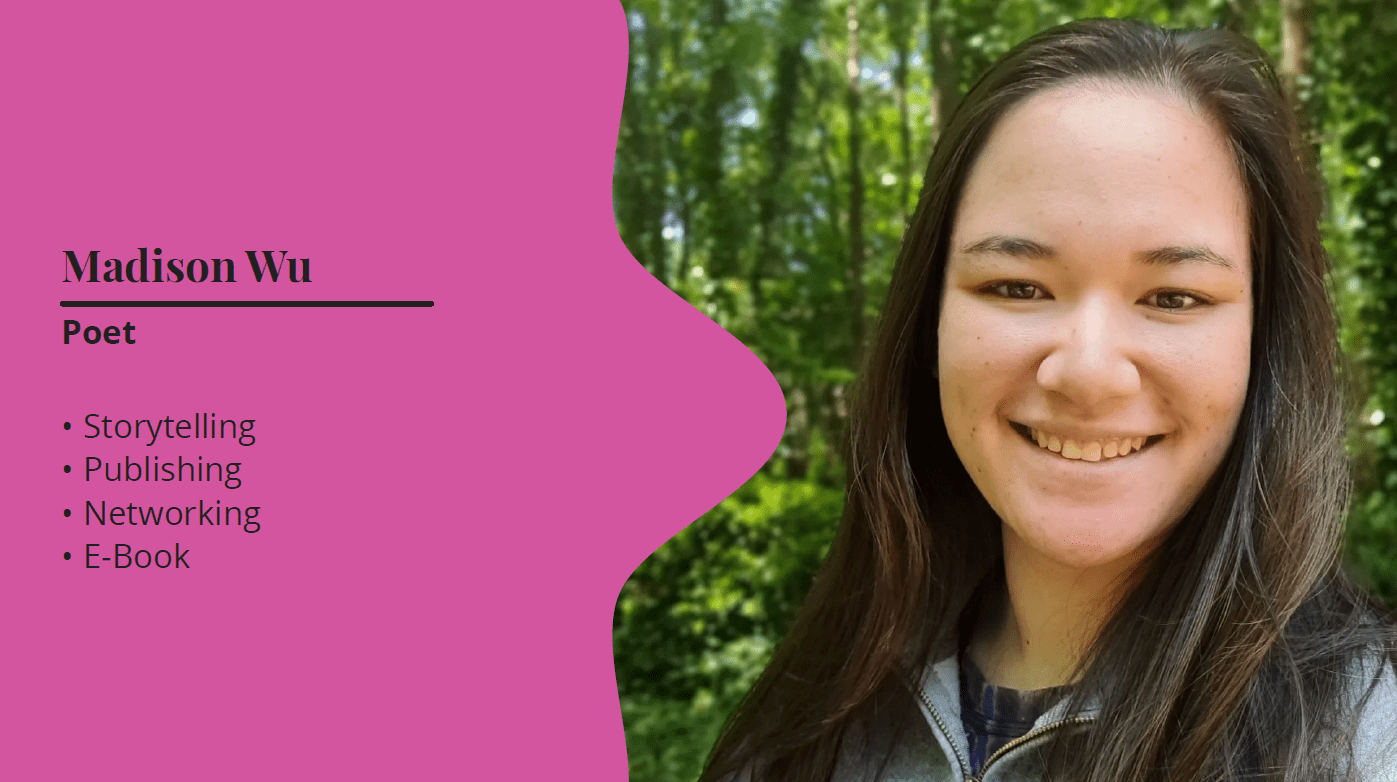
Madison Wu is a self-employed author based in North Carolina, crafting poetry, fantasy, and contemporary stories centered around inclusivity, vulnerability, and self-discovery.
Interview
Transcript
Nora Smith
Thank you so much for taking the time to speak with me. I’m super excited. So just to get right into it, what do you do for work and where are you currently working from?
Madison Wu
So where am I currently working from? I work from home. I work from my room most of the time. And what do I have to work? I write. I write literally anything that I can think of, usually stories of some of some sort.
Nora Smith
So cool. Do you work for yourself, or do you work for a Smart Company at all?
Madison Wu
Yep, I work for myself. I am hoping to, um, become traditionally published in the future, but I am currently self employed.
Nora Smith
Awesome, awesome. Um, how long have you been doing that for?
Madison Wu
Since 2022 so I started my first full book manuscript in 2022 and and then I just didn’t stop.
Nora Smith
Awesome. What kind of, what kind of like, what kind of the genre do you write?
Madison Wu
So poetry, right now, my only publish published work is poetry. I have a poetry book that I started writing because I saw something that said, if you’re afraid to get published, write 100 Poems and publish it on Amazon for free, and then you’ve been published, and you can’t tell anyone that you’re afraid to put your work out there anymore. And what was supposed to be 100 Poems turned into a lot more than that. I can’t remember the exact number, and what was supposed to be an ebook with a cover made on whatever free version of Photoshop ended up being an actual book that I self published through Kindle Direct. And so there’s that my one of my manuscripts that I have finished is fantasy, and I am currently working on a contemporary piece. I really like to explore genres. I really like to not fit myself in a box. I’m also working on a Spotify as a plot for a James Bond esque type thing that I want to do. But more than genre, I like to focus on themes. So themes like diversity and inclusivity, and the one I’m working on right now is is really about is really about being a woman in a man’s world and growing up and getting your first job and all that kind of stuff?
Nora Smith
So cool, so cool. I’d love to read some tone time. What is one? Do you have one specific thing that you love about working in a creative field, specifically in South Carolina. Like out of all the places you could be, is there something that you love about being in your specific area?
Madison Wu
I think the thing that I love about my specific area is that I actually am located in North Carolina, but like most of my community is in South Carolina, so the I think the people that are around me, even though I don’t even if they aren’t in The creative community, or they don’t work in creativity themselves. They are so supportive. I don’t know if that answers the question. I can’t. No, that’s great. That’s great. I think that when you’re a writer, you’re constantly exploring the world and constantly meeting different people, and learning about different things, and being able to take all those experiences and put them into stories is such a fun thing.
Nora Smith
Yeah, great, great. I love that. Do you think the area has contributed in any way to your work, like has it had a unique influence of any kind on the work that you do.
Madison Wu
Um, I think that I live in, I live in a an area where if you go 30 minutes north, you hit the city, and if you go 30 minutes south, you hit rural area, and I think that, I think that you know, for me being I’m Asian, American, I’m disabled, I’m I’m part of the LGBTQ community, all those things. Things, and the lack of representation that I generally see just around really contributes to me wanting to put more representation out there. But it also when you find those people in the area, makes it and they’re excited about that kind of stuff. It makes it really cool and really fun and really special.
Nora Smith
Yeah, I Yeah, that’s a great way to go about that, to look at that, to have it turn it in or inward, or do something great. So this is kind of a similar question to sort of what we were just talking about. But do you have, like, a specific way that you would describe the local community around you?
Madison Wu
Um, the local community around me, or the local community that I live in? I feel like those are two different things.
Nora Smith
Oh, I would just say, like, the local professional, like, who you work with, the people who you kind of, if you have any, like, networking you know, other writers, that sort of ordeal, just like the general census of, like, your relationships with, like your other professionals, if you know any people, maybe,
Madison Wu
yeah, so, um, Actually, my, my cousin is about she designed my, my book cover, and she’s just been, like, super, super helpful and in that, and just being a creative presence. And she, she’s about to graduate from Clemson, wow. And she, she’s a she does graphic design, and being able to work with her, because our our families, our families, are not from around this area, so being able to work with her is really cool in the fact that it was, it’s say, away from home connection that makes any sense.
Nora Smith
I totally get that. I totally understand exactly what you’re talking about. Great. How would you yourself define success? Like, what points have you reached? Or what points do you think you will reach in which you feel you’ll be like, Oh, this is it. I’m successful. Do you have any examples of that? Or how would you define that?
Madison Wu
I think that, for me, I think success is finding joy in what you do. And I definitely, you know, I think there’s, like, there’s, there’s little things of success everywhere. When you reach a word count in a book, when you reach a stage where you’re, you know, ready to start working with other creatives so that you can take your work a step further into the world. I also think that there’s something really successful about connecting with people through through anything pretty, through art. So I remember my, uh, someone had, uh, gotten my poetry book and actually told me that they got extra copies because they liked it so much they wanted to be able to keep extra copies in their car so when they go to different places. If they meet a cool person, they can give them my book.
Nora Smith
That was, yeah, I was like, Oh my God, that’s the cool like, that is the coolest thing ever. I think that’s I would love that. I’d be like, oh my goodness, really. Okay, great. Um, so did you have any really big fears when you decided to pursue a career in the creative field? Or what if you had fears? What was your biggest fear?
Madison Wu
I think my, my biggest fear that I’m still getting used to is criticism, and not from a not from a like, oh, I don’t want to learn more. I don’t want to explore more. But I think that anytime anyone does anything creative, it puts you in a vulnerable position. It’s like, if you really put your your heart and your soul into your art, and then someone says something bad about it, from a a perspective of not understanding the artwork for what it is. Um. You know that that’s hard, and I think that that will I think that’s just something that is constantly present in life, and I am slowly but surely always working on on closing that gap until one day I can just be like, I’m writing whatever I want, and I don’t care what anyone says,
Nora Smith
right, right? Yeah, criticism is hard, especially with art. It’s so it’s so vulnerable. And you you know, it’s so scary doing stuff like that, it’s actually terrifying. So have you had a defining moment in your creative journey, like a particular project or something that had a specific impact on you, that really showcased your creativity.
Madison Wu
Oh, god. Oh gosh. That’s how do I pick one?
Nora Smith
You didn’t give any of them all.
Madison Wu
I think so I had to, I I had to stop going to school because of my disability, and that was really hard. And the moment that I decided, like, okay, you know what? That’s fine. I’m gonna give up science, and I’m gonna do art, I’m gonna do that. I think that that in itself, was a defining moment. I think it’s, it’s the moment that, the moments that I decided things, um, when I decided that I was gonna publish a book, when I decided that I was gonna start writing a contemporary novel, because I never pictured myself writing a contemporary novel. I think all those moments of stepping into something that was uncomfortable. Great, anything.
Nora Smith
Oh, sorry, were you gonna say something else?
Madison Wu
Oh, no. Just like any, anything that involves stepping out of the comfort zone is definitely great, great.
Nora Smith
So going into the kind of artistic, creative career field, what was the the best and the worst advice you’ve ever received from someone?
Madison Wu
The best advice that I’d ever received was to make bad art and make it often, um, I think that we focus on perfection so much. And when you’re sitting there staring at a blank computer screen or a blank piece of paper and you’re trying to put the words together in the perfect way, it just slows you down. And as soon as you as soon as I was like, You know what? Throw everything out the window. Throw all the grammar rules ever like, you know, plotting all that, throw it out the window, and I just wrote, and I allowed myself to be myself. Best advice ever received, right? The worst advice I’ve ever received, gosh, feel like, I feel like that’s that’s hard. Because I feel like even if a piece of advice doesn’t work, it’s valuable for me to learn that that doesn’t work. Yeah, I get that. That’s really hard. Maybe, oh, I think the worst piece of piece of advice is you’ll only feel good if you go viral. I think, like you know, you can, you can make as many as many social media posts as you want, but it’s more important to focus on, on the actual art. A lot of times
Nora Smith
I agree, I agree. So if you could please just walk me through your typical work day. What does your process look like and like? What kind of schedule do you have for yourself with your work like on a daily basis? So
Madison Wu
I usually, I get up, I take care of my dog, and then I come upstairs, and I sit down, and I typically try to get myself into the writing mood beforehand. So usually, when I’m, you know, when I’m taking care of my dog or eating breakfast, I will, you know, either look at Pinterest or listen to a playlist that I made that reminds me of a character, something like that, to just kind of get everything brought up, um and then, uh. I sit down, and I usually have a timer. I don’t like to let let myself write for more than 10 minutes, because if I do get stuck just staring at a screen and time just passes. So if I can’t, if I sit down and I can’t seem to get something down, I stop and I go do something else. I go do a chore, or just literally anything else, and then I come back to and then after that, I come back to it, and I usually right until about 11 o’clock, and then I train my dog and take a lunch break. And then my afternoons are usually depending on how I feel. Sometimes I sometimes I will write in the afternoon, sometimes I won’t, but I do really enjoy after dinner, getting in bed and sitting in bed and writing. I’m the most productive writing at the end of the day, I feel like the pressure of the day is off. Yeah, I just get to, like, put everything into what I want to do.
Nora Smith
I totally understand that. So with kind of your creativity and artistic skills being a part of your professional career. How do you separate creativity from like professionalism, like art and like enjoyment from like, what you like your career?
Madison Wu
I think the beautiful thing about art is that you you don’t have to, I try to help out my friends with little things like, admit, like administrative work or little things like that. Because I, I have friends who own their own businesses and, you know, I just, I help them out with that kind of stuff. So I feel like I’m doing a job and that kind of, you know, sidetracks to me being able to be like, Okay, that’s my job. Now I get to work on my calling and going in to going into anything creative, kind of reminding myself that the best outcome is when I’m not worried about how it’s going to be professionally, because we already see too much of that we need. We need rawness and weirdness and vulnerability, and that’s what the world needs. Kind of a cliche answer,
Nora Smith
but no, that’s good. That’s good. That’s good. Do you have any advice that you would give someone going into your field, wanting to become a writer or an author.
Madison Wu
Don’t let whatever one says scare you. I think that there’s a lot of pressure nowadays about writing to the market, or, you know, needing to feel like writing has become more about how much money things can bring in than the actual art of writing, and I think that takes away so much of the humanity of of writing and story storytelling in any capacity, and so not worrying about that, because when you focus on, oh, this is what I want to do, because this is what feels right, that’s when you reach Another level.
Nora Smith
Great, great. That’s some great advice. Do you have any questions that you wish I had asked at all?
Madison Wu
No, those were all amazing questions. Great.
Nora Smith
Do you have any creative that you would like to nominate to be interviewed at all, anyone that you know in the field?
Madison Wu
I think I’m going to say my cousin Natalie Bell. I was thinking of her, yeah, she, she’s amazing, she’s she’s amazing, she’s so talented. She’s so wonderful to work with.
Nora Smith
Okay, great, great. This has been great. I’ve had such a great time talking to you.
Madison Wu
Yeah, thank you so much. This was awesome.
Nora Smith
Yeah, thank you.
Madison Wu
You did a great job. I can’t believe this was your first interview.
Nora Smith
Thank you. Well, so did you.