Tag: Networking

  • Simone Liberty

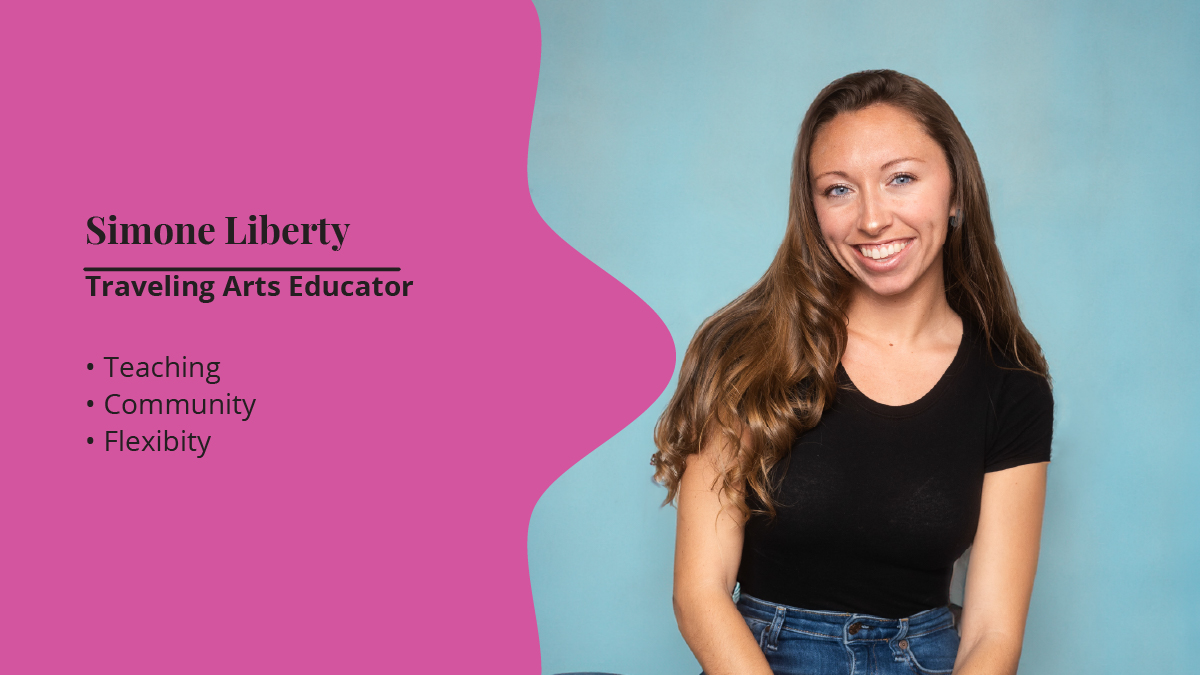
    Simone Liberty

    “I really love to extend art and creativity for everyone. Art for all. Art for everybody.”

    Simone Liberty is a full-time Teaching Artist based in Charleston. As a Teaching Artist, or traveling arts educator, Liberty teaches Arts Integration in schools throughout Charleston, Dorchester, and Berkeley counties. Arts Integration uses visual and performing art forms including dance, art, and theatre, connecting them to core curriculum subjects such as math, science, and ELA. 

    Interview

    Transcript

    Simone Liberty 0:00  

    I’m Simone Liberty. I’m from Connecticut originally- but I’ve been down here in Charleston since fall 2015. 

    Emma Plutnicki 0:06  

    So, can you please tell us what you do for work and what your official job title is? 

    Simone Liberty 0:10  

    Yeah, sure. I am a Teaching Artist, and this would be my official job title. I’m a traveling arts educator. I go to lots of different schools at this point. Although a teaching artist doesn’t have to be just confined to schools; they are community art educators, so they could go and do workshops for adults or other communities as well. Right now, my work has me going into schools all over Charleston, Dorchester, and Berkeley counties. 

    Emma Plutnicki 0:41  

    Very cool. How long have you been doing that? 

    Simone Liberty 0:43  

    I’ve been a full-time Teaching Artist for about two years now. 

    Emma Plutnicki 0:48  

    So, how did you end up doing this? How did you know that it was a profession that you could actually pursue? How did you know that you wanted to do this? 

    Simone Liberty 0:53  

    Yeah, so. It was kind of funky. So, I have to go back to tell you about my undergraduate degree at the College of Charleston. I was an Arts Management Major, and I graduated in 2019 with my bachelor’s degree. And while I knew that I wanted to roll right into a master’s program. I also had a desire to start connecting with some of the organizations around Charleston in the arts. 

    So, the best thing about my arts Management experience undergrad was that we had some great adjunct faculty members, and one of my professors was Catherine Brack, who at the time was the Director of Development at the Gaillard Center. So, I went in, and I was just kind of trying to pick her brain about what she does for work. And while I was there, she invited me to go and see their youth theater program in the summertime.  It was a summer camp. And she said, “You know, it’s going to be super cute.” They do every summer. So, would you, you know, just come and check it out? And totally adorable. I fell in love with just watching the kids on stage. And it reminded me of some work that I had done in the summers during my undergraduate experience. 

    So, I met Sterling DeVries, who is the Director of Education at the Gaillard Center, and still is, and just told her how interested I was in arts education. We talked for a while about that. And I ended up actually writing a letter in email form- to both Catherine and Sterling. I’m basically creating myself a position at Gaillard. I ended up getting that position, but the catch was that what I really wanted to do was work part-time in the Education Department and part-time in the Fundraising and Development Department. And instead, what they could offer me because of budgetary needs, was a full-time or it was still a part-time position in development while I was in graduate school. And I ended up raising funds for specifically the education program at the Gaillard while I was there for about two and a half years and absolutely loved the work that I was doing because I got to raise the funds that were supporting the arts education. But I wasn’t doing it myself. I really wanted to be with the kids specifically. So, I started to talk to Sterling more about that. And she eventually ended up asking me to be one of their teaching artists for the summer camp that I went to and saw originally. So, that was kind of my bridge into teaching artistry. 

    It started out as just teaching summer camps. And increasingly as I got my name out there and started to network myself a little bit harder and got connected with some other community partners, I’m now able to say that I’m full-time as a teaching artist. 

    Emma Plutnicki 3:46  

    Amazing. That’s a great story. So, nowadays, how would you say the split is between working in schools and working behind a desk? What does your typical day look like? 

    Simone Liberty 3:58  

    Yeah, so it really depends. I used to love my routine. Unfortunately, this job has no routine. So, if I’m in school, it’s either in school after school, or maybe summer camp. 

    Let’s take today, I am going to be in a school, but my school time doesn’t starts until 12:45 And from 12:45 until the end of their school day, basically, I’ll be teaching different classes, and then I will do an after-school program. So, that meant that I had a couple of hours this morning to be on my laptop. And that’s what I have been doing and will continue to do after we get off this zoom call. This I would say, looks like a pretty typical day. If there were such thing as a typical day, where you know, it’s a balance between computer work and then being face to face with students for me, but like I said, a teaching artist can also be face to face with adults in the community or anything like that. 

    Emma Plutnicki 4:53  

    Yeah, so do you think it’s been I mean, you said that you kind of paved your way to find this position, but has it been challenging to work within this field? What kind of challenges do you see on a day-to-day basis? And how do you kind of overcome those? 

    Simone Liberty 5:07  

    Yeah, so it has been difficult to call this a full-time career path. As I mentioned before, you really must be intentional with networking and getting yourself out in the community, so that people know who you are and what you do. And what I have found is that I’ll speak specifically to the Charleston area. Lots of people have questions or are generally confused about what a teaching artist does for their work, and I think that has to do with the broad nature of the role. You know what age range do you like to work with? Or what’s the style of your workshops? Sometimes, when I’m working with different community members when I am going into schools, specifically, I’m doing arts integration. And so that’s making sure that it’s not just a dance or theater, workshop, I’m teaching dance and theater things, but it’s also teaching a core curriculum subject like Math, or Science or ELA. 

    So, all those moving pieces make a teaching artist change how they describe themselves. And it’s just this really vast thing that hasn’t really been nailed down, nor do you want it because we’re creative individuals. So, all, it’s tricky to keep having the conversation of who are you and what do you do? And you know, what are your credentials? Because there’s not real credentials in Geometry, there’s no certificate, and there’s no degree in teaching artistry. But you know, that’s, that’s kind of the tricky part of it. And with that comes, where do you find your peers? You know, it can be a little bit isolated if you don’t have community partners that you’re really in contact with. It’s just that it requires lots of self-initiation. 

    Emma Plutnicki 6:51  

    Yeah, and so far, as networking goes, how have you been able to network with people? Are there any events that you’ve gone to? Or is there anything within South Carolina programs or communities that you’ve found to kind of build those connections? 

    Simone Liberty 7:05  

    Yes. So, first and foremost, I will need to tell you about Engaging Creative Minds, which is one of my community partners, and one of the organizations that I work for. They’re kind of like a booking agent for Teaching Artists, and they have a whole roster of artists. All these artists go into schools as well and do very similar things to what I’m doing, but just maybe in a different discipline or the same. So, I focus on dance and Musical Theater. And so lots of those teaching artists I’ve been able to connect with through engaging creative minds, even if it’s just on an email basis, some of them I’ve been able to meet in person, even, you know, get coffee with and pick their brain about how they run their workshops. But that’s been a great help. 

    I should also call out professional connections that aren’t teaching artists have been very helpful in just understanding the field more broadly. And I would like to stay well connected with the South Carolina Arts Commission and the South Carolina Arts Alliance, two separate things. The Arts Alliance is a non-profit that is a statewide Arts Advocacy Organization. So, that, those two organizations or the agency and that organization have been great to relate to so that I understand more about the South Carolina Arts field at large. 

    And then I found a lot of my personal connections to be a part of my graduate program. So not only did I do the master’s in public administration, but the College of Charleston also offers a certificate in Arts and Cultural management. So, a lot of the individuals from my cohort and I are still quite close. So, I would say that those are a couple of events and organizations that I stay connected with. 

    Emma Plutnicki 8:48  

    Perfect, and so throughout your journey so far, has there been any particular project or, I don’t know, a program that you’ve worked on that has had a significant impact on you, or that you hold, like, close to your heart, anything that stands out as being like a highlight of your career so far? 

    Simone Liberty 9:05  

    Yes. And it’s kind of a new one. But I’ve been happy about this past couple of months now. So, I for the past couple of years, have struggled with the question of what my why is. And I think that’s a really important question, especially for young professionals to ask themselves when they’re going through, trying to find what they love to do for work. What you know, makes their workday feel like it’s fun, rather than work. And what I’ve been working on is, I really love to extend art and creativity to everyone, art for all, art for everybody. And one thing that had been kind of gnawing at me for a while is that I love tap dancing. I’m not a ballerina, but I do love tap dancing, and I can’t teach that in most of the schools that I go into because there’s a prohibitive cost to tap dancing. Those tap shoes they start at $65 dollars. So, that’s just not possible for a lot of the students that I teach. 

    So, what I created last fall, I’m calling them Tip Taps. It is a low-cost tap accessory, I’ll call it. It’s not a replacement for tap shoes. But it’s simply just a piece of metal that you can strap to any shoe. And I can now go in and teach tap dance workshops. Now it’s just one tap, it’s not the heels, but I can teach tap dance workshops to kids who might not have ever had a tap shoe on their feet before. So, this has been a highlight. And it’s really brought me back to that, what’s your why? Because, like I said, my why is art for all and making sure that there are accessible ways to bring art into our community, even if it’s not in a traditional way. 

    Emma Plutnicki 10:48  

    As far as the skills that you possess, what do you think has helped you in this role? Clearly, you have ingenuity and creativity with projects like that. But are there any other skills that you’ve had that you think really advance your role? 

    Simone Liberty 11:02  

    That’s a good question. Yes, I want to say flexibility and not in the dance way. But being flexible in your schedule, in your idea of what your day is going to look like in your goals, even. You know, sometimes you end up either under or overshooting a goal that you have at, say, the beginning of the year or the beginning of a school year or semester, whatever it might be. Whether that’s a financial goal, a mindset goal, or a life, a work-life balance goal, whatever it is, there’s an element of entrepreneurship in craft. And it takes some flexibility. 

    There was another thing that I was thinking of well, ah, curiosity would be another one. That’s been a skill that I’ve had to flex quite a lot, you know, ask lots of questions and kind of dive into who might be potential partners for you to go in and offer your teaching artistry to. I would say, Yeah, curiosity and flexibility. Those would be the two skills. 

    Emma Plutnicki 12:03  

    Yeah, great. And so, just as we wrap up, do you have any advice for young professionals and college students who are trying to make a path in the creative world and looking for a job similar to yours? 

    Simone Liberty 12:15  

    Stay connected to what brought you to the arts in the first place. This has been something that I’ve been trying to get back to the last year, I would say, you know, we probably all landed in arts management or arts administration or wanting to be in the creative field because we are creatives, and we are artists, or at least we say like, oh, I used to be. 

    It’s not gone, and it doesn’t need to be. So, my advice to young professionals is to find that adult dance class, down here in Charleston, we’ve got Redux that offers adult art workshops. Find those opportunities to stick with your craft and make sure that that stays in your practice. So, I think the reason that I’m saying this is because it really does help you to fill in that work-life balance, and at the same time might let you draw some connections towards your why, why you’re doing this. 

    Emma Plutnicki 13:09  

    Great. That’s such good advice. Okay. So, thank you so much for joining us. Is there anything else you’d like to add about your profession, your career, or anything else? 

    Simone Liberty 13:18  

    Oh, my gosh, we need more teaching artists please. You know there is no lack of demand. I think that the field of teaching artistry is growing at just an exponential rate in South Carolina at large. I do know that there’s planning to be a teaching artists forum in the fall by the South Carolina Arts Commission. And I think they always have community partners on things like that. So yes, you know, look out for things like that if the idea of teaching artistry is interesting to you. I also would say to get connected with Tag, which is the Teaching Artists Guild. There’s other national and even international resources for teaching artists to kind of connect with so that you can explore the field more and of course, if you have anyone up your way that would like to connect with me about teaching artistry with more questions, feel free to send them my way.  
  • Katie Hinson Sullivan

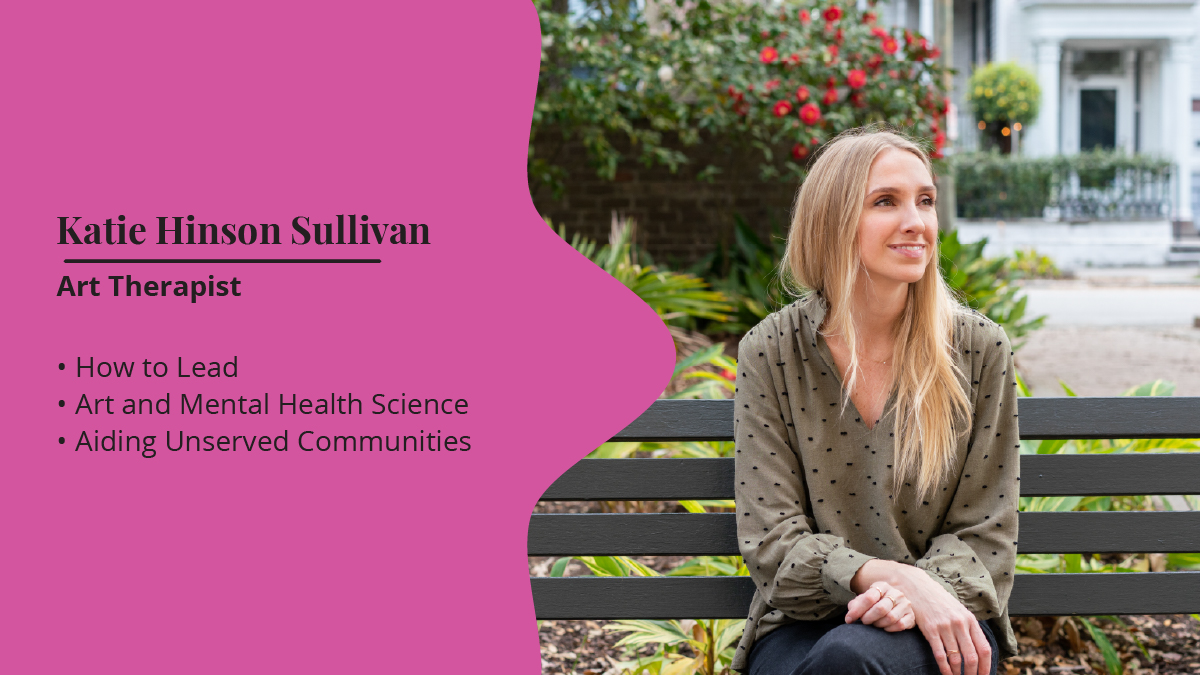
    Katie Hinson Sullivan

    “Art has been a language to me that made sense throughout my life.”

    Katie Hinson Sullivan is an Art Therapist and program director of the Arts and Healing program at MUSC Health in Charleston, SC. She holds a degree in Studio Art and Psychology from the College of Charleston and a Masters in Art Therapy from New York.

    Interview

    Transcript

    Katie Hinson Sullivan  00:00 

    My name is Katie Hinson Sullivan. I am a board certified and registered art therapist and I am from Charleston, South Carolina; I actually moved to New York to get my masters to become an art therapist, and I worked in New York for 10 years as an art therapist and then moved back about six years ago and started the arts and healing program here at MUSC. 

    So, we started Arts and Healing in 2018. And it started off with as a very small program, I think the CEO initially here wanted to create some kind of art program, he didn’t know what that was, he was thinking more of art on the walls, but hiring an art therapist, I kind of went in the more clinical evidence-based direction and started a Creative Arts Therapy Department here, which is… art therapy is actually a mental health field. A lot of people can misunderstand that as kind of an educational field, but it’s not, we’re not teaching any kind of art activities. We are using art in a way to impact the health and well-being of patients from children to you know, end of life. Essentially, I have worked in a number of different populations. I’ve worked with vets; I’ve worked with children of abuse and neglect. I actually worked at Rikers Island in New York for three years working with the incarcerated because when words are really hard to find, or really unsafe to use, I think art therapy has a really important place for those types of people, especially the underserved populations out there, which is kind of where my heart lies. 

    But when MUSC Arts and Healing was created, we started with just one art therapist and one music therapist and doing work within the palliative care space with both adults and children, and that just exploded. I think people quickly saw the impact of having that kind of holistic approach in the hospital. Counselors and therapists don’t typically work within hospital spaces. It’s generally, you know, just like a psych eval, but people are going through a lot of things. And we have people that stay here for years sometimes in the hospital, which is really sad, or family members are just experiencing a big loss. So, losing a family member happens often here in the hospital, so we work directly with patients and family members as well. So, we now have three art therapists and four music therapists working at MUSC. Music therapy is a separate field. Music therapists focus on functional goals. If you like, I can connect you to a music therapist as well. But it’s a completely different field than art therapy. 

    Yeah, so that’s kind of us in a nutshell, in the inpatient world. We’ve also expanded with the help of the South Carolina Arts Commission to be in our school systems across the state, which is like the most exciting work ever, especially after COVID-19. Kiddos are very isolated; they really struggle socially. I think anxiety really just took off. We wrote a grant to get funding, a little funding for this to start things off before partnering with the South Carolina Arts Commission, because we were seeing an increase in our emergency room with kiddos having suicidal ideation or just feeling completely overwhelmed and having mental health crises. So, the best place to reach our kids is in schools, especially with those who are underserved and don’t have access to mental health care. So that was our main goal. So, we started pushing into schools using art therapy two years ago. And again, we’ve expanded to four districts. Thank goodness to the South Carolina Arts Commission for helping that work along. 

    We’ve been in the school system, and we’re pushing into underserved populations as well within our community. So, we’re working with an addiction agency and working with their clientele. We’re working at an assisted living facility, we’re actually doing art therapy with the blind and visually impaired in partnership with the South Carolina Arts Commission, we’re actually pushing into a children’s group home and also working with foster care families as well. And then a myriad of other populations. It’s kind of expanded to very diverse settings. But yeah, that is where we are at – MUSC.  

    Emma Plutnicki  03:59 

    How long have you been there and doing the show? And what’s your official job title?  

    Katie Hinson Sullivan  04:04 

    So, I’m the leader of the Arts and Healing department and I started the program in 2018. 

    Emma Plutnicki  04:08 

    Okay, perfect. And so, what kind of background, like, led you down this path? How did you end up doing what you’re doing now? 

    Katie Hinson Sullivan  04:16 

    Yeah, I’ve been asked that question before. I was a kiddo who actually had open heart surgery here at MUSC Health when I was five. And I think, throughout my life, I had an art teacher as a mother, so I think she always just put materials out and that was my way of expressing myself when I was very young. So, art was just kind of a language to me, so it made sense throughout my life. I didn’t know what that equated to. I was actually going to the College of Charleston, I was majoring in psychology and just taking art classes on the side because it was like my interest, just growing up doing it. And I had a professor my senior year at College of Charleston, and I didn’t know what the heck I wanted to do, but she was kind of like, you understand that there is an actual profession that kind of blends your two interests, psychology and art. So, I looked into it and then started applying to schools. You have to have a master’s degree to become an art therapist, just to get training. And then there’s a whole myriad of board certification tests, all this and collecting hours in front of patients just like any other mental health field. But yeah, in my senior year, I decided to become an art therapist. I really didn’t have any idea what that was until I got into it. And just, it just makes so much sense to me, just given my history, I think.  

    Emma Plutnicki  05:28 

    Yeah, amazing. So, on a day-to-day basis, are you going to schools and teaching the kids, or what does your day-to-day look like?  

    Katie Hinson Sullivan  05:38 

    Yeah, so, I am more on the administrator’s side. Now, I can speak about what that looked like when I was an active therapist. But my day today is really building programming, really thinking strategically about how we can build sustainable programming and these spaces that don’t have access to care. I am doing a research study currently in the hospital. So, I’m working with pediatric patients who have just had a bone marrow transplant, which is a really tough procedure to go through. So, I’m working on a study that is looking at whether or not art therapy helps young people be discharged quicker. I’m working alongside PT (physical therapy) so if children receive art therapy before PT, does it make them, essentially does it help them to engage in their services a little longer, or more readily, because as we know, if a kiddo going through BMT is compliant with their physical therapy they can be discharged a lot quicker. So just providing that support, assisting them. 

    Emma Plutnicki  06:51 

    Has there been one project that has stood out to you over the years, that was the pinnacle of your creativity, or just had a significant impact on you? 

    Katie Hinson Sullivan  07:02 

    Yeah, I think my work at Rikers was the most impactful work I did. Actually, my job before that, I worked at HeartShare human services before that in New York, and it was an agency, it was called a preventive agency. So, child abuse cases would come through the city, and then we would be contracted to provide support for those families. I worked with the entire family. I think that just allowed me to get every type of issue or struggle that a family was going through, and whether that was child abuse or neglect, that really gave me a very dynamic view of the world, I think. As a new therapist, I worked there for five years. And then I think that kind of led me to my position at Rikers. I answered a cryptic job posting about a mental health clinician wanted, and luckily, I got the job. And I mean, it was really intense. As people know, Rikers Island is very known for being a really scary place and giving inmates a voice or helping them process what was going on. I mean, there’s so many layers in jails, right, like just who we incarcerate and why we incarcerate them. But allowing them the space to have support in a really scary time, was really impactful to me.  

    Then I fought to work in the women’s jail. There are over 10,000 inmates on that island, and only about 1500 Women were in the jail at the time. And they were receiving little to no services because the men were just, you know, they were having a lot more issues and like code reds throughout the days. And women, a lot of them have children at home. And they were trying to get through their time at Rikers, to find out what the outcome of their sentencing was, et cetera. So very impactful work for me gave me a very different view of the world.  

    Emma Plutnicki  8:51 

    Wow, that’s incredible. 

    Katie Hinson Sullivan  8:53 

    Yeah, a bigger view of the world. I mean, it was really impactful. And the women were so strong. 

    Emma Plutnicki  08:58 

    Wow. That’s amazing. So, has it been challenging, like the work itself, and also the way that you got into this career path? Was that challenging to find and kind of get your foot into the door? 

    Katie Hinson Sullivan  09:09 

    It’s very challenging in our state to become an art therapist. There are no grad schools here, and you have to have a master’s degree to become an art therapist. There are some online schools. And I didn’t know what the field was like; I didn’t even know that it existed. I had a professor that was from New York, where it, you know, obviously mental health is a little more accessible in another state. In South Carolina, not only am I a mental health clinician, but I’m an art therapist, which, you know, I think is a double whammy. We don’t have licensure in our state yet. We’re pushing hard for licensure. So, I think that’s a challenge, but we’re doing it. In 2018, I think there were 39 art therapists throughout the entire state. Right now, we are sitting at like 62 therapists, so within a few years, it’s really grown, which is crazy. Then we have a bunch of interns that are working with our program and then just people are flocking to the state because we now have the opportunity for art therapists to work. It is challenging here in South Carolina, in New York; it was not a challenge. There was a huge community of art therapists that were great and wonderful to work with. And there were jobs available and all of that. But South Carolina is really moving along. I have high hopes for the next few years, for sure. 

    Emma Plutnicki  10:19 

    Yeah. And within South Carolina, do you know if there’s any like programs or events or organizations that kind of allow people to network or meet or find out more about a field as an art therapist? Are there any like organizations or anything? 

    Katie Hinson Sullivan  10:33 

    Yeah, the South Carolina Association for Art Therapists, our state organization. I’m actually the treasurer and have been a past president for that organization. They’re great. We’re small, but I think anybody who’s interested in the field of art therapy, please just get in touch with a licensed or credentialed art therapist to ask about what the field looks like, there’s a lot of art therapists out there that are claiming to be art therapists in our state, because there’s not, I think there’s just a lack of understanding of what it is. But if you’re interested in the field of art therapy, get in touch with me, get in touch with somebody who has an ATR behind their name. That’s the credential to be an art therapist and ask questions. There are online programs to become an art therapist. There are internships available across the state, the association is happy to connect people, or I am happy to connect anybody and/or just have a conversation with people about what the field entails. 

    Emma Plutnicki  11:30 

    As an applicant, are there any specific skills that you think would be beneficial to have? If you were hiring somebody and saw, “Oh, this applicant has this skill, this skill, this skill, they’re good,” or any skills that you have or use on a daily basis that you find come in handy? 

    Katie Hinson Sullivan  11:44 

    Yeah, they would have to have their training and their credentials to become an applicable applicant. And for any job with us, I think just, I mean, art therapists, you have to be interested in the mental health field, right? And you also, I think, artists just generally are more or are a little empathetic to the world around them, you know. It’s a hard job. Because you’re, I mean, it is mental health, and you’re just hearing trauma and dealing with trauma. And as an art therapist, I think you get to those spaces a little quicker, because you have this process and product that you’re doing with a client or a patient, in that therapeutic space, but I think skill sets would be – A: that they’ve been through their training, B: that they’ve been willing to do the work personally. 

    So, I think any art therapist who’s, you know, been in therapy, or you know, has a good idea of where they end and where a client begins. That’s always a good trait to have as a therapist. To experience therapy yourself, as a therapist, I think it is really important. And just willingness to learn. I feel like even, you know, well into my career, I’m still getting supervision myself, and still learning from others. And I think just always being open to growing. And then also having your own art making on the side, you have to have a place to dump all this stuff, right. I think art is why we became art therapists, right? Or why people become art therapists because they believe in that process of art making. So also, applicants, one of the questions I always ask is, how do you take care of yourself? Do you do anything creative on the side? That is, I think, just a really important piece of that creative outlet as well. 

    Emma Plutnicki  13:25 

    So just as we’re wrapping up, do you have any advice for someone who’s looking to get into the field? 

    Katie Hinson Sullivan  13:30 

    Just connect with an art therapist, ask them about possible programs they can go to, if they’re in South Carolina. Ask, you know, just talk through what you’re thinking because there’s so many different ways that art therapy is applicable. You can do art therapy in a museum, just you know, going into museums and maybe creating work based on what you’ve seen. There’s, there’s so many different directions an art therapist can go. But again, I think it just takes diving into training, like I said earlier, like I didn’t know what I was getting myself into as an art therapist until I actually got into the training itself. Also, if anybody ever wants to come and shadow an art therapist here at MUSC, we have that opportunity for people, if they’re kind of like, seeing whether or not they want to volunteer or want to come into the field like there are opportunities to shadow or volunteer with a program like ours. Yeah, just throwing that out there. 

    Emma Plutnicki  14:22 

    And then is there just anything else you’d like to add overall, any last thoughts? 

    Katie Hinson Sullivan  14:27 

    Not necessarily, if anybody wants to get in touch, I always do offer conversation. 

    Emma Plutnicki  14:35 

    Perfect.