
“Do your best, and never settle for seconds.”
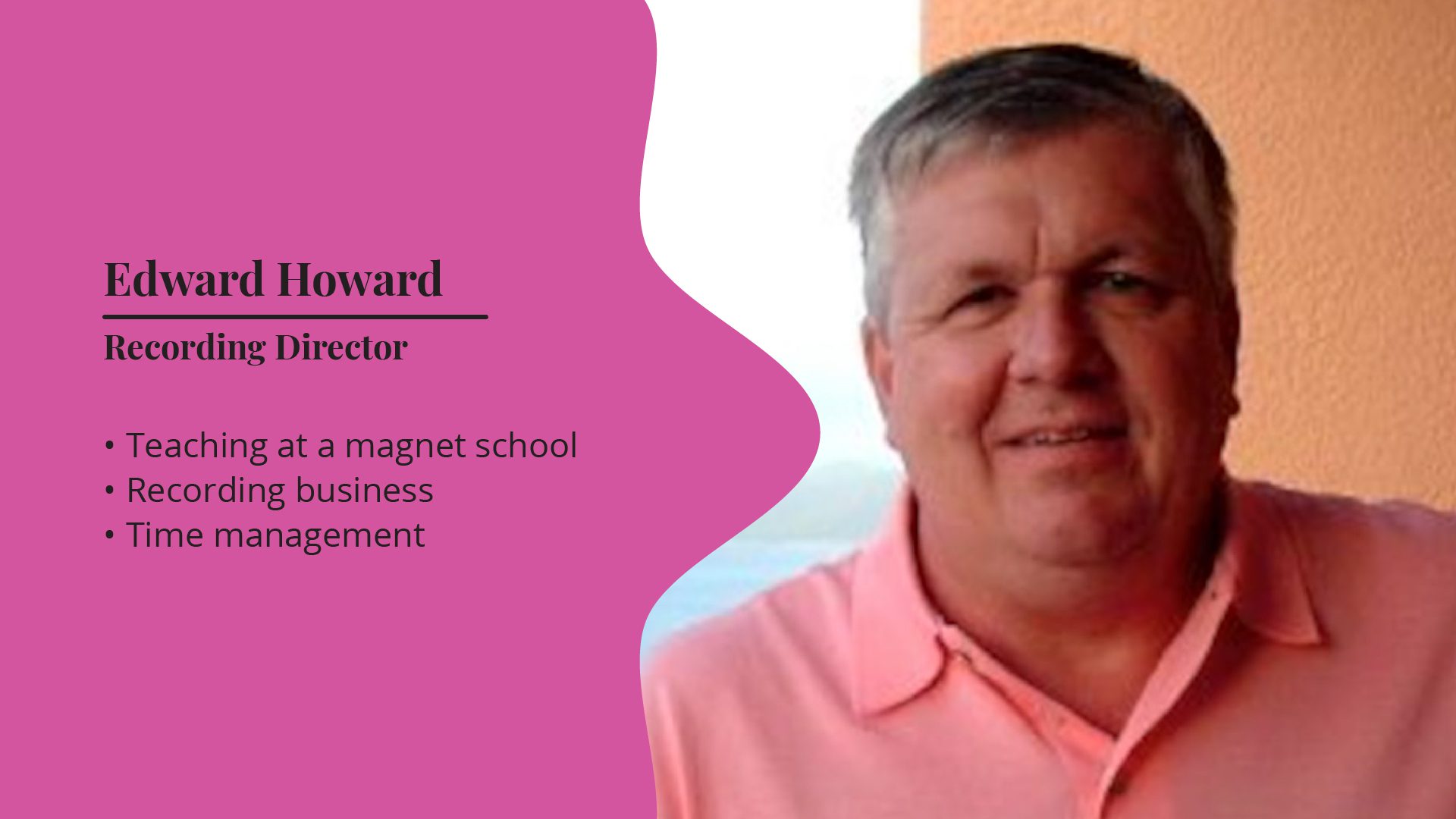
Eddie Howard, from Greenville, South Carolina, is the Director of the Recording Arts Program at the Fine Arts Center. Establishing the program in 2007, Eddie Howard teaches both younger and older students how to record music.
Interview
Transcript
Edward Howard 00:00
I am from Greenville, South Carolina. I teach the Recording Arts program at the Fine Art Center in Greenville.
Haley Hansen 00:07
How long have you been working there?
Edward Howard 00:08
Well, I started the Recording Arts program in 2007 as an afternoon class, teaching high school students- the art of recording. It’s like a recording studio. And that’s what we have. And so, I’ve been teaching afternoon classes since then. But we just added a morning class, so, that is it is doing I’m doing that full time now.
Haley Hansen 00:28
What is your official job title at the Fine Arts Center?
Edward Howard 00:31
It is the Director of Recording Arts.
Haley Hansen 00:33
Can you walk me through a typical workday there?
Edward Howard 00:36
Okay. Yeah, we have a morning class of younger students who are more on an entry level, just learning how to record the very, very basics. So, I walk through and demonstrate different things they have, they do some book work, but it’s mostly hands-on.
Edward Howard 00:53
And then my afternoon class has little older students. They are typically 11th and 12th graders, sometimes 10th graders. And most of those students are already recording when they come into that class. They have figured out ways to do it at home, and so they have some experience going in. So, they just kind of come in and take it to the next level.
Haley Hansen 01:16
How did you end up in this field?
Edward Howard 01:18
My uncles, my mother’s three- four brothers built the first recording studio in Greenville, South Carolina, in 1958. And so, my dad used to love to go hang out in the studio when I was five or six years old. So, we, for years, really all my life, would go hang out at the studio, sometimes at nights and on weekends when they were doing sessions. So, I kind of got the studio bug from that.
And then later, for the last couple of years in high school, I was a guitar player. And that was involved in a couple of bands between 1971 and ’74. We finished high school in ’72 and hit the road, and the band got very, very busy. And we were staying gone so much, I just did not like traveling that much.
And so, I decided to come back to Greenville, and wanted to get into the studio business. And so, that is what I did, I came back to Greenville in ’74, started hanging out at the studio, and went to work there in ’77, spring of ’77.
So, I worked in the studio ever since I’ve been in the recording business; I have owned three different studios, been part owners/partners, in three different studios. And I’ve built several studios for people as well. So, that’s what I’ve done.
Haley Hansen 02:34
How did you wind up at the Fine Arts Center?
Edward Howard 02:36
Well, a friend of mine, Steve Watson, who is retiring this year, has been directing a jazz program at the Fine Art Center for 27 years. He and I met in 1985 when he first moved back here from L.A., and he and I worked. We did a number of jazz records together, and a number of albums together in the studio. Became friends and just have ever since.
And so when they built the new Fine Arts Center in 2006, I believe it’s when they were it was under construction, he called, and he said, “I think I can get the budget to put a recording rig in my jazz class, I just won’t be able to record my kids.” And so, we met, and I consulted with some folks there about what kind of equipment to put in, and you know, everything had gone Pro tools and computers and stuff by then. So, he did that. And they installed all the equipment.
And every couple of weeks or so he would call and say, “Can you come by on Thursday afternoon or something and record the kids?” And so, I’d go over and do that every couple of weeks or so. And I will say recording one day in 2007, I believe it was, and Dr. Flour, the director at the time walked in, and he said, “Oh my gosh, we’ve got $80,000 worth of equipment in this room, and we’re not doing a recording program.” And so, I said, “I’ll help you start it. And I give you the afternoons, that’s all I can give you: two-hour afternoons.”
And so, we did that and started our first semester, which began in 2008. I think it was fall of 2008, and that has a two-hour afternoon class. And then we just added this past year, added the morning class. So doing a morning and afternoon class. And I have about 20 students now.
Haley Hansen 04:16
Are you still teaching out of the first studio you helped design there?
Edward Howard 04:19
Where?
Haley Hansen 04:20
At the Fine Arts Center, like the one that you were hired as a consultant for?
Edward Howard 04:24
Yes, that’s our main control room. And since then, since we started the program, we’ve added two spaces. There are two rounds that are about 12 by 12 spaces. One of them has three workstations in it, the other one has four workstations.
Haley Hansen 04:39
Do you have a defining moment in your creative journey that made you realize this was what you wanted to do with your life like a particular project that you worked on?
Edward Howard 04:48
No, really, I had always loved the recording process. And even when I was traveling on the road before I always had in the back of my mind that “You know one day I need to get into the studio that’s what I need to do.” And I really just kind of knew that. I had grown up around it and had seen enough of it to know that that’s what I want to do. And so, I did that and started in ’77. And I have been doing it ever since.
Haley Hansen 05:14
What was the biggest adjustment or challenge that you faced when you started your current role at the Fine Arts Center?
Edward Howard 05:20
Well, when Dr. Fluhrer, Roy, is what we always called him. When Roy asked me to start the program, I said, “Roy, I’m not the teacher. That is not something I feel like I do.”
My biggest challenge was learning how to teach, learning how to develop curriculum. I have done some workshops. Me and a friend of mine used to do some workshops in the studios, but it was mostly for adults, producers, and arrangers and musicians who wanted to learn how to record. They wanted to learn the technical side of the recording.
So, I’ve never been in a position to teach kids, you know, students. So that was probably the biggest challenge. Learning that, but the faculty, the other teachers, these guys are just incredible people. And they were so helpful to help me to learn how to do stuff like that, how to develop a curriculum, how to teach, you know, how to teach a class. Yeah, it’s a whole different thing than recording with a bunch of professional musicians.
Haley Hansen 06:24
Do you recommend any specific skills that someone aspiring toward you, toward your field or position like yours should try to develop?
Edward Howard 06:32
Just learn, learn how to do it yourself. You know, most of my best students come in, and they’ve found free software programs at home. And they found out ways to do it. And a lot of them are just doing stuff on their phones nowadays. And they come in with these demos, impressive demos that they’ve done with them, on their phone, with free software. And that’s, that just seems to be the best way to get started with it.
And a lot of times when I am interviewing students, one of the first questions I ask is, “Are you already recording?” And if they say, “No, I’ve not done anything yet.” So, I’ll tell them, “Then find a way. Go out and find your way. There’s free software all over the internet, you could do it on your phone, you can do it on iPads, if you have the luxury of having a good computer available, you know, even better. But find a way to do it.” And that’s really the best way for them to learn the basics, to start learning the basics.
Haley Hansen 07:31
What’s something that you want your students specifically to learn about pursuing a career in a creative field?
Edward Howard 07:39
The biggest thing you know, some of the biggest things I have tried to do with them is to teach them how to be self-disciplined. Teach them how to manage projects, manage their time and do their best, you know, never settle for seconds, go in for the best sounds. And because if they go out in this business as a recording engineer, or producer, or composer, that’s what the challenge is going to be in the real world.
Haley Hansen 08:02
What would you say is the hardest part of advising students for college and for career-readiness?
Edward Howard 08:08
In this kind of work, in the recording work, the college of choice has more to do with where do you want to be when you come out on the other side? Because they’re their universities around the country. Almost all universities have great recording programs now. Unlike when I came along, there were no educational, no colleges, were offering any kind of training in recording field, and audio or video. And so now just about every university has serious recording programs.
But each university tends to steer students in a particular direction. So, if you go to Nashville and Belmont, you are probably going to end up in Nashville, you know. So, different universities and different programs tend to guide students in different areas into different parts of the country. So, you have to kind of look at their programs, and look at their internship programs, and see where do they push students at the other end? You know, and where do you want to be? You want to be in New York, you want to be in Dallas, LA, you know, or in a small town somewhere, like Greenville?
Haley Hansen 09:13
What part of that process of preparing students for college and career readiness would you say that you’re very successful at?
Edward Howard 09:20
Just teaching at a commercial-level, recording. Teaching them how to how to record music, you know, live music and digital music. And how to produce music. How to work with people, you know. I really encourage my kids to collaborate on projects because they will learn 10 times more collaborating with someone else than they will if they just sit down at their computer and work in a bubble. The progress they make will be very slow for most students, generally, but they will progress much faster if they work with other students creating music projects. And that prepares them for university level.
Most of the college programs, that are doing recording programs, I constantly get feedback from people from the universities, that will tell me that my, my students that go into those programs, they’ll tell the students, you’re going to be bored for the first semester or maybe for two semesters, because it takes that long for, for my students to catch up with where you are. So, they’re getting a real boost ahead in the recording program, you know, if they decide to enter a four-year program of recording.
Haley Hansen 10:31
I know that some of the colleges in South Carolina have an arrangement with the Fine Arts Center, that the classes there count as college-level courses. I took creative writing there, and I got credit for a creative writing class at Coastal [Carolina University. Does your program have anything set up with colleges like that?
Edward Howard 10:51
Yeah, we try to get colleges to do as much of that possible. We have actually had a contract with Clemson for a number of our programs, with Clemson University. Were with Recording Arts, they can test out of a semester, or they might test out of two semesters.
So, if they decided to go into the Recording Arts program, depending on what level that they’ve learned in my program, they might be able to skip a semester at Clemson, for instance. And we’re working on more universities that do that there. A lot of universities will talk about that. And they’ll say, oh, yeah, that’s a great idea. But it is a very time-consuming thing to put together an agreement like that. It’s a very complex agreement.
Haley Hansen 11:33
Are there any organizations or programs, or events that you recommend for folks in South Carolina who are interested in your field?
Edward Howard 11:41
For universities?
Haley Hansen 11:43
Universities, or summer camps, like getting involved in the community, or anything like that?
Edward Howard 11:49
Well, I encourage them to get involved in the community, all they can. They can go to other studios and hang out, or they go hang out at some live concerts and just kind of get the feel of live music as well. But there’s not a lot of programs, summer camps, for that kind of thing.
We are actually doing a thing this summer, called Summer Intensive, where a number of our programs at the Fine Arts Center are doing one week, three hours a day for a week. Four days, it’s just four days, not a week. And so, it’s kind of like an icebreaker for a student that would be coming into my program. And I’ve got several students that have enrolled in my program next Fall that are coming to the Summer Intensive thing, just to kind of get a leg up on it, you know, get ahead of the game. So that’s a particular thing.
But you got universities, like in this area, immediate area, you’ve got UNC Charlotte, you’ve got Francis Marion, I think Coastal Carolina has a program, Clemson has an incredible program, the USC [University of South Carolina] has a program. And so, most of the universities nowadays are doing really good Recording Arts programs.
Haley Hansen 12:57
Before we end the interview, do you have any advice for current students or young adults who are pursuing a creative career?
Edward Howard 13:05
You know, Dr. Fluhrer, the guy who started the Fine Arts Center and ran the Fine Arts Center for years, always had this whole thing…. All the time I’ve worked around him, he had this little saying, and he would say he would just say, “Do the work.” You know, just a simple thing. And that’s coming to school every day, doing the work, you know, not lollygag, not hanging out, just talking.
But you know, I think for the Recording Arts Program, I tell parents and students, this is not if you’re not a very self-disciplined program, this is not for you. Because we don’t have a class where I gather everybody up every day. And today’s students, this is what we’re going to never happen. Everybody works at their own pace at their own level. And that’s the way the real world works. In the recording business.
You know, nobody in the recording world wants to be paying a studio musician or a recording engineer or producer and has to say, “Come on, guys, let’s go for it. Let’s get this done. You know, they don’t want to be pushing people. You know, they want people to work there because they love what they do, and they do it well. And that’s what I try to get my students to learn, learn how to do the work and do it well.
Haley Hansen 14:20
Is there anything else you think it’s important to say before we end the interview?
Edward Howard 14:24
No, just self-discipline and do what you love. My dad used to tell me, “Whatever you decide to do, make sure it’s what you love to do.” There’s no reason why anybody should hate their job or their career. And so, when you choose students when they choose, we just try to encourage them to choose the right career for the right reason. And choose something that you love to do.
You know, not something that your parents want you to do, or somebody else is pushing you to do it. Or not because you think, “Oh, I’ll look at that career because you can make a lot of money.” You know, you can’t do it for the money. You know, the recording business is a very lucrative business for people who are very self-disciplined and determined. It makes a great career. And if you do that for the right reason, the money is always there.
Haley Hansen 15:17
Well, thank you for taking the time to speak with me.