Tag: Mentorship

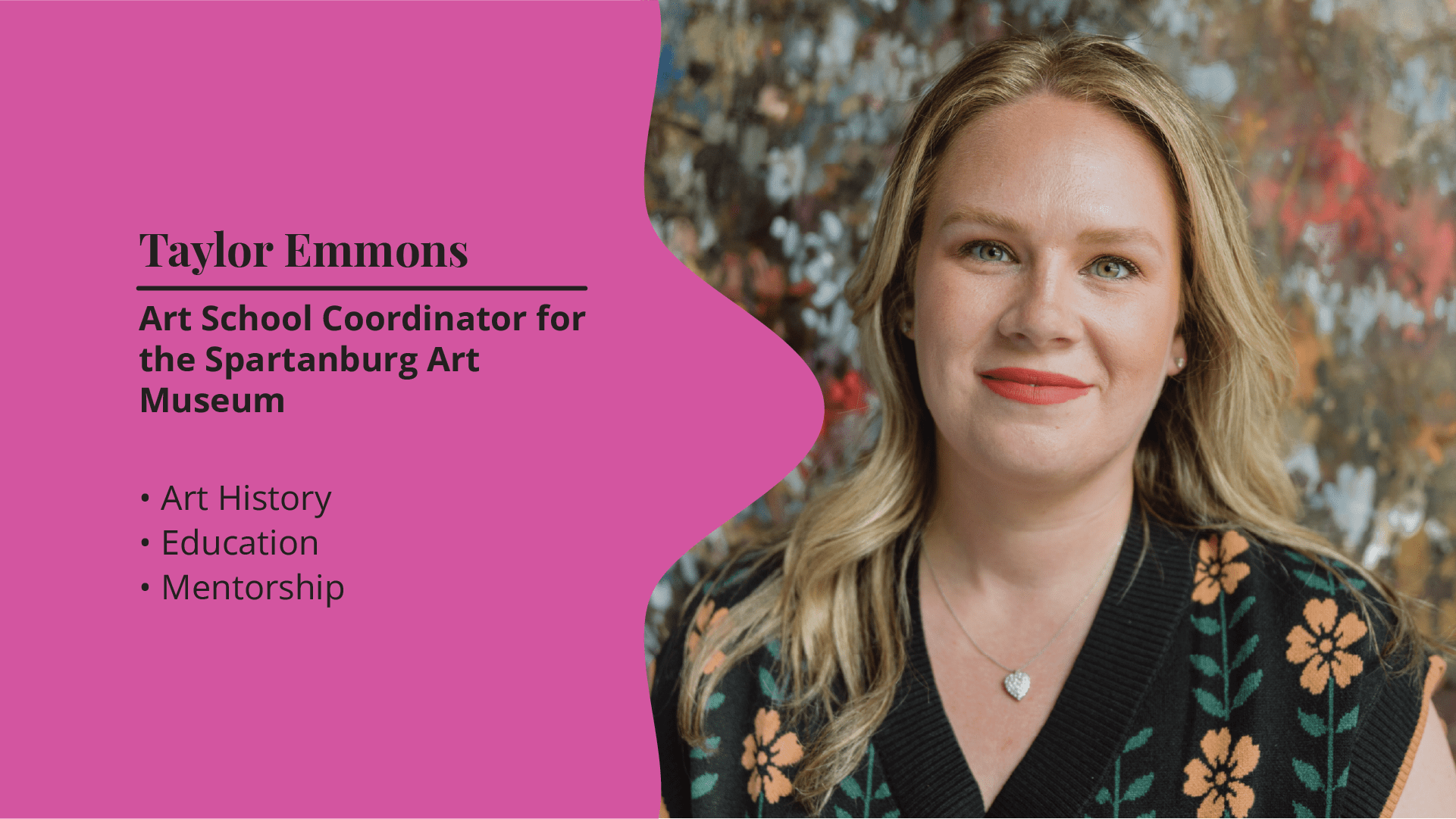
  • Taylor Emmons

    Taylor Emmons

    Interview

    Transcript

    00:00 Ryleigh Kelley 

    Hello, my name is Ryleigh and today we are talking with Taylor Emmons, a professional creative working from and within South Carolina. 

    As we get started, can you tell us your current career and where you are from? 

    00:12 Taylor Emmons 

    Absolutely. So I am originally from Orlando, Florida. 

    I grew up in the Central Florida area, and I moved to Massachusetts for grad school almost a decade ago. I’ve kind of lived all up and down the East Coast. 

    Currently, I am the CEO and founder of Tailored Impact, an art and culture firm. It is the first art advising and cultural strategy firm in Spartanburg County. We didn’t have anything like this before I created it. It’s really exciting to be in this space, and to be talking with you today. 

    00:46 Ryleigh Kelley 

    Yeah, absolutely. Okay, so before we go into the details of your profession, we have a brief section of the interview called “One Career, Sixty Seconds,” where you describe your job in sixty seconds or less, similar to an elevator pitch. 

    01:01 Taylor Emmons 

    Okay! I am a community-based art historian, and I focus on using art as a strategic tool to drive impact in mission. So, either that be economic mobility, creative placemaking, tourism opportunities. 

    My company can do that through a whole slew of different ways. It can be through curating a show at a gallery or in a public art space with traditional and non-traditional exhibitions.  It could be helping somebody build an art collection, whether it be a business, a hospital, or a private collector. It’s also through creative placemaking ways. So, thinking about how we can infuse art and culture into every aspect of where we live. 

    You and I both know, and people watching this know, the impact that art can have, but it’s often thought of as the afterthought, or if there’s time or if there’s budget, then we can include art. 

    I’m really interested in reframing that approach and thinking, “okay, so let’s put art at the very top for me always.” I understand it’s not everyone’s priority, even though it should be, but thinking like, “where can we include art earlier within the project?” 

    That way it could have impact or drive, and reframing the way that we think about art. That art is for all and that everybody should have access to art, and that it’s not just an afterthought or something nice to have or something pretty to look at. It can be used as a tool. 

    02:28 Ryleigh Kelley 

    Yeah, absolutely. 

    Okay, a minute and forty seconds, but I’m just going to say it was great. I will ignore the time because you had a really great answer. 

    02:40 Taylor Emmons 

    I had to talk about the, you said clock and I thought of like immediately I was like, “oh, clocks, unperfect, what is it called? Untitled Perfect Lovers.” I think that’s what it’s called. 

    02:52 Ryleigh Kelley 

    I think you’re close! In your profession, is there anything South Carolina or Spartanburg County in particular brings to your work? Does it have a unique influence on you compared to people in the same profession in different states? 

    I know that you mentioned that you’re from Central Florida. So how does that influence, especially in Spartanburg County and South Carolina, how does that weave in conversation with your work? 

    03:29 Taylor Emmons 

    Yeah, absolutely. So right now, I am hyper-local to Spartanburg County. That’s where a lot of my focus is because there is nothing, like I mentioned earlier, there is nothing similar to what I’m doing right now in Spartanburg County. I really see myself serving as the community-based art historian, but as a connector and as an activator.  

    Spartanburg has such a well robust and working artist scene. There are so many fantastic artists here. We have so many arts organizations, but there’s nothing that’s connecting everything together. There’s nothing that’s making us work towards one unified strategic goal.  

    At a lot of places, you would see somebody in an Office of Cultural Affairs. Or Greenville, which is right next door, has somebody who does art in public spaces. We don’t have anyone like that at a civic level in Spartanburg. I feel like I created this because I noticed the need, right? There’s two competing things going on at the same time, which is really fun, where it’s building this business, but then it’s also, “what would it look like if we built out infrastructure for arts leadership in Spartanburg?” 

    We have a museum, we have a cultural center, we have a ballet, a Philharmonic, a little theater, and they’re all very active. What would it look like to build out maybe something at a civic level, right? So that’s also some grassroots efforts that I’m working on in addition to building my business. 

    05:05 Ryleigh Kelley 

    Was there a defining moment in your life which kind of had an impact on this journey to this point? I know you mentioned your particular projects with your business and you know building that community outreach and especially to grassroots work. 

    Was there a particular project or something you produced which showcased your creativity in a way it never had before? 

    05:31 Taylor Emmons 

    Yes, yeah. I would say there was like a couple of things, but pinpointing one thing in particular, definitely my upbringing. I grew up in Orlando, and my mom was the volunteer coordinator for the Navy base. She was extraordinary. She would do these like superwoman things where somebody would come in and say like, “we need help, a little girl’s missing.” And she said, “okay, we’ll get a helicopter, and we’ll go find the little girl.” 

    And they would say, “Marcia, we don’t have a helicopter.” 

    And she said, “I know I’m going to ask somebody for a helicopter.” She would get a helicopter and then she found the missing girl, right? Like these heroic, really incredible things.  

    I studied art history in high school, and I fell in love with it. It was like the first thing that made me realize, “oh, I am not just one person. There is a larger world that I’m a part of and a larger history.” I’m just a moment in time and it contextualized things for me in a way that I had never experienced. I had this interest in art history, and then I had this mom who was like out there planting flowers on the highway I-4 in Orlando. 

    It was kind of my upbringing and then my educational interest that morphed into this community art historian focus where thinking about art in public spaces, art for all, everybody should have access to art, right? 

    You can go and buy a print and that’s starting an art collection. Like you are collecting art. We’ve overcomplicated it, to an extent, and we’ve kind of like gate kept it. It’s been held within a museum or Sotheby’s or an ivory tower where people are like, “oh, no, no, I’m not an art collector. I just have two pieces of original artwork in my house, but I’m not an art collector.” No, no, that is art collecting. You’re engaging in the process of collecting art. 

    You’re helping the local economy, you’re helping support artists; you’re engaging in this practice that we’ve kind of thought of as like, “no, that’s not for me.” 

    So, I would say those two intellectual interests and my upbringing were really helping to define where I’m going in my life. 

    07:39 Ryleigh Kelley 

    As you were carving this path, especially like with the combination of like the inspiration from your mother and then like your academic pursuits, you mentioned, in the ivory tower and the gatekeeping culture in art curation before you delved into that space, did you have any fears like entering into it? 

    You talked about like your mother, how she was able to kind of just like get anything done. If she put her mind to it, she could do it. What are other inspirations that inspired you basically to continue beyond those fears? 

    08:17 Taylor Emmons 

    Yeah, absolutely. I didn’t know that in order to work in the art world, a lot of people have great support outside, if you get what I’m saying, if you catch my drift. 

    I didn’t have that. When I went to graduate school, I went to UMass Amherst. They have a fantastic program. I can’t recommend it enough, and a fantastic assistantship program. I was able to go there completely on an assistantship where I taught, they paid for my classes, they paid for my insurance, and they paid me on top of it. 

    I was always looking for those sorts of opportunities. I wasn’t really in a place where I could afford to not get paid to work. So, internships had to be paid. I couldn’t take an unpaid internship. Most of the unpaid internships were in curatorial work and most of the paid internships were in like public outreach or museum education. So that’s where a lot of my internships were. 

    While I was in graduate school, I was lucky enough to get paid to work. So, during the semester, I could do the curatorial internships. But during the summer, I needed to get paid. That just had to happen. My scope of what I was working towards was a little limited. 

    Through that, being somebody in a museum space who couldn’t afford to work certain internships, it was an interesting dichotomy where I knew my stuff, and I knew about curation, and I knew about art history. I studied Islamic and medieval art and architecture, but I couldn’t operate within those spaces. 

    When I started this company, I was really intentional about making sure the mission and the values were, I’ve mentioned it a couple times, art for all, but I don’t say that as like a catch all, right? 

    That is something that’s really important to me because I was not able to do a curatorial internship always. I had to be strategic about where I went. And when you’re in those spaces, it can be difficult. 

    I think just reminding yourself that it is a moment in time and that things will change and constantly things are evolving. I think museums are getting a lot better with paid internships now, which is really exciting to see. I definitely was in a space even in graduate school where my experiences were a little limited. 

    10:45 Ryleigh Kelley 

    That kind of goes into the next question about especially with the piece of advice of like it is a moment in time and things can change. 

    Do you have any additional advice for young adults or students who have an interest in pursuing like a similar career to you in the creative world or some sort of combination and are there any particular skills one should practice or have before doing this kind of endeavor? 

    I know you talked about your experience in graduate school and especially to like, I think it’s interesting that you have a Master of Arts in Islamic and Medieval Art. We could talk more about the experience, too. But what is your advice for young adults or students who are thinking about doing this kind of work? 

    11:37 Taylor Emmons 

    There’s the skill set that you develop when you’re in your coursework and you’re in your seminars and your surveys and your writing and those skills are really important. 

    But for this particular career that I’m doing, I had to learn how to get out of my own way quickly. You are your own worst enemy. 

    All the cliches are really true when you’re engaging as a small business owner. You have to put yourself out there. I’m making videos for Instagram. I’m thirty one. I don’t know really what I’m doing. I’m still young, but in the social media world, I’m geriatric. I should go to like a nursing home. 

    I remember thinking, “I want to make a video.” We have Art Walk coming up in Spartanburg. I wanted to make a video about the three most exciting gallery openings for me or yada yada and why I’m going. I’m recording myself and I’m like, “stop thinking, just go, just act, stop doing.” Get out of your own way and get out of your own head. How I did that was a lot of just like grounding technique. And it sounds so like “woo woo,” but it actually works for me at least. 

    You’ll have to find what works for you. Really good therapy. I can’t understate it enough. I think that’s really important. 

    And surrounding yourself with people who are supportive and really just believing in your own reality, right? When I say that, when I started this business, I remember being uncomfortable telling people what I did. And then I was like, “no, no, no, I have to really own this because they will then buy into it, right?”  

    So, do your coursework, do your surveys, do your seminars, and do all of the studio art classes that you can do. 

    Then, also outside of that coursework, really work on the internal stuff because that’s what I found has allowed me to then push it, right? Like I know my stuff, I know my art history, I know my dates, I know my mediums. But if I don’t get out of my own head, nobody else is gonna know that I know that. If I don’t start putting myself out there, then it’s not gonna happen. So that’s the advice I would give. 

    13:47 Ryleigh Kelley 

    I really resonate with the get out of your own head. That is like the story of my life, just like everything. So, I resonate that with a lot, especially to I appreciate how you touched on there’s the practical, the techniques and all that coursework you have to do, but also you got to apply that same effort and energy into yourself. 

    I think that’s very valuable for young creatives to hear and to also just reflect and think about.  

    I’m curious to know a little bit more about just like more about your graduate school experience in terms of pursuing a Master’s in Islamic and Medieval Art. Could you touch a little bit more just about that and how did you end up doing that? How did your interest begin with that? 

    14:45 Taylor Emmons 

    Yes, absolutely. So, the interest was completely accidental. I had no experience in Islamic Art at all. Like in the survey book, you kind of go through it, but it’s just like a little blimp, maybe a couple pages. 

    I was signing up for classes in between like the add-drop week in undergrad. I was using my phone, and this was like a decade ago. So, the app wasn’t all flushed out like it is today. And so just saw briefly, it said ‘Visual Cultures’ and I clicked on it. I was like, “I signed up for that class, met my requirement.” 

    I showed up for the first day and it was Visual Cultures of the Islamic World. This professor walks in, this art historian walks in, and she says, I’ll never forget: she’s like, “I’m sorry if I forgot how to speak English. I was in Turkey all summer.” 

    And I was like, “what is happening? Like, where am I?” By the end of the class, I was hooked. I was just hanging on every word that she was saying, and she was so mesmerizing. 

    She was from Istanbul and the way that she spoke about her hometown, which is kind of crazy to say that, but yes, that is people’s hometown. To just hear the way that she talked about art, and she thought about art, specifically Islamic art, I had never experienced before and I was mesmerized. 

    After that I was like, “I have to take every class that this professor offers.” I took all her courses. She was a huge mentor, advocate, and champion of my work. She allowed me to; I received this grant to study abroad in Paris. And while I was there, I got to conduct research. 

    Then I came back, and I turned it into this huge project and presentation that I then was awarded an opportunity to go to Capitol Hill and present that research. Without her mentorship, that would have never happened. 

    I would have never conducted international arts research and then come back and presented it on Capitol Hill, with the representatives asking me questions, which was incredible. She allowed me to the opportunity to go to Oberlin and be a visiting scholar there when I was an undergrad. She really championed me getting into graduate school. She helped immensely. 

    While I was in graduate school, I went to UMass Amherst, like I mentioned, and I studied under Walter Denny. And he is known as the carpet guy in the field of art history. So, he studied and wrote the book called How to Read the Islamic Carpet. It was published by the Met, and he completely was a pioneer in that field in the carpet world. 

    You adopt the love of these professors that you admire. It was fantastic. Then I got to travel to Istanbul three years ago with my undergraduate advisor and we got to be together. 

    It was amazing to be in these spaces, in her hometown, with the architecture that she taught me about, and walking through them. I saw my graduate advisor, I saw Walter’s, one of his pieces that he wrote about these blue tiles. Being there with her was really magical. I love Islamic art, yeah. Yeah, that’s so surreal. 

    18:11 Ryleigh Kelley 

    That’s just so interesting that it just happened completely on accident. This is how beautifully it unfolded. Well, thank you so much for taking the time to speak with me today. 

    18:26 Taylor Emmons 

    Thank you so much, Ryleigh! This was great. 
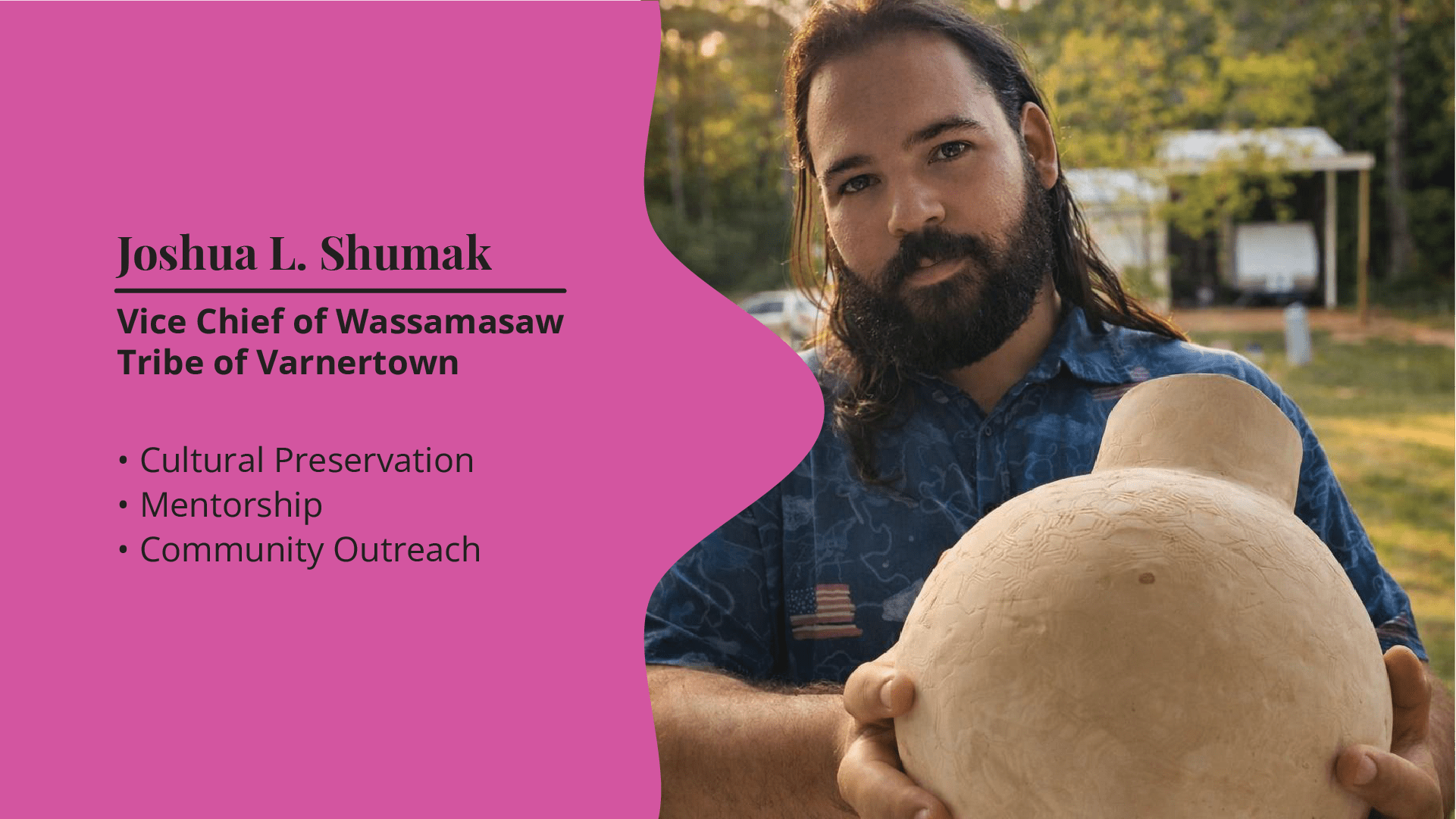
  • Joshua L. Shumak

    Joshua L. Shumak

    Interview

    Transcript

    00:00 Ryleigh Kelley 

    Hello, my name is Ryleigh Kelley, and today we are talking with Joshua Shumak, a professional creative working from and within South Carolina. As we get started, can you tell us your current career and where you’re from? 

    00:23 Joshua Shumak 

    I serve as the tribal liaison for the State Commission for Community Advancement and Engagement, as well as the Assistant Chief for the Wasamasaw Tribe of Barnertown Indians. 

    I am from Monk’s Corner, South Carolina, moved to North Charleston, South Carolina, and ever since I took on my state role, I’ve been in Columbia working statewide. 

    00:46 Ryleigh Kelley 

    Before we get into the details of your profession and what you do, we have this brief little section of the interview called “One Career, Sixty Seconds”, where you describe your job in sixty seconds or less, similar to an elevator pitch. 

    01:03 Joshua Shumak 

    Understood. 

    01:04 Ryleigh Kelley 

    So, let me get my timer started. Alright, are you ready? 

    01:16 Joshua Shumak 

    Yeah, yeah, we’ll see. Maybe I’ll have less than sixty seconds, maybe more. We’ll see. 

     01:21 Ryleigh Kelley 

    Alright, great. Okay, let’s begin. You’re on the clock. 

     01:25 Joshua Shumak 

    I’m Joshua Shumak, and I’m a Native American leader and cultural preservationist from South Carolina. I serve the Assistant Chief with the Wasmassaw Tribe of Warner Town Indians. 

    And for a little bit over the past decade, my work is centered around Native American affairs, where I focus on advancing tribal communities through policy, partnerships, and programming across the state. 

    My work mainly centers on historic and cultural preservation, food sovereignty, expanding opportunities for Native American artists and small businesses across the state. I’ve led some initiatives ranging from statewide cultural programming, film festivals, agricultural and community development projects that directly support tribal citizens. 

    And really, at the core of everything I do, I do it with a commitment to preserving our state’s Native American history and culture, and ensuring that Native American communities are represented, not just for our presence in the past, but as peoples who actively shape the future of the state. 

     02:21 Ryleigh Kelley 

    Oh, perfect! You had three seconds left. That was really good. Thanks for playing! 

     In your profession, is there anything South Carolina, or in your region, or in the city in particular, brings to your work? Does it have a unique influence on you compared to people in the same profession in different states? 

     02:45 Joshua Shumak 

    When we’re talking about Native American affairs, I think it’s really different state to state. I’ve worked in South Carolina for this past decade, but I’ve also talked with some of my correspondence and equivalents in Georgia, North Carolina, Minnesota, and even when I spoke at the UN, I got a lot of different worldviews and perspectives. 

     Each state has its own history, and that history and how it’s worked with its Native people shape where their Native people are today. There are some states where there’s a lot more opportunity, and there are some states where there’s a lot less opportunity. My job has been trying to find out where those opportunities have been in other states, and seeing if I can bring them into our states. Working with our Native American business owners, our Native American artists, seeing if I can put them into some more mainstream art shows. 

    I’ve worked with the Columbia Museum of the Arts. We’ve been doing our Native American Art Marketplace during Soda City for the past four years now. I know that the Native American Studies Center at USC Lancaster has also been a big supporter and are even doing their quarterly art shows now, along with their monthly programming. And there’s just so many different partnerships that are getting built out across the state. And so, even though we started in 2005, with statewide Native American programming and positioning, I think that we are slowly coming along. 

    04:08 Ryleigh Kelley 

    You mentioned that you spoke at the UN, is that correct? 

    04:11 Joshua Shumak 

    That’s correct. 

     04:12 Ryleigh Kelley 

    Could you talk a little bit more about that experience? 

     04:15 Joshua Shumak 

    That was the first time I had been to Geneva, Switzerland. It was a very interesting experience. The food is very different. I love the public transportation. You can just go anywhere by their little train system. 

    It was my first time speaking at that body. I think I was the first representative or tribal delegate from South Carolina to approach that specifically for the expert mechanism on the rights of Indigenous people.  

    The UN Voluntary Fund brought me up to represent South Carolina in that conversation; basically talking about what are the things that we’ve gone through, what are the things we are looking at, those to connect with some of our peers, both in the United States and the Indigenous population across the globe. 

    05:01 Ryleigh Kelley 

    Very cool, very cool. 

    You were talking about the UN and these really interesting experiences, but was there a defining moment in your life which had an impact on your creative journey? 

    And was there any particular project or something you produced which showcased your creativity in a way that it never had before? 

     05:25 Joshua Shumak 

    Well, coming from a Native community, I feel like I’ve been ingrained in the arts and culture since a very young age. I know that since 2005, I’ve been going to our local my tribe-specific culture classes, which are usually monthly culture classes where we do pottery, basket weaving, and beadwork.  

    I’ve been very blessed to have taken some apprenticeships through our cultural preservationist, Tammy Leach, who is a Jean Laney Harris Folk Heritage Award winner, who herself learned some of her artistic skills from Will Goins, who was another Gene Laney Harris Folk Heritage Award winner. 

    And having been able to work since 2005 to present day, and now actively working in our community, I think one of the things that is the best that I have seen come out is some of the programming is what we’ve been able to do with our own youth. 

     For example, we just started our own master apprenticeship program based on the one I was able to take through the South Carolina Art Commission with Tammy, and now I believe we have about fifteen different apprentices being trained by five different masters, all from different tribes, to bring in some of that culture. 

    Something about Native American communities is that, especially on the East Coast, our culture was very targeted and erased due to the Code of Indian offenses, which was a code that existed that basically, illegalized a lot of our ceremonies, a lot of our arts, a lot of our practices. 

    It’s only now recently, within the past twenty to thirty years, we’ve been actively allowed and actively pursuing these practices publicly that had been stripped from us. And so that, all these tribal artists and culture bearers coming together, being able to bring them together, work together with them to re-inject that in our tribe and recultivate that in our youth is something that I think I’ve seen that is very important to my community. 

    07:15 Ryleigh Kelley 

    With this kind of tension that you’ve outlined, especially growing up in Native American community, being ingrained in the arts from such a young age, but also there is that external, cultural erasure slash pressure. Before entering your field, did you have any fears about becoming a creative professional? And if you did, what inspired you to continue beyond them? 

     I know you’ve kind of discussed that  throughout the interview, but, what really inspired you to just work beyond those barriers and try to push against those? 

    07:54 Joshua Shumak 

    I think that your question raises a few good points. I think almost it’s the wrong question, only because from my perspective, coming from a twentieth century child, twenty-first century, I think we are going through life not understanding our history. For me, I really didn’t start understanding the importance of the history of my community or these cultural practices, even though I grew up ingrained in it, until I was about fifteen to my early years in college. 

    When I started to get exposed more to other people, other communities, I started to really appreciate and realize the importance of my own community. And I think for me. The kind of the erasure of community that you see going along throughout the nation, just as urbanization comes with the rise of the internet. Some of the things that are fraying community bonds all across the nation, not just the Native communities. 

    It really helped inspire me. That it was so important to make sure that we were able to keep culture alive, keep practices alive, document it, and try to especially capture and inspire tribal youth. I think that having that cultural identity also can bring a lot of pride and be an anchor in a world that can blow you away. 

    09:15 Ryleigh Kelley 

    You’re talking about talking to tribal youth and bringing awareness to what you do. With that being said, do you have any advice for young adults or students who have an interest in pursuing a similar career in the creative world? Are there any particular skills one should practice or have before entering this industry? 

     09:40 Joshua Shumak 

    I think that we all take ourselves very seriously as people. I have that issue sometimes. I think once you learn it’s okay to make mistakes, it’s okay to be silly, and it’s okay to learn, because I think a lot of things that stops people from getting involved in creativity, or even things that they don’t fully understand, is that discomfort that, “Will I be laughed at, will I pick it up?” 

    You will make mistakes, and it’s okay to make mistakes. I think that’s why it’s so good to have mentors within whatever field you’re trying to go into, and to be able to laugh at yourself.  

    It’s kind of the same thing when you go into public speaking. You have to know how to have fun with it. Otherwise, you’re just going to tremble and just sit there in that discomfort. I think it’s all about a mindset that you have to be okay with. Okay with learning something new, knowing that there are going to be bumps along the way. 

    10:33 Ryleigh Kelley 

    I resonate with that, because it can be easy to take yourself seriously, but I like that piece of advice to have fun with it, and whatnot. So that was the last of my questions. Is there anything particular that you would like to speak on, before we wrap up? 

    10:44 Joshua Shumak 

    I am bad at speaking about myself, but I’m really good at answering questions. So ask away anything that may have piqued your interest that you might want to know a little bit more about. 

    11:07 Ryleigh Kelley 

    I would love to hear about how you mentioned that you didn’t get really into learning more about your community until you were a teenager. Could you maybe talk about that experience a little bit more? 

    11:21 Joshua Shumak 

    Well, for me, up until I started to actually get truly engaged with my community. 

    It almost seemed like a little bit of a chore when you’re a kid, and you’re like, “Oh, why is history important? Why is this important? I want to go play video games; I want to go and do this fun thing over here.” I think it’s that aspect of not knowing what you’re sitting on.  

    It’s kind of like whenever someone in your family dies, or your grandparent dies, and you’re like, “I should have been closer to this person,” and then you hear all the stories about them after the fact. 

     And I feel like it’s kind of like that mindset where you suddenly have that shift, and you see what’s important, especially in your community and your context. And I think that shift happened to me, like I said, end of high school, early college for myself. 

     After that, I was very much involved in my community, working with tribal government, working with the cultural preservation team, bringing in cultural programming and other programming for my tribe, and some collaborations with other tribes around the state. 

    12:24 Ryleigh Kelley 

    Very cool. One common thread I’ve seen, or I’ve noticed, as you’re talking about is the kind of intention that you have behind your creative practice is mindset. And I feel like, especially right now, there’s all these different pressures and external forces. Especially as young adults, it can be easy to get swept up in that. When a young creative is kind of, like, trying to navigate all those spaces and craft their mindset. 

     I know you briefly talked about this a little bit, what are some pointers or just gentle reminders that young adults and young creatives should remember when they’re crafting that mindset, amidst all these different potential distractions and whatnot. 

    13:24 Joshua Shumak 

    I think you have to find joy in what you’re doing. I worked in beadwork with seed beads and master beadwork. I’ve also now started working more seriously in pottery. I find both of them very fun. I think sometimes, for me, some of the hardest things were actually doing hands-on art. 

    13:46 Ryleigh Kelley 

    Yes. 

    13:47 Joshua Shumak 

    Psyching myself up to get started, because I know it’s a long process, and once I get started, I’m good. Then it’s psyching myself up from there.  

    I think it’s a lot about community, too. Like, do you know somebody that you’re willing to go up to and say, “Hey, are you willing to teach me this? Is that available to you? Does your city have an art guild if your community isn’t as involved in it?” 

    I think a big part about Native American art that I feel is that it’s very stereotyped still. In that regard, where it comes from. It’s very hard for emerging Native artists who are practicing folk art specifically to be able to put their art in places contemporarily. Because you see these museums sometimes that — let’s bring up Catawba pottery, for example. That is a very strong folk art. It has a very unique, distinct style to it. 

     And you see sometimes, a museum or an art museum may say, “We have this piece from 1924, why do I need to invest in this kid’s piece from 2026?” And so you see that that does not happen as much. 

     And I think just the fact that folk art is less celebrated across the United States right now means that a lot of these grants that museums have don’t really apply to that category, so sometimes it’s hard to get that breakout for Native artists who specifically are using folk art. 

    I was even talking with South Arts and different programming that could be involved in potentially making funds specifically for African American community, the Native American community’s art acquisition in museums, which I think would be very, very needed. But I think sometimes they can be discouraging, so I think sometimes trying to find these opportunities is very hard for young Native creatives. 

    15:45 Ryleigh Kelley 

    Like you said, that’s kind of hard to find these opportunities for Native creatives. Do digital platforms like social media, the rise of all these technological advancements, do you feel that it might complement young Native artists, or does it complicate their efforts, especially as they’re trying to find more opportunities? 

    16:15 Joshua Shumak 

    I feel like it is adjacent. I wouldn’t say it complements, but I would say it’s adjacent. I feel like it is a way to get them out there to people who do value folk art and the art that is being created, but I do think there is still sometimes that issue when it comes to Native Americans breaking into the contemporary greater art field. It’s very exclusive for Native art for a long time. Because the art sells, don’t get me wrong, but sometimes it’s hard for a young Native creative to be celebrated outside of the niche Native American or folk art-specific community.  

    17:00 Ryleigh Kelley 

    You said you talk about poetry, let’s discuss! Feel free to add it, whatever it is about that. Yeah, I can’t believe we missed that. 

    17:11 Joshua Shumak 

    Well, one of the things that I think I was very blessed to have been able to go through is the Berkeley County arts program. I started out getting into the lottery to be able to go to Howe Hall Ames Elementary School for the Arts. Then I went to Marrington Middle their art program, and then I was able to go into the Goose Creek High School art program, where I really started to go into the creative writing field, specifically poetry, and I’ve been able to publish quite a few poems since my high school years. 

     And a lot of it goes around some of that theme of identity, culture, and even into that, what Native communities today are facing, which includes a lot of land loss, cultural loss, trying to reclaim culture and some of the struggles and victories that we face every day. 

    18:04 Ryleigh Kelley 

    Is there any particular style or creative style of poetry that you like? 

    18:11 Joshua Shumak 

    I usually do free verse spoken word, only because my creative writing teacher really hated rhyming poetry. He wanted us to do very different things, sometimes avant-garde poetry, which is all about doing unique poetry writing styles. Sometimes you basically speak around a poem instead of saying the poem. Sometimes it’s the words that are missing in the poem. Things along that line. 

    18:40 Ryleigh Kelley 

    I love to hear that. Very cool to hear about your background in that as well. You have a creative writing component and a hands-on craft component. I’m curious on how all of those flow together in your creative process. Is there one that you feel really speaks to you more? Do they all have some sort of personal component? 

    I do digital work as well as creative work, and those are all in different conversations with each other. I’m curious for you, how do those kinds of mediums of art and your creative practice talk to each other? 

    19:31 Joshua Shumak 

    Of course, poetry, I think, is the only one that actually talks. 

    I think that that one is one that you can go into a lot more different directions with what you are actually saying. I feel like that almost goes hand-in-hand with beadwork. I know that that usually in itself, is like painting a picture, but without words. What am I trying to express?  

    Some of the beadwork I’ve done has been more nature-based. It has more symbolism, especially when you’re talking about making regalia, or sometimes the tribal symbols, putting that together, what that means to the community or myself. And I feel like it’s almost the opposite with pottery. I feel like pottery is almost more of a resilient, defying art form. 

    One of the things I try to incorporate in my pottery is in my slip, which is what we use to bind the different coils of clay together for hand building, I try to include some soil from either the Charleston Peninsula or Edisto Beach State Park, which is our first contact location. And that way, in each of my pieces that I’m creating, there’s a little bit of our history in it.  

    We are basically using the Earth, putting back into the Earth, creating things from nothing. I almost feel like art in itself is just such a big gift. From the creator to be able to create things ourselves. 

    21:01 Ryleigh Kelley  

    I really love to hear how, especially with pottery and the bead making. I love to hear about resilience. I think it’s interesting through something like that it speaks to that, whereas poetry maybe could be more literal, and like, “I’m literally telling you what it is.” 

    21:30 Joshua Shumak 

    I would even say that through poetry and beadwork, those two pieces of art, saying something and painting a picture. I would say pottery is the opposite. Pottery, it tells you what it wants to be and it tells you what it doesn’t want to be. 

    21:47 Ryleigh Kelley 

    Yeah. Alright, well, I love how we went on that little tangent. Thank you for sharing about your poetry background as well. I really appreciate that. 

    Thank you so much for taking the time to speak with us today. I really appreciate it. 

    22:03 Joshua Shumak 

    Will do. Thank you very much. Hope you have a good rest of your day. 

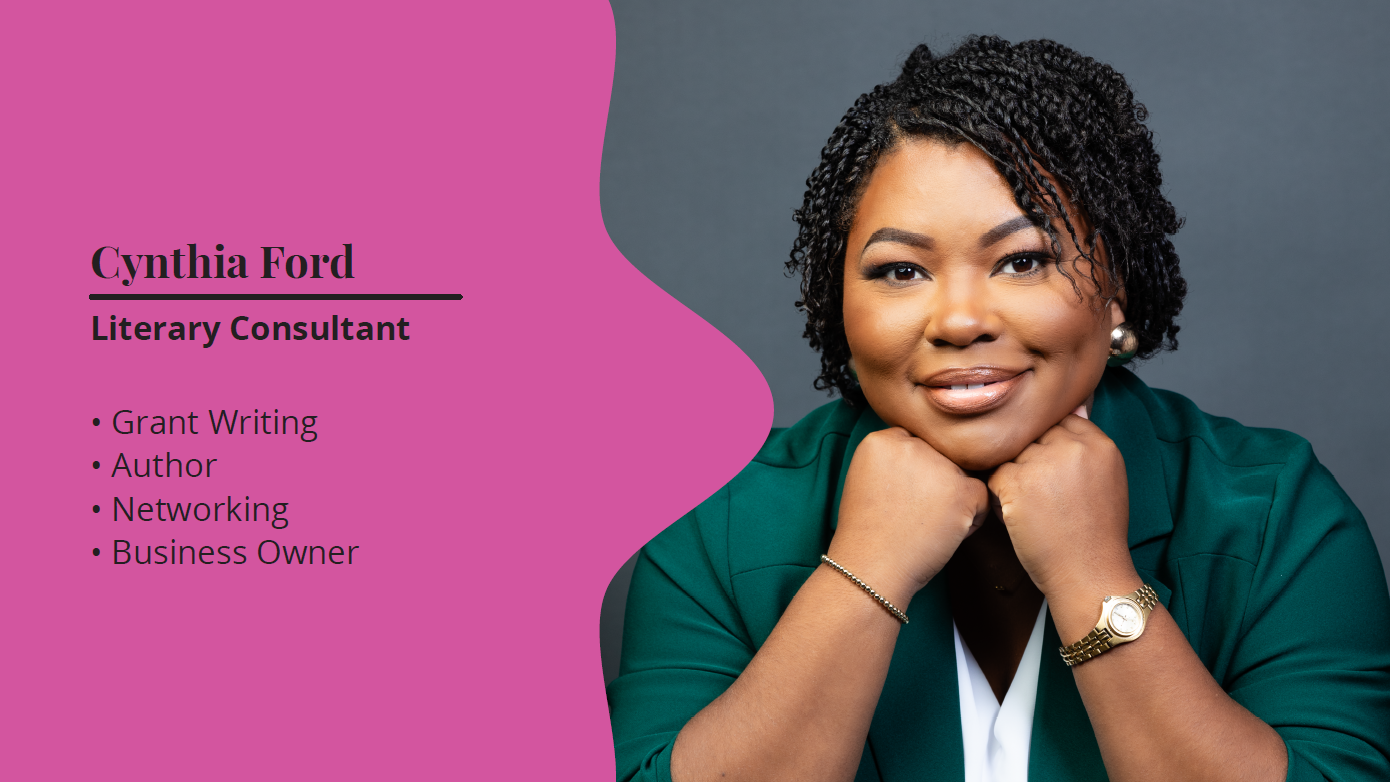
  • Cynthia Ford

    Cynthia Ford

    “Each moment that you’re able to get up again and keep pushing, that’s success.” 

    Cynthia Ford is the Founder and CEO of Cynthia O Writing & Consulting, a South Carolina-based firm specializing in writing services, consulting, and speaking engagements. Her company focuses on three core areas; authoring inspirational literature, providing strategic business consulting, and delivering transformative speaking engagements  

    Interview

    Transcript

    Emma Plutnicki 

    So, to start, what do you do for work? And where are you currently working from?  

    Cynthia Ford 

    Okay, I’m working from home, and as of 2023, I left for my full-time job to work on my own business. So, I own Cynthia O Writing and Consulting, and I have three portions of that business. One, I’m an artist in residence for literature. I’m also an author, and also I help businesses with consulting and writing needs, such as grant writing and other additional writing services.  

    Emma Plutnicki 

    Okay, cool and how long have you been doing that for? Since 2023? 

    Cynthia Ford

    Full time? 2023 you know, I have done some other things part time as I was working full time. And I’ve been doing some social media content management as well, just part time until I launched that. 

    Emma Plutnicki

    Okay, nice and where is home for you?  

    Cynthia Ford

    Mullins. 

    Emma Plutnicki

    Okay, nice. And so, what does a typical day look like for you? What’s expected of you on a daily basis, and what kind of responsibilities do you have?  

    Cynthia Ford

    The day, the typical day, really just doesn’t exist, you know, but I do plan things out ahead of time, you know, on my schedule, times to meet with those who are interested in services. I set certain days for that. I also set time aside for researching, for grant writing. So, I just split it up. You know, I split up my day for the first portion of the day is my time where I’m, you know, I had that moment to myself, whether I’m just outside, meditating, reading, listening to podcasts, or just preparing for the day. And, you know, then I’ll begin to do my social media posts for the businesses that I help with that. And then I’ll begin additional things that I have to do for other businesses, whether it’s the grant writing services I’m consulting and reaching out and networking with other people where I can, you know, spread my services. Um, I also save time for writing, as relates to me being an author, so I have another book that will be coming out, so I set aside specifically time just to make sure that I’m on task when it comes to things I have to publish or networking regarding the books that I’m doing. 

    Emma Plutnicki

    Nice and so the businesses that you consult for, are they, oftentimes, South Carolina based, or are they around the country? 

    Cynthia Ford

    So far, they’ve been only South Carolina based. I’m not opposed to, you know, reaching out to other businesses outside of South Carolina. But so far, yeah. 

    Emma Plutnicki

    How would you describe the like local working professional community in South Carolina. Do you have any experience in other places where South Carolina is particularly, particularly unique, or how is that community here?  

    Cynthia Ford

    Do you mean as far as the business, the different businesses in itself, are they unique, or? 

    Emma Plutnicki 

    Just in general, with like, how the working community is in South Carolina. Is there a lot of collaboration? Is it kind of there are cliques of groups? How is like collaborating with businesses in South Carolina?  

    Cynthia Ford

    I have actually seen both aspects of it. I have seen situations where businesses are able to grow because they have networked with other businesses, you know, provided resources to other constituents and, you know, just information that they needed in order to help push them to the next level. So, I have seen that definitely, yeah, you know how they’ll say sometimes not what you know its who you know. I see a lot of that, you know, you know, from just my experiences, from working with other businesses, yeah. 

    Emma Plutnicki 

    And is there a way, if you’re starting out to kind of break through that or grow your network? 

    Cynthia Ford

    Yes, I would definitely say, attend any type of event, whether it’s virtual or in person. A lot of times there are free events that people can tap into, searching through different places, like Eventbrite or just searching online when there, when there are things that are related to what you’re doing or what you desire to do, but just kind of tapping into that. I’ve also found a lot of resources virtually myself, just through podcasts, you know, YouTube, and I have been able to pour into my business just through those things and connecting and investing in myself, the things that I’ve researched through that. 

    Emma Plutnicki

    Yeah, of course. And so, you have a lot of things pulling you in different directions. In a creative career like that, it’s hard to kind of know what success looks like. So how would you define personal and professional success in your career? 

    Cynthia Ford

    Well, you know success, of course, and like you said, I am pulled in different directions, but when I can accomplish things that I have set out to do, when I’ve set those goals and they’re accomplished. So those moments are success to me. Trying each day is success to me, because I could have a moment where I’m like, okay, you know, I’m really just not feeling this. But then when you get up and you try again, that’s success. You know, you’ve gotten past the mental things that try to hold you back, or you’ve gotten past any type of barriers that are out of your control. You know, found a way to go around it. That’s success. So, each moment that you’re able to get up again and keep pushing, yeah. 

    Emma Plutnicki 

    For sure, did you have any fears when you came into this career? 

    Cynthia Ford

    I did. I actually it took me a couple of years to do it, and I actually desired to start it in 2019, but it’s like I knew that there was something that I wanted to do. I didn’t know how to get there, and didn’t know exactly what it was, but it was a big jump for me, because I was with the Department of Juvenile Justice for 15 years, and so I went to coastal, you know, I started with teaching, and I did some other things, and I worked with DJ J and moved up to kind of direct the position. So, to actually move from that position where you’re settled and everything is good, to launch out to something where you have to start over, that was a huge leap. So I was afraid, and I was okay, well, how am I going to make it financially? I just couldn’t pull those things together. But I began to prepare financially, mentally, and just began to get all those things together before I took the big leap, you know, just make sure that I was, you know, well, I had a well, um, grounded Foundation, and knew that was what I was going to do. 

    Emma Plutnicki

    For sure, and along the way, when you had those fears and faced challenges, was there anybody there to give you advice, either mentors or family? Do you remember any like, the best advice that you received and also the worst advice? 

    Cynthia Ford

    Yes, the worst advice, I think, would come from, you know, when someone would say, well, just leave. Just do it. Don’t just leave. Just do it without being prepared. And there were times when I could, yeah, I could have left when I first thought about it, but I was no way of where I needed to be as far as when prepared. I could have fell on my face financially, but, um, you know, don’t just leave without being prepared. And some people was like, just go. Let’s go. No, don’t just go. But I also received, one of the best advice that I received was someone that told me, just make sure you stay in your lane. You know you don’t have to look on anyone else’s paper when you know exactly what it is you should supposed to be doing, and you’re grounded in that. Just stay in your lane. You don’t have to copy what someone else is doing, or feel like you have to emulate what the other person is doing, do the best of what you are supposed to do.  

    Emma Plutnicki 

    Yeah, that’s great advice. Very good advice. And so, throughout your career, have you had one project that made a significant impact on you, maybe something that was particularly meaningful, that just kind of resonated with you and kind of stands out as a pinnacle or peak of your career? 

    Cynthia Ford 

    Goodness. Actually, I have a couple, but I would probably say, when I released my second book, Dream Like a Queen. I did that in collaboration with the library, Marion County Library, and it was a tea party, and so I really prepared for that. I bought this gal, and we asked the girls to come out and dress up in their little princess dresses. And we had the library just totally transformed. So, when you went in there, it wasn’t like, oh, just your regular library. It was a magical type thing. And the young ladies were just amazed that we had a station for pictures, a station for painting, arts and crafts. And of course, they got their copy of their book pictures together. So that was, um, you know, huge for me, just to be able to bring literacy to the young people in that format, and for them to see the library in a different way. 

    Emma Plutnicki

    Yeah, that must have been amazing to witness. It was your project come to life. And just overall, as we’re wrapping up, is there anything else you’d like to add about your career? Any advice, anything of that nature? 

    Cynthia Ford

    Well, as relates to great creativity, I first started and see how large of a spectrum that I can go into, as relates to writing. I just thought about, okay, me as an author, you know, I’ve written, I’ve published four books, but I have a living weight, but not knowing, just the expansion of what I can do, you know, I can. I launched out to different workshops where I can teach children and adults literacy, so you can also turn it into speaking opportunities and coaching opportunities. So, I also thought about I had, you know, take myself back to what I truly love and desire in every career or job in.  I love some aspect of it, and I wasn’t afraid to close the door at a certain point. So, when you get to that point where you want to close the door and launch to something else, do that because we have different purposes in life. And you know, just don’t be afraid to tap into that. And if the door closes and it’s your time to move on, move forward. You know, it’s okay to move forward if where you are is no longer serving you, and that’s what I did. I just moved forward, and I was able to see it unfolded to me to different ways how I can launch my writing services and connect into different areas where I love and that was business that was helping youth and helping the community, but also publishing my book and knowing that I can take that book and do different things, teaching workshops, speaking, so it’s not just that one thing, 

    Emma Plutnicki 

    Yeah, yeah. That’s great advice, and it’s an amazing story about how you, you know, arrange your finances and gain the courage to then quit a job that you know you had well established. So it’s really inspiring, and I love it, and I’m glad that you’re, it’s refreshing to hear that you really enjoy your job now. So thank you so much for sharing. Really appreciate it.