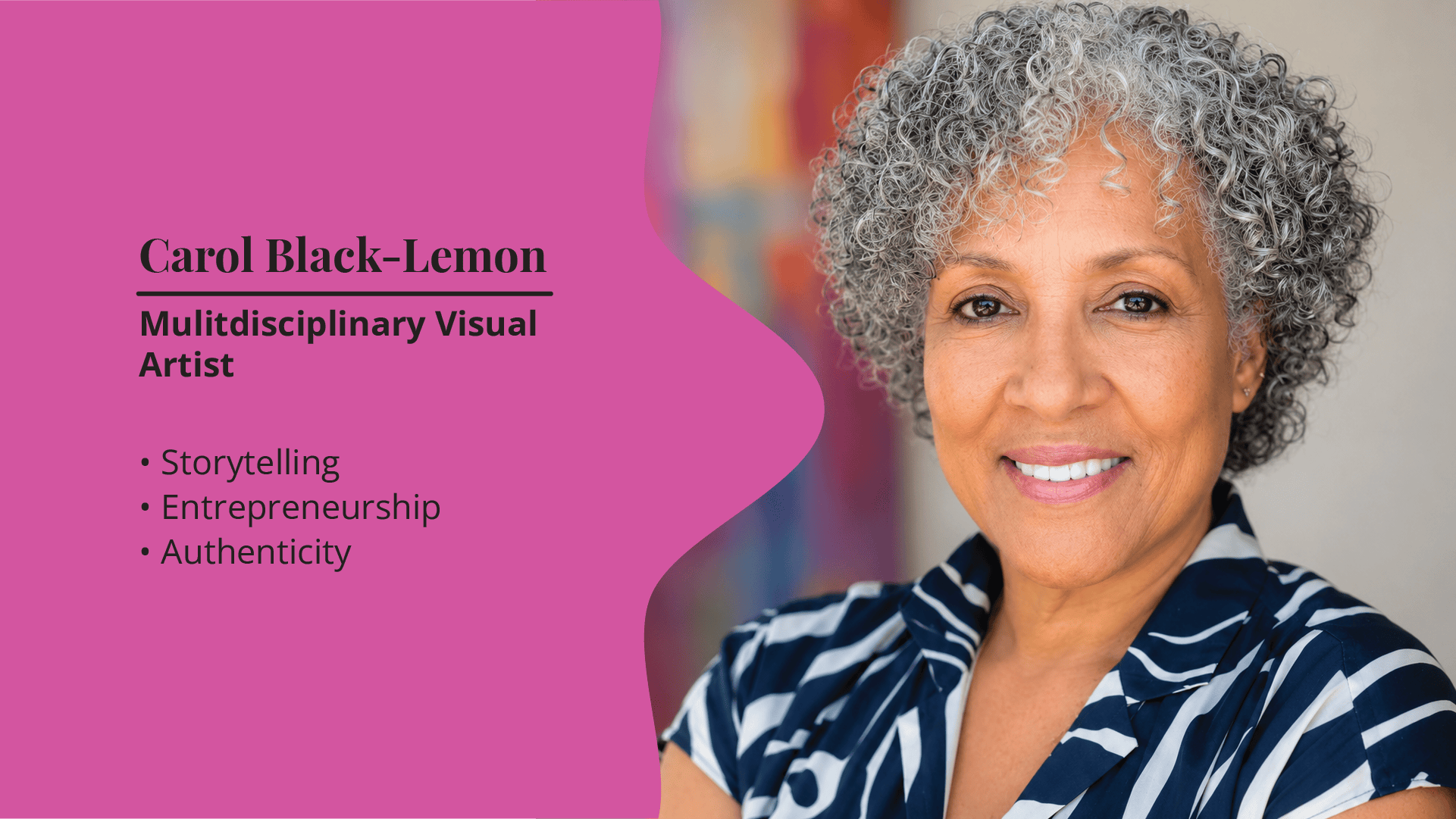
Hello, my name is Sarah Jane Thomas, and today we are talking with Carol Black-Lemon, a professional creative working from and within South Carolina. So, as we get started, can you tell us your current career and where you’re from?
Carol Black-Lemon 00:12
Sure. I’m originally from New Jersey, born in Newark, raised in Brooklyn, and my husband and I retired recently and moved to Florence, South Carolina.
Sarah Jane Thomas 00:24
Wonderful. Before we go into details of your profession, we have a brief section of the interview called “One Career, Sixty Seconds” where you describe your job in sixty seconds or less, similar to an elevator pitch. And we can start whenever you’re ready.
Carol Black-Lemon 00:38
Okay. So I consider myself a solopreneur, and that I do pretty much everything on my own. I’ve always been that type of person where I multitask. But four years ago, almost four years ago, I retired, and from my job as a marketing administrator for a law firm. I was there for twenty years, and I built a lot of experiences working on web design and marketing.
So now I do that for myself, and my business is Black-Lemon Art, aka Carol Black-Lemon Art, and I am a multidisciplinary artist, where my mainstay is creating artwork and storytelling through my art, and that’s my passion. Always been, always will be, and now I represent a new generation of artists who are at a certain age point, and for me, I’m still becoming, and it’s me letting younger folks know that even when you get a certain age, it doesn’t end. It’s where your passion lies. Just keep going with it, and that’s what life is all about.
Sarah Jane Thomas 02:08
I love the term solopreneur. I think that’s so fun and exciting. That was perfect. So, what would you consider your official job title?
Carol Black-Lemon 02:20
Creator. I’m a creator. I just feel very, very blessed to be creating whatever, whatever comes to mind. But painter, for sure, storyteller through my art. I love doing web design. They make it pretty easy today, so I don’t have to get into coding. But I can fiddle around with that as well. And what was the question?
Sarah Jane Thomas 02:55
I was just wondering what you would consider your professional job title, but creator just sums it all up. So, as a creative creator, is there anything in South Carolina that you feel you bring into your work, as opposed to people who may not live in South Carolina?
Carol Black-Lemon 03:17
Something that I bring into my work…I would say communicating with other like-minded or other folks that that want to tap into their creativity. I’m all about that. It’s like folks that I know work on nine-to-five jobs and under fluorescent lighting and the watchful eye; they don’t have freedom. They may be in a creative job, which is wonderful, but for a lot of people, they have their jobs that don’t really give them an opportunity to be creative. You have to follow the pattern and the hierarchy and so forth. But tapping into your creativity allows you to find your voice, allows you to be your authentic self. So, I like to help people to do that, and I founded a group called Creative Connection here in Florence, and it was a call out to anyone who wants to tap into that and talk about their creative process.
Sarah Jane Thomas 04:33
That’s beautiful. Do you think that there was a defining moment in your life that really had an impact on your creative journey?
Carol Black-Lemon 04:43
A defining moment in my life on my creative journey….it’s a good question. Defining moment….I think I had many defining moments, and which was just letting me know that I can control my creative voice, so I had to find time for that. When I had a nine-to-five and raising a family, it wasn’t just about me. It was about what I have to give to my job, what I have to give to my family. But at some point, I’m like, well, what about me? Who am I? And I tapped into that little girl that was just curious about everything, and so that little girl still lives in me, and I keep reminding myself who she was. And now, I was proud of her, and she would be proud of me that I’m still doing that.
Sarah Jane Thomas 05:45
You mentioned your own initiative, your own little startup. Do you think that there was a particular project that you worked on that allowed you to express that creativity in a way that hadn’t really been something that you’ve done before?
Carol Black-Lemon 06:03
I think that might be. There was a point where I was designing my own website, and I went with the DIY. I’m like, okay, I’m that type of person. I’m gonna figure it out, and I really enjoyed it. I had fun with it, and my website was great. And then I thought, “I can do this for other people,” so I looked at some other folks’ websites, some friends, or just people that I knew, and I’m like, “Would you like me to improve your website?” And I did like three of them for free. I’m like, “let me do this so that I can put it on my portfolio,” and that led to a client. So, I said after six months, I’m like, “okay, I’ll help you to navigate it.” Ultimately, and this is going back maybe twenty years now, but that led to fifteen website clients, and for me, that’s why I say I’m a solopreneur. I didn’t have anyone helping me, and by the way, I was doing a nine-to-five job.
Sarah Jane Thomas 07:16
So, you mentioned this nine-to-five job. So, before you stepped away from that and became a creative strictly in your professional life, did you have any fears about that?
Carol Black-Lemon 07:34
Yeah, absolutely. I had to learn about just the business setup and taxes, all the accountability what goes with being a legitimate business and calling yourself a business. So, I had to learn all that, and I was always afraid if I was doing that correctly. My fears of starting up is just learning how to prioritize and not getting ahead of myself, and because then I became responsible for other people, and then I learned that people were counting on me. I’ll never forget a call on Easter Sunday because there was something that they wanted on their website, and I was like, “Wait a minute, it’s Easter. I didn’t sign up for that.” But that was when I understood that the criteria that I had to set forth and letting folks know this is a business, and you have to go by these terms and so that was a real learning experience for me to set those guidelines.
Sarah Jane Thomas 09:00
Was there anything in particular that helped you move beyond these fears?
Carol Black-Lemon 09:07
Anything in particular that helped me move beyond these fears….what got me moving beyond the fears was this understanding the complexity of ownership and accountability, and that if I were to call myself the boss lady, that I needed to step up and take better notes and just be better at what I was doing, what I was being called to do. So it was that I need to step up. That was like pivoting to the next level of being a professional.
Sarah Jane Thomas 09:59
Do you have any advice for young adults or students who have an interest in becoming a creative professional and maybe starting up their own business, as you have?
Carol Black-Lemon 10:08
Yeah, I would say tap into what’s already out there. You don’t have to reinvent the wheel. The information is at our fingertips now. I mean between Google and ChatGPT and Claude, it’s all there. Like, what do I do? They can even build your own website. You know, push the button. There’s your website already. But I’m a hands-on kind of person, and I always want to make sure that if I do use AI to help me, which why not, it’s there. Make sure that it’s at least 80% you and maybe 20% AI, if that makes sense. Yeah, it’s a great tool and it really helps to get things done. But don’t let AI do more of your work than you, and then talking to seasoned professionals and talking to your peers, especially those that are transparent, that are willing to share.
There are some folks that they’re not maybe willing to tell you what they use. I’m like, well, those aren’t your people. If I find something that’s working for me, I’m going to tell my friends, “look, don’t waste your time there. This is a better tool.” But talking to seasoned professionals who are doing it, who will give you the real lowdown in terms of what you need? Make good use of your resources.
Sarah Jane Thomas 11:50
So, you mentioned utilizing AI and utilizing the internet and just like all the information that’s out there now. Do you think that there are any particular skills, either within that or apart from that, that one should practice before trying the same things?
Carol Black-Lemon 12:12
Right, before trying the same things for sure, and that is having just being more hands-on with your own work in your own occupation, meaning taking notes. Every thought that comes into your mind, some of them are good, and some you need to trash. So, prioritizing your vision for yourself, like what do you need to do right now? And that’s doing your homework. So, and if you’re a student, that’s like the greatest place to be tapping into all the resources available to you. Because at a certain point, those resources and those mentors may go away.For me, it’s organization for sure.
Just you know, and there’s a lot of folks [who have it]. I don’t like the term ADHD. A lot of people are like, “I have ADHD.” It’s like if you got a lot going on in your head, there’s a lot of attention deficit because you’re managing so many different things that you are that you have to be accountable for. You’re a student, but you may have a part-time job, and you may have other responsibilities. So, time management is really key. And for someone like me, who’s a multitasker, which I’ve had to tone down. I’m at a certain age right now, and I can’t remember everything, but my mind is still going and going. I wake up with thoughts and ideas, and I don’t want to lose track of it. So having a wonderful calendar, I have this great, beautiful calendar that I use that may even have two years versus an annual calendar and files that I can reference. Organization is definitely key.
Sarah Jane Thomas 14:16
Well, I want to thank you so much for just sharing your story and your experience and your advice and I really–listening to you talk is it just fills me with happiness for some reason. You have such a way of expressing yourself in a way that’s very genuine, and I really loved it.
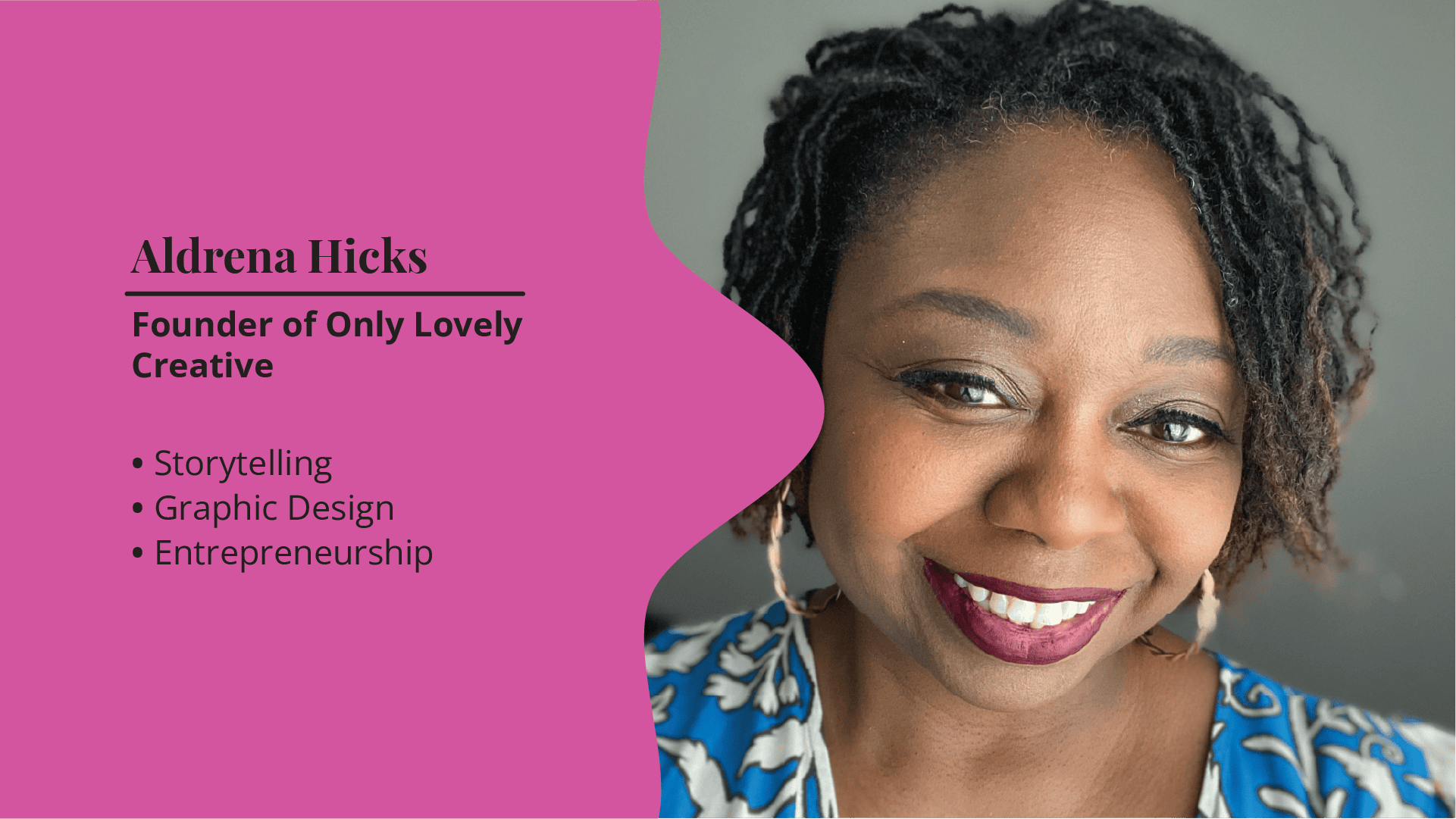
Hello everyone. My name is Victoria, and today we are talking with Aldrena Hicks. She’s a professional creative working from and within South Carolina.
As we get started, can you tell us your current career and where you’re from?
00:13 Aldrena Hicks
Yes. So, my name is Aldrena Hicks, as she said. I am a maker, artist, creative director, and founder of Only Lovely Creative. So, I’ve spent the last 20 years working across higher education, nonprofits and cultural organizations, leading design work that blends strategy, storytelling, brand, and design thinking.
My work ranges from large-scale public projects like the Briggs v. Elliott case. That’s a case that led to the big paved the way for the Brown v. Board of Education. Then to editorial work, like the stitch cover I did for Louisville Magazine, honoring Breanna Taylor.
At the core of it, I’m always making, and it’s through Only Lovely. I do design weddings and experiences that feel personal and lasting. It’s things that people actually want to keep.
So one of the things that is near and dear to my heart is also making sure I care deeply. I care deeply about who gets to be in these rooms. So, making sure the next generation of creatives, especially those that look like me, see a path forward and know that this space is a viable career.
01:32 Victoria Bartolotto
Wow, that’s awesome. That’s amazing work.
Before we go into the nitty gritty details, we have a brief section of our interview called “One Career, Sixty Seconds,” where you kind of describe your job in an elevator pitch style.
01:47 Aldrena Hicks
Oh, that’s what I just did.
01:49 Victoria Bartolotto
Oh! Oh! It’s okay. If that was your script, that’s totally fine. We can continue, but that was great. I didn’t know if you had anything else.
02:00 Aldrena Hicks
No.
02:01 Victoria Bartolotto
No, okay. That’s perfect. Thank you so much. So as a graphic designer, as a maker, is there anything about South Carolina or your region in particular that brings some uniqueness to your work?
Does it have any kind of influence on you?
02:18 Aldrena Hicks
Yeah, that’s a great question. So of course, I grew up in South Carolina, Somerville, Charleston area. Everybody knows Charleston, right?
I come from a long line of makers. So, my grandfather was a brick mason. He’s actually paved some of the walkways with brick work in some of the plantations when they’ve needed somebody to redesign some or fix it up. Then also some of the walkways in the downtown Charleston area, I remember going. My dad would take us to visit him while he was laying bricks on those special pave ways and stuff. So that was nice. My grandmother was a seamstress, very well-known and well respected. Then of course, a family of musicians. All of that I bring into the things that I do.
I’ve always been around creatives growing up. So just having that flair. What I try to do is then incorporate that identity into little nuggets here and there in the work that I do. But that’s why I’m hyper focused on when I’m doing stories, especially when I’m working with brides or organizations. I want to hear the story because that’s important, incorporating that into whatever we’re going to create for them.
03:43 Victoria Bartolotto
Definitely. I feel it really depends on who the person is in order to continue the project.
03:48 Aldrena Hicks
Yeah.
03:50 Victoria Bartolotto
Was there a defining moment in your life that had an impact on your creative journey, whether in education or just personal life? Was there anything that kind of marked that?
04:00 Aldrena Hicks
Oh, there’s so many. Which one do I choose?
04:06 Victoria Bartolotto
Any one! Any one!
04:08 Aldrena Hicks
I will probably say my experience with my graduate work. I am a graduate of Vermont College of Fine Arts, and I majored in graphic design. That was my concentration, of course, the MFA in graphic design. When I started there, I applied sight unseen.
I was already in some other graduate programs. I bounced around a little bit, but nothing felt personal. Nothing felt like this is what I want to do. There was nothing wrong with those other programs, but I didn’t want to lean into the corporate world like that. I’ve already felt I was losing a sense of self because, as you know, when you’re designing and you’re doing work, it is about who you’re designing for. So, you kind of lose that, and I didn’t want that to happen.
When I got to VCFA, I immediately fell in love because the school focuses on the work, the creative, who you are, and then that comes through. That typically doesn’t happen in this case, in cases of grad school work.
So, the probably the pivotal moment is when, I was in a two-year track. Probably after my year and a half review, they’re like, “Aldrena, listen, girl, we love you, but we don’t see you. We don’t see, you’re giving us all the polish and that’s cute, but we’re here to discover the messy and you know, who are you?”
After that little talk, I had my little cry and all that stuff. I realized, “Okay. This is the time where I need to shine and show and dig deep into who I am, my roots, my culture, and be proud of that.”
From that came my thesis work, which has paved the way for other things that I’ve done since then. I will say that was probably the most transformative experience. I’m very proud to be a part of that legacy.
06:08 Victoria Bartolotto
That’s amazing. So, speaking of your thesis project, was that something particular that you produced that maybe showcased your creativity in a way that it never had before? What about it was different compared to previous work?
06:28 Aldrena Hicks
Yeah. So, I took the approach. I did weave in some research because that’s part of the requirements. I took the approach of creating a storytelling experience, because I told you storytelling is part of my thing. What I did was I explored how the media portrays black women and how we’ve influenced the media and culture. I wove certain pieces of history and then turned it back on to how it affected me personally, how it did as a creative.
I studied and talked about hair, respectability, politics, and then skin, colorism and all that stuff. I then found ways to remember how those things affected me growing up and how I now advocate for, especially young black women and my daughter, to be proud of who they are.
So yeah, the approach was different because I did a personal narrative, but I wove in some history and some research in that. It has won a few awards. I’ve written a children, a self-published children’s book out of that. So yeah.
07:56 Victoria Bartolotto
That’s really awesome. Especially just seeing that I’m a writer too. A lot of the times that I’m working on projects, it’s like seeing something grow from a tiny little seed into this huge thing. You have to step back and be like, “Wow. I did that. You know?”
08:14 Aldrena Hicks
Yeah.
08:16 Victoria Bartolotto
So before entering your field, maybe in your education process, did you have any fears about becoming a creative professional? If there were some fears, what inspired you to keep going beyond them?
08:30 Aldrena Hicks
I knew I wanted to do creative work. Like I said, grew up with musicians, makers and all that stuff. I never knew graphic design was an actual thing. I’ve been doing that, just didn’t know that’s what it was.
So, I was at my undergrad, working at Columbia College, SC, not Chicago. When I discovered graphic design, I was like, “People make money doing this?” They’re like, “yeah.”
So, I don’t think I was ever afraid of being a creative in this space. It was more of finding the right place to let that talent grow. Of course, through trial and error and all the careers and stuff, I quickly found out that advertising work is not my scene. I met some wonderful people and did a lot of things. But again, going back to the why behind things, the history behind things. So, then I veered into the nonprofit world. Now what’s scary now is that I’m doing this full time. So, it’s more like, “who’s going to get these invitations? Who wants to have brand work done?”
09:53 Victoria Bartolotto
Oh, wow. Do you have any advice for young adults or students who may have an interest in pursuing becoming a graphic designer? Are there any particular skills that you think someone should practice or at least have before entering the industry?
10:08 Aldrena Hicks
Yeah. One of the things I want to say is that, and I know people have different networks and all of that, all of that is great.
I read a book along, I think I might have mentioned in my pre-interview, one of the books I recommend is reading is Talent is Not Enough, because a lot of people think talent will get you all the places, but it really is the soft skills, building these connections and learning how to relate with folks. It will show up in your work. So, make as many connections as you can.
I know it’s hard because a lot of times you feel like people aren’t going to respond to you. But there are a lot of us out here who really love and want to reach back and help. I mentor. I’m still in touch with many of the students that I taught during my time as a professor.
Do not discount your people skills. I know it’s hard when folks like love the internet, love being on Chat and all that stuff. That’s great. Still learning how to write with and without AI. Learning how to write, learning how to speak, learning how to read the room, that will get you further than just having a talent because you can be the most talented person in the
world. If you don’t know how to relate to folks, you don’t know how to talk with them, get with them on a personal level or at least be professional about things; you won’t last long.
11:45 Victoria Bartolotto
Thank you so much for taking the time to speak with me today. This has been an amazing interview. Have a great day.
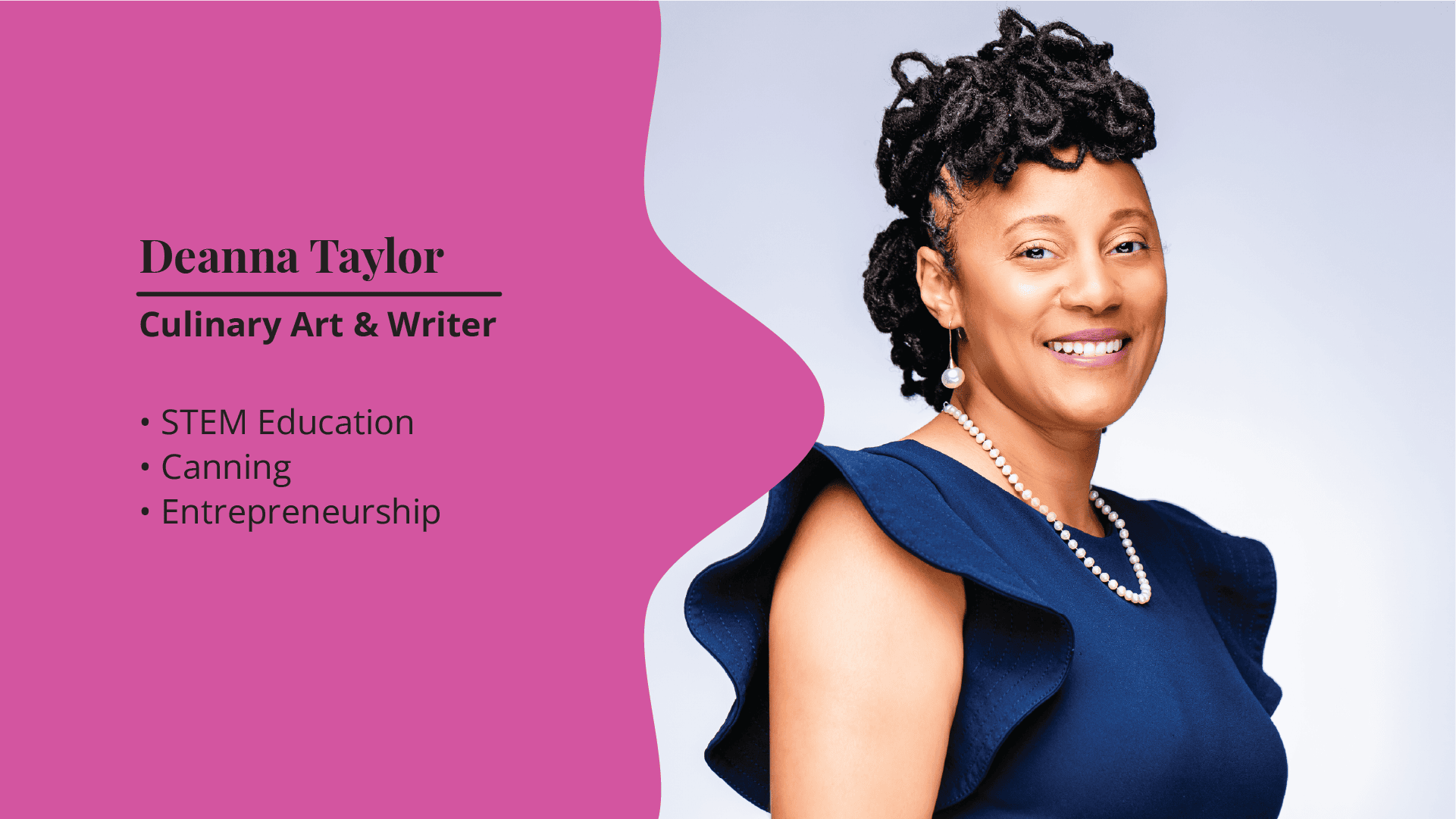
Hello everybody. My name is Victoria, and today we are talking with Dr. Deanna Taylor, a professional creative working from and within South Carolina. As we get started, can you tell us about where you’re from and what your current career is?
00:13 Deanna Taylor
Yeah, so I’m originally from Georgia. I grew up in a little place called Kenneth Hall, Georgia, and I am currently working in out of Camden, Kershaw County, South Carolina. And my career, I am a consultant, and I work in the room of Creative Arts Education and Wellness.
00:36 Victoria Bartolotto
Before we go into the details of your profession, we have a brief section of the interview called “One Career Sixty Seconds,” where you describe your job in sixty seconds or less in an elevator pitch style. Are you ready?
00:49 Deanna Taylor
I’m ready.
00:50 Victoria Bartolotto
All right, let’s start.
00:52 Deanna Taylor
Okay, so I started in eighth grade, and I really loved science. I moved through my career into science, and so now I focus on STEM learning through creative arts, mostly in the realm of making jams, jellies, and preserves, and attaching that to the way that people move through life and are coached. There’s also a little realm of taste testing in there and adding in the element of matching their taste test and what kind of fruit and preserves they like to what their business career or their coaching style is like as well.
01:32 Victoria Bartolotto
That’s so interesting! With working in the culinary arts, specifically with preserving, is there anything about South Carolina, in particular, that is unique to preserving, or does it have some kind of influence on you?
01:47 Deanna Taylor
Yes, so I actually use only locally grown fruits, and those are harvested from my backyard. The tie to South Carolina is that I use pears, figs, and muscadines, and muscadines are really known for growing in the South. As a matter of fact, some of my clients don’t even know what a muscadine is. So, giving them the cultural piece of how it came to be here in South Carolina is one interesting piece.
The other part is I harvest the fruit from my backyard and then the neighbor’s backyard. So, my grandfather got me into looking more at the locally sourced fruit, because he started sharing the craft and everything with the people at his church. So now we harvest the fruit from people’s backyards, mostly his elderly neighbors and folks that aren’t able to get into the backyard, to get the fruit. We salvage it from going to waste, and then I turn that into jams, jellies, and preserves, and we share that with the community. I give some back to the neighbors as well.
02:50 Victoria Bartolotto
I know you mentioned in the form that you filled out that you started preserving over quarantine and COVID. Can you talk a little bit about that, and how that story puts you on the trajectory to be where you are now?
03:04 Deanna Taylor
Yes, so I moved to where I am now. I moved to Kershaw County in 2020 during the height of COVID. I was about six to seven months pregnant, and we moved to this space where it was like room for growing all these fruits and things, and I noticed that the squirrels and the birds were having a good time eating up all the fruit.
My grandparents taught us, and instilled, you do not waste food. You don’t throw anything away; you do not waste food. I grew up in that era where you know you saved everything; scraps and all of that. I started going back to my roots of asking my mom, my grandma, “Hey, y’all used to teach that canning thing, or y’all used to try to get me to do that, can you teach me again, because I want to pay attention now.”
So, I got into it because I wanted to save some of the fruits and not have things to go to waste. Then I just started with taste testing and letting neighbors and friends and family members taste the preserves and things, and then kind of progress from there. Now people request them on a regular. Folks have been asking for new flavors. I’m like, “Yeah, we gotta see about that one.”
04:17 Victoria Bartolotto
I know you also mentioned that you have a book that you wrote. Can you describe the process of going from doing the physical making of canning and preserving, and how you kind of put that down onto the page, possibly?
04:32 Deanna Taylor
The canning process, even picking up the fruit, is more about family and community, and bringing all of those elements back into the kitchen. Making it relevant for the generation that we have now. I mentioned earlier that I was pregnant, and that was our second child in 2020. So, I have little people at the house that are also involved in the process. They help pick the grapes and wash the pears. To me, the book was looking more into those family connections and making sure that the kitchen is a place where it’s a lab. You’re in there experimenting; you’re trying things out. You’re seeing, “Do the kids like this? Do you like this? What kind of herbs things are you going to put in there?” So, the cookbook is actually a cookbook and a text.
My colleague and I collaborated on it and worked on it together. Her name is Dr. Regina Seifra, and it’s a cookbook. It’s a text, because we wanted to bring outdoors and like the growing process and bring it and put it on a plate for the children. There’s activities in there where let’s say, for example, in one chapter they’re going to create their own herb garden, and then they kind of plan ahead for the recipes and they grow the herbs that they’re actually going to use in the recipes and the food for later on. So, making a connection for them between growing and what you’re eating on your plate; that you can actually go through the experimenting phase and figure out what it is that you like and what you don’t like, and how things get there.
06:14 Victoria Bartolotto
I feel like that’s such an important story, even for like adults now just figuring it out. A lot of people don’t know where their food comes from. Learning about that process, I think, is something that a lot more people should know. So, you do this full-time. Was there any kind of moment in your creative journey that solidified that you needed or wanted to do this full time, or was there something that really kickstarted you into this, other than COVID?
06:46 Deanna Taylor
I would say my children. I have been in education for over twenty years, and I have done all kinds of studies, and I’ve worked in different settings. However, making sure that what I’m doing is bringing me joy, and being able to integrate what I do with what the children do has been one of those things. I’m not going to go the traditional job route, I’m going to move more into this creative space, more into the space where I can bring them to work with me.
How many children ask, “Mommy, can I go to work with you?” My kids really like it. They enjoy being able to even get on a video camera and tell out the process. Like, “Okay, Mommy, first we pick the grapes, and then we do this.”
So going through the process and learning the names and being able to teach them is something that I wanted to be able to do. That pushed me, or pivoted me, into the space of being able to bring the real world to life for them and wanting other children to be able to enjoy the same thing,
08:02 Victoria Bartolotto
Yeah. Wow, that’s really sweet. Before thinking about doing this full-time, did you have any kind of fears about entering a creative industry that isn’t well known as a lot of other industries are? Was there anything that might have held you back from doing it full time?
08:19 Deanna Taylor
Yes, so I was leaving a position that had state benefits and all the things. So, jumping into it, I will say one of the fears was of failing or not being successful, but I had to learn to define success for myself and what that looks like.
Then also learning that just like I learned with my science degree, I may not be explicitly using that right this moment, but just like I learned with that degree, if you try something, you can tweak it and then make it better. Your business, and even with a business, doesn’t have to stay and do the same thing year in and year out. Although some businesses are well known for doing their own thing. On the creative side, if I do the same thing over and over, I don’t think I would have much of an audience.
To me, it brings the spice piece in, just like I have spices in my pear preserves, or whatever. I need a little cinnamon, I need a little all spice, if I put the same thing in plant and just pears by themselves, no offense, but in a jar of pears and nothing else, you need a little something to spice it up. I think jumping in scared and also knowing that there’s other avenues and ways and pivots that you can make within a business. That it’s fine, it’s okay, you’re being creative with multiple things, not just your actual medium that you’re using to express.
09:52 Victoria Bartolotto
Do you have any advice for young adults or students who possibly have an interest in starting their own business or jumping into something new? Are there any particular skills or knowledge that they should have before entering either the preserving industry or just something creative in general?
10:09 Deanna Taylor
So, I would say my piece of advice is to stay true to you. Be authentic in what you do, because that’s what sets you apart and kind of makes it. Yes, there are tons of people out there making preserves. There are tons of people out there creating with their hands, creating with their minds, voices, whatever. But there’s something about you that makes you unique. So, focus in on that part and let that part shine through.
I don’t think there’s many people, at least I haven’t found any, that has an education and human resources background that now makes jellies and jam, so I kind of blend those things together.
Using that unique advantage and using it to your advantage, to speak to the world and to make something that you love and enjoy doing. Family is also very important to me, so sticking to those values and things that are important. Yes, making money is great; it pays the bills, but being happy in what I’m doing, actually bringing joy to other people, and telling my story is something that is priceless, for lack of a better word.
I was trying to find something that wasn’t so cliche, but it’s good, I’m going to use it. So that’s the advice I would say: be true to yourself, be authentic, do your thing, and like let that thing that makes you unique kind of make you shine, and go for it with that.
11:39 Victoria Bartolotto
Yeah, thank you so much. That was amazing, and I appreciate you taking the time to speak with me today.
11:46 Deanna Taylor
Okay, you’re welcome. Thank you very much. It was great meeting you, Victoria.
11:49 Victoria Bartolotto
It was nice meeting you as well. Have a great day.
“You determine your worth and set your success. Don’t allow your success to be set on what others think of you and how others perceive you. You determine that, so you won’t have expectations from the world, but you can set your own guidelines and your own expectations.”
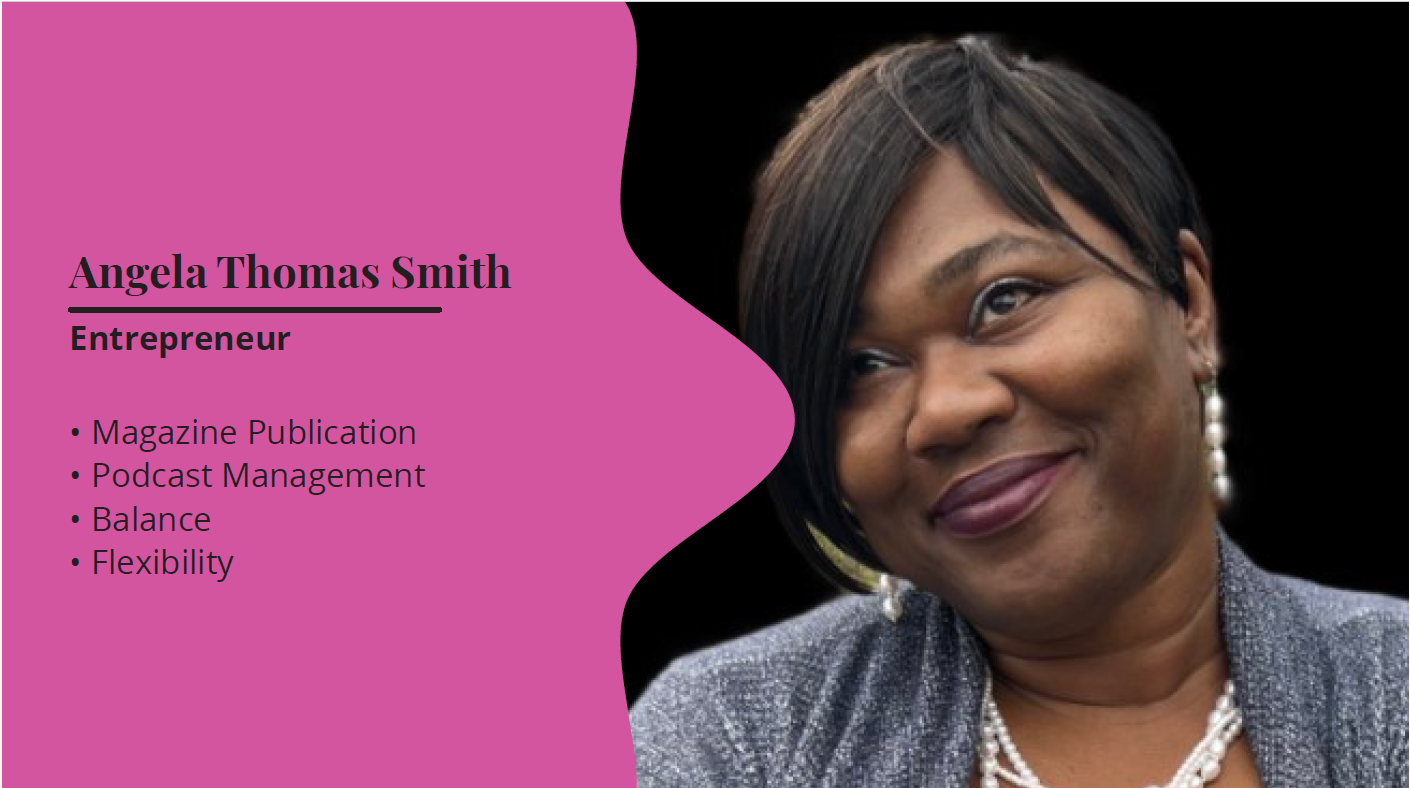
Angela Thomas Smith is an entrepreneur who helps authors publish their books in addition to having a podcast and a magazine based in Georgia.
Interview
Transcript
Emma Plutnicki 00:02
So, to start, what do you do for work and where are you currently working from?
Angela Smith 00:24
I work from wherever my computer allows me.
Emma Plutnicki 00:31
Amazing and where is home for you?
Angela Smith 00:34
So, home right now is Georgia.
Emma Plutnicki 00:37
Okay,
Angela Smith 00:38
I actually just moved from Myrtle Beach.
Emma Plutnicki 00:41
Oh, Amazing! Um, so how long have you been doing that? How long have you been an entrepreneur? How long have you been helping with publishing and all that?
Angela Smith 00:50
I’ve been doing this since 2012. I started in 2012, I really stepped out in 2016 it really picked up the during the pandemic, and it’s just been going amazing. And I published my first client. Um, we’re having a book signing in Georgia this weekend, so I’m excited about that. Amazing! congratulations. That’ll be so fun and so how has your work shifted at all living in South Carolina to now Georgia has done South Carolina has any influence on your work, as opposed to now living in Georgia? So, I am originally from South Carolina. I’m originally from upstate South Carolina Anderson, South Carolina. Actually, nothing has shifted. It is the same because, I have established a virtual community. So, I’m able to connect with people virtually, um, so we’re able to connect globally. I have individuals that’s not here in the US, and we’re connected with individuals in the UK, Africa, the Virgin Islands. I have a host from one of my podcasts that she’s a professor at University of Virgin Islands. So, we are connected globally, and during the pandemic, I was able to establish that platform. So, I’m grateful for that. Yeah, it’s great to have that flexibility. So, if you’re working with people from different time zones, and you’re on your computer conducting these tasks. Is it ever hard to have a good work life balance, because you’re able to work at any time at your fingertips? Is it ever hard to shut the laptop and kind of get away and have some time for yourself? It was at first, but when you learn how to balance, when you learn that if you don’t take care of yourself, then you’re not going to be any good for anyone else. So, when you learn how to incorporate self-care into your daily life, it makes everything so much easier. Just having that time to, you know, escape from the computer, you know, because sometimes you can get overwhelmed and you can get consumed with what you’re doing, and you get caught up. So just having that time to escape, it’s necessary, I encourage everyone to have that for sure. So, what does a typical day look like for you now? What’s expected of you on a daily basis, and what kind of things do you get into? Okay, so first thing I’m usually up at 4am I normally take Angel, who is my mom, my God, mom’s little baby. For a baby, I usually take her out. And I do a 5am prayer. I am a spiritual person, so I am part of a prayer call. We’ve been doing it now for five years. So, I do that every morning, and it starts my day. It encourages me, it uplifts me, it gets me started. And then, I own the computer doing whatever that task is for the day, and it can range from today, I’m working on a magazine. We have a special edition of the magazine that’s dropping to honor poets, celebrating our new poet of the year out of Dallas, so I’m excited about that. She’s from Dallas, Texas, and we get opportunity to really connect, collaborate and be creative, and build a community where people can come and have that safe space to be creative and to allow that express side of them to come forth, whether it’s through books, whether it’s through podcasting, whether it’s through magazine, whatever it is, we want to be that space that allow you to be able to create, yeah, for sure.
Emma Plutnicki 04:31
And so, your podcast, how often do you film those and what kind of topics do you cover?
Angela Smith 04:36
So, we stream live, and we stream on from Sunday to Friday. We have nine hosts, and they all have two shows a month. So, say one may come on every first and third Wednesday, like doctor chin, she comes on every first and third. Thursday, we have a young lady that comes. On first, no second, Sundays and fourth Thursday. So, they have different days that they may come on, but we have someone on every day, Sunday through Friday, at 8pm and they talk about different things because they come from different walks of life. We have individuals that have disabilities. They have a young lady that was born with spina bifida and hydro syphilis. She has a podcast called delayed but not deny. So, she not only focused on disabilities and showing people that you can overcome disabilities, but she allowed anybody that has a story that wants to share it to come on her podcast. Individuals that work in social work and librarians. We have a young lady from Toss in South Carolina. She’s a librarian, um, she hosts a podcast that focuses on authors and anything in the literary world, creative side, she likes to focus on that. So, we are a diverse group, and we’re from all over. We have South Carolina, we have New York, we have the Virginia area, California, Texas. So, we have a variety of individuals as a part of what we do amazingly.
Emma Plutnicki 06:08
And so, with a career like this, is it hard to kind of quantify success? Because, you know, in a creative career, it can be hard to figure out what success looks like, whether it’s financial or ideological. So, in your role, how do you define personal and professional success? Is it how many viewers you have on your podcast? Is it the stories and of people saying that they’ve been touched? Or how do you how do you kind of define that?
Angela Smith 06:36
So, that is something that is just like beauty is in the eye of the beholder. So, that will be something that each individual person will have to say. But for me, success, to me, is seeing individuals that I’ve worked with go to the next level and seeing them excel and go beyond what they thought they could do to me, that’s success. Seeing articles about me, seeing interviews, seeing different things, where people acknowledge the things that I’ve done to me. That’s success, and you know, it’s measured upon the person that is doing it. It is in the eye of the beholder. So, you determine your work, and you set your success. Don’t allow your success to be based on what others think of you and how others perceive you. You determine that…So, you won’t have expectations from the world, but you can set your own guidelines, and you can set your own expectations so that’s my, that’s my take on that. Yeah, that’s a great way of framing that.
Emma Plutnicki 07:46
Did you have any fears when you were coming into this career?
Angela Smith 07:49
I had a lot of fears but had to step out on faith. I had to believe in myself and knowing that I had all these dreams and I was doing things that I didn’t want to do, and I never thought I would be doing the stuff that I’m doing. But when I stepped out and believed in me and believed in what I felt was on the inside of me, things came forth, and I just began to Just go and things just begin to open up, and the more and more I did, the more and more things opened up. And I tell anybody, if you take that first step, that is the most important thing, get rid of fear. Because fear is not something that we are supposed to have. Because if you’re a believer, whatever your belief is, it has to lead to you not having a spirit of fear but having that spirit to do what you’ve been purposed to do. And how do you do that? Go forth, step into it. Do it boldly. You know, I’m reminded of when I was a child, and all the things that I did when I was a child, and how I enjoyed those things. You know, I got back to doing those things. You know, sometimes we get caught up in trying to live up to expectations of other people, where we lose those things that we’re passionate about by chasing after the things that everybody around us want us to do, but if we hold on to those things that we’re passionate about, it will allow us to be creative, and it will allow us to be who we are, and it allowed that true spirit of us to come forth.
Emma Plutnicki 09:35
I love that. Yeah, and along the way, was there anybody offering you advice, or was this something that you just kind of figured out on your own?
Angela Smith 09:44
Well, there were a lot of people that were in and out of my life, and people that probably didn’t realize that they were pouring into me and giving me advice and encouraging me, like my sister. For example, for those that know my story, I lost my mom to a day after my 16th birthday. So, my sister was very important in my life. She was a very inspirational person. She was one of those people that no matter what, she always encouraged me, she always uplifted me, she always pushed me to go beyond. She always believed in me. And she was one of those people that no matter what you did, she would tell you, you did wrong, but she didn’t hold it against you. She always solved the good in you, and that was one of my inspirations. But there have been so many people, and I can’t begin to name them. Because I would definitely lead someone out, and I don’t want to do that, because there have been so many people that have been inspirational to me, even giving credit to my high school coach, Monica Denise Davis, she was someone that if I never come across her, I never would have played basketball. I never would have had that opportunity to go to college. I ended up in North Greenville for one year. I ended up at Morris Brown College. We had the opportunity to play basketball, meet, some individuals, had the opportunity to travel and do some things that I never would have done. So, there’s been a lot of people and just allowing those people to pour into your life. So, take those mentors. If you have an opportunity to be mentored, take that mentorship. Allow individuals to pour into you.
Emma Plutnicki 11:19
Yeah, for sure. And so last kind of question, has there been one significant project that you’ve worked on, or something that you’ve done that kind of sticks out as being particularly significant throughout your career? Maybe it’s a project or someone you worked with, or something that stands out as kind of like the pinnacle of your creativity or of your career.
Angela Smith 11:42
Wow, I can say right now what we’re doing the 100 authors movement, the 100 authors to watch being able to work with a diverse group of authors that are trying to make an impact, that are trying to leave a legacy, that are trying to allow their voice to speak and touch on different things that they’re passionate about. I am grateful for that opportunity that right now is the most, I mean, pivotal thing, and to hear I’ve had the opportunity to sit and interview all of these authors, a part of this movement right now, and every last one of them, they have a spirit of gratitude. They’re grateful for the opportunity, and it’s based on four seeds, connection, collaboration, creativity and community. That is truly what is based on and being able to give individuals a platform where they can be supportive, where they can feel comfortable and open to support. There was a young guy, he was getting ready to release a book. He was having writer’s block. He came inside the chat. We have a chat room on Facebook. We have a group on Facebook, so we have a chat. He comes inside the chat, and he just said he was having a bad day, and he explained what was going on. One of the group leaders immediately responded to his post. She posted some things that he could do. Just willingly. Posted things that he could do. He incorporated those things, he came back, he gave his testimony, he wrote his book. His book dropped, and that’s what we’re doing. We share resources. We are pulling on each other. We’re letting each other know that we’re there, that you don’t have to do this alone. Because a lot of people start a podcast, they start a magazine, they start a book, they do whatever they do, and then they get stuck after they’ve done this thing, like, what do I do now? Now you have a community that’s there to support you, that’s helped, to push you, that’s there to help promote your stuff, that’s helped, and we just want to be a family so that, I think right now, that is the most pivotal thing. And just having all these individuals from different backgrounds, you know, when I say different backgrounds, we have professors involved. We have a professor right now that’s being honored out at miles University, a part of the movement. We have Doctor Chen. We have teachers, elementary and middle school teachers. We even have a high school teacher. I forgot about him down in Texas. We have men and we have women a part of the project. So, we are a diverse group of individuals just wanting to be a voice, um, wanting individuals to know that, yes, you can. We are not respective people, just as we did it. You can do it too. So that’s what, that’s what I’m doing, and I’m excited about that, that project.
Emma Plutnicki 14:38
Yeah, I love that. That’s amazing. Thank you for sharing all that. And just as we wrap up, is there anything else you’d like to say about your career? Any advice or anything else you’d like to add?
Angela Smith 14:50
Well, I just want to tell everybody. As I turn, I’m turning 50 in a couple of days, I would say, what? 12 days I’ll be 50. I’m going to be dropping another book. It’s never too late. Um, because I didn’t start until 2016 and it took me almost losing my life. Because I’m a domestic violence survivor. And it took me almost losing my life for me to really step out and do the things that I wanted to do. Don’t allow something to be the reason that you step out and do something. Do it because you’re passionate about it, and it’s something that you just want to do, and you want to leave your impact. Because we are our legacy. We are our brand. We are the ones that must tell our story. So, we can tell that in the form of written. We can tell in the form of audio, like we’re doing now, visuals, different things, where we can archive the great works that we’re doing. Because if you are a believer, and you are a word, when you know that the words say we should do greater works, and if we should do greater works, how will they know? Because we can’t alter none of the things that have come before us. So, we have to leave the evidence and how we do it through our works, our works just speak even when we’re not here, and we want to leave something that the next generation can pull off because someone did something for us before we got here, and those things that they did for us allow us to be in place to do the things that we’re doing now. So, I just tell anybody, believe in yourself, know your worth, know that you have power because you were positioned to be an overcomer, because you didn’t get dropped out of the sky. You are a willing investor to move forth and allow that thing to come forth out of you. And how do we do that? By educating, empowering, encouraging others. Through our resilience, we can’t give up. You can’t quit, no matter what it looked like. I just completed it on Monday. I just turned in a 40-page document for my last class. I just completed my master’s, so I will walk with my MBA. So, I’m excited about this. 30 years after graduating high school, I went back and I got my Bachelor’s, and now I can walk 12 days before my birthday. I now am a master holder, so I’m excited about, you know, what we have in store, you know? And I say to anybody, chase after your dream, don’t stop chasing your dream, because dreams still come true.
“I put in 30 minutes of practice every day, whether it’s guitar or composing. It’s like exercise 30 minutes a day goes a lot further than five hours once a week. It keeps your brain engaged.”
Brandon Goff is a composer, producer, engineer, performer, and professor of Music Industry at Francis Marion University in Florence, South Carolina. As a Memphis, Tennessee, local, he attended Rhodes College where Goff’s creative path began. This path has taken him through academic and professional music spaces across the U.S. and abroad. With a PhD and a background in music composition, he believes in celebrating every step of creative growth, whether that’s writing an album or landing a gig. His career is a witness to persistence, curiosity, and the value of creative support systems.
Interview
Transcript
Emma Plutnicki 00:00
So, to start, what do you do for work, and where are you currently working from?
Brandon Goff 00:06
I mean, I do a lot of things to be fair, but I’m a professor of Music Industry in Florence, South Carolina, at Francis Marion University, which is obviously going to be the biggest chunk of what I do. But my, you know, my background’s as a composer, a producer, and an engineer and a performer does a lot of different aspects to being a professional musician, and you don’t always do just one. And I’m one of those people who do all those all the time.
Emma Plutnicki 00:27
Amazing. So how long have you been working as a professor, and then how long have you been doing all the other things?
Brandon Goff 00:35
I’m from Memphis, Tennessee, and I’ve been teaching on a university level since, oh my, it goes way back. I first started a Rhodes College, which is a really nice liberal arts school in Memphis, and then I moved from there to probably started teaching, you know, around 2003 2004 so it’s been a minute. Yeah, it’s been a while. Then I went to, like, around Nashville, at a place called Lambuth University, and then I came here from there, and I’ve been here since 2011 so I’ve been in South Carolina for like, you know, proper, 14 years now.
Emma Plutnicki 01:11
Okay, so what is one thing that you love about working as a creative in South Carolina, specifically, as opposed to in Memphis or Nashville?
Brandon Goff 01:22
Well, you know, I do. I—anybody who works in the creative, especially the music industry, is going to love Memphis and Nashville. These are two, like, major hubs of music industry. But along with that, from an academic standpoint, meaning from in the in regards to the education portion of what I do, it’s fun working with students who don’t have that grandiose expectation of someone who’s growing up in Nashville. I mean, these in the talent pool, it’s a misconception. People always think, well, everyone’s so talented in New York, London, Nashville, they’re always just like, let alone actually, mathematically, no, they’re not. They’re just surrounded by an industry which really kind of draws that talent out. So, one of the beautiful things about South Carolina, that I love is the talent pool is thick. It’s just as the talent pool is just as big as it is anywhere else. But there’s just less exposure to it, less exposure to your opportunities, your potential, to chances you can take that you don’t realize you can because you’re not in one of those big music hubs. And I do, I really do love that. Actually, I do. I do enjoy that a lot.
Emma Plutnicki 02:26
Yeah, that’s amazing. So, has South Carolina had any unique influence on your work specifically?
Brandon Goff 02:34
I mean, of course, yes. I mean, it would do, wouldn’t it? I mean, it’s the, I don’t feel, musically? How would I—there’s a, it’s a different—you know, I’m from Tennessee, in Memphis and Nashville. Everyone’s a musician. That is the thing that everyone does. You probably have an uncle who’s a songwriter. You might have another uncle who works for a record label, who’s like a, you know, a talent scout. And I kind of, I didn’t, honestly, I didn’t realize the rest of the world wasn’t like that until I moved here. When I moved to South Carolina, I was like, Oh, this isn’t like the major industry. This isn’t what everybody does. And so, in being steeped in a non-music focused culture is going to obviously be influential. There’s a complete different music culture here. There’s a different kind of nightlife culture, a different culinary culture. And so, I’m constantly stealing, like, little, you know, snippets of sounds and lifestyles and putting them in songs and putting them in, you know, pieces and stuff like that, which I think is as well you should.
Emma Plutnicki 03:37
Yeah, I love that. So how would you describe the local professional community within South Carolina?
Brandon Goff 03:45
In regards to music professionals? You know, again, you’re not in—there’s not, there aren’t a ton of recording studios. There aren’t just a ton of, you know, production houses and things like that. There aren’t a ton of publishing houses. There aren’t a ton of things like that. There are a few here and there and around. It’s more competitive getting into those spaces because there are less spaces for people to access. But one of the biggest, we’re still a big production state, in large part because we do, we still have a lot of arts funding, and we have a lot of massive churches that run big productions. So, I’ve had a lot of students who go work for big, big churches here in South Carolina who have productions that are equal to that, of, you know, equal to that, of like, a large performance venue. And we do have large performance venues, you know, Myrtle Beach, the coast has a lot of that stuff. Even Columbia has a few things like that, Green Velocity, nice stuff or something. A lot of students who have internships up there and stuff like that. And it’s just, it’s going to be, your churches are massive, and they have a massive production budget, so a lot of students will go work for the big churches, and a lot of students that’s like, that’s kind of what they want to do, because that’s like, that’s how they got into music this lot of in the we’re in the Bible Belt, so a lot of the students are picking up musical skills, and the gold concepts in church, and then end up wanting to go back there and kind of work in that church as a worship leader or as a production leader or something like that.
Emma Plutnicki 05:10
Yeah, makes sense. Very cool. So, within a creative career, it can be difficult to define success sometimes, because there aren’t always clear expectations. So how do you define professional and personal success within your career?
Brandon Goff 05:26
Oh, how you, know what I think—I tell this to my students all the time. Yeah and I suspect that depends on your personality type as well. But when I was quite poor, grew up very, very poor and actually I was not, I was not a high school graduate. I was a high school dropout. I dropped out of high school and got a job at a factory. And so, you gauge your dreams and your expectations of success on the reality around you. So, as you accomplish something, you then gauge, well, my next level of success will be that. And so, like, at that point in my life, I was like, you know, my dream is to work inside a place that has air conditioning, because I was working at a factory that had no air conditioning in the South, so it was hot. So, but then as I, as you move forward, like, Oh, I just, I just wrote a song. So I want to write 10 songs. And you, so each one of those little accomplishments is a success of its own, but ideally, and you find contentment and what you’ve accomplished, but you also, it’s fun to see how far you can push what you can do. So, you’re always looking for a new kind of success, but then recognizing the success that you had as you move through it. So, I mean, if you’re a full-time musician anywhere, you are mathematically successful because you’ve done something that’s difficult to do. You’re making a living off of a craft, art, a passion that’s very few people get to do that, and so that’s already successful. But even if you don’t do that, even if you’re just someone who’s actually sat down and written an entire album worth of material, and that’s not what you do for a living that’s still incredibly successful, because very few people have the patience and the skill set and the focus to accomplish that. So, there’s success can be found in so many different avenues. And I think it’s important for—I always tell this to my students, to recognize that and to reward yourself emotionally and psychologically for those successes, regardless of the monetary outcome that you might receive.
Emma Plutnicki 07:28
Yeah, that’s a great way of framing it. So, did you have any fears going into this career, or were you…?
Brandon Goff 07:35
I mean, I was too stupid to be scared like I didn’t know. I didn’t I mean, I didn’t know I had then that’s, that’s a benefit of youth, isn’t it? Like, no, I’m gonna, I mean, I’m gonna do this because I don’t know that I can’t do this. And it’s amazing how when you don’t know you can’t do something, that you kind of put your all into it, and all of a sudden, you’ve done it when everyone else knew you couldn’t do it. And it turns out you could do it all along. So, you’ve kind of got to the ignorance has its role there some level. Or, you know, unabashed arrogance helps as well. Because I’m going to do this no matter what, I’m just going to push through it. Just stick to it, even if you know you can’t do it, just convince you commit yourself you can.
Emma Plutnicki 08:18
Yeah, and was that something that you just found within yourself, or were there people along the way giving you advice?
Brandon Goff 08:25
I mean my undergraduate, you know, actually, my undergraduate degree is in music composition, so it’s not even music industry. Music industry is a lot of what I do, but that was just the nature of being a musician in Tennessee, where there’s a massive music industry. And I got into the music industry because I was one of the first people who was using computers to produce music, and so studios would call me to come do that kind of work, and that just opened the door for me. But again, I wasn’t, it wasn’t part of a grand plan. I was just, again, I was poor. I was, it was day by day. I was like, Okay, I need, I’ve got to eat tomorrow. So, I’m going to do this gig tonight. I’ve got to figure out how to make this happen. So, it was a constant. There was a constant, just a, you know, piece by piece by piece by piece by piece, and you kind of work it, work it out and make it happen.
Emma Plutnicki 09:10
Yeah, makes sense. Can you recall any times when maybe a mentor or professor within your degree maybe gave you some good advice, or even the worst advice you’ve ever heard?
Brandon Goff 09:27
I mean, I say advice, perhaps not advice so much as just support and belief. And that was very meaningful for me when I was, when I was an undergrad, you know, I had a professor who thought that I was very, very bright, and therefore gave me a scholarship to learn a new piece of software that the university had acquired. And that software turned out to be a thing called Pro Tools eventually. So, I was one of the first people who knew how to use this particular software thing called Pro Tools. And so that particular belief and my ability to do that changed my life dramatically. And then, when I was doing that PhD, my PhD professor just really loved my music, loved what I did professionally, and as such, would often, he was a very, very famous composer, would bring me along, would program my works on big concerts across like Europe and from Turkey across, you know, through France and such. So that gave my work massive exposure that I would not have gotten, if not for a particular professor who saw something in me and really, really took it upon themselves to push me forward, if you call that advice. But it was yeah, no, but it was both those, both those episodes were very, very life changing for me.
Emma Plutnicki 10:46
For sure, and with Pro Tools being really life changing in your life, would you say, or, I guess, could you describe a time or a project that you’ve worked on that has been very meaningful to your life? It can be a significant, I don’t know, project or piece that you’ve performed or written, or just anything that you feel has had a significant impact on your life and has really showcased your creativity.
Brandon Goff 11:13
You know, it’s funny, the most popular piece that I have, and it was not. It was never intended to be this way. I was, I was relatively new to South Carolina, and I’m a guitar player. I play lots of instruments, but my guitar is kind of one of my main instruments. I would do session work in Nashville as a guitar player, but I’m a composer. I’m a writer. And so, the concert band director said, Hey, Dr, Goff, we would love you to come in and play perhaps an electric guitar concerto, which is where you have, like, a large concert band or orchestra and with electric guitar as a lead instrument. And so, I thought, okay, great, I’ll let me find a piece that will be good. And so, I searched and I searched and I searched and I discovered that there were almost no electric guitar concertos that are in existence. I was like, Okay, this doesn’t really exist. So, I said, Hey, how about I just write a piece for you guys that you did this for me and for you. And so, I did this. It’s a piece called Full On Rumble. So, it was like, and I actually made it. I wanted to make it kind of tongue in cheek, if you know that phrase, I wanted to make it kind of like, I used all of the over the top guitar techniques from like, the 80s and 90s. They’re all like, all the, you know, the big hair guitar players would play, from Led Zeppelin to AC DC to Van Halen, all the, I threw it all in there. It’s kind of a kitchen sink piece. It has like every little nuance in it, kind of poking fun at, like, the absurdity of guitar solos and stuff, yeah. But everyone loved it, and it’s become, by far, probably 80 to 90% of my professional work is traveling the world, playing that particular piece with other orchestras and concert bands all over the place. I’ve done it in the past two or three years, from London to Portugal to Germany to Istanbul, all the way. It gets performed all the time. So that one piece, that one little weird thing where I was like, Well, I can’t find that piece much better. I better just write one, that was that, changed everything, that opened so many weird doors that’s still a lot of what I do is just manage the distribution, publication and performances of that piece.
Emma Plutnicki 13:13
Very cool. You said it’s called Full On Rumble. Full On Rumble
Brandon Goff 13:16
Yeah, F, U, L, L, on Rumble.
Emma Plutnicki 13:22
All right, I’ll have to check it out. And so nowadays, what does a typical work day look like for you?
Brandon Goff 13:29
It’s, I’m, unlike most musicians, I guess I don’t know. I’m regimented, because I have to be. And it’s taken, yeah, I mean, everyone deals with this. I guess you discover over time what times of day you’re better at certain things. Because when I first get up in the morning, that’s not the only time of the day that I have the mental acuity to like, to do all my invoicing and to send, like, do all my communiques emails, like, I’ve got about an hour and a half where I have the I have the emotional wherewithal to sit down and, like, okay, because I don’t, I don’t relish that. I love creating, I love producing, I love teaching, I love performing. But all of that is tethered to, like, if I’m doing the music for TV commercial, I have to then invoice that, and then have to go through and like, you know, I might have to do all kinds of clerical work behind that, and then send off demos to other places for public publishers. Yeah, it’s like, tons of legwork. So, I have an hour and a half of morning legwork. You have to do that every morning. Just get all that stuff done. And then I’ll always, always put in about 30 minutes of just practice. And we can practice guitar, or could be practicing composing. It is just like, just like exercise, which I do as well. But I do that because it just keeps your brain engaged. You know, 30 minutes a day goes a lot further than five hours one day a week. So, I always do that. Then all my classes are always in that little mid-day chunk, and then I do a lot of production work late in the afternoon, a lot of like mathematical studio stuff I go through and take pieces I’ve worked on and start working on new mixes for them, for release and things like that. Yeah, I know those, the times a day, like times a day when I am most effective for those arenas. If that makes sense.
Emma Plutnicki 15:11
Yeah. You have to know yourself.
Brandon Goff 15:15
Yeah, you did. It takes a long time too.
Emma Plutnicki 15:25
Yeah. So how are you able to, you know, balance work and life, and just keep your creativity at you know, just keeping it alive, because it can be hard, you get bogged down and other things. So how do you keep that work life balance?
Brandon Goff 15:31
Oh, wow, that’s man, that’s enough. You know, work life balance. And these are generational concepts. When I was young, I don’t know that anyone ever really discussed work life balance. So that was the kind of, I’m sure we had issues with it. We just hadn’t figured out how to name it and, you know, manage it. So, if you do something that you really, really enjoy, if it’s the kind of thing you would do, whether you’re getting paid for it or not. That is a beautiful, beautiful thing, but it’s also rife with its own challenges, as you can imagine, because you’re never really off work, and that’s one of the biggest challenge for me, is to disengage with what I’m doing and find a way to tune it out, you know, after, say, 8pm so that I have a shot in hell of sleeping, which is my dream scenario where my brain isn’t frantic at 10pm and like I’m asleep before to 2am I’ll be great, difficult to do, because it is you do what you—it’s what I’m thinking about, whether I’m working on it or not. Like I often, like, in the summers, when I have the rare weekend where I can, like, not do music and go mow my lawn, I’m like, wow, that was amazing. I went and mowed a lawn, and I’m done, and I’m not thinking about my lawn now, like, I like that. I like that. You can put something to bed. And as a musician, you rarely get to do that. You’re just, it’s always doing and you have to. I—so I’ve called it work life balance, so much as just because you love music. And music’s everywhere. So, every time I turn on a Netflix show, there’s a piece of music in there that I’m like, Oh, I could steal that idea. I could do—and so everything’s research, so it’s difficult to pull away from that. So, I’ll often listen. I’ll often dive into, like, some sort of talk radio, because it has no affiliation to my career whatsoever. And it just kind of helps bring me, pull me away from that, that whirlpool of creativity.
Emma Plutnicki 17:38
Yeah, that must be hard, because music is everywhere, and it’s just part of life. Which is good and can also be challenging. But you’re right. As we just wrap up, are there any, is there anything else you’d like to add, or any questions you wish that maybe I asked that I didn’t?
Brandon Goff 17:58
I don’t think so. Thank you. That was a really nice selection of questions. I mean, it’s, my colleagues often call me—they say he’s kind of workaholic, he’s kind of hyper, and I am kind of hyper, and I can’t appear to be a workaholic, because I do love to perform and I love to write and I love to write and I love to produce. These aren’t all the same thing, but there’s absolutely no reason you can’t pick one of those things and be that. Be that thing. One of my best friends is one of our piano faculty here, and he’s just a concert pianist, and that’s all he does. But, and that’s a beautiful thing. If I just performed, I think I would lose my mind because I want to write as well, but I also love being in the studio and like, you know, stacking guitars and laying things in and making a nice product, that’s my particular passion. Is that diversified approach to a career, but it is by no means I don’t know what I would even suggest that to every student, because that said that it’s a challenge, and that’s it. That suits my personality, that suits the way that I work, pretty well, but I suspect it’s not the best fit for most people. I suspect I’m a minority in this that that arena. It’s hard to say.
Emma Plutnicki 19:17
Yeah, hard to find a balance, but amazing. Well, I’ve loved hearing your story, and thank you again for taking the time to speak with me. Last thing is, do you have anybody that you think would be great for us to interview another professional in the creative space? I could give you some time to think also and shoot you over a nominations link.
Brandon Goff 19:43
Yeah, please do. I know a lot. I know a lot of great creatives.
Rhodes Farrell, a videographer based in Spartanburg, South Carolina, offers healthy habits to generate inspiration and build skills that are beneficial not only to filmmakers, but to any creative.
Interview
Transcript
Lexi00:00
My name is Lexi, so I’ll be interviewing you today for the Athenaeum Press for a little project we’re doing called Uncharted. And basically it’ll be professional creatives giving advice to students. And yeah, so first, just give us a little introduction of yourself. What do you do for work, and where are you currently working from?
Rhodes Farrell00:27
Yeah, I’m a videographer, and I do that full time. I came from, like, audio world, and then a AV and then video kind of took hold of me, and I fell in love with that. So I didn’t go through school for that. Particularly. I was in audio, but we moved out here in 2018, and that’s when I went full time, and it’s been great. But I’m in Spartanburg, South Carolina, and loving it. It’s a really great town.
Lexi00:59
So, yeah, okay, awesome. So how long have you been working like doing this creatively? Are you doing this full time or part time?
Rhodes Farrell01:14
Yeah, so full time, I tried to make it part of my job. I was technical director at a couple different churches and other jobs before that, so I always tried to include videography, yes, but when we moved in here in 2018 from Atlanta, I just went full time into it, and haven’t looked back. And so I guess full time was it now close to seven years, six or seven years, but I’ve been doing videos since high school, so 20, yeah, ish years.
Lexi01:47
So you said you moved to South Carolina in 2018 is there anything that you love, like, specifically about working in South Carolina as a videographer?
Rhodes Farrell02:06
I’m kind of grateful I moved away from Atlanta, because this is, you know, I didn’t feel like a small fish in a big pond kind of thing out here I could, you know, stretch my wings a little bit More, or be the the decent size fish and the decent sized pond, I really want to put it, but yeah, so it’s it’s worked out really well. I wasn’t 100% sure that Spartanburg would support filmmaking full time, but surprisingly, it has been. And even more so.
Lexi02:39
That’s amazing. So what does South Carolina like bring to your work, and what is its unique influences on you, if it has?
Rhodes Farrell02:51
My people are here. I guess Spartanburg coming into it. They’ve just got arts all over the place. Same thing with Greenville, I’ve been able to set up a community called Film Bar, and that’s just filled with hundreds of people in the upstate that are just in filmmaking, whether they’re acting or voiceover, or they just do sound, or they just do lights or whatever. They have some role in filmmaking, and I’ve gotten to know not all of them, but a pretty good number of them. So it’s been really great to have that connection where it might have been more cutthroat in other areas. Yeah, that’s awesome, because there’s a it just seems like there’s a clear ladder to climb here, if that makes any sense, but yeah.
Lexi03:40
So I actually never knew that Greenville and the Spartanburg area were such big areas for filmmaking, but I’ve actually heard a lot about Greenville and that area, so I feel like that’s awesome. Yeah. So how would you describe the local community?
Rhodes Farrell04:05
Well, I mean, with film bar, I mean, that’s kind of my wheelhouse. Is we started it three years ago, and it’s technically 1700 people on Facebook, but I’ve only met 400 or so of them, which is still a good number, and they’re just constantly working on different projects and doing things and trying different things. And so it’s great that we have that community, that people can, you know, because it’s, it’s a very collaborative artwork for, you know, narrative short films, or even for commercials, you have to have more than just one person generally. So it’s good to have those connections there, but it’s just really diverse. I mean, like I was saying all the different roles that you have in filmmaking, yes, you get a large collection of brains and smarts and creatives.
Lexi04:55
I feel like it’s also so special that you’ve been really a big person in bringing everybody together with film bar. So that’s amazing. So how would you define professional versus personal success in your creative endeavors?
Rhodes Farrell05:15
Well, I my slogan or quote or whatever. It’s a Disney quote, but “Keep moving forward.” There’s just so many things to be creative with. You just keep moving on to the next project. And some people like to stick with the project and do a festival run and stuff like that. But I’m always keen to work on the next thing. I don’t know why, but, but also just 1% better. That’s another one. If I did 10 podcasts last year, I want to do 11 this year. So I want to just incrementally get better and better and do more and more and and find more success that way.
Lexi05:52
Yeah, that’s awesome. It’s always good to be looking for something to grow. So what was your biggest fear when you decided to pursue filmmaking professionally?
Rhodes Farrell06:04
Like I said, the Spartanburg being a small town, I wasn’t sure it could, if I would get enough work or whatever, but it took a while to get there. But it’s, it’s definitely proven itself.
Lexi06:21
Yeah, that’s awesome. Okay, and then can you please describe like a defining moment in your creative journey? Like, was there a particular project that made a significant impact on you, or was something that, like you produced that you believe really showed your creativity?
Rhodes Farrell 06:39
I did win the indie grants, which is through the film commission for a short film last year. So we got $30,000 to shoot a short film that’s amazing. Partnered with my friend who wrote it and directed it, I was a producer on it, pulled in a bunch of people on a project. We had 40 people most days, and I think we had a bunch of background one day. So we had up to 60 or 70 people one day, and just just pulling all that together was a ton of fun to do, and it’s actually gonna show at Beaver Film Festival first, and then the Greenville Reels Film Festival second. But they’re not announcing the name, so we can save our premier status for festival. We end up going to so exciting. And so that was a big one, that was a really fun project to be awarded and get to do. And then film bar really has been a huge turning point for me. I started it just because I wanted a few friends, and then it’s huge, grown so much so, and that’s just changed, a lot of access points for me to be able to have that weight behind me, to talk to people and stuff like that.
Lexi07:54
So on your whole journey, what has been the best and worst advice that you’ve ever received?
Rhodes Farrell08:03
Oh gosh, I have like, hundreds of little slogans or nuggets or whatever from all kinds of various places. Some of the ones I really love are from the Imagineering workbooks, stuff like that, the Disney theme of things. But one, I would say, pretend you’re an expert. That’s a great one. Kind of fake a team make it, so to speak, and then don’t use your head as a filing cabinet. That’s a really good one too. Yeah, I write stuff down now way more than I used to. It’s like, Oh, y’all remember that note doesn’t work? Yeah, when the worst one was probably just sign it. Don’t just sign a contract. You get in sticky situations. Technically, I heard that first with our house, when we’re trying to buy a house out here and they’re like, oh, just sign the contracts, like, but I don’t know what this means. Yeah, so, but I’ve heard it from other times, for other places.
Lexi09:08
I feel like that is some good advice. Just like all around you don’t want to get into anything without knowing…
Rhodes Farrell09:15
Well, you just forget the bad and the bad advice.
Lexi09:19
I think that’s good on its, I think that’s a good piece of advice, like on its own, because I feel like if you are remembering all this bad advice and negative comments, you’re just gonna get bogged down by it. So okay, so can you walk me through like a typical workday for you, what does your process look like, and what do you kind of like expect from yourself on a daily basis?
Rhodes Farrell09:48
There’s not really a typical day in filmmaking as a freelancer, maybe, if you’re in a corporate world, you might have more of a typical day. But there’s a typical process, which is kind of like, you know, you’re doing cold emails, you’re finding the client, and then you they call you back, you do all the pre production stuff, the brainstorming, and then you set some dates for finding talent, locations you know, to film whenever you get all your footage. Then you have two to four weeks of editing, depending on the project. Social media turns around a lot faster and present them with that, and hopefully they do the next video. So that’s that’s kind of just the process, but in a typical day, I’ll answer a lot of feedback from different things. I’m on a lot of the reading reels, Film Festival board. I do film bar, and I do YouTube and podcasts, and then there’s marketing myself and work. So there’s a lot of different variables that go in.
Lexi10:57
That sounds like a lot to juggle.
Rhodes Farrell11:01
Yeah, I’m actually working on doing an AV install, which is throwback to what I used to do, but I’m helping the museum install stuff. So it’s a very different than my normal day, but it’s just what it is to be freelance, I suppose.
Lexi11:15
Yeah, so with freelance, how do you how do you create, like, a good work life balance, where you’re able to, like, maintain everything?
Rhodes Farrell11:29
The biggest answer for that is probably my wife. She is a teacher, and she takes care of so much, takes care of me and allows me to be able to do this. So that’s, that’s a big part of it. So shout out to Emmy. I love her. But being encouraging to clients to kind of take a creative step, not a leap. You don’t want to push them too far, too fast. Some of them are all up for it, but just, you know, slowly, give them a little bit of nudge to hey, let’s do try something a little edgy that you may not be totally comfortable with. Getting out of that comfort zone is a great spot to be. And then the other thing I’d say is, like, learn public speaking. How to start a conversation in conversation, small talk, doing that with film. Barb to go from person to person, kind of have those conversations you and editing. You kind of learn how to narrow down your communication to the most useful nuggets and be quick about things. Yeah, last one is learn business and marketing and keep things simple. Because it’s if you don’t know how to do that for yourself, then you’re stuck.
Lexi12:44
Yeah, yeah. I feel like, I feel like that is very good advice. I feel like that there’s a lot of moving aspects in every part of a creative career. So you’ve kind of already described some of them, but what are some habits that you think would be beneficial to others wanting to get into videography, filmmaking and stuff in that realm.
Rhodes Farrell13:18
Just like any artist will tell you, who can go out and practice your thing, I would say, find a community. If you can find people to do this with, whether it’s just you and your siblings or you and your best friend just go out and start doing stuff together. And there’s so many stories of filmmakers that have say, Oh, I’ve got these YouTube videos of I guess, in this day of age, YouTube videos, you know that no one sees anymore because I took them down, but they’re just silly little things that people went out and did, but that that’s what made them fall in love with it. So keep doing those things that make you fall in love with it, and just find your community.
Lexi14:02
That’s, I think that’s really beautiful, because I feel like fear holds so many people back from what they really want to do.
Rhodes Farrell14:12
But, yeah, I have a great quote for that too.
Lexi14:15
Yeah, go ahead.
Rhodes Farrell14:19
Let me find it. It’s from, it’s from Walt Disney. Sometimes I wonder if common sense isn’t just another way of saying fear, and fear, too often, spells failure, Walt Disney.
Lexi14:32
I think that’s really fitting. That’s a good one for sure. So do you have any questions that you wish that you were asked.
Rhodes Farrell14:46
I do lots of interviews myself, doing videos, stuff like that, so I like to ask the question like: What are your other hobbies do you have? Or if you had a TED talk, what would be what would it be about?
Lexi14:59
So, if you had a TED talk, what would yours be about?
Rhodes Farrell15:05
Public speaking? Probably for one, just being able to get out there and talk and how to hold a microphone. I don’t know why that gets me, but,yeah, that would probably be one of and then my other hobbies, I do leather working, just because my hobby was filmmaking and then became a job, so I needed something else, so I do leather working for fun. My wife is an art teacher, so we do crafts all the time. She does ceramics. And then we recently got our scuba license, so I’m trying to do more of that. That’s very fun. Incorporate that in my videography as well.
Lexi15:50
Yeah, I feel like that opens up a lot of, like, good shots that you could have that’s super cool.
Rhodes Farrell15:56
And just wildlife in general, if I can film wildlife, that’s a good day.