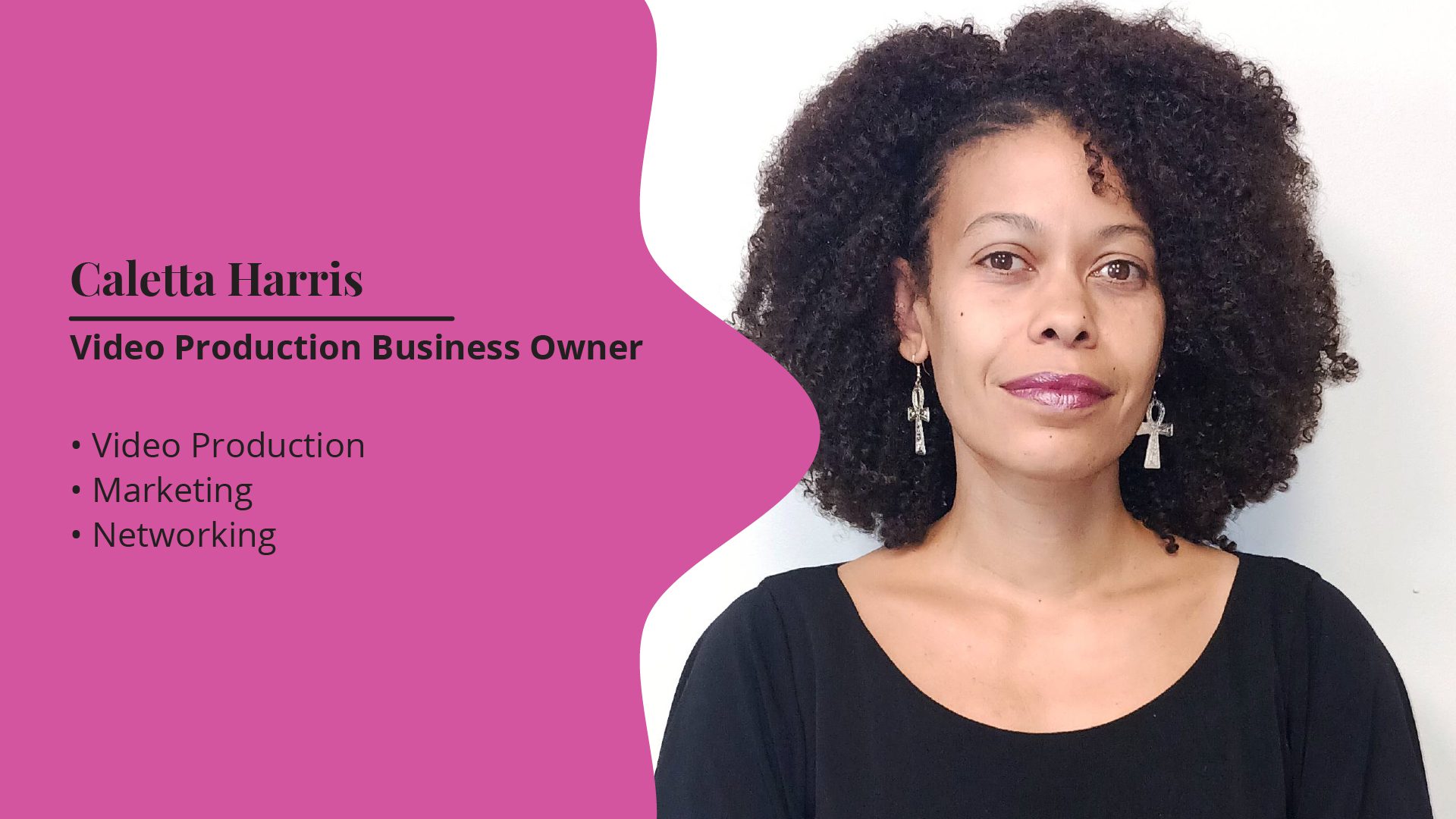
“Know your worth and follow your path, and entrust yourself”
Caletta Harris is the founder and owner of Reel2Real Productions, a video production company that has been transforming stories into powerful visual narratives for nearly 20 years. She is based in South Carolina and works nationally, blending creative passion with purpose-driven storytelling by using media to empower, educate, and amplify voices across South Carolina.
The powerhouse behind Reel2Real Productions is a woman with a camera and a mission. For nearly two decades, she has built a full-service video production company that thrives on diversity of stories, clients, and causes. Based in South Carolina, her work stretches far beyond its borders, but the state’s rich history and collaborative spirit have deeply shaped her creative journey.
Interview
Transcript
Lexi Raines 00:01
So, what do you do for work, and where are you currently working from? Well, I
Caletta Harris 00:05
Currently I have my own business called Reel to Reel change to Reel2Real Productions, and we have been there for 19 years, almost 20 years. Next year will be 20 years, and I’m kind of out of everywhere. I’m remote, but I do work all over. So right now, I’ll say South Carolina, awesome.
Lexi Raines 00:26
And so, what is your official job title, being the creator of realtor. I am the owner. And what is one thing that you love about working as a creative in South Carolina?
Caletta Harris 00:37
Well, I love the rich history in South Carolina, and to have that creative freedom being a creative there’s a lot of stories to be told. A lot of rich history here, and just the people connecting with some great, like minded individuals, is always a plus.
Lexi Raines 00:55
I completely agree. So first, just tell us a little bit about Reel2Real.
Caletta Harris 00:59
So, Reel2Real is my baby. My production company is a full service video production company. So we basically do everything from commercial marketing all the way to documentaries. I am the videographer, the editor, all of the above, the marketer, all of that. So we basically do a lot of branding for companies. So we are going on our 20th year, next year.
Lexi Raines 01:25
Awesome. That’s so cool. So what does South Carolina bring to reel to reel, and what is its unique influences on you compared to anywhere else I can
Caletta Harris 01:33
Say, South Carolina has brought me a lot of diverse clients, like my projects totally different. And when I was starting the business, people always would say, you need to get, like, a portfolio that’s vast. You can’t just do one thing, and then expect people to say, Oh, well, you can do it, but they have to see it. I’m like, This has definitely given me an opportunity to have different type of clients, different type of genres. And I just love it. I love just creating people’s vision that
Lexi Raines 02:03
Awesome. I feel like South Carolina is definitely a very diverse community. And saying that, like, how would you describe your local professional community? Local
Caletta Harris 02:11
Professional community? They are wonderful. They’re very interesting. They’re very talented. And, you know, they bring opportunities with them. So it’s not like, this is just mine. They see where people can fit in. And then once I start talking, you know this, the wheels start spinning, and it’s like, oh, well, maybe we can fit you here. And then my wheels start turning. Say, oh, maybe I can connect you with so is a good connecting hub? I like, yes,
Lexi Raines 02:38
That’s actually something I’ve heard a lot throughout, like almost all of my interviews, is that South Carolina really is such a good community where people want to like be able to lean on each other, which I think it achieves pretty well. How do you define professional or personal success in your creative endeavors? Well,
Caletta Harris 02:57
I would define personal professional success is retention rate. I can say my longest client has been 15 years, and then the next one has been 11. So I can say that I have a great rent retention rate with a lot of my clients. And then from there it’s still, you know, multiple years, and then even the new client is like, we don’t want to just stop here. We want to keep that show’s success. To me, that I must be doing something right, and then just personally, it’s kind of the same thing. Sometimes I’d intertwines, but just building relationships personally, because it’s not always professionalism with my clients. So we build that relationship. Yes,
Lexi Raines 03:38
That’s awesome. And sometimes that’s the base you need to work on. So that’s really great. What was your biggest fear when you first decided to pursue the arts professionally? Can
Caletta Harris 03:47
I be self-sustainable? I think that’s a lot of people fear. Can you do this long term? So I was smart with it, because I held on to a job until I said I can do this long term. It kind of worked out. And then when I got my first office space, I just took off from there, because people want to see that to make it real for them, right? So that I just didn’t have to go back doing anything else for anybody else.
Lexi Raines 04:15
And that is awesome. I know a lot of the creatives that I’ve interviewed so far like they are kind of working on their projects, and then they have, like, a day job, and so that seems like difficult to juggle. So it’s awesome that, like, you aren’t having to do that. Okay, so can you describe, for me, like, a defining moment in your creative journey? Like, did you have a particular project that made a significant impact on you
Caletta Harris 04:40
Absolutely! back in 2013 I started a journey while in my office downtown, I read it in the newspaper that city council wanted to do something about their homeless issue, and I was called by what the options were. So I was like, I want to do something about. It. I already have a production company. Let me just start filming and talking to people and seeing what’s going on around me. And it became a full feature documentary. It’s called No Address. It’s a documentary series featuring Columbia, South Carolina and Atlanta, Georgia.
So it talks about, you know, the criminalization of homelessness, what’s going on as well as practical solutions, because we can’t keep talking about the problems without the solutions. And that has had the biggest impact on my life. I the first one came out. Columbia came out in 2020 and Atlanta came out in 2022 so we hit the whole film festival market, and now it’s on Tubi, Amazon. I’m about, I’m thinking, I’m on about 10 streaming platforms now, so it has made a huge impact. I’ve spoken to a lot of colleges, even middle school and high schoolers, and they’re excited about doing something in their own community. So this has been one of my biggest passion projects, and I continue to expand with it, because I want to be a part of the solution now, yes,
Lexi Raines 06:01
That is, like, actually so amazing and so meaningful that is, and being on so many streaming sites like, that’s so cool, that’s actually awesome. So what is the best and worst advice you’ve ever received on your career path? That
Caletta Harris 06:19
Was a struggle, because I can’t really think of the worst advice, because I really block out a lot of that negative energy, right? The best advice, I would say, is when you know someone told me just going through this is to trust yourself, follow your own path, because had a lot of challenges at the beginning, me being a woman owned business, so that was a challenge in itself, and people taking you seriously. So that I that was the best advice was to say, you know you know your worth and follow your path, and you know you know and trust yourself. So but the I could say something generalized, like the worst advice would be something like, it doesn’t matter, everybody’s doing it, so go ahead and do it. And I’m not that type. If you say go right, I’m gonna go left. Open your mind and think creatively, yes, so that I don’t say that. Yeah,
Lexi Raines 07:16
I think that is, like, really good advice to, like, stay true to what you want to do, not what everybody else is doing. So that’s awesome. Can you walk me through like a typical work day for you, what does your process look like and what’s expected of you on a daily basis?
Caletta Harris 07:32
So normally, I wake up, I stretch, I meditate, then I go drink some coffee or tea, and then I either edit or film, depending on the day. So every day is different. I usually work until like seven, unless it’s a long shoot or something, but I kind of cut it off at seven, and then I have me time. I relax and do whatever, and then I try to go to bed by 10 o’clock, because rest is so important to me, because I use my brain so much, and sometimes I’m juggling two or three projects simultaneously. So it’s like shifting gears here and there all the time, somebody else talking about something totally different. So it’s like your mind is always going so I’m like, shut it down at 10 o’clock and then, and then I just start the day, just to rejuvenate and start the day. So that’s kind of my routine. And then I don’t I try not to talk business after seven.
Lexi Raines 08:28
I think that is super smart, like, and a good practice to have, because I think so many times people don’t know where the line, like, the line kind of blurs between, like, work life and personal life. So I think that’s really, really good advice. Actually,
Caletta Harris 08:44
Being entrepreneurs, we people don’t know how to cut it off. It emailed at 2am from people in that one time, and then I said, You know what? This isn’t healthy, because you’re going to burn out at some point. So it’s like, every day is a new day, and I’m ready to conquer it. You know, along
Lexi Raines 09:01
Kind of with that, I know you’ve explained some of them trying to get to bed early. What are some habits that you think would be beneficial for others wanting to do what you do? I
Caletta Harris 09:10
Would say, you know, just find your peace. Whatever it is at times, just take breaks and find your peace. I’m a nature person, so I go out in nature and, you know, just soak it in vitamin D, go out to the farm, you know, things like that, just to digress, and then you can kind of recharge yourself and get back into because you don’t realize, once you do that, how much information can come in and Creativity can come in when always thinking about everything else. So take that time, even if it’s five minutes, whatever it takes, just go out, walk, do something, stretch or just be silent, you know. And a lot of times that really can make a huge difference, subtle, but it can make a big difference.
Lexi Raines 09:57
Yes, I completely agree, just for. My personal experience, I feel like just those few moments that you take to like, ground yourself, super, super important.
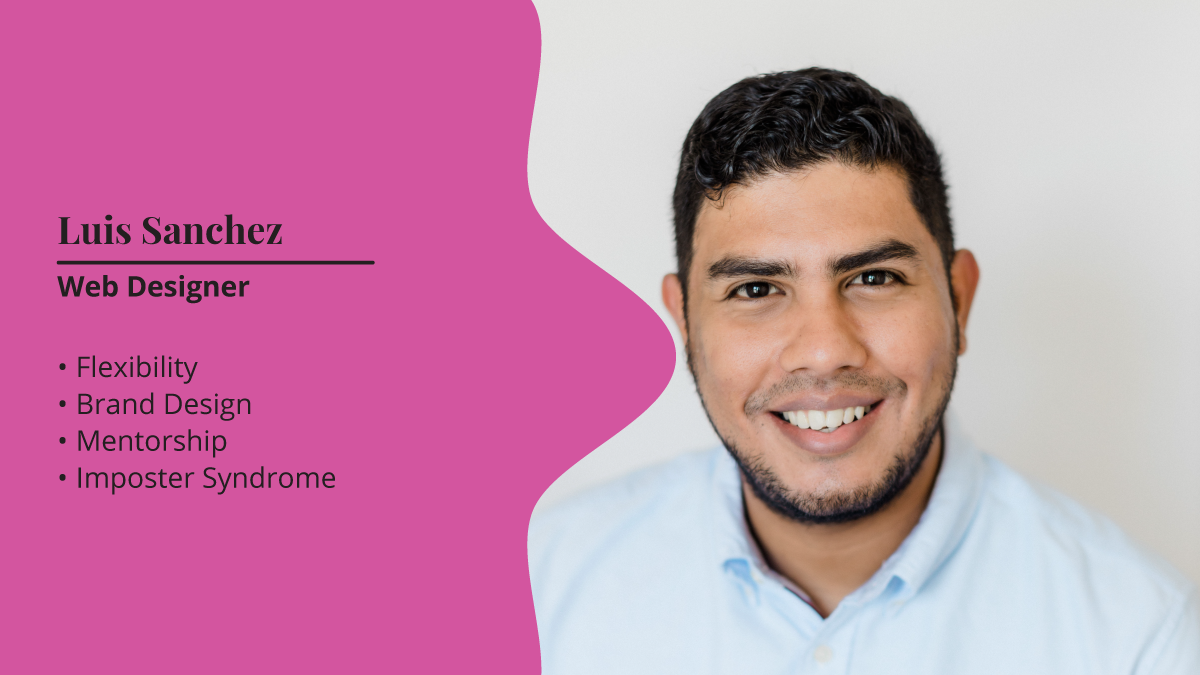
“Be wise where you put your time, money, and effort.”
Luis Sanchez is a freelance web designer based in South Carolina.
Interview
Transcript
Emma Plutnicki 00:02
Okay, so to start, what do you do for work and where are you currently working from?
Luis Sanchez 00:09
So, so I, I started a web design business last June. So most of my time is, you know, setting that up, working from home, but you know, my main job is- I work at a church as a Youth Director. So those are the two things I do.
Emma Plutnicki 00:29
All right, amazing. And what would you say your official job titles for each of those will be?
Luis Sanchez 00:36
So, that’s a good question for, you know, small businesses like, am I a CEO? But you know, the main passion is just web designer, brand design, web and brand design. And then for the church, is just the youth director.
Emma Plutnicki 00:52
Yeah, great. And how long have you been doing those four?
Luis Sanchez 00:55
Yeah, so I’ve been working here since at the church, since 2021. August 2021, and the design since June last year.
Emma Plutnicki 01:08
Okay, nice. And so what does a typical day to day look like for you nowadays? What’s expected of you on a daily basis? What do you get into? What are your responsibilities?
Luis Sanchez 01:17
Yeah so it actually works out pretty, pretty well for me, I- so we’re going to church. Most of my stuff is done on the weekends, so I have a chance of putting time on the web design part during the week, you know. So a week when I have, you know, when I’m working with a client, it’s just meeting with them and then spending, you know, you know, four to five hours a day working on, just design, research, designing, testing different things, and then just, depending on the website, it’ll just take a couple weeks or not. So it was either meeting, doing a lot of research and just designing. And then during the weekends, you know, I pivot back to the church. So I was just preparing for Sunday youth group. We have youth group on Sunday, so the main job just preparing, just everything for for that to happen on Sunday. But yeah, during the week is- I’m working from home, just on my computer and then meeting with clients when needed.
Emma Plutnicki 02:25
Yeah, nice. And so having some work on the weekends, I’m sure it could be hard at times to have a healthy work life balance. So how are you able to navigate that with two jobs and making sure you still have time for your own personal creativity?
Luis Sanchez 02:41
Yeah well, I have a six month old baby, so you should have a clock hits me and my wife are just just spending time together with family. But one thing about it is my wife is usually pretty- she wants to take some time off, and so we have dinner together, spend time together, but usually she goes to bed a little bit earlier. So I’ll hit a lot of different things, you know, from like nine to 11pm I like to read books. YouTube’s pretty cool just seeing what other people are looking at and, you know, and every now and then, I mean, I’ll pick a day in the week where I’m just not going to do anything, but just sit there and think about day and relax and do something aside from it. But yeah, I would just just have intentional time of consuming other- from other people who do design. It’s just helpful for me, but it’s always tempting when you hear something, it’s like, “oh, I want to try that”. You grab your computer. I just kind of have some liberty where it’s okay to do that sometimes, it’s okay to just read, It’s okay to just take some time off. But I think my job allows me to be creative too, with the church. You know doing things like running social media, creating graphics, videos, whatever it is. So I still get to do that. So it’s a good way for me to try out things that I maybe not try out with clients. So I don’t know, I just look at opportunities for- to do different things and try different things.
Emma Plutnicki 04:22
Yeah, no, makes sense. And so with both of your careers, sometimes within creative fields it can be hard to measure success, so how do you- is there a difference between what success looks like in both of your roles? And how do you personally define either professional success and then also just personal success?
Luis Sanchez 04:42
There’s definitely, very different, I think, you know, with a business there’s, there’s just numbers, whether you like it or not, whether it’s financial numbers or number of clients. But you know, in working out of church. Which, you know, we’re talking about real people. So you don’t want to treat it just as a number. So that’s not really what I’ve- I have had to learn not to focus on that, which I think helps me with my business, because I mostly care about just interactions, and how I’m interacting with the people around me, you know. So I want to, I want my clients with web design to love their website and love, you know, I want to help their businesses. Ultimately, that’s the goal for me. To make a website for them. Is to help their businesses, their brands and everything. So when I get to just interact with them or interact with their website, see that they’re growing, that people are, you know, visiting whatever, then that, for me, is fulfilling. And same thing in my church job is, you know, if I’m having good interactions with with the students, with the volunteers, then that’s just fulfilling. That’s always going to be, you know, how are people responding to the work that I’m doing? I think it’s just a healthier way to look at things, instead of just a number. And of course, I have goals, but, you know, I keep an eye on those, but those are not ultimately, they’re just determined if I’m going the right way or I need to change something, but not- defines failure or success for me. So.
Emma Plutnicki 06:19
Yeah, no, amazing, yeah. And did you have any fears when you were coming into either of these careers?
Luis Sanchez 06:26
Yeah, the biggest fear is for especially for the web design, is just investing. That imposter syndrome kicks in. Is this really something I can do, or does anyone even want to work with me? Can I- Can I even make a website like this? Weird how these thoughts take over. So it’s just investing. You know, putting that time aside every every day to work is a big deal financially. You know, you want to get the best tools, the best stuff, or whatever. You know, is it worth it if they’re gonna- so I think that’s the biggest fear. I mean, right now, just starting, you know, is finding confidence in what I can do and being wise about where to put my time and money and effort. Well, ideally, I just don’t want to look back, you know, and I messed it all up with making or whatever, so I think. But again, trying to act with the fears, it’s just hard to navigate. Yeah.
Emma Plutnicki 07:34
Yeah and has there been anybody that has helped you navigate those fears or struggles? Any advice that you’ve been given, whether good advice or bad advice?
Luis Sanchez 07:44
Yeah, I would say my professors, when I studied Digital Arts at Horry Tech and graduated last May from that- that’s so, you know, I always had. I always like creative and arts and all that but I needed some, I needed, you know, someone to teach me how to do it right. It’s all self taught and so I think just having people that you know, I graduated in May, but I still talk to them, I send every time I make a website, like, “Hey, can you give it a look? Let me know” and just, you know, just having people that I respect who would look at myself and tell me, you know, whether it’s good or bad, but just letting me have confidence that, hey, like I’m not an imposter, like I did the work, I studied, I graduated, the stuff, whatever looks good. And so I don’t know it’s like a specific advice, but just- having- being able to show stuff to other people, for critique, for ideas, for that’s probably the hardest part of me when I first started the design program, because I always kept my art to myself.
Emma Plutnicki 08:58
Yeah.
Luis Sanchez 08:58
And then once I through my professors, they pushed me to start showcasing that, you know, different ideas and different things, and I started to gain confidence in my creativity and my art. And so the- best, my best advice would be that just be willing to show, show it to other people, and you’ll get rid of the imposter syndrome for sure, because you’ll find out if you’re really a designer or not, you know.
Emma Plutnicki 09:26
Yeah. And throughout your career, you’ve mentioned, you know, struggling with imposter syndrome. Has there been one specific project that has had a significant impact on you, or has kind of been the pinnacle of your career that you can really draw on when you are feeling doubts? And you could say, Yes, I worked on this project and I can do it. Is there anything like that that stands out?
Luis Sanchez 09:49
Yeah, definitely. I think there’s a lot of them. Not that I like-
Emma Plutnicki 09:54
That’s a good problem!
Luis Sanchez 09:56
Every project that, especially in school, every project I did. I taught me something about myself. I think we have a senior showcase where you just have to show off everything you created in the past two years, which is just nerve wracking and very scary. But there’s something about looking back at those nights where you were there 2am freaking out because your design looked horrible, like it’s not going to work, and and then you see the finished product, and you know that you pushed through. It’s just really helpful, just to know that you can do it. But I mean, ultimately, for my business, my- the first website I designed, and the client likes it, and you get paid for it. It’s a little surreal, like I created something for someone. So I would say that would be probably the most meaningful, just the first website, just the full, first whole client process, website design, delivering, and it’s out on the web. So I would say that was just probably the most meaningful for me.
Emma Plutnicki 11:00
Yeah, for sure, that must be incredible to see things come to light and actually being used in a real setting.
Luis Sanchez 11:07
It’s worth it. It’s like, yes, what I want to do.
Emma Plutnicki 11:10
Amazing and how do you like working in South Carolina specifically? Have you lived in other places? Or what kind of, you know, contribution does South Carolina specifically have to your work? Is there any influence?
Luis Sanchez 11:21
Yeah. So I’ve actually, I was born in Honduras,
Emma Plutnicki 11:25
Okay.
Luis Sanchez 11:26
Yeah and then I originally went to school in Spain, so I lived there for five years, studied computer science, but then moving to South Carolina, it’s been a huge impact, because first of all, I went to Horry tech in 2022 and they had free tuition. So I did the whole program for free. So that’s just the best thing ever. Very grateful for Horry county or South Carolina, whoever made that happen, a huge opportunity, just for everyone that you know can take that. And so that was very, very big. And then I think the one thing that I love about working here in web design and church and everything just very relational. Every time- every client I work with that’s like, the goal is to be relational. I think we all have, I just feel the sense of our small businesses or it’s just a community. So, you know, I’m just, like I said, I’m not just making a website so you can pay me. I want to grow your business. I want to grow your brand, because we’re all a community, and so I think South Carolina is just, the southern charm is just very alive, and I want to be part of that. And so, you know, the heart behind what I’m doing is helping out people who want to showcase their business and their brand and grow and- but I want to do it in a relational way, not in a transactional way. And so I lived here for seven years, and everyone’s just been so, so welcoming, so helpful, so everything. So I just want to return that same to, you know, through people, through my art. So.
Emma Plutnicki 13:16
That’s great. I’m glad you found South Carolina.
Luis Sanchez 13:18
I know. Oh this is the best place, I lived a lot of places in the world, but-
Emma Plutnicki 13:22
Yeah.
Luis Sanchez 13:23
-home.
Emma Plutnicki 13:24
Good, amazing. So just as we wrap up, is there anything else you’d like to add about your career? Any advice or anything else?
Luis Sanchez 13:31
I would just add, I just, you know, looking back, you know, I’m 33 and I graduated last year, and I just know high school was a hard time because I just couldn’t figure out what I wanted to do, what I was good at, what I was not. And I studied computer science in school, but I realized that’s not what I- where my passion was. And then, you know, even though it took me a long time to go back to school, I spent that time just trying to find what is it that I was passionate about, and thankfully I had the opportunity to do digital arts. And now I know it’s very fulfilling. I’m just very I just know that was the right place where I needed to be, and this is probably where I need to be doing. So, you know, just just, just trust your passions, your- your skills, your, you know, I think everyone’s creative, and we just need to be able to have opportunities to showcase to the world how we are creative. So just, yeah, just looking back, I know that I feel like there’s a lot of people in that same boat of, like, trying to figure out what they’re called to do. And I just, you know, just go for it and ask people for help and show people what you can do and what you help you figure out and give you confidence. So you don’t feel like, you know. An impostor or anything like that.
Emma Plutnicki 15:02
No amazing. Thank you so much. That’s great advice. I should take that advice myself. So thank you so much.
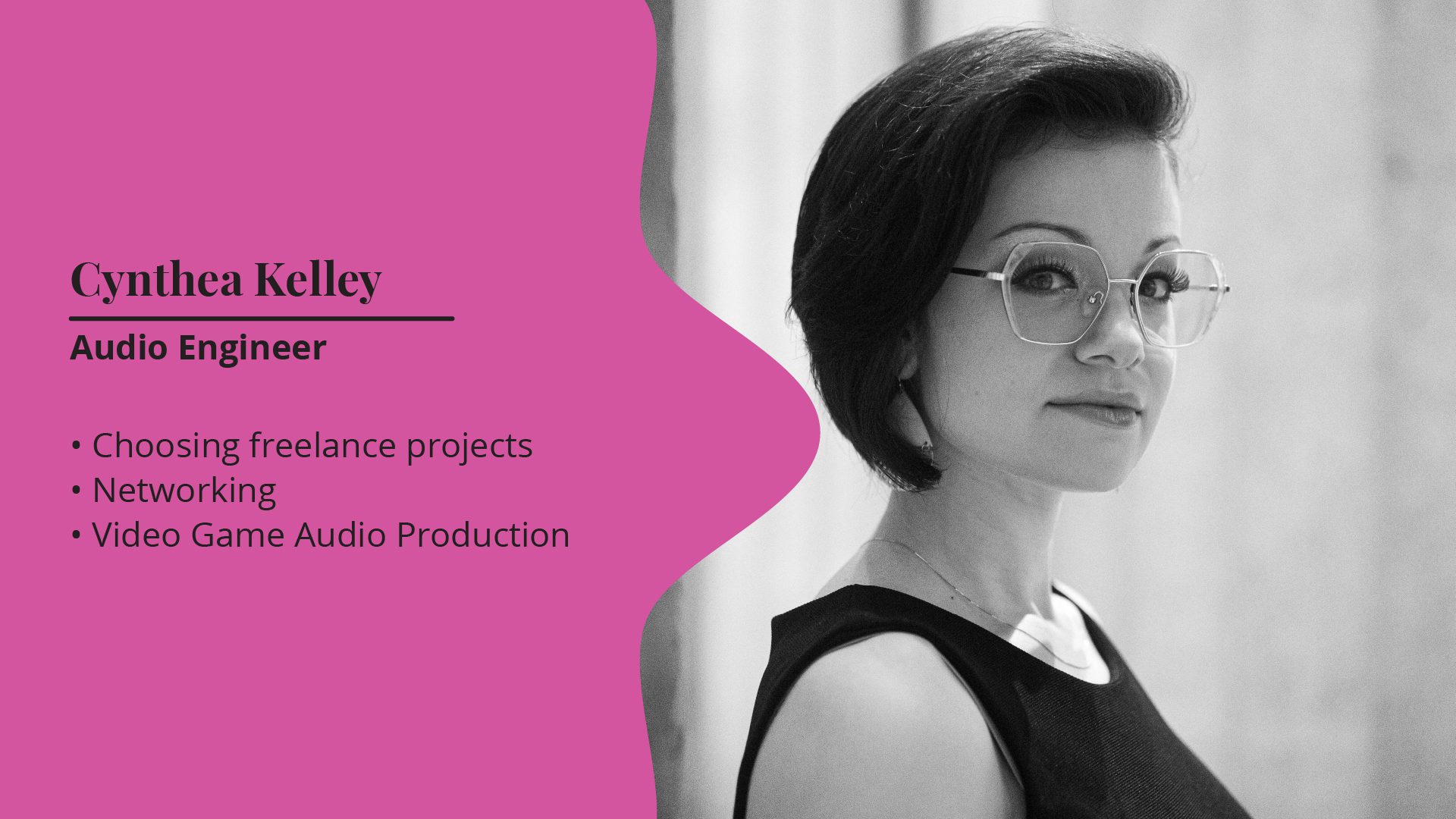
“Even though it’s in the arts… being able to afford taking a day off has been huge for me lately.”
Cynthea Kelley is a Nashville-based audio engineer and performer. She balances technical work and artistry in the dynamic worlds of music and gaming.
Interview
Transcript
Emma Plutnicki 00:02
So, to start, what do you do for work and where are you currently working from?
Cynthea Kelley 00:06
So, I’m based in Nashville, Tennessee, and I am an audio engineer and musician, performer. So, primarily what I do is edit audio from home, and I also run live sound. In addition to performing, I sing and play guitar.
Emma Plutnicki 00:27
Cool! And how long have you been doing all of those?
Cynthea Kelley 00:30
I’ve been performing since I was like, I grew up in a musical family, so I grew up performing, but I guess kind of doing my own thing since I was 14, so about 14 years now. And then, as far as engineering goes, I really started doing it more seriously when I was a student at Coastal. So, I got to work at the Wheelwright Recording Studio for like, two and a half years while I was a student, and got to really understand and learn more about like how to record various types of ensembles and different kinds of projects.
Emma Plutnicki 01:10
Amazing, and so what would you consider, if you had to boil it down, everything that you do, what would you say your official job title is?
Cynthea Kelley 01:20
I would say musician and audio engineer, or just musician.
Emma Plutnicki 01:28
Amazing! And so, what does your day to day look like? What’s expected of you on a daily basis? What kind of things do you get into? Just kind of describe what your days look like.
Cynthea Kelley 01:39
So, I am self-employed, and kind of have, like, a lot of different work that I do as an independent contractor. So, day to day, it kind of varies, but I, about a year ago, started doing audio editing for the video game Fortnite, and so that’s, like a very specific thing in Fortnite, with Fortnite Festival Jam Stage. So that’s like music editing. So, I get to set my own schedule, which is really cool. I have, like, a certain amount of hours that I’m expected to work every month, but there’s flexibility there so I can kind of decide, like, you know, I wake up and then I have my tea and then sit down and get to audio editing and that might be between like, three and seven hours a day, and so that’s kind of like an audio editing day. On days where I run live sound, that’s at a venue, and so I’ll get there in the evening, early evening, and set up, and then be there for maybe like five to eight hours, working with a band and running sound for an event. I also sing with a wedding band, and so that usually involves some travel, maybe, like, two to three hours one way. So, I’ll like, you know, get up and kind of take it easy, and then in the afternoon, drive to the location, perform like three to four hours and then drive home. So, it kind of varies a lot. There’s also, I’ll assist at recording studios, and so those are typically like, longer days where I’ll arrive at like 9am and be there until anywhere between like 6 and 8 or 10pm so it kind of varies. Sorry, that’s not a super specific—
Emma Plutnicki 03:54
No. Totally fine. So, when you have events, you’re traveling, you have things late at night that you’re working on. How are you able to manage kind of a work life balance? Because it seems like the work kind of consumes a lot of your day-to-day life. So how do you manage that?
Cynthea Kelley 04:11
Yeah, that’s something I’ve been learning a lot about in the last two years, and I feel really grateful because doing the audio editing from home, having that flexibility, I’m able to, like, if I have a day or two or three in a row where I’m just like, going, going, going traveling, performing, usually I can, like, take a day or two to just, kind of like, relax. And as a musician, usually we’re working on the weekends. And so, I feel grateful that I kind of get to compensate for that through the week and just like, take a couple days off. But yeah, I’ve like, really been learning how to prioritize sleep in the last few years, and like, eating healthy food that’s going to give me energy and like, not make me feel lethargic. So, yeah, it’s been, I think I’ve been learning how to, like, prioritize resting as well. And just like, started bird watching and Zelda, like, I’ve never been—I wasn’t allowed to play video games when I was growing up. So now I’m like, okay, I’m just gonna chill and fun thing and like, not feel like I have to, like, go, go, go all the time.
Emma Plutnicki 05:30
Yeah, I love that. And within a creative career, I feel like a lot of times it can be hard to figure out what success looks like. It’s different for everybody. So how would you define success, both personally and professionally?
Cynthea Kelley 05:43
I think for me, since I moved to Nashville at the beginning of 2022, I’ve been doing music full time. And I think when I was a student, that was like, really, all that I would have said is like, “Oh, I’m doing music full time. That means, like, I’m a successful musician”. And now, I think especially being surrounded by so many musicians in Nashville, because it’s Music City, it’s given me the opportunity to see, like so many different lifestyles and like careers like, what different types of careers as a musician can look like. And so, for me, I feel like I’m very grateful to be doing what I love full time. And so I think that that feels like part of it, for me, is like, that’s part of the definition is that, like, obviously, like, it’s not 100% of any job that you’re gonna love, like that everything has its tedious parts, or it’s things that you don’t love as much, but, like, I would say, like, 90% of it, I’m just like, really, I really enjoy and really love, and so that feels like success to me. And then also being able to, like, just put money in a savings account for the first time, it’s like, “oh, this is really cool.” That feels like building on success. And so, there’s, like, even though it’s, you know, it’s in the arts. And so, it’s not like crazy, you know, extravagant, but being able to, like, afford things like, you know, like I was saying earlier, like healthy food. Being able to afford taking a day off that, is, has been huge for me lately. And then another part of it has been being able to decide and prioritize what kind of projects I want to work on, especially as an independent contractor. If there, you know, maybe I took a job and it ended up being way more stressful than I expected, and so being able to say no when things like that come up in the future, or if, you know, maybe I wasn’t treated the way that I wanted to be treated, or it was unprofessional, being able to yeah, just like, decide who I’m working with.
Emma Plutnicki 08:28
Yeah, no, it definitely makes sense. And, I’m sure you’ve worked on a wide array of projects throughout your career. So, has there been one that’s had a significant impact on you, or one that sticks out in your head as being, you know, exceptionally meaningful to you?
Cynthea Kelley 08:45
Absolutely, yeah, this, this job with Fortnite. I started in February of 2024, and it’s kind of been like ideal for me, because I’m super introverted and a homebody, and so the fact that it’s from home is really cool. And I’ve never worked on a project with like, such a big name before, so that’s felt really exciting. And what’s been really cool about it, too is like, not only do I really enjoy the work, but the teams that I’m working with are just like, super solid, and I feel like they really value the people who are working on their teams. And so it’s just like a really good support system. And in addition to being really fun, so I feel like it’s, it’s like a little bit of a dream job. So I’m really grateful to be—
Emma Plutnicki 09:45
Yeah, and so are you able—when you play, I assume you play in some aspects, are you able to, like, hear the pieces that you’ve worked on? Like, how does that feel?
Cynthea Kelley 09:55
So, my specific job is for the Jam Stage in Fortnite Festival. So basically, what that is players can choose an instrument, like drums, vocals, guitar or bass, and it takes loops of different songs, and you can, like, mash them up together. So, like, you could have the guitar part from a blink 182 song playing with the drum part from Metallica and vocals from Lady Gaga. And so, my job is basically to make the audio from those songs flexible enough so that they can all fit together at the same time. So, I’ve worked on, I don’t know it’s like, maybe definitely dozens of songs at this point in the last year, maybe upwards of 100 but yeah, so they’re, like, featured in the game now, and players can, like, use them. And yeah, it’s fun to fun to hear and see it like implemented in the game.
Emma Plutnicki 11:02
Yeah, that’s very cool. So, did you have any fears going into this job role, or just fears in your career as a whole?
Cynthea Kelley 11:11
Yeah, I think something that feels difficult in the arts and in music and as an independent contractor doing so many different kinds of jobs. I feel like in something that’s more, maybe more like typically structured in the job world, like you might be able to say, like, “Oh, I did sales at this place for five years, and now I’m like, this in this management position, and so that’s why I’m qualified to do this job,” you know, like with the arts, it’s like, well, I did this thing and I did that thing over there, and I did this over here, and I think they all relate. But like, am I qualified, you know? So, I was super nervous that, like, I thought I knew what I was doing, and then all of a sudden I would start doing the job and wouldn’t have what I needed. You know, so I think definitely, like some imposter syndrome played into that for me. But yeah, I think again what’s been really cool about this team is that it’s super supportive and just really great people to be working with. And so even with things that you know, I needed to learn or like needed to brush up on, the team was just, like, really welcoming and really supportive, and like, we all help each other out.
Emma Plutnicki 12:42
Amazing, and having lived in South Carolina, has that had any influence on your work at all?
Cynthea Kelley 12:49
So, I lived in South Carolina basically for high school and college years, then moved after that. But I will say that my junior year, I went to the Academy for Art, Science and Technology, and was able to major in entertainment technology and learn a lot about like production and video, like video production, and got to do some music production for those as well. And then being in the songwriting community in Myrtle Beach too was just like, huge for my development. And I’ll give a shout out to Brian Ressler, who’s just like, you know, like the Papa of the music community. I felt in the songwriter community and so, and then being at Coastal too, I just learned so much and made a lot of, like, really great connections with my professors and with my colleagues and fellow students and so I haven’t had a lot of work in South Carolina since I graduated, but I do think that, like a lot of the educational elements that were offered within the arts in South Carolina really played a big part in my development and like getting me to where I am now.
Emma Plutnicki 14:09
Yeah, amazing, and hopefully those programs continue to grow. Well, thank you so much. Just wrapping up here, is there anything else you want to speak on, maybe advice or anything else about your career?
Cynthea Kelley 14:25
Yeah, I think, as far as advice goes, I think that the biggest thing that I’ve taken with me is just being persistent, especially again as an independent contractor, where you might not know where your work is going to come from, like week to week or month to month or year to year, just like being persistent in making connections and networking and reaching out to people. And I think advice, just like for me, that I feel like I’ve been learning is we ask ourselves and get asked the question too, so much like from when we’re kids, like, “What do you want to do? What do you want to be when you grow up?” and we’re thinking about what kind of opportunities we want to take and what I’ve been kind of trying to learn how to ask myself more in addition to that, question is, like, “how do I want to be treated in those as well?” So like, being able to set boundaries and recognize when it’s like a healthy working relationship and a professional one. So, I think those are kind of the biggest things.
Emma Plutnicki 15:37
Definitely. Yeah, thanks for sharing that. It’s great advice, and a lot of times people can’t find that, so I appreciate that. But yeah, thank you so much.
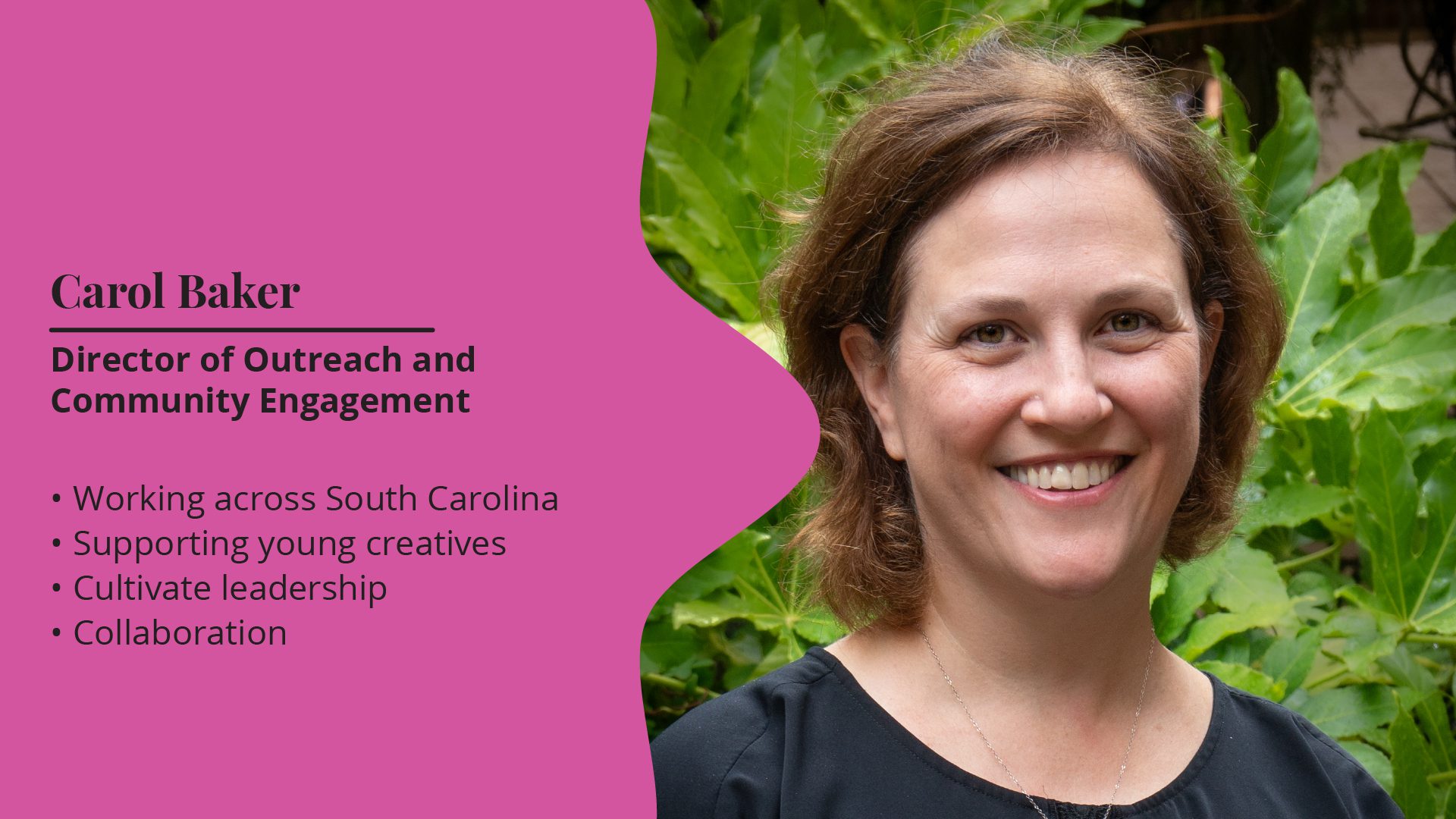
“I gotta do the right fit for me, because ultimately I’m the one who’s got to show up and do it every day.”
Carol Baker is the Director of Outreach and Community Engagement at the South Carolina Governor’s School for the Arts and Humanities.
Interview
Transcript
Lexi Raines 00:02
Okay, so first, I’m just going to ask you to introduce yourself. What do you do for what do you do for work? And where are you currently working from?
Carol Baker 00:10
So I- My name is Carol Baker. I am the Director of Outreach and Community Engagement at the South Carolina Governor School for the Arts and Humanities.
Lexi Raines 00:20
That’s awesome. So how long have you been working there?
Carol Baker 00:23
Yeah, so I’ve been there since 2012 so my first school year, we think in school years a lot, was the 12-13 academic year.
Lexi Raines 00:31
Awesome. So what’s one thing that you love about working there, working as like a creative in South Carolina?
Carol Baker 00:41
So I- our school has a statewide mission, which is great, because that means I get to be in all kinds of different communities and all kinds of different places. What I love about South Carolina is I think there’s a really strong identity. So there’s a there’s there feels like there’s a strong statewide identity, for sure. And people who are from South Carolina are really proud of that, like, we’ve got some really amazing things here. But if you have a chance to go into all of these smaller towns, or medium sized towns, or, you know, urban, rural, we have such a wide range. And what you see in the upstate might look totally different from what you see in the low country, and it’s such a, I don’t know when you get to do community engagement work like that. It’s such a joy to get to see all of that and see the different creatives and creative people and the ways that different people approach their their sort of communication, and how they show up for themselves.
Lexi Raines 01:31
I completely agree. I feel like South Carolina is a very dynamic state, and yeah, that’s part of what we’re trying to showcase. So what do you think South Carolina brings to, like, your work? Like, does it have like, unique influences on you compared to being anywhere else?
Carol Baker 01:49
It does. You know, my job is kind of like a mix of things. So I do, I do community engagement, right? There’s building and working in communities. There’s arts education specialty, like I’m an arts education specialist, so that’s my field, that’s my area. And then there’s also just arts management, right? There’s leadership and understanding how to work in a budget and how to write a grant, and all of those things too. It’s kind of a nice mix of things. And one of the things I think South Carolina is really special in and really what it offers is unique- Is a very, very vibrant arts education community. So we have got strong arts education leadership. We’ve got bipartisan support. We have opportunities to advocate. We have opportunities to learn how to be better at our jobs. There’s an arts education community here that’s very It’s tight knit, it’s strong and it’s supportive. It’s, it’s, you know, not as competitive as you might see in other areas. So, and having sort of seen it from the outside, you know, especially when you travel, you go to other states, and they’re like, you have what? I’m like, yeah. So this whole ecosystem here that is really unique to South Carolina?
Lexi Raines 03:01
Yeah I feel like that is very important. Because I feel like the support that young creatives have, like, oftentimes rely on, like, their teachers and just their direct community around them. So yeah, I think that’s really awesome. Yeah, so how would you describe that local professional community?
Carol Baker 03:24
Yeah so for me, local is interesting work, because I have a state mission, and in many ways, my my professional community is actually a statewide community, and not just a local, you know, down the street or in my neighborhood, kind of professional community. What I see is support, which is amazing, people who are willing to cultivate leadership, which I think is important, but also a willingness to kind of allow people to do what they do best. So we have different people who do different things, and as a result, I don’t have to feel like I have to do everything, which is a great feeling. I know I can pick up the phone and call somebody in my professional community and ask for help, or ask for support, or say, hey, students were really kind of outside my my lane. Can I call on you to help? And the answer will be yes, because we have such a supportive community. So the other thing is, I think we’re a little bit of a bunch of misfits, which I think artists kind of are in a lot of ways. You know, there’s only one me. I’m the only one who does what I do. There’s only one person who does XYZ job over here and XYZ over job over there. And in order to, like, build community and have community like, you need to be able to have those individual kind of personalities and roles come together, because otherwise, I think you could feel pretty isolated. So it’s a very deliberate and purposeful community.
Lexi Raines 04:49
Yes, I feel like in like bigger cities such as like New York or Los Angeles, I feel like there is some type of community unity, but it’s, I feel like it’s definitely not as involved as the one that we have here. Because I feel like, at the end of the day, everyone there is trying to get ahead of each other, where here, I’ve heard this a lot through all my interviews, that everyone’s just wants to support each other and help each other out. So I think that’s absolutely awesome. Yeah. So how would you define professional or personal success in your creative endeavors or at your work?
Carol Baker 05:30
Yeah, so 97% of what I do is collaborative. I do very, very few things in a bubble, by myself in a vacuum. So for me, and this is going to sound maybe a little bit heady, but it actually, it actually is, the most crucial piece of it is trust. I have to know that people trust me, and I have to be able to trust other people. So for me, success is when that trust is cultivated and we have a relationship that is built around that. Because community, any kind of community work, whether it’s in the arts or any, you know, in, you know, hospital outreach, whatever community work you’re doing, you have to work with people. It. That’s the whole function of community, right? So when I when I have somebody pick up the phone and call me and say, Hey, I don’t know the answer to this, but I figured you either would know or could help me find the right person that shows that I have developed a trust relationship with that person or that community, and they know that they can call me and we’ll stand with them and figure it out. So that, to me, actually is probably the biggest sign of success.
Lexi Raines 06:37
Yeah, I completely agree. Trust is just so so so important. So you said you’re an arts education like, that’s like your main field. So what was your biggest fear when you decided to, like that you wanted to pursue the arts or being a arts education teacher? I feel like it can be, like, very scary.
Carol Baker 07:01
Yeah I think for me, and I probably still deal with this to a certain degree, is a little bit of imposter syndrome, and also some definite sense of there’s a very specific path you’re supposed to take with this certification and this type of degree and this type of educational outcome, right? Like and if you don’t have those boxes checked, then you’re not really a part of that field, right? And that’s actually not necessarily the case. I’m not a certified teacher, which is interesting. I have a teaching artist background and a management of education background. So when you look at these traditional paths and you kind of think, Oh, well, those people, they must know something I don’t know, or there’s they probably are better at something than I am. I think there, I think if there was a lot of reminding myself that there are other ways to go about doing things and still be a part of a community. So yeah, you know those traditional paths, they are critical. And I don’t, I do not say don’t do that. They’re fantastic. And also there are other ways as well. So it kind of takes, I think, a lot of different ways to approach a problem.
Lexi Raines 08:08
I completely agree that’s one of the main things that we want to do, is to show that there’s not just one set way to get somewhere as a creative there’s so many different paths. There’s people who went to school for something in STEM and then later decided to pursue the arts, right? It’s just such a dynamic range, and it changes all the time. So I definitely understand how it can be scary, but I feel like there is so much of that support here and people to lean on, yeah, so please, can you, like, describe a defining moment that you’ve had in your career?
Carol Baker 08:47
Sure. You know, I saw that question last night, and I was like, gosh, I feel like there’s a million, and I don’t even know how I would pick one, but I think, I think I would pick something that’s actually happening now that we started in 2016 but it’s important, because actually everything in my career path sort of led up to it, so I’m currently- so as the Outreach Director, we run a lot of different types of programs, right? We have, you know, just a wide range of things that you can kind of choose from, if you’re a teacher or an after school provider. One of the programs is called Spark, and it is a program that uses drama strategies to support literacy. So reading, writing, oral communication, all of that, primarily reading is what we’re mostly interested in, but getting kids up on their feet and using playful strategies and using creative strategies instead of that. Hey, not everybody wants to sit and read a book. I personally love to sit in read a book, but that’s me. I understand that that’s when you’re eight years old. You need to move your body and you get it, you need to physically embody and understand what’s happening. I could not have known that that was going to be an opportunity for me when I started this a million years ago. But what’s interesting is that if I look at my path, where. I started was and when folks asked me my art form, I started in story. I started in the development of story, of why and how people tell stories. You know, I started leaning into the management of these kinds of programs. How do you build them? How do you structure them? How do you find funding for them? What do people need? Data do people need in order to believe you and trust you, right? How do you work with teachers to, you know, provide professional development services and all of that, I didn’t, I didn’t and couldn’t, have known that this would be an opportunity for me. And yet, everything that I was doing was pointing me in that path. And so when I look at it, I’m like, “Oh my gosh”. Like, that’s exactly what I was supposed to be doing all along. I just didn’t know, and yet, now I’m in it. I’m like, Well, this is exactly what I’m supposed to be doing. This is where my choices led me. So I feel like as a defining moment, that’s an important piece to say, “Hey, I didn’t know I was going somewhere, but the things that I cared about and trusted enough to learn about led me to the right place”. That’s awesome. I feel like that is such a comforting feeling at the end of the day to look back and be like I was supposed to be here. My path led me to this. And I feel like that also goes back to what you’re saying about imposter syndrome, because, like, you got yourself here at the end of the day, like you- Right, exactly, right.
Lexi Raines 11:30
So also, can I ask you, what is the best and worst advice you’ve ever received?
Carol Baker 11:36
Yeah, so probably the best advice actually got two pieces of really good advice, but that would say the best advice for a community person and it was actually said, go to the kids. Always go to the kids. The idea was so I was, at that point, I was debating between working in more of an education setting or more of like an arts setting in education, like a performing arts center that has education programs, slightly different, dynamics, very similar, and either one would is they’re both great. But regardless of that, at that time, the advice was, don’t ever assume a child or a community member or a person that you’re working with is going to come to you. Your job is to go to them. It is to be in their community. It is to trust their decision making. It is to recognize what they need. It is not that they come into your space. And that advice was given to me specific about school kids. You know, we’re talking about school kids. Well, where do they go every day? They go to school every day. So like, how do we work with schools? Right? But it actually is true for any community, right? No matter what you’re doing, community driven work is about the other person. It’s not about you, it’s about what they need, what they’re asking for, what they’re assessing within their own situation, right? So I think that was the best advice I’ve never I can’t actually call up the worst advice, but I do have a thing that I think is probably falls in that category. I was very lucky. I grew up in a family of musicians and community service people, people who worked in nonprofits and arts and all this stuff. So in some ways, what I do makes complete sense, right product of my environment. Not everybody has that, you know, experience. But what was interesting to me was the expectation so they were musicians. The the expectation was that I would go into music. That was just it. There was no question about it. It was never said. It was never even a thing. It was just kind of, well, that’s what’s going to happen. It was almost like a the world around me had just decided this for me, right? Yeah, I spent a lot of time in my early adult years really trying to figure out the difference between what other people expected from me and what I needed for myself creatively. That was never going to be my gig. It doesn’t mean I don’t love it, because I do. I’m actually interested in all the arts, but especially interested in all the performing arts. Very interested in stories. I’m very interested in how we embody stories, right? So if I had sort of allowed that sort of wave to direct where I was going, I wouldn’t be as happy as I am. And so I think there is a necessity to evaluate yourself and your own needs as well as what’s actually available to you, right? Like, because I was, again, I was looking at parents who were like, That’s cool. Go a different direction. That’s fine. The community at large, that was actually also kind of interesting, because people knew who we were, and there was an expectation that, oh, she said, I probably do that. That was not the right thing for me. And so I say that, to say that there are social expectations and social dynamics that we all face, regardless of what they are, whether you want to be a musician or chiropractor or whatever it’s still, there’s a certain. Level of I got to do the right fit for me, because this is, ultimately, I’m the one every who’s got to show up and do it every day at the end of the day. So I think that was, I wouldn’t say it’s bad advice, but it was almost like a very quiet assumption that had to be pushed against.
Lexi Raines 15:16
Yeah, and I feel like there’s a lot of things that are true for like, a lot of students like that, like, I know, for me personally, I came into school with a computer science degree because kind of growing up, my whole family was like, you can do anything, but don’t do anything in the arts because you’ll never make money. So and I feel like that’s how it is for, like, so many students everywhere. And then I was miserable in that, like, so miserable because, like, that’s just not what I wanted to do. That’s what other people wanted me to do. Wasn’t what I wanted to do. And so I ended up switching to English, and I’m, like, significantly, significantly happier. Like, I’ve never missed computer science a day in my life, right, right? So I when I ended up telling my mom she was okay with it, because she was like, at the end of the day, it’s, it’s your life. But I feel like just having any ounce of support is from your family, from a community, is so, so important.
Carol Baker 16:20
Yeah, yeah, yeah. One of the things when I was trying to decide my degree, I’m also an English I had an English major and did some arts management as well. Never heard of arts management. I just fell into it as an elective at school, because I was interested in writing and publishing and, you know, the arts and all this kind of stuff. But I remember my dad was told me one time. He was like, you know, what do you not want to do? Let’s focus on that first. Get that out of the way so that we don’t end up accidentally doing something that sounds horrible, right? Like, sometimes you don’t know what you do want to do, but you definitely know what you don’t want to do. Yes, which I thought was another, another good piece of advice.
Lexi Raines 16:57
So I completely agree that’s, that’s something really good to go off of, yeah. Okay, so can you walk me through a typical work day?
Carol Baker 17:08
Yeah, I can do my best. So a typical work day for me? Actually, one of the joys of this job is that I don’t have a super typical work day, which I love. Like each day could look different than it did the day before, but the kind of broad strokes things that are generally expected of me during a day, we have a lot of public facing documents. There’s a good bit of reading, writing and editing that has to happen, making sure that you know, you don’t accidentally say 2004 instead of 2024 which may or may not have happened to me just last week and a document, there’s also a lot of advocacy work that gets done, so whether that’s internally within my own leadership team, and I have amazing support here, so that’s not a huge thing, but there’s just a reminder of what does it mean to be a community person, like an explanation of, sort of the back end, that these things don’t magically happen Every day. There’s budgets that have to go behind them. There’s, you know, procurement and purchasing that has to happen. There are rules about what you can and cannot do in a public school that I’m responsible for making sure that my team follows. You know, do we have media releases on this kit these kids before we take photos of them? So a lot of the stuff that I do is actually an ef- in and done in an effort to make sure that my teaching artists, who work for me can actually teach so they focus on the teaching. My job is to say, Do you have the right lesson plan in place? Do you understand what you know? Have we aligned this appropriately with the standard so that the teacher that you’re visiting will have a quality lesson and a quality experience. Do we need to go explore a grant option and make sure that we have written that correctly so that a donor and we’re gathering the right data for that donor? So there’s a lot of back end work that happens. There’s also a good bit of travel that happens as well. That’s a part of the job. And I remember during COVID, I was like, a community director is meant to be in their community. So there’s just being out with people and in their, you know, local restaurants or their schools or their after school clubs is a big part of it as well. Yeah, that
Lexi Raines 19:17
sounds very busy, but it sounds like very, very engaging. That is what we do, community engagement. But I feel like it sounds just so interesting to always be out there in the community see what’s going on. So that’s awesome. Yeah. What are some habits that you have that you think would be beneficial for others wanting to join your field?
Carol Baker 19:42
I think one of the things that’s super important is a very clear awareness of yourself and how you function, because the this type of job can wear you out really fast. You spend a lot of time in the car, you spend a lot of time in hotels, you spend a lot of time in other people’s environments and that also is- Goes to your creativity practice as well, right? Like, if you’re going to maintain boundaries and all of those things, you need to know yourself well enough to know I probably can’t actually drive that far and what, even though I could five years ago, maybe I can’t do that now. Or I need to make sure I stay in a hotel that has this kind of situation, right? Like those personal boundaries have to actually really be strong and in place if you’re going to be in a position where you’re constantly giving and putting out. Because if you don’t do that, you’re just going to run yourself run yourself ragged. And I think the other piece is really knowing what you can and cannot provide. You know, we have folks, and be clear about that. You know, we have folks who will call. We don’t have this as much now, but when we were first kind of trying to decide on some things, outreach can look and community engagement can look like. So many things, there’s a million ways to do it, and they’re all great like that doesn’t mean one is better than the other, but you have within your capacity, whether it’s budget wise, staffing wise, just human capacity right to show up for you have what you have. So if you if somebody calls and asks for one thing and you can’t meet that need, it’s actually okay to say, I love that you have that need I can’t meet it, but let me help you find someone who can, because you’ll just end up being like, Oh no, this person needs something, and this person needs something, and you have to have pretty clear professional and personal boundaries. I would say boundaries, I think is the biggest, the biggest answer to that probably.
Lexi Raines 21:36
Yeah, I I completely, complete. I feel like that’s an amazing piece of advice, because I feel like so many people do struggle with setting those boundaries. So is that like, how you would say you created your like, work life balance?
Carol Baker 21:52
Yeah, in a lot of ways, and I think also, you know, for me and this, this might look different depending on the kind of artists or creative that you are. I consider myself more of a creative than an artist, but artist, but I’m more interested in the process than I am in the product. So I’m not the type of person who’s that worried about getting my thing that I’ve done, my piece that I’ve written, or whatever, exactly right? Because I’m not that interested in putting it out so that 20,000 people listen to it. I do it more for myself and my own sort of creative expression and my own mental health and well being and personal curiosity, right? That means that I’m more flexible. I can do it more places. I don’t have to. I’m not tied to a rehearsal that’s happening at the theater down the street or whatever, right? So that’s that’s unique to me. And some people are like that. Some people are in the other direction. That’s totally cool. One of the things I think that’s fun about this job, though, is that you get to go into all these communities, and you get to participate in their cultural stuff, which is fantastic. So you get your needs met in a lot of ways, because you’re exploring the culture. You can go to the local museum while you’re in Barnwell. You can go to the local art festival while you’re in Georgetown, right? You can do those things because you’re there, and that’s actually part of your job, which is fabulous, right? So I would say that a lot of it is taking advantage of what’s immediately in front of you, in terms of your creative outlets, practices, things that you want to explore. You know, there is nothing wrong with a great night in a hotel room working on crafting a piece of something that you might not even do at home. Because when you’re at home, you’re like, how do the dishes, right? Like, it’s kind of, I don’t know, it’s kind of nice to kind of have an escape to a certain degree.
Lexi Raines 23:34
Yeah, that’s a really, yes. That’s a really, like, fun and interesting mindset that like, I haven’t really heard heard of a lot, but I feel like that’s definitely a good thing to keep in mind when you are traveling so much and it’s for work. Why when you work creatively, why not find stuff to do within what you’re already doing? So Right? I feel like that is an amazing mindset to have so almost my last question, so, do you have, like, any questions that you wish you were asked?
Carol Baker 24:12
I think the one thing I would say, I don’t know if it’s a question, but I think the one thing that would say is that it’s okay if you are not a specific artist within a specific area. So, like, if you’re not an assistant block yet, I’m trying to think of an example. But if you’re not an oboe player, right? Like, and you have this very clear defined thing, I’m an oboe player. This is what I am. It’s okay if you’re not that, it’s okay to say, I love all of the arts. I love all of maybe I don’t love all of the arts. Maybe I love everything that has to do the writing. Or maybe I love everything that has to do with the performing arts. Or, oh my gosh, I I just love three different things, right? Like, I think this idea that an artist and a creative has to be. Assigned to a specific thing is, is good. There’s nothing wrong with it. There’s plenty of people who do that. I work in a school that supports that, so I want to be really clear, like, even my school here, that’s what we do for kids, is we’re like, that’s your passion. Let me help you go deep with that. Not everybody’s going to do that. Some people will also be in the broader sort of multi art kind of domain, or the hyphenate artist, or whatever it is that you’re considering. That’s also great too. There are plenty of roles for that. I think I may have mentioned this earlier, but when I first started working, I people would ask me my art form, and I’d say, “Well, you know, primarily drama, but really it’s story”. And that was, that was, that was a thing people be like, when you type what? That doesn’t fall in the box, right? But it actually is the connecting piece between all the art forms that I’m interested in. I’m interested in how artists and creatives tell stories. So it’s, I think it’s one of those things to remember that all of those things are important, right? It’s a pie. It’s a puzzle. We need those deep dive people in order to be in the symphony, and we need those deep dive people to make beautiful pieces of photography or whatever. And also we need other people who can help pull it all together from sort of a different perspective. So we just toss that out there.
Lexi Raines 26:22
No, I can- I completely agree with that. I feel like also, when you are just you’re only limiting yourself to one thing, I feel like you can, kind of like hinder yourself from other opportunities or other things you might end up loving even more than you love one thing so and I feel like I feel like interdisciplinary artists are definitely growing in popularity, because people are finally realizing, “oh, I can do everything I want to everything that I love. I don’t just have to market myself towards one thing” which is absolutely awesome.
Carol Baker 26:59
You know, I’ve actually most of the folks, when I was kind of coming along, were exceptionally skilled in multiple art forms. I mean, it was mind boggling to me, and I was like, Oh, you’re actually an artist. Like, that’s here. Let’s zoom up and talk about it as, like an artist versus this or that and I don’t- and again, I those that does not mean that those other things aren’t valuable. It means that we need all of them, and if we just focus on one or we just focus on the other, then we’re missing the point, right? But I love the term creative. I love the idea of the creative as a type of individual, right? Like it just kind of kind of shakes it out a little bit and gives you some room to breathe. If that is the right place for you to be.
Lexi Raines 27:44
I completely, I completely agree with that. So my last question for you is, do you have a creative or an artist that you would like to nominate to be interviewed?
Carol Baker 27:57
I do actually have two. Can I nominate 2? Am I allowed to do that?
Lexi Raines 27:59
Yeah, let me get a pen and paper.
Carol Baker 28:02
They’re both affiliated with the Governor’s School, so I don’t know if that is I don’t know how you make your decisions about who you choose, but-
Lexi Raines 28:08
Okay, I’m ready.
Carol Baker 28:10
So the first one is Dr Cedric Adderly, C, E, D, R, I, C, A, D, E, R, L, E, Y. He’s the Governor School’s president, and he is also a so he’s an educator, but also a composer. And, you know, just has a really cool, interesting story and dynamic to tell the others. Anne Tretromsness: TR and with an E, and then T, R, O, M, S, N, E, S, S, to look up at the sky, to follow the letters. How do I spell that?
Lexi Raines 28:45
Okay, so wait, S N, what is that?
Carol Baker 28:50
Yeah, so it’s, let’s start the beginning, T, R, O,M, S N, as in no, E, S, S, Tromsness.
Lexi Raines 29:01
Okay awesome.
Carol Baker 29:02
Yeah, she is on our faculty here, but she’s been an educator in lots of different settings, but she’s also an active director and active performer, very much into social justice type movements. Just a really all around interesting. She was Teacher of the Year for Greenville County. I think they both have just really nice, interesting stories. I think, yeah, what you’re looking for, I don’t know what you’re looking for, but I don’t even know how I ended up here. So there you go. How does this happen? So, yeah
Lexi Raines 29:33
Yeah so you were nominated. I could, could probably pull up who you were nominated by, actually, because we can tell you. You were nominated by Thurraya.
Carol Baker 29:45
Oh, okay, great, yes.
Lexi Raines 29:46
And then we also actually do have Dr Cedric on or Dr Adderley on our nominations list.
Carol Baker 29:54
So I figured he probably, I think I have actually nominated him before in some other capacity, so that’s good. Yes. So they’re very different individuals from each other, but, you know, they’ve got really great stories. Yeah,
Lexi Raines 30:05
That’s awesome. So I’m going to be sending you a follow up email eventually, if, in that email, I’ll also ask in there you could connect like Ann’s email, because we already have Dr Adderley’s email, okay, just so that we can look into her a little bit more and put her on our list to reach out to.
Carol Baker 30:31
Yeah, absolutely.
Lexi Raines 30:32
Thank you so much for your time.
Carol Baker 30:34
Yes!
Lexi Raines 30:34
I loved interviewing you, its really awesome, and-
“Success is building meaningful relationships with our youth… making sure that the youth get positive exposure and not just be limited to what their sentence is.”
Akai Shelise Jones is the Visual Digital Media Director for the South Carolina Department of Juvenile Justice, where she blends creativity with purpose to tell powerful stories of change.
Interview
Transcript
Emma Plutnicki 00:02
So to start, what do you do for work and where are you currently working from?
Akai Shelise Jones 00:06
All right. So, hi guys. My name is Akai Jones. I currently work for the Department of Juvenile Justice, and what I do here is, the state title is Public Information Manager. So, I urge anyone, if they were going to look, it’s in the communications umbrella, but my in-house title is Visual Digital Media Director. So, it runs the gamut from anything like, if we have an incident here, I may have to communicate that internally. If it’s really bad, we may have to communicate that externally, and that would happen by way of media notification, some type of writing. Sometimes it’s drafting a letter or a memo to state the facts, so the funner sides of it, or the more love and light sides of it, I get to carry a camera and I go out and sometimes I just try to capture things that are around retention efforts for current employees. Sometimes it’s trying to gain the interest of potential employees. So, I may post some employee morale things. I run the social media page so you can check out the South Carolina Department of Juvenile Justice Facebook page. Sometimes it’s website updates. So, it really is a lot under the communications umbrella.
Emma Plutnicki 01:38
Yeah, and how long have you been working there for?
Akai Shelise Jones 01:41
So, this August will make three years.
Emma Plutnicki 01:44
Okay.
Akai Shelise Jones 01:45
Yeah, it’s coming up fast. But prior to that, I was a foster care social worker, so this has always been my population of people. We have youth here depending on the age, but most of the youth are anywhere between, and this is facility wide, between 13 and 18.
Emma Plutnicki 02:06
Okay, makes sense. And so what does the typical day to day look like for you? What are your responsibilities and what do you get into on a daily basis?
Akai Shelise Jones 02:13
So it depends. So, I try to be very organized, because I’m the only one that does this job for the entire state of South Carolina. So depending on, I usually try to keep like a content calendar. And like, for instance, this month is Social Worker Month Appreciation Month. So instead of just doing a flyer, I was like, let’s do something a little different this year, as long as everyone is on board. So, we had, like the leadership, our deputy directors, submit a few names, and I literally went out and grabbed a few interviews for a few social workers. So now that would mean capturing it, editing, putting some graphic design around some of the more poignant parts of the interview. So that’s just like one small piece. Some like day, the day after tomorrow, we have a community graduation. So that’s anybody that’s in a community role. So, you could be Intensive Supervision, you know, a Probation Officer. You could be an administrative person in the community, because we have over 43—it’s either 43 or 46, excuse me, counties, and those people do varied work. So, I may go out, I’ll take the graduation so that everybody has that personal moment. I’ll just do still photographs, but then I’ll come back to Facebook and post, we had another graduation. We had X amount of people. So, the duties do change. The other hot topic right now is we’re migrating from an old, kind of antiquated website to a new one. So I had to, like, kind of go through my external drive and find some cool pictures and upload that. Then there was a lot of text. I had to go back, and I had to vet information with leadership and say, “Is this still valid? Do we still need this? Is this any good?” So, it—that’s been laborious in that way, because it’s just like, I gotta make sure that everything is current and, you know, still even relevant. Yeah, so it really depends day to day.
Emma Plutnicki 04:30
Yeah, and with so many tasks on a daily basis, how do you personally define success in your role? Is it accomplishing all your tasks? Is it financial based? Is it, you know, ideological? How do you define success in your career?
Akai Shelise Jones 04:45
For me, I think it’s getting the right stories out, and what I mean by the right stories. A lot of employees here have been here for 17, 20 years. And for me, I think there’s some intrinsic value to getting those stories out where people don’t, you know, they don’t even know what the role is. I mean, some roles are so unique, like, I have a colleague of mine. He’s a Hearings Officer. Well, he’s the only one that does that role over the entire state. So, getting his story out and like, how the worlds collide with how we help our youth. To me, that’s the most important is just making sure that these kids are exposed as well. Like, because I have the clinical background with social work, it allows me to open up that conversation when I just have the camera out. So, they’re like, “Ms. Akai, you know you’re gonna, can you take my picture?” or “Do you do, you know, you do videos, you do music videos?” You know? And it allows me to put the camera in their hand, and then I have a conversation, and I might say, what are you in here for? And somebody may say, “Well, I did armed robbery.” I mean, some of these charges are heavy. And I’m like, “How much do you think the camera is?” And you know, they usually don’t guess. And I’m like, “Just the body of the camera, without a lens, is $3,600” and they’re like, “What?” And then I start to tell them. I said, “Well, if you were to book me as a client for two hours, what could you charge me to come out and shoot your event?” So, I think for me, defining success is have—making building meaningful relationships with our youth, giving them the opportunity to understand what I do and how it can translate to their life, and getting their stories out. So like, I guess the long answer is, you know, making sure that the youth get positive exposure and not just be limited to what their sentence is.
Emma Plutnicki 06:48
Yeah, no, it makes sense. And did you have any fears when you were coming into this career?
Akai Shelise Jones 06:53
I won’t really say fears, but like, there was some apprehension, because I’m what we call, we have some jargon, but we call it “behind the fence.” So like, for you, I wanted to take your call, but if there’s an incident and I’m on the other side of the fence where I’m just locked out, you know, so I think, like, more family and like friends were like, “Don’t do it,” you know, they have these stories and in their mind it made up that this is jail, this is corrections. But for me, it was a dream come true, because, like, I’ve always loved media, but, and I’ve always liked working with children, and really on the prevention side and the intervention side, but here, just because they’ve made a mistake doesn’t mean that it’s over. So, this was a dream job to be able to have both parts for me. So, I really didn’t listen to anyone, but I would say apprehension, like, would I be safe? You know, would I be able to tell the stories in the way that I want, have the autonomy to work? But I don’t know. I’m from the Bronx too, so I don’t, I don’t know about being scared.
Emma Plutnicki 08:04
Yeah, no, it makes sense. You mentioned your family members talking about it. Have you received any advice from family or friends or mentors or other colleagues along the way in your career, either positive or negative? And what kind of things do people say, what’s like, the worst and the best thing that people have given you advice about?
Akai Shelise Jones 08:27
The best advice is keep creating like, no matter what. I probably would say the worst advice is people saying, “Oh, they don’t want to see that,” you know, or “Oh, don’t, don’t do the pictures. Just do a newsletter, a stoic newsletter with no pictures or no don’t attach video to it.” I think that’s probably the worst advice, because in this ever changing world where we’re literally being, our attention spans are like really being governed by social media and things like that, like we have an opportunity to leverage that in the communications field and, like, do things in a new and fresh way. And so, I think that’s probably been the worst advise. Like, don’t do it, just somebody trying to put a limit on the seat. You know, when I look at it, like it’s a glass ceiling, I’m like, I can keep going. So, I don’t know. I’m just, I motivate myself, I try new things, and I think I really have leadership. You know, I have a nice relationship with the director here, Eden Hendrick, and the Chief of Staff, Christine Wallace, and they give me the autonomy to work, and that is probably the biggest blessing, so I can try new things. If it doesn’t work. They you know, I don’t know if there’s anything they’ve ever been displeased with, but they may tell me, I have an area of opportunity, and I work on them go from there.
Emma Plutnicki 09:48
No, that’s great to have, great to have. And throughout your career, has there been one moment that stood out as an especially significant moment in your career? Whether that’s a project you worked on, maybe an individual who impacted you, anything like that?
Akai Shelise Jones 10:05
I think one of the things that I have, I have two, but I’ll give you one. When I see youth, if they’ve been incarcerated and they’re out, they’re released into the community, and they’re able to actually come back and say, “Ms. Akai, I’m working. I’m here, I’m, you know, I’m helping my family.” So I started a segment called, where are they now? And I think the most memorable time was I had a young man and he said, “Ms. Akai, I want to play for South Carolina State.” And I was like, “What?” And he, big guy, and when you go, go scroll our Facebook page and look, look for in the video section. But so the team, we have a Career Readiness Team here that worked with him to help him with admissions and getting into the school and that kind of thing. Well, for me, what was so gratifying was, he was like, “Well, let’s just ride up there and you can see, you know, be a part of the process.” So it was like, I was like an extended family member, and it was myself, a few of the counselors here that worked with him, and I literally just followed him around with the camera through SC State, and then the school superintendent here, Floyd Lyles, was like, we’re gonna try to find the football team, since that’s what he wants to do. So we, like, went to that building, and ironically, the football team happened to be in a meeting, and they—we just kind of knocked on the door and they let us in. So he, to see the kid light up and say, this is at arm’s reach. It is attainable. And like to capture all of those moments. And it was just a short video. I mean, I think in it was toward the end of 2024 but like in a short amount of time, I had over 20,000 views, and that that felt good, because he got exposure, and it just showed that these kids are more than their, the first mistake that they made. So that was pretty memorable.
Emma Plutnicki 12:10
That’s a great story, and I’m sure it’s so rewarding to be able to see those stories come to light. Amazing. Yeah. And just like as we’re wrapping up, is there anything else you’d like to share about your career? Any advice for young professionals, young professionals who might want to get into this career?
Akai Shelise Jones 12:29
I would, I would tell them the first thing is, go beyond the actual search, because I think looking for a job like sometimes the descriptions are not really what we think it is, and like for me, seeing public information, having no exposure to what that meant, may have deterred me from applying. So I would say, do a cross search, ask questions, and look at some of the sub points within a posting, and then ask questions about those sub bullets because a lot of times something that you want to do is really embedded in that job description. I think the second thing would be, is still try the job shadowing. It feels like it may be an archaic thought, but some people are willing, whether it be internships, career shadowing and going for a day. I would tell those young folks, go online and be bold, because they’re so brazen and bold now. Use that boldness to like command and build what career you want, because you can do it. And not saying like you can do it, but like you, literally, it’s within arm’s reach to have someone write a position description and really make a job for you that you may not necessarily see on Indeed, on Monster or whatever, and that the third thing would be, use the creativity that they have in their personal life. You know, if you’re, if you’re a social media person, if you’re a Tiktok person, use that to get some structure around what you do, because it will help you professionally. So, I’ll give an example. If you, if you are, if you podcast, I’m just saying, and you think it’s just fun and you’re doing it with your friends, well, really set up the structure of a show. Really, storyboard, really, you know, do a treatment, really do a shot list for it. So, I would urge them to do what they do in their—use what they do in their personal time, and make it as structured and professional as they can, because it will translate to a career that’s awesome like this.
Angela Yemi Gibson is a medical biller by day and an arts visionary by night: founder of a nonprofit African Dance Company in Spartanburg, SC.
Audio Interview
Transcript
00:02
Emma Plutnicki: So to start, what do you do for work and where are you currently working from?
00:07
Angela Yemi Gibson: I work from home. I am a medical biller, and I work for a billing company called Medical Billing Center Incorporated,
00:16
Emma Plutnicki: Okay, amazing. How long have you been working there?
00:18
Angela Yemi Gibson: Six years.
00:20
Emma Plutnicki: Okay, amazing. And that’s based in South Carolina?
00:23
Angela Yemi Gibson: Yes, it is in South Carolina.
00:25
Emma Plutnicki: Okay, how does working in South Carolina specifically influence your work, if at all?
00:32
Angela Yemi Gibson: Well, I have a nonprofit that I do outside of this, but, you know, being a nonprofit, you have to at least have some type of stream. So I do both. I don’t know, I moved here from Colorado, so it’s a little different,
00:48
Emma Plutnicki: Okay, yeah. And what is your nonprofit?
00:52
Angela Yemi Gibson: My nonprofit is an African Dance Company.
00:54
Emma Plutnicki: Okay, amazing and how long have you been doing that for?
00:57
Angela Yemi Gibson: Over 20 years!
00:59
Emma Plutnicki: Wow, and you started that?
01:01
Angela Yemi Gibson: Yes, I started dancing with other companies in Ohio, and then I moved to Colorado, and now I’m here. So I have my own nonprofit here in South Carolina.
01:11
Emma Plutnicki: Yeah, what made you want to start that?
01:14
Angela Yemi Gibson: It’s something different. It’s always changing. It keeps people engaged and it also brings a sense of community to everyone that’s involved.
01:27
Emma Plutnicki: Yeah, for sure. So what does a typical work day for you look like these days? What’s expected of you on a daily basis? What are your responsibilities
01:36
Angela Yemi Gibson: For my primary job?
01:38
Emma Plutnicki: Both.
01:40
Angela Yemi Gibson: So I work every day, Monday through Friday, from 7 to 4:30. Iam responsible for making sure that claims are clean when they go out of the system. I am responsible for fixing denied claims and rebilling those claims, patient statements, speaking to patients about their balances, communicating with the clinics and the owners about any account issues thatI have. Teamwork. and in my nonprofit, I am responsible for all the choreography, all the booking, all the costumes and the musicality.
02:21
Emma Plutnicki: Wow. And how are you able to manage both at the same time? Because I’m sure both of them are pulling you in different directions.
02:27
Angela Yemi Gibson: Yes, I’m not able to manage at all. I’m not good. I’m not able to manage it all. Since I work from home, I hop from one thing to another. So it’s one moment I’m here, then the next minute I’m there. So fortunately, I have the flexibility with my job to be able to do that.
02:43
Emma Plutnicki: Yeah, and are you able to manage a healthy work life balance, or is that difficult to manage?
02:50
Angela Yemi Gibson: It’s difficult to manage most of the time because most of our- I teach classes during the week and we perform and rehearse during the week or during the weekend, so it was kind of wherever. But fortunately, I have a good support system within my family, so I’m able to juggle both pretty, pretty good.
03:09
Emma Plutnicki: Amazing, and within both of your jobs, how would you define success? I feel like it’s difficult sometimes with creative careers, especially, you know, some people say it’s monetary, some people say it’s more ideological. So how do you define success in your professional career and also just in your personal life?
03:30
Angela Yemi Gibson: In my- my professional career, I would label success financially, because as much work as you do, you want to getpaid for the work that you do. But as far as my nonprofit work, I label success by the people’s response. So if no one responds when you’re doing something, that means you’re really probably not doing a good job. So if it’s- I’d rather deal with customer engagement and the responses of people in order to garner my success for my nonprofit.
04:02
Emma Plutnicki: Yeah, makes sense. And did you have any fears when you started your nonprofit?
04:07
Angela Yemi Gibson: Oh absolutely. Whether I will be successful in doing it correctly, and will it be sustainable?
04:17
Emma Plutnicki: Yeah. And how were you able to kind of overcome those fears?
04:21
Angela Yemi Gibson: Just keep going. I have a team of 10 so far, and we have been going strong for these past few years, since we started the nonprofit, so it’s been pretty good. So I mean, dealing-working with people that you trust and that are dependable is key. If you don’t have those types of people involved, then you probably won’t be successful.
04:46
Emma Plutnicki: Yeah, no, that definitely makes sense. And overall, have you been able to get advice from anybody? Is there any advice that stands out as either exceptionally good or just terrible advice that you received along the way?
05:02
Angela Yemi Gibson: I have received a mixture of both. I’m online a lot, so I tend to research more than anything else. So I’ve received a mixture of good and bad advice. Some people say, you know, don’t- What do people say? Don’t confide so much in the people that you work with, because the more that they know, the more that people can possibly use against you, so to speak. But I think that if you are more transparent with people, people are more- tend to either appreciate you or to be more understanding if you’re a little bit more transparent. But I’ve also learned that a closed mouth don’t get fed. You gotta ask. Sometimes it’s okay to ask for help if you need it.
05:57
Emma Plutnicki: Yeah, I love that. No, that’s great advice. And throughout your career, has there been any specific projects that you’ve worked on that kind of stand out as having a significant impact on you, or just something that you know is something that has kind of been the pinnacle of your career? Anything that stands out?
06:18
Angela Yemi Gibson: This year we did, for- this is for my nonprofit, I can’t really say for my my primary job, because we do the same thing every day.
06:26
Emma Plutnicki: Yeah, okay.
06:28
Angela Yemi Gibson: But as far as my nonprofit, we successfully completed our very first residency- artist in residency. So that was a week long, and it was new, and it was completely different, and it was way out of the comfort zone, but it was successful. It was very successful.
06:48
Emma Plutnicki: Amazing. Congratulations on that. And what was that? Where did that take place?
06:53
Angela Yemi Gibson: It was in Monks Corner, South Carolina, and we taught fourth grade kids and kindergarteners for five days.
07:01
Emma Plutnicki: Amazing. And how has the community reacted to your projects and just overall, your nonprofit?
07:08
Angela Yemi Gibson: Wonderfully. They’ve been very supportive here where I am, because I live in Spartanburg, so they’ve been very supportive here. Also, I am a dance teacher at one of the ballet centers here, and they have been so supportive to where they’ve written grants to be able to get make sure that myself and my two drummers are paid for our classes. So the we’ll be able to offer the classes for free to the community. So they’re free to the community, but yet we get paid for our time.
07:41
Emma Plutnicki: Amazing. And have you seen the community, like the local professional community in South Carolina, generally helping?And is it tight knit, or is there any gaps in it?
07:51
Angela Yemi Gibson: It’s tight knit. I really think that if you don’t know the right people, you’re not in specific circles. So I think that it’s really click-ish, so you just gotta know the right people. And unfortunately, I don’t know a lot of people, so I just stick to where I’m at work, who I know.
08:09
Emma Plutnicki: Yeah, how are you able to have those conversations with people? Are there any, like, networking events or anything within South Carolina that you’d recommend for people if they’re trying to get in the door with people.
08:21
Angela Yemi Gibson: I honestly have no idea. I really need to know those things myself, because I need to get out there and network a little bit more.
08:30
Emma Plutnicki: Yeah, I’m sure at some some points, it’s just being in the right place at the right time.
08:34
Angela Yemi Gibson: Yeah, and it’s just finding those right places in the right time, that’s the problem.
08:38
Emma Plutnicki: Yeah, exactly. Amazing. Well, thank you so much for your time. Just as we wrap up, is there anything else you’d like to share any advice for future people looking for a career in your field?
08:52
Angela Yemi Gibson: Keep swimming. What I can say is, honestly, don’t waste your money on college, unless you’re going to do something specific to that particular major that you’re going for. If you go to trade school, go to trade school, but stick to your guns and just remain positive.
09:17
Emma Plutnicki: Yeah, I love that. Well, thank you so much. I really- You’re welcome!
Mahoganee Amiger works in Beaufort S.C., is an interdisplinary artist in the field of music and has been a songwriter for over 30 years. Mahoganee incorporates poetry and photography into her music to produce a form of visual art.
Interview
Transcript
00:02 | Lexi
So first, we’re going to start, just give a little introduction of yourself. What do you do for work, and where are you currently working from?
00:13 | Mahoganee Amiger
So I am, well, I’m an artist. I am an interdisciplinary artist in the field of music. Music, Music is my primary discipline, and I have been a songwriter for over 30 years, and I incorporate poetry and photography to my music and makes me a visual art.
00:43 | Lexi
That’s, that’s amazing. So is that like your full time job?
00:49 | Mahoganee Amiger
Yeah, it is.
00:50 | Lexi
That’s, that’s amazing. So how long you said? 30 years?
00:54 | Mahoganee Amiger
Yes, I’ve been in music 30 years. How long I’ve been full time in music? I would say, let’s see. I had my last corporate job in 2010 I believe, yeah, somewhere, somewhere in there.
01:21 | Lexi
That’s awesome. Yeah. Okay, so what is- Wait, where are you based in?
01:28 | Mahoganee Amiger
I’m in, I’m in the lowcountry. I’m in Beaufort, South Carolina, in Beaufort.
01:32 | Lexi
So what’s one thing that you love about working as a creative in Beaufort?
01:40 | Mahoganee Amiger
One thing that is so I live on Saint Helena Island, and specifically I am a Gullah Geechee woman, right? This is Gullah Geechee land in Saint Helena Island is so important and pivotal in our community, and it’s a very special place, very spiritual. And so being a creative it is, in my opinion, it is a very magical portal, yes, that right, that I can tap into, and because I allow myself to be open to that I I am never, not creative. Yeah, I am never, there’s not a dry spell.
02:31 | Lexi
That’s awesome. That’s amazing. So with your, what is your you said that, of course, your heritage is tied to South Carolina. How would you describe the local creative community there?
03:00 | Mahoganee Amiger
There is a very powerful and strong creative community here on Saint Helena Island. And also, because I my my branches, you know, reach out into, you know, other areas I am able to… I live here, right? I work here, I create here, but I’m also able to reach out, literally to people all over the world and create. And a lot of people are interested in South Carolina, in the lowcountry, and the delegatee culture. And so I’m able to, I’ve done tours, you know, people have wanted to come here and visit. And my husband and I have actually, you know, put an itinerary together and really introduce people to the low country of South Carolina, to the Gullah culture. And it’s a magical place. And people are, you know, very, very interested in it. Now, it’s a hot culture.
04:05 | Lexi
Yes, that’s such a, that’s such a beautiful thing to be able to do for others, because I feel like South Carolina does have so much to offer. You just kind of have to reveal it to people, and so you do so much creatively, how would you define both your professional and personal successes in your creative endeavors?
04:36 | Mahoganee Amiger
So the interesting thing, I believe they’re one, right? They’re just woven together, because being a culture keeper or cultural worker and all of my artistry is tied to my culture and who I am in. It’s about South Carolina. It’s about. The culture. It’s about my African heritage, so it’s personal. Is professional? Yes, right? Because when I, when I walk in, I am whether it is a professional setting or personal setting. I walk in as an artist. Yes, I’m able to just, you know, share from that perspective. So they’re, they’re definitely woven together.
05:25 | Lexi
Yeah, that is very true. So what was your biggest fear when you decided to pursue your career professionally?
05:41 | Mahoganee Amiger
You know, I have been singing literally all my life, since elementary school, and I have always done it afraid, you know, like my friends would like, I’ll give you an example. So elementary school, I believe this was fourth or fifth grade, my teacher walks out of the class and they’re like, Okay, can you sing us a song? Can you sing this song? So I go up and I sit in my teacher’s desk, and I don’t know where we got these glasses from, but I had on I put on some glasses like Ray Charles or Stevie Wonder. So to block out everybody, because I’m I’m nervous, but I’m still excited to do it, yeah, and so I think, through, through high school, I was very afraid, but I always did it, even if I had to turn my back to the crowd. So there was the fear of, I think, just being in front of people, you know, and sharing something, but the love for it really just it outshine the fear. And I think I’ve just always been able to walk like that, and until I just got to a point where now I’m nervous, I’m not fearful, the nerves are always going to be there. But I get past the nerves usually in the first, you know, couple of lines of the song, and then, and then I’m in it.
07:09 | Lexi
Yeah, I feel like that’s amazing. There’s, I feel like there’s so much that people can take from that. I feel like that’s a really good piece of advice, just to get out there and just do it. So, right, yes, do it afraid. That’s that’s a really, really good piece of advice, because I feel like fear holds a lot of people back sometimes. So can you describe, for me, like a defining moment in your journey, like was your particular project that you did that made a significant impact on you, or something that you’ve done that you believe really like showcased your creativity and talent.
07:53 | Mahoganee Amiger
I think what sticks out the defining moment, really for me, embracing myself as an artist and really embracing myself right like and what I mean by that is being able to look in the mirror and love who I see was when I moved back to South Carolina, and this was also in 2010 and I’m from Summerton, South Carolina, which is about an hour and maybe 15 minutes away from Beaufort, South Carolina. And I never knew about the Gullah Geechee culture. Growing up like it was. It was not taught in school. But once I moved back here and I started to learn about the culture, and it was as if I gained a superpower, yeah, right. The more I learn about my heritage and my culture, the more I learn about myself, the more I learn about my parents, you know, my siblings, just my ancestry, yeah, the more powerful I am. But moving back home was the starting point for that, and it just, everything else just opened up. And it’s been, it’s been an amazing journey finding myself.
09:20 | Lexi
Yes, that is amazing. And I know, I know there have been so many movements, especially like along the coast, to bring awareness to the Gullah Geechee community. And I think that is like, I think that’s just wonderful. Like, it can bring, it brings so many people together. And I think that’s just just an amazing thing. So what was the best and worst advice you’ve ever received?
09:48 | Mahoganee Amiger
You know, that’s an interesting question, because I don’t hold, I don’t retain bad advice. Yeah, so I’m not really like i. Really have to think about that one. And you know what? I think something that I remember was trying to play small and having people tell you that you’re not good enough, or you’re that the person to be in the spotlight. And what I mean by that is, I’ve been in music groups where I because of the way that I look, because of my physical attributes, I will not the one they wanted to be, the lead vocalist, and so for somebody that might crush them, you know, and it might stop them on their journey from pursuing their dreams, specifically in music, right, and in the arts and in something in the public. But for me, I just decided that, okay, that means I need to be solo on this journey, and I’m going to have to be my own advocate, right? I’ve gotta be my cheerleader. And but that’s one thing that sticks out. They were trying to put me in the background, and I was like, nah, nah. That’s this is not going to work for me.
11:22 | Lexi
Yes, yeah. I feel like that is just something that it’s an amazing piece of advice. You just gotta Well, not that specifically, but just learning that there’s always going to PP be people that are trying to hold you down, but you just gotta move past it. Can’t, can’t surround yourself with those people.
11:48 | Mahoganee Amiger
Yeah, so the other half of your question was some of the best in life. Yes. And I don’t remember who told me this, but I know I’ve heard it somewhere, and it was to when you get up in the morning and you the first thing you do is you go and you talk to yourself in the mirror, right? And you give yourself these affirmations. And it’s something that I have. I do throughout the day. I don’t write. I don’t just do it in the morning. Whenever I need to give myself a pep talk, I just go and I find a mirror and I talk to myself and because I am with me all day long, right, all the time, and So just always feeding yourself positive words. Positive affirmation is some of the best advice that I got, and I hate that. Can’t remember who told me, and I’ve heard it over and over again, and I see it often, so it’s just, it’s something that I would always tell people, yeah, just love yourself and talk to yourself nicely.
13:02 | Lexi
Yeah. That is, honestly, like, I do believe that’s one of the most important things you can do, because you are stuck with you for forever. You gotta love yourself. So can you, like, walk me through a typical workday, like, what does your process look like, and what’s what do you expect of yourself, just on a daily basis?
13:28 | Mahoganee Amiger
Right now, as an artist I am in a fellowship, and that’s also some some good advice that I would share with people, anytime you can find an opportunity to be in a cohort or fellowship or something that is really going to help you grow as a human being, as an artist, as a community leader, I would look for those opportunities because they have been very instrumental in my growth, just as a human and and as an artist and one so how my days look now. I am in a cohort, and we have meetings every month. We also have to work on a project, so and so that is also along with, if I’m having to rehearse for a show just got through writing and recording project for Zora Neale Hurston, so it’s not just one thing. I don’t have a nine to five, so my schedule is kind of different every day, yeah, and it’s but what I’ve learned is that time management is something I need to really, really work on. And as an when you are an entrepreneur or an artist and we’re. For yourself. That’s the that’s the thing that we have to work on the most, because we don’t have the the nine to five schedule where, you know, we we have to create some sort of schedule for ourselves.
15:13 | Lexi
Yes. So you said that you kind of find that you’re professional and, like personal times are, like, woven together. Like, your creativity, do you try to create a work life balance? Or are you able to maintain, like, keep those two life separate? Or do you like having them join together?
15:41 | Mahoganee Amiger
It’s all joined together because my husband is also my partner, my business, my partner in music, my partner, my my partner in life, and because we are both musicians and both creatives, it is. It’s an interesting thing balance, because there is no, you know, like I said, there’s another nine to five schedule. And my husband is a music producer and a sound engineer, so he could be working on a particular composition at 3am right? I’m sleeping. If I hear the music, I’m going to wake up. And this has happened, and lyrics have come to me immediately, right? So I get up, yes, I’ve either recorded them on my phone or I, you know, write the lyrics down. So it’s in the creative world, you have to get it when it comes.
16:50 | Lexi
Yes, right? So, yeah, go ahead. I’m sorry. No, you’re good. You can continue.
16:58 | Mahoganee Amiger
So the the, that’s why I say the balance is we make it work. Yes, the best answer I can give you is that it works for us because we make it work. And when, when the creative waves come, you have to answer to that call, and then, you know, life moves around that.
17:23 | Lexi
Yeah, so what are some habits that you have that you think would be beneficial for others, wanting to get into music, wanting to get into storytelling, just get into a creative field?
17:42 | Mahoganee Amiger
I would say, always capture the idea when it comes whether that is audio right, or whether that is writing it down. Make sure you are always in a learning mindset and just wanting to grow and always get better in your craft. And that’s why I recommended the cohorts and fellowships, any type of professional development that you can do that first helps you as a human being, and then second, it helps you to better yourself and your craft. Those are things that I, I think, have been the most important to me, especially in the growing phase, and just always be willing to learn and grow.
18:42 | Lexi
Yes, I think, I think those that’s an amazing mindset to begin like at all times in your life. So do you have any questions that you wish that we asked you?
18:57 | Mahoganee Amiger
Ah, I couldn’t think of any, that’s a really good question. And we didn’t even get through all the questions, right? I cannot think of any question that you shouldn’t have asked me, and I’m trying to think of something that I really want to leave with. People go ahead and ask me the last question, and I’ll marinate on that one for a minute.
Think of something that I wish I had thought of. Here’s, here’s one thing, not a question, but something that I will share. And because there’s so much noise on the internet, right, and a lot of times, people are emulating what they see, I would really tell people to dig deep and be your authentic self, because that is where the magic is, and that is what really will make you excel, because now you’re able to stand out when you dig Deep and you really find who you are and what you love, the passion and the purpose I feel will really elevate you in that authenticity, but just being yourself, and that may mean being by yourself for a little bit. You know, being away from people, being away from the noise, and not looking at anything online, because sometimes it’ll feed into your creativity. It’ll feed into who you are, and some, some self reflection time alone, just dig deep for who you are, and that’s where the light is, that’s, that’s where you’re going to shine. That is what I want to share with just everybody, just and it’s, it’s, it’s a simple phrase, be you, but it’s really a big phrase, be you. You know, yeah, that’s, that’s what I would leave people with.
22:45 | Lexi
That is, I think, really, really beautiful advice. I think that’s really amazing. So many people could learn from that. But thank you so much for your time. I’ve really enjoyed this interview. I think that you’re going to give so many people a lot to think about, a lot of good advice. And yeah.
23:15 | Mahoganee Amiger
Thank you, Lexi. Of course, I appreciate you taking the time to you know, to do this, and I love that you’re actually doing it, and you made me think of something else, because not just Gullah Geechee people, but really all people. Every every place has a dialect, right? Right. Every place has, you know, people speak differently. Words are said differently. Words mean different things in different cultures. And I want people to hold on to that, you know, because we try, not we, but the world will try to take you out of you.
You know the world wants you to sound a certain way. The world wants you to look a certain way. But it all really comes back to again, who you are, what you how you grew up. You know that playing might be in your voice. It may be Jamaican, right? It may be Patwa, it may be Southern, it may be whatever it is, but that’s the thing that makes you you. And I wish that someone had told me that instead of No, I need you to speak proper, you know, I need you to do this, and I need you to look this way. And all they were doing was stripping away, you know, pieces of me. And so when I got back home, I began to, you know, those scripts, I began to put them back on Me. You. And really just become myself and but when you when you said about, you know, learning people’s stories and sharing their voice, it’s like the voice can actually, actually be literal, right? And it can be your speaking tongue, and the world will try and strip that away from you. And I, and I wish that we can hold on to whatever our ancestors did, you know what, whatever our parents did, and allow that to always be a piece of you. Take the other stuff, but just keep, keep that for yourself, and it just adds to the magic.
“Take your work seriously, and your client will as well.”
Matteo Miles, from Greenville, South Carolina is a self-employed and full-time traveling artist and painter. Specializing in painting murals, he travels around the region creating artwork.
Interview
Transcript
Matteo Miles
My name is Matteo Miles. I’m 28, I live in Greenville, South Carolina, and I’m a full time artist, painter, specifically in murals. So it helps you do murals and kind of travel to other areas of the region and the country as well.
Haley Hansen
Are you self-employed?
Matteo Miles
Yes, I am.
Haley Hansen
Can you say, like, what your typical workday is?
Matteo Miles
So typically, what I’ll do is kind of start off by either answering emails or DMs of, like, inquiries, and just get those out of the way. And probably just, most of the time, it’s answering questions, especially for people who haven’t had any mural work done specifically, is what the business is that I’m doing right now. So I’ll respond to those, and either get people scheduled or, you know, kind of giving the information. And then after that, I’ll go in and work on some proposals that may be required for people that have moved forward in getting a mural done, whether that be getting together a vision board full of ideas, taking measurements, or doing the designs and drawings, and kind of going back and forth. And I call that pretty much the whole like planning process of it. And then if I have anything going on that day, any projects to start, then I’ll probably go on-site to wherever I’m working on, whether that be a restaurant or a hotel, and then kind of mapping out and prepping the space, if it isn’t day one for a project. But I typically like to at least try to work on at least two or three murals a month, and sometimes they will overlap. But that can get kind of chaotic, depending on the project, and what it could require. But on a typical day, during the week, if, if I’m not actively on-site at a project, it’ll just be kind of the administration stuff with planning and drawing. Takes up a lot of that time.
Matteo Miles
How did you get started painting murals?
Matteo Miles
So I got started painting murals, pretty much a transition from doing canvas work. So I’m assuming this is just like another part of the question, another question kind of talking about how I got into it. But I always started doing murals was I worked at a hotel over here in Greenville, South Carolina, and I was bartending and they had this big chalk wall in their lobby space that someone else had initially done when the hotel opened. And that person, you know, wasn’t able to come back. So I was like, oh, well, I, you know, was already doing chalk signage for Starbucks and stuff like that. So I was like, why not give it a go. So since then, I was able to change it out and rotate the themes, and along with the seasons with the artwork. So with that in mind, it became public art. So I was able to present that, you know, pretty much for free, and then you know, I would get paid to just change it out. But through that, I was able to get other people reading my name, and then kind of looking me up and asking me to come to their space, or, you know, if they said they had chalk murals and whatnot, or a permanent mural, and that’s kind of how it got started with kind of, you know, networking and getting other opportunity for larger walls and not just on canvas.
Haley Hansen
Did you have any education in visual arts, or were you self taught?
Speaker 1
I was self taught for the majority of the time. Of course, throughout grade school or high school, I would take the art classes required, or like AP, any kind of advanced, you know, exercise that I could get with it, because I just, I loved it. I was always drawing since the second grade and, just, any reason to not do other homework. And just to, and just focus on like, whatever required any kind of art, whether that be like science class and stuff like that. And then through high school, there was a institution called the Fine Arts Center. That was for high schoolers, kind of like a magnet trade school to get people started into college as well, but this one just focused on arts and liberal and music and stuff like that. And so after that, I did a couple years at Greenville Technical School over here, and that focused on, that had an incredible art program.
Speaker 1
But I did that for a couple of years, and that really helped me get a better gauge on the community, and like my mentors, including professors, and, you know, people who are really trying to take it more seriously and engage, you know, their own work into real life and into career aspect. So, that definitely helped me take it more seriously. Of course, it got a little bit heavy with trying to regulate, you know, I was living on my own already and then I had two jobs and stuff like that. So it was a lot to carry. But it really was manageable. You know, it was just you learn a lot about discipline and, you know, what art school or whatever you’re focusing on in creative work requires. But it really did help having like my mentors and the professors there kind of guiding me. I did have to take a break for about a year just to focus on work, but I was still selling my own personal freelance canvas stuff, and I eventually returned back to finish up my studies. And then after that, went to mortuary school for a few years, worked in a funeral home, and decided that my passion took even further a backseat. And I wasn’t really making art anymore. And then after that is when I found that hotel opportunity to do public art. And I’m like, “Well, let me just jump on this and see where that goes.” And over a span of maybe about three years, where I’m at now, I was able to kind of kickstart you know, going full time and, but learning every day about everything, and then everyone else in that community. Yeah.
Haley Hansen
You said that you’ve pretty much been, like, artistic your whole life. But was there one defining moment where you realized that you could and you wanted to make a career out of that?
Matteo Miles
There was in, I’d say it started in about middle school, when I would do art, or participate in art shows, I just had more of a business mindset, like track on it. So that was all I was determined to do was to really make it into a business and say, “I want to make a living off of this, I can’t do it by you know, just appreciating my own work.” Of course, I appreciate my own work, but just to be realistic. And I tried to share that concept with other people, then, you know, our professors as well, just so people didn’t think that the super high privileged could be the only ones being able to make art today as an adult in our generation. So I think that’s something that we all work on in education at the moment just to make everyone aware about that.
Haley Hansen
What would you say the biggest adjustment or challenge you faced was when you started being self-employed, working as a mural painter?
Speaker 1
One of the biggest challenges that took me a while to learn was how much things cost, but also the like, kind of underestimating what actually was required to get a project done. And at the end of it, having that learning experience of being like, “Oh, well, this required so much more than I at first intended to,” with supplies or equipment. And at the end of it, you kind of just didn’t really gain much out of it other than having the job finished. But that was just learning scenario, that’s probably one of the things I share with other people who are trying to go into actual murals, is just make sure you have your, your estimate correct, and your numbers good for your client. Because it’s, you can’t go back and try to change the numbers just because you thought you needed a more expensive paint or needed a scissor lift that you didn’t initially put into your proposal or a number, you’re just gonna have to like eat it.
Matteo Miles
Also be just taking your work seriously so that your client does as well. And that equals your own value. Because you can do the work, you can do what I call portfolio building, which I think is really important, which is doing your mural work. But if you’re first getting started and you’re gaining that experience, you know, you kind of give some slack to your prices, just so, you know, you make it easier, you’re able to portfolio build, and I think that’s important. And later on, as soon as you’re getting more experience, you get more value, then you can kind of up those prices. But don’t feel discouraged that you’re not just doing your work for a penny, you know, on the dollar just, you know, kind of realize that these are stepping stones in every career and every type of creative work too. And they only get better.
Haley Hansen
Are there any specific skills that you would recommend to someone who’s trying to start a career in your field?
Matteo Miles
I think special skills, probably first, drawing and painting, getting good exercise. With large scale, for some reason for me, it feels easier to draw large scale, that idea seems really intimidating for people who are used to drawing within boundaries of you know, a smaller form, so just exercising with that. Also your body is super important, because you’re using your whole body. So exercise your body, stretch, make sure you’re able to have endurance, whether it’s inside or outside on ladders, scaffolding, scissor lifts, weather difficulties, whether it’s outside or inside, accessibility, not being afraid of heights, and not being afraid of strangers, not being afraid to perform in public, because that’s a big deal of it too. I had, it took me a while to kind of build up that, that shell of anxiety, like to reduce anxiety from being in public trying to draw or paint and not being able to focus because there’s people around you, people want to talk to you, people are interested in what you’re doing.
Matteo Miles
And sometimes that little like, “Oh, thank you” or “Yeah, I am drawing this” is fun, but, it’s exciting, but it’s so hard to like keep clicking back in that gear of like focusing on your drawing, because you’re not like in your studio, being able to do your own thing whenever you want. That’s, that’s one thing I’d say to definitely learn is that public, just awareness. Exercise your body, and your eye, your hand eye coordination, to think big, because when you’re up close, you spend 10 hours working on something super up close, and then you like stand back, it’ll look completely different. So sometimes you have to shift things up close on purpose, though, stand back, it looks different. So those are probably the three things that I would recommend for someone who’s wanting to go into mural paintings, and that’s just kind of the physical of it. And then business is a whole other ballgame. Yeah.
Haley Hansen
Are there any organizations or programs or events that you would recommend for people who are interested in, like locally or statewide?
Matteo Miles
There are mural festivals happening all over the country, they’re very easy to look up, there’s plenty of resources to find them. I’d say there’s about maybe well over 10 that happen every year all over the country. In my region, in South Carolina, we have our local art festivals, like Artisphere, or I think there’s one in Asheville, and then Charleston I believe, and Columbia, like Soda City. But those, they will incorporate sometimes some larger work or live performances by a mural artist or other people. So that’s for like the festival part and also going there to look at what other artists or muralists are doing. And you really learn a whole lot about that. I feel like I didn’t start doing that until maybe like last year. I was learning about Asheville’s big art, mural scene. And then also I went to Miami for the first time this year to look at Art Basel. I think Miami is a super huge mecca for murals within the United States, it’s probably one of the largest. And then there’s always, always local city of resources for RFQs, request for proposal that cities and people will post those goes for funding for grants and scholarships and opportunity for people interested in doing the mural work.
Matteo Miles
Because the most common question that I get asked from artists who want to do murals is, “how do I get started? Who do I ask?” And I’ll say, “if you haven’t done one yet, if your neighbor or family member or friend hasn’t asked you to come into their home and paint their bedroom wall or something, if it’s not a rental, then that was to me, it’d be a good place to start.” And what I got started with was a great opportunity was in a hotel space. But if you don’t have the opportunity, I’d say start with residential, that includes the bedroom, kitchen, ceilings that are pretty cool, and also baby nurseries, as well, those are a great start to do. You can do them for $1,000 to $3,000 per project. That way for people to agree with, and then you could start going into like restaurants or, you know, hotels or sides of buildings, and you know what the professional people are doing.
Matteo Miles
So I would say that that’s a good start. Because eventually, honestly, how it goes is once you do one or two of, you know, give it your best shot, mostly, most of the time that person’s going to share it, or people are going to see it and they’d be like, “Wow, I would really like something like that.” And it’s all word of mouth honestly, as well. It’s a very short one just because it’s very taxing on your body. So that’s another challenge that I faced was like, I’m 28. So I think I could probably do murals for another, hopefully 10 years is the goal. And then hopefully more after that if I’m still good at that checkpoint. But yeah, that’s another thing too is what makes it a little bit more challenging. Do you have any more questions?
Haley Hansen
Do you have any final advice for current students who are interested in pursuing a career in the creative world?
Matteo Miles
I’d say, stay in school as long as you can. Because there, most of the time there will be a section in, if you’re doing specifically Visual Arts on outdoor art, sculpture or murals. And I remember vividly, when we got to that part of the course or the curriculum, I was like, “I don’t need to learn.” I was like, “I’m never going to be doing that.” I go “that sounds too complicated.” I go “I don’t want to do that.” But, and then I didn’t really listen, and, but that’s what I would say to people or to students. It’s to just pay attention to maybe that portion, just since we’re getting a little bit more education and actual muralists out there now that are younger and kind of starting that generation. So I would say to if you’re, if they’re interested in it, it does pay off. Just pay attention in school to that part. And then yeah, and just try your best to connect to other muralists online to because I’ve met, I’ve met a lot that really do, they do like to work with each other. And I’ve met a few that rather would not work with other artists. I think, I don’t know why that works, I just think artists are just like that. But there are a lot of resources and helpful tips that people could share with each other. Yeah.
“Take time to celebrate every achievement, because it’s huge. And your creativity is a gift. You’ve got to keep stewarding that gift.”
Ronda Taylor is a poet, writer, storyteller, and program director of Youth Empowerment Services, a non-profit organization in Charleston. Taylor earned a B.A. in English with a minor in creative writing, as well as a Master of Arts in Writing, both from Coastal Carolina University. She published a children’s book titled Radiant Girl: Daughter of the King (2024), and her work appears in two poetry anthologies: This is the Honey (2023), edited by Kwame Alexander, and Ukweli: Searching for Healing Truth (2022) Taylor is the founder of Seen Heard Loved Publishing, LLC.
Interview
Transcript
Ronda Taylor
My name is Rhonda Taylor. I am a poet and author. I’m also a program director for a nonprofit organization called Youth Empowerment Services. So we were middle and high school girls, and I live in Charleston, South Carolina.
Emma Plutnicki
Perfect. And how long have you been working there?
Ronda Taylor
The nonprofit?
Emma Plutnicki
Yeah.
Ronda Taylor
The nonprofit, was technically at the beginning of last year, so January, but I have been working in my different capacities since 2020. I actually was introduced to them because of my poetry. I did a poetry event at their annual Dream Girls Conference that brings in about 1,200 to 1,500 girls from across South Carolina. And then I just started serving and volunteering, and then I ended up loving it so much, that I ended up becoming program director. So.
Emma Plutnicki
Amazing. So, would you say that that conference really helped spark your career? Without that conference, do you think you would have ended up where you are now?
Ronda Taylor
I think it was a big turning point. But, I think it was always there.
Emma Plutnicki
Like, yeah.
Ronda Taylor
happens for…creativity was always there. That’s what I went to school for. So, I was always pursuing that. And then that conference just kind of solidified, is what I would kind of say. It solidified what I already knew was kind of my passion, and then being able to work with young people. It just all aligned, with what I was looking for.
Emma Plutnicki
That’s Amazing. So, what background did you have that specifically helped you learn that role? I know you said that you’ve had some interest in creative fields before, but what specifically in that role within your background helped you land that?
Ronda Taylor
So, of course, I’m alumni from Coastal Carolina University. So, I’ve always wanted to write, I’ve always kind of been creative and artsy, so I knew if I went to school, it would be for writing. And so I went to Coastal. I got my bachelor’s in English with a minor in Creative Writing. And then, I went on to get my Master’s in writing. And so I think I got introduced to the Athenaeum Press in undergrad. And I loved it so much, I continued to stay with it even in my graduate program. And so all of those things were very helpful to like, set the foundation. And then, during my college career and being a part of things like the Athenaeum Press, it just helped me refine more and more what I enjoyed about writing and what I enjoyed about my creativity. So with the Athenaeum Press, cultural things that that the press highlights, different communities, that was always important, because it felt like it was creative storytelling with a purpose. And that’s what I love. Is creative storytelling with a purpose.
Emma Plutnicki
Yeah, amazing. So, can you please walk us through a typical workday? What your process looks like? what’s expected of you on a daily basis, is every day the same? Does it change?
Ronda Taylor
Every day is not the same, which is hard to… It’s so hard to answer. Because I don’t have like a specific structure, like I go into the office, I do what I need to do, and then I leave every day. So, like, vastly different. It just depends on what each project or thing requires. And I think the Athenaeum Press kind of set me up for that too, because you could be doing a bunch of research on a computer or in a library at a research center. Or you could be in the field, visiting St. Helena Island, talking to different people in the community, like, it just depends on on what’s needed at that time. And so, like I said, I work with a nonprofit. And so we do a lot of mentoring. And so, it could look like going into schools and group homes and talking to students. We have different Summer programs and Fall programs. Sometimes, we take the kids on cultural events. The students on cultural events. And so, yes, not just one thing, it looks very different.
Emma Plutnicki
Yeah.
Ronda Taylor
Each time, depending on where my creative will is, I’ll make space to write. I’m also working on a book right now. I’m coming out with a children’s book called Radiant Girl, Daughter of the King. And so, there’s also the business entrepreneurship side of creativity. Of just figuring out, okay, how do I get this book out there? How do I market it? How do I, how do I fund this? Invest in this? Invest in my creativity. And so, when I graduated from school, one of the biggest things that I did was, I was like, I really want to pursue writing children’s books. I really want to pursue poetry. And so what I did was, I would go to different writing and author events to connect with people. And that was the big thing, is for me to network. I would go to conferences and retreats, and I created, like, some of the best networking experiences I have, like, I’m on personal levels with, with authors and illustrators that I was inspired by and I look up to. And so, that was a lot, but, I’m saying that because not every day is the same, but it’s also very exciting because you never know what the day will bring.
Emma Plutnicki
Yeah, and no, I love that. And so, you mentioned some projects. So, how many projects at a time do you typically work on? Are there set projects? Or is it more just whatever pops up? Or are you working on long-term projects? Short-term projects? All at the same time? And how do you juggle those?
Ronda Taylor
Yeah, great question. I would say, naturally, I would prefer to work on one thing at a time. But as I stepped more into this world, it’s kind of multiple things at once. So, like I said, I’m coming out with this book project. And I have to learn a lot about watching the book and getting it into libraries and getting it into stores and making sure that it’s online. And all of those parts are a lot of things that lead to kind of one. But also, within that I have a publishing company that I published through. And, the goal for that is not just to publish myself but eventually to publish future authors, to partner with illustrators, and just different people in the publishing world. And so, I have a long-term goal, which is, I really want to have a solid and successful publishing company that, you know, produces diverse. Which is really important. Diverse work, for children and for future generations. And so, I would say multiple projects, even though that’s not how I’m naturally built, it’s, it’s just a learning curve for me, and it stretches my capacity or stretches me outside of my comfort zone, but that’s, that’s also how you learn.
Emma Plutnicki
Yeah, I love that. And can you describe a defining moment in your creative journey? You were just talking about the book, that might be it, but, maybe a particular project that has made a significant impact on you, or something that you produced that really just was the pinnacle of your creativity.
Ronda Taylor
Oh, I think it’s a lot of little things, honestly, that makes it kind of grand. Because when I really look and reflect, I’ve been able to accomplish some really great things in a short amount of time. And if I don’t take the time to reflect on those little things, I’ll just be so focused on going forward that I won’t even realize my successful moment. So there’s a few I think, honestly being published, this is a big deal. I’m publishing two Anthologies, as a contributing poet. So, one of them is Ukweil: Searching For Healing Truth. And then the other one is a big one, which is. This is the Honey, edited by Kwame Alexander. Those are really two beautiful moments, especially with This is the Honey, because I’m in a work of art with, literally, poets, black poets that I grew up on and who I’m inspired by. Some who are personal friends, and also people that I’m learning about, I’m within that, that community. And that’s really awesome. And then on top of that, I’m releasing my first personal project, which is a really huge step. It’s something like if you’re a kid, and like the goal, and your dream was always to be published and have your own book, like, this is the moment where I can say, I’m going to be able to hold my own book in my hand, and other people will be able to read it, I’ll be able to share it with young girls, I’ll be able to share with children and their families, and they get to take that book home and read it and enjoy it. That’s very exciting.
Emma Plutnicki
Yeah, that’s amazing. That’s gonna be great. Do you think it was, has been challenging in this field? This is a very difficult field, for sure. But how have you been able to kind of face the challenges that you’ve found along the way? And conquer them?
Ronda Taylor
For sure. Specifically, with the writing. When I came home, I took a really big step to pursue this. And so, you never know what that road looks like, and how much it takes to get through that. And so, you do have disappointing moments where things didn’t work out exactly how you saw it in your head, but you have to take those disappointments and the rejection and just redirect.
Ronda Taylor
And so, that’s what I had to learn in this process is just, you had this destination, and you weren’t able to go this route, but you’re able to redirect, and you’re still getting there. And so, still, persevere, still endure. Try a different way, and know that it’s okay, and what’s for you is for you. And so that’s what I had to learn, is, I had to shift and make that change. And so, I’m still in a beautiful place, even though it took me a different route to get here.
Emma Plutnicki
Perfect. I love that. And can you recommend any specific skills that someone should have to increase their chances of you know, making it in this field? Are there any specific skills that you use on a daily basis that you find are particularly important in your work?
Ronda Taylor
I would say networking has been really important. Finding those spaces where there’s just opportunity for community has been important. So, that’s looked different in different ways. Sometimes, that looks like specific memberships, being a part of a children’s membership. Being a part of even social media, Facebook groups. You can find really great communities and opportunities for networking and mentorship. When I don’t have the answers. I ask questions. I find someone who I admire, and I see what they’re doing, and I want to do something similar, and I just shoot them an email or shoot them a message, and I don’t get a response from everybody, but when I do get a response, people take the time to pour into me, share with me their insight, and those things have been really huge. I’ve also made time just to invest in myself. That might look like a workshop or a class just learning more about whatever field I’m interested in and passionate about. And so, that’s how I pursued that. And a really helpful thing for me, because you mentioned the South Carolina Arts Commission. I received a grant from the South Carolina Arts Commission, the Artists Business Initiative Grant, and that was really huge to help me launch a publishing company. And to invest in an illustrator, invest in a website, and be able to make that dream of publishing a children’s book come true. So, that was a very helpful thing as well.
Emma Plutnicki
Yeah, amazing. So, for networking that you mentioned, are there any specific programs or organizations or events within South Carolina that you find particularly important for networking, or things that you’ve gone to?
Ronda Taylor
Yes, for me with writing, I think about independent bookstores that we have. Which are really important. So Best in Books has been a great community partnership. That’s where we did a poetry reading with This is the Honey, and that’s a great community partnership. There’s Turning Page Bookshop, which is an independent Black-Owned, Black Woman-owned bookstore in South Carolina, which is very rare. So, those independent bookstores are great communities; the Charleston Libraries, of course, are just great for me. And then different people like our Charleston poet Laureate. Formerly, was Marcus Am . He’s doing great things in the community. And now in Asia, Asian man, she’s really great as well. And so I just tried to find specific events and conferences, and people to connect to.
Emma Plutnicki
Yeah, perfect. So, as we’re wrapping this up. Do you have any advice for current college students or young adults who are about to enter the workforce and looking to make a start in a creative field of work?
Ronda Taylor
Don’t get discouraged. Definitely keep going. Definitely surround yourself with a community that will support you and encourage you. And yeah, just just keep, keep going, keep moving forward, because it will happen even if it doesn’t happen in a certain way. And take, take the time to celebrate every achievement because it’s really huge. And your creativity is important, and it’s a gift. So you just got to keep stewarding that gift.
Emma Plutnicki
Yeah, that’s great. Well, thank you so much.
Emma Plutnicki
I’ll be reaching out to you for a few more things. Thank you for sending over the headshot. That’s great. And would you be open to speaking to our team again, if anything comes up?