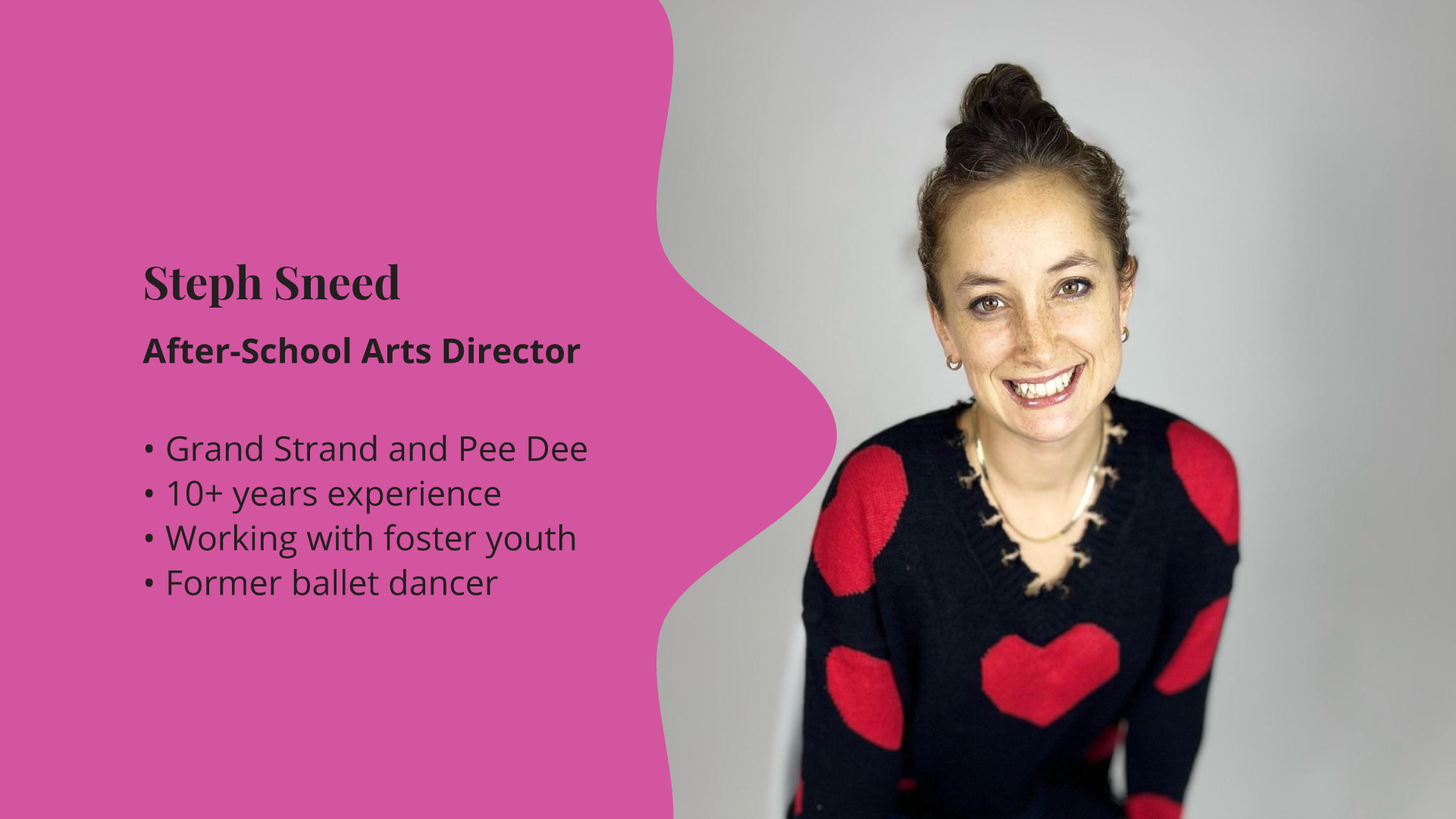
Hello, my name is Sarah Jane Thomas, and today we are talking with Steph Sneed, a professional creative working from and within South Carolina. As we get started, can you tell us your current career and where you’re from?
Steph Sneed 00:12
Sure. Originally, I am from West Virginia, but I have moved around a lot in my life, and I ended up in South Carolina, about eight years ago, and my job is called Imagine Academy. It’s an after-school program for kids age six to 12, and I also do like a lot of workshops, and I work with different organizations within our community.
Sarah Jane Thomas 00:40
Perfect. Before we go into detail of your profession, we have a brief section of the interview called One Career 60 Seconds, where you describe your job in 60 seconds or less, similar to an elevator pitch. We’re ready whenever you are.
Steph Sneed 00:55
Okay, so my job is basically creating programming for kids, but I also I’m like a one-woman show here. I don’t have any employees or anything. I keep my program very small. I operate out of my house, so I have six students a day. And let’s see what else. I also have a big heart for just kids and youth who don’t get the opportunity to create on a regular basis, and so I actually get to partner with a foster. It’s like a an organization who work with teens in foster care. So I work a lot with that organization, creating classes and opportunities for them to express themselves. And I also work a lot with an occupational therapist nonprofit in our area, who allows me to work with kids on the spectrum and have other disabilities.
Sarah Jane Thomas 01:48
That was perfect. What would you consider your job title?
Steph Sneed 01:53
I am the director, but I’m also like the teacher. But I would say I’m like the creative director. A lot of the program, a lot of the projects that we do, I like push the kids to create like individual, like themes, and so I’m often like directing them individually based off their ideas.
Sarah Jane Thomas 02:20
So, as a director, is there anything in South Carolina in particular that you bring to your work?
Steph Sneed 02:28
Like that maybe sets me apart. So, I think the thing that sets my work apart is that I work kind of so with such a small group. I have done workshops with like the school with different school districts, and I’ve noticed in like based off of feedback from the other teachers, the projects that I have in mind are unique because in school settings they would not have the capacity to attempt them, and so because it requires so much like personalized help and support. So I think that’s kind of that and the that I do two part classes. I do like a guided part where we work on like something technical, and then yeah, we do the project where they’re like really being pushed to express themselves personally, based off their interest in, and it’s it’s amazing because it really asks a lot of them to figure out like what do they like, what are they interested in, what inspires them, and that’s a pretty big question for a child.
Sarah Jane Thomas 03:40
Do you think it gives you a sense of familiarity being in the area?
Steph Sneed 03:45
I don’t know. I don’t know what you mean.
Sarah Jane Thomas 03:47
Like with the kids, do you think? Like, do you work with the same kids consistently? Do you work with the same school consistently? Does it kind of give you the ability to get familiar with everything?
Steph Sneed 04:00
Yeah. Well, I live in a small town, so I definitely see kids in the community on repeat. I’m really fortunate with the organization, the like teens in foster care organization, that I get to work with their group home. And though that does have turnover, it’s been really amazing. I actually the school district pays me to work with them. They have like a special grant, and so I get to go once a week and work with the group home, and it really, really helps me connect with them by getting to work with them regularly. And they really need people to take the time to get to know them, and I’ve seen a lot of growth in engagement with them because of that consistency.
Sarah Jane Thomas 04:50
That’s beautiful. Do you think that there was a defining moment in your life that had an impact on your creative journey?
Steph Sneed 04:58
Ooh, good question. Well, for this career, yes. So I actually was a professional ballet dancer before this, and so I’ve I say that I’ve worked in the arts like my whole like professional career, but I I have had kind of like a switch from like the dance to visual arts, and the way that happened was really organically. I was, I kind of had retired from dance, but I was actually babysitting a family in our area, and the kids moved away, and I realized that I really didn’t want to, and when I was babysitting them, all we did was art together, and I I realized when they moved away, or as I was preparing to like say goodbye to them, that I didn’t want to stop working with kids in this way. They just filled this like hole in my heart, and like also they were wonderful collaborators. So that was the moment. Like that was a big moment in my career where I was like, “Okay, I guess I’m gonna try this out. And crazy enough, it worked.
Sarah Jane Thomas 06:16
So, kind of along the same lines, before entering your field, did you have any fears about that?
Steph Sneed 06:23
Yeah, of course. I mean, I didn’t know if my idea would work. I and also because I hadn’t really trained all my training. It was in the arts. It was in the arts, and I went to like a boarding school for ballet, and like I’ve like and I went to the San Francisco Conservatory of Dance and like I have lived and worked in the arts, but I hadn’t really technically been in the trained in like the visual art field. But I, all my dance education had taught me how to basically pay attention to what my ideas are and learn how to like execute those ideas, and so that really translated into like this whole thing, and give me the confidence to try it, even though I hadn’t gone to like art school necessarily like visual art school, but as I’ve done all this work, I’ve also learned and gained a lot more confidence in my visual art skills, of course, and I’m always hungry to learn more. So yeah, I think those were some fears, but I wasn’t I wasn’t that afraid because I knew, like, from the experience that I had with the kids, that it was fun. Like, whatever we tried together, we were all learning, and it was fun. And so, I was like, if anyone is willing to take a chance on me, I think this is going to be fun for everybody who tries it, and I’ll just be committed to keep learning and getting better, and paying attention to how kids learn. And so, does that answer the question?
Sarah Jane Thomas 08:09
Yeah, perfectly. Okay. I was going to ask what inspired you to move beyond those fears, but you kind of encompassed the whole thing for me. Okay.
Steph Sneed 08:16
Sorry.
Sarah Jane Thomas 08:17
No. Please don’t apologize. This is wonderful. Do you have any advice for young adults or students interested in pursuing a similar career path?
Steph Sneed 08:28
I guess so. You have well, you have to be smart, especially like financially. You have to play the game of like how. You really do have to pay attention to. You can’t just go on like your love of art. Like you have to become a business person as well, and so I’ve learned that the best way that I can get like gigs and stuff is to package it nicely, like come up with how it’s going, come up with the plan for how it’s going to benefit the person you’re working with, and like explain that in a concise and clear way, and then just be committed to what you’re doing. Like do a good job with what you’re offering. Like pay attention and be a good communicator. Like those are all like really key elements. But also just like when you get started, you just have to be a little bit brave and show up and ask people if they’re interested in sharing an experience like this with you. Like one of the gigs that I got for a while was at a assisted living place, and what I did was I just showed up with I made this like pumpkin cottage. Like I bought like a little pumpkin from Target, and I like made all these like. Pieces for it that I glued onto it that made it look like a little cottage. I made it out of polymer clay and painted it, and I brought the pumpkin in, and I was like, “Hey, would you guys like it if I like did a class with you and I could teach you guys how to make this pumpkin, like a pumpkin cottage? And they were like, “That is amazing. Yes, and actually, that whole class ended up falling through that time. But later, they reached out to me, and they invited me to come later. And I worked with them for almost a year. And just similarly, like with the organization with the foster teens is called the Trent Hill Center, and I had I think I asked them if they wanted to do the pumpkin cottages as well, and they say yes. So so yeah, I think just being willing to like put yourself out there a little bit. Be kind. Don’t burn bridges, especially if you’re in the community of South Carolina. It’s kind of you know it’s a very small town vibe. Like I think across the state, and so I guess that yeah. I think that’s how I answer that question.
Sarah Jane Thomas 11:22
Well, aside from knowing how to build pumpkin cottages, are there any other particular skills one should practice before entering your career path or industry?
Steph Sneed 11:33
Well, yeah. I mean, I think if you’re wanting to be like an art teacher or like a community Art teacher, you do also need to, like I said, it kind of goes back to like the business, the business mindset. You have to like price things out, and you have to figure out how to make it affordable for your customers. Also, you have to know who your customers are, and I think something that drives me crazy is when people just consider art a business because it’s like you have to love it, like you have to believe in it, and then that helps you make your business decisions, like have an identity, and like your passion for it becomes your identity, and then you can make your decisions from, from like why you care about what you care about. Like for instance, like my son is autistic, and that’s why I like love to work with the occupational therapist nonprofit because I’m kind of uniquely I’m not like a professional therapist, but the experience that I have with my son makes me a little bit more uniquely qualified to at least facilitate classes where kids with who need like additional support, like that’s like that’s a great area for me to explore. And so, like paying attention to what you care about, what makes you mad, like what upsets you, and creating solutions like is really important because if you go through it identity less and you’re just copying things that you’re seeing like other art groups doing, it’s not going to be as interesting, and they’re going to like they don’t really have a reason to pick you over anybody else to select you to be the person who’s going to hold or host or facilitate. So, those are some of my thoughts on that. Yeah.
Sarah Jane Thomas 13:45
Well, I want to thank you so much for taking the time to speak with me today. Would you be open to talking to our team again?
Steph Sneed 13:52
Sure. Yeah.
Sarah Jane Thomas 13:54
Perfect. We will send you the transcript from this interview. Do you have any of those questions you were wondering about at the beginning of this.
Steph Sneed 14:02
So I guess I guess I’m curious, like who I looked at the website a little bit, but like who does this reach?
Sarah Jane Thomas 14:11
A big part is students like me. I go to Coastal Carolina, and so obviously me working on the project, I’m aware of it. My boss Alli will go into different classes and speak to different students about it. We also have a big Gullah Geechee presence on campus, and so any opportunity, like we have days for it, and so any opportunity to do some kind of outreach, we kind of talk about this. It’s a big thing for students still trying to figure out like where we are in the world and like what we can do with our passions, and so like especially you talking about formally being a ballerina and now coming into this world, like I think it’s a big pathfinder, I guess, for students like me. So that’s kind of what it’s intended for, but it’s also intended for people in the community to understand their other community members. So that’s kind of what this specific project is.
Steph Sneed 15:12
Oh, that’s really cool. That’s cool.
Sarah Jane Thomas 15:14
Yeah, I send it like my grandmother looks at it and like sees all the different peoples, and I think too it helps. Like it can be used as a tool for business as well, because we have a lot of artistic creators. We have a lot of film directors. We have theater producers. We have game makers. So it’s kind of just like it could be used as a little directory as well.
Steph Sneed 15:39
Oh, okay. Yeah, I like that.
Sarah Jane Thomas 15:41
It kind of does a lot of things, reaches a lot of people.
Steph Sneed 15:45
That’s great. I love that.
Sarah Jane Thomas 15:47
Yeah. So we’ll get the interview transcript sent off to you if you want anything edited or cut. Feel free to tell us. And if you have any questions, you can always reach out to that email.
“Value success through impact rather than accolades.”
Dr. Walter B. Curry, Jr. is an award-winning author, educator, and historian based in Columbia, South Carolina. Through Renaissance Publications, he documents African American family and local history, connecting ancestral narratives to broader historical themes.
Interview
Transcript
Lexi Raines 00:04
So what do you do for work and where are you currently working from? Just give a little introduction of yourself.
Walter Curry 00:10
Well, first I want to thank you for inviting me. I have followed the Athenaeum Press for a while. I have a connection there, actually how I found out about the press about a year ago, when I’ve heard about your organization, initiatives focusing on community, with the Communal Pen, I’ve learned more about the Press.
But just to tell you about who I am: I am author and educator, and I currently live here in Columbia, South Carolina, and my work focuses on ancestry and local history. And so as an author, I write narratives about my family history which connects to local history in South Carolina, in Orangeburg and Aiken counties, where my family is located, and using those ancestral narratives through the historical context, in the broader scope of African American History and beyond.
Lexi Raines 01:29
That sounds that sounds really fascinating. It’s good to hear that you also know about the Communal Pen. That’s amazing. So how long have you been writing?
Walter Curry 01:40
I’ve been writing about been writing for five years. Yeah, five years. I started in 2018 I published my first book on the Thompson family on told stories from the past 1830 to 1960 and because of the success of the book, I won my first book award in 2019 I was encouraged to use that as a opportunity to launch my business. And so the concept and the business Renaissance Publications is a self publishing company where I published my books focusing on the literary arts, and so I’ve been writing about five years. I’ve written two books, The Thompson Family Book, my second book, The Awakening: the Cy Ellison Family Saga, Volume One, a narrative history. That book won several awards as well. And—
Lexi Raines 02:45
Awesome.
Walter Curry 02:47
Thank you. Thank you. And my third book, which will be a blockbuster South Carolina, Matilda Evans, she was the first African American woman licensed to practice medicine here in South Carolina, that book is coming out in April, and that book is going to be the exclusive biography of Dr. Evans. And so I’m blessed to have written three books so far, and I have also branched out to other areas in the literary arts, visual art. I also do presentations and design of exhibitions as well.
Lexi Raines 03:33
That’s awesome. So it sounds like you’re definitely staying busy. Yes, yes. I am. I am. You said that you have a family history in South Carolina. What’s one thing that you have, like loved about working as a creative here?
Walter Curry 03:47
South Carolina is a very unique state. South Carolina is about 80% rural, 20 urban. And the beautiful thing about South Carolina is that South Carolina is unique because of our rich history and culture. And when I travel across South Carolina doing presentations, I’m always paying attention to the area, looking at the features of the area, looking at the cultural aspects and the local history, which connects that area to other broader aspects of history. And so I will say, with South Carolina, we’re very unique as it relates to our culture, our rich history, and that creates opportunities for authors like myself to bring that history out and to make it come alive. Through the literary arts.
Lexi Raines 05:02
That’s awesome, because I feel like South Carolina does have so much like kind of hidden history that’s kind of been like pushed to the back, and that deserves to all come forward, because it’s always like such beautiful stories that are meaningful.
Walter Curry 05:18
Yes, yes, yes, I totally agree. South Carolina has a lot of hidden history. I’ve discovered during my journey that when I was researching my mother’s maternal native County, Aiken County, I discovered that Aiken County was founded by three African American men during the Reconstruction Era. Aiken County was founded on March the 10th, 1871 and I also found out that Aiken County was the only county in South Carolina that was founded during the Reconstruction Era. And so when I asked my mom and some of my relatives and friends who grew up in Aiken county in the salad area, they had no idea about the founding of Aiken County. They didn’t know that Aiken County was founded by three African American men, all state legislators and civil war veterans. And so it’s the hidden history that I have discovered which is an opportunity for authors and historians like myself to bring that hidden history out, and that is relevant in all communities across South Carolina, there are stories of hidden history that need to be brought out so it creates opportunities for those of us like myself to focus on local history and to make those broader connections to state history, national history, African American History, Women history, or other areas of History.
Lexi Raines 07:20
I feel like you’re definitely helping pave the way, like uncovering all of this stuff. So you how would you like describe the local professional community? Because you did say there’s a few others that are also working on similar projects?
Walter Curry 07:36
Yes, yes, I have a great relationship with the local professional community. I do my best to support my peers. They support me. I have collaborated with several of my peers on various projects, one in particular a good friend of mine named Wayne O’Brien. He’s a local historian and author from Aiken County. He’s from Charleston originally. We have partnered together on several activities and initiatives, the Harlem Renaissance, that exhibition. He has written several essays on his family history, about his family connection to the Harlem Renaissance, and how his great uncle, Charles Linton, discovered Ella Fitzgerald. And yes, yes. Charles Linton the Lenten family, they are from Shera and so his family is from Cheraw, and how the Harlem Renaissance is connected to my family, I’ve discovered in my ancestry that my great grandfather, first cousin Asman Ellison, lived in Harlem New York in the 1930s during the Harlem Renaissance, and he was employed at Hotel Teresa, and that that was the famous place where all of the political dignitaries, cultural icons in the African American community, even foreign leaders, they patronized and stayed at a hotel, Theresa. And so looking at my cousin his life, and also saw, I saw his picture, and I have his picture, and he wore a Zoot Suit. And so I learned about the zoot suits. And so me and my colleague, Wayne o Bryant, we have partnered together over the years. And one of the thing about being a part of a professional community, a network of peers, you are able to share information and share ideas. With each other and potential collaborative opportunities. And so I encourage that, because we don’t know everything. We have our strengths, we have our weaknesses, and I think we as creative, should acknowledge that. And the beautiful thing about being a part of a network is you lift each other up because this work sometimes is challenging, sometimes it’s frustrating. It’s a battle of the mind where we have to constantly reassure ourselves that we despite the struggles that we face from time to time, we’re in this because of our talent and we want to show the world that our talent has value because we believe that we as creatives have value, and that our value is the creative arts.
Lexi Raines 11:06
That’s awesome. Yes, I feel like I completely agree. I think it’s also so nice that, like you have, that South Carolina has such a good community to lean on. Because I feel like that’s something you may not find in, like bigger states, is that just really close connection and networking capability that we have here?
Walter Curry 11:27
Yes, yes, I totally agree. South Carolina is a close community. Is a small state, and we’re a state that is blessed to have rich culture, rich history, diversity. And I remember Governor McMaster, he mentioned in a state of the state address, he spoke about South Carolina rich diversity in history and culture, and that we are the envy of some of our competitive states because of the fact that we have rich history, rich culture from the American Revolution, Revolutionary War, Civil War and beyond. And we also have access to the mountains. We have access to the beaches. We have warm climate. So we have a lot of amenities that motivate us as creative artists to really highlight South Carolina through our work.
Lexi Raines 12:34
Yes, I would completely agree with that. And so kind of shifting gears here in your writing, like, how? How do you define, like, professional and or personal success in your creative endeavors?
Walter Curry 12:49
That’s a great question. I never thought of it. I would say that professional success, to me, is growth. I believe that over time you want to you want to see whether or not you are actually growing in the areas that you need to grow in in order to maintain success. And so for me, I look at my writing. I look at how my writing has improved over time. I also look at my activities. What are what am I doing as far as my activities to make sure that I stay active. So I measure that. Am I’m going to networking events? Am I doing professional development, professional learning opportunities? So I measure that, and how am I applying the knowledge and skills that I have obtained over time, and whether or not the knowledge and skills are working in my favor. And so that’s how I measure myself, professionally, personally, I look at the accolades, because we all want, we all need to know whether or not our work is being recognized. I’m not a person who seek personal recognition, because that is a trap. I think we have to be careful as creative to if we focus too much on personal recognition, but it doesn’t help to get recognized, and so when I receive awards, and I have received several awards for my work, that tells me that I am being noticed, and I am out there and people are. Recognizing my work, not only those who follow me and support me, but my peers who are judging my work as well.
Lexi Raines 15:09
Yeah, I would completely agree with both of those. I think, like first for what you said in your professional life, like I feel like the worst thing that can happen to a creative is that kind of like stagnation. So I feel like striving for growth at all times is the only way to grow to get anywhere. Really.
Walter Curry 15:35
I agree. I agree. I agree and to and to your point, you don’t want to feel stagnated. You always want to achieve growth, and
Lexi Raines 15:48
then with the your personal success, the like awards and stuff, I feel like it definitely, I would agree it’s important to have a mix of having a drive for doing it for yourself, and then having a drive to put stuff out there and be recognized. So I would, I would agree with that. Thank you. Thank you. So what was like your biggest fear when you first decided to pursue the arts?
Walter Curry 16:19
Oh, man, that’s a great question. I would say fear, fear of failure. I have failed several times in business, and I’ve learned from my mistakes. I started out as an insurance agent, following my father’s path, did pretty well, but I found out like this, ain’t me, you know, he’s a very successful insurance professional. He taught me a lot about business and some of the skills and lessons that he taught me, I still apply till this day. And then I moved into real estate, got my real estate license, and I only sold one house. Actually, it was a cousin who I helped, and he owned a rental property, and he sold it, and I helped him for 21,000 so I didn’t do well, because I thought, Man, I got this real estate license. I’m going to make a lot of money. I remember going to a subdivision and this successful real estate broker. He was like, Walter, if you come to this subdivision and you be the agent on duty. And I was thought, man, all these people going to come to me, I found out that was not so. And so I got out of, out of real estate, and then I tried jam Pro, because I was, I was convinced by a cousin to get into the cleaning business. Did okay with that. Then I quit, and then got into education. I taught school for four and a half years, then at the time, I was blessed to obtain my graduate degrees. I have three graduate degrees, by the way, and I decided to leave the classroom because I was tired of teaching middle school kids, so I didn’t do well with that. And I look back at that experience, and I said to myself, if I would have applied myself, I would have been a better teacher. So I was a rebel, okay? And I didn’t take my training seriously, so I fell on what I know, and at the time, I was going through a midlife, midlife crisis, I remember all of the stories that my mom shared with me about her family history, and I did some research and find out that man I have an ancestor who was an enslaved cook in the Confederate Army, and found out about her, located her pension record. Then I did some more research find out about ancestors who were enslaved, more written records, primary sources. I said, Wait a minute. I got something here. Okay, and so I was able to discover my passion in history. I have discovered my passion as a writer, and because of my background in education and business, I put those skills to use, and I have successfully applied those skills. And so I’ve been doing this for five years, but my biggest fear when I started. Out was the fear of failure. And the fear of failure for me was the mistake over the years prior to me becoming a business owner in the literary arts, was the lack of application, the lack of discipline, not being humble, okay, not learning from mistakes. And so I say to myself, I will not fail again, you know? And so I’m blessed to be in business for five years. It has really been an incredible journey. Yes, I
Lexi Raines 20:41
I feel like that definitely shows too that everything that you do does ultimately get you, if not, where you thought you would originally be. It gets you to where, somewhere, where you will be happy, like your business background, your time as a teacher, all of that led up to you being a writer. So it really shows you never know where life is going to take you all the time.
Walter Curry 21:08
Well, I agree. I agree, and that’s why you have to have a open mind. I encourage everyone to seek your gift, seek your calling. I believe that everyone has a calling. Everyone has a gift. It’s how we cultivate our calling, how we cultivate our gift and be able to appreciate that. I’ve learned that you cannot be something that you’re not. You know you could try, but you cannot be something that you’re not. You could, you could try to fill somebody else’s shoes, but over time, those shoes are going to get bigger and bigger, and your feet going to get smaller and smaller. It’s kind of like my grandma, Lizzie Williams curry, she passed away several years ago at the age of 102 and she said she shared a lot of wisdom and advice with me during her last years. We had a lot of private conversations, and she told me about my journey, she said, Walter, I’m going to tell you something. You got to stay in your lane. Okay, stay in your lane. Don’t worry about trying to ride somebody else’s lane, because if you do that, you’re going to get run over. Okay, stay on the path that God has called you to do. Don’t worry about what people say, because people going to talk, they going to criticize. I mean, that’s part of life, that’s part of the game, but you got to stay focused on what God has called you to do, and stay in your lane. So I live by that example, and I don’t try to interject myself in a lane that I am not called to run on. So for instance, because of my popularity as an author and a historian, I have received numerous requests about doing other things and also requests in knowledge that I’m not familiar with don’t have no expertise, so I’m happy to defer to those who do have knowledge, experience and expertise, and that’s why a professional community of peers is so important, because, number one, it helps you to identify peers who have the knowledge, skills and expertise and the resources. And number two, it gives you credibility, meaning that I don’t know all the answers, but I know someone who does so that gives folks a sense of your credibility and your ethical behavior in the field,
Lexi Raines 24:12
I would completely agree. I feel like staying in your lane, like I have a question later about like the best and worst advice you’ve ever received, but I think that is genuinely good advice too, because I feel like, if you are trying to like, you said, like, interject yourself into other places. I feel like that can be where, like so much unhappiness will stem from. Like, that fear of judgment from doing like, what you truly want to do. So I feel like that is just a really, really important and wise piece of information she gave you. Thank you. Thank you. Thank you. So please like describe, for me, a defining moment in your creative journey, like, did you have a like, a particular project or moment that had the biggest. Impact on, on you.
Walter Curry 25:03
Yes, yes, I will say the defining moment for me was in 2020 before COVID. February the first 2020 black history, month of the unveiling of my first exhibition Sally in the Thompson family, and that exhibition was featured at the Aiken County Historical Museum in Aiken, South Carolina, where my maternal family is from. And I, along with the director, Laura Virgo, we collaborated for about six months on the exhibition, the items and the promotion. And I remember putting, putting the word about the exhibition out to the public and on social media. And I looked up one day find out. Man, it is sold out. And I remember Laura said, Doctor, curry. We are at capacity. I said, what? You gotta be kidding me. And so I remember, I spent the weekend down there. My cousins gave me we had an Alli at my cousin house, and so they were so excited. I mean, I mean, they were so excited. Some cousins I never met, who came down, and I was like, wow, they doing all this for me. And so I on Saturday morning, I lost my wallet, and luckily, I was able to recover it. I left it at a gas station, so I said to myself, Man, I lost my wallet a few hours before the opening event of this exhibition. I’m freaking out. And so when, when, when the exhibition was finally open, during event time, I looked up and there were people coming from all walks of life. I mean, I think it was over 100 people. And according to the museum, they say that that was the largest gathering of an exhibition in its history. Insane. That was insane. I was like, Oh, my God, this is insane here, you know. So that was a defining moment for me to really sink my teeth in and say, Okay, this is something. I could do this. And so that led to me defining my skills, making sure that I stayed with what I am doing. And so that was the defining moment. And the second defining moment was recently when I finished writing, when I finished writing my third book on South Carolina, Matilda Evans, a medical pioneer, and looking at my work and looking at how this book is really going to be a major blockbuster in South Carolina history. That is another defining moment for me. So yes, those are two defining moments.
Lexi Raines 28:30
Those both sound so like special I can’t even imagine, like, how you must have felt in that moment. That is congratulations. That is actually amazing. Thank you. So, yeah, of course. So I know we kind of already did hit on this, but if you have any other advice, what is the best advice you’ve received and the worst advice you’ve received?
Walter Curry 28:57
The best advice I receive, I will say, like I said during our interview, is stay in your lane. Know what you’re good at, and perfect your skill and talent. And that has helped me the worst advice. I haven’t received any worse advice. I will say, being tempted to do something that you don’t want to do. I will say over joining organizations. Sometimes we do that. Join this organization, you join that organization, and you hoping that if you join organizations, you will get something out of it. So I will say that is, is the worst advice that I receive. And I will say in that if you going to join an. Organization, you have to feel comfortable. You have to know why you join in that organization, and you don’t want to over join. You want to join organizations that relates to your interests. So that is the two advices that I have received.
Lexi Raines 30:47
I feel like that is definitely good thing, or a good piece of advice, or not over joining organizations, because I feel like young creatives, they are just trying to, like, get their names out there, do whatever they can do, as much as they can. And I feel like, as an artist, it’s so easy to stretch yourself too thin and kind of like get burnt out in that way, which is obviously never what you want to happen to your passions.
Walter Curry 32:53
Oh, I totally agree. And we can get burned out, and you get burned out to a point where it does affect your cognitive ability, because as a creative your mind is all over the place. You know, I even have to guard that myself. Well, well, I want to do this, but, but I know I shouldn’t okay, what I shouldn’t do, what I shouldn’t do I should do okay and to your point, we have to guard our minds. And I will tell any creative, guard your mind. Take time for yourself. Don’t worry about whether or not you’re going to get opportunities. Opportunities will come if you just stay focused and perfect your craft, stay engaged. Opportunities will come, and I’ve discovered that. I’ve discovered the days that I feel like, Are there any opportunities coming? You check your email, you find out, Oh, man, there’s an opportunity. Okay, yeah, yeah. And also cultivate relationships and give back. I think sometimes we miss that. I mean those organizations and peers who have helped us, we need to help them. And I would say that to creatives, that when you have downtime, that doesn’t mean that you’re not working. Okay, that’s an opportunity where you can reflect. That’s an opportunity where you can say, Okay, I need to retweet this. I need to retweet that. I may need to revise this content, revise that content, that content. That could be an opportunity to do some promotion on social media. Okay, follow up on emails. So So I always, I will always say that there’s always something to do, but the same time you have to know what your goals are, what your interests are.
Lexi Raines 32:53
I completely agree with that. Because, like, even on your point with like, not being afraid to give yourself that time to relax and have that downtime. Even I have felt that this past semester in school like it, it’s okay to give your brain a little break, and in that moment, in those moments where you are taking that break, you can find so much inspiration for things when they pick up again.
Walter Curry 33:21
Oh, absolutely. And you have to reflect on your successes too. When you reflect on your successes, that will help you feel positive, because, you know it’s like with Steve Harvey. He owns a radio show, and he has his his morning talks, and his morning talks are very, very powerful, inspirational. I remember listening to one of his morning talks, and he mentioned about how you have to speak something positive about your life, where God has placed you in your life. He will start off by saying, Steve got a radio show, yeah, I got a radio show. Okay? And he will tell you what led to him getting that radio show. He will tell you that man, several years ago, I was homeless. I was sleeping in my car. Okay, now I’m sitting in this chair, and I have my own radio show, and so he takes the time to reflect on his successes, and we have to do that, but particularly in this world of distractions, as we see, there are so many distractions, and so I would encourage creatives to reflect on your successes, and that doesn’t mean reflecting on your awards or your accomplishments, but but if you have published a book, if you have. Design or create a painting. Count that as a success. I mean, I mean, count the fact that you are participating in a professional development opportunity. Okay, the little things. It’s the little things that we have to appreciate. I believe in what St Augustine said in his book confessions, it’s the little things that leads to the greater things he didn’t say. These are the greater things he says, those little things. And so those little things that we have to pay attention to.
Lexi Raines 35:37
I completely agree you have, you have good advice after good advice, this is going to be awesome. So can you walk us through like a typical work day, like, what does your work process look like, and what do you kind of like expect from yourself on a daily basis?
Walter Curry 35:57
That’s a great question. You never know. I’m a father of two sons. I have a lovely wife who supports me, so it’s always unpredictable. I’m blessed to have flexibility. I work from home, so I make it a point to walk outside while my wife and my boys, they in the kitchen getting ready. I’m getting ready to take them to school. So I believe walking outside in the morning to feel refreshed, to connect with nature, to clear your mind, because your mind has to be clear. Also, I work out. I go to the gym twice a week. I’m trying to increase it to three times a week, because your success connects to your physical success. I believe that in order for us as creatives to stay engaged mentally, to decrease stress, we must take care ourselves, take care of our bodies, and we have to incorporate physical activity. So I do work out at the gym. I check my emails in the morning. I look at things that I could do as far as my work. I pick up the kids from school, help them out with their homework, and when my wife and my kids are sleep, I’m back on the computer, catching up on things. Well, that’s my typical work day. I do have presentations, and so when I schedule presentations. I take the time to prepare for those presentations and other projects that I’m working on, making phone calls.
Lexi Raines 37:51
So how do you create like that work life balance where you’re able to maintain like your professional creativity, your personal creativity, and just like that time with your family.
Walter Curry 38:03
Yeah, it’s a challenge. Sometimes it’s a challenge because in my position, I’m blessed to be compensated for my work. I receive compensation through a grant from the South Carolina Arts Commission. I have a partnership with the Aiken Center for the Arts. I am the author in residence, and so we have a grant through the South Carolina Arts Commission, where we host historical exhibitions in middle schools across Aiken County, eighth grade classes. And so I’m blessed to be compensated, and also I’m a member of the South Carolina humanities speakers bureau, where I’m part of a circuit of speakers of history, art and culture called South Carolina, and I present at various cultural centers, museums, arts and humanities organizations across the state. And so I’m blessed that I am being compensated for my work. And I think we have to feel well, let me say we need to be compensated for our work because of what we put in. And so I’m always looking for opportunities for compensation, and if those opportunities for compensation don’t come quickly, then I’m looking to help other authors. And that’s a key point I want to make too, is don’t just look to see compensation all the time, there could be an opportunity to help another creative, and that creative will help you. There could be an opportunity to connect with it, with an influencer. And influencers are very, very important in our work. Those are the individuals who have influence in areas of expert. Teas, but also have influence in networks that could give us opportunities, and so we have an opportunity to help the influencer. So these are strategies that I have used over the years that have helped me, because as a creative, you’re going to experience gaps, okay? I mean, in any business, there will be gaps, okay, but how do you overcome those gaps? How do you train your mind mentally to not allow those gaps to affect your confidence? And so that’s why I live by three things, looking for opportunities that provide compensation, looking to help other peers, and also looking to help influencers and get involved in my professional networks.
Lexi Raines 40:58
I would completely agree. I feel that, like, obviously, when you are working creatively, you do want to worry about money, but like, there’s so many other ways that you can kind of get that, like payout, like just their experience, or growing your circle, all of those things that you mentioned.
Walter Curry 41:19
Yeah, yeah, I totally agree. Totally agree.
Lexi Raines 41:24
So as we’re approaching the end of the interview, do you have any questions that you wish you were asked?
Walter Curry 41:32
Oh, no, no. I really enjoyed this interview. I got off to a slow start, but over time during this interview, really enjoyed answering the questions.
Lexi Raines 41:47
I’ve really enjoyed talking with you. I feel like you have so many like valuable, so many valuable words of advice for people that I think will be just so helpful. Thank you. Thank you. So my last question, do you have a creative that you would like to be interviewed, that you’d like to nominate to be interviewed?
Walter Curry 42:09
I do several of them, several of them. I will say my cousin Teresa Corley Wright and here’s why I say that, because she was the one who introduced me to the world of writing. Really tell you this story like myself, she is a family historian. We share a common we share a common ancestors, and I remember myself and Teresa, we discussed the idea of a family history book. And at the time, I knew that Teresa had experience in writing books. She has written several books over the years and and she told me, she said, Well, Walter, since you know the family history and you know a lot of relatives, you should write the book. I said, me, Ah, man, I’ve never written a book, you know. I said. I said, okay, okay, okay, okay. You gotta be kidding me. I’m just gonna provide you the information. But I said, Well, wait a minute. You know, I’m at a midlife crisis. This is an opportunity for me to show what I can do. And so I took the opportunity I wrote the book through trial and error. But what’s so interesting about my first book is the structure of the book is the same structure that I use when I wrote my dissertation. And so I had no format of writing a book. I say, Okay, I’m going to write the narratives, and then I’m going to write an interpretive essays about the narratives. Okay? And that’s qualitative research, where you take narratives and you write interpretive reflection essays about the narratives, looking at themes and context and so forth. And so I follow that format, yeah, yeah, yeah, yeah, I’ll follow that format. So yes, Teresa has been very helpful. She She deserved to be honored. She has now received accolades for her work, and so I will, I will be be honored to recommend her,
Lexi Raines 44:55
Yes, okay, awesome, so I’m going to be sending. You like a little follow up email, and I’ll remind you in there. But could you just like, attach either her contact information, like her email or her phone number, whichever she prefers, and then also, thank you. Thank you so much. Thank you. Yeah, I’ve really enjoyed our time today this you just have so much good advice. It’s awesome. I feel like your story is really inspiring. Like you’re just you didn’t know what you do. That’s kind of how I’m feeling. Like I don’t know what I want to do, but you give me hope that I will end up there.
Walter Curry 45:35
Well, I appreciate it. And that’s, and that’s, and that’s, that’s what we have, is hope. Like Steve Harvey said, If you don’t have faith, have hope. And I draw on that because that was the characteristic that my ancestors had when they were enslaved and share crop. And in the rural South Carolina, they had faith, but they had hope. And I think before you have faith in something, you got to have hope. You got to have something to believe in. Because when you have hope for something, then then you will develop faith, but you got to have hope first. And how I describe hope as optimism, you have to be you have to be optimistic, and you have to really believe in yourself, because, again, there will be challenges. You have to face rejections. One of things. One thing I learned when I was active in the insurance industry, I learned about rejections. I learned about overcoming rejections, because that’s part of the process. When you are in the sales industry, you going to have objections, you’re going to have rejections. Okay? Is how you overcome those objections and rejections to move forward. It’s all saying it’s a numbers game, you know, an insurance business, it is a numbers game. And that has never changed. And so we as creatives, we’re selling our work. We are actually selling content, okay, where in insurance business, you’re selling a product, okay? That product could be life insurance, health insurance, disability, okay? Where, as a creative, you’re selling content based on an idea. Okay? You’re trying to convince people that your content and your idea worth something for them to buy. Okay, so you got to have hope and you got to have faith.
Lexi Raines 48:06
Yes, that’s also more good advice you, you just keep coming with this.
Walter Curry 48:16
I love to do a podcast one day, my tips and strategies.
Lexi Raines 48:22
Yeah, that would be awesome. We actually do have a podcast section on our website, so I’ll definitely, I’ll definitely mention you to my boss for sure.
Walter Curry 48:37
Yeah, yeah, yeah. I appreciate it.
Lexi Raines 48:40
Yeah, of course. So just thank you again for your time. I’ve really enjoyed this interview. I’m going to send you that follow up email, and obviously you can, like, email me any questions you have, but yeah, I think that’s it.
Walter Curry 48:55
Alright? Thank you so much.
Lexi Raines 48:57
Yeah, of course, you have a good rest of your week.