
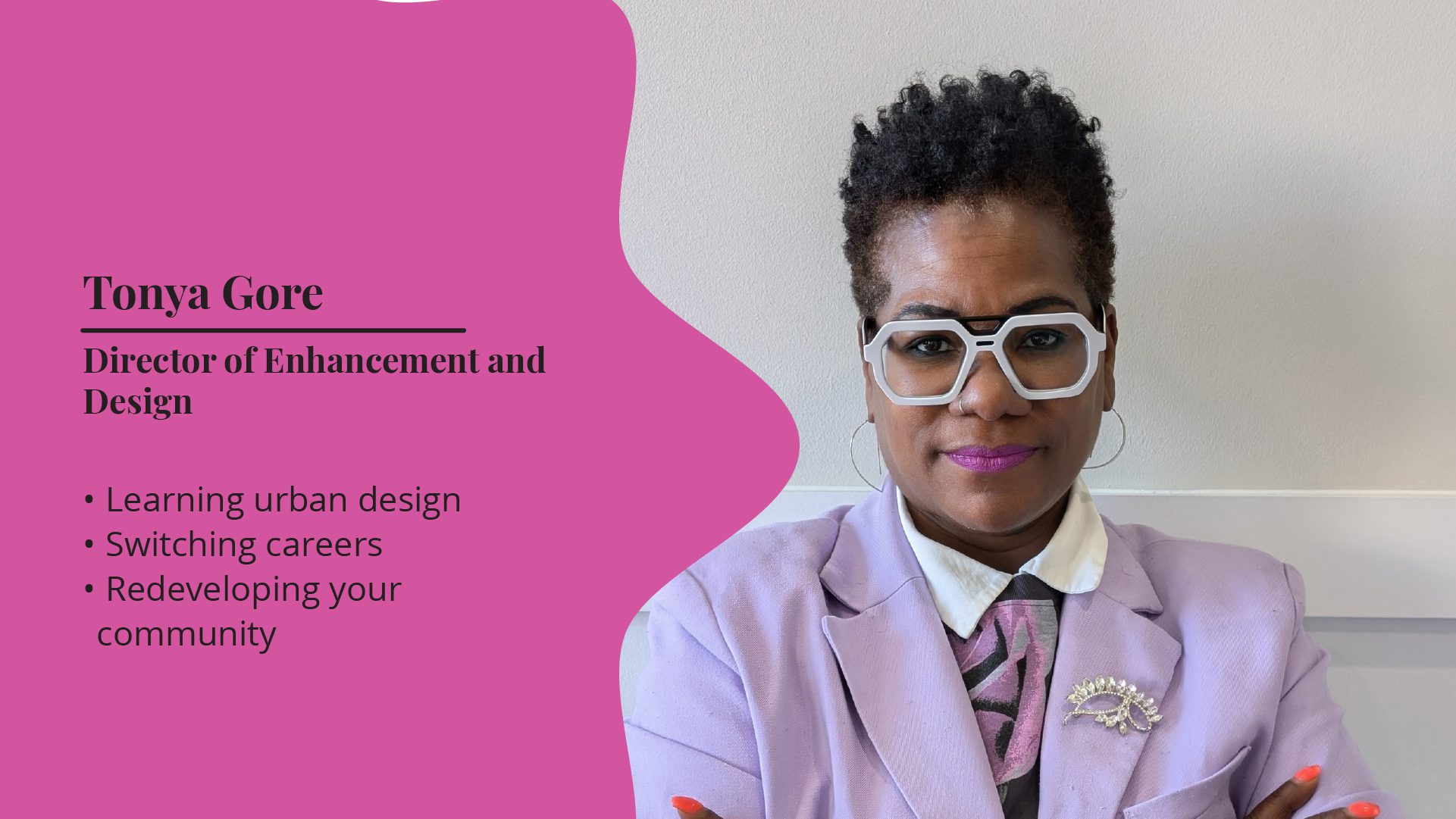
“I sold everything, packed my dogs, and moved to Charleston because I refused to let fear of the unknown stop me. I had to stay creative and find a way to help my community at the same time.”
Tonya Gore, Director of Enhancement and Design, Myrtle Beach Downtown Alliance. From artist to urban designer: Tonya Gore’s journey is a masterclass in resilience, reinvention, and rootedness. After a devastating flood hit her hometown, Tonya left behind a two-decade career in graphic design to pursue a new path in Resilient Urban Design. Now serving as Director of Enhancement and Design at the Myrtle Beach Downtown Alliance, she fuses her artistic background with a deep commitment to community-building, proving that creativity can shape not just art, but entire cities.
Interview
Transcript
Tonya Gore 0:00
My name is Tonya Gore. I was born and raised in Myrtle Beach, South Carolina.
Sara Sobota 0:04
Okay, great. And who do you work for? And from where?
Tonya Gore 0:08
I have worked for Myrtle Beach Downtown Alliance, located in Downtown Myrtle Beach, South Carolina.
Sara Sobota 0:13
Okay, and how long have you been working there? And what is your official job title?
Tonya Gore 0:18
Almost two years. And my official job title is Director of Enhancement and Design.
Sara Sobota 0:24
Okay. How did you end up in this field? And how did you hear about it? Long story, I guess.
Tonya Gore 0:30
It’s a long story because my creative field actually started after I left Coastal Carolina University. And I did an internship, I do not know if you knew this, Sara, but my degree is actually in fine arts.
Sara Sobota 0:46
Oh, I didn’t know that.
Tonya Gore 0:47
So, I went to Coastal, graduated in 2000, in Fine Art. And the program just sorts of introduced graphic design to the program. They had one computer lab, and Max just started.
And so, it was suggested that we go and get internships if we want to make a career out of graphics. So, I found an internship with a local, local small advertising agency working on the beach ball class.
Sara Sobota 1:12
I did not know any of that, that is awesome.
Tonya Gore 1:15
That is so mild in the fine artists, I just have not done a lot of fine art. A lot of my background that I have done, or fine art pieces with some watercolor and some oils. So, their position is all throughout my family’s house. I worked at the fish that did an internship, I finished that she hired me full time. I stayed there for a few years.
So, my full career for almost 20 years was in graphic design. And I simultaneously I worked as a adjunct in digital arts at Horry Georgetown.
Sara Sobota 1:49
Oh, I didn’t know that either.
Tonya Gore 1:50
I did that for almost 10 years, like eight years, to be exact. And I also worked in the community a lot. I wanted to find a career that can work because I’ve always wanted to stay creative. I’ve always said I would never get out of a creative field. I wanted to do something that had some creativity in it.
So, I did soul searching, I wanted to do something with the community that combined my creative field as well. And I found the program and went back to school, to Clemson in the master’s program for urban design degree.
Sara Sobota 2:20
Okay.
Tonya Gore 2:21
So, it’s a Resilient Urban Design degree because of my family, my family’s from Nichols, and my mom’s family from Nichols, South Carolina. And a few years ago, Nichols was one of the areas that went through a 100-year flood. And my family lost everything. And then two years later, the same thing happened. I had an eighty-something-year-old aunt that lost everything that could not be rebuilt. She was too old, she, you know, and it was the most devastating thing to me.
So, I said, well, let me see what I can do, still wanting to be creative, but also wanting to go back into the community as well. So, I found out what had happened. So, Clemson just started a program called Resilient Urban Resilience and Urban Design that focuses on being resilient communities. And I did that, I quit all my jobs, almost 20 years.
Sara Sobota 3:10
Wow.
Tonya Gore 3:11
And I went back to college to do this, again, still wanting to stay creative, because I knew I could not do anything that is not creative, because that will drive me crazy. And I did that. finish that up. It was a yearlong accelerated program for one year. And I found my first job designing streets urban design or for an engineering firm.
Sara Sobota 3:34
Okay.
Tonya Gore 3:35
So, while I was there, I used to attend an institute they had every once a month, they had a coffee with ULI [Urban Land Institute], and they did speakers, and the President of the ULI was Amy Barrett.
Sara Sobota 3:51
Okay, I’m sorry. Well, ULI is urban…
Tonya Gore 3:53
Urban Land Institute.
Sara Sobota 3:54
Land Institute, okay.
Tonya Gore 3:54
Urban Land Institute.
Sara Sobota 3:57
And that was here, or was that in Clemson?
Tonya Gore 3:58
It was in Charleston when I was in school.
Sara Sobota 4:01
Okay.
Tonya Gore 4:01
It was in Charleston and Amy was the, Amy was the president. So, one of my classmates’ texts, and she texts all of us and let us know that Amy took a job with Myrtle Beach, downtown Lyons. And she knew I was local. She knows I have my creative career. And she also knew I had my design background. So, she offered me a job here to combine them all. So that’s how I get with the title and with this job is a long circle, but it is full circle,
Sara Sobota 4:32
Wow, and so many accomplishments along the way, and so many ways. Yeah, that’s amazing. Now, the resiliency in urban design, I thought you said it was Clemson, but it was in Charleston?
Tonya Gore 4:46
Charleston, Clemson has a study of full remotes, what do you call it, a remote branch or class, and most branches. It is on East Bay Street, and it’s at the cigar factory. The full Second floor to Cigar Factory is three different programs as architecture, they have a choice to go to Charleston or go to Italy, the historical preservation. They are for two years, and the Urban Design Program share the second floor at the cigar factory floor Clemson. Okay. And it is a one-year program. So, that’s how I ended up in a job.
Sara Sobota 5:23
That’s amazing. Okay, great. The next question is, what background did you have that helped you land that role? I think you kind of walked through that a little bit, right? Yeah. Motivation and your background? Can you walk us through a typical workday? Is there one?
Tonya Gore 5:41
Okay, we sit all over the place with this because right now, if I had my interns on a Monday, my interns come in. Okay, it’s three interns, digital arts, and we are. My project is the brand in the wayfinding element for downtown. Okay, so we start at nine, I meet with them, we go over their previous week’s work to make sure they are on the path of what I’m asking them to do.
Sara Sobota 6:08
Yeah.
Tonya Gore 6:08
And that’s until 10 o’clock, we have staff, from 10 to 11:30. Most of the time, our staff through our weekly projects, we have one on at about 11:30, then I go make sure the interns, okay, and I start, you know, what’s the easiest first, sorry, because I do plan events as well. So, right now we’re planning all of our events for Nights of Nance. So, I had to get all the bands lined up there.
And then when I finished that, then I’ll go back to my pendant and wayfinding and make sure that I give them something to do, or make sure all my input meeting and they need Pantone colors, and making sure their Pantone colors is exactly correct what they need to use it. When they send in vows.
I double check and make sure all their files, because I work in Adobe programs, make sure their files are situated. Then, once I finish that, I’ll go check and see if any of the businesses, like a couple of businesses, have an event this weekend. There is a Pride event this weekend. I’m making sure he’s okay. He has all of his elements to make sure. Then I finished that. Now, I’m working on a schedule because we’re going to activate the space in the pocket park.
So, I want to make sure you know we have to have a schedule for the whole year, in trying to come up with ideas for the whole year. So today, I was researching other people’s websites to see some ideas. So far, we went to yoga and went to a farmers’ market. One, trying to get Jason about our bench, but it’s not. We wanted it with Bistro lights, so, two functions. So, and now today, we had to walk from downtown.
Sara Sobota 5:42
Okay.
Tonya Gore 5:58
So, that usually stops around 5:00 or 5:30. But I normally do not finish all my lifts throughout the day. As long as I’m finished, because I go back and forth doing multiple things and things like that.
Sara Sobota 8:05
Yeah. Well, let’s talk. A big picture of your job. You are ah, I mean you are in a way of building. You are building a city. I mean, you are crafting. It is kind of an upgrade, but not really. I mean, your kind of building from the ground up. Right?
Tonya Gore 8:23
Right, right, right. I, I call it my, my version of it, is an empty canvas.
Sara Sobota 8:23
Okay, yeah.
Tonya Gore 8:31
That is what I may have done when I first started out, so we had an empty canvas to play with. Just, I don’t because I am in such a love of historical buildings. I don’t like tearing down, I like building on what you have already.
Sara Sobota 8:45
Tell me, just in your words, although I know the mission statement of MBDA, what is it? What is it doing?
Tonya Gore 8:51
From my perspective or just…
Sara Sobota 8:51
The whole organization, the whole organization.
Tonya Gore 8:52
We’re pretty much a place management organization.
Sara Sobota 8:59
Okay.
Tonya Gore 8:59
So, our task is to help with redevelopment, partnering with the city of Myrtle Beach redevelopment, activate spaces, bring people downtown, host events, sponsoring events, make sure people are coming downtown, and to help it revitalize, to make it a walkable community for all.
Sara Sobota 9:17
Okay, okay, awesome. Can you describe a defining moment in your creative journey? Could it be a project that made an impact on you or something you produced? You know, in my opinion, it could even be a decision you made but a defining moment in your creative journey.
Tonya Gore 9:35
The entire time?
Sara Sobota 9:36
You’re defining yourself.
Tonya Gore 9:37
I think, my defining moment is when, I was talking about with my family, the impact and the impact that had on my family and my community because of Vietnam. I was born and raised here. Let me think of a specific one outside of the flood. It was 2017, or something like that. Yeah, I think that is what was close to the research on that with that.
Sara Sobota 9:59
Was it Mathew?
Tonya Gore 10:01
I’m not sure, probably, it was two back-to-back.
Sara Sobota 10:01
Yep, yep.
Tonya Gore 10:04
Matthew, maybe Floyd, Matthew, maybe Floyd, back-to-back. It’s two years apart.
Sara Sobota 10:08
Okay.
Tonya Gore 10:09
Let me think, what was the defining moment in my career? That made me think about my career in a different way? or just…
Sara Sobota 10:18
Or that when you, when you produced it, you went, wow, look at what I can do.
Tonya Gore 10:22
Let me think. My last job, I did a lot of mentoring for cities.
Sara Sobota 10:22
Okay.
Tonya Gore 10:29
For a street, that, when it’s revitalized, the street with it was more of a street design, not buildings. So, add bike lanes, to add types of parking, some medians, some roundabouts, and you will take a picture of the street the way it is. And then I would add all the elements to the street, and sometimes even now when I look back, I’m like, Whoa, wow. Like, who did this? I amazed myself with that, because I took something that didn’t look like anything.
And I produce something that looks, you know, a rendering that people can associate with how they want the community to vote. So, I hope to take that skill and pass it on to what I’m doing now. Where I am working with that.
Sara Sobota 11:20
Yeah, that makes a lot of sense. And when you know about your job, you can go see what you’ve done. I mean, it’s their people who use it. Oh, that’s amazing.
Tonya Gore 11:30
Yeah, yeah.
Sara Sobota 11:32
Was it challenging for you to find this career path? Or what are some challenges that you faced, or even every day, your challenges now, whatever.
Tonya Gore 11:40
What challenge made me stop 20 years of graphic design that, when I was teaching, I saw a lot of talented young artists coming through, and I realized that they are also there, the market value for them increased. Even though I had more experience, I did not keep up with my, my skill, my craft. Meaning they knew how to write programs; they kept up with developing websites. And I did not keep up with that element.
So, that was a real challenge for me. Because I felt like, okay, if I want to be more marketable, the kids coming out of high school know a little bit more than I do right now. So, I need to think about, that was the hardest challenge about my career, that I’ve still found, I don’t find it as challenging now, as I did then.
So that was another reason why I felt like I needed to gain more just saying, and, again, every time I say I’m utilizing this to go back into my community as well.
Sara Sobota 11:40
Yeah.
Tonya Gore 12:15
So, so that was a challenge, that was like an eye-opening experience for me because, younger generation is so much more technically advanced than I was.
Sara Sobota 13:03
Yeah, yep. I think a lot of people agree with that. Can you recommend any specific skills that an aspiring applicant should have to increase their chances of landing a role in your field? Specific skills.
Tonya Gore 13:18
Specific skill in my career, when I’m doing now. It helps that I have graphic skills, but I think my knowledge base might be a little bit more valuable than my…. The skill is valuable, but it also could be taught. Knowledge from my experience over the years cannot be taught. So, I think that when you enter a career, value those around you will have the experience.
Sara Sobota 13:48
That’s smart. That’s absolutely true. Yeah. Okay. Great. Are there any local organizations programs or events that you recommend for aspiring creatives?
Tonya Gore 14:00
Art is so subjective when it comes to creating, so I don’t think that there’s any kind of like event or any kind of like program that, that can teach you that because, I don’t feel like art can be bad, because it’s subjective, but I would I would if I had to think of a skill that you would learn, I think technology is changing so much that it will be in your best interests if you took some classes to enhance your skill level.
Tonya Gore 14:29
Rather it be the Adobe programs, or if you want it to because this career, finding that, you know, when I was doing my, not graphics, but doing my urban design portion, my graphics laid so heavily, but I also gained knowledge in more skills as well like architectural skills far as AutoCAD, 3D programs.
So I would think that if you had to learn, I would brush up on this skill level when it comes to technology and take as many classes, or go to any seminars or any type of podcast that you can, to brush up on that and stay up to date with it. I never let my; even though I don’t technically, I’m not technically a graphic designer anymore.
I always keep my skills up to date. I have never gotten rid of my programs. I always kept my programs and stayed in them. I made sure I brought laptops that I could use to program because I’m from the old school generation, but my father taught me if you always have a skill, you’ll always have a job. So, I kept my skills, and I always kept my skills up.
Sara Sobota 15:37
Yeah, and that is important and hard right now, I think.
Okay, do you have advice for current college students or pre-professional young adults who are pursuing a career in the creative world?
Tonya Gore 15:51
You don’t know everything. Just because you have an education does not mean you know everything. You do not know everything. Sometimes, people who do not hold a career, the degree, have more knowledge than you do. Listen, willing to learn and be patient. It will come.