
Interview
Transcript
00:00 Ryleigh Kelley
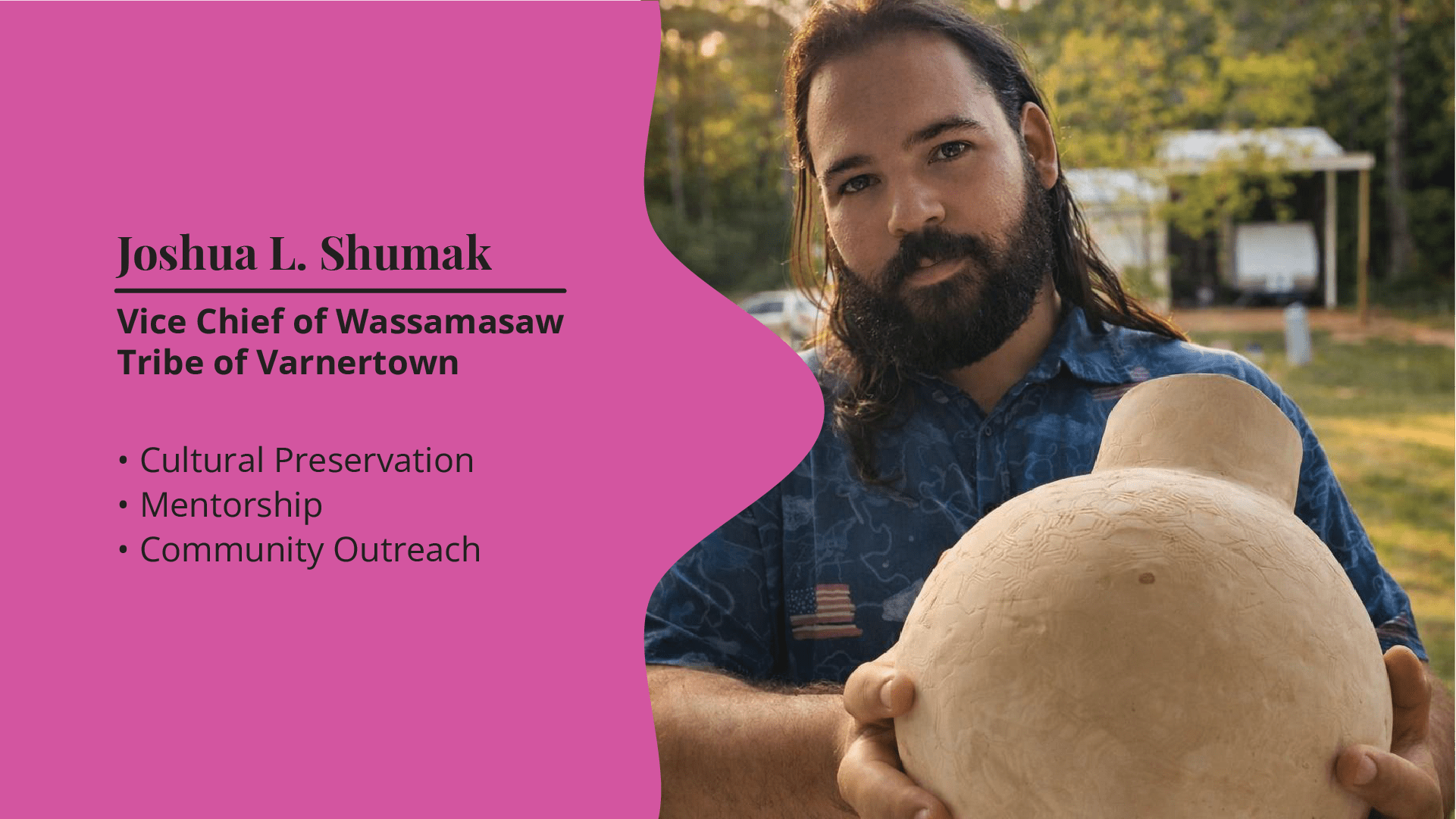
Hello, my name is Ryleigh Kelley, and today we are talking with Joshua Shumak, a professional creative working from and within South Carolina. As we get started, can you tell us your current career and where you’re from?
00:23 Joshua Shumak
I serve as the tribal liaison for the State Commission for Community Advancement and Engagement, as well as the Assistant Chief for the Wasamasaw Tribe of Barnertown Indians.
I am from Monk’s Corner, South Carolina, moved to North Charleston, South Carolina, and ever since I took on my state role, I’ve been in Columbia working statewide.
00:46 Ryleigh Kelley
Before we get into the details of your profession and what you do, we have this brief little section of the interview called “One Career, Sixty Seconds”, where you describe your job in sixty seconds or less, similar to an elevator pitch.
01:03 Joshua Shumak
Understood.
01:04 Ryleigh Kelley
So, let me get my timer started. Alright, are you ready?
01:16 Joshua Shumak
Yeah, yeah, we’ll see. Maybe I’ll have less than sixty seconds, maybe more. We’ll see.
01:21 Ryleigh Kelley
Alright, great. Okay, let’s begin. You’re on the clock.
01:25 Joshua Shumak
I’m Joshua Shumak, and I’m a Native American leader and cultural preservationist from South Carolina. I serve the Assistant Chief with the Wasmassaw Tribe of Warner Town Indians.
And for a little bit over the past decade, my work is centered around Native American affairs, where I focus on advancing tribal communities through policy, partnerships, and programming across the state.
My work mainly centers on historic and cultural preservation, food sovereignty, expanding opportunities for Native American artists and small businesses across the state. I’ve led some initiatives ranging from statewide cultural programming, film festivals, agricultural and community development projects that directly support tribal citizens.
And really, at the core of everything I do, I do it with a commitment to preserving our state’s Native American history and culture, and ensuring that Native American communities are represented, not just for our presence in the past, but as peoples who actively shape the future of the state.
02:21 Ryleigh Kelley
Oh, perfect! You had three seconds left. That was really good. Thanks for playing!
In your profession, is there anything South Carolina, or in your region, or in the city in particular, brings to your work? Does it have a unique influence on you compared to people in the same profession in different states?
02:45 Joshua Shumak
When we’re talking about Native American affairs, I think it’s really different state to state. I’ve worked in South Carolina for this past decade, but I’ve also talked with some of my correspondence and equivalents in Georgia, North Carolina, Minnesota, and even when I spoke at the UN, I got a lot of different worldviews and perspectives.
Each state has its own history, and that history and how it’s worked with its Native people shape where their Native people are today. There are some states where there’s a lot more opportunity, and there are some states where there’s a lot less opportunity. My job has been trying to find out where those opportunities have been in other states, and seeing if I can bring them into our states. Working with our Native American business owners, our Native American artists, seeing if I can put them into some more mainstream art shows.
I’ve worked with the Columbia Museum of the Arts. We’ve been doing our Native American Art Marketplace during Soda City for the past four years now. I know that the Native American Studies Center at USC Lancaster has also been a big supporter and are even doing their quarterly art shows now, along with their monthly programming. And there’s just so many different partnerships that are getting built out across the state. And so, even though we started in 2005, with statewide Native American programming and positioning, I think that we are slowly coming along.
04:08 Ryleigh Kelley
You mentioned that you spoke at the UN, is that correct?
04:11 Joshua Shumak
That’s correct.
04:12 Ryleigh Kelley
Could you talk a little bit more about that experience?
04:15 Joshua Shumak
That was the first time I had been to Geneva, Switzerland. It was a very interesting experience. The food is very different. I love the public transportation. You can just go anywhere by their little train system.
It was my first time speaking at that body. I think I was the first representative or tribal delegate from South Carolina to approach that specifically for the expert mechanism on the rights of Indigenous people.
The UN Voluntary Fund brought me up to represent South Carolina in that conversation; basically talking about what are the things that we’ve gone through, what are the things we are looking at, those to connect with some of our peers, both in the United States and the Indigenous population across the globe.
05:01 Ryleigh Kelley
Very cool, very cool.
You were talking about the UN and these really interesting experiences, but was there a defining moment in your life which had an impact on your creative journey?
And was there any particular project or something you produced which showcased your creativity in a way that it never had before?
05:25 Joshua Shumak
Well, coming from a Native community, I feel like I’ve been ingrained in the arts and culture since a very young age. I know that since 2005, I’ve been going to our local my tribe-specific culture classes, which are usually monthly culture classes where we do pottery, basket weaving, and beadwork.
I’ve been very blessed to have taken some apprenticeships through our cultural preservationist, Tammy Leach, who is a Jean Laney Harris Folk Heritage Award winner, who herself learned some of her artistic skills from Will Goins, who was another Gene Laney Harris Folk Heritage Award winner.
And having been able to work since 2005 to present day, and now actively working in our community, I think one of the things that is the best that I have seen come out is some of the programming is what we’ve been able to do with our own youth.
For example, we just started our own master apprenticeship program based on the one I was able to take through the South Carolina Art Commission with Tammy, and now I believe we have about fifteen different apprentices being trained by five different masters, all from different tribes, to bring in some of that culture.
Something about Native American communities is that, especially on the East Coast, our culture was very targeted and erased due to the Code of Indian offenses, which was a code that existed that basically, illegalized a lot of our ceremonies, a lot of our arts, a lot of our practices.
It’s only now recently, within the past twenty to thirty years, we’ve been actively allowed and actively pursuing these practices publicly that had been stripped from us. And so that, all these tribal artists and culture bearers coming together, being able to bring them together, work together with them to re-inject that in our tribe and recultivate that in our youth is something that I think I’ve seen that is very important to my community.
07:15 Ryleigh Kelley
With this kind of tension that you’ve outlined, especially growing up in Native American community, being ingrained in the arts from such a young age, but also there is that external, cultural erasure slash pressure. Before entering your field, did you have any fears about becoming a creative professional? And if you did, what inspired you to continue beyond them?
I know you’ve kind of discussed that throughout the interview, but, what really inspired you to just work beyond those barriers and try to push against those?
07:54 Joshua Shumak
I think that your question raises a few good points. I think almost it’s the wrong question, only because from my perspective, coming from a twentieth century child, twenty-first century, I think we are going through life not understanding our history. For me, I really didn’t start understanding the importance of the history of my community or these cultural practices, even though I grew up ingrained in it, until I was about fifteen to my early years in college.
When I started to get exposed more to other people, other communities, I started to really appreciate and realize the importance of my own community. And I think for me. The kind of the erasure of community that you see going along throughout the nation, just as urbanization comes with the rise of the internet. Some of the things that are fraying community bonds all across the nation, not just the Native communities.
It really helped inspire me. That it was so important to make sure that we were able to keep culture alive, keep practices alive, document it, and try to especially capture and inspire tribal youth. I think that having that cultural identity also can bring a lot of pride and be an anchor in a world that can blow you away.
09:15 Ryleigh Kelley
You’re talking about talking to tribal youth and bringing awareness to what you do. With that being said, do you have any advice for young adults or students who have an interest in pursuing a similar career in the creative world? Are there any particular skills one should practice or have before entering this industry?
09:40 Joshua Shumak
I think that we all take ourselves very seriously as people. I have that issue sometimes. I think once you learn it’s okay to make mistakes, it’s okay to be silly, and it’s okay to learn, because I think a lot of things that stops people from getting involved in creativity, or even things that they don’t fully understand, is that discomfort that, “Will I be laughed at, will I pick it up?”
You will make mistakes, and it’s okay to make mistakes. I think that’s why it’s so good to have mentors within whatever field you’re trying to go into, and to be able to laugh at yourself.
It’s kind of the same thing when you go into public speaking. You have to know how to have fun with it. Otherwise, you’re just going to tremble and just sit there in that discomfort. I think it’s all about a mindset that you have to be okay with. Okay with learning something new, knowing that there are going to be bumps along the way.
10:33 Ryleigh Kelley
I resonate with that, because it can be easy to take yourself seriously, but I like that piece of advice to have fun with it, and whatnot. So that was the last of my questions. Is there anything particular that you would like to speak on, before we wrap up?
10:44 Joshua Shumak
I am bad at speaking about myself, but I’m really good at answering questions. So ask away anything that may have piqued your interest that you might want to know a little bit more about.
11:07 Ryleigh Kelley
I would love to hear about how you mentioned that you didn’t get really into learning more about your community until you were a teenager. Could you maybe talk about that experience a little bit more?
11:21 Joshua Shumak
Well, for me, up until I started to actually get truly engaged with my community.
It almost seemed like a little bit of a chore when you’re a kid, and you’re like, “Oh, why is history important? Why is this important? I want to go play video games; I want to go and do this fun thing over here.” I think it’s that aspect of not knowing what you’re sitting on.
It’s kind of like whenever someone in your family dies, or your grandparent dies, and you’re like, “I should have been closer to this person,” and then you hear all the stories about them after the fact.
And I feel like it’s kind of like that mindset where you suddenly have that shift, and you see what’s important, especially in your community and your context. And I think that shift happened to me, like I said, end of high school, early college for myself.
After that, I was very much involved in my community, working with tribal government, working with the cultural preservation team, bringing in cultural programming and other programming for my tribe, and some collaborations with other tribes around the state.
12:24 Ryleigh Kelley
Very cool. One common thread I’ve seen, or I’ve noticed, as you’re talking about is the kind of intention that you have behind your creative practice is mindset. And I feel like, especially right now, there’s all these different pressures and external forces. Especially as young adults, it can be easy to get swept up in that. When a young creative is kind of, like, trying to navigate all those spaces and craft their mindset.
I know you briefly talked about this a little bit, what are some pointers or just gentle reminders that young adults and young creatives should remember when they’re crafting that mindset, amidst all these different potential distractions and whatnot.
13:24 Joshua Shumak
I think you have to find joy in what you’re doing. I worked in beadwork with seed beads and master beadwork. I’ve also now started working more seriously in pottery. I find both of them very fun. I think sometimes, for me, some of the hardest things were actually doing hands-on art.
13:46 Ryleigh Kelley
Yes.
13:47 Joshua Shumak
Psyching myself up to get started, because I know it’s a long process, and once I get started, I’m good. Then it’s psyching myself up from there.
I think it’s a lot about community, too. Like, do you know somebody that you’re willing to go up to and say, “Hey, are you willing to teach me this? Is that available to you? Does your city have an art guild if your community isn’t as involved in it?”
I think a big part about Native American art that I feel is that it’s very stereotyped still. In that regard, where it comes from. It’s very hard for emerging Native artists who are practicing folk art specifically to be able to put their art in places contemporarily. Because you see these museums sometimes that — let’s bring up Catawba pottery, for example. That is a very strong folk art. It has a very unique, distinct style to it.
And you see sometimes, a museum or an art museum may say, “We have this piece from 1924, why do I need to invest in this kid’s piece from 2026?” And so you see that that does not happen as much.
And I think just the fact that folk art is less celebrated across the United States right now means that a lot of these grants that museums have don’t really apply to that category, so sometimes it’s hard to get that breakout for Native artists who specifically are using folk art.
I was even talking with South Arts and different programming that could be involved in potentially making funds specifically for African American community, the Native American community’s art acquisition in museums, which I think would be very, very needed. But I think sometimes they can be discouraging, so I think sometimes trying to find these opportunities is very hard for young Native creatives.
15:45 Ryleigh Kelley
Like you said, that’s kind of hard to find these opportunities for Native creatives. Do digital platforms like social media, the rise of all these technological advancements, do you feel that it might complement young Native artists, or does it complicate their efforts, especially as they’re trying to find more opportunities?
16:15 Joshua Shumak
I feel like it is adjacent. I wouldn’t say it complements, but I would say it’s adjacent. I feel like it is a way to get them out there to people who do value folk art and the art that is being created, but I do think there is still sometimes that issue when it comes to Native Americans breaking into the contemporary greater art field. It’s very exclusive for Native art for a long time. Because the art sells, don’t get me wrong, but sometimes it’s hard for a young Native creative to be celebrated outside of the niche Native American or folk art-specific community.
17:00 Ryleigh Kelley
You said you talk about poetry, let’s discuss! Feel free to add it, whatever it is about that. Yeah, I can’t believe we missed that.
17:11 Joshua Shumak
Well, one of the things that I think I was very blessed to have been able to go through is the Berkeley County arts program. I started out getting into the lottery to be able to go to Howe Hall Ames Elementary School for the Arts. Then I went to Marrington Middle their art program, and then I was able to go into the Goose Creek High School art program, where I really started to go into the creative writing field, specifically poetry, and I’ve been able to publish quite a few poems since my high school years.
And a lot of it goes around some of that theme of identity, culture, and even into that, what Native communities today are facing, which includes a lot of land loss, cultural loss, trying to reclaim culture and some of the struggles and victories that we face every day.
18:04 Ryleigh Kelley
Is there any particular style or creative style of poetry that you like?
18:11 Joshua Shumak
I usually do free verse spoken word, only because my creative writing teacher really hated rhyming poetry. He wanted us to do very different things, sometimes avant-garde poetry, which is all about doing unique poetry writing styles. Sometimes you basically speak around a poem instead of saying the poem. Sometimes it’s the words that are missing in the poem. Things along that line.
18:40 Ryleigh Kelley
I love to hear that. Very cool to hear about your background in that as well. You have a creative writing component and a hands-on craft component. I’m curious on how all of those flow together in your creative process. Is there one that you feel really speaks to you more? Do they all have some sort of personal component?
I do digital work as well as creative work, and those are all in different conversations with each other. I’m curious for you, how do those kinds of mediums of art and your creative practice talk to each other?
19:31 Joshua Shumak
Of course, poetry, I think, is the only one that actually talks.
I think that that one is one that you can go into a lot more different directions with what you are actually saying. I feel like that almost goes hand-in-hand with beadwork. I know that that usually in itself, is like painting a picture, but without words. What am I trying to express?
Some of the beadwork I’ve done has been more nature-based. It has more symbolism, especially when you’re talking about making regalia, or sometimes the tribal symbols, putting that together, what that means to the community or myself. And I feel like it’s almost the opposite with pottery. I feel like pottery is almost more of a resilient, defying art form.
One of the things I try to incorporate in my pottery is in my slip, which is what we use to bind the different coils of clay together for hand building, I try to include some soil from either the Charleston Peninsula or Edisto Beach State Park, which is our first contact location. And that way, in each of my pieces that I’m creating, there’s a little bit of our history in it.
We are basically using the Earth, putting back into the Earth, creating things from nothing. I almost feel like art in itself is just such a big gift. From the creator to be able to create things ourselves.
21:01 Ryleigh Kelley
I really love to hear how, especially with pottery and the bead making. I love to hear about resilience. I think it’s interesting through something like that it speaks to that, whereas poetry maybe could be more literal, and like, “I’m literally telling you what it is.”
21:30 Joshua Shumak
I would even say that through poetry and beadwork, those two pieces of art, saying something and painting a picture. I would say pottery is the opposite. Pottery, it tells you what it wants to be and it tells you what it doesn’t want to be.
21:47 Ryleigh Kelley
Yeah. Alright, well, I love how we went on that little tangent. Thank you for sharing about your poetry background as well. I really appreciate that.
Thank you so much for taking the time to speak with us today. I really appreciate it.
22:03 Joshua Shumak
Will do. Thank you very much. Hope you have a good rest of your day.