
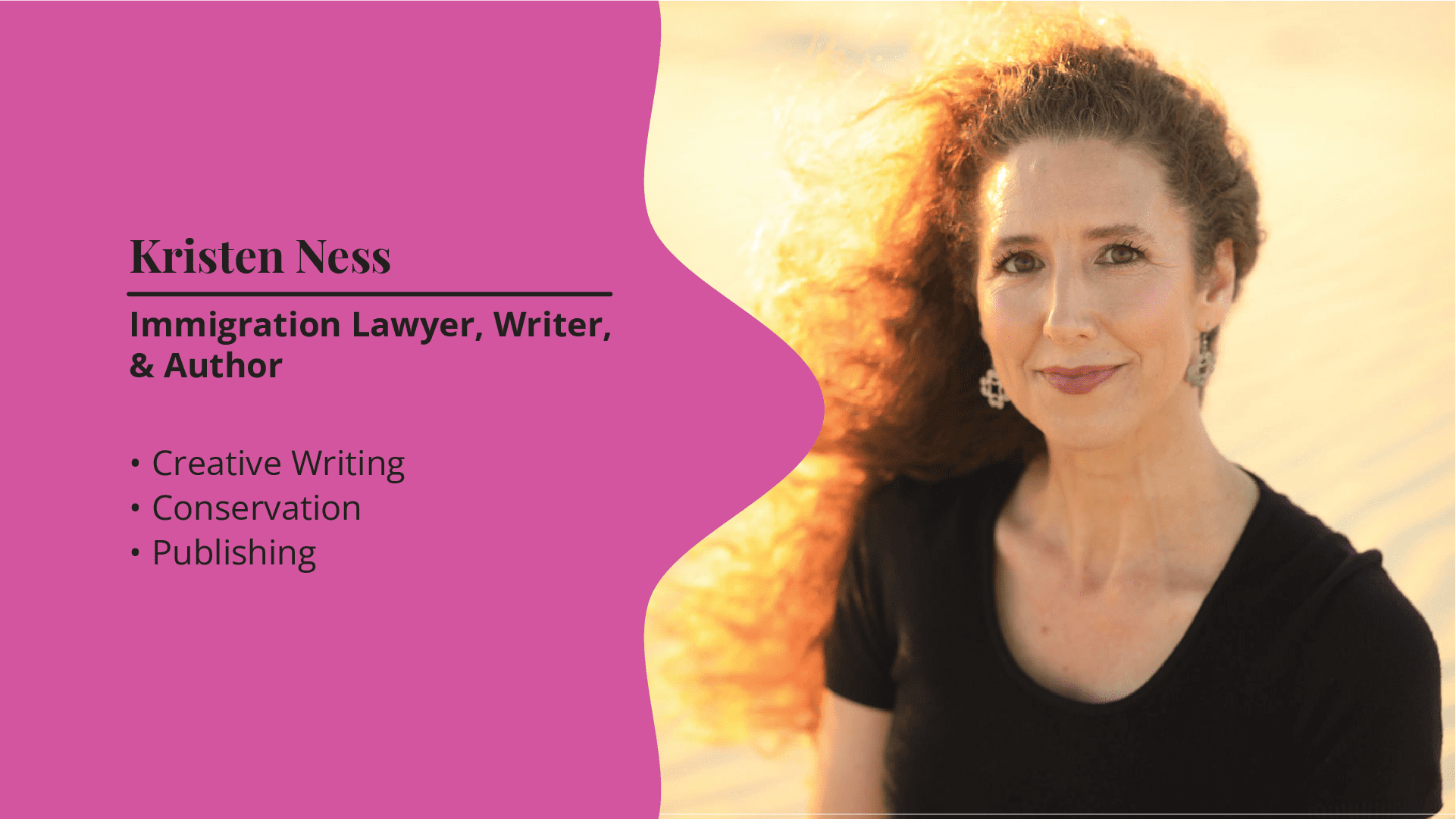
Interview
Transcript
00:00 Victoria Bartolotto
OK, so to start, can you just introduce yourself, spell out your name and tell us where you’re from?
00:06 Kristen Ness
Yes. My name is Kristen Ness, and that’s spelled. And I grew up mostly in Columbia, SC.
00:17 Victoria Bartolotto
So, what do you do for work and where are you currently working from?
00:22 Kristen Ness
I am currently living in Charleston, SC, right near the coast., And I am an author, so I write novels and my first debut novel was published in 2023. It’s called At Loggerheads. I mostly work from home, although because I’m a writer and my lifestyle, I can kind of write anywhere, even if there’s white noise in the background. So sometimes I’ll pop around to bookstores or coffee shops. There’s so many great spots in Charleston, or even out by the beach.
00:52 Victoria Bartolotto
Do you have a favorite spot to go or…?
00:55 Kristen Ness
A couple of my favorite coffee shops. I like Kudu Coffee right downtown on Vanderhorst St. and Starbucks. Pretty much any Starbucks. I’ll go to those as well and book stores. There’s a new bookstore called The Archive that just opened up. I like to sit in there. They have a little coffee spot, like a little coffee bar and wine for later in the evening inside their bookstore. I’ve only been there once, but I’m planning to spend more time there and then so many great bookstores around town that I’ll occasionally pop into, but those are a few favorite.
01:30 Victoria Bartolotto
That’s awesome. So being from South Carolina, I did a little bit of research on your book. I’m a big reader myself, and I’m also a writer. So like when I was looking your stuff up, I’m like this looks so interesting. I love murder mystery novels. And so one of my questions is, what does South Carolina bring to your work? What about it is unique and influences you compared to anywhere else, any other kind of place?
01:56 Kristen Ness
Oh, that’s a good question. OK, so why set my novel in South Carolina? Well, first of all, I grew up here, so I grew up coming down to the coast right here near Charleston, to Isle of Palms.
What’s unique, I think about our coastline is the way the barrier islands are set apart from the mainland, so those islands become sort of small towns of their own. And I know that happens in other places, but there’s something about our beaches in particular, the way the marshes are in between the mainland and the barrier island.
I think there’s something unique about the people in South Carolina. We tend to be friendlier and kind of create little microcosms of bigger cities in our smaller towns, so you have just a big mix of people and everybody kind of knows what’s going on in everybody’s business. I like that about small South Carolina towns.
That beach in particular became a big inspiration from my book. I did fictionalize the barrier island in my story only because I wanted to be able to control everything that was happening in the setting, but it is loosely based on Isle of Palms.
Another big reason why this state in particular worked for my story is the loggerhead sea turtle. So I’m on the Island Turtle Team on Isle of Palms and Sullivans Island and I’ve been doing that for about a decade; a little more than a decade since I moved down here and loggerhead sea turtles are the most common species of sea turtles that nest on our beaches. And I needed a setting where that was going to be the case. And the loggerhead sea turtle is also the South Carolina state reptile.
So, so many things, you know, made it work as the best setting for my story. Everything from the small town feel to the way the barrier island ecosystem works to the way that development is happening on those barrier islands that plays into my story a little bit and I’ve seen a lot of the changes take place on some of the barrier islands here on our coast.
So, that gave me a great background in what the setting would be like over time and why my main character, Brooke, would be so connected to it both through the sea turtles and because she grew up there.
04:14 Victoria Bartolotto
Wow, that that seems it just fit perfectly and that’s — that’s great. Oh my goodness. So could you define a moment in your creative journey that really had an impact on why you became an author, why you wrote At Loggerheads? Was there anything that kind of struck you as: “this is the time I need to write this novel”?
04:37 Kristen Ness
Yes, that’s a great question. I’ve first of all, I’ve always, I think I am a writer at heart. From the start, I’ve always, even when I was little loved to write, I would keep journals from the time I was probably in first grade. So I went on to try to turn all of my papers in other classes into creative papers. Any chance I got, I would go to my teachers or professors and just say ‘instead of writing this boring, like research paper, can I just turn it into a creative version, like fictionalize it and make that my final paper?’ and some of my professors would humor me, but there was always that lean toward fiction that lean toward making it into a creative writing piece, and I majored in English.
I would say what eventually kind of kicked me into gear to write my first novel was about the time when I was practicing law, so I went to law school out of college and I’m a lawyer and I was with a big firm in Charlotte and I was practicing immigration law, which is what I still do a little bit on my own. I have my own firm now, but I was with this big firm and I was thinking in my office. I had all of these favorite quotations from different writers and I would still, I would still be doing a little bit of research, like ‘what would I want to write about?’ and even while I was in my office doing law work – shhh, don’t put that in the story – but I was supposed to be doing my work, but anyway it was clear that I was wanting to do more creative writing. I needed a creative outlet.
About that time I’ve been practicing law in big firms for about 7 years and I had decide as much as I enjoyed that practice, I didn’t want to do it that way. I didn’t want to be a partner at a big law firm, so I needed to get off that partner track and so. You know, I did something that most associates at big law firms never do, and I just resigned. I just decided; “you know what? I want to start a family. We’re in Charlotte and this now is the time. If I keep going and stay on this track, I’m going to end up being a partner at a big law firm and I’m never going to have time to write my novel, and I really want to give it a shot.” So I left the big law firm world.
I thought probably at some point I’ll start my own little firm, but I wasn’t doing it yet and about a month after I left, I got pregnant with my daughter, so we started our family! So I was pregnant, and I figured now’s the time. I haven’t started my new firm yet. I have a lot of free time. I need to find that idea for a novel. I wanted it to involve something on the coast. I knew I wanted it to be connected back to the sea. I always loved marine biology as a young child and growing up too, so I thought that’d be a great way to marry my love for writing with my love for marine biology.
And the reason that was such a perfect time is because not only did I have more time to get started on the idea, but I happened to be down at the beach with my mom, pretty soon after. So that summer, after I had left my law firm job and I saw a sea turtle track for the first time in real life. And so, it planted the seed of an idea. I was kicking around like ‘which creature would I wanna write about? Which genre am I gonna be in?’ I really like reading mysteries and thrillers and suspense. So probably that.
We saw this track on the beach and it was at Isle of Palms and I just the seed of an idea came to me like ‘what might be going on if there was a track, a turtle track on the beach?’ And when you read my book, you learn about it. Normally there’s a track going on from the water to the dunes. She makes a nest and then she leaves a track going back to the water. And I thought, well, ‘what would be going on?’ Maybe if you just saw one track from the water up to the dunes. But then there was no nest, no turtle, and no track going back into the water.
That idea just popped into my head. What would be going on the island if that sort of thing was happening and that’s where I got the seed of the idea. And at the same time, because I had a little bit more time, I was taking an evening creative writing course at Queens University in Charlotte and just getting the tools to put together a novel, since I don’t have any actual degree in creative writing, I just wanted some guidance on that.
And so, all of those things came together, and I started putting together my outline for what became At Loggerheads and sat down and started writing it from page one on my computer. Now, that was the moment I started it. Remember I was pregnant with my daughter and she’s now 17 years old.
So, it took, off and on. You know, I started a law firm. We moved to Charleston. I had my son. So, we had a second child, and I was just using any creative time I could find to work on my story. It just became this passion project while I was doing a little more immigration work and raising our kids and enjoying being here at the beach and joining the turtle team and gaining some more insight so I could put that in my book.
I’d say off and on. It took me about 10 years to write the first draft. If you condense down all the time I spent on it, it was probably more like a year of full-time writing. But I was just getting a couple hours here and there each day, or maybe even not even every day. And so, it took me just that long to do the full first draft.
And I was editing as I went and then I edited it a lot before. Then I went and found an agent. That took a little time to work with that agent and then got the published and going. So, overtime it took me a long time to get from Page One to publication, but now that I’ve kind of been through all of that and I’ve done it once, I’m working on my next book and it’s going much faster. So I think I’ll have it finished within-I’ve probably been working on it for about a year and I’ll have a manuscript, I think finished by probably the end of summer, early fall and hopefully get that out from my agent to a publisher pretty soon.
10:54 Victoria Bartolotto
Oh, that’s amazing. I understand the whole like trying to find time because I’m a writer myself. I’ve written a couple of books but just trying to make my way and even as a college student, I’m always trying to find a couple hours, wake up earlier just so I can get a couple words in just like spacing that time.
11:12 Kristen Ness
But so, you’re busy with classes and you have life, and things are going on and the writing. As much as you love doing it, it’s something that you have to really keep doing on your own until at some point maybe you have a publisher who has you under contract and then you have a deadline. But until you have that, it’s really up to you and your schedule can look. However it works best for you.
There’s no right way or wrong way to write. You just have to write. So anytime you can find if even if it’s just 15 minutes for a while. You know when I was working at that big firm, I was just doing sitting down at night and writing for 15 minutes and I called it my free write. And just whatever came out on the page that was creative at that time.
I would just write for 15 minutes, and a lot those little bits of writing ended up being in my book. I pulled from some of those little free writes I’ve done and used them for part of the story. So, you never know where it might be going, as long as you’re just– just don’t give up. Just keep working at it. Little by little, it might take you 10 years, but that’s, it’s OK.
12:18 Victoria Bartolotto
Speaking of how long a span you had to drop this novel, were there any kinds of fears or things that gave you a little bit of anxiety when you decided to pursue becoming an author? Was there any fear around querying, submitting to publishers? How did that kind of go for you?
12:38 Kristen Ness
That’s a good question. OK. So, I’d say some of my fears were, first of all, as you’re in the middle, I’m in the middle of this, you know, trying to write a novel. And I’ve never attempted writing a novel length piece of writing before. So, I had a lot of, I guess, trepidation or like uncertainty around like, “am I doing this right? Like is this making sense?” I had a little bit of an outline, but some people write with outlines and some people just fly by the seat of their pants and I was a little bit of both I guess I had plot points, but then from one plot point to the next, I wasn’t exactly sure how I was going to get there. So definitely a little bit of uncertainty about am I going to actually be able to pull this off? Is this going to come together and make any sense to anybody or are people going to read the first chapter and be like “I know who did it.”?
It’s like I’ve got to figure out how to make the mystery enough of a mystery, so they keep reading. Not having done that before, but of course, having read a lot, I’m a voracious reader. So I had read a lot of books, so I kind of knew what it should do. How it should look. So that kind of kept me going. Like I’m just gonna go for it. I just need to write it.
And then when it came to the agent search. Yeah, I was. There was a lot of –I had a lot of nerves around that because that to me, I really wanted to go the traditional publishing route. I figured if I couldn’t find a publisher who wanted to publish my book, I would just write another one. I just didn’t want to, I didn’t want to be in the business of publishing books. I didn’t want to have to go figure out how to do all of that. I just wanted to do the writing.
14:18 Victoria Bartolotto
Yeah, I get that.
14:19 Kristen Ness
I was planning to get the agent and then try to find a publisher and then try to find a publisher. I spent a lot of time editing it myself and trying to get it as in is the best shape it could be in for going to an agent. I really got lucky with the agent search. I was very nervous about it to start, but I think luck and timing were on my side, so I had heard from going, I also went to a lot of author events as I was getting into writing I would.
I’d love to go hear authors talk about their books and their process and how their publishing experience was. So I remembered one of the authors I’d seen had said when you’re looking for an agent, a great way to find one aside from just going into the general list of literary agents is to go to the bookstore and find books that are similar to yours in similar genres or books that you really liked, that you felt resonated with you because of the writing style, maybe, or because of how they put the book together. The structure of it, and then the authors always almost always without fail thank their agents in the back of the book, in the acknowledgements. So, find those books that are similar to yours, or that you really loved. And go look and see in the acknowledgements who the agent is and then query those agents.
And so, I, about that time it was probably 2019, middle of 2019, in the summer, a book that you might have heard of called where the Crawdad sing has become.
15:56 Victoria Bartolotto
Yes, I have.
15:57 Kristen Ness
Huge book, right? So Reese Witherspoon had picked it for her book club, and it had just taken off and I’d heard about it. I had seen it in the bookstores, and I was always like, I mean, an interesting title. What is this book about? And so a friend of mine told me you have to read it. You know, she knew how much I love nature and sea creatures and that I was writing this murder mystery set on a coastal beach and in the South Carolina setting.
So I went and read it, and it had so many things I loved. I loved her descriptions of nature. I loved her writing style. And also, the story itself had a murder mystery wrapped into a coming of age. Now mine’s not as much of ‘a coming of age’, but I had a murder mystery, and it was set on a in a coastal location. So, hers was North Carolina mine, South Carolina. A lot of nature and science woven into the story and I thought, “OK well, go big or go home.” I’m going to query him. You know? Why not?
So I looked him up in the back of her book, and then I looked him up online and found his agency. And every agent has a different way that they want to receive submissions from authors. So the way he wanted his submission was just a query letter. The one page query letter that you send by e-mail. So the query letter’s one page, it tells a little bit about why you think an agent will like your book, what your book is about, and then any credentials that you have in publishing. So obviously I had a lot of nervous energy around this thinking like, “OK, well, I’m just going to send it.” And I mean, I don’t know what I’m doing. This is I’m brand new to this. And either it’ll just go into his slush pile and I’ll never hear from him or maybe I’ll hear from him. I don’t know. I have this whole other list of agents.
And so just not really even knowing what I’m doing. I just sent him my query letter and went on about my day and went back to check my work e-mail and he had emailed me back 15 minutes later and I thought that my e-mail had been like, that’s how that’s how fast it was, and now that I know as so, yeah, I messed it up. So I opened his e-mail and it just said “You had me at turtles. Please send me your manuscript.” That’s all it said. That was his e-mail to me.
I screamed and jumped up and down sent him my manuscript and you know, called my mom, called my husband. I was like, “Oh my God. Like, I actually heard back from this agent.” And he read it in about a week and he got back to me and said, “you know, I’m interested in seeing where this is going. Let’s keep in touch and work on it a little bit. If you don’t hear back from any other agents.” I was like, “are you crazy? Like you’re my dream agent. I’m not going, not even looking for any other agents. I’m just working on making sure we can work together.”
So we kind of corresponded back and forth and he was reading my manuscript and giving me suggestions for edits and kind of seeing if he could get it to a point where he felt like it was saleable and by the time we got to that point, COVID 19 hit, and it was 2020 March and none of the publishers were accepting submissions and a lot of their authors, they were having to take off of tour. So we just held it for a while and didn’t submit it to publishers until maybe 20 late 2021, when COVID had settled down and the publishing houses were opening back up. And again, had some good luck there.
We submitted to maybe 7 or 8 different publishers at all ranges to some of the big houses, mid-size houses, small publishers and landed with the small press where the editor had been a volunteer on a sea turtle team up in Pawleys Island. The turtle team, so she knew, she really liked the whole sea turtle piece of it and how that wrapped into the story. And she bought my book and put me under contract. And then I worked with them and we put it out. I think it was. Oh, yeah.
So we my publication day, publication days are always on Tuesdays. In case you didn’t notice that new books are coming, are always released on Tuesday, and so the Tuesday in May that we chose in 2023 happened to be world seat World Turtle Day. So, it was May 23rd, 2023. It was World Turtle Day. It was a Tuesday, and that was my launch day.
So I definitely had some from there to get back to the original question, there was a lot of nervous energy and uncertainty in the whole process of writing along the way and that’s why I say just keep going. Don’t give up, even if this is your first time writing a novel, even if you’re not sure where it’s going, get that first full draft finished. Edit it. Make it as good as you can and then with the agent process, I was very nervous about that and really just kind of blind luck I ended up with an agent; who one of the reasons why he wrote back to me so quickly is because it just happened that the second thing he really loves in addition to being a literary agent. First is he loves conservation and nature and science, and he actually represents a lot of authors who write nonfiction, science related books, as well as fiction that has science in it.
So it just turned out that the book that I was writing happened to be right in his wheelhouse. And that that agent searched was much shorter than pretty much anybody I’ve heard of. So that was a lot like I said, just a lot of luck and good timing. Had Crawdads not been out and so big at that time, I don’t think I ever would have found him. So it was just all it all, I guess was kind of meant to be from my book.
21:46 Victoria Bartolotto
That’s so amazing. That’s cause I-I’ve done a little bit of querying for one of the books I wrote and it needed to be worked on a little bit more, let’s just say. It’s always been such an anxiety inducing thing for me because I’m like, ‘oh gosh, what if they don’t respond? What if, like, this happens? What if that happens?’ It’s, you know, a lot.
22:07 Kristen Ness
And that is way more than normal. That is definitely more of the normal response. In fact, I’ve heard since I’ve been going around doing stuff with my book, I’ve been on panels with other authors and the general average number of queries that people sent out to agents. I mean, we’re in the hundreds, like sometimes people would query 50 agents, 100 agent before they found that one that worked for them and then ended up going on to have a really big book. I think that Shelby Van Pelt, who gave me my cover blurb. She’s the one who wrote Remarkably Bright Creatures about the octopus. I don’t know if you’ve read her book yet, but…
22:48 Victoria Bartolotto
I’ve heard of it, yeah.
22:48 Kristen Ness
It became a big hit, too, when it was it was picked by Jenna for Jenna’s book club, and it’s an awesome book, but she had a long agent search, so she had gone through, I mean I think probably at least 50, maybe even 100 agent queries before she found the agent who wanted to represent her book, and they ended up landing with an imprint of, oh, I don’t want to mess up the house. I think it’s Harper Collins. But it was Echo Publishing, and they didn’t think, they didn’t know it was going to be such a big book, but again, just a lot of just sticking with it. Sometimes you’re going to get crickets. You’re not going to hear anything back from an agent, and that’s a really common thing that happens sometimes. You’ll just get a couple requests for a partial manuscript or requests for a full manuscript. Even then, they might read it and say it’s not quite a good fit for me.
And I experienced a lot of that when we were going through the publishing process, trying to find a publisher. Even though I had an agent, we were submitting my book to publishing houses, and sometimes they would take a really long time to get back to us. Sometimes we would get responses that were just like this doesn’t fit with our list or you know, we like the idea, the concept of it, but it’s just not for us. So you have to just keep going. You have to have a thick skin. And believe in your work.
I also have heard a lot of authors who have that, that book or several books in a drawer, that those were kind of their practice novels. And those were the ones they’ve written, but they just for whatever reason didn’t find a home with an agent or with the publishing house. And maybe at some point they’ll bring them back out and work on them and they’ll get published. But that’s also a really common thing that I hear and had my book not found a home. I think I would have done the same thing, just chalked it up to this was my this was my training and I’m gonna keep going on and working on my next one.
24:46 Victoria Bartolotto
Yeah, that’s great. Oh, my goodness. As we wrap up, I know we’ve kind of talked a little bit about not giving up and a little bit of advice, but if you do, do you have any advice or skills that you think would be important to have for current college students or pre-professional young adults who want to pursue possibly being author, is anything that you think they definitely should hit before they start their process? Do you have any advice for something like that?
25:12 Kristen Ness
That’s a good question. So if. Yes, and again, novelists can come from any kind of background. You don’t have to have a degree in English or creative writing to be a great writer. If you do have the chance to take some coursework, I think it would be really helpful to take a creative writing course because you will learn some of the tools of the trade of how to structure a novel. I see a lot of novelists who often came from a journalism background, so maybe if you have those types of courses available to you, it helps you.
As you’re researching a novel and putting a story together to learn those who, what, when, where, why, how to investigate your story, how to develop your characters. You know, a lot of characters come from real life. So, learning to pull stories out of what you see and observe around you, those would be the types of classes I would look to take.
In general, if you’re developing your skills as a writer, some of the things that I did that I found to be very helpful were, of course, reading, read, read the authors that you truly enjoy. You enjoy their writing style, or you enjoy their plots. Pay attention, go to those books as a writer instead of a reader, and try to read the book as if you’re taking it apart and paying attention to how did they put in so much background information about this character without slowing down the plot? So go to your favorite books and read them as a writer. That was really helpful to me as I was developing my skills. Go hear authors speak, go to author events and ask questions and find out from them what their process is like. Very much like you’re doing with me. You get little tips and insights that might work for you later.
Sit down and if even if you don’t have a story that you’re working on, or a or a novel or a plot in mind that you want to write, go to the page as often as you can and just write something. Like I was doing a lot of free writing that turned out to be a great way to exercise those writing muscles, and I just would spend, like I said, about 15 minutes a day. Usually at night when I had a little bit of downtime between dinner and whatever I was doing later. Just sat down and wrote for fifteen minutes. It could be what I did that day. It could be something I observed that I thought was interesting. It could just be a completely made-up paragraph about something. I found that to be very helpful too.
And then I’d say after college, if you’re really wanting to go, if coming out of school that what you want to do is become a novelist. Another thing I’ve heard a lot of people do that helps launch you into the industry a little bit is to get a master’s in fine arts. So an MFA degree, or if you if you’re still working on your bachelors, you can get a bachelor’s in fine arts or a bachelor’s degree in creative writing. A lot of times having that tool, the masters in particular. If you go into a master’s program, I didn’t do this myself, but I know that a lot of authors I’ve been on panels with and heard talk have come through a master’s program.
It provides you with a great networking opportunity where you get to meet not only professors who might also be published authors, but sometimes they’ll have agents come or publishing houses come to the master’s program and you might get a chance to connect with one of those and also a lot of times in the masters programs you’re working on, you’re working on a book while you’re in the program and you’re getting immediate feedback from both your peers and from your professors.
So that’s also something to consider if you know going in, coming out of college or even while you’re in college, that you definitely want to see, you want to try to become a novelist and just keep writing. Go to your favorite books and see which kinds of course work, and possibly degree programs might be available to you and go just go for it.
29:08 Victoria Bartolotto
Thank you so much for taking the time to talk with me today. I really appreciated it.
29:11 Kristen Ness
Welcome, it was such a pleasure. Thanks for reaching out to me. I really, I was so pleasantly surprised to get your message and always happy to help pass along what little advice I have one book in, you know, it’s fun to be able to be to have a little bit of experience under my belt. So, I can tell people about it.
29:32 Victoria Bartolotto
Would you before we end the call, would you be open to talking with our team again if we have questions or if we want to contact you for more interviews or things like that, would you be open to that?
29:44 Kristen Ness
Absolutely. Happy to do that. Feel free to reach out to me. You have my e-mail address and my phone number. Yes. Follow up with any questions or anything you’d like for me to do to be involved with. I love talking to people about writing and about my book. It’s just such a thrill. It seems really surreal to me still, so I love it, I’ve been talking to a lot of book clubs that reach out and have me come to their book club meetings. It’s just been so much fun. So I would love to be involved however I can be and talk to students and answer your questions whatever you need.
30:16 Victoria Bartolotto
OK. Thank you so much. I hope you have a great day.
30:18 Kristen Ness
Thanks, Victoria. It’s nice talking to you.
30:24 Victoria Bartolotto
It’s nice talking with you.