
Interview
Transcript
00:00 Victoria Bartolotto
To start, can you introduce yourself? Tell us where you’re from. Spell out your name. Just kind of, like a general overview, I guess.
00:09 Meg Reid
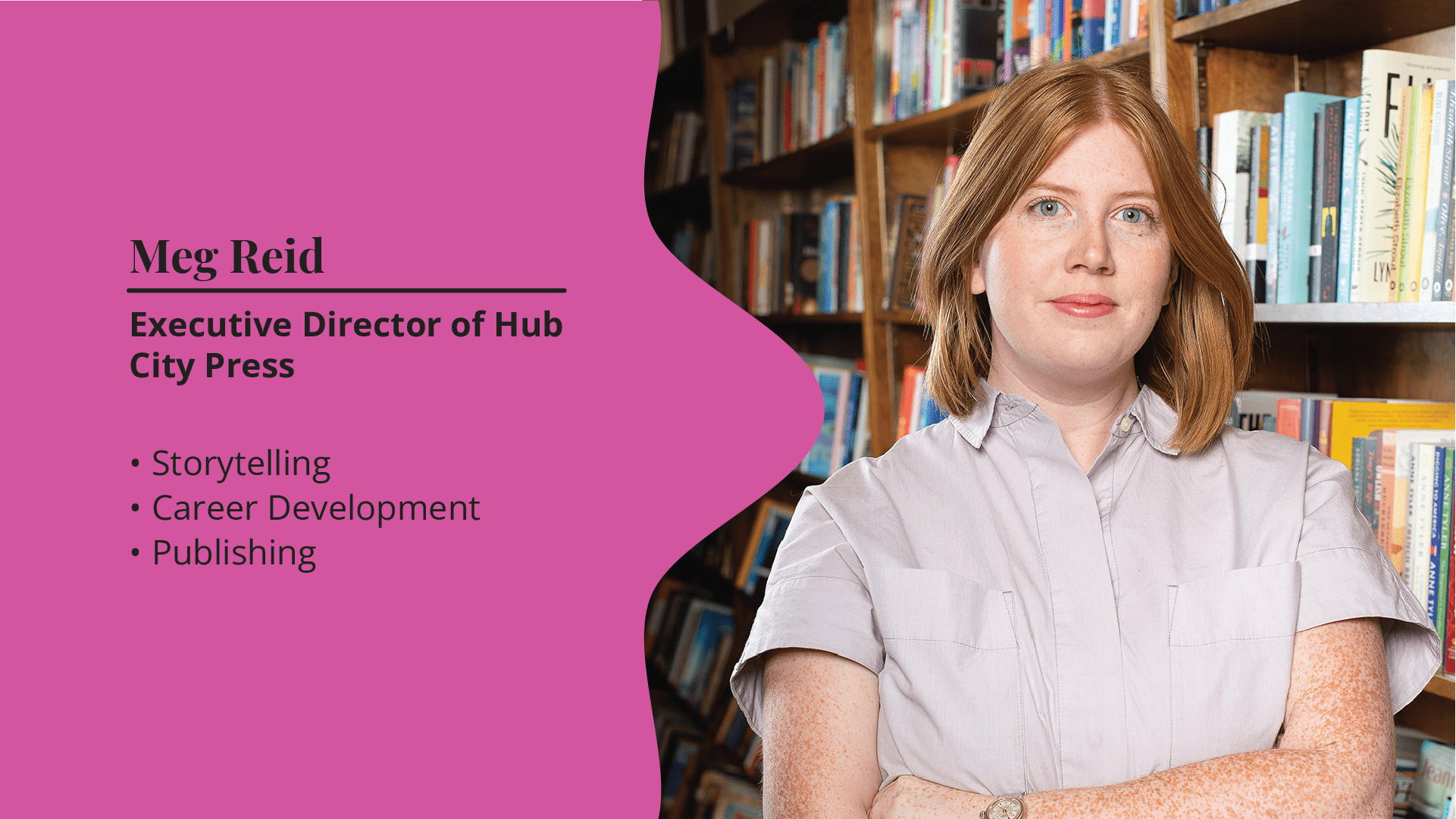
Sure! I’m Meg Reid and I am in Spartanburg, South Carolina and I am the executive director of the Hub City Writers Project and as well as the publisher of Hub City Press. I was born in Canada and raised in Maine. I went to school in North Carolina at University of Wilmington, in North Carolina, Wilmington, and then I moved to Spartanburg for a job at Hub City Press, and I’ve been here for the last 10 or 11 years.
00:38 Victoria Bartolotto
Oh wow. Per the Hub City press, overall, I was doing a little bit of research. It sounds like you guys have an amazing initiative. It’s an independent – indepe –, excuse me. It’s an independent publishing firm, isn’t it? Or is it more like traditional?
00:53 Meg Reid
It is — It’s a, we’re traditional publisher, but we’re a nonprofit literary prep. So, we’re a 501-C3 organization, and that means that we have a mission, and everything we do in the publishing relates to our mission.
01:08 Victoria Bartolotto
Could you describe the mission a little bit?
01:13 Meg Reid
Yeah! Our mission is publishing new and extraordinary writers from the American South, and we are the only publisher in the world, really, that only publishes southern writers, and we define that it, you know it, it’s a little bit loose, but usually from the D.C./Virginia area to Texas. We publish fiction, nonfiction and poetry, and books of regional interest, and this year is our 30th anniversary.
And though we published books about the American South, so we are like a regional press. We do so to a national audience and international audience. And our books are routinely in the New York Times and Wall Street Journal and places like that. And so, we’ve been in Spartanburg since 1995, and we’re still very embedded in this community. And then we do national work from Spartanburg.
02:06 Victoria Bartolotto
Oh, wow. Congratulations on 30 years!
02:09 Meg Reid
Thank you! It is, it’s quite the quite the achievement. So, we’re very excited. We’ve kind of been celebrating all year long. So…
02:18 Victoria Bartolotto
Awesome. Speaking of the South and South Carolina in particular, is there anything you think about either Spartanburg, or South Carolina as a state, that brings something unique to the table in publishing that other houses anywhere else don’t really have? Do you think there is anything special about South Carolina or Spartanburg?
02:38 Meg Reid
Yeah! I think that Hub City could only exist in Spartanburg. We are very much built from the people who started it and who have supported it. We have had hundreds of people in Spartanburg who have given money every year to support what we’re doing. So, we’ve been community-vested and community-grounded since we started, so you can’t separate our community from what we’re doing.
But also just I think that we’re big proponents at Hub City of something that we call, like “decentralizing publishing.” Most of publishing occurs in New York, in big cities, and specifically in New York. And it occurs, you know, with one of five big conglomerate companies. And so those big 5 companies have so many imprints underneath them. But they all funnel to five companies.
We think that our model is kind of like local foodways or other kinds of celebrations of local culture. It’s saying that we’re doing something that is different from the consolidated model. And we are doing something that’s really grounded in our place and where we’re from. And so, we really think that’s scalable and that if somebody wants to start, like they’re like, “oh, I want to start publishing books.” If it feels really daunting because it’s a really big system, it’s really good to think about: What does my community need? What does my town need? What can I celebrate here with the people around me? And starting from there and growing from that local community aspect. And so that’s what we’ve done and that’s a really integral to our identity as a press.
I think that we can do a lot of the stuff we do because we’re not in New York. We’re in South Carolina, and I think people don’t have as high expectations overall from a small city in South Carolina. So, it’s very fun, surprising people and reminding people that books and literary culture can exist anywhere, not just in one city.
04:42 Victoria Bartolotto
Yeah, I think that’s really important to think about, especially with like New York. And also, I think also in California like I know so many writers just come out of there and I’m actually an English student studying writing, studying how to write books and do poetry and things like that. So hearing that, oh, I have to be in New York, or I have to be in L.A. to publish. It is kind of daunting like you said.
05:06 Meg Reid
Yeah, well, we just want people to remember that they can. And the great thing about independent publishing is that there are independent publishers everywhere. There’s independent publishers in, you know, Minnesota and Texas and Kansas City, big ones, really good ones. So, it there is something about independent publishing that works, can kind of work anywhere. So, I think that once people find that out, it opens up the whole world for them. It’s not like publishing is just six buildings in New York City. It’s a lot broader than that. And it includes a lot more people.
05:42 Victoria Bartolotto
Throughout your own personal journey, becoming the executive director, was there anything that you think was a defining moment that made you want to go into publishing, made you want to get into this industry and kind of like, make your mark on it? Was there any kind of ‘something’ that propelled you into it?
06:00 Meg Reid
Yeah, I think I always had an interest in publishing, and I didn’t know how to go about it. The same problem. You know, I grew up in, as I said, Maine and I was kind of far from any publishing activities and so. But I did go; I went to UNCW for my MFA and they have a publishing laboratory program which is like a student-run press. I decided to take classes in the pub-lab because I had that interest. I’m a book designer as well and I learned how to do book design at UNCW and that was something I had never done. I have no artistic inclination. They had this book building class where you learn about how cover design works and how the insides of books work, and that it’s required to work for the publisher. You have to have a background and like how books are put together and that was really fascinating to me, and I found out I was really good at it, even though I cannot draw. I have no artistic ability. But putting type and photos together made sense for my brain, and that was really exciting and it was a skill that I didn’t know I had until I was in grad school. At Hub City, we’ve always tried to really make our books with a lot of care and we don’t do that many books. We do 8 to 10 books a year and we’ve kept that really small, so that we can keep producing them at the quality that we want to produce them. And I think that idea got set at that point and that’s how I decided to do things because I really wanted them always to make an impression of being objects of art and objects that the people who made them cared about them. It’s not just like we’re cranking out a million books; very opposite of Kindle and Ebook, you know, like high volume stuff, which is just a totally different model. But I think that that got set very early that we would, that I would do things in a different way that was more sustainable and more based on care and cultivation.
08:04 Victoria Bartolotto
I think that’s really important, and I really appreciate the work that you described because I know so many big publishers they’ll put out like a book and people will get copies in the mail and they’ll be damaged or they’ll be, you know, like printing was wrong. And I’ve heard so many stories, and I’ve experienced a few myself, so I really appreciate that you guys do that. When you were going through your education, when you were starting out, was there any kind of fear that you had when you first decided to pursue getting into the industry?
08:38 Meg Reid
I definitely didn’t know. So, I graduated from UNCW and I was working at a coffee shop and I didn’t know how I was going to stay in publishing and not go to New York. I wasn’t necessarily committed to staying in the South, but then this job at Hub City came up, and so that’s why it’s become really important for us to like as part of our mission, to remind people that they don’t need to feel like they need to leave, their home or their region or wherever to in order to do publishing that doesn’t exist only in one place. But I definitely was, because I knew that I just could not afford to move to New York and do the unpaid internship, at that point, it’s all unpaid. And so that was a little scary because it was kind of what I thought I wanted to do and now I know that there are a bunch of publishers nationwide, like I said, and I should have been kind of like looking more broadly.
Kate McMullen, who also went to UNCW, she works here, she’s the managing editor. She and I both whenever we talk to students or talked to any sort of education settings, we’re always trying to remind people like, you know, there could be a publisher in the city you grew up in and you might not know about it because they’re not Penguin Random House but they’re doing something, you know? So, I think that’s really become important to me, is reminding people to do that digging and see and not feel despondent that they have to go to New York or California.
10:10 Victoria Bartolotto
Yeah, popping off of that. Do you think that for students who want to get into publishing, who want to get into this kind of career, do you think there are any specific skills that they should have? Any kind of niche interests or something you think that they should explore before getting into publishing or that would help propel them into it?
10:30 Meg Reid
Well, I think you know the general interest in books, and reading obviously is really important. I don’t think you can do it without that. And so I think career writing and English students tend to kind of have that.
But I think publishing has a really the reverse way; I think publishing skills are also very applicable to other things. That’s why I always tell people if you’re going to do a program at well while you’re in school, publishing programs are really useful because even if you don’t end up going into publishing, it teaches you how to like, take large amounts of information and like, summarize them really quickly. Like, say, what is this book about in one sentence. Or say why somebody should read a book like be more persuasive and argumentative, in terms of being able to persuade people while you’re speaking. So those are skills that I definitely think are developed in publishing. And so, I think if you’re not interested in those skills, then I think that publishing wouldn’t be a great fit for you.
But I think really just an interest in books, and an interest in, everybody that I know that has really loved publishing, this is including the people that work here and that have worked here, have an interested in how things are made and how putting things together. Because books take eighteen months to put together and a bunch of people work on it from manuscript to final product.
If you’re looking for really like quick, instant gratification, it’s not that kind of job necessarily. It’s a very, very slow burn job. But if you like that feeling of assembling something with the team, I think those are, that’s really the skill that you need along with interest and love of books, in order to do well and succeed in publishing.
12:16 Victoria Bartolotto
Awesome. Thank you so much for taking the time to speak me today. As we wrap up, would you be open to talking with our team again? I can let you know when the interview is published on our website. There may be an opportunity for another conversation for a podcast that we have here with the Atheneum Press. Just kind of general stuff like that. Any updates.
12:36 Meg Reid
Absolutely. Yeah. I’d be happy too. And I’m really interested in what you guys are doing over there. I like how multidisciplinary it is and everything different from the Wilmington program, but like, you know, similar ethos. And so, what have you been doing in the program?
12:56 Victoria Bartolotto
So mostly I’ve been working well, I’ve actually mostly been doing this: organizing interviews with the Uncharted initiative, which is just like being able to showcase people across l different creative careers to students who didn’t know that those careers were an option. So that’s one of the things I’ve been working on this summer.
And then another thing is our Communal Pen initiative, which is our writing workshops across South Carolina to get local voices and local stories and tell them to people who wouldn’t have known. So those are the two main projects I’m working on right now.
We do also have a third initiative. It is a food-ways project with the Gullah Geechee community. I’m not so much involved on that, but it’s a really cool thing. We’re putting together a bunch of different boxes and there have been interviews done with Gullah Geechee makers for either they’re farmers or the people who work with yarn, or just overall artisan craftsmanship. It’s a really cool project, and I’ve been watching it kind of grow over the summer. And everyone who’s worked on it has done a phenomenal job. And, yeah.
14:04 Meg Reid
Well, that’s awesome. Well, yeah, happy, happy to be involved. And yeah, if you guys need anything else for me, just shoot me an e-mail. I’m happy to help.