Interview
Transcript
00:00 Victoria Bartolotto
Hello, everybody.
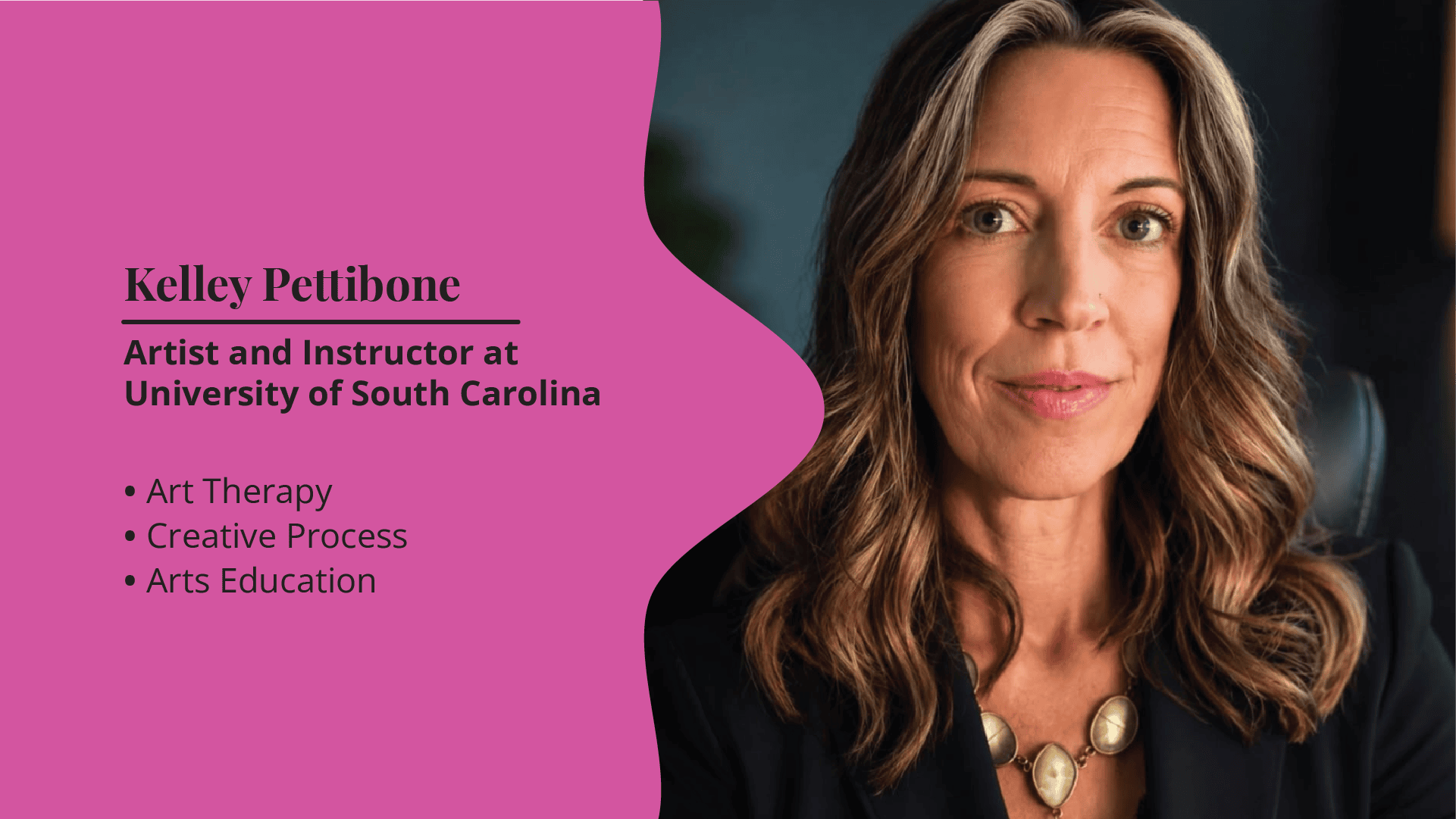
My name is Victoria, and today we are talking with Kelly Pettibone, a professional creative working from and within South Carolina.
As we get started, can you tell us about your current career and where you are currently located?
00:14 Kelley Pettibone
Yeah, I live in Columbia, South Carolina, and I am an educator. I teach for the School of Visual Art and Design at the University of South Carolina in Columbia.
As an artist, as a working artist, I mainly am a printmaker, but also mixed media artist and sculptor. I’m a mom and a dog mom. I’m a wife and my husband is a retired Army veteran and a disabled veteran.
So, I wear many hats. I do a lot of different things.
00:50 Victoria Bartolotto
Okay. Before we get into the nitty gritty details of being a professional educator, but also a studio artist, we have a brief section of our interview called “One Career, Sixty Seconds,” where you give an elevator style pitch about what your work is and how it kind of functions. Are you ready?
01:08 Kelley Pettibone
I’m ready.
01:08 Victoria Bartolotto
Okay, you can go ahead.
01:11 Kelley Pettibone
All right. Primarily printmaking and mixed media collage art, I focus mainly on grief. That’s the nature of my art. My art was born in grief as a therapy for myself. I look to my studio as a way to heal myself and work through my grief. That has blossomed now into more of a joyful space.
I also work sculpturally. I entertain the idea of home and what home means to me in the essence of losing my entire family in a decade of time. That is kind of where all my body of work began and where it has continued to grow, through living with that grief rather than living in grief. I love to do art as therapy, but it’s become so much more.
02:05 Victoria Bartolotto
Wow. I know art speaks to a lot of people and with that being your main focus, is there anything about South Carolina in particular that brings, in addition to your family and the grief that you experienced, does the state or your particular region or the city of Columbia bring anything to your art as well?
02:25 Kelley Pettibone
It does. My father passed away of leukemia, and he was treated at the MUSC Center in Charleston. My parents lived for a while down across the street from the Folly Beach Pier in Folly Beach. That’s where he was getting treatment. I used repurposed wood when they rebuilt the Folly Beach Pier. I was able to get a lot of that wood.
I use that in my sculptural work because of the place and it’s from Folly Beach. It’s significant to South Carolina in the region.
03:07 Victoria Bartolotto
So that project with the reclaimed wood is just one of many. Is there another project in particular that had an impact on your creative journey as well?
03:17 Kelley Pettibone
Absolutely. In working with my mother, she passed away in 2018 on Mother’s Day, so May has been a big month for me. I had all of her clothing after she passed away. No one tells you what to do with people’s stuff. You have to make these rough decisions.
As a printmaker, I needed paper. And so, I took her cotton clothing and pulped it and turned it into paper. That was a significant experience in learning to let go of things, but repurposing it into something that’s going to be useful for me in my art practice.
I have now started a whole new series of handmade paper using four generations of denim. It’s my grandmother’s, my mother’s, mine, and my daughter’s blue jeans. So all denim. So, I have quite the denim pulp happening at the moment.
Things like that, learning how to let things go, but then repurposing it into something else within your art and giving it a new space and then sending it out in the world to exhibit or wherever it ends up. It’s kind of cool and fascinating.
04:31 Victoria Bartolotto
Before entering becoming a studio artist full-time and obviously with teaching and things like that, did you have any fears about pursuing studio art as a full-time job? Was there anything that kept you back from maybe pursuing that as a source of income? If there was, what might have inspired you to continue beyond it?
04:58 Kelley Pettibone
Right now, I’m entertaining the idea of, and I haven’t yet, and only because I’ve been holding back. I wasn’t ready to pull the plug yet on it, but I want to join like art events as a vendor to sell art outside of a gallery environment, but in like an art fair and community events.
I want to do that in terms of like the capitalism side of selling my art, but I work to fund my art. That’s kind of why, being an educator and getting that check from being an educator helps fund my studio passion and my art helps me buy more materials so that I can do that.
Well, now I’m at a point where I have a lot of art and I need to get rid of it. I’m running out of space. So now I’m at the point where how do I sell this and how do I do both? How do I make money being an educator as well as making money being a studio artist? It’s great I can make it, but now I need to figure out selling it.
06:12 Victoria Bartolotto
Can you talk a little bit about the gallery experience and how a student who might be wanting to pursue becoming a studio artist or have their art exhibited in a gallery? Can you talk a little bit about that and how that works?
06:26 Kelley Pettibone
Yeah, it’s a full-time job in and of itself. I’m trying to find open calls, who’s looking for work, for what type of work, making sure that your work fits in that space. My work, because it’s grief in nature, doesn’t fit in a lot of places. So, you kind of have to pick and choose.
Also, if it’s sculptural art, it might be an environment where there are a lot of traffic. Maybe sculpture isn’t okay to say show in a bookstore where there’s going to be children and families and things like that.
So, you kind of have to know the gallery or do your homework and research the places. But it’s a lot of time spent on the computer. It’s a lot of administrative type work in the looking, but also in the applying. I had someone tell me one time, “if you haven’t collected a box of nos, then you haven’t made it yet as an artist.” Throwing all the pasta at the wall and seeing what sticks, basically.
You have to be okay with being told no. I’ve applied and reapplied at places, I’ve been told no and then reapplied, and then I’ve been told yes with the same body of work. So maybe it’s just not the right time, but maybe later. And I’ve been told no, not this year, but next year, and that’s okay. You can put it on a back burner for next year.
Planning ahead and keeping a good calendar of what you have going on and what you have applied where, so you don’t overbook or double book your work. Last thing you want to do is have this body of work in one gallery and then you’ve promised another space the same images or the same pieces.
So being a good juggler and a good manager but also being good administratively and researching.
08:27 Victoria Bartolotto
With the different types of mediums that you work with, do you approach each one through the lens of grief, or are there different lenses that you approach the different mediums through?
08:40 Kelley Pettibone
I kind of always seem to fall into that vein because it is so therapeutic for me. But when I work with printmaking, mainly I’m a woodcut printmaker and so I carve wood and carving is meditative, but it’s also very mindful.
I have to be present while I’m carving because one carve and now it’s gone and I can’t get it back. So, you have to be fully present and fully mindful of what you’re doing in that.
But whenever I am, say, mixed media collage or painting, it’s more playful and it’s more joyful and I can dance around and listen to music while I’m working, and I don’t have to necessarily be as mindful with that. And it is more of a playful in nature process for me and also very impromptu.
When I am working in printmaking, it’s very planned and it’s very organized. I have to have an idea of where it’s going, or it’ll fall apart quickly. With collage, it’s very throw it all up in the air and see where it lands. And then if I don’t like it, just cover it up with paint, you know? So, it’s not a lot of planning at all, if any. I might start with a color story and that’s about the extent of the planning on that.
But with sculpture, also, it’s more mindful. I have to kind of have an idea of what I’m going for and then sculpt it out. But it also can be more playful than the printmaking for me. So, I kind of go back and forth between the two or three or four. I might have three or four things going on.
And when I’m tired of being present and I’m tired of being mindful, then I might say, “okay, it’s time to play.” Then I’ll go do something else that feels more playful for a while.
10:34 Victoria Bartolotto
It seems like there’s a good balance that you have.
10:36 Kelley Pettibone
Yeah, I try. I try to, and I don’t know if maybe it’s the ADD or the ADHD in me that I can’t sit still for very long. So, I have to kind of hop around in both process and in my pieces. I get bored with something for very long. And so, I can only sit here for a few hours and then I gotta, oh, I gotta go do something else.
11:01 Victoria Bartolotto
Yeah.
11:02 Kelley Pettibone
Seasonally, I’m like that in my own house too. Like I change around spaces and I change around things. I just get tired of it after a while and I have to do something different and freshen it up.
11:14 Victoria Bartolotto
Do you have any advice for young students, particularly like high school or freshmen in college who might want to pursue studio art and multimedia art as a profession? Do you have any advice? Are there any particular skills that they should have or a mindset they should go into it with?
11:32 Kelley Pettibone
The only real advice that I have after having taught studio art for a while is that I have a lot of students. The very first thing they’ll say at the beginning of the semester is, “I don’t know how to do this very well” or “I’m not a good drawer” or, you know, “I can’t draw” or “I can’t do this”. Nobody does when you begin.
I didn’t even know of printmaking or like my idea of printmaking was making posters or t-shirts. I had no idea, and everyone starts somewhere. And don’t be afraid to learn and play and allow yourself to play because through play is when you learn what works well and what doesn’t work well.
But also, I think my greatest advice, because I started as a biology anatomy major. That’s a heck of an adjustment. But I spent a lot of time and a lot of money in classes that didn’t translate over to studio art.
But don’t spin your wheels and waste your time doing something because it’s what you feel like you ought to do. Or like, “I had an uncle that was a biologist. I should study biology.” No, you should not. You should admire your uncle for being that and what he was and his hard work. But if that is not innately you, that is not what you should do.
And I feel like everyone should follow their passion. And if the world were full of people that were passionate about what they do every day, imagine the space we’d live in. I mean, it’d be different.
13:21 Victoria Bartolotto
It would be so different.
13:23 Kelley Pettibone
Everyone waiting to take your order would be so happy you’re here. “My pleasure,” everywhere. If it was like that, it would be wonderful. And I feel like that if making art is your passion, you’ll find a way. Everything else will fall into space. The money will come. All the questions will get answered. You will find a way to make it work if that is what your passion is.
If it’s not what your passion is, then that’s gonna be a struggle bus. But if it is what you’re passionate about, then you will find a way. Where there’s a will, there’s a way. But definitely don’t do something because — I have a lot of students that are in my class, classes, studio art classes, and I’ll say, “what’s your major?” “Math.” “Why? Do you like your major?”
And they’ll say, “well, I really wish that I was a studio art major, but–” and I’m like, “why aren’t you a studio art major?”
And then they’ll say, “well, because I can’t make money at that, because my dad said I can’t make money at that.”
Well, you can, make money at that. As a matter of fact, I have artist friends that sell art for the price of cars, houses. You can make money at that, but you have to decide how much you’re willing to sacrifice to make that happen in the beginning to make that money in the end. Passion is where it lies and do from the get-go what you are passionate about doing rather than having a 25-year college plan like I did before you finish up.
15:20 Victoria Bartolotto
Yeah, no, I can totally sympathize with that because I graduated with an English degree. And a lot of people come up to me and they’re like, “oh, what do you want to do with an English degree? Do you want to be a teacher?” And while teaching is an amazing profession, it is not for me. And I’m like, “oh, no, I want to be an author. I really want to write books.” And they’ll be like, “Authors don’t make any money. You won’t make any money.” It’s just like, well, I have a vision. I have a plan. I want to make it work. And so, I can totally sympathize with that kind of mindset, for sure.
15:55 Kelley Pettibone
I remember specifically coming home after I had discovered, I was in clinicals, and I was going through all of my notes. I had tons of notebooks full of all anatomy stuff. And I was going through all my notebooks, and I realized that all my notes were drawings. I draw all my notes rather than write notes. I have pictorial notes.
And all my notes were mainly drawings of like body parts and like the human body and its inner workings. And I thought, “I’m an artist”. That’s what I am. I don’t want to be stuck in a lab for the rest of my life.
There’s no creativity in that, and like you feel about teachers. That’s a life for somebody, but that is not the life for me. That is not what I want to do. We need those people, but that is not my jimmy jam. I went home and I told my parents, I remember I was not living at home at the time, but I told them one night over dinner, I said, “I’ve decided that I’m gonna change my major.”
And both of them were like, “what?” And I said, “I’m going to art school.” And I remember my dad, who was a chemical engineer, he said, “How are you going to support yourself being an artist? Like you’re going to be one of those people that sit on the side of the road and tries to sell art out of your trunk. Like, how are you going to do that?” And I was like, “I don’t know if I haven’t figured it out yet, but I will.”
And my mom, she was always so supportive and she was like, “Well, I know you’ll do it, and you’ll do great because you’ve been drawing since you were like 2. So, I think you’re going to be fantastic. Like maybe you can make Hallmark cards.” That’s what she said.
17:43 Victoria Bartolotto
That’s what my mom said, too! She was like, “You can write for Hallmark.” And I was like, “I don’t know, maybe?”
17:49 Kelley Pettibone
You write it; I’ll make it comical. There we go! It’s a collaboration.
I just remember them thinking, “How are you gonna do this?” But my mom being very supportive, but also she couldn’t support you forever. I know now, once I figured out that I do love teaching, I love teaching, I love creating artists. That’s like my thing.
Like, I believe everybody is an artist. You’re an artist. You’re an artist of words.
18:25 Victoria Bartolotto
Yeah.
18:25 Kelley Pettibone
We’re all artists in our own way. You don’t necessarily have to be a painter or a sculptor. We all have a gift and that’s an art. Being able to write is an art. You’re in the literary arts. I couldn’t write a book. Maybe I don’t know. But I have written poems and poetry. So, it’s all an art and we’re all creatives in some way.
I feel like being a teacher is kind of the vein where I fell into and creating and encouraging students to follow their passion is like right where I belong.
And that funding my art, you know, my independent art as a fine artist, as a studio artist, that’s necessary. But also having a creative space for me is necessary. My grandmother used to say, “Idle hands are a devil’s workshop.” And that’s true. Like I cannot not create. That’s essential for me. It’s essential to get all of these feelings and all of these thoughts out.
If it becomes a whole body of work that gets shown in an exhibition, if it touches somebody, even if just one person, job well done, you know?
19:51 Victoria Bartolotto
Yeah. Well, thank you so much for taking the time to talk with me today. I sincerely appreciate it.
19:59 Kelley Pettibone
Enjoy your summer and congratulations to you.
20:01 Victoria Bartolotto
Thank you so much. I appreciate it. I hope you have a lovely day.
20:04 Kelley Pettibone
All right, you too.