
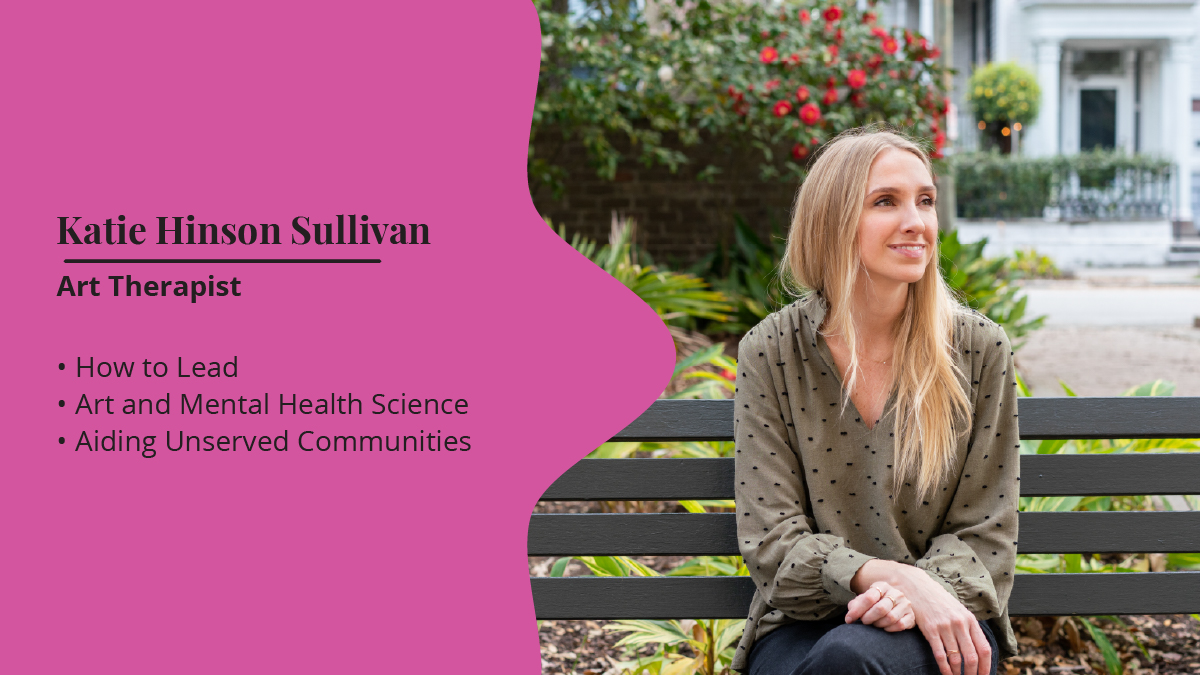
“Art has been a language to me that made sense throughout my life.”
Katie Hinson Sullivan is an Art Therapist and program director of the Arts and Healing program at MUSC Health in Charleston, SC. She holds a degree in Studio Art and Psychology from the College of Charleston and a Masters in Art Therapy from New York.
Interview
Transcript
Katie Hinson Sullivan 00:00
My name is Katie Hinson Sullivan. I am a board certified and registered art therapist and I am from Charleston, South Carolina; I actually moved to New York to get my masters to become an art therapist, and I worked in New York for 10 years as an art therapist and then moved back about six years ago and started the arts and healing program here at MUSC.
So, we started Arts and Healing in 2018. And it started off with as a very small program, I think the CEO initially here wanted to create some kind of art program, he didn’t know what that was, he was thinking more of art on the walls, but hiring an art therapist, I kind of went in the more clinical evidence-based direction and started a Creative Arts Therapy Department here, which is… art therapy is actually a mental health field. A lot of people can misunderstand that as kind of an educational field, but it’s not, we’re not teaching any kind of art activities. We are using art in a way to impact the health and well-being of patients from children to you know, end of life. Essentially, I have worked in a number of different populations. I’ve worked with vets; I’ve worked with children of abuse and neglect. I actually worked at Rikers Island in New York for three years working with the incarcerated because when words are really hard to find, or really unsafe to use, I think art therapy has a really important place for those types of people, especially the underserved populations out there, which is kind of where my heart lies.
But when MUSC Arts and Healing was created, we started with just one art therapist and one music therapist and doing work within the palliative care space with both adults and children, and that just exploded. I think people quickly saw the impact of having that kind of holistic approach in the hospital. Counselors and therapists don’t typically work within hospital spaces. It’s generally, you know, just like a psych eval, but people are going through a lot of things. And we have people that stay here for years sometimes in the hospital, which is really sad, or family members are just experiencing a big loss. So, losing a family member happens often here in the hospital, so we work directly with patients and family members as well. So, we now have three art therapists and four music therapists working at MUSC. Music therapy is a separate field. Music therapists focus on functional goals. If you like, I can connect you to a music therapist as well. But it’s a completely different field than art therapy.
Yeah, so that’s kind of us in a nutshell, in the inpatient world. We’ve also expanded with the help of the South Carolina Arts Commission to be in our school systems across the state, which is like the most exciting work ever, especially after COVID-19. Kiddos are very isolated; they really struggle socially. I think anxiety really just took off. We wrote a grant to get funding, a little funding for this to start things off before partnering with the South Carolina Arts Commission, because we were seeing an increase in our emergency room with kiddos having suicidal ideation or just feeling completely overwhelmed and having mental health crises. So, the best place to reach our kids is in schools, especially with those who are underserved and don’t have access to mental health care. So that was our main goal. So, we started pushing into schools using art therapy two years ago. And again, we’ve expanded to four districts. Thank goodness to the South Carolina Arts Commission for helping that work along.
We’ve been in the school system, and we’re pushing into underserved populations as well within our community. So, we’re working with an addiction agency and working with their clientele. We’re working at an assisted living facility, we’re actually doing art therapy with the blind and visually impaired in partnership with the South Carolina Arts Commission, we’re actually pushing into a children’s group home and also working with foster care families as well. And then a myriad of other populations. It’s kind of expanded to very diverse settings. But yeah, that is where we are at – MUSC.
Emma Plutnicki 03:59
How long have you been there and doing the show? And what’s your official job title?
Katie Hinson Sullivan 04:04
So, I’m the leader of the Arts and Healing department and I started the program in 2018.
Emma Plutnicki 04:08
Okay, perfect. And so, what kind of background, like, led you down this path? How did you end up doing what you’re doing now?
Katie Hinson Sullivan 04:16
Yeah, I’ve been asked that question before. I was a kiddo who actually had open heart surgery here at MUSC Health when I was five. And I think, throughout my life, I had an art teacher as a mother, so I think she always just put materials out and that was my way of expressing myself when I was very young. So, art was just kind of a language to me, so it made sense throughout my life. I didn’t know what that equated to. I was actually going to the College of Charleston, I was majoring in psychology and just taking art classes on the side because it was like my interest, just growing up doing it. And I had a professor my senior year at College of Charleston, and I didn’t know what the heck I wanted to do, but she was kind of like, you understand that there is an actual profession that kind of blends your two interests, psychology and art. So, I looked into it and then started applying to schools. You have to have a master’s degree to become an art therapist, just to get training. And then there’s a whole myriad of board certification tests, all this and collecting hours in front of patients just like any other mental health field. But yeah, in my senior year, I decided to become an art therapist. I really didn’t have any idea what that was until I got into it. And just, it just makes so much sense to me, just given my history, I think.
Emma Plutnicki 05:28
Yeah, amazing. So, on a day-to-day basis, are you going to schools and teaching the kids, or what does your day-to-day look like?
Katie Hinson Sullivan 05:38
Yeah, so, I am more on the administrator’s side. Now, I can speak about what that looked like when I was an active therapist. But my day today is really building programming, really thinking strategically about how we can build sustainable programming and these spaces that don’t have access to care. I am doing a research study currently in the hospital. So, I’m working with pediatric patients who have just had a bone marrow transplant, which is a really tough procedure to go through. So, I’m working on a study that is looking at whether or not art therapy helps young people be discharged quicker. I’m working alongside PT (physical therapy) so if children receive art therapy before PT, does it make them, essentially does it help them to engage in their services a little longer, or more readily, because as we know, if a kiddo going through BMT is compliant with their physical therapy they can be discharged a lot quicker. So just providing that support, assisting them.
Emma Plutnicki 06:51
Has there been one project that has stood out to you over the years, that was the pinnacle of your creativity, or just had a significant impact on you?
Katie Hinson Sullivan 07:02
Yeah, I think my work at Rikers was the most impactful work I did. Actually, my job before that, I worked at HeartShare human services before that in New York, and it was an agency, it was called a preventive agency. So, child abuse cases would come through the city, and then we would be contracted to provide support for those families. I worked with the entire family. I think that just allowed me to get every type of issue or struggle that a family was going through, and whether that was child abuse or neglect, that really gave me a very dynamic view of the world, I think. As a new therapist, I worked there for five years. And then I think that kind of led me to my position at Rikers. I answered a cryptic job posting about a mental health clinician wanted, and luckily, I got the job. And I mean, it was really intense. As people know, Rikers Island is very known for being a really scary place and giving inmates a voice or helping them process what was going on. I mean, there’s so many layers in jails, right, like just who we incarcerate and why we incarcerate them. But allowing them the space to have support in a really scary time, was really impactful to me.
Then I fought to work in the women’s jail. There are over 10,000 inmates on that island, and only about 1500 Women were in the jail at the time. And they were receiving little to no services because the men were just, you know, they were having a lot more issues and like code reds throughout the days. And women, a lot of them have children at home. And they were trying to get through their time at Rikers, to find out what the outcome of their sentencing was, et cetera. So very impactful work for me gave me a very different view of the world.
Emma Plutnicki 8:51
Wow, that’s incredible.
Katie Hinson Sullivan 8:53
Yeah, a bigger view of the world. I mean, it was really impactful. And the women were so strong.
Emma Plutnicki 08:58
Wow. That’s amazing. So, has it been challenging, like the work itself, and also the way that you got into this career path? Was that challenging to find and kind of get your foot into the door?
Katie Hinson Sullivan 09:09
It’s very challenging in our state to become an art therapist. There are no grad schools here, and you have to have a master’s degree to become an art therapist. There are some online schools. And I didn’t know what the field was like; I didn’t even know that it existed. I had a professor that was from New York, where it, you know, obviously mental health is a little more accessible in another state. In South Carolina, not only am I a mental health clinician, but I’m an art therapist, which, you know, I think is a double whammy. We don’t have licensure in our state yet. We’re pushing hard for licensure. So, I think that’s a challenge, but we’re doing it. In 2018, I think there were 39 art therapists throughout the entire state. Right now, we are sitting at like 62 therapists, so within a few years, it’s really grown, which is crazy. Then we have a bunch of interns that are working with our program and then just people are flocking to the state because we now have the opportunity for art therapists to work. It is challenging here in South Carolina, in New York; it was not a challenge. There was a huge community of art therapists that were great and wonderful to work with. And there were jobs available and all of that. But South Carolina is really moving along. I have high hopes for the next few years, for sure.
Emma Plutnicki 10:19
Yeah. And within South Carolina, do you know if there’s any like programs or events or organizations that kind of allow people to network or meet or find out more about a field as an art therapist? Are there any like organizations or anything?
Katie Hinson Sullivan 10:33
Yeah, the South Carolina Association for Art Therapists, our state organization. I’m actually the treasurer and have been a past president for that organization. They’re great. We’re small, but I think anybody who’s interested in the field of art therapy, please just get in touch with a licensed or credentialed art therapist to ask about what the field looks like, there’s a lot of art therapists out there that are claiming to be art therapists in our state, because there’s not, I think there’s just a lack of understanding of what it is. But if you’re interested in the field of art therapy, get in touch with me, get in touch with somebody who has an ATR behind their name. That’s the credential to be an art therapist and ask questions. There are online programs to become an art therapist. There are internships available across the state, the association is happy to connect people, or I am happy to connect anybody and/or just have a conversation with people about what the field entails.
Emma Plutnicki 11:30
As an applicant, are there any specific skills that you think would be beneficial to have? If you were hiring somebody and saw, “Oh, this applicant has this skill, this skill, this skill, they’re good,” or any skills that you have or use on a daily basis that you find come in handy?
Katie Hinson Sullivan 11:44
Yeah, they would have to have their training and their credentials to become an applicable applicant. And for any job with us, I think just, I mean, art therapists, you have to be interested in the mental health field, right? And you also, I think, artists just generally are more or are a little empathetic to the world around them, you know. It’s a hard job. Because you’re, I mean, it is mental health, and you’re just hearing trauma and dealing with trauma. And as an art therapist, I think you get to those spaces a little quicker, because you have this process and product that you’re doing with a client or a patient, in that therapeutic space, but I think skill sets would be – A: that they’ve been through their training, B: that they’ve been willing to do the work personally.
So, I think any art therapist who’s, you know, been in therapy, or you know, has a good idea of where they end and where a client begins. That’s always a good trait to have as a therapist. To experience therapy yourself, as a therapist, I think it is really important. And just willingness to learn. I feel like even, you know, well into my career, I’m still getting supervision myself, and still learning from others. And I think just always being open to growing. And then also having your own art making on the side, you have to have a place to dump all this stuff, right. I think art is why we became art therapists, right? Or why people become art therapists because they believe in that process of art making. So also, applicants, one of the questions I always ask is, how do you take care of yourself? Do you do anything creative on the side? That is, I think, just a really important piece of that creative outlet as well.
Emma Plutnicki 13:25
So just as we’re wrapping up, do you have any advice for someone who’s looking to get into the field?
Katie Hinson Sullivan 13:30
Just connect with an art therapist, ask them about possible programs they can go to, if they’re in South Carolina. Ask, you know, just talk through what you’re thinking because there’s so many different ways that art therapy is applicable. You can do art therapy in a museum, just you know, going into museums and maybe creating work based on what you’ve seen. There’s, there’s so many different directions an art therapist can go. But again, I think it just takes diving into training, like I said earlier, like I didn’t know what I was getting myself into as an art therapist until I actually got into the training itself. Also, if anybody ever wants to come and shadow an art therapist here at MUSC, we have that opportunity for people, if they’re kind of like, seeing whether or not they want to volunteer or want to come into the field like there are opportunities to shadow or volunteer with a program like ours. Yeah, just throwing that out there.
Emma Plutnicki 14:22
And then is there just anything else you’d like to add overall, any last thoughts?
Katie Hinson Sullivan 14:27
Not necessarily, if anybody wants to get in touch, I always do offer conversation.
Emma Plutnicki 14:35
Perfect.