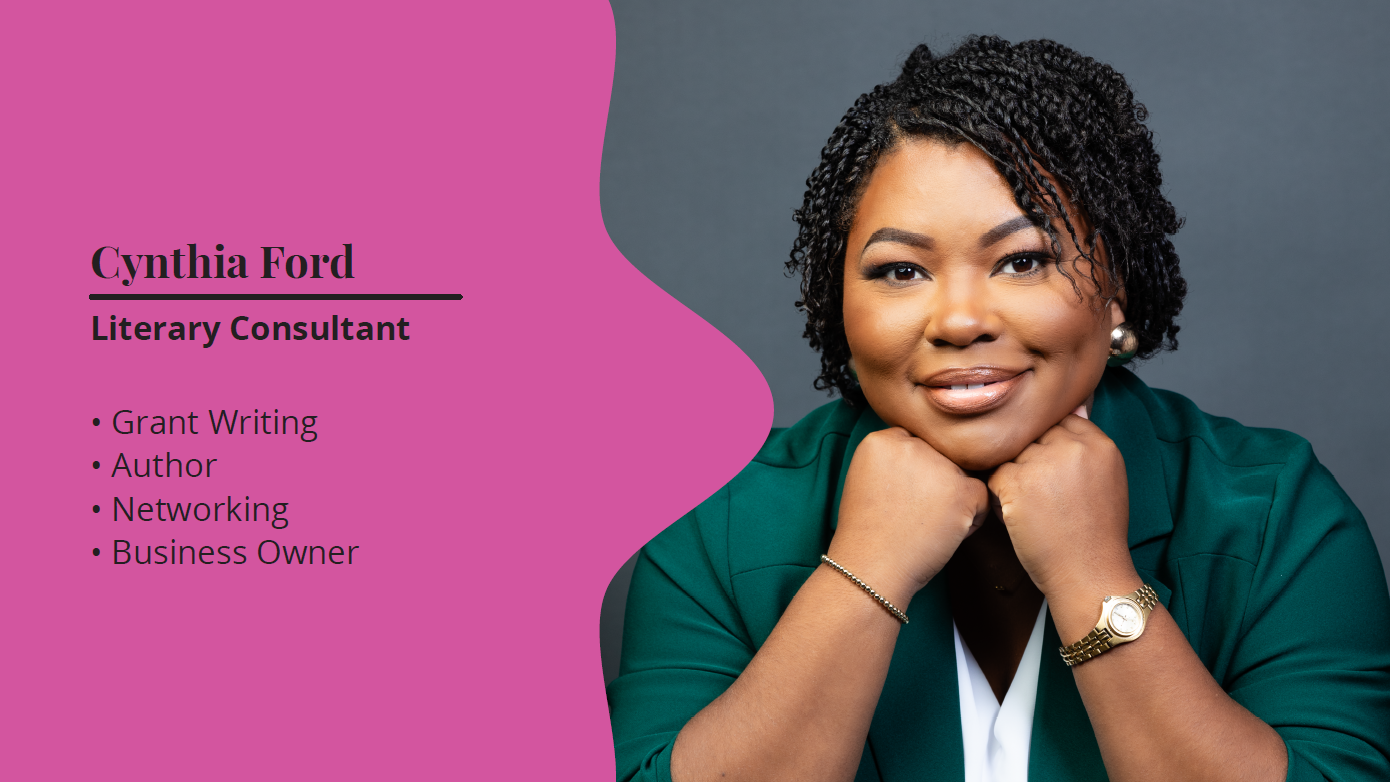
Location: Pee Dee and Grand Strand

  • Cynthia Ford

    Cynthia Ford

    “Each moment that you’re able to get up again and keep pushing, that’s success.” 

    Cynthia Ford is the Founder and CEO of Cynthia O Writing & Consulting, a South Carolina-based firm specializing in writing services, consulting, and speaking engagements. Her company focuses on three core areas; authoring inspirational literature, providing strategic business consulting, and delivering transformative speaking engagements  

    Interview

    Transcript

    Emma Plutnicki 

    So, to start, what do you do for work? And where are you currently working from?  

    Cynthia Ford 

    Okay, I’m working from home, and as of 2023, I left for my full-time job to work on my own business. So, I own Cynthia O Writing and Consulting, and I have three portions of that business. One, I’m an artist in residence for literature. I’m also an author, and also I help businesses with consulting and writing needs, such as grant writing and other additional writing services.  

    Emma Plutnicki 

    Okay, cool and how long have you been doing that for? Since 2023? 

    Cynthia Ford

    Full time? 2023 you know, I have done some other things part time as I was working full time. And I’ve been doing some social media content management as well, just part time until I launched that. 

    Emma Plutnicki

    Okay, nice and where is home for you?  

    Cynthia Ford

    Mullins. 

    Emma Plutnicki

    Okay, nice. And so, what does a typical day look like for you? What’s expected of you on a daily basis, and what kind of responsibilities do you have?  

    Cynthia Ford

    The day, the typical day, really just doesn’t exist, you know, but I do plan things out ahead of time, you know, on my schedule, times to meet with those who are interested in services. I set certain days for that. I also set time aside for researching, for grant writing. So, I just split it up. You know, I split up my day for the first portion of the day is my time where I’m, you know, I had that moment to myself, whether I’m just outside, meditating, reading, listening to podcasts, or just preparing for the day. And, you know, then I’ll begin to do my social media posts for the businesses that I help with that. And then I’ll begin additional things that I have to do for other businesses, whether it’s the grant writing services I’m consulting and reaching out and networking with other people where I can, you know, spread my services. Um, I also save time for writing, as relates to me being an author, so I have another book that will be coming out, so I set aside specifically time just to make sure that I’m on task when it comes to things I have to publish or networking regarding the books that I’m doing. 

    Emma Plutnicki

    Nice and so the businesses that you consult for, are they, oftentimes, South Carolina based, or are they around the country? 

    Cynthia Ford

    So far, they’ve been only South Carolina based. I’m not opposed to, you know, reaching out to other businesses outside of South Carolina. But so far, yeah. 

    Emma Plutnicki

    How would you describe the like local working professional community in South Carolina. Do you have any experience in other places where South Carolina is particularly, particularly unique, or how is that community here?  

    Cynthia Ford

    Do you mean as far as the business, the different businesses in itself, are they unique, or? 

    Emma Plutnicki 

    Just in general, with like, how the working community is in South Carolina. Is there a lot of collaboration? Is it kind of there are cliques of groups? How is like collaborating with businesses in South Carolina?  

    Cynthia Ford

    I have actually seen both aspects of it. I have seen situations where businesses are able to grow because they have networked with other businesses, you know, provided resources to other constituents and, you know, just information that they needed in order to help push them to the next level. So, I have seen that definitely, yeah, you know how they’ll say sometimes not what you know its who you know. I see a lot of that, you know, you know, from just my experiences, from working with other businesses, yeah. 

    Emma Plutnicki 

    And is there a way, if you’re starting out to kind of break through that or grow your network? 

    Cynthia Ford

    Yes, I would definitely say, attend any type of event, whether it’s virtual or in person. A lot of times there are free events that people can tap into, searching through different places, like Eventbrite or just searching online when there, when there are things that are related to what you’re doing or what you desire to do, but just kind of tapping into that. I’ve also found a lot of resources virtually myself, just through podcasts, you know, YouTube, and I have been able to pour into my business just through those things and connecting and investing in myself, the things that I’ve researched through that. 

    Emma Plutnicki

    Yeah, of course. And so, you have a lot of things pulling you in different directions. In a creative career like that, it’s hard to kind of know what success looks like. So how would you define personal and professional success in your career? 

    Cynthia Ford

    Well, you know success, of course, and like you said, I am pulled in different directions, but when I can accomplish things that I have set out to do, when I’ve set those goals and they’re accomplished. So those moments are success to me. Trying each day is success to me, because I could have a moment where I’m like, okay, you know, I’m really just not feeling this. But then when you get up and you try again, that’s success. You know, you’ve gotten past the mental things that try to hold you back, or you’ve gotten past any type of barriers that are out of your control. You know, found a way to go around it. That’s success. So, each moment that you’re able to get up again and keep pushing, yeah. 

    Emma Plutnicki 

    For sure, did you have any fears when you came into this career? 

    Cynthia Ford

    I did. I actually it took me a couple of years to do it, and I actually desired to start it in 2019, but it’s like I knew that there was something that I wanted to do. I didn’t know how to get there, and didn’t know exactly what it was, but it was a big jump for me, because I was with the Department of Juvenile Justice for 15 years, and so I went to coastal, you know, I started with teaching, and I did some other things, and I worked with DJ J and moved up to kind of direct the position. So, to actually move from that position where you’re settled and everything is good, to launch out to something where you have to start over, that was a huge leap. So I was afraid, and I was okay, well, how am I going to make it financially? I just couldn’t pull those things together. But I began to prepare financially, mentally, and just began to get all those things together before I took the big leap, you know, just make sure that I was, you know, well, I had a well, um, grounded Foundation, and knew that was what I was going to do. 

    Emma Plutnicki

    For sure, and along the way, when you had those fears and faced challenges, was there anybody there to give you advice, either mentors or family? Do you remember any like, the best advice that you received and also the worst advice? 

    Cynthia Ford

    Yes, the worst advice, I think, would come from, you know, when someone would say, well, just leave. Just do it. Don’t just leave. Just do it without being prepared. And there were times when I could, yeah, I could have left when I first thought about it, but I was no way of where I needed to be as far as when prepared. I could have fell on my face financially, but, um, you know, don’t just leave without being prepared. And some people was like, just go. Let’s go. No, don’t just go. But I also received, one of the best advice that I received was someone that told me, just make sure you stay in your lane. You know you don’t have to look on anyone else’s paper when you know exactly what it is you should supposed to be doing, and you’re grounded in that. Just stay in your lane. You don’t have to copy what someone else is doing, or feel like you have to emulate what the other person is doing, do the best of what you are supposed to do.  

    Emma Plutnicki 

    Yeah, that’s great advice. Very good advice. And so, throughout your career, have you had one project that made a significant impact on you, maybe something that was particularly meaningful, that just kind of resonated with you and kind of stands out as a pinnacle or peak of your career? 

    Cynthia Ford 

    Goodness. Actually, I have a couple, but I would probably say, when I released my second book, Dream Like a Queen. I did that in collaboration with the library, Marion County Library, and it was a tea party, and so I really prepared for that. I bought this gal, and we asked the girls to come out and dress up in their little princess dresses. And we had the library just totally transformed. So, when you went in there, it wasn’t like, oh, just your regular library. It was a magical type thing. And the young ladies were just amazed that we had a station for pictures, a station for painting, arts and crafts. And of course, they got their copy of their book pictures together. So that was, um, you know, huge for me, just to be able to bring literacy to the young people in that format, and for them to see the library in a different way. 

    Emma Plutnicki

    Yeah, that must have been amazing to witness. It was your project come to life. And just overall, as we’re wrapping up, is there anything else you’d like to add about your career? Any advice, anything of that nature? 

    Cynthia Ford

    Well, as relates to great creativity, I first started and see how large of a spectrum that I can go into, as relates to writing. I just thought about, okay, me as an author, you know, I’ve written, I’ve published four books, but I have a living weight, but not knowing, just the expansion of what I can do, you know, I can. I launched out to different workshops where I can teach children and adults literacy, so you can also turn it into speaking opportunities and coaching opportunities. So, I also thought about I had, you know, take myself back to what I truly love and desire in every career or job in.  I love some aspect of it, and I wasn’t afraid to close the door at a certain point. So, when you get to that point where you want to close the door and launch to something else, do that because we have different purposes in life. And you know, just don’t be afraid to tap into that. And if the door closes and it’s your time to move on, move forward. You know, it’s okay to move forward if where you are is no longer serving you, and that’s what I did. I just moved forward, and I was able to see it unfolded to me to different ways how I can launch my writing services and connect into different areas where I love and that was business that was helping youth and helping the community, but also publishing my book and knowing that I can take that book and do different things, teaching workshops, speaking, so it’s not just that one thing, 

    Emma Plutnicki 

    Yeah, yeah. That’s great advice, and it’s an amazing story about how you, you know, arrange your finances and gain the courage to then quit a job that you know you had well established. So it’s really inspiring, and I love it, and I’m glad that you’re, it’s refreshing to hear that you really enjoy your job now. So thank you so much for sharing. Really appreciate it. 
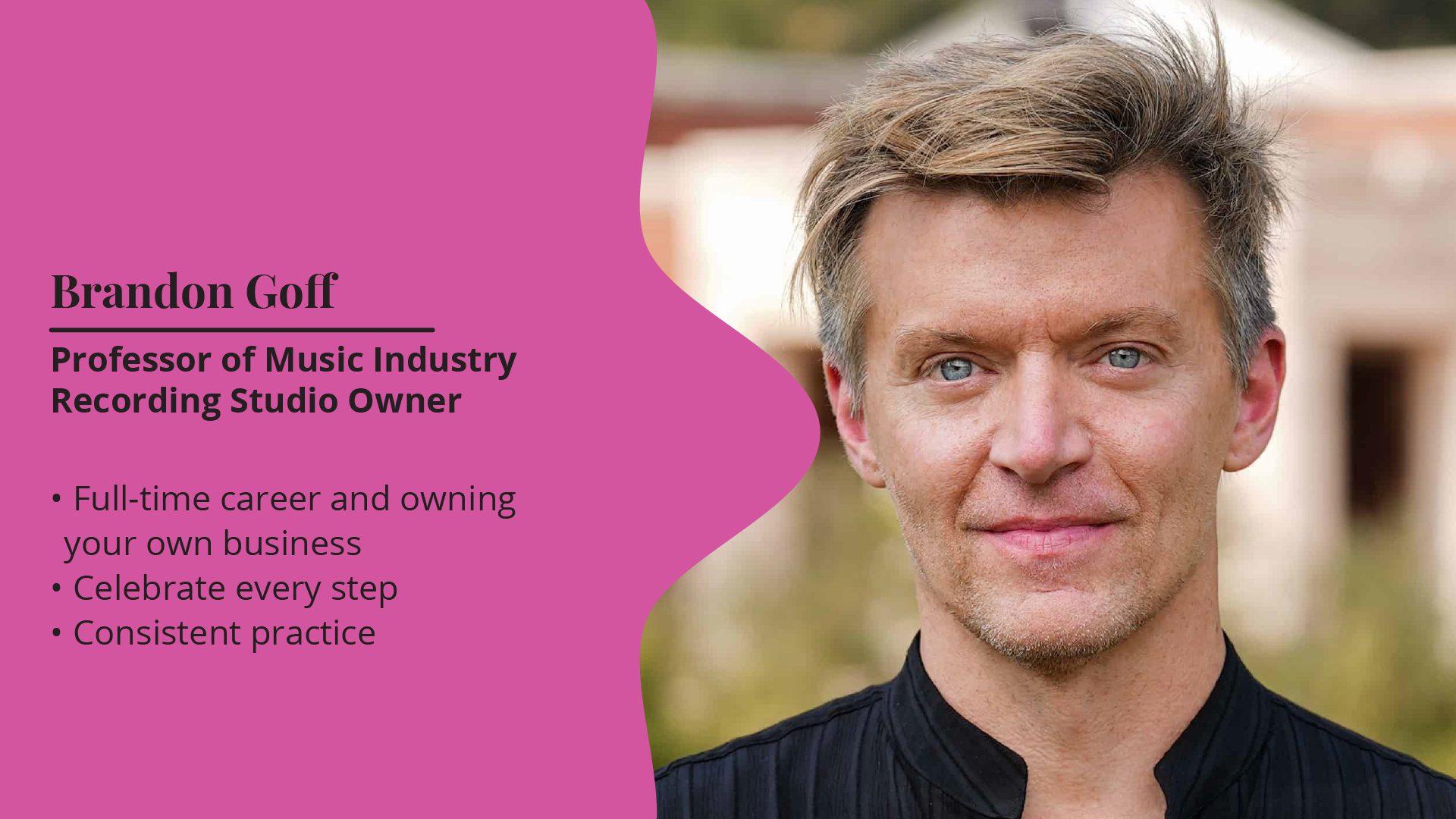
  • Brandon Goff

    Brandon Goff

    “I put in 30 minutes of practice every day, whether it’s guitar or composing. It’s like exercise 30 minutes a day goes a lot further than five hours once a week. It keeps your brain engaged.”

    Brandon Goff is a composer, producer, engineer, performer, and professor of Music Industry at Francis Marion University in Florence, South Carolina. As a Memphis, Tennessee, local, he attended Rhodes College where Goff’s creative path began. This path has taken him through academic and professional music spaces across the U.S. and abroad. With a PhD and a background in music composition, he believes in celebrating every step of creative growth, whether that’s writing an album or landing a gig. His career is a witness to persistence, curiosity, and the value of creative support systems.

    Interview

    Transcript

    Emma Plutnicki  00:00 

    So, to start, what do you do for work, and where are you currently working from?  

    Brandon Goff  00:06 

    I mean, I do a lot of things to be fair, but I’m a professor of Music Industry in Florence, South Carolina, at Francis Marion University, which is obviously going to be the biggest chunk of what I do. But my, you know, my background’s as a composer, a producer, and an engineer and a performer does a lot of different aspects to being a professional musician, and you don’t always do just one. And I’m one of those people who do all those all the time. 

    Emma Plutnicki  00:27 

    Amazing. So how long have you been working as a professor, and then how long have you been doing all the other things? 

    Brandon Goff  00:35 

    I’m from Memphis, Tennessee, and I’ve been teaching on a university level since, oh my, it goes way back. I first started a Rhodes College, which is a really nice liberal arts school in Memphis, and then I moved from there to probably started teaching, you know, around 2003 2004 so it’s been a minute. Yeah, it’s been a while. Then I went to, like, around Nashville, at a place called Lambuth University, and then I came here from there, and I’ve been here since 2011 so I’ve been in South Carolina for like, you know, proper, 14 years now.  

    Emma Plutnicki  01:11 

    Okay, so what is one thing that you love about working as a creative in South Carolina, specifically, as opposed to in Memphis or Nashville?  

    Brandon Goff  01:22 

    Well, you know, I do. I—anybody who works in the creative, especially the music industry, is going to love Memphis and Nashville. These are two, like, major hubs of music industry. But along with that, from an academic standpoint, meaning from in the in regards to the education portion of what I do, it’s fun working with students who don’t have that grandiose expectation of someone who’s growing up in Nashville. I mean, these in the talent pool, it’s a misconception. People always think, well, everyone’s so talented in New York, London, Nashville, they’re always just like, let alone actually, mathematically, no, they’re not. They’re just surrounded by an industry which really kind of draws that talent out. So, one of the beautiful things about South Carolina, that I love is the talent pool is thick. It’s just as the talent pool is just as big as it is anywhere else. But there’s just less exposure to it, less exposure to your opportunities, your potential, to chances you can take that you don’t realize you can because you’re not in one of those big music hubs. And I do, I really do love that. Actually, I do. I do enjoy that a lot. 

    Emma Plutnicki  02:26 

    Yeah, that’s amazing. So, has South Carolina had any unique influence on your work specifically? 

    Brandon Goff  02:34 

    I mean, of course, yes. I mean, it would do, wouldn’t it? I mean, it’s the, I don’t feel, musically? How would I—there’s a, it’s a different—you know, I’m from Tennessee, in Memphis and Nashville. Everyone’s a musician. That is the thing that everyone does. You probably have an uncle who’s a songwriter. You might have another uncle who works for a record label, who’s like a, you know, a talent scout. And I kind of, I didn’t, honestly, I didn’t realize the rest of the world wasn’t like that until I moved here. When I moved to South Carolina, I was like, Oh, this isn’t like the major industry. This isn’t what everybody does. And so, in being steeped in a non-music focused culture is going to obviously be influential. There’s a complete different music culture here. There’s a different kind of nightlife culture, a different culinary culture. And so, I’m constantly stealing, like, little, you know, snippets of sounds and lifestyles and putting them in songs and putting them in, you know, pieces and stuff like that, which I think is as well you should. 

    Emma Plutnicki  03:37 

    Yeah, I love that. So how would you describe the local professional community within South Carolina? 

    Brandon Goff  03:45 

    In regards to music professionals? You know, again, you’re not in—there’s not, there aren’t a ton of recording studios. There aren’t just a ton of, you know, production houses and things like that. There aren’t a ton of publishing houses. There aren’t a ton of things like that. There are a few here and there and around. It’s more competitive getting into those spaces because there are less spaces for people to access. But one of the biggest, we’re still a big production state, in large part because we do, we still have a lot of arts funding, and we have a lot of massive churches that run big productions. So, I’ve had a lot of students who go work for big, big churches here in South Carolina who have productions that are equal to that, of, you know, equal to that, of like, a large performance venue. And we do have large performance venues, you know, Myrtle Beach, the coast has a lot of that stuff. Even Columbia has a few things like that, Green Velocity, nice stuff or something. A lot of students who have internships up there and stuff like that. And it’s just, it’s going to be, your churches are massive, and they have a massive production budget, so a lot of students will go work for the big churches, and a lot of students that’s like, that’s kind of what they want to do, because that’s like, that’s how they got into music this lot of in the we’re in the Bible Belt, so a lot of the students are picking up musical skills, and the gold concepts in church, and then end up wanting to go back there and kind of work in that church as a worship leader or as a production leader or something like that. 

    Emma Plutnicki  05:10 

    Yeah, makes sense. Very cool. So, within a creative career, it can be difficult to define success sometimes, because there aren’t always clear expectations. So how do you define professional and personal success within your career? 

    Brandon Goff  05:26 

    Oh, how you, know what I think—I tell this to my students all the time. Yeah and I suspect that depends on your personality type as well. But when I was quite poor, grew up very, very poor and actually I was not, I was not a high school graduate. I was a high school dropout. I dropped out of high school and got a job at a factory. And so, you gauge your dreams and your expectations of success on the reality around you. So, as you accomplish something, you then gauge, well, my next level of success will be that. And so, like, at that point in my life, I was like, you know, my dream is to work inside a place that has air conditioning, because I was working at a factory that had no air conditioning in the South, so it was hot. So, but then as I, as you move forward, like, Oh, I just, I just wrote a song. So I want to write 10 songs. And you, so each one of those little accomplishments is a success of its own, but ideally, and you find contentment and what you’ve accomplished, but you also, it’s fun to see how far you can push what you can do. So, you’re always looking for a new kind of success, but then recognizing the success that you had as you move through it. So, I mean, if you’re a full-time musician anywhere, you are mathematically successful because you’ve done something that’s difficult to do. You’re making a living off of a craft, art, a passion that’s very few people get to do that, and so that’s already successful. But even if you don’t do that, even if you’re just someone who’s actually sat down and written an entire album worth of material, and that’s not what you do for a living that’s still incredibly successful, because very few people have the patience and the skill set and the focus to accomplish that. So, there’s success can be found in so many different avenues. And I think it’s important for—I always tell this to my students, to recognize that and to reward yourself emotionally and psychologically for those successes, regardless of the monetary outcome that you might receive. 

    Emma Plutnicki  07:28 

    Yeah, that’s a great way of framing it. So, did you have any fears going into this career, or were you…? 

    Brandon Goff  07:35 

    I mean, I was too stupid to be scared like I didn’t know. I didn’t I mean, I didn’t know I had then that’s, that’s a benefit of youth, isn’t it? Like, no, I’m gonna, I mean, I’m gonna do this because I don’t know that I can’t do this. And it’s amazing how when you don’t know you can’t do something, that you kind of put your all into it, and all of a sudden, you’ve done it when everyone else knew you couldn’t do it. And it turns out you could do it all along. So, you’ve kind of got to the ignorance has its role there some level. Or, you know, unabashed arrogance helps as well. Because I’m going to do this no matter what, I’m just going to push through it. Just stick to it, even if you know you can’t do it, just convince you commit yourself you can. 

    Emma Plutnicki  08:18 

    Yeah, and was that something that you just found within yourself, or were there people along the way giving you advice? 

    Brandon Goff  08:25 

    I mean my undergraduate, you know, actually, my undergraduate degree is in music composition, so it’s not even music industry. Music industry is a lot of what I do, but that was just the nature of being a musician in Tennessee, where there’s a massive music industry. And I got into the music industry because I was one of the first people who was using computers to produce music, and so studios would call me to come do that kind of work, and that just opened the door for me. But again, I wasn’t, it wasn’t part of a grand plan. I was just, again, I was poor. I was, it was day by day. I was like, Okay, I need, I’ve got to eat tomorrow. So, I’m going to do this gig tonight. I’ve got to figure out how to make this happen. So, it was a constant. There was a constant, just a, you know, piece by piece by piece by piece by piece, and you kind of work it, work it out and make it happen.  

    Emma Plutnicki  09:10 

    Yeah, makes sense. Can you recall any times when maybe a mentor or professor within your degree maybe gave you some good advice, or even the worst advice you’ve ever heard? 

    Brandon Goff  09:27 

    I mean, I say advice, perhaps not advice so much as just support and belief. And that was very meaningful for me when I was, when I was an undergrad, you know, I had a professor who thought that I was very, very bright, and therefore gave me a scholarship to learn a new piece of software that the university had acquired. And that software turned out to be a thing called Pro Tools eventually. So, I was one of the first people who knew how to use this particular software thing called Pro Tools. And so that particular belief and my ability to do that changed my life dramatically. And then, when I was doing that PhD, my PhD professor just really loved my music, loved what I did professionally, and as such, would often, he was a very, very famous composer, would bring me along, would program my works on big concerts across like Europe and from Turkey across, you know, through France and such. So that gave my work massive exposure that I would not have gotten, if not for a particular professor who saw something in me and really, really took it upon themselves to push me forward, if you call that advice. But it was yeah, no, but it was both those, both those episodes were very, very life changing for me. 

    Emma Plutnicki  10:46 

    For sure, and with Pro Tools being really life changing in your life, would you say, or, I guess, could you describe a time or a project that you’ve worked on that has been very meaningful to your life? It can be a significant, I don’t know, project or piece that you’ve performed or written, or just anything that you feel has had a significant impact on your life and has really showcased your creativity. 

    Brandon Goff  11:13 

    You know, it’s funny, the most popular piece that I have, and it was not. It was never intended to be this way. I was, I was relatively new to South Carolina, and I’m a guitar player. I play lots of instruments, but my guitar is kind of one of my main instruments. I would do session work in Nashville as a guitar player, but I’m a composer. I’m a writer. And so, the concert band director said, Hey, Dr, Goff, we would love you to come in and play perhaps an electric guitar concerto, which is where you have, like, a large concert band or orchestra and with electric guitar as a lead instrument. And so, I thought, okay, great, I’ll let me find a piece that will be good. And so, I searched and I searched and I searched and I discovered that there were almost no electric guitar concertos that are in existence. I was like, Okay, this doesn’t really exist. So, I said, Hey, how about I just write a piece for you guys that you did this for me and for you. And so, I did this. It’s a piece called Full On Rumble. So, it was like, and I actually made it. I wanted to make it kind of tongue in cheek, if you know that phrase, I wanted to make it kind of like, I used all of the over the top guitar techniques from like, the 80s and 90s. They’re all like, all the, you know, the big hair guitar players would play, from Led Zeppelin to AC DC to Van Halen, all the, I threw it all in there. It’s kind of a kitchen sink piece. It has like every little nuance in it, kind of poking fun at, like, the absurdity of guitar solos and stuff, yeah. But everyone loved it, and it’s become, by far, probably 80 to 90% of my professional work is traveling the world, playing that particular piece with other orchestras and concert bands all over the place. I’ve done it in the past two or three years, from London to Portugal to Germany to Istanbul, all the way. It gets performed all the time. So that one piece, that one little weird thing where I was like, Well, I can’t find that piece much better. I better just write one, that was that, changed everything, that opened so many weird doors that’s still a lot of what I do is just manage the distribution, publication and performances of that piece. 

    Emma Plutnicki  13:13 

    Very cool. You said it’s called Full On Rumble. Full On Rumble 

    Brandon Goff  13:16 

    Yeah, F, U, L, L, on Rumble.  

    Emma Plutnicki  13:22 

    All right, I’ll have to check it out. And so nowadays, what does a typical work day look like for you? 

    Brandon Goff  13:29 

    It’s, I’m, unlike most musicians, I guess I don’t know. I’m regimented, because I have to be. And it’s taken, yeah, I mean, everyone deals with this. I guess you discover over time what times of day you’re better at certain things. Because when I first get up in the morning, that’s not the only time of the day that I have the mental acuity to like, to do all my invoicing and to send, like, do all my communiques emails, like, I’ve got about an hour and a half where I have the I have the emotional wherewithal to sit down and, like, okay, because I don’t, I don’t relish that. I love creating, I love producing, I love teaching, I love performing. But all of that is tethered to, like, if I’m doing the music for TV commercial, I have to then invoice that, and then have to go through and like, you know, I might have to do all kinds of clerical work behind that, and then send off demos to other places for public publishers. Yeah, it’s like, tons of legwork. So, I have an hour and a half of morning legwork. You have to do that every morning. Just get all that stuff done. And then I’ll always, always put in about 30 minutes of just practice. And we can practice guitar, or could be practicing composing. It is just like, just like exercise, which I do as well. But I do that because it just keeps your brain engaged. You know, 30 minutes a day goes a lot further than five hours one day a week. So, I always do that. Then all my classes are always in that little mid-day chunk, and then I do a lot of production work late in the afternoon, a lot of like mathematical studio stuff I go through and take pieces I’ve worked on and start working on new mixes for them, for release and things like that. Yeah, I know those, the times a day, like times a day when I am most effective for those arenas. If that makes sense. 

    Emma Plutnicki  15:11 

    Yeah. You have to know yourself.  

    Brandon Goff  15:15 

    Yeah, you did. It takes a long time too.  

    Emma Plutnicki  15:25 

    Yeah. So how are you able to, you know, balance work and life, and just keep your creativity at you know, just keeping it alive, because it can be hard, you get bogged down and other things. So how do you keep that work life balance? 

    Brandon Goff  15:31 

    Oh, wow, that’s man, that’s enough. You know, work life balance. And these are generational concepts. When I was young, I don’t know that anyone ever really discussed work life balance. So that was the kind of, I’m sure we had issues with it. We just hadn’t figured out how to name it and, you know, manage it. So, if you do something that you really, really enjoy, if it’s the kind of thing you would do, whether you’re getting paid for it or not. That is a beautiful, beautiful thing, but it’s also rife with its own challenges, as you can imagine, because you’re never really off work, and that’s one of the biggest challenge for me, is to disengage with what I’m doing and find a way to tune it out, you know, after, say, 8pm so that I have a shot in hell of sleeping, which is my dream scenario where my brain isn’t frantic at 10pm and like I’m asleep before to 2am I’ll be great, difficult to do, because it is you do what you—it’s what I’m thinking about, whether I’m working on it or not. Like I often, like, in the summers, when I have the rare weekend where I can, like, not do music and go mow my lawn, I’m like, wow, that was amazing. I went and mowed a lawn, and I’m done, and I’m not thinking about my lawn now, like, I like that. I like that. You can put something to bed. And as a musician, you rarely get to do that. You’re just, it’s always doing and you have to. I—so I’ve called it work life balance, so much as just because you love music. And music’s everywhere. So, every time I turn on a Netflix show, there’s a piece of music in there that I’m like, Oh, I could steal that idea. I could do—and so everything’s research, so it’s difficult to pull away from that. So, I’ll often listen. I’ll often dive into, like, some sort of talk radio, because it has no affiliation to my career whatsoever. And it just kind of helps bring me, pull me away from that, that whirlpool of creativity. 

    Emma Plutnicki  17:38 

    Yeah, that must be hard, because music is everywhere, and it’s just part of life. Which is good and can also be challenging. But you’re right. As we just wrap up, are there any, is there anything else you’d like to add, or any questions you wish that maybe I asked that I didn’t? 

    Brandon Goff  17:58 

    I don’t think so. Thank you. That was a really nice selection of questions. I mean, it’s, my colleagues often call me—they say he’s kind of workaholic, he’s kind of hyper, and I am kind of hyper, and I can’t appear to be a workaholic, because I do love to perform and I love to write and I love to write and I love to produce. These aren’t all the same thing, but there’s absolutely no reason you can’t pick one of those things and be that. Be that thing. One of my best friends is one of our piano faculty here, and he’s just a concert pianist, and that’s all he does. But, and that’s a beautiful thing. If I just performed, I think I would lose my mind because I want to write as well, but I also love being in the studio and like, you know, stacking guitars and laying things in and making a nice product, that’s my particular passion. Is that diversified approach to a career, but it is by no means I don’t know what I would even suggest that to every student, because that said that it’s a challenge, and that’s it. That suits my personality, that suits the way that I work, pretty well, but I suspect it’s not the best fit for most people. I suspect I’m a minority in this that that arena. It’s hard to say. 

    Emma Plutnicki  19:17 

    Yeah, hard to find a balance, but amazing. Well, I’ve loved hearing your story, and thank you again for taking the time to speak with me. Last thing is, do you have anybody that you think would be great for us to interview another professional in the creative space? I could give you some time to think also and shoot you over a nominations link.   

    Brandon Goff  19:43 

    Yeah, please do. I know a lot. I know a lot of great creatives.