
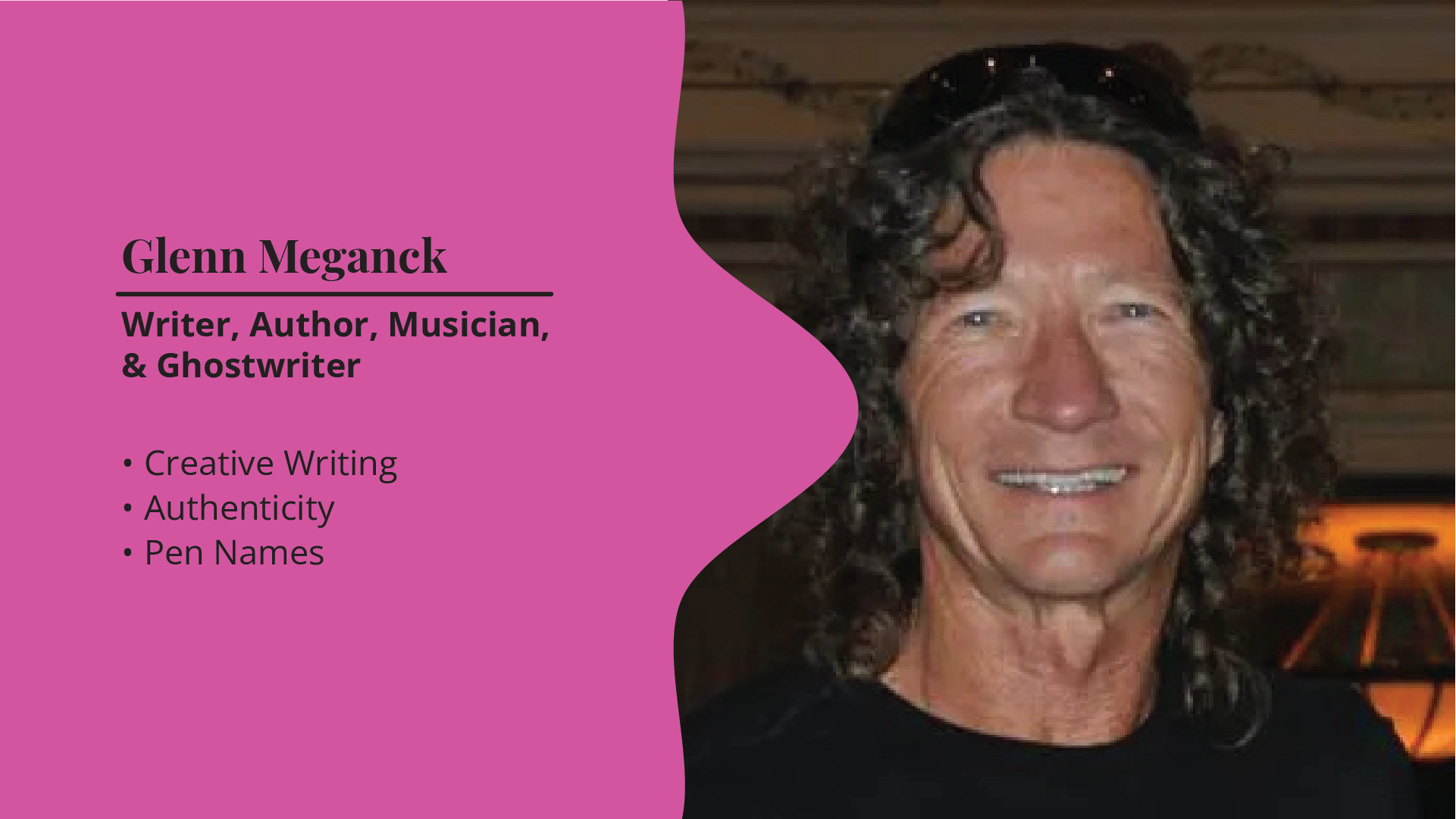
Interview
Transcript
00:00 Victoria Bartolotto
It’s okay. To start, could you do the favor of introducing yourself? Spell out your name, tell us where you’re located currently. And yeah, we’ll start there.
00:10 Glenn Meganck
My real name is, that I rarely use is Glenn Meganck. And right now, I’m in Chapel Hill, North Carolina.
00:20 Victoria Bartolotto
Okay. Can you tell us a little bit about your job? I know you do multiple things, songwriter, ghostwriter, author. Can you just tell us just a little bit about what you do and what you specialize in?
00:35 Glenn Meganck
Well, that’s it. Every day I do some writing and some music. Both are equally important to me. So, I tend to write every morning, seven days a week, and then switch to music at some point in the afternoon, and work on more songwriting and recording and that sort of thing. I’m always working on at least two or three novels at a time, it seems, these days as well, under a lot of different genres. So, there’s no one kind of thing that I do in terms of that.
01:07 Victoria Bartolotto
I know one of your books, “Booking a Killer Vacation”, is set in Myrtle Beach, South Carolina. Is that correct?
01:16 Glenn Meganck
Yeah, that’s a J.R. Ripley book, and that’s more like a light mystery, which I do a lot of those. I did a bunch of them in a very short period of time, and now I just do a few here and there, but…
It was something I had never done before, and then I just sort of fell into it for a couple of years where people were asking for them, a publisher. And so, I ended up doing about, nine a year for a few years. Kind of cranking them out until I got kind of tired of it, because it really wasn’t what I did. I really didn’t even know the genre at all. It was like, “oh, I better read some of those and see what they do.”
02:01 Victoria Bartolotto
Can I ask specifically about that book? What about South Carolina or Myrtle Beach itself drew you to that specific location? What did you think was unique about it that you were like, “yeah, this needs to be set in South Carolina?”
02:15 Glenn Meganck
Well, for that genre, of these sorts of cozy light mysteries, that are amateur sleuths, right? So the setting is important. You want someplace unique and that makes sort of like its own little world that can be fun and has enough interesting things going on. Not necessarily a small town, but most of them are in a small town. I mean, there are a few that are probably in New York City that people do, but in general, they tend to be a either real, a fictionalized version of a real town or again, just something you make up or use like Myrtle Beach. I like Myrtle Beach and I’ve been there a lot. And it was a good setting. And I just finished a couple more of them. And it has a nice vibe.
I love music. I mean, I’m a musician. So, the next one, when I finally got back to doing more of them, the next one, which comes out in, I don’t know, a couple of months, maybe, that one involves music as well. And of course, in the Myrtle area, there’s lots of live music and bands that come through and theater. So I was able, in the ’60s kind of music and stuff, so I was able to incorporate that. Then in the third one, which I wrote already as well, but I don’t know when that one comes out, but that one involves more surfing. So, it has people surfing yeah, so. But yeah, it’s just a fun place. And because it’s a place a lot of people know and have been to, at least in this country, and lots of tourism. It has a lot of interesting characters too, the kind of people that come there and the partying and then the motorcycle events and things like that too. And yet it’s a small, sort of a small town feel in and of itself, you know?
04:10 Victoria Bartolotto
Definitely. Overall, throughout your creative career, was there a defining moment that you can think of that led you to wanting to become an author or wanting to do kind of multiple pen names? Was there anything that really stood out to you when you were like, “yeah, I want to be a writer? Yeah, I want to pursue this kind of career?”
04:34 Glenn Meganck
The writing and music, I’ve always been since the youngest that I can remember. I loved to read. I didn’t grow up in a household where reading mattered or music. I mean, my grandparents loved music and played, but my parents weren’t into music, didn’t play at all. They listened to country music, but they didn’t play any instruments and nobody read books in my family except me. And, I always wrote whether it was writing poetry or whatever, when I was a little kid. And I always wanted to learn the piano and then the guitar and whatever so I just kind of started on my own with all that. And it’s just sort of like a compulsion. I’m not happy or satisfied if I don’t do it.
The pen names is because when I started out getting published, I remember I was still living at home. I was young. One day I was home alone and, at my parents’ house, and a girl came knocking at the door and wanted to meet me because she’d seen an article about me in the paper. It just freaked me out, you know, and it was a book that came out under my real name. And I hadn’t thought about it at the time. This was when I was living in Florida. It just freaked me out that people knew who I was. And so, I liked the idea from then of using pen names, because I like being anonymous.
So, I’ve done a lot of books and a lot of music where, and for the longest time it was new book, new name. New record, new name. Just so nobody would ever know who I was because I like my privacy. So, I’m still not keen on a lot of that. I know, especially these days of social media and everything, it’s kind of hard to remain anonymous. And of course, publishers or music people and whatever in the business, they don’t want you to be anonymous because that doesn’t sell, it’s not good for business. It’s not good for your career. In a perfect world, I would be completely anonymous.
06:54 Victoria Bartolotto
Yeah, I can relate to that a little bit. I’m a writer myself. I’m in school to become a writer and I’ve been thinking about pen names and things like that because, like you, I really don’t like people in my privacy, especially with, like you said, social media. Everyone wants to know who you are. Everyone wants to know everything about you. And it’s like, that’s not how it should be. Celebrities are people too.
07:20 Glenn Meganck
Exactly. I’m not in it for that. I don’t care about celebrity stuff. I don’t care about other celebrities. I don’t care. I mean, for a long time I lived in LA full of celebrities and the gym I would go to was full of all these really well-known people in every aspect of the arts, especially, actors and musicians and writers. I mean, because it was in this little studio in this area of town where they all went, and that’s where I happened to live and go too. But it didn’t mean anything to me, and I just wanted to be left alone.
And when I would go to the gym, I never talked to anybody. I always felt like, I always feel invisible, that nobody sees me anyway. I can just come and go, and nobody notices me. And then one day in the gym, a woman came up to me and said, “my friend is afraid of you.” I thought, “huh?” I never talked to anybody. And she said, “yeah, you come here every day. You never look at anybody. You never talk to anybody. You’re just kind of freaking her out.” So, I said “I didn’t even know you saw me, I just feel like I’m a ghost.”
And the other thing, for you as a writer, what evolves though, uh, with the writing. What kind of writing do you do? Do you have any preferences?
08:43 Victoria Bartolotto
I’m very into historical action, very much like treasure hunting. I love any kind of contemporary story that involves history, that involves big impacts on the world. Right now, I’m currently writing a treasure hunting series that takes place in Key West. So I’m super excited about that project. I’ve been thinking about it for so long. So, I really want to go in the direction of kind of this contemporary adventure that isn’t so much commercialized. I feel a lot of things are, especially commercialized fiction nowadays. I feel it’s so quick and rapid and not deep, if that makes sense.
09:27 Glenn Meganck
Oh, sure. I mean, the market right now, because the people who run the business, they’re business people. They’re not the kind of people who, when you read about the days when Hemingway and stuff was writing, where the editors really loved books and cared about books. Now they’re just marketing people and that’s all they care about; how many followers you have. Whatever kind of book succeeds, they just want more of those. So, it’s tough. But so like with yours, I mean, so you have historical elements in it too, or just more of a modern day?
10:04 Victoria Bartolotto
It has some historical elements. I did a lot of research on this one fleet of Spanish ships that went down in the Keys, and there was someone who went and found all the treasure in that, fleet. One of my questions was, for the novel to take place, because it is obviously fictionalized. I don’t want to just pull directly from history and do whatnot. But one of the questions I had was, “what if there was a third ship?” Because there were two that went down. And so, I’m like, “what if there was a third ship with a secret treasure on it that no one knew about?” And it draws from some people who actually lived in Key West. It draws from this one guy who actually owned it at one point before America bought it. Not Mel Fisher, I know who that is and that’s who like found everything. I actually went to go see his museum there and I did like the whole walkthrough which was an amazing experience.
11:05 Glenn Meganck
I’ve met him in the past a long time ago yeah.
11:07 Victoria Bartolotto
Oh really? Oh wow! That’s cool!
11:10 Glenn Meganck
Because he lived in Florida so I met him there, yeah.
11:15 Victoria Bartolotto
Yeah, kind of just really want to incorporate the history of Key West and how it kind of became the kind of big tourist spot that it is now. Maybe draw a little bit of attention to how it’s not just a tourist spot. There’s actually a lot of history here that no one really knows about. So that’s kind of my goal with that novel, with that series.
11:37 Glenn Meganck
So that’s it, you’re planning it as like a series?
11:40 Victoria Bartolotto
Yeah, I want it to be a three-book thing.
11:43 Glenn Meganck
Yeah, that’s a good way to look at it. Anyway, again, my advice is because I remember sometimes, again, when I was starting, you’d write a book and you’d think “that’s it, that’s just all I want.” But then the publisher would want more. And like, wait, there can’t be more. I mean, that was the end, but they wanted it to be a series because it did well enough and they liked it.
I had thought, well, I boxed myself. Where am I going to go? How am I going to do that? But you find a way. Now, whenever I do a book that even as a standalone, I always tell myself, leave some room that it could be a series. And then to get back to your point again with the pen names, though, the way it develops too, because of the business side of it over time as it’s become harder and harder and tighter and tighter and more labels become more important.
So certain pen names and most of the names I use are just ones that I can’t say anyway, even though they’re pen names or names that publishers asked for. I do the ghostwriting too with other authors. But so, if you have a certain name, for a style of book that you do, then if I write a book that’s like the, what was the one you said, the Myrtle Beach one? I forget the titles because I write so many books in a year. But the Myrtle Beach series, when you write a book like that, and then you say you write a book that’s more like Carl Hiaasen kind of novels, which are kind of Florida thrillers, but there’s a lot more sex and violence and all that kind of stuff. Well, you can’t very well do that under the same name because it’s a different audience, they’d be offended by the language or whatever. So it’s better the publishers would rather that was under a different name.
So your name sort of becomes your label. They know you’re buying a certain name that they’re going to get a certain kind of book, right? If you buy a James Patterson book, you know what kind of the vibe and feel and language are going to be, right? Or if you buy a, I can’t think of anybody modern. I mean, but they’re a lighter novel or someone who writes literary things.
The business just expects you to stay within that. And the bookstores, they don’t want a cozy mystery by someone who writes hard thrillers. Well, no, that’s not going to fit or that doesn’t sell. They’re looking at that name. They would rather have it under a new name. than the other name, even though people know that name. They would rather you start with a fresh name. So, the little things of the business that come up that, you know, for better or worse, that’s the business.
14:40 Victoria Bartolotto
With changing up the names, because every time you take a new name, you kind of get a fresh blank page, fresh slate. Is there any kind of fear that comes up that maybe the project isn’t going to work out or maybe dipping into this genre isn’t going to be received well? Is there any kind of fear or something around that that you experience?
15:02 Glenn Meganck
Not for me, because I don’t care. I mean, I do what I like to do, and it’s all I’ve ever done, you know? So even within a certain genre, if I don’t like it, I’m not going to do it, and I don’t need to do it. So, I don’t do it for the money. I don’t do it for fame, clearly. I just do what I feel like writing, and it has to excite me. It has to make me want to sit down the next morning and do some more of that and have it in my head like you, you’re a writer you know, so it’s in your head.
You couldn’t pay me enough to write something I didn’t want to write. And whether it succeeds or not in a genre, again, I’ll get asked to do things and I can’t go into them because they’re for other well-known authors. But, in genres that I don’t necessarily write in, they’ll say they’re stuck and, “oh, can you help me?” And I don’t really want to, but people ask and it just becomes, “oh, fine, I’ll help you.”
Then it’ll often be where I have to research the genre a little bit. And then even then I’ll kind of twist it to the way I see it, like one that I just recently doing with, again, a bestselling author, but I thought, when he first asked me to do it was because he felt like he couldn’t write the next one. I said, “yeah, no, I’m just not the right person and I don’t want to write it, it’s just not my thing.” And I said, “you went too dark and that kind of violence. I just don’t gravitate.” And he said, “well, don’t make it like that. Make it sound like me but make it like you too. And you can make it what you want.”
Ah fine. I just try to always truck myself out of jobs. So, things succeed. I’d rather write what I like and have 10 people like it than write something I don’t like and have a million people like it. You know what I mean? Because I would. And I would be out of it and I’d feel like I’d cringe. So, I worry about failure if I’m happy, though I’m never happy. So that’s different.
17:11 Victoria Bartolotto
As we kind of wrap up, do you have any kind of advice or skills that you would give to college students like me or people in high school that maybe want to pursue becoming an author? Do you have any kind of advice to give to those kinds of people?
17:25 Glenn Meganck
Well, just kind of what I was saying. I mean, write because you love it. Don’t write because you think you’re going to make money. Don’t follow the trends. Just write what you love because you’ll find your audience. It’s easier now in some ways because you can always self-publish, indie publish, whatever, and get started and get your name out there. So instead of trying to be like everybody else, which is how I feel about life in general. There’s an old song called “Dare to be Different”. And that’s how I think. Don’t be afraid to be different. Don’t be afraid to say what you feel.
And another thing people get into when they write their first book is they hold back because they feel, well, “I can’t put too much in it because what will I write about in the next book?” Don’t worry about it. Just throw everything. It’ll come. And for me, and again, this is just my advice. Plenty of people will tell you different, but for writing and music are two things that I absolutely love. And just, I mean, I can’t live without them. I do them every day just because I can’t not do them and I’m not satisfied if I don’t. But they’re also the two things I would never go to school for personally, because I don’t want anybody else telling me how to do it.
Isaac Asimov, when people would ask him, how do you write a novel, he would say, write a million words. I mean, all these people, they would say, don’t go. I mean, all you’re going to learn is how someone else did it. If you want to be unique, do it your way. Just don’t worry about the rules or whatever anybody else tells you. Just go figure it out your way. And that’s, that’s what I’ve always done. And whether people like it or not, I mean, I don’t care. So it all worked out okay for me anyway.
So, I mean, I had a friend who, her father, an old girlfriend, whose father, he had been in World War II as an American soldier. And when he got out, he wanted to be, he was an artist, a painter, and a writer. And they decided to stay in France after the war. And the mother taught at an American school. And he would paint in the summer and write in the winter. Never sold anything. Couldn’t sell a painting, couldn’t sell a book, couldn’t sell anything, right? Until he was about, let’s see, I would say he was 55 or 60 years old. And then out of the blue sells a book for half a million dollars. And took off from there. They made some movies, some other books, but I mean, he just kept doing what he did. And he again, did it under a pen name because he didn’t want anybody to know who else. And he wanted to paint under one name, do his books under another name, and have nobody know any of the names. And when he died, he had a huge warehouse with full of thousands of paintings because he didn’t even want anybody to see him or make them for sale at that point. He just thought, oh, I don’t need money now, so I’m not even going to try to sell them, right? He just hoarded them all.
20:23 Victoria Bartolotto
Thank you so much for taking the time to talk with me today.
20:32 Glenn Meganck
Yeah, thank you.