“Build your connections and your network. No one works in isolation especially creatives.”
Quick Facts
Education Level: Graduate School
Years of Experience: 20+ Years
About
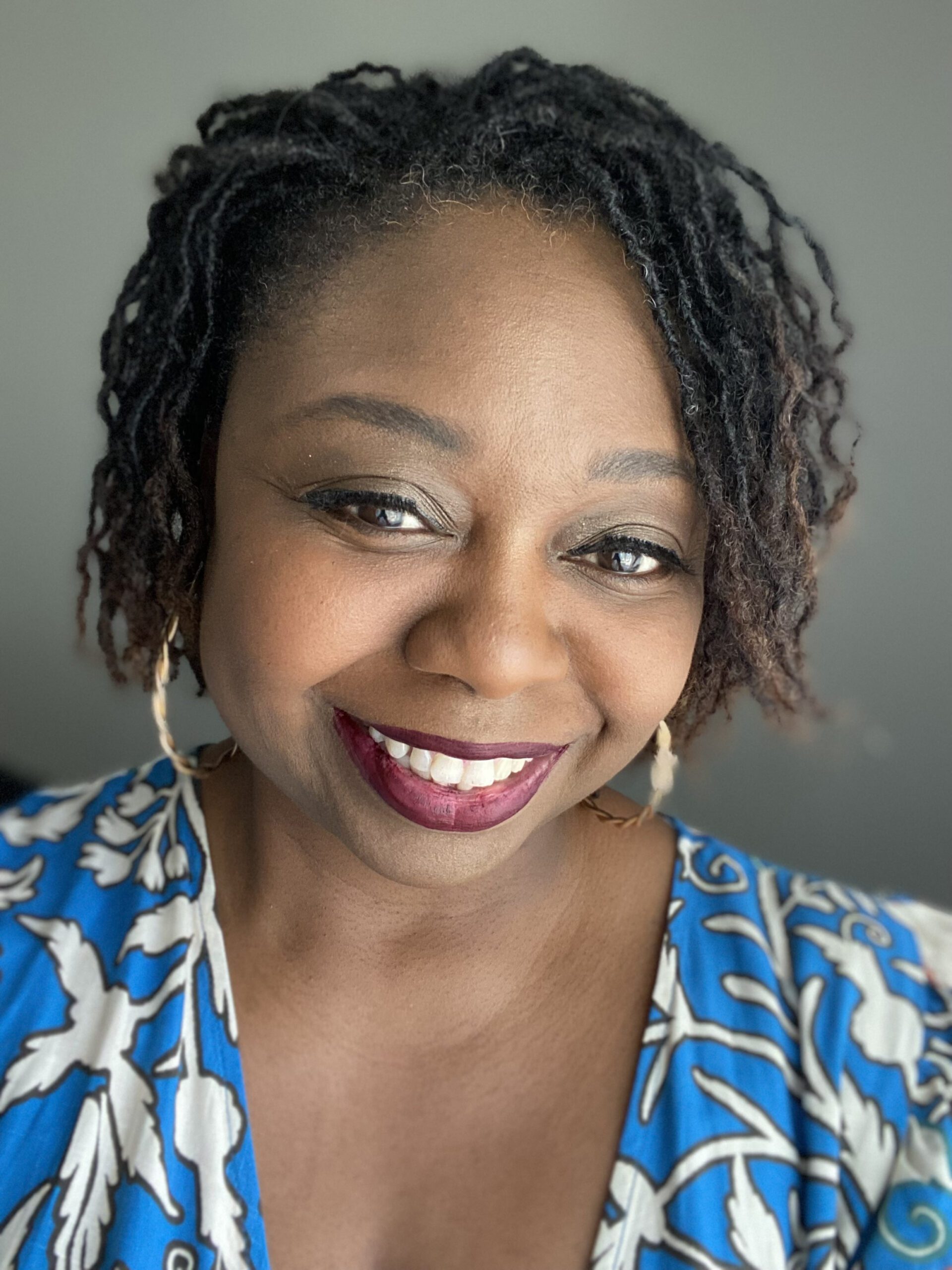
Aldrena Hicks is an artist and designer whose work spans cultural storytelling, visual design, and event stationery. As the founder of Only Lovely Creative, she creates meaningful visual experiences that connect people to their stories, whether through design projects, cultural initiatives, or personalized celebrations.
Her journey into the field was shaped by a lifelong connection to creativity. Growing up within a family of artists such as makers, musicians, and fiber artists, creating was always a part of her world. She shares that, “An art class in high school first sparked my interest, and I went on to study Studio Art at Columbia College SC. During my second year, I took my first graphic design course and realized that design was the lane where my love of art, storytelling, and problem-solving all came together.”
Aldrena prioritizes time and research on the story behind her current projects, whether it is an organization, cultural initiative, or a couple planning a wedding. This allows her to understand the depth of the client’s story and helps her unique creative process. She explains that “Understanding the people and context helps guide the creative direction. I also still build paper prototypes and explore ideas by hand before moving fully into digital design. That mix of research, storytelling, and hands-on experimentation shapes the way I approach every project.”
Storytelling and cultural identity are central to her work. As a South Carolina creative, she explores how design can help people celebrate who they are and the moments that matter in their lives. Her graduate thesis, “Little Brown Girl,” focused on identity and representation in design and later evolved into her self-published book, “You Are a Queen,” which speaks to young Black girls and the young girl within about identity, worth, and self-definition.
Aldrena emphasizes the importance of collaboration, connection, and understanding the business side of creative work. She encourages emerging creatives to build strong networks, seek feedback, and recognize that sustainable creative practice requires both artistic and professional awareness.
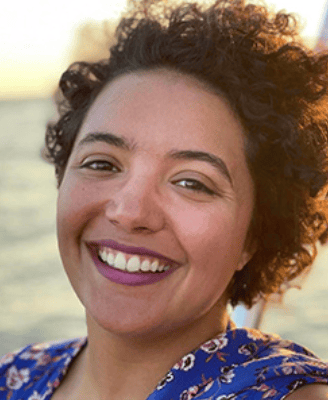
Bonnie Harris-Lowe is the creative director of Basking Bee, a gaming company dedicated to collaboration and self-determination, as well as a full-time instructor at the University of South Carolina. Her studio works to produce independent games while taking on freelance work for interactive projects. Bonnie has a passion for making the gaming industry a space for girls and people of color, and she is determined to change games for the better.
Bonnie has been playing video games since the age of six, but she felt a sense of hostility toward her race and gender. After experiencing the “Gamer Gate harassment scandal” in high school, she took classes in multiple forms of media production and decided she wanted to change the world of gaming, starting with creating her own company. She highlights the importance of “learn[ing] as much as you can,” especially to be able to “meet likeminded creatives.”
There is more than what meets the eye at Basking Bee Games. While most gaming studios choose between creating content or doing contract work, Bonnie’s does both. Bonnie proudly states, “Basking Bee was designed as a hybrid studio with the goal to build a collective portfolio for industry newcomers through independent games,” while working as a full-time instructor.
After realizing all her notes were filled with drawings and not written words for her biology major, Kelley Pettibone switched to Studio Art and never looked back. Currently, she is an Artist and Instructor at the University of South Carolina. She primarily works as a woodcut relief printmaker, but also dabbles in painting, mixed media collage, sculpture, and paper making.
During her BFA, she suffered a hard familial loss and struggled to find creativity. Over time, she channeled her feelings through her artistic practice to visually document her journey through grief. Kelley is an advocate for the healing nature of creating art and refers to her studio as a “sanctuary.” She insists that “a box full of ‘no’s’ indicates that you are putting yourself out there and trying,” and emphasizes the importance of continuously submitting your work.
Kelley enjoys fusing inherited family ephemera and repurposed materials. In her next project she will be reimagining denim, a fabric spanning the age of four generations, to make paper. Kelley strives to express her emotions through her work and allow her creativity to live a life beyond herself. She loves teaching and advises any potential graduate student to experience an Assistantship, feeling as though every class is “a series of playdates each day.”
“Stay connected to your community and honor what came before you”
Quick Facts
Education Level: Graduate School
Years of Experience: 10 Years
About
Joshua L. Shumak, Vice Chief of the Wassamasaw Tribe, works to preserve and promote Native American culture in South Carolina through leadership, cultural education, traditional arts, and community partnerships. Growing up, he recognized the importance of cultural knowledge, art, and storytelling in sustaining identity. He began by engaging in cultural preservation efforts and learning traditional arts from Native artists and cultural leaders, which developed into a broader commitment to advocacy, education, and community engagement.
The uniqueness of his work comes from its intersection of culture, community leadership, and public service. As Vice Chief of the Wassamasaw Tribe of Varnertown Indians as well as the Tribal Liaison for the State of South Carolina, he operates between tribal communities and state institutions, fostering collaboration and mutual understanding. His work emphasizes “the intersection of culture, community leadership, and public service.”
He emphasizes the importance of remaining connected to one’s community and understanding that creativity is not only about producing something new, but also about honoring what came before. For Indigenous artists, creative work carries stories, teachings, and responsibilities. He encourages aspiring creatives to learn from elders and mentors, to understand the meaning behind traditions, and to develop their voice from their cultural roots.
Joshua prioritizes the fact that Native cultures are living cultures. The tribe’s traditions, arts, and stories are not just part of history—they continue to evolve and thrive today. He tries to “help create spaces where Native voices, artists, and communities can share their stories in their own words, and ensure that future generations have the opportunity to learn and carry those traditions forward.”
“If you ever start to feel inadequate at what you’re doing, don’t let that stop you.”
Whitney McDonald is the Theatre Operator for the Amentum Center of Performing Arts and the Aiken Community Theatre in Aiken, S.C. She acts as a liaison between the city and the theater, runs the box office, and handles communications for the theater.
Interview
There was a technical issue with our audio during this interview, so we are providing just the transcript.
Transcript
Whitney McDonald 00:00 Hi, I am Whitney McDonald. I live in Aiken, South Carolina. I am the theater operator for the Momentum Center for Performing Arts. It is a city-owned facility, and Aiken Community Theater is the main tenant. So, I work mostly for Aiken Community Theater, but I also do work for the city as well. I’m kind of split between both. I am more of a liaison between the city and the Aiken Community Theater.
Haley Hansen 00:28 How long have you been doing that?
Whitney McDonald 00:29 Two years in August. Yeah! coming up in August. It will be two years.
Haley Hansen 00:33 Can you walk me through your typical workday?
Whitney McDonald 00:36 Sure. I come in at 8:00 a.m. every morning, even though the box office isn’t open until 9:00. I use that hour to check voicemails and emails for both the theater and the city. I walk through the theater to make sure everything looks okay, especially if we have a rental that day making sure the stage and the back hallway are clean. After that, I answer phone calls and emails. It really depends on what is going on that week or month. There is always something different to do, which keeps you on your toes.
Haley Hansen 01:21 How did you wind up in that field?
Whitney McDonald 01:23 I’ve been a part of the theater for a long time. The previous theater coordinator was with the theater for over 20 years, and I always thought, “If she ever retired, that would be a really great position to have.” It seemed like a nice job weekend off, evenings free. In mid-2022, she announced she was leaving, so I applied. I knew it was a city position, so I had to interview both the city and the executive director of the theater. I had an interview one day, and two weeks later, they offered me the job.
I already knew everyone in the theater. I’ve always been a performer, mostly on stage, and a bit backstage. I did not realize how much went on behind the scenes until I took the job. I’m still learning new things every day. There is no handbook for this position; my predecessor created the role. So, I’m the second person to fill it in. I just take it day by day with support from the board and executive director.
Haley Hansen 03:08 Was there any specific moment when you realized you wanted this job?
Whitney McDonald 03:25 It was always in the back of my mind as a “Dream Job,” but I never thought it would really happen. I was happy doing theater as a hobby. When the job opened, I saw it as an opportunity. I figured even if I did not get it, I would not regret applying. It still feels surreal that I actually work here, kind of like a dream come true.
Haley Hansen 04:21 What were you doing before you came to this position?
Whitney McDonald 04:24 I did a lot of retail, food service, and worked in banking for a while. Those were the main things. I didn’t have a lot of administrative experience, other than what I gained in banking. I think I got lucky. Knowing the people involved helped a lot.
Haley Hansen 04:45 What was the biggest adjustment when you started?
Whitney McDonald 04:58 Getting comfortable answering the phone was a big one. I keep my personal phone silent all day, like a true millennial. Learning the ticketing system was daunting too. The previous coordinator had already left, so there was no formal training. Volunteers, board members, and the executive director helped, but I had to figure out a lot on my own. Learning quickly and independently was the biggest adjustment.
Haley Hansen 05:50 Are there any specific skills a student or young adult should pick up if they want to work in theater administration?
Whitney McDonald 06:01 A background in administration would help. I did not have much, and I was lucky this position didn’t require a lot of it. It depends on how much administrative responsibility a theater coordinator has. We have a treasurer who handles finances, and our executive team shares administrative duties. Also, being okay working alone is important and there are many days I’m here by myself. Customer service is key, too. You are the face of the box office, so being pleasant and helpful really matters.
Haley Hansen 07:19 That’s helpful.
Whitney McDonald 07:20 I’ve never met another theater operator, so I can’t really compare my role with others. Each theater’s daily operations are unique.
Haley Hansen 07:34 Are there any organizations, programs, or events you’d recommend for people interested in theater?
Whitney McDonald 07:43 We used to offer workshops, improve acting classes but haven’t in a while. That is a great place to start. Or just go to an audition. That is how I got started, I had never done theater before, went to an audition, got cast, and went from there. As for getting a job in the industry, I don’t know the exact route. I just got lucky. Some theaters require degrees or certifications.
Haley Hansen 08:28 It sounds like if you show up and get involved, people will help.
Whitney McDonald 08:33 Absolutely. We always welcome new volunteers and encourage people to come in and help.
Haley Hansen 08:40 Do you have any advice for students pursuing a creative career?
Whitney McDonald 08:46 If you ever start to feel inadequate, don’t let that stop you. I feel that way all the time, but I am still learning. If it’s something you really want to pursue, don’t give up. That’s my advice.
“It’s a very fortunate blessing to find something in life that you like enough that you do it before you’re paid for it.”
Philip Mullen is a painter and professor emeritus. Philip Mullen reflects on decades of artmaking and mentoring and why South Carolina and a bathtub shaped his creative life.
Interview
Transcript
Nora Smith 00:00
Alright, to start. What do you do for work, and where are you currently working from?
Philip Mullen 00:07
Well, I’m a painter of large acrylic paintings, and I have a studio in Columbia. My studio is designed for large paintings. It’s 1300 square feet made as a studio for that. Actually, when I first built the studio in 1989 and when, right after I built it, a national magazine was running this…It was called, The Artist Magazine, and I think it may have had the biggest circulation of any art magazine at the time, because it was, it was aimed at a really clever group, and that was amateur artists who think they’re pros, a very large audience. But it’s, you know, it’s a great audience. It’s a wonderful thing for people to go into. But they used mine as an example of how to set up big paintings.
And the two, the two items that kind of got them interested was, I needed a big sink. Big sinks are really expensive, but mobile home Bathtubs are really pretty cheap, and you can mount them up high, like a sink. Of course, the guys who installed it kept saying, what are you going to have a ladder to get into this thing? No, no, guys, it’s a sink. It’s a sink.
And then during the time I did, it was, I was represented for 35 years by David Finley galleries in New York. And those shows, you know, I had, like I said, 14 solo shows with them over the 35 years. And those shows often would have 40 to 45 pieces, half of which have six-foot dimensions, or half of which just had a four-foot dimension, and maybe a few larger ones included. And because the way I do my edges, I can’t set them down, but I’d have a lot of paintings collected up at any one given time. And I designed a very simple rack that I could hang 46-foot paintings on without the edges touching anything.
More of an answer than you probably needed. I warn you, I was once interviewed on the radio, and after 10 minutes, the interviewer said, Mr. Mullin, I was kind of hoping to ask a second question.
Nora Smith 02:45
Okay, well, this one kind of wraps in with the first one. How long have you been working there, and what is your official job title?
Philip Mullen 02:53
Well, my only official job title now is artist. And I guess I have a sort of official job title as distinguished professor emeritus from USC. I had a very good arrangement with USC. I taught there from 69 to 2000 and, but I took nine, I did not teach in summers, and I took nine years of leave during that time. So, I taught 22 because those New York shows took an enormous amount of time to put together. You really put it this way, my art gallery friends were very suspicious of my teaching, because they said, if you teach, you can’t paint enough. And my teaching friends were very suspicious of my art gallery’s success because they said, “You can’t sell without selling out.” And each of those things probably has some basis in possibility, but there’s certainly things you have to watch out for.
Nora Smith 04:06
Yeah, well, you just do, you do it all.
Philip Mullen 04:10
Well, I was a bit of an obsessive worker for decades and decades. It didn’t make me socially very interested, but I got a lot of artwork done. And the teaching, you know, the teaching like that, was wonderful, because I didn’t end up doing it quite, it wasn’t like I was doing it all the time. You know that one period where I literally was taking half, where I had 12 years and only taught during fall semesters, yeah, and so it made my teaching much more exciting for me, and it was like a chance to talk to bright young people about the only thing I knew anything about. And it, you know, while I’m sure there were other teachers that were more talented, as teachers, than I was.
The one thing I could bring to it was especially like the graduate students might see me working on a particular painting and then end up seeing that painting reproduced in Arts Magazine, for example. And so, it brought the sense, I think, to students, that it could be something bigger. That was especially true before I built the studio in 89 because I had a studio at the university furnished and, you know, graduate students and undergraduates were in and out of that while I was down there.
Nora Smith 05:40
That’s so cool.
Philip Mullen 05:42
Well, I tell you, it’s, you know, its a very fortunate blessing to find something in life that you like enough that you do it before you’re paid for it. You do it if you’re paid for you do it if you’re not paid for it, you know people, they said, “Oh, man, you’re so disciplined, you’re always in the studio.” I wasn’t disciplined. I was self-indulgent. I was doing what I, you know, that’s what I wanted to be doing.
Nora Smith 06:11
Yeah. Super cool! Okay, so this is more of a question specific to your area, okay, in the creative field in South Carolina. What is one thing you love about working in the creative field in South Carolina?
Philip Mullen 06:29
Well, one thing that was that I found really great at first, when I was young and needed to get grants for something, was that while there may not be as many grants here as there are in a bigger city, when you stop to think about how many artists are per grants available, it’s pretty rich here. When I got with my gallery in New York, I’d had the good fortune of being included in a show called the Whitney Biennial. It’s a show at the Whitney Museum in New York, and in 1975, and I knew I wanted to have a gallery in New York, so I wanted to take advantage of that.
I took a year off of teaching, moved to New York, and did that, I did have sabbatical money that time. Most of my leaves were unpaid, but I went on sabbatical money. I spent all of my own money, but got what was at the time, a quite large grant from the Arts Commission to go there. Rented three fifths of Andy Warhol’s old factory, lived and worked in that. Of course, lived illegally.
Nora Smith 07:42
The commitment, a lot of commitment there.
Philip Mullen 07:45
Yeah, I learned a couple of very important skills there because of living illegally, you know, because if you’re in a place that is selling commercial in New York, they only have to give you heat six days a week. Oh yes. And so first we crank the heat up, you know, very high on Saturday night and hope to survive till Monday. Later I learned two of the skills I developed was how to hotwire a locked elevator and how to start up a furnace in a big building. And none of the other tenants complained, and the building manager didn’t like the building owner. So, I’m sure he figured it out when he came in every Monday and the furnace was on.
Nora Smith 08:29
That’s so funny.
Philip Mullen 08:32
The art world, the painting world, has changed a good bit since then. Now I loved, absolutely loved the notion of earning money, selling paintings in New York and spending money in South Carolina. You can see where that might function. Of course, one of the things I did learn is, if you’re going to do that, you’re not just making paintings and somebody else is doing stuff for you. You are pretty constantly working on business things as well.
Nora Smith 09:06
For sure, for sure. Yeah. How would you describe your local professional community around you?
Philip Mullen 9:16
It’s a lot like most places. There’s a few people who are, who are, you know, real top-notch pros to deal with. There’s a lot of people who it’s a hobby for, and it’s a wonderful hobby to take up, you know, I mean, I was reading one time about in different professions, what age you peak at. Or you don’t want to be a female gymnast, you know, you peak very early in life, but being an artist was actually the thing that you the people peaked at the latest in life. Yeah, you know, it’s sort of something that you can do for a long time.
So, I would describe most of the community as a sort of normal hobbyist community. But one of the funny things, you know, in certain areas, there’s sort of funny things that occur in terms of how people develop, like, if you want to learn yoga real well, pretty quickly, you end up going into yoga teacher training. I mean, even if you don’t want to teach, you go through yoga teacher training, and all of a sudden, then you’re a trained yoga teacher.
Nora Smith 10:33
Yeah.
Philip Mullen 10:34
So, you’re out teaching yoga. If people go and take a painting, go into it. I mean, very quickly, way too quickly. Generally, they feel like they need to get out and start selling their stuff. And I’m a little suspect that was certainly not me. Now, when I did it, I got, I was obviously really serious about it, because, you know, I’ll tell you that year in New York, while it was professionally very important, it was very lonely, I’m going around to galleries, trying to get into galleries. They’re being approached every day by artists. Many of them are not very polite to you. You know, it pretty gruesome thing. You know, to be an artist, you’ve got to have it in one seat. You’ve got to have a big ego. I mean, the idea that, the idea that you can make something and somebody else should actually take time looking at it, is pretty amazing.
That they should actually pay you for it is incredible. But myself, like most artists I know, have very fragile egos. You know, it’s so getting out there and trying to do that part about promoting it is something.
Now, I did, you know, I lived in New York. I did not want to raise a family in New York, like South Carolina, that way. You know, in 69 when I was looking for a university teaching position, I very specifically looked at the south, it’s one of those, you know, I didn’t know where I was raised. I went to nine schools before I was out of high school. You know, when I went to college, I thought I’d settle down, and most of us in states in the north, but for three years, it was in Texas, and that was the only place that the weather made any sense to me. So, I focused on South Carolina, and the position I got here worked out so so well for me. Fortunately, I never really had any reason to not want to just stay.
Nora Smith 12:55
That’s great. That’s great. How would you define success personally?
Philip Mullen 13:06
Well, I think one of the wonderful things about being a serious artist in an art is that we define other artists’ success in terms of the work they make. We don’t define it in terms of how well they do business. Mm, hmm. We all know people who have who are just out of the out of this world, sensational painters, lot of depth to their work, and all who never get any recognition. We also know people who are just hacks who make tons of money because they’re great business people.
Nora Smith 13:45
Yeah.
Philip Mullen 13:47
In a way to me, success has to do with putting together a life in which I could do, spend a lot of time, making paintings. Now, there were parts to that that were, you end up doing some other things in order to make that happen. You know, in my case, one of the things I did was I did an academic PhD, which was, boy, not my forte. I was, I mean, that was three years of struggling, but it gave me a wonderful way to get into a really good academic position, which gave me a basis of support and encouraged me to do a lot of painting early on. In those early years, I used to send a lot of shows around the state, including one to Coastal Carolina, probably back in the early 70s.
Nora Smith 14:50
How lovely!
Philip Mullen 14:51
It might have been later than that, because actually, one of my students ended up as a theater professor at Coastal.
Nora Smith 14:58
Really! Are they still here?
Philip Mullen 15:00
I would Imagine not, and they must be retired by now. I cannot remember her name.
Nora Smith 15:09
That’s alright.
Philip Mullen 15:10
She did have it. Have you ever seen the movie sleeping with the enemy?
Nora Smith 15:13
No, but I’ve heard of it.
Philip Mullen 15:16
Yeah. Well, it’s almost just a two-person thing, but she’s a big part in that.
Nora Smith 15:21
Oh, okay, that’s super cool.
Philip Mullen 15:23
If you ever watch it, she’s a nurse and she was a professor at Coastal.
Nora Smith 15:27
Oh, that’s super cool. Okay, great to know. I find out so much doing these interviews with people, yeah, so kind of going back to the beginning of starting your career. What was your biggest fear when you decided that you wanted to do something in the arts?
Philip Mullen 15:41
My biggest fear, well, I certainly had no encouragement. I’m not going to say the words online that my dad said to me when he realized I was actually going into being an artist. It’s not something you want to publish. So that was, that was a big challenge.
Nora Smith 15:58
Yeah, I’m sure, I’m sure.
Philip Mullen 16:00
Fortunately, I ran across people who gave me enough encouragement. One thing that helped me a lot was that I graduated in the lower half of my high school class. I did not want to go to college. I didn’t know what else to do. I got to, you know, I went to the University of Minnesota. I had been such a poor student, I realized I’d never get through college, so I figured, and I was not an art major, so I figured I’d go hang out with my buddy Mike, who was an art major. And I got over there, and I realized that the beginning art classes were not much fun, and the art majors had to take them, but I didn’t. So, I sort of had to talk this professor into letting me start in that upper level, middle level, I should say mid-level painting course. He did not want to do it, and I was kind of persistent. And he finally said, okay, okay, I’ll let you in and under his breath, he said, “In the other guy’s section.
And it turned out the other guy was Ed Corbett, who back when abstract expressionism was getting going, and the Museum of Modern Art did a show of 16 of the young abstract expressionists. Ed Corbett was in it. So, my first teacher was an absolute top run guy, and I thought, and I had had really very little success in life. So, failure was like, was getting pretty, if not comfortable with it, at least used to it. I just think this is wonderful. These guys get to spend tons of time just making paintings. What could be better? You know? Yeah, I still feel that way. That didn’t go away. And that’s amazing. That’s amazing to have it last that long. You know, I mean, and I was, what was 18 years old, then I’m 82 years old. Now, it’s great to have something stick with you that long.
Nora Smith 17:55
Yeah, that’s amazing.
Philip Mullen 17:57
It is, it’s, I don’t feel like taking credit for that so much is just being very thankful that I stumbled upon the stuff that made me want to do that, you know.
Nora Smith 18:10
Right. So, what would you say is the best and worst advice you’ve ever received about going into the field or being in the field, just some things you’ve heard?
Philip Mullen 18:22
I can’t think of anything, anything that I really think was best or worst advice. I think a person needs to be realistic about what they’re willing to put into it and what they want out of it.
Nora Smith 18:35
Yeah.
Philip Mullen 18:36
I had some wonderful art students over the years, some that I’ve you know remained long term friends with. I don’t know you might, you might even see above my head one of my ex-students works if…
Nora Smith 18:46
Oh, no, I can’t.
Philip Mullen 18:49
I pride myself in the fact that my student’s work does not look like mine. It, you know, there’s something important to all that.
These two guys are guys that are like me. They’re driven to make this stuff. They can’t help themselves. They’re quite different in terms of how they handle their business around it. Now, that’s one way you can go into it. Now, there’s a lot of other art students who really got a lot out of it, but I’d see him afterwards, and it’s, I always hated this one as subjective. “Well, I hate to tell you, I’m really not painting anymore. I’ve gone into I’m doing something else.” Well, the point wasn’t that everybody becomes a painter. It’s, you know, you took a sociology class, you took a history class, you took a math class. You can become a mathematician. You know.
It’s a lot of that’s about rounding it all out for yourself. Actually, in a way, when I get done with it, a class that I invented that I taught, not for the art department, but for the Honors College, is probably the class that I am most proud of having come up with when I was teaching at the university. It was called the artist experience, and only 15 people could be in it, but you’ll see why as I tell you. It was, it’s basically an art history class, I don’t know, an art appreciation class. However, you never saw a slide in it. If we learned about ceramics, we went to a ceramic studio. Graduate students there taught each person how to how to make, how to throw a pot. Two weeks later, we go back and do a Raku firing. Say, learn it from the inside out.
We visited artists studios and went to art shows. Now, what the purpose of this course was, is not to develop artists, but the purpose was to develop people’s appreciation for the Arts. I think art departments should be doing way, way, way more of that. It’s not so great for the egos of the professors who want to teach graduate students and the people who are really going into it, you know, sure, and I value, you know, these guys work, obviously, who were former students, and I value the kind of careers they put together, but I think as a general service.
And then what we would do is we would end the course with a three-day trip to New York. And that was when I had, when I had a lot of good New York connections. My former Los Angeles dealer had moved to New York, and she would lead the trip some. She would lead a day of the trip. Sometimes my own gallery would always do a wonderful thing. Oh, we go to, went up to Peter Finley gallery and his son, Josh, who worked there. And he was young, and the students kind of related to him, you know. And he, I remember, one year he’s passing a sculpture around. It’s about two and a half feet high, heavy pieces going around, gets a halfway around the circle, and he announces that it’s a Dega, with a kid holding it. I mean, he’s probably still clenched in this position, you know? And Josh says,”No, no, no, no. We’re not a museum. We’re trying to sell this piece.” People touch it. I mean that opportunity to, like, hold something like that.
I remember going to the Museum of Modern Art, and one of the girls in the class who probably hadn’t gotten too far out of South Carolina Previously, she calls me over to Van Gogh’s Starry Night was up, which calls me, and she says, Dr. Mullen, is this the real Starry Night? Yes, this is a real Starry Night, you know. And my gallery would always take them in the back room and pull out all the paintings for them and stuff. So it was, that’s why I called it the artist experience? We didn’t do it by teaching about art. We did it by experiencing. I didn’t have to worry. I didn’t have to worry about grading. I mean, this is honors college class. They’re all “A” students all the time anyhow. And so, what I did, I did the grades were simply based on attendance and a certain amount of projects they did, they would have to do. I mean, I’d have them do. I don’t know, are you a visual artist at all?
Nora Smith 23:53
No.
Philip Mullen 23:55
Okay, well, I had them do an exercise called negative shape drawing.
Nora Smith 23:58
I think I know what you’re talking about.
Philip Mullen 24:00
Okay, it’s sort of a, it’s a beginning, it’s a beginning drawing thing. But they would not, and we, you know, we’d spend not the time that an art major would spend on it but would spend a period on that. But they would never grade it on the quality of the work because that’s not the point. The point was to get to the head of it. And, I mean, that is where I would really like to see training in, not just in visual arts, but in the arts in general. Because being an artist does what we imagine, you just make this art and people buy it. That’s like, it’s like being an athlete who plays for; it’s a pretty small percentage of folks that that works out for. And the commitment is just, it’s more than most people really want to make to it and more than we. It makes sense for most people to make,
Nora Smith 25:03
Yeah.
Philip Mullen 25:03
And interestingly enough, of any classes I ever took taught, I still, I mean, here I am, 25 years away from having retired to university, and within the last year, I’ve still gotten some correspondence from some of the people who took that course. I mean, it was, you know, it was something that, it’s something that offers a kind of art, art can enrich, enrich everybody’s life.
Nora Smith 25:34
I agree. I would take that class. I would take that class.
Philip Mullen 25:38
Oh, whenever they opened it up. It started with seniors, you know, I mean it, it was filled the first day it was opened up.
Nora Smith 25:47
That sounds awesome, yeah.
Philip Mullen 25:51
And it was a very simple idea of art appreciation. But whoever got interested in art by looking at slides, I don’t know, you know, whoever got interested in music by memorizing composers?
Nora Smith 26:06
That’s such a great idea for a class. And I can imagine how amazing that was, teaching that, and the students experiencing that, such a great take on it, because now it seems so distant when you’re looking at slides of how to do things, instead of experiencing it like it completely distances it from you. And it’s, it feels impossible, almost in a way. Yes, yeah, that’s so cool. I love that.
Philip Mullen 26:34
What is the area that you’re studying in?
Nora Smith 26:37
I’m in English, in English. So, everything you’re saying, I’m like, it’s going to be my writing, because I would like to be a writer, and so I totally understand the artist. The whole it’s, yeah.
Philip Mullen 26:52
Every Wednesday, including today, almost every Wednesday, I have lunch with a writing friend of mine. And one of the things that I like about talking with him is it’s so nice to talk across disciplines, because you tend to talk about the bigger picture, as opposed if you talk to people in your own discipline, it can kind of get into, you know, how do you compose this sentence? How do you make this color transition and things like that? And we find that there are so many things about how we work that crossover.
Nora Smith 27:44
Yes, exactly. That’s so cool. Yeah, everything you were saying, I’m like, yeah, makes complete sense, even to me. So, yeah. So, I’ll keep you updated. Thank you so much for taking the time to speak with me. If you have any questions, just send me an email, send me a text, but I will keep you updated.
“I define success by being able to wake up and actually see my work impacting the lives of others.”
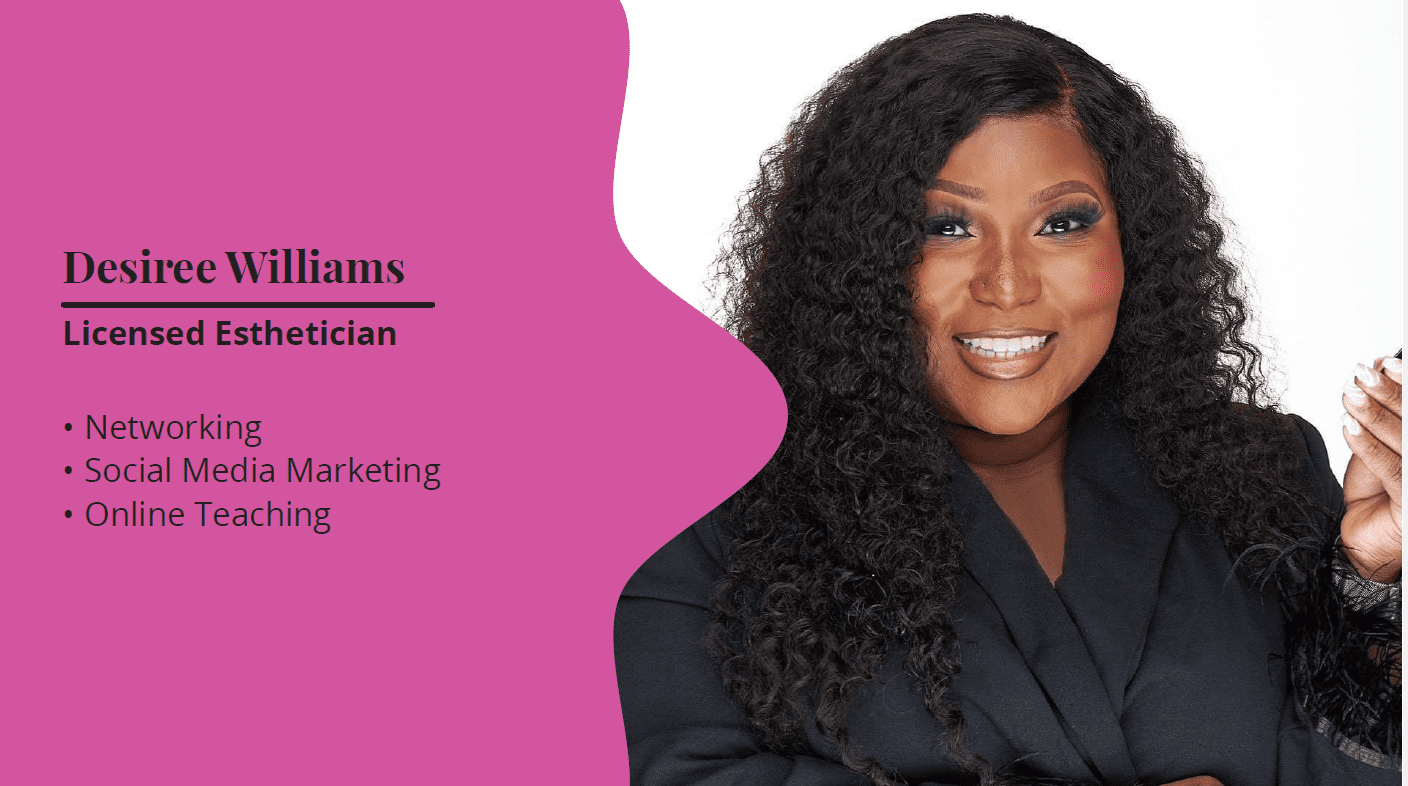
Desiree Williams is a licensed esthetician and educator. Desiree is turning creative passion into community impact, one lash, lesson, and life at a time.
Interview
Transcript
Emma Plutnicki 00:03
Okay, so to start, what do you do for work and where are you currently working from?
Desiree Williams 00:08
Well, my name is Desiree Williams. I am a licensed esthetician and a licensed esthetics instructor. I do have a suite that I work from, and I perform master extension applications as well as teaching it.
Emma Plutnicki 00:22
Amazing. And how long have you been doing that?
Desiree Williams 00:25
It’s been going on for six years.
Emma Plutnicki 00:30
Okay, a good amount of time. So, what is a typical day? Look like for you?
Desiree Williams 00:36
A typical day for me kind of starts like today. Wake up, do all my good, do all the things I need to do, and then run and go see clients. So, I like to get my clients out of the way at the beginning of the day, so in the evening I can do all of my marketing, all of my mentee calls. I teach a lot on Tiktok. So, I do free lash artist classes on Tiktok every day at 9pm so that’s basically what my day looks like. I start immediately getting into it after I do my gratitude and drink my tea and do everything that I need to do.
Emma Plutnicki 01:14
Yeah, amazing. And so how did you gain the skills to be successful in your career? I would
Desiree Williams 01:20
Say networking as well as reading. One thing that I learned is that if you want information out there it is always in a book, it’s somewhere in a book. I don’t even like Google anymore. I love to find a good book that talks about whatever topic I want to learn. So, I also watch a lot of like Alex hermosi, Grant Cardone, those guys to help me scale and do things like that. So, I feel like just networking and being a student forever has assisted me in getting where I am today.
Emma Plutnicki 01:50
Yeah, for sure. And did you have any fears when you were going into this career?
Desiree Williams 01:54
Oh, yes, plenty. I’m the first business owner in my family. So, it was a learning curve. I don’t even know where to start with my fears. I always was like, oh, well, how am I going to do this to get the inventory or the main thing was capital. So, a lot of times when you don’t have previous experience in business, it’s hard to get capital, especially if you’re not educated on things like the SBA and stuff like that. So, getting started finding a space to work was, you know, kind of hard as well. I started from my home and grew my business and was able to leave my home. So, there were a lot of fears, but thankfully, with faith, I overcame all of that.
Emma Plutnicki 02:35
Yeah, and did you have anybody along the way giving you any advice, any mentors or family members? Do you remember any of the best or worst pieces of advice that you were given?
Desiree Williams 02:44
I’m not gonna lie, like a couple weeks ago, my husband gave me the best pep talk ever, because I was like, I’m just gonna go get me a job. I’m not gonna have to worry about anything. I don’t have to follow up behind people. Just go get a job. So, I would definitely say my husband, he very, very much inspires me, even though, you know, it’s like, oh, it’s your husband. He should do that. No, some days he’s not going with my shenanigans, and other days he is. So, he was a big integral part of growing the business and doing things or learning how to do things the right way. So, some of the best advice I’ve gotten from him was, just do it. Stop overthinking it, just do it. And some of the worst advice I’ve ever gotten was not from him, but just from in general, like listening to social media. Like on social media, people tell you do ABC, you do it, and you don’t get the results that they promised. So, I learned not to use social media as a guy. But as far as the inspiration goes.
Emma Plutnicki 03:42
Yeah, that’s a good point. And have you been able to maintain a healthy work life balance with your work? Is it hard to kind of separate your personal life from your professional life
Desiree Williams 03:54
In the past? Yes, I was at the point where my business was my personality. So, like every time someone sings seeing me, they’ll be like, oh, its flash girl dance, you know? So, over the years, I was actually diagnosed with lupus at the height of my career. So that goes to show that when you first start in your business, create systems that are going to help your business continue to do what it needs to do, even if you’re not behind the chair or you can’t work. So now, after that diagnosis, I have a healthy work life balance. But before I didn’t, I woke up immediately checking emails, immediately doing this, but putting implement in business hours has been a great help to me, and now I feel like once I follow my business hours, the balance is it’s not even balanced. It’s harmony for me, yeah,
Emma Plutnicki 04:40
Perfect. And with a career like this, I’m sure it can be hard to kind of define what success looks like. So, what does success look like for you? Is it a positive review? Is it financial based? How do you define success in your professional career?
Desiree Williams 04:58
Oh, that’s a good one. I. I define success by being able to wake up and actually see my work impacting the lives of others. A lot of times, like in the career that I’m doing as an esthetician, a lot of people go to school, and they get done with school, and they never take their boards, or they learn lash extensions, and they never actually start the business or take clients. So, with me being able to teach over 1500 students, I’ve learned that my success is in helping people change their lives in a real, true way, where you know they’re not worried about what’s happening next, they actually have a plan, a strategy, to get things done. So, I define my success by how many lives I can positively impact, which is, which has been a lot. It’s kind of overwhelming once you think about it, but just being myself and letting them know, like, hey, if I can do it, you can do it too. My success comes from that. Yeah,
Emma Plutnicki 05:53
I love that. And has there been one specific moment that you can remember throughout your career that kind of stands out as having a significant impact on you, whether that’s your greatest success or just something that was kind of the pinnacle of your creativity.
Desiree Williams 06:08
I would say, honestly, my loop is diagnosis. Then the reason I say that is because I had to quickly pivot into not being behind the chair as much to oh my goodness, my hands are numb today. I can’t work today. What? What else can I do to help impact others? That moment where it’s like, I don’t I realize that I don’t physically have to be touching people to impact them. That was very pivotal for me, because social media is huge. You can. You could be in China right now. We’ll be talking like you get what I’m saying. So, um, just understanding that, boom, this is, I don’t know, it’s a lot, it’s a lot, it’s it’s a lot. And I would say, just, excuse me, I’m so sorry. No, you’re so good. Questions over here, like, I can think of multiple moments that’s great talking. I was thinking of another moment like, I was just like, whoa. You don’t realize how much you’re pouring into something till you step back and look at the bigger picture. So just the bigger picture, that’s really it?
Emma Plutnicki 07:17
Yeah, no, for sure, and working in South Carolina has that had any specific impact on you the state as a whole? Have you worked in other places, and does South Carolina specifically have any impact on your work?
Desiree Williams 07:30
Oh, very much. So I’m completing a course with Columbia’s business office. It’s called The Next Level micro entrepreneur, and I’ve never seen something like that in any other state, like just researching like, oh, I want to leave South Carolina. Where am I going to move to? What type of business support would I have? One thing that I will say about South Carolina in whole, is that our bit the business realm of it, those who are in those higher seats, they do want to see smaller micro businesses succeed. And today is, well, tomorrow will be week nine of the course. And I always tell anybody, if you want to run a business, definitely take this course, because it tells you, step by step on how to run your business and what to do, how to find loans with the SBA. This all the resources you think we didn’t have here in South Carolina that we do have, the class is only like $50 so I was just like, whoa, this information. It needs to be more. So South Carolina has definitely impacted my business like that, because it shows me that I have the resources here to do better than do the things that I want to do to impact the community. I don’t really I only work in Columbia, but I do have a lot of people that travel from Charleston. I had a young lady travel from North South Carolina, and I have no idea. I was like, I have no idea where that’s at. But just being born and raised here, it was, it’s great to have run a business here and see how things are changing. And it’s a really great straight state, especially if you want to run a business. So, yeah, I love my city.
Emma Plutnicki 09:02
Yeah, no, amazing. And how is the local working professional community? Is there a lot of support? Is, are there any, like, weekly meetings you go to? Or what kind of support do you receive within South Carolina,
Desiree Williams 09:16
It’s so many to name. They have different things, like, I’ll go on like Facebook and see what they have for meetups, like networking mixers and things like that. I don’t do anything weekly as far as networking. The last 10 weeks, I have been doing that class with the Columbia Business Office, and then just the esthetics community here is very loving, very huge. You know, everyone wants to see each other win, so I love that aspect of running my business here as well.
Emma Plutnicki 09:48
Yeah, amazing. And just as we wrap up, is there anything else that you’d like to add about your job, your career, any advice or anything like that? I’ll
Desiree Williams 09:59
Give some advice. If you are creative, because I’m definitely a creative I love with last extension, application, and just being an esthetician, doing application and things like that, you have to have that type of creativity so each person can have like, their signature look. So if you are creative, I just recommend to stick to it. Don’t try to see, do what other people are doing, do what works for you and your business will flourish.
Emma Plutnicki 10:25
Yeah, I love that. Well. Thank you so much. Thank you for taking the time to speak with us. I know everything that you said will definitely help anybody looking to pursue a similar career. So really appreciate it.
“It’s just that when we’re conceptualizing art, we always think of it as something that has happened, but not something you can do in your own life, like in the current moment.”
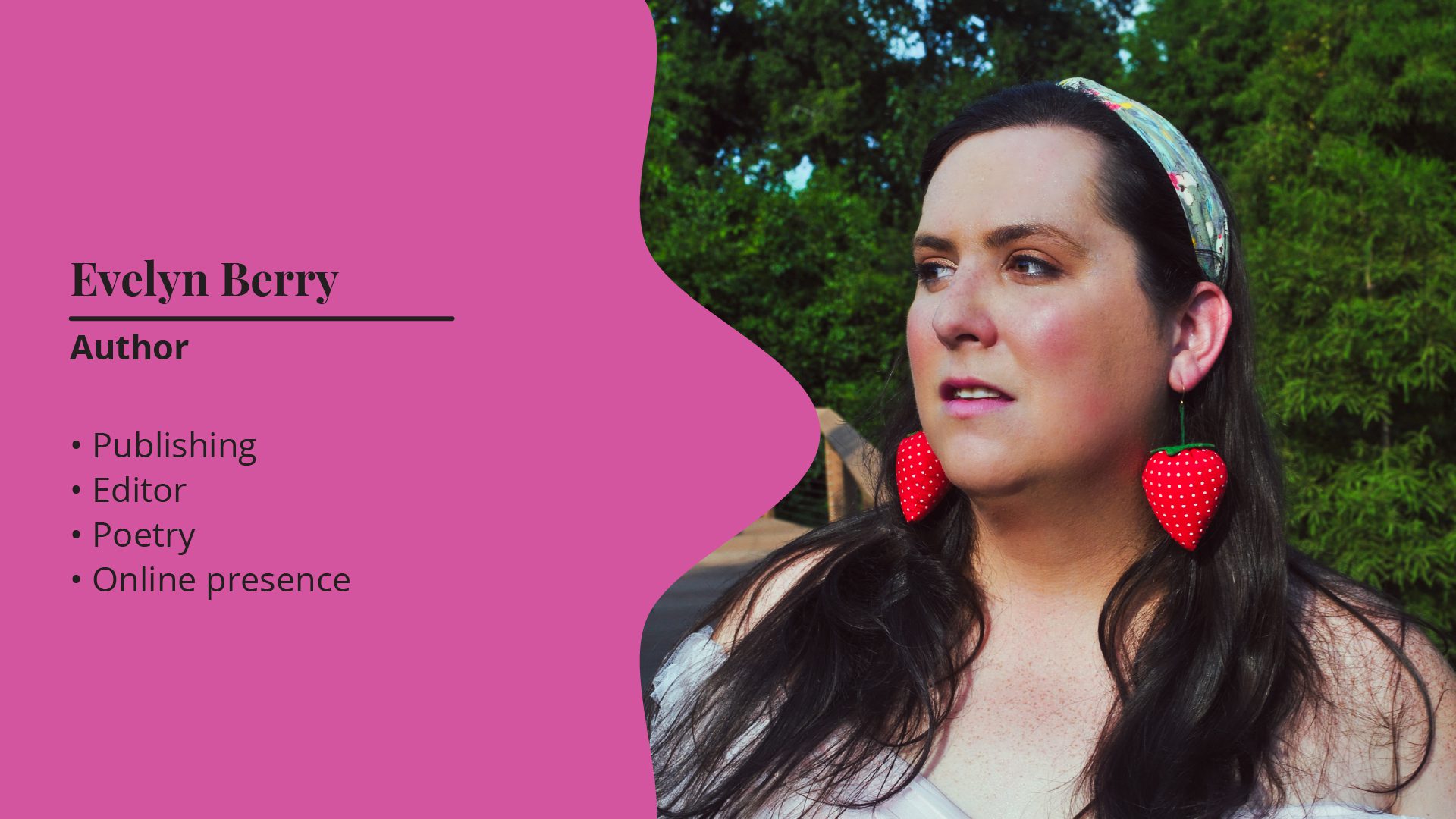
Evelyn Berry, poet and educator from Columbia, SC, uses her voice to champion authenticity and queer Southern storytelling. Through workshops, editing, and her acclaimed poetry, she inspires writers to embrace vulnerability and speak truth to power.
Interview
Transcript
Lexi Raines 00:00
Alli, okay. So, first just give us a little introduction to yourself. What do you do for work and where are you currently working from? Yeah.
Evelyn Berry 00:08
My name is Evelyn Barry. I was born and raised here in South Carolina. I am an author of a book called grief slut, which was published last year by sundress publications, as well as some chat books called buggery and glitter husk. I have another book coming out next year called Tea for tea, from a small harbor press. In addition to writing and publishing, I teach workshops at organizations, whether that’s a nonprofit that’s looking to bring me in for a workshop series, a literary festival that wants to bring me on for a panel, a conference where I’m going to do kind of like a masterclass seminar with students, either online or in person, as well As universities. Where I might come speak to the classes, lead a couple of classes, and then usually do like a masterclass in reading at that university. In addition to that, I am an editor. Yeah, I would say, big role, besides writer and educator, is as a freelance editor, so I work one on one with writers all across the country on their manuscripts. This might look like helping build better writing practices where we talk about how they can deepen their craft, or it might look like helping them navigate the like the world of professional publishing. How one seeks agents, how one seeks publishing opportunities, how you write cover letters and things like that, or even find out about these kind of publishing and funding opportunities. And then my day job, which probably comprises of, like, probably two thirds of all of the money I made last year, is as a library communications strategist. So, I work with staff at a pretty large library system here in South Carolina and help with employee communications that might include anything from drafting all staff emails to share operational updates, creating talking points to help staff talk to and discuss kind of interesting, relevant topics with our communities. This might be a new initiative, an art gallery. Maybe it’s something that’s happened in the news that we want to make sure staff are equipped to talk about, and also staff newsletters, so this includes a lot of blogs that feature staff stories’ this could be anything about a staff who really likes speaking, and it’s about their love of baking, or it might be about staff who run programs using tabletop role playing games, or sometimes like a Storytelling Festival that we’ve had at the library, things like that. So, anything kind of communications wise that might be shared with staff. I usually have a hand in, and I’m sitting on different committees for different projects.
Lexi Raines 03:23
Awesome. You sound very busy, but that all seems very exciting.
Evelyn Berry 03:27
It is very busy. It’s a full schedule. Yes!
Lexi Raines 03:32
I’m sure. So how long have you been writing?
Evelyn Berry 03:38
So, I’ve been writing since I was a kid, which I think is pretty common, though, I’d say probably started writing seriously around the age of 16, when I was that’s also when I started to publish in literary journals. I was around the age of 16, you know, both obviously in my like high school literary journal, but also in some community literary journals, and then a little farther afield by the time I got to college. I kind of started in high school publishing short stories and poems. I also used to write some articles and a semi regular column for like, a local arts alt weekly newspaper in Augusta.
Speaker 2 04:19
Georgia. Oh, that’s so cool. That’s all, that’s actually awesome. One of my first paid.
Evelyn Berry 04:24
Writing gigs, and I think I was just a precocious teenager. Very much precocious.
Lexi Raines 04:32
What’s one thing that you love about working as a creative in South Carolina?
Evelyn Berry04:38
In South Carolina, there’s a fairly close-knit community of writers. I think that one of our one of our strengths, is the small size of the state, both in numbers as well as geographically, which means that it’s really easy. Get to one another. I live in Columbia, so within two and a half hours I can pretty much get to any other city which offers a lot of really cool opportunities. When I started to write, I probably had no real business like teaching or writing book reviews, or, like, writing articles in magazines. But a lot of older writers took me under their wing and kind of believed in my work, and, you know, helped me navigate those processes, helped introduce me to new opportunities, and that was tremendously helpful. I don’t have, like, an educational background in writing. I did study English, and I don’t have an MFA, don’t have a PhD, but what I do have is, like a massive village of writing mentors throughout South Carolina and beyond. Who care really deeply about community, and so that’s, that’s a big thing I really love about South Carolina. It’s gotten to the point now where, you know, anytime I go to pretty much anywhere, no matter how small. I know someone there, you know, and I know someone I can grab coffee with, or who would be glad to have me over at their house and, you know, eat dinner their family. Just because, like, that’s kind of what the writing and the arts community at large is here, which is, is really beautiful.
Lexi Raines 06:26
It is super beautiful. I’ve heard a lot about that in my interview. So it is, I think it’s super awesome to hear that. It really is just a huge community. So, what does South Carolina bring to your work compared to anywhere else.
Evelyn Berry 06:43
I mean, I grew up in Aiken, South Carolina. I went to school in Charleston, South Carolina. I live in Columbia, South Carolina. Now I’ve you know, spent the majority of my life here in South Carolina. So. it’s kind of impossible for the landscape, the culture, the language, the stories of South Carolina not to seep into my work. I write confessional poetry which is often very biographical. So, the experience of living in the South, especially as a queer person, has kind of informed most of my creative work. Also, in the past, I’ve had the opportunity to work in different capacities in archives, as well as write in response to materials from archives, and it’s gotten me really interested in South Carolina history. I specifically am really interested in South Carolina’s queer history and the ways in which queer people have kind of fought for our rights here in South Carolina, whether that’s the like 1989 ACT UP die in at the state house, or the first Pride festival, which was only like 35 years ago, or, you know, even some of the more, like illicit parts of history, like the history of cruising down in Charleston, South Carolina, from like the sailors and things like that. So there’s all of these, like interesting stories, whether it’s like stories of resistance, or kind of sordid stories, or really fun stories. And I think people don’t think about that when they think of South Carolina, other parts of history. And I’m really always interested in what different spaces and places offer up in terms of their history.
Lexi Raines 08:39
I completely agree. I think South Carolina has, like, a very diverse history that, like, not too many people know about, like outside of those specific communities. So, I feel like just bringing out that research is super cool. That’s awesome.
Evelyn Berry 08:55
Yeah, it’s been super fun, especially, you know, I’m not an academic, I’m not a historian, so I get to have the freedom of doing things creatively, which gives you a lot of leeway with these things, which is, which is a lot of fun. How
Lexi Raines 09:10
Would you define professional or personal success in your creative endeavors?
Evelyn Berry 09:15
Um, I think that personal success, I think usually comes when you’ve written something that people respond to, that speaks to them. That might change how they think or how they feel, or just move them in some way. I would say the best kind of response that I’ve gotten from like books, is people I’m talking about what it meant to them, whether that it’s, you know, helped vocalize something about their own life that they had never seen on the page before, or that it helped them write something about their own life. Think, which I think is always super cool to see. So I think that’s kind of personal success, professional success, I think is a little bit trickier, because, you know, we do live in a society where you got to pay rent, got to have health insurance. So, I think that if you can consistently get projects and you know, say for poetry or novels, it’s consistently getting published, consistently getting invited to festivals and conferences to teach, so that you can kind of maintain a steady income, which is extremely hard to do because, you know, funding in the arts is very unpredictable. Some years you might, for example, get a fellowship, which I’ve done in the past. Like, last year, I got the South Carolina Arts Commission fellowship. And, like, you know, that’s, that’s like, $10,000 you know, on top of what I usually make. And it’s a big, you know, that that’s, that’s a huge thing for me. And then, you know, having to think of, okay, next year you’re not going to have that. Well, how are you going to make sure to maintain what you’re doing? Like, what will you have to do differently? So I think finding sustainability is really the key for professional artistic success.
Lexi Raines 11:27
Yes, I would completely, completely agree with that. So, um, this kind of goes along the same lines of that, what was your biggest fear when you first decided to pursue the arts professionally?
Evelyn Berry 11:41
Well, you know, I mentioned that I didn’t really study English. I really wanted to, I really, you know, when I was applying to colleges and high school, all I wanted to do was write. I wanted to write stories. I wanted to write novels. I wanted to write poems, plays, whatever I could get my hands on. And everyone kind of tells you that it’s a dead end, that it’s impossible. But I think that’s also because they don’t really know anyone who’s ever done it. It’s a weird thing, because, you know, we have, culturally, an idea of artists as something from the past, right? You know, when we think about if you ask someone their favorite artist or their favorite writer, they’re more than likely going to name someone who’s dead, which is not a problem. It’s just that when we’re conceptualizing art, we always think of it as something that has happened, but not something you can do in your own life like in the current moment. So, I think that was the big thing. Is just kind of like falling on my face. I’ll say I remember feeling so like defeated at one point. So, I had a I had my first novel come out when I was very young. So, I like signed a contract when I was 19, and then all came out when I was 22 which is like, maybe irresponsibly young to publish it, to be honest. And, you know, of course, like I was in college, I had this very romantic idea of what a right being a writer was like, I, you know, got to go to, like, one or two conferences and festivals and be like, here’s my novel. And then like, reality set in really fast, which was like, you know, there’s hundreds and hundreds and, you know, there’s 10s of 1000s of novels out there. And so now, just because you’ve, you know, published one, how do you make people actually care about that? How do you sustain that kind of momentum as well? I didn’t have anything else ready to go, you know, at that point, because I’d been college through that entire editing process, and it was a couple of days after, you know, it was months after the novel had come out, interest had already dried up. Like six months in, I’d stopped doing events, and I finally graduated college, which was a crazy kind of thing. And then I remember the very next day, I was like, working at this restaurant, and I was like, a busboy and a like, I like, came up on this table, and it was like a mother with her daughter, and they were touring the college from which I had just graduated, right? It just graduated from the Honors College or top honors, and I dropped the plates in front of them, like I, like, tripped and, like, dropped plates. And the mom looked down at me and pointed at me and went, see, that’s why you need to go to college. And I remember just being like, Oh no, crazy that I’ve, like, you know, thought that I have, like, reached this height, and you think that you’re going to, like, have a single success, or you’re going to graduate from college and then launch yourself into some sort of, like, career of miracle after miracle after just like, coincidence. Yeah, but it’s much harder work than that. So, I think that’s the biggest fear, was realizing that it would not be as easy as I thought, or that, you know, luck and coincidence can only take you so far.
Lexi Raines 15:18
An English major, actually going back to your first point, like, I was terrified to be an English major. I didn’t come into college as an English major. I was originally a computer science major, and I just hated it, like it was so miserable. And like, I’ve always really enjoyed writing and like reading, and so when I made that switch, I was so much happier. And so I feel like people saying that they don’t have there’s no jobs in English is very, very untrue, obviously. So I feel like just being able to keep your options open and look for those opportunities is something that’s really important.
Evelyn Berry 16:03
Awesome! Well, I mean, I’ll just say, in response to that, like, something that I would say to anyone who’s graduating with, like, an English degree, or say, like sociology, or any kind of degree that people are generally saying that doesn’t make money, there’s, there’s a lot of jobs out in the world that you’ve never heard of that actually need the skill set that you have, and the skill set that you have, whether it’s like writing and communicating clearly, is becoming more and more rare. I mean, I’m sure you see it in your own peers. Like the ability to write a like cogent and coherent essay about a literary piece without using AI is like a huge deal these days. I see it in, you know, my communications work all the time where, like, you know, being able to quickly and correctly write, or even knowing, like, the basics of grammar or the basics of sentence construction, that’s something I take for granted. I’m like, everyone, everyone knows that. Like, duh, everyone can but that’s not true. And the more that you kind of like work in the world, you realize, oh, actually, I do have a set of skills that might be really useful to some people, and my I might be able to leverage it in real ways. Yes,
Lexi Raines 17:24
I’ve, really noticed that. And I think coastal does a good job with preparing English majors to, like, really market their skills. So it’s awesome. Can you describe, like, a defining moment in your creative journey?
Evelyn Berry 17:38
You know, what’s kind of interesting is, you know, when you’re doing creative work, every Turning Point feels like the big break. You know, in some ways, I would say the biggest thing for me a big turning point. A couple of years ago, a mentor of mine encouraged me to apply for a National Endowment for the Arts fellowship in creative writing. So these are governmental fellowships that are given to 25 writers per year. It’s a tremendous amount of funding. And beyond that, it’s quite like an honor to get it is, you know, one of those awards that people recognize on a resume and will bring you in. And at the time, I didn’t have a full length poetry collection out. The novel had been kind of a flop. I was starting to publish in different places, but I still didn’t feel like a quote, unquote, real writer. You know, I still felt like I had failed to live up to that kind of potential, and there was a massive amount of insecurity around the fact that I never went to graduate school and never studied writing. The older I got, the further I felt behind my peers, despite the fact that, you know, I was reading the same books that they were in graduate school. I was, you know, having the same conversations, going to the same events, doing this in kind of community volunteering and getting involved in the literary community. So, you know, this sort of fellowship wasn’t a sort of thing that I thought someone like me was one supposed to apply to, because it would be a waste of time, right? That it would be something no one without proper training, no one without that kind of pedigree already would be able to get a fellowship like that. But I decided to apply. I applied twice, and on the second time I got it, it was, it was really life changing. I actually didn’t believe them when they pulled me on the phone that I had gotten the fellowship, yeah. And it was just really cool to, like, have that moment of like, okay, like, this is real. Like this is, you know, it kind of was funny because it eclipsed a lot of other failures, because it didn’t really matter anymore. It’s like, well, you have, like, this seal of approval, which sounds silly, like, you know, a lot of especially universities, they look for those. Seals of approval, right? And or before they like invite you to come teach, or invite you to come read. And sometimes when you’re able to get a fellowship or an award like that, it’s just the one thing that can help you kind of stand out in the crowd. And that was really a turning point for me. I think that I was able to take myself a little bit more seriously as a writer, I was able to demand a little bit more in terms of, like, what I charge from, you know, people who were hiring me and mostly it kind of gave me, like, the confidence to continue to actually say to myself, like, okay, like, this isn’t just something I do for fun. It is actually, like, my vocation. It is the thing I’m doing with my life is to write and share stories and share poems. Congratulations!
Lexi Raines 20:53
On that. That’s actually, so that’s awesome. So it was really great.
Evelyn Berry 20:58
Cool. Yeah, I think, um, it was kind of interesting. Last year, a like, some academic did, like, a qualitative study on, like, who got these kinds of fellowships, and I was the first one to receive that fellowship, I think, in like 30 years. Like, the last person who did it was James Dickey, and so it’s kind of like, yeah, like even that, like Southern writers, rural writers are, like, massively underrepresented for these fellowships. You know, the majority of writers who get them are people who are already well-established. They’re already teaching at major universities and things like that. So it felt really good to like represent for my state as well. And I didn’t realize that until someone pointed it out, and I was like, wow. Like, it’s kind of wild, because I know so many amazing artists and writers here who deserve support, sometimes ignored by like, the national art scene.
Lexi Raines 22:01
Yeah, that makes it even more meaningful. Congratulations again. Like, what is the best and worst advice you’ve ever received?
Evelyn Berry 22:10
Unfortunately, the best advice, and I think this goes for any creative path, is just do the thing that you want to do. What I mean by that is, I know a lot of writers who think, Well, I would love to write a novel, but before I can write a novel, I need to go take a creative writing class. Before I write a novel, I need to read 10 books about writing a novel. Before I write a novel, I need to like prove myself in some way, same with being an artist. You know, I will become an artist. I will start making art once I get to the certain point that it’s proved myself. But the only way that you can actually develop craft and develop as an artist, as a photographer, as an actor, is to practice that craft. And, you know, often practice looks like failure because you’re not going to be good at it at first, right? No one is no one is like perfect or no one is skilled at what you do first, and you still might feel inadequate years later, too. But once you start comparing you know how you’ve developed, you’ll see growth. So I think that’s really important as to whatever you’re doing to begin now, you know to not kind of wait for any kind of permission, to wait for any kind of degree or certification or seal of approval from anyone else, but just to start making and also start sharing that work, even if you don’t think it’s very good, you know, upload that photography to Instagram if you’re writing stuff and you know, you know, go ahead and send it out to literary journals. If it’s not getting published in literary journals, like print it in a zine. Share it with friends. Once you start to get into that cycle of creating and sharing art, you’ll kind of you’ll do some more often, the worst advice I’ve ever gotten, I think that the worst advice I’ve gotten is that one should separate, not write about politics. I think a very common thing, what used to be a very common thing in the arts, and especially in writing, was that, you know, people didn’t want to read, you know, quote, unquote, political stories or political art, because it was very heavy handed, which it definitely can be for sure. You know, we’ve all read work that is very heavy handed in that way. But I think it’s really important to think about why that advice is given and Who Gives it often. You know, the lack of politics is not. A lack it is just like a defense of the status quo. And so art that does not engage with values that might be seen as quote, unquote, political are still political. You know, they are. They’re maintaining a kind of status quo, a patriarchy of white supremacy, you know, kind of this, this, this kind of paradigm, right? That is seen as the quote, unquote norm or seen as apolitical when, in fact, it’s very political. All of our lives are very political. And as a poet you know, writing about like being queer in the south, it’s impossible for pretty much anything I write not to be viewed by others as political, even if I don’t mean it that way. And so I remember getting some advice, like definitely, from like, fiction writing mentors and teachers to kind of avoid, you know, talking to explicitly about politics, despite the fact that it kind of informs our every day, I feel like it
Lexi Raines 26:04
Would be hard to ever completely avoid that topic, because it makes up who you are. It makes up the community around you. It really makes up everything a lot, influencing you.
Evelyn Berry 26:14
Yeah? So that’s what? Yeah, exactly. It’s an impossible piece of advice unless you are, like, the single most privileged person in the world and are able to insulate yourself completely.
Lexi Raines 26:25
So, can you please walk us through a typical work day for you, like, what does your process look like, and what’s kind of expected of you on a daily basis? Yeah,
Evelyn Berry 26:33
Let me take you through kind of a general day that includes all of my different jobs. So I usually wake up at five in the morning, which I know is not fun to hear. If I have real energy, I’ll work out. Otherwise, I’ll go shower. I will say I this is so I mean, maybe it won’t sound weird, but like, you know, I’m not the biggest physical fitness person, but I do think that exercise and just moving your body, whether that’s walking or going to the gym or like playing a game with friends, actually can, like, help boost your creativity. It puts you in a better mood, and it helps bring you energy that doesn’t necessarily fade throughout the day. So I think it’s a really good way to get one’s mind ready to write after that. I usually end up coming home showering, putting on makeup, etc., and I will go right. So sometimes I write at home at my desk. More often, I will go to like a local coffee shop, and write for anywhere from one to two hours before work. And the reason I do this is just that I’m a morning person. It is like when I do my best work is when I wake up by the time like one o’clock rolls around, I’m a little less sharp, so I want to give the best version of myself to my creative work. Then I usually go to work at the at the library. So this usually looks like spending the morning, usually dealing with more immediate needs. So that might be helping write an email, helping finish up some projects, maybe being in meetings so often I will find, like, we have meeting rooms at the library, so I like to find, like, a quiet place have my like, noise canceling headphones, and just really dig into the deep work. So anywhere from one o’clock to five o’clock is when I do that kind of deep work for communications, that’s strategy building, or just something that’s going to take a long time to write. I will say I’m very lucky in that sense, like I have a job in which people generally leave me alone unless they need something or they’ll send me an email, so I get a lot of uninterrupted time to, like, think and sit, and I think that’s really important to kind of have, like, you know, I’m also totally allowed if I wished to, like, leave the library and just like, wander around, because that might help, like, write something that I need to write, and get me in the right mindset to do it. So, yeah, that’s generally what that workday looks like after work. I might do different things. So I help. I helped start a local collective here called queer writers of Columbia. We hold like write ins and workshops and open mics. So often, if that is happening, I will leave work and go grab something to eat, maybe with some of the friends from that group, and we will go and write together even more. Sure, generally in that setting, I’m actually not writing my own work. I’m usually helping other people navigate stuff, just a lot of moving parts. So it might be, you know, just mentoring people basically to get published or to seek opportunities. It might be going to support people at open mics. I’m at the point in my career now where, like, I don’t necessarily have to do those things, you know, like, I can get paid to go read poetry, so I don’t need to go to an open mic and, like, have that kind of exposure. But I think it’s still important to engage with like, everyone in your community, no matter like, level of development they’re at, because, you know, that’s kind of how I had any opportunity at all as a writer, is that someone took a chance on me and gave me an opportunity before I was ever ready for it. So that’s, that’s a big thing that I believe in, is, you know, encouraging people to say, hey, you know, you should really host this. And they’re like, I or teach a workshop, you know? And usually people say, like, I don’t have anything that I could possibly teach others. And I think that when you start doing it, you’ll be surprised by what you can teach others. Something else I really believe in is like, to not get, keep, like, publishing secrets. There’s a lot of norms around literary magazine publishing, wearing agents reaching out to bookstores that are not like written down in many places. You might learn them in an MFA program, but even then, probably not. So the only way to learn them is through trial and error or from just another writer telling you. So I’m a big believer in, you know, mentoring writers to make sure that their talent is not being unnoticed, that they’re able to develop and both within their community and beyond. Yeah,
Lexi Raines 32:00
So,it sounds like you again, you’re very, very busy person. How do you, like, create a good work life balance where you’re able to maintain both, like, your professional creativity and your personal creativity. That
Evelyn Berry 32:15
Can be hard sometimes. You know, I think one of the challenges that you run into, like I write for work, and so when I’m done sitting at a computer for eight hours, I don’t want to go sit at a computer anymore. So one of the things I do is prioritize my personal creativity. I think of that as you know, despite the fact that it doesn’t make me as much money, it is the thing that I want to give, like the best part of myself to, which is why I tried to do it before work, right? You know, I say that’s a typical day, but, you know, maybe going and spending time with other writers happens maybe once a week. You know, I’m also very conscious, and even more so these days of like self care, make sure to have time to myself. One of the huge benefits of working at the library where I work is that it has a big emphasis on work life balance. So we have open PTO, which means we can basically take as much PTO as we need. I’m able to work from home one day a week, which is where I am now. I’m not at work right now or not at the workplace. So, you know, it allows the flexibility, which is really great because, you know, I work with people, with families who, you know, need to like to pick up their kids from school in the middle of the day or drop their kids off at daycare. And it’s really nice to work for both a organization as well as for a manager who cares about your personal well being like, beyond anything else, like the actual parts of my job, sometimes they’re fine, like, I like writing articles, but a lot of it’s very boring. It’s very boring writing. It’s very technical, it’s very straightforward, but that doesn’t really matter to me, because what’s more important is that I’ve chosen a career that can sustain me enough that I have the energy and the time and the ability to pursue my creative passions. So for example, like last year, I went on book tour for grief slut. And, you know, I was able to take, you know, several days off, sometimes weeks, or like, a week at a time, to go travel around the country and tour this book. And it was really important to have support from the organization. Person I was working for. And not everyone has that. So like, you know, if, again, you know, if I’m would give advice to someone, I’d say, like, you know, think about the values of the people for whom you’re working, because they will also, you know, sometimes help shape you will they see, like, your art career as something that supplements them, like it’s like something that they’re very happy about, or do they see it as a rival for their time? And so if you can find someone who supports your art as well as your livelihood, it’s a really beautiful thing. I agree.
Lexi Raines 35:39
That is, I want to find would be an amazing opportunity for a lot of people.
“Know your worth and follow your path, and entrust yourself”
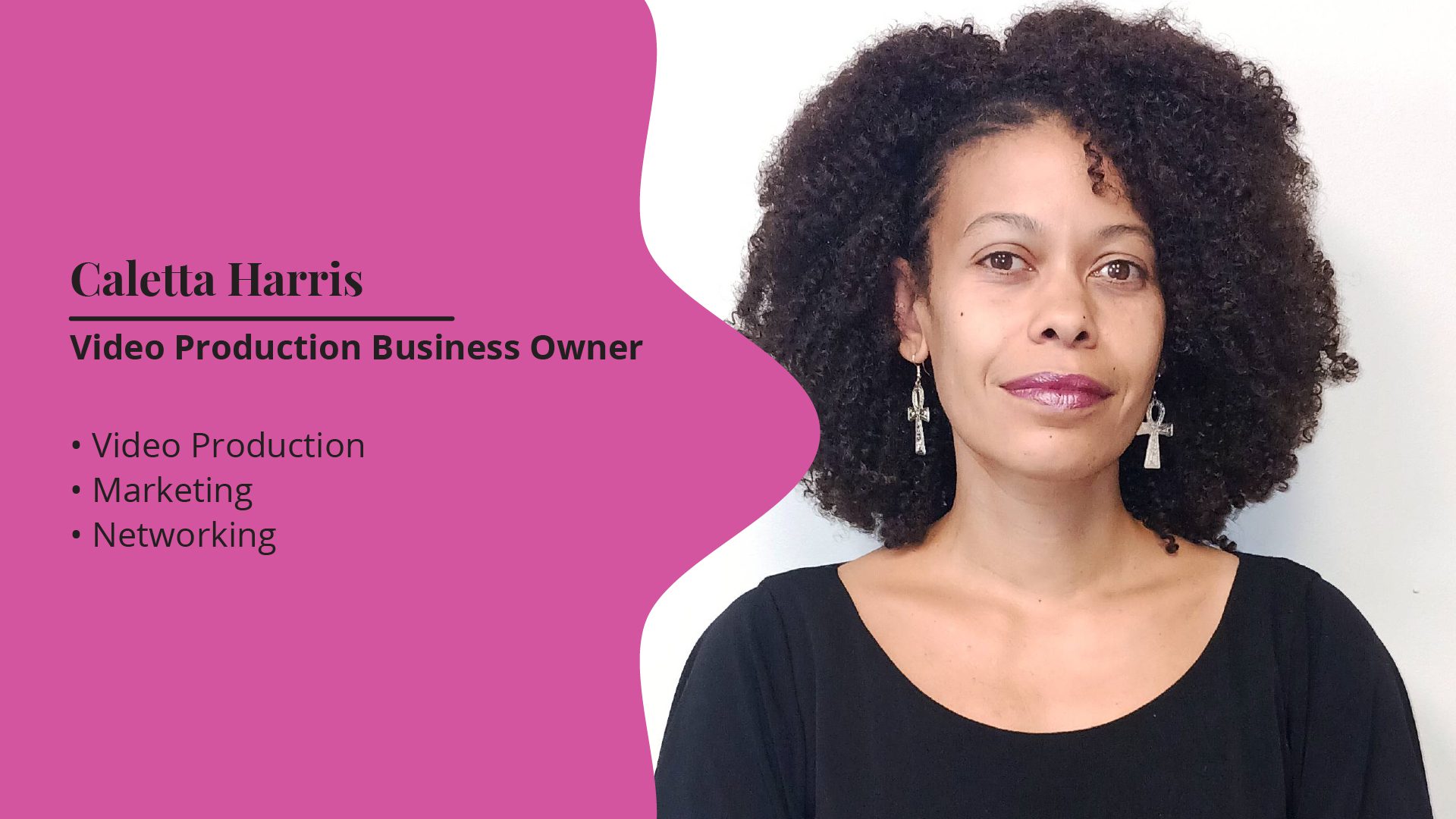
Caletta Harris is the founder and owner of Reel2Real Productions, a video production company that has been transforming stories into powerful visual narratives for nearly 20 years. She is based in South Carolina and works nationally, blending creative passion with purpose-driven storytelling by using media to empower, educate, and amplify voices across South Carolina.
The powerhouse behind Reel2Real Productions is a woman with a camera and a mission. For nearly two decades, she has built a full-service video production company that thrives on diversity of stories, clients, and causes. Based in South Carolina, her work stretches far beyond its borders, but the state’s rich history and collaborative spirit have deeply shaped her creative journey.
Interview
Transcript
Lexi Raines 00:01
So, what do you do for work, and where are you currently working from? Well, I
Caletta Harris 00:05
Currently I have my own business called Reel to Reel change to Reel2Real Productions, and we have been there for 19 years, almost 20 years. Next year will be 20 years, and I’m kind of out of everywhere. I’m remote, but I do work all over. So right now, I’ll say South Carolina, awesome.
Lexi Raines 00:26
And so, what is your official job title, being the creator of realtor. I am the owner. And what is one thing that you love about working as a creative in South Carolina?
Caletta Harris 00:37
Well, I love the rich history in South Carolina, and to have that creative freedom being a creative there’s a lot of stories to be told. A lot of rich history here, and just the people connecting with some great, like minded individuals, is always a plus.
Lexi Raines 00:55
I completely agree. So first, just tell us a little bit about Reel2Real.
Caletta Harris 00:59
So, Reel2Real is my baby. My production company is a full service video production company. So we basically do everything from commercial marketing all the way to documentaries. I am the videographer, the editor, all of the above, the marketer, all of that. So we basically do a lot of branding for companies. So we are going on our 20th year, next year.
Lexi Raines 01:25
Awesome. That’s so cool. So what does South Carolina bring to reel to reel, and what is its unique influences on you compared to anywhere else I can
Caletta Harris 01:33
Say, South Carolina has brought me a lot of diverse clients, like my projects totally different. And when I was starting the business, people always would say, you need to get, like, a portfolio that’s vast. You can’t just do one thing, and then expect people to say, Oh, well, you can do it, but they have to see it. I’m like, This has definitely given me an opportunity to have different type of clients, different type of genres. And I just love it. I love just creating people’s vision that
Lexi Raines 02:03
Awesome. I feel like South Carolina is definitely a very diverse community. And saying that, like, how would you describe your local professional community? Local
Caletta Harris 02:11
Professional community? They are wonderful. They’re very interesting. They’re very talented. And, you know, they bring opportunities with them. So it’s not like, this is just mine. They see where people can fit in. And then once I start talking, you know this, the wheels start spinning, and it’s like, oh, well, maybe we can fit you here. And then my wheels start turning. Say, oh, maybe I can connect you with so is a good connecting hub? I like, yes,
Lexi Raines 02:38
That’s actually something I’ve heard a lot throughout, like almost all of my interviews, is that South Carolina really is such a good community where people want to like be able to lean on each other, which I think it achieves pretty well. How do you define professional or personal success in your creative endeavors? Well,
Caletta Harris 02:57
I would define personal professional success is retention rate. I can say my longest client has been 15 years, and then the next one has been 11. So I can say that I have a great rent retention rate with a lot of my clients. And then from there it’s still, you know, multiple years, and then even the new client is like, we don’t want to just stop here. We want to keep that show’s success. To me, that I must be doing something right, and then just personally, it’s kind of the same thing. Sometimes I’d intertwines, but just building relationships personally, because it’s not always professionalism with my clients. So we build that relationship. Yes,
Lexi Raines 03:38
That’s awesome. And sometimes that’s the base you need to work on. So that’s really great. What was your biggest fear when you first decided to pursue the arts professionally? Can
Caletta Harris 03:47
I be self-sustainable? I think that’s a lot of people fear. Can you do this long term? So I was smart with it, because I held on to a job until I said I can do this long term. It kind of worked out. And then when I got my first office space, I just took off from there, because people want to see that to make it real for them, right? So that I just didn’t have to go back doing anything else for anybody else.
Lexi Raines 04:15
And that is awesome. I know a lot of the creatives that I’ve interviewed so far like they are kind of working on their projects, and then they have, like, a day job, and so that seems like difficult to juggle. So it’s awesome that, like, you aren’t having to do that. Okay, so can you describe, for me, like, a defining moment in your creative journey? Like, did you have a particular project that made a significant impact on you
Caletta Harris 04:40
Absolutely! back in 2013 I started a journey while in my office downtown, I read it in the newspaper that city council wanted to do something about their homeless issue, and I was called by what the options were. So I was like, I want to do something about. It. I already have a production company. Let me just start filming and talking to people and seeing what’s going on around me. And it became a full feature documentary. It’s called No Address. It’s a documentary series featuring Columbia, South Carolina and Atlanta, Georgia.
So it talks about, you know, the criminalization of homelessness, what’s going on as well as practical solutions, because we can’t keep talking about the problems without the solutions. And that has had the biggest impact on my life. I the first one came out. Columbia came out in 2020 and Atlanta came out in 2022 so we hit the whole film festival market, and now it’s on Tubi, Amazon. I’m about, I’m thinking, I’m on about 10 streaming platforms now, so it has made a huge impact. I’ve spoken to a lot of colleges, even middle school and high schoolers, and they’re excited about doing something in their own community. So this has been one of my biggest passion projects, and I continue to expand with it, because I want to be a part of the solution now, yes,
Lexi Raines 06:01
That is, like, actually so amazing and so meaningful that is, and being on so many streaming sites like, that’s so cool, that’s actually awesome. So what is the best and worst advice you’ve ever received on your career path? That
Caletta Harris 06:19
Was a struggle, because I can’t really think of the worst advice, because I really block out a lot of that negative energy, right? The best advice, I would say, is when you know someone told me just going through this is to trust yourself, follow your own path, because had a lot of challenges at the beginning, me being a woman owned business, so that was a challenge in itself, and people taking you seriously. So that I that was the best advice was to say, you know you know your worth and follow your path, and you know you know and trust yourself. So but the I could say something generalized, like the worst advice would be something like, it doesn’t matter, everybody’s doing it, so go ahead and do it. And I’m not that type. If you say go right, I’m gonna go left. Open your mind and think creatively, yes, so that I don’t say that. Yeah,
Lexi Raines 07:16
I think that is, like, really good advice to, like, stay true to what you want to do, not what everybody else is doing. So that’s awesome. Can you walk me through like a typical work day for you, what does your process look like and what’s expected of you on a daily basis?
Caletta Harris 07:32
So normally, I wake up, I stretch, I meditate, then I go drink some coffee or tea, and then I either edit or film, depending on the day. So every day is different. I usually work until like seven, unless it’s a long shoot or something, but I kind of cut it off at seven, and then I have me time. I relax and do whatever, and then I try to go to bed by 10 o’clock, because rest is so important to me, because I use my brain so much, and sometimes I’m juggling two or three projects simultaneously. So it’s like shifting gears here and there all the time, somebody else talking about something totally different. So it’s like your mind is always going so I’m like, shut it down at 10 o’clock and then, and then I just start the day, just to rejuvenate and start the day. So that’s kind of my routine. And then I don’t I try not to talk business after seven.
Lexi Raines 08:28
I think that is super smart, like, and a good practice to have, because I think so many times people don’t know where the line, like, the line kind of blurs between, like, work life and personal life. So I think that’s really, really good advice. Actually,
Caletta Harris 08:44
Being entrepreneurs, we people don’t know how to cut it off. It emailed at 2am from people in that one time, and then I said, You know what? This isn’t healthy, because you’re going to burn out at some point. So it’s like, every day is a new day, and I’m ready to conquer it. You know, along
Lexi Raines 09:01
Kind of with that, I know you’ve explained some of them trying to get to bed early. What are some habits that you think would be beneficial for others wanting to do what you do? I
Caletta Harris 09:10
Would say, you know, just find your peace. Whatever it is at times, just take breaks and find your peace. I’m a nature person, so I go out in nature and, you know, just soak it in vitamin D, go out to the farm, you know, things like that, just to digress, and then you can kind of recharge yourself and get back into because you don’t realize, once you do that, how much information can come in and Creativity can come in when always thinking about everything else. So take that time, even if it’s five minutes, whatever it takes, just go out, walk, do something, stretch or just be silent, you know. And a lot of times that really can make a huge difference, subtle, but it can make a big difference.
Lexi Raines 09:57
Yes, I completely agree, just for. My personal experience, I feel like just those few moments that you take to like, ground yourself, super, super important.
“You determine your worth and set your success. Don’t allow your success to be set on what others think of you and how others perceive you. You determine that, so you won’t have expectations from the world, but you can set your own guidelines and your own expectations.”
Angela Thomas Smith is an entrepreneur who helps authors publish their books in addition to having a podcast and a magazine based in Georgia.
Interview
Transcript
Emma Plutnicki 00:02
So, to start, what do you do for work and where are you currently working from?
Angela Smith 00:24
I work from wherever my computer allows me.
Emma Plutnicki 00:31
Amazing and where is home for you?
Angela Smith 00:34
So, home right now is Georgia.
Emma Plutnicki 00:37
Okay,
Angela Smith 00:38
I actually just moved from Myrtle Beach.
Emma Plutnicki 00:41
Oh, Amazing! Um, so how long have you been doing that? How long have you been an entrepreneur? How long have you been helping with publishing and all that?
Angela Smith 00:50
I’ve been doing this since 2012. I started in 2012, I really stepped out in 2016 it really picked up the during the pandemic, and it’s just been going amazing. And I published my first client. Um, we’re having a book signing in Georgia this weekend, so I’m excited about that. Amazing! congratulations. That’ll be so fun and so how has your work shifted at all living in South Carolina to now Georgia has done South Carolina has any influence on your work, as opposed to now living in Georgia? So, I am originally from South Carolina. I’m originally from upstate South Carolina Anderson, South Carolina. Actually, nothing has shifted. It is the same because, I have established a virtual community. So, I’m able to connect with people virtually, um, so we’re able to connect globally. I have individuals that’s not here in the US, and we’re connected with individuals in the UK, Africa, the Virgin Islands. I have a host from one of my podcasts that she’s a professor at University of Virgin Islands. So, we are connected globally, and during the pandemic, I was able to establish that platform. So, I’m grateful for that. Yeah, it’s great to have that flexibility. So, if you’re working with people from different time zones, and you’re on your computer conducting these tasks. Is it ever hard to have a good work life balance, because you’re able to work at any time at your fingertips? Is it ever hard to shut the laptop and kind of get away and have some time for yourself? It was at first, but when you learn how to balance, when you learn that if you don’t take care of yourself, then you’re not going to be any good for anyone else. So, when you learn how to incorporate self-care into your daily life, it makes everything so much easier. Just having that time to, you know, escape from the computer, you know, because sometimes you can get overwhelmed and you can get consumed with what you’re doing, and you get caught up. So just having that time to escape, it’s necessary, I encourage everyone to have that for sure. So, what does a typical day look like for you now? What’s expected of you on a daily basis, and what kind of things do you get into? Okay, so first thing I’m usually up at 4am I normally take Angel, who is my mom, my God, mom’s little baby. For a baby, I usually take her out. And I do a 5am prayer. I am a spiritual person, so I am part of a prayer call. We’ve been doing it now for five years. So, I do that every morning, and it starts my day. It encourages me, it uplifts me, it gets me started. And then, I own the computer doing whatever that task is for the day, and it can range from today, I’m working on a magazine. We have a special edition of the magazine that’s dropping to honor poets, celebrating our new poet of the year out of Dallas, so I’m excited about that. She’s from Dallas, Texas, and we get opportunity to really connect, collaborate and be creative, and build a community where people can come and have that safe space to be creative and to allow that express side of them to come forth, whether it’s through books, whether it’s through podcasting, whether it’s through magazine, whatever it is, we want to be that space that allow you to be able to create, yeah, for sure.
Emma Plutnicki 04:31
And so, your podcast, how often do you film those and what kind of topics do you cover?
Angela Smith 04:36
So, we stream live, and we stream on from Sunday to Friday. We have nine hosts, and they all have two shows a month. So, say one may come on every first and third Wednesday, like doctor chin, she comes on every first and third. Thursday, we have a young lady that comes. On first, no second, Sundays and fourth Thursday. So, they have different days that they may come on, but we have someone on every day, Sunday through Friday, at 8pm and they talk about different things because they come from different walks of life. We have individuals that have disabilities. They have a young lady that was born with spina bifida and hydro syphilis. She has a podcast called delayed but not deny. So, she not only focused on disabilities and showing people that you can overcome disabilities, but she allowed anybody that has a story that wants to share it to come on her podcast. Individuals that work in social work and librarians. We have a young lady from Toss in South Carolina. She’s a librarian, um, she hosts a podcast that focuses on authors and anything in the literary world, creative side, she likes to focus on that. So, we are a diverse group, and we’re from all over. We have South Carolina, we have New York, we have the Virginia area, California, Texas. So, we have a variety of individuals as a part of what we do amazingly.
Emma Plutnicki 06:08
And so, with a career like this, is it hard to kind of quantify success? Because, you know, in a creative career, it can be hard to figure out what success looks like, whether it’s financial or ideological. So, in your role, how do you define personal and professional success? Is it how many viewers you have on your podcast? Is it the stories and of people saying that they’ve been touched? Or how do you how do you kind of define that?
Angela Smith 06:36
So, that is something that is just like beauty is in the eye of the beholder. So, that will be something that each individual person will have to say. But for me, success, to me, is seeing individuals that I’ve worked with go to the next level and seeing them excel and go beyond what they thought they could do to me, that’s success. Seeing articles about me, seeing interviews, seeing different things, where people acknowledge the things that I’ve done to me. That’s success, and you know, it’s measured upon the person that is doing it. It is in the eye of the beholder. So, you determine your work, and you set your success. Don’t allow your success to be based on what others think of you and how others perceive you. You determine that…So, you won’t have expectations from the world, but you can set your own guidelines, and you can set your own expectations so that’s my, that’s my take on that. Yeah, that’s a great way of framing that.
Emma Plutnicki 07:46
Did you have any fears when you were coming into this career?
Angela Smith 07:49
I had a lot of fears but had to step out on faith. I had to believe in myself and knowing that I had all these dreams and I was doing things that I didn’t want to do, and I never thought I would be doing the stuff that I’m doing. But when I stepped out and believed in me and believed in what I felt was on the inside of me, things came forth, and I just began to Just go and things just begin to open up, and the more and more I did, the more and more things opened up. And I tell anybody, if you take that first step, that is the most important thing, get rid of fear. Because fear is not something that we are supposed to have. Because if you’re a believer, whatever your belief is, it has to lead to you not having a spirit of fear but having that spirit to do what you’ve been purposed to do. And how do you do that? Go forth, step into it. Do it boldly. You know, I’m reminded of when I was a child, and all the things that I did when I was a child, and how I enjoyed those things. You know, I got back to doing those things. You know, sometimes we get caught up in trying to live up to expectations of other people, where we lose those things that we’re passionate about by chasing after the things that everybody around us want us to do, but if we hold on to those things that we’re passionate about, it will allow us to be creative, and it will allow us to be who we are, and it allowed that true spirit of us to come forth.
Emma Plutnicki 09:35
I love that. Yeah, and along the way, was there anybody offering you advice, or was this something that you just kind of figured out on your own?
Angela Smith 09:44
Well, there were a lot of people that were in and out of my life, and people that probably didn’t realize that they were pouring into me and giving me advice and encouraging me, like my sister. For example, for those that know my story, I lost my mom to a day after my 16th birthday. So, my sister was very important in my life. She was a very inspirational person. She was one of those people that no matter what, she always encouraged me, she always uplifted me, she always pushed me to go beyond. She always believed in me. And she was one of those people that no matter what you did, she would tell you, you did wrong, but she didn’t hold it against you. She always solved the good in you, and that was one of my inspirations. But there have been so many people, and I can’t begin to name them. Because I would definitely lead someone out, and I don’t want to do that, because there have been so many people that have been inspirational to me, even giving credit to my high school coach, Monica Denise Davis, she was someone that if I never come across her, I never would have played basketball. I never would have had that opportunity to go to college. I ended up in North Greenville for one year. I ended up at Morris Brown College. We had the opportunity to play basketball, meet, some individuals, had the opportunity to travel and do some things that I never would have done. So, there’s been a lot of people and just allowing those people to pour into your life. So, take those mentors. If you have an opportunity to be mentored, take that mentorship. Allow individuals to pour into you.
Emma Plutnicki 11:19
Yeah, for sure. And so last kind of question, has there been one significant project that you’ve worked on, or something that you’ve done that kind of sticks out as being particularly significant throughout your career? Maybe it’s a project or someone you worked with, or something that stands out as kind of like the pinnacle of your creativity or of your career.
Angela Smith 11:42
Wow, I can say right now what we’re doing the 100 authors movement, the 100 authors to watch being able to work with a diverse group of authors that are trying to make an impact, that are trying to leave a legacy, that are trying to allow their voice to speak and touch on different things that they’re passionate about. I am grateful for that opportunity that right now is the most, I mean, pivotal thing, and to hear I’ve had the opportunity to sit and interview all of these authors, a part of this movement right now, and every last one of them, they have a spirit of gratitude. They’re grateful for the opportunity, and it’s based on four seeds, connection, collaboration, creativity and community. That is truly what is based on and being able to give individuals a platform where they can be supportive, where they can feel comfortable and open to support. There was a young guy, he was getting ready to release a book. He was having writer’s block. He came inside the chat. We have a chat room on Facebook. We have a group on Facebook, so we have a chat. He comes inside the chat, and he just said he was having a bad day, and he explained what was going on. One of the group leaders immediately responded to his post. She posted some things that he could do. Just willingly. Posted things that he could do. He incorporated those things, he came back, he gave his testimony, he wrote his book. His book dropped, and that’s what we’re doing. We share resources. We are pulling on each other. We’re letting each other know that we’re there, that you don’t have to do this alone. Because a lot of people start a podcast, they start a magazine, they start a book, they do whatever they do, and then they get stuck after they’ve done this thing, like, what do I do now? Now you have a community that’s there to support you, that’s helped, to push you, that’s there to help promote your stuff, that’s helped, and we just want to be a family so that, I think right now, that is the most pivotal thing. And just having all these individuals from different backgrounds, you know, when I say different backgrounds, we have professors involved. We have a professor right now that’s being honored out at miles University, a part of the movement. We have Doctor Chen. We have teachers, elementary and middle school teachers. We even have a high school teacher. I forgot about him down in Texas. We have men and we have women a part of the project. So, we are a diverse group of individuals just wanting to be a voice, um, wanting individuals to know that, yes, you can. We are not respective people, just as we did it. You can do it too. So that’s what, that’s what I’m doing, and I’m excited about that, that project.
Emma Plutnicki 14:38
Yeah, I love that. That’s amazing. Thank you for sharing all that. And just as we wrap up, is there anything else you’d like to say about your career? Any advice or anything else you’d like to add?
Angela Smith 14:50
Well, I just want to tell everybody. As I turn, I’m turning 50 in a couple of days, I would say, what? 12 days I’ll be 50. I’m going to be dropping another book. It’s never too late. Um, because I didn’t start until 2016 and it took me almost losing my life. Because I’m a domestic violence survivor. And it took me almost losing my life for me to really step out and do the things that I wanted to do. Don’t allow something to be the reason that you step out and do something. Do it because you’re passionate about it, and it’s something that you just want to do, and you want to leave your impact. Because we are our legacy. We are our brand. We are the ones that must tell our story. So, we can tell that in the form of written. We can tell in the form of audio, like we’re doing now, visuals, different things, where we can archive the great works that we’re doing. Because if you are a believer, and you are a word, when you know that the words say we should do greater works, and if we should do greater works, how will they know? Because we can’t alter none of the things that have come before us. So, we have to leave the evidence and how we do it through our works, our works just speak even when we’re not here, and we want to leave something that the next generation can pull off because someone did something for us before we got here, and those things that they did for us allow us to be in place to do the things that we’re doing now. So, I just tell anybody, believe in yourself, know your worth, know that you have power because you were positioned to be an overcomer, because you didn’t get dropped out of the sky. You are a willing investor to move forth and allow that thing to come forth out of you. And how do we do that? By educating, empowering, encouraging others. Through our resilience, we can’t give up. You can’t quit, no matter what it looked like. I just completed it on Monday. I just turned in a 40-page document for my last class. I just completed my master’s, so I will walk with my MBA. So, I’m excited about this. 30 years after graduating high school, I went back and I got my Bachelor’s, and now I can walk 12 days before my birthday. I now am a master holder, so I’m excited about, you know, what we have in store, you know? And I say to anybody, chase after your dream, don’t stop chasing your dream, because dreams still come true.