Interview
Transcript
00:00 Victoria Bartolotto
Okay, so to start, can you just introduce yourself a bit? Spell out your name, tell us where you’re from, where you’re located currently, that kind of stuff.
00:08 Kate McMullen
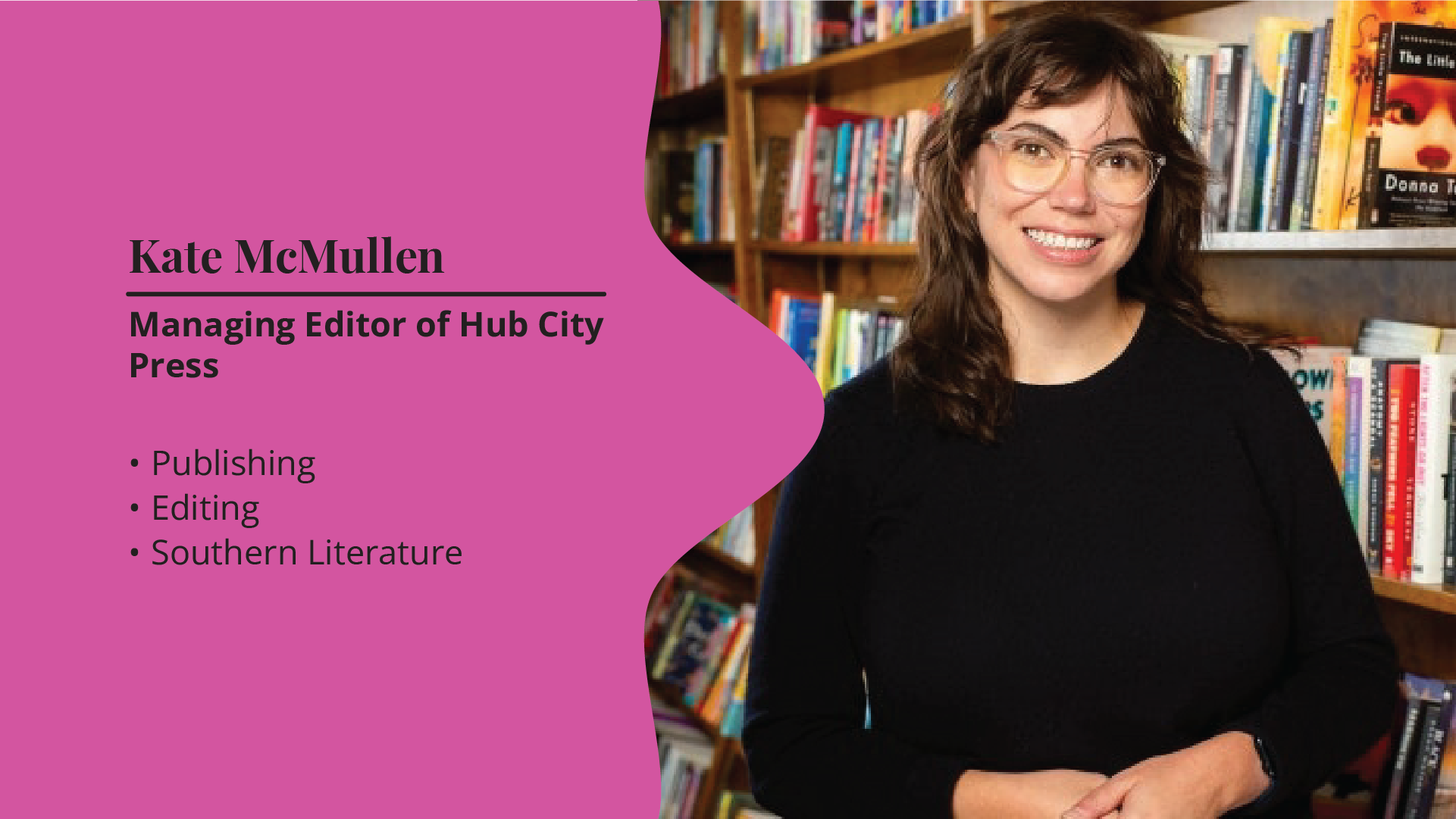
Yeah, I’m Kate McMullen. I am currently in Spartanburg, South Carolina. I am from Greensboro, North Carolina. I lived all over North Carolina before I ended up here. I’ve been here for eight years, which is nuts. Is that everything? Yeah.
00:34 Victoria Bartolotto
So can you tell us what your position is, what you do for the press, and a little bit of a summary of what you guys do?
00:42 Kate McMullen
Yeah, so I’m the managing editor of Hub City Press. I started out as the assistant director doing mostly social media and some book design. And I worked more for the overarching nonprofit, which is Hub City Writers Project, a bit more. So we are 30 years old this year, and we, as the Writers Project, we operate in Spartanburg, South Carolina. We run a bookshop downtown. We run literacy nonprofit efforts in our communities. So, we give books away to kids. We run writers workshops and conferences.
And then where I work, officially, Hub City Press has been around for 30 years. We have been publishing; we started out in 1995, publishing writers in South Carolina and Spartanburg specifically. So, we put out two anthologies of Spartanburg writers in the first two years of the press.
01:35 Victoria Bartolotto
Oh, wow! That’s exciting.
01:37 Kate McMullen
Yeah! So we, those are Hub City anthology one and two, essentially. And then since then, we have been in our early years, we were doing a lot of local history. There’s a camp nearby that sent people to World War II, and there’s training and stuff there. We have a book about that. We’re a mill town, so we have a book about the textile industry here. We have two books now. We did one in the aughts, and we did one last year on urban renewal in our Black communities. So, we’ve done a lot of that historical regional interest stuff, and that’s how we got started. And then in the late aughts, we started publishing more traditionally, fiction, poetry, non-fiction.
So we started out specifically with novels and poems. Since then, we now do eight to ten books a year; fiction, poetry, non-fiction. We run a few prizes. We run a short story prize. We won a prize for South Carolina novelists, which is the only one of its kind in the country. We work with the Arts Commission to sponsor a South Carolina book every other year from a South Carolina writer. And then we also run two poetry contests. We run a general, it’s called New Southern Voices. So it’s a book prize for a Southern poet that is judged. We run that every other year. The short story prize is also judged. We run that every other year.
Then we do what we are calling our BIPOC poetry series, which is essentially every year we choose a book with an editor at large, from a Southern poet that’s not residency based. Our other ones are Virginia to Texas. So, we’re supporting writers who are living in the South. And that, the BIPOC poetry series, is funded by the Poetry Foundation and is a little bit different where you can be anywhere in the country, but as long as you’re writing about Southern themes.
So Hub City Press, now we do all of that stuff. We publish Southern writers, essentially, from Virginia to Texas. We really to try to find new and extraordinary voices. We’re also now getting into reprinting old out of print things that we thought could be brought back into the light in terms of Southern, in this case, nonfiction, but across the board, Southern works that could use a second life. So we’re getting into that too.
As the managing editor, I am running all of those prizes. I’m opening and closing those things and signing readers. We also receive books from agents year-round. Pitches from agents. We also open for un-agented submissions three times a year, depending on what we need. So that’s a weekend where we’ll open for something specific like short stories outside of the prize years, or poetry.
But mostly that’s how we’re opening for novels. It’s the best way to get stuff to us if you don’t have an agent. We really believe not everybody has one and there’s just a lot of gatekeeping in that sense. So, we like to talk directly to writers that way. So, I run all of those.
I’m assigning all of those things out to people. We have a group of readers who I work with on a contract basis. We also have an editor who works out of Birmingham who I work with on editing the books that have come in that we’ve picked up.
And then I am also a book designer here. So, I am a production manager slash designer. So I run all of those books through the printing process. And that’s the other big heavy lifting part of my job. There’s really only three of us here, so I also do some publicity. We have a sales and marketing manager and then our publisher, Meg Reid is the higher level royalties and contracts. And she also does design. We’re both self-taught book designers. So we do all that stuff together.
Then our sales and marketing manager runs social media and all of the book ordering. All of that stuff. I essentially handle acquiring production and then author care in between. We do work with outside publicity now sometimes, which is great. But I mostly am a shepherd, I think, of books from start to finish.
It’s fun. It’s really nice to wear a lot of hats because when I was looking for publishing jobs, I wanted a lot of variety because I think otherwise it’s really boring.
06:12 Victoria Bartolotto
Well, definitely. I feel like, what you said about writers not having a lot of agents. It’s like, I’m currently in school to be a writer and I’m trying to figure out which route I want to take. Trying to get an agent is so overwhelming. And I feel like that’s such a great opportunity that you provide writers who don’t have that, in order to still be published. I think that’s great. That’s awesome!
06:32 Kate McMullen
Yeah, it’s nice and it’s fun to discover things. I hate that we call it a slush pile, but it’s fun to discover things in there. And a lot of smaller presses are doing this. I think it’s really nice. There’s just, there’s other stuff.
Agents want to pick stuff up that is- their clients tend to be this really commercially viable kind of stuff, which is fantastic and great. And they’re going to help you get those big deals if you want. But if you, A, don’t want that or B, can’t get in with an agent, being able to talk directly to a publisher is a really fantastic thing. So, I’m really glad that we do it. It’s really nice.
07:11 Victoria Bartolotto
Like you said, when the Hub City Press started getting up, you guys are really interested in the history of the area. What about South Carolina specifically do you think brings a unique aspect or unique niche thing to your work or the Press itself that nowhere else gets from? I don’t know where, you know what I’m saying? How does South Carolina influence you?
07:34 Kate McMullen
This is a great question. Yeah, this is a great question. I think that Hub City, there are some presses around with our model, but I feel we’re one of the earlier ones to do it. And I think the thing about South Carolina, and specifically the semi-rural area that we’re in, feels like a really ripe place to consider history and all its facets in this specific way.
I think in the South we are obviously very obsessed with our history and our history is very marked with conflict and differing opinions, I’ll say. So, I think it’s nice to work somewhere here. We’re the books that we were doing early on are like wrestling with some of the complicated Southern history that’s not unique to us, obviously. Like, What was it like to work in these mills? They allowed child labor and it was a very difficult life. And then when the mills left our town, it was rather decimated from the 50s to about the 90s. There was not much going on here after the textile mills left.
So, and then you also get our books about urban renewal and all of this stuff where we’re disenfranchising black communities. All of that stuff is really important. It’s nice to work somewhere where we’re contemplating that stuff and we’re not just writing it off because it’s part of our history. It’s something that happened.
So of course, it’s important to chew through that and to think about where we’re at now and how that can inform Southern identity going forward. I think that’s the thing about Southern identity too, it’s got some weird contradictions, right? So that’s such good fodder for story. So that’s looking forward into the fiction or non-fiction that we publish and the poetry too.
A lot of our non-fiction books, we put out one last year about the Georgia Gullah Geechee community and how difficult it has been for them to continue to thrive and to have that community space. We published a book a number of years ago about the Atlanta airport and all of the neighborhoods that it overturned to be built. So, there’s a lot of- obviously that’s fantastic. The Atlanta airport is the world’s busiest airport, but we did uproot communities to build it, right?
There’s all this very fascinating stuff about the growth of the South that I think has a lot of fodder for conflict, not in a bad way, but tension in fiction and nonfiction and prose.
We’re in a unique position to be contemplating that stuff. And I think that’s what we look for when we’re looking for books is things that feel like they haven’t been discussed. I have not published a Civil War novel. We’ve not published a novel about the Civil War. I think there’s a lot of that stuff out. You can find that stuff if you want. We don’t want to retread that so much as we want to find other places in Southern history that feel underexplored and learn what they can teach us about, right? And looking ahead by looking behind. I think that that’s kind of the ethos of what we like to publish here.
10:57 Victoria Bartolotto
Yeah, that’s great. Because, like you said, you can go to any bookstore and find a million books on the Civil War, but you can’t find the niche things that no one else would know about. So that’s awesome.
11:07 Kate McMullen
More than sweet tea and magnolias in the South is always what we’re telling people. So yeah, that’s a fantastic question. Wow. So good.
11:17 Victoria Bartolotto
So reflecting a little bit personally, can you describe a moment in your journey throughout your education, throughout just life in general, that made you want to become an editor? Made you want to take on projects in the publishing industry? Was there a defining moment for you?
11:33 Kate McMullen
It’s interesting. I tell people that I tripped into publishing a little bit. I got my MFA at the University of North Carolina Wilmington. Fantastic program, it’s a three-year program. And I was like, “I guess I’m going to teach.” I don’t know. What I wanted to do was just keep writing.
I had worked with Ron Rash at Western Carolina University where I did my undergrad. And he was like, “Hey, you should get an MFA.” And I was like, “okay!” Both of my parents have like theater MFAs. And they were like, “Yes, MFAs are like the next step.” And I’m like, “Cool. I guess, let’s do it.” And I did want to keep writing. Everybody had said this is a great opportunity to essentially buy yourself time to write and to give yourself all this space.
And I miss it every day. It was so nice to as a writer, to only have that. That was my only job. It’s fantastic. It’s not actually a thing that people can do in real life, unfortunately. But I found out pretty quickly that I didn’t want to teach. I don’t like it very much. And I think that’s maybe for other folks to do. I don’t think I was very good at it. So, it just made me so nervous that I didn’t want to keep doing it.
So luckily, Wilmington has a student-run press. They’re a non-profit university press. And they do a book a year usually. It’s been a minute, like some time, there’s been some transition, I think, over there. But usually they do a book of the year. And essentially what happens is it’s a practicum run press. So students make the books and do a lot of the work guided by publishing professionals. So I took a class in book building and then they were like, “Hey, you should take this class in publishing.” And I was like, “Great, sounds fun.”
I love books. I love writers. I love this industry stuff. This is new and fun. Then I ended up taking that class the whole time I was there. My last year at Wilmington, I ended up being the TA for that class, essentially. Emily Smith, who’s the publisher there, I was her assistant, which was fantastic. And I was like, “Cool, I think I can do this. This is like what I’m going to do now.”
I needed a plan that was not my original plan. So I was like, “Oh this is here, great!” So it was that experience made me realize, this is something that I could keep doing. I wanted to work in the industry, so to speak. I find publishing a lot more suited to me than academia was. So it was really nice. We got to go with authors on tours and stuff. We wrote grants for that, so we had to document a lot of it. So I was driving around and going to bookstores and learning how bookstores were managed. It was very hands-on and something that just really helped me fall in love with it, I think.
So then I started applying for jobs as I was finishing my MFA. I was looking around in New York and I was like, “I don’t know if I’m going to be, as a Southern writer myself, just like slide into the job.” And it was not an editing job originally, but I ended up doing some editing. And I think because of my MFA experience doing workshops and that kind of thing. I think that’s always something I really like doing is…giving my opinion. But there’s something about book length editing that I’ve really come to like. I think I’m good at it, but I also really like that big structure stuff. So that was something that, again, that I like slid into here.
As I started taking more of it on, I think that’s when the moment I was like; there’s a lot of imposter syndrome because, you’re working with authors who have published like a few books or whatever.
Last year I edited Minrose Gwynn, who has published like1000 books and it’s just a consummate storyteller. And I was like, “I feel a little crazy telling you what I think you should do.” But she’s been very grateful and she is always telling me that the book was better after we worked on it together. So that’s very flattering and special. But it’s also just something I really, it’s something I ended up really liking doing. So I’m fortunate to get to do that in the job here. It’s really a nice thing to do, to have this relationship with a writer and to polish something up and put it out. It’s really special.
So I do feel I tripped into it a little bit, but I do really like it. As a writer myself, it’s really nice to get the book into that place where it’s ready to go and reviewers and critics are going to read it, and readers in bookstores and stuff. So, it’s special. And I think having done it enough, I’m like, “Okay, like this seems like something I’m allowed to keep doing, I guess.”
16:45 Victoria Bartolotto
Yeah, no, I completely sympathize and empathize with you on the whole imposter syndrome because even when I’m in workshop in one of my creative writing classes, I’m like, “Who am I to say that your work is bad or it’s good.”
16:59 Kate McMullen
Yeah, like this isn’t working. I don’t know. I just like books and I read a lot of books. It’s funny to have the authority on that, but it’s fine.
17:13 Victoria Bartolotto
So throughout your whole journey, was there any kind of fear that you might have experienced, as you said, tripping into publishing? Was there any moment that you were like, “Oh, maybe this isn’t going to work out at all?”
17:28 Kate McMullen
Yeah, the publishing industry is a funny place to be because everyone’s like, “It’s dead, it’s dying,” all the time. I was talking to an author whose book we’re reprinting yesterday and she was like, “I don’t know, they’ve been saying this for 50 years, that books are over.” I think there’s a pretty near constant state of panic that something might snap and no one will ever buy a book again. And fewer and fewer people read.
So sometimes it feels like you’re in a weird niche industry for sure, which I don’t mind. And I guess, I don’t know. This is always how it is, especially if you’re somebody like me who’s always had a lot of interests. It’s hard to be like, “oh, I’m picking this. I’m doing this. This is happening. I’m going to base my career on this forever.” And it’s not you can’t just jump out and do something else.
But I also feel like I’ve really dug in here, and I really like the town. And so there’s just a lot of certainty. As an anxious person, you’re like, “oh, man, did I make the right call?” But I love my job, and I like working with writers. And it’s the best way to do it, I think. If I’m not going to be teaching them, putting their books out into the world is really special. And it feels good to work.
We’re a nonprofit. It’s nice that the values of this organization align with my own. It’s nice to be, as a Southerner myself, supporting Southern writers, because I’m one too. In terms of the future of books and the uncertainty now; obviously working on a nonprofit where the NEAs, and kind of this flux with the current administration, recently all of the writers grants have been canceled. So now writers aren’t getting money.
So that’s always, that funding stuff is concerning for sure, and definitely something that is not fun. It feels the uncertainty is not a great place to be in, but we’ve been just putting our head down and working really hard.
And I think it’s the best we can do, honestly. Because if it wasn’t this, it would be something else. A nonprofit publisher is always not doing the bottom line stuff that a big publisher is. We get to take these kind of wild risks with books as long as we make budget, essentially. So anyway, it’s kind of a weird time to be in publishing. I still really like it. It’s nice.
It’s nice to work with writers and to make their dreams come true. It gives you that kind of like, “No, this is the right choice.”
20:33 Victoria Bartolotto
No, definitely. So as we wrap up, bouncing off of that, can you give us any advice for either current college students or high school students who are thinking about going into college for writing or thinking of getting into publishing? Do you have any advice to give to them?
20:51 Kate McMullen
Yeah, the first thing I’ll say is because I got an MFA and now you don’t need to get an MFA, obviously, to go into publishing. If you’re a writer and you want to do that for you, that’s great. I went in right after undergrad and sometimes I’m like, I should have waited and gone and had a little life or something. Because what I wouldn’t give for that writing time now, now that I’m in my 30s and have more things to write about.
You don’t need an MFA. I think the things that are cool are the Denver Publishing Institute at the University of Denver is a summer certificate program for two or three months that is so fantastic and gives you a real leg up in terms of jargon.
I meet a lot of people who are coming out of undergrad and they’re like, “Oh God, I think I want to go into publishing. Like what, degree do I need?” And you don’t really. There’s so much, I think generally humanities degrees work in publishing. You need communication skills and critical thinking and you need to be able to write an e-mail and have a phone call. And you need to love books. And you can find jobs, like they’re around. It’s a weird industry and it can be small and it takes forever sometimes, which is never fun. But things like Denver are great.
There’s one in Columbia too, which is pricier and but you can specialize in stuff, which is neat. And they also do one where they send you to Oxford in England, which is really cool.
22:20 Victoria Bartolotto
Oh, wow!
22:22 Kate McMullen
I know! So there’s all kinds of stuff, like publishing certificate programs, I think are especially cool. Like if you’re like me and you’re like, “I need a little school first,” that’s a great resource to dig in and meet people. And Denver especially has a really high job placement rate.
If you are interested in the MFA route, there are a lot of places where you can work with publishers. My other advice is to never take an unpaid internship. I think we’re better at these now in the industry. I don’t think there’s as many of these. I know that New York publishers do this a lot and they tend to go to kids who already live there, whose parents can float them. But if you’re not one of those people, that’s not for you.
So there are a lot of cool opportunities at small presses. They can’t always pay for you to come live there or anything. Gray Wolf and Milkweed and a couple of these other kind of big indies have a lot of growth. There’s a lot of really interesting places to go, learn on the job, but just definitely make sure that they’re paying you.
And then the other thing is, this is what I always say too, is cold emails. Learn how to do a cold e-mail. Write a press that you’re interested in and say, “Do you need manuscript readers?” If they run a prize, say, “Do you need prize readers?” I have read for these literary journals. That’s a great– and agents need readers too. Again, sometimes this is unpaid, but it’s a little easier to read a book unpaid.
So yeah, especially if you’re interested in editing or if you’re interested in being an agent. Just knowing how to do a book report, for the industry is just a great skill to have. It’s also super fun. If you like doing that stuff, it’s a pleasure to do.
I always need contract readers, we pay people whenever possible, almost always to read books for us. So there’s always that extra work that we’re like, “Okay, like someone can do that.” So writing a cold e-mail to a press, and just saying like, “Hi, can I jump on a call? Hi, do you have any opportunities?”
And just following people on social media. We post our jobs there or any kind of calls that we need. So that stuff is always there. And I think my best advice to not be shy. Just if there’s someone you want to work for, be in their inbox. So that way if something opens up, you could be like, “Hello, we’ve worked together before.”
Because at these smaller places, it can be, the jobs don’t come open as much. The teams are smaller. And there are some jobs that do turnover everyone. So like editorial assistant position jobs, those entry level jobs, because people move on. Some places don’t have them. We don’t always have, that would be great, but we don’t always have, that entry level spot. So for us, it’s that contracting. So that’s always like cold emails are in.
I’ll make sure that enthusiasm, I just like to see, and I think other people do too. But agent whose books you love, whose authors they represent, who you love, any of those kind of things, I think is like worth a shot, right? Because sometimes the right job won’t come up for a minute, but you can always be, even at the end of undergrad and stuff, thinking about, where you might want to go. And it just gives you a little bit of an in or some experience, which is always helpful.
But definitely. All you got to do is love books, and it comes through. People who are book people, we know each other.
26:13 Victoria Bartolotto
Yeah, exactly. I know what you mean.
26:17 Kate McMullen
Yeah, like “I see you.”
26:20 Victoria Bartolotto
But thank you so much for taking the time to talk with me today. I sincerely appreciate it. Would you be open to talking with us again for a potential second interview or we have another opportunity about a podcast that goes on with our press initiatives. So there might be a chance that if you are open to it, you could possibly get on the mic.
26:41 Kate McMullen
Yeah, anytime! I love doing these kind of things. I think it’s non-profit stuff, it’s important. If I had seen any of this stuff in undergrad, I would have been like, “oh, I know what I’m doing, right?” I’m always open to jumping on anything or zoom-in a class or literally whatever. So yeah, please let me know.