Interview
Transcript
00:00 Victoria Bartolotto
Hello, everybody! My name is Victoria, and I’m talking with Cookie Washington, a creative professional working from and within South Carolina. As we get started, can you tell us your current career and just where you’re from?
00:14 Cookie Washington
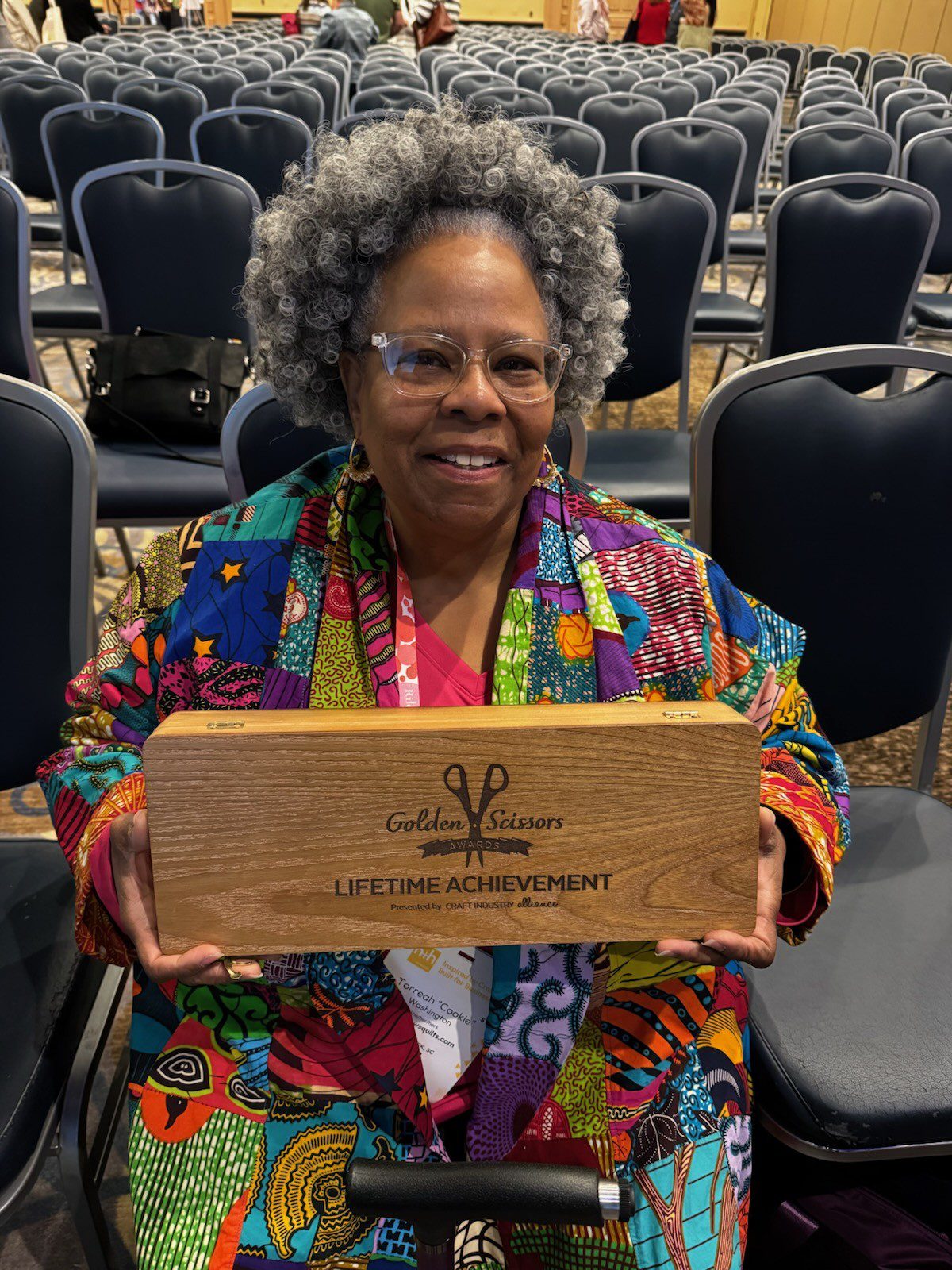
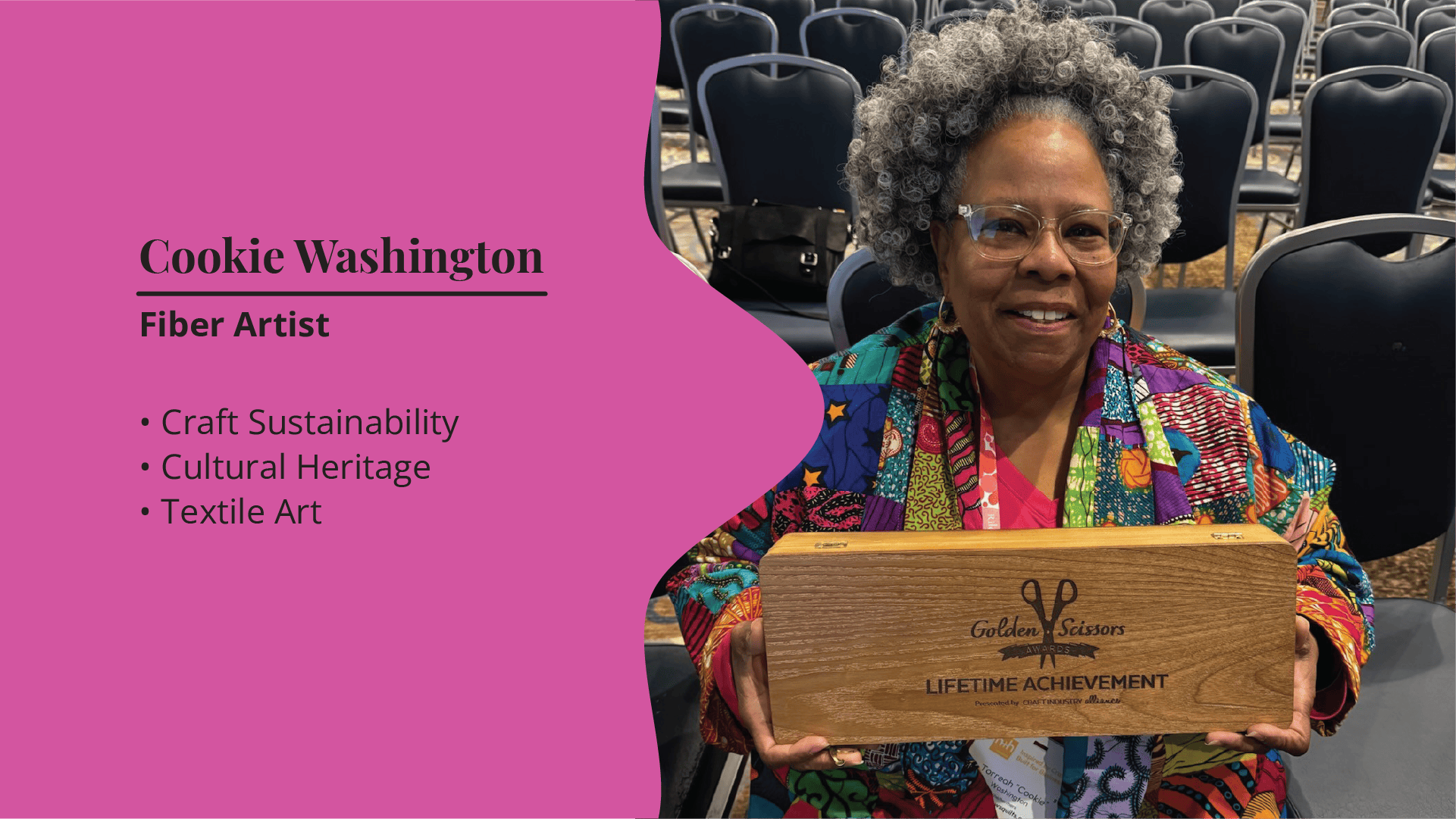
Hi, I am Cookie Washington, and I currently live in Goose Creek, South Carolina. I’ve lived in South Carolina for forty years, but I’m not originally from here. I came here and fell in love with the place, and I’ve stayed.
00:30 Victoria Bartolotto
Great, so before we get into the nitty-gritty details of your profession, can you give us a little elevator pitch about what quilting and ragging is?
00:41 Cookie Washington
You know how some people feel instantly comforted by a handmade quilt or a basket? You know that moment when your hands brush against soft fabric that has possibly lived another life? Well, I believe in a world drowning in fast fashion and waste; we’re desperate for things that last. Things that feel like home. That carry history, and that do not harm Mother Earth.
Futility is my line of handcrafted rugs, baskets, home goods, and totes rooted in the Gullah tradition of rag quilting, an indigenous no-sew method created from necessity. We transformed discarded textiles into soulful, functional art for everyday living. Each piece is made by me in the South Carolina Low Country using century-old techniques passed down by Black women who knew how to make beauty from nothingness.
I’ve been featured in some national press, and I’ve taught at the Smithsonian. Futility is redefining luxury as a sustainable, emotional, and ancestral craft.
01:52 Victoria Bartolotto
Thank you so much, that was great!
01:55 Cookie Washington
Thank you.
01:58 Victoria Bartolotto
So, as a quilter, is there anything that South Carolina, or the Lowcountry in particular, that brings some uniqueness to your work? What kind of influence does South Carolina have on it?
02:11 Cookie Washington
Being surrounded by water on three sides; I’m in the Charleston area, so we’re in a peninsula. The colors of the marshes, and the sky, and the beautiful birds that fly around in my neighborhood very much inspire me. I also try really hard to upcycle and reuse things that have gone before.
One of the ways that I got into this part of my career was, I lost my mother in October of 2023, and then I lost my brother 90 days later in January of 2024. I was obviously overwhelmed and in huge grief. I was both of their executors, and I didn’t know what to do with their clothing. I didn’t want to just throw it out. I’m a way different size than my mom was, so I couldn’t wear her clothes, and my daughters didn’t want clothes from their 89-year-old grandmother.
So, I was sitting, going through some things with my mom’s, and I found a really old picture of me and my grandmother, her mother, sitting on the porch, and we were weaving rag rugs together. I had kind of forgotten about that, and I thought, “oh, I know how to turn this into baskets.” So, I took my mother’s and my brother’s clothes, and I created a basket. For each of the cousins. My mother was the last surviving one of her generations. She had 16 siblings.
03:50 Victoria Bartolotto
Oh, wow.
03:51 Cookie Washington
She was very last one that passed. So, when the cousins came down for our memorial, I made baskets for the ones that I knew were really close and important to her.
I wove some things of my brother’s into that too. When he passed away, I wanted to present his son with a living memory, so I made him a beautiful basket as well. My brother had been in the military, and so I wove in some of his old uniforms, and he loved the beach, so there was beach clothing. I even ripped up one of his kites that he had used and put that all into a weaving to honor him. To make it as a piece of living memory that will hopefully last for a couple more generations.
04:39 Victoria Bartolotto
Yeah, wow, that is extremely touching and definitely personal. Is there a particular piece of clothing or cloth that you liked working with? I crochet, so I know a little bit about handmaking stuff, and I know a lot of the different fabrics feel different when you’re working with them. Was there a particular one that you enjoy?
05:02 Cookie Washington
I use rag crochet, so I rip up old sheets or old clothing, into 1-to-1.5-inch strips, and I crochet with a size 7 needle.
05:13 Victoria Bartolotto
Mmm.
05:14 Cookie Washington
Because it’s really important to me because I found this statistic out, and it drove me crazy. There’s about one hundred fifteen pounds of textile waste that goes into the landfill for every single American every year. Think about it, there are three hundred fifty million of us.
So, one of the things that I do that I think is really important in my work is whenever I make something, I weigh it. And write it down so that I’m trying to get to zero. I have zero waste by the end of the year. I’ve made rugs that are 4 pounds, and 10 pounds, and baskets that are a pound and a half or something. I write that all down, and by the end of each year, I try to make sure that I have at least used my 115 pounds of textiles so that I’m taking them out of the landfill.
This is important to me because landfills are generally in the neighborhoods of people who look like me. It’s poisoning the land. It’s poisoning the groundwater, and I’m very concerned about that. Only about 15% to 18% of what you would buy from a thrift store or Goodwill is ever used. The rest of it is packed up and shipped to another continent to ruin their land. I’m trying in my very small way to help that.
06:39 Victoria Bartolotto
Before entering quilting professionally, did you have any fears about doing it professionally and making a living off of it, or was there anything that held you back?
06:51 Cookie Washington
Another great question, Victoria, thank you. Before I started quilting, I was making upscale wedding gowns.
I have a degree in nursing from Johns Hopkins, and I realized that I couldn’t do that. I was a neonatal nurse, and the first baby that died under my care, it was just devastating. So, I went home, and I’d just gotten married, and had my own babies, and I thought, “I have to do something.” It was easier for me to stay at home and take care of my children. And, I have sewn since I was four.
Being able to make beautiful upscale wedding dresses here in the Lowcountry, and as well as raise my children, I have three children, was very important to me. I did, at one point, get a little stressed about bridezillas, and I thought “I will do something different.”
I saw the most amazing exhibit; it was the Communion of the Spirits exhibit by Roland Freeman at the Gibbs Museum in Charleston. I had been gifted the book for Christmas the year before. To see those quilts in person, it was like…wow! I’m also a crazy activist. I realized that I was waging peace against people who were trying to wage war, and I thought. I have so much that I could say in cloth. It’s my voice in the cloth.
So, I could change the way that I was trying to get my point across in a more gentle, easy-to-digest way. So that’s how I started doing art quilting. I don’t do traditional [quilting]. This is not like your grandmother’s quilt.
08:45 Victoria Bartolotto
Oh, yeah.
08:46 Cookie Washington
I’m never gonna make a bed quilt that’s 9 patches or something. I work a lot with Black mermaids and African goddesses and queens in my work, and so that’s really important to me, because you don’t know where you’re going if you don’t know where you’ve been. I want very much, especially now that I’m the grandmother of three granddaughters, I want them to know that the history of Black women in America or in the world did not start on a slave station somewhere in South Carolina or Mississippi.
We have been regarded as goddesses for four thousand years. We need to remember that and claim that. Whether it’s a myth or whether it’s the truth, just knowing that there is some scholarship around those stories. I think makes you walk a little taller, makes you feel a little more important, and so I love that.
09:43 Victoria Bartolotto
Definitely, yeah. That is so important. Do you have any advice for possibly young adults or students who would want to get into just either quilting, ragging, or just making with their hands in general? Are there any particular skills? Obviously, there are some skills that one would need. What would be kinds of those skills?
10:07 Cookie Washington
Other than having the technical skill of being able to sew, or crochet, or knit, or weave, the thing that I think you most need is patience. Decisiveness, and you’ve got to learn how to market. That is so important, and you need to know your worth. I’ve seen there’s some incredible people who are crocheting clothes, which is something I don’t do.
But they’ll make an entire wedding gown, or the most beautiful coat, and they’re like, “oh, well, $300.” It’s like, “no, no, no, there’s $200 worth of yarn in that.”
10:50 Victoria Bartolotto
Yes.
10:52 Cookie Washington
I usually keep a little notebook when I’m sitting in my studio. I’ll say, “Okay, I started working on this particular project at 9 AM, and I go through lunch, and I sign off. Okay, I did 3 hours.” At the end of the project, you’ll know how many hours you spent. I pay myself about $25 an hour or more, depending on the technique that I’m using. You add that up, plus the price of your ingredients.
I’m currently working on a really cool orange and pink, large tote bag out of tee-shirt yarn. And, I’m at hour five, and I think I’ll be able to finish it in about nine or ten hours. I need to know that for myself, so that I can price it correctly.
I would say to many, many people who are trying to get started in this, in any kind of arts career, find a mentor who will be very honest with you. Sometimes you think that you’re doing something fantastic, and it’s not quite there. Or you’re just duplicating something else. You want to be original; you don’t want to be a copyist.
The other thing I would suggest to people, especially in any kind of textile arts: go to the most expensive, like Neiman Marcus, or iMagnon or something, and look at what they’re selling their handmade, crocheted, or knitted goods for. Take that as a way to think about pricing your stuff. Everything that they’re getting is probably coming from overseas, and they’re probably not paying those people anywhere near what they’re charging. So I think that it’s important for us to, especially in America, at this time, where it’s so difficult to find work-work. As we’re becoming more hands-on. I think we’re switching back to analog work. Rather than an infection of AI or whatever.
I think we just need to know our worth, and we need to work hard to be successful. Some people think, “Oh, I’m going to start a business, and I’m gonna be able to have lunch with my friends three days a week, and I’m going to get to go sailing.” No, you’re gonna sit in your studio sometimes till two o’clock in the morning, but if you want it badly enough, it really will happen.
13:34 Victoria Bartolotto
I can totally empathize with the whole textile situation. I have friends who will ask me for sweaters, or for blankets, and they’re like, “Oh, well, can you get it to me by the end of the week?” I’m a full-time student, and I’m working two jobs. I would look at them like, “That’s gonna take me at least fifteen hours to do.”
13:56 Cookie Washington
Even if you weren’t, you’re not a genie. You’re a craftsperson.
14:03 Victoria Bartolotto
So, I can totally imagine.
14:04 Cookie Washington
When they ask you for something for free, I think that’s the hardest part. It’s learning to say no.
You want a blanket for the baby, and you’re always glad when someone is bringing a new life into the world, but if you spend ten hours on that, and they say, “Oh, I’ll pay for your yarn.” The yarn is the smallest part of it. It’s your labor, it’s your love. You need to be compensated for that.
I think telling people, “Oh okay, well, my crocheted baby blankets start at $450. My hand-crocheted or hand-quilted baby blankets start at this other price, and this is why.”
Then shut up, because people go “$400 for a baby blanket? I thought…” Let them talk themselves into it or out of it. No is a complete sentence. “No. I will not make you a baby blanket for $50. Unless it’s out of air.” Be very firm and confident in yourself.
15:20 Victoria Bartolotto
Yeah. Well, thank you so much for taking the time to speak with me today. I am so grateful and honored to hear from you, especially from somebody who works with textiles as well.
15:30 Cookie Washington
You have a wonderful afternoon, hon!
15:33 Victoria Bartolotto
You as well. It was a pleasure speaking with you.
15:35 Cookie Washington
It’s a pleasure speaking with you too, hon. Bye-bye.