Interview
Transcript
Ryleigh Kelley 00:00
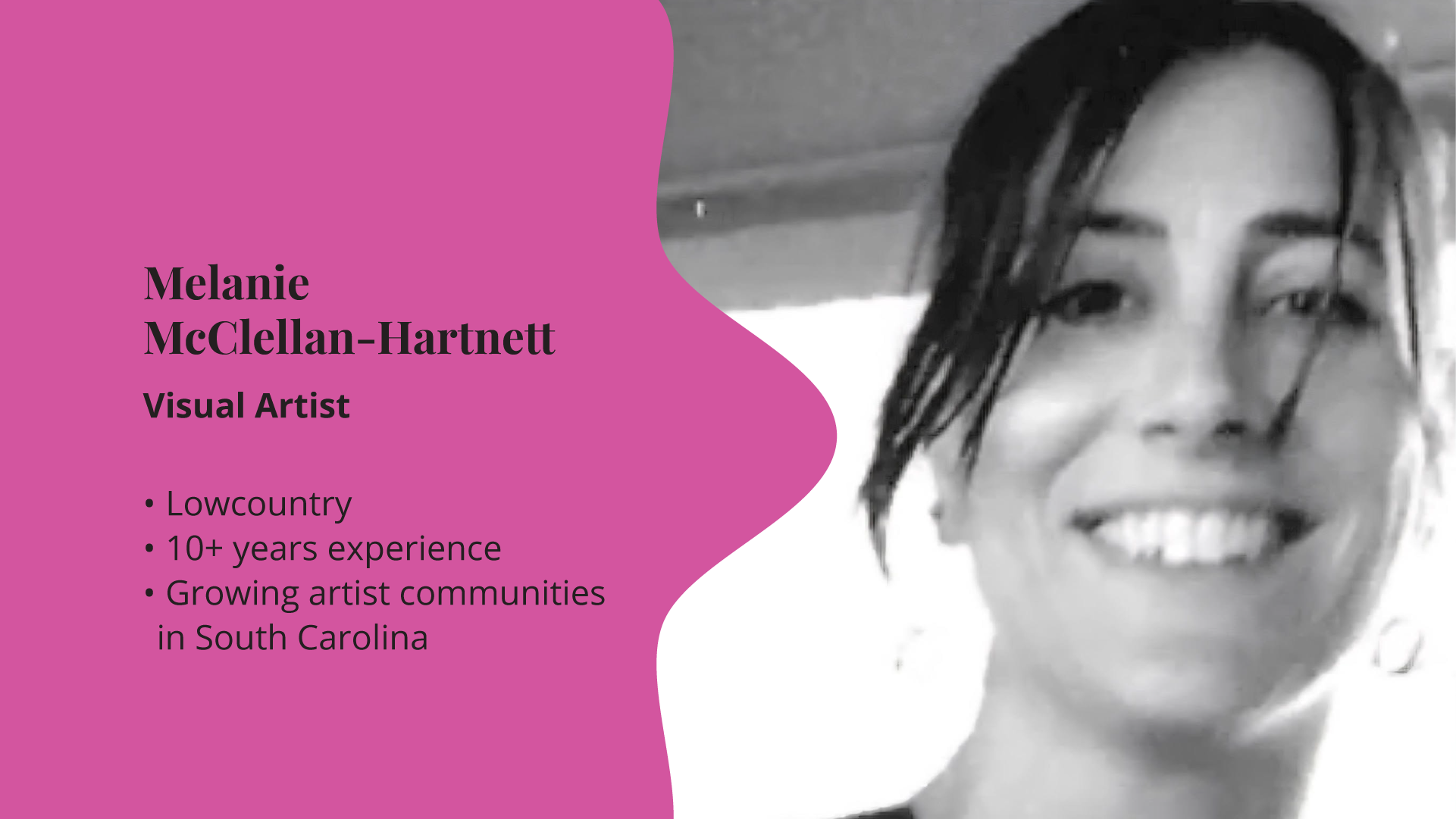
Hello, my name is Ryleigh, and today we are talking with Melanie McClellan-Hartnett, a professional creative working from and within South Carolina. So, as we get started, can you tell us your current career and where you’re from?
Melanie McClellan-Hartnett 00:14
Sure, so I grew up in McClellanville, South Carolina, which is the same as my last name. There is a lot of my family there. It’s a very small town, and I did go to school elsewhere, and I’ve lived elsewhere, but that’s my roots, and that’s where I’ve been from most of my career, which has been wonderful.
I will always support, when you have a community behind you, no matter how small they are, that’s just a wonderful, wonderful resource. There’s just less, just not as many opportunities in a small place as there are in a city.
So, my husband and I are empty nesters now. I have some very wonderful mentors, who said, ‘We love you, you’re doing great work. You’ve got to get out of your zip code. Listen, you can come back. We want you to come back, but you need to be where you can connect with people easily, and that just happens more readily in a city.” You can walk into an art gallery, and you’ll bump into somebody you know. It’s just different.
I am in Charleston, South Carolina, right now, and everything is just blown open. It’s incredible. It’s been the best year, and I just want to encourage people to go out on that limb and see what can happen, and especially I think that we feel like we’re extra connected sometimes because of social media, which we can be.
My daughter is in Europe, and I get to see her face. I love that, but we miss out on some of the people connections, and you really miss out on what can happen organically when people just come together and it’s not planned or scheduled. Especially because art, whether it’s literary or visual or whatever, means whatever, it’s a larger vision.
When you can come together and connect with other people in that larger vision, you’re going to see stuff you never would have thought of before, and so coming to Charleston has been wonderful for me. I just started painting. My husband was in my studio yesterday, and he’s like, “You have three exhibits here.” Which is a lot, because I have one currently hanging, so really, before the paintings were like four exhibits, but it’s because I realized I was so lucky to be in such a pretty place. I always thought of 1920s Paris with the artists. God, I was jealous, and now I’m not jealous, because we have that.
You live in a beautiful place. You want to paint it? Do it. You want to draw it? Do it. You want to write about it? Do it, and don’t be afraid to just connect with people who are doing what they love. You don’t have to be a professional. I didn’t start out as a professional by any means. I thought I was going to be a writer.
“Melanie, you’re going to be doing oil paintings.” Okay, another life, maybe. I like oil paintings, but I was scared to try, and I think getting over that fear, meeting a lot of people, and so right now I have an exhibit, it’s at the Healing Gallery, which is on Queen Street, and everybody laughs at me, so like, “Of course, this is your solo exhibit,” my debut one.
You have to go down a little path between hedges, very hidden, private, covered in vines, just the house I moved from, but it’s the best vibe, and so it has twenty-two oil paintings in it that they’re all full of words and symbols, intentions, mantras, anything I’ve kind of wrangled out, but then I’ll paint it out, or sometimes I will inscribe it with a lit incense stick, so because I feel like if you’re doing that and then you’re using the other end to inscribe, it’s like a prayer.
It just puts me in the right place, and people are always like, “Well, how do you know when you’re done when you look at these very abstract paintings?” I think that’s a fair question. I say, “Because I’m struggling with things in the paintings, and so I don’t sign it until I find the light.” I think you can do that with anything.
So, with this show, I’m really excited. It posits that if you put positive intentions in something, and then you tell people, because I don’t want to be sneaky, if you tell people and they are open to it, and they want to look for that immediately, your brain triggers positive neurochemistry. It’s psychological priming. It doesn’t even matter if you believe in the metaphysics of what is written, your brain will automatically reward you. So, this show is about what could happen if we just start putting positive things in everything, because I’m tired of microplastics, and all that. If we have to live with all the negativity, we need to learn to do more. It has been amazing, seeing so many different kinds of people come in and just be open.
It’s a great experience, and I have found that I was a little nervous moving here because I was very comfortable where I was. I just turned fifty, and you don’t always make friends very quickly, and I don’t know how this is going to go. I have started getting to know artists around here, and they’re wonderful, and we’re doing things together; we’re doing cool things together.
I don’t know if this is a little repetitive, if it’s not, but I will say that one of the biggest things that helped me coming to Charleston was somebody connected me with Beeple Studios, and they are so great about supporting artists and connecting artists. I’ve met a bunch of artists through that, and it’s like when you have somebody who’s willing to put that kind of support in, it’s fantastic.
Ryleigh Kelley 06:41
Yeah, absolutely. Community is so important, and I’m happy to hear that you’re finding that in Charleston, because you’re in your comfort zone for a while. It’s like you feel that peace and security, and then when that change comes, it can be scary, but it sounds like that it’s doing just wonders right now.
Melanie McClellan-Hartnett 07:05
It’s wonderful. I am working on the poster, or a competition for the poster for the 2027 Cooper River Bridge Run. I pretty much try to die then after a run, which is not my fate at all, but I have started entering more community competitions like that, because somebody wins, so why not try?
Also, I find it makes me really value things about my community, because you have to think about it, if you’re going to do something, have your vision, then you have to really engage with it, and it helps you value what’s there. I’ve started doing more little things like that, because those are all opportunities when you see things like that, I think a lot of artists think, “That’s not ‘angsty’ enough.”
Ryleigh Kelley 08:08
Yeah, the tortured artist aesthetic.
Melanie McClellan-Hartnett 08:10
Or serious, or whatever, and I get that, obviously, I want to do serious stuff. When you are forced to think about things through your medium, but they’re different things, that’s great. People [Studios], when he has live painting events, I’ve been lucky enough to paint at two of them. The first one was about crypto punks. I didn’t even know what they were. I had to learn about them.
That was fascinating. And then the second one was the future of art, which I was like, well, that’ll be the future of humanity. And for a moment, I was like, “that sounds kind of bleak.” And then I was like, “no, wait a minute, let’s think.” They say we’ll be living on Mars. And so, I spent three months studying Mars. It’s so cool.
Do I think that we should solve stuff here first? Heck yeah, but it’s great to give your mind new frontiers. New challenges. It doesn’t matter if it’s not your subject matter. I guess that’s kind of my point. It’s like take that risk, try it, it doesn’t have to define you.
Ryleigh Kelley 09:27
Yeah, and also, too, it gets into this aspect of play and art, and I love how you’re leaning into that. You said, there could be positivity, there could be play and I love that you explore that.
Melanie McClellan-Hartnett 09:48
Well, I feel like people need to tell artists that, because we need permission to be humans, and also we need ease. But I don’t know, one of my artist friends, actually, she’s the one that she’s from Japan, and she gave me this little guy, and one day we’re having a show in Japan, so I always wear this to all my art stuff, because it’s like a promise that we’re gonna be that.
But she is like one of those ‘extremely talented when you sit next to her’ people, and she told me that my gift to her was teaching her to make art without rules, which there are obvious rules like you can’t put acrylic over oil, like there’s things, yes, you have to pay attention to–
Ryleigh Kelley 10:34
Yeah, the practical, I guess, yeah.
Melanie McClellan-Hartnett 10:37
Right. Like, the physics rules, the chemical rules, but the people rules? No, that’s like one of the coolest things about being an artist is my job is to question why those are rules, and think about it,
Picasso is a mixed bag for me. Sometimes I don’t want to know about people’s personal lives, people are people, but he said to, “Learn the rules like a pro, so you can break them like an artist.” That is my favorite art quote. That is exactly what you need to do, because you want your work to stand up, but you also don’t want, I mean, if it’s your vision, nobody else can tell you how to do it.
I mean, I get our mentors who can say, “Hey, you could do this better.” One thing I did when I moved to Charleston, I joined the Redux Art Gallery, does figure drawing on Sunday nights. It’s expensive, and it’s just a great vibe, and all my lines immediately improved. I never draw naked people, but the human body is very, very beautiful, and if you can draw it, you can draw anything, and being around more artists who are just that’s all there, everyone’s just following their vision.
Then you’ll find, “Hey, I’m using this too, or I’ve been thinking about whatever.” I love it, especially, if it’s someone from another country, and you’ll meet, you’ll be playing with some of the very same things, and not from social media. Usually I don’t do a lot of scrolling while I’m thinking about stuff, because I’m afraid of it being too much. I’ll do it after I have an idea, because then I want to see what kind of variations there are, but I, but I think it’s really cool when you’re like, “oh my god, we’re all leaning into something so much bigger.” That’s so cool.
Ryleigh Kelley 12:43
Yeah, yeah, and especially, too, I love how you talk about that temptation to scroll on social media when you get an idea, because it fulfills our curiosity a little bit, but it’s that fine line of, okay, when it gets too much, and then you lose the idea. Finding and striking that balance in everything.
I kind of want to talk a little bit more about, what you just said about how even you’re meeting artists from different countries, and how you’re all collectively working to something kind of bigger, and I’m curious, you kind of already talked about this, but is there anything South Carolina, or maybe even your hometown, or Charleston, in particular, brings to your work, and does it have a unique influence on you compared to people in the same profession in different states, or even different countries?
Melanie McClellan-Hartnett 13:42
I might be too small to answer that. I think that water is a huge part. I’m living in downtown Charleston. We feel flooding all the time. Also, where I grew up, McClellanville, South Carolina, was where Hurricane Hugo hit, which was devastating water. So, I’ve seen what water can do, and we know sea levels are rising. That is something – it’s not like everybody is painting water, but everybody’s talking about it.
Everybody’s talking about what kind of changes are we going to need to make, like architecturally, which, honestly, I don’t think that’s doom and gloom. I think that’s cool, because the world has been changing forever. That’s what it does. People have been adapting, that’s what we do, and that I honestly think is cool… like, I don’t know if you’ve ever read, they’re very old school, The Notebooks of Leonardo Da Vinci.
Ryleigh Kelley 14:53
I feel like I’ve heard of it, but I haven’t read it.
Melanie McClellan-Hartnett 14:55
Okay, just skim it, that’s all I’ve honestly done, because they’re dense. But they’re so cool, because science is such a part of art and social stuff. You’re studying all kinds of different stuff. I think it’s exciting, I feel like there are going to be answers made. I think an artist is not afraid to completely fantasize. We fantasize about making it big all the time, but also, well, what do you mean you can’t have a house made out of a sphere?
I can, I’m gonna make it work, and that’s a little bit of a jump. I’ve gotten really interested in the fact that MIT has all kinds of open-source courses that you can study. I know a lot of artists and people who are kind of interested, because that was not them in school, but now just want to know more about this.
I think the dynamics of where you live, for sure, and South Carolina – it’s really not just coastal South Carolina, because I saw a map the other day, and it was kind of scary, but it was also cool. It was like from space, showing how the currents were changing the coastline again. But okay, we’ll adapt, so however that looks, maybe it’s relocating, maybe it’s completely different housing.
When you’re an artist or a writer or a musician, all of that is an opportunity to discuss that and to think about different ways you could do it, and to not really have a budget, like when you’re trying to produce it. Yes, but in your head with your idea, it’s free, so it’s a lot less limits.
Ryleigh Kelley 16:55
Great sentiments about that too, especially with Charleston, how there’s this issue of rising sea levels. You kind of take as an opportunity to be like, “we need to adapt, like we’re going to adapt.” I love too, about architecture, and how that may change being an artist and the opportunity to be included in that discussion.
Melanie McClellan-Hartnett 17:24
If you include artists in that discussion, then they’ll think of something radical, and then the person who knows physics better will say, “But…” I do love all the steam education stuff they’re doing? It’s fantastic. It’s so holistic, and I know that they put that label on some things; they’re like, “Where are you getting that?” But honestly, any connection you can make, you don’t know where that’ll go. So, try it.
Ryleigh Kelley 17:57
Yeah, speaking of that, kind of little bit of words of advice. Do you have any advice for young adults or students that have an interest, in pursuing a similar career, in your world, in the creative world? And are there any just particular skills, not just like artistry, but like people skills, one should practice or have before stepping fully into this industry?
Melanie McClellan-Hartnett 18:26
Artists are such a wide range of folks, you know? One thing that helped me become more professional, and because I was just working out of my laundry room-turned-studio, and then I ended up being the director at the McClellan Arts Council for a while, which was really cool, because that really connected me to the network that is in South Carolina. That’s where I saw Arts Commission, that’s where I saw the different universities coming together, and we did stuff with the Smithsonian.
That’s where you see people who just don’t know that you have all these resources, and so with that I think getting a working knowledge of the resources that are around you is invaluable. Also, I’ve done a lot of volunteer work with seniors and kids. I think the better your social skills are all across the board, like Queen Victoria said something about beware of artists, because they mix with all types of societies, so therefore they’re the most dangerous and good.
I think that that’s true, and I think that the more so, like social studies, a little bit of business sense. What I have done is find somebody who’s better at business than I am who I call my ‘business oracle.’ I think that’s fair, but you still want to have some idea of what the rules are, because I love her – she’s wonderful, but you can’t trust everybody. You need to know. You read stories about people with managers and things going wrong all the time, so get a mentor.
I love my mentors, and I think you should switch them up sometimes, because if you get a little too good, too connected, then it becomes more support, which is great, but you still need someone who will tell you if, “Nah, you’re going off kind of weird path, there.” So, get good mentors, and connect with your museums and your universities’ programs. They always need hands. They always need hands. If you’re good at that, doors will open. You’ll meet people.
We just had Piccolo and Spolito here in Charleston, and Marion Square is like one of my favorite places to get with all—I had a bunch of friends there. I do not have the stamina to stay in a tent for seventeen days in the heat, but I will come visit them when they do. I was really struck with; I don’t even know how they would do it, but this is such an opportunity for mentorship.
If you look at young artists who are just starting, or even not sure they want to do it, but they’re thinking about it, not for the whole time, just for a little bit of that time, it’d be so good for them because they need so much. This is going to sound kind of crazy, but most artists are doing food and bev[erage] anyway to pay their bills. I actually think that working food and bev[erage] was great, because you meet all kinds of people. You just don’t know where that’s going to go.
I did an arts program once where I specifically went and hired people from restaurants, because I knew a lot of creatives have that side. I wanted people who couldn’t do that full time, didn’t have room or resources to have it set up, but just still to do their work for a little bit, get into their groove. It was so cool, honestly, you could study anything in the whole wide world, but languages, social time, different age groups, and just plug into all the resources. There’s so many resources, I mean, goodness, and also–
Ryleigh Kelley 22:36
Emphasis on resources.
Melanie McClellan-Hartnett 22:38
No, like really, but they can help each other so much, and you can get two for one. If people are working together, there’s so much money. Well, what if we can do more with it? You know, not trying to shortchange people, maybe that same person could get two benefits.
I was thinking down here every restaurant should adopt an artist, because they’re so hot out there. Like, name a drink after them, put one of their pieces, so many possibilities.
Ryleigh Kelley 23:13
Really, there really is. There really is. Yeah. We are running a little bit out of time, but thank you so much for just taking the time to speak with me, and I really appreciate all of your sentiments, and just for you talking and articulating about your experiences. I think this was a lovely, lovely conversation.
Melanie McClellan-Hartnett 23:37
You’ve been really awesome. Thank you so much. I don’t really like doing interviews, and you have just been so human.
Ryleigh Kelley 23:44
Well, thank you. That means a lot to me.