Audio
Transcript
Sarah Jane Thomas 00:00
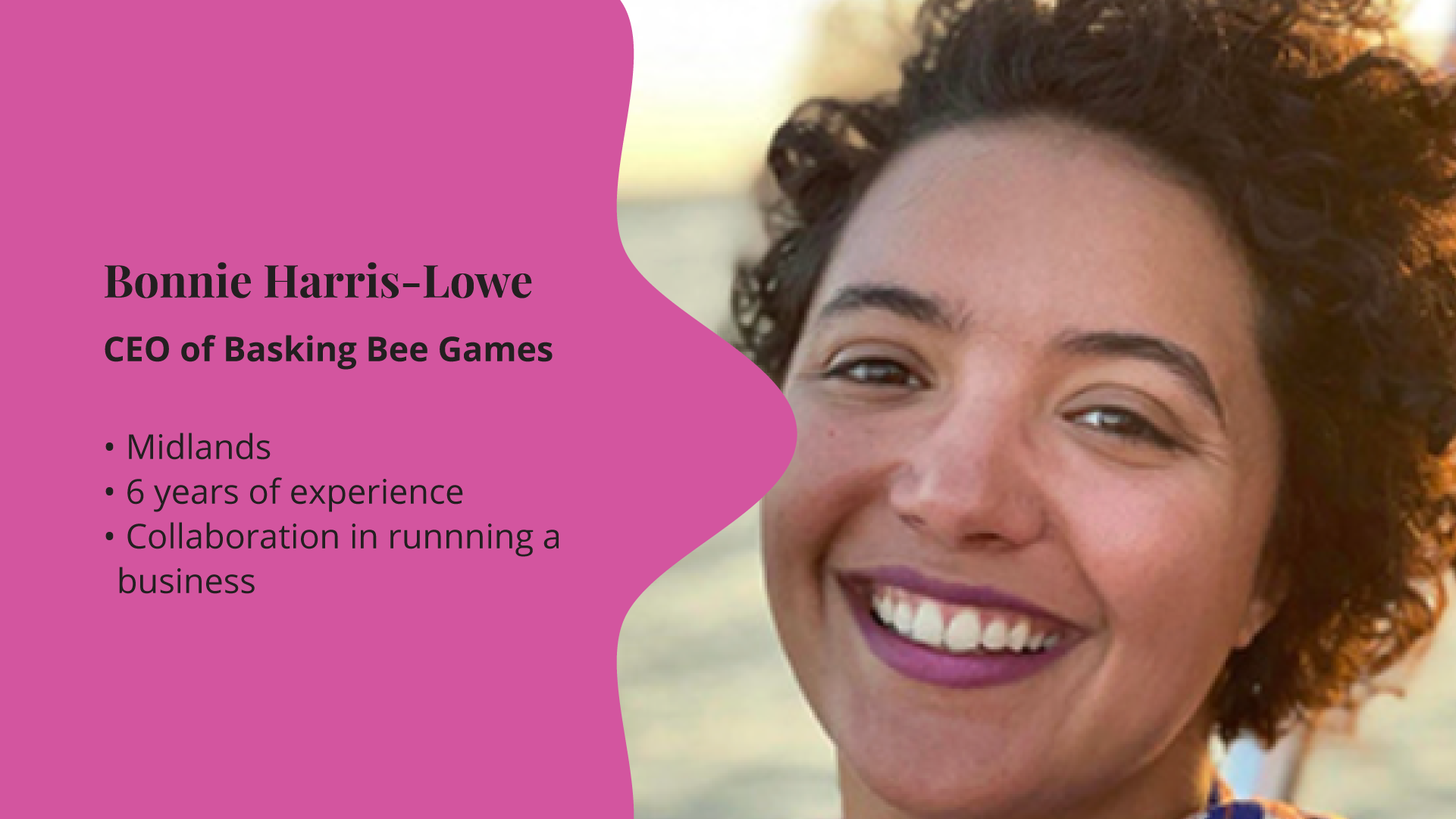
My name is Sarah Jane Thomas, and today we are talking with Bonnie Harris-Lowe, a professional creative working from and within South Carolina. As we get started, can you tell us your current career and where you’re from?
Bonnie Harris-Lowe 00:13
So currently, I am an instructor at the University of South Carolina, and I also have my own business, which is a combination work for hire and game development studio. I live in Columbia, South Carolina, currently.
Sarah Jane Thomas 00:28
Perfect. Before we get into details, we have a brief section of the interview called “One Career 60 Seconds”, where you describe your job in 60 seconds or less, similar to a little elevator pitch.
Sarah Jane Thomas 00:44
Go ahead and give it a shot. Sorry.
Bonnie Harris-Lowe 00:47
Okay, no, you’re good. Basking Bee Games is a combination work for hire and volunteer game development studio. Since our founding in 2023, we have been hired by multiple clients, including Legend Stories Studios, and have released a game demo, which was showcased at DreamHack Dallas and the Southeast Game Exchange. We are currently working on a multiplayer party game called Wardrobe Dysfunction internally, while continuing to work on active external contracts.
Sarah Jane Thomas 01:16
That sounds absolutely perfect. Thank you so much for playing our little game.
Bonnie Harris-Lowe 01:20
Yeah, no problem.
Sarah Jane Thomas 01:21
So, what would you describe your official job title as?
Bonnie Harris-Lowe 01:26
Within Basking Bee, I’m the founder and sole full-time member. So, CEO, creative director, either of those would apply. But as far as oh, sorry, no, okay, I didn’t want to just like clarify. As far as the studio, I’m the creative director, as far as operations and everything, but when it comes to our internal projects, I do like to spread the responsibility around.
So, I wouldn’t say I’m the creative director for like every project that we’re doing. The development side is a much more flat structured collaborative effort.
Sarah Jane Thomas 02:09
Okay, so as a CEO and creative director, is there anything in South Carolina or where you’ve grown up and lived that brings something new to your work that you think others in your field don’t necessarily have?
Bonnie Harris-Lowe 02:26
Interesting question. So, I don’t think I said before–I live in Columbia now, but I grew up in Greenville, South Carolina. So, I’ve been here most of my life. I went to graduate school in California and lived there for three years, where I studied. I got my master’s in game design and interactive media there, and what was interesting about that experience was they were kind of in… California, obviously, is a huge hub for entertainment in all sectors, including game development in the U.S. Whereas South Carolina, North Carolina has a few game studios, but South Carolina doesn’t really have that much of a scene in that in that industry.
So, I think as far as growing up here, I feel like a common theme with growing up in South Carolina is it gets you it gets you kind of underestimated, kind of labeled in some less than favorable ways by people who aren’t from here. I’ve seen through like mentorship opportunities that I’ve done at high schools and summer camps and things living here that there is a lot of creativity and a lot of thirst to work in these creative spaces, including games.
I just kind of want to not only put forth my own creative energy but also focus on doing it in South Carolina because I know that there are that there’s a lot of potential here, and I want to help kind of bring that to the forefront over the course of my career.
Sarah Jane Thomas 04:06
Oh, that’s really beautiful, actually.
Bonnie Harris-Lowe 04:08
Oh, thanks.
Sarah Jane Thomas 04:10
Do you think that there was like a defining moment in your life that had a big impact on your creative journey, or a particular project?
Bonnie Harris-Lowe 04:21
I can think of two big moments. So, the first one was when I was around eight years old. I was playing The Legend of Zelda: The Wind Waker, and you know, prior to that, I’d been gaming for about three years at the time I started, when I was around five. There’s a character in Wind Waker who is a little girl with brown skin, and spoiler alert: later in the game, it’s revealed that she is the princess in disguise. And when that is revealed, she goes through a transformation sequence, and her skin turned white, which really messed me up. Because as I had noticed already, that there weren’t a lot of women, especially or brown women or brown people at all, in video games, unless they were villains.
So, seeing a little brown girl who looked like me was really impactful, and then watching that get washed away literally just really broke my heart and made me think, “You know, if I ever start making games, I’m gonna do something about this.”
Then, as I was growing up, I learned more about what working in the games industry traditionally is like with bad labor practices and toxicity from within companies and within the community at large, especially being a woman of color, which kind of gave me pause. But when I went to undergrad at the University of South Carolina, which is again where I’m teaching now, I took every single class on games that I could find while still trying to figure out which part of a creative industry I would, which creative sector I wanted to work in.
In one of the games classes I took, we watched a documentary called Indie Game: the Movie, which hasn’t aged the best. But at the time, watching it and seeing the stories of these developers, you know, struggling but ultimately meeting their goals, it kind of made me cry and just gave me the sense that like that’s what I’m supposed to be doing, regardless of all of the horror stories. I knew I had to at least give it a try.
Sarah Jane Thomas 06:32
Are you? I’m assuming you’re happy that you did….
Bonnie Harris-Lowe 06:35
For the most part.
Sarah Jane Thomas 06:38
Is there something particular that you felt showcased your creativity in a way that you’ve never been able to before?
Bonnie Harris-Lowe 06:46
The biggest example is the demo that Basking Bee released in 2023 called Project Parallel, which started out as my graduate thesis project, but I was not able to finish it because my last semester of graduate school was Spring 2020.
Sarah Jane Thomas 07:08
Oh.
Bonnie Harris-Lowe 07:09
Yes, and that kind of threw a big wrench into my team’s productivity, and you know, totally understandable. And it took me a few years to get back to it, and by the time I did, I’d already founded the Basking Bee label, so I decided to release it under that name. And in 2024, that’s the game that was showcased at two different games exhibitions.
I remember I have a TikTok floating around somewhere of walking into DreamHack and setting up the booth and everything. And when I saw the name of the game on my empty booth, once again, I started crying. I’m a very teary, emotional person, but yeah, that was just a really amazing feeling.
Sarah Jane Thomas 07:55
Yeah, this is something that you’ve kind of already touched on a little bit, but I think a more direct question would help. Before entering your field, did you have any fears about being a professional?
Bonnie Harris-Lowe 08:08
Yes, numerous. So yeah, like I said, the games industry is not known for being a welcoming place for women and people of color or LGBTQ people, for that matter. Just I’m not really. I don’t really fall into that category, so I tend to focus on the other two when talking about myself, but I digress. A few, I think, a year at the year after I, the year I graduated high school or my first year of college, is when the Gamergate incident happened, which was a massive harassment campaign against a targeted select few female game devs, who you know they received death threats, rape threats.
They were doxxed. They had to flee their homes and things like that. One of them wasn’t even a game developer. She was a content creator who just talked about feminism and representation of women in games. Somebody actually made a game where the premise was just you get to beat that woman up. Yeah, it’s pretty dark stuff, and so that really like scared me. Like if I ever get too loud about what I’m doing, get too get too feminist, get too woke, as I think I would call it these days. Like, is that kind of thing going to happen to me?
And then on top of that, if I were to work at a larger studio, I learned about ‘crunch,’ which is when going back to the bad labor practices, the most infamous in the games industry is the idea of crunch, where people basically have to live at their jobs and work like 80-hour weeks, no overtime for months at a time, which just does not sound sustainable for anybody. I don’t know how people out there do it. I’m sure that I could not.
So, between those two things, just to illustrate in greater detail what my trepidation was, I was definitely frightened. But I’ve kind of gone down a path. Obviously, I’m not working at a big Triple A studio. I can set my own hours and kind of am in control of my own schedule, my own voice. And because we’re such a small studio, there’s also not much of a reason to target any of us at the moment, which is nice. I don’t know if that will last forever because I would like to have a bigger name out there.
But yeah, I’ve managed to squeak through all of the problems that I have described, and you know I know better now what I’m willing to accept and what I’m not if I ever were to pivot to working for a game studio again, and there’s one other thing I wanted to say on that subject, but I can’t remember, so I’ll stop there.
Sarah Jane Thomas 11:13
Okay. Aside from, you know, you setting up your own company and being able to do all of this yourself, are there any other things that kind of helped you continue and push forward into this field?
Bonnie Harris-Lowe 11:28
I would definitely have to shout out my two collaborators for that, Jessica and Pernima. Pernima is still a student and an absolute rock star programmer, and Jessica is a longtime friend. We met at what was my first industry job in games? I think it might have been her first job in games as well. She is a prolific 2D artist. She was also a bridesmaid in my wedding. So, we’ve known each other for oh my gosh, it’s been like six years now. But yes, they are working with me on our new game, Wardrobe Dysfunction, and it’s just really nice having somebody to touch base with every week. We stream on Fridays at 5:30pm on Twitch. The channel is called Basking Bee Games, if you want to check it out.
But yes, just having that time to collaborate with people who, while we’re all making something that we are excited about, because you know, working by yourself can get pretty lonely. It can be hard to motivate yourself, especially for like the internal projects. But the contract stuff, it’s easier because that’s somebody who’s hiring me and paying me to perform a service for them, whereas the internal development can get easily pushed off because it’s just like something I’m doing in my free time.
Doing contract work and now teaching–it’s exhausting. So, definitely having people who are willing to come along on this ride with me, and who have been so instrumental in you know the process of brainstorming, creating this idea, and now building this game has been lovely. So big shoutouts to them!
Sarah Jane Thomas 13:23
Oh, good! I’m glad you had people to come alongside of you. Do you have any advice for young adults or students who have an interest in pursuing a similar career path?
Bonnie Harris-Lowe 13:35
Yes. So, I think the games industry is in a weird spot right now. So, another problem in the games industry is layoffs are rampant. Oh, I remember the thing I was going to say earlier. There are starting to be movements towards unionization in games, especially in QA (quality assurance), which is one considered a lower rung or lower tier job in games, even though it’s extremely important. So, I’m optimistic about unionization efforts for the future of games.
So, if you want to work at a big studio, know that I would say keep watch on those kinds of efforts. See which companies are supporting those versus which ones are trying to suppress them. But the future of the games, I think, right now is pivoting towards indie studios, independent development, because in 2023, the layoffs we experienced were in historic numbers.
I think there’s a whole Wikipedia page just on layoffs in 2023, even though it’s always been a common thing. And since then, there’s been a big upswing in people who are working at indie studios, starting indie studios like what I did, or even forming volunteer teams, which is essentially what Basking Bee is as far as the internal development part, like with the contracting. Obviously, we get income from that, but the internal development, we are all volunteering our time for that.
I had the good fortune of meeting Alla Derrick at a game jam in 2023. I want to say, or yeah, 2023 or four, and she shortly after that started a company called Cave Bear Games, which is now a nonprofit volunteer game studio. Their whole mission is to connect small studios to each other, to aspiring talent, and just help people find other people to make games with. That’s how I found Pernima, who is the backbone of this organization’s programming, so I think being willing to volunteer your time and look for those opportunities to collaborate with people who can fill in the gaps in your skill set and who can motivate you to continue working and whom you like working with is a big first step.
Even if you do want to transition into working at a more traditional studio, the best thing that you can have in your portfolio, if you want to be a game designer and apply to game design companies, is a game that you’ve already finished and released. So, I think looking for those volunteer opportunities and those collaborators that you can be close with and maintain relationships with, and you know ideally keep working with, is a critical first step.
Sarah Jane Thomas 16:37
I guess along the same lines of finding people and continuing with people and finding those opportunities to volunteer your time, are there any particular skills you would suggest refining before stepping into the career path?
Bonnie Harris-Lowe 16:52
I mean, it’s never a bad idea to learn to code. That’s one of the most in-demand and secure career paths in game dev. I personally am not a programmer. I have tried to learn several times. I know enough to do basic things, but it stresses me out so much. I have not been able to breakthrough that barrier to doing the more advanced things. But knowing at least how to build simple things with code will help you contribute. It will help you contribute to volunteer projects.
It might not get you a job unless you are really dedicated to learning the more advanced stuff. But if you do want to go down that path, again, it’s very secure. The two big game engines that I would recommend are Unity and Unreal Engine; they’re both free to download. Unity is much more common at small indie studios. A lot of big studios have their own custom engines, but if they don’t, a lot of them will use Unreal because it’s a bit higher fidelity. It’s got a lot more bells and whistles than Unity.
Other than that, learning the basics of game design, game theory can help if you already have some creative background. It can help you learn how to pivot those skills into games because let’s say you’re coming from television or you’re coming from music or something, the skills that you have in those fields are transferable, but they do need to be tweaked when you are incorporating interactivity into the medium.
So, learning how interactivity can change and augment the skills that you already have is also a great step. So, the last thing I’d say on that is, if you want to work at a larger studio, it’s good to specialize in something. Whether that’s programming, whether it’s animation or character rigging, that’s a big one. If you want to do 3d characters, a lot of people can animate and model, rigging is a bit more of a specialized skill set, but if you want to work at a bigger company, specializing in one thing and showcasing that a lot is a good idea. Whereas if you want to work at an indie studio, it’s generally a good idea to develop and showcase multiple different skills across your projects because at indie studios, it’s much more common that you will have to do multiple jobs because the teams are smaller. So yes, I’d say tailor your skills to the kind of studio that you want to work at. Does that help?
Sarah Jane Thomas 19:43
Yes. Okay. I just want to thank you so much for talking with me and taking the time out of your day. Out of your day, would you be willing to talk to one of my team members again?
Bonnie Harris-Lowe 19:55
Sure.
Sarah Jane Thomas 19:56
Well, I will take that off. I have a personal question. I would like to ask you. Okay, have you ever read the book, Tomorrow and Tomorrow and Tomorrow?
Bonnie Harris-Lowe 20:05
I have not. Let me look it up really quick.
Sarah Jane Thomas 20:07
It is. I think it takes place over the span of like 25 years, and it’s about these three people who go on to develop these games. I haven’t read it in a few years, so I can’t remember like all the specifics. But just hearing you talk about the Unreal Engines and stuff like that just reminded me of it, and I feel like it might be up your alley a little bit. Yes, but it is a really good book.
Bonnie Harris-Lowe 20:36
I’m skimming the Wikipedia right now. It does look very interesting and super applicable to what I was talking about. That’s why check this out.
Sarah Jane Thomas 20:43
That’s why I wanted to ask because hearing you talk about all of this, I’m like, I have read a book about this stuff.
Bonnie Harris-Lowe 20:49
Yeah, there you go.
Sarah Jane Thomas 20:51
Well, it was wonderful to meet you. Thank you so much for talking with us. We will get a transcript of your interview, and I believe the video clips to it, and your profile all sent to you, so you can check over that. Thank you.
Bonnie Harris-Lowe 21:05
All right, thanks so much.
Sarah Jane Thomas 21:06
Have a good rest of your day.
Bonnie Harris-Lowe 21:08
You too. Bye.