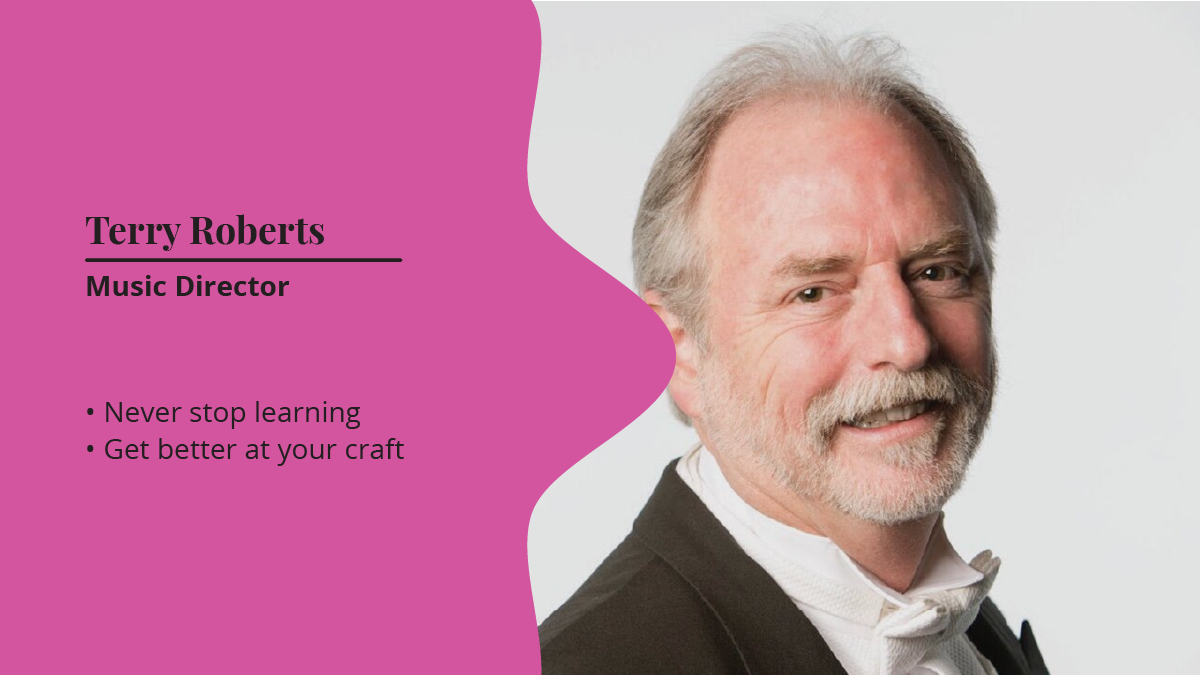
“If you ever start to feel inadequate at what you’re doing, don’t let that stop you.”
Whitney McDonald is the Theatre Operator for the Amentum Center of Performing Arts and the Aiken Community Theatre in Aiken, S.C. She acts as a liaison between the city and the theater, runs the box office, and handles communications for the theater.
Interview
There was a technical issue with our audio during this interview, so we are providing just the transcript.
Transcript
Whitney McDonald 00:00 Hi, I am Whitney McDonald. I live in Aiken, South Carolina. I am the theater operator for the Momentum Center for Performing Arts. It is a city-owned facility, and Aiken Community Theater is the main tenant. So, I work mostly for Aiken Community Theater, but I also do work for the city as well. I’m kind of split between both. I am more of a liaison between the city and the Aiken Community Theater.
Haley Hansen 00:28 How long have you been doing that?
Whitney McDonald 00:29 Two years in August. Yeah! coming up in August. It will be two years.
Haley Hansen 00:33 Can you walk me through your typical workday?
Whitney McDonald 00:36 Sure. I come in at 8:00 a.m. every morning, even though the box office isn’t open until 9:00. I use that hour to check voicemails and emails for both the theater and the city. I walk through the theater to make sure everything looks okay, especially if we have a rental that day making sure the stage and the back hallway are clean. After that, I answer phone calls and emails. It really depends on what is going on that week or month. There is always something different to do, which keeps you on your toes.
Haley Hansen 01:21 How did you wind up in that field?
Whitney McDonald 01:23 I’ve been a part of the theater for a long time. The previous theater coordinator was with the theater for over 20 years, and I always thought, “If she ever retired, that would be a really great position to have.” It seemed like a nice job weekend off, evenings free. In mid-2022, she announced she was leaving, so I applied. I knew it was a city position, so I had to interview both the city and the executive director of the theater. I had an interview one day, and two weeks later, they offered me the job.
I already knew everyone in the theater. I’ve always been a performer, mostly on stage, and a bit backstage. I did not realize how much went on behind the scenes until I took the job. I’m still learning new things every day. There is no handbook for this position; my predecessor created the role. So, I’m the second person to fill it in. I just take it day by day with support from the board and executive director.
Haley Hansen 03:08 Was there any specific moment when you realized you wanted this job?
Whitney McDonald 03:25 It was always in the back of my mind as a “Dream Job,” but I never thought it would really happen. I was happy doing theater as a hobby. When the job opened, I saw it as an opportunity. I figured even if I did not get it, I would not regret applying. It still feels surreal that I actually work here, kind of like a dream come true.
Haley Hansen 04:21 What were you doing before you came to this position?
Whitney McDonald 04:24 I did a lot of retail, food service, and worked in banking for a while. Those were the main things. I didn’t have a lot of administrative experience, other than what I gained in banking. I think I got lucky. Knowing the people involved helped a lot.
Haley Hansen 04:45 What was the biggest adjustment when you started?
Whitney McDonald 04:58 Getting comfortable answering the phone was a big one. I keep my personal phone silent all day, like a true millennial. Learning the ticketing system was daunting too. The previous coordinator had already left, so there was no formal training. Volunteers, board members, and the executive director helped, but I had to figure out a lot on my own. Learning quickly and independently was the biggest adjustment.
Haley Hansen 05:50 Are there any specific skills a student or young adult should pick up if they want to work in theater administration?
Whitney McDonald 06:01 A background in administration would help. I did not have much, and I was lucky this position didn’t require a lot of it. It depends on how much administrative responsibility a theater coordinator has. We have a treasurer who handles finances, and our executive team shares administrative duties. Also, being okay working alone is important and there are many days I’m here by myself. Customer service is key, too. You are the face of the box office, so being pleasant and helpful really matters.
Haley Hansen 07:19 That’s helpful.
Whitney McDonald 07:20 I’ve never met another theater operator, so I can’t really compare my role with others. Each theater’s daily operations are unique.
Haley Hansen 07:34 Are there any organizations, programs, or events you’d recommend for people interested in theater?
Whitney McDonald 07:43 We used to offer workshops, improve acting classes but haven’t in a while. That is a great place to start. Or just go to an audition. That is how I got started, I had never done theater before, went to an audition, got cast, and went from there. As for getting a job in the industry, I don’t know the exact route. I just got lucky. Some theaters require degrees or certifications.
Haley Hansen 08:28 It sounds like if you show up and get involved, people will help.
Whitney McDonald 08:33 Absolutely. We always welcome new volunteers and encourage people to come in and help.
Haley Hansen 08:40 Do you have any advice for students pursuing a creative career?
Whitney McDonald 08:46 If you ever start to feel inadequate, don’t let that stop you. I feel that way all the time, but I am still learning. If it’s something you really want to pursue, don’t give up. That’s my advice.
“Even though it’s in the arts… being able to afford taking a day off has been huge for me lately.”
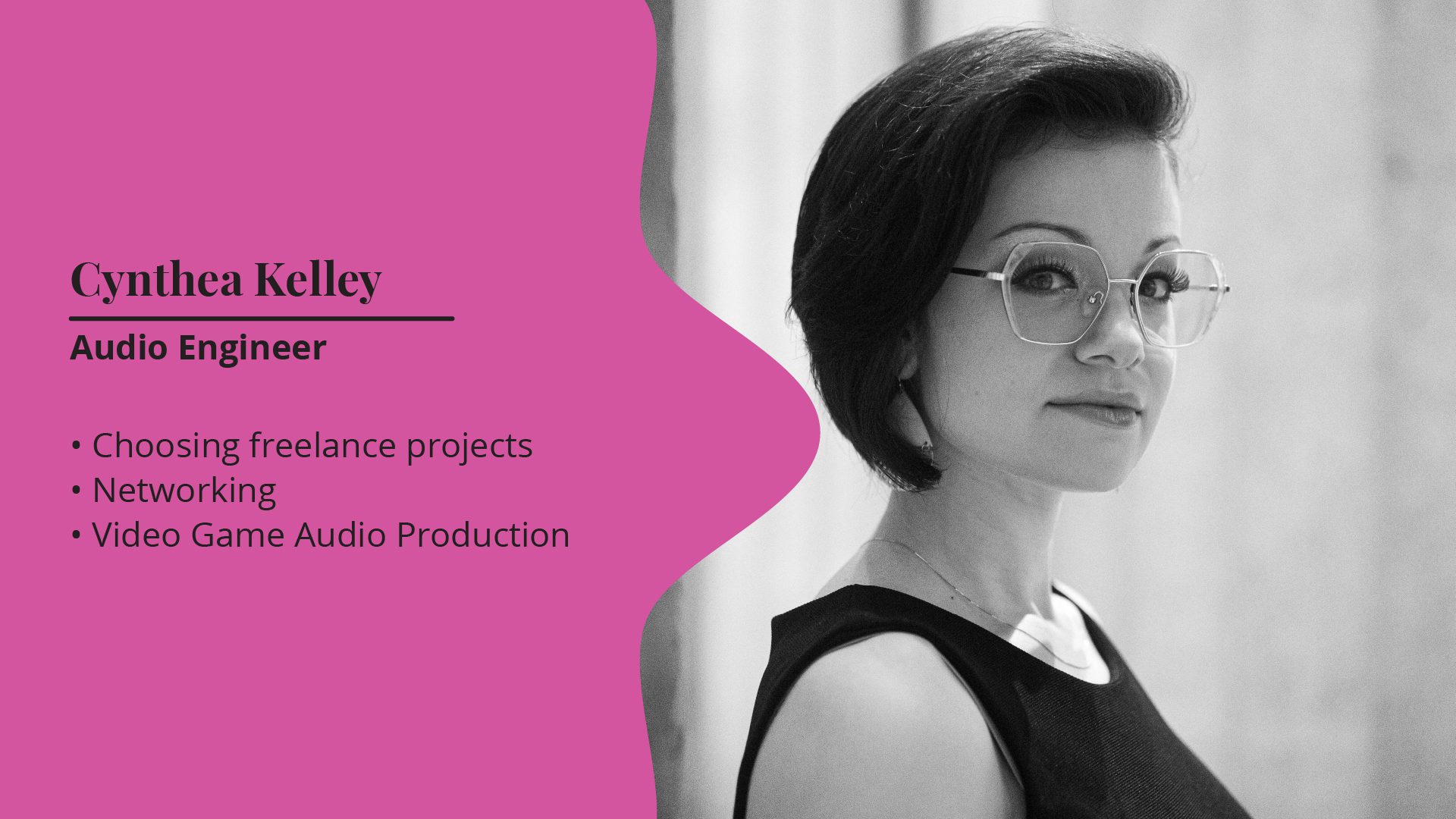
Cynthea Kelley is a Nashville-based audio engineer and performer. She balances technical work and artistry in the dynamic worlds of music and gaming.
Interview
Transcript
Emma Plutnicki 00:02
So, to start, what do you do for work and where are you currently working from?
Cynthea Kelley 00:06
So, I’m based in Nashville, Tennessee, and I am an audio engineer and musician, performer. So, primarily what I do is edit audio from home, and I also run live sound. In addition to performing, I sing and play guitar.
Emma Plutnicki 00:27
Cool! And how long have you been doing all of those?
Cynthea Kelley 00:30
I’ve been performing since I was like, I grew up in a musical family, so I grew up performing, but I guess kind of doing my own thing since I was 14, so about 14 years now. And then, as far as engineering goes, I really started doing it more seriously when I was a student at Coastal. So, I got to work at the Wheelwright Recording Studio for like, two and a half years while I was a student, and got to really understand and learn more about like how to record various types of ensembles and different kinds of projects.
Emma Plutnicki 01:10
Amazing, and so what would you consider, if you had to boil it down, everything that you do, what would you say your official job title is?
Cynthea Kelley 01:20
I would say musician and audio engineer, or just musician.
Emma Plutnicki 01:28
Amazing! And so, what does your day to day look like? What’s expected of you on a daily basis? What kind of things do you get into? Just kind of describe what your days look like.
Cynthea Kelley 01:39
So, I am self-employed, and kind of have, like, a lot of different work that I do as an independent contractor. So, day to day, it kind of varies, but I, about a year ago, started doing audio editing for the video game Fortnite, and so that’s, like a very specific thing in Fortnite, with Fortnite Festival Jam Stage. So that’s like music editing. So, I get to set my own schedule, which is really cool. I have, like, a certain amount of hours that I’m expected to work every month, but there’s flexibility there so I can kind of decide, like, you know, I wake up and then I have my tea and then sit down and get to audio editing and that might be between like, three and seven hours a day, and so that’s kind of like an audio editing day. On days where I run live sound, that’s at a venue, and so I’ll get there in the evening, early evening, and set up, and then be there for maybe like five to eight hours, working with a band and running sound for an event. I also sing with a wedding band, and so that usually involves some travel, maybe, like, two to three hours one way. So, I’ll like, you know, get up and kind of take it easy, and then in the afternoon, drive to the location, perform like three to four hours and then drive home. So, it kind of varies a lot. There’s also, I’ll assist at recording studios, and so those are typically like, longer days where I’ll arrive at like 9am and be there until anywhere between like 6 and 8 or 10pm so it kind of varies. Sorry, that’s not a super specific—
Emma Plutnicki 03:54
No. Totally fine. So, when you have events, you’re traveling, you have things late at night that you’re working on. How are you able to manage kind of a work life balance? Because it seems like the work kind of consumes a lot of your day-to-day life. So how do you manage that?
Cynthea Kelley 04:11
Yeah, that’s something I’ve been learning a lot about in the last two years, and I feel really grateful because doing the audio editing from home, having that flexibility, I’m able to, like, if I have a day or two or three in a row where I’m just like, going, going, going traveling, performing, usually I can, like, take a day or two to just, kind of like, relax. And as a musician, usually we’re working on the weekends. And so, I feel grateful that I kind of get to compensate for that through the week and just like, take a couple days off. But yeah, I’ve like, really been learning how to prioritize sleep in the last few years, and like, eating healthy food that’s going to give me energy and like, not make me feel lethargic. So, yeah, it’s been, I think I’ve been learning how to, like, prioritize resting as well. And just like, started bird watching and Zelda, like, I’ve never been—I wasn’t allowed to play video games when I was growing up. So now I’m like, okay, I’m just gonna chill and fun thing and like, not feel like I have to, like, go, go, go all the time.
Emma Plutnicki 05:30
Yeah, I love that. And within a creative career, I feel like a lot of times it can be hard to figure out what success looks like. It’s different for everybody. So how would you define success, both personally and professionally?
Cynthea Kelley 05:43
I think for me, since I moved to Nashville at the beginning of 2022, I’ve been doing music full time. And I think when I was a student, that was like, really, all that I would have said is like, “Oh, I’m doing music full time. That means, like, I’m a successful musician”. And now, I think especially being surrounded by so many musicians in Nashville, because it’s Music City, it’s given me the opportunity to see, like so many different lifestyles and like careers like, what different types of careers as a musician can look like. And so, for me, I feel like I’m very grateful to be doing what I love full time. And so I think that that feels like part of it, for me, is like, that’s part of the definition is that, like, obviously, like, it’s not 100% of any job that you’re gonna love, like that everything has its tedious parts, or it’s things that you don’t love as much, but, like, I would say, like, 90% of it, I’m just like, really, I really enjoy and really love, and so that feels like success to me. And then also being able to, like, just put money in a savings account for the first time, it’s like, “oh, this is really cool.” That feels like building on success. And so, there’s, like, even though it’s, you know, it’s in the arts. And so, it’s not like crazy, you know, extravagant, but being able to, like, afford things like, you know, like I was saying earlier, like healthy food. Being able to afford taking a day off that, is, has been huge for me lately. And then another part of it has been being able to decide and prioritize what kind of projects I want to work on, especially as an independent contractor. If there, you know, maybe I took a job and it ended up being way more stressful than I expected, and so being able to say no when things like that come up in the future, or if, you know, maybe I wasn’t treated the way that I wanted to be treated, or it was unprofessional, being able to yeah, just like, decide who I’m working with.
Emma Plutnicki 08:28
Yeah, no, it definitely makes sense. And, I’m sure you’ve worked on a wide array of projects throughout your career. So, has there been one that’s had a significant impact on you, or one that sticks out in your head as being, you know, exceptionally meaningful to you?
Cynthea Kelley 08:45
Absolutely, yeah, this, this job with Fortnite. I started in February of 2024, and it’s kind of been like ideal for me, because I’m super introverted and a homebody, and so the fact that it’s from home is really cool. And I’ve never worked on a project with like, such a big name before, so that’s felt really exciting. And what’s been really cool about it, too is like, not only do I really enjoy the work, but the teams that I’m working with are just like, super solid, and I feel like they really value the people who are working on their teams. And so it’s just like a really good support system. And in addition to being really fun, so I feel like it’s, it’s like a little bit of a dream job. So I’m really grateful to be—
Emma Plutnicki 09:45
Yeah, and so are you able—when you play, I assume you play in some aspects, are you able to, like, hear the pieces that you’ve worked on? Like, how does that feel?
Cynthea Kelley 09:55
So, my specific job is for the Jam Stage in Fortnite Festival. So basically, what that is players can choose an instrument, like drums, vocals, guitar or bass, and it takes loops of different songs, and you can, like, mash them up together. So, like, you could have the guitar part from a blink 182 song playing with the drum part from Metallica and vocals from Lady Gaga. And so, my job is basically to make the audio from those songs flexible enough so that they can all fit together at the same time. So, I’ve worked on, I don’t know it’s like, maybe definitely dozens of songs at this point in the last year, maybe upwards of 100 but yeah, so they’re, like, featured in the game now, and players can, like, use them. And yeah, it’s fun to fun to hear and see it like implemented in the game.
Emma Plutnicki 11:02
Yeah, that’s very cool. So, did you have any fears going into this job role, or just fears in your career as a whole?
Cynthea Kelley 11:11
Yeah, I think something that feels difficult in the arts and in music and as an independent contractor doing so many different kinds of jobs. I feel like in something that’s more, maybe more like typically structured in the job world, like you might be able to say, like, “Oh, I did sales at this place for five years, and now I’m like, this in this management position, and so that’s why I’m qualified to do this job,” you know, like with the arts, it’s like, well, I did this thing and I did that thing over there, and I did this over here, and I think they all relate. But like, am I qualified, you know? So, I was super nervous that, like, I thought I knew what I was doing, and then all of a sudden I would start doing the job and wouldn’t have what I needed. You know, so I think definitely, like some imposter syndrome played into that for me. But yeah, I think again what’s been really cool about this team is that it’s super supportive and just really great people to be working with. And so even with things that you know, I needed to learn or like needed to brush up on, the team was just, like, really welcoming and really supportive, and like, we all help each other out.
Emma Plutnicki 12:42
Amazing, and having lived in South Carolina, has that had any influence on your work at all?
Cynthea Kelley 12:49
So, I lived in South Carolina basically for high school and college years, then moved after that. But I will say that my junior year, I went to the Academy for Art, Science and Technology, and was able to major in entertainment technology and learn a lot about like production and video, like video production, and got to do some music production for those as well. And then being in the songwriting community in Myrtle Beach too was just like, huge for my development. And I’ll give a shout out to Brian Ressler, who’s just like, you know, like the Papa of the music community. I felt in the songwriter community and so, and then being at Coastal too, I just learned so much and made a lot of, like, really great connections with my professors and with my colleagues and fellow students and so I haven’t had a lot of work in South Carolina since I graduated, but I do think that, like a lot of the educational elements that were offered within the arts in South Carolina really played a big part in my development and like getting me to where I am now.
Emma Plutnicki 14:09
Yeah, amazing, and hopefully those programs continue to grow. Well, thank you so much. Just wrapping up here, is there anything else you want to speak on, maybe advice or anything else about your career?
Cynthea Kelley 14:25
Yeah, I think, as far as advice goes, I think that the biggest thing that I’ve taken with me is just being persistent, especially again as an independent contractor, where you might not know where your work is going to come from, like week to week or month to month or year to year, just like being persistent in making connections and networking and reaching out to people. And I think advice, just like for me, that I feel like I’ve been learning is we ask ourselves and get asked the question too, so much like from when we’re kids, like, “What do you want to do? What do you want to be when you grow up?” and we’re thinking about what kind of opportunities we want to take and what I’ve been kind of trying to learn how to ask myself more in addition to that, question is, like, “how do I want to be treated in those as well?” So like, being able to set boundaries and recognize when it’s like a healthy working relationship and a professional one. So, I think those are kind of the biggest things.
Emma Plutnicki 15:37
Definitely. Yeah, thanks for sharing that. It’s great advice, and a lot of times people can’t find that, so I appreciate that. But yeah, thank you so much.
“Pave your own path, make your own way, it can look anyway you want it to.”
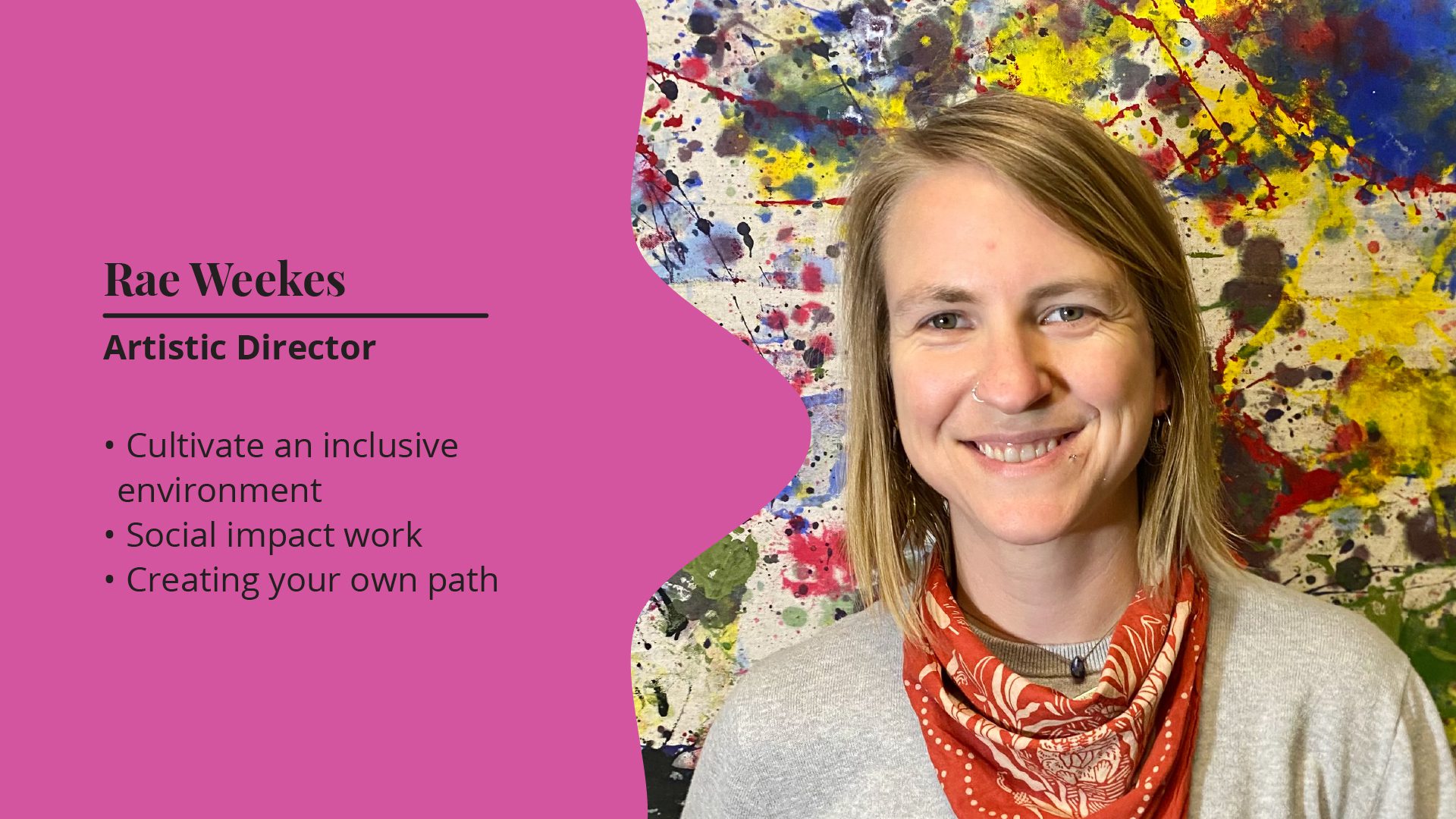
Rae Weekes is the Artistic Director at the Hearts Inclusive Arts Community in North Charleston, South Carolina.
Interview
Transcript
Emma Plutnicki 00:00
Okay, so to start, what do you do for work and where are you currently working from?
Rae Weekes 00:06
I work for a nonprofit called Heart Inclusive Arts Community, and we are a visual and performing arts studio for adults with disabilities who want to grow as artists. And, I am currently working or, yeah, I’m currently working from my office that is in our studio building in North Charleston.
Emma Plutnicki 00:26
Amazing. And how long have you been working there?
Rae Weekes 00:29
I’ve been here since it started 10 years ago in 2014.
Emma Plutnicki 00:34
Wow. And what’s your official job title?
Rae Weekes 00:36
I am currently the artistic director.
Emma Plutnicki 00:39
Okay amazing. So, what is one thing that you love about working in South Carolina specifically?
Rae Weekes 00:48
I really don’t have any experience elsewhere. So, this is really, I’ve lived most of my life in South Carolina. I grew up in Greenville and then moved to Charleston for college, and then just have stayed here ever since, and Heart has kept me here. So, I mean, it’s, it just kind of is, I think we have a lot of opportunities here. I think what’s also special about our organization, specifically being here is that I think our state tends to lean in a direction that is not very supportive of who we work with and what we do and who we are. So, it feels good to be doing something that takes up space and lets our artists be seen in a different light.
Emma Plutnicki 01:39
Amazing. And how would you describe the local professional community in South Carolina? Are you able to collaborate with other groups? Or how’s the professional community?
Rae Weekes 01:50
Absolutely. I’d say within the creative community here, it’s pretty tight knit. We’re always trying to connect and figure out ways that we can collaborate together. I think at times, well, at times it can be, it can feel a little competitive, I guess, just because we’re all kind of trying to fight for our way to exist, but, but it all in all like we acknowledge that and realize that that’s not beneficial to anybody. And so yeah, we all try to work together as much as we can, and that opens up new opportunities that you wouldn’t really imagine or think of before, and also just kind of pulls from all different disciplines.
Emma Plutnicki 02:31
Yeah perfect. So you know, in a creative career, it can be kind of difficult to figure out what success looks like. So how do you define personal or professional success in your career. Do you have any metrics, or how do you kind of calculate that?
Rae Weekes 02:51
That’s a big question for me. I guess I would say social impact, community impact and those kinds of things, awareness. How many people can we affect? Are we changing things for the better? So I try to stay on that track, and that’s, I guess, kind of my focus for success.
Emma Plutnicki 03:14
Yeah, amazing. And did you have any fears when you were looking into a career in kind of off the beaten path, any careers that came up?
Rae Weekes 03:27
No I guess I’d say no for me personally, no, I think my parents did. I’m probably, like a lot of other folks in this field, was kind of the black sheep of the family. So was paving my own path. Was doing things that my parents didn’t really, I mean, I’m super grateful they were super, super supportive, but they were definitely nervous. And my dad gave me like a book when I was a senior in high school that said what to do with an arts major, and I probably thumbed through it once or twice. It’s like, well, I don’t know. I’m probably not going to follow any one specific path. And I didn’t. Here I am.
Emma Plutnicki 04:11
Yeah there you go. And along the way, throughout your career, and when you were looking into this career, was there any advice that you were given along the way, good or bad, either from family or mentors or anything that stuck with you?
Rae Weekes 04:27
I can’t, I guess I can’t really say any one thing that sticks out, I think, kind of at large it was to pave your own path, make your own way, and that can, that can look any way you want it to. And yeah, I think that was just comforting to be able to hear that, especially from somebody who’s older, and it wasn’t any one person that said that. It was kind of like, once I got into this field and into the arts, it was kind of like a, surrounding advice from mentors within the community, teachers…
Emma Plutnicki 05:07
Yeah that makes sense. So now, on a typical day-to-day basis, what does your work look like? What’s expected of you on a daily basis? What kind of tasks do you get into? What does your day look like?
Rae Weekes 05:20
It can differ from day to day, which is something that I really enjoy about what we do. So, I guess a typical day we would come in, everybody, all of our artists would, well, let me backtrack a little bit. So, our artists are only in our studio two days a week. The other two days we do all of the behind the scenes. We’re a very small staff. Do all of the emailing, scheduling, things like that. So that’s more of like the boring, like computer stuff, I guess, and then. But when our artists are in the studio, that’s when we all are very energetic, and personalities are just bouncing off the walls. So, I’ll talk about that kind of day. We all come in, and all of our artists just kind of trickle in for the first, like 30 minutes, hour of the day. We’re together for eight hours, and we start our day with a daily draw, which is led by a volunteer. And that kind of gets our creative juices flowing. And just kind of, it’s not expected to be a masterpiece by any means, just a creative activity to get the day started, and then we’ll jump into our main activities for the day. And that can typically start with a couple hours of Visual Arts, where everybody is working on their own, their own projects, their own ideas, brainstorming, everybody’s at different stages. And then staff is there to just help facilitate any needs or wants or thoughts or questions and help just kind of build and strengthen whatever they’re working on. And then we’ll break for lunch. And then after lunch, we dedicate the afternoon to, well, maybe, like 30 minutes of, like movement, or just kind of meditation, yoga, and then after that, a couple hours of Performing Arts, and that could be whatever we’re working on at the time. Maybe we have a small performance that’s coming up and we’re going to do a couple songs, or we have our big summer production, and we’re doing full rehearsals, but that time would be dedicated to that, and then at the end of the day, we just kind of chill while everybody’s leaving, but we do pepper in a lot of outings within our community. We go see shows and events. We go have fun and go to the beach or go to the pool. We take a family vacation every year. And so, yeah, it really just kind of varies week by week.
Emma Plutnicki 07:48
Yeah, amazing. Sounds like busy days. And so, you mentioned that there are some shows for the Performing Arts, kind of side of your days, but for the art, like portions of the days, are there ways for the art to be exhibited? Or do you have exhibits? Or do the artists take the works home with them? Are there any ways of showing their work to the community?
Rae Weekes 08:11
Absolutely, we do a number of markets throughout the year, so we’ll have, like, a vendor table, and those markets can vary as well. We’re part of an arts festival some other like holiday markets. We also have been or the past couple of years, have had an exhibition and a professional gallery, one at one in Somerville at the Public Works Art Center, which was incredible, and then one in the Park Circle gallery, we try to have an art exhibition that coincides with our show or its own exhibition at a gallery. I’m not explaining this very well. Yeah, we try to take whatever opportunity we can find, but that also puts us in the same playing field as any other artist. We don’t want to be secluded, we don’t want to be set aside, pushed to the side. We want to hang on the same walls that another artist would, and that’s important to me, personally and for our artists as well. And then we do have an online store. It’s a little messy right now, but that’s another space that we try to showcase their work and on our website, and try to make that accessible to folks who can’t physically come to our shows.
Emma Plutnicki 09:44
Oh, great, great. And so throughout your career, has there been a particular project that has really resonated with you, or one, one single moment that you really reflect on as being kind of a defining moment in your creative journey?
Rae Weekes 10:07
Oh, every single day you see something that, yeah I try to see every moment, or try to use every moment as a learning opportunity through and through. So, I mean, there’s been a lot of big moments. I mean, that feeling you get after a production. All of our productions are original, and so there’s a lot, a lot of work and effort put into it. I mean, across the board, within our gallery exhibitions as well, there’s just so much work put into it. And so I feel, I mean, I’ve never been disappointed after a show or after an exhibition, opening. Never been disappointed. We’ve been disappointed in rehearsals like, What the hell are we doing? You know, but, but everybody just shows up and shows out for everything, every performance and exhibition that we do, and I think those are just big moments that you know, you feel accomplished, you feel pride, you’re there with your people. And you can, I mean, you see it on everybody’s face, it’s oh. So, I guess collectively, those moments of just being able to take a breath and be like, Look what we just did. Look what we accomplished, and all together, we did it together. So those are, those are the moments, I guess.
Emma Plutnicki 11:31
Yeah, that’s very sweet and I’m sure when you know performances happen, that’s taking up a lot of time in your life. So how do you manage the life-work, balance? And you know, just have space for personal creativity, while also managing that in a professional setting?
Rae Weekes 11:49
I wouldn’t say I’m a poster child for work life, for a healthy work life.
Emma Plutnicki 11:54
Why not?
Rae Weekes 11:57
Because, I mean, I’m getting, I’ve gotten better over the years, but I think a big thing that defines my life is my work and because we’re so close knit, we consider ourselves a family. So it’s, I mean, I hang out with some of our artists outside of our studio hours. We go to shows together. We go to dances together. So, it’s not necessarily all work. I also feel it’s kind of difficult to get things done when our artists are in the studio. So, anything like, we’ve done the computer, I could be like, Yeah, well, I’ll just do that later tonight, or, like, I’ll look up that later tonight. I can do it on the couch. And I also, I mean, I’m a single person with a dog living alone, and so I have, I mean, I’m able to do all those things, and it doesn’t really affect my life too much, but also it’s all kind of I know, but that’s okay. And then in terms of personal creativity, it really is just whenever it strikes me, it’s not a regular thing that happens. Because we’re so creative all the time in our studio, I feel like I do get that creative—that scratches that creative itch very quickly. By just being here. I tend to get more personal work done, I guess, around the holidays and stuff, because I make most of my gifts. So, when there’s a need for a gift or something like that, I can get a little bit more creative and get more work done. But really, if I other than that, if I’m out, or if I’m inspired by something, or if I want to try new material, like I’ll do it pretty quickly, and then it’ll just kind of sit on my coffee table for a while, and then I’ll pick it up again, and then I’ll put it away. So, it just varies. But I think everything’s kind of intertwined for me.
Emma Plutnicki 13:45
Yeah, no makes sense. So just as we wrap up, is there anything else you’d like to add, or anything else you may have wished that I asked that I didn’t?
Rae Weekes 13:54
Not that really comes to mind. Remind me, how are you guys using these interviews again? So, I know you’re pulling the information for folks who want to, like, maybe gain some insights and things like that. But is it going to be like, written or like, our video is going to be posted?
Emma Plutnicki 14:15
Yeah, so it’ll be a little bit of both. Mainly, we are having a professional directory on the Uncharted initiative of the Creative Career Studio, and then I’ll send you the link to the South Carolina Arts Commission Creative Career Studio website. It’s very cool, very intuitive, and offers a lot of great information, but we’ll be collaborating with that, kind of cross-referencing the interviews that we’re doing here with them, so there’ll be a little bit of back and forth on their website. And then we’re also starting a podcast and having video guides to just give more information for young professionals. So, getting the word out there,
Rae Weekes 14:54
Yeah, it’s so awesome.
Emma Plutnicki 14:59
Yeah, no, it’s a great resource. And everybody we’ve been talking to has been amazing. So, I really hope that a lot of young kids are able to utilize this and really work toward a future career doing whatever they want to do.
Rae Weekes 15:08
That’s amazing, exciting.
Emma Plutnicki 15:10
And is there anybody else that, either a coworker or somebody else that you know, in a creative field that you think we should interview?
Rae Weekes 15:21
I mean, I have a number, like, just like artists and teaching artists.
Emma Plutnicki 15:27
Amazing, yeah, I can send you a follow up email. We’ll we ask for, like, a headshot of you. And then also just sign-up permission form, and then I’ll also send a nomination link. If you think of anybody, you can put them there!
Rae Weekes 15:44
Well, thank you so much for doing this. I know I, when I found out about the—sorry reminder—the Creative Career Studio, I immediately send it to my mom, because I was like, I think this would have just been so helpful for you guys, just to feel like, okay, look at all this, the variety of opportunity that people can have, and because they just could, you know, they’re creative, in a sense, but like they probably wouldn’t consider themselves like creatives, and so they just were so unaware. And my mom was also a guidance counselor after I was in school and everything. And I just think that would be such an important tool for all of those people to have who are guiding young people, and especially, yeah, just families, parents who are scared that, like, you can’t make a life out of something like that. And it’s so, so not true. Collecting all this data and information and having real people, real voices is, it’s really important stuff you’re doing. So again, yeah, just super great. It’s awesome.
“Being brave does not mean being unafraid. It’s being scared and going forward with it anyway.”
Sisi Garland is the Executive Director of Heart Inclusive Arts Community, an interdisciplinary art studio in North Charleston, South Carolina, serving adults with disabilities. With a background in stage management and theater, Garland has worked in New York and Charleston and celebrates five years of leadership at Heart. She believes in the power of creativity, community, and courage in the arts.
Interview
Transcript
0:02 | Lexi Raines
So first, just give a little introduction of yourself. What do you do from work and where are you currently working from?
0:20| Sisi Garland
I am Sierra Sisi Garland. I’m the Executive Director of Heart Inclusive Arts Community. And I am working from my office (my pink office) here at the Heart Art studio. And I’ve been with Heart for five years now. I just celebrated my fifth anniversary as the Executive Director. (Yeah? So, yeah, did that answer all of those?)
0:47 | Lexi Raines
Yeah, tell us a little bit about the Hearts initiative.
0:52 | Sisi Garland
Heart Inclusive Arts Community is an art studio for adults with disabilities, and we are multi-disciplinary. So, we do performing arts, visual arts, any kind of creative endeavor that we want to get our hands into. We take it on.
1:07 | Lexi Raines
That’s awesome. That sounds like a really fun and meaningful thing to start. So, where in South Carolina are y’all based?
1:23 | Sisi Garland
We are in North Charleston, South Carolina. We started 10 years ago in downtown Charleston and have moved into the North Charleston area about a year ago. But yeah, so we’re in the Lowcountry. We have members in our studio who are from all over the Dorchester, Berkeley, Charleston area.
1:46 | Lexi Raines
Yeah, that’s awesome. Charleston! I love Charleston. Such a good area.
1:50 | Sisi Garland
Yeah, it’s beautiful here.
1:53 | Lexi Raines
It really is. So, kind of on that note, like what’s one thing that you love about working as a creative in South Carolina?
2:03 | Sisi Garland
There’s lots of inspiration here, for sure. Visually, it’s stunning, especially in this and I’m bias from being from Charleston, but especially in this Low Country region, it’s just gorgeous. You have so many places and parks that you can go to and create. But outside of that, there’s also such a rich culture here, and so many different cultures coming together, especially in this downtown area. There’s just a lot to take in, and a lot that you can be inspired by.
2:38 | Lexi Raines
I completely agree. I’ve been in Charleston a lot. I used to have family who lived there, and I feel like there’s just so many different areas blended into one. Like, I feel like you can go to like, one side of Charleston, and it’s completely different from the other side of Charleston.
2:57 | Sisi Garland
Yeah, absolutely it makes it pretty clear why a lot of Hollywood productions want to come out to Charleston and South Carolina, because there’s a lot to offer here.
03:10 | Lexi Raines
Yes, for sure. So, what do you think South Carolina does offer, like, what do you think it brings to your work compared to anywhere else?
03:21 | Sisi Garland
South Carolina has this incredible way of feeling like a sort of small town, where you know everyone, and everyone knows what’s going on with you and what you’re doing, and you just have a lot of familiar support. But at the same time, it also has this broader, bigger feeling to it as well. Like it has a lot of resources, it cares a lot about the arts. It was immediately surprising to me how much South Carolina actually does support its arts and artists, while still feeling very tight-knit community as well
04:07 | Lexi Raines
And that’s amazing to hear, obviously, because that’s like, what we’re trying to do here is just spread that word. Because so many people, I feel like, especially young students in like, middle school and high school, I feel like they really think that they have to move out of South Carolina to pursue a creative path, which definitely isn’t true at all. So that’s amazing to hear.
04:32 | Sisi Garland
Yeah, absolutely. My niece is in high school now, and she’s thinking about a creative career. She’s an actor, and so she, you know, is starting to do the search for school programs and things that she can get to when she graduates. And she’s dead set on New York. She’s got her mind fixed that she’s going to go to New York. And I’ve done the New York path. I’ve moved there for a little over two years and worked there as a stage manager and an actor, primarily as a stage manager, if we’re being honest, but it’s so hard to break people of that idea that you have to go to these you know, like New York especially, or Chicago, if you’re an improver or if you’re in film and television, that you have to move out to LA and it’s just not true.
And in a lot of ways, I think that being go going to those big places, especially for your education in the arts, before becoming a career professional, it can be a little too daunting, or it can be a little too unsupportive, because if you’re not coming there with a network or with a confident background, then it’s going to, it’s going to feel so overwhelming so quickly. So, I’ve been trying to steer her in other directions, to find something a little bit more friendly to the younger, to the greener people, before hitting the big cities.
06:10 | Lexi Raines
Yeah. Well, if she does get accepted there, maybe, like, I feel like New York is obviously an awesome place, but maybe, maybe she’ll miss home.
06:21 | Sisi Garland
Maybe. I’m originally from Delaware, and she still lives in Delaware as well, so it’s only three hours away. It’s fine.
06:28 | Lexi Raines
Yeah, that’s not that bad at all. So how would you describe like the local professional community in Charleston?
06:38 | Sisi Garland
Supportive. That’s the first word that comes to mind. We are so lucky to have a lot of professionals around us who are not only interested in what we’re doing and want to be a part of it, but that will rally their support around us whenever we do things. They’re coming to shows they’re supporting each other’s shows. they’re just getting involved amongst everyone and not just creating this insular, individual attitude where it can’t all exist together.
07:17 | Lexi Raines
I feel like that definitely is something that does happen in a lot of bigger cities, because I feel like things start to get, like, so niche that it’s like you have to be in one specific group or interest. So, I feel like that’s definitely an amazing thing.
07:33 | Sisi Garland
Yeah, yeah. I saw that a lot in New York, which is bizarrely, you know, for being such a big city and everyone, millions of people living there, you still ran into the same people all the time. You’d be in auditions with the same people, or you’d end up like in productions with somebody else’s show running at the same theater. And so, to still have that sort of competitive mindset and attitude toward things. It made it so much more difficult, because on one hand, you’re talking to each other so chummily and or, you know, whatever it is, but then you’re still feeling like you have to compete with those people for the same resources. And so, it just nothing ever felt very secure.
Whereas here it feels like you have friends, you have supporters, you have people that you can turn to, and they’re not going to hoard their information or their experiences and ideas. They’re sharing with you because that inspires them as well.
08:42 | Lexi Raines
Yeah, that’s something I’ve heard a lot across all interviews, is that, South Carolina, really is such a community. Everybody is willing to support everybody. Everyone wants to, kind of, like, hold a hand out for everyone who’s trying to get in who’s trying to grow, all that stuff, and I feel like that’s just such a beautiful thing.
So, kind of shifting gears here. How would you define professional or personal successes in your creative endeavors or in your career?
09:19 | Sisi Garland
As far as in my career, it’s kind of easy, I guess, to define for me, because being Executive Director, I’m sort of responsible for the overall wellness and health of the organization, and so as long as the nonprofit is still going, then I feel like we’ve succeeded to some degree, but as far as in our creative endeavors, if we have reached even one person who hadn’t seen us before, or who was touched by something that we did, or inspired by it, or felt something from what we were doing. Sounds so cliche, I know that’s probably like the creative cliche, but it does mean something, and it does feel like a success. If you’re presenting a gallery in a new space, and someone has walked in and they had no idea what Heart was or who our artists were, and they come in and they see a piece, and they just are in awe of it. That’s so successful and so meaningful to us. So, that’s creatively how we know we’re doing something.
10:31 | Lexi Raines
That is really awesome. And do y’all have your showings in North Charleston? How often do y’all have those showings?
10:43 | Sisi Garland
We don’t have set shows or exhibits necessarily. We do a musical every year. Tends to be an original musical that we’ve written ourselves every year, that we might be exploring different avenues in that and outside of that, we do a rock concert at the poor house in Charleston every year in the winter, we do performances all over the place, like we’ve been invited to perform in Myrtle Beach for some professionals convening there, we were just invited to perform at the State House in Columbia for our advocacy day. Yeah, performances were canceled because of the thunderstorms.
11:32 | Lexi Raines
This weather’s been crazy lately.
11:35 | Sisi Garland
It cannot decide what season it is around here.
11:41 | Lexi Raines
So, what was your, you mentioned that you were an actor. What was your biggest fear when you first decided to pursue the arts professionally?
11:52 | Sisi Garland
The fear that you won’t succeed, that you won’t survive the biz, I guess. You know, like I said, I came from Delaware, which is a small state to begin with, but also I came from a small farming town in Delaware. There wasn’t arts really happening. We had our one school musical every year. And outside of that, there just was not a lot of exposure to the arts, so I had no real concept of what being a professional creative could look like. It felt to me at the time like you either had to be A-Lister red carpet famous or a sad, struggling wannabe, and that there was no in between.
And so, when I came down to Charleston, I moved here to go to the College of Charleston, and I signed up that first day to be a theater major. My father was just so worried. And I don’t know that he’s ever stopped being worried about this, but he just was like, “You’re going to have to do something else. You have to have that backup plan. Everyone has to have the backup plan.” And to some degree, he was right, because you know, you have to have that survival gig while you’re forming that career for some people. Some people are lucky that, that career is built in for them from the beginning. But a lot of times you do have to have other things that you’re good at, but having that creative basis, that creative foundation, makes you good at those other things as well. So, his worry that having a theater degree was going to be completely useless the second that I graduated became also my fear, and I was so nervous about it that I was just going to be poor and struggling forever.
But everything I learned being a creative and being a theater person has gone into all the work I’ve done since, whether or not it’s directly a creative job
14:15 | Lexi Raines
I feel like that’s definitely a barrier that a lot of people have to work through whether it’s like you just have self-doubt, or your family isn’t supportive about it.
Because I know personally, I am an English major, that’s not what I was originally. I was originally a computer science major, but when I told my family I was going to be an English major, it did not go down well, but I feel like if you have a buyer for it, I feel like you can figure it out. And I feel like these jobs do have a lot more to offer than people think. So, I feel like breaking down those boundaries is just so important.
15:03 | Sisi Garland
Yeah, and it starts with having exposure, so like this program that’s coming up, and the creative careers resources, if you don’t know those possibilities are out there, or realize how infused into everything else the arts are. Then if you don’t know it exists, you can’t necessarily imagine that it could happen for you. Um, so, yeah, it’s really cool these programs that that are coming up.
15:36 | Lexi Raines
I 100% agree. So, can you define, like a defining moment, or describe a defining moment in your creative journey? Like, did you have a particular project you worked on that like had a significant impact on you, or did something that you like produced really showcase your creativity?
16:01 | Sisi Garland
I think one, probably the most defining moment in my career, was my first time working professionally as a stage manager. I had stage managed all through college as a theater major, but I hadn’t really expanded outside of that yet, and probably mostly because of that fear and nervousness and doubt. But someone I had worked with on a production in college, they were already a creative professional. They were an actor and director, and they were directing a show in Charleston, and wanted me to come stage manage for them. And I said yes to it. Swallowed the doubts and everything, and I said yes, and came on and did it. And it was that production that connected me to the theater company that I have now been working with for almost 15 years. And it was through doing that that I realized, no matter what else I’m doing in my life, to survive or to be able to live day to day, I’m never not going to do theater as well like I have to keep this in my life.
So, it’s like you said, it’s kind of, if you have that passion, or you have that fire for something, you’re going to go out and do it. It’s just a matter of how it manifests in your in your world. So that show brought me essentially the rest of my career, and it all came from just saying yes to somebody I had worked with in college, and he’s now on Broadway. He’s originated roles in Once, and he was just in Anastasia and Amalie. Yeah, he’s incredible, and I very much have him to thank for continuing to do the arts even when it was scary.
18:07 | Lexi Raines
Yeah. So, I feel like that is, like a really positive note, but kind of going from that, what do you have, like, the worst advice you’ve ever received?
18:21 | Sisi Garland
The worst advice, I mean you always hear the superficial stuff like that, “you have to define your brand” or that you…
I mean, I graduated in 2009 from college, which probably sounds like a long time ago now. But even still then, when I was young, you were still hearing like things about body shaming and appearance and all of these things that you have to do, which thankfully, I feel like have kind of gone away.
But it never leaves you if someone has said that thing to you about just your personal being. Something that is not yourself and took it as, and they say it was such authority that you believe them, you know. And so that’s definitely the worst advice, is listening to anybody about who you need to be and what you need to look like to do anything. It’s terrible. It’s hard not to listen to it, but it’s terrible, it’s awful advice. No one should listen.
19:40 | Lexi Raines
I completely agree. I feel like everybody is their own person. You got to love yourself. So, what’s the best advice you’ve ever received?
19:55 | Sisi Garland
Again, probably a cliché, but it’s true, and I still think about it all the time. That being brave does not mean being unafraid. It’s being scared and going forward with it anyway. So being nervous about an audition or a show that’s coming up, or anything that you have coming in, or taking the leap into a new career, a new job.
All of these things are really scary, but that doesn’t mean that you can’t do it, and you can still be brave and go forward with it, even as scary as it is.
I was terrified when I took this job. I feel like I’m probably still terrified every day in this job, but it’s the most rewarding thing I’ve ever done, and it feels like the culmination of all of these disparate career paths and skills that I had just been doing that because I love them, for so long. And now they get to come together in my job here as the Executive Director, but it was so, so scary. And if you know I didn’t have people telling me that it can be scary, but you can still do it, then I probably would have been like, no, it the this is telling me something I shouldn’t be doing it if I’m this worried about it.
21:21 | Lexi Raines
Yeah, I completely agree with that. I just feel like fear is the best motivator you can have, because I feel like it goes along the lines of like, the only way to grow is to get out of your comfort zone and push yourself. So, I think that is like, I agree with you. I think that’s like the number one advice you can give receive anything, because that’s personally helped me a lot too.
21:54 | Sisi Garland
Yeah. It’s hard to live it, too, though. I mean, I say that, but it’s not like I was the most bravest person, just going out there, throwing myself into things, I still played it fairly safe. I’m still kind of a scaredy cat in that way. But all the good things that I’ve done were when I, like you said, stepped out of my comfort zone, went for that thing that I’d always wanted to do, and I wish I had done even more of that, especially when I was younger, especially when I just like, you know, when things felt a little bit more, not carefree, but possible. You know, when you’re looking ahead into your future and you’re thinking, you can do anything, keep that you can do anything. You can always do anything. So go ahead and do it.
22:43 | Lexi Raines
That’s awesome. I think that’s really amazing. So, can you walk me through, like a typical work day at Heart?
22:55 | Sisi Garland
Yeah, we have sort of a dual life here. So, I have my office time on Mondays and Wednesdays, where I’m doing all of the background support work for the organization. But then on Tuesdays and Thursdays, we have our artists in the studio, and we have about 25 artists that we see every Tuesday and Thursday, nine to five, and they’re all adults. They’re all our peers and our friends and our creative partners in crime.
So, I get to come to work every morning about 8:30 or 9:00, come into the studio and be greeted by everyone and just sort of like, just have that water cooler chat with all of my friends as we come in. And then we first get into sort of a creative but palate cleanser. It’s our daily draw. It jumps starts our day with a little bit of creative thinking, we get an interesting fact for the day from one of our volunteers, and from that, she also creates a drawing prompt that we all work on. So, we do that to kick things off, we get into visual arts, which is now being led by our artistic director, Rae, and that can look all kinds of ways, depending on what we’re working on.
Often, artists are working on some individual piece that they are wanting to finish and see through to its ending. Sometimes we’re doing collaborative larger pieces all together, and sometimes we’re working on a theme towards a specific gallery, but in any case, we’re all creating some form of visual arts there.
We have lunch. We’re usually watching something silly or fun or creative or whatever during lunch. A lot of documentaries about animals, because that’s always fun to see. And then in the afternoons, we do performing arts. So, our performing arts Director, Mel, is a music background. She is the musical director for all of our performances, all of our shows. And so generally, we’re working towards whatever our next performance is going to be.
So lately, it’s been preparing for that state house performance that didn’t quite happen, but we were also performing at “A Night to Shine: The Prom,” which is sponsored by the Tim Tebow Foundation. We were asked to perform there at our local prom. We also have some other performances coming up, and then ultimately, we are rehearsing for that original musical that we do each year. So that goes from auditioning, writing, editing, rehearsing the production, rehearsing the musical, putting it all together with a live band, all of that jazz.
And then at the end of the day, we sort of have some decompression time. We’ve got our free time where we can chat and socialize. We can finish up projects that didn’t quite get to a good spot along the way during the day or just say hi to everyone who stops in to visit on the way home.
26:22 | Lexi Raines
That sounds very busy, but it sounds like a lot of fun. That sounds awesome.
26:28 | Sisi Garland
It is a lot of fun, but I am exhausted at the end of the day on Thursday.
26:34 | Lexi Raines
So, you mentioned that you still want to always try and include, like acting into your life, even when that’s like, not specifically what you’re doing. So how have you created, like, a work life balance where you’re still able to maintain both your professional and personal creativity?
26:59 | Sisi Garland
It’s hard. It’s very hard, especially when your career is so closely aligned to what your passion creativity is, and especially lately, since the pandemic, it was very difficult. I’m part of the acting company for the Village Repertory Company, which is over 20 years old now, here in Charleston, but we had to close during the pandemic. And so that avenue of personal creativity was sort of lost to me, and at a very important time in my career as well, because I had just started working here at Heart.
And so, this new experience, I didn’t have that sort of old, reliable source of creativity to turn to. So, it is really hard, but I feel like just anything that you’re doing, almost as like a self-care or just to feel good, if it’s creative, even if it’s reading a book, even if it’s going to see a show or a performance, that you’re not a part of. Engaging in art, whatever your favorite kind of art is to you, that is the balance, right?
So, it doesn’t always have to be, I feel like sometimes creatives we can put like this burden on ourselves, that we have to complete something, or that we have to show something, we have to have something to put out there for it to count and it doesn’t. It can be whatever you do for yourself, even if that’s like writing one sentence of a novel at the end of the day, and that novel goes nowhere. Who cares, you are expressing yourself. You’re doing something that you care about, and that’s all it ever needs to be. It never needs to see the light of day for it to be important to you.
29:15 | Lexi Raines
I completely agree with that. I think that, like you’re saying, there is such a push to just keep putting stuff out there, but at the end of the day, you are like a person who needs to have things just for you. So, I think that is an amazing piece of advice. So, do you have any questions that you wish you were asked?
29:40 | Sisi Garland
Oh gosh, no, I don’t know that I could have come up with any questions better than what you guys already have.
29:48 | Lexi Raines
Awesome. Yeah, I feel like we kind of put people on the spot without that question. So finally, do you have, this is also not to put you on the spot, but do you have a creative that you’d like to nominate to be interviewed?
30:05 | Sisi Garland
Oh yes, I spoke with someone at Arts Advocacy. Oh, gosh. Okay, let me, for some reason her Instagram, oh no, I know her name. Her name is Janelle Smalls.
30:16 | Lexi Raines
Janelle Smalls. Can you spell that for me?
30:19 | Sisi Garland
I believe it’s Janelle and last name is Smalls. I might have to dig for her contact information to send to you to reach out to her. But she is an artist who is also a K through 12 arts educator and speaking with her at Arts Advocacy this week or last week, she was so passionate and was like, so full of gumption to do something for her students. I think she would be an incredible person to speak with.
30:54 | Lexi Raines
That’s awesome. Yeah, she sounds amazing. Definitely, definitely, send me her information if you can find that. It was so nice talking with you. I think you had such wonderful advice. And you obviously come from a place where you care so much.
31:14 | Sisi Garland
I hope so. That’s sometimes the only thing keeping us going is how much we care about it.
31:20 | Lexi Raines
I completely agree. So, thank you. I hope you have a good rest of your day. Yeah, I’ll be reaching back out to you just for that headshot, and then I can definitely try to email you whenever this goes live to send you the link.
31:36 | Sisi Garland
Yeah, perfect. And if there’s anything we can do at Heart, any of us to support this project, future projects, everything you all are doing, please, just let us know, and we’re there for you.
Angela Yemi Gibson is a medical biller by day and an arts visionary by night: founder of a nonprofit African Dance Company in Spartanburg, SC.
Audio Interview
Transcript
00:02
Emma Plutnicki: So to start, what do you do for work and where are you currently working from?
00:07
Angela Yemi Gibson: I work from home. I am a medical biller, and I work for a billing company called Medical Billing Center Incorporated,
00:16
Emma Plutnicki: Okay, amazing. How long have you been working there?
00:18
Angela Yemi Gibson: Six years.
00:20
Emma Plutnicki: Okay, amazing. And that’s based in South Carolina?
00:23
Angela Yemi Gibson: Yes, it is in South Carolina.
00:25
Emma Plutnicki: Okay, how does working in South Carolina specifically influence your work, if at all?
00:32
Angela Yemi Gibson: Well, I have a nonprofit that I do outside of this, but, you know, being a nonprofit, you have to at least have some type of stream. So I do both. I don’t know, I moved here from Colorado, so it’s a little different,
00:48
Emma Plutnicki: Okay, yeah. And what is your nonprofit?
00:52
Angela Yemi Gibson: My nonprofit is an African Dance Company.
00:54
Emma Plutnicki: Okay, amazing and how long have you been doing that for?
00:57
Angela Yemi Gibson: Over 20 years!
00:59
Emma Plutnicki: Wow, and you started that?
01:01
Angela Yemi Gibson: Yes, I started dancing with other companies in Ohio, and then I moved to Colorado, and now I’m here. So I have my own nonprofit here in South Carolina.
01:11
Emma Plutnicki: Yeah, what made you want to start that?
01:14
Angela Yemi Gibson: It’s something different. It’s always changing. It keeps people engaged and it also brings a sense of community to everyone that’s involved.
01:27
Emma Plutnicki: Yeah, for sure. So what does a typical work day for you look like these days? What’s expected of you on a daily basis? What are your responsibilities
01:36
Angela Yemi Gibson: For my primary job?
01:38
Emma Plutnicki: Both.
01:40
Angela Yemi Gibson: So I work every day, Monday through Friday, from 7 to 4:30. Iam responsible for making sure that claims are clean when they go out of the system. I am responsible for fixing denied claims and rebilling those claims, patient statements, speaking to patients about their balances, communicating with the clinics and the owners about any account issues thatI have. Teamwork. and in my nonprofit, I am responsible for all the choreography, all the booking, all the costumes and the musicality.
02:21
Emma Plutnicki: Wow. And how are you able to manage both at the same time? Because I’m sure both of them are pulling you in different directions.
02:27
Angela Yemi Gibson: Yes, I’m not able to manage at all. I’m not good. I’m not able to manage it all. Since I work from home, I hop from one thing to another. So it’s one moment I’m here, then the next minute I’m there. So fortunately, I have the flexibility with my job to be able to do that.
02:43
Emma Plutnicki: Yeah, and are you able to manage a healthy work life balance, or is that difficult to manage?
02:50
Angela Yemi Gibson: It’s difficult to manage most of the time because most of our- I teach classes during the week and we perform and rehearse during the week or during the weekend, so it was kind of wherever. But fortunately, I have a good support system within my family, so I’m able to juggle both pretty, pretty good.
03:09
Emma Plutnicki: Amazing, and within both of your jobs, how would you define success? I feel like it’s difficult sometimes with creative careers, especially, you know, some people say it’s monetary, some people say it’s more ideological. So how do you define success in your professional career and also just in your personal life?
03:30
Angela Yemi Gibson: In my- my professional career, I would label success financially, because as much work as you do, you want to getpaid for the work that you do. But as far as my nonprofit work, I label success by the people’s response. So if no one responds when you’re doing something, that means you’re really probably not doing a good job. So if it’s- I’d rather deal with customer engagement and the responses of people in order to garner my success for my nonprofit.
04:02
Emma Plutnicki: Yeah, makes sense. And did you have any fears when you started your nonprofit?
04:07
Angela Yemi Gibson: Oh absolutely. Whether I will be successful in doing it correctly, and will it be sustainable?
04:17
Emma Plutnicki: Yeah. And how were you able to kind of overcome those fears?
04:21
Angela Yemi Gibson: Just keep going. I have a team of 10 so far, and we have been going strong for these past few years, since we started the nonprofit, so it’s been pretty good. So I mean, dealing-working with people that you trust and that are dependable is key. If you don’t have those types of people involved, then you probably won’t be successful.
04:46
Emma Plutnicki: Yeah, no, that definitely makes sense. And overall, have you been able to get advice from anybody? Is there any advice that stands out as either exceptionally good or just terrible advice that you received along the way?
05:02
Angela Yemi Gibson: I have received a mixture of both. I’m online a lot, so I tend to research more than anything else. So I’ve received a mixture of good and bad advice. Some people say, you know, don’t- What do people say? Don’t confide so much in the people that you work with, because the more that they know, the more that people can possibly use against you, so to speak. But I think that if you are more transparent with people, people are more- tend to either appreciate you or to be more understanding if you’re a little bit more transparent. But I’ve also learned that a closed mouth don’t get fed. You gotta ask. Sometimes it’s okay to ask for help if you need it.
05:57
Emma Plutnicki: Yeah, I love that. No, that’s great advice. And throughout your career, has there been any specific projects that you’ve worked on that kind of stand out as having a significant impact on you, or just something that you know is something that has kind of been the pinnacle of your career? Anything that stands out?
06:18
Angela Yemi Gibson: This year we did, for- this is for my nonprofit, I can’t really say for my my primary job, because we do the same thing every day.
06:26
Emma Plutnicki: Yeah, okay.
06:28
Angela Yemi Gibson: But as far as my nonprofit, we successfully completed our very first residency- artist in residency. So that was a week long, and it was new, and it was completely different, and it was way out of the comfort zone, but it was successful. It was very successful.
06:48
Emma Plutnicki: Amazing. Congratulations on that. And what was that? Where did that take place?
06:53
Angela Yemi Gibson: It was in Monks Corner, South Carolina, and we taught fourth grade kids and kindergarteners for five days.
07:01
Emma Plutnicki: Amazing. And how has the community reacted to your projects and just overall, your nonprofit?
07:08
Angela Yemi Gibson: Wonderfully. They’ve been very supportive here where I am, because I live in Spartanburg, so they’ve been very supportive here. Also, I am a dance teacher at one of the ballet centers here, and they have been so supportive to where they’ve written grants to be able to get make sure that myself and my two drummers are paid for our classes. So the we’ll be able to offer the classes for free to the community. So they’re free to the community, but yet we get paid for our time.
07:41
Emma Plutnicki: Amazing. And have you seen the community, like the local professional community in South Carolina, generally helping?And is it tight knit, or is there any gaps in it?
07:51
Angela Yemi Gibson: It’s tight knit. I really think that if you don’t know the right people, you’re not in specific circles. So I think that it’s really click-ish, so you just gotta know the right people. And unfortunately, I don’t know a lot of people, so I just stick to where I’m at work, who I know.
08:09
Emma Plutnicki: Yeah, how are you able to have those conversations with people? Are there any, like, networking events or anything within South Carolina that you’d recommend for people if they’re trying to get in the door with people.
08:21
Angela Yemi Gibson: I honestly have no idea. I really need to know those things myself, because I need to get out there and network a little bit more.
08:30
Emma Plutnicki: Yeah, I’m sure at some some points, it’s just being in the right place at the right time.
08:34
Angela Yemi Gibson: Yeah, and it’s just finding those right places in the right time, that’s the problem.
08:38
Emma Plutnicki: Yeah, exactly. Amazing. Well, thank you so much for your time. Just as we wrap up, is there anything else you’d like to share any advice for future people looking for a career in your field?
08:52
Angela Yemi Gibson: Keep swimming. What I can say is, honestly, don’t waste your money on college, unless you’re going to do something specific to that particular major that you’re going for. If you go to trade school, go to trade school, but stick to your guns and just remain positive.
09:17
Emma Plutnicki: Yeah, I love that. Well, thank you so much. I really- You’re welcome!
“I put in 30 minutes of practice every day, whether it’s guitar or composing. It’s like exercise 30 minutes a day goes a lot further than five hours once a week. It keeps your brain engaged.”
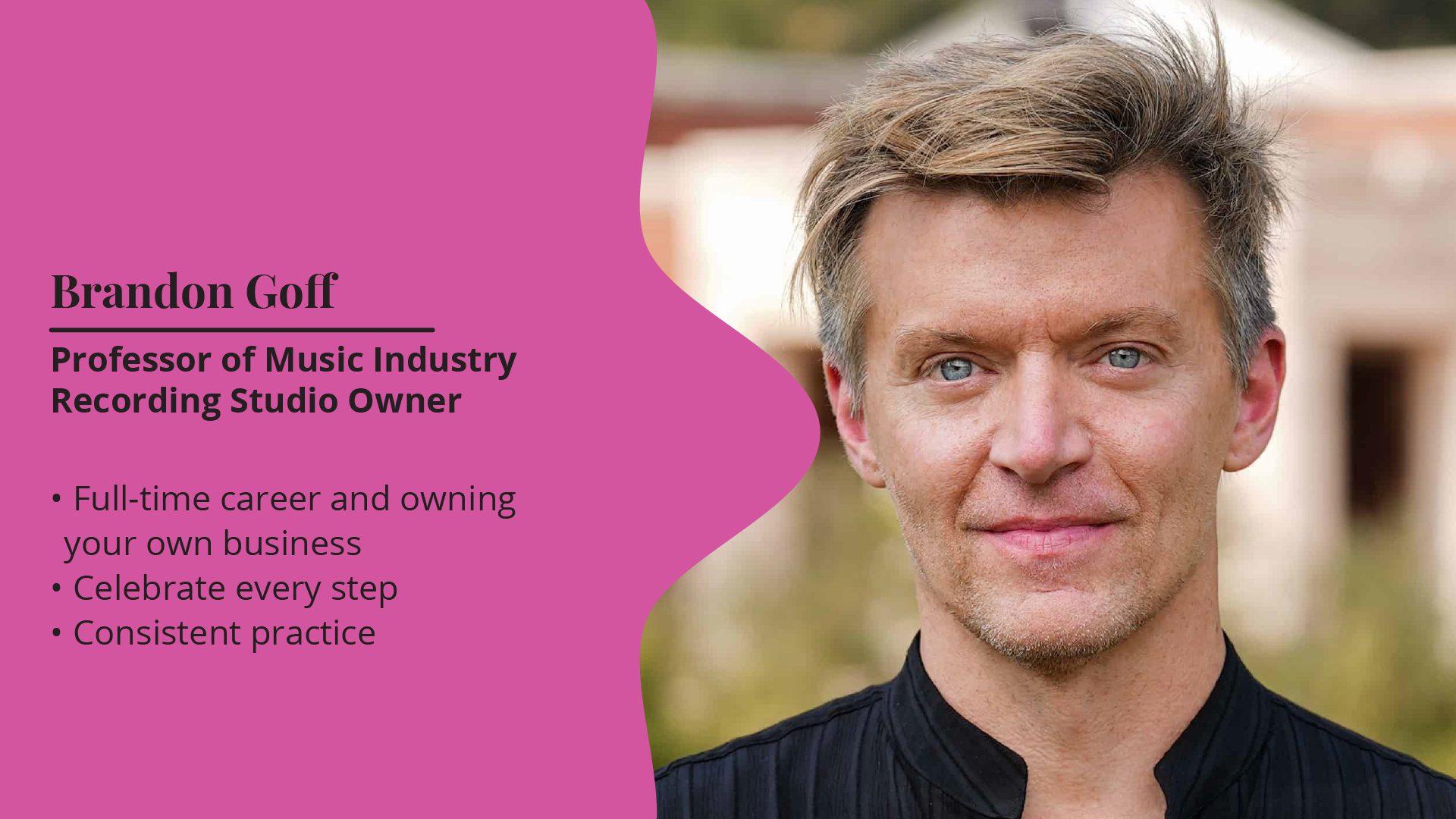
Brandon Goff is a composer, producer, engineer, performer, and professor of Music Industry at Francis Marion University in Florence, South Carolina. As a Memphis, Tennessee, local, he attended Rhodes College where Goff’s creative path began. This path has taken him through academic and professional music spaces across the U.S. and abroad. With a PhD and a background in music composition, he believes in celebrating every step of creative growth, whether that’s writing an album or landing a gig. His career is a witness to persistence, curiosity, and the value of creative support systems.
Interview
Transcript
Emma Plutnicki 00:00
So, to start, what do you do for work, and where are you currently working from?
Brandon Goff 00:06
I mean, I do a lot of things to be fair, but I’m a professor of Music Industry in Florence, South Carolina, at Francis Marion University, which is obviously going to be the biggest chunk of what I do. But my, you know, my background’s as a composer, a producer, and an engineer and a performer does a lot of different aspects to being a professional musician, and you don’t always do just one. And I’m one of those people who do all those all the time.
Emma Plutnicki 00:27
Amazing. So how long have you been working as a professor, and then how long have you been doing all the other things?
Brandon Goff 00:35
I’m from Memphis, Tennessee, and I’ve been teaching on a university level since, oh my, it goes way back. I first started a Rhodes College, which is a really nice liberal arts school in Memphis, and then I moved from there to probably started teaching, you know, around 2003 2004 so it’s been a minute. Yeah, it’s been a while. Then I went to, like, around Nashville, at a place called Lambuth University, and then I came here from there, and I’ve been here since 2011 so I’ve been in South Carolina for like, you know, proper, 14 years now.
Emma Plutnicki 01:11
Okay, so what is one thing that you love about working as a creative in South Carolina, specifically, as opposed to in Memphis or Nashville?
Brandon Goff 01:22
Well, you know, I do. I—anybody who works in the creative, especially the music industry, is going to love Memphis and Nashville. These are two, like, major hubs of music industry. But along with that, from an academic standpoint, meaning from in the in regards to the education portion of what I do, it’s fun working with students who don’t have that grandiose expectation of someone who’s growing up in Nashville. I mean, these in the talent pool, it’s a misconception. People always think, well, everyone’s so talented in New York, London, Nashville, they’re always just like, let alone actually, mathematically, no, they’re not. They’re just surrounded by an industry which really kind of draws that talent out. So, one of the beautiful things about South Carolina, that I love is the talent pool is thick. It’s just as the talent pool is just as big as it is anywhere else. But there’s just less exposure to it, less exposure to your opportunities, your potential, to chances you can take that you don’t realize you can because you’re not in one of those big music hubs. And I do, I really do love that. Actually, I do. I do enjoy that a lot.
Emma Plutnicki 02:26
Yeah, that’s amazing. So, has South Carolina had any unique influence on your work specifically?
Brandon Goff 02:34
I mean, of course, yes. I mean, it would do, wouldn’t it? I mean, it’s the, I don’t feel, musically? How would I—there’s a, it’s a different—you know, I’m from Tennessee, in Memphis and Nashville. Everyone’s a musician. That is the thing that everyone does. You probably have an uncle who’s a songwriter. You might have another uncle who works for a record label, who’s like a, you know, a talent scout. And I kind of, I didn’t, honestly, I didn’t realize the rest of the world wasn’t like that until I moved here. When I moved to South Carolina, I was like, Oh, this isn’t like the major industry. This isn’t what everybody does. And so, in being steeped in a non-music focused culture is going to obviously be influential. There’s a complete different music culture here. There’s a different kind of nightlife culture, a different culinary culture. And so, I’m constantly stealing, like, little, you know, snippets of sounds and lifestyles and putting them in songs and putting them in, you know, pieces and stuff like that, which I think is as well you should.
Emma Plutnicki 03:37
Yeah, I love that. So how would you describe the local professional community within South Carolina?
Brandon Goff 03:45
In regards to music professionals? You know, again, you’re not in—there’s not, there aren’t a ton of recording studios. There aren’t just a ton of, you know, production houses and things like that. There aren’t a ton of publishing houses. There aren’t a ton of things like that. There are a few here and there and around. It’s more competitive getting into those spaces because there are less spaces for people to access. But one of the biggest, we’re still a big production state, in large part because we do, we still have a lot of arts funding, and we have a lot of massive churches that run big productions. So, I’ve had a lot of students who go work for big, big churches here in South Carolina who have productions that are equal to that, of, you know, equal to that, of like, a large performance venue. And we do have large performance venues, you know, Myrtle Beach, the coast has a lot of that stuff. Even Columbia has a few things like that, Green Velocity, nice stuff or something. A lot of students who have internships up there and stuff like that. And it’s just, it’s going to be, your churches are massive, and they have a massive production budget, so a lot of students will go work for the big churches, and a lot of students that’s like, that’s kind of what they want to do, because that’s like, that’s how they got into music this lot of in the we’re in the Bible Belt, so a lot of the students are picking up musical skills, and the gold concepts in church, and then end up wanting to go back there and kind of work in that church as a worship leader or as a production leader or something like that.
Emma Plutnicki 05:10
Yeah, makes sense. Very cool. So, within a creative career, it can be difficult to define success sometimes, because there aren’t always clear expectations. So how do you define professional and personal success within your career?
Brandon Goff 05:26
Oh, how you, know what I think—I tell this to my students all the time. Yeah and I suspect that depends on your personality type as well. But when I was quite poor, grew up very, very poor and actually I was not, I was not a high school graduate. I was a high school dropout. I dropped out of high school and got a job at a factory. And so, you gauge your dreams and your expectations of success on the reality around you. So, as you accomplish something, you then gauge, well, my next level of success will be that. And so, like, at that point in my life, I was like, you know, my dream is to work inside a place that has air conditioning, because I was working at a factory that had no air conditioning in the South, so it was hot. So, but then as I, as you move forward, like, Oh, I just, I just wrote a song. So I want to write 10 songs. And you, so each one of those little accomplishments is a success of its own, but ideally, and you find contentment and what you’ve accomplished, but you also, it’s fun to see how far you can push what you can do. So, you’re always looking for a new kind of success, but then recognizing the success that you had as you move through it. So, I mean, if you’re a full-time musician anywhere, you are mathematically successful because you’ve done something that’s difficult to do. You’re making a living off of a craft, art, a passion that’s very few people get to do that, and so that’s already successful. But even if you don’t do that, even if you’re just someone who’s actually sat down and written an entire album worth of material, and that’s not what you do for a living that’s still incredibly successful, because very few people have the patience and the skill set and the focus to accomplish that. So, there’s success can be found in so many different avenues. And I think it’s important for—I always tell this to my students, to recognize that and to reward yourself emotionally and psychologically for those successes, regardless of the monetary outcome that you might receive.
Emma Plutnicki 07:28
Yeah, that’s a great way of framing it. So, did you have any fears going into this career, or were you…?
Brandon Goff 07:35
I mean, I was too stupid to be scared like I didn’t know. I didn’t I mean, I didn’t know I had then that’s, that’s a benefit of youth, isn’t it? Like, no, I’m gonna, I mean, I’m gonna do this because I don’t know that I can’t do this. And it’s amazing how when you don’t know you can’t do something, that you kind of put your all into it, and all of a sudden, you’ve done it when everyone else knew you couldn’t do it. And it turns out you could do it all along. So, you’ve kind of got to the ignorance has its role there some level. Or, you know, unabashed arrogance helps as well. Because I’m going to do this no matter what, I’m just going to push through it. Just stick to it, even if you know you can’t do it, just convince you commit yourself you can.
Emma Plutnicki 08:18
Yeah, and was that something that you just found within yourself, or were there people along the way giving you advice?
Brandon Goff 08:25
I mean my undergraduate, you know, actually, my undergraduate degree is in music composition, so it’s not even music industry. Music industry is a lot of what I do, but that was just the nature of being a musician in Tennessee, where there’s a massive music industry. And I got into the music industry because I was one of the first people who was using computers to produce music, and so studios would call me to come do that kind of work, and that just opened the door for me. But again, I wasn’t, it wasn’t part of a grand plan. I was just, again, I was poor. I was, it was day by day. I was like, Okay, I need, I’ve got to eat tomorrow. So, I’m going to do this gig tonight. I’ve got to figure out how to make this happen. So, it was a constant. There was a constant, just a, you know, piece by piece by piece by piece by piece, and you kind of work it, work it out and make it happen.
Emma Plutnicki 09:10
Yeah, makes sense. Can you recall any times when maybe a mentor or professor within your degree maybe gave you some good advice, or even the worst advice you’ve ever heard?
Brandon Goff 09:27
I mean, I say advice, perhaps not advice so much as just support and belief. And that was very meaningful for me when I was, when I was an undergrad, you know, I had a professor who thought that I was very, very bright, and therefore gave me a scholarship to learn a new piece of software that the university had acquired. And that software turned out to be a thing called Pro Tools eventually. So, I was one of the first people who knew how to use this particular software thing called Pro Tools. And so that particular belief and my ability to do that changed my life dramatically. And then, when I was doing that PhD, my PhD professor just really loved my music, loved what I did professionally, and as such, would often, he was a very, very famous composer, would bring me along, would program my works on big concerts across like Europe and from Turkey across, you know, through France and such. So that gave my work massive exposure that I would not have gotten, if not for a particular professor who saw something in me and really, really took it upon themselves to push me forward, if you call that advice. But it was yeah, no, but it was both those, both those episodes were very, very life changing for me.
Emma Plutnicki 10:46
For sure, and with Pro Tools being really life changing in your life, would you say, or, I guess, could you describe a time or a project that you’ve worked on that has been very meaningful to your life? It can be a significant, I don’t know, project or piece that you’ve performed or written, or just anything that you feel has had a significant impact on your life and has really showcased your creativity.
Brandon Goff 11:13
You know, it’s funny, the most popular piece that I have, and it was not. It was never intended to be this way. I was, I was relatively new to South Carolina, and I’m a guitar player. I play lots of instruments, but my guitar is kind of one of my main instruments. I would do session work in Nashville as a guitar player, but I’m a composer. I’m a writer. And so, the concert band director said, Hey, Dr, Goff, we would love you to come in and play perhaps an electric guitar concerto, which is where you have, like, a large concert band or orchestra and with electric guitar as a lead instrument. And so, I thought, okay, great, I’ll let me find a piece that will be good. And so, I searched and I searched and I searched and I discovered that there were almost no electric guitar concertos that are in existence. I was like, Okay, this doesn’t really exist. So, I said, Hey, how about I just write a piece for you guys that you did this for me and for you. And so, I did this. It’s a piece called Full On Rumble. So, it was like, and I actually made it. I wanted to make it kind of tongue in cheek, if you know that phrase, I wanted to make it kind of like, I used all of the over the top guitar techniques from like, the 80s and 90s. They’re all like, all the, you know, the big hair guitar players would play, from Led Zeppelin to AC DC to Van Halen, all the, I threw it all in there. It’s kind of a kitchen sink piece. It has like every little nuance in it, kind of poking fun at, like, the absurdity of guitar solos and stuff, yeah. But everyone loved it, and it’s become, by far, probably 80 to 90% of my professional work is traveling the world, playing that particular piece with other orchestras and concert bands all over the place. I’ve done it in the past two or three years, from London to Portugal to Germany to Istanbul, all the way. It gets performed all the time. So that one piece, that one little weird thing where I was like, Well, I can’t find that piece much better. I better just write one, that was that, changed everything, that opened so many weird doors that’s still a lot of what I do is just manage the distribution, publication and performances of that piece.
Emma Plutnicki 13:13
Very cool. You said it’s called Full On Rumble. Full On Rumble
Brandon Goff 13:16
Yeah, F, U, L, L, on Rumble.
Emma Plutnicki 13:22
All right, I’ll have to check it out. And so nowadays, what does a typical work day look like for you?
Brandon Goff 13:29
It’s, I’m, unlike most musicians, I guess I don’t know. I’m regimented, because I have to be. And it’s taken, yeah, I mean, everyone deals with this. I guess you discover over time what times of day you’re better at certain things. Because when I first get up in the morning, that’s not the only time of the day that I have the mental acuity to like, to do all my invoicing and to send, like, do all my communiques emails, like, I’ve got about an hour and a half where I have the I have the emotional wherewithal to sit down and, like, okay, because I don’t, I don’t relish that. I love creating, I love producing, I love teaching, I love performing. But all of that is tethered to, like, if I’m doing the music for TV commercial, I have to then invoice that, and then have to go through and like, you know, I might have to do all kinds of clerical work behind that, and then send off demos to other places for public publishers. Yeah, it’s like, tons of legwork. So, I have an hour and a half of morning legwork. You have to do that every morning. Just get all that stuff done. And then I’ll always, always put in about 30 minutes of just practice. And we can practice guitar, or could be practicing composing. It is just like, just like exercise, which I do as well. But I do that because it just keeps your brain engaged. You know, 30 minutes a day goes a lot further than five hours one day a week. So, I always do that. Then all my classes are always in that little mid-day chunk, and then I do a lot of production work late in the afternoon, a lot of like mathematical studio stuff I go through and take pieces I’ve worked on and start working on new mixes for them, for release and things like that. Yeah, I know those, the times a day, like times a day when I am most effective for those arenas. If that makes sense.
Emma Plutnicki 15:11
Yeah. You have to know yourself.
Brandon Goff 15:15
Yeah, you did. It takes a long time too.
Emma Plutnicki 15:25
Yeah. So how are you able to, you know, balance work and life, and just keep your creativity at you know, just keeping it alive, because it can be hard, you get bogged down and other things. So how do you keep that work life balance?
Brandon Goff 15:31
Oh, wow, that’s man, that’s enough. You know, work life balance. And these are generational concepts. When I was young, I don’t know that anyone ever really discussed work life balance. So that was the kind of, I’m sure we had issues with it. We just hadn’t figured out how to name it and, you know, manage it. So, if you do something that you really, really enjoy, if it’s the kind of thing you would do, whether you’re getting paid for it or not. That is a beautiful, beautiful thing, but it’s also rife with its own challenges, as you can imagine, because you’re never really off work, and that’s one of the biggest challenge for me, is to disengage with what I’m doing and find a way to tune it out, you know, after, say, 8pm so that I have a shot in hell of sleeping, which is my dream scenario where my brain isn’t frantic at 10pm and like I’m asleep before to 2am I’ll be great, difficult to do, because it is you do what you—it’s what I’m thinking about, whether I’m working on it or not. Like I often, like, in the summers, when I have the rare weekend where I can, like, not do music and go mow my lawn, I’m like, wow, that was amazing. I went and mowed a lawn, and I’m done, and I’m not thinking about my lawn now, like, I like that. I like that. You can put something to bed. And as a musician, you rarely get to do that. You’re just, it’s always doing and you have to. I—so I’ve called it work life balance, so much as just because you love music. And music’s everywhere. So, every time I turn on a Netflix show, there’s a piece of music in there that I’m like, Oh, I could steal that idea. I could do—and so everything’s research, so it’s difficult to pull away from that. So, I’ll often listen. I’ll often dive into, like, some sort of talk radio, because it has no affiliation to my career whatsoever. And it just kind of helps bring me, pull me away from that, that whirlpool of creativity.
Emma Plutnicki 17:38
Yeah, that must be hard, because music is everywhere, and it’s just part of life. Which is good and can also be challenging. But you’re right. As we just wrap up, are there any, is there anything else you’d like to add, or any questions you wish that maybe I asked that I didn’t?
Brandon Goff 17:58
I don’t think so. Thank you. That was a really nice selection of questions. I mean, it’s, my colleagues often call me—they say he’s kind of workaholic, he’s kind of hyper, and I am kind of hyper, and I can’t appear to be a workaholic, because I do love to perform and I love to write and I love to write and I love to produce. These aren’t all the same thing, but there’s absolutely no reason you can’t pick one of those things and be that. Be that thing. One of my best friends is one of our piano faculty here, and he’s just a concert pianist, and that’s all he does. But, and that’s a beautiful thing. If I just performed, I think I would lose my mind because I want to write as well, but I also love being in the studio and like, you know, stacking guitars and laying things in and making a nice product, that’s my particular passion. Is that diversified approach to a career, but it is by no means I don’t know what I would even suggest that to every student, because that said that it’s a challenge, and that’s it. That suits my personality, that suits the way that I work, pretty well, but I suspect it’s not the best fit for most people. I suspect I’m a minority in this that that arena. It’s hard to say.
Emma Plutnicki 19:17
Yeah, hard to find a balance, but amazing. Well, I’ve loved hearing your story, and thank you again for taking the time to speak with me. Last thing is, do you have anybody that you think would be great for us to interview another professional in the creative space? I could give you some time to think also and shoot you over a nominations link.
Brandon Goff 19:43
Yeah, please do. I know a lot. I know a lot of great creatives.
Mahoganee Amiger works in Beaufort S.C., is an interdisplinary artist in the field of music and has been a songwriter for over 30 years. Mahoganee incorporates poetry and photography into her music to produce a form of visual art.
Interview
Transcript
00:02 | Lexi
So first, we’re going to start, just give a little introduction of yourself. What do you do for work, and where are you currently working from?
00:13 | Mahoganee Amiger
So I am, well, I’m an artist. I am an interdisciplinary artist in the field of music. Music, Music is my primary discipline, and I have been a songwriter for over 30 years, and I incorporate poetry and photography to my music and makes me a visual art.
00:43 | Lexi
That’s, that’s amazing. So is that like your full time job?
00:49 | Mahoganee Amiger
Yeah, it is.
00:50 | Lexi
That’s, that’s amazing. So how long you said? 30 years?
00:54 | Mahoganee Amiger
Yes, I’ve been in music 30 years. How long I’ve been full time in music? I would say, let’s see. I had my last corporate job in 2010 I believe, yeah, somewhere, somewhere in there.
01:21 | Lexi
That’s awesome. Yeah. Okay, so what is- Wait, where are you based in?
01:28 | Mahoganee Amiger
I’m in, I’m in the lowcountry. I’m in Beaufort, South Carolina, in Beaufort.
01:32 | Lexi
So what’s one thing that you love about working as a creative in Beaufort?
01:40 | Mahoganee Amiger
One thing that is so I live on Saint Helena Island, and specifically I am a Gullah Geechee woman, right? This is Gullah Geechee land in Saint Helena Island is so important and pivotal in our community, and it’s a very special place, very spiritual. And so being a creative it is, in my opinion, it is a very magical portal, yes, that right, that I can tap into, and because I allow myself to be open to that I I am never, not creative. Yeah, I am never, there’s not a dry spell.
02:31 | Lexi
That’s awesome. That’s amazing. So with your, what is your you said that, of course, your heritage is tied to South Carolina. How would you describe the local creative community there?
03:00 | Mahoganee Amiger
There is a very powerful and strong creative community here on Saint Helena Island. And also, because I my my branches, you know, reach out into, you know, other areas I am able to… I live here, right? I work here, I create here, but I’m also able to reach out, literally to people all over the world and create. And a lot of people are interested in South Carolina, in the lowcountry, and the delegatee culture. And so I’m able to, I’ve done tours, you know, people have wanted to come here and visit. And my husband and I have actually, you know, put an itinerary together and really introduce people to the low country of South Carolina, to the Gullah culture. And it’s a magical place. And people are, you know, very, very interested in it. Now, it’s a hot culture.
04:05 | Lexi
Yes, that’s such a, that’s such a beautiful thing to be able to do for others, because I feel like South Carolina does have so much to offer. You just kind of have to reveal it to people, and so you do so much creatively, how would you define both your professional and personal successes in your creative endeavors?
04:36 | Mahoganee Amiger
So the interesting thing, I believe they’re one, right? They’re just woven together, because being a culture keeper or cultural worker and all of my artistry is tied to my culture and who I am in. It’s about South Carolina. It’s about. The culture. It’s about my African heritage, so it’s personal. Is professional? Yes, right? Because when I, when I walk in, I am whether it is a professional setting or personal setting. I walk in as an artist. Yes, I’m able to just, you know, share from that perspective. So they’re, they’re definitely woven together.
05:25 | Lexi
Yeah, that is very true. So what was your biggest fear when you decided to pursue your career professionally?
05:41 | Mahoganee Amiger
You know, I have been singing literally all my life, since elementary school, and I have always done it afraid, you know, like my friends would like, I’ll give you an example. So elementary school, I believe this was fourth or fifth grade, my teacher walks out of the class and they’re like, Okay, can you sing us a song? Can you sing this song? So I go up and I sit in my teacher’s desk, and I don’t know where we got these glasses from, but I had on I put on some glasses like Ray Charles or Stevie Wonder. So to block out everybody, because I’m I’m nervous, but I’m still excited to do it, yeah, and so I think, through, through high school, I was very afraid, but I always did it, even if I had to turn my back to the crowd. So there was the fear of, I think, just being in front of people, you know, and sharing something, but the love for it really just it outshine the fear. And I think I’ve just always been able to walk like that, and until I just got to a point where now I’m nervous, I’m not fearful, the nerves are always going to be there. But I get past the nerves usually in the first, you know, couple of lines of the song, and then, and then I’m in it.
07:09 | Lexi
Yeah, I feel like that’s amazing. There’s, I feel like there’s so much that people can take from that. I feel like that’s a really good piece of advice, just to get out there and just do it. So, right, yes, do it afraid. That’s that’s a really, really good piece of advice, because I feel like fear holds a lot of people back sometimes. So can you describe, for me, like a defining moment in your journey, like was your particular project that you did that made a significant impact on you, or something that you’ve done that you believe really like showcased your creativity and talent.
07:53 | Mahoganee Amiger
I think what sticks out the defining moment, really for me, embracing myself as an artist and really embracing myself right like and what I mean by that is being able to look in the mirror and love who I see was when I moved back to South Carolina, and this was also in 2010 and I’m from Summerton, South Carolina, which is about an hour and maybe 15 minutes away from Beaufort, South Carolina. And I never knew about the Gullah Geechee culture. Growing up like it was. It was not taught in school. But once I moved back here and I started to learn about the culture, and it was as if I gained a superpower, yeah, right. The more I learn about my heritage and my culture, the more I learn about myself, the more I learn about my parents, you know, my siblings, just my ancestry, yeah, the more powerful I am. But moving back home was the starting point for that, and it just, everything else just opened up. And it’s been, it’s been an amazing journey finding myself.
09:20 | Lexi
Yes, that is amazing. And I know, I know there have been so many movements, especially like along the coast, to bring awareness to the Gullah Geechee community. And I think that is like, I think that’s just wonderful. Like, it can bring, it brings so many people together. And I think that’s just just an amazing thing. So what was the best and worst advice you’ve ever received?
09:48 | Mahoganee Amiger
You know, that’s an interesting question, because I don’t hold, I don’t retain bad advice. Yeah, so I’m not really like i. Really have to think about that one. And you know what? I think something that I remember was trying to play small and having people tell you that you’re not good enough, or you’re that the person to be in the spotlight. And what I mean by that is, I’ve been in music groups where I because of the way that I look, because of my physical attributes, I will not the one they wanted to be, the lead vocalist, and so for somebody that might crush them, you know, and it might stop them on their journey from pursuing their dreams, specifically in music, right, and in the arts and in something in the public. But for me, I just decided that, okay, that means I need to be solo on this journey, and I’m going to have to be my own advocate, right? I’ve gotta be my cheerleader. And but that’s one thing that sticks out. They were trying to put me in the background, and I was like, nah, nah. That’s this is not going to work for me.
11:22 | Lexi
Yes, yeah. I feel like that is just something that it’s an amazing piece of advice. You just gotta Well, not that specifically, but just learning that there’s always going to PP be people that are trying to hold you down, but you just gotta move past it. Can’t, can’t surround yourself with those people.
11:48 | Mahoganee Amiger
Yeah, so the other half of your question was some of the best in life. Yes. And I don’t remember who told me this, but I know I’ve heard it somewhere, and it was to when you get up in the morning and you the first thing you do is you go and you talk to yourself in the mirror, right? And you give yourself these affirmations. And it’s something that I have. I do throughout the day. I don’t write. I don’t just do it in the morning. Whenever I need to give myself a pep talk, I just go and I find a mirror and I talk to myself and because I am with me all day long, right, all the time, and So just always feeding yourself positive words. Positive affirmation is some of the best advice that I got, and I hate that. Can’t remember who told me, and I’ve heard it over and over again, and I see it often, so it’s just, it’s something that I would always tell people, yeah, just love yourself and talk to yourself nicely.
13:02 | Lexi
Yeah. That is, honestly, like, I do believe that’s one of the most important things you can do, because you are stuck with you for forever. You gotta love yourself. So can you, like, walk me through a typical workday, like, what does your process look like, and what’s what do you expect of yourself, just on a daily basis?
13:28 | Mahoganee Amiger
Right now, as an artist I am in a fellowship, and that’s also some some good advice that I would share with people, anytime you can find an opportunity to be in a cohort or fellowship or something that is really going to help you grow as a human being, as an artist, as a community leader, I would look for those opportunities because they have been very instrumental in my growth, just as a human and and as an artist and one so how my days look now. I am in a cohort, and we have meetings every month. We also have to work on a project, so and so that is also along with, if I’m having to rehearse for a show just got through writing and recording project for Zora Neale Hurston, so it’s not just one thing. I don’t have a nine to five, so my schedule is kind of different every day, yeah, and it’s but what I’ve learned is that time management is something I need to really, really work on. And as an when you are an entrepreneur or an artist and we’re. For yourself. That’s the that’s the thing that we have to work on the most, because we don’t have the the nine to five schedule where, you know, we we have to create some sort of schedule for ourselves.
15:13 | Lexi
Yes. So you said that you kind of find that you’re professional and, like personal times are, like, woven together. Like, your creativity, do you try to create a work life balance? Or are you able to maintain, like, keep those two life separate? Or do you like having them join together?
15:41 | Mahoganee Amiger
It’s all joined together because my husband is also my partner, my business, my partner in music, my partner, my my partner in life, and because we are both musicians and both creatives, it is. It’s an interesting thing balance, because there is no, you know, like I said, there’s another nine to five schedule. And my husband is a music producer and a sound engineer, so he could be working on a particular composition at 3am right? I’m sleeping. If I hear the music, I’m going to wake up. And this has happened, and lyrics have come to me immediately, right? So I get up, yes, I’ve either recorded them on my phone or I, you know, write the lyrics down. So it’s in the creative world, you have to get it when it comes.
16:50 | Lexi
Yes, right? So, yeah, go ahead. I’m sorry. No, you’re good. You can continue.
16:58 | Mahoganee Amiger
So the the, that’s why I say the balance is we make it work. Yes, the best answer I can give you is that it works for us because we make it work. And when, when the creative waves come, you have to answer to that call, and then, you know, life moves around that.
17:23 | Lexi
Yeah, so what are some habits that you have that you think would be beneficial for others, wanting to get into music, wanting to get into storytelling, just get into a creative field?
17:42 | Mahoganee Amiger
I would say, always capture the idea when it comes whether that is audio right, or whether that is writing it down. Make sure you are always in a learning mindset and just wanting to grow and always get better in your craft. And that’s why I recommended the cohorts and fellowships, any type of professional development that you can do that first helps you as a human being, and then second, it helps you to better yourself and your craft. Those are things that I, I think, have been the most important to me, especially in the growing phase, and just always be willing to learn and grow.
18:42 | Lexi
Yes, I think, I think those that’s an amazing mindset to begin like at all times in your life. So do you have any questions that you wish that we asked you?
18:57 | Mahoganee Amiger
Ah, I couldn’t think of any, that’s a really good question. And we didn’t even get through all the questions, right? I cannot think of any question that you shouldn’t have asked me, and I’m trying to think of something that I really want to leave with. People go ahead and ask me the last question, and I’ll marinate on that one for a minute.
Think of something that I wish I had thought of. Here’s, here’s one thing, not a question, but something that I will share. And because there’s so much noise on the internet, right, and a lot of times, people are emulating what they see, I would really tell people to dig deep and be your authentic self, because that is where the magic is, and that is what really will make you excel, because now you’re able to stand out when you dig Deep and you really find who you are and what you love, the passion and the purpose I feel will really elevate you in that authenticity, but just being yourself, and that may mean being by yourself for a little bit. You know, being away from people, being away from the noise, and not looking at anything online, because sometimes it’ll feed into your creativity. It’ll feed into who you are, and some, some self reflection time alone, just dig deep for who you are, and that’s where the light is, that’s, that’s where you’re going to shine. That is what I want to share with just everybody, just and it’s, it’s, it’s a simple phrase, be you, but it’s really a big phrase, be you. You know, yeah, that’s, that’s what I would leave people with.
22:45 | Lexi
That is, I think, really, really beautiful advice. I think that’s really amazing. So many people could learn from that. But thank you so much for your time. I’ve really enjoyed this interview. I think that you’re going to give so many people a lot to think about, a lot of good advice. And yeah.
23:15 | Mahoganee Amiger
Thank you, Lexi. Of course, I appreciate you taking the time to you know, to do this, and I love that you’re actually doing it, and you made me think of something else, because not just Gullah Geechee people, but really all people. Every every place has a dialect, right? Right. Every place has, you know, people speak differently. Words are said differently. Words mean different things in different cultures. And I want people to hold on to that, you know, because we try, not we, but the world will try to take you out of you.
You know the world wants you to sound a certain way. The world wants you to look a certain way. But it all really comes back to again, who you are, what you how you grew up. You know that playing might be in your voice. It may be Jamaican, right? It may be Patwa, it may be Southern, it may be whatever it is, but that’s the thing that makes you you. And I wish that someone had told me that instead of No, I need you to speak proper, you know, I need you to do this, and I need you to look this way. And all they were doing was stripping away, you know, pieces of me. And so when I got back home, I began to, you know, those scripts, I began to put them back on Me. You. And really just become myself and but when you when you said about, you know, learning people’s stories and sharing their voice, it’s like the voice can actually, actually be literal, right? And it can be your speaking tongue, and the world will try and strip that away from you. And I, and I wish that we can hold on to whatever our ancestors did, you know what, whatever our parents did, and allow that to always be a piece of you. Take the other stuff, but just keep, keep that for yourself, and it just adds to the magic.
“Anything is possible. Anything is possible. You just have to be creative”
Fran Coleman is an associate professor of voice and choral activity at Francis Marion University. Fran’s teaching spans from voice lessons, directing choirs and any other coral activity. Fran is located in Florence S.C. and currently teaches but is also a performer as well as producer with a regional party band called Emerald Empire band.
Interview
Transcript
0:03 | Emma Plutnicki
Okay, perfect. So, to start off, what do you do for work and where are you currently working from?
0:09 | Fran Coleman
I do a lot of work. Currently, I work at Francis Marion University. I am an associate professor of voice and choral activities there. So, I teach voice lessons. I direct all of their choirs. I arrange any kind of Choral Activities that might be on or off campus. I arrange any kind of vocal recitals, anything like that. I arrange. We also have a couple of other vocal groups. We have a jazz ensemble and a music industry ensemble. I don’t direct those, but I do work with most of the singers that are in those groups, just by default music.
1:03 | Emma Plutnicki
How long have you been working there?
1:05 | Fran Coleman
This is my seventh year. Yeah, this is the end of my seventh year. So I’m also a performer and a producer with a regional party band. So I obviously sing and perform with them, but I also put together events with them. I work with our, with our vendors, with our, with our, obviously, with all of our clients. I work with them. I’m kind of like the third party between them and the vendor and the band also. So I kind of wear multiple hats when it comes to them, because when I am dealing with them before the event, I’m the producer, as far as helping them to plan the event, plan out what the band is going to do, how the band how the band is going to fit into their event schedule. When I get on site, I am kind of the band manager, as far as advocating for the band, making sure the band gets their breaks, making sure that they can, especially like last summer, when it was super duper hot, making sure they, you know, get water, make sure they get their dinner break and all that kind of stuff.
2:16 | Fran Coleman
And then when I’m on stage, I am the performer. I wear lots and lots of hats when I’m with the band as well. And then I’m also a classical singer. That’s kind of a freelance thing. I sing with a lot of different churches in the area for weddings, funerals, Sunday services. I sing with the symphony in the area. I also sing with the Long Bay symphony at Myrtle Beach. I do a lot of regional work just with other events in the Carolinas and Georgia. When it comes to the arts, I always like to say that you have to wear a lot of different hats. You have to be willing to have a kind of piecemeal life together. You have to be willing to, you have to be willing to have lots of different side hustle. And if you’re willing to do that, you’re going to be fine. But it’s like understanding that you have to know where your passion is, if to know why you’re doing it, you know.
3:24 | Emma Plutnicki
Yeah, amazing, yeah. It sounds like you have a lot of things pulling you in different directions. But what is one thing that you like specifically about working as a creative in South Carolina?
3:40 | Fran Coleman
You know, moving down here, I moved from Richmond, Virginia, which is a fairly different size city, you know, then particularly Florence, which is where I’m at, but even Conway, or Charleston, for that matter, I mean, Richmond’s a pretty, pretty decent sized city, which I wasn’t, I really wasn’t ready to realize until I moved, but it was really nice to move to an area that appreciated the arts as much as they do. This area really appreciates the arts and and they’re willing to pay for it.
3:40 | Fran Coleman
You know what I mean? Like, I feel like in Richmond, I was constantly advocating for artists to be paid for what they do, constantly, constantly advocating. When I was in Richmond, the hustle was even more real when I mean I was, I wasn’t a full-time professor up there. I was an adjunct professor, which is what’s called a part time professor. Where I was, I was part time at several different universities around the state. Some were a couple hours away. Some were less than, you know, an hour away.
4:58 | Fran Coleman
But either way, I was trying. Traveling a lot. I was working with several different nonprofit organizations to advocate for the arts. And I was working with Virginia opera, which was a couple hours away. I mean, it was just, it was a lot a lot of driving, and a lot a lot of hustle, and that was and the basis of all of that hustle was advocating for the arts, advocating for the artists to be paid, you know, and to be such a cosmopolitan area, it’s amazing how little they wanted to pay for the arts. So, to move down here and to come to an area where the arts were so appreciated, the very second question after you know, what can you offer? Is, what is your fee? And I was just dumbfounded, because I was like, wow, okay, let me think about it, because I didn’t know. So, so that I really do love is how appreciated the arts are around here.
6:00 | Emma Plutnicki
Yeah, amazing. And have you been able to find a professional community within South Carolina that you kind of meet with, or how would you describe your local professional community?
6:14 | Fran Coleman
Well, you know, through the band, through the band that I work with is called Emerald Empire band. And Emerald Empire band, excuse me, I have a frog in my throat. Emerald Empire band is part of a larger organization called the International Musicians League. And so that International Musicians League is literally International, and it spans across the world. And so I was with them in Virginia as well. Up there, they were called the Bachelor Boy Band. And so when I moved down here, I was able to transition over to Emerald. And so they really helped me to find a large entity of professional musicians that I wanted to be a part of and through them, I was able to branch out and kind of find a little bit more of that, like classical entity that I was looking for. But also in working with the Florence Symphony Orchestra and the Long Bay symphony orchestra, and then also through working with some of the other musicians in Emerald, I was able to meet some of the some of the other crossover musicians like myself that do classical as well as contemporary music, that work in the Charleston area and as well as in the Columbia area. I also sing with a nonprofit in Columbia called Palmetto Opera.
7:40| Fran Coleman
And so I was able to meet some of the other classical players in the Columbia area. So through all of those entities, I feel like I’ve been able to really like I’ve been able to really dig into the contemporary pool of players. I’ve been able to scratch the surface when it comes to the classical players. I know there are so many more that I would love to get in touch with and start collaborating with. There’s a fantastic woman in the Florence area who is doing some work with the Met, the Florence Masterworks Choir. She’s doing some work rebuilding their website and helping to build their database, and she has created an organization called the Ladies Who Lunch, and that is a group of ladies, all who work within the arts community in Florence, whether it be through visual arts or performing arts.
8:40 | Fran Coleman
And we all try and get together at least once a month, just to kind of talk through things that are happening, things that are, you know, things that need to happen, things we like to see happen. And so that’s a great, great way to try and keep things moving. And so that’s been happening, and so that’s really good. Things like that are what need to continue to happen, right? Just having conversations, and just knowing who to have conversations with, right? Yeah, particularly within the female community, you know, because even in 2025 we’re still so subdued, yeah, so yeah, yeah,
9:27 | Emma Plutnicki
No, it sounds like a great community, and hopefully it continues to grow. And with all the hats that you wear, you know, how do you define professional or personal success in such creative fields?
9:44 | Fran Coleman
Oh, I used to put dollar signs on it. I don’t anymore. I really define success in how full my heart is. You know, if I’m waking myself up and putting myself to bed? Every day with music, then that’s how I define my success.
10:03 | Emma Plutnicki
That’s great. It really is great. So have you had a kind of major project in your life, or, I don’t know, like a defining moment in your creative journey that’s made a significant impact on you, or something that you have produced or sang, or project that you’ve worked on that has really showcased your creativity?
10:36 | Fran Coleman
So many things. I try and keep the creative fires burning as much as I can. This particular semester, I’ve got, like, next week, we have an event happening at a little restaurant in Florence called Victor’s. And so, through the Palmetto opera, I was introduced to a kind of dinner, a dinner theater type event called up, called, what they call it, Villa Tronco. And Villa Tronco is just a restaurant in Columbia, and excuse me, it’s like a it’s like a dinner theater where two opera singers get up and they just sing a few songs, and then they take a little break, and then they sing another few songs, they take a little break, and then they get up and they sing a few more, and then they take a little break all and all of it is paired with meals and then within those pairings are like little mini sets. And those little mini sets include some backstory behind the areas. And there’s always a duet within each of those mini sets, and there’s an explanation behind it.
12:00 | Fran Coleman
Anybody is invited to these dinner theaters like you don’t have to be a world-renowned opera buff to understand. I kind of borrowed their idea, and I took it to Victor’s, which is a restaurant in Florence, and I said, I’ve got this great business model, and I would love to bring it to Victor’s. Victor’s is like one of the classier restaurants in Florence, and they have a great back room, like, a kind of conference room area where they could kind of create a nice little dinner concept and sell reservations. And so that was a great success. We did that a couple times, so it was really successful. And we’ve got another one coming up in February, and so far, it’s been really successful. We had one scheduled for October, and it was the day before Halloween, and it didn’t sell like we wanted, so we had to end up postponing that one.
12:55 | Fran Coleman
That was, unfortunately, not as great, but the one we had coming up in February was really successful, so that was great. I did an event on campus last year with where it was called singing the legacy of black female composers, and I paired that with some of my current students along with some of my alumni students, and we did a whole concert where we sang nothing but music of black female composers, and we talked about the works of these women and all of the great all of the great information, all of the great things they did. We talked about all sorts of amazing things they brought to us as composers, as women, and that was really cool. Back home, I worked with a couple of nonprofits where we built a Mozart Festival every year in different parts of the city.
13:55 | Fran Coleman
That was amazing. I mean, every year it was, and it was almost all completely female run. You know, that was amazing. Every year, I am the only female that helps to put together this event called FSO Rocks at the end Florence, where it’s the Florence Symphony Orchestra, and we do all classic rock music. So that’s really amazing. Anytime I can help build something new and exciting that is even the slightest bit different. I always like to say that, you know, I kind of like Winnie the Pooh. I’m not your average bear. Yeah, you know, yeah. Anytime I anytime I can, anytime help out, like, with something that’s slightly different, I try and get involved. So great.
14:47 | Emma Plutnicki
And when you decided to go into a creative profession, did you have any fears about that? Like, what was your biggest fear?
14:55 | Fran Coleman
I mean, I’m always fearful of the unknown, but ultimately I. Um, I let anybody who says they don’t think I can handle it fuel me, like anytime I’ve ever had a professor to say, I don’t know if this is for you or you might want to try something different. I let them. I let that fuel me to say, oh, really, really, watch me, you know, and I let that kind of feel me. And so that’s what’s gotten me to where I am. Any negative feedback has been what’s got me to where I am? Yeah, it’s not, it’s not pulled me down.
15:37 | Emma Plutnicki
What’s the worst advice that you’ve ever gotten, or the best advice?
15:45 | Fran Coleman
Well, when I first got to undergraduate school, I was so in when I was a senior in high school, my dear and bestest friend from, like, literal infancy, um, she, she and her dad and my dad were like, best friends. They like went to military school together. They were stationed in Germany together. They like, we were born two months apart. Like, we were raised together, you know. And she died in a car accident when we were, like, 17, just boom, two months before graduation, gone. Dead. And it was just, I mean, it just, it shook your world, you know. And so, I didn’t go straight to high school. I mean, I didn’t go straight to college straight after graduation. I just moved out after high school, and just kind of like, got a couple jobs and started singing in bands, and started going to open mic nights and just kind of sewing my musical oats and deciding what I might want to do with my life. I just didn’t know. I just knew that if God could take Kim at 17, he could take me too, you know, and so, so I just knew that I needed to explore what, what the world had to offer me. And so that’s what I did. And so, one band led to another, led to another, led to another, until eventually I started getting into some, some significantly successful bands, and we started doing some touring up and down the coast, and things were doing really well, until eventually that van broke up. I was about 24 at that point, 23 maybe, landed back in Richmond, and I said, okay, now what do I do? And so, I decided I would go back to college.
17:38 | Fran Coleman
And I started, you know, taking some like, gen ed classes at community college. And then by the time I was 24 I decided, okay, I’m going to go back to Virginia Commonwealth University, which is kind of like the USC of Richmond, you know, big urban campus. They’ve got a great music program, and I was going to learn how to really sing, right? And they are a very, very traditional school in 2001 which was at the time when I decided to go back to school. They had removed their jazz voice program, which in 1994 when I originally auditioned for the school, they had they didn’t tell me, they dropped it, right?
18:24 | Fran Coleman
So, like, when I re-auditioned with the exact same two songs that I auditioned in 1994 for, they didn’t tell me, they dropped it. So when I got in again, I was like, Okay, well, I’m going to be a jazz voice major. And I was, I was alerted very, very, very staunchly in the middle of theory class, that I was not a theory, that I was not a jazz voice major, but I was classical voice major. And so, so that was a little daunting and so that was eye opening to know that I was going to spend the next four years singing classical music when I’d never sung a note of classical music before. And so I spent the next at least two years fighting that tooth and nail and so many, many of my teachers in undergraduate school were not pleasant to me.
19:19 | Fran Coleman
They basically compartmentalized me and said, oh well, she sings rock music, so she must be an alto or a mezzo. No, I’m really not. I’m very much a high soprano. But they didn’t give me the benefit of trying to listen to me or understand me at all because they didn’t want to. So that was very frustrating those first two years, so and so, and that’s really the negativity that fueled me, but at the same time, I needed to find an outlet, because I knew I couldn’t just in classical music. So that’s when I started. Kind of moonlighting, so to speak, with the jazz department at school. And instead of just singing with the madrigalists, which was like the very traditionalist a cappella group, I sang with the small jazz ensemble, and then I was invited to sing with the large jazz ensemble, which was like their big band, you know.
20:19 | Fran Coleman
And I really fell in love with jazz music. And then I started, you know, studying like Jazz, Jazz vocal pedagogy, and I was able to do an independent study with them, and, and I was able to study with one of the best jazz drummers that this country’s ever seen, you know, and, and I was able to make some fabulous connections that I still have to this day, and that have stuck with me for 20 years, you know, and it’s just, it’s, it’s been phenomenal. And they, they really are, who got me through undergraduate school. Now, mind you, I fell in love with classical music in the meantime, and I ended up getting a doctorate in opera. And I love classical music.
20:58 | Fran Coleman
And like I said, I you know, both of the nonprofits that I worked with in Richmond were both classical. One of them was the Classical Revolution, and the other one was a small nonprofit opera company that I helped build from the ground up. And so, I love classical music, and I will sing classical music till the day I die, but I’m never going to not sing other things either, you know what I mean, I can’t, I can’t just sing one thing. That’s not who I am. I’m somebody that has to have my hand in lots of different cookie jars, because that’s just the world we live in, and that’s the person I am, you know? So, um, so that’s, and that’s also the teacher I am as well.
21:39 | Fran Coleman
That’s, that’s who, in my opinion, we need to be as singers, is, is somebody that is diverse in what we sing, in what we represent as performers. Because there’s just, there’s too much talent and there’s too much to say, you know. So, if you want an active job as a performer, you need to be able to say a lot of different things and in a lot of different ways.
22:11 | Emma Plutnicki
Yeah, wow. That’s been an incredible journey for you. Thank you for sharing all that. So nowadays, what does your typical workday look like? What’s expected of you daily,
22:25 | Fran Coleman
On Mondays and Wednesdays…Mondays, I have voice lessons in the morning and then we have studio in the afternoon, meaning, like either recital, like with the whole voice department, or the, excuse me, the whole music department, or just my voice studio in the afternoon, and then I have my women’s choir in the afternoon after that. And then on Tuesdays, I have voice lessons in the morning, and then I have my University Choir in the afternoon. On Wednesdays, I just have voice lessons. On Thursdays, I have voice lessons in the morning, University Choir in the afternoon, and then my men’s choir after that. And then on Fridays, I generally try and keep that free for you know, personal like if I have makeup lessons, or if I have doctor’s appointments, or if I have personal appointments, or, you know, interviews, things, whatever need to happen. And then on the weekends, you know, on Friday, Saturday, Sunday is generally set aside for gigs and things like that too.
23:37 | Emma Plutnicki
Okay, amazing. So how do you create that kind of work life balance when you have a busy schedule, where you’re able to kind of have professional creativity, but then also have some time for personal creativity?
23:50 | Fran Coleman
Last semester, really, last year 2024, was probably the busiest year I’ve had in probably a decade, and it was, it was so busy for me. I mean, it was great. Everything was great. Like all of them, all the work I had was all good work, but it was so much. It was so demanding. And last fall in particular, I was supposed to be teaching four classes. I ended up teaching seven classes because my part time professor resigned, so I had nobody else to teach but me. And instead of telling anybody that I can’t help them, I just say, no, I’ll do it. I’ll just take another class. I’ll take another student. And so, I ended up overloading myself by like, three classes, right?
24:45 | Fran Coleman
And then the fall is always busy with the band, so I ended up in triple overload academically, and then I ended up with over 70 singing engagements on me. Calendar, and between that, between all of the teaching and all of the singing, I ended up by December and then, so with not being able to find a healthy work life balance, I ended up getting sick constantly. I mean, I was sick constantly last semester, from the end of September until the middle of December. I think I got sick at least five times. It was like, every time I got better, I’d get sick again. It was like, it was just this constant roller coaster of like, you know, it was like a sinus infection, and then it was a cold, and then it was an upper respiratory infection.
25:45 | Fran Coleman
Then everything just sits right here, when you’re a singer, you know, it’s just and it was just horrible. And so, I would get better long enough to, you know, regain my voice for the next gig, and then, and then I would get sick again, and then I would sing through illness, and then I would get better enough to sing for the next gig. And then I would, you know, lose my voice. And that, you know what I mean, and that the window of time that I would have to get my voice back was getting wider and wider and wider until eventually I was getting really worried, and so I went to my otolaryngologist, which, if any vocalist is having a challenge with their voice, I would say, don’t just go to your standard ENT down the street, because God bless them. If you have a cleft palate, if you have a deviated septum, if you have chronic sinus infections, if you have you know concern of laryngeal cancer.
26:44 | Fran Coleman
You know any standard ENT issue go right, but anything else that is pertaining to the singing voice, please go to an otolaryngologist that is who is trained to know things about the singing voice, and I went to go see mine. And I had, I had a vocal injury, you know, and so I had to go on strict vocal rest for two and a half weeks. And for the very first time in my entire adult singing life, I couldn’t sing for Christmas. I’ve never been able to sing for Christmas, and it was heartbreaking, you know.
27:23 | Fran Coleman
And so that was really, really sad. And that was, that was, that was the result of not knowing or not being able to find a good work life balance, you know, yeah. And so that’s sad. And so that’s that, that’s, that’s how I had to find that. That’s how I had to know, unfortunately, a better, that’s how I had to find a better work life balance this semester. You know?
27:55 | Emma Plutnicki
So just as we wrap up, are there any, is there anything else you want to add, or any questions you wish I may have asked that I didn’t?
28:21 | Fran Coleman
I can’t think of anything right off the top of my head. Um, you know, like I said before, it’s like, you know, the life of an artist is not one for the faint of heart. You know, I certainly don’t deter anybody from it. If you have a passion for anything, if you have a passion for singing, if you have a passion for painting, if you have a passion for set design or costume design or makeup or arts administration, or, you know, sound work or production or anything, you know, I mean, anything in the arts is going to be challenging. Anything, anything that does not live in a box, is going to be challenging, right? But if it is what makes you happy, then do it right? Because think about how many times you go out into the world, whether it be to the grocery store or to pick up you know, your food order, or your, you know, your dry cleaning, or whatever it’s like.
29:25 | Fran Coleman
And you deal with miserable people who want to be miserable. Nobody wants to be miserable. Be happy and spread happiness. And the only way to do that is to find what brings you joy. You know, so the best way to find, the best way to do that is to is to do what brings you joy, and if that is not ultimately lucrative upfront, then you have to find ways to bring the funding. You know what I mean. Anything is possible. Anything is possible. You just have to be creative.
29:49 | Emma Plutnicki
Yeah, that’s great advice and a great perspective. Amazing. So last thing. Do you have anybody that is in your life that’s a creative working in South Carolina that you would like to nominate or think would be beneficial for us to talk to?
30:23 | Emma Plutnicki
I could also just have you think on it and send you, yeah, if anybody comes to mind, we have a nomination link where you can input somebody.
30:34| Fran Coleman
Yeah, yeah. Let me think on it, and then I can maybe send you, like, a list of a few people.
30:37 | Emma Plutnicki
Yeah, that’d be great, amazing.
30:41 | Fran Coleman
I’m always the type of person that likes to think of a bunch of things since I walk out the door.
“There’s always something new to learn, if you really believe in yourself then something will happen.”
Terry Roberts is a conductor, professor, and lifelong musician in Florence, South Carolina. He leads with passion and perseverance across every stage.
Transcript
Emma Plutnicki |00:01
Okay, so first, what do you do for work and where are you currently working from?
Terry Roberts| 00:06
I’m the coordinator of music at Francis Marion University, and I’m a professor for various different classes and ensembles, and I’m also the music director of the Florence Symphony Orchestra. So, this is all in Florence, of course. I’ve been here, I’ve been a conductor since 2003 and with the University for about 16 years. I believe.
Emma Plutnicki| 00:31
Amazing. So, what is one thing that you love about working in South Carolina, specifically?
Terry Roberts| 00:37
Well, normally, you can play golf year-round, but not now. Well, I was raised in the South mostly. I’m from Oklahoma originally, but, yeah, most of my life I’ve lived in the South. It’s a lot nicer, calmer. I had friends, one friend of mine, who’s a soloist, said “The only reason to go to New York is to get the check and leave.” So yeah, I was in Europe for a long time. When I moved back, people asked why I didn’t move to New York. I said, “Well, I can get to New York real easy. I don’t need to live there.” So yeah, and I get up there to do some gigs. But, yeah, one week’s about all I can stand in there.
Emma Plutnicki |01:25
Fair. So, what does South Carolina bring to your work? Does it have any unique influence on your work compared to working anywhere else, working in New York?
Terry Roberts| 01:37
Well, like I said, I’ve had, I’ve had the good fortune to live in several different places. So, I’m more like trying to bring what I’ve learned culturally in different countries, different places in the United States, to impart that information, if you will, to my students and also to the public, and culturally speaking simply. South Carolina obviously has a lot of history. One of my professors was a famous composer from Latta, just up the street here, Carlisle Floyd, and I studied with him when I was in Florida State University, and I played some of his works and things like that.
Emma Plutnicki| 02:28
And how would you describe kind of the working community in South Carolina? How is your local professional community?
Terry Roberts| 02:38
Oh, well, Florence especially is sort of booming. To be quite honest, when I moved here, I wasn’t going to stay, but things change you know. That’s fate, as they say, and this particular community has really just blossomed. I mean, we have two major hospitals, several major companies have moved here, and culturally, it’s just a gold mine. There’s a lot of culture going on here, and there’s a lot of talent within the community. So, it’s great. I mean, it’s very refreshing, and everyone loves to partake in the arts here, which is great. And I try to be diverse as possible, which is a hard thing to do anyway, but to include as many people as I can in the arts. So, I mean, when I had hair, long hair, I played in rock bands and all that stuff. So, you know, I’ve sort of done everything, if you will, so just a classical player.
Emma Plutnicki| 03:46
Amazing yeah, so within your working in a creative field, how do you define personal success and professional success?
Terry Roberts| 03:57
Oh, wow. Well, for me, personal success is being able to learn more every day. You never stop learning in music. There’s always something new to learn and to hopefully to grow a bit every day. Professionally, I’ve been blessed to have done a lot of different things. I’ve played in all the major, I played French horn, solo horn in Europe for 16 years, and I played in all the major opera houses, concert halls in Europe and the United States. And that was, I was very fortunate. I was able to learn two more languages, you know. So, all those things are because of music. I got to see a lot of the world. So, it, I’ve been very fortunate. And it wasn’t easy at first, I have to admit, you know, but I think everyone who’s successful has to persevere.
Emma Plutnicki |05:08
Yeah, amazing. So, you said it was difficult. Were there any fears that you had when you first decided to step into a profession in the arts?
Terry Roberts| 05:18
Well, my father has a PhD in music education. He was a chairman of music for years at universities, and so I was sort of raised in that environment. And I thought about actually becoming a pilot, that really intrigued me. But then I would have to stop playing, and I really wanted to play. And I mean, I’ve been playing some instruments since I was six years old, so, you know, and playing music is almost mathematical too, so that sort of tied in. I thought about piloting or architecture and things that, and my father encouraged me to do that because he didn’t want me to be a poor musician. But, but anyway, it worked out. So, it was hard at first. I mean, when I got to Germany, I was going to study for one year, and I had like, $250 in my pocket and a horn and two suitcases, and I didn’t know what was going to happen. And it just sort of blossomed from there. So, I was very fortunate. Right place at the right time, so to speak.
Emma Plutnicki| 06:24
Yeah, it’s great how it works out that way. Were there any people in your life giving you advice? Do you remember like the best advice or the worst advice that you ever received?
Terry Roberts| 06:39
Well, I mean, gosh, there’s so many different people. My teacher, he was very famous horn player, Erich Penzel in Germany. He gave me a bunch of tips about how to handle conductors and now I’m a conductor, so it’s funny. And I would talk to a lot of different conductors, I worked under some very big names, and I would ask them how they went into the field. And all of them, all of them, talk about perseverance, and talk about, when you’re starting out, how hard it is, and it is. You just have to be at the right place at the right time. You know, there’s, there’s plenty of people out there that can do my job, but I just happen to get lucky, you know? I tell my students, “There’s always someone waiting to take your place.” You have to think that way. You have to, you have to practice. You have to always continue to get better. You can’t just sit and do nothing. And that, I believe that still to this day. I mean, the orchestra could say one day, “oh, come on and get someone else,” you know, with different ideas, you know.
Emma Plutnicki| 07:46
Makes sense. And within your career, has there been one particular project that has made a significant impact on your life or a project that you think really showcased your creativity and kind of was the pinnacle of your career?
Terry Roberts| 08:15
I don’t think I’ve reached that yet. To be quite honest. I hope I haven’t. I’m very proud of some of the works I’ve commissioned to be premiered with this orchestra, and I’m doing another work next fall, in October, that a former student of mine is writing. So, I’m always very proud when former students are successful. It makes me, you know, it’s like having your own children be successful. You know, which I do have children, they’re somewhat successful to me.
Terry Roberts| 08:58
I mean, it’s always good, when you see someone succeed and you’ve been nurturing them and sort of mentoring or whatever, you know. So, yeah, I mean, I like helping out young people, and I think that’s probably one of my best things around.
Emma Plutnicki| 09:18
I love that. So nowadays, what does a typical workday look like for you? What’s your work process and what’s kind of expected of you on a daily basis?
Terry Roberts| 09:32
Well, one thing about the arts, it’s never the same every day. I mean, obviously at the university you have your schedule. But, like, I’ve just done three days of rehearsals with three different ensembles, Monday, Tuesday and Wednesday. And today, I gotta regroup. I’ve gotta get ready for a different ensemble. Yeah, so and then I’ll teach a bit. I always have one day, and this is my day actually. I always have one day during the week where I try to regroup, and that’s Thursday this semester. But normally I come into the office, I start answering emails, which there’s plenty of, and stuff like that, and then I’ll start studying whatever music I need to be studying for the next concert I’m doing, or next project I’m doing. And at the same time, I’m doing budgets for the orchestra, budgets for the music program, things like that and people are asking me for money and all that neat stuff, a lot of paperwork. I mean, everyone goes, “Oh, so it must be so great be a musician.” I say, “Well, you know, when you spend 75% of your time doing the other stuff, so you can be a musician, yeah, it’s really great when you make music.”
Emma Plutnicki| 10:53
So how are you able to keep that work life balance where you’re able to work on your professional responsibilities, but then also have time for personal creativity?
Terry Roberts| 11:07
It’s, actually not that hard. It’s all about time management. And, you know, teaching my students about that, that’s the one thing that you know, ever since I was, gosh, since I don’t know “it,” or whatever. The first thing I do every day is do some music. You know, whether it’s practice, listen, study or something, that’s the first thing you want to do every day. That sort of like, gets you going, then you can take care of all this, other things like that. So, I don’t think it’s hard to balance it out. I like to play golf, I like to watch sports, crazy about the football stuff right now and, you know, I try to have other interests. And everyone you know, sort of, you know -I hate saying this. Everyone thinks that I’m just focused on music. I said, “You know, I have a normal life,” you know, and that’s what you have to have, is a normal life.
Terry Roberts | 12:10
So, you have to shut it down sometimes. And I get, you know, nervous or excited, whatever. But you have to learn how to turn it off, too. And that’s, that’s difficult, and some days I’ll get pretty perturbed, you know? But you always have to look for a solution. You can’t stay perturbed. You have to figure out what you can do. After every rehearsal, I like to sit down for a second and just think about what I can do to make something better. You know, after when I teach something, did I teach it correctly? Or can I make it better? Make it more understood, if you will. So, it’s, it’s a, you know, different lifestyle. It’s not going into the office, clocking in, do your work, there, go have lunch. It’s not that. You’re sort of married to music, but you have to, just like with your spouse, you have to spend a little time away from it.
Emma Plutnicki| 13:20
That’s a great perspective to have.
Terry Roberts| 13:23
I once told someone, I’ve known my horn longer than I’ve known my wife.
Emma Plutnicki| 13:27
Yeah, there you go. True. Perfect. So just as we wrap up, are there any other questions you wish I would have asked, or anything else you’d like to add about you, know, your career and your life.
Terry Roberts| 13:43
I think the most important thing for anyone in the arts doesn’t matter, music, art, theater, whatever, that you cannot become discouraged. And that’s easy to say, very easy to say, because I have been discouraged many times. I’ve done auditions all over the world, and, you know, been disappointed, gotten almost there, and you feel really disappointed afterwards, but you have to persevere. You can’t just stop, you know. If you really love what you’re doing, it doesn’t matter. And I used to say, “the money will come later.” Yeah, you have to pay bills. Yeah, you have to know how to do a budget and all that stuff. But, if you persevere, if you really believe in yourself, then something will happen. It might not be exactly the way you thought. I mean, I didn’t think I was going to be a professor. After growing up that way I swore, I’d never do that. Here I am, you know. So you just never know the path, you have to be flexible and persevere.
Emma Plutnicki| 15:22
Well perfect. Do you have any other creatives in your life that you think would be good for us to interview? Can you think of anybody?
Terry Roberts| 15:40
My wife, she was a prima ballerina in Pacific Northwest Ballet in France and we met in Monte Carlo. We were both working there, and she does the ballet here. She’s artistic director of the South Carolina Dance Theater.
Emma Plutnicki| 15:58
Okay, amazing. If we could get her contact information, or I can send you the link to nominate an individual.
Terry Roberts| 16:05
I’ll just email you her email address and whatever.
Emma Plutnicki| 16:08
Okay, amazing. That’d be great.
Terry Roberts| 16:11
She’s seen more of the world than me. She has literally been around the world. But she’s from Wilmington, North Carolina, of all things. And she went to North County School of the Arts and studied. Well, she’d been dancing since, professionally, she started at 17. Dancers have a short lifespan, you know. Then she went into teaching, so I never saw her dance. I met her when she was finished dancing, so.
Emma Plutnicki| 16:41
She’s got to still be dancing a little bit these days, right?
Terry Roberts| 16:44
Well, she demonstrates. And sometimes she says, “I shouldn’t have demonstrated that.”
Emma Plutnicki| 16:50
Yeah.
Terry Roberts| 16:53
So, she choreographs and runs the ballet here.
Emma Plutnicki| 16:57
Okay, amazing. That would be great if you could send that over.
“I put in 30 minutes of practice every day, whether it’s guitar or composing. It’s like exercise 30 minutes a day goes a lot further than five hours once a week. It keeps your brain engaged.”
Brandon Goff is a composer, producer, engineer, performer, and professor of Music Industry at Francis Marion University in Florence, South Carolina. As a Memphis, Tennessee, local, he attended Rhodes College where Goff’s creative path began. This path has taken him through academic and professional music spaces across the U.S. and abroad. With a PhD and a background in music composition, he believes in celebrating every step of creative growth, whether that’s writing an album or landing a gig. His career is a witness to persistence, curiosity, and the value of creative support systems.
About
Dr. Brandon Goff is a composer, producer, engineer, performer, and professor of Music Industry at Francis Marion University in Florence, South Carolina. Originally from Memphis, Tennessee, he brings decades of professional experience to the classroom. Although he comes from major music hubs like Memphis and Nashville, Goff believes in the creative potential of South Carolina: “The talent pool is just as big as it is anywhere else” he states that there is less exposure here than big music hubs, yet there are “chances you can take even if you don’t realize it.”
While many students aspire to break into big-city music scenes, Goff sees value in the grassroots nature of local music. South Carolina’s cultural variety and fresh perspectives help shape his own compositions. Even without the traditional infrastructure of the industry, students can gain real-world experience in unique settings like running sound and lighting for large-scale worship services. “We’re still a big production state,” Goff says.
A high school dropout who once worked in a factory, Goff believes success is about growth and persistence, not fame. “Even if you’re just someone who has actually sat down and written an entire album worth of material, and that’s not what you do for a living, that’s still incredibly successful.” he says. That mindset has guided his journey, from early breaks with recording software to composing Full on Rumble, a guitar concerto that unexpectedly became one of his most performed works.
Goff’s creative life is grounded in daily discipline. Mornings start with emails and invoicing, followed by teaching, and afternoons filled with studio work. “Thirty minutes a day goes a lot further than five hours once a week,” he explains. For Goff, consistency matters more than flash: “You don’t always know what you’re building while you’re building it. But if you stay in motion, keep making, keep believing you’ll look up one day and realize you’ve created something that lasts.”