Interview
Transcript
00:00 Ryleigh Kelley
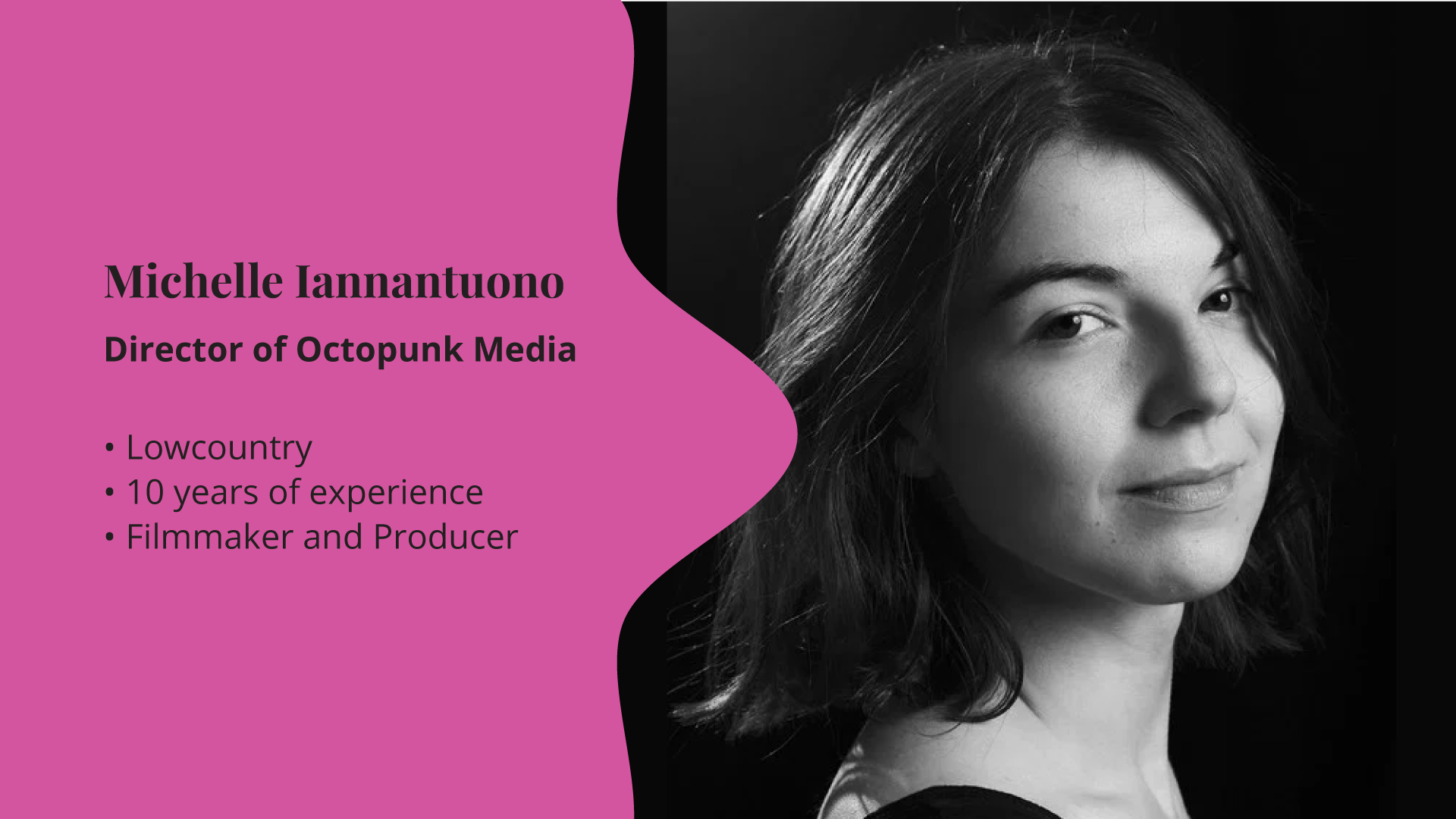
Alright, hello! My name is Ryleigh and today we are talking with Michelle Iannantuono as a professional creative working from and within South Carolina.
As we get started, can you tell us your current career and where you’re from?
00:15 Michelle Iannantuono
I am from Charleston, South Carolina, in the north area suburbs. I am a filmmaker and have been for 10 years. I am making a little bit of a transition into the games industry, I think.
00:29 Ryleigh Kelley
Very cool, very cool.
00:30 Michelle Iannantuono
I’m kind of between this career nexus point right now.
But yeah, the majority of what I’ve done and still continue to do is film and video.
00:40 Ryleigh Kelley
Very cool. So, before we go into the details of your profession, I know you’re talking about a little bit of a career transition right now.
We have this brief section of the interview, and it’s called “One Career, Sixty Seconds,” where you describe your job in 60 seconds or less. I know you kind of briefly discussed about it in the previous question, but this is similar to an elevator pitch.
Okay? Alright. Are you ready?
01:07 Michelle Iannantuono
Oh, I’m actually being timed. Okay, great.
01:10 Ryleigh Kelley
I have a stopwatch ready.
01:12 Michelle Iannantuono
Alright. Yeah, let’s go.
01:14 Ryleigh Kelley
Okay. You’re on the clock. Let’s start.
01:17 Michelle Iannantuono
I am the creative lead and owner of Octopunk Media, which is a film and video production company located in Charleston. I am a sole proprietor, so I do a little bit of everything above the line and often below the line. So that includes direction, writing, producing.
I run a streaming service called Octopunks.tv, which is for our fan community to enjoy exclusives that we produce, as well as our entire backlist library of VODs, films and shows. I’m most known for the feature films Live Screamers, Live Scream, and Detroit Evolution, as well as over 7 or 8 short films over the past few years.
I also take client work on a per-project basis for editing, post-production, that sort of thing.
Or I’m a bit of a Swiss army knife, so whatever you need to put me in, I’ll do.
02:08 Ryleigh Kelley
Okay. That was really great.
You had six seconds left.
02:12 Michelle Iannantuono
I also do Unreal Engine. That’s the other thing.
02:15 Ryleigh Kelley
Yes, yes, yes. I know that. That’s another kind of thing that another part of your background that you do. Obviously we’ll talk more a little bit about that. But yeah, thanks for playing.
So as the director of Octopunk Media and especially with your background in working with Unreal Engine, is there anything South Carolina, or your region in South Carolina, or city in particular that brings to your work?
Does it have a unique influence on you compared to people in the same profession in different states?
02:51 Michelle Iannantuono
Oh, that’s a really interesting one.
So, in terms of film, I think we have a really good community here, especially because of Trident Tech. I have a lot of admiration for Trident. I’ve worked with a lot of graduates from Trident.
My mother actually graduated from there in graphic design 20 years ago, 30 years ago. Then I also have gone through their animation program when the COVID stuff and when the tuition was free.
And, yeah, I wouldn’t have been able to make my SC Indie Grant film, Lotso, without them as well because they fronted a lot of the bill of that film and let us use their motion capture volume and stuff for free.
We also ran an animation practicum for an entire semester where a bunch of students worked on the film. So yeah, I think that that’s probably one of the major places that Charleston has, and South Carolina has that other places may not.
I would say Rough House, the Danny McBride, David Gordon Green stuff is also pretty significant. They kind of have staked their claim on a lot of the film industry in South Carolina. For better or for worse, I think that they do a lot of good for giving opportunities to new grads from Trident and stuff to get on a real set and make union money and that sort of stuff. But I also think that they hire a lot of above the line from out of state.
So, I would like to see more opportunities for directors and writers and department heads to be here in the region as well, particularly from these bigger productions like Outer Banks and Righteous Gemstones and other stuff that’s kind of come to the area. I do think that is a struggle though, even in Atlanta, even in Georgia, they like outsourcing or bringing in from out of town, those department heads and stuff.
We have talent in South Carolina, and I think that we should be given a shot as well. But, yeah, in terms of other influence on the region, I mean, I’ve lived in Charleston for 25 years. I was originally from Wilmington, also a film town. So, it’s kind of just always sort of been a thing for me.
I think that my latest film, Lotso, which was the SC Indie Grant film, takes place in Charleston. It is a cyberpunk Charleston. It is like 2059. King Street’s flooded. It’s all built in Unreal because it’s a fantasy world, but I still sort of am recreating my hometown in there, which is really cool to be able to combine real life references with this sort of sci-fi vision of the future of this town.
As well as the FC&D grants, I should mention as well, that’s another unique opportunity that South Carolina has. You can get up to $45,000 for a short film, and they do that every year. A lot of places don’t have, a lot of states don’t have anything like that.
So that’s a really cool opportunity for short filmmakers to be able to have a significant budget for a short and have access to festivals that they wouldn’t normally have access to and resources and department heads and stuff as well.
06:02 Ryleigh Kelley
Speaking of real life, was there a defining moment in your life which had an impact on your creative journey? I know you talked about how your hometown or Wilmington, or Charleston means a lot to you and is featured in your work.
Was there a particular project or something you produced which showcased your creativity in a way you never had before?
06:26 Michelle Iannantuono
Oh, so I’ve had a lot of big moments. In terms of, I’ve always wanted to be a storyteller since I was four years old and I’ve always wanted to be a filmmaker since I was 8. So that was always part of me.
But I actually went to school for chemistry. I went to the College of Charleston and got a chemistry degree.
I graduated high school in ‘09, so right in the Recession. I was like, “well, I’m going to get a pragmatic career and then this film stuff will be kind of like the plan B, I guess.” It turns out I did some cool stuff as a scientist.
I was an intern at NASA, I was an intern at MUSC, and I was a chemist for four years, but I was kind of lousy at it. It was very clearly for somebody who’s actually passionate about this and was good at it could do it better.
I remember I was stuck on this project in summer 2015 at that job, and I was really, really miserable in that job. I remember I just turned to my spouse, and I was like, “I can’t do this anymore.” I was like, “I have to do something.”
This job is destroying me.
I just had a vision board, and I started just writing down a plan. I was like; I’m going to make a videography company. I’m going to be self-employed. I’m going to climb my way out of this job.
Within a year, I had started an LLC and started taking clients. Then a year after that, I quit my job and was full time in just corporate freelance video editing. Never did super well at that either.
I did okay, but I was not making a lot of money. I remember there was sort of another defining moment in Summer 2018 after I’d been doing the freelancing for a year or two, and it was not super lucrative. I was doing okay. But I had just completed my first feature, Live Scream. At that point I was making movies because it was fun.
I didn’t really have any sort of intention to do it as a career. I remember I was part of a female networking group called Elevate, which was all online. There was a life coach, business coach lady who was giving free consultations as part of our group.
She gave me a personality quiz or something and told me what category I fit into, what are my strengths, what are my weaknesses, whatever. She’s like, “your strengths are power and excellence, and your weakness is discretion.” I’m like, “oh yeah, I have no poker face at all.”
That doesn’t surprise me, but power and excellence. I was like, “so what is that?”
She’s like, “you’re committed to quality, and you have, you can command, and you can lead, and you have the ability to be able to get attention.”
I was like, “what do I do with this?”
She was like, “so you just put out this feature film. What have you learned?”
One thing that’s surprising to me, as I go to festivals and stuff, is how much it connects with the audience to where they actually want to see it again or they want to buy it. They want to watch it. I’m, for the first time realizing that, as an independent person, I have the ability to get fans.
I have the ability to actually get an audience interested in my work beyond other filmmakers supporting me and being a peer-to-peer thing, but actually getting an audience interested into my stories. She’s like, “okay, so act like that is possible.”
I started doing these live streams called Octopunk Live on Facebook Live, where basically it was State of the Union for Octopunk. 10 people showed up, mostly my friends, but it started to build a brand.
It started to build the identity of my films and my company as beyond just me, but actually a brand.
I made a fan film called Detroit Awakening, which is in the Detroit Become Human Universe because I was obsessed with that game at the time. Within 8 months of that, I published that movie, and it kind of blew up on YouTube and connected with the fandom. I was having 70, 80, 90 people watching my Twitch streams to talk about my movie.
Long story short, over the next year or two, I leaned more into that fan film thing and built an audience. That audience ended up crowdfunding over $100,000 of other original projects and provided the basis for what Octopunks.tv is today. I had a Patreon with them for six years, and then Octopunks kind of replaced the Patreon.
I’ve basically been able to finance my film career all in crowdfunding and audience building from the last six years.
So, I would say deciding to actually do it and take the life less ordinary. Then also realizing that fans can come.
Like you, even as an independent, even without a publicist, even without a studio connections in finance. If you can find a niche, you can find an audience; you actually can find other people like you who are interested in the stories that you have to tell. You have to believe that.
You have to get over that kind of imposter syndrome of like, “who’s gonna pay attention to me? Aren’t they gonna watch Disney movies instead?”
11:37 Ryleigh Kelley
Yeah, yeah.
11:38 Michelle Iannantuono
Are they gonna pre-judge me? Some will. There’s a lot of audience out there for people who, like for me particularly, like the queer community really latched on to our work. Even specific niches within the queer community have latched on to our work. They’re like, “well, we don’t see like this sort of representation in movies, in Hollywood movies.” So, this means a lot to them.
12:04 Ryleigh Kelley
That’s really beautiful.
So, imposter syndrome, before you entered the field, when you were having these conversations with your spouse about like, “I don’t want to be a scientist anymore. I don’t want to live this kind of life, something needs to change.”
Did you have any fears about becoming a creative professional? What inspired you to continue beyond them?
12:32 Michelle Iannantuono
I think the inspiration was really my spouse being a safety professional, talked a lot about the burning platform.
You’ll be on a burning platform and then there’s shark-infested waters, but the platform ain’t gonna last, so you better take your risk with the sharks. That’s kind of where I was with that chemistry job is like, “well, I can’t stay here.”
I don’t have to go home, but I can’t stay here. So, I have to find something else. Actually, within three months of me quitting, I do believe I had a performance review where my boss was just like, “hey, so, we don’t know if you’re gonna be here in six months, you know?”
I think I would have been fired from that job, had I not quit. What inspired me was necessity. I had to do something else.
Did I ever have doubts? I mean, yeah, it was scary. Luckily, he made enough money to where we could pay our bills. We would not be destitute so long as he had his job.
So, we could live on one income. So, we were never going to lose our house or anything. I was still kind of like, “all right, well; I have a decent amount of savings. I have a 401k. I’ve lived pretty frugally these past four years as a chemist, and I made decent enough money to where I was able to build up a bit of a safety net.” I wasn’t super worried again about that, but I definitely didn’t want to fail, and I didn’t do as well as I had hoped.
I was hoping to have big contracts and stuff within a few years, and it was really hard for me to find work. It was really hard for me to find clients. I actually have to think back on it now. I was…24? I was a kid. I didn’t know anything.
Now that I’ve, looking back on it 10 years later, I’m like, “oh, one of my prime issues is that I kept saying that I was a company and that I was a business.” I don’t like the word freelancer, but I still behaved like one. I still conducted my searches like one.
Now, going into the game stuff and thinking about starting new businesses and structures and what do I do, I have a much different mindset about it. It’s like, “oh, I actually know how to think like a business.”
I know how to think like a studio. I also have the network and the connections and the partnerships to be able to make a structure like that from the jump instead of doing everything myself and pricing my stuff per hour instead of per value.
I also just understand now that people got money. They do, it exists. Companies will write a $50,000 check and not think about it. You just have to know where to look and also understand that writing down that number is not insane.
And it’s still to this day something I have a hard time wrapping my brain around because to me $50,000 will never not be a lot of money. That will always be a lot of money.
It is actually pretty standard if you’re working with a certain level of client and working with a certain level of partnership or sponsorship.
15:49 Ryleigh Kelley
Do you have any advice for young adults or students who have an interest in pursuing a similar career to yours or pursuing a career in the creative world? Are there any particular skills one should practice or have before entering the industry?
I know you talked about when you’re writing that $50,000 check as a director of a company, they don’t blink twice. If you could maybe speak a little bit more about that, especially particular skills that young adults or students may want to think about before or develop before entering the field?
16:22 Michelle Iannantuono
The biggest thing that I see in young people that I always sort of shake my head at is scope. Know what you know and realize that the dream project is gonna take time to get to.
Don’t try to drink from a fire hose and learn it all at once. It’s impossible.
I actually have an apprentice right now in Unreal, and I’ve sort of had to navigate this a little bit with him, and he’s just like, “well, I want a job in six months.” I’m like, “we’ll try, buddy. I’m gonna try my best.”
He’s a very hard worker. He’s a very great learner and he’s becoming very good at something, but in order to achieve his goal, we’ve tried to niche down just into animation.
I’m like, “I’m gonna make you really good at animation and you can maybe get a job in that. There’s still gonna be a ton of other stuff that we’re gonna learn over time that I know that I can share eventually, but we’re putting on the shelf for right now because I’ve been doing this for the better part of a decade, depending upon what we’re talking about, whether it’s Unreal or editing and stuff and I’m still learning all the time.” There’s still certain things where I know a little bit about that, but I’m not an expert at it.
I’m kind of a jack of all trades. I think that that’s something I definitely didn’t do well when I was younger. I also see it in other people all the time. I see kids graduating from film school at 21 and they’re like, “I’m gonna go make a feature film.”
I’m like, “buddy. Whoa, whoa, whoa. You will regret that because it’s not gonna be what you want it to be.”
You’re gonna be like, “man, I failed my passion project or I’m gonna be apologizing for this movie two years later when I’m publishing my second feature film,” and all the press are gonna be like, “well, we really hated his first one.”
No, you move in silence. You only get one shot to be able to move in silence and build yourself up. Fail in private. Don’t fail in public; you can’t come back from it in a lot of cases. I see this a lot as well with crowdfunding.
I see a lot of people who say, “I’m gonna crowdfund $25,000 for my first project and I don’t know anybody.” Then they make 500 bucks, and then the Kickstarter fails. No, you have to have an audience before you can try and do that.
I kind of worked myself up to that a little bit because I crowdfunded Detroit Evolution, which is my second feature. I self-financed Live Scream. That was $1,500.
I just paid for it. Detroit Evolution was about $17,000. That was more money than I had. I was like, “I’m not gonna do a Kickstarter for this because this is still a little fledgling.”
I’m gonna do a Patreon, I’m gonna do Ko-Fi, I’m gonna do Twitch, I’m gonna do a merch store and just any money that I get from that over the next nine months, I’m gonna put towards the movie. That’s basically how I financed the film.
Then after that was a success, I was like, “okay, we have the audience now. Let me see if I can make another one and we’ll do an Indiegogo.” We set the goal at 10,000. We achieved that in 3 minutes. Then ultimately raised $50,000 in that campaign because our stretch goals were doing an event in Europe and doing an event in New York.
Over a month we were able to raise $50,000. And so, I was like, “okay, now I understand crowdfunding.”
You have to have the audience, you have to have the people who are eager for what you’re selling because otherwise it’s really, really hard. I’m really glad that I didn’t try to do a crowdfunding campaign when I was nobody because that sticks with you forever. It’s always going to be on your page that like, “oh, they got the failed crowdfunding campaign. Nobody wanted this project.”
Unfortunately, a lot of it’s about appearances. It’s funny how people who just know me through social media or just know Octopunk through social media perceive it. They perceive it as so much more successful than, maybe it is financially. They’re like, “oh, can you hire me?” I’m like, “I don’t have money for that. I barely pay my own bills. What are we talking about?”
I would say that young people fail in private, move in silence and work yourself up. I know it sucks to basically be like, “oh man, I have all these big ambitions.” I’ve spent maybe my entire life. I mean, I spent my entire childhood in high school and college, wanting to make movies, wanting to write. By the time I finally was an adult and had the free time and the wherewithal to do it, I’m gonna go out there and do it.
Those first projects were not good. They weren’t. They weren’t very good. Luckily, I didn’t spend a lot of money on them. Luckily, I didn’t spend a lot of time on them. I learned a lot. Luckily, a lot of people didn’t see them.
Then by the time I actually did have something that people liked, which was Live Scream. I still made a lot of mistakes on Live Scream, but it was good enough. I was able to be proud of the work that I was putting out and be able to look back on it years later and be like, “oh, people still watch that movie. People still like that movie. Cool. It’s something that I don’t have to apologize for.”
21:37 Ryleigh Kelley
Yeah, yeah, absolutely. I really resonate with your advice about failing in private. Move in silence. Take your time because especially with the kind of work that you do. That does take a lot of time and learning.
I’m curious to know more about your work with Unreal Engine, which is a 3D computer design software developed by Epic Games. I’m curious to hear more about your experience with that and how you came across it. What was your experience with that?
I know that you mentioned you have an apprentice learning skills in that. Could you speak a little bit more on your work with that and just the experiences you’ve had with Unreal Engine?
22:24 Michelle Iannantuono
Yeah.
I’ve been into the games sphere since 2014. I didn’t grow up with video games. They just were not a thing in my house. I had a couple PC games, but that was it.
Then I won a PlayStation 3 at work in a raffle at Christmas in college. So I had that and my then-boyfriend, now spouse, was really into games. He grew up with games, and he’s like, “can you use your PlayStation 3 as more than just a Blu-ray player, please?”
So, I was like, “okay, well, what should we play?”
And of course, Portal 2 was my gateway game, as it is for 25% of my generation. And then I played Heavy Rain. That I would say was such a life-changing game for me in so many, so many avenues. It introduced me to Quantic Dream, the studio that made it, which later made Detroit Become Human, which later I made fan films on, which later changed my life.
It introduced me to the fact that motion capture could be used in games, and you could make this sort of photorealistic-like story that wasn’t high fantasy, that wasn’t Beowulf or the Polar Express or anything that had been used in Hollywood. Like a gritty David Fincher crime thriller you could do with mocap, and you could tell a story through it.
Also, it was my gateway into video games at large, which again has completely changed my life. Actually, I interviewed at Quantic Dream last year, which was really, really cool. I applied to be a writer for one of their games, and ultimately, I didn’t want to move to Paris full-time. I was like, “I would love to work for you guys, but yeah, if we can’t do this remotely, this isn’t gonna work.”
That was such a watershed moment for me because I was talking to the interviewer, and I was like, “literally, you guys are responsible for my entire life right now.”
This is big for me. So Heavy Rain was kind of my gateway. From that point on, I started learning more about motion capture, and I started playing more games like Life is Strange, Tales from the Borderlands, a lot of those Telltale games, interactive games.
I was also watching a lot of Let’s Play culture, watched a lot of Markiplier, Jacksepticeye, that sort of thing. I was absorbing so much about games history and games culture, game news, how games are made.
I saw that a lot of people were using Unreal Engine to make little games. It’s free, so these people with no experience were just downloading the engine and just building things in it, putting it online for free, and these streamers would play it. Some of the games were good, some of them were not very good, but it was a tool that I learned about through absorbing, over the course of five years, the game industry.
As I got into film, I was thinking about maybe doing some animation stuff. I downloaded Unreal and just played around with it for eight hours. I was like, “oh, this is surprisingly user friendly. This is very intuitive to me and easy to learn.” There’s a lot of documentation about it, so, I kind of had that on the back burner of my mind.
Then when I had the idea for Live Scream, which essentially is a found-footage movie. It’s a real time found-footage movie. It’s like a screen capture of a Twitch stream as an uninterrupted webcam for 70 minutes of this one actor reacts to gameplay footage that is happening on screen and there’s a chat as well with narrative characters who come and go. Basically, if he dies in the game, his followers start to die in the chat. So, it’s like a high-stakes horror film that I had to build nine fake games for in order to achieve the concept of the film.
When I had the idea for the movie, again, having watched Let’s Play Culture for so long and understanding that world in and out. I was like, “I got to make fake games for this.”
Unreal it is. I was able to pick it up really quickly and by using assets that I was, because I wasn’t a modeler, I couldn’t like square the circle of like, how do I get the stuff to put in the game? All that is available for purchase or download or for free. There’s a lot of assets out there.
If you need a door, if you need a monster, if you need animations, you can find that stuff online and then just cobble it kind of together in Unreal and do some visual scripting and make it work. That was my first intro to Unreal, and this was in 2018. This was at a point where like nobody was using Unreal for film short of James Cameron and like the Mandalorian, maybe.
Over time, I revisited Unreal in 2022, when I was making the sequel to Live Scream, and that was when Unreal Engine 5 came out. Lots of new features, incredible new features. Unreal and Epic Games are starting to get more into the film industry at this point in time. They’re doing a lot of virtual production. They were also doing a lot of like in-engine animation and that sort of stuff.
They were starting to realize that like, “oh, there’s more people who could use our tools than just game makers.” I actually went to the AFM, the American Film Market, in 2023, when I had finished Live Screamers and was pitching it.
I remember seeing Unreal Engine logo everywhere and I just had to laugh. I was just like, “yeah, I knew it. Yeah, right? Yeah.
I was like, “hey, I just made a movie with this.”
They’re like, “oh, virtual production.”
I’m like, “no, not quite.” I was like, “I’m doing a hybrid live-action game capture cinematic thing. I don’t really know how to describe it.” I really dove into Unreal in Live Screamers. Just working on it for months and months and learned the cinematic creation tools really, really deeply. Then the SC Indie Grant(s) thing happened because I have, by sheer happenstance, met an OptiTrack rep and OptiTrack is a motion capture company.
They’re like, “oh yeah, we have a system at Trident Tech.”
I’m like, “that’s in my backyard. I can walk there.” I knew that Trident Tech and the Indie Grants were tied together. They like to put Trident Tech students in the Indie Grants projects.
I wondered if they would go for a pitch where I use their volume because the OptiTrack guy was like, “yeah, they don’t really do much with it. I think that they would like somebody to come in and use it.”
I wrote a short film that was completely animated, completely actually CGI-animated in Unreal, and would use motion capture. Through my Detroit movies, I also got to know Neil Nubon, who is Astarion in Baldur’s Gate 3. He’s one of the best motion capture artists in the world.
I was like, “hey, would you like to come direct my mocap?”
He agreed.
Through him coming on to the pitch and us having this interesting concept, I think the Indie Grants went for it. We were able to shoot on their volume at Trident Tech and then use their animation program as well to get some students on the project. I’ve spent the last two years in post. We’re really close to finishing.
That’s sort of my journey with Unreal Engine.
Ultimately, my thesis on Unreal Engine is that it’s the most democratizing thing for indie filmmakers since the DSLR. It is a free program. It is easy to learn. You can make anything in it.
I’m not going to say it’s easy. I’m not going to say it’s going to be quick, but I would never be able to make cyberpunk Charleston in real life. It would always look cheap no matter what, if we had a low budget for that, even with VFX workflow. For me to be able to build that completely from scratch in Engine and also have photorealistic versions of our actors who are able to come to life, who are very, very high fidelity of what they look like in real life, all due to free tools that came with Unreal Engine. Yeah, it’s really cool.
I remember Neil; I was showing him how we were capturing facial mocap on an iPhone, literally just right here beside me. I had my actor sitting in front of an iPhone, and they were doing their facial capture.
He was like, “it captures the neck movement? That’s insane. Like we can’t do that on these big stages.”
I was like, “yeah, man, it’s the future.”
31:05 Ryleigh Kelley
It’s the future.
31:09 Michelle Iannantuono
Yeah, and completely marker-less on the face, which he was telling me is actually pretty normal now. It’s pretty old fashioned to do the markers on the face, although some people still do it. To be able to even introduce some of these tools to a seasoned veteran in this technology and in this world, who’d been doing it for 10, 15 years himself was really cool.
I think that just goes to show how powerful this resource is. It also has so many, if you want to go get a job in it, you could do arch phys, you can do automotive, you can do, the military actually has a lot of applications for Unreal as well. I know that from my mother working for the Coast Guard. So yeah, it’s not just for games and film and television. It also has like wide-ranging applications that anybody can pick up and learn.
32:06 Ryleigh Kelley
Yeah, that is just really so fascinating and thank you for speaking more about that. I know that’s one of the key tools that you use in your work. Thank you so much for taking the time to speak with me today.