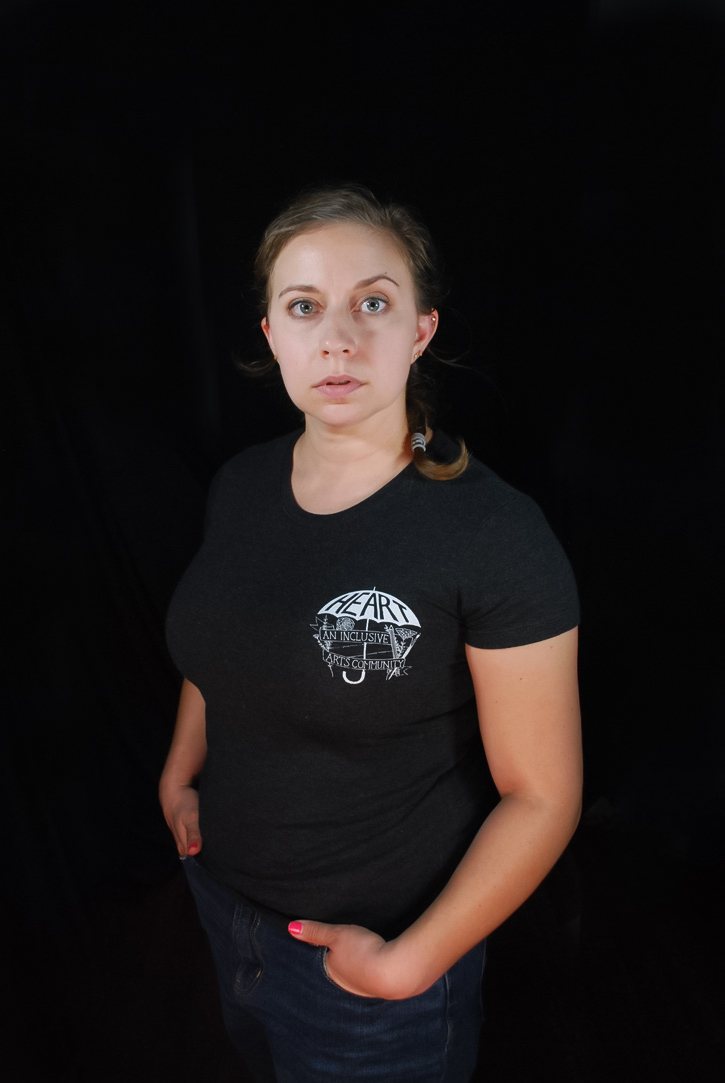
“Being brave does not mean being unafraid. It’s being scared and going forward with it anyway.”
Sisi Garland is the Executive Director of Heart Inclusive Arts Community, an interdisciplinary art studio in North Charleston, South Carolina, serving adults with disabilities. With a background in stage management and theater, Garland has worked in New York and Charleston and celebrates five years of leadership at Heart. She believes in the power of creativity, community, and courage in the arts.
Interview
Transcript
0:02 | Lexi Raines
So first, just give a little introduction of yourself. What do you do from work and where are you currently working from?
0:20| Sisi Garland
I am Sierra Sisi Garland. I’m the Executive Director of Heart Inclusive Arts Community. And I am working from my office (my pink office) here at the Heart Art studio. And I’ve been with Heart for five years now. I just celebrated my fifth anniversary as the Executive Director. (Yeah? So, yeah, did that answer all of those?)
0:47 | Lexi Raines
Yeah, tell us a little bit about the Hearts initiative.
0:52 | Sisi Garland
Heart Inclusive Arts Community is an art studio for adults with disabilities, and we are multi-disciplinary. So, we do performing arts, visual arts, any kind of creative endeavor that we want to get our hands into. We take it on.
1:07 | Lexi Raines
That’s awesome. That sounds like a really fun and meaningful thing to start. So, where in South Carolina are y’all based?
1:23 | Sisi Garland
We are in North Charleston, South Carolina. We started 10 years ago in downtown Charleston and have moved into the North Charleston area about a year ago. But yeah, so we’re in the Lowcountry. We have members in our studio who are from all over the Dorchester, Berkeley, Charleston area.
1:46 | Lexi Raines
Yeah, that’s awesome. Charleston! I love Charleston. Such a good area.
1:50 | Sisi Garland
Yeah, it’s beautiful here.
1:53 | Lexi Raines
It really is. So, kind of on that note, like what’s one thing that you love about working as a creative in South Carolina?
2:03 | Sisi Garland
There’s lots of inspiration here, for sure. Visually, it’s stunning, especially in this and I’m bias from being from Charleston, but especially in this Low Country region, it’s just gorgeous. You have so many places and parks that you can go to and create. But outside of that, there’s also such a rich culture here, and so many different cultures coming together, especially in this downtown area. There’s just a lot to take in, and a lot that you can be inspired by.
2:38 | Lexi Raines
I completely agree. I’ve been in Charleston a lot. I used to have family who lived there, and I feel like there’s just so many different areas blended into one. Like, I feel like you can go to like, one side of Charleston, and it’s completely different from the other side of Charleston.
2:57 | Sisi Garland
Yeah, absolutely it makes it pretty clear why a lot of Hollywood productions want to come out to Charleston and South Carolina, because there’s a lot to offer here.
03:10 | Lexi Raines
Yes, for sure. So, what do you think South Carolina does offer, like, what do you think it brings to your work compared to anywhere else?
03:21 | Sisi Garland
South Carolina has this incredible way of feeling like a sort of small town, where you know everyone, and everyone knows what’s going on with you and what you’re doing, and you just have a lot of familiar support. But at the same time, it also has this broader, bigger feeling to it as well. Like it has a lot of resources, it cares a lot about the arts. It was immediately surprising to me how much South Carolina actually does support its arts and artists, while still feeling very tight-knit community as well
04:07 | Lexi Raines
And that’s amazing to hear, obviously, because that’s like, what we’re trying to do here is just spread that word. Because so many people, I feel like, especially young students in like, middle school and high school, I feel like they really think that they have to move out of South Carolina to pursue a creative path, which definitely isn’t true at all. So that’s amazing to hear.
04:32 | Sisi Garland
Yeah, absolutely. My niece is in high school now, and she’s thinking about a creative career. She’s an actor, and so she, you know, is starting to do the search for school programs and things that she can get to when she graduates. And she’s dead set on New York. She’s got her mind fixed that she’s going to go to New York. And I’ve done the New York path. I’ve moved there for a little over two years and worked there as a stage manager and an actor, primarily as a stage manager, if we’re being honest, but it’s so hard to break people of that idea that you have to go to these you know, like New York especially, or Chicago, if you’re an improver or if you’re in film and television, that you have to move out to LA and it’s just not true.
And in a lot of ways, I think that being go going to those big places, especially for your education in the arts, before becoming a career professional, it can be a little too daunting, or it can be a little too unsupportive, because if you’re not coming there with a network or with a confident background, then it’s going to, it’s going to feel so overwhelming so quickly. So, I’ve been trying to steer her in other directions, to find something a little bit more friendly to the younger, to the greener people, before hitting the big cities.
06:10 | Lexi Raines
Yeah. Well, if she does get accepted there, maybe, like, I feel like New York is obviously an awesome place, but maybe, maybe she’ll miss home.
06:21 | Sisi Garland
Maybe. I’m originally from Delaware, and she still lives in Delaware as well, so it’s only three hours away. It’s fine.
06:28 | Lexi Raines
Yeah, that’s not that bad at all. So how would you describe like the local professional community in Charleston?
06:38 | Sisi Garland
Supportive. That’s the first word that comes to mind. We are so lucky to have a lot of professionals around us who are not only interested in what we’re doing and want to be a part of it, but that will rally their support around us whenever we do things. They’re coming to shows they’re supporting each other’s shows. they’re just getting involved amongst everyone and not just creating this insular, individual attitude where it can’t all exist together.
07:17 | Lexi Raines
I feel like that definitely is something that does happen in a lot of bigger cities, because I feel like things start to get, like, so niche that it’s like you have to be in one specific group or interest. So, I feel like that’s definitely an amazing thing.
07:33 | Sisi Garland
Yeah, yeah. I saw that a lot in New York, which is bizarrely, you know, for being such a big city and everyone, millions of people living there, you still ran into the same people all the time. You’d be in auditions with the same people, or you’d end up like in productions with somebody else’s show running at the same theater. And so, to still have that sort of competitive mindset and attitude toward things. It made it so much more difficult, because on one hand, you’re talking to each other so chummily and or, you know, whatever it is, but then you’re still feeling like you have to compete with those people for the same resources. And so, it just nothing ever felt very secure.
Whereas here it feels like you have friends, you have supporters, you have people that you can turn to, and they’re not going to hoard their information or their experiences and ideas. They’re sharing with you because that inspires them as well.
08:42 | Lexi Raines
Yeah, that’s something I’ve heard a lot across all interviews, is that, South Carolina, really is such a community. Everybody is willing to support everybody. Everyone wants to, kind of, like, hold a hand out for everyone who’s trying to get in who’s trying to grow, all that stuff, and I feel like that’s just such a beautiful thing.
So, kind of shifting gears here. How would you define professional or personal successes in your creative endeavors or in your career?
09:19 | Sisi Garland
As far as in my career, it’s kind of easy, I guess, to define for me, because being Executive Director, I’m sort of responsible for the overall wellness and health of the organization, and so as long as the nonprofit is still going, then I feel like we’ve succeeded to some degree, but as far as in our creative endeavors, if we have reached even one person who hadn’t seen us before, or who was touched by something that we did, or inspired by it, or felt something from what we were doing. Sounds so cliche, I know that’s probably like the creative cliche, but it does mean something, and it does feel like a success. If you’re presenting a gallery in a new space, and someone has walked in and they had no idea what Heart was or who our artists were, and they come in and they see a piece, and they just are in awe of it. That’s so successful and so meaningful to us. So, that’s creatively how we know we’re doing something.
10:31 | Lexi Raines
That is really awesome. And do y’all have your showings in North Charleston? How often do y’all have those showings?
10:43 | Sisi Garland
We don’t have set shows or exhibits necessarily. We do a musical every year. Tends to be an original musical that we’ve written ourselves every year, that we might be exploring different avenues in that and outside of that, we do a rock concert at the poor house in Charleston every year in the winter, we do performances all over the place, like we’ve been invited to perform in Myrtle Beach for some professionals convening there, we were just invited to perform at the State House in Columbia for our advocacy day. Yeah, performances were canceled because of the thunderstorms.
11:32 | Lexi Raines
This weather’s been crazy lately.
11:35 | Sisi Garland
It cannot decide what season it is around here.
11:41 | Lexi Raines
So, what was your, you mentioned that you were an actor. What was your biggest fear when you first decided to pursue the arts professionally?
11:52 | Sisi Garland
The fear that you won’t succeed, that you won’t survive the biz, I guess. You know, like I said, I came from Delaware, which is a small state to begin with, but also I came from a small farming town in Delaware. There wasn’t arts really happening. We had our one school musical every year. And outside of that, there just was not a lot of exposure to the arts, so I had no real concept of what being a professional creative could look like. It felt to me at the time like you either had to be A-Lister red carpet famous or a sad, struggling wannabe, and that there was no in between.
And so, when I came down to Charleston, I moved here to go to the College of Charleston, and I signed up that first day to be a theater major. My father was just so worried. And I don’t know that he’s ever stopped being worried about this, but he just was like, “You’re going to have to do something else. You have to have that backup plan. Everyone has to have the backup plan.” And to some degree, he was right, because you know, you have to have that survival gig while you’re forming that career for some people. Some people are lucky that, that career is built in for them from the beginning. But a lot of times you do have to have other things that you’re good at, but having that creative basis, that creative foundation, makes you good at those other things as well. So, his worry that having a theater degree was going to be completely useless the second that I graduated became also my fear, and I was so nervous about it that I was just going to be poor and struggling forever.
But everything I learned being a creative and being a theater person has gone into all the work I’ve done since, whether or not it’s directly a creative job
14:15 | Lexi Raines
I feel like that’s definitely a barrier that a lot of people have to work through whether it’s like you just have self-doubt, or your family isn’t supportive about it.
Because I know personally, I am an English major, that’s not what I was originally. I was originally a computer science major, but when I told my family I was going to be an English major, it did not go down well, but I feel like if you have a buyer for it, I feel like you can figure it out. And I feel like these jobs do have a lot more to offer than people think. So, I feel like breaking down those boundaries is just so important.
15:03 | Sisi Garland
Yeah, and it starts with having exposure, so like this program that’s coming up, and the creative careers resources, if you don’t know those possibilities are out there, or realize how infused into everything else the arts are. Then if you don’t know it exists, you can’t necessarily imagine that it could happen for you. Um, so, yeah, it’s really cool these programs that that are coming up.
15:36 | Lexi Raines
I 100% agree. So, can you define, like a defining moment, or describe a defining moment in your creative journey? Like, did you have a particular project you worked on that like had a significant impact on you, or did something that you like produced really showcase your creativity?
16:01 | Sisi Garland
I think one, probably the most defining moment in my career, was my first time working professionally as a stage manager. I had stage managed all through college as a theater major, but I hadn’t really expanded outside of that yet, and probably mostly because of that fear and nervousness and doubt. But someone I had worked with on a production in college, they were already a creative professional. They were an actor and director, and they were directing a show in Charleston, and wanted me to come stage manage for them. And I said yes to it. Swallowed the doubts and everything, and I said yes, and came on and did it. And it was that production that connected me to the theater company that I have now been working with for almost 15 years. And it was through doing that that I realized, no matter what else I’m doing in my life, to survive or to be able to live day to day, I’m never not going to do theater as well like I have to keep this in my life.
So, it’s like you said, it’s kind of, if you have that passion, or you have that fire for something, you’re going to go out and do it. It’s just a matter of how it manifests in your in your world. So that show brought me essentially the rest of my career, and it all came from just saying yes to somebody I had worked with in college, and he’s now on Broadway. He’s originated roles in Once, and he was just in Anastasia and Amalie. Yeah, he’s incredible, and I very much have him to thank for continuing to do the arts even when it was scary.
18:07 | Lexi Raines
Yeah. So, I feel like that is, like a really positive note, but kind of going from that, what do you have, like, the worst advice you’ve ever received?
18:21 | Sisi Garland
The worst advice, I mean you always hear the superficial stuff like that, “you have to define your brand” or that you…
I mean, I graduated in 2009 from college, which probably sounds like a long time ago now. But even still then, when I was young, you were still hearing like things about body shaming and appearance and all of these things that you have to do, which thankfully, I feel like have kind of gone away.
But it never leaves you if someone has said that thing to you about just your personal being. Something that is not yourself and took it as, and they say it was such authority that you believe them, you know. And so that’s definitely the worst advice, is listening to anybody about who you need to be and what you need to look like to do anything. It’s terrible. It’s hard not to listen to it, but it’s terrible, it’s awful advice. No one should listen.
19:40 | Lexi Raines
I completely agree. I feel like everybody is their own person. You got to love yourself. So, what’s the best advice you’ve ever received?
19:55 | Sisi Garland
Again, probably a cliché, but it’s true, and I still think about it all the time. That being brave does not mean being unafraid. It’s being scared and going forward with it anyway. So being nervous about an audition or a show that’s coming up, or anything that you have coming in, or taking the leap into a new career, a new job.
All of these things are really scary, but that doesn’t mean that you can’t do it, and you can still be brave and go forward with it, even as scary as it is.
I was terrified when I took this job. I feel like I’m probably still terrified every day in this job, but it’s the most rewarding thing I’ve ever done, and it feels like the culmination of all of these disparate career paths and skills that I had just been doing that because I love them, for so long. And now they get to come together in my job here as the Executive Director, but it was so, so scary. And if you know I didn’t have people telling me that it can be scary, but you can still do it, then I probably would have been like, no, it the this is telling me something I shouldn’t be doing it if I’m this worried about it.
21:21 | Lexi Raines
Yeah, I completely agree with that. I just feel like fear is the best motivator you can have, because I feel like it goes along the lines of like, the only way to grow is to get out of your comfort zone and push yourself. So, I think that is like, I agree with you. I think that’s like the number one advice you can give receive anything, because that’s personally helped me a lot too.
21:54 | Sisi Garland
Yeah. It’s hard to live it, too, though. I mean, I say that, but it’s not like I was the most bravest person, just going out there, throwing myself into things, I still played it fairly safe. I’m still kind of a scaredy cat in that way. But all the good things that I’ve done were when I, like you said, stepped out of my comfort zone, went for that thing that I’d always wanted to do, and I wish I had done even more of that, especially when I was younger, especially when I just like, you know, when things felt a little bit more, not carefree, but possible. You know, when you’re looking ahead into your future and you’re thinking, you can do anything, keep that you can do anything. You can always do anything. So go ahead and do it.
22:43 | Lexi Raines
That’s awesome. I think that’s really amazing. So, can you walk me through, like a typical work day at Heart?
22:55 | Sisi Garland
Yeah, we have sort of a dual life here. So, I have my office time on Mondays and Wednesdays, where I’m doing all of the background support work for the organization. But then on Tuesdays and Thursdays, we have our artists in the studio, and we have about 25 artists that we see every Tuesday and Thursday, nine to five, and they’re all adults. They’re all our peers and our friends and our creative partners in crime.
So, I get to come to work every morning about 8:30 or 9:00, come into the studio and be greeted by everyone and just sort of like, just have that water cooler chat with all of my friends as we come in. And then we first get into sort of a creative but palate cleanser. It’s our daily draw. It jumps starts our day with a little bit of creative thinking, we get an interesting fact for the day from one of our volunteers, and from that, she also creates a drawing prompt that we all work on. So, we do that to kick things off, we get into visual arts, which is now being led by our artistic director, Rae, and that can look all kinds of ways, depending on what we’re working on.
Often, artists are working on some individual piece that they are wanting to finish and see through to its ending. Sometimes we’re doing collaborative larger pieces all together, and sometimes we’re working on a theme towards a specific gallery, but in any case, we’re all creating some form of visual arts there.
We have lunch. We’re usually watching something silly or fun or creative or whatever during lunch. A lot of documentaries about animals, because that’s always fun to see. And then in the afternoons, we do performing arts. So, our performing arts Director, Mel, is a music background. She is the musical director for all of our performances, all of our shows. And so generally, we’re working towards whatever our next performance is going to be.
So lately, it’s been preparing for that state house performance that didn’t quite happen, but we were also performing at “A Night to Shine: The Prom,” which is sponsored by the Tim Tebow Foundation. We were asked to perform there at our local prom. We also have some other performances coming up, and then ultimately, we are rehearsing for that original musical that we do each year. So that goes from auditioning, writing, editing, rehearsing the production, rehearsing the musical, putting it all together with a live band, all of that jazz.
And then at the end of the day, we sort of have some decompression time. We’ve got our free time where we can chat and socialize. We can finish up projects that didn’t quite get to a good spot along the way during the day or just say hi to everyone who stops in to visit on the way home.
26:22 | Lexi Raines
That sounds very busy, but it sounds like a lot of fun. That sounds awesome.
26:28 | Sisi Garland
It is a lot of fun, but I am exhausted at the end of the day on Thursday.
26:34 | Lexi Raines
So, you mentioned that you still want to always try and include, like acting into your life, even when that’s like, not specifically what you’re doing. So how have you created, like, a work life balance where you’re still able to maintain both your professional and personal creativity?
26:59 | Sisi Garland
It’s hard. It’s very hard, especially when your career is so closely aligned to what your passion creativity is, and especially lately, since the pandemic, it was very difficult. I’m part of the acting company for the Village Repertory Company, which is over 20 years old now, here in Charleston, but we had to close during the pandemic. And so that avenue of personal creativity was sort of lost to me, and at a very important time in my career as well, because I had just started working here at Heart.
And so, this new experience, I didn’t have that sort of old, reliable source of creativity to turn to. So, it is really hard, but I feel like just anything that you’re doing, almost as like a self-care or just to feel good, if it’s creative, even if it’s reading a book, even if it’s going to see a show or a performance, that you’re not a part of. Engaging in art, whatever your favorite kind of art is to you, that is the balance, right?
So, it doesn’t always have to be, I feel like sometimes creatives we can put like this burden on ourselves, that we have to complete something, or that we have to show something, we have to have something to put out there for it to count and it doesn’t. It can be whatever you do for yourself, even if that’s like writing one sentence of a novel at the end of the day, and that novel goes nowhere. Who cares, you are expressing yourself. You’re doing something that you care about, and that’s all it ever needs to be. It never needs to see the light of day for it to be important to you.
29:15 | Lexi Raines
I completely agree with that. I think that, like you’re saying, there is such a push to just keep putting stuff out there, but at the end of the day, you are like a person who needs to have things just for you. So, I think that is an amazing piece of advice. So, do you have any questions that you wish you were asked?
29:40 | Sisi Garland
Oh gosh, no, I don’t know that I could have come up with any questions better than what you guys already have.
29:48 | Lexi Raines
Awesome. Yeah, I feel like we kind of put people on the spot without that question. So finally, do you have, this is also not to put you on the spot, but do you have a creative that you’d like to nominate to be interviewed?
30:05 | Sisi Garland
Oh yes, I spoke with someone at Arts Advocacy. Oh, gosh. Okay, let me, for some reason her Instagram, oh no, I know her name. Her name is Janelle Smalls.
30:16 | Lexi Raines
Janelle Smalls. Can you spell that for me?
30:19 | Sisi Garland
I believe it’s Janelle and last name is Smalls. I might have to dig for her contact information to send to you to reach out to her. But she is an artist who is also a K through 12 arts educator and speaking with her at Arts Advocacy this week or last week, she was so passionate and was like, so full of gumption to do something for her students. I think she would be an incredible person to speak with.
30:54 | Lexi Raines
That’s awesome. Yeah, she sounds amazing. Definitely, definitely, send me her information if you can find that. It was so nice talking with you. I think you had such wonderful advice. And you obviously come from a place where you care so much.
31:14 | Sisi Garland
I hope so. That’s sometimes the only thing keeping us going is how much we care about it.
31:20 | Lexi Raines
I completely agree. So, thank you. I hope you have a good rest of your day. Yeah, I’ll be reaching back out to you just for that headshot, and then I can definitely try to email you whenever this goes live to send you the link.
31:36 | Sisi Garland
Yeah, perfect. And if there’s anything we can do at Heart, any of us to support this project, future projects, everything you all are doing, please, just let us know, and we’re there for you.
31:49 | Lexi Raines
That’s awesome. Thank you.