Interview
Transcript
00:00 Victoria Bartolotto
Hello everybody. My name is Victoria, and today we are talking with Dr. Deanna Taylor, a professional creative working from and within South Carolina. As we get started, can you tell us about where you’re from and what your current career is?
00:13 Deanna Taylor
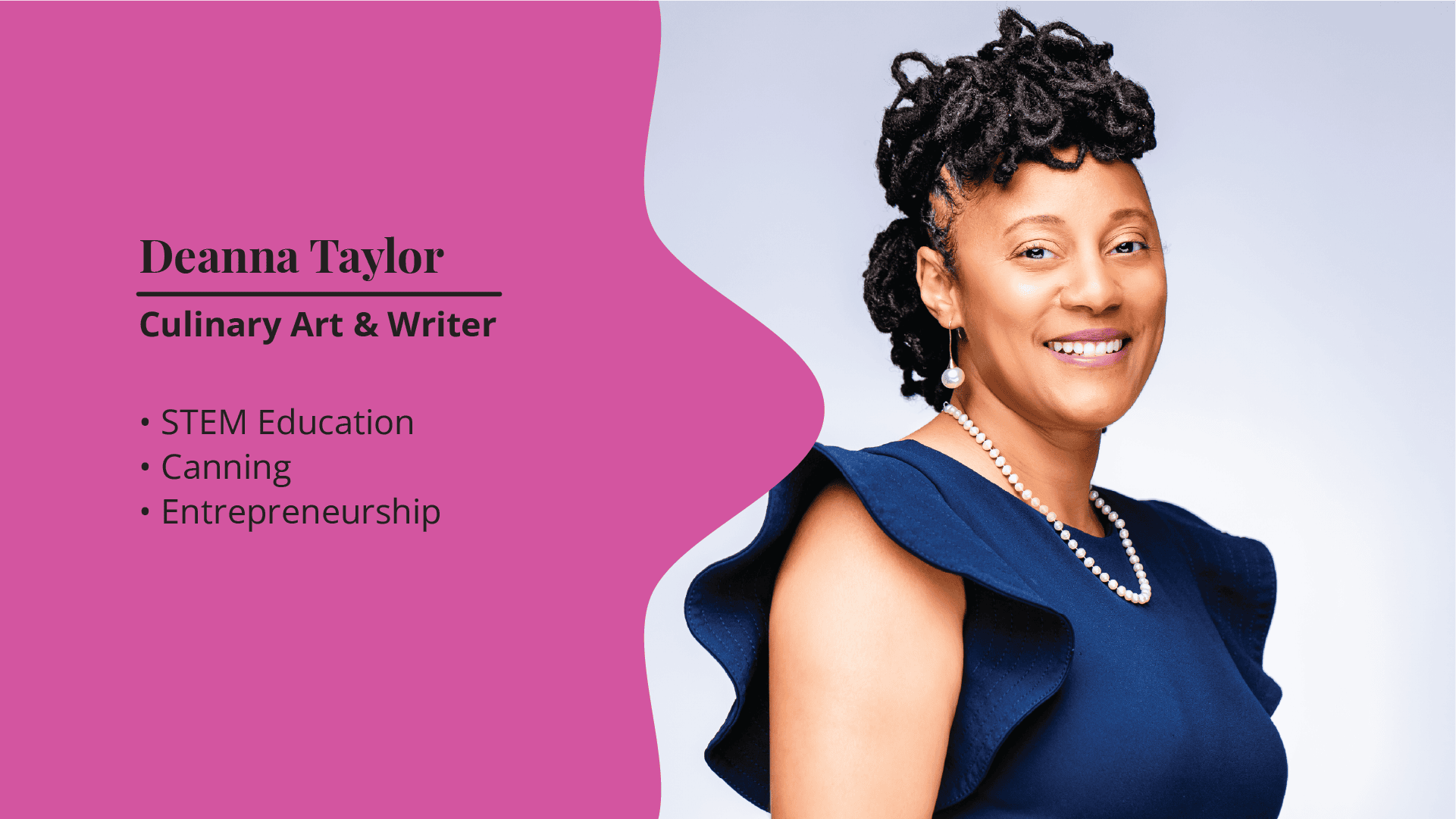
Yeah, so I’m originally from Georgia. I grew up in a little place called Kenneth Hall, Georgia, and I am currently working in out of Camden, Kershaw County, South Carolina. And my career, I am a consultant, and I work in the room of Creative Arts Education and Wellness.
00:36 Victoria Bartolotto
Before we go into the details of your profession, we have a brief section of the interview called “One Career Sixty Seconds,” where you describe your job in sixty seconds or less in an elevator pitch style. Are you ready?
00:49 Deanna Taylor
I’m ready.
00:50 Victoria Bartolotto
All right, let’s start.
00:52 Deanna Taylor
Okay, so I started in eighth grade, and I really loved science. I moved through my career into science, and so now I focus on STEM learning through creative arts, mostly in the realm of making jams, jellies, and preserves, and attaching that to the way that people move through life and are coached. There’s also a little realm of taste testing in there and adding in the element of matching their taste test and what kind of fruit and preserves they like to what their business career or their coaching style is like as well.
01:32 Victoria Bartolotto
That’s so interesting! With working in the culinary arts, specifically with preserving, is there anything about South Carolina, in particular, that is unique to preserving, or does it have some kind of influence on you?
01:47 Deanna Taylor
Yes, so I actually use only locally grown fruits, and those are harvested from my backyard. The tie to South Carolina is that I use pears, figs, and muscadines, and muscadines are really known for growing in the South. As a matter of fact, some of my clients don’t even know what a muscadine is. So, giving them the cultural piece of how it came to be here in South Carolina is one interesting piece.
The other part is I harvest the fruit from my backyard and then the neighbor’s backyard. So, my grandfather got me into looking more at the locally sourced fruit, because he started sharing the craft and everything with the people at his church. So now we harvest the fruit from people’s backyards, mostly his elderly neighbors and folks that aren’t able to get into the backyard, to get the fruit. We salvage it from going to waste, and then I turn that into jams, jellies, and preserves, and we share that with the community. I give some back to the neighbors as well.
02:50 Victoria Bartolotto
I know you mentioned in the form that you filled out that you started preserving over quarantine and COVID. Can you talk a little bit about that, and how that story puts you on the trajectory to be where you are now?
03:04 Deanna Taylor
Yes, so I moved to where I am now. I moved to Kershaw County in 2020 during the height of COVID. I was about six to seven months pregnant, and we moved to this space where it was like room for growing all these fruits and things, and I noticed that the squirrels and the birds were having a good time eating up all the fruit.
My grandparents taught us, and instilled, you do not waste food. You don’t throw anything away; you do not waste food. I grew up in that era where you know you saved everything; scraps and all of that. I started going back to my roots of asking my mom, my grandma, “Hey, y’all used to teach that canning thing, or y’all used to try to get me to do that, can you teach me again, because I want to pay attention now.”
So, I got into it because I wanted to save some of the fruits and not have things to go to waste. Then I just started with taste testing and letting neighbors and friends and family members taste the preserves and things, and then kind of progress from there. Now people request them on a regular. Folks have been asking for new flavors. I’m like, “Yeah, we gotta see about that one.”
04:17 Victoria Bartolotto
I know you also mentioned that you have a book that you wrote. Can you describe the process of going from doing the physical making of canning and preserving, and how you kind of put that down onto the page, possibly?
04:32 Deanna Taylor
The canning process, even picking up the fruit, is more about family and community, and bringing all of those elements back into the kitchen. Making it relevant for the generation that we have now. I mentioned earlier that I was pregnant, and that was our second child in 2020. So, I have little people at the house that are also involved in the process. They help pick the grapes and wash the pears. To me, the book was looking more into those family connections and making sure that the kitchen is a place where it’s a lab. You’re in there experimenting; you’re trying things out. You’re seeing, “Do the kids like this? Do you like this? What kind of herbs things are you going to put in there?” So, the cookbook is actually a cookbook and a text.
My colleague and I collaborated on it and worked on it together. Her name is Dr. Regina Seifra, and it’s a cookbook. It’s a text, because we wanted to bring outdoors and like the growing process and bring it and put it on a plate for the children. There’s activities in there where let’s say, for example, in one chapter they’re going to create their own herb garden, and then they kind of plan ahead for the recipes and they grow the herbs that they’re actually going to use in the recipes and the food for later on. So, making a connection for them between growing and what you’re eating on your plate; that you can actually go through the experimenting phase and figure out what it is that you like and what you don’t like, and how things get there.
06:14 Victoria Bartolotto
I feel like that’s such an important story, even for like adults now just figuring it out. A lot of people don’t know where their food comes from. Learning about that process, I think, is something that a lot more people should know. So, you do this full-time. Was there any kind of moment in your creative journey that solidified that you needed or wanted to do this full time, or was there something that really kickstarted you into this, other than COVID?
06:46 Deanna Taylor
I would say my children. I have been in education for over twenty years, and I have done all kinds of studies, and I’ve worked in different settings. However, making sure that what I’m doing is bringing me joy, and being able to integrate what I do with what the children do has been one of those things. I’m not going to go the traditional job route, I’m going to move more into this creative space, more into the space where I can bring them to work with me.
How many children ask, “Mommy, can I go to work with you?” My kids really like it. They enjoy being able to even get on a video camera and tell out the process. Like, “Okay, Mommy, first we pick the grapes, and then we do this.”
So going through the process and learning the names and being able to teach them is something that I wanted to be able to do. That pushed me, or pivoted me, into the space of being able to bring the real world to life for them and wanting other children to be able to enjoy the same thing,
08:02 Victoria Bartolotto
Yeah. Wow, that’s really sweet. Before thinking about doing this full-time, did you have any kind of fears about entering a creative industry that isn’t well known as a lot of other industries are? Was there anything that might have held you back from doing it full time?
08:19 Deanna Taylor
Yes, so I was leaving a position that had state benefits and all the things. So, jumping into it, I will say one of the fears was of failing or not being successful, but I had to learn to define success for myself and what that looks like.
Then also learning that just like I learned with my science degree, I may not be explicitly using that right this moment, but just like I learned with that degree, if you try something, you can tweak it and then make it better. Your business, and even with a business, doesn’t have to stay and do the same thing year in and year out. Although some businesses are well known for doing their own thing. On the creative side, if I do the same thing over and over, I don’t think I would have much of an audience.
To me, it brings the spice piece in, just like I have spices in my pear preserves, or whatever. I need a little cinnamon, I need a little all spice, if I put the same thing in plant and just pears by themselves, no offense, but in a jar of pears and nothing else, you need a little something to spice it up. I think jumping in scared and also knowing that there’s other avenues and ways and pivots that you can make within a business. That it’s fine, it’s okay, you’re being creative with multiple things, not just your actual medium that you’re using to express.
09:52 Victoria Bartolotto
Do you have any advice for young adults or students who possibly have an interest in starting their own business or jumping into something new? Are there any particular skills or knowledge that they should have before entering either the preserving industry or just something creative in general?
10:09 Deanna Taylor
So, I would say my piece of advice is to stay true to you. Be authentic in what you do, because that’s what sets you apart and kind of makes it. Yes, there are tons of people out there making preserves. There are tons of people out there creating with their hands, creating with their minds, voices, whatever. But there’s something about you that makes you unique. So, focus in on that part and let that part shine through.
I don’t think there’s many people, at least I haven’t found any, that has an education and human resources background that now makes jellies and jam, so I kind of blend those things together.
Using that unique advantage and using it to your advantage, to speak to the world and to make something that you love and enjoy doing. Family is also very important to me, so sticking to those values and things that are important. Yes, making money is great; it pays the bills, but being happy in what I’m doing, actually bringing joy to other people, and telling my story is something that is priceless, for lack of a better word.
I was trying to find something that wasn’t so cliche, but it’s good, I’m going to use it. So that’s the advice I would say: be true to yourself, be authentic, do your thing, and like let that thing that makes you unique kind of make you shine, and go for it with that.
11:39 Victoria Bartolotto
Yeah, thank you so much. That was amazing, and I appreciate you taking the time to speak with me today.
11:46 Deanna Taylor
Okay, you’re welcome. Thank you very much. It was great meeting you, Victoria.
11:49 Victoria Bartolotto
It was nice meeting you as well. Have a great day.