Career Area: Author/Writer

  • Caleb Wygal

    Caleb Wygal

    “It’s just, it’s so gratifying to me to be able to just have that privilege to be able to entertain people like that” 

    Mystery author Caleb Wygal turns personal tragedy into literary triumph through the Myrtle Beach Mysteries series. 

    Interview

    Transcript

    Caleb Wygal Interview Transcript 

    March 2025 

    Nora Smith 00:00 

    Okay, so to start, what do you do for work, and where are you currently working from?  

    Caleb Wygal 00:06 

    So, I’m an author. I write mystery novels, Myrtle Beach mysteries. And I work from my office, coffee shops, or breweries, but typically from my home office. 

    Nora Smith 00:16 

    And where is that in South Carolina? (Surfside Beach) Cool, cool, great area. How long have you been working there? And your official job title is… 

    Caleb Wygal 00:28 

    I have been an author for almost 20 years. Full-time for the past three years. And my official job title is just author. 

    Nora Smith 00:38 

    Super cool, awesome. What’s one thing you love about working as a creative in South Carolina compared to other locations? 

    Caleb Wygal 00:49 

    Compared to other locations I love… so when I started writing, I lived in the upstate of South Carolina, in Greenville. We moved to Concord, North Carolina for 15 years after that, and we’ve been in Surfside Beach – Myrtle Beach area for about five years now. What I love about being in this area compared to other areas, is that whenever I want to get out of my home office to write, I can go to the beach, pop down a chair, sit by and watch the ocean, and type and make up stuff. Yeah, that’s a big, big, big step up from where I was before, just being stuck inland.  

    Nora Smith 01:35 

    I can see that. And what does South Carolina bring to your work? Has it had any sort of influence on your writing at all?  

    Caleb Wygal 01:45 

    It’s had all the influence on my writing because I write Myrtle Beach mysteries. They wouldn’t exist if it weren’t for South Carolina. So, I mean, I’ve written before I started the Myrtle Beach mysteries. I’ve written mystery novels, a couple action-adventure novels, and basically, I just did that as a hobby. Well, once I started writing the Myrtle Beach mysteries, and I got to book three, that’s when I was selling enough copies that I was able to make a living off of it. So, if it weren’t for South Carolina and Myrtle Beach, I would probably just be doing social media marketing and website development for small businesses. 

    Nora Smith 02:27 

    How did you come up with an idea? What brought you to write about the Myrtle Beach mysteries? 

    Caleb Wygal 02:33 

    I’ve always been interested in mystery novels, and when we moved down here, my main job then was to take care of our son. I was a stay-at-home dad, and I would do social media marketing, website development, and whenever he was sleeping, I would write whenever I had a spare moment between all that.  

    We moved down here. He was three. He needed his afternoon naps, and I needed his afternoon naps to maintain my sanity. So, I put him in the back of the car every day we drive up and down Ocean Boulevard about every day. I could see the ocean and coast to classical music. He would sleep for an hour or so, and I just drove back and forth, back and forth, back and forth. And it was during one of these trips, I had the idea for this mystery series, set there, set here in Myrtle Beach, and we went home. I did some research, came up with the character, pitched it to Paul Bucha, and they told me to stop working on what I was doing and do this instead. 

    Nora Smith 03:33 

    Wow, so cool. That’s super interesting. Wow. What a great start. So how would you describe your local professional community down in Surfside? 

    Caleb Wygal 03:48 

    Well, I mean, really, there’s authors. I’ve found authors; other authors are scattered all over the Grand Strand from Garden City to Murrells Inlet to Calabash and on into North Carolina. There’s a much stronger author network here than there was where we lived outside of Charlotte, and I’ve found that out. You know? I regularly have coffee, I had lunch with another author earlier today, because it’s a much more supportive community among each other, and we try to help each other out, and I help others where I can. 

    Nora Smith 04:28 

    It’s great. That’s a great community to work with. How would you define professional or personal success in your creative endeavors? 

    Caleb Wygal 04:41 

    Professional success – I define it, for me in my station in life is being able to pay the mortgage payment and the car payments. If I can sell enough books that I can do that, then that to me, that’s everything. Yeah, we’re not worried about that. But personally, I enjoy being able to just tell stories to give readers an escape from their lives. And I love hearing readers tell me how much they enjoy the characters and stories and how surprised they were when something crazy happens and just their reactions to.  

    I love hearing readers say that they have never read books before, but they wanted to start reading this series. So, they started reading the series. I’ve had people tell me they’ve used the books to learn English as a second language. I’ve had people tell me that they have been in the hospital for long stays, and they’ve read the book series as a way to make it through their long hospital stays and recovery periods. And it’s just so gratifying to me to be able to have had that privilege to be able to entertain people like that. 

    Nora Smith 06:04 

    Yeah, that sounds awesome. That’s so cool using your books to learn a second language. I would be so taken back if someone said that to me. 

    Caleb Wygal 06:14 

    I had a woman, I think last year, I think it was her. She reached out to me; said she was from Peru. And she married a guy who lives somewhere in the upstate of South Carolina, and when she moved here, she started trying to learn English. Her husband gave her one of my books, and she read them all, and she said, “Your books helped me learn English.” I’ve had a Russian friend who did some work around our house, and I know he takes English lessons, and he asked me one day, “Can I use your books to learn English? My English teacher told me to read American books.” So, I gave him some books. 

    Nora Smith 07:01 

    That’s so cool. What was your biggest fear when you decided to pursue a career in the arts? 

    Caleb Wygal 07:13 

    My biggest fear was that nobody would like it, nobody would buy it, and therefore I wouldn’t be able to do what I do. But that’s always the risk you take when you put yourself out there like that. 

    Nora Smith 07:30 

    Could you define a sort of defining moment in your creative journey, something that happened and you were like, wow, this is it? Like, “I really did this,” and kind of taken back about it, about what you could create? 

    Caleb Wygal 07:47 

    Oh wow. There’s several that pop into mind.  

    Nora Smith 07:52 

    Give them all. Give as many as you’d like.  

    Caleb Wygal 07:59 

    So, I’ve been on TV probably a couple dozen times by now. And do you know who Greg Rolls is? So, he headlined the Alabama theater for 20 years, and he has his own theater now in North Myrtle Beach. He’s in local commercials. He has a daytime talk show on the local Fox affiliate. And when I started writing the second book, I wanted the victim to be somebody who was well known in Myrtle Beach, was on billboards and TV, and because it was a main character at a large-scale dinner theater show, they were the victims. I based the victim on a younger version of Greg Rolls. I never met the man before, and so about three months after the book came out, I was invited back. I was invited to a media event at a local restaurant that was about to open. They wanted to have people come in, influences in the community, to maybe talk about the restaurant. I don’t know if you’re familiar with 1229 Shine in the Market Common. 

    Nora Smith 09:31 

    It sounds familiar to me. I feel like I’ve definitely seen or heard of it before, right?  

    Caleb Wygal 09:37 

    If you go, drive past Barnes and Noble down that street, behind it. Okay, yeah, there’s the building that has a big scuba diver mural on it. So, they invited my wife and I to go there for a media event, and there’s 10 people there total, and in the middle of the restaurant, there is this huge bar. My wife and I were on one side of the bar in the middle, and two women over in the far corner. And throughout our dinner, I kept seeing those women looking over at us. And whenever we left, my wife said, “I’m going to use the restroom.” So, my wife goes the restroom, the two women follows her into the restroom, and I’m waiting for like 10 minutes for her to come out. When she comes out, the two other women are behind her, and they’re dying laughing. And it turned out that the Fox TV station is right behind that restaurant, and the two women work for Greg Rolls, and told him the story about how I’d used him as a victim, as inspiration for a victim in one of the books.  

    So, they invited me to come on the show. And I said, “I will come on, provided you do not tell Greg anything about this story. You can tell him who I am, but don’t tell him the story.” And so, a couple weeks later, it’s a live show. They invited me there for such and such dates. I came into the studio, Greg came up, introduced himself to me, he said, “I just learned your name 10 minutes ago. I don’t know anything about you, but we’ll wing it. We’ll figure it out.” He said, “My producer gave me some notes, whatever.” And so, whenever it comes time for the interview, to interview me. He said we’re on live TV, and he looks down at his notes. He said, “My producer says there’s something about me, to do with one of your most recent books, and what was it?” And I said, “Well, I looked to my wife while I was figuring out who was going to be the victim in this novel. And we were watching television one day, and you came on the screen, I looked at my wife and I said, what if somebody like him?” And I pointed right at him; you wash up dead with a sword plunged through your chest one day.  

    People kind of came out of their offices to watch this, I guess they knew it was going to happen, and he looked at the camera, “Did you kill me,” like, no, I didn’t kill you. I killed somebody like you, but, but after that, it kind of went viral in the area, and that’s really when the book started to take off. It was after that interview, because you can find it on YouTube. That was a big moment. I’ve been on there probably six, seven or more times. They just liked the way that he and I went back and forth together.  

    Another one, and probably one of the most rewarding ones, was last year. My son was at elementary over next to Prestwick. I met one of the teachers at a book signing, and she invited me to come speak to her class, her fourth-grade class. Well, the fourth-grade class, there’s four different classes in fourth grade, and they said, once you come in, talk to the students. And so, I go in whenever they want me to come, and they lead me to their small gym. And there’s 150 kids in there just waiting to hear me speak. And it was just so many smiling little precious faces. They were so eager to hear me speak, and I gave my little speech, and we played a little game about using your senses to solve mysteries. They wanted me to sign little pieces of paper so I could give my autograph and that was just the best.   

    I’ve spoken in front of crowds of, you know, 60 to 100 people and it always just amazes me that people enjoy the series, they want to hear me talk about the books. And it’s just a rewarding thing that I never thought would happen in my life, because 25 years from this past Sunday, 25 years ago, I was in a car accident where I had a severe brain injury. I was just out of high school. I hadn’t started college or anything, and I had to relearn how to walk, how to talk, how to write my own name. Again, I never set foot in a college classroom until a couple years ago, whenever I taught a mystery writing class for Alli at Coastal.  

    Nora Smith 14:48 

    Wow, that is so inspirational.  

    Caleb Wygal 14:52 

    They told me I would never be able to work a full-time job or do any hard labor or anything like that. If you know me, where I’m coming from, where I’ve been to get to this point where I can go talk to groups of people and entertain people just by just making stuff up. I mean, I couldn’t have asked for more. If the car accident hadn’t happened, I wouldn’t have asked for a better career. 

    Nora Smith 15:20 

    Wow. That’s a really cool story. Well going sort of off the last question, in a sense, what was the best and worst advice you’ve ever received in your career? 

    Caleb Wygal 15:40 

    Oh, that’s a good one. Instead of writing standalone books, write a series and have the books connect, like each book has its own self-contained story or mystery, but I have a storyline that connects them all together. And so, I went from writing individual books before I came up with this series idea where I had the main character trying to figure out, through the course of the series, what happened to his wife. Because his wife died two years before the series started, and he always thought it was of natural causes, but he learns through the course of the first book that it wasn’t natural causes. And so, he’s spent the next six, seven books trying to figure out what happened to his wife, and that was really what drew readers in, more than just individual mysteries. The best advice I’ve gotten is to write a series.  

    There’s a lot of bad advice out there. There’s a time where I spent a lot of money on something, I’m thinking about doing this again, because I’m just, I’m just a glutton for punishment. I spent $700 on a billboard advertisement that just got crickets and by that, I mean, that’s a lot of money for somebody like me, because I’m not John Grisham, I’m not some of these really big-name authors. I don’t have a lot of extra money to spend on advertisements like that, so I’ll put down $700 on a billboard ad for a month that did nothing, and then that came off to the advice of another author said, “Hey, I’ve done billboards where I live, and they work.” Well, good for you, probably because there’s so many billboards here in Myrtle Beach, nobody pays attention. They just end up being background noise. That was one of the worst pieces of advice, to get a billboard. 

    Nora Smith 18:05 

    Well, that’s unfortunate you spent that much money on that. 

    Caleb Wygal 18:09 

    Now you learn, and I am thinking about doing it again because I have another book coming out in May.  It takes place at the Legends Theater where you have all these impersonators, celebrity impersonators like Elvis Presley, Dolly, Parton, Tina Turner, The Blues Brothers, and Michael Jackson. So, they go to the theater, and somebody collapses on stage and dies. And that’s what they’re trying to figure out. 

    Nora Smith 18:35 

    Exciting! I’m going to have to read these books. I’m from New Hampshire, so I’m not originally from here, so I’ve never heard of them, and I’m very intrigued. 

    Caleb Wygal 18:47 

    You can get them at every bookstore in Myrtle Beach. 

    Nora Smith 18:52 

    Lovely. I will definitely have to read them, especially the new ones coming out. That’s basically all I have. Are there any questions that you wish I had asked at all? 

    Caleb Wygal 19:03 

    No. So when I go and give an author talk, I already know a lot about what I’m going to talk about. I’ve done it so much, and a lot of what I just gave you ends up being in my author talks.  It ends in some shape or form or order or whatever. I can’t think of much that you didn’t go over. Oh, maybe, like, how I really started writing books.  

    Okay, so basically, like I told you, with the car accident, I wasn’t able to work full time jobs, especially the first couple years after that. But my uncle owned a hearing aid office in Greenville, on the upside of South Carolina, and I worked for him for a while. Basically, I would sit in his office, behind a computer or behind a desk. This is 2003 or 2004. I would answer phone calls, schedule appointments for them, change hearing aid batteries and clean out the wax from hearing aids. But it was a really slow job. So, I read a lot of books. And I read so many books, I started to read in front of clients, and he told me one day that I couldn’t read books anymore because it didn’t look good for him or his business if I read books all the time.  

    So, there’s a computer on the desk, like I said 2003-2004, and it was not hooked up to the internet. There was no such thing as Facebook or social media or anything like that. There were no smartphones and so all he had on that computer was Microsoft Paint, Microsoft Word, and scaling software. So, I started writing short stories and here we are, 20 years later. That’s basically how it all started, out of boredom. 

    Nora Smith 20:58 

    Wow, that’s awesome. Well, I’m glad you had that question, because I did not have that written down, but yeah, that’s basically it. Do you have any professionals in the creative field that you’d like to nominate to be interviewed? And if nothing comes to mind right now, I’m going to send an interview press release form later, and there’ll be a little form you can write someone in. So, no worries. 

    Caleb Wygal 21:25 

    Somebody that might be interesting for you to talk to, her name is Kelly Burton. Kelly Capriotti Burton, another fellow author who originally moved to the area with her husband. It’s been like 10 to 15 years since they’ve moved here. But they came to start a theater where the Hollywood Wax Museum is, they were going to have a theater there. It was the Pat Boone theater. I don’t know some gospel musician or something like that, there was going to be a theater there. So, she and her husband, upped their family from Chicago, moved to Myrtle Beach, got in to start getting ready to start the theater, and before the theater opened, they shut it down. You must ask her.  

    She and her husband are both very, very in tune with the arts. He has a band. Her daughters are both in dance school. Performing arts, stuff like that. And she writes books as well. So, she’s somebody who’s multi-talented, and owns a business too. Have you ever heard of the Black Dog Running Company? They have one business in downtown Conway and another one on Farrows Parkway. But she owns that with another friend of hers, and she’d be a good person for you to talk to.  

    Nora Smith 23:03 

    Great! I wrote down her name. 

    Caleb Wygal 23:06 

    I can whenever we get off here, I’ll send you her email address. 

    Nora Smith 23:09 

    Okay, great. That’d be awesome. 

    Caleb Wygal 23:13 

    She’s somebody who’s super creative.  
  • Evelyn Berry

    Evelyn Berry

    “It’s just that when we’re conceptualizing art, we always think of it as something that has happened, but not something you can do in your own life, like in the current moment.” 

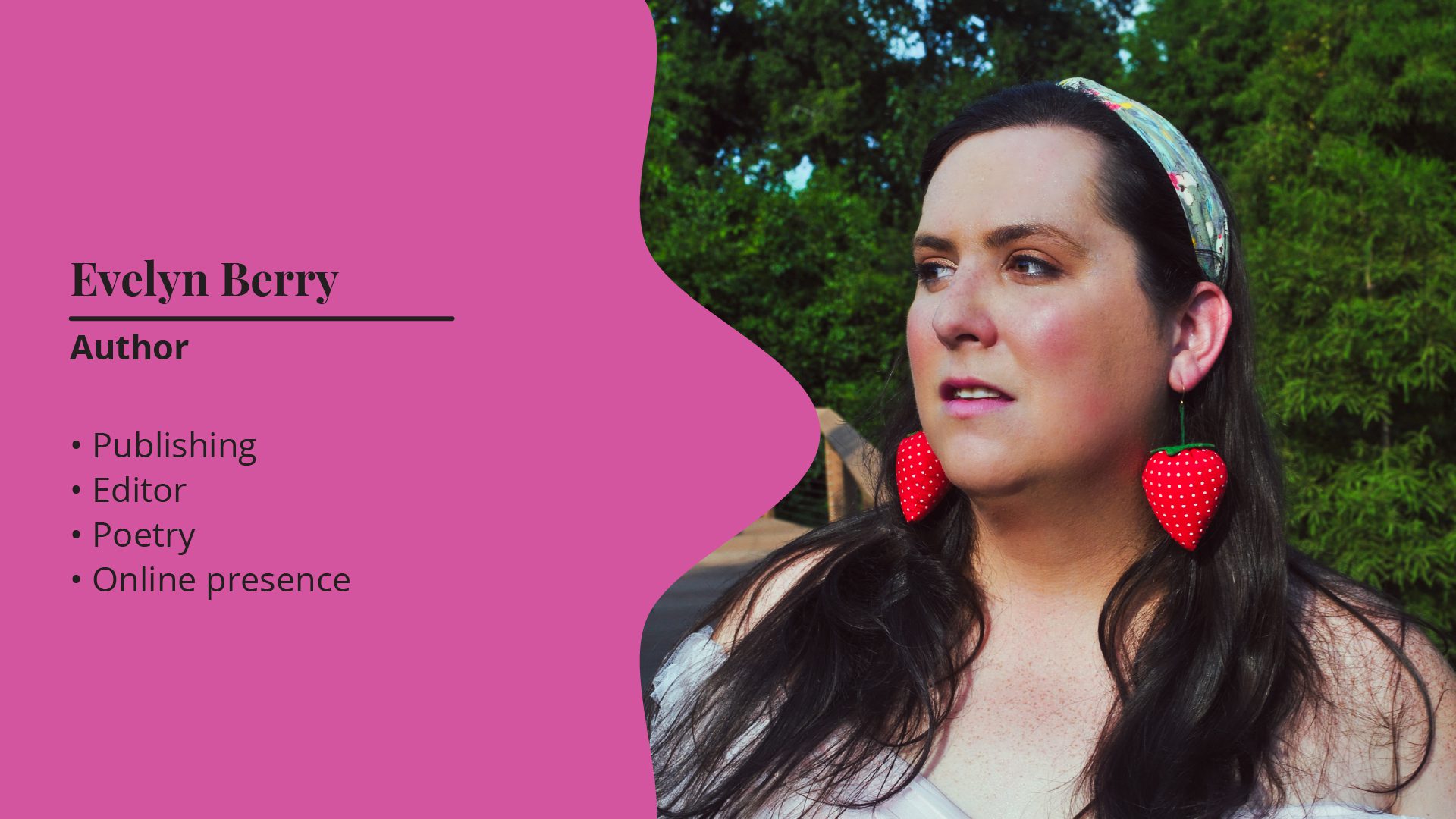
    Evelyn Berry, poet and educator from Columbia, SC, uses her voice to champion authenticity and queer Southern storytelling. Through workshops, editing, and her acclaimed poetry, she inspires writers to embrace vulnerability and speak truth to power.

    Interview

    Transcript

    Lexi Raines 00:00 

    Alli, okay. So, first just give us a little introduction to yourself. What do you do for work and where are you currently working from? Yeah. 

    Evelyn Berry 00:08 

    My name is Evelyn Barry. I was born and raised here in South Carolina. I am an author of a book called grief slut, which was published last year by sundress publications, as well as some chat books called buggery and glitter husk. I have another book coming out next year called Tea for tea, from a small harbor press. In addition to writing and publishing, I teach workshops at organizations, whether that’s a nonprofit that’s looking to bring me in for a workshop series, a literary festival that wants to bring me on for a panel, a conference where I’m going to do kind of like a masterclass seminar with students, either online or in person, as well As universities. Where I might come speak to the classes, lead a couple of classes, and then usually do like a masterclass in reading at that university. In addition to that, I am an editor. Yeah, I would say, big role, besides writer and educator, is as a freelance editor, so I work one on one with writers all across the country on their manuscripts. This might look like helping build better writing practices where we talk about how they can deepen their craft, or it might look like helping them navigate the like the world of professional publishing. How one seeks agents, how one seeks publishing opportunities, how you write cover letters and things like that, or even find out about these kind of publishing and funding opportunities. And then my day job, which probably comprises of, like, probably two thirds of all of the money I made last year, is as a library communications strategist. So, I work with staff at a pretty large library system here in South Carolina and help with employee communications that might include anything from drafting all staff emails to share operational updates, creating talking points to help staff talk to and discuss kind of interesting, relevant topics with our communities. This might be a new initiative, an art gallery. Maybe it’s something that’s happened in the news that we want to make sure staff are equipped to talk about, and also staff newsletters, so this includes a lot of blogs that feature staff stories’ this could be anything about a staff who really likes speaking, and it’s about their love of baking, or it might be about staff who run programs using tabletop role playing games, or sometimes like a Storytelling Festival that we’ve had at the library, things like that. So, anything kind of communications wise that might be shared with staff. I usually have a hand in, and I’m sitting on different committees for different projects. 

    Lexi Raines 03:23 

    Awesome. You sound very busy, but that all seems very exciting. 

    Evelyn Berry 03:27 

    It is very busy. It’s a full schedule. Yes! 

    Lexi Raines 03:32 

    I’m sure. So how long have you been writing?  

    Evelyn Berry 03:38 

    So, I’ve been writing since I was a kid, which I think is pretty common, though, I’d say probably started writing seriously around the age of 16, when I was that’s also when I started to publish in literary journals. I was around the age of 16, you know, both obviously in my like high school literary journal, but also in some community literary journals, and then a little farther afield by the time I got to college. I kind of started in high school publishing short stories and poems. I also used to write some articles and a semi regular column for like, a local arts alt weekly newspaper in Augusta. 

    Speaker 2 04:19 

    Georgia. Oh, that’s so cool. That’s all, that’s actually awesome. One of my first paid. 

    Evelyn Berry 04:24 

    Writing gigs, and I think I was just a precocious teenager. Very much precocious.  

    Lexi Raines 04:32 

    What’s one thing that you love about working as a creative in South Carolina?

    Evelyn Berry 04:38 

    In South Carolina, there’s a fairly close-knit community of writers. I think that one of our one of our strengths, is the small size of the state, both in numbers as well as geographically, which means that it’s really easy. Get to one another. I live in Columbia, so within two and a half hours I can pretty much get to any other city which offers a lot of really cool opportunities. When I started to write, I probably had no real business like teaching or writing book reviews, or, like, writing articles in magazines. But a lot of older writers took me under their wing and kind of believed in my work, and, you know, helped me navigate those processes, helped introduce me to new opportunities, and that was tremendously helpful. I don’t have, like, an educational background in writing. I did study English, and I don’t have an MFA, don’t have a PhD, but what I do have is, like a massive village of writing mentors throughout South Carolina and beyond. Who care really deeply about community, and so that’s, that’s a big thing I really love about South Carolina. It’s gotten to the point now where, you know, anytime I go to pretty much anywhere, no matter how small. I know someone there, you know, and I know someone I can grab coffee with, or who would be glad to have me over at their house and, you know, eat dinner their family. Just because, like, that’s kind of what the writing and the arts community at large is here, which is, is really beautiful.  

    Lexi Raines  06:26 

    It is super beautiful. I’ve heard a lot about that in my interview. So it is, I think it’s super awesome to hear that. It really is just a huge community. So, what does South Carolina bring to your work compared to anywhere else.  

    Evelyn Berry  06:43 

    I mean, I grew up in Aiken, South Carolina. I went to school in Charleston, South Carolina. I live in Columbia, South Carolina. Now I’ve you know, spent the majority of my life here in South Carolina. So. it’s kind of impossible for the landscape, the culture, the language, the stories of South Carolina not to seep into my work. I write confessional poetry which is often very biographical. So, the experience of living in the South, especially as a queer person, has kind of informed most of my creative work. Also, in the past, I’ve had the opportunity to work in different capacities in archives, as well as write in response to materials from archives, and it’s gotten me really interested in South Carolina history. I specifically am really interested in South Carolina’s queer history and the ways in which queer people have kind of fought for our rights here in South Carolina, whether that’s the like 1989 ACT UP die in at the state house, or the first Pride festival, which was only like 35 years ago, or, you know, even some of the more, like illicit parts of history, like the history of cruising down in Charleston, South Carolina, from like the sailors and things like that. So there’s all of these, like interesting stories, whether it’s like stories of resistance, or kind of sordid stories, or really fun stories. And I think people don’t think about that when they think of South Carolina, other parts of history. And I’m really always interested in what different spaces and places offer up in terms of their history. 

    Lexi Raines  08:39 

    I completely agree. I think South Carolina has, like, a very diverse history that, like, not too many people know about, like outside of those specific communities. So, I feel like just bringing out that research is super cool. That’s awesome. 

    Evelyn Berry  08:55 

    Yeah, it’s been super fun, especially, you know, I’m not an academic, I’m not a historian, so I get to have the freedom of doing things creatively, which gives you a lot of leeway with these things, which is, which is a lot of fun. How 

    Lexi Raines  09:10 

    Would you define professional or personal success in your creative endeavors? 

    Evelyn Berry 09:15 

    Um, I think that personal success, I think usually comes when you’ve written something that people respond to, that speaks to them. That might change how they think or how they feel, or just move them in some way. I would say the best kind of response that I’ve gotten from like books, is people I’m talking about what it meant to them, whether that it’s, you know, helped vocalize something about their own life that they had never seen on the page before, or that it helped them write something about their own life. Think, which I think is always super cool to see. So I think that’s kind of personal success, professional success, I think is a little bit trickier, because, you know, we do live in a society where you got to pay rent, got to have health insurance. So, I think that if you can consistently get projects and you know, say for poetry or novels, it’s consistently getting published, consistently getting invited to festivals and conferences to teach, so that you can kind of maintain a steady income, which is extremely hard to do because, you know, funding in the arts is very unpredictable. Some years you might, for example, get a fellowship, which I’ve done in the past. Like, last year, I got the South Carolina Arts Commission fellowship. And, like, you know, that’s, that’s like, $10,000 you know, on top of what I usually make. And it’s a big, you know, that that’s, that’s a huge thing for me. And then, you know, having to think of, okay, next year you’re not going to have that. Well, how are you going to make sure to maintain what you’re doing? Like, what will you have to do differently? So I think finding sustainability is really the key for professional artistic success. 

    Lexi Raines  11:27 

    Yes, I would completely, completely agree with that. So, um, this kind of goes along the same lines of that, what was your biggest fear when you first decided to pursue the arts professionally? 

    Evelyn Berry 11:41 

    Well, you know, I mentioned that I didn’t really study English. I really wanted to, I really, you know, when I was applying to colleges and high school, all I wanted to do was write. I wanted to write stories. I wanted to write novels. I wanted to write poems, plays, whatever I could get my hands on. And everyone kind of tells you that it’s a dead end, that it’s impossible. But I think that’s also because they don’t really know anyone who’s ever done it. It’s a weird thing, because, you know, we have, culturally, an idea of artists as something from the past, right? You know, when we think about if you ask someone their favorite artist or their favorite writer, they’re more than likely going to name someone who’s dead, which is not a problem. It’s just that when we’re conceptualizing art, we always think of it as something that has happened, but not something you can do in your own life like in the current moment. So, I think that was the big thing. Is just kind of like falling on my face. I’ll say I remember feeling so like defeated at one point. So, I had a I had my first novel come out when I was very young. So, I like signed a contract when I was 19, and then all came out when I was 22 which is like, maybe irresponsibly young to publish it, to be honest. And, you know, of course, like I was in college, I had this very romantic idea of what a right being a writer was like, I, you know, got to go to, like, one or two conferences and festivals and be like, here’s my novel. And then like, reality set in really fast, which was like, you know, there’s hundreds and hundreds and, you know, there’s 10s of 1000s of novels out there. And so now, just because you’ve, you know, published one, how do you make people actually care about that? How do you sustain that kind of momentum as well? I didn’t have anything else ready to go, you know, at that point, because I’d been college through that entire editing process, and it was a couple of days after, you know, it was months after the novel had come out, interest had already dried up. Like six months in, I’d stopped doing events, and I finally graduated college, which was a crazy kind of thing. And then I remember the very next day, I was like, working at this restaurant, and I was like, a busboy and a like, I like, came up on this table, and it was like a mother with her daughter, and they were touring the college from which I had just graduated, right? It just graduated from the Honors College or top honors, and I dropped the plates in front of them, like I, like, tripped and, like, dropped plates. And the mom looked down at me and pointed at me and went, see, that’s why you need to go to college. And I remember just being like, Oh no, crazy that I’ve, like, you know, thought that I have, like, reached this height, and you think that you’re going to, like, have a single success, or you’re going to graduate from college and then launch yourself into some sort of, like, career of miracle after miracle after just like, coincidence. Yeah, but it’s much harder work than that. So, I think that’s the biggest fear, was realizing that it would not be as easy as I thought, or that, you know, luck and coincidence can only take you so far.  

    Lexi Raines  15:18 

    An English major, actually going back to your first point, like, I was terrified to be an English major. I didn’t come into college as an English major. I was originally a computer science major, and I just hated it, like it was so miserable. And like, I’ve always really enjoyed writing and like reading, and so when I made that switch, I was so much happier. And so I feel like people saying that they don’t have there’s no jobs in English is very, very untrue, obviously. So I feel like just being able to keep your options open and look for those opportunities is something that’s really important. 

    Evelyn Berry  16:03 

    Awesome! Well, I mean, I’ll just say, in response to that, like, something that I would say to anyone who’s graduating with, like, an English degree, or say, like sociology, or any kind of degree that people are generally saying that doesn’t make money, there’s, there’s a lot of jobs out in the world that you’ve never heard of that actually need the skill set that you have, and the skill set that you have, whether it’s like writing and communicating clearly, is becoming more and more rare. I mean, I’m sure you see it in your own peers. Like the ability to write a like cogent and coherent essay about a literary piece without using AI is like a huge deal these days. I see it in, you know, my communications work all the time where, like, you know, being able to quickly and correctly write, or even knowing, like, the basics of grammar or the basics of sentence construction, that’s something I take for granted. I’m like, everyone, everyone knows that. Like, duh, everyone can but that’s not true. And the more that you kind of like work in the world, you realize, oh, actually, I do have a set of skills that might be really useful to some people, and my I might be able to leverage it in real ways. Yes, 

    Lexi Raines  17:24 

    I’ve, really noticed that. And I think coastal does a good job with preparing English majors to, like, really market their skills. So it’s awesome. Can you describe, like, a defining moment in your creative journey? 

    Evelyn Berry 17:38 

    You know, what’s kind of interesting is, you know, when you’re doing creative work, every Turning Point feels like the big break. You know, in some ways, I would say the biggest thing for me a big turning point. A couple of years ago, a mentor of mine encouraged me to apply for a National Endowment for the Arts fellowship in creative writing. So these are governmental fellowships that are given to 25 writers per year. It’s a tremendous amount of funding. And beyond that, it’s quite like an honor to get it is, you know, one of those awards that people recognize on a resume and will bring you in. And at the time, I didn’t have a full length poetry collection out. The novel had been kind of a flop. I was starting to publish in different places, but I still didn’t feel like a quote, unquote, real writer. You know, I still felt like I had failed to live up to that kind of potential, and there was a massive amount of insecurity around the fact that I never went to graduate school and never studied writing. The older I got, the further I felt behind my peers, despite the fact that, you know, I was reading the same books that they were in graduate school. I was, you know, having the same conversations, going to the same events, doing this in kind of community volunteering and getting involved in the literary community. So, you know, this sort of fellowship wasn’t a sort of thing that I thought someone like me was one supposed to apply to, because it would be a waste of time, right? That it would be something no one without proper training, no one without that kind of pedigree already would be able to get a fellowship like that. But I decided to apply. I applied twice, and on the second time I got it, it was, it was really life changing. I actually didn’t believe them when they pulled me on the phone that I had gotten the fellowship, yeah. And it was just really cool to, like, have that moment of like, okay, like, this is real. Like this is, you know, it kind of was funny because it eclipsed a lot of other failures, because it didn’t really matter anymore. It’s like, well, you have, like, this seal of approval, which sounds silly, like, you know, a lot of especially universities, they look for those. Seals of approval, right? And or before they like invite you to come teach, or invite you to come read. And sometimes when you’re able to get a fellowship or an award like that, it’s just the one thing that can help you kind of stand out in the crowd. And that was really a turning point for me. I think that I was able to take myself a little bit more seriously as a writer, I was able to demand a little bit more in terms of, like, what I charge from, you know, people who were hiring me and mostly it kind of gave me, like, the confidence to continue to actually say to myself, like, okay, like, this isn’t just something I do for fun. It is actually, like, my vocation. It is the thing I’m doing with my life is to write and share stories and share poems. Congratulations! 

    Lexi Raines  20:53 

    On that. That’s actually, so that’s awesome. So it was really great.  

    Evelyn Berry  20:58 

    Cool. Yeah, I think, um, it was kind of interesting. Last year, a like, some academic did, like, a qualitative study on, like, who got these kinds of fellowships, and I was the first one to receive that fellowship, I think, in like 30 years. Like, the last person who did it was James Dickey, and so it’s kind of like, yeah, like even that, like Southern writers, rural writers are, like, massively underrepresented for these fellowships. You know, the majority of writers who get them are people who are already well-established. They’re already teaching at major universities and things like that. So it felt really good to like represent for my state as well. And I didn’t realize that until someone pointed it out, and I was like, wow. Like, it’s kind of wild, because I know so many amazing artists and writers here who deserve support, sometimes ignored by like, the national art scene. 

    Lexi Raines 22:01 

    Yeah, that makes it even more meaningful. Congratulations again. Like, what is the best and worst advice you’ve ever received? 

    Evelyn Berry  22:10 

    Unfortunately, the best advice, and I think this goes for any creative path, is just do the thing that you want to do. What I mean by that is, I know a lot of writers who think, Well, I would love to write a novel, but before I can write a novel, I need to go take a creative writing class. Before I write a novel, I need to read 10 books about writing a novel. Before I write a novel, I need to like prove myself in some way, same with being an artist. You know, I will become an artist. I will start making art once I get to the certain point that it’s proved myself. But the only way that you can actually develop craft and develop as an artist, as a photographer, as an actor, is to practice that craft. And, you know, often practice looks like failure because you’re not going to be good at it at first, right? No one is no one is like perfect or no one is skilled at what you do first, and you still might feel inadequate years later, too. But once you start comparing you know how you’ve developed, you’ll see growth. So I think that’s really important as to whatever you’re doing to begin now, you know to not kind of wait for any kind of permission, to wait for any kind of degree or certification or seal of approval from anyone else, but just to start making and also start sharing that work, even if you don’t think it’s very good, you know, upload that photography to Instagram if you’re writing stuff and you know, you know, go ahead and send it out to literary journals. If it’s not getting published in literary journals, like print it in a zine. Share it with friends. Once you start to get into that cycle of creating and sharing art, you’ll kind of you’ll do some more often, the worst advice I’ve ever gotten, I think that the worst advice I’ve gotten is that one should separate, not write about politics. I think a very common thing, what used to be a very common thing in the arts, and especially in writing, was that, you know, people didn’t want to read, you know, quote, unquote, political stories or political art, because it was very heavy handed, which it definitely can be for sure. You know, we’ve all read work that is very heavy handed in that way. But I think it’s really important to think about why that advice is given and Who Gives it often. You know, the lack of politics is not. A lack it is just like a defense of the status quo. And so art that does not engage with values that might be seen as quote, unquote, political are still political. You know, they are. They’re maintaining a kind of status quo, a patriarchy of white supremacy, you know, kind of this, this, this kind of paradigm, right? That is seen as the quote, unquote norm or seen as apolitical when, in fact, it’s very political. All of our lives are very political. And as a poet you know, writing about like being queer in the south, it’s impossible for pretty much anything I write not to be viewed by others as political, even if I don’t mean it that way. And so I remember getting some advice, like definitely, from like, fiction writing mentors and teachers to kind of avoid, you know, talking to explicitly about politics, despite the fact that it kind of informs our every day, I feel like it 

    Lexi Raines  26:04 

    Would be hard to ever completely avoid that topic, because it makes up who you are. It makes up the community around you. It really makes up everything a lot, influencing you. 

    Evelyn Berry  26:14 

    Yeah? So that’s what? Yeah, exactly. It’s an impossible piece of advice unless you are, like, the single most privileged person in the world and are able to insulate yourself completely. 

    Lexi Raines  26:25 

    So, can you please walk us through a typical work day for you, like, what does your process look like, and what’s kind of expected of you on a daily basis? Yeah, 

    Evelyn Berry  26:33 

    Let me take you through kind of a general day that includes all of my different jobs. So I usually wake up at five in the morning, which I know is not fun to hear. If I have real energy, I’ll work out. Otherwise, I’ll go shower. I will say I this is so I mean, maybe it won’t sound weird, but like, you know, I’m not the biggest physical fitness person, but I do think that exercise and just moving your body, whether that’s walking or going to the gym or like playing a game with friends, actually can, like, help boost your creativity. It puts you in a better mood, and it helps bring you energy that doesn’t necessarily fade throughout the day. So I think it’s a really good way to get one’s mind ready to write after that. I usually end up coming home showering, putting on makeup, etc., and I will go right. So sometimes I write at home at my desk. More often, I will go to like a local coffee shop, and write for anywhere from one to two hours before work. And the reason I do this is just that I’m a morning person. It is like when I do my best work is when I wake up by the time like one o’clock rolls around, I’m a little less sharp, so I want to give the best version of myself to my creative work. Then I usually go to work at the at the library. So this usually looks like spending the morning, usually dealing with more immediate needs. So that might be helping write an email, helping finish up some projects, maybe being in meetings so often I will find, like, we have meeting rooms at the library, so I like to find, like, a quiet place have my like, noise canceling headphones, and just really dig into the deep work. So anywhere from one o’clock to five o’clock is when I do that kind of deep work for communications, that’s strategy building, or just something that’s going to take a long time to write. I will say I’m very lucky in that sense, like I have a job in which people generally leave me alone unless they need something or they’ll send me an email, so I get a lot of uninterrupted time to, like, think and sit, and I think that’s really important to kind of have, like, you know, I’m also totally allowed if I wished to, like, leave the library and just like, wander around, because that might help, like, write something that I need to write, and get me in the right mindset to do it. So, yeah, that’s generally what that workday looks like after work. I might do different things. So I help. I helped start a local collective here called queer writers of Columbia. We hold like write ins and workshops and open mics. So often, if that is happening, I will leave work and go grab something to eat, maybe with some of the friends from that group, and we will go and write together even more. Sure, generally in that setting, I’m actually not writing my own work. I’m usually helping other people navigate stuff, just a lot of moving parts. So it might be, you know, just mentoring people basically to get published or to seek opportunities. It might be going to support people at open mics. I’m at the point in my career now where, like, I don’t necessarily have to do those things, you know, like, I can get paid to go read poetry, so I don’t need to go to an open mic and, like, have that kind of exposure. But I think it’s still important to engage with like, everyone in your community, no matter like, level of development they’re at, because, you know, that’s kind of how I had any opportunity at all as a writer, is that someone took a chance on me and gave me an opportunity before I was ever ready for it. So that’s, that’s a big thing that I believe in, is, you know, encouraging people to say, hey, you know, you should really host this. And they’re like, I or teach a workshop, you know? And usually people say, like, I don’t have anything that I could possibly teach others. And I think that when you start doing it, you’ll be surprised by what you can teach others. Something else I really believe in is like, to not get, keep, like, publishing secrets. There’s a lot of norms around literary magazine publishing, wearing agents reaching out to bookstores that are not like written down in many places. You might learn them in an MFA program, but even then, probably not. So the only way to learn them is through trial and error or from just another writer telling you. So I’m a big believer in, you know, mentoring writers to make sure that their talent is not being unnoticed, that they’re able to develop and both within their community and beyond. Yeah, 

    Lexi Raines  32:00 

    So,it sounds like you again, you’re very, very busy person. How do you, like, create a good work life balance where you’re able to maintain both, like, your professional creativity and your personal creativity. That 

    Evelyn Berry  32:15 

    Can be hard sometimes. You know, I think one of the challenges that you run into, like I write for work, and so when I’m done sitting at a computer for eight hours, I don’t want to go sit at a computer anymore. So one of the things I do is prioritize my personal creativity. I think of that as you know, despite the fact that it doesn’t make me as much money, it is the thing that I want to give, like the best part of myself to, which is why I tried to do it before work, right? You know, I say that’s a typical day, but, you know, maybe going and spending time with other writers happens maybe once a week. You know, I’m also very conscious, and even more so these days of like self care, make sure to have time to myself. One of the huge benefits of working at the library where I work is that it has a big emphasis on work life balance. So we have open PTO, which means we can basically take as much PTO as we need. I’m able to work from home one day a week, which is where I am now. I’m not at work right now or not at the workplace. So, you know, it allows the flexibility, which is really great because, you know, I work with people, with families who, you know, need to like to pick up their kids from school in the middle of the day or drop their kids off at daycare. And it’s really nice to work for both a organization as well as for a manager who cares about your personal well being like, beyond anything else, like the actual parts of my job, sometimes they’re fine, like, I like writing articles, but a lot of it’s very boring. It’s very boring writing. It’s very technical, it’s very straightforward, but that doesn’t really matter to me, because what’s more important is that I’ve chosen a career that can sustain me enough that I have the energy and the time and the ability to pursue my creative passions. So for example, like last year, I went on book tour for grief slut. And, you know, I was able to take, you know, several days off, sometimes weeks, or like, a week at a time, to go travel around the country and tour this book. And it was really important to have support from the organization. Person I was working for. And not everyone has that. So like, you know, if, again, you know, if I’m would give advice to someone, I’d say, like, you know, think about the values of the people for whom you’re working, because they will also, you know, sometimes help shape you will they see, like, your art career as something that supplements them, like it’s like something that they’re very happy about, or do they see it as a rival for their time? And so if you can find someone who supports your art as well as your livelihood, it’s a really beautiful thing. I agree.  

    Lexi Raines  35:39 

    That is, I want to find would be an amazing opportunity for a lot of people. 

  • Walter Curry

    Walter Curry

    “Value success through impact rather than accolades.”

    Dr. Walter B. Curry, Jr. is an award-winning author, educator, and historian based in Columbia, South Carolina. Through Renaissance Publications, he documents African American family and local history, connecting ancestral narratives to broader historical themes.

    Interview

    Transcript

    Lexi Raines 00:04 

    So what do you do for work and where are you currently working from? Just give a little introduction of yourself.  

    Walter Curry 00:10 

    Well, first I want to thank you for inviting me. I have followed the Athenaeum Press for a while. I have a connection there, actually how I found out about the press about a year ago, when I’ve heard about your organization, initiatives focusing on community, with the Communal Pen, I’ve learned more about the Press. 

    But just to tell you about who I am: I am author and educator, and I currently live here in Columbia, South Carolina, and my work focuses on ancestry and local history. And so as an author, I write narratives about my family history which connects to local history in South Carolina, in Orangeburg and Aiken counties, where my family is located, and using those ancestral narratives through the historical context, in the broader scope of African American History and beyond. 

    Lexi Raines 01:29 

    That sounds that sounds really fascinating. It’s good to hear that you also know about the Communal Pen. That’s amazing. So how long have you been writing? 

    Walter Curry 01:40 

    I’ve been writing about been writing for five years. Yeah, five years. I started in 2018 I published my first book on the Thompson family on told stories from the past 1830 to 1960 and because of the success of the book, I won my first book award in 2019 I was encouraged to use that as a opportunity to launch my business. And so the concept and the business Renaissance Publications is a self publishing company where I published my books focusing on the literary arts, and so I’ve been writing about five years. I’ve written two books, The Thompson Family Book, my second book, The Awakening: the Cy Ellison Family Saga, Volume One, a narrative history. That book won several awards as well. And— 

    Lexi Raines 02:45 

    Awesome. 

    Walter Curry 02:47 

    Thank you. Thank you. And my third book, which will be a blockbuster South Carolina, Matilda Evans, she was the first African American woman licensed to practice medicine here in South Carolina, that book is coming out in April, and that book is going to be the exclusive biography of Dr. Evans. And so I’m blessed to have written three books so far, and I have also branched out to other areas in the literary arts, visual art. I also do presentations and design of exhibitions as well.  

    Lexi Raines 03:33 

    That’s awesome. So it sounds like you’re definitely staying busy. Yes, yes. I am. I am. You said that you have a family history in South Carolina. What’s one thing that you have, like loved about working as a creative here?  

    Walter Curry 03:47 

    South Carolina is a very unique state. South Carolina is about 80% rural, 20 urban. And the beautiful thing about South Carolina is that South Carolina is unique because of our rich history and culture. And when I travel across South Carolina doing presentations, I’m always paying attention to the area, looking at the features of the area, looking at the cultural aspects and the local history, which connects that area to other broader aspects of history. And so I will say, with South Carolina, we’re very unique as it relates to our culture, our rich history, and that creates opportunities for authors like myself to bring that history out and to make it come alive. Through the literary arts.  

    Lexi Raines 05:02 

    That’s awesome, because I feel like South Carolina does have so much like kind of hidden history that’s kind of been like pushed to the back, and that deserves to all come forward, because it’s always like such beautiful stories that are meaningful.  

    Walter Curry 05:18 

    Yes, yes, yes, I totally agree. South Carolina has a lot of hidden history. I’ve discovered during my journey that when I was researching my mother’s maternal native County, Aiken County, I discovered that Aiken County was founded by three African American men during the Reconstruction Era. Aiken County was founded on March the 10th, 1871 and I also found out that Aiken County was the only county in South Carolina that was founded during the Reconstruction Era. And so when I asked my mom and some of my relatives and friends who grew up in Aiken county in the salad area, they had no idea about the founding of Aiken County. They didn’t know that Aiken County was founded by three African American men, all state legislators and civil war veterans. And so it’s the hidden history that I have discovered which is an opportunity for authors and historians like myself to bring that hidden history out, and that is relevant in all communities across South Carolina, there are stories of hidden history that need to be brought out so it creates opportunities for those of us like myself to focus on local history and to make those broader connections to state history, national history, African American History, Women history, or other areas of History. 

    Lexi Raines 07:20 

    I feel like you’re definitely helping pave the way, like uncovering all of this stuff. So you how would you like describe the local professional community? Because you did say there’s a few others that are also working on similar projects?  

    Walter Curry 07:36 

    Yes, yes, I have a great relationship with the local professional community. I do my best to support my peers. They support me. I have collaborated with several of my peers on various projects, one in particular a good friend of mine named Wayne O’Brien. He’s a local historian and author from Aiken County. He’s from Charleston originally. We have partnered together on several activities and initiatives, the Harlem Renaissance, that exhibition. He has written several essays on his family history, about his family connection to the Harlem Renaissance, and how his great uncle, Charles Linton, discovered Ella Fitzgerald. And yes, yes. Charles Linton the Lenten family, they are from Shera and so his family is from Cheraw, and how the Harlem Renaissance is connected to my family, I’ve discovered in my ancestry that my great grandfather, first cousin Asman Ellison, lived in Harlem New York in the 1930s during the Harlem Renaissance, and he was employed at Hotel Teresa, and that that was the famous place where all of the political dignitaries, cultural icons in the African American community, even foreign leaders, they patronized and stayed at a hotel, Theresa. And so looking at my cousin his life, and also saw, I saw his picture, and I have his picture, and he wore a Zoot Suit. And so I learned about the zoot suits. And so me and my colleague, Wayne o Bryant, we have partnered together over the years. And one of the thing about being a part of a professional community, a network of peers, you are able to share information and share ideas. With each other and potential collaborative opportunities. And so I encourage that, because we don’t know everything. We have our strengths, we have our weaknesses, and I think we as creative, should acknowledge that. And the beautiful thing about being a part of a network is you lift each other up because this work sometimes is challenging, sometimes it’s frustrating. It’s a battle of the mind where we have to constantly reassure ourselves that we despite the struggles that we face from time to time, we’re in this because of our talent and we want to show the world that our talent has value because we believe that we as creatives have value, and that our value is the creative arts.  

    Lexi Raines 11:06 

    That’s awesome. Yes, I feel like I completely agree. I think it’s also so nice that, like you have, that South Carolina has such a good community to lean on. Because I feel like that’s something you may not find in, like bigger states, is that just really close connection and networking capability that we have here?  

    Walter Curry 11:27 

    Yes, yes, I totally agree. South Carolina is a close community. Is a small state, and we’re a state that is blessed to have rich culture, rich history, diversity. And I remember Governor McMaster, he mentioned in a state of the state address, he spoke about South Carolina rich diversity in history and culture, and that we are the envy of some of our competitive states because of the fact that we have rich history, rich culture from the American Revolution, Revolutionary War, Civil War and beyond. And we also have access to the mountains. We have access to the beaches. We have warm climate. So we have a lot of amenities that motivate us as creative artists to really highlight South Carolina through our work.  

    Lexi Raines 12:34 

    Yes, I would completely agree with that. And so kind of shifting gears here in your writing, like, how? How do you define, like, professional and or personal success in your creative endeavors?  

    Walter Curry 12:49 

    That’s a great question. I never thought of it. I would say that professional success, to me, is growth. I believe that over time you want to you want to see whether or not you are actually growing in the areas that you need to grow in in order to maintain success. And so for me, I look at my writing. I look at how my writing has improved over time. I also look at my activities. What are what am I doing as far as my activities to make sure that I stay active. So I measure that. Am I’m going to networking events? Am I doing professional development, professional learning opportunities? So I measure that, and how am I applying the knowledge and skills that I have obtained over time, and whether or not the knowledge and skills are working in my favor. And so that’s how I measure myself, professionally, personally, I look at the accolades, because we all want, we all need to know whether or not our work is being recognized. I’m not a person who seek personal recognition, because that is a trap. I think we have to be careful as creative to if we focus too much on personal recognition, but it doesn’t help to get recognized, and so when I receive awards, and I have received several awards for my work, that tells me that I am being noticed, and I am out there and people are. Recognizing my work, not only those who follow me and support me, but my peers who are judging my work as well.  

    Lexi Raines 15:09 

    Yeah, I would completely agree with both of those. I think, like first for what you said in your professional life, like I feel like the worst thing that can happen to a creative is that kind of like stagnation. So I feel like striving for growth at all times is the only way to grow to get anywhere. Really. 

    Walter Curry 15:35 

    I agree. I agree. I agree and to and to your point, you don’t want to feel stagnated. You always want to achieve growth, and  

    Lexi Raines 15:48 

    then with the your personal success, the like awards and stuff, I feel like it definitely, I would agree it’s important to have a mix of having a drive for doing it for yourself, and then having a drive to put stuff out there and be recognized. So I would, I would agree with that. Thank you. Thank you. So what was like your biggest fear when you first decided to pursue the arts?  

    Walter Curry 16:19 

    Oh, man, that’s a great question. I would say fear, fear of failure. I have failed several times in business, and I’ve learned from my mistakes. I started out as an insurance agent, following my father’s path, did pretty well, but I found out like this, ain’t me, you know, he’s a very successful insurance professional. He taught me a lot about business and some of the skills and lessons that he taught me, I still apply till this day. And then I moved into real estate, got my real estate license, and I only sold one house. Actually, it was a cousin who I helped, and he owned a rental property, and he sold it, and I helped him for 21,000 so I didn’t do well, because I thought, Man, I got this real estate license. I’m going to make a lot of money. I remember going to a subdivision and this successful real estate broker. He was like, Walter, if you come to this subdivision and you be the agent on duty. And I was thought, man, all these people going to come to me, I found out that was not so. And so I got out of, out of real estate, and then I tried jam Pro, because I was, I was convinced by a cousin to get into the cleaning business. Did okay with that. Then I quit, and then got into education. I taught school for four and a half years, then at the time, I was blessed to obtain my graduate degrees. I have three graduate degrees, by the way, and I decided to leave the classroom because I was tired of teaching middle school kids, so I didn’t do well with that. And I look back at that experience, and I said to myself, if I would have applied myself, I would have been a better teacher. So I was a rebel, okay? And I didn’t take my training seriously, so I fell on what I know, and at the time, I was going through a midlife, midlife crisis, I remember all of the stories that my mom shared with me about her family history, and I did some research and find out that man I have an ancestor who was an enslaved cook in the Confederate Army, and found out about her, located her pension record. Then I did some more research find out about ancestors who were enslaved, more written records, primary sources. I said, Wait a minute. I got something here. Okay, and so I was able to discover my passion in history. I have discovered my passion as a writer, and because of my background in education and business, I put those skills to use, and I have successfully applied those skills. And so I’ve been doing this for five years, but my biggest fear when I started. Out was the fear of failure. And the fear of failure for me was the mistake over the years prior to me becoming a business owner in the literary arts, was the lack of application, the lack of discipline, not being humble, okay, not learning from mistakes. And so I say to myself, I will not fail again, you know? And so I’m blessed to be in business for five years. It has really been an incredible journey. Yes, I  

    Lexi Raines 20:41 

    I feel like that definitely shows too that everything that you do does ultimately get you, if not, where you thought you would originally be. It gets you to where, somewhere, where you will be happy, like your business background, your time as a teacher, all of that led up to you being a writer. So it really shows you never know where life is going to take you all the time. 

    Walter Curry 21:08 

    Well, I agree. I agree, and that’s why you have to have a open mind. I encourage everyone to seek your gift, seek your calling. I believe that everyone has a calling. Everyone has a gift. It’s how we cultivate our calling, how we cultivate our gift and be able to appreciate that. I’ve learned that you cannot be something that you’re not. You know you could try, but you cannot be something that you’re not. You could, you could try to fill somebody else’s shoes, but over time, those shoes are going to get bigger and bigger, and your feet going to get smaller and smaller. It’s kind of like my grandma, Lizzie Williams curry, she passed away several years ago at the age of 102 and she said she shared a lot of wisdom and advice with me during her last years. We had a lot of private conversations, and she told me about my journey, she said, Walter, I’m going to tell you something. You got to stay in your lane. Okay, stay in your lane. Don’t worry about trying to ride somebody else’s lane, because if you do that, you’re going to get run over. Okay, stay on the path that God has called you to do. Don’t worry about what people say, because people going to talk, they going to criticize. I mean, that’s part of life, that’s part of the game, but you got to stay focused on what God has called you to do, and stay in your lane. So I live by that example, and I don’t try to interject myself in a lane that I am not called to run on. So for instance, because of my popularity as an author and a historian, I have received numerous requests about doing other things and also requests in knowledge that I’m not familiar with don’t have no expertise, so I’m happy to defer to those who do have knowledge, experience and expertise, and that’s why a professional community of peers is so important, because, number one, it helps you to identify peers who have the knowledge, skills and expertise and the resources. And number two, it gives you credibility, meaning that I don’t know all the answers, but I know someone who does so that gives folks a sense of your credibility and your ethical behavior in the field,  

    Lexi Raines 24:12 

    I would completely agree. I feel like staying in your lane, like I have a question later about like the best and worst advice you’ve ever received, but I think that is genuinely good advice too, because I feel like, if you are trying to like, you said, like, interject yourself into other places. I feel like that can be where, like so much unhappiness will stem from. Like, that fear of judgment from doing like, what you truly want to do. So I feel like that is just a really, really important and wise piece of information she gave you. Thank you. Thank you. Thank you. So please like describe, for me, a defining moment in your creative journey, like, did you have a like, a particular project or moment that had the biggest. Impact on, on you.  

    Walter Curry 25:03 

    Yes, yes, I will say the defining moment for me was in 2020 before COVID. February the first 2020 black history, month of the unveiling of my first exhibition Sally in the Thompson family, and that exhibition was featured at the Aiken County Historical Museum in Aiken, South Carolina, where my maternal family is from. And I, along with the director, Laura Virgo, we collaborated for about six months on the exhibition, the items and the promotion. And I remember putting, putting the word about the exhibition out to the public and on social media. And I looked up one day find out. Man, it is sold out. And I remember Laura said, Doctor, curry. We are at capacity. I said, what? You gotta be kidding me. And so I remember, I spent the weekend down there. My cousins gave me we had an Alli at my cousin house, and so they were so excited. I mean, I mean, they were so excited. Some cousins I never met, who came down, and I was like, wow, they doing all this for me. And so I on Saturday morning, I lost my wallet, and luckily, I was able to recover it. I left it at a gas station, so I said to myself, Man, I lost my wallet a few hours before the opening event of this exhibition. I’m freaking out. And so when, when, when the exhibition was finally open, during event time, I looked up and there were people coming from all walks of life. I mean, I think it was over 100 people. And according to the museum, they say that that was the largest gathering of an exhibition in its history. Insane. That was insane. I was like, Oh, my God, this is insane here, you know. So that was a defining moment for me to really sink my teeth in and say, Okay, this is something. I could do this. And so that led to me defining my skills, making sure that I stayed with what I am doing. And so that was the defining moment. And the second defining moment was recently when I finished writing, when I finished writing my third book on South Carolina, Matilda Evans, a medical pioneer, and looking at my work and looking at how this book is really going to be a major blockbuster in South Carolina history. That is another defining moment for me. So yes, those are two defining moments.  

    Lexi Raines 28:30 

    Those both sound so like special I can’t even imagine, like, how you must have felt in that moment. That is congratulations. That is actually amazing. Thank you. So, yeah, of course. So I know we kind of already did hit on this, but if you have any other advice, what is the best advice you’ve received and the worst advice you’ve received?  

    Walter Curry 28:57 

    The best advice I receive, I will say, like I said during our interview, is stay in your lane. Know what you’re good at, and perfect your skill and talent. And that has helped me the worst advice. I haven’t received any worse advice. I will say, being tempted to do something that you don’t want to do. I will say over joining organizations. Sometimes we do that. Join this organization, you join that organization, and you hoping that if you join organizations, you will get something out of it. So I will say that is, is the worst advice that I receive. And I will say in that if you going to join an. Organization, you have to feel comfortable. You have to know why you join in that organization, and you don’t want to over join. You want to join organizations that relates to your interests. So that is the two advices that I have received.  

    Lexi Raines 30:47 

    I feel like that is definitely good thing, or a good piece of advice, or not over joining organizations, because I feel like young creatives, they are just trying to, like, get their names out there, do whatever they can do, as much as they can. And I feel like, as an artist, it’s so easy to stretch yourself too thin and kind of like get burnt out in that way, which is obviously never what you want to happen to your passions. 

    Walter Curry 32:53 

    Oh, I totally agree. And we can get burned out, and you get burned out to a point where it does affect your cognitive ability, because as a creative your mind is all over the place. You know, I even have to guard that myself. Well, well, I want to do this, but, but I know I shouldn’t okay, what I shouldn’t do, what I shouldn’t do I should do okay and to your point, we have to guard our minds. And I will tell any creative, guard your mind. Take time for yourself. Don’t worry about whether or not you’re going to get opportunities. Opportunities will come if you just stay focused and perfect your craft, stay engaged. Opportunities will come, and I’ve discovered that. I’ve discovered the days that I feel like, Are there any opportunities coming? You check your email, you find out, Oh, man, there’s an opportunity. Okay, yeah, yeah. And also cultivate relationships and give back. I think sometimes we miss that. I mean those organizations and peers who have helped us, we need to help them. And I would say that to creatives, that when you have downtime, that doesn’t mean that you’re not working. Okay, that’s an opportunity where you can reflect. That’s an opportunity where you can say, Okay, I need to retweet this. I need to retweet that. I may need to revise this content, revise that content, that content. That could be an opportunity to do some promotion on social media. Okay, follow up on emails. So So I always, I will always say that there’s always something to do, but the same time you have to know what your goals are, what your interests are.  

    Lexi Raines 32:53 

    I completely agree with that. Because, like, even on your point with like, not being afraid to give yourself that time to relax and have that downtime. Even I have felt that this past semester in school like it, it’s okay to give your brain a little break, and in that moment, in those moments where you are taking that break, you can find so much inspiration for things when they pick up again.  

    Walter Curry 33:21 

    Oh, absolutely. And you have to reflect on your successes too. When you reflect on your successes, that will help you feel positive, because, you know it’s like with Steve Harvey. He owns a radio show, and he has his his morning talks, and his morning talks are very, very powerful, inspirational. I remember listening to one of his morning talks, and he mentioned about how you have to speak something positive about your life, where God has placed you in your life. He will start off by saying, Steve got a radio show, yeah, I got a radio show. Okay? And he will tell you what led to him getting that radio show. He will tell you that man, several years ago, I was homeless. I was sleeping in my car. Okay, now I’m sitting in this chair, and I have my own radio show, and so he takes the time to reflect on his successes, and we have to do that, but particularly in this world of distractions, as we see, there are so many distractions, and so I would encourage creatives to reflect on your successes, and that doesn’t mean reflecting on your awards or your accomplishments, but but if you have published a book, if you have. Design or create a painting. Count that as a success. I mean, I mean, count the fact that you are participating in a professional development opportunity. Okay, the little things. It’s the little things that we have to appreciate. I believe in what St Augustine said in his book confessions, it’s the little things that leads to the greater things he didn’t say. These are the greater things he says, those little things. And so those little things that we have to pay attention to. 

    Lexi Raines  35:37 

    I completely agree you have, you have good advice after good advice, this is going to be awesome. So can you walk us through like a typical work day, like, what does your work process look like, and what do you kind of like expect from yourself on a daily basis?   

    Walter Curry 35:57   

    That’s a great question. You never know. I’m a father of two sons. I have a lovely wife who supports me, so it’s always unpredictable. I’m blessed to have flexibility. I work from home, so I make it a point to walk outside while my wife and my boys, they in the kitchen getting ready. I’m getting ready to take them to school. So I believe walking outside in the morning to feel refreshed, to connect with nature, to clear your mind, because your mind has to be clear. Also, I work out. I go to the gym twice a week. I’m trying to increase it to three times a week, because your success connects to your physical success. I believe that in order for us as creatives to stay engaged mentally, to decrease stress, we must take care ourselves, take care of our bodies, and we have to incorporate physical activity. So I do work out at the gym. I check my emails in the morning. I look at things that I could do as far as my work. I pick up the kids from school, help them out with their homework, and when my wife and my kids are sleep, I’m back on the computer, catching up on things. Well, that’s my typical work day. I do have presentations, and so when I schedule presentations. I take the time to prepare for those presentations and other projects that I’m working on, making phone calls.  

    Lexi Raines 37:51 

    So how do you create like that work life balance where you’re able to maintain like your professional creativity, your personal creativity, and just like that time with your family. 

    Walter Curry 38:03 

    Yeah, it’s a challenge. Sometimes it’s a challenge because in my position, I’m blessed to be compensated for my work. I receive compensation through a grant from the South Carolina Arts Commission. I have a partnership with the Aiken Center for the Arts. I am the author in residence, and so we have a grant through the South Carolina Arts Commission, where we host historical exhibitions in middle schools across Aiken County, eighth grade classes. And so I’m blessed to be compensated, and also I’m a member of the South Carolina humanities speakers bureau, where I’m part of a circuit of speakers of history, art and culture called South Carolina, and I present at various cultural centers, museums, arts and humanities organizations across the state. And so I’m blessed that I am being compensated for my work. And I think we have to feel well, let me say we need to be compensated for our work because of what we put in. And so I’m always looking for opportunities for compensation, and if those opportunities for compensation don’t come quickly, then I’m looking to help other authors. And that’s a key point I want to make too, is don’t just look to see compensation all the time, there could be an opportunity to help another creative, and that creative will help you. There could be an opportunity to connect with it, with an influencer. And influencers are very, very important in our work. Those are the individuals who have influence in areas of expert. Teas, but also have influence in networks that could give us opportunities, and so we have an opportunity to help the influencer. So these are strategies that I have used over the years that have helped me, because as a creative, you’re going to experience gaps, okay? I mean, in any business, there will be gaps, okay, but how do you overcome those gaps? How do you train your mind mentally to not allow those gaps to affect your confidence? And so that’s why I live by three things, looking for opportunities that provide compensation, looking to help other peers, and also looking to help influencers and get involved in my professional networks. 

    Lexi Raines 40:58 

    I would completely agree. I feel that, like, obviously, when you are working creatively, you do want to worry about money, but like, there’s so many other ways that you can kind of get that, like payout, like just their experience, or growing your circle, all of those things that you mentioned.  

    Walter Curry 41:19 

    Yeah, yeah, I totally agree. Totally agree.  

    Lexi Raines 41:24  

    So as we’re approaching the end of the interview, do you have any questions that you wish you were asked?  

    Walter Curry 41:32 

    Oh, no, no. I really enjoyed this interview. I got off to a slow start, but over time during this interview, really enjoyed answering the questions. 

    Lexi Raines 41:47 

    I’ve really enjoyed talking with you. I feel like you have so many like valuable, so many valuable words of advice for people that I think will be just so helpful. Thank you. Thank you. So my last question, do you have a creative that you would like to be interviewed, that you’d like to nominate to be interviewed?  

    Walter Curry 42:09 

    I do several of them, several of them. I will say my cousin Teresa Corley Wright and here’s why I say that, because she was the one who introduced me to the world of writing. Really tell you this story like myself, she is a family historian. We share a common we share a common ancestors, and I remember myself and Teresa, we discussed the idea of a family history book. And at the time, I knew that Teresa had experience in writing books. She has written several books over the years and and she told me, she said, Well, Walter, since you know the family history and you know a lot of relatives, you should write the book. I said, me, Ah, man, I’ve never written a book, you know. I said. I said, okay, okay, okay, okay. You gotta be kidding me. I’m just gonna provide you the information. But I said, Well, wait a minute. You know, I’m at a midlife crisis. This is an opportunity for me to show what I can do. And so I took the opportunity I wrote the book through trial and error. But what’s so interesting about my first book is the structure of the book is the same structure that I use when I wrote my dissertation. And so I had no format of writing a book. I say, Okay, I’m going to write the narratives, and then I’m going to write an interpretive essays about the narratives. Okay? And that’s qualitative research, where you take narratives and you write interpretive reflection essays about the narratives, looking at themes and context and so forth. And so I follow that format, yeah, yeah, yeah, yeah, I’ll follow that format. So yes, Teresa has been very helpful. She She deserved to be honored. She has now received accolades for her work, and so I will, I will be be honored to recommend her,  

    Lexi Raines 44:55 

    Yes, okay, awesome, so I’m going to be sending. You like a little follow up email, and I’ll remind you in there. But could you just like, attach either her contact information, like her email or her phone number, whichever she prefers, and then also, thank you. Thank you so much. Thank you. Yeah, I’ve really enjoyed our time today this you just have so much good advice. It’s awesome. I feel like your story is really inspiring. Like you’re just you didn’t know what you do. That’s kind of how I’m feeling. Like I don’t know what I want to do, but you give me hope that I will end up there.  

    Walter Curry 45:35 

    Well, I appreciate it. And that’s, and that’s, and that’s, that’s what we have, is hope. Like Steve Harvey said, If you don’t have faith, have hope. And I draw on that because that was the characteristic that my ancestors had when they were enslaved and share crop. And in the rural South Carolina, they had faith, but they had hope. And I think before you have faith in something, you got to have hope. You got to have something to believe in. Because when you have hope for something, then then you will develop faith, but you got to have hope first. And how I describe hope as optimism, you have to be you have to be optimistic, and you have to really believe in yourself, because, again, there will be challenges. You have to face rejections. One of things. One thing I learned when I was active in the insurance industry, I learned about rejections. I learned about overcoming rejections, because that’s part of the process. When you are in the sales industry, you going to have objections, you’re going to have rejections. Okay? Is how you overcome those objections and rejections to move forward. It’s all saying it’s a numbers game, you know, an insurance business, it is a numbers game. And that has never changed. And so we as creatives, we’re selling our work. We are actually selling content, okay, where in insurance business, you’re selling a product, okay? That product could be life insurance, health insurance, disability, okay? Where, as a creative, you’re selling content based on an idea. Okay? You’re trying to convince people that your content and your idea worth something for them to buy. Okay, so you got to have hope and you got to have faith.  

    Lexi Raines 48:06 

    Yes, that’s also more good advice you, you just keep coming with this.  

    Walter Curry 48:16 

    I love to do a podcast one day, my tips and strategies. 

    Lexi Raines 48:22 

    Yeah, that would be awesome. We actually do have a podcast section on our website, so I’ll definitely, I’ll definitely mention you to my boss for sure. 

    Walter Curry 48:37 

    Yeah, yeah, yeah. I appreciate it. 

    Lexi Raines 48:40 

    Yeah, of course. So just thank you again for your time. I’ve really enjoyed this interview. I’m going to send you that follow up email, and obviously you can, like, email me any questions you have, but yeah, I think that’s it.  

    Walter Curry 48:55 

    Alright? Thank you so much. 

    Lexi Raines 48:57 

    Yeah, of course, you have a good rest of your week. 

    Walter Curry 49:00 

    Same to you. Same to you. thank you.  

    Lexi Raines 49:02 

    Thank you. 

  • Madison Wu

    Madison Wu

    “The best outcome is when I’m not worried about how it’s going to be professionally, we need rawness, weirdness, and vulnerability.”

    Madison Wu is a self-employed author based in North Carolina, crafting poetry, fantasy, and contemporary stories centered around inclusivity, vulnerability, and self-discovery.

    Interview

    Transcript

    Nora Smith

    Thank you so much for taking the time to speak with me. I’m super excited. So just to get right into it, what do you do for work and where are you currently working from? 

    Madison Wu

    So where am I currently working from? I work from home. I work from my room most of the time. And what do I have to work? I write. I write literally anything that I can think of, usually stories of some of some sort.

    Nora Smith 

    So cool. Do you work for yourself, or do you work for a Smart Company at all? 

    Madison Wu 

    Yep, I work for myself. I am hoping to, um, become traditionally published in the future, but I am currently self employed.  

    Nora Smith 

    Awesome, awesome. Um, how long have you been doing that for? 

    Madison Wu

    Since 2022 so I started my first full book manuscript in 2022 and and then I just didn’t stop. 

    Nora Smith 

    Awesome. What kind of, what kind of like, what kind of the genre do you write? 

    Madison Wu

    So poetry, right now, my only publish published work is poetry. I have a poetry book that I started writing because I saw something that said, if you’re afraid to get published, write 100 Poems and publish it on Amazon for free, and then you’ve been published, and you can’t tell anyone that you’re afraid to put your work out there anymore. And what was supposed to be 100 Poems turned into a lot more than that. I can’t remember the exact number, and what was supposed to be an ebook with a cover made on whatever free version of Photoshop ended up being an actual book that I self published through Kindle Direct. And so there’s that my one of my manuscripts that I have finished is fantasy, and I am currently working on a contemporary piece. I really like to explore genres. I really like to not fit myself in a box. I’m also working on a Spotify as a plot for a James Bond esque type thing that I want to do. But more than genre, I like to focus on themes. So themes like diversity and inclusivity, and the one I’m working on right now is is really about is really about being a woman in a man’s world and growing up and getting your first job and all that kind of stuff? 

    Nora Smith 

    So cool, so cool. I’d love to read some tone time. What is one? Do you have one specific thing that you love about working in a creative field, specifically in South Carolina. Like out of all the places you could be, is there something that you love about being in your specific area?

    Madison Wu 

    I think the thing that I love about my specific area is that I actually am located in North Carolina, but like most of my community is in South Carolina, so the I think the people that are around me, even though I don’t even if they aren’t in The creative community, or they don’t work in creativity themselves. They are so supportive. I don’t know if that answers the question. I can’t. No, that’s great. That’s great. I think that when you’re a writer, you’re constantly exploring the world and constantly meeting different people, and learning about different things, and being able to take all those experiences and put them into stories is such a fun thing. 

    Nora Smith 

    Yeah, great, great. I love that. Do you think the area has contributed in any way to your work, like has it had a unique influence of any kind on the work that you do. 

    Madison Wu 

    Um, I think that I live in, I live in a an area where if you go 30 minutes north, you hit the city, and if you go 30 minutes south, you hit rural area, and I think that, I think that you know, for me being I’m Asian, American, I’m disabled, I’m I’m part of the LGBTQ community, all those things. Things, and the lack of representation that I generally see just around really contributes to me wanting to put more representation out there. But it also when you find those people in the area, makes it and they’re excited about that kind of stuff. It makes it really cool and really fun and really special. 

    Nora Smith 

    Yeah, I Yeah, that’s a great way to go about that, to look at that, to have it turn it in or inward, or do something great. So this is kind of a similar question to sort of what we were just talking about. But do you have, like, a specific way that you would describe the local community around you?

    Madison Wu 

    Um, the local community around me, or the local community that I live in? I feel like those are two different things.  

    Nora Smith

    Oh, I would just say, like, the local professional, like, who you work with, the people who you kind of, if you have any, like, networking you know, other writers, that sort of ordeal, just like the general census of, like, your relationships with, like your other professionals, if you know any people, maybe, 

    Madison Wu 

    yeah, so, um, Actually, my, my cousin is about she designed my, my book cover, and she’s just been, like, super, super helpful and in that, and just being a creative presence. And she, she’s about to graduate from Clemson, wow. And she, she’s a she does graphic design, and being able to work with her, because our our families, our families, are not from around this area, so being able to work with her is really cool in the fact that it was, it’s say, away from home connection that makes any sense.  

    Nora Smith 

    I totally get that. I totally understand exactly what you’re talking about. Great. How would you yourself define success? Like, what points have you reached? Or what points do you think you will reach in which you feel you’ll be like, Oh, this is it. I’m successful. Do you have any examples of that? Or how would you define that? 

    Madison Wu 

    I think that, for me, I think success is finding joy in what you do. And I definitely, you know, I think there’s, like, there’s, there’s little things of success everywhere. When you reach a word count in a book, when you reach a stage where you’re, you know, ready to start working with other creatives so that you can take your work a step further into the world. I also think that there’s something really successful about connecting with people through through anything pretty, through art. So I remember my, uh, someone had, uh, gotten my poetry book and actually told me that they got extra copies because they liked it so much they wanted to be able to keep extra copies in their car so when they go to different places. If they meet a cool person, they can give them my book. 

    Nora Smith 

    That was, yeah, I was like, Oh my God, that’s the cool like, that is the coolest thing ever. I think that’s I would love that. I’d be like, oh my goodness, really. Okay, great. Um, so did you have any really big fears when you decided to pursue a career in the creative field? Or what if you had fears? What was your biggest fear? 

    Madison Wu 

    I think my, my biggest fear that I’m still getting used to is criticism, and not from a not from a like, oh, I don’t want to learn more. I don’t want to explore more. But I think that anytime anyone does anything creative, it puts you in a vulnerable position. It’s like, if you really put your your heart and your soul into your art, and then someone says something bad about it, from a a perspective of not understanding the artwork for what it is. Um. You know that that’s hard, and I think that that will I think that’s just something that is constantly present in life, and I am slowly but surely always working on on closing that gap until one day I can just be like, I’m writing whatever I want, and I don’t care what anyone says, 

    Nora Smith 

    right, right? Yeah, criticism is hard, especially with art. It’s so it’s so vulnerable. And you you know, it’s so scary doing stuff like that, it’s actually terrifying. So have you had a defining moment in your creative journey, like a particular project or something that had a specific impact on you, that really showcased your creativity. 

    Madison Wu 

    Oh, god. Oh gosh. That’s how do I pick one?  

    Nora Smith 

    You didn’t give any of them all. 

    Madison Wu

    I think so I had to, I I had to stop going to school because of my disability, and that was really hard. And the moment that I decided, like, okay, you know what? That’s fine. I’m gonna give up science, and I’m gonna do art, I’m gonna do that. I think that that in itself, was a defining moment. I think it’s, it’s the moment that, the moments that I decided things, um, when I decided that I was gonna publish a book, when I decided that I was gonna start writing a contemporary novel, because I never pictured myself writing a contemporary novel. I think all those moments of stepping into something that was uncomfortable. Great, anything. 

    Nora Smith 

    Oh, sorry, were you gonna say something else? 

    Madison Wu 

    Oh, no. Just like any, anything that involves stepping out of the comfort zone is definitely great, great. 

    Nora Smith 

    So going into the kind of artistic, creative career field, what was the the best and the worst advice you’ve ever received from someone? 

    Madison Wu

    The best advice that I’d ever received was to make bad art and make it often, um, I think that we focus on perfection so much. And when you’re sitting there staring at a blank computer screen or a blank piece of paper and you’re trying to put the words together in the perfect way, it just slows you down. And as soon as you as soon as I was like, You know what? Throw everything out the window. Throw all the grammar rules ever like, you know, plotting all that, throw it out the window, and I just wrote, and I allowed myself to be myself. Best advice ever received, right?  The worst advice I’ve ever received, gosh, feel like, I feel like that’s that’s hard. Because I feel like even if a piece of advice doesn’t work, it’s valuable for me to learn that that doesn’t work. Yeah, I get that. That’s really hard. Maybe, oh, I think the worst piece of piece of advice is you’ll only feel good if you go viral. I think, like you know, you can, you can make as many as many social media posts as you want, but it’s more important to focus on, on the actual art. A lot of times 

    Nora Smith 

    I agree, I agree. So if you could please just walk me through your typical work day. What does your process look like and like? What kind of schedule do you have for yourself with your work like on a daily basis? So 

    Madison Wu 

    I usually, I get up, I take care of my dog, and then I come upstairs, and I sit down, and I typically try to get myself into the writing mood beforehand. So usually, when I’m, you know, when I’m taking care of my dog or eating breakfast, I will, you know, either look at Pinterest or listen to a playlist that I made that reminds me of a character, something like that, to just kind of get everything brought up, um and then, uh. I sit down, and I usually have a timer. I don’t like to let let myself write for more than 10 minutes, because if I do get stuck just staring at a screen and time just passes. So if I can’t, if I sit down and I can’t seem to get something down, I stop and I go do something else. I go do a chore, or just literally anything else, and then I come back to and then after that, I come back to it, and I usually right until about 11 o’clock, and then I train my dog and take a lunch break. And then my afternoons are usually depending on how I feel. Sometimes I sometimes I will write in the afternoon, sometimes I won’t, but I do really enjoy after dinner, getting in bed and sitting in bed and writing. I’m the most productive writing at the end of the day, I feel like the pressure of the day is off. Yeah, I just get to, like, put everything into what I want to do. 

    Nora Smith 

    I totally understand that. So with kind of your creativity and artistic skills being a part of your professional career. How do you separate creativity from like professionalism, like art and like enjoyment from like, what you like your career? 

    Madison Wu 

    I think the beautiful thing about art is that you you don’t have to, I try to help out my friends with little things like, admit, like administrative work or little things like that. Because I, I have friends who own their own businesses and, you know, I just, I help them out with that kind of stuff. So I feel like I’m doing a job and that kind of, you know, sidetracks to me being able to be like, Okay, that’s my job. Now I get to work on my calling and going in to going into anything creative, kind of reminding myself that the best outcome is when I’m not worried about how it’s going to be professionally, because we already see too much of that we need. We need rawness and weirdness and vulnerability, and that’s what the world needs. Kind of a cliche answer, 

    Nora Smith 

    but no, that’s good. That’s good. That’s good. Do you have any advice that you would give someone going into your field, wanting to become a writer or an author. 

    Madison Wu 

    Don’t let whatever one says scare you. I think that there’s a lot of pressure nowadays about writing to the market, or, you know, needing to feel like writing has become more about how much money things can bring in than the actual art of writing, and I think that takes away so much of the humanity of of writing and story storytelling in any capacity, and so not worrying about that, because when you focus on, oh, this is what I want to do, because this is what feels right, that’s when you reach Another level.

    Nora Smith 

    Great, great. That’s some great advice. Do you have any questions that you wish I had asked at all? 

    Madison Wu 

    No, those were all amazing questions. Great. 

    Nora Smith

    Do you have any creative that you would like to nominate to be interviewed at all, anyone that you know in the field? 

    Madison Wu 

    I think I’m going to say my cousin Natalie Bell. I was thinking of her, yeah, she, she’s amazing, she’s she’s amazing, she’s so talented. She’s so wonderful to work with.  

    Nora Smith 

    Okay, great, great. This has been great. I’ve had such a great time talking to you. 

    Madison Wu 

     Yeah, thank you so much. This was awesome.  

    Nora Smith 

    Yeah, thank you.  

    Madison Wu 

    You did a great job. I can’t believe this was your first interview. 

    Nora Smith

    Thank you. Well, so did you.  

  • Kelly Moran

    Kelly Moran

    “Success is all dependent on every single individual’s definition… You have to define what that goal is for you, because it’s going to be different for everybody.”

    Kelly Moran is a multi-genre author and founder of Rowan Prose Publishing, based in York County, South Carolina. Since her first book was published in 2005, Moran has authored over 30 titles across paranormal romance, contemporary romance, and light horror.

    Interview

    Transcript

    Emma Plutnicki  00:02 

    So to start, what do you do for work, and where are you currently working from? 

    Kelly Moran  00:09 

    I live in South Carolina. I’m in York, up in the north-central area, not far from Charlotte. As an author, my first published book was in 2005, and I’ve been publishing it ever since. I mostly write paranormal and contemporary romance, but I do have a horror persona as well, who writes light horror books. And in 2023 I started my own small press publishing company called Rowan Prose Publishing, also based out of York. And right now, we’ve got a little over 50 authors. 

    Emma Plutnicki  00:57 

    And so how long have you been doing each? Author you said since 2005 and publishing since 2023? 

    Kelly Moran  01:05 

    I want to say 2005 was my first published book. That sounds about right. But really, in essence, I’ve been writing since kindergarten. I always wanted to be an author, but I didn’t always know that’s what it was. You know, I get these ideas in my head, like I want to be the president, or I want to be a US gymnast or whatever, and I realized it was more the story I was interested in, than, you know, the actual job title. So I always had a creative mind. Other people sit and watch movies or do things, and 10 ideas for a new book pops up in my head. I can’t tell you how many titles I have, like 45 maybe, and I’ve been traditionally published with Berkeley/Penguin, larger publishers like Entangled and Kensington, and then I’m also I’m what they call a hybrid author. I also independently published some of my own work. I have foreign translation rights in seven different countries, and I learned a lot about marketing and design amongst other things. That kind of persuaded me to start Rowan Prose Publishing, because I would get a lot of authors who would ask for advice. So, we’re getting a whole different side of publishing and writing and things like that which never would have been seen before. So, you got the Big Five who are publishing what they want to publish, what sounds good, what’s trending. But a lot of them are not taking on what readers are necessarily looking for. They’re not taking a chance on the smaller authors, debut authors, who are just starting out. They don’t want to put a lot of time and effort into helping an author build a career or working really hard on developing a book to the best of its ability. But unless you’re a big name, a lot of publishers, even with agents, aren’t accepting new and debut authors. I got into conversations with an author, and I’ve been friends with her for a very long time, and we were discussing how can we do this? It was a big undertaking, a huge undertaking, but we’re showcasing a lot of authors that you would not see on shelves elsewhere. You know, you would never have heard about these great, amazing, wonderful stories that bigger publishers don’t just want to take a chance on. And because we were by authors, for authors, we wanted to make sure we were not only showcasing new talent, but using new and innovative marketing techniques that some other publishers don’t. We give our authors a lot more freedom than some other publishers would. So, it was a big undertaking, but I’m really glad we did it. We have some really, really amazing talent. 

    Emma Plutnicki  06:03 

    And is the is the talent that you work with from South Carolina? Or is there any influence of South Carolina within your work, whether that be the clientele or any influence that the state has on your writing? 

    Kelly Moran  06:19 

    In my own personal writing, yes, I have. In my, fact, I’m writing a southern romcom series right now that’s been contracted with Germany for foreign translation. For Rowan Prose, yes and no. We’ve had some really great output from independent bookstores and libraries. I don’t think we have a South Carolina author right now. Publishing is mostly a virtual entity. What I would love to see is more of the colleges and whatnot, like what you guys are doing, showcasing how to properly do this. I mean, there are so many young adults who were me once, who are like, I want to do this. And it can be very dejecting and demoralizing. And it’s, it’s, I wouldn’t want that for anybody. One of our authors, in fact, is based out of Louisiana, and is only 20. She’s in college right now.  

    Emma Plutnicki  08:02 

    Amazing. And within a creative career, I mean, it can be very difficult to figure out what your niche is and also how to find success. So how would you define professional success? Is it the number of books you sell, or is it kind of just something within you of like bringing your words to the page. What does success look like for you, both personally and professionally? 

    Kelly Moran  08:27 

    I think, to be honest with you, success is all dependent on what every single individual’s definition is. Several of my authors are like, I would just love to see my book in a library, and they will be happy for the rest of their life. Some want New York Times and USA Today bestsellers. Some want to be Stephen King or Nora Roberts and be a household name. For each individual person, you have to define what that goal is for you, because it’s going to be different for everybody.  

    Emma Plutnicki  14:15 

    Yeah, no, it makes sense. Did you have any fears when you were starting as an author, or any fears when you started your publishing company? 

    Kelly Moran  14:23 

    Oh my gosh, yes, and I still do to this day. I’ve been in this business for 20 years. A lot of it now is fear for my authors. Like, I remember getting that first bad review. Having somebody navigate that with you when you’re first starting out makes all the difference. It’s kind of like hand holding. Not every reader picks up the same book. They always say to grow a backbone, but, in my opinion, if you grow a backbone, you lose a lot of that emotional edge you can put into your writing. You know what? Cry about the bad review. Drink a glass of wine and start again. That’s all you can do. I mean, one of the funniest things I like to tell my authors is, if you look up on Google the reviews for Stonehenge, it’s got an average 2.5 to a 3-star review. So, look at it that way. There’s going to be people out there who are going to hate, and all you can do is keep going, because for everyone that does, there’s 10 that don’t. It’s easy to say grow a backbone, sometimes you get tougher skin out of it. But that’s what always scared me. I think about that every day, and I think about all my new debut authors and how they’re going through that right now. I tell them the same thing: you’re going to get bad reviews, but you’re going to get great ones, and you’re going to build great readers, too. I think a lot of what they fear the most: rejection and failure, but failure is just like success.  

    Emma Plutnicki  17:43 

    Yeah, that must be pretty cool to look back on. But has there been a significant project that you’ve worked on throughout your career that really stands out as kind of the pinnacle of your creativity, or just one project that has had a significant impact on your life?  

    Kelly Moran  18:02 

    I don’t know if there’s one project in particular, because especially for an author, it’s the little things like, oh my goodness, USA Today reviewed me, or I just won this award, or I’m a finalist in this one, or you collaborate with other authors sometimes to write a compilation and anthology. As a matter of fact, one of my other big pieces of advice is to join a writer’s group, because they have publishing professionals, editing professionals, cover design professionals, indie authors, and traditional authors. And you’ll learn a lot by going to conferences. And some of them are virtual. Some of them are in person. I remember, I think, probably my most pivotal moment that I can think of is I had written and published two or three books with some small press before this happened, and I had written this book, and it was very emotional, it kind of bordered on romance and women’s fiction, but it was a romance, and one of my author friends who I met at a conference had said, why don’t you try submitting it to my agent? I’m like, I don’t know. Okay, let me try. I had hit up hundreds of agents before in some of these previous books, and I didn’t have the reader following. I didn’t have that experience. Most of them didn’t pick me up. So, I did. I submitted it to her agent. She loved it, and that was my first mass market contract. That was my first I’m in every bookstore. That to me, I think, was the most, to date, eye opening and pivotal experience I had, because not only did I get a mass market contract and these books were everywhere, but it was also a two-book deal. That was my moment. So that would probably be the one that stands out the most. 

    Emma Plutnicki  21:57 

    Yeah, that’s pretty special. So now, a typical day, what does that look like for you? Do you spend a certain amount of time in your day writing? Are you more on the publishing side? What does a typical day look like? 

    Kelly Moran  22:10 

    It depends on what contracts I have for my writing. At the time, Rowan Prose ate most of my time, and I’m happy to do it. I mean, I love what I do. I’m literally living my dream. I wake up when I feel like it, though it’s usually six o’clock in the morning. I check on my authors, and I check on our social media. I post, but it’s a big balance. Here I have all of these responsibilities, and I don’t want to let my authors down. So, there’s that, and then I have my own books to make sure I maintain for my readers, and I’m still following that dream, and I do still have many foreign translation contracts that I fulfill every year. So what I like to do is start out with, you know, something slow in the morning, I always do our social media accounts, make sure we’re posting, doing things, checking email, and then from there, I like to get into whatever edits we have for our authors. Make sure everybody is doing okay. We’re ahead of schedule, and I’ll usually do two to three hours of writing in the late afternoon. We have three interns who are amazing, who help me out when we get backed up, and two other editors beside me. One of them is an author, the other one’s a blogger earning a bachelor’s degree in journalism. We try to make sure we have a balance between work and whatnot. 

    Emma Plutnicki  24:25 

    We maintain that, because I’m sure working from home doesn’t make it easy to separate the work from just your normal day-to-day life, and I’m sure creativity strikes at different times of day and night. So how are you able to kind of have time for your work, and then also have time for yourself? 

    Kelly Moran  24:43 

    It’s really difficult. You have to be very detail oriented. I have a number of my writers who have day jobs, and then they write at night, which is what I used to do. And for me, I’ve always been obsessively organized, would probably be a good way to put it. So, I have schedules. My schedules have schedules, and those have post-it notes that have their own post-it notes. I make myself follow a schedule, because if I can’t do that, then things go crazy. You just have to set boundaries and stick to them, and set a schedule and stick to it, especially if you’re working a full-time job away from your writing career or your publishing aspirations. A lot of people feel really bad because they go to three days without writing or typing something on a page, but you can’t fix a blank page. I mean, writers probably have one of the best and toughest jobs. 

    Emma Plutnicki  27:06 

    Yeah, it’s hard.  

    Kelly Moran  27:10 

    I mean, unless you’re an actor or a journalist, what other job is there where, when your day is done, every single person in the world can leave a review about you. I mean, it’s cutthroat. Let’s say you’re a mechanic, right? Imagine going to the shop every day and you’re changing brakes and oil and transmission work, and then every person whose car you fixed then went on to the largest platform on the planet and says, “One star.” I didn’t like his overalls. That’s how it is. 

    Emma Plutnicki  28:05 

    I can imagine you must have tough skin to, you know, brave in those reviews? 

    Kelly Moran  28:12 

    A dream is a dream, and that’s just one of the things that a lot of people need to take into consideration. A lot of authors don’t even read their reviews for that reason. They don’t even look at one of them. I will, on occasion, pop onto Goodreads or Amazon, but I try not to anymore.  

    Emma Plutnicki  28:35 

    Oh man, oh my gosh, yeah. I don’t know if I could, uh, restrain myself from reading them. But, um, perfect. Well, just as we wrap up, is there anything else you’d like to add about your career advice or anything like that? 

    Kelly Moran  28:51 

    Follow your dream? It’s the cheesiest, most cliche thing out there on the planet. Learn your craft, join some writer groups, meet a couple of writer friends, and they don’t have to be in your area. I mean, in this day and age, zoom, or, you know, Facebook chat or whatever. Meet some other authors. Learn how it’s done. We do get a lot of authors who don’t even bother reading our submission page before they send it to us, and I’m sorry, but if you can’t take the time to at least think about what we need from you to submit, then that tells me you’re not going to be open to the other things that need to be done later on. When you’re submitting to agents and publishers, follow their guidelines, because every single one is going to have something different. Think about what your goals are. If this is something you want to do, definitely think about the degree you are earning and how you can get into that world, earning a paycheck while you’re working on your book, while you’re working on submitting and any of things like that. That would be my best advice. I had, I want to say it was something like 80 agent rejections before I got mine. And yeah, and I’ve had a number of small presses all the way up to big five rejections, and most of those came from the series that got me the Spiegel bestseller in Germany, and lots and lots of royalties afterwards. And when you’re stuck, move on to something else. We’re authors, we’ve always got something going on in our heads. Don’t feel dejected, because this is one of the toughest markets to break into. 

    Emma Plutnicki  31:37 

    That’s great advice. Thank you so much. I really appreciate the time and words of wisdom. I’m sure this will definitely help some people who want to become authors in the future. So, I really appreciate it. Thank you. Bye. 

  • Megan Koon

    Megan Koon

    “Everything I produce could only come from me, and so it is a personal contribution.” 

    Megan Koon is an editor, coach, and author Megan Koon is on a mission to help others tell the stories only they can write. 

    Interview

    Transcript

    Megan Koon  00:02 

    So to start, what do you do for work and where are you currently working from? So for work, I am a professional writer, a writing coach and an editor, and I work from Simpsonville, South Carolina. 

    Emma Plutnicki  00:18 

    Nice and how long have you been doing that for? 

    Megan Koon  00:21 

    Well, I’ve been a professional writer at least part time for I guess, I published my first novel in 2019 so around that time, and then I recently in November, decided to go full time with professional writing, writing coaching and editing and all the good storytelling stuff. Nice, exciting. So what is a typical day look like for you? What’s expected of you, and what do you got into on a daily basis? So a typical day for me is, well, I have children too, so I get up going, but then when it becomes time for professional work, I find a place to work that is not my house, because I am not a productive person in my home. So I like to work from coffee shops as a writer. It’s great to be immersed in different kinds of people and hear conversations and see dynamics. So I really like to work from coffee shops, sometimes the library, if I need to lock in, but so I’ll go to wherever it is I’ve decided to work that day, sometimes outside as well, and then I usually spend a couple of hours working on a piece that I’m editing. Often that’s followed by a meeting with whoever I’m editing for. I just recently finished editing a or- developmental editing a young adult novel. So I met with the writer recently, and then I take a break for lunch, and then I like to spend my time writing my own stuff or working on podcast ideas, because that’s something new that I’m working on and yeah, and then often in the late afternoons, after school. I also work with kids. So I will go and work with kids. I work with kids who who have dyslexia and dysgraphia, so they struggle to read and write and so I’ll work with them after school, typically. So that’s, that’s my day. It’s a whole bunch of words. 

    Emma Plutnicki  02:21 

    Yeah amazing. And so you put on a lot of hats throughout your day and have to deal with your family and everything. So how are you able to maintain a healthy work life balance? Because I’m sure also creativity strikes at different times. So how are you able to manage that? 

    Megan Koon  02:38 

    Yes, that’s a really good question. And honestly, that is an acquired skill that takes time to figure out, because you’re right. Like creativity strikes at random and often inconvenient times, which is one reason I always have my notebook with me. I have a notebook with me at all times, everything, everything’s in here, and so that way I can scribble down or write something or make notes as I go, no matter where I am. But I think that most importantly, when I first started doing this work, I really overbooked myself. I was taking on clients right and left. I was so concerned about making enough money to support myself, that I was just like grasping for people, and then I realized that that was taking a toll just on me and my mental health and all of that. And so I keep a pretty standard schedule every day, like there are blocks of my time, just like anybody else would go to work, I block off segments of my time. This is when I work on this. This is when I work on that, and I try to keep to those unless something comes up. So I think that having a regular schedule, even though this kind of work is more freelance and, you know, I report to myself, I still block off those times, and that’s been really helpful. 

    Emma Plutnicki  04:02 

    Yeah makes sense. And is there any like local professional community in South Carolina that you lean on? Is there like a group of authors or anything like that? 

    Megan Koon  04:12 

    Yeah, so, so there are, there are many groups here. I have just a group of local writers that I have a writing partner who I’ve been writing with for years. She writes screenplays and does short films. I write novels, but we, I mean, we both, we’re both storytellers, so I’ve been working with her for years. And then I also am part of a local group with poets, novelists, playwrights, who just get together, and support and accountability is important too. So there is a lot of local support here. There are certainly national organizations that I could belong to and subscriptions that you can have, but I’ve really found so much validation and support just here in the community, you just have to, you have to seek it, because sometimes these kinds of of groups are not advertising themselves out in the community. So. Yeah, makes sense. And along the way, have individuals in that community, or maybe family members or any other mentors given you any advice along the way, whether positive or negative? Yeah, so so both I have certainly being in a creative field. There are plenty of folks who, for whatever reason that I certainly will never understand, don’t see this kind of work as as valid as something like I was a teacher for 20 years, so as something like that, or where I go somewhere else, and I report to someone, and I do my work. It’s hard for people who are not creatives to conceptualize what it is that I do and and why it’s important and like how I support myself. So certainly over time, I’ve had people give advice out of the goodness of their hearts, but with an obvious non understanding of what I do, why it’s important. But also, I’ve gotten some great advice from those that I’ve worked with, whether it was my novel that I published, and I knew something was missing from it, and I had a friend read it and said, “Oh, well, obviously it needs this”. And I’m like, oh yes, obviously it does. And then I put it in, and then we got published. And then also friends in the writing world who are also more astute in like, marketing areas who have said, “Yeah, you should absolutely start this podcast”. Here’s how you should do it. Here’s how. There’s some tiers. So the thing about creatives, too, is that we bring a lot to the experience, beside, just, besides, just whatever our creative ability, like our creative talent, is. I mean, I’m a writer, but having been a teacher for years, I’m a great communicator. I can help explain things. Some of my friends who are writers have marketing backgrounds or, you know, all kinds of things. And so that’s the nice thing about a community of creatives, is that we bring a whole lot of experience to each other. 

    Emma Plutnicki  07:21 

    Yeah, for sure. And so when you you were a teacher, and then you decided to become a full time author. Did you have any fears when you made that switch? 

    Megan Koon  07:29 

    Yes, it was terrifying, because as sure, you know it’s it’s regular hours, it’s a regular paycheck. I loved teaching. I loved what I was doing. I taught English, surprise, surprise, and I loved doing that work, but I also realized that I was so busy and I committed so much of myself to that work that there was no time for this part of who I am, and I have, since I was teeny tiny, I have known that I am a writer, it is what I am supposed to do. I’m supposed to help other people write, and I did that as a teacher. But, you know, in addition, there were so many other responsibilities. So really, I feel that I was really nervous, but I was taking the bits of my teaching career that I loved the most, and I think are the most important, and deciding to make all of that the absolute focus of my time, and also to be able to devote more time to my own creativity, which just makes me a happier, healthier person. But I was certainly afraid, because it sounds and to my family, it also sounded like this unstable thing, because there are no set work hours. There’s no cont- like one contract that I sign, and so there was some nerve in that. But I’m a person who- I truly believe that if you know yourself and you know what gifts you’ve been given, and you feel compelled by those and you’re using them for good, then the universe will help you make your way. And so I took the leap and and I mean not to say that there haven’t been bumpy times where I’m like, “oh gosh, really is that that’s that’s the amount of income I brought to our family this month”  or “why can’t I find more clients right now?” And there’s certainly those moments, but I have learned through this experience that because I am doing what I am supposed to do, things are shaking out, and not even just shaking out, but thriving now, so yeah. 

    Emma Plutnicki  09:34 

    Amazing. So although you may have those bumps in the road, has there been one project that you’ve worked on that has had a significant impact on you, whether it showcased your like, peak of your creativity, or just continues to leave a lasting impact on your life? 

    Megan Koon  09:52 

    Yeah, that’s a great question. So there are certainly projects that I’ve worked on just my own writing novel writing that I, I love them, I haven’t complete. They’re finished, but not finished. So I have not submitted them for publication or anything, but I I feel very they feel very organic for me and very defining. But I would also say that part of what I do with as a writing coach to help other people write their novels or poetry collections, all kinds of things. Is a book that I just finished, I just finished doing an edit, and now the author has hired me into a writing coach retainer. And as I was working on this book, I this was when I was certain, like, this is exactly what I should be doing besides my own writing, I already know I should be doing that, but I love this work. I loved reading his work, and I loved being able to being able to make big suggestions. It was developmental editing, so I basically went in there and said, “Hey, you have two books here. It’s not one book. You’ve written two, and so we need to chop it in half and do all this”. And I felt so- it made me feel very confident myself, because I was certain that I was correct in all of these things, and I knew that I was helping, and he was so receptive, and so that that project was very affirming, that I not only do I know that I have gifts for writing and I know that I can help people write, but that I really can help people with their their their own career and life defining projects, and that’s awesome.  Yeah and so do you feel, I mean, in a creative field, it’s hard sometimes to know what success looks like. So how do you define professional or personal success? Is it moments like that where you just feel fulfilled helping somebody? Is it more financial, ideological? How do you define success in a creative career? That’s such a great question. I’m really glad you asked that, because having taught for many years, I taught high school, and you would ask the students what success was, and they would always say, you know, it’s this income, or it’s being able to live in this kind of neighborhood. And while, of course, there is a part of success that’s able to independently support yourself, for sure, in the creative field, I would say that for me success, I see success in many different ways, but it usually has to do with- either conveying my story and having someone respond to it, and it meant something to them. So, you know, I publish a book, and people read it and they’re like, “oh, this reminded me of, you know, where I grew up”, or “this was so relatable”, like that success. When I’m helping someone with their writing, they’re- they come back with a revision, and they’re so excited, because they really have accomplished this big thing, and that is success to me, because if nothing, I mean, I I’m, I think I’m a pretty good editor, but I, by all, I am an encourager and cheerleader for everybody to tell their story. I was at a career day for an elementary school recently, and I told them all like the most important thing in life to me is storytelling, whether that whether you and and we do that in many different ways. I do it with words. Some people do visual arts. I mean, some people vocally give talks and whatever it is, but everybody has their own individual story. No one could have ever told your story. No one else will ever be able to tell your story, and the world needs stories. So success, to me, is in any way helping to put stories into the world, whether it’s through my own writing, or helping someone else do it, because I really feel like that. That’s what we need as people, is to have those kinds of connections that we can only get through stories. 

    Emma Plutnicki  14:02 

    Yeah I love that. That’s a great perspective to have. Amazing so just as we wrap up, is there anything else you’d like to add, any advice or anything like that? 

    Megan Koon  14:13 

    I would just say that I am in my 40s now. I’ve been writing for a really long time, and I’ve done some other things in the meantime. Teaching, actually worked in IT for a little while, which is very funny, but I was doing communications, so um, and all of that has been well and good, but I am so grateful that I’ve come to the place where I can make space in my life to pursue these creative pursuits, and I wish that I had had more support for it earlier, like when I was growing up from my family or, you know. And so my advice to folks is that if they want to pursue a career in something creative, then know that this is in fact a career. It’s a career it is just as valid as any other career, and it’s, it is one of the most important careers, because we do need stories and we need things of beauty in the world and the the wonderful thing about being a creative is that everything I produce could only come from me, and so it is a personal contribution, but I would just say that if you’re going along and you want to pursue a creative career, and people are acting as if it’s not as valuable, or what does that really mean? If I hear the phrase starving artist one more time, I’m going to just start screeching, but just ignore the naysayers, like you know what you were created to do. You know what your gifts are, and go for them. It’s a legitimate career field, and you should spend your career doing something you love, because that’s how we all spend most of our day as you know, adult, grown up people so do what you love and don’t let detractors try to tell you that it’s not significant, because it really is. 

    Emma Plutnicki  16:03 

    Yeah, thank you. That’s great advice. I really appreciate you taking the time to speak about your career, and you clearly love it. So it’s really refreshing to hear. 

    Megan Koon  16:13 

    Yay! Thank you. [inaudible ] ask me!  Of course! 

  • Cynthia Ford

    Cynthia Ford

    “Each moment that you’re able to get up again and keep pushing, that’s success.” 

    Cynthia Ford is the Founder and CEO of Cynthia O Writing & Consulting, a South Carolina-based firm specializing in writing services, consulting, and speaking engagements. Her company focuses on three core areas; authoring inspirational literature, providing strategic business consulting, and delivering transformative speaking engagements  

    Interview

    Transcript

    Emma Plutnicki 

    So, to start, what do you do for work? And where are you currently working from?  

    Cynthia Ford 

    Okay, I’m working from home, and as of 2023, I left for my full-time job to work on my own business. So, I own Cynthia O Writing and Consulting, and I have three portions of that business. One, I’m an artist in residence for literature. I’m also an author, and also I help businesses with consulting and writing needs, such as grant writing and other additional writing services.  

    Emma Plutnicki 

    Okay, cool and how long have you been doing that for? Since 2023? 

    Cynthia Ford

    Full time? 2023 you know, I have done some other things part time as I was working full time. And I’ve been doing some social media content management as well, just part time until I launched that. 

    Emma Plutnicki

    Okay, nice and where is home for you?  

    Cynthia Ford

    Mullins. 

    Emma Plutnicki

    Okay, nice. And so, what does a typical day look like for you? What’s expected of you on a daily basis, and what kind of responsibilities do you have?  

    Cynthia Ford

    The day, the typical day, really just doesn’t exist, you know, but I do plan things out ahead of time, you know, on my schedule, times to meet with those who are interested in services. I set certain days for that. I also set time aside for researching, for grant writing. So, I just split it up. You know, I split up my day for the first portion of the day is my time where I’m, you know, I had that moment to myself, whether I’m just outside, meditating, reading, listening to podcasts, or just preparing for the day. And, you know, then I’ll begin to do my social media posts for the businesses that I help with that. And then I’ll begin additional things that I have to do for other businesses, whether it’s the grant writing services I’m consulting and reaching out and networking with other people where I can, you know, spread my services. Um, I also save time for writing, as relates to me being an author, so I have another book that will be coming out, so I set aside specifically time just to make sure that I’m on task when it comes to things I have to publish or networking regarding the books that I’m doing. 

    Emma Plutnicki

    Nice and so the businesses that you consult for, are they, oftentimes, South Carolina based, or are they around the country? 

    Cynthia Ford

    So far, they’ve been only South Carolina based. I’m not opposed to, you know, reaching out to other businesses outside of South Carolina. But so far, yeah. 

    Emma Plutnicki

    How would you describe the like local working professional community in South Carolina. Do you have any experience in other places where South Carolina is particularly, particularly unique, or how is that community here?  

    Cynthia Ford

    Do you mean as far as the business, the different businesses in itself, are they unique, or? 

    Emma Plutnicki 

    Just in general, with like, how the working community is in South Carolina. Is there a lot of collaboration? Is it kind of there are cliques of groups? How is like collaborating with businesses in South Carolina?  

    Cynthia Ford

    I have actually seen both aspects of it. I have seen situations where businesses are able to grow because they have networked with other businesses, you know, provided resources to other constituents and, you know, just information that they needed in order to help push them to the next level. So, I have seen that definitely, yeah, you know how they’ll say sometimes not what you know its who you know. I see a lot of that, you know, you know, from just my experiences, from working with other businesses, yeah. 

    Emma Plutnicki 

    And is there a way, if you’re starting out to kind of break through that or grow your network? 

    Cynthia Ford

    Yes, I would definitely say, attend any type of event, whether it’s virtual or in person. A lot of times there are free events that people can tap into, searching through different places, like Eventbrite or just searching online when there, when there are things that are related to what you’re doing or what you desire to do, but just kind of tapping into that. I’ve also found a lot of resources virtually myself, just through podcasts, you know, YouTube, and I have been able to pour into my business just through those things and connecting and investing in myself, the things that I’ve researched through that. 

    Emma Plutnicki

    Yeah, of course. And so, you have a lot of things pulling you in different directions. In a creative career like that, it’s hard to kind of know what success looks like. So how would you define personal and professional success in your career? 

    Cynthia Ford

    Well, you know success, of course, and like you said, I am pulled in different directions, but when I can accomplish things that I have set out to do, when I’ve set those goals and they’re accomplished. So those moments are success to me. Trying each day is success to me, because I could have a moment where I’m like, okay, you know, I’m really just not feeling this. But then when you get up and you try again, that’s success. You know, you’ve gotten past the mental things that try to hold you back, or you’ve gotten past any type of barriers that are out of your control. You know, found a way to go around it. That’s success. So, each moment that you’re able to get up again and keep pushing, yeah. 

    Emma Plutnicki 

    For sure, did you have any fears when you came into this career? 

    Cynthia Ford

    I did. I actually it took me a couple of years to do it, and I actually desired to start it in 2019, but it’s like I knew that there was something that I wanted to do. I didn’t know how to get there, and didn’t know exactly what it was, but it was a big jump for me, because I was with the Department of Juvenile Justice for 15 years, and so I went to coastal, you know, I started with teaching, and I did some other things, and I worked with DJ J and moved up to kind of direct the position. So, to actually move from that position where you’re settled and everything is good, to launch out to something where you have to start over, that was a huge leap. So I was afraid, and I was okay, well, how am I going to make it financially? I just couldn’t pull those things together. But I began to prepare financially, mentally, and just began to get all those things together before I took the big leap, you know, just make sure that I was, you know, well, I had a well, um, grounded Foundation, and knew that was what I was going to do. 

    Emma Plutnicki

    For sure, and along the way, when you had those fears and faced challenges, was there anybody there to give you advice, either mentors or family? Do you remember any like, the best advice that you received and also the worst advice? 

    Cynthia Ford

    Yes, the worst advice, I think, would come from, you know, when someone would say, well, just leave. Just do it. Don’t just leave. Just do it without being prepared. And there were times when I could, yeah, I could have left when I first thought about it, but I was no way of where I needed to be as far as when prepared. I could have fell on my face financially, but, um, you know, don’t just leave without being prepared. And some people was like, just go. Let’s go. No, don’t just go. But I also received, one of the best advice that I received was someone that told me, just make sure you stay in your lane. You know you don’t have to look on anyone else’s paper when you know exactly what it is you should supposed to be doing, and you’re grounded in that. Just stay in your lane. You don’t have to copy what someone else is doing, or feel like you have to emulate what the other person is doing, do the best of what you are supposed to do.  

    Emma Plutnicki 

    Yeah, that’s great advice. Very good advice. And so, throughout your career, have you had one project that made a significant impact on you, maybe something that was particularly meaningful, that just kind of resonated with you and kind of stands out as a pinnacle or peak of your career? 

    Cynthia Ford 

    Goodness. Actually, I have a couple, but I would probably say, when I released my second book, Dream Like a Queen. I did that in collaboration with the library, Marion County Library, and it was a tea party, and so I really prepared for that. I bought this gal, and we asked the girls to come out and dress up in their little princess dresses. And we had the library just totally transformed. So, when you went in there, it wasn’t like, oh, just your regular library. It was a magical type thing. And the young ladies were just amazed that we had a station for pictures, a station for painting, arts and crafts. And of course, they got their copy of their book pictures together. So that was, um, you know, huge for me, just to be able to bring literacy to the young people in that format, and for them to see the library in a different way. 

    Emma Plutnicki

    Yeah, that must have been amazing to witness. It was your project come to life. And just overall, as we’re wrapping up, is there anything else you’d like to add about your career? Any advice, anything of that nature? 

    Cynthia Ford

    Well, as relates to great creativity, I first started and see how large of a spectrum that I can go into, as relates to writing. I just thought about, okay, me as an author, you know, I’ve written, I’ve published four books, but I have a living weight, but not knowing, just the expansion of what I can do, you know, I can. I launched out to different workshops where I can teach children and adults literacy, so you can also turn it into speaking opportunities and coaching opportunities. So, I also thought about I had, you know, take myself back to what I truly love and desire in every career or job in.  I love some aspect of it, and I wasn’t afraid to close the door at a certain point. So, when you get to that point where you want to close the door and launch to something else, do that because we have different purposes in life. And you know, just don’t be afraid to tap into that. And if the door closes and it’s your time to move on, move forward. You know, it’s okay to move forward if where you are is no longer serving you, and that’s what I did. I just moved forward, and I was able to see it unfolded to me to different ways how I can launch my writing services and connect into different areas where I love and that was business that was helping youth and helping the community, but also publishing my book and knowing that I can take that book and do different things, teaching workshops, speaking, so it’s not just that one thing, 

    Emma Plutnicki 

    Yeah, yeah. That’s great advice, and it’s an amazing story about how you, you know, arrange your finances and gain the courage to then quit a job that you know you had well established. So it’s really inspiring, and I love it, and I’m glad that you’re, it’s refreshing to hear that you really enjoy your job now. So thank you so much for sharing. Really appreciate it. 

  • Daniel Kline

    Daniel Kline

    “Just jump in and just do it and learn along the way. Don’t wait until you’re don’t. Don’t wait until you feel ready.”

    Daniel Kline is a fitness coach and writer/producer for Starling media in Conway, South Carolina. Daniel has been professionally making films for two years now and offers great advice for those entering a career in the arts. 

    Interview

    Transcript

    Lexi Raines| 00:01 

    First, just give a little introduction of yourself. What do you? Who are you? What do you do for work, and where are you currently working from?  

    Daniel Kline| 00:09 

    Yeah. So my name is Daniel Kline. I am from Conway, South Carolina, and I, as far as work goes, I’m kind of doing two things as most artists are doing. I, my main job is, I’m a fitness coach, but my creative job is, I’m a writer and producer for Starling Media.  

    Lexi Raines| 00:31 

    Yeah, that’s awesome. And, so how long have you been working for, you said Starlight Media?  

    Daniel Kline| 00:40 

    Starling media, like the bird. Yeah, yes. So that’s Starling media is actually it’s my thing. I, I’ve been making films like professionally, both creatively and I’ve done a couple of commercial things, but I’ve been doing film for about two years now, although Starling media was started back in November, so it’s still pretty fresh. But yeah, I’ve been doing film professionally for about two years, but total about four years. First two years was mostly learning.  

    Lexi Raines| 01:14 

    Yeah, that’s awesome. So you said you’re from Conway. So what is one thing that you like working as a creative in South Carolina? Because I know some people, they tend to think that if you want to be a creative professional, you’re going to have to move out of South Carolina. You’re going to have to move somewhere bigger. What does South Carolina give to you that somewhere else wouldn’t?  

    Daniel Kline| 01:40 

    I think South Carolina is actually a really great place to be a filmmaker, because one of the largest hubs in the world for filmmaking is Atlanta, which is practically our back door. I mean, it’s a little bit further for us because, you know, or at least makes them in Conway, but, I mean, it’s, yeah, we got Atlanta right in our back door, which means a lot of, a lot of film companies are, you know, they do kind of like sub out in a bunch of different areas that are nearby. So like, Charleston is close to us, Wilmington is close to us. And actually, most of the work that I do is up in Greenville, which is about an hour and a half from Atlanta, and so we get a lot of, like, Atlanta productions that film in Greenville as well. So I think we’re, like, we’re at a really great position to, you know, have, like, a really affordable living and, you know, also be very close to where the action’s at.  

    Lexi Raines| 02:37 

    Yeah, that’s amazing. So I’ve actually heard a lot of filmmakers and producers, there is a big hub for that in Greenville right now. So how would you describe the professional community up there?  

    Daniel Kline| 02:56 

    Oh, gosh. I absolutely love my filmmaking friends. I mean, I’ve met producers, I’ve met filmmakers that are kind of on both sides, so it’s not 100% but the community that I’ve, I’ve met, and I’ve worked with, and I’ve really, you know, dug roots with, there are some of the kindest, most giving people. Like, they freely give their time. We, we pretty much exchange time, like, I’ll work on your project if you work on mine. And everyone really gives 100%, sometimes 110%, and it’s just a really fantastic community, and I’m just, I love being part of it, and they welcome me as a local, even though I’m three hours away.  

    Lexi Raines| 03:38 

    Yeah, South Carolina really is just like one big community. I feel like, no matter where you’re from, we’re all very close with each other, which is awesome. So kind of moving a little bit, how do you define your professional or personal successes in your creative endeavors?  

    Daniel Kline| 03:58 

    So as far as filmmakers go, there’s a lot of talented filmmakers out there. And, I mean, there’s a lot of talented filmmakers that are way more talented than I could ever hope to be. So I learned pretty early on that my why, my why is, what’s going to make me different. And so like professional success would, would, on the surface, be, you know, like having a successful film, you know, film that wins awards and everything but personal success. I, I’m really passionate about people, and I think if I’ve got an award winning film, but my film was a miserable experience to work on, then I failed. And so that’s, that’s kind of how I am choosing to define my success; is just being a team player, being a, creating a positive work environment, and also just creating a product that shows love. You know, when I say shows love, like you can tell that people loved it when they worked on it. And I think that, and I think that really shows in the final product as well.  

    Lexi Raines| 04:58 

    I completely agree. I- I’ve seen movies in the past that you can just tell the actors, the people on set, they weren’t super passionate or happy about it, but I feel like it always makes the biggest difference.   

    Daniel Kline| 05:12 

    Yeah, absolutely.  

    Lexi Raines| 05:13 

    Yeah, so you said that you’ve been making movies for a while now, seriously, and just outside of that, what was your biggest fear when you first decided to pursue this career?  

    Daniel Kline| 05:30 

    I think the easy answer would be fear of failure. But I’m going to dig a little deeper, and I’m going to say my biggest fear is creating a product that I think is great, and people not liking it. Like, if I look at the final product, I’m like, “alright, this is awesome. This is my best work”, and it just absolutely flops. I think that’s the biggest fear.  

    Lexi Raines| 05:53 

    Yeah, I feel like that is a- that’s a big fear for a lot of people. But, so on a more positive note, like, what’s a defining moment you’ve had in your creative journey? Like, was there a particular project that made a significant impact on you, or was it something you produced that really showcased your creativity?  

    Daniel Kline| 06:17 

    Yeah, so my- I would have to say that the most defining moment was probably my first project, my first short film. It was, it was that big step where I went from wanting to become a filmmaker to actually being a filmmaker. I took I’d been, I had spent like, two years learning. At that point, two years learning and not doing anything. And everyone was just saying, “Just do it. Just do it. Just, you know, just push through. You’ve got stuff, if you’ve got a phone, you can make a film,” and so we just did it. I wrote something that was accessible, that had like a little creative spin on it, and something that we could film like, pretty easily in a weekend, and we just put a lot of effort into it, and it was, it was pretty good. Like, it’s, it wasn’t like the best thing, and you can tell it was like our first thing ever. But I got to show it to our, my filmmaking community up in Greenville, and these are people who, like, work full time in it, and like, they, like, some of them were actually wowed by it. They were like, “wow! Like, who, who did this? Who, you know, who edited them?” Like, it’s, my brother edited it. He’s never edited anything in his life and it was just like, it, it ended up being such a really cool thing, because we just, we just did it, and it’s been entered into film festivals. We just won Best Short and Best Director for it couple months ago. And so it’s like it was a really defining moment, because it was just that moment where I realized, you know, we can do this.  

    Lexi Raines| 07:47 

    Yeah, that is amazing. That’s so special. Congratulations on that.  

    Daniel Kline| 07:52 

    Thank you.   

    Lexi Raines| 07:53 

    So, what is, while you were on this path, was there any like advice you received, like good advice, bad advice?  

    Daniel Kline| 08:05 

    That- the advice, the best advice that I received was, was just do it. There’s a lot of, there’s a lot of creative people, not just filmmakers, but there’s a lot of creative people who are afraid to take that first step, but I mean, really, there’s no reason- there’s no time like the present, and there’s no reason why you can’t, and especially if you’ve got a phone in your pocket, you can do most of your creative work to some capacity. And, so the best advice and the thing I always just tell people who ask me what to do, just do it. Just jump in and just do it and learn along the way. Don’t wait until you’re ready. Don’t wait until you feel ready.  

    Lexi Raines| 08:43 

    Yeah because- I feel that. Like you’ll never feel ready.  

    Daniel Kline| 08:48 

    Yeah, I had about a dozen people tell me that in a day, and I was like, “Okay, I get it. I get it.”  

    Lexi Raines| 08:55 

    Yeah, so along with “just do it” you obviously, you said you were a fitness instructor, so you have another job. How would you- How do you balance your day? Like walk us through a typical work day for you. That is an awesome, an awesome balance. So when you’re shifting into more of like, your creative mindset later in the day, what does your process look like for when like, you’re writing these movies, producing them, what does what does that process look like?  

    Daniel Kline| 09:11 

    Oh my gosh. So my day usually starts at 4am, which is rough. I’m not a morning person, but you know, I have to be, but no, my day usually starts at 4am and I just basically work between four and seven sessions. So my day, usually, my professional day usually ends around 11 or 12- 11am, or 12pm, so I mean, I’ve got the the last half of my day to do anything creative, you know, anything creative that I want and so it does allow for a lot of time, and, but- and the gym that I work at, they know, they know what I do. They know what I love to do, what I want to do and so, like, anytime there’s a project, I can freely take off and, you know, go pursue that. And I- So I, it’s a really awesome job to have, yeah.   

    Lexi Raines| 10:05 

    That is an awesome, an awesome balance. So when you’re shifting into more of life, your creative mindset later in the day, what does your process look like for when like, you’re writing these movies, producing them, what does that process look like?  

    Daniel Kline| 10:22 

    Yeah, you asked about writing and producing. I could, I could talk for hours about either so I’m going to choose one. I’m going to shorten it. I mean, writing, writing is, is just a bunch of planning. That’s all it is. It’s just a bunch of planning. You plan on conversations and everything, and then you write it out. So I’m actually going to shift to producing what my day looks like as a producer. It’s a lot of- it’s a lot of boring office work. It’s phone calls. It’s making sure that people’s schedules align. It’s making sure that money is where it needs to be. It’s filling out spreadsheets, creating spreadsheets. I like to use this website called Milanotes. I know a lot of people use it to, like, take notes and everything it’s, it’s where I like to have, like, a different- it’s basically like a giant virtual cork board that you can, like, put different files and draw different lines between things. It looks like a crazy conspiracy theorist board, but- that’s, but yeah, it’s basically just filling in information and just making sure that everyone’s caught up on everything.  

    Lexi Raines| 11:27 

    Yeah, so, that seems like a lot to juggle. What are some habits that you have, that you’ve developed that you think would be beneficial for others wanting to join this field?  

    Daniel Kline| 11:47 

    I think the- the best habit for people who are wanting to join the field, if they’re starting from scratch, the- probably the best thing that I did for myself, and I, like, I would absolutely recommend, is I keep this, this rolodex spreadsheet. I created- I created this spreadsheet that anytime I, I basically just got on set, anytime I could, like, I volunteered, I like, met people, shadowed people, and I spent, like, two years working on sets, different sets, without getting paid, just to, like, meet people. And so what I did was, every time I worked with somebody that I enjoyed with- enjoyed working with, and that I would want to work with again, someday, I would put their name, put their information in spreadsheet, put how I met them, and then, I also had a line that was like, this is the last date that I talked to them on, and I kept all of those dates within a month. And so, like, if it’s been about a month since I talked to somebody, I would text them say, like, “Hey, what are you working on? How are you doing?” and that spreadsheet quickly grew into, like, 100 lines. And that was 100 different connections that I you know, people that I kept in in contact with, and that, after about a year and a half of investment, that- that became work, like those people started calling me for- for work, and those became paid projects. And so, like, so, I mean, bottom line is, however you want to do it, like, find your community. Write down, write down a list of people that you want to work with and stick with those people.  

    Lexi Raines| 13:26 

    Yeah, that’s actually a really, a really clever idea. I haven’t- I wouldn’t have even thought to do that. That’s so smart. So do you have any questions that you wish we would have been asked- we would have asked you?  

    Daniel Kline| 13:47 

    Oh, no, not really. I think that covers everything.  

    Lexi Raines| 13:50 

    Okay, awesome. And my last question for you today is, do you have a creative that you’d like to nominate to be interviewed?  

    Daniel Kline| 13:57 

    Hmm, well, I’ve got a whole Rolodex full of them. Yeah, I’ve got, I’ve got one. I think she’d be really cool person talk to. But Yasmine Lee.  

    Lexi Raines| 14:11 

    Yasmin Lee?  

    14:12 | Daniel Kline  

    Yeah.   

    Lexi Raines| 14:14 

    Awesome.   

    Daniel Kline| 14:15 

    She’s a filmmaker up in Greenville. She’s an Emmy Award winning person, really, yeah, she’s and she’s really cool. Worked with her several times.  

    Lexi Raines| 14:24 

    Okay, awesome. Yeah, send us, send us her information, and then, yeah, I will hear this if you can. Thank you so much for your time. It was really great interviewing you. I’m going to look into your work. You seem so passionate about everything, I’ll be looking for your name out there.   

    Daniel Kline| 14:46 

    Thanks. Appreciate it.  

    Lexi Raines| 14:48 

    Thank you so much for your time. I hope you have a good. rest of your day, stay safe in the snow. Supposed snow.  

    Daniel Kline| 14:59 

    Alrighty, bye.  

  • Kelly Moran

    Kelly Moran

    “Don’t give up. A reader can’t read a blank page and rejection is just a step toward the story you’re meant to share.”

    Kelly Moran is a hybrid author, small press publisher, and international bestseller living in York, South Carolina. Through her company, Rowan Prose Publishing, she champions emerging writers and tells stories that resonate globally.

    About

    Kelly Moran is a seasoned author and founder of Rowan Prose Publishing, a small press that uplifts underrepresented voices in the literary world. Based in York, South Carolina, Kelly began her professional journey in 2005 as a novelist, publishing over 30 titles in paranormal and contemporary romance, and even light horror. She is a hybrid author having published both independently and through major houses like Penguin/Berkeley and her books have earned international acclaim, particularly in Germany, where she is a household name.

    In 2023, Kelly launched Rowan Prose to support debut authors often overlooked by large publishers. Her goal is to provide a welcoming, professionally rigorous publishing experience that balances author freedom with editorial excellence. With over 50 authors on her roster, she works daily to edit, market, and nurture literary careers from her home office complete with the “commute” past two dogs and a pot of coffee.

    For Kelly, success isn’t measured solely in sales or bestseller status, though she’s achieved both. It’s found in the emotional connection readers form with her work readers who write to say her characters made them laugh, cry, or feel seen. She champions inclusive storytelling, often weaving in themes of disability, anxiety, and social justice into her romance novels.

    Her advice to aspiring creatives is simple but powerful: follow your dream. Whether you’re writing at 5 a.m. before work or querying your 80th agent, keep going. “Rejection will come,” she says, “but so will the right readers and maybe even your dream contract.”

  • Cynthia Ford

    Cynthia Ford

    “Each moment that you’re able to get up again and keep pushing, that’s success.” 

    Cynthia Ford is the Founder and CEO of Cynthia O Writing & Consulting, a South Carolina-based firm specializing in writing services, consulting, and speaking engagements. Her company focuses on three core areas; authoring inspirational literature, providing strategic business consulting, and delivering transformative speaking engagements  

    About

    Cynthia Ford is a South Carolina-based writer, consultant, and founder of Cynthia O Writing and Consulting. After working for 15 years at the Department of Juvenile Justice and in education, she made the leap into full-time entrepreneurship in 2023. Her business includes grant writing, content development, social media management, and author services anchored by her deep love for literature. 

    Cynthia is also an artist-in-residence for literature and a published author with four books to her name. Each day looks different in her world, but her work always blends planning, creativity, and community connection. She sets aside time for writing, client meetings, content creation, and self-reflection, often starting her mornings outdoors or with a podcast. 

    One of the most meaningful moments in her career was launching her second book, Dream Like a Queen, through a collaboration with the Marion County Library. She hosted a tea party for young girls, complete with princess gowns, crafts, photo booths, and story time. That event helped children see the library as a magical space and brought literacy to life in a new way. 

    Cynthia encourages aspiring creatives to prepare thoughtfully before making big transitions. She’s learned to stay focused on her path, resist outside pressure, and build a foundation rooted in her strengths. Whether through consulting, writing, or workshops, Cynthia continues to grow a career that brings value to others and joy to herself. For her, success is not measured by accolades, but by impact and the courage to keep going, even when it’s hard.