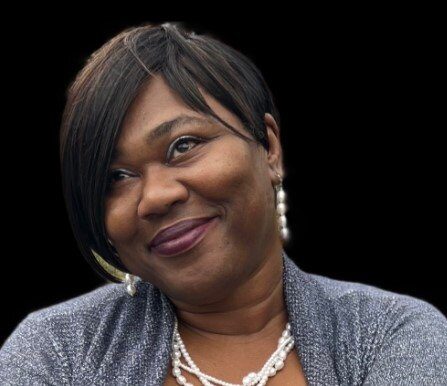
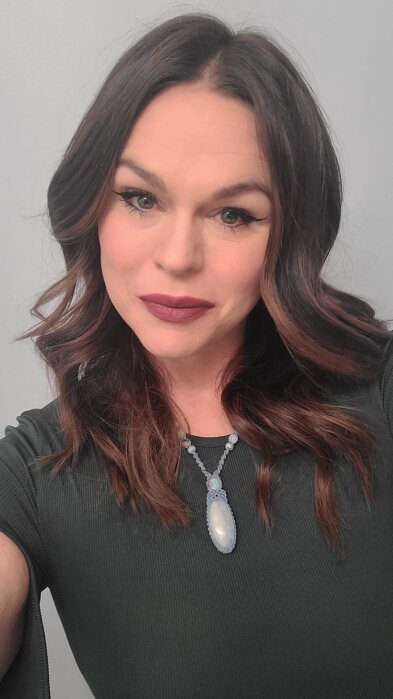
“The money will come and go, but the impact you make on people’s lives that’s the real success.”
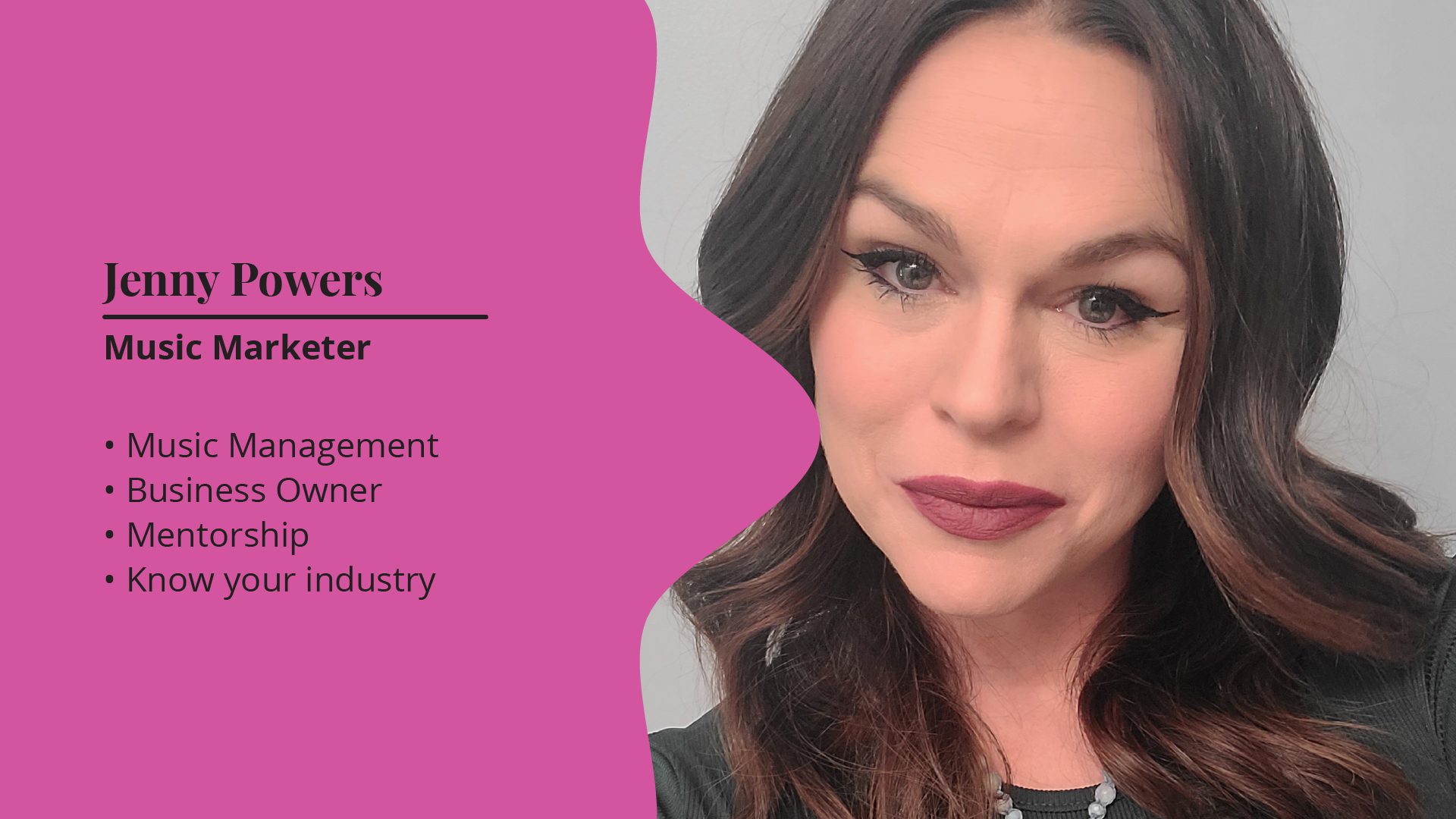
Jenny Powers is a Myrtle Beach-based music marketing strategist and founder of Blue Avenue Music Group, empowering independent musicians to thrive on their own terms.
Interview
Transcript
Emma Plutnicki
Okay, so to start, what do you do for work and where are you currently working from?
Jenny Powers
So I live in Myrtle Beach, South Carolina. My husband is the men’s tennis coach at Coastal and I am here in my office. And I own Blue Avenue Music Group, which is a music marketing and management company, and so I work a lot with artists and musicians from everyone from ground up to Grammy nominated artists
Emma Plutnicki
Cool, and how long have you been doing? That for?
Jenny Powers
I’ve had my company for seven years, and then I’ve been managing a tree house the local reggae rock band for about 15 years.
Emma Plutnicki
Amazing. So what does a typical day look like for you? What kind of responsibilities are expected of you, and what do you get into?
Jenny Powers
Oh, well, it varies from artist to artist. So right now, with Treehouse, we have a new song that will be coming out in a few weeks, and so we’ve been working on their content plans and their tour and making sure everything is uploaded and ready for those releases
Emma Plutnicki
cool and so how do you manage kind of like having a work life balance, because I’m sure, like creativity strikes at different times of day and things like that. So how are you able to kind of manage that?
Jenny Powers
Oh, that’s a good one. Definitely set boundaries. I mean, my clients are on tour, so they are up at all times of the day and night, and so for me, it was really about setting those boundaries that I am available between eight in the morning and five o’clock in the evening, unless there’s an absolute emergency that cannot be taken care of. So definitely setting those work boundaries, especially because I work from home, so making sure that I allocate the necessary time to spend with my family and do the things I love to do like I even like I don’t respond on weekends either. So those are, those are my times, and those are times that I think everyone should be be bound to, yeah, for sure, 40 hours, yeah, and working from home.
Emma Plutnicki
Is it sometimes hard to separate work life from personal life? Or have you been able to kind of overcome that?
Jenny Powers
Oh, I have, even in my family life, it’s, you know, eight o’clock until five o’clock here at home, and if my door is closed, I’m in meetings or I’m actively working on something, but if my door is open, then my kids are always welcome to just come on in and see, see what I’m doing and what’s what we’re what’s going on.
Emma Plutnicki
Yeah, for sure. And so living in Myrtle Beach, does South Carolina play any role in your work? Does it influence your work in any way? Or have you lived in other places where you notice that living in South Carolina kind of has a different influence on what you do?
Jenny Powers
So that’s that’s a really great question. I was born and raised here. I graduated from the academy of arts, science and technology in entertainment technology, my sister is one of the first graduating students from the Governor’s School in Greenville for music and arts, and she went on to found the longest running Girls Rock and Roll camp, and now we have our our nonprofit in Nashville. So South Carolina’s definitely given me and my family a lot of opportunities. My brother’s been a touring musician for 17 years. My sister was a touring musician for 10 years, and and I’ve been doing this for a long time too, and so we’ve always had that philosophy of bloom, where you’re planted. And we’ve, we’ve done so well.
Emma Plutnicki
Yeah, amazing. So coming from such a musical family, have you been given any advice along the way from family members or mentors that kind of helped you in this career path?
Jenny Powers
No, no, no, because think about think about it like the major hubs for music are New York, Nashville and. And LA with Austin having its own central like Texas is like its own music world. Honestly, there’s artists that only tour Texas and never leave it. So being in South Carolina that wasn’t a music hub. I had to learn those things. And I was very lucky to meet Ari Herston, who is, you know, the go to guy for independent music. And what I learned from there, I was able to bring and work with my artists and really elevate them from where they are and take them to where they want to go.
Emma Plutnicki
Yeah, for sure. Did you have any fears when you started in this career?
Jenny Powers
No, no. Like, I didn’t have a choice. Yeah, my brother called me up, and he was like, I need a manager. And I was like, I have no idea how to manage you in your music career. Yeah, we’ll find out. And once I found out, made a plan. We’ve been trucking along ever since.
Emma Plutnicki
So yeah, amazing. So throughout your entire career, have you had one specific project you worked on, or one specific person that you’ve worked with that has really kind of had a significant impact on you, and you kind of see as maybe, like the pinnacle of your career, just something that stands out in in your career so far.
Jenny Powers
I mean, every day is kind of magical, because I love that you never know what’s going to come your way. So I mean, I’ve had some really great people in this industry that I really do lean on. So Ari. Ari was one of them. And I have all kinds of great friends that I lean on, but I think I forgot your question.
Emma Plutnicki
No, it’s okay. How is, how is the local working community in South Carolina? Is there a network that you rely on in South Carolina specifically, or are you kind of just a lone wolf out here?
Jenny Powers
I am probably the lone wolf of South Carolina in the way that I work with artists, and the amount of artists I’ve worked with and the impact that I’ve actually made in the music industry. So one of my other positions is the VP of community of artist hub, which is a music marketing company. And we’ve, you know, we actually changed how you market music. So through those, those deep links, we’ve, you know, revolutionized how you market your music. And right now we’re working on building direct distribution through the blockchain. So that is going to be, you know, taking the way things are right now and looking into the future of how the whole industry is going to be moving forward.
Emma Plutnicki
Yeah, makes sense. And so to succeed in this career, you know, in creative fields, it can be kind of hard to figure out what success looks like, because it’s different. So how would you define success in your career? Is it financial? Is it projects you’ve worked on reaching success? Like, how do you kind of gage your success and your professional life?
Jenny Powers
Well, okay, that’s a that’s a good one. I mean, yeah, it’s hard. That is a hard one because I have been able to literally take everyone else’s platforms that they’re working on and help them succeed, and by helping them succeed, that is my success. So the money will come and go, but the help and the impact that you make on people’s lives is what really is my driving force?
Emma Plutnicki
Yeah, I love that. And what kind of skills do you need to have in your career to find success? Like, what are, what are important qualities to have for someone in your position,
Jenny Powers
One, knowing the ins and outs of how the industry works. So one of the big things in our industry right now is the independent music voice was about 40% of streaming revenue, and they were doing it so well that the major labels but. Up all the independent distributions, and that was a big scary thing for me, because I’ve seen where the major labels would actually use independent artists and take them off of platforms to negotiate with like Tiktok and things like that, so the artist who thought they were independent really weren’t independent. And so now artists have almost no true autonomy over their careers without new independent sectors coming in and giving them that opportunity that they had before. So that’s really where I am, is making sure that, you know, all these artists that I love back here have the ability to have full control over their music business. You know who’s managing their catalogs and who is managing their publishing administration and where they’re just distributing their music on these platforms, because if they don’t know up the chain who owns those they could be giving their rights away without knowing it. That’s my, my biggest concern.
Emma Plutnicki
Yeah, and how were you able to learn those ins and out ins and outs? How were you able to kind of establish your knowledge within that?
Jenny Powers
Oh, definitely. I mean, I read, read a book, not much about the structure of your businesses, like the music business itself has changed, but being able to use the new ways that are implemented to your advantage is really, you know, staying ahead of the curve while everyone is talking about things I’ve been doing for the last year and a half, they’re just now like, this is what you should be doing. And I started doing those things because you can see those trends if you’re paying attention.
Emma Plutnicki
Yeah, makes sense. Amazing. So just as we wrap up, is there anything else you’d like to add, any advice you’d like to give, or anything else you’d like to add about your career?
Jenny Powers
Oh, wow, yeah, if you’re going into you know, if you’re going to be a musician that wants to tour and distribute your music and have, like, a real business and that be your livelihood, then make sure you know the ins and outs of what that means, the contracts, the the everything, because you have all of these rights. And with every step of the way, everyone wants a cut of it. And so by maintaining your rights, gives you the power to have that autonomy over your career. Amazing.
Emma Plutnicki
That’s great advice. Well, thank you so much. I’m going to stop the recording. Okay, bye.
“Even though it’s in the arts… being able to afford taking a day off has been huge for me lately.”
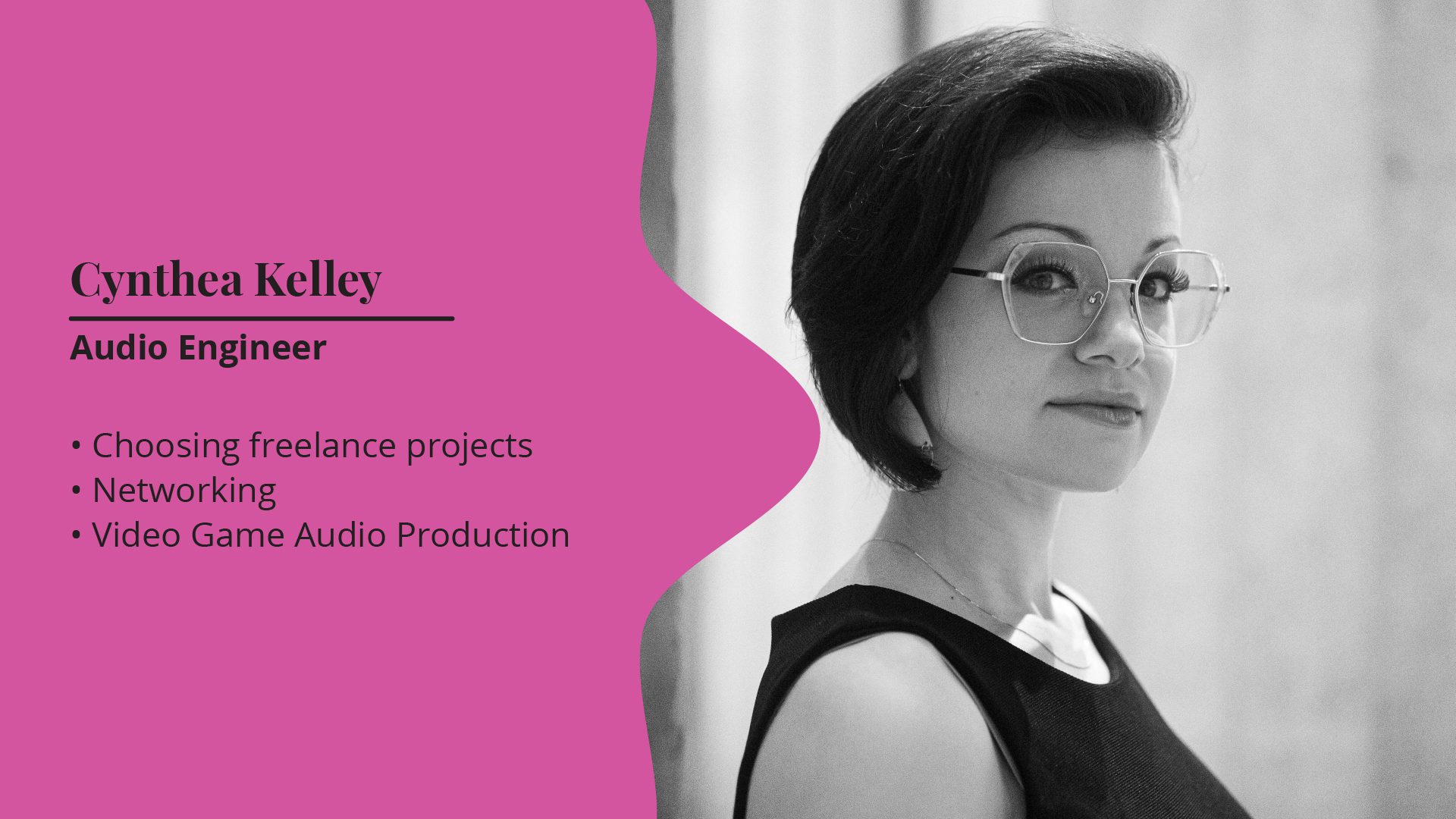
Cynthea Kelley is a Nashville-based audio engineer and performer. She balances technical work and artistry in the dynamic worlds of music and gaming.
Interview
Transcript
Emma Plutnicki 00:02
So, to start, what do you do for work and where are you currently working from?
Cynthea Kelley 00:06
So, I’m based in Nashville, Tennessee, and I am an audio engineer and musician, performer. So, primarily what I do is edit audio from home, and I also run live sound. In addition to performing, I sing and play guitar.
Emma Plutnicki 00:27
Cool! And how long have you been doing all of those?
Cynthea Kelley 00:30
I’ve been performing since I was like, I grew up in a musical family, so I grew up performing, but I guess kind of doing my own thing since I was 14, so about 14 years now. And then, as far as engineering goes, I really started doing it more seriously when I was a student at Coastal. So, I got to work at the Wheelwright Recording Studio for like, two and a half years while I was a student, and got to really understand and learn more about like how to record various types of ensembles and different kinds of projects.
Emma Plutnicki 01:10
Amazing, and so what would you consider, if you had to boil it down, everything that you do, what would you say your official job title is?
Cynthea Kelley 01:20
I would say musician and audio engineer, or just musician.
Emma Plutnicki 01:28
Amazing! And so, what does your day to day look like? What’s expected of you on a daily basis? What kind of things do you get into? Just kind of describe what your days look like.
Cynthea Kelley 01:39
So, I am self-employed, and kind of have, like, a lot of different work that I do as an independent contractor. So, day to day, it kind of varies, but I, about a year ago, started doing audio editing for the video game Fortnite, and so that’s, like a very specific thing in Fortnite, with Fortnite Festival Jam Stage. So that’s like music editing. So, I get to set my own schedule, which is really cool. I have, like, a certain amount of hours that I’m expected to work every month, but there’s flexibility there so I can kind of decide, like, you know, I wake up and then I have my tea and then sit down and get to audio editing and that might be between like, three and seven hours a day, and so that’s kind of like an audio editing day. On days where I run live sound, that’s at a venue, and so I’ll get there in the evening, early evening, and set up, and then be there for maybe like five to eight hours, working with a band and running sound for an event. I also sing with a wedding band, and so that usually involves some travel, maybe, like, two to three hours one way. So, I’ll like, you know, get up and kind of take it easy, and then in the afternoon, drive to the location, perform like three to four hours and then drive home. So, it kind of varies a lot. There’s also, I’ll assist at recording studios, and so those are typically like, longer days where I’ll arrive at like 9am and be there until anywhere between like 6 and 8 or 10pm so it kind of varies. Sorry, that’s not a super specific—
Emma Plutnicki 03:54
No. Totally fine. So, when you have events, you’re traveling, you have things late at night that you’re working on. How are you able to manage kind of a work life balance? Because it seems like the work kind of consumes a lot of your day-to-day life. So how do you manage that?
Cynthea Kelley 04:11
Yeah, that’s something I’ve been learning a lot about in the last two years, and I feel really grateful because doing the audio editing from home, having that flexibility, I’m able to, like, if I have a day or two or three in a row where I’m just like, going, going, going traveling, performing, usually I can, like, take a day or two to just, kind of like, relax. And as a musician, usually we’re working on the weekends. And so, I feel grateful that I kind of get to compensate for that through the week and just like, take a couple days off. But yeah, I’ve like, really been learning how to prioritize sleep in the last few years, and like, eating healthy food that’s going to give me energy and like, not make me feel lethargic. So, yeah, it’s been, I think I’ve been learning how to, like, prioritize resting as well. And just like, started bird watching and Zelda, like, I’ve never been—I wasn’t allowed to play video games when I was growing up. So now I’m like, okay, I’m just gonna chill and fun thing and like, not feel like I have to, like, go, go, go all the time.
Emma Plutnicki 05:30
Yeah, I love that. And within a creative career, I feel like a lot of times it can be hard to figure out what success looks like. It’s different for everybody. So how would you define success, both personally and professionally?
Cynthea Kelley 05:43
I think for me, since I moved to Nashville at the beginning of 2022, I’ve been doing music full time. And I think when I was a student, that was like, really, all that I would have said is like, “Oh, I’m doing music full time. That means, like, I’m a successful musician”. And now, I think especially being surrounded by so many musicians in Nashville, because it’s Music City, it’s given me the opportunity to see, like so many different lifestyles and like careers like, what different types of careers as a musician can look like. And so, for me, I feel like I’m very grateful to be doing what I love full time. And so I think that that feels like part of it, for me, is like, that’s part of the definition is that, like, obviously, like, it’s not 100% of any job that you’re gonna love, like that everything has its tedious parts, or it’s things that you don’t love as much, but, like, I would say, like, 90% of it, I’m just like, really, I really enjoy and really love, and so that feels like success to me. And then also being able to, like, just put money in a savings account for the first time, it’s like, “oh, this is really cool.” That feels like building on success. And so, there’s, like, even though it’s, you know, it’s in the arts. And so, it’s not like crazy, you know, extravagant, but being able to, like, afford things like, you know, like I was saying earlier, like healthy food. Being able to afford taking a day off that, is, has been huge for me lately. And then another part of it has been being able to decide and prioritize what kind of projects I want to work on, especially as an independent contractor. If there, you know, maybe I took a job and it ended up being way more stressful than I expected, and so being able to say no when things like that come up in the future, or if, you know, maybe I wasn’t treated the way that I wanted to be treated, or it was unprofessional, being able to yeah, just like, decide who I’m working with.
Emma Plutnicki 08:28
Yeah, no, it definitely makes sense. And, I’m sure you’ve worked on a wide array of projects throughout your career. So, has there been one that’s had a significant impact on you, or one that sticks out in your head as being, you know, exceptionally meaningful to you?
Cynthea Kelley 08:45
Absolutely, yeah, this, this job with Fortnite. I started in February of 2024, and it’s kind of been like ideal for me, because I’m super introverted and a homebody, and so the fact that it’s from home is really cool. And I’ve never worked on a project with like, such a big name before, so that’s felt really exciting. And what’s been really cool about it, too is like, not only do I really enjoy the work, but the teams that I’m working with are just like, super solid, and I feel like they really value the people who are working on their teams. And so it’s just like a really good support system. And in addition to being really fun, so I feel like it’s, it’s like a little bit of a dream job. So I’m really grateful to be—
Emma Plutnicki 09:45
Yeah, and so are you able—when you play, I assume you play in some aspects, are you able to, like, hear the pieces that you’ve worked on? Like, how does that feel?
Cynthea Kelley 09:55
So, my specific job is for the Jam Stage in Fortnite Festival. So basically, what that is players can choose an instrument, like drums, vocals, guitar or bass, and it takes loops of different songs, and you can, like, mash them up together. So, like, you could have the guitar part from a blink 182 song playing with the drum part from Metallica and vocals from Lady Gaga. And so, my job is basically to make the audio from those songs flexible enough so that they can all fit together at the same time. So, I’ve worked on, I don’t know it’s like, maybe definitely dozens of songs at this point in the last year, maybe upwards of 100 but yeah, so they’re, like, featured in the game now, and players can, like, use them. And yeah, it’s fun to fun to hear and see it like implemented in the game.
Emma Plutnicki 11:02
Yeah, that’s very cool. So, did you have any fears going into this job role, or just fears in your career as a whole?
Cynthea Kelley 11:11
Yeah, I think something that feels difficult in the arts and in music and as an independent contractor doing so many different kinds of jobs. I feel like in something that’s more, maybe more like typically structured in the job world, like you might be able to say, like, “Oh, I did sales at this place for five years, and now I’m like, this in this management position, and so that’s why I’m qualified to do this job,” you know, like with the arts, it’s like, well, I did this thing and I did that thing over there, and I did this over here, and I think they all relate. But like, am I qualified, you know? So, I was super nervous that, like, I thought I knew what I was doing, and then all of a sudden I would start doing the job and wouldn’t have what I needed. You know, so I think definitely, like some imposter syndrome played into that for me. But yeah, I think again what’s been really cool about this team is that it’s super supportive and just really great people to be working with. And so even with things that you know, I needed to learn or like needed to brush up on, the team was just, like, really welcoming and really supportive, and like, we all help each other out.
Emma Plutnicki 12:42
Amazing, and having lived in South Carolina, has that had any influence on your work at all?
Cynthea Kelley 12:49
So, I lived in South Carolina basically for high school and college years, then moved after that. But I will say that my junior year, I went to the Academy for Art, Science and Technology, and was able to major in entertainment technology and learn a lot about like production and video, like video production, and got to do some music production for those as well. And then being in the songwriting community in Myrtle Beach too was just like, huge for my development. And I’ll give a shout out to Brian Ressler, who’s just like, you know, like the Papa of the music community. I felt in the songwriter community and so, and then being at Coastal too, I just learned so much and made a lot of, like, really great connections with my professors and with my colleagues and fellow students and so I haven’t had a lot of work in South Carolina since I graduated, but I do think that, like a lot of the educational elements that were offered within the arts in South Carolina really played a big part in my development and like getting me to where I am now.
Emma Plutnicki 14:09
Yeah, amazing, and hopefully those programs continue to grow. Well, thank you so much. Just wrapping up here, is there anything else you want to speak on, maybe advice or anything else about your career?
Cynthea Kelley 14:25
Yeah, I think, as far as advice goes, I think that the biggest thing that I’ve taken with me is just being persistent, especially again as an independent contractor, where you might not know where your work is going to come from, like week to week or month to month or year to year, just like being persistent in making connections and networking and reaching out to people. And I think advice, just like for me, that I feel like I’ve been learning is we ask ourselves and get asked the question too, so much like from when we’re kids, like, “What do you want to do? What do you want to be when you grow up?” and we’re thinking about what kind of opportunities we want to take and what I’ve been kind of trying to learn how to ask myself more in addition to that, question is, like, “how do I want to be treated in those as well?” So like, being able to set boundaries and recognize when it’s like a healthy working relationship and a professional one. So, I think those are kind of the biggest things.
Emma Plutnicki 15:37
Definitely. Yeah, thanks for sharing that. It’s great advice, and a lot of times people can’t find that, so I appreciate that. But yeah, thank you so much.
“You can score a Hollywood movie out of a bedroom now.”
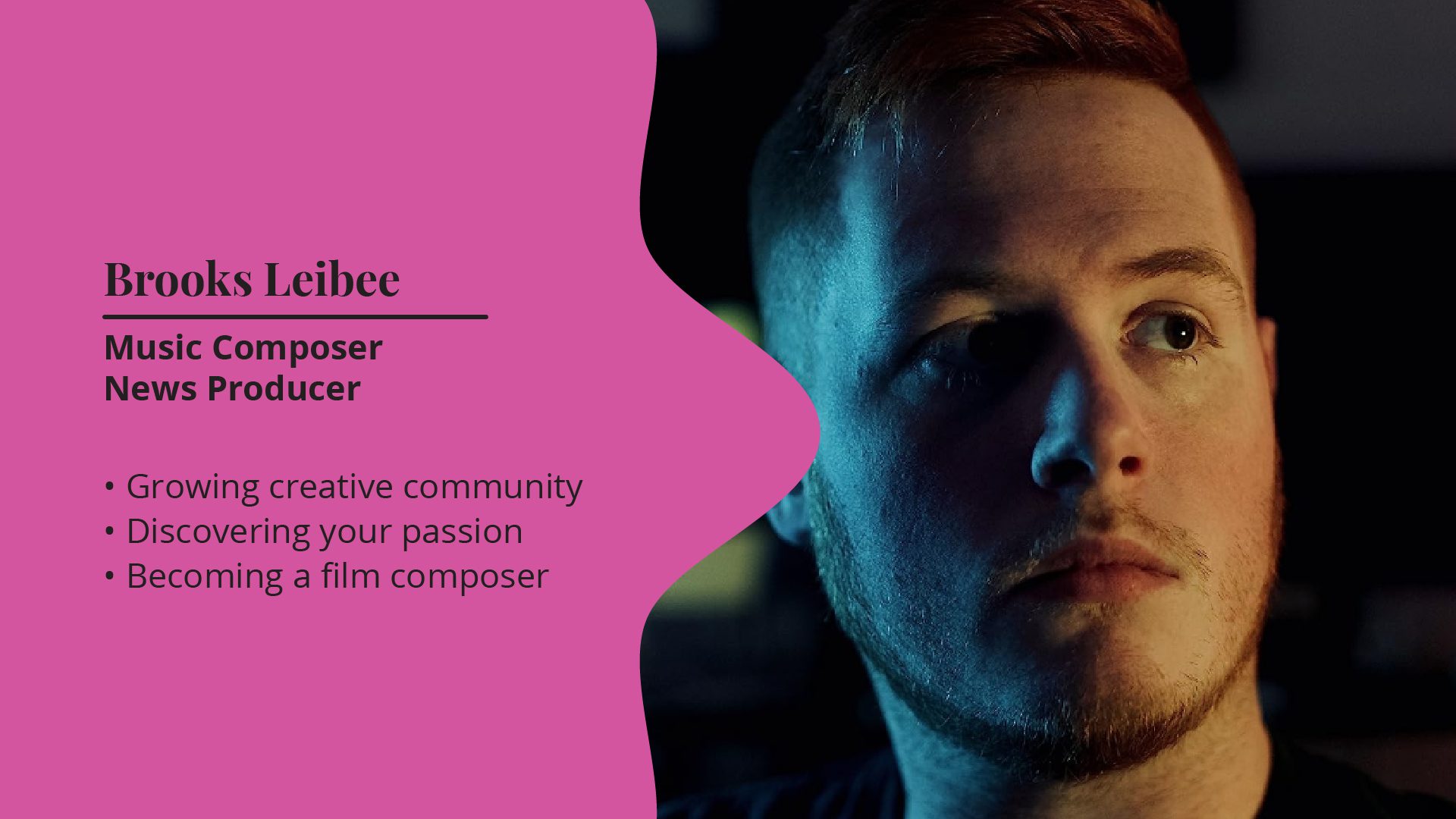
Brooks Leibee is a media composer for TV, film, and interactive media, currently working out of Myrtle Beach, South Carolina. He describes his role as “virtually building assets that go into another digital process” and is excited by the growing creative community in the region. Originally a filmmaker, he discovered his love for composition during college and now collaborates with local musicians and studios. Leibee defines success as “being happy doing what you’re doing” and believes strongly in the value of creative work in the digital age.
Interview
Transcript
Emma Plutnicki 00:02
Okay, so to start, what do you do for work and where are you currently working from?
Brooks Leibee 00:07
I’m a Media Composer for TV, film and interactive media, like games. This is my first year venturing into that. I’m currently working out of Myrtle Beach, South Carolina.
Emma Plutnicki 00:21
Amazing, so what is one thing that you love about working as a creative in South Carolina, specifically?
Brooks Leibee 00:27
Just from the perspective of via composition, there’s not a lot of us here. It’s a very niche job in industry. It’s one of the- it’s like a big three sort of situation where you find them in, like LA, Nashville, New York, or even overseas. So it’s a rare occasion when I, you know, get to meet other people in my field. So it’s, it’s fun talking to, like, local filmmakers and things like that, because they’re like, “oh, wow, I’ve never met someone who does this sort of thing”. So it’s, it’s, it’s fun to be like, the hidden gem or whatever.
Emma Plutnicki 01:10
Yeah, amazing. So how does having kind of a smaller knit community in South Carolina influence your work as as compared to working in New York or LA if you were to work there?
Brooks Leibee 01:22
It’s far less competitive. Obviously, you make friends. Here it is a small knit community, so there’s that little bit of competition there, but I find it more community based. I mean, there’s only a few studios in the area that can fit ensembles or things like that- that you’d find in soundtracks for things like movies, shows and video games and not a lot of for example, like orchestras that are aware of like forming those relationships with media composers and building a work out of that, cities like Nashville, LA, they they have that just naturally because of the culture there. And also working with people like I said, it’s a lot of fun, because when you’re one of a handful of someone that does a certain thing, the excitement is a fun part of it. I mean, it always feels like, you know, working on something with your friends, because it’s, it’s an exciting thing to have original music for your project. It’s, it’s tailor made. It’s, it’s a bit more emotional, far more than what, like library music or something you pull off of YouTube, for example, can do.
Emma Plutnicki 02:47
Yeah, and how would you describe the local professional working community in Myrtle Beach and in South Carolina overall?
Brooks Leibee 02:58
In South Carolina, most of the people that I work with is it’s a lot more commercial in Myrtle Beach. A lot of people seem to, I know right now they’re working on getting more film projects and narrative projects here, but so far, it’s, it’s heavily commercial in the literal sense. It’s, it’s a lot of commercials, promo, that sort of thing. And the people that are making narrative things in Myrtle Beach, they’re super independent. A lot of the time they’re making everything on their own. So you find a lot of well rounded people in film. Before I started getting into music, when I was at Coastal I was making short films, and a lot of the time I was doing it on doing everything myself, filming, writing, and then getting into music. And that’s how I discovered, wow, this is my favorite part of the process. Let me focus on on this thing and run with it. But most of the people that I work with for narrative appear to be from Midlands, the upstate of South Carolina. A lot of narrative work out of the those cities, and same with like festivals and things like that. So I think, like the film culture more inland out of Myrtle Beach you get the more used to they seem to be and familiar with it, yeah, but I’m excited for the future of film in Myrtle Beach.
Emma Plutnicki 04:29
Yeah that’s exciting. And I mean, within a creative career, it can sometimes be hard to define success. So in your opinion, how do you define either professional success or personal success in your career?
Brooks Leibee 04:48
Yeah, I guess it’s like, professional success, it’s like, it’s a comfortability. And I guess that comes in fine with personal success. If you’re happy doing what you’re doing, people always say, if your- if your job- if you have fun with your job, it won’t feel like a job, and when there’s bills to pay and things like that can be tough. It’s not a rare thing for someone to have a day job, and that’s fine. You just you have to live. So if you’re struggling with your creative you know, job, your career in that field, work for it. Never, don’t give up on it. But if you have to get a part time, or even full time job, I know plenty of people that have full time jobs on top of their full time jobs. So it’s, it’s, it’s- it’s overall, it’s okay. And it’s not a failure. It’s not a failure. It’s not a you know, time waster. You have to live. And whenever you have that creative job, it that’s like, what keeps you going. So I think, yes, the personal success is just being happy doing what you’re doing, and professional success, you know, you’re living comfortably if you’re if you’re struggling, that tends to make the creative job harder, because sometimes the creative jobs are more expensive than living so.
Emma Plutnicki 06:11
Yeah, and so when you decided to go into this career, did you have any fears, or did you have, like- What was your biggest fear going into this career?
Brooks Leibee 06:25
Starting out, yeah, the fear of just industry, like in Myrtle Beach, it’s it’s growing, for sure, the last few years, especially, it’s just been rapid shifting, especially in community, with just meeting people, but starting out, yeah, there, you know, just no one here in this industry, even in just like the more, even more niche parts of it, like recording engineers, orchestrators, things, you know, things that go into it, that more behind the scenes, that a lot of people don’t get to see or or know about but we’re thinking about it all the time, and be the prospect of moving to another city. So LA was always on the mind, uh, Nashville, New York, things where, or even overseas, where these industries are flourishing, and that’s where the people are, and there’s an abundance of of culture and facility resources, especially so I’m sure in the future it’ll be it’ll become more localized, and there are more resources than there were just a few years ago. So yeah, starting out, it was just the fear of location, industry, resources, things like that. But career wise, those go hand in hand. But yeah, there weren’t, there aren’t many fears in terms of like choice or like repercussions of career choice, if that makes sense.
Emma Plutnicki 08:03
Yeah and so when you have those fears, were there any people around you giving you advice? What was the best and worst advice that you have received throughout your career?
Brooks Leibee 08:18
Worst advice is going to be is going to take a minute.
Emma Plutnicki 08:20
Yeah?
Brooks Leibee 08:20
Best advice that I hear all the time, and it’s true. I mean, it’s it’s proven true, just in my experience. But with some jobs, you can do it wherever. With this job, especially like in the digital age and post COVID, we’re like working from home became part of our daily lives with this, I’m, you know, I’m virtually building assets that go into another digital process. You know, in editing, people just drop the music in, it lines up, and that’s it. You know, there’s some mixing that other people have to do, but my job can literally be done anywhere, and especially now post COVID, a lot of the things, like the things I was talking about with recording engineers and recording spaces that can fit large ensembles, there are brand new services overseas or even in the states that can record large Hollywood scale orchestras that are used in Hollywood films and TV shows and video games remotely, and these are in major European countries and cities with AAA musicians, some of the best in the world. And that’s a post COVID thing that wasn’t possible pre-2020, so that just yeah, that adds to it. So you can, really, you can write. Like, I’m working out of my bedroom right now. Yeah, you can write anywhere, prepare, do all of your mechanical technical work. And then, I mean, yeah, you can, you can, you can score a Hollywood movie out of out of a bedroom now. And I think that’s crazy. That’s probably the best advice that I’ve heard everywhere. And it’s proven true that you can work from anywhere in this field. And, yeah, worst advice is hard.
Emma Plutnicki 10:29
That’s good, good that you haven’t had anybody tell you-
Brooks Leibee 10:34
I- if I hear or see things, something where, that’s where something you know, rubs me the wrong way. I tend to deflect it, because there’s just no point, you know, in focusing on- on- on our you know, of course, there’s the doubters and people that that are always going to say creative fields aren’t successful. You know, it’s a rare thing. It’s one, one in a million, which I’m sure, I’m sure there’s some statistic truth to that. But if you know, if you work hard, work hard, and you love what you’re doing, and you’re good at what you what you’re doing, that comes with working hard, and over time, yeah, you fly. So it’s, yeah.
Emma Plutnicki 11:17
Yeah, no, I love that. And so throughout your career, have you had any specific project that has made a big impact on on you, or something that you’ve produced that has really showcased your creativity?
Brooks Leibee 11:35
Last year yeah, I worked- I got to work with another Coastal alum on a short film. Name is Jay Bennett, and they made this Gothic Horror short that, yeah, she produced a short film while she was at Howard, and it was the most creative and I think culturally and emotionally rich project that I’ve gotten to write music for, and when things like that have that amount of support creatively, that makes music writing so much easier. So I really enjoyed scoring that one, and also that was a very fun project to produce because worked with a studio in Calabash, North Carolina called Sunset Beach recording. Ironically, it’s not in Sunset Beach, but yeah, and local musicians, five cellists and the bass player. So there’s this cello choir that we called it, but like a low string ensemble, and recorded there for for a few hours, and just got to jam with some cellists and that was a lot of fun. Some were from Wilmington, some were from Myrtle Beach. And, yeah, just the, like, just the Carolina musicianship showed itself there, and that was a lot of fun. So I definitely think that’s where, like, oh, local resources are here. And it was a lot of fun, especially, and I feel more prepared for future projects when that sort of opportunity comes again. That was the second time I got to record with musicians. So you know, if you learn as you go, and that was definitely the more successful session.
Emma Plutnicki 13:36
Yeah amazing. It must be so cool to see the music come to life like that. Very cool-
Brooks Leibee 13:43
Yeah, it’s unreal every time.
Emma Plutnicki 13:44
Yeah, so nowadays, what- What does a typical work day look like? What’s expected of you on a daily basis? What does your work process look like?
Brooks Leibee 13:54
It’s very different. Every day. I don’t have, like, a set process, but I like to set deadlines, so usually days like today is when I’m having calls, having meetings and setting my calendar for deadlines through the week or in the following weekend. So and I live in my calendar and my it’s just the Apple calendar. I live out of that thing. So a lot of the scheduling happen happens through there. So from say, I have a call today for a project coming up in the next couple of weeks, if it’s a film, generally, after the first call, I like to set up what’s called a spotting session, where either the filmmaker or I can screen share. We watch the project. Usually it’s edited. It’s mostly done by the time I’m but I’m brought on board and we set ins and outs for things called cues, where music starts in. Ends, and that’s for every scene. So we just watch the movie and talk about what music could go there, what it’s supposed to do, what it could sound like. And from there, I start sketching, and that’s usually like a week to two weeks most time I’m working on short films. So there they come together pretty quickly, and from then, it’s just a an approval process. So I’m sending drafts, either they- they have notes, or they sign off. And if I’m given the opportunity to record musicians, that’s probably another two weeks of taking the virtual music from my software and transferring it onto paper as legible music for musicians, and then contracting a space the musicians, setting a date, making sure everyone is ready to go on that- sending the musicians the music, and then recording, and after that’s just mixing, mastering the music and then sending it off to the editor. And it’s very similar for for interactive music, a lot more music than your than a short film whenever it’s a game, but that’s generally it’s generally a similar process, only when you’re writing, you’re focusing on interactivity, loops, stingers and the different possible endings for where a player chooses to go in a game. That’s, that’s a whole other, whole other thing. But yeah, generally that’s, that’s the process, and it’s different with each project. But usually it’s a about a month, month and a half for a project.
Emma Plutnicki 16:57
Okay, yeah, so it sounds like pretty busy schedule. So how were you able to kind of manage the work life balance with keeping personal creativity, but then also getting your professional work done?
Brooks Leibee 17:09
Yeah, also days like today, I feel like Sundays generally are like the “life day”. I hang out with my roommates a lot more because most of the scheduling and calls happen in the morning to afternoon. So after that, yeah, anything’s possible. So but, and then also just throughout, throughout weeks. Some, you know, some days are off, or even in off seasons, sometimes there isn’t a project. So it’s a lot of, excuse me, so it’s a lot of like, housekeeping or, yeah, it’s sparse, but like, Yeah, but it’s there. The work, the work life balance is there. And actually had a kind of conversation with a friend online not long ago about the work life balance and how it’s just life. You know, it’s all it’s all life. So if because I can get caught up in the whole work life balance thing like, Oh, am I spending my putting enough time into A or B? But if you, if you are mindful about it, and you don’t spiral over one thing or another, and just making sure that you’re spending time taking care of yourself, touching grass, you know, getting out of getting out of your space, and I’m working out of my bedroom. So, you know, it’s always a work life, a mix. You know, my beds are behind me. My there’s a closet of clothes right there. You know, it’s, but on the opposite side, I have all, all of my instruments and tools and my desk right here. So it and living with a house of roommates, you know, we’re young, we’re saving money. It’s, it’s the intersection of work, like work life balance and Brooks’s life right there. That makes it really interesting, but it but it’s working, and as long as it works for you, won’t work for everyone, but as long as it works for you, and you’ll find that then.
Emma Plutnicki 19:34
Yeah, that’s a great way of looking at it. And just as we wrap up our Is there anything else that you would like to add, or any questions you wish that I might have asked that I didn’t?
Brooks Leibee 19:49
No, I think you asked really good questions. Anything else to add? I- Yeah, the- this, it’s funny with things like social media and like online presence. Since, since you are where, at least from my perspective, I am working out of my bedroom. I amsometimes going overseas for programs or, you know, traveling the country to meet to meet friends. It’s it, but all of these are connected online. So I think having a strong, a strong social media presence is important, but especially today, where social media is in a very strange spot. Yeah, you have to be careful, I suppose, maintain your professionalism. I think more so because in these creative fields where, and especially living in somewhere like Myrtle Beach, where there isn’t an industry for this specific job. It’s all online. You’re going to be talking to people from around the world, around the country, and you never know who’s going to come across you. I was went to a concert in New York last year, very end of last year, and the composer, I’m a huge fan of or, his music, excuse me, and we had a moment to chat after his concert, and he recognized me just from online. He’s like, “Oh yeah, I see you everywhere”. I was like, “Oh, is that a good thing? “Didn’t clarify, so I don’t know, but, but yet, but we had a great talk, and talked about music and things like that. But that made it very clear that you know your presence online is very important now, and if you’re in a creative field, it’s, it’s a weird moment in time where you kind of have to be very active and putting things out there, which is something that I’m personally struggling with, is just writing music that I can just, you know, throw online. Because sometimes with projects, you have this like respectability thing, where you don’t want to throw all your music out there, because the filmmaker is, you know, still processing, and it’s a creative process, and you don’t want to show all of it. It’s a thing also NDAs with larger projects, but, yeah, social media presence is big, and the work life balance thing is also there with- with, like your personal accounts and professional accounts. That’s the one that comes to mind right now. Yeah, not sure of anything else.
Emma Plutnicki 23:06
No, that’s great. Thanks for sharing all that. And so last thing, if there is any other creative that you think we could benefit from talking to, would love to hear of anybody. I could send you a link to that to nominate people. So I’ll give you time to think on it, if you can think of anybody. But other than that, thanks for talking with me today.
“You determine your worth and set your success. Don’t allow your success to be set on what others think of you and how others perceive you. You determine that, so you won’t have expectations from the world, but you can set your own guidelines and your own expectations.”
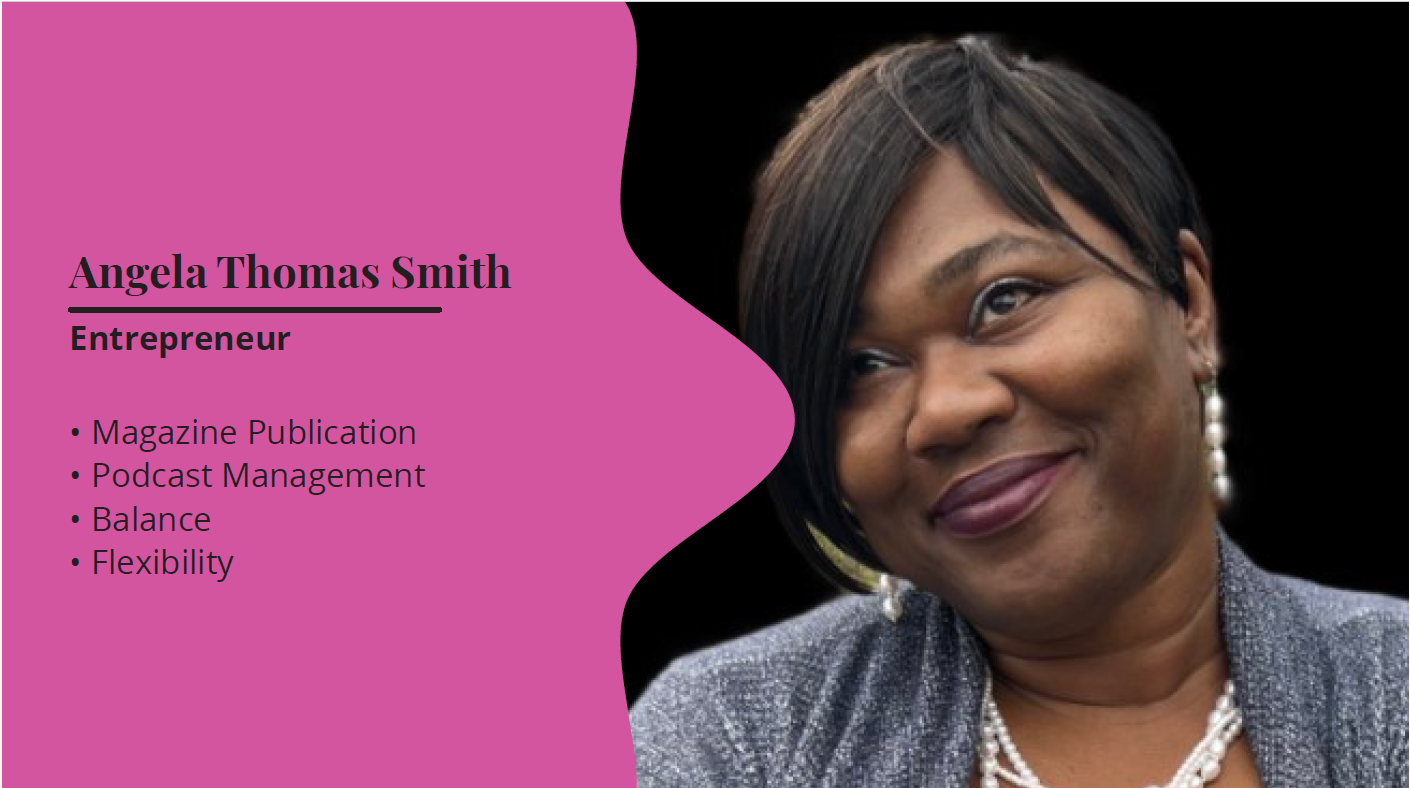
Angela Thomas Smith is an entrepreneur who helps authors publish their books in addition to having a podcast and a magazine based in Georgia.
Interview
Transcript
Emma Plutnicki 00:02
So, to start, what do you do for work and where are you currently working from?
Angela Smith 00:24
I work from wherever my computer allows me.
Emma Plutnicki 00:31
Amazing and where is home for you?
Angela Smith 00:34
So, home right now is Georgia.
Emma Plutnicki 00:37
Okay,
Angela Smith 00:38
I actually just moved from Myrtle Beach.
Emma Plutnicki 00:41
Oh, Amazing! Um, so how long have you been doing that? How long have you been an entrepreneur? How long have you been helping with publishing and all that?
Angela Smith 00:50
I’ve been doing this since 2012. I started in 2012, I really stepped out in 2016 it really picked up the during the pandemic, and it’s just been going amazing. And I published my first client. Um, we’re having a book signing in Georgia this weekend, so I’m excited about that. Amazing! congratulations. That’ll be so fun and so how has your work shifted at all living in South Carolina to now Georgia has done South Carolina has any influence on your work, as opposed to now living in Georgia? So, I am originally from South Carolina. I’m originally from upstate South Carolina Anderson, South Carolina. Actually, nothing has shifted. It is the same because, I have established a virtual community. So, I’m able to connect with people virtually, um, so we’re able to connect globally. I have individuals that’s not here in the US, and we’re connected with individuals in the UK, Africa, the Virgin Islands. I have a host from one of my podcasts that she’s a professor at University of Virgin Islands. So, we are connected globally, and during the pandemic, I was able to establish that platform. So, I’m grateful for that. Yeah, it’s great to have that flexibility. So, if you’re working with people from different time zones, and you’re on your computer conducting these tasks. Is it ever hard to have a good work life balance, because you’re able to work at any time at your fingertips? Is it ever hard to shut the laptop and kind of get away and have some time for yourself? It was at first, but when you learn how to balance, when you learn that if you don’t take care of yourself, then you’re not going to be any good for anyone else. So, when you learn how to incorporate self-care into your daily life, it makes everything so much easier. Just having that time to, you know, escape from the computer, you know, because sometimes you can get overwhelmed and you can get consumed with what you’re doing, and you get caught up. So just having that time to escape, it’s necessary, I encourage everyone to have that for sure. So, what does a typical day look like for you now? What’s expected of you on a daily basis, and what kind of things do you get into? Okay, so first thing I’m usually up at 4am I normally take Angel, who is my mom, my God, mom’s little baby. For a baby, I usually take her out. And I do a 5am prayer. I am a spiritual person, so I am part of a prayer call. We’ve been doing it now for five years. So, I do that every morning, and it starts my day. It encourages me, it uplifts me, it gets me started. And then, I own the computer doing whatever that task is for the day, and it can range from today, I’m working on a magazine. We have a special edition of the magazine that’s dropping to honor poets, celebrating our new poet of the year out of Dallas, so I’m excited about that. She’s from Dallas, Texas, and we get opportunity to really connect, collaborate and be creative, and build a community where people can come and have that safe space to be creative and to allow that express side of them to come forth, whether it’s through books, whether it’s through podcasting, whether it’s through magazine, whatever it is, we want to be that space that allow you to be able to create, yeah, for sure.
Emma Plutnicki 04:31
And so, your podcast, how often do you film those and what kind of topics do you cover?
Angela Smith 04:36
So, we stream live, and we stream on from Sunday to Friday. We have nine hosts, and they all have two shows a month. So, say one may come on every first and third Wednesday, like doctor chin, she comes on every first and third. Thursday, we have a young lady that comes. On first, no second, Sundays and fourth Thursday. So, they have different days that they may come on, but we have someone on every day, Sunday through Friday, at 8pm and they talk about different things because they come from different walks of life. We have individuals that have disabilities. They have a young lady that was born with spina bifida and hydro syphilis. She has a podcast called delayed but not deny. So, she not only focused on disabilities and showing people that you can overcome disabilities, but she allowed anybody that has a story that wants to share it to come on her podcast. Individuals that work in social work and librarians. We have a young lady from Toss in South Carolina. She’s a librarian, um, she hosts a podcast that focuses on authors and anything in the literary world, creative side, she likes to focus on that. So, we are a diverse group, and we’re from all over. We have South Carolina, we have New York, we have the Virginia area, California, Texas. So, we have a variety of individuals as a part of what we do amazingly.
Emma Plutnicki 06:08
And so, with a career like this, is it hard to kind of quantify success? Because, you know, in a creative career, it can be hard to figure out what success looks like, whether it’s financial or ideological. So, in your role, how do you define personal and professional success? Is it how many viewers you have on your podcast? Is it the stories and of people saying that they’ve been touched? Or how do you how do you kind of define that?
Angela Smith 06:36
So, that is something that is just like beauty is in the eye of the beholder. So, that will be something that each individual person will have to say. But for me, success, to me, is seeing individuals that I’ve worked with go to the next level and seeing them excel and go beyond what they thought they could do to me, that’s success. Seeing articles about me, seeing interviews, seeing different things, where people acknowledge the things that I’ve done to me. That’s success, and you know, it’s measured upon the person that is doing it. It is in the eye of the beholder. So, you determine your work, and you set your success. Don’t allow your success to be based on what others think of you and how others perceive you. You determine that…So, you won’t have expectations from the world, but you can set your own guidelines, and you can set your own expectations so that’s my, that’s my take on that. Yeah, that’s a great way of framing that.
Emma Plutnicki 07:46
Did you have any fears when you were coming into this career?
Angela Smith 07:49
I had a lot of fears but had to step out on faith. I had to believe in myself and knowing that I had all these dreams and I was doing things that I didn’t want to do, and I never thought I would be doing the stuff that I’m doing. But when I stepped out and believed in me and believed in what I felt was on the inside of me, things came forth, and I just began to Just go and things just begin to open up, and the more and more I did, the more and more things opened up. And I tell anybody, if you take that first step, that is the most important thing, get rid of fear. Because fear is not something that we are supposed to have. Because if you’re a believer, whatever your belief is, it has to lead to you not having a spirit of fear but having that spirit to do what you’ve been purposed to do. And how do you do that? Go forth, step into it. Do it boldly. You know, I’m reminded of when I was a child, and all the things that I did when I was a child, and how I enjoyed those things. You know, I got back to doing those things. You know, sometimes we get caught up in trying to live up to expectations of other people, where we lose those things that we’re passionate about by chasing after the things that everybody around us want us to do, but if we hold on to those things that we’re passionate about, it will allow us to be creative, and it will allow us to be who we are, and it allowed that true spirit of us to come forth.
Emma Plutnicki 09:35
I love that. Yeah, and along the way, was there anybody offering you advice, or was this something that you just kind of figured out on your own?
Angela Smith 09:44
Well, there were a lot of people that were in and out of my life, and people that probably didn’t realize that they were pouring into me and giving me advice and encouraging me, like my sister. For example, for those that know my story, I lost my mom to a day after my 16th birthday. So, my sister was very important in my life. She was a very inspirational person. She was one of those people that no matter what, she always encouraged me, she always uplifted me, she always pushed me to go beyond. She always believed in me. And she was one of those people that no matter what you did, she would tell you, you did wrong, but she didn’t hold it against you. She always solved the good in you, and that was one of my inspirations. But there have been so many people, and I can’t begin to name them. Because I would definitely lead someone out, and I don’t want to do that, because there have been so many people that have been inspirational to me, even giving credit to my high school coach, Monica Denise Davis, she was someone that if I never come across her, I never would have played basketball. I never would have had that opportunity to go to college. I ended up in North Greenville for one year. I ended up at Morris Brown College. We had the opportunity to play basketball, meet, some individuals, had the opportunity to travel and do some things that I never would have done. So, there’s been a lot of people and just allowing those people to pour into your life. So, take those mentors. If you have an opportunity to be mentored, take that mentorship. Allow individuals to pour into you.
Emma Plutnicki 11:19
Yeah, for sure. And so last kind of question, has there been one significant project that you’ve worked on, or something that you’ve done that kind of sticks out as being particularly significant throughout your career? Maybe it’s a project or someone you worked with, or something that stands out as kind of like the pinnacle of your creativity or of your career.
Angela Smith 11:42
Wow, I can say right now what we’re doing the 100 authors movement, the 100 authors to watch being able to work with a diverse group of authors that are trying to make an impact, that are trying to leave a legacy, that are trying to allow their voice to speak and touch on different things that they’re passionate about. I am grateful for that opportunity that right now is the most, I mean, pivotal thing, and to hear I’ve had the opportunity to sit and interview all of these authors, a part of this movement right now, and every last one of them, they have a spirit of gratitude. They’re grateful for the opportunity, and it’s based on four seeds, connection, collaboration, creativity and community. That is truly what is based on and being able to give individuals a platform where they can be supportive, where they can feel comfortable and open to support. There was a young guy, he was getting ready to release a book. He was having writer’s block. He came inside the chat. We have a chat room on Facebook. We have a group on Facebook, so we have a chat. He comes inside the chat, and he just said he was having a bad day, and he explained what was going on. One of the group leaders immediately responded to his post. She posted some things that he could do. Just willingly. Posted things that he could do. He incorporated those things, he came back, he gave his testimony, he wrote his book. His book dropped, and that’s what we’re doing. We share resources. We are pulling on each other. We’re letting each other know that we’re there, that you don’t have to do this alone. Because a lot of people start a podcast, they start a magazine, they start a book, they do whatever they do, and then they get stuck after they’ve done this thing, like, what do I do now? Now you have a community that’s there to support you, that’s helped, to push you, that’s there to help promote your stuff, that’s helped, and we just want to be a family so that, I think right now, that is the most pivotal thing. And just having all these individuals from different backgrounds, you know, when I say different backgrounds, we have professors involved. We have a professor right now that’s being honored out at miles University, a part of the movement. We have Doctor Chen. We have teachers, elementary and middle school teachers. We even have a high school teacher. I forgot about him down in Texas. We have men and we have women a part of the project. So, we are a diverse group of individuals just wanting to be a voice, um, wanting individuals to know that, yes, you can. We are not respective people, just as we did it. You can do it too. So that’s what, that’s what I’m doing, and I’m excited about that, that project.
Emma Plutnicki 14:38
Yeah, I love that. That’s amazing. Thank you for sharing all that. And just as we wrap up, is there anything else you’d like to say about your career? Any advice or anything else you’d like to add?
Angela Smith 14:50
Well, I just want to tell everybody. As I turn, I’m turning 50 in a couple of days, I would say, what? 12 days I’ll be 50. I’m going to be dropping another book. It’s never too late. Um, because I didn’t start until 2016 and it took me almost losing my life. Because I’m a domestic violence survivor. And it took me almost losing my life for me to really step out and do the things that I wanted to do. Don’t allow something to be the reason that you step out and do something. Do it because you’re passionate about it, and it’s something that you just want to do, and you want to leave your impact. Because we are our legacy. We are our brand. We are the ones that must tell our story. So, we can tell that in the form of written. We can tell in the form of audio, like we’re doing now, visuals, different things, where we can archive the great works that we’re doing. Because if you are a believer, and you are a word, when you know that the words say we should do greater works, and if we should do greater works, how will they know? Because we can’t alter none of the things that have come before us. So, we have to leave the evidence and how we do it through our works, our works just speak even when we’re not here, and we want to leave something that the next generation can pull off because someone did something for us before we got here, and those things that they did for us allow us to be in place to do the things that we’re doing now. So, I just tell anybody, believe in yourself, know your worth, know that you have power because you were positioned to be an overcomer, because you didn’t get dropped out of the sky. You are a willing investor to move forth and allow that thing to come forth out of you. And how do we do that? By educating, empowering, encouraging others. Through our resilience, we can’t give up. You can’t quit, no matter what it looked like. I just completed it on Monday. I just turned in a 40-page document for my last class. I just completed my master’s, so I will walk with my MBA. So, I’m excited about this. 30 years after graduating high school, I went back and I got my Bachelor’s, and now I can walk 12 days before my birthday. I now am a master holder, so I’m excited about, you know, what we have in store, you know? And I say to anybody, chase after your dream, don’t stop chasing your dream, because dreams still come true.
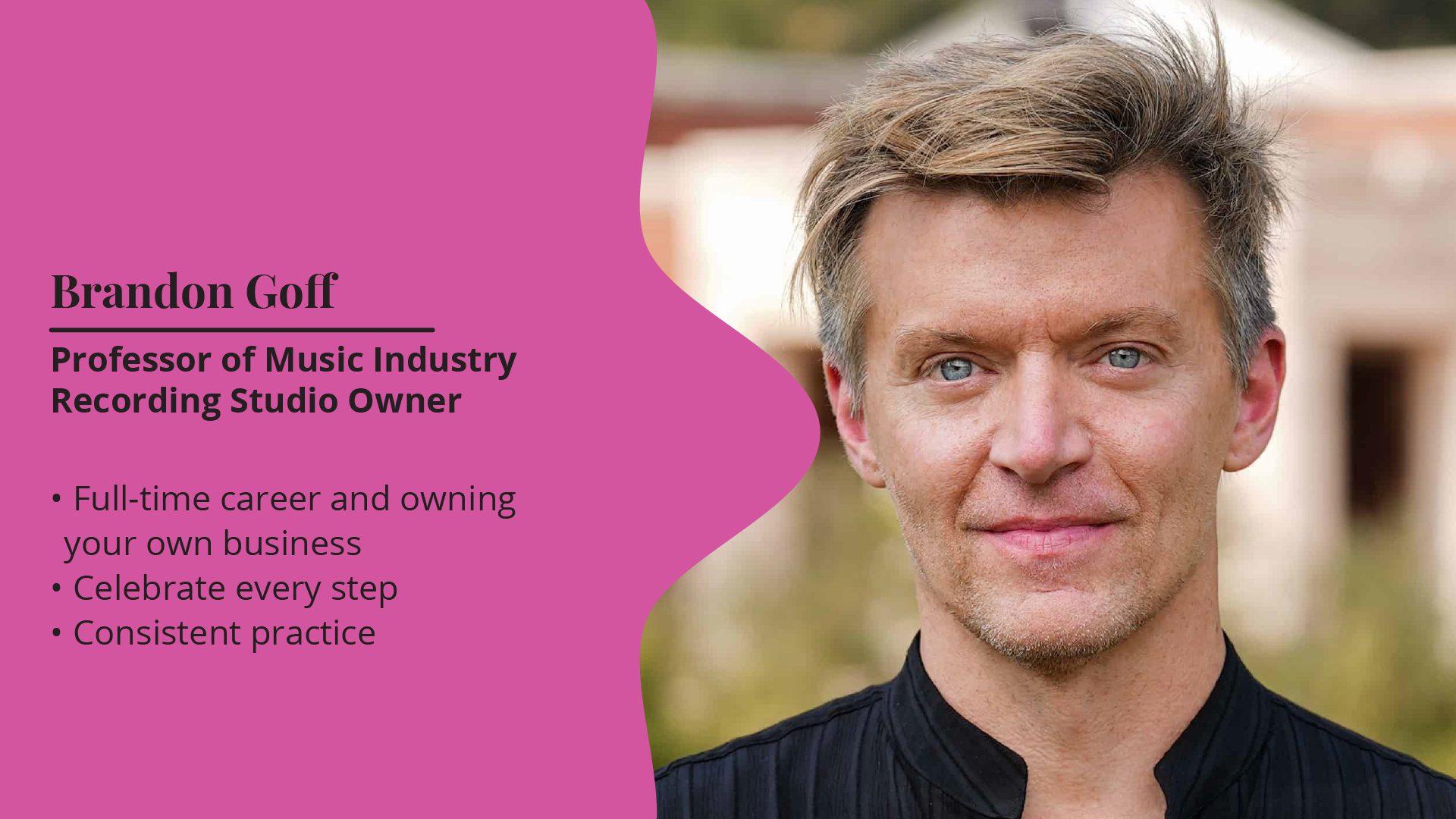
“I put in 30 minutes of practice every day, whether it’s guitar or composing. It’s like exercise 30 minutes a day goes a lot further than five hours once a week. It keeps your brain engaged.”
Brandon Goff is a composer, producer, engineer, performer, and professor of Music Industry at Francis Marion University in Florence, South Carolina. As a Memphis, Tennessee, local, he attended Rhodes College where Goff’s creative path began. This path has taken him through academic and professional music spaces across the U.S. and abroad. With a PhD and a background in music composition, he believes in celebrating every step of creative growth, whether that’s writing an album or landing a gig. His career is a witness to persistence, curiosity, and the value of creative support systems.
Interview
Transcript
Emma Plutnicki 00:00
So, to start, what do you do for work, and where are you currently working from?
Brandon Goff 00:06
I mean, I do a lot of things to be fair, but I’m a professor of Music Industry in Florence, South Carolina, at Francis Marion University, which is obviously going to be the biggest chunk of what I do. But my, you know, my background’s as a composer, a producer, and an engineer and a performer does a lot of different aspects to being a professional musician, and you don’t always do just one. And I’m one of those people who do all those all the time.
Emma Plutnicki 00:27
Amazing. So how long have you been working as a professor, and then how long have you been doing all the other things?
Brandon Goff 00:35
I’m from Memphis, Tennessee, and I’ve been teaching on a university level since, oh my, it goes way back. I first started a Rhodes College, which is a really nice liberal arts school in Memphis, and then I moved from there to probably started teaching, you know, around 2003 2004 so it’s been a minute. Yeah, it’s been a while. Then I went to, like, around Nashville, at a place called Lambuth University, and then I came here from there, and I’ve been here since 2011 so I’ve been in South Carolina for like, you know, proper, 14 years now.
Emma Plutnicki 01:11
Okay, so what is one thing that you love about working as a creative in South Carolina, specifically, as opposed to in Memphis or Nashville?
Brandon Goff 01:22
Well, you know, I do. I—anybody who works in the creative, especially the music industry, is going to love Memphis and Nashville. These are two, like, major hubs of music industry. But along with that, from an academic standpoint, meaning from in the in regards to the education portion of what I do, it’s fun working with students who don’t have that grandiose expectation of someone who’s growing up in Nashville. I mean, these in the talent pool, it’s a misconception. People always think, well, everyone’s so talented in New York, London, Nashville, they’re always just like, let alone actually, mathematically, no, they’re not. They’re just surrounded by an industry which really kind of draws that talent out. So, one of the beautiful things about South Carolina, that I love is the talent pool is thick. It’s just as the talent pool is just as big as it is anywhere else. But there’s just less exposure to it, less exposure to your opportunities, your potential, to chances you can take that you don’t realize you can because you’re not in one of those big music hubs. And I do, I really do love that. Actually, I do. I do enjoy that a lot.
Emma Plutnicki 02:26
Yeah, that’s amazing. So, has South Carolina had any unique influence on your work specifically?
Brandon Goff 02:34
I mean, of course, yes. I mean, it would do, wouldn’t it? I mean, it’s the, I don’t feel, musically? How would I—there’s a, it’s a different—you know, I’m from Tennessee, in Memphis and Nashville. Everyone’s a musician. That is the thing that everyone does. You probably have an uncle who’s a songwriter. You might have another uncle who works for a record label, who’s like a, you know, a talent scout. And I kind of, I didn’t, honestly, I didn’t realize the rest of the world wasn’t like that until I moved here. When I moved to South Carolina, I was like, Oh, this isn’t like the major industry. This isn’t what everybody does. And so, in being steeped in a non-music focused culture is going to obviously be influential. There’s a complete different music culture here. There’s a different kind of nightlife culture, a different culinary culture. And so, I’m constantly stealing, like, little, you know, snippets of sounds and lifestyles and putting them in songs and putting them in, you know, pieces and stuff like that, which I think is as well you should.
Emma Plutnicki 03:37
Yeah, I love that. So how would you describe the local professional community within South Carolina?
Brandon Goff 03:45
In regards to music professionals? You know, again, you’re not in—there’s not, there aren’t a ton of recording studios. There aren’t just a ton of, you know, production houses and things like that. There aren’t a ton of publishing houses. There aren’t a ton of things like that. There are a few here and there and around. It’s more competitive getting into those spaces because there are less spaces for people to access. But one of the biggest, we’re still a big production state, in large part because we do, we still have a lot of arts funding, and we have a lot of massive churches that run big productions. So, I’ve had a lot of students who go work for big, big churches here in South Carolina who have productions that are equal to that, of, you know, equal to that, of like, a large performance venue. And we do have large performance venues, you know, Myrtle Beach, the coast has a lot of that stuff. Even Columbia has a few things like that, Green Velocity, nice stuff or something. A lot of students who have internships up there and stuff like that. And it’s just, it’s going to be, your churches are massive, and they have a massive production budget, so a lot of students will go work for the big churches, and a lot of students that’s like, that’s kind of what they want to do, because that’s like, that’s how they got into music this lot of in the we’re in the Bible Belt, so a lot of the students are picking up musical skills, and the gold concepts in church, and then end up wanting to go back there and kind of work in that church as a worship leader or as a production leader or something like that.
Emma Plutnicki 05:10
Yeah, makes sense. Very cool. So, within a creative career, it can be difficult to define success sometimes, because there aren’t always clear expectations. So how do you define professional and personal success within your career?
Brandon Goff 05:26
Oh, how you, know what I think—I tell this to my students all the time. Yeah and I suspect that depends on your personality type as well. But when I was quite poor, grew up very, very poor and actually I was not, I was not a high school graduate. I was a high school dropout. I dropped out of high school and got a job at a factory. And so, you gauge your dreams and your expectations of success on the reality around you. So, as you accomplish something, you then gauge, well, my next level of success will be that. And so, like, at that point in my life, I was like, you know, my dream is to work inside a place that has air conditioning, because I was working at a factory that had no air conditioning in the South, so it was hot. So, but then as I, as you move forward, like, Oh, I just, I just wrote a song. So I want to write 10 songs. And you, so each one of those little accomplishments is a success of its own, but ideally, and you find contentment and what you’ve accomplished, but you also, it’s fun to see how far you can push what you can do. So, you’re always looking for a new kind of success, but then recognizing the success that you had as you move through it. So, I mean, if you’re a full-time musician anywhere, you are mathematically successful because you’ve done something that’s difficult to do. You’re making a living off of a craft, art, a passion that’s very few people get to do that, and so that’s already successful. But even if you don’t do that, even if you’re just someone who’s actually sat down and written an entire album worth of material, and that’s not what you do for a living that’s still incredibly successful, because very few people have the patience and the skill set and the focus to accomplish that. So, there’s success can be found in so many different avenues. And I think it’s important for—I always tell this to my students, to recognize that and to reward yourself emotionally and psychologically for those successes, regardless of the monetary outcome that you might receive.
Emma Plutnicki 07:28
Yeah, that’s a great way of framing it. So, did you have any fears going into this career, or were you…?
Brandon Goff 07:35
I mean, I was too stupid to be scared like I didn’t know. I didn’t I mean, I didn’t know I had then that’s, that’s a benefit of youth, isn’t it? Like, no, I’m gonna, I mean, I’m gonna do this because I don’t know that I can’t do this. And it’s amazing how when you don’t know you can’t do something, that you kind of put your all into it, and all of a sudden, you’ve done it when everyone else knew you couldn’t do it. And it turns out you could do it all along. So, you’ve kind of got to the ignorance has its role there some level. Or, you know, unabashed arrogance helps as well. Because I’m going to do this no matter what, I’m just going to push through it. Just stick to it, even if you know you can’t do it, just convince you commit yourself you can.
Emma Plutnicki 08:18
Yeah, and was that something that you just found within yourself, or were there people along the way giving you advice?
Brandon Goff 08:25
I mean my undergraduate, you know, actually, my undergraduate degree is in music composition, so it’s not even music industry. Music industry is a lot of what I do, but that was just the nature of being a musician in Tennessee, where there’s a massive music industry. And I got into the music industry because I was one of the first people who was using computers to produce music, and so studios would call me to come do that kind of work, and that just opened the door for me. But again, I wasn’t, it wasn’t part of a grand plan. I was just, again, I was poor. I was, it was day by day. I was like, Okay, I need, I’ve got to eat tomorrow. So, I’m going to do this gig tonight. I’ve got to figure out how to make this happen. So, it was a constant. There was a constant, just a, you know, piece by piece by piece by piece by piece, and you kind of work it, work it out and make it happen.
Emma Plutnicki 09:10
Yeah, makes sense. Can you recall any times when maybe a mentor or professor within your degree maybe gave you some good advice, or even the worst advice you’ve ever heard?
Brandon Goff 09:27
I mean, I say advice, perhaps not advice so much as just support and belief. And that was very meaningful for me when I was, when I was an undergrad, you know, I had a professor who thought that I was very, very bright, and therefore gave me a scholarship to learn a new piece of software that the university had acquired. And that software turned out to be a thing called Pro Tools eventually. So, I was one of the first people who knew how to use this particular software thing called Pro Tools. And so that particular belief and my ability to do that changed my life dramatically. And then, when I was doing that PhD, my PhD professor just really loved my music, loved what I did professionally, and as such, would often, he was a very, very famous composer, would bring me along, would program my works on big concerts across like Europe and from Turkey across, you know, through France and such. So that gave my work massive exposure that I would not have gotten, if not for a particular professor who saw something in me and really, really took it upon themselves to push me forward, if you call that advice. But it was yeah, no, but it was both those, both those episodes were very, very life changing for me.
Emma Plutnicki 10:46
For sure, and with Pro Tools being really life changing in your life, would you say, or, I guess, could you describe a time or a project that you’ve worked on that has been very meaningful to your life? It can be a significant, I don’t know, project or piece that you’ve performed or written, or just anything that you feel has had a significant impact on your life and has really showcased your creativity.
Brandon Goff 11:13
You know, it’s funny, the most popular piece that I have, and it was not. It was never intended to be this way. I was, I was relatively new to South Carolina, and I’m a guitar player. I play lots of instruments, but my guitar is kind of one of my main instruments. I would do session work in Nashville as a guitar player, but I’m a composer. I’m a writer. And so, the concert band director said, Hey, Dr, Goff, we would love you to come in and play perhaps an electric guitar concerto, which is where you have, like, a large concert band or orchestra and with electric guitar as a lead instrument. And so, I thought, okay, great, I’ll let me find a piece that will be good. And so, I searched and I searched and I searched and I discovered that there were almost no electric guitar concertos that are in existence. I was like, Okay, this doesn’t really exist. So, I said, Hey, how about I just write a piece for you guys that you did this for me and for you. And so, I did this. It’s a piece called Full On Rumble. So, it was like, and I actually made it. I wanted to make it kind of tongue in cheek, if you know that phrase, I wanted to make it kind of like, I used all of the over the top guitar techniques from like, the 80s and 90s. They’re all like, all the, you know, the big hair guitar players would play, from Led Zeppelin to AC DC to Van Halen, all the, I threw it all in there. It’s kind of a kitchen sink piece. It has like every little nuance in it, kind of poking fun at, like, the absurdity of guitar solos and stuff, yeah. But everyone loved it, and it’s become, by far, probably 80 to 90% of my professional work is traveling the world, playing that particular piece with other orchestras and concert bands all over the place. I’ve done it in the past two or three years, from London to Portugal to Germany to Istanbul, all the way. It gets performed all the time. So that one piece, that one little weird thing where I was like, Well, I can’t find that piece much better. I better just write one, that was that, changed everything, that opened so many weird doors that’s still a lot of what I do is just manage the distribution, publication and performances of that piece.
Emma Plutnicki 13:13
Very cool. You said it’s called Full On Rumble. Full On Rumble
Brandon Goff 13:16
Yeah, F, U, L, L, on Rumble.
Emma Plutnicki 13:22
All right, I’ll have to check it out. And so nowadays, what does a typical work day look like for you?
Brandon Goff 13:29
It’s, I’m, unlike most musicians, I guess I don’t know. I’m regimented, because I have to be. And it’s taken, yeah, I mean, everyone deals with this. I guess you discover over time what times of day you’re better at certain things. Because when I first get up in the morning, that’s not the only time of the day that I have the mental acuity to like, to do all my invoicing and to send, like, do all my communiques emails, like, I’ve got about an hour and a half where I have the I have the emotional wherewithal to sit down and, like, okay, because I don’t, I don’t relish that. I love creating, I love producing, I love teaching, I love performing. But all of that is tethered to, like, if I’m doing the music for TV commercial, I have to then invoice that, and then have to go through and like, you know, I might have to do all kinds of clerical work behind that, and then send off demos to other places for public publishers. Yeah, it’s like, tons of legwork. So, I have an hour and a half of morning legwork. You have to do that every morning. Just get all that stuff done. And then I’ll always, always put in about 30 minutes of just practice. And we can practice guitar, or could be practicing composing. It is just like, just like exercise, which I do as well. But I do that because it just keeps your brain engaged. You know, 30 minutes a day goes a lot further than five hours one day a week. So, I always do that. Then all my classes are always in that little mid-day chunk, and then I do a lot of production work late in the afternoon, a lot of like mathematical studio stuff I go through and take pieces I’ve worked on and start working on new mixes for them, for release and things like that. Yeah, I know those, the times a day, like times a day when I am most effective for those arenas. If that makes sense.
Emma Plutnicki 15:11
Yeah. You have to know yourself.
Brandon Goff 15:15
Yeah, you did. It takes a long time too.
Emma Plutnicki 15:25
Yeah. So how are you able to, you know, balance work and life, and just keep your creativity at you know, just keeping it alive, because it can be hard, you get bogged down and other things. So how do you keep that work life balance?
Brandon Goff 15:31
Oh, wow, that’s man, that’s enough. You know, work life balance. And these are generational concepts. When I was young, I don’t know that anyone ever really discussed work life balance. So that was the kind of, I’m sure we had issues with it. We just hadn’t figured out how to name it and, you know, manage it. So, if you do something that you really, really enjoy, if it’s the kind of thing you would do, whether you’re getting paid for it or not. That is a beautiful, beautiful thing, but it’s also rife with its own challenges, as you can imagine, because you’re never really off work, and that’s one of the biggest challenge for me, is to disengage with what I’m doing and find a way to tune it out, you know, after, say, 8pm so that I have a shot in hell of sleeping, which is my dream scenario where my brain isn’t frantic at 10pm and like I’m asleep before to 2am I’ll be great, difficult to do, because it is you do what you—it’s what I’m thinking about, whether I’m working on it or not. Like I often, like, in the summers, when I have the rare weekend where I can, like, not do music and go mow my lawn, I’m like, wow, that was amazing. I went and mowed a lawn, and I’m done, and I’m not thinking about my lawn now, like, I like that. I like that. You can put something to bed. And as a musician, you rarely get to do that. You’re just, it’s always doing and you have to. I—so I’ve called it work life balance, so much as just because you love music. And music’s everywhere. So, every time I turn on a Netflix show, there’s a piece of music in there that I’m like, Oh, I could steal that idea. I could do—and so everything’s research, so it’s difficult to pull away from that. So, I’ll often listen. I’ll often dive into, like, some sort of talk radio, because it has no affiliation to my career whatsoever. And it just kind of helps bring me, pull me away from that, that whirlpool of creativity.
Emma Plutnicki 17:38
Yeah, that must be hard, because music is everywhere, and it’s just part of life. Which is good and can also be challenging. But you’re right. As we just wrap up, are there any, is there anything else you’d like to add, or any questions you wish that maybe I asked that I didn’t?
Brandon Goff 17:58
I don’t think so. Thank you. That was a really nice selection of questions. I mean, it’s, my colleagues often call me—they say he’s kind of workaholic, he’s kind of hyper, and I am kind of hyper, and I can’t appear to be a workaholic, because I do love to perform and I love to write and I love to write and I love to produce. These aren’t all the same thing, but there’s absolutely no reason you can’t pick one of those things and be that. Be that thing. One of my best friends is one of our piano faculty here, and he’s just a concert pianist, and that’s all he does. But, and that’s a beautiful thing. If I just performed, I think I would lose my mind because I want to write as well, but I also love being in the studio and like, you know, stacking guitars and laying things in and making a nice product, that’s my particular passion. Is that diversified approach to a career, but it is by no means I don’t know what I would even suggest that to every student, because that said that it’s a challenge, and that’s it. That suits my personality, that suits the way that I work, pretty well, but I suspect it’s not the best fit for most people. I suspect I’m a minority in this that that arena. It’s hard to say.
Emma Plutnicki 19:17
Yeah, hard to find a balance, but amazing. Well, I’ve loved hearing your story, and thank you again for taking the time to speak with me. Last thing is, do you have anybody that you think would be great for us to interview another professional in the creative space? I could give you some time to think also and shoot you over a nominations link.
Brandon Goff 19:43
Yeah, please do. I know a lot. I know a lot of great creatives.
“Keep creating, no matter what. So, use what you do in your personal time make it structured and professional, because it will translate to a career that’s awesome like this.”
Akai Shelise Jones is the Visual Digital Media Director for the South Carolina Department of Juvenile Justice, where she blends creativity with purpose to tell powerful stories of change.
About
As the Visual Digital Media Director for the South Carolina Department of Juvenile Justice, Akai Shelise Jones is a one-woman creative powerhouse managing storytelling, strategy, and communications across the entire state. With a background in foster care social work, Akai brings deep compassion to her role showcasing the humanity and potential in the youth and staff who make up DJJ.
Her days are anything but predictable. From documenting community graduations and capturing employee morale moments, to managing a full website migration and crafting digital campaigns, Akai does it all. She’s the creative force behind impactful internal and public-facing content, including the agency’s social media presence.
But her work goes beyond design it’s about visibility. “Getting the right stories out,” she says, especially those of staff who’ve served for decades or young people ready to transform their lives, is the heart of her mission. One of her most meaningful projects, a video following a formerly incarcerated teen touring South Carolina State University, earned thousands of views and even more community impact.
Akai’s advice to emerging creatives? Be bold, job shadow, and structure your personal creativity into professional frameworks. She urges young professionals to look past job titles, seek mentorship, and remember that every skill from TikTok videos to podcasting—has real-world value when refined with intention.
For Akai, this isn’t just a job, it’s purpose-driven communication. And in her lens, every youth deserves a new narrative.
“Even though it’s in the arts… being able to afford taking a day off has been huge for me lately.”
Cynthea Kelley is a Nashville-based audio engineer and performer. She balances technical work and artistry in the dynamic worlds of music and gaming.
About
Cynthea Kelley is a Nashville-based audio engineer, musician, and performer who has steadily built a multifaceted creative career. Whether she’s editing music for Fortnite Festival’s Jam Stage or performing with a wedding band, Cynthea’s days are shaped by adaptability and artistry. Since graduating from Coastal Carolina University, she’s been on a mission to forge a sustainable creative life.
Her work with Fortnite editing tracks to seamlessly blend vocals and instrumentals for in-game mashups, is one of her proudest achievements. “It’s kind of been like a dream job,” she said of the experience, noting the prestige: she’s working with a globally recognized brand.
Success, for Cynthea, is defined by doing what she loves while sustaining her well-being. That means financial stability, creative control, and learning to set boundaries in professional relationships. “How do I want to be treated in those [jobs] as well?” she asked.
Through her journey, Cynthea has embraced the balance between rest and hustle. She encourages other creatives to stay persistent and remember that professional fulfillment includes both passion and self-care.
Brooks Leibee is a media composer for TV, film, and interactive media, currently working out of Myrtle Beach, South Carolina. He describes his role as “virtually building assets that go into another digital process” and is excited by the growing creative community in the region. Originally a filmmaker, he discovered his love for composition during college and now collaborates with local musicians and studios. Leibee defines success as “being happy doing what you’re doing” and believes strongly in the value of creative work in the digital age.
About
Brooks Leibee is a media composer for TV, film, and interactive media, including games. Based in Myrtle Beach, South Carolina, this is his first year venturing into the field full-time. As one of the few composers in the area, Leibee says the role is niche and the community small, but close-knit. Myrtle Beach’s scene is mostly commercial (ads and promos) but narrative filmmaking is slowly gaining ground, particularly inland South Carolina.
Leibee defines success as simply being happy doing the work. Starting out, he worried about location, resources, and industry connections, but says the flexibility of his job now makes it possible to score a Hollywood film from a home built studio. His favorite project so far was a gothic horror short film he scored last year. It featured a cello choir of local musicians from Calabash, NC, and was recorded at Sunset Beach Recording a highlight of regional artistry and collaboration.
Leibee says he “lives in his calendar” and likes to do what is called spotting session, where he and the filmmakers decide how music should support the story. Each project, whether film or interactive, has its own unique rhythm. Leibee, who works from home, sees work-life balance as fluid. For him, it’s about making sure to step outside, reset, and take care of himself. “As long as it works for you,” he says, “you’ll find the balance.”
“You determine your worth and set your success. Don’t allow your success to be set on what others think of you and how others perceive you. You determine that, so you won’t have expectations from the world, but you can set your own guidelines and your own expectations.”
Angela Smith is a Georgia-based entrepreneur, publisher, and podcast host empowering global creatives through storytelling, collaboration, and resilience.
About
Angela Smith is a passionate publisher, entrepreneur, and podcast host who built a global creative platform rooted in resilience and connection. Originally from Anderson, South Carolina, Angela now operates from Georgia, where she leads a vibrant virtual community of authors, educators, and storytellers through her publishing business and multimedia network.
Her journey began in 2012 but took flight in 2016, gaining momentum during the pandemic. She publishes books, produces a live-streamed podcast six nights a week, and collaborates with a diverse team of nine hosts across the U.S. and abroad. Her work emphasizes “connection, collaboration, creativity, and community,” values she instills in her signature initiative the 100 Authors Movement.
Angela’s days begin at 4 a.m. with prayer and self-care, grounding her spiritually before diving into a range of creative tasks. She defines success not by numbers, but by impact: “Seeing individuals that I’ve worked with go beyond what they thought they could do, that’s success.”
“The money will come and go, but the impact you make on people’s lives that’s the real success.”
Jenny Powers is a Myrtle Beach-based music marketing strategist and founder of Blue Avenue Music Group, empowering independent musicians to thrive on their own terms.
About
Jenny Powers is the founder of Blue Avenue Music Group, a Myrtle Beach-based music marketing and artist management firm supporting both emerging talents and Grammy-nominated acts. With 15 years of experience managing the reggae-rock band Treehouse and seven years leading her company, Jenny brings an unshakable commitment to artist autonomy and ethical music business practices. Her work spans content planning, tour logistics, block chain distribution, and rights management advancing the next generation of independent musicians.
Born and raised in South Carolina, Jenny comes from a deeply creative family. Her sister co-founded the country’s longest-running girls’ rock camp, and her brother has been touring for nearly two decades. “We’ve always had the philosophy of bloom where you’re planted,” she says. This grounding has helped her shape a unique career path outside major music hubs like LA or New York.
Jenny’s day-to-day involves everything from preparing music releases to helping artists understand their contracts and protect their publishing rights. She has taken a leading role in changing how music is marketed pioneering new technologies like direct-to-fan block chain distribution and serving as VP of Community at Artist Hub.
What sets her apart is her fierce protection of independent artist rights. “With every step, someone wants a cut,” she explains. “By understanding your rights, you gain autonomy over your career.” Jenny’s mission is clear; to ensure musicians know the business behind their art before someone else takes control of it.