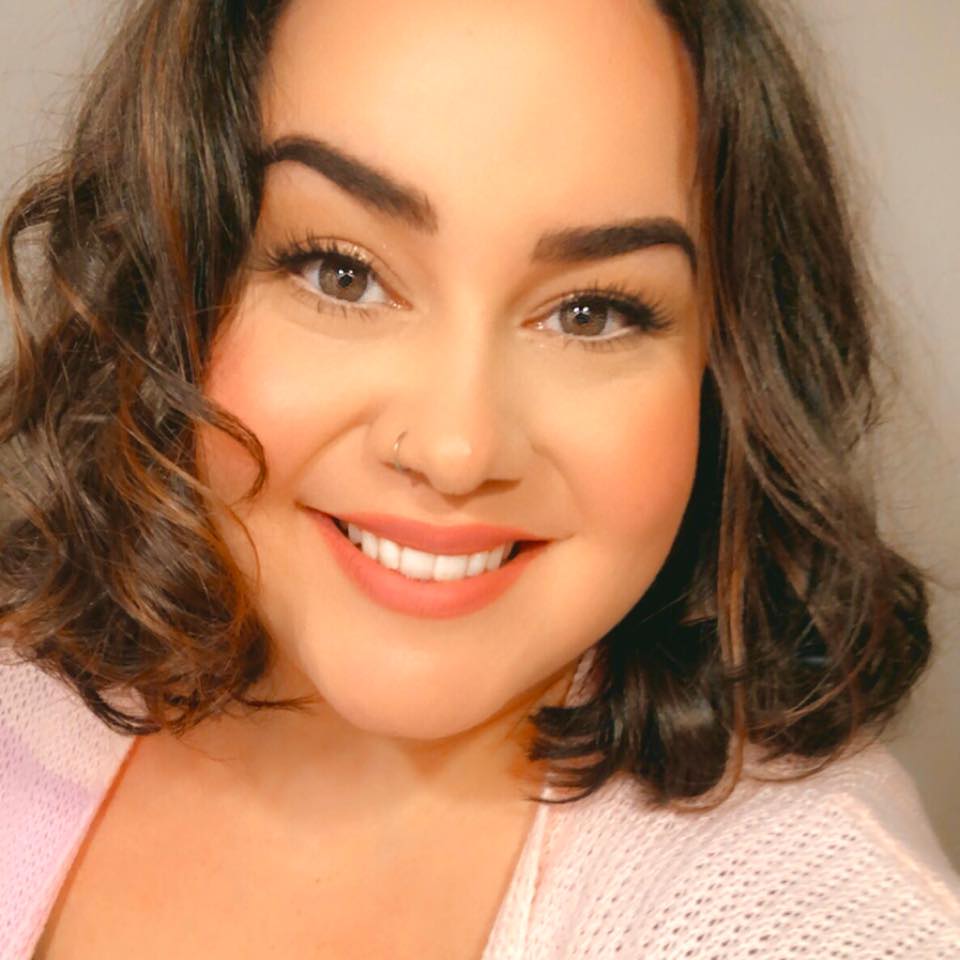
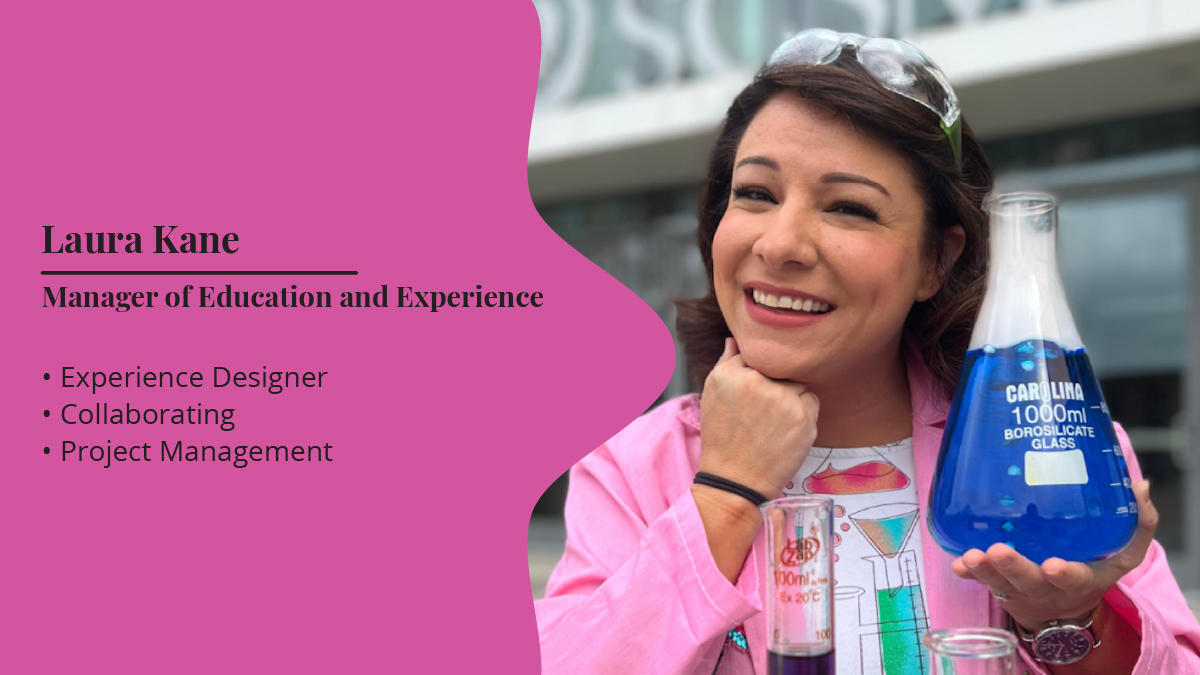
Laura Ybarra-Kane, a native of Columbia, South Carolina, is the Manager of Education and interpretation planning at the South Carolina State Museum in Columbia. She holds an Anthropology of Education in Museum Studies degree from the University of South Carolina.
Laura Ybarra-Kane, a native of Columbia, South Carolina, is the Manager of Education and interpretation planning at the South Carolina State Museum in Columbia. She holds an Anthropology of Education in Museum Studies degree from the University of South Carolina.
Interview
Transcript
Laura Kane 00:00
My name is Laura Ybarra Kane, and I am from Columbia, South Carolina.
Emma Plutnicki 00:03
What do you do for work? What’s your official job title?
Laura Kane 00:10
Yeah, so, my job title changes every year, I feel like I’ve got a new one. My official job title is Manager of Education and Interpretation at your South Carolina State Museum. And I say “your” because we are your state’s Museum, which means I am a public servant; I am a state employee. And, what I do is all things education and interpretation. Now, a lot of people think interpretation, they think Spanish language, and a lot of times when they see the last name, Ybarra, they assume that I’m Spanish language interpretation, or they think it’s ASL interpretation. And that’s not necessarily what I do, even though both of them end up being part of my job.
So, interpretation in a museum means looking at all the exhibits and all the things that you come into contact with. The front desk, the main lobby, the videos that you come into contact with. Even the movies, the planetarium, the 40-theater, the observatory, all of our science and steam and history and social studies education classes. Everything you come into contact with, whether it’s physical, or just learning or something. It’s me and my team. And we are in charge of – what is your interpretation? What’s your experience of that? And a lot of other museums, you’ll see my title as Education and Experiences, because that’s really what I’m typically in charge of is, what’s your experience like when you get here. And I put on a bunch of different hats figuratively when I’m doing these things, you know, sometimes I’m like, okay, if I’m a teacher, and I’m looking at this space, and how am I going to use it? If I’m a grandma with my grandchild, how am I going to use the space? If I’m a mom, you know, and I’m a new mom, where’s my access to my pumping station? And where’s my stroller going to go? Or if I’m a dad or just a guy, maybe I’m a Vietnam War Vet. What’s it like for me here, because we have an area where you press a button, and you can hear fake bombs exploding. Is that going to cause a PTSD issue? So, I have to put all these different hats on when I’m going through these exhibition areas and interpret that for them. That’s one part of my job.
Another part of my job is all educational. So, I like to tell people that if you’re a child, a teacher, a student, or a parent, or if it blows up, and it’s gross and explodes, It’s me. I have everything to do with that. So, I do all of our camp stuff. I have a colleague who I work with closely, she’s my assistant for all my camp things. We do camps, we do STEAM programs, some of our STEAM programs, you light the table on fire, and other ones, we have liquid nitrogen and dry ice, and we’re exploding things in the classroom and chemical reactions and everything. W
We also teach astronomy very heavily. So, we have a big blowup dome that we take to schools. We have a big, massive 145-seater dome here at the museum and observatory; we’ve got both. But we also have a little version that we can take to schools and do outreach with. So sometimes we go to festivals and things like that. So, we do all things education and inspiring wonder that’s the big part of that part of the job is educational content. And when it comes to the specific educational content, versus the experiential content, because those are a little bit different, experiential content, I can kind of do anything I want. Educational content, I have to follow state standards, state education standards. So, I’ve got my big binders over there that I look through all the time, and we’ve got our books, and everything. And we go through with our teacher and our principal hat on and our grant hat on, and we make sure that whatever we’re doing here is going to meet a standard. That way, a teacher can pull it and shoot it out to their PTO [Parent Teacher Organization] or whoever else might be there or even for grants; that way, they can get grant money and fund their field trip. So, that’s another part of my job.
And then, another really big part of my job is accessibility, and when we say accessibility here at the Museum, we really mean disability. I am in charge of all our accessibility efforts here at the museum. So, everything from our accessibility mornings, which are the second Saturday of every month, and they’re two hours long. We shut down the sounds in the exhibits, we have a sensory room set up, we’ve got special sensory bags, we have ASL interpreted shows, we have sensory shows, and all kinds of cool things. There’s a whole lot more characters and readings and all kinds of things. And then our yearly Disability Celebration Day, which is actually this Saturday, is really cool. It is our celebration of all South Carolina and South Carolinians of every ability. So, it’s a big free day. It’s all day long. And we have an adaptive artist come in, who makes spark tools for wheelchairs and walkers and things like that. So typically, folks who don’t get to participate can now participate.
We have a silent disco coming in from the Children’s Museum in the low country. We’ve got hands-on history stations, so people who are blind or have low vision can actually touch objects instead of just hearing about them. We have Ira on site, which is a Visual Interpretation Service for the Blind. So, they will log on to their phone and press a button, and a live person will take them through the museum and describe everything to them, which is amazing. Such a great resource there. We again have ASL interpreters here, and we work closely with the School for the Deaf and Blind, and we work with ABA therapy groups [Applied Behavior Analysis] and in DDSN [Department of Disabilities and Special Needs] and everything, so that’s another really big part of my job.
And then the other big part of my job. I have four jobs in one. The other really big part of my job is that I am also the liaison for the state for different educational resources. So, I go out to, like, next week, I’m going to Orangeburg County, I’m talking to every single principal in Orangeburg County. And I’m not only telling them what we offer, but I’m also asking them, what do you need us to do? What do we have to do here? It’s my job to go to the state house and talk about funding there. It’s my job to work with different organizations that might have some funding issues or maybe new exhibitions we can bring in to meet different needs that folks aren’t meeting. I connect very closely with EdVenturer, who is across the parking lot from me. And they’re the Children’s Museum over here. They do have an EdVenture over in Myrtle Beach as well. But it’s my job to connect with EdVenture and the Museum of Art, and the Zoo and the Children’s Museum of the Lowcountry over in Myrtle, the Sandbox Children’s Museum. So, it’s my job to connect with other museums and other non-formal education institutions around the state and around the country. I do work around the country and internationally. I have a site in Spain that I work with, and it’s my job to work with everyone and kind of see how are we connecting? What are they doing, so that we’re not duplicating it? And how are we celebrating and promoting everybody?
Emma Plutnicki 06:14
Amazing, sounds so exciting. So, where are you currently working from? You mainly work in the museum?
Laura Kane 06:20
Yes. So, this is my office. I’m at the South Carolina State Museum in the heart of Columbia, downtown. I share a parking lot with EdVenture. I share a building with EdVenture Children’s Museum, and I share a building with the Confederate Relic Room, which is a separate museum from us. I’m two blocks away from the Columbia Museum of Art. Five minutes away from Riverbanks Zoo and three minutes away from the historic Columbia area as well.
Emma Plutnicki 06:41
That’s amazing. So, how did you end up in this field? What background led you to it? And how did you hear about it?
Laura Kane 06:50
Yeah, so it’s really interesting. It’s a long, long story. So, I’ll try to make it brief. When I was a kid, when I was about four years old, we used to go visit my family in San Antonio all the time. So, my mom’s side is from Spain, and I was born in Madrid, but my dad’s side of the family is from all over Texas, and San Antonio, and Dallas. We used to go over there to see them. And, I remember very, very distinctly and clearly going into the science center that also had a planetarium, and Captain Picard from Star Trek was talking to me. And I was like, oh my gosh, this is amazing. Mind you, I’m four.
Emma Plutnicki 07:25
Yeah.
Laura Kane 07:26
And I went into this planetarium. And I was like, “this is it. This is what I want to do. This is amazing.” But I thought you had to be like an astronaut to do it. I didn’t realize you could go into education or anything. So, I was just blown away. I remember the event. I remember seeing it; I remember that little hair clip that I got. It was magenta stars, and they were sparkly, and everything. I remember it. So clearly. And I remember being like, I want to be a dinosaur astronaut teacher, which is a dinosaur that teaches in space from what I’m gathering in my four-year-old brain. So, you know, I go to school, and I love astronomy, and I love space, and all that other stuff and everything. And then I realized I didn’t really have; I had some good teachers, but I didn’t have a lot of teachers who supported me the way that I feel, like, as an adult, I really could have been supported, you know. And I love all the teachers and educators I work with. But there were some things that were missing from a kid who, quite frankly, needed some extra help, you know, and so I didn’t really have that person. So, I wanted to be that person.
So, when I got to college, I wanted to work in museums somehow and do these things. But I didn’t really know how and I didn’t know what the field was. I went into college with a bunch of different majors, but what I landed on was the Anthropology of Education and Museum Studies. And what I really specialized in was learning how other cultures and people around the world learn. And how do we gain knowledge? How do we retain knowledge? What do we value as knowledge, you know, and depending on where you are in the world, that’s vastly different. Brains are different wherever you go based on what you value.
And so, when I was 19, I was in the Anthropology Department. And they were like, “You know what, you’re really good at this kind of field here. Why don’t you go over here and just try this thing really quick.” So, when I was 19 years old, I started volunteering right here at the State Museum. I was giving tours; I was working with the curatorial team; I was writing these little tiny serial numbers on every single object, and in one of the collections, I had to practice writing on a grain of rice to get the number small enough, and everything it was really interesting. And so, I started doing all of that. And within about six months, they hired me part time to start taking the portable planetarium on the road. That was my very first paid job in the museum, was the Outreach manager or Outreach Coordinator at the time, not manager, and I would take all kinds of programs out to the children of South Carolina, some parts of North Carolina, and Georgia as well. And then, I was here for five years doing that and learning a lot of things about the field. I left for EdVenture for about five years, and I learned a lot when I was there. And I learned a lot about after-school programs and early childhood education school systems; I was, you know, EdVenture gave me the opportunity to work within schools. So that I could really understand what the teachers were doing. And then after that, after about five years, the State Museum came calling, and they said, “We want you back over here. And we want you to change the face of state museum education and education in South Carolina.” What are we doing here? We opened the planetarium, the 40-theater, and the observatory. And we needed someone to come in and really update all the resources. So, I came in, and I’ve been here for 10 years again. So, for about 20 years, I’ve been in the museum field, and it’s just kind of going full circle.
Emma Plutnicki 10:28
Amazing. Oh, my gosh. So, do you think it was challenging? Like getting into this career path? How do you handle challenges on a day-to-day basis?
Laura Kane 10:39
Yeah, I’ve worked with a lot of people, and museums are notoriously difficult to get into. The best thing you can do is just get your foot in the door. And most of the time, that’s going to be as a volunteer, unfortunately, and I don’t like unpaid labor, but sometimes you just got to get your foot in the door, which is how I started. But it’s really hard to get into these positions. When I opened up my full-time education coordinator position, I was looking for someone full-time to help me with what I do. We got hundreds of applications within a couple of weeks, and it’s very competitive. So just getting your foot in the door and just getting to know people is the best way to do it. In terms of how I handle challenges throughout… my daily basis. I mean, no, I tend to be a person who, just like I, compartmentalize a lot. And I organize a lot. So, if anyone is interested or does any project management, I’m very into project management. So, that’s how I organize myself. And I find that most of the time, that’s the challenge in the museum; there’s so much to do and not enough time, and everyone thinks their priority is priority. So, you have to be realistic about those, and you have to have very honest conversations. So, I kind of handle challenges by blocking them before they even happen. And then, once I do run into a challenge, it is just very honest conversations. We got to level with each other. And we have to be very honest about what is the actual priority? What’s coming down the pipeline? And let’s just move on and keep going.
Emma Plutnicki 11:59
Yeah, so you said it’s really competitive to get into the museum space. Are there any specific skills that an applicant should have to increase their chances of landing a role in that field? Or do you have a skill that you have that you find really helps you in your job?
Laura Kane 12:16
What makes me so good at my job is my ADHD [Attention-Deficit/Hyperactivity Disorder]. So, I have fairly severe ADHD. And it gives me the ability to work on multiple projects all at the same time, which is a huge strength, I also do really well with flexibility and adapting very quickly. So, I don’t do well, in a kind of monotonous sort of schedule, if you like things to kind of be a little bit more routine, and you’d like to be able to predict what’s happening. I struggle with that. So that’s definitely not a field that would work for me. However, I can tell you that my colleague who I share a wall with. She has that kind of schedule, she’s our Rentals Manager and she has a process for things that are a little bit more standardized because she’s not working with children, and children are by nature not going to be standardized, they’re all going to do something different, no matter how long you plan.
So, I think skills-wise, overall, what all of us have, you need to be really organized. There’s no such thing as linear movement or planning in the museum world. You can’t just make a checklist and go down it; it’s not going to work that way. I use a lot of what are called Kanban charts. So, you know, we kind of organize, organize ourselves in Kanban charts. I have three massive calendars on my wall that I’m looking at right now that I use all the time, they go out to 2026. So, we plan three years out. And then I also use a Q2 production planner. It quadrants off what priority levels things are, and helps me make decisions that way. And, that way, I can also express them to my team because I also do have full-time and part-time staff working for me. So, it helps me express that to them.
So I’d say organization, and then people skills. Even if you are in the back, and you’re one of the folks who like working with objects and you don’t come out onto the floor very often, I would say people skills are really, really important. Because even if you’re not on the floor all the time working with people, you’re still telling the stories. So, curators aren’t on the floor a lot. But they are the keepers of the stories here; every object that comes through, they have a story to tell in a tale to tell. And it’s their job to get to the heart of what that is. So, I would say people skills are the other thing and just be very comfortable making mistakes. You have to be very, very comfortable making mistakes. There’s not always a guidebook for everything that we do. A lot of times, we kind of come up with something that no one’s done before. And so, you just kind of have to say something like, alright, well, let’s all put our heads together and try to figure out what this is going to be today because I’m not quite too sure. And we just asked people. So, when I was coming up with our accessibility and our disability stuff, I didn’t really know how we wanted to do it. So, I just started sending emails to all of the disability and accessibility partners in the area and all these people that handle all these things, and I said, Hey, I’m Laura. This is what I do. This is what we would like to do. Tell me about what your life is like, and I just listened to them, and for the first six months since I started that project, I just listened, and I just heard what people were saying. And they would tell me what troubles and tribulations they had in the area, and I would say, okay, well, I think we could solve that. And then I would work with them to create something. So just listen.
Emma Plutnicki 15:12
Make sense. Yeah. And so, since you did say it’s so difficult to get into this space, are there any events, programs, or organizations within South Carolina that you recommend for people to kind of get their foot into the door?
Laura Kane 15:27
SEMC is the South Eastern Museums Conference. And SCFM is the South Carolina Federation of Museums. And both of those hold conferences, usually in the fall and somewhere in the state. And I’m trying to remember where the one is coming up this year, I think it’s in Lawrence County. And what’s really cool about those is something I’m actually working on with some of my staff right now. So, when I have staff, I’d have them write about their future job. And then I try to help them get to whatever that job is.
So, one of the things I’m doing with those folks is saying, well, these are the conferences coming up. And they have scholarship programs for new people, which is amazing. So, and that’s one of the things that I got started, I have an award up here somewhere from SCFM. Um. When I was in college, I got to go to that conference on a scholarship, so they paid for a free ride for me to go. Unfortunately, I couldn’t afford a hotel. So, I had to drive every day. But it was like a 45-minute drive. Oh, in South Carolina, nothing’s too far for us here. But yeah, those are the two professional museum organizations. And like I said, the conferences have scholarship programs for the young and up-and-coming; we call them N.E.M.P. So, you know, emerging museum professionals is what it’s called. So, there’s scholarships for those.
They also sometimes have happy hours in the area. So, if you’re in the Richland County area, or somewhere in the middle of South Carolina, we tend to have museum happy hours, like once every few months, and so you just meet other museum people. The other thing you can do is look at your area and see if there’s a museum Happy Hour, if see if there’s an informal educators meet up. I have to say that a lot of the time the parks and folks are really good at connecting and getting together. And even though it’s not a museum, it’ll still kind of get you into the same kind of field. And you’ll sometimes meet somebody like I’ve done, who also works in a museum. So sometimes you can connect in that way. So, that’s kind of a sneaky way to get in there. And again, just volunteering is a good way to just kind of just kind of get to know people. So yeah.
Emma Plutnicki 17:15
Yeah, that sounds great. Do you have a specific project that you find had a significant impact on you? Something that really showcased your creativity, or was a defining moment in your profession so far? It’s kind of a hard question.
Laura Kane 17:33
I have so many. If I died tomorrow, this is something I’m proud of, and I did really well. I would say one right now that I’m working on is the Disability Celebration Day. I feel like this is a really big mark to make, not just on the museum, but on the state as a whole. But when I was at EdVenture, we opened up a Makerspace. And, it was the first time we’ve had a Makerspace in this state, and we really spent a lot of our time just educating people about what Makerspaces were even though that’s not as big an impact as something like Disability Celebration Day, and we didn’t get as much notoriety and, you know, interviews and stuff like that. That, for me personally, was really special because it was the first time that I had done the full exhibit design, working with contractors, working with staff assignments, budgeting, doing a full budget and everything. So that one stands with me as the first time that I got to do a whole lot of experience and make a lot of mistakes. It’s also the first time that I created something where you can physically go there now. I can look across the parking lot and I can see the exhibition I designed over a decade ago. And there are still kids and families smiling and laughing and spending time together.
There’s something in the museum world that we call stay time. Some people call it some different things. But essentially, what it means is how much time people spend in an exhibition space or looking at an object, and usually it’s less than two minutes. So, it’s really quick; people go through stuff fairly fast unless you’re with a museum person that we’re going to talk your ear off the whole time. But when I developed that space, EDVenture with the team, it wasn’t just me. But you know, a lot of people, when we developed that space at EdVenture, noticed that the stay time for that area was upwards of 20 minutes, which is incredible. So, I think for me, those two, the exhibit over there that I take my daughters to now. So, I take her over there and we play in the exhibit. And, you know, we build things and everything. And I see all these families still enjoying stuff, and they see the creations that I made over a decade ago still on the walls and everything inspiring the joy of learning, right? And then the disability work that I’m doing now, I think, are the two stamps of my career that we’re the proudest of. Just because they have a very heartfelt impact and they were very needed at the time.
Emma Plutnicki 19:41
Yeah, I love that. That’s amazing. And so, just as we wrap up, do you have any advice for current college students or just young people who are pursuing a career in a creative profession?
Laura Kane 19:54
Yeah, just try it. Just try it. You don’t know. You never know. I was talking to a group of students with an Autism Society last week about this very thing. It was so interesting. The same day, I’m walking; I’m actually walking out the door to talk to a group of students with autism right now about this very thing. Just try it; you never really know. There are so many different jobs in the museum that you might not be the super crazy personality to do all that crazy education stuff; you might be a little more grounded and cerebral, right? And there are spaces for that, there are jobs for that, you have exhibits designers and fabricators, you have the store to run, managers, and people who are running the shop, you know. You have people who do all these big, huge, beautiful events like weddings, and all these other cool things, observatory events, and stuff. You have curators who tell stories, but then you have registrars who, you know, don’t tell the stories, but they take care of the stuff; they protect the items. Then you have people who do marketing, you know, all of that marketing brain that they’ve got to do, and you have fundraisers and money people, which I don’t I spend the money, I don’t make the money typically, but they do. So, they’ve raised all the funding that you need, you know, executive directors and board members. So, there’s so many different jobs just in one museum that I wouldn’t be afraid to just try it and see what you like because you never know what you’re going to stumble upon.
And every single museum you go to is going to be crazy, different, very, very different. And it’s not just museums; we call ourselves informal education. So formal education is a traditional cable classroom. But informal education is everywhere. Everywhere you go, there’s some sort of informal educator. So, like I said, you know, I work with EdVenture in the zoo, and the art museum, and the State House and everybody because they all have ‘a me’ there. And all of us have ‘our jobs’. And we’re all very different in how we do them. So just because I do it one way doesn’t mean it’s going to be the way that you do it. So just try it out. And then make sure you’re a good problem solver. I would go back to the skills that you asked me about before. And I would say problem-solving is probably the number one skill that we look for, again, because there aren’t always answers. So, you have to figure it out.
Emma Plutnicki 21:56
Yeah, I love that. Just overall, is there anything else you’d like to add?
Laura Kane 22:00
Yeah. I hope everyone you know finds their path in life. It takes a long time. Again, I changed my major 11 times because I had no idea that this was a field, you know, and anything I can ever do to help, I’m an open book. So, feel free to reach out to me and I’m happy to help do whatever I can.
Emma Plutnicki 22:17
Amazing. Well, thank you so much for talking to me today.