Career Area: Art School Coordinator

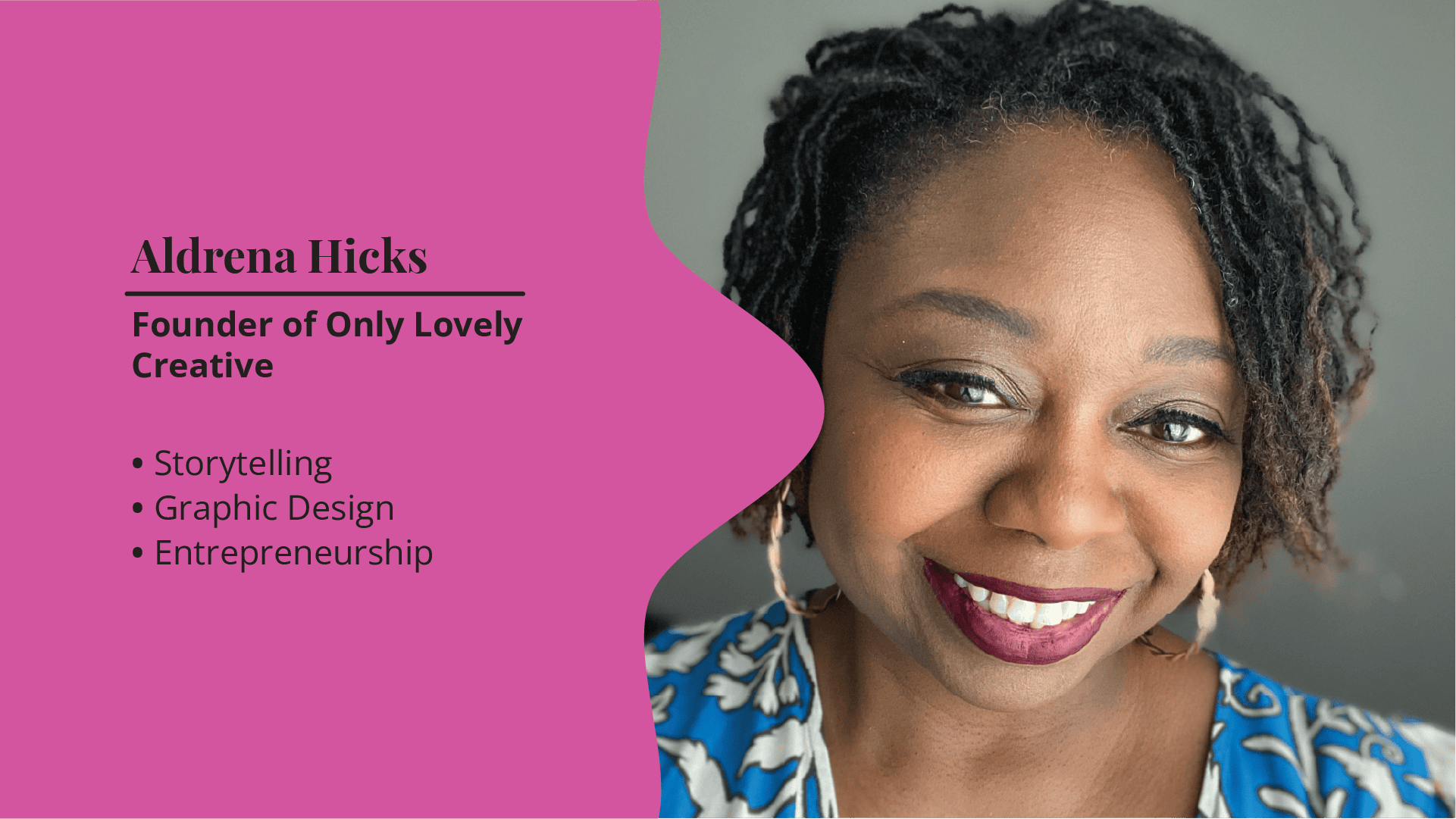
  • Aldrena Hicks

    Aldrena Hicks

    Interview

    Transcript 

    00:00 Victoria Bartolotto

    Hello everyone. My name is Victoria, and today we are talking with Aldrena Hicks. She’s a professional creative working from and within South Carolina.

    As we get started, can you tell us your current career and where you’re from?

    00:13 Aldrena Hicks

    Yes. So, my name is Aldrena Hicks, as she said. I am a maker, artist, creative director, and founder of Only Lovely Creative. So, I’ve spent the last 20 years working across higher education, nonprofits and cultural organizations, leading design work that blends strategy, storytelling, brand, and design thinking.

    My work ranges from large-scale public projects like the Briggs v. Elliott case. That’s a case that led to the big paved the way for the Brown v. Board of Education. Then to editorial work, like the stitch cover I did for Louisville Magazine, honoring Breanna Taylor.

    At the core of it, I’m always making, and it’s through Only Lovely. I do design weddings and experiences that feel personal and lasting. It’s things that people actually want to keep.

    So one of the things that is near and dear to my heart is also making sure I care deeply. I care deeply about who gets to be in these rooms. So, making sure the next generation of creatives, especially those that look like me, see a path forward and know that this space is a viable career.

    01:32 Victoria Bartolotto

    Wow, that’s awesome. That’s amazing work.

    Before we go into the nitty gritty details, we have a brief section of our interview called “One Career, Sixty Seconds,” where you kind of describe your job in an elevator pitch style.

    01:47 Aldrena Hicks

    Oh, that’s what I just did.

    01:49 Victoria Bartolotto

    Oh! Oh! It’s okay. If that was your script, that’s totally fine. We can continue, but that was great. I didn’t know if you had anything else.

    02:00 Aldrena Hicks

    No.

    02:01 Victoria Bartolotto

    No, okay. That’s perfect. Thank you so much. So as a graphic designer, as a maker, is there anything about South Carolina or your region in particular that brings some uniqueness to your work?

    Does it have any kind of influence on you?

    02:18 Aldrena Hicks

    Yeah, that’s a great question. So of course, I grew up in South Carolina, Somerville, Charleston area. Everybody knows Charleston, right?

    I come from a long line of makers. So, my grandfather was a brick mason. He’s actually paved some of the walkways with brick work in some of the plantations when they’ve needed somebody to redesign some or fix it up. Then also some of the walkways in the downtown Charleston area, I remember going. My dad would take us to visit him while he was laying bricks on those special pave ways and stuff. So that was nice. My grandmother was a seamstress, very well-known and well respected. Then of course, a family of musicians. All of that I bring into the things that I do.

    I’ve always been around creatives growing up. So just having that flair. What I try to do is then incorporate that identity into little nuggets here and there in the work that I do. But that’s why I’m hyper focused on when I’m doing stories, especially when I’m working with brides or organizations. I want to hear the story because that’s important, incorporating that into whatever we’re going to create for them.

    03:43 Victoria Bartolotto

    Definitely. I feel it really depends on who the person is in order to continue the project.

    03:48 Aldrena Hicks

    Yeah.

    03:50 Victoria Bartolotto

    Was there a defining moment in your life that had an impact on your creative journey, whether in education or just personal life? Was there anything that kind of marked that?

    04:00 Aldrena Hicks

    Oh, there’s so many. Which one do I choose?

    04:06 Victoria Bartolotto

    Any one! Any one!

    04:08 Aldrena Hicks

    I will probably say my experience with my graduate work. I am a graduate of Vermont College of Fine Arts, and I majored in graphic design. That was my concentration, of course, the MFA in graphic design. When I started there, I applied sight unseen.

    I was already in some other graduate programs. I bounced around a little bit, but nothing felt personal. Nothing felt like this is what I want to do. There was nothing wrong with those other programs, but I didn’t want to lean into the corporate world like that. I’ve already felt I was losing a sense of self because, as you know, when you’re designing and you’re doing work, it is about who you’re designing for. So, you kind of lose that, and I didn’t want that to happen.

    When I got to VCFA, I immediately fell in love because the school focuses on the work, the creative, who you are, and then that comes through. That typically doesn’t happen in this case, in cases of grad school work.

    So, the probably the pivotal moment is when, I was in a two-year track. Probably after my year and a half review, they’re like, “Aldrena, listen, girl, we love you, but we don’t see you. We don’t see, you’re giving us all the polish and that’s cute, but we’re here to discover the messy and you know, who are you?”

    After that little talk, I had my little cry and all that stuff. I realized, “Okay. This is the time where I need to shine and show and dig deep into who I am, my roots, my culture, and be proud of that.”

    From that came my thesis work, which has paved the way for other things that I’ve done since then. I will say that was probably the most transformative experience. I’m very proud to be a part of that legacy.

    06:08 Victoria Bartolotto

    That’s amazing. So, speaking of your thesis project, was that something particular that you produced that maybe showcased your creativity in a way that it never had before? What about it was different compared to previous work?

    06:28 Aldrena Hicks

    Yeah. So, I took the approach. I did weave in some research because that’s part of the requirements. I took the approach of creating a storytelling experience, because I told you storytelling is part of my thing. What I did was I explored how the media portrays black women and how we’ve influenced the media and culture. I wove certain pieces of history and then turned it back on to how it affected me personally, how it did as a creative.

    I studied and talked about hair, respectability, politics, and then skin, colorism and all that stuff. I then found ways to remember how those things affected me growing up and how I now advocate for, especially young black women and my daughter, to be proud of who they are.

    So yeah, the approach was different because I did a personal narrative, but I wove in some history and some research in that. It has won a few awards. I’ve written a children, a self-published children’s book out of that. So yeah.

    07:56 Victoria Bartolotto

    That’s really awesome. Especially just seeing that I’m a writer too. A lot of the times that I’m working on projects, it’s like seeing something grow from a tiny little seed into this huge thing. You have to step back and be like, “Wow. I did that. You know?”

    08:14 Aldrena Hicks

    Yeah.

    08:16 Victoria Bartolotto

    So before entering your field, maybe in your education process, did you have any fears about becoming a creative professional? If there were some fears, what inspired you to keep going beyond them?

    08:30 Aldrena Hicks

    I knew I wanted to do creative work. Like I said, grew up with musicians, makers and all that stuff. I never knew graphic design was an actual thing. I’ve been doing that, just didn’t know that’s what it was.

    So, I was at my undergrad, working at Columbia College, SC, not Chicago. When I discovered graphic design, I was like, “People make money doing this?” They’re like, “yeah.”

    So, I don’t think I was ever afraid of being a creative in this space. It was more of finding the right place to let that talent grow. Of course, through trial and error and all the careers and stuff, I quickly found out that advertising work is not my scene. I met some wonderful people and did a lot of things. But again, going back to the why behind things, the history behind things. So, then I veered into the nonprofit world. Now what’s scary now is that I’m doing this full time. So, it’s more like, “who’s going to get these invitations? Who wants to have brand work done?”

    09:53 Victoria Bartolotto

    Oh, wow. Do you have any advice for young adults or students who may have an interest in pursuing becoming a graphic designer? Are there any particular skills that you think someone should practice or at least have before entering the industry?

    10:08 Aldrena Hicks

    Yeah. One of the things I want to say is that, and I know people have different networks and all of that, all of that is great.

    I read a book along, I think I might have mentioned in my pre-interview, one of the books I recommend is reading is Talent is Not Enough, because a lot of people think talent will get you all the places, but it really is the soft skills, building these connections and learning how to relate with folks. It will show up in your work. So, make as many connections as you can.

    I know it’s hard because a lot of times you feel like people aren’t going to respond to you. But there are a lot of us out here who really love and want to reach back and help. I mentor. I’m still in touch with many of the students that I taught during my time as a professor.

    Do not discount your people skills. I know it’s hard when folks like love the internet, love being on Chat and all that stuff. That’s great. Still learning how to write with and without AI. Learning how to write, learning how to speak, learning how to read the room, that will get you further than just having a talent because you can be the most talented person in the

    world. If you don’t know how to relate to folks, you don’t know how to talk with them, get with them on a personal level or at least be professional about things; you won’t last long.

    11:45 Victoria Bartolotto

    Thank you so much for taking the time to speak with me today. This has been an amazing interview. Have a great day.

    11:51 Aldrena Hicks

    Thank you so much. You too.

    11:53 Victoria Bartolotto

    Bye.

    11:53 Aldrena Hicks

    Bye.
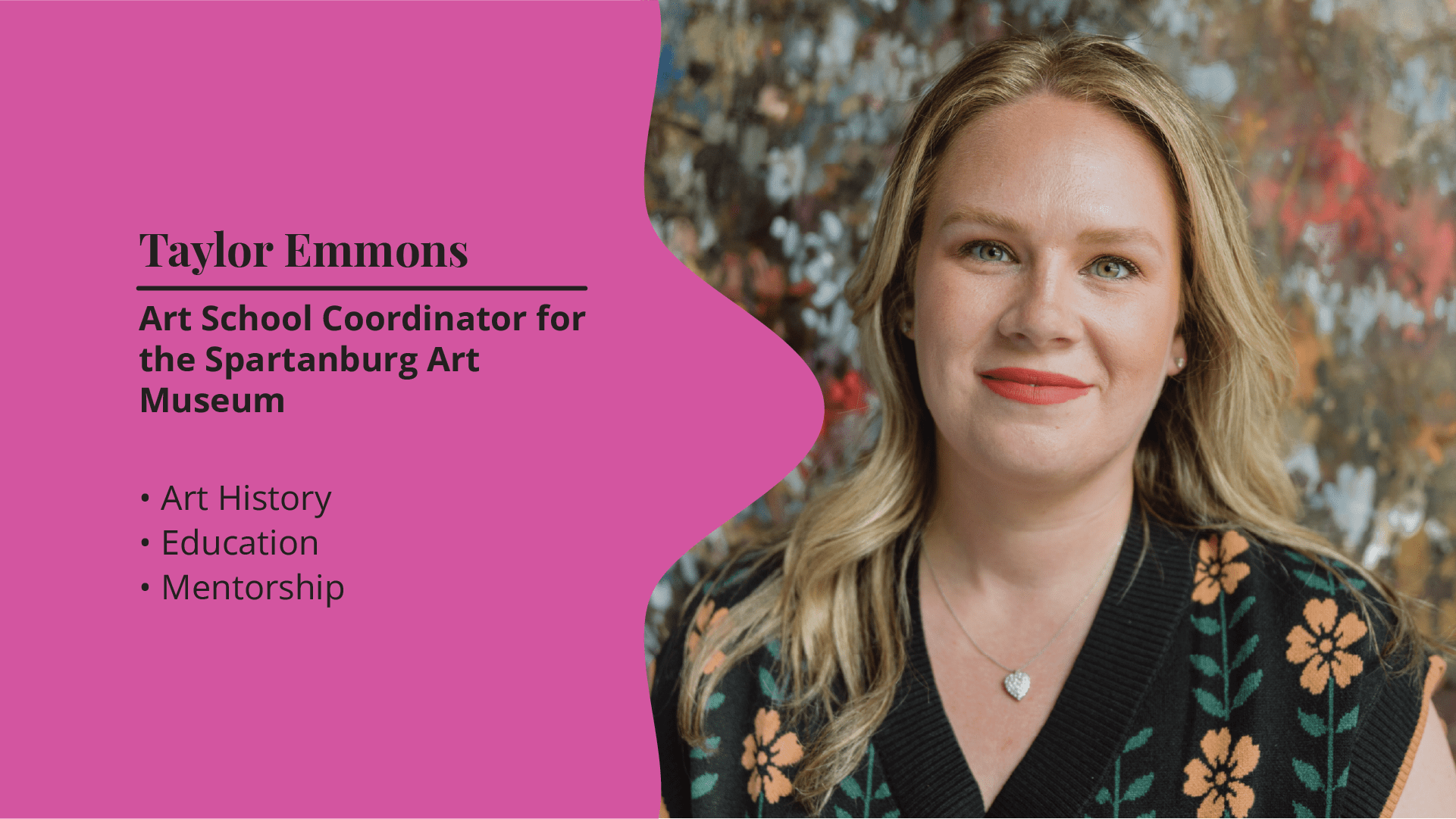
  • Taylor Emmons

    Taylor Emmons

    Interview

    Transcript

    00:00 Ryleigh Kelley 

    Hello, my name is Ryleigh and today we are talking with Taylor Emmons, a professional creative working from and within South Carolina. 

    As we get started, can you tell us your current career and where you are from? 

    00:12 Taylor Emmons 

    Absolutely. So I am originally from Orlando, Florida. 

    I grew up in the Central Florida area, and I moved to Massachusetts for grad school almost a decade ago. I’ve kind of lived all up and down the East Coast. 

    Currently, I am the CEO and founder of Tailored Impact, an art and culture firm. It is the first art advising and cultural strategy firm in Spartanburg County. We didn’t have anything like this before I created it. It’s really exciting to be in this space, and to be talking with you today. 

    00:46 Ryleigh Kelley 

    Yeah, absolutely. Okay, so before we go into the details of your profession, we have a brief section of the interview called “One Career, Sixty Seconds,” where you describe your job in sixty seconds or less, similar to an elevator pitch. 

    01:01 Taylor Emmons 

    Okay! I am a community-based art historian, and I focus on using art as a strategic tool to drive impact in mission. So, either that be economic mobility, creative placemaking, tourism opportunities. 

    My company can do that through a whole slew of different ways. It can be through curating a show at a gallery or in a public art space with traditional and non-traditional exhibitions.  It could be helping somebody build an art collection, whether it be a business, a hospital, or a private collector. It’s also through creative placemaking ways. So, thinking about how we can infuse art and culture into every aspect of where we live. 

    You and I both know, and people watching this know, the impact that art can have, but it’s often thought of as the afterthought, or if there’s time or if there’s budget, then we can include art. 

    I’m really interested in reframing that approach and thinking, “okay, so let’s put art at the very top for me always.” I understand it’s not everyone’s priority, even though it should be, but thinking like, “where can we include art earlier within the project?” 

    That way it could have impact or drive, and reframing the way that we think about art. That art is for all and that everybody should have access to art, and that it’s not just an afterthought or something nice to have or something pretty to look at. It can be used as a tool. 

    02:28 Ryleigh Kelley 

    Yeah, absolutely. 

    Okay, a minute and forty seconds, but I’m just going to say it was great. I will ignore the time because you had a really great answer. 

    02:40 Taylor Emmons 

    I had to talk about the, you said clock and I thought of like immediately I was like, “oh, clocks, unperfect, what is it called? Untitled Perfect Lovers.” I think that’s what it’s called. 

    02:52 Ryleigh Kelley 

    I think you’re close! In your profession, is there anything South Carolina or Spartanburg County in particular brings to your work? Does it have a unique influence on you compared to people in the same profession in different states? 

    I know that you mentioned that you’re from Central Florida. So how does that influence, especially in Spartanburg County and South Carolina, how does that weave in conversation with your work? 

    03:29 Taylor Emmons 

    Yeah, absolutely. So right now, I am hyper-local to Spartanburg County. That’s where a lot of my focus is because there is nothing, like I mentioned earlier, there is nothing similar to what I’m doing right now in Spartanburg County. I really see myself serving as the community-based art historian, but as a connector and as an activator.  

    Spartanburg has such a well robust and working artist scene. There are so many fantastic artists here. We have so many arts organizations, but there’s nothing that’s connecting everything together. There’s nothing that’s making us work towards one unified strategic goal.  

    At a lot of places, you would see somebody in an Office of Cultural Affairs. Or Greenville, which is right next door, has somebody who does art in public spaces. We don’t have anyone like that at a civic level in Spartanburg. I feel like I created this because I noticed the need, right? There’s two competing things going on at the same time, which is really fun, where it’s building this business, but then it’s also, “what would it look like if we built out infrastructure for arts leadership in Spartanburg?” 

    We have a museum, we have a cultural center, we have a ballet, a Philharmonic, a little theater, and they’re all very active. What would it look like to build out maybe something at a civic level, right? So that’s also some grassroots efforts that I’m working on in addition to building my business. 

    05:05 Ryleigh Kelley 

    Was there a defining moment in your life which kind of had an impact on this journey to this point? I know you mentioned your particular projects with your business and you know building that community outreach and especially to grassroots work. 

    Was there a particular project or something you produced which showcased your creativity in a way it never had before? 

    05:31 Taylor Emmons 

    Yes, yeah. I would say there was like a couple of things, but pinpointing one thing in particular, definitely my upbringing. I grew up in Orlando, and my mom was the volunteer coordinator for the Navy base. She was extraordinary. She would do these like superwoman things where somebody would come in and say like, “we need help, a little girl’s missing.” And she said, “okay, we’ll get a helicopter, and we’ll go find the little girl.” 

    And they would say, “Marcia, we don’t have a helicopter.” 

    And she said, “I know I’m going to ask somebody for a helicopter.” She would get a helicopter and then she found the missing girl, right? Like these heroic, really incredible things.  

    I studied art history in high school, and I fell in love with it. It was like the first thing that made me realize, “oh, I am not just one person. There is a larger world that I’m a part of and a larger history.” I’m just a moment in time and it contextualized things for me in a way that I had never experienced. I had this interest in art history, and then I had this mom who was like out there planting flowers on the highway I-4 in Orlando. 

    It was kind of my upbringing and then my educational interest that morphed into this community art historian focus where thinking about art in public spaces, art for all, everybody should have access to art, right? 

    You can go and buy a print and that’s starting an art collection. Like you are collecting art. We’ve overcomplicated it, to an extent, and we’ve kind of like gate kept it. It’s been held within a museum or Sotheby’s or an ivory tower where people are like, “oh, no, no, I’m not an art collector. I just have two pieces of original artwork in my house, but I’m not an art collector.” No, no, that is art collecting. You’re engaging in the process of collecting art. 

    You’re helping the local economy, you’re helping support artists; you’re engaging in this practice that we’ve kind of thought of as like, “no, that’s not for me.” 

    So, I would say those two intellectual interests and my upbringing were really helping to define where I’m going in my life. 

    07:39 Ryleigh Kelley 

    As you were carving this path, especially like with the combination of like the inspiration from your mother and then like your academic pursuits, you mentioned, in the ivory tower and the gatekeeping culture in art curation before you delved into that space, did you have any fears like entering into it? 

    You talked about like your mother, how she was able to kind of just like get anything done. If she put her mind to it, she could do it. What are other inspirations that inspired you basically to continue beyond those fears? 

    08:17 Taylor Emmons 

    Yeah, absolutely. I didn’t know that in order to work in the art world, a lot of people have great support outside, if you get what I’m saying, if you catch my drift. 

    I didn’t have that. When I went to graduate school, I went to UMass Amherst. They have a fantastic program. I can’t recommend it enough, and a fantastic assistantship program. I was able to go there completely on an assistantship where I taught, they paid for my classes, they paid for my insurance, and they paid me on top of it. 

    I was always looking for those sorts of opportunities. I wasn’t really in a place where I could afford to not get paid to work. So, internships had to be paid. I couldn’t take an unpaid internship. Most of the unpaid internships were in curatorial work and most of the paid internships were in like public outreach or museum education. So that’s where a lot of my internships were. 

    While I was in graduate school, I was lucky enough to get paid to work. So, during the semester, I could do the curatorial internships. But during the summer, I needed to get paid. That just had to happen. My scope of what I was working towards was a little limited. 

    Through that, being somebody in a museum space who couldn’t afford to work certain internships, it was an interesting dichotomy where I knew my stuff, and I knew about curation, and I knew about art history. I studied Islamic and medieval art and architecture, but I couldn’t operate within those spaces. 

    When I started this company, I was really intentional about making sure the mission and the values were, I’ve mentioned it a couple times, art for all, but I don’t say that as like a catch all, right? 

    That is something that’s really important to me because I was not able to do a curatorial internship always. I had to be strategic about where I went. And when you’re in those spaces, it can be difficult. 

    I think just reminding yourself that it is a moment in time and that things will change and constantly things are evolving. I think museums are getting a lot better with paid internships now, which is really exciting to see. I definitely was in a space even in graduate school where my experiences were a little limited. 

    10:45 Ryleigh Kelley 

    That kind of goes into the next question about especially with the piece of advice of like it is a moment in time and things can change. 

    Do you have any additional advice for young adults or students who have an interest in pursuing like a similar career to you in the creative world or some sort of combination and are there any particular skills one should practice or have before doing this kind of endeavor? 

    I know you talked about your experience in graduate school and especially to like, I think it’s interesting that you have a Master of Arts in Islamic and Medieval Art. We could talk more about the experience, too. But what is your advice for young adults or students who are thinking about doing this kind of work? 

    11:37 Taylor Emmons 

    There’s the skill set that you develop when you’re in your coursework and you’re in your seminars and your surveys and your writing and those skills are really important. 

    But for this particular career that I’m doing, I had to learn how to get out of my own way quickly. You are your own worst enemy. 

    All the cliches are really true when you’re engaging as a small business owner. You have to put yourself out there. I’m making videos for Instagram. I’m thirty one. I don’t know really what I’m doing. I’m still young, but in the social media world, I’m geriatric. I should go to like a nursing home. 

    I remember thinking, “I want to make a video.” We have Art Walk coming up in Spartanburg. I wanted to make a video about the three most exciting gallery openings for me or yada yada and why I’m going. I’m recording myself and I’m like, “stop thinking, just go, just act, stop doing.” Get out of your own way and get out of your own head. How I did that was a lot of just like grounding technique. And it sounds so like “woo woo,” but it actually works for me at least. 

    You’ll have to find what works for you. Really good therapy. I can’t understate it enough. I think that’s really important. 

    And surrounding yourself with people who are supportive and really just believing in your own reality, right? When I say that, when I started this business, I remember being uncomfortable telling people what I did. And then I was like, “no, no, no, I have to really own this because they will then buy into it, right?”  

    So, do your coursework, do your surveys, do your seminars, and do all of the studio art classes that you can do. 

    Then, also outside of that coursework, really work on the internal stuff because that’s what I found has allowed me to then push it, right? Like I know my stuff, I know my art history, I know my dates, I know my mediums. But if I don’t get out of my own head, nobody else is gonna know that I know that. If I don’t start putting myself out there, then it’s not gonna happen. So that’s the advice I would give. 

    13:47 Ryleigh Kelley 

    I really resonate with the get out of your own head. That is like the story of my life, just like everything. So, I resonate that with a lot, especially to I appreciate how you touched on there’s the practical, the techniques and all that coursework you have to do, but also you got to apply that same effort and energy into yourself. 

    I think that’s very valuable for young creatives to hear and to also just reflect and think about.  

    I’m curious to know a little bit more about just like more about your graduate school experience in terms of pursuing a Master’s in Islamic and Medieval Art. Could you touch a little bit more just about that and how did you end up doing that? How did your interest begin with that? 

    14:45 Taylor Emmons 

    Yes, absolutely. So, the interest was completely accidental. I had no experience in Islamic Art at all. Like in the survey book, you kind of go through it, but it’s just like a little blimp, maybe a couple pages. 

    I was signing up for classes in between like the add-drop week in undergrad. I was using my phone, and this was like a decade ago. So, the app wasn’t all flushed out like it is today. And so just saw briefly, it said ‘Visual Cultures’ and I clicked on it. I was like, “I signed up for that class, met my requirement.” 

    I showed up for the first day and it was Visual Cultures of the Islamic World. This professor walks in, this art historian walks in, and she says, I’ll never forget: she’s like, “I’m sorry if I forgot how to speak English. I was in Turkey all summer.” 

    And I was like, “what is happening? Like, where am I?” By the end of the class, I was hooked. I was just hanging on every word that she was saying, and she was so mesmerizing. 

    She was from Istanbul and the way that she spoke about her hometown, which is kind of crazy to say that, but yes, that is people’s hometown. To just hear the way that she talked about art, and she thought about art, specifically Islamic art, I had never experienced before and I was mesmerized. 

    After that I was like, “I have to take every class that this professor offers.” I took all her courses. She was a huge mentor, advocate, and champion of my work. She allowed me to; I received this grant to study abroad in Paris. And while I was there, I got to conduct research. 

    Then I came back, and I turned it into this huge project and presentation that I then was awarded an opportunity to go to Capitol Hill and present that research. Without her mentorship, that would have never happened. 

    I would have never conducted international arts research and then come back and presented it on Capitol Hill, with the representatives asking me questions, which was incredible. She allowed me to the opportunity to go to Oberlin and be a visiting scholar there when I was an undergrad. She really championed me getting into graduate school. She helped immensely. 

    While I was in graduate school, I went to UMass Amherst, like I mentioned, and I studied under Walter Denny. And he is known as the carpet guy in the field of art history. So, he studied and wrote the book called How to Read the Islamic Carpet. It was published by the Met, and he completely was a pioneer in that field in the carpet world. 

    You adopt the love of these professors that you admire. It was fantastic. Then I got to travel to Istanbul three years ago with my undergraduate advisor and we got to be together. 

    It was amazing to be in these spaces, in her hometown, with the architecture that she taught me about, and walking through them. I saw my graduate advisor, I saw Walter’s, one of his pieces that he wrote about these blue tiles. Being there with her was really magical. I love Islamic art, yeah. Yeah, that’s so surreal. 

    18:11 Ryleigh Kelley 

    That’s just so interesting that it just happened completely on accident. This is how beautifully it unfolded. Well, thank you so much for taking the time to speak with me today. 

    18:26 Taylor Emmons 

    Thank you so much, Ryleigh! This was great. 

  • Taylor Emmons

    Taylor Emmons

    “Start, even if you are unsure of where.”  

    Quick Facts

    Level of Education: Graduate School

    Years of Experience: 10 Years

    About

    Taylor Emmons is the Art School Coordinator for the Spartanburg Art Museum, where she weaves in art and culture “into the fabric of all facets of life.” After graduating with a BFA in Art History and an MA in Islamic Art, she established her own LLC to blend academic rigor and community into art history.  

    Her academic pursuits, combined with her personal experiences, helped shape Emmons’ interest in community-based work. As a working mom, and the daughter of working-class parents, her passion for the arts is rooted in her own memories. “My formal academic training gave me a unique skill set of looking and training my eye to be able to identify style, medium, time period, and artist,” she says, “but my life experience shaped my interest in community work.”  

    Emmons aspires to use her platform as an art historian to emphasize the inclusion of arts into everyday life and cultivate communities that celebrate diverse upbringings and experiences. “When I started to study art history, I was confronted with the stereotypical questions, ‘what are you going to do with a degree in art history?’” she says. “I have taken that question and turned it into ‘what can’t I do with a degree in art history?’”