
Audio
Transcript
00:00 Ryleigh Kelley
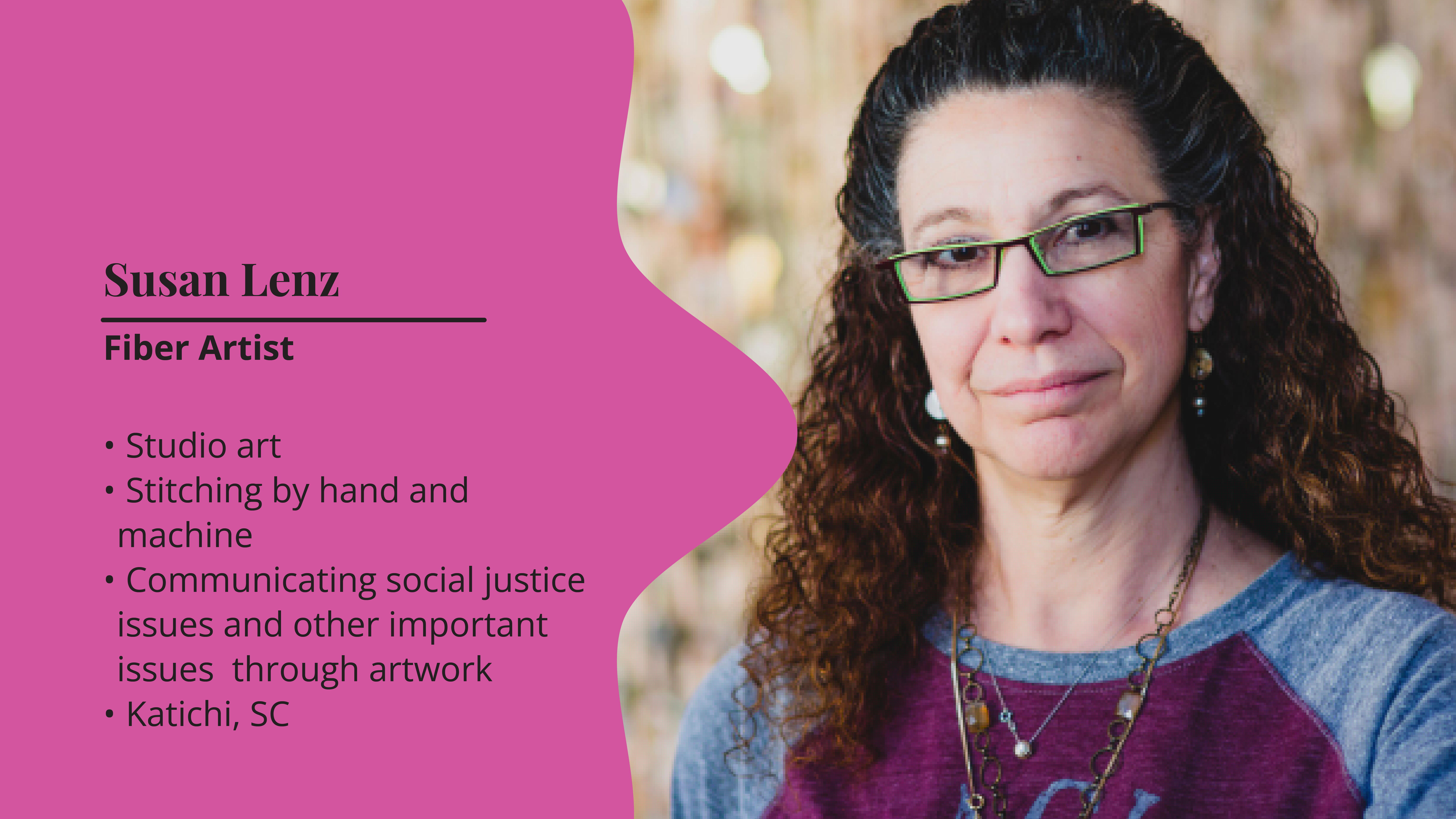
Hello, my name is Ryleigh and today we are talking with Susan Lenz, a professional creative working from and within South Carolina. As we get started, can you tell us your current career and where you are from?
00:12 Susan Lenz
I am a professional studio artist working with fiber and installation. My studio is part of my large structure here outside of central South Carolina in the former textile mill village called Katichi.
My husband and I bought the old union church, and had former Sunday school rooms and offices converted into our living area. Now my studio is literally sanctuary sized. It’s wonderful because it allows me plenty of space to spread out and work in sizes that would have been difficult in a smaller situation.
01:02 Ryleigh Kelley
Lovely. Before we get into the details of your profession, we have a resection of the interview and it’s called “One Career, Sixty Seconds,” which you kind of started doing just a little bit now, but this is where you describe your job in sixty seconds or less, and it’s similar to an elevator pitch. It is timed. I have my phone on me for a little stopwatch. But yeah, are you ready to get started?
01:28 Susan Lenz
Absolutely. I actually thought I just did that since…
01:33 Ryleigh Kelley
You kind of just did. Well, maybe this could be a little bit more detailed.
01:38 Susan Lenz
I’ve got it. I’ve got it. Yeah. I do read my emails and you said that would be the first thing that would happen.
01:48 Ryleigh Kelley
Yeah.
01:48 Susan Lenz
So, are you ready with the stopwatch?
01:51 Ryleigh Kelley
Yeah, you’re on the clock. Okay. Ready, set, go.
01:59 Susan Lenz
I’m a fiber and installation artist. I use needle and thread and stitch, both by machine and hand, to create work that expresses many things that are important to me and that I hope are important to others. The passage of time, environmental issues, and social justice concerns. How did I do?
02:27 Ryleigh Kelley
34.52 seconds.
02:29 Susan Lenz
Ooh, I have another half a minute to go. Half a minute, yeah.
02:36 Ryleigh Kelley
I know, it’s like there’s so much to–
02:40 Susan Lenz
Well, generally, if you’re only going a couple floors on an elevator, you don’t get all sixty seconds.
02:45 Ryleigh Kelley
Yeah. I feel that was really good. That was really good. Thank you so much. So, in your profession, is there anything South Carolina or central South Carolina, your region in particular, brings to your work? Does it have a unique influence on you compared to people in the same profession in different states?
03:06 Susan Lenz
Okay, first, I’m in the upstate.
03:09 Ryleigh Kelley
Oh, yes, yes.
03:11 Susan Lenz
Although I have lived in central South Carolina, in Columbia, for about thirty-six years. The move to the upstate is new, and it was in order for me to truly become a full-time professional artist. Beforehand, I was, like many artists, splitting my time with a better-paying job. This area is important to me because it has allowed me that time. It allows me to enjoy things like the seasons, which tend to blend together when you’re working inside.
04:00 Ryleigh Kelley
Yes, yes.
04:01 Susan Lenz
One of the things that intellectually, and occasionally during the year, you realize summer has more daylight hours. But when you are living in such a way that your day is focused on being creative, you tend to notice, “oh, wow, there’s a couple, it used to be dark at this time. And oh, wow, it’s getting darker at this time.” So, being in tune with just the planet is important.
I live now in a very rural setting, and there are stars at night. And we can hear sounds that weren’t possible to hear because of the ambient noise of traffic when living downtown.
So, for me, that has translated into a sense of peace and calm and appreciation for every day, instead of madly checking your schedule to see what you have to do next. It’s not me slowing down, but me appreciating the speed at which time passes. So, that is important to me.
05:28 Ryleigh Kelley
Yeah, absolutely. And I resonate with that so much because I grew up in a very rural, small town in Pennsylvania and going to college here at Coastal, it’s definitely a different change of pace. I notice every time I go back home, it’s not quite slowing down and losing momentum. It’s just a different, more intentional way of living.
I really resonate with your sentiments about appreciating the finer things and appreciating nature and the outside. And also to just the difference in noises because I relate to that a lot because I live right near 501, and I don’t realize sometimes I can hear the traffic when I’m outside and that’s a big game changer.
06:18 Susan Lenz
I think COVID let us know about the potential of these types of game changers. During the pandemic, at night, it was very apparent. You could hear trains very far off and more birds in the morning. And the knowledge that in another location, you might be more in sync with the natural world.
06:49 Ryleigh Kelley
Was there a defining moment in your life which had an impact on your creative journey? Speaking of defining moments, was there a particular project or something you produced which showcased your creativity in a way it never had before?
07:04 Susan Lenz
Well, I’m probably old enough to be your grandmother, so there’s more than one. Yes, of course. Like I said, there’s more than one. Defining moments, one of which, of course, was admitting that I wanted to be an artist when I grew up. I was forty-two at that time.
That admission meant acting on it, getting the studio outside of my home, which was also my workplace, and teaching myself to become an artist was extremely important. The studio I rented was in a cooperative setting with twelve other professional artists and included the opportunity, actually the requirement, of showing artwork with this group twice a year.
So, that decision to take a leap of faith and enhance your creativity in an honest and forthright way that you kind of announced to the world, was very much a jumpstart to the responsibility of being a creative. And there is a responsibility to being creative. Otherwise, it’s just a waste. But there were other important things. I’ve, along the way, got gallery representation. That’s really important. Getting accepted into the Smithsonian Craft Show in D.C. A feather in your cap, a validation from an outside panel of jurors saying, “you’re good enough.” Those were important steps.
Getting a digital camera, which is something people your age assume. I mean, we have them in our pockets. They’re called our phones. Back in 2003, this was a new device, but it was an important milestone because it was evident that the world was going to change, technologically, or whatever that word is. And that you had to be prepared to submit a JPEG.
In the late 20th century, you could ask just about anybody and they wouldn’t have known what one was. And yet the acquisition of a digital camera, and getting your own website and learning how in this modern day age, how to express your creativity beyond the confines of your own studio. They were really important things.
10:20 Ryleigh Kelley
Yeah, absolutely. I think it attests to just thinking now as emergent artists in this age, how different it is, because now you have the whole social media component to it. And you talked about getting the digital camera and the website. Before you entered into the field, did you have any fears about becoming a creative professional? What inspired you to continue beyond them?
10:52 Susan Lenz
I had lots of fears, and I think that’s why I delayed admitting the desire to be a professional artist for so long. Fears of not being liked, not being accepted, not knowing what to do. I don’t paint. I don’t sculpt. I don’t work in the traditional medias, that’s plural, that most people think of when in association with the words professional artists. There are assumptions, there are stereotypes, and they’re reasonable. Most artists do paint. Most artists produce 2D works that hang on the wall with a wire on the back of the frame.
Coming from a custom picture framing background, that was my job for thirty-six years running the shop. There was that assumption that I would go into a field where that would be the normal, only I didn’t. So, there was fear in becoming a professional artist in lack of validation, lack of professional training, lack of the appropriate college degrees. Fear was definitely there.
How did I overcome it? Well, when you end up renting a studio and you go to your studio and are enclosed in four white walls with nothing else to do but make art, you either leave or make art. And if you paid for that studio, which I did, it only made sense to make art, even bad art, because bad art informs better.
Most of us had music lessons or some other sort of lesson as kids and heard our elders tell us a truth: practice makes perfect. And I may never be perfect, but practice, well, it does make you better than you were before.
13:13 Ryleigh Kelley
Yeah, giving yourself permission to make that art. I think that is so key and crucial, which honestly goes into my next question.
Do you have any advice for young adults or students who have an interest in pursuing a similar career to yours in the creative world? And are there any particular skills one should practice or have before entering the industry?
13:38 Susan Lenz
Yes. First piece of advice. Remember, we are talking about a career. To be in a career and to be professional as an artist means you are a business. So, don’t delay getting a business license, because if you start selling your work before you have a business license, you’re technically illegal. And then when you later want to become legal, what are you supposed to say to those people? Oh, I just haven’t bothered collecting sales tax.
There are an awful lot of advantages of immediately saying, “I’m going to be professional.” I’m going to be a business because a business license also entitles you to purchasing materials at wholesale prices, and without paying sales tax on those, because you intend to sell them, and that’s when the sales tax gets added.
Along with being professional, start an inventory book immediately. Because the business license, it’s really hard after a couple of years to start an inventory book when there’s so much of your work that isn’t already documented. So, start that inventory book and put down the measurements, anything important, and the price, and stick to that price.
There’s nothing worse than being an art lover and purchasing an artwork from an artist and later learning that your neighbor or friend got something similar for significantly less simply because the artist couldn’t remember what they were charging. The inventory book is a place to write it down. Get an Excel sheet. Get an inventory number. Take a picture of the piece when it’s done, so that when it comes to applying for other opportunities, at least that work is finished.
These are things that don’t necessarily make you better at your craft, but it makes you better at your sense of professionalism and being taken seriously by others. Those are the things I would always advise other people. Inventory book, take the pictures, and get that business license. Be legal from the start. There’s something validating when you can say, “I really am professional.” And I’ve talked to way too many artists that say, “oh, I don’t want to be a business. I just want to go to these pop-up shows and sell my artwork.” And these are generally people that would never consider doing anything illegal, and yet that is.
So, get the business license and start that inventory book, everybody, if you want to be an artist. Yeah, I think that’s so important, especially to the legal aspect, because, again, that’s one more thing.
Oh, yes. If you want to be a full-time artist, get a time card. Track your hours. Most artists are really surprised at how few hours they put in initially. And this is a career of being creative. In any other profession, we know what full-time is. We know what part-time is. If you want to be a full-time artist, figure out how to put in your thirty seven and a half hours like any government employee has to put in. Then you are full-time.
17:40 Ryleigh Kelley
Yeah, absolutely.
17:43 Susan Lenz
And then practice makes perfect. That’s an automatic because what are you doing in those times?
17:48 Ryleigh Kelley
Yeah, you got to make bad art to inform the better art, like you said, which is put that on a t-shirt, honestly. Thank you for all of your wonderful insights.
Leave a Reply